You are currently viewing a new version of our website. To view the old version click .
Molbank
  • Short Note
  • Open Access

12 July 2023

3-(4-(Benzyloxy)-3-methoxyphenyl)-[1,2,4]triazolo[4,3-a]pyridine

,
,
and
Department of Chemistry, University of Connecticut, 55 North Eagleville Road, Storrs, CT 06269-3060, USA
*
Author to whom correspondence should be addressed.
This article belongs to the Collection Heterocycle Reactions

Abstract

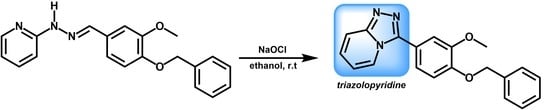
The [1,2,4]triazolo[4,3-a]pyridine derivative 3-(4-(benzyloxy)-3-methoxyphenyl)-[1,2,4]triazolo[4,3-a]pyridine was prepared in a 73% isolated yield by means of an oxidative ring closure of a hydrazine intermediate. Sodium hypochlorite was used as the oxidant and ethanol as a solvent, making the process a clean, green approach. The reaction was performed at room temperature for 3 h, and then the heterocycle was isolated in an analytically pure form by extraction, followed by passing the crude product mixture through a small plug of alumina.

1. Introduction

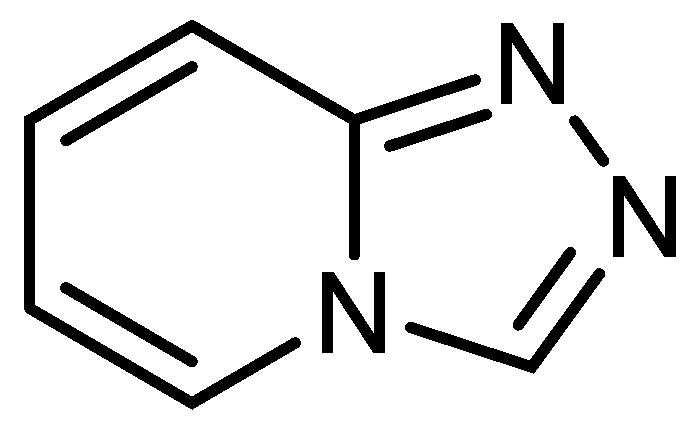
Triazolopyridines are a class of compounds that are currently attracting significant attention [1,2]. These heterocyclic molecules comprise a triazole ring fused to a pyridine ring. There are multiple isomers which differ by the location of the nitrogen atoms and the nature of the ring fusion. The [1,2,4]triazolo[4,3-a]pyridine motif (Figure 1) is found in a variety of biologically active compounds, including antibacterial, antithrombotic, anti-inflammatory, antiproliferative, and herbicidal agents [3,4,5,6,7,8]. They can also be used as molecular chemosensors for metal ions, anions, and amino acids [9,10] as well as in the construction of luminophores [11]. This subset of the triazolopyridine family can be prepared with a number of synthetic routes [2]. Some involve an oxidative ring closure [12,13,14,15,16,17] and others employ a transition metal catalysis [18,19].
Figure 1. The [1,2,4]triazolo[4,3-a]pyridine motif.
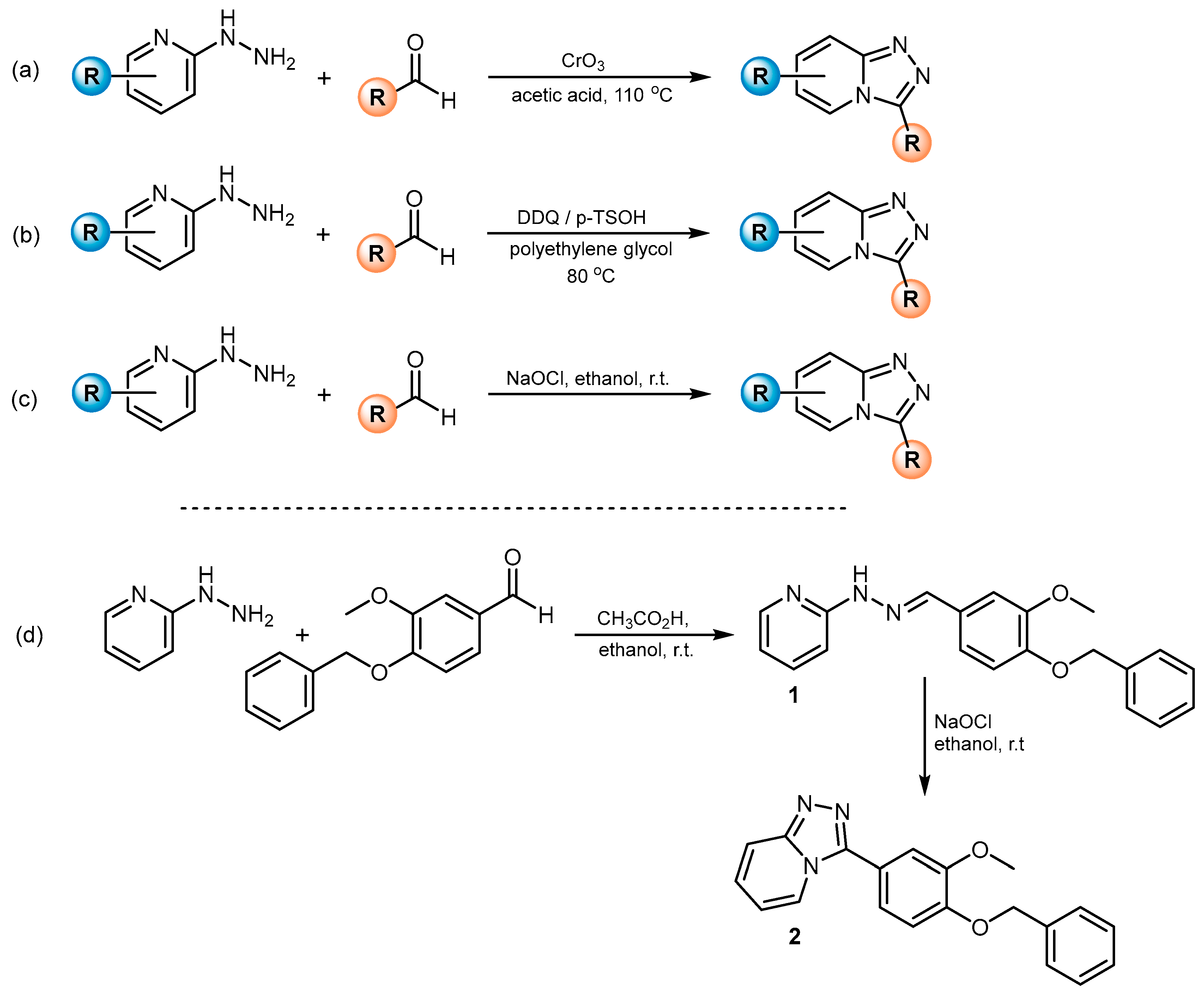
Our research group has focused some significant effort on the preparation of heterocyclic compounds, and we have developed a series of methodologies centered around the use of oxoammonium salts and their corresponding nitroxide analogs as reagents and catalysts [20,21,22,23]. A theme running through our work is the use of cleaner, greener approaches to preparative chemistry. As such, we became interested in applying some of our methodologies to the synthesis of [1,2,4]triazolo[4,3-a]pyridines by means of an oxidative cyclization of hydrazines. Such an approach is not unprecedented but often involves the use of toxic or hazardous reagents such as Cr(VI) salts (Figure 2a) [13] or 2,3-dichloro-5,6-dicyano-1,4-benzoquinone (DDQ) (Figure 2b) [14]. Sodium hypochlorite was used as an oxidant, being more environmentally benign (Figure 2c) [24], and served as a starting point for our method development. Here, we present the synthesis of 3-(4-(benzyloxy)-3-methoxyphenyl)-[1,2,4]triazolo[4,3-a]pyridine (2) from N-[(3-methoxy-4-phenylmethoxyphenyl)methylideneamino]pyridin-2-amine (1), serving as a representative example of our approach (Figure 2d).
Figure 2. Preparation of [1,2,4]triazolo[4,3-a]pyridines by means of oxidative cyclization of hydrazines using (a) Cr(VI) salts, (b) DDQ, (c) sodium hypochlorite, and (d) our approach to prepare 2 from 1.

2. Results and Discussion

To prepare [1,2,4]triazolo[4,3-a]pyridine 2, we first generated hydrazine 1. This was achieved by treating a 1:1 stoichiometric mixture of 2-hydrazinopyridine and 4-benzyloxy-3-methoxybenzaldehyde in ethanol with acetic acid. The hydrazine precipitated out of the solution in pure form. Hydrazine 1 was then treated with four equivalents of sodium hypochlorite pentahydrate in ethanol, with the reaction mixture being stirred at room temperature for 3 h. The [1,2,4]triazolo[4,3-a]pyridine 2 was isolated by means of an aqueous/organic extraction and purified by passing the material through a plug of alumina, obtaining a 73% isolated yield.
The novel [1,2,4]triazolo[4,3-a]pyridine product 2 was characterized by IR and NMR spectroscopy as well as high-resolution mass spectrometry. 13C-NMR spectrum showed 18 signals, which was in agreement with the number of unique carbon environments in 2. The 1H-NMR showed signals for the aromatic backbone of the [1,2,4]triazolo[4,3-a]pyridine as well as the 4-benzyloxy-3-methoxy group in the 3-position of the heterocyclic moiety. The high-resolution mass spectrum confirmed the identity and purity of the product.

3. Materials and Methods

3.1. General Experimental

Chemicals were purchased from Oakwood Chemicals (Estill, SC, USA), Sigma-Aldrich (St. Louis, MO, USA), and Alfa Aesar (Haverhill, MA, USA), with the exception of 4-benzyloxy-3-methoxybenzaldehyde, which was prepared using the literature method. Deuterated dimethyl sulfoxide (DMSO-d6) was purchased from Cambridge Isotope Laboratories (Tewksbury, MA, USA). NMR spectra (1H and 13C) were recorded at 300 K on a Brüker Avance Ultra Shield 300 MHz, Bruker DRX-400 400 MHz, or Brüker Avance 500 MHz spectrometer. The 1H-NMR spectra were referenced to residual non-deuterated dimethyl sulfoxide (2.50 ppm) in DMSO-d6. 13C-NMR spectra were referenced to DMSO (39.52 ppm). Reactions were monitored with NMR and/or with TLC on alumina plates (60 Å porosity, 250 μm thickness). TLC analysis was performed using dichloromethane and visualized with UV light. Infrared spectra were recorded on a Bruker Alpha FTIR spectrometer using an attenuated total reflection (ATR) diamond crystal. High-resolution mass spectra were collected on an Applied Biosystems QSTAR Elite instrument equipped with an electrospray ionization (ESI) source, calibrated using Agilent LC/MS tuning mix.

3.2. Preparation of N-[(3-Methoxy-4-phenylmethoxyphenyl)methylideneamino]pyridin-2-amine (1)

In a 6 dram (18.5 mL) vial equipped with a stir bar, 2-hydrazinopyridine (5 mmol, 0.546 g) was dissolved in ethanol (10 mL). After, 4-benzyloxy-3-methoxybenzaldehyde (5 mmol, 1.211 g) was added to the vial, and the mixture was stirred for 1 min before adding approximately 10 drops of acetic acid. The precipitate formed was isolated using vacuum filtration; it was first washed with water and then with methanol to afford pure N-[(3-methoxy-4-phenylmethoxyphenyl)methylideneamino]pyridin-2-amine (1) as a white solid (1.523 g, 91% yield).
MP 175–176 °C. FTIR (ATR 4000–400 cm−1) 3198 w, 2986 w, 2933 w, 1596 s, 1539 m, 1509 s, 1438 vs. 1382 w, 1306 m, 1261 s, 1229 s, 1165 s, 1131 vs. 1087 m, 1019 m cm−1. 1H-NMR (400 MHz, DMSO-d6) δ 10.72 (s, 1H), 8.09 (dd, J = 4.8, 0.9 Hz, 1H), 7.95 (s, 1H), 7.66–7.58 (m, 1H), 7.49–7.31 (m, 6H), 7.24 (d, J = 8.4 Hz, 1H), 7.12–7.02 (m, J = 15.9, 5.0 Hz, 2H), 6.73 (dd, J = 6.5, 5.2 Hz, 1H), 5.11 (s, 2H), 3.84 (s, 3H). 13C-NMR (101 MHz, DMSO-d6) δ 157.16, 149.40, 148.48, 147.70, 138.94, 137.79, 136.95, 128.63, 128.39, 127.86, 127.81, 119.72, 114.60, 113.38, 108.25, 106.21, 69.90, 55.48. HRMS (ESI) m/z calculated for C20H20N3O2 [M + H]+ 334.1556, found 334.1553.

3.3. Preparation of 3-(4-(Benzyloxy)-3-methoxyphenyl)-[1,2,4]triazolo[4,3-a]pyridine (2)

In a 100 mL capacity round-bottom flask equipped with a stir bar, 1 (2 mmol, 0.666 g), sodium hypochlorite pentahydrate (8 mmol, 1.316 g), and ethanol (40 mL) were added. The flask was sealed with a rubber septum, then the contents were allowed to stir at room temperature for 3 h. The septum was then removed from the flask, and the contents were left open to air overnight, after which time the remaining ethanol was removed in vacuo from the product mixture. The resultant material was dissolved in dichloromethane and gently added atop an aluminum oxide plug. The desired product was eluted off the plug with chloroform. The eluent was collected, and the solvent was removed in vacuo to afford the pure 3-(4-(benzyloxy)-3-methoxyphenyl)-[1,2,4]triazolo[4,3-a]pyridine (2) as a white solid (0.481 g, 73%).
MP 136-139 °C. FTIR (ATR 4000-400 cm−1) 3232 w, br, 2931 w, br, 1605 w, 1527 m, 1479 m, 1370 m, 1256 vs. 1228 s cm−1. 1H-NMR (400 MHz, DMSO-d6) δ 8.55 (d, J = 7.0 Hz, 1H), 7.83 (d, J = 9.3 Hz, 1H), 7.53–7.47 (m, J = 7.2 Hz, 2H), 7.46–7.32 (m, 6H), 7.27 (d, J = 8.3 Hz, 1H), 7.00 (t, J = 6.6 Hz, 1H), 5.21 (s, 2H), 3.88 (s, 3H). 13C-NMR (101 MHz, DMSO-d6) δ 149.78, 149.43, 149.15, 145.96, 136.80, 128.45, 127.94, 127.82, 127.62, 123.93, 120.66, 119.21, 115.54, 114.19, 113.65, 111.85, 69.93, 55.73. HRMS (ESI) m/z calculated for C20H18N3O2 [M + H]+ 332.1399, found 332.1402.

4. Conclusions

A [1,2,4]triazolo[4,3-a]pyridine derivative was prepared simply and rapidly in a 73% isolated yield by means of an oxidative ring closure of a hydrazine intermediate. The product could be isolated in an analytically pure form by extraction followed by passing the crude product mixture through a small plug of alumina.

Supplementary Materials

Copies of the 1H- and 13C-NMR as well as the IR spectra of 1 and 2.

Author Contributions

Conceptualization, K.E.D.; methodology, K.E.D., A.L.S. and E.T.M.; validation, K.E.D., A.L.S. and E.T.M.; formal analysis, K.E.D., A.L.S. and E.T.M.; resources, N.E.L.; data curation, K.E.D., A.L.S. and E.T.M.; writing—original draft preparation, N.E.L.; writing—review and editing, K.E.D., A.L.S., E.T.M. and N.E.L.; supervision, A.L.S. and N.E.L.; project administration, N.E.L.; funding acquisition, N.E.L. All authors have read and agreed to the published version of the manuscript.

Funding

This research was funded by the University of Connecticut Office of Undergraduate Research.

Data Availability Statement

Data are contained within the article or Supplementary Materials.

Acknowledgments

We thank the University of Connecticut Office of Undergraduate Research for funding. The equipment support from Adam Graichen for high-resolution mass spectrometry and the equipment support from Vitaliy Gorbatyuk for NMR spectroscopy are acknowledged.

Conflicts of Interest

The authors declare no conflict of interest.

References

  1. Jones, G. The chemistry of the triazolopyridines: An update. In Advances in Heterocyclic Chemistry; Academic Press: Cambridge, MA, USA, 2002; Volume 83, pp. 1–70. [Google Scholar] [CrossRef]
  2. Poormoradkhan Melal, S.; Mahmoodi, N.O. A review of synthetic methods of 1,2,4-triazolopyridines and their therapeutic properties. Results Chem. 2023, 5, 100782. [Google Scholar] [CrossRef]
  3. Szabó, G.; Károlyi, B.I.; Vaskó, Á.G.; Potor, A.; Vukics, K.; Kapus, G.L.; Fodor, L.; Bobok, A.; Vastag, M.; Bata, I. Identification of Triazolopyridines as Selective α5-GABAAReceptor Negative Allosteric Modulators by a Hybridization Approach. ACS Chem. Neurosci. 2023, 14, 148–158. [Google Scholar] [CrossRef]
  4. Yang, L.; Bo Xu, W.; Sun, L.; Zhang, C.; Hua Jin, C. SAR Analysis of Heterocyclic Compounds with Monocyclic and Bicyclic Structures as Antifungal Agents. ChemMedChem 2022, 17, e202200221. [Google Scholar] [CrossRef]
  5. Tian, C.; Zhang, G.; Xia, Z.; Chen, N.; Yang, S.; Li, L. Identification of triazolopyridine derivatives as a new class of AhR agonists and evaluation of anti-psoriasis effect in a mouse model. Eur. J. Med. Chem. 2022, 231, 114122. [Google Scholar] [CrossRef]
  6. Menet, C.J.; Fletcher, S.R.; Van Lommen, G.; Geney, R.; Blanc, J.; Smits, K.; Jouannigot, N.; Deprez, P.; van der Aar, E.M.; Clement-Lacroix, P.; et al. Triazolopyridines as Selective JAK1 Inhibitors: From Hit Identification to GLPG0634. J. Med. Chem. 2014, 57, 9323–9342. [Google Scholar] [CrossRef] [PubMed]
  7. Manaithiya, A.; Alam, O.; Sharma, V.; Naim, M.J.; Mittal, S.; Azam, F.; Husain, A.; Sheikh, A.A.; Imran, M.; Khan, I.A. Current Status of Novel Pyridine Fused Derivatives as Anticancer Agents: An Insight into Future Perspectives and Structure Activity Relationship (SAR). Curr. Top. Med. Chem. 2021, 21, 2292–2349. [Google Scholar] [CrossRef]
  8. Du, W.; Zhang, F.; Yan, P.; Lai, Q.; Li, J.; Zhu, D.; Ye, L. Design, Synthesis, Activity Evaluation and Molecular Docking Study of Novel Janus kinase Inhibitors. ChemistrySelect 2021, 6, 4212–4216. [Google Scholar] [CrossRef]
  9. Hiranmartsuwan, P.; Wangngae, S.; Nootem, J.; Kamkaew, A.; Daengngern, R.; Wattanathana, W.; Chansaenpak, K. BODIPY-Based Fluorescent Probes for Selective Visualization of Endogenous Hypochlorous Acid in Living Cells via Triazolopyridine Formation. Biosensors 2022, 12, 923. [Google Scholar] [CrossRef] [PubMed]
  10. Chadlaoui, M.; Abarca, B.; Ballesteros, R.; Ramírez de Arellano, C.; Aguilar, J.; Aucejo, R.; García-España, E. Properties of a Triazolopyridine System as a Molecular Chemosensor for Metal Ions, Anions, and Amino Acids. J. Org. Chem. 2006, 71, 9030–9034. [Google Scholar] [CrossRef] [PubMed]
  11. Wu, J.; You, Q.; Lan, J.; Guo, Q.; Li, X.; Xue, Y.; You, J. Cu-catalysed direct C–H (hetero)arylation of [1{,}2{,}4]triazolo[4{,}3-a]pyridine to construct deep-blue-emitting luminophores. Org. Biomol. Chem. 2015, 13, 5372–5375. [Google Scholar] [CrossRef] [PubMed]
  12. Inturi, S.B.; Kalita, B.; Ahamed, A.J. I2-TBHP-catalyzed one-pot highly efficient synthesis of 4{,}3-fused 1{,}2{,}4-triazoles from N-tosylhydrazones and aromatic N-heterocycles via intermolecular formal 1,3-dipolar cycloaddition. Org. Biomol. Chem. 2016, 14, 11061–11064. [Google Scholar] [CrossRef] [PubMed]
  13. Bhatt, A.; Singh, R.K.; Kant, R. A convenient one-pot synthesis of N-fused 1,2,4-triazoles via oxidative cyclization using chromium (VI) oxide. Synth. Commun. 2019, 49, 22–31. [Google Scholar] [CrossRef]
  14. Bhatt, A.; Singh, R.K.; Kant, R. Facile one pot synthesis of N-fused 1,2,4-triazoles via oxidative cyclisation using DDQ. ARKIVOC 2018, 2018, 236–247. [Google Scholar] [CrossRef]
  15. Vidavalur, S.; Nakka, M.; Tadikonda, R.; Rayavarapu, S.; Sarakula, P. A Simple and Efficient Synthesis of 3,4,5-Trisubstituted/N-Fused 1,2,4-Triazoles via Ceric Ammonium Nitrate Catalyzed Oxidative Cyclization of Amidrazones with Aldehydes Using Polyethylene Glycol as a Recyclable Reaction Medium. Synthesis 2015, 47, 517–525. [Google Scholar] [CrossRef]
  16. Vadagaonkar, K.S.; Murugan, K.; Chaskar, A.C.; Bhate, P.M. A facile and practical one-pot synthesis of [1,2,4]triazolo[4,3-a]pyridines. RSC Adv. 2014, 4, 34056–34064. [Google Scholar] [CrossRef]
  17. Vadagaonkar, K.S.; Yang, C.-J.; Zeng, W.-H.; Chen, J.-H.; Patil, B.N.; Chetti, P.; Chen, L.-Y.; Chaskar, A.C. Triazolopyridine hybrids as bipolar host materials for green phosphorescent organic light-emitting diodes (OLEDs). Dye. Pigment. 2019, 160, 301–314. [Google Scholar] [CrossRef]
  18. Reichelt, A.; Falsey, J.R.; Rzasa, R.M.; Thiel, O.R.; Achmatowicz, M.M.; Larsen, R.D.; Zhang, D. Palladium-Catalyzed Chemoselective Monoarylation of Hydrazides for the Synthesis of [1,2,4]Triazolo[4,3-a]pyridines. Org. Lett. 2010, 12, 792–795. [Google Scholar] [CrossRef]
  19. Thiel, O.R.; Achmatowicz, M.M.; Reichelt, A.; Larsen, R.D. Palladium-Catalyzed Coupling of Aldehyde-Derived Hydrazones: Practical Synthesis of Triazolopyridines and Related Heterocycles. Angew. Chem. Int. Ed. 2010, 49, 8395–8398. [Google Scholar] [CrossRef]
  20. Nandi, J.; Vaughan, M.; Leon Sandoval, A.; Paolillo, J.; Leadbeater, N. Oxidative Amidation of Amines in Tandem with Transamidation: A Route to Amides Using Visible-Light Energy. J. Org. Chem. 2020, 85, 9219–9229. [Google Scholar] [CrossRef]
  21. Politano, F.; León Sandoval, A.; Witko, M.L.; Doherty, K.E.; Schroeder, C.M.; Leadbeater, N.E. Nitroxide-Catalyzed Oxidative Amidation of Aldehydes to Yield N-Acyl Azoles Using Sodium Persulfate. Eur. J. Org. Chem. 2022, 2022, e202101239. [Google Scholar] [CrossRef]
  22. Nandi, J.; Ovian, J.M.; Kelly, C.B.; Leadbeater, N.E. Oxidative Functionalisation of Alcohols and Aldehydes via the Merger of Oxoammonium Cations and Photoredox Catalysis. Org. Biomol. Chem. 2017, 15, 8295–8301. [Google Scholar] [CrossRef]
  23. León Sandoval, A.; Doherty, K.E.; Wadey, G.P.; Leadbeater, N.E. Solvent- and Additive-Free Oxidative Amidation of Aldehydes Using a Recyclable Oxoammonium Salt. Org. Biomol. Chem. 2022, 20, 2249–2254. [Google Scholar] [CrossRef]
  24. Zhang, Y.; Teng, H.; Gao, Y.; Afzal, M.W.; Tian, J.; Chen, X.; Tang, H.; James, T.D.; Guo, Y. A general strategy for selective detection of hypochlorous acid based on triazolopyridine formation. Chin. Chem. Lett. 2020, 31, 2917–2920. [Google Scholar] [CrossRef]
Disclaimer/Publisher’s Note: The statements, opinions and data contained in all publications are solely those of the individual author(s) and contributor(s) and not of MDPI and/or the editor(s). MDPI and/or the editor(s) disclaim responsibility for any injury to people or property resulting from any ideas, methods, instructions or products referred to in the content.

Article Metrics

Citations

Article Access Statistics

Multiple requests from the same IP address are counted as one view.