Review

A Systematic Lifecycle-Referenced Capability Mapping of MLOps Platforms for Energy Forecasting

SDU Center for Energy Informatics, Maersk Mc-Kinney Moller Institute, The Faculty of Engineering, University of Southern Denmark, 5230 Odense, Denmark
*
Author to whom correspondence should be addressed.
Information 2026, 17(4), 328; https://doi.org/10.3390/info17040328
Submission received: 28 January 2026 / Revised: 25 March 2026 / Accepted: 26 March 2026 / Published: 28 March 2026

Abstract

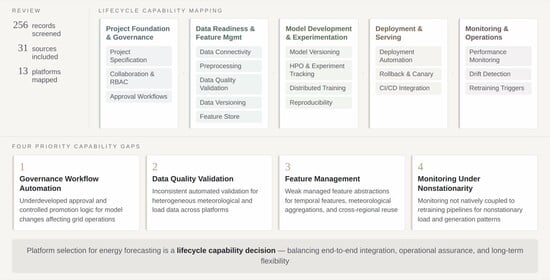
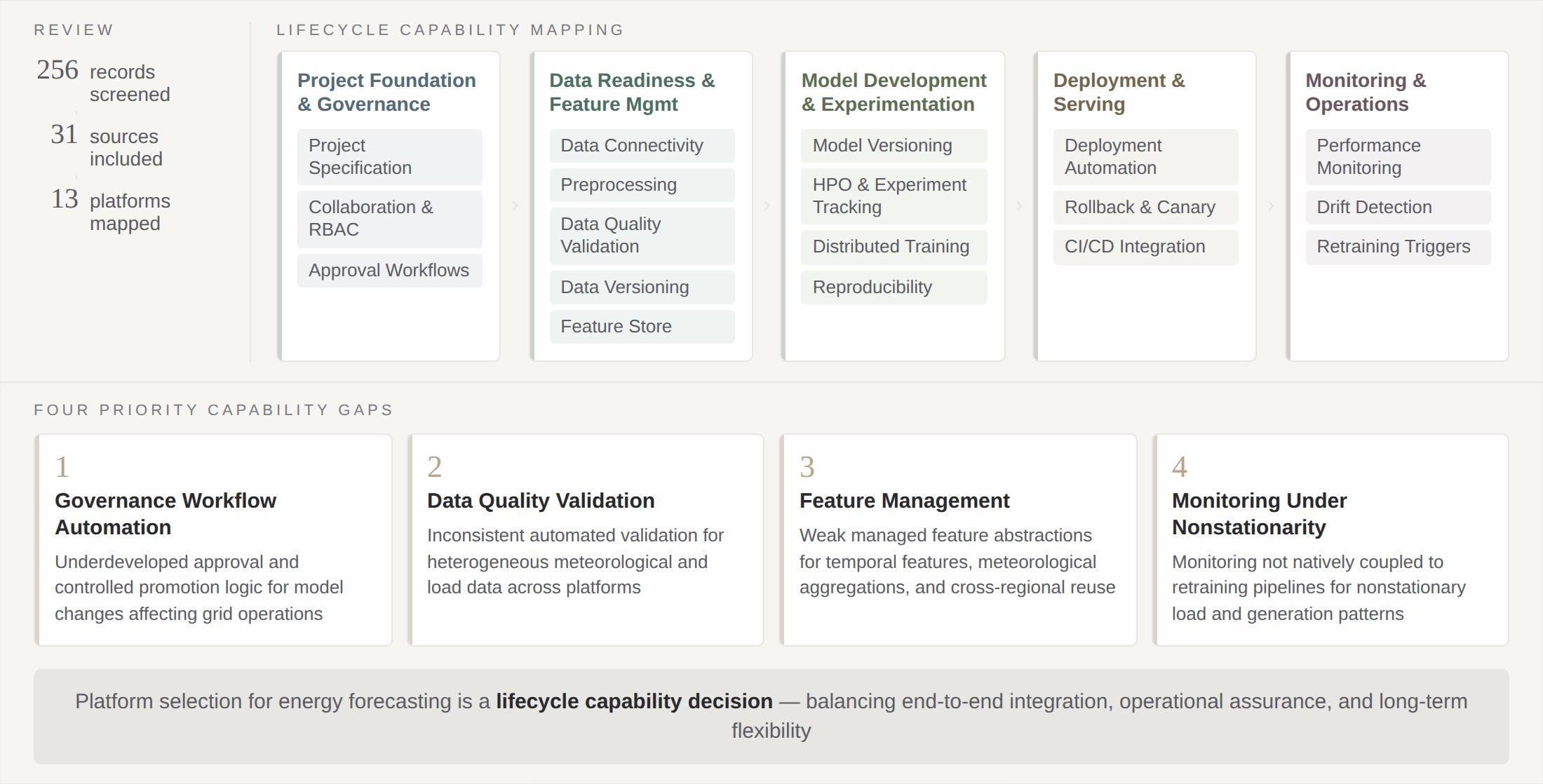
Accurate energy forecasting is essential for maintaining power system reliability, integrating renewable generation, and ensuring market stability. Although machine learning has improved forecasting accuracy, its operational deployment depends on Machine Learning Operations (MLOps) platforms that automate and scale the entire lifecycle of energy data pipelines. However, the capabilities of existing MLOps platforms for energy forecasting have not been systematically compared. This study adopts a PRISMA-informed review process to identify relevant end-to-end MLOps platforms for energy forecasting and then maps their documented capabilities using an established energy forecasting pipeline lifecycle as the reference structure. A total of 256 records were screened across vendor documentation, open-source repositories, and academic literature, of which 13 MLOps platforms were selected for comparative capability analysis. Platform capabilities are organised and presented across an end-to-end lifecycle covering project setup and governance, data ingestion and management, model development and experimentation, deployment and serving, and monitoring and feedback. Commercial platforms such as Amazon SageMaker and Google Vertex AI generally provide stronger end-to-end integration and production readiness, while open-source platforms such as Kubeflow and ClearML offer modular flexibility that typically requires additional integration effort to achieve end-to-end operation. The mapping identifies four priority areas where platform support remains limited, namely (i) governance workflow automation, (ii) automated data quality validation, (iii) feature management, and (iv) deployment and monitoring support under nonstationary conditions. These findings indicate that platform selection for energy forecasting should be treated as a lifecycle capability decision, balancing end-to-end integration, operational assurance, and long-term flexibility.

Graphical Abstract

1. Introduction

Accurate energy forecasting is foundational to decision-making for utilities, grid operators, and energy markets. It enables proactive resource allocation, improves grid reliability, and supports the integration of variable wind and solar resources. The growing adoption of Machine Learning Operations (MLOps), which brings together Development and Operations (DevOps), data engineering, and machine learning (ML), addresses deployment and lifecycle challenges for production models. MLOps promotes robustness, scalability, and governance through automation, continuous integration and deployment, and systematic monitoring [1]. The DevOps-to-MLOps transition has been specifically validated in energy domains such as forecasting electricity market prices and day-ahead demand models [2].
In the context of renewable energy forecasting, integrating MLOps frameworks significantly enhances model deployment and reliability. A wind energy forecasting study demonstrated that Docker-based MLOps pipelines can accelerate deployment, reduce latency to ~9 ms, and improve scalability and monitoring [3]. Similarly, MLOps frameworks tailored for energy consumption management, integrating real-time data ingestion, achieved sub-second end-to-end latency under high-volume workloads [4].
Despite these emerging examples, systematic and comparative reviews of MLOps platforms for energy forecasting remain scarce. Existing literature on MLOps surveys platforms at a general level, without domain-specific evaluation criteria [5], while energy forecasting reviews focus on algorithmic improvements and model accuracy without examining the operational pipeline infrastructure required to sustain those models in production. No prior study has systematically mapped the documented capabilities of the full MLOps platform landscape against an end-to-end energy forecasting lifecycle reference, which is the gap this paper addresses. A modular approach integrating domain expertise, decision-point governance, and traceability within MLOps pipelines has only recently been proposed, showing promising improvements in the whole end-to-end process, reliability, and regulatory readiness in building-level electricity prediction scenarios [6].
Compared with many other ML application domains, energy forecasting is tightly coupled to critical infrastructure operations, so failures can have direct reliability and financial impacts. Utilities and grid operators also face strict regulatory and audit requirements, which make reproducible pipelines, traceable model changes, and robust access control especially important. Because these forecasting systems are long-lived and continuously updated, end-to-end MLOps capabilities become more central here than in many short-lived or less regulated ML deployments.
This highlights a clear research gap: while MLOps implementation is growing in energy applications, there is no end-to-end, structured feature mapping that matches current platform capabilities to the specific needs of energy forecasting. Addressing this gap is essential to guide researchers, but also practitioners in utilities and grid operations toward selecting or developing platforms that align with the domain’s unique functional, regulatory, and sustainability requirements.
This article seeks to fill that gap by delivering:
  • A structured capability mapping of existing open-source and commercial MLOps platforms.
  • A comparative synthesis that summarises how these platforms support lifecycle phases relevant to energy forecasting and identifies areas where capability coverage remains limited.
This capability mapping is based on our previously published methodology framework for an end-to-end energy forecasting pipeline [6]. Accordingly, Section 3 follows the lifecycle structure defined in [6], as a reference for organising the capability mapping across Section 3.1, Section 3.2, Section 3.3, Section 3.4 and Section 3.5. The lifecycle phases defined in [6] are treated as the conceptual baseline and are aggregated into analytically coherent lifecycle categories, enabling systematic cross-platform comparison. The mapping reflects evidence available in public technical documentation, repositories, and the academic literature, and is intended to support transparent comparison of lifecycle coverage and integration pathways. Importantly, the paper does not present a benchmark or product ranking: it relies on documented evidence rather than hands-on testing or operational deployments, does not compare platform cost structures, and does not evaluate security controls or compliance claims beyond what is explicitly stated in the sources. The contribution is, therefore, a lifecycle-referenced map and synthesis to guide platform shortlisting and identify gaps for future research. Ultimately, the goal is to support both academic researchers and industrial stakeholders by clarifying how platform capabilities relate to pipeline lifecycle categories and by enabling more interoperable and scalable MLOps practices for energy forecasting.
In this study, lifecycle-referenced means that platform capabilities are mapped and evaluated against the phases of an established end-to-end energy forecasting pipeline framework [6], rather than assessed against generic software criteria or ranked by empirical performance. The platform’s capabilities are assessed across the full end-to-end operational pipeline, rather than focusing on the model development step in isolation; questions of which forecasting algorithm achieves higher accuracy are therefore outside the scope of this study. The platforms evaluated span a broad architectural spectrum, from lightweight pipeline orchestration frameworks that require users to assemble their own toolchains, to fully managed end-to-end cloud suites that integrate data management, training, deployment, and monitoring under a single service abstraction.
Compared with prior reviews that focus on forecasting algorithms or generic ML lifecycles, this paper contributes a vendor-neutral, lifecycle-referenced capability map across mature platforms, tailored to operational constraints of energy forecasting. The mapping is grounded in traceable public evidence and is intended to support platform shortlisting and highlight ecosystem capability gaps rather than to rank tools.
The remainder of this article is organised as follows. Section 2 describes the PRISMA-informed methodology, including the information sources, eligibility criteria, selection process, and the capability extraction procedure. Section 3 organises and presents MLOps platform capabilities using the pipeline framework in [6] as a reference structure, synthesising features across five capability categories. Section 4 discusses the implications of the mapping for energy forecasting research and practice. Section 5 concludes the article and outlines directions for future work.

2. Methodology

This study adopts a PRISMA (Preferred Reporting Items for Systematic reviews and Meta-Analyses) informed approach to systematically identify MLOps platforms relevant to energy forecasting, and to ensure transparent reporting of the identification, screening, and inclusion process. The PRISMA guidance is used to support transparency and traceability in source identification and platform selection, rather than to synthesise empirical evidence, estimate effects, or compare intervention outcomes. After the platform set is established, the paper conducts a structured capability extraction and mapping based primarily on official platform documentation and open repositories.

2.1. Objective

The objective of this study is to identify mature MLOps platforms potentially applicable to energy forecasting using a PRISMA-informed scoping process, and to perform a structured capability mapping and analysis based on evidence extracted from official platform documentation and public repositories. The study is positioned as a capability-oriented follow-up to our previously published end-to-end energy forecasting pipeline framework [6], and maps platform capabilities to the corresponding lifecycle phases defined in that framework.
To operationalise this objective in a transparent and systematic manner, the study pursues the following subobjectives:
  • To decompose the end-to-end energy forecasting pipeline into analytically distinct lifecycle capability categories.
  • To identify and extract documented platform capabilities corresponding to each lifecycle category, based strictly on publicly available evidence, including official technical documentation, and open-source repositories.
  • To synthesise and compare capability coverage across platforms within each lifecycle category, characterising patterns of native support, partial support, and undocumented functionality without resorting to aggregate scoring or platform ranking.
  • To identify cross-cutting capability gaps that recur across platforms and lifecycle categories, with particular emphasis on limitations that constrain the operational deployment of energy forecasting pipelines.
Together, these subobjectives justify the lifecycle-referenced narrative analysis approach adopted in this article and ensure a direct alignment between the stated objective, the methodological design, and the structure of the capability mapping presented in the subsections of Section 3.

2.2. Information Sources and Search Strategy

The search strategy targets mature, production-oriented MLOps platforms because energy forecasting deployments commonly operate in critical infrastructure contexts where reliability, maintainability, and governance requirements favour well-documented and actively supported solutions. We therefore prioritised platforms with substantial technical documentation, visible maintenance activity, and evidence of adoption beyond isolated prototypes.
Three complementary source types were searched to build the initial candidate set and supporting evidence base:
  • Google web search identified official platform documentation comprising vendor-maintained technical guides, Application Programming Interface (API) references, and architecture documentation, serving as the primary reference for capability assessment.
  • GitHub (https://github.com/) repository search identified open-source platform repositories, providing access to implementation details, development activity, and community engagement metrics to verify platform maturity through commit history and release cadence.
  • Academic database search across Scopus, IEEE Xplore, and Web of Science identified peer-reviewed literature discussing MLOps platforms in energy forecasting contexts, providing independent platform evaluations and evidence of research community adoption.
Searches were conducted on 24 September 2025 and updated on 1 October 2025 across all source types. As a representative example, the core academic database query used across Scopus, IEEE Xplore, and Web of Science was: (electricity OR power OR energy) AND (MLOps OR “ML Ops” OR “machine learning operations”) AND (platform OR framework OR pipeline), filtered to publication years 2015–2025 and English language. Complete search strings, filters, and database query settings for all three source types are reported in Appendix A.

2.3. Eligibility Criteria and Selection Process

Information sources were assessed against predefined criteria structured around content quality, platform maturity, and technical depth. Inclusion criteria required: (1) content type must be official platform documentation, repository documentation with substantial README files, wikis, or documentation folders, or peer-reviewed academic papers discussing platform usage or evaluation; (2) platform maturity must be evident through production readiness indicators including substantial user base, enterprise adoption, or active maintenance over multiple years; (3) technical depth must include substantive information about platform capabilities, architecture, or features rather than superficial mentions; (4) recency must fall between 2015 and 2025; (5) language must be English; (6) accessibility must be public without requiring paid subscriptions, though for academic papers abstract accessibility was sufficient; and (7) scope must cover end-to-end MLOps platforms supporting multiple ML lifecycle stages. These inclusion criteria were designed to focus the review on realistic options that organisations could adopt for production-grade forecasting pipelines, rather than experimental or poorly documented systems.
Exclusion criteria eliminated sources meeting any of the following: (1) immature platforms including research prototypes, experimental systems, or newly developed platforms without production evidence; (2) non-technical content including news articles, press releases, marketing materials, blog posts, social media, or forum discussions; (3) insufficient detail such as brief mentions without technical specifications; (4) duplicates including identical URLs, DOIs, or repositories; (5) non-English sources; (6) inaccessible sources including broken links or fully paywalled content; and (7) out-of-scope content including single-purpose tools covering only one ML lifecycle stage or pure development frameworks. These exclusions avoid mixing full MLOps platforms with single-stage tools, ephemeral prototypes, or purely promotional material, which would make a fair comparison across the full lifecycle difficult.
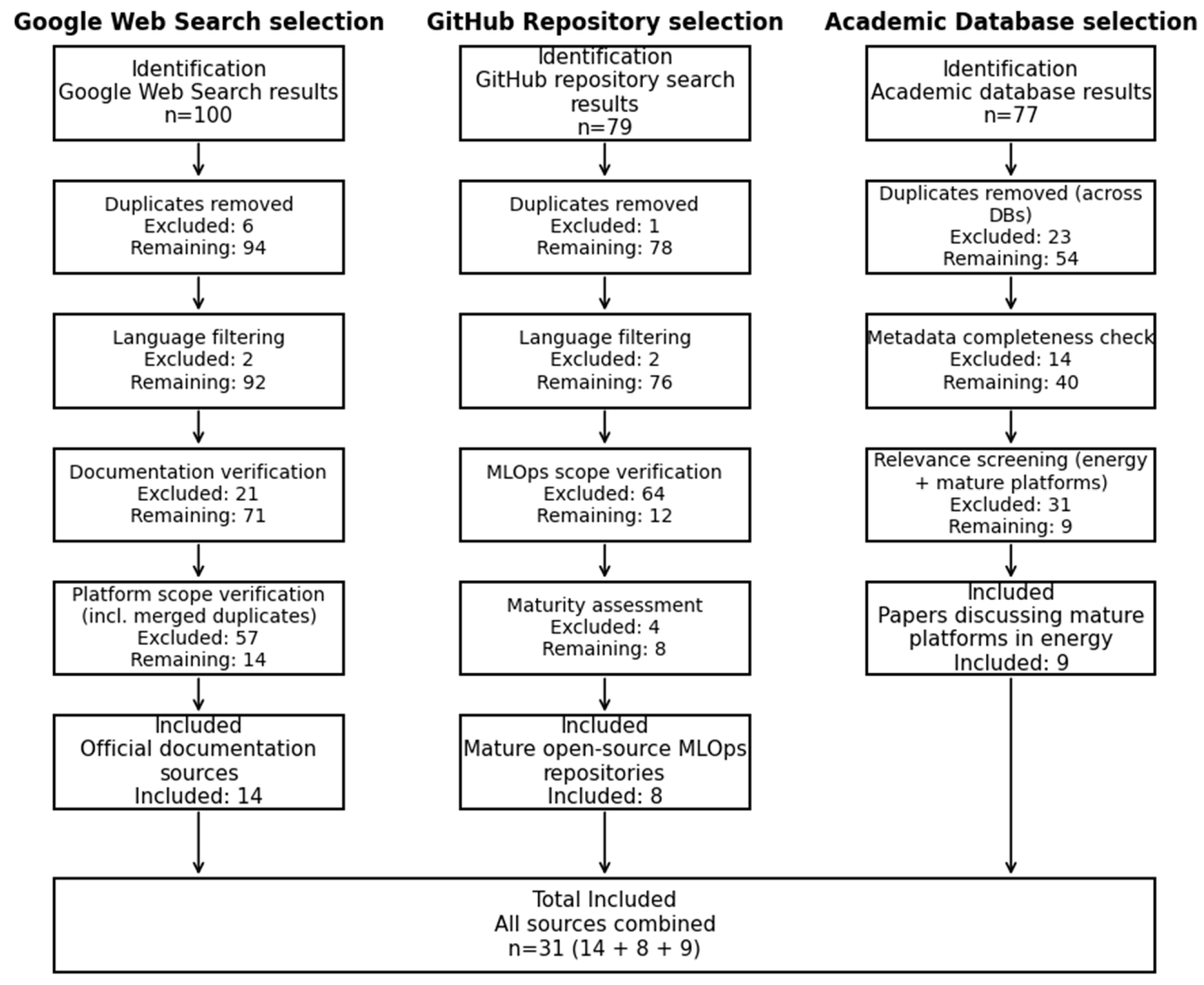
Screening was performed separately per source type to accommodate differences in structure. The PRISMA flow diagram (Figure 1) reports identification, screening, eligibility, and inclusion counts.
Screening was conducted independently by two reviewers against the predefined inclusion and exclusion criteria. Disagreements on source inclusion or exclusion were resolved through discussion and consensus before capability extraction. This independent screening process was used to reduce interpretive bias at the study-selection stage.
The search and screening process resulted in 31 included sources from 256 records, comprising official documentation sites, GitHub repositories, and academic papers. No energy-specific mature MLOps platforms were identified within the screened sources; therefore, energy forecasting implementations typically adapt general-purpose platforms to domain requirements.

2.4. Platform Identification and Selection

Platforms were identified from the included sources (31 results from the search and screening process) through structured content inspection. Platform names were extracted from documentation sites, repositories, and academic papers, then consolidated to remove duplicates. Each candidate platform was then verified against four criteria: (1) comprehensive ML lifecycle management capability, (2) active maintenance within 24 months, (3) accessible English documentation, and (4) support for at least three ML lifecycle stages.
Following verification, 13 platforms were selected for comprehensive comparative capability mapping: Open Data Hub, Kubeflow, Polyaxon, Metaflow, ZenML, ClearML, H2O-3, Amazon SageMaker, Google Vertex AI, Azure ML, Databricks ML, DataRobot, and Domino Data Lab. This set includes both open-source and commercial platforms and represents diverse architectural approaches and deployment models. The platforms also differ substantially in their intended user base. Open-source platforms such as Kubeflow, Polyaxon, and ZenML are primarily designed for ML engineers managing production pipelines, while Metaflow and ClearML are widely adopted by research and data science teams. H2O-3 targets data scientists and business analysts through its AutoML orientation. Among the commercial platforms, Amazon SageMaker, Google Vertex AI, and Azure ML serve data scientists and MLOps engineers in their respective cloud ecosystems, Databricks is oriented towards data and ML engineering teams in lakehouse environments, DataRobot is designed for business analysts and domain experts with a low-code focus, and Domino Data Lab specifically targets data science teams in regulated industries including energy, pharma, and finance. These differences in intended user base are relevant to organisational fit and inform the platform selection guidance in Section 4.2. For platforms with both open-source and managed commercial editions, capability extraction prioritised publicly available documentation describing baseline capabilities, to minimise dependence on non-public enterprise materials and to keep the mapping reproducible.
The 31 included sources informed the identification and verification of 13 distinct MLOps platforms selected for comparative mapping.

2.5. Capability Extraction and Mapping Framework

Platform capabilities were extracted and mapped using an end-to-end MLOps lifecycle framework aligned with the energy forecasting pipeline reference in [6]. References to [6] in this paper therefore point to the lifecycle framework used as the conceptual baseline; section-level pointers are used only where needed for clarity. Extracted evidence was organised into five lifecycle capability categories: project foundation and governance, data readiness and feature management, model development and experimentation, deployment and serving, and monitoring and operations, which correspond to the stages required to operationalise forecasting models. Within each category, platform evidence was mapped to a set of concrete capability dimensions (reported in Section 3) to enable consistent comparison across platforms.
Capability evidence was extracted directly from publicly available platform documentation, including official product manuals, API references, architectural overviews, and governance or deployment guides. For each platform–capability dimension pair, support was summarised using a three-level classification scheme:
  • Native—the capability is provided as a first-class, built-in feature of the platform and is managed under a unified service abstraction (for example, a built-in experiment tracker, feature store, or deployment mechanism that operates natively without requiring user-managed additional components).
  • Partial—the capability is achievable, but only via non-trivial integration with external tools or services (for example, relying on a separate data validation library, custom CI/CD pipelines, or an external monitoring stack). This level also covers cases where the platform offers only minimal hooks or templates and leaves the operational implementation to the user.
  • Not Clear—publicly available documentation, examples, or release notes do not provide enough detail to determine whether the capability is supported in practice.
In this study, capability refers to documented platform support for a given lifecycle function, encompassing both the presence of the relevant technical feature and the degree to which that feature is managed as a native abstraction rather than requiring user-assembled integration. More precisely, lifecycle capability is treated as a documentation-based proxy for deployment readiness rather than a direct measure of organisational capability or operational performance. The mapping. Therefore, reflects the presence of platform-supported lifecycle functions and the extent to which those functions are provided as managed abstractions, and does not evaluate operational maturity or runtime performance, as these require empirical rather than documentation-based assessment. It is also important to distinguish between capability coverage, meaning the extent to which a platform documents support for a given lifecycle function, which is what this study assesses, and capability maturity, which concerns the depth, reliability, and operational assurance of individual features and would require empirical evaluation to determine. Consequently, the analysis focuses on capability coverage across lifecycle stages, and capability maturity is explicitly out of scope.
To further operationalise the documentation-based extraction procedure, supplementary evidence was consulted whenever official documentation was incomplete, edition-specific, or ambiguous with respect to a capability assignment. These supplementary sources included public release notes, repository documentation, implementation examples, and platform-adjacent technical guidance where available. When the supplementary material confirmed the original interpretation, the initial classification was retained. When the supplementary material remained inconclusive or suggested that the documented support depended on a non-trivial external configuration or service assembly, the classification was conservatively retained as Partial or downgraded to Not Clear. For example, when a platform documented a dedicated component for a lifecycle function but the available evidence did not confirm seamless managed integration with the platform core, the capability was conservatively classified as Partial rather than Native. In this way, supplementary evidence was used primarily to challenge or constrain favourable interpretations rather than to infer undocumented capability.
Extraction was performed and verified by two reviewers using a structured extraction template aligned with the 18 lifecycle capability dimensions. Before full extraction, an initial calibration pass across three platforms was conducted: ClearML (a general-purpose open-source platform with broad lifecycle coverage), Amazon SageMaker (a fully managed cloud-native commercial suite), and Kubeflow (a Kubernetes-native open-source orchestration framework). These three platforms were selected for calibration because they represent structurally distinct points on the architectural spectrum, ensuring that the Native/Partial/Not Clear boundary definitions were tested against both managed and user-assembled integration patterns before being applied to the full platform set. The primary boundary ambiguity encountered during calibration concerned the Native versus Partial distinction for capabilities where a platform provides a dedicated component that nevertheless requires user-configured integration with core platform services; these cases were consistently resolved by classifying the capability as Partial rather than Native. Ambiguous assignments were flagged and revisited during synthesis to reduce interpretation drift and to ensure consistent application across platforms and lifecycle categories. All classification disagreements between the two reviewers were discussed and reconciled, with conservative downgrading applied where consensus required it.
For each platform and capability dimension, classifications were derived directly from publicly available documentation and are supported by explicit inline citations in Section 3 as the primary evidence traceability mechanism. This means that any individual classification can be independently verified by consulting the cited source documentation directly.
The distinction between Native and Partial also accounts for the degree of managed integration. Capabilities are classified as Native when they share a unified identity management and service abstraction with the platform core, enabling automated orchestration. Capabilities requiring the user to bridge independent software ecosystems or manage cross-component communication are classified as Partial. To ensure conservative and reproducible classification, ambiguous or weakly supported claims were labelled Not Clear rather than inferred. Where capabilities relied on external components or services, classifications followed the Partial definition.

2.6. Limitations

This study reflects the state of publicly available technical sources during the review window. Because the MLOps landscape evolves rapidly, platform documentation, product editions, and feature availability may change, and some classifications may become outdated as platforms release new versions or reorganise their documentation.
The capability mapping is derived primarily from official documentation and public repositories, which describe intended functionality and recommended workflows but may not capture operational behaviour, implementation effort, hidden constraints, or production reliability. Capabilities labelled “Partial” can vary substantially in engineering complexity depending on the deployment environment, and some commercial capabilities may be restricted to enterprise tiers or described only in non-public materials.
Commercial platform documentation is typically produced by professional technical teams and may emphasise intended enterprise workflows while leaving edition boundaries, pricing-tier restrictions, or implementation constraints underspecified in public materials. Open-source documentation, by contrast, may be less complete for enterprise use cases and may under-document operational pathways that are well understood within practitioner communities but not clearly formalised in official guidance. This documentation asymmetry may therefore affect platform comparability in more than one direction.
To reduce over-attribution under these conditions, official documentation was cross-referenced with release notes, issue trackers, and community-maintained wikis alongside official product documentation for each platform. Where repository evidence qualified or contradicted official claims, the affected classifications were revisited; in practice, such cases most often reinforced conservative Partial or Not Clear assignments rather than elevating a rating to Native. The conservative classification policy described in Section 2.5 was applied throughout.
The three-level scheme (Native/Partial/Not Clear) supports consistent comparison across platforms but necessarily simplifies differences in depth, maturity, usability, and operational assurance within each capability area. In addition, the paper does not perform hands-on deployments, runtime benchmarking, cost comparisons, or empirical evaluation of forecasting accuracy, and it does not verify security or compliance claims beyond what is explicitly documented. The results should therefore be interpreted as a lifecycle-referenced capability mapping and analysis, not a performance ranking or certification of readiness.
It is important to note that the capability mapping presented in this study is non-weighted. All lifecycle capability dimensions are reported descriptively, without assigning relative importance or aggregating scores across platforms. The practical relevance of individual capabilities is inherently context-dependent and varies across energy forecasting use cases, organisational maturity levels, regulatory environments, and operational constraints. Consequently, the mapping is intended to support informed interpretation and platform shortlisting rather than to imply a universal prioritisation or ranking of capabilities.
The platform set and evidence base may be influenced by selection and reporting biases: the focus on mature platforms with accessible English technical sources may exclude emerging or region-specific solutions, and “Not Clear” classifications may reflect documentation gaps rather than the absence of functionality.
A further dimension not captured is computational scale and the infrastructure resources required to operate each platform. The evaluated platforms differ substantially in this respect based on their publicly documented architectures. Commercial platforms such as Amazon SageMaker, Google Vertex AI, Azure ML, and Databricks operate on managed cloud infrastructure with elastic scaling, which means training jobs and batch inference workloads can expand without user-managed cluster provisioning, though at ongoing cloud cost. Open-source platforms such as Kubeflow and Polyaxon depend on user-provisioned Kubernetes clusters, so available compute is bounded by the organisation’s own infrastructure investment. Lighter open-source platforms such as Metaflow, ZenML, and ClearML can operate on single-node setups, making them accessible for smaller forecasting tasks but potentially constraining for national-scale deployments with high-frequency retraining. H2O-3 uses an in-memory distributed architecture that requires sufficient RAM across cluster nodes to hold the training dataset, which may limit its applicability to very large temporal datasets without significant hardware investment. DataRobot and Domino manage infrastructure on behalf of users in their commercial tiers, abstracting scale constraints at the cost of vendor dependency. These differences in computational scope and resource requirements are noted as an important practical consideration that falls outside the documentation-based classification employed in this study and represents a direction for future empirical evaluation.

3. Systematic Capability Mapping of MLOps Platforms

This section analyses and synthesises MLOps platform capabilities relevant to end-to-end energy forecasting pipelines using the end-to-end framework in [6] as a reference structure. Capabilities are reported strictly as documented in the available sources. Based on this, Section 4 identifies gaps and their implications for deployment and organisational decision-making.
The mapping is presented across five capability categories: project foundation and governance (Section 3.1), data readiness and feature management (Section 3.2), model development and experimentation (Section 3.3), deployment and serving (Section 3.4), and monitoring and operations (Section 3.5). Throughout, the focus is on MLOps platforms and integrated toolchains that support multiple lifecycle functions, rather than individual point solutions. To support readability, each subsection from 3.1 to 3.5 closes with a brief comparative synthesis to highlight cross-platform patterns. Section 3.6 provides a consolidated synthesis of the mapped themes. For readers who prefer to start with a high-level comparison, the consolidated results are provided in Section 3.6, which integrates the category-level findings from Section 3.1, Section 3.2, Section 3.3, Section 3.4 and Section 3.5.

3.1. Project Foundation and Governance

The foundation of any successful MLOps implementation lies in robust project initialization and governance mechanisms. In energy forecasting, governance is particularly critical because systems operate within highly regulated environments where forecasting results directly affect grid security and dispatch decisions [7,8], and because projects typically span cross-functional teams involving data engineering, meteorology, and grid operations [9], a complexity that necessitates formalized access control and project management frameworks [10].
This section examines three critical aspects of project setup and governance across MLOps platforms: project specification and templates that establish standardized project structures; collaboration and role-based access control (RBAC) mechanisms that enable secure multi-team coordination; and approval workflows that ensure compliance with regulatory and organizational requirements.

3.1.1. Project Specification and Templates

A robust project specification is a prerequisite for scalable MLOps. Specification captures the business and technical understanding of the forecasting problem, including data requirements, performance objectives, compliance constraints, and acceptance criteria. Combined with scaffolding and templates, it ensures that projects start with a consistent structure that reflects domain-specific needs such as time series processing, weather data alignment, regulatory reporting formats, and grid operation constraints [11]. Standardization is particularly critical for utilities managing multiple forecasting models across regions, time horizons, and energy sources. Research on project governance demonstrates that structured project setups improve alignment with organizational goals and increase value realization [12].
SageMaker provides first-class, reproducible project scaffolding through SageMaker Projects, which bootstrap repos, Continuous Integration and Continuous Delivery/Deployment (CI/CD), environments, and registry integration in a managed way [13]. By contrast, Vertex AI offers building blocks like Pipelines and example blueprints but relies on teams to design end-to-end scaffolds across services [14]. Azure ML ships MLOps v2 solution accelerators and examples that help, yet full project scaffolding still depends on repo templates and DevOps choices outside the service boundary [15,16]. Databricks publishes Solution Accelerators and notebooks to jumpstart work, though teams still structure their own repository and CI/CD patterns [17]. DataRobot Workbench organizes work and experiments but is oriented to projects within the product rather than generalizable repo scaffolds for custom codebases [18]. Domino provides Projects and curated environments to start quickly, yet prescriptive, end-to-end scaffolding remains up to the user [19].
Open-source platforms such as Kubeflow, Polyaxon, Metaflow, ZenML, and Open Data Hub provide scaffolding more as a configurable capability than a prescriptive template. Kubeflow offers reusable pipeline components and Katib trial templates [20], but repository structure, CI/CD pipelines, and environments are typically user-defined. Polyaxon has a formal Polyaxonfile specification to define jobs, services, parallel executions, and pipelines. It also supports presets to inject reusable config at compile time [21,22]. ZenML OSS has stack-components, pipelines/steps defined in code with YAML config options and reusable configs [23]. There is no explicit documentation indicating that ClearML or H2O-3 provides project specification or template features [24]. Metaflow defines work as flows with steps and supports config-driven experimentation using configs and tools like Hydra [25]. There is no formal business-spec template. Open Data Hub provides basic project creation through OpenShift [26] namespaces with data science annotations but lacks a comprehensive templating system for ML project structures. Projects provide an organizational framework but no pre-built functions [27].
For energy forecasting pipelines, the practical value of project templates is most concentrated in standardising the handling of domain-specific inputs such as weather data joins, load lag features, and regulatory reporting structures, where inconsistent setup across teams introduces reproducibility risk.

3.1.2. Collaboration and RBAC

This section addresses in-pipeline collaboration and access control, focusing on how roles, permissions, and isolation are applied across data access, experimentation, model registry, and deployment steps in the energy forecasting workflow. The multi-disciplinary nature of energy forecasting requires platforms that can accommodate different user roles, skill levels, and access requirements while maintaining data security and intellectual property protection. Energy utilities typically require sophisticated access control mechanisms that align with organizational hierarchies, regulatory requirements, and data sensitivity classifications.
Collaboration is a first-class citizen across managed platforms, with enterprise-grade RBAC. All six managed platforms support organization-grade access control. SageMaker enforces permissions through AWS Identity and Access Management (IAM) and Studio domain permissions [13,28]. Vertex AI controls access via Google Cloud IAM roles scoped to AI Platform resources [29,30]. Azure ML uses Azure RBAC over workspaces and dependent resources [31]. Databricks enforces permissions through Unity Catalog across data and models [32]. DataRobot documents platform roles and sharing controls for assets [33]. Domino exposes project and dataset permissions for fine-grained collaboration [34,35].
Open platforms provide collaboration through namespaces, workspaces, or API keys. Open Data Hub provides RBAC through OpenShift native access controls, OAuth integration, and Keycloak for authentication with project-based isolation [36]. Kubeflow implements multi-user isolation using Profiles that wrap Kubernetes Namespaces; contributors can be granted view or modify access at the namespace level [37]. ZenML OSS supports server-backed access control with basic roles and permissions, while ZenML Pro adds multi-tenant workspaces, single sign-on (SSO), and expanded governance [33]. ClearML OSS supports multi-user access management through the self-hosted ClearML Server. Fine-grained RBAC and user-group governance are Enterprise-only [38]. Polyaxon offers multi-tenant workspaces and role concepts for its pro version. Metaflow supports a centralized metadata service for shared access [39], but RBAC is not a documented feature. H2O-3 OSS does not list any native RBAC features in its official documentation.
For energy forecasting projects, commercial platforms comprehensively documented support multi-disciplinary teams where grid operators, data scientists, and compliance officers require differentiated access to weather data, model parameters, and production deployment controls. Utilities operating across multiple jurisdictions particularly benefit from the granular permissions that can restrict access to region-specific forecasting models and sensitive market data. Open-source platforms document less granular access control, which may require supplementary infrastructure in regulated energy settings.

3.1.3. Governance Gates and Approval Workflows

Creating or reviewing existing regulatory processes for model governance is a necessary step for any new production ML model pipeline. This process involves understanding the ML use case category and identifying the individuals responsible for overseeing governance processes [10], e.g., defining the approver(s), setting criteria, and determining required artifacts (metrics, explainability, bias, etc.) In regulated energy markets, formal approval processes are often mandated for models that influence grid operations, market transactions, or regulatory reporting. The automated deployment is dependent on the fulfillment of the model governance tasks [40], highlighting how model governance and MLOps interact in practice.
Commercial platforms frequently provide mechanisms to enforce controlled model promotion, though the level of native support varies. But none of these platforms ship a universal, turnkey approval gate that blocks promotion across the entire lifecycle by default. SageMaker teams usually implement approvals with CI/CD and Model Registry workflows rather than a single built-in gate [13]. Vertex AI relies on Pipelines, Model Registry, and Cloud Build to implement gated workflows that a team defines [14]. Azure ML documents model management with CI/CD patterns that can encode approvals, not without a single switch in the UI [41,42]. Databricks supports checks via MLflow model stages, deployment jobs, and Unity Catalog, yet formal approvals are still process-driven [43]. DataRobot and Domino provide governance hooks inside their deployment workflows, but organizations typically configure review steps and sign-offs themselves [44,45].
In the open-source ecosystem, the governance function is less mature. ClearML has model registry and tasks with versions; some of the model registry features mention triggering pipelines based on changes, which may serve as lightweight workflow control, though not a clearly defined “approval gate” [46]. Open Data Hub pipeline docs describe portable workflows and automation, but there is no explicit approval-gate or human-in-the-loop release workflow described. Kubeflow lacks built-in approval workflows for ML pipelines and deployments. The feature remains a documented community request without current implementation [47]. For ZenML OSS, H2O-3 OSS, Polyaxon and Metaflow, there are no explicit governance gates or approval workflows documented in the open-source version.
Commercial platforms provide building blocks for governance workflows, but require teams to design and configure formal approval processes rather than offering turnkey solutions. Notably, automated approval gates that block model promotion until defined criteria are satisfied are widely cited as a key characteristic of mature MLOps practice [9,10]. Their consistent absence as a native feature across all evaluated platforms thus reflects a structural gap in the current ecosystem, rather than an isolated design choice by any individual vendor. Open-source platforms have limited governance capabilities, with most lacking explicit approval workflows, making them less suitable for regulated environments that require formal model promotion controls and audit trails.
In energy forecasting contexts, this governance gap becomes critical when models influence real-time dispatch decisions or regulatory reporting, where unauthorized model changes could result in grid instability or compliance violations.

3.1.4. Summary and Comparative Insights

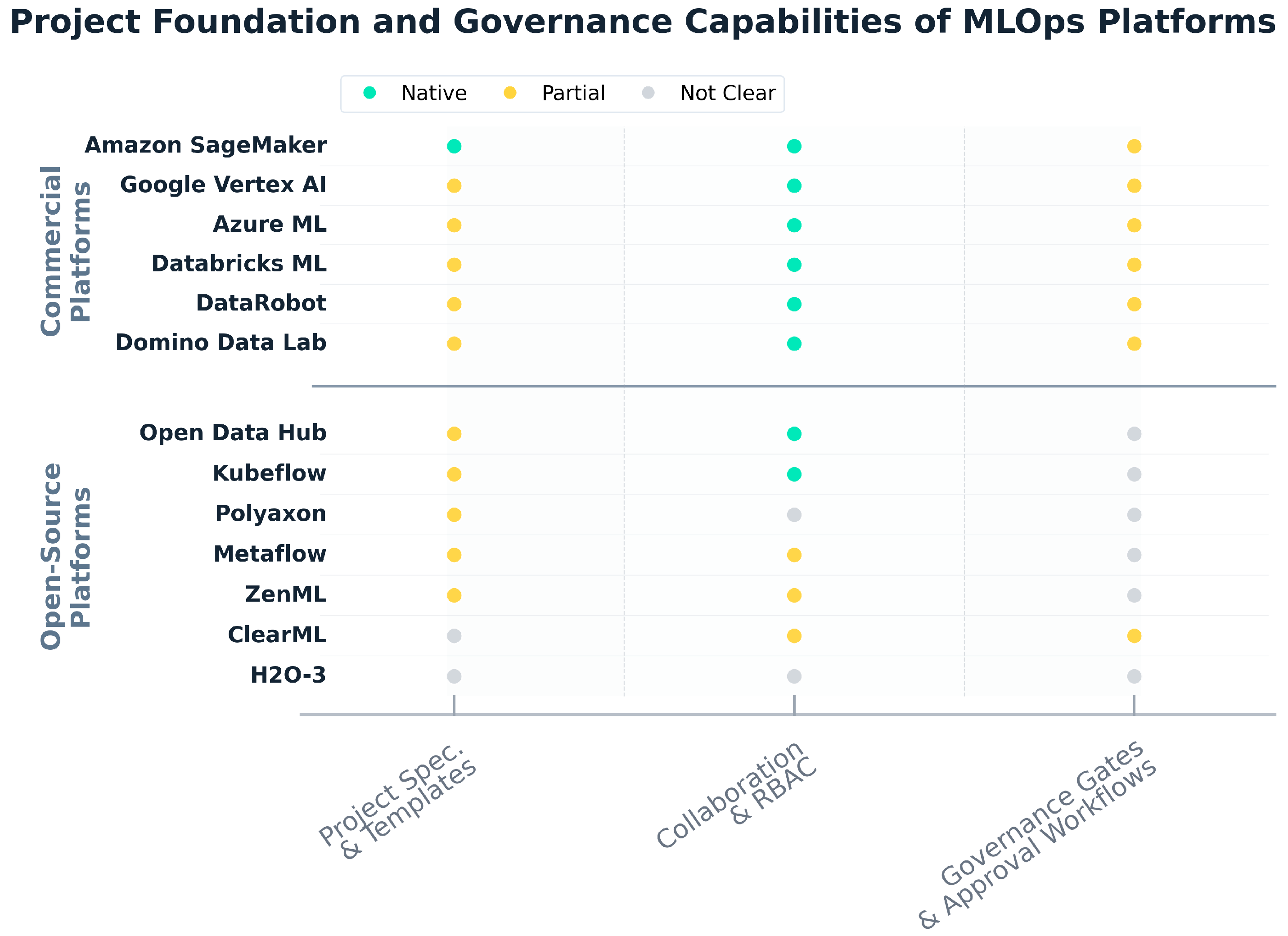
Project setup and governance capabilities establish the foundation for reliable and compliant MLOps operations in energy forecasting environments, revealing distinct patterns between commercial and open-source platforms across three critical dimensions. Figure 2 shows the Project Foundation & Governance capabilities of all identified MLOps platforms, comparing Native, Partial, and Not Clear support.
Commercial platforms show stronger documented support for early lifecycle governance functions, particularly project scaffolding, collaboration support, and RBAC, because these capabilities are closely aligned with the identity, workspace, and service-management abstractions of managed cloud environments. However, Figure 2 also makes clear that even these platforms do not translate governance maturity into fully native model-promotion control. The most consequential asymmetry in this category is therefore not between strong and weak governance overall, but between relatively mature access control and comparatively weak support for formal approval gates that govern model transition into production.
Open-source platforms display greater heterogeneity across project setup and collaboration, but the same structural weakness is visible more sharply. Some platforms provide credible namespace isolation, workspace concepts, or reusable pipeline definitions, yet formal human-in-the-loop promotion control remains largely external to the platform core. For regulated energy forecasting settings, this distinction is highly consequential because it means that even where technical collaboration is well supported, organisations still need to assemble approval logic, evidence review, and auditable release control through adjacent process and tooling layers.
Among the three dimensions shown in Figure 2, native approval and promotion control is the weakest, and is also the point at which capability gaps most directly translate into governance risk in operational forecasting settings. This corresponds to the first of the four priority gaps identified in the abstract and discussed further in Section 4.1.

3.2. Data Readiness and Feature Management

Effective data ingestion and feature management are foundational to energy forecasting MLOps because forecasting models depend on timely and reproducible handling of batch and streaming inputs, robust preprocessing, quality checks, versioned datasets, and reusable features. These capabilities shape forecast reliability, training-serving consistency, drift detection, and long-term maintainability, especially where weather, metering, and market data must be aligned across repeated retraining cycles.
This section examines five dimensions of data ingestion and management across key platforms: Data source connectivity (batch or streaming), Preprocessing and transformation pipeline support, Built-in data quality validation, Data versioning (raw and processed), and Feature store (curated, reusable, versioned)

3.2.1. Data Source Connectivity and Ingestion Modalities

The capability to establish connectivity with diverse data sources and support both batch and streaming ingestion represents a fundamental requirement for modern MLOps platforms. Data source connectivity encompasses the platform’s ability to interface with heterogeneous data repositories, including relational databases, data lakes, and event streaming systems, while supporting both periodic batch loading and continuous near-real-time streaming modalities. In the context of energy forecasting applications, streaming connectivity enables the incorporation of contemporaneous load measurements and meteorological sensor data, while batch ingestion remains essential for historical data archives and backfill operations.
Commercial platforms such as Amazon SageMaker, Databricks ML, Azure ML, DataRobot, and Domino Data Lab offer strong support for connecting to diverse data sources in both batch and streaming modes. For example, SageMaker Feature Store supports batch or streaming ingestion through a single API, and streaming can be implemented with surrounding AWS services such as Kinesis [48]. Vertex AI works with Cloud Storage, BigQuery, and Feature Store ingestion, with streaming handled through Google Cloud services and the Feature Store streaming import capability [49]. Azure ML binds datastores to Azure Storage and other sources, and streaming is typically built with Event Hubs or similar services feeding managed assets [50]. Databricks connects broadly and supports streaming tables on Delta [51]. DataRobot connects to many stores via Data Connections and catalogs data in the AI Catalog [52]. Domino integrates to enterprise data systems and manages governed access in platform projects [53].
Open-source platforms present a more heterogeneous landscape. Polyaxon, ZenML, ClearML, and H2O-3 support connection configuration for various data sources, but comprehensive streaming capabilities are not clearly documented in OSS versions [38,54,55,56]. Open Data Hub, Kubeflow, and Metaflow primarily provide batch-oriented ingestion and rely on external tools or add-ons for continuous or streaming sources. Their core functionality centres on pipeline orchestration, artifact management, and reproducibility, leaving streaming ingestion as an optional, user-implemented extension [36,57,58,59].
The primary differentiator across platforms is streaming ingestion rather than batch connectivity, where most platforms including open-source ones offer adequate support. For energy forecasting, platforms without documented streaming capability are effectively limited to day-ahead or week-ahead batch workflows, while real-time grid balancing applications requiring sub-minute feature updates have a narrower set of viable platform options.

3.2.2. Preprocessing and Transformation

Preprocessing and transformation pipeline support constitutes the platform’s capacity to define, orchestrate, version, and execute reproducible data processing workflows encompassing data cleaning, gap-filling, feature engineering, and other transformations. Energy forecasting applications frequently encounter data quality challenges including missing or invalid sensor readings, temporal misalignments, and irregular sampling intervals, necessitating robust preprocessing capabilities. Reproducible pipelines ensure methodological transparency and consistency across model retraining cycles.
Commercial platforms provide mature, integrated tools for data preprocessing and transformation, allowing end-to-end pipeline definition, versioning, and reuse. All six support managed preprocessing, but depth varies. SageMaker offers Data Wrangler and Processing jobs and can orchestrate in Pipelines [13,60]. Vertex AI uses Pipelines and component ecosystems to codify transforms before training [14]. Azure ML supports pipeline components, Designer, and MLTable-backed assets for repeatable transforms [16]. Databricks provides Spark-based feature engineering and jobs that run at scale [61]. DataRobot supports data prep in AI Catalog and Exploratory Data Analysis (EDA) stages but very custom pipelines are still code-driven by users [62]. Domino enables prep in notebooks and jobs, with the platform focusing on reproducibility and snapshots rather than prescriptive visual ETL flows [63].
Open-source platforms generally offer greater flexibility. For example, Open Data Hub supports preprocessing and transformation through Kubeflow Pipelines 2.0 with workflow orchestration capabilities [64]. Kubeflow provides preprocessing and transformation pipeline support. The Component Specification and Pipelines software development kit (SDK) defines reproducible workflows [65]. The Kubeflow Spark Operator can be used for data preparation and feature engineering [66]. Polyaxon provides experimentation tools and pipelines via Polyaxonfiles to run jobs, track artifacts, and orchestrate workflows [67]. Metaflow supports preprocessing and transformation pipelines by letting users define directed graphs of “steps,” where each step can perform data processing or transformation, and intermediate artifacts persist and flow between steps [68]. ZenML OSS and ClearML defines pipelines and steps in code, supports orchestrators, steps for transformations etc. [69,70]. H2O-3 provides AutoML and various functions for feature engineering, data parsing, and transformations, but does not have a built-in orchestrated pipeline framework (with all features like downstream versioning or scheduling) in OSS at the same level [71].
For energy forecasting, where retraining pipelines must reliably handle irregular sensor data and maintain methodological consistency across cycles, the maturity gap between commercial and open-source platforms is relatively narrow in this dimension, as most platforms, regardless of tier, offer some form of codified, reproducible workflow.

3.2.3. Data Quality Validation

Built-in data quality validation encompasses the platform’s capability to automatically assess data integrity during ingestion or within processing pipelines, detecting issues such as missing values, outliers, schema violations, and anomalies. Focus on the initial data quality check and the data pattern validation after preprocessing or feature engineering. In energy forecasting contexts, data quality is paramount, as erroneous meteorological data, sensor failures, or corrupted measurements can propagate errors throughout the modelling pipeline and compromise forecast accuracy.
Commercial platforms routinely include built-in data quality validation to catch issues early in the pipeline. Amazon SageMaker Data Wrangler generates a “Data Quality and Insights” report that surfaces missing values, outliers, and similar issues during preparation, supporting intake checks and inspection of engineered columns before training [13]. Google Vertex AI managed datasets provide statistics and visualizations to verify distributions prior to training, and pipelines commonly add TensorFlow Data Validation for schema inference and anomaly, skew, or drift checks on raw and transformed data when needed [14,72]. Azure ML supports profiling and structured data preparation through data assets and interactive wrangling, which teams use to operationalize intake checks and validations, engineered features within pipelines [16]. Databricks validates data during ingestion and transforms with Delta Live Tables expectations and supports declarative quality tests for raw and engineered features prior to training [17]. DataRobot runs automated EDA that flags common data quality issues at intake and supports targeted quality checks before model building, which can be reapplied after feature engineering to confirm distributions [18]. Domino Data Lab documents workflows to compute feature distributions and analyse drift, which practitioners often run before deployment and can reuse earlier in pipelines to validate engineered features prior to training [19].
Open-source platforms generally provide limited native data quality validation compared to commercial offerings. Kubeflow Pipelines does not ship a native validator, yet pipelines commonly add TensorFlow Data Validation to compute statistics, infer schemas, and detect anomalies, skew, and drift on both raw and post-transform data [20,72]. Polyaxon validates component input and output types to enforce step interfaces at intake, while native dataset-level anomaly or drift detection is not described in the OSS docs [22]. Metaflow centres on pipeline authoring and execution and does not document native dataset validators, so users embed external checks for intake and post-engineering verification inside flows as needed [25]. ZenML provides an official Great Expectations integration to profile and validate datasets inside pipelines, which supports early checks and repeated validation after feature engineering when enabled [23]. ClearML does not document native dataset validation; validation logic is ordinarily supplied by external libraries invoked within ClearML tasks or pipelines [73]. H2O-3 documentation focuses on algorithmic handling of missing values and imputation utilities rather than an ingestion-time validation service, which indicates that intake and post-engineering checks are typically implemented outside the platform [24]. Open Data Hub highlights TrustyAI for model assessment and drift metrics, and its public docs do not clearly document built-in ingestion-time dataset validation or standardized post-engineering checks for datasets themselves [27,74].
Automated data quality validation is the most consistently underdeveloped dimension in this category across all platform types. Even among commercial platforms, native validation is often limited to managed dataset profiling rather than systematic schema enforcement and anomaly detection across the full preprocessing pipeline. For energy forecasting, this gap is particularly consequential because data quality failures such as sensor outages, measurement offsets, or delayed delivery are structurally common and can propagate silently into training data without automated checks in place.

3.2.4. Data Versioning for Raw and Processed Datasets

Data versioning ensures that both raw unprocessed data and processed datasets following cleaning, transformation, and feature extraction are stored in a manner enabling reproduction, auditing, comparison, and rollback operations. In energy forecasting applications, versioning is critical because modifications to preprocessing methodologies, imputation strategies, feature aggregation techniques, or raw data streams can significantly impact forecast performance. The ability to trace the exact data and processing versions employed is essential for reproducibility and debugging.
None of the six commercial platforms provides a universal, automatic dataset version control mechanism for all raw and derived data. SageMaker teams version data with S3 practices and lineage in Experiments, with Canvas maintaining dataset versions inside Canvas and Feature Store keeping feature history rather than full, arbitrary dataset versions [13,48]. Vertex AI supports dataset versions for managed datasets, while broader versioning of arbitrary processed data still depends on storage systems and conventions outside the dataset object [75]. Azure ML registers data assets with versions and can track lineage, while capture of every derived artifact requires users to register outputs explicitly [76]. Databricks relies on Delta Lake time travel for table versions, which is strong for tabular data but does not version arbitrary file bundles unless teams convert them to Delta tables [77,78]. DataRobot’s AI Catalog supports snapshots and version history for registered datasets, while intermediate artifacts outside the catalog need user management [79]. Domino Datasets support immutable snapshots that teams must take at the right points in a pipeline [63,80].
Open-source platforms provide heterogeneous approaches to versioning of raw and processed data. ClearML OSS includes ClearML Data for versioning data over file systems or object storage, and tasks keep snapshots [81]. This capability allows precise tracking of which dataset version was used for each experiment. Polyaxon OSS supports artifact versioning and versioned assets features [82]. Kubeflow tracks artifacts and lineage via ML Metadata, but full dataset content versioning is not provided as a built-in dataset versioning system [83]. Other platforms such as ZenML, Metaflow, and Open Data Hub offer partial support. They enable tracking and reproducibility through artifact lineage, metadata stores, and pipeline snapshotting, but typically require external tools such as DVC or Pachyderm for complete raw data version control [64,84,85]. For example, Metaflow persists immutable snapshots of artifacts, data, code, and dependencies for each run and uses a content-addressed datastore for lineage and retrieval [86]. H2O-3 maintains data in memory or distributed frames and supports parsing and transformations, but explicit dataset versioning and lineage across versions is not clearly documented in core OSS [71].
Commercial platforms provide stronger built-in versioning through integrated feature stores and offline storage, while open-source solutions typically depend on external tools such as DVC or Pachyderm for comprehensive coverage. For energy forecasting, built-in versioning directly supports audit of historical forecasts, regulatory traceability of data transformations, and comparative analysis of model behaviour across retraining cycles.

3.2.5. Feature Store

Feature stores represent centralized repositories that manage feature definitions, storage architectures (online/offline), reusability, versioning, training-serving consistency, and metadata, including lineage and schemas. In energy forecasting applications, features such as lagged variables, rolling averages, and meteorological aggregates require reuse across multiple models or sharing across teams. Maintaining consistency between online and offline environments is critical for preventing training-serving skew.
Feature store capabilities are among commercial platforms’ strongest areas in data ingestion/management. SageMaker provides a managed Feature Store with online and offline stores and historical retrieval [48]. Vertex AI provides a managed Feature Store with new and legacy implementations and documented migration guidance [49]. Azure ML offers a Managed Feature Store that serves and monitors features once teams define feature sets [87]. Databricks integrates Feature Store with Unity Catalog for governance and reuse [88]. DataRobot promotes reuse through feature lists inside projects, although the semantics differ from a cloud-scale online and offline feature store [89]. Domino ships a managed feature store based on Feast patterns for curated, shareable features [90].
Across all evaluated criteria, open-source platforms display a spectrum of maturity in features management capabilities. Kubeflow and Open Data Hub rely more heavily on external tooling. Open Data Hub and Kubeflow can leverage Feast for schema enforcement and online feature storage, but advanced validation or versioning typically require complementary solutions [58,91]. ZenML OSS integrates with Feast as a feature store [92]. There is no official documentation available for a feature store component in H2O-3, Polyaxon OSS, ClearML, or Metaflow.
For energy forecasting applications, platforms with integrated feature store capabilities reduce feature engineering duplication, ensure consistency across development and production environments, and facilitate deployment of real-time forecasting systems that require low-latency feature serving for grid operations and market decisions.

3.2.6. Summary and Comparative Insights

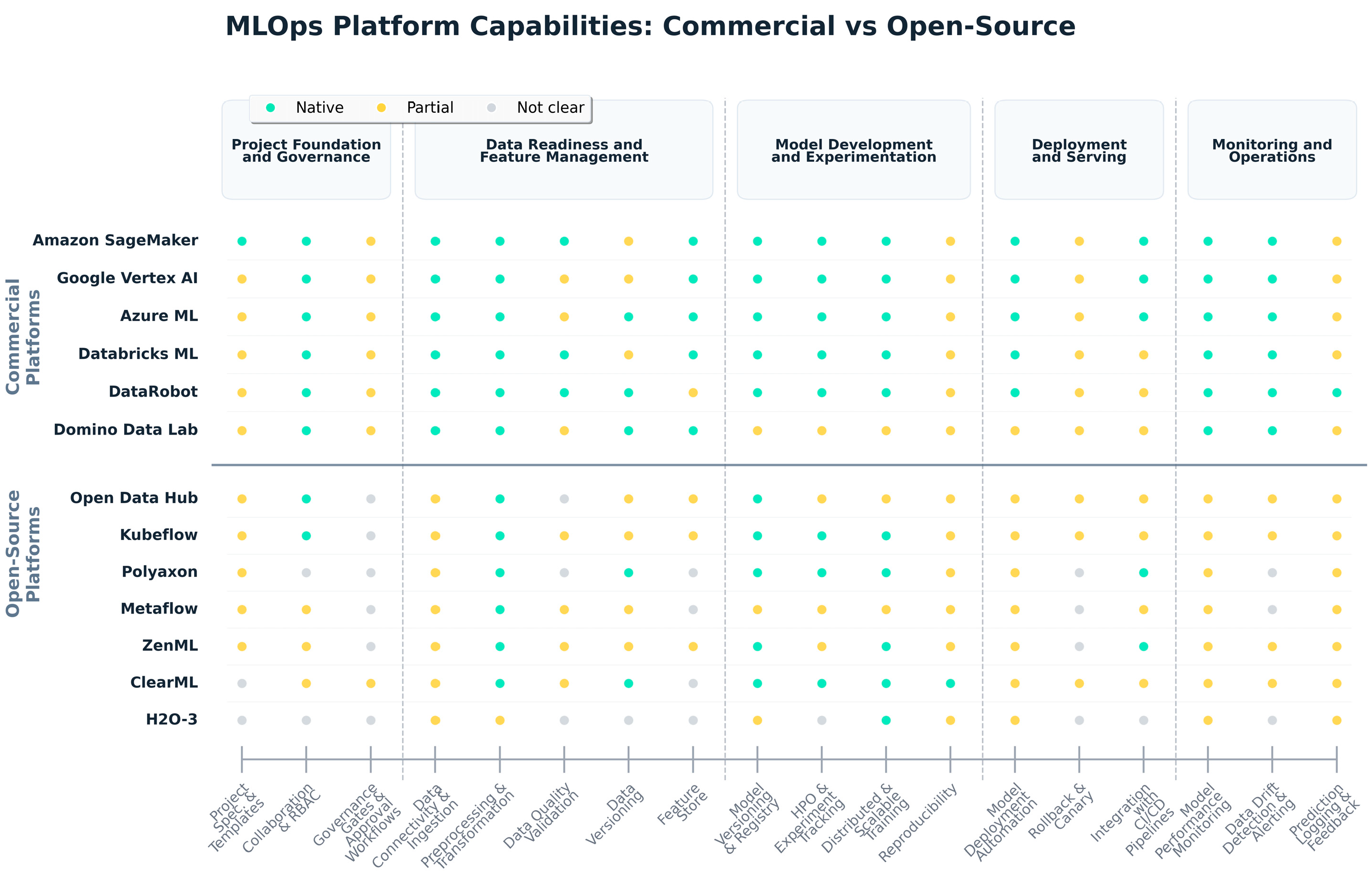
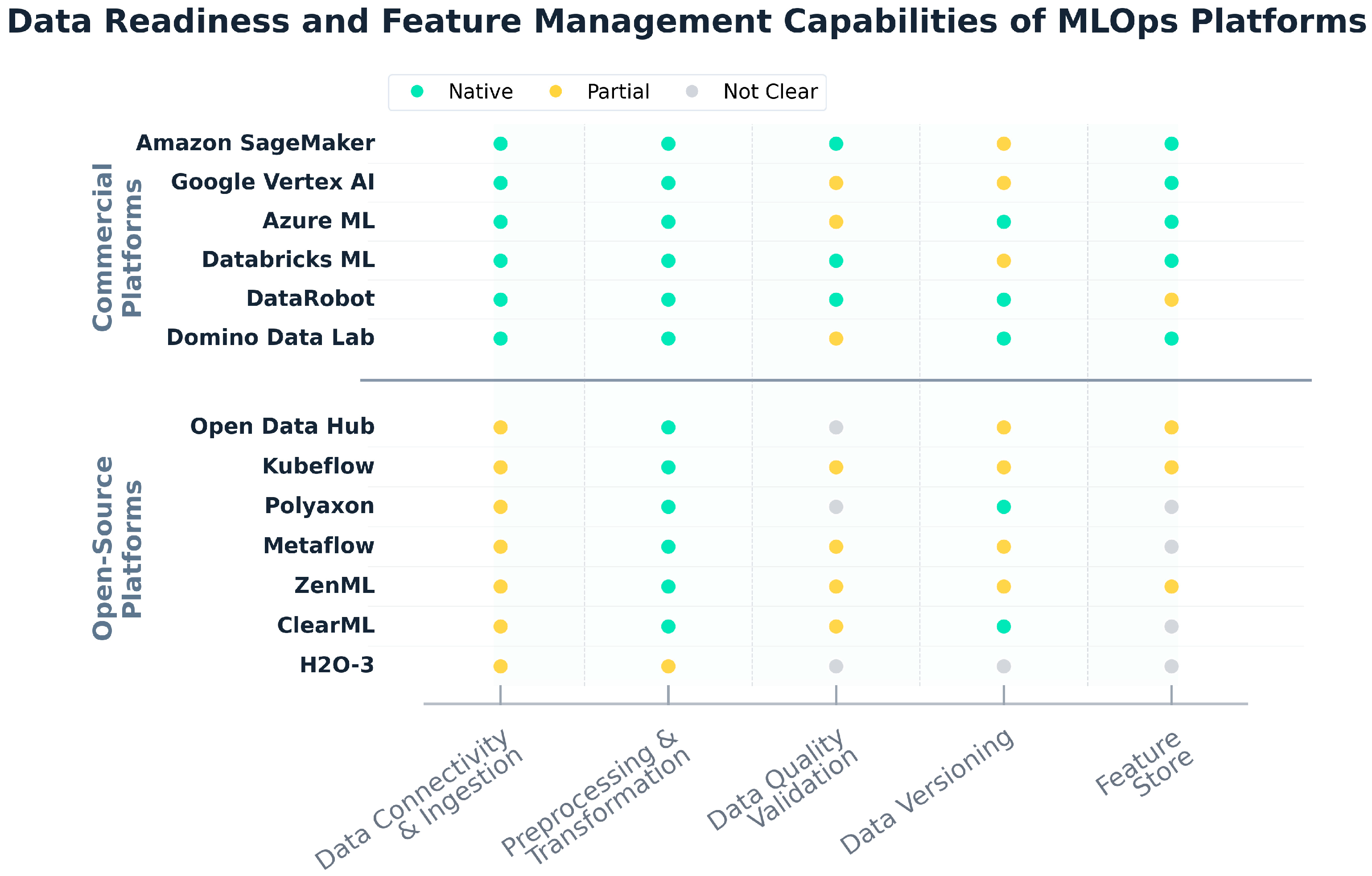
The comparative analysis reveals distinct capabilities and trade-offs between commercial and open-source platforms across data ingestion and management dimensions, with significant implications for energy forecasting applications where data quality and real-time processing are paramount. Figure 3 presents the Data Readiness & Feature Management capabilities covered by the platforms.
The figure shows stronger parity on core ingestion connectors and data handling, but a systematic drop in documented support for automated data quality validation and managed feature stores outside the major commercial suites. The pattern suggests that data readiness is often addressed through integrations, while feature consistency and validation remain common weak points for production energy forecasting pipelines.
A cross-dimension reading of Figure 3 reveals a progression: platform support is strongest at the left side of the data lifecycle (ingestion connectors and preprocessing, where commercial and open-source platforms approach parity) and weakens toward the right (validation, versioning, and feature management, where commercial platforms retain a clearer advantage). This gradient suggests that the data readiness challenge for energy forecasting is not access to raw inputs but the downstream control functions that determine whether those inputs remain trustworthy and consistent across retraining cycles.
Open-source platforms partially offset this gradient through individual strengths, notably ClearML in dataset versioning and ZenML in validation via Great Expectations, but no single open-source platform documents native support across all five dimensions. For organisations assembling open-source stacks, the practical implication is that validation and feature management are the components most likely to require external tooling, and therefore the points where integration risk is highest.
Among the dimensions shown in Figure 3, automated data quality validation and managed feature support represent the most consequential shortfalls for production energy forecasting pipelines, as both directly affect forecast reliability and training-serving consistency. These correspond to the second and third priority gaps identified in the abstract and are examined further in Section 4.1.

3.3. Model Development and Experimentation

The model development and training phase is critical within MLOps pipelines, especially for energy forecasting, where time-series dynamics, auto-tuning demands, and scalability are paramount. Unlike static classification tasks, forecasting models must adapt to seasonality, evolving demand patterns, and stochastic fluctuations in weather or market variables. This requires robust model registries, reliable experiment tracking, scalable distributed training, and reproducible setups that ensure traceability across retraining cycles. The following subsections examine four dimensions: model versioning and registry, hyperparameter optimization (HPO) and experiment tracking, distributed and scalable training, and reproducibility of code, environment, and seeds.

3.3.1. Model Versioning and Registry

Model versioning and registry provide structured storage, lineage tracking, and lifecycle management of trained models. This is crucial in energy forecasting, where multiple models may be used simultaneously (short-term, day-ahead, week-ahead forecasts) and must be retrained periodically. A well-maintained registry ensures that only validated models are deployed, allows rollbacks if performance degrades, and supports audit trails for compliance.
Commercial platforms universally include model registries that support versioning, governance, and deployment workflows. Amazon SageMaker Model Registry versions, models and captures approval status, lineage, and links to pipelines and endpoints [13]. Vertex AI Model Registry provides a central source of truth with versioning and aliases [93]. Azure ML registers models as versioned assets with lineage and deployment support [41]. Databricks uses MLflow Model Registry integrated with Unity Catalog for centralized governance [94]. DataRobot exposes a Model Registry that tracks and promotes versioned packages across environments [44]. Domino Data Lab provides a registry with review and governance and integrates with deployment and monitoring [45,95].
Open-source MLOps platforms provide uneven but evolving model-registry capabilities, ranging from full registries with versioning and governance to tools that track artifacts and rely on external registries for production use. Open Data Hub, Polyaxon, ZenML, and ClearML all include native registries with version tracking and metadata [46,96,97,98]. Kubeflow has a native component providing centralized model management with version control [99], Metaflow provides only partial support, usually by tracking artifacts but requiring external registries for production-grade governance [68,86]. H2O-3 supports saving and loading binary and MOJO or POJO artifacts for deployment, which does not constitute a full registry with built-in version lineage [100].
All commercial platforms provide comprehensive model registries with integrated governance and deployment workflows, while open-source platforms offer varying levels of registry functionality, from full-featured solutions in ClearML and Polyaxon to basic artifact tracking in Metaflow and H2O-3. For energy forecasting, robust registry support is essential for managing multiple forecasting horizons and enabling rapid rollbacks when performance degrades.

3.3.2. Hyperparameter Optimization and Experiment Tracking

HPO and experiment tracking ensure systematic exploration of model configurations and traceable performance history. In energy forecasting, this accelerates tuning of sequence models to achieve optimal accuracy while avoiding manual trial-and-error.
Commercial systems offer automated HPO and experiment tracking. SageMaker provides hyperparameter tuning jobs and tracks runs via SageMaker Experiments, with lineage captured by ML Lineage Tracking [13]. Vertex AI supports hyperparameter tuning jobs and tracks runs in Pipelines [101]. Azure ML offers HPO and exposes runs and metrics through MLflow integration [102]. Databricks leans on MLflow Tracking and distributed jobs for large sweeps [103]. DataRobot automates large candidate searches and keeps leaderboards and experiment artifacts in product [104,105]. Domino records experiments and environments, while automated HPO patterns are typically implemented by users in jobs or notebooks [106,107].
Among OSS tools, Polyaxon’s Optimization Engine provides built-in support for hyperparameter tuning via multiple search algorithms (e.g., grid search, random search, Hyperband, Bayesian optimization, custom iterative methods), with concurrency, routing, early stopping, and visualization, all managed through Polyaxon operations [108]. Kubeflow has comprehensive HPO through Katib and experiment organization through KFP experiments [109,110]. ClearML tracks hyperparameters and metrics via its HyperParameterOptimizer class and related tools [111]. Open Data Hub’s experiment tracking is available through MLflow integration, but automated HPO capabilities are not clearly documented as native platform features [64]. ZenML provides partial support, often requiring MLflow or external trackers [112]. Metaflow supports strong automatic experiment tracking through flow versioning, but dedicated HPO algorithms are not explicitly documented [113]. H2O-3 OSS has more limited support, such as model export, hyperparameter search in simpler cases, but lacks full tracking and HPO combination in its core [24].
Commercial platforms provide integrated automated HPO with comprehensive experiment tracking, while open-source platforms show significant variation, with Polyaxon and Kubeflow offering sophisticated HPO engines comparable to commercial solutions, but others requiring external tools or manual implementation. For energy forecasting, automated HPO directly reduces the manual tuning burden needed to maintain model accuracy across seasonal pattern shifts.

3.3.3. Distributed and Scalable Training

Distributed training enables scaling across GPUs/TPUs or nodes to handle large historical datasets and frequent retraining. This is vital for energy forecasting models trained on multi-year, high-resolution data that must adapt quickly to demand shifts. Scaling training is particularly important in energy forecasting due to the need for long historical datasets, fine-grained temporal resolutions, and retraining across regions.
Commercial platforms such as SageMaker run distributed training across managed clusters and execute large HPO fleets [13]. Vertex AI supports distributed custom training and large tuning jobs on managed compute [14]. Azure ML spins up clusters for distributed training and parallel HPO via SDK v2 [16]. Databricks scales Spark and distributed frameworks easily for parallel sweeps [17]. DataRobot executes many concurrent blueprints under the hood [18]. Domino orchestrates distributed jobs on the platform’s compute grid [19].
Open-source platforms show mixed capabilities. Polyaxon and Kubeflow provide distributed training support, for example, Kubeflow via TFJob, PyTorchJob, and MPIJob operators [20,22]. Metaflow can scale out by parallelizing steps over many instances using Kubernetes or AWS Batch, including GPU support. Parallel HPO is achievable by orchestrating many runs, but there is no built-in HPO engine [25]. H2O-3 is inherently distributed (in-memory cluster, multiple nodes) and supports grid search/parallel modelling by splitting across nodes [24]. ClearML and ZenML allow multi-GPU training and can dispatch tasks to clusters but require user configuration [73,114]. Open Data Hub mainly supports scaling via integration with external engines (e.g., CodeFlare, Spark, Ray, or Slurm) [27].
Commercial platforms provide managed distributed training infrastructure with seamless scaling capabilities, while open-source platforms demonstrate mixed capabilities, with Kubeflow and Polyaxon offering sophisticated distributed training operators, but others requiring external orchestration systems or manual cluster configuration. For energy forecasting, scalable training reduces the latency between new data availability and updated forecasts, critical for grid operations and market participation.

3.3.4. Reproducibility

Reproducibility ensures that forecasting models can be re-run on the same data to produce identical results, which is vital for auditing, compliance, and root-cause analysis in case of forecast failures. In energy forecasting, reproducibility encompasses multiple dimensions: exact replication of training processes including random seed states, precise versioning of code and dependencies, consistent computational environments, and deterministic data processing pipelines. This capability becomes critical when forecast errors lead to significant operational or financial consequences, such as grid imbalances, incorrect market bidding, or regulatory violations.
Commercial platforms provide strong support: SageMaker records inputs, artifacts, and container images but relies on user discipline for random seeds and exact dependency locks across steps [13]. Vertex AI and Azure ML capture pipeline inputs, container specs, and model artifacts, while perfect end-to-end determinism requires pinned environments and explicit seeding in components [14]. Databricks and MLflow capture parameters and artifacts and can pin environments, while reproducibility depends on how repos and images are versioned [17]. DataRobot and Domino retain blueprints, dataset snapshots, and environment definitions, but seed capture and bit-for-bit builds depend on user configuration [18,19].
Open-source platforms differ: ClearML offers reproducibility by automatically logging code, packages, git hashes, and seeds for each run [73]. Kubeflow, Metaflow, Open Data Hub, Polyaxon, ZenML, and H2O.ai provide partial support, often requiring user setup for seed fixing and external environment managers [20,22,23,24,25,27].
Commercial platforms provide comprehensive artifact and environment capture but typically require user discipline for complete reproducibility, while ClearML offers more convenient out-of-the-box coverage through automatic logging of code state, dependency hashes, and random seeds. For energy forecasting, reproducibility is essential for auditing forecast decisions and tracing dispatch or market-facing outputs when challenged by regulators or stakeholders.

3.3.5. Summary and Comparative Insights

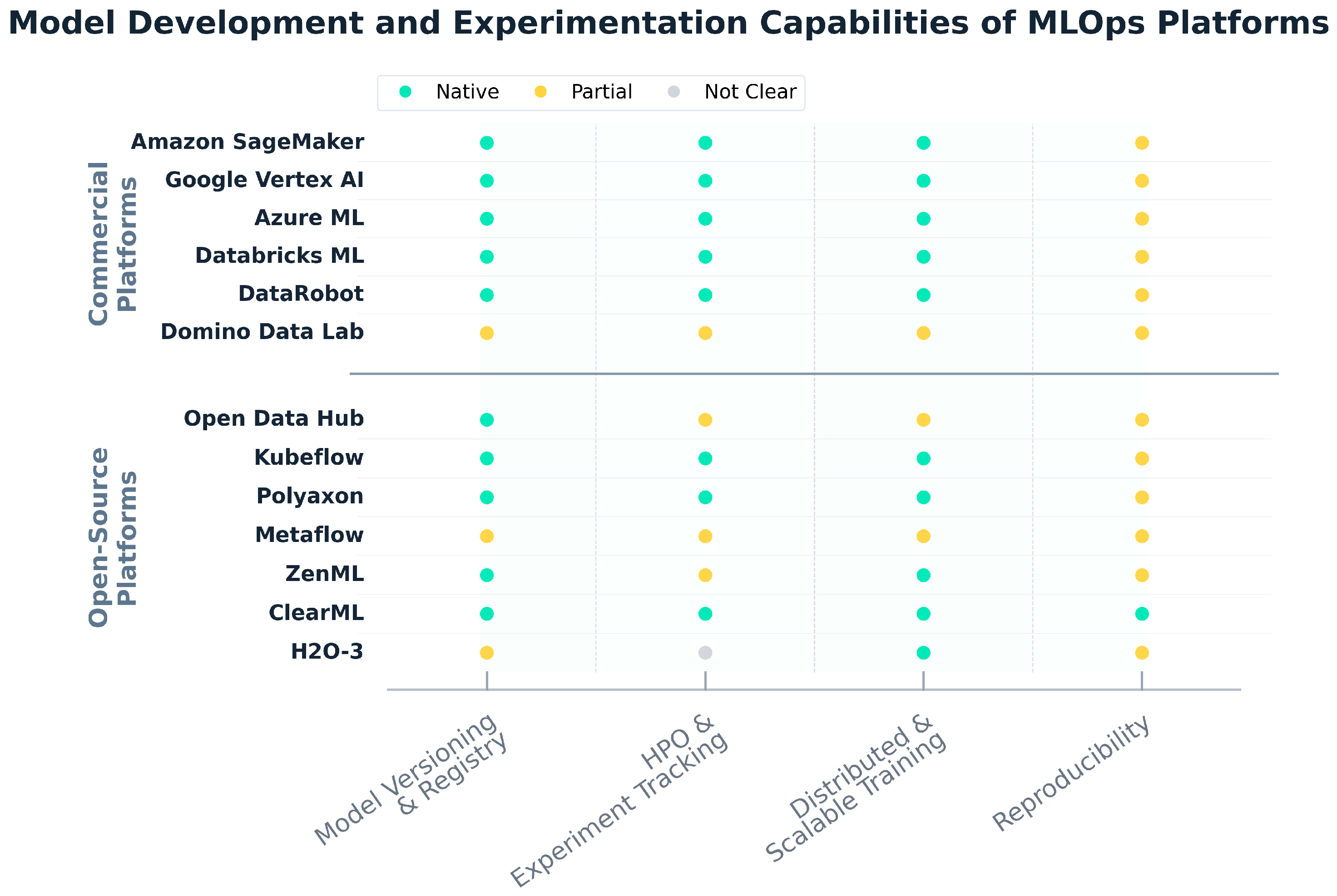
The evaluation of model development and experimentation capabilities reveals distinct patterns with significant implications for energy forecasting applications where accuracy, auditability, and operational efficiency are paramount. Figure 4 highlights the Model Development & Experimentation Capabilities of MLOps Platforms.
Among the dimensions in this category, model registry and experiment tracking show the strongest convergence across platform types: all commercial platforms and several open-source platforms, including ClearML, Polyaxon, and Kubeflow, provide documented registry support with versioning and governance hooks, indicating that this function is relatively mature across the ecosystem. HPO is the dimension where the open-source and commercial capability gap is smallest, with Polyaxon’s Optimization Engine and Kubeflow’s Katib providing search algorithms and early stopping support that are architecturally comparable to commercial tuning services. The most consequential remaining gap is reproducibility, where ClearML’s automatic logging of code state, dependency hashes, and random seeds provides more convenient out-of-the-box coverage than most commercial platforms, which rely on user discipline for seed management and dependency pinning.
For energy forecasting, the practical implication is that model development and experimentation functions are the least likely to constrain platform selection, because adequate capability is achievable on both commercial and open-source stacks. The more relevant differentiator for energy forecasting workflows is whether the platform’s registry and experiment tracking integrate natively with governance gates and deployment automation, since those downstream connections determine whether model quality evidence produced during experimentation flows into controlled production promotion.

3.4. Deployment and Serving

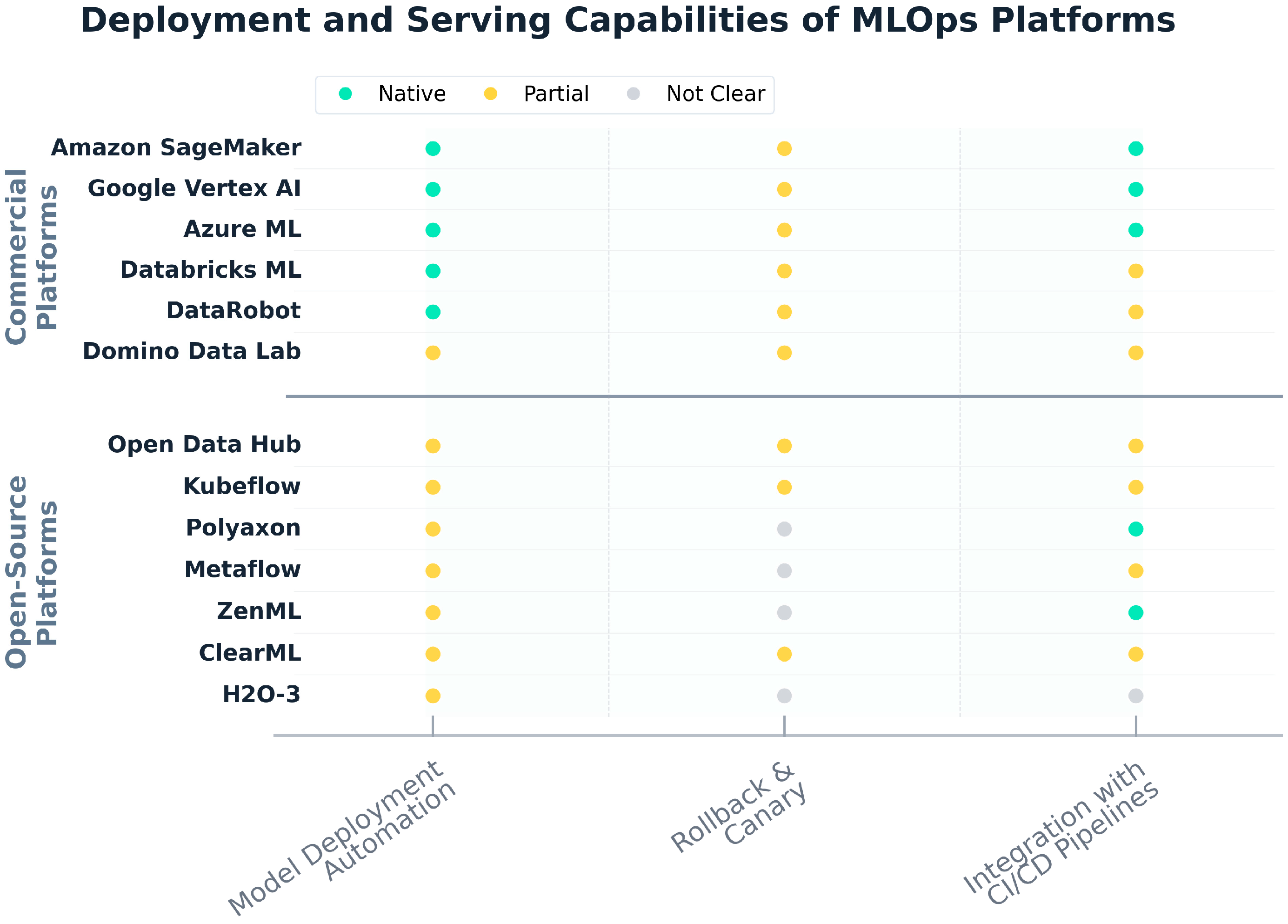
The deployment and serving phase of the MLOps lifecycle transforms trained models into operational services, enabling continuous predictions in production environments. In energy forecasting pipelines, effective deployment solutions mostly support automated batch or API-based inference, safe rollbacks and canary or blue/green updates in response to changing model performance, and integration with CI/CD pipelines to ensure reproducibility, governance, and speed. These capabilities are essential because energy systems often work in real-time, subject to demand spikes, supply variability, and regulatory constraints. Deployment failures or latency issues can lead to high costs or reliability risks.

3.4.1. Model Deployment Automation

Automation of model deployment (batch jobs or prediction APIs) ensures that energy forecasting models are deployed reliably and on schedule. Forecasts such as hourly or daily aggregated predictions often run as batch jobs; real-time or near real-time APIs are required for use cases like grid balancing, demand response, or real-time market price estimation. Automation reduces human error and delays.
Most commercial platforms offer strong automated deployment tooling. For example, SageMaker supports real-time endpoints, async inference, and Batch Transform [13]. Vertex AI supports online endpoints and batch prediction with registry-backed models [14]. Azure ML exposes managed online endpoints and batch pipelines [16]. Databricks serves models via Mosaic AI Model Serving and runs batch scoring with jobs [17]. DataRobot deploys to managed prediction environments for API and scheduled batch scoring [18]. Domino publishes model APIs and batch jobs from projects [19].
Open-source platforms show more variation. The open-source version of ClearML includes ClearML Serving, which enables model deployment with endpoints, monitoring capabilities, and automatic updates. However, for batch scoring or offline batch deployment automation, the open-source edition does not provide clearly documented support as a fully managed or scheduled feature [73]. Open Data Hub offers automated model deployment through both ModelMesh for multiple models [115] and Kubernetes-native Model Serving Project (KServe) for single models [116], with interfaces based on Representational State Transfer (REST) and gRPC [27]. Kubeflow provides comprehensive automation for API deployment with multi-framework support [117]. Polyaxon supports basic deployment capabilities through service abstraction, but comprehensive production deployment automation may require additional configuration or external tools [22]. Metaflow provides production orchestrator integrations and programmatic deploys for scheduled batch workflows using Step Functions, Argo, or Airflow. No native API serving is documented in OSS [25]. ZenML OSS supports a “model deployers” stack component for online API endpoints, when included, and pipeline steps can deploy models; batch deployment is possible via pipelines, but comprehensive automation may need external components [23]. H2O-3 provides exportable Plain Old Java Object (POJO) or a Model ObJect, Optimized (MOJO) [118] artifacts for embeddable batch and real-time scoring, and also supports scoring via the H2O-3 REST API against a running cluster; however, fully managed deployment automation (endpoint lifecycle, scheduling, monitoring) is outside the OSS scope and instead provided by H2O MLOps [24].
Commercial platforms deliver comprehensive turnkey deployment automation for both batch and API-based serving with managed infrastructure and scheduling capabilities, while open-source platforms provide flexible deployment frameworks that often require additional configuration and external tools for production-grade automation. For energy forecasting, reliable deployment automation is critical for maintaining continuous forecast availability across scheduled batch jobs and real-time API endpoints.

3.4.2. Rollback and Canary Deployment Support

Rollback and canary deployments (or blue/green, traffic-shifting) allow safer model updates. In energy forecasting, updates may introduce unexpected performance degradations (e.g., due to new weather patterns) or drift; canary/rollback mitigates risk by limiting exposure. Canary testing ensures new versions are validated before full rollout.
SageMaker implements traffic shifting with blue-green and canary updates and supports automatic rollback on alarms [13]. Vertex AI supports multiple model versions on an endpoint with traffic splitting configured during deployment, though teams still manage redeployments when settings change [14]. Azure ML documents safe rollout for online endpoints with staged promotion patterns [16]. Databricks lets teams switch model versions behind a serving endpoint, while precise canary traffic patterns are configured by the user or external routing [17]. DataRobot supports champion-challenger promotion policies rather than automatic canary across any network tier [18]. Domino maintains version history for published apps and models, while traffic control patterns are configured by teams [19].
OSS platforms generally offer partial support. ClearML Serving supports canary/A/B deployment/online canary updates. Users can define a “canary endpoint” with traffic-splitting between model versions. However, rollback (automatic fallback to a previous version in case a new deployment fails) is not clearly documented in the OSS version [119]. Kubeflow’s official documentation does not explicitly have built-in support for canary deployments or rollbacks in the sense of blue/green or traffic splitting. But it can support canary deployment and rollback capabilities through KServe [120]. Open Data Hub can also support these patterns via the bundled KServe component [27]. There is no explicit OSS guidance for canary or rollback strategies documented for ZenML, H2O-3 OSS, Polyaxon and Metaflow.
Commercial platforms provide built-in rollback and canary capabilities as first-class features, while open-source platforms offer partial support through KServe components but typically require manual configuration and external monitoring for complete automation. For energy forecasting, where deployment failures can trigger grid imbalances or market penalties, these safety mechanisms are essential for introducing model updates with controlled exposure.

3.4.3. Integration with CI/CD Pipelines

CI/CD pipeline integration ensures continuous, automated deployment of models following testing, versioning, and quality checks. For energy forecasting, this is important because models might need retraining regularly (daily, weekly) in response to new sensor data or weather forecasts; having CI/CD ensures that code, data, and model updates move through staging, testing, and production reliably.
Commercial platforms have mature CI/CD integration. Each platform integrates with CI/CD, but teams must assemble the pipeline. SageMaker pairs naturally with AWS CodePipeline and CodeBuild and also GitHub Actions through the SDK and CLI [13]. Vertex AI ties into Cloud Build and Cloud Deploy with Pipelines for reproducible training and promotion [14]. Azure ML publishes guidance and accelerators for DevOps integration and promotion workflows [15]. Databricks supports repos, jobs, and APIs for automated promotion and testing and publishes accelerator patterns with partners [17]. DataRobot provides APIs to register, promote, and deploy models programmatically [18]. Domino exposes a CLI and API to wire projects into external CI/CD [19].
OSS platforms provide varying levels of CI/CD integration. Kubeflow Pipelines has APIs, SDKs, and REST API. The pipelines’ interface documentation shows REST API usage for integration [20]. Also, model registry and pipelines can be integrated via scripts/SDK. Polyaxon has service accounts to create token-based, non-user identities that enable secure CI/CD integration and automation while tracking activity separately from human users [22]. ZenML supports service accounts, API tokens, CLI and stack components enabling usage within CI/CD [23]. In ClearML, this is typically achieved through documented integrations with external CI tools [73]. Metaflow provides a deployer API that can be integrated into CI/CD pipelines, but it relies on external orchestrators and CI/CD tools to complete the workflow [25]. Other OSS tool such as Open Data Hub is possible through OpenShift native CI/CD capabilities and GitOps, but require custom development [121]. H2O-3 OSS docs focus more on users running models, and CI/CD integration is not well documented as a core OSS capability.
Commercial platforms provide seamless CI/CD integration through native cloud services and comprehensive APIs, while open-source platforms offer comparable hooks via service accounts and SDKs but typically require more custom assembly. For energy forecasting, where forecast refresh timing is critical, CI/CD automation ensures model updates move through staging and production reliably.

3.4.4. Summary and Comparative Insights

Evaluating deployment and serving capabilities reveals clear differences between commercial and open-source platforms that matter for energy forecasting, where reliability, safety, and automation are critical. Figure 5 summarizes the Deployment & Serving Capabilities of MLOps Platforms.
Across the deployment and serving dimensions, basic deployment automation for both batch and API inference is relatively well covered on both commercial and open-source platforms. The principal differentiating gap is automatic rollback and canary traffic control, where commercial platforms such as SageMaker and Azure ML provide alarm-triggered rollback and staged promotion as first-class features, while open-source platforms remain largely dependent on external KServe configuration to achieve comparable behaviour. CI/CD integration shows strong parity, with both commercial APIs and open-source service accounts providing the necessary hooks for programmatic model promotion; the difference here is engineering effort rather than a documented capability absence.
For energy forecasting, the main differentiator in deployment and serving is not basic deployability, which is broadly documented across platforms, but the degree to which rollback and staged release control are operationalised as managed safety mechanisms. Commercial platforms more often expose these controls as documented first-class deployment patterns, whereas open-source platforms depend more heavily on KServe-based composition and user-managed observability to achieve comparable behaviour. The practical distinction is therefore one of deployment safety integration and assembly burden, rather than simple presence or absence of serving functionality.
Among the deployment dimensions, rollback and canary support represent the most consequential gap for operational energy forecasting, where it intersects with the monitoring limitations discussed in Section 3.5 to compound the fourth priority gap examined in Section 4.1.

3.5. Monitoring and Operations

Robust monitoring and operations close the loop of the MLOps lifecycle by turning deployed models into observables that can be governed and improved. In energy forecasting, continuous performance tracking, timely drift detection, and systematic prediction logging directly affect operational reliability, retraining cadence, and risk management. Grid load and meteorological regimes shift over time, so pipelines must detect distributional change early, capture production inputs and outputs for audit and hindcast evaluation, and trigger retraining with traceable evidence. This section reviews three capabilities across platforms: model performance monitoring, data and feature drift detection with alerting, and prediction logging with feedback for retraining.

3.5.1. Model Performance Monitoring

Model performance monitoring refers to first-class mechanisms that track service health and forecasting accuracy after deployment. For energy forecasting, routine measurement of absolute and relative error across horizons, latency budgets for API scoring, and service uptime ensures that dispatch or trading systems are not driven by stale or degraded signals.
Commercial platforms provide mature monitoring that couples operational telemetry with model quality metrics. SageMaker Model Monitor computes data and model quality metrics and alerts on thresholds [13]. Vertex AI Model Monitoring runs scheduled jobs for drift and performance signals [14]. Azure ML provides built-in monitoring signals and scheduled jobs, plus alerting through Azure services [16]. Databricks Lakehouse Monitoring tracks model and data quality metrics with dashboards and alerts [17,122]. DataRobot surfaces data and prediction drift and performance metrics for deployments [18]. Domino monitors drift and quality, can ingest ground truth, and raises alerts on exceeded thresholds [19].
Open-source tools cover monitoring unevenly and often rely on composable components. Kubeflow provides partial support for monitoring. Their official docs for Model Registry include “monitoring” as part of architecture and use-cases (track deployed model, performance, drift) in overview [20]. But built-in, system-level performance monitoring (metrics, dashboards) is not fully detailed. ClearML offers extensive experiment logging and resource monitoring, and its serving stack can be instrumented for production metrics, with community features augmented by enterprise model monitoring when needed [73], but model performance monitoring in production relies on configuring the Serving stack to emit metrics and then using external tooling like Prometheus and Grafana. Polyaxon tracks parameters, metrics, and artifacts and exposes run-level observability for pipelines, which can be extended with Prometheus and Grafana for service monitoring [22]. Metaflow has experiment tracking, result visualization “cards”, and the ability to compare performance across runs, but lacks full-production monitoring features (dashboards, drift alerts, etc.) [25]. Similarly, ZenML OSS provides good tracking, metrics, versioned artifacts, and experimental dashboards, but full live-production monitoring (drift, latency alerts, etc.) is not clearly documented in OSS [23]. Open Data Hub packages its components on OpenShift and provides documentation for model monitoring through TrustyAI and the surrounding observability stack, while deferring specific configuration details to the deployment blueprint [27]. H2O-3 OSS provides model evaluation functions, grid search and AutoML leaderboards, and REST API scoring, but no built-in mechanism in OSS docs for automatically streaming prediction logs in the core H2O-3 package. These are features described under H2O MLOps, which is a separate product [24].
Commercial platforms provide integrated monitoring with managed alerting and dashboards, while open-source platforms require assembly with external observability tools such as Prometheus and Grafana. For energy forecasting, integrated monitoring is essential for continuous oversight of forecast accuracy across time horizons and rapid incident response when degradation affects grid operations.

3.5.2. Data Drift Detection and Alerting

Drift detection identifies changes in feature distributions or target behaviour that undermine forecast validity. In energy forecasting, shifts in consumption patterns, weather regimes, or market structures require early detection, notification, and controlled responses such as retraining or model re-selection.
Commercial offerings expose drift monitors that can alert on deviations from baselines. SageMaker detects data quality and model quality drift and can trigger notifications [13]. Vertex AI schedules drift checks and supports alerting when metrics cross thresholds [14]. Azure ML lists data drift and prediction drift among its built-in signals for online endpoints [16]. Databricks computes drift over Delta tables and model outputs in Lakehouse Monitoring [17,122]. DataRobot enables feature and target drift tracking by default in deployments [18]. Domino provides drift dashboards and threshold-based alerts for monitored models [19].
Open-source solutions tend to implement drift through integrations. ClearML and ZenML lead here because they have first-class integrations (ClearML with monitoring UI + Grafana, ZenML with Evidently) that simplify drift detection inside pipelines. ZenML integrates with Evidently to run data, prediction, and model performance checks inside pipelines, enabling drift reports and automated guards that can drive retraining steps [23,123]. ClearML captures rich experiment telemetry and can be combined with Grafana for production signal visualization, with enterprise features covering model monitoring where required [73,124]. Open Data Hub and Kubeflow are strong but require more configuration (KServe/Prometheus/TrustyAI setup). Kubeflow with KServe’s native hooks with Alibi Detect support online drift and outlier detection alongside payload logging, which enables automated detection around model endpoints on Kubernetes [125]. Open Data Hub deployments often rely on Seldon and TrustyAI to realize drift and explainability monitors in OpenShift environments [27]. H2O-3 core OSS does not clearly document drift detection or automatic alerting, but H2O MLOps provides drift metrics accessible through its APIs and workflow, which can be used for automated evaluation and alerting in production [24]. There is no built-in automatic drift detection or alerting mechanism in core Metaflow and Polyaxon.
Managed services deliver prescriptive drift monitors and alerts with minimal assembly, while OSS toolchains use detectors like Alibi Detect or Evidently to supply comparable checks inside custom pipelines. The latter approach maximizes flexibility for domain-specific drift logic at the price of integration effort.

3.5.3. Prediction Logging and Feedback Loop for Retraining

Prediction logging captures request features and model responses, then links them to eventual ground truth to enable backtesting and supervised retraining. In energy forecasting, this function enables horizon-indexed error analysis, supervised learning with delayed truth, and model governance.
All six commercial platforms can log online inference requests and responses, and most can feed that data into monitoring and retraining pipelines the team builds. SageMaker Data Capture stores inputs and outputs in S3 and is configurable via API for selective capture [13]. Vertex AI supports online prediction logging to BigQuery or Cloud Logging for custom and AutoML models [14]. Azure ML provides a Data Collector that logs inference to Blob Storage and registers it as data assets for monitoring and retraining [16]. Databricks offers Inference Tables that automatically log requests and responses into Delta tables, which then drive Lakehouse Monitoring and analysis [17]. DataRobot goes further with automatic retraining policies that can trigger new models from registered datasets when drift or performance thresholds are met, subject to user-defined rules [18]. Domino logs predictions for monitored models and can incorporate ground truth later, while the actual retraining loop is orchestrated by user pipelines or jobs [19].
Open-source projects enable logging and feedback through composable services. ClearML stands out as the most feature-complete. It has endpoint logging, model registry, and documented examples of setting up retraining loops with Task Scheduler and ClearML Data [73]. Prediction logging capabilities of Open Data Hub exist through monitoring integration, but automated retraining feedback loops require custom pipeline development and orchestration [27]. For Kubeflow, KServe provides payload logging via Knative Eventing, so requests and responses can be routed to storage or stream processors, which support later labelling, diagnostics, and retraining jobs on Kubernetes clusters [126], but retraining automation still requires custom pipeline assembly on the user’s side. ZenML offers scheduling and pipeline orchestration so teams can plug in Evidently checks and retraining steps that consume logged data, enabling continuous training patterns when feedback accumulates [23]. Polyaxon and Metaflow record artifacts and metadata at run time, and when combined with storage and message systems, they support dataset curation and retraining triggers, though manual assembly is often required [22,25,127]. H2O-3 provides prediction via REST or POJO/MOJO, but the OSS docs do not describe a built-in prediction-logging store or automated feedback triggers [128].
Commercial platforms provide comprehensive built-in data capture with managed storage and direct retraining pipeline integration, with DataRobot offering the most advanced automated retraining policies, while open-source platforms achieve similar functionality through composable services requiring custom orchestration. For energy forecasting, systematic prediction logging with stable keys to ground truth is essential for horizon-indexed accuracy computation and triggering controlled model refresh cycles.

3.5.4. Summary and Comparative Insights

Across the three monitoring and operations dimensions, performance monitoring, drift detection, and prediction logging with retraining feedback, commercial and open-source platforms differ most in how tightly these functions are integrated into a closed-loop pipeline rather than in whether individual components exist. Figure 6 captures the Monitoring & Feedback Capabilities of MLOps Platforms.
Across the monitoring and operations dimensions, prediction logging capability is relatively well documented on both commercial and open-source platforms. The more consequential gap is the coupling between monitoring outputs and controlled retraining triggers. Among commercial platforms, DataRobot is the only one with documented automated retraining policies that activate based on drift or performance thresholds without user-initiated orchestration; other commercial platforms provide the logging and alerting infrastructure but leave the retraining decision and pipeline trigger to user-configured workflows. Among open-source platforms, ClearML’s Task Scheduler with documented retraining loop examples and ZenML’s Evidently integration with pipeline-level guard steps come closest to closing this gap, though both still require custom assembly rather than a turnkey feedback mechanism.

3.6. Synthesis of Mapped Capability Findings

The systematic analysis in Section 3.1, Section 3.2, Section 3.3, Section 3.4 and Section 3.5 encompasses the complete ML lifecycle stages that constitute an end-to-end MLOps pipeline, from project initialization through continuous monitoring and feedback. Across the 18 dimensions, this structured comparison highlights distinct capability patterns between commercial and open-source platforms, with significant implications for energy forecasting applications where reliability, governance, and real-time responsiveness are paramount.
Figure 7 summarises platform capability coverage across all dimensions using a three-level classification that distinguishes between comprehensive, documented built-in capabilities (“Native”), partial implementations through components or integrations (“Partial”), and undocumented features (“Not Clear”). The comparison indicates that no single platform achieves complete coverage across all dimensions, although clear differences emerge in lifecycle comprehensiveness and production readiness.
The category-level findings from Figure 2, Figure 3, Figure 4, Figure 5 and Figure 6, together with the bridging statements in each summary subsection that map each figure to the corresponding priority gap, provide the evidentiary basis for the cross-platform synthesis presented in Figure 7.
Commercial platforms demonstrate stronger documented end-to-end lifecycle integration and broader support for production-oriented workflows, with Amazon SageMaker, Google Vertex AI, Azure ML, and Databricks ML providing comprehensive coverage across data connectivity, feature stores, model deployment automation, and performance monitoring. These cloud-native offerings enable smooth handoffs from feature engineering to serve with built-in monitoring suitable for production energy-forecasting systems, though governance capabilities remain mixed across vendors. Model-development capabilities consistently mature across commercial platforms, with native model versioning, experiment tracking, and scalable training.
Open-source platforms present a more heterogeneous landscape with distinct strengths requiring external integrations for comprehensive functionality. ClearML emerges as a comparatively open-source alternative, offering strong experiment tracking and dataset versioning capabilities. Kubeflow demonstrates excellent scalability through its Kubernetes-native architecture, while Polyaxon and ZenML represent specialized solutions with focused strengths in workflow orchestration. However, most open-source platforms show limited coverage in governance and monitoring areas, requiring significant external integration to achieve comparable end-to-end deployment support.
In summary, the mapping across the 18 dimensions indicates a clear distinction between integrated commercial suites and more modular open-source stacks, with correspondingly different levels of end-to-end lifecycle coverage and production readiness.

4. Discussion

This section synthesizes the mapped capability findings to provide strategic insights for energy forecasting MLOps deployments.
It links documented platform capability patterns to operational requirements and organisational decision-making from an architectural and lifecycle-support perspective. The four priority gaps highlighted in the following subsections emerge from recurring limitations observed across platforms, particularly where Partial and Not Clear classifications coincide with capabilities that are critical for operational energy forecasting. Section 4.1 summarises cross-cutting challenges that recur across deployments, while Section 4.2 provides implementation guidance and strategic directions.

4.1. Cross-Cutting Challenges for Energy Forecasting Deployments

The comparison reveals several capability gaps that are particularly significant for energy forecasting applications.
Governance and approval workflows remain underdeveloped across platforms, with limited support for formal model promotion and approval processes. As Figure 2 shows, this weakness is less visible in basic access management than in the limited native support for auditable approval and controlled promotion logic. This is particularly consequential from a governance and lifecycle-control perspective, where model changes affecting grid operations or market participation require documented approval processes under regulations.
Data quality validation remains a critical gap, with most platforms providing only partial support for automated data integrity checking. This pattern is also reflected in Figure 3, where core ingestion connectivity is comparatively well covered, but automated validation support remains much less consistent across platforms. Energy forecasting systems depend on high-quality meteorological and load data, making robust validation essential at the level of documented pipeline safeguards for preventing forecast degradation due to sensor failures or data corruption. Tu et al.’s validation across 2000 production pipelines demonstrates that automated detection of data quality issues is particularly important because manual monitoring becomes infeasible at enterprise scale [129]. This parallels energy forecasting, where multiple models across forecast horizons, geographic regions, and applications increase pipeline volume and exceed manual monitoring capacity. The heterogeneous data sources in energy forecasting present distinct quality characteristics and failure modes that require automated validation, which current platforms do not consistently provide.
Feature store capabilities show strong development in commercial platforms but remain limited in open-source alternatives. Figure 3 similarly indicates that the gap is not simply data access, but the weaker availability of managed feature abstractions needed for stable reuse across forecasting workflows. For energy forecasting applications requiring complex temporal features, meteorological aggregations, and cross-regional data sharing, comprehensive feature management often becomes critical for maintaining forecast consistency and reducing development overhead.
Real-time deployment and monitoring capabilities vary significantly between platforms, with commercial solutions more often providing native support for deployment automation and operational monitoring, while open-source platforms typically require custom deployment architectures and additional integration. For energy forecasting applications that require both batch and real-time inference, such as day-ahead market forecasting combined with real-time grid balancing, integrated deployment capabilities are particularly valuable and are better documented in commercial platforms.
Day-ahead load forecasting is used here as an illustrative example because it concentrates all four identified priority gaps within a single regulated workflow: it is subject to regulatory oversight requiring documented model approval before market submission, depends on heterogeneous temporal data streams necessitating automated quality validation, requires complex temporal feature management including lag variables and meteorological aggregations, and operates under nonstationary load patterns demanding continuous monitoring that is linked to controlled retraining. In such a setting, the absence of native approval gates means that model changes affecting market submissions may proceed without auditable change management, directly exposing the governance gap. Absent automated data quality validation allows sensor anomalies or delayed data delivery to propagate into training inputs undetected, addressing the data quality gap. Limited native feature store support increases the risk of training-serving inconsistency across retraining cycles, reflecting the feature management gap. Finally, monitoring that is not natively coupled to retraining pipelines delays corrective action when load regime shifts degrade forecast accuracy, illustrating the deployment and monitoring gap. The interaction of these shortfalls compounds their individual effects: weakened audit trails, degraded forecast reliability, and increased regulatory exposure arise not from any single missing capability but from their co-occurrence within the same operational pipeline.
Beyond the four priority capability gaps, infrastructure scale and computational resource requirements are a practical cross-cutting constraint. Commercial platforms often offer elastic scaling for large-scale workloads, whereas self-hosted open-source stacks require organisations to provision and operate distributed compute infrastructure, which increases operational effort. Infrastructure capacity should therefore be considered alongside lifecycle capability coverage when shortlisting platforms, because documented capability support may not be sufficient if the deployment cannot accommodate the target forecasting workload.
Production lifecycle complexity compounds these challenges. Sorvisto’s MLOps lifecycle toolkit, developed with explicit consideration of energy sector problems, supports prioritising end-to-end integration capabilities, confirming that lifecycle completeness is associated with stronger support for operational deployment, particularly in operationally critical energy forecasting contexts [130]. Doroshenko et al.’s electrical energy market implementation demonstrates that production deployment requires multidisciplinary expertise spanning business domain knowledge, programming, statistics, machine learning, containers, networking, and deployment practices [131].
Domain-specific adaptations required for energy forecasting extend beyond general MLOps practices. Subramanya et al.’s framework for electricity market forecasting emphasises automated retraining pipelines to address nonstationary load patterns, supporting the need for monitoring and feedback where concept drift necessitates continuous model adaptation [2]. Oyucu and Aksöz’s wind energy forecasting implementation achieves millisecond inference latency while enhancing reliability through containerisation, providing empirical evidence that MLOps integration improves operational characteristics [3]. Their documentation of SCADA integration challenges indicates that deployment automation and operational integration distinguish production-ready platforms from development-focused tools. In summary, the challenges identified above converge on a set of capability requirements that are central to operational energy forecasting pipelines. These include robust governance and approval controls, dependable automated data quality validation, systematic feature management for complex temporal inputs, and integrated deployment and monitoring for both batch and real-time inference.
Together, these requirements define the practical boundary between platforms that mainly support experimentation and those that more fully document support for governed production operation in energy forecasting. The distinction is therefore not only one of feature breadth, but of lifecycle control, namely the extent to which validation, approval, deployment, monitoring, and retraining are coherently linked within the documented platform architecture.

4.2. Strategic Directions and Implementation Guidance

The capability gap analysis reveals critical research directions and practical guidance for energy organisations navigating platform selection decisions. Research priorities include governance and approval workflow automation, automated data quality validation for heterogeneous temporal energy data, feature management for complex time series and cross-regional inputs, and deployment and monitoring support that enables both batch forecasting and operational inference under nonstationary conditions.
The comparison indicates distinct value propositions for different organisational contexts and energy forecasting requirements. Commercial platforms provide integrated, production-ready solutions that can reduce implementation complexity and accelerate deployment timelines. Organisations requiring rapid deployment of regulated energy forecasting systems benefit from stronger end-to-end integration and integrated monitoring, alongside governance-related controls where available, while formal approval workflows often remain limited and require organisational process design. Open-source platforms offer greater customisation flexibility and potential cost advantages while requiring significant engineering investment to achieve production readiness. Organisations with strong technical capabilities and specific customisation requirements may find open-source solutions provide better long-term value, particularly when combined with selective commercial components for critical production functions. Platform selection should additionally account for team composition and intended user base, as these differ substantially across the evaluated platforms and bear directly on organisational fit and deployment feasibility.
Hybrid architectures emerge as a pragmatic approach for many organisations, leveraging open-source platforms for research and experimentation while using commercial platforms for production deployment and monitoring. This strategy enables organisations to maintain innovation flexibility while ensuring operational reliability for critical energy forecasting systems. The findings suggest that, from a capability-coverage and lifecycle-integration perspective, platform selection for energy forecasting applications should prioritise end-to-end integration capabilities, governance support, and monitoring comprehensiveness over individual functional strengths. The complexity of energy forecasting workflows, combined with regulatory requirements and operational criticality, favours platforms with comprehensive lifecycle coverage over specialised tools that require extensive integration effort.
The analysis remains vendor neutral and application agnostic, but it can guide scenario dependent decisions at a high level. For example, real-time or high frequency forecasting typically requires strong support for streaming data, low latency serving, and automated retraining, whereas batch or day ahead forecasting places more emphasis on experiment tracking, data and model versioning, and reproducible backtesting. In heavily regulated utility settings, governance and auditability become central. The capability matrices are intended to support such context aware decisions without prescribing a single best platform.
A detailed discussion of study limitations, including the documentation-based scope, classification scheme constraints, and evidence-based biases, is provided in Section 2.6.

5. Conclusions

Applying a PRISMA-informed identification process and a structured documentation-based capability extraction methodology, this study contributes the first lifecycle-referenced capability map of 13 mature MLOps platforms evaluated specifically against an end-to-end energy forecasting pipeline framework.
This article mapped the documented capabilities of contemporary MLOps platforms against an end-to-end energy forecasting pipeline reference structure, enabling a structured comparison of how current tooling supports operational forecasting workflows. The mapping indicates a clear distinction between integrated commercial suites and more modular open-source stacks, which typically require additional engineering integration to achieve end-to-end operation.
Across platforms, several limitations remain consistently salient for production energy forecasting. First, governance and approval workflows are not comprehensively supported, which is consequential in regulated settings where model changes that affect grid operations or market participation require documented change management. Second, automated data quality validation is frequently only partially supported despite the dependence of forecasting pipelines on heterogeneous temporal data and the operational impracticality of manual checks at scale. Third, capability variation persists in feature management for complex time-series inputs and cross-regional sharing. Finally, gaps remain in deployment and monitoring support for workflows that combine batch forecasting with operational inference under nonstationary conditions, where reliable prediction logging, drift detection, and controlled retraining are central to maintaining performance over time.
These findings reinforce that platform choice for energy forecasting should be treated as a lifecycle capability decision rather than a selection based on isolated features. Integrated commercial platforms appear better positioned to reduce implementation complexity and accelerate operationalisation when documented end-to-end lifecycle integration is prioritised, whereas open-source platforms offer flexibility and potential long-term value for organisations with strong engineering capacity and specialised requirements. In practice, hybrid approaches are often appropriate where portfolios mix mission-critical production forecasts with exploratory research use cases.
Overall, this work contributes a vendor-neutral, lifecycle-referenced capability map of 13 mature platforms, based on publicly available evidence rather than hands-on benchmarking or product ranking. The mapping can support platform shortlisting under scenario constraints and highlights priority directions for both practice and research, including stronger governance support for controlled model promotion, more robust automation for energy-specific data quality validation and feature management, and tighter closed-loop monitoring that links detection to controlled retraining and approval processes.
A natural next step is a hands-on empirical benchmark that evaluates the actual implementation complexity and operational performance of platforms across the four identified gap areas, using realistic energy forecasting workloads. Equally, future work could develop and evaluate domain-specific governance templates and automated data quality validation components that can be shared across both commercial and open-source platforms to reduce the integration burden currently required for production energy forecasting deployments.

Author Contributions

Conceptualization, B.N.J., Z.G.M. and X.Z.; methodology, X.Z., Z.G.M. and B.N.J.; software, X.Z.; validation, X.Z. and B.N.J.; formal analysis, X.Z. and B.N.J.; investigation, X.Z. and B.N.J.; resources, B.N.J. and Z.G.M.; data curation, X.Z.; writing—original draft preparation, X.Z.; writing—review and editing, B.N.J. and Z.G.M.; visualization, X.Z.; supervision, B.N.J. and Z.G.M.; project administration, B.N.J.; funding acquisition, Z.G.M. All authors have read and agreed to the published version of the manuscript.

Funding

This paper is part of the project titled “Automated Data and Machine Learning Pipeline for Cost-Effective Energy Demand Forecasting in Sector Coupling” (jr. Nr. RF-23-0039; Erhvervsfyrtårn Syd Fase 2), The European Regional Development Fund.

Institutional Review Board Statement

Not applicable.

Informed Consent Statement

Not applicable.

Data Availability Statement

No new data were created or analyzed in this study.

Conflicts of Interest

The authors declare no conflicts of interest.

Abbreviations

The following abbreviations are used in this manuscript:
APIApplication Programming Interface
CI/CDContinuous Integration and Continuous Delivery/Deployment
DevOpsDevelopment and Operations
EDAExploratory Data Analysis
HPOHyperparameter Optimization 
IAMIdentity and Access Management 
KServeKubernetes-native Model Serving Project 
MLMachine Learning
MLOpsMachine Learning Operations 
OSSOpen-Source Software 
PRISMAPreferred Reporting Items for Systematic Reviews and Meta-Analyses
RBACRole-Based Access Control 
SDKSoftware Development Kit 
SSOSingle Sign-On 

Appendix A. Search Strings and Filters

Searches were conducted on 24 September 2025 and updated on 1 October 2025. Deduplication was performed by consolidating identical URLs, repository identifiers, and DOIs prior to screening. Screening proceeded in stages, including title or snippet screening for web sources, followed by full-document inspection for documentation sites, repositories, and academic papers that met initial eligibility criteria.

Appendix A.1. Google Web Search

The Google web search targeted mature MLOps platforms by combining MLOps terminology with documentation-specific keywords and URL pattern operators. The core query was:
(MLOps OR “machine learning lifecycle” OR “ml platform”)
  • AND (platform OR service OR framework)
  • AND (documentation OR docs OR “user guide” OR “API reference”)
  • AND (inurl:docs OR inurl:documentation OR intitle:docs OR intitle:documentation)
The inurl and intitle operators were used to prioritize official technical documentation (e.g., docs subdomains, documentation sections) over marketing pages or news articles. The first ten pages of results (100 URLs) were screened.
To check for domain-specific platforms, an additional energy-focused query was used:
(electricity OR power OR energy)
  • AND (MLOps OR “ML Ops” OR “machine learning operations”)
  • AND (platform OR framework OR pipeline)
This supplementary search did not identify any mature, energy-specific MLOps platforms; all identified platforms were general-purpose MLOps tools.

Appendix A.2. GitHub Repository Search

GitHub search focused on identifying mature, actively maintained open-source platforms using star and activity thresholds. The following queries were used:
  • machine learning platform stars: >2000 pushed: >2023
mlops stars: >2000 pushed: >2023
The stars: >2000 filter was used to distinguish mature projects with substantial community validation from experimental or niche repositories. The pushed: >2023 filter ensured that repositories had commits after 1 January 2023, indicating ongoing maintenance.
The first 100 repositories matching these criteria were reviewed. A supplementary energy-focused query:
(energy OR power OR electricity) mlops stars: >2000
was also executed to identify potential energy-specific MLOps platforms. No such specialized platforms meeting the maturity criteria were found.

Appendix A.3. Academic Database Searches (Scopus, IEEE Xplore, Web of Science)

Searches across Scopus, IEEE Xplore, and Web of Science focused on energy-domain applications to identify research discussing MLOps platforms in forecasting contexts. The core query string was:
(electricity OR power OR energy)
  • AND (MLOps OR “ML Ops” OR “machine learning operations”)
  • AND (platform OR framework OR pipeline)
Database-specific implementations of this query followed each platform’s syntax, with the following filters applied in all cases:
  • Publication years: 2015–2025
  • Language: English
This strategy was used to capture peer-reviewed perspectives on MLOps platform usage and suitability in energy forecasting and related applications.

References

  1. Kreuzberger, D.; Kühl, N.; Hirschl, S. Machine Learning Operations (MLOps): Overview, Definition, and Architecture. IEEE Access 2023, 11, 31866–31879. [Google Scholar] [CrossRef]
  2. Subramanya, R.; Sierla, S.; Vyatkin, V. From DevOps to MLOps: Overview and Application to Electricity Market Forecasting. Appl. Sci. 2022, 12, 9851. [Google Scholar] [CrossRef]
  3. Oyucu, S.; Aksöz, A. Integrating Machine Learning and MLOps for Wind Energy Forecasting: A Comparative Analysis and Optimization Study on Türkiye’s Wind Data. Appl. Sci. 2024, 14, 3725. [Google Scholar] [CrossRef]
  4. Im, J.; Lee, J.; Lee, S.; Kwon, H.-Y. Data pipeline for real-time energy consumption data management and prediction. Front. Big Data 2024, 7, 1308236. [Google Scholar] [CrossRef] [PubMed]
  5. Mystakidis, A.; Koukaras, P.; Tsalikidis, N.; Ioannidis, D.; Tjortjis, C. Energy Forecasting: A Comprehensive Review of Techniques and Technologies. Energies 2024, 17, 1662. [Google Scholar] [CrossRef]
  6. Zhao, X.; Ma, Z.G.; Jørgensen, B.N. An End-to-End Data and Machine Learning Pipeline for Energy Forecasting: A Systematic Approach Integrating MLOps and Domain Expertise. Information 2025, 16, 805. [Google Scholar] [CrossRef]
  7. Fu, T.; Zhou, H.; Ma, X.; Hou, Z.J.; Wu, D. Predicting peak day and peak hour of electricity demand with ensemble machine learning. Front. Energy Res. 2022, 10, 944804. [Google Scholar] [CrossRef]
  8. Zhang, D.; Jin, X.; Shi, P.; Chew, X. Real-time load forecasting model for the smart grid using Bayesian optimized CNN-BiLSTM. Front. Energy Res. 2023, 11, 1193662. [Google Scholar] [CrossRef]
  9. Model Governance. Available online: https://ml-ops.org/content/model-governance (accessed on 24 September 2025).
  10. What Is MLOps Governance. Available online: https://www.iguazio.com/glossary/mlops-governance/ (accessed on 24 September 2025).
  11. ML Ops: Machine Learning Operations. Available online: https://ml-ops.org/ (accessed on 24 September 2025).
  12. Too, E.G.; Weaver, P. The management of project management: A conceptual framework for project governance. Int. J. Proj. Manag. 2014, 32, 1382–1394. [Google Scholar] [CrossRef]
  13. Amazon Web SageMaker. Amazon SageMaker Developer Guide. Available online: https://docs.aws.amazon.com/sagemaker/latest/dg/ (accessed on 1 October 2025).
  14. Google Cloud. Vertex AI Documentation | Google Cloud. Available online: https://cloud.google.com/vertex-ai/docs/ (accessed on 1 October 2025).
  15. Azure MLOps (v2) Solution Accelerators. Available online: https://github.com/Azure/mlops-v2 (accessed on 24 September 2025).
  16. Microsoft. Azure Machine Learning Documentation | Microsoft Learn. Available online: https://learn.microsoft.com/azure/machine-learning/ (accessed on 1 October 2025).
  17. Databricks. Databricks Machine Learning Documentation. Available online: https://docs.databricks.com/machine-learning/ (accessed on 1 October 2025).
  18. DataRobot. DataRobot Documentation. Available online: https://docs.datarobot.com/ (accessed on 1 October 2025).
  19. Domino Data Lab. Domino Data Lab Documentation. Available online: https://docs.dominodatalab.com/ (accessed on 1 October 2025).
  20. Kubeflow. Kubeflow Documentation. Available online: https://kubeflow.org/docs/ (accessed on 1 October 2025).
  21. Polyaxonfile Specification. Available online: https://polyaxon.com/docs/core/specification/ (accessed on 24 September 2025).
  22. Polyaxon. Polyaxon Documentation. Available online: https://polyaxon.com/docs/ (accessed on 1 October 2025).
  23. ZenMl. ZenML Documentation. Available online: https://docs.zenml.io/ (accessed on 1 October 2025).
  24. H2O.ai. H2O-3 Documentation (Latest Stable). Available online: https://docs.h2o.ai/h2o/latest-stable/index.html (accessed on 1 October 2025).
  25. Metaflow. Metaflow Documentation. Available online: https://docs.metaflow.org/ (accessed on 1 October 2025).
  26. Kubeflow Project Contributors. Kubeflow Pipelines: Multi-User Isolation with Profiles and Namespaces. Available online: https://www.kubeflow.org/docs/components/pipelines/operator-guides/multi-user/ (accessed on 28 October 2025).
  27. Open Data Hub. Open Data Hub Documentation. Available online: https://opendatahub.io/docs/ (accessed on 1 October 2025).
  28. Permissions Management for Amazon SageMaker Studio Administrators. Available online: https://docs.aws.amazon.com/whitepapers/latest/sagemaker-studio-admin-best-practices/permissions-management.html (accessed on 24 September 2025).
  29. Access Control in Vertex AI. Available online: https://cloud.google.com/vertex-ai/docs/general/access-control (accessed on 24 September 2025).
  30. Roles and Permissions for Vertex AI. Available online: https://cloud.google.com/iam/docs/roles-permissions/aiplatform (accessed on 24 September 2025).
  31. Assign Roles for Azure Machine Learning. Available online: https://learn.microsoft.com/en-us/azure/machine-learning/how-to-assign-roles (accessed on 24 September 2025).
  32. Manage Privileges in Unity Catalog. Available online: https://docs.databricks.com/aws/en/data-governance/unity-catalog/manage-privileges/ (accessed on 24 September 2025).
  33. Roles and Permissions. Available online: https://docs.datarobot.com/en/docs/reference/misc-ref/roles-permissions.html (accessed on 24 September 2025).
  34. Access Controls and Collaboration. Available online: https://docs.dominodatalab.com/en/cloud/user_guide/22a752/access-controls-and-collaboration/ (accessed on 24 September 2025).
  35. Collaborator Permissions. Available online: https://docs.dominodatalab.com/en/latest/user_guide/7876f1/collaborator-permissions/ (accessed on 24 September 2025).
  36. Open Data Hub Architecture. Available online: https://opendatahub.io/docs/architecture/ (accessed on 24 September 2025).
  37. User Profiles in the Kubeflow Central Dashboard. Available online: https://www.kubeflow.org/docs/components/central-dash/profiles/ (accessed on 24 September 2025).
  38. Deploying ClearML Server. Available online: https://clear.ml/docs/latest/docs/deploying_clearml/clearml_server/ (accessed on 24 September 2025).
  39. Metaflow on AWS. Available online: https://docs.metaflow.org/v/r/metaflow-on-aws (accessed on 24 September 2025).
  40. Model Governance in MLOps. Available online: https://www.innoq.com/en/articles/2022/01/mlops-model-governance/ (accessed on 24 September 2025).
  41. Model Management and Deployment on Azure Machine Learning. Available online: https://learn.microsoft.com/en-us/azure/machine-learning/concept-model-management-and-deployment (accessed on 24 September 2025).
  42. Model Management Design in Azure ML Ops Accelerator. Available online: https://microsoft.github.io/azureml-ops-accelerator/2-Design/2-ModelManagement.html (accessed on 24 September 2025).
  43. Deploy Models Using MLflow Deployment Jobs on Databricks. Available online: https://docs.databricks.com/aws/en/mlflow/deployment-job.html (accessed on 24 September 2025).
  44. Create a Model Package in the Model Registry. Available online: https://docs.datarobot.com/en/docs/mlops/deployment/registry/reg-create.html (accessed on 24 September 2025).
  45. Monitor Models. Available online: https://docs.dominodatalab.com/en/latest/user_guide/715969/monitor-models/ (accessed on 24 September 2025).
  46. ClearML Model Registry. Available online: https://clear.ml/docs/latest/docs/model_registry/ (accessed on 24 September 2025).
  47. Support Parameter Sweeps as an Early Stage of Model Optimization. Available online: https://github.com/kubeflow/pipelines/issues/3454 (accessed on 24 September 2025).
  48. Amazon SageMaker Feature Store. Available online: https://docs.aws.amazon.com/sagemaker/latest/dg/feature-store.html (accessed on 24 September 2025).
  49. Vertex AI Feature Store Overview. Available online: https://cloud.google.com/vertex-ai/docs/featurestore (accessed on 1 October 2025).
  50. Create and Manage Data Assets in Azure Machine Learning. Available online: https://learn.microsoft.com/en-us/azure/machine-learning/how-to-create-data-assets (accessed on 1 October 2025).
  51. Delta Live Tables Streaming Tables. Available online: https://docs.databricks.com/aws/en/dlt/streaming-tables (accessed on 1 October 2025).
  52. Connect Data to DataRobot. Available online: https://docs.datarobot.com/en/docs/data/connect-data/data-conn.html (accessed on 1 October 2025).
  53. Access Data in Domino. Available online: https://docs.dominodatalab.com/en/latest/user_guide/16d9c1/access-data-in-domino (accessed on 1 October 2025).
  54. Connections Specification. Available online: https://polyaxon.com/docs/setup/connections/specification/ (accessed on 1 October 2025).
  55. Roles and Access Management in ZenML. Available online: https://docs.zenml.io/pro/access-management/roles (accessed on 1 October 2025).
  56. Access Rules and User Management in ClearML. Available online: https://clear.ml/docs/latest/docs/user_management/access_rules/ (accessed on 24 September 2025).
  57. Kubeflow Architecture. Available online: https://www.kubeflow.org/docs/started/architecture/ (accessed on 1 October 2025).
  58. Feast on Kubeflow Introduction. Available online: https://www.kubeflow.org/docs/external-add-ons/feast/introduction/ (accessed on 1 October 2025).
  59. What Is Metaflow. Available online: https://docs.metaflow.org/introduction/what-is-metaflow (accessed on 24 September 2025).
  60. Amazon SageMaker Data Wrangler. Available online: https://aws.amazon.com/sagemaker/ai/data-wrangler/ (accessed on 24 September 2025).
  61. Feature Engineering with Databricks Feature Store. Available online: https://docs.databricks.com/aws/en/machine-learning/feature-store/concepts (accessed on 24 September 2025).
  62. Transform Data in DataRobot. Available online: https://docs.datarobot.com/en/docs/data/transform-data/index.html (accessed on 24 September 2025).
  63. Version Data with Snapshots in Domino. Available online: https://docs.dominodatalab.com/en/latest/user_guide/dbdbff/version-data-with-snapshots/ (accessed on 24 September 2025).
  64. Working with Data Science Pipelines on Open Data Hub. Available online: https://opendatahub.io/docs/working-with-ai-pipelines/ (accessed on 24 September 2025).
  65. Kubeflow Pipelines Component Specification. Available online: https://www.kubeflow.org/docs/components/pipelines/reference/component-spec/ (accessed on 24 September 2025).
  66. Kubeflow Spark Operator. Available online: https://www.kubeflow.org/docs/components/spark-operator/ (accessed on 24 September 2025).
  67. Polyaxon Experimentation Overview. Available online: https://polyaxon.com/docs/experimentation/ (accessed on 24 September 2025).
  68. Creating Flows. Available online: https://docs.metaflow.org/metaflow/basics (accessed on 24 September 2025).
  69. ZenML Migration and Pipeline Guidance. Available online: https://zenml.mintlify.app/guidelines/migration-zero-twenty (accessed on 24 September 2025).
  70. ClearML Pipelines. Available online: https://clear.ml/docs/latest/docs/pipelines/ (accessed on 24 September 2025).
  71. H2O-3 Documentation Home. Available online: https://docs.h2o.ai/h2o/latest-stable/h2o-docs/welcome.html (accessed on 24 September 2025).
  72. TensorFlow. TensorFlow Data Validation: Checking and Analyzing Your Data | TFX. Available online: https://www.tensorflow.org/tfx/guide/tfdv (accessed on 1 October 2025).
  73. ClearMl. ClearML Documentation. Available online: https://clear.ml/docs/ (accessed on 1 October 2025).
  74. TrustyAi. Welcome to TrustyAI:: TrustyAI. Available online: https://trustyai.org/docs/main/main (accessed on 1 October 2025).
  75. Manage Dataset Versions in Vertex AI. Available online: https://cloud.google.com/vertex-ai/docs/datasets/manage-dataset-versions (accessed on 24 September 2025).
  76. Version and Track Datasets in Azure Machine Learning. Available online: https://learn.microsoft.com/en-us/azure/machine-learning/how-to-version-track-datasets (accessed on 24 September 2025).
  77. Delta Lake Table History and Time Travel. Available online: https://learn.microsoft.com/en-us/azure/databricks/delta/history (accessed on 24 September 2025).
  78. Delta Lake Time Travel: The Definitive Guide. Available online: https://delta.io/blog/2023-02-01-delta-lake-time-travel/ (accessed on 24 September 2025).
  79. Catalog Asset Details in DataRobot. Available online: https://docs.datarobot.com/en/docs/data/ai-catalog/catalog-asset.html (accessed on 24 September 2025).
  80. Work with Domino Datasets. Available online: https://docs.dominodatalab.com/en/cloud/user_guide/ba5bad/work-with-domino-datasets/ (accessed on 24 September 2025).
  81. ClearML Data: Dataset Versioning. Available online: https://www.clear.ml/docs/latest/docs/clearml_data/ (accessed on 1 October 2025).
  82. Artifacts Versioning and Versioned Assets in Polyaxon. Available online: https://polyaxon.com/docs/management/artifacts-versioning/ (accessed on 1 October 2025).
  83. ML Metadata: Artifacts and Lineage in Kubeflow Pipelines. Available online: https://www.kubeflow.org/docs/components/pipelines/concepts/metadata/ (accessed on 1 October 2025).
  84. Artifacts in ZenML. Available online: https://github.com/zenml-io/zenml/blob/main/docs/book/how-to/artifacts/artifacts.md (accessed on 24 September 2025).
  85. Scaling Data Management in Metaflow. Available online: https://docs.metaflow.org/scaling/data (accessed on 24 September 2025).
  86. Metaflow Datastore: Content-Addressed Storage. Available online: https://github.com/Netflix/metaflow/blob/master/docs/datastore.md (accessed on 24 September 2025).
  87. What Is Azure Managed Feature Store. Available online: https://learn.microsoft.com/en-us/azure/machine-learning/concept-what-is-managed-feature-store (accessed on 24 September 2025).
  88. Databricks Feature Store. Available online: https://docs.databricks.com/aws/en/machine-learning/feature-store/ (accessed on 24 September 2025).
  89. Custom Lists Reference (DataRobot Predict AI). Available online: https://docs.datarobot.com/en/docs/reference/pred-ai-ref/custom-list-ref.html (accessed on 24 September 2025).
  90. Domino Feature Store (Feast-Based). Available online: https://docs.dominodatalab.com/en/5.10/user_guide/059b1c/feature-store/ (accessed on 24 September 2025).
  91. Configure Feature Store on Open Data Hub (Feast-Based). Available online: https://opendatahub.io/docs/working-with-machine-learning-features/ (accessed on 24 September 2025).
  92. ZenML Integration with Feast. Available online: https://www.zenml.io/integrations/feast (accessed on 24 September 2025).
  93. Vertex AI Model Registry: Versioning. Available online: https://cloud.google.com/vertex-ai/docs/model-registry/versioning (accessed on 24 September 2025).
  94. Manage the Machine Learning Model Lifecycle (Databricks). Available online: https://docs.databricks.com/aws/en/machine-learning/manage-model-lifecycle/ (accessed on 24 September 2025).
  95. Register a Model in Domino. Available online: https://docs.dominodatalab.com/en/latest/user_guide/d1f8bb/register-a-model/ (accessed on 24 September 2025).
  96. Working with Model Registries (Open Data Hub). Available online: https://opendatahub.io/docs/working-with-model-registries/ (accessed on 24 September 2025).
  97. Polyaxon Model Registry. Available online: https://polyaxon.com/docs/management/model-registry/ (accessed on 24 September 2025).
  98. ZenML: Model Registries (API Docs). Available online: https://sdkdocs.zenml.io/0.83.0/core_code_docs/core-model_registries (accessed on 24 September 2025).
  99. Kubeflow Model Registry. Available online: https://www.kubeflow.org/docs/components/model-registry/ (accessed on 24 September 2025).
  100. H2O-3: Save and Load Models. Available online: https://docs.h2o.ai/h2o/latest-stable/h2o-docs/save-and-load-model.html (accessed on 24 September 2025).
  101. Using Hyperparameter Tuning with Vertex AI. Available online: https://cloud.google.com/vertex-ai/docs/training/using-hyperparameter-tuning (accessed on 24 September 2025).
  102. Tune Hyperparameters in Azure Machine Learning. Available online: https://learn.microsoft.com/en-us/azure/machine-learning/how-to-tune-hyperparameters (accessed on 1 October 2025).
  103. MLflow on Databricks. Available online: https://docs.databricks.com/aws/en/mlflow/ (accessed on 1 October 2025).
  104. Leaderboards in DataRobot. Available online: https://docs.datarobot.com/en/docs/workbench/wb-experiment/manage-experiments/leaderboard.html (accessed on 1 October 2025).
  105. Advanced Tuning in DataRobot. Available online: https://docs.datarobot.com/en/docs/modeling/analyze-models/evaluate/adv-tuning.html (accessed on 1 October 2025).
  106. Track and Monitor Experiments in Domino. Available online: https://docs.dominodatalab.com/en/latest/user_guide/da707d/track-and-monitor-experiments/ (accessed on 1 October 2025).
  107. Tune Hyperparameters with Ray Tune on Domino. Available online: https://docs.dominodatalab.com/en/latest/user_guide/874b46/tune-hyperparameters-with-ray-tune/ (accessed on 1 October 2025).
  108. Polyaxon Optimization Engine. Available online: https://polyaxon.com/docs/automation/optimization-engine/ (accessed on 1 October 2025).
  109. Katib Overview. Available online: https://www.kubeflow.org/docs/components/katib/overview/ (accessed on 1 October 2025).
  110. Experiments in Kubeflow Pipelines. Available online: https://www.kubeflow.org/docs/components/pipelines/concepts/experiment/ (accessed on 1 October 2025).
  111. Hyperparameter Optimization in ClearML. Available online: https://clear.ml/docs/latest/docs/getting_started/hpo/ (accessed on 24 September 2025).
  112. Tracking Experiments in ZenML. Available online: https://zenml.mintlify.app/advanced-guide/practical-mlops/tracking-experiments (accessed on 1 October 2025).
  113. Metaflow Client. Available online: https://docs.metaflow.org/metaflow/client (accessed on 1 October 2025).
  114. ZenML. ZenML User Guide: CI/CD (GitHub). Available online: https://github.com/zenml-io/zenml/blob/main/docs/book/user-guide/production-guide/ci-cd.md (accessed on 1 October 2025).
  115. KServe. KServe ModelMesh Serving—Admin Guide. Available online: https://kserve.github.io/website/docs/admin-guide/modelmesh (accessed on 28 October 2025).
  116. KServe. KServe GenAI InferenceService—Getting Started. Available online: https://kserve.github.io/website/docs/getting-started/genai-first-isvc (accessed on 28 October 2025).
  117. KServe. KServe: Inference Frameworks Overview. Available online: https://kserve.github.io/website/docs/model-serving/predictive-inference/frameworks/overview (accessed on 1 October 2025).
  118. H2O.ai. H2O POJO Quick Start Guide. Available online: https://h2o-release.s3.amazonaws.com/h2o/rel-tverberg/2/docs-website/h2o-docs/pojo-quick-start.html (accessed on 28 October 2025).
  119. Clearml. GitHub—Clearml/Clearml-Serving: Model Serving Orchestration and Repository. Available online: https://github.com/clearml/clearml-serving (accessed on 1 October 2025).
  120. KServe. KServe v0.8: TensorFlow Model Serving (v1beta1). Available online: https://kserve.github.io/website/docs/model-serving/predictive-inference/frameworks/tensorflow (accessed on 1 October 2025).
  121. Red Hat Developer. From Notebooks to Pipelines: Using Open Data Hub and Kubeflow on OpenShift. Available online: https://developers.redhat.com/blog/2020/07/29/from-notebooks-to-pipelines-using-open-data-hub-and-kubeflow-on-openshift (accessed on 1 October 2025).
  122. Databricks. Introduction to Databricks Lakehouse Monitoring. Available online: https://docs.databricks.com/aws/en/lakehouse-monitoring (accessed on 1 October 2025).
  123. Zenml. GitHub—Zenml-io/Zenml: MLOps Framework for Building Reliable ML Systems. Available online: https://github.com/zenml-io/zenml (accessed on 1 October 2025).
  124. Grafana Labs. Monitoring Machine Learning Models in Production with Grafana and ClearML. Available online: https://grafana.com/blog/2023/08/18/monitoring-machine-learning-models-in-production-with-grafana-and-clearml (accessed on 1 October 2025).
  125. KServe. KServe: Alibi Detect (Outlier & Drift Detection). Available online: https://kserve.github.io/website/docs/model-serving/predictive-inference/detect/alibi/alibi-detect (accessed on 1 October 2025).
  126. KServe. KServe: Payload Logger with Knative Eventing. Available online: https://kserve.github.io/website/docs/model-serving/predictive-inference/logger/knative-eventing-logger (accessed on 1 October 2025).
  127. Metaflow. GitHub—Netflix/Metaflow: Human-Centric Framework for Data Science. Available online: https://github.com/Netflix/metaflow (accessed on 1 October 2025).
  128. H2O.ai. GitHub—h2oai/h2o-3: Distributed, Scalable Machine Learning Platform (H2O-3). Available online: https://github.com/h2oai/h2o-3 (accessed on 1 October 2025).
  129. Tu, D.; He, Y.; Cui, W.; Ge, S.; Zhang, H.; Shi, H.; Zhang, D.; Chaudhuri, S. Auto-Validate by-History: Auto-Program Data Quality Constraints to Validate Recurring Data Pipelines. In Proceedings of the 29th ACM SIGKDD Conference on Knowledge Discovery and Data Mining (KDD ’23), Long Beach, CA, USA; pp. 4991–5003.
  130. Sorvisto, D. MLOps Lifecycle Toolkit: A Software Engineering Roadmap for Designing, Deploying, and Scaling Stochastic Systems; Apress: Berkeley, CA, USA, 2023. [Google Scholar]
  131. Doroshenko, A.; Zhora, D.; Zhyrenkov, O. The Machine Learning Model Development Lifecycle for Prediction of Electrical Energy Market Volumes. In Proceedings of the Information Technology and Implementation (IT&I-2024), Kyiv, Ukraine, 20–21 November 2024; pp. 29–42. [Google Scholar]
Figure 1. PRISMA Selection Flow.
Information 17 00328 g001
Figure 2. Project Foundation & Governance Capabilities of MLOps Platforms.
Information 17 00328 g002
Figure 3. Data Readiness & Feature Management Capabilities of MLOps Platforms.
Information 17 00328 g003
Figure 4. Model Development & Experimentation Capabilities of MLOps Platforms.
Information 17 00328 g004
Figure 5. Deployment & Serving Capabilities of MLOps Platforms.
Information 17 00328 g005
Figure 6. Monitoring & Feedback Capabilities of MLOps Platforms.
Information 17 00328 g006
Figure 7. MLOps Platform Capabilities.
Information 17 00328 g007
Disclaimer/Publisher’s Note: The statements, opinions and data contained in all publications are solely those of the individual author(s) and contributor(s) and not of MDPI and/or the editor(s). MDPI and/or the editor(s) disclaim responsibility for any injury to people or property resulting from any ideas, methods, instructions or products referred to in the content.