Article

Drone Detection and Classification Using Physical-Layer Protocol Statistical Fingerprint

1
ENSTA Bretagne, Lab-STICC, CNRS, UMR 6285, F-29200 Brest, France
2
Université de Bretagne Occidentale (UBO, Brest Campus), Lab-STICC, CNRS, UMR 6285, F-29200 Brest, France
*
Author to whom correspondence should be addressed.
Sensors 2022, 22(17), 6701; https://doi.org/10.3390/s22176701
Submission received: 5 August 2022 / Revised: 25 August 2022 / Accepted: 29 August 2022 / Published: 5 September 2022
(This article belongs to the Special Issue Physical-Layer Security for Wireless Communications)

Abstract

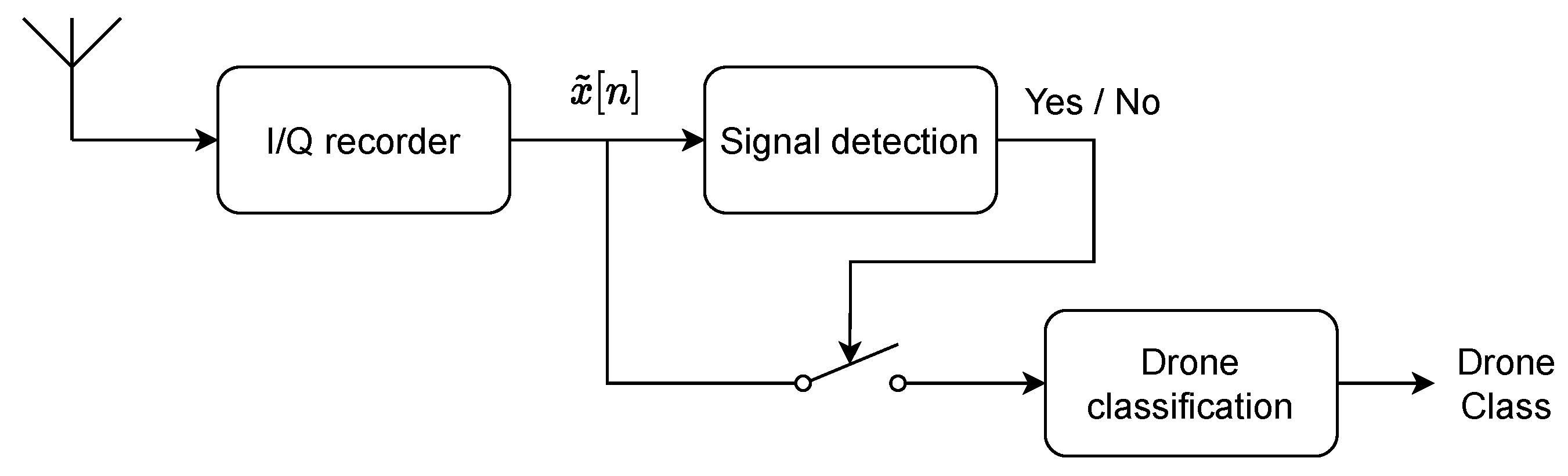
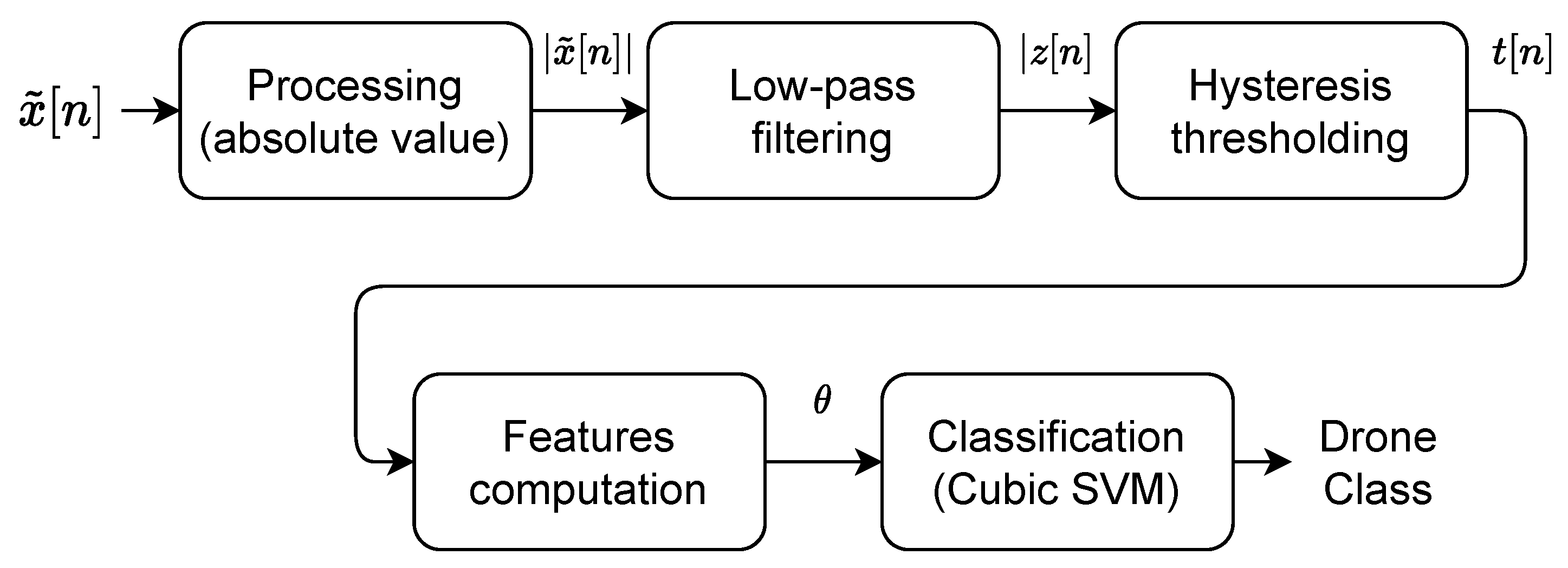
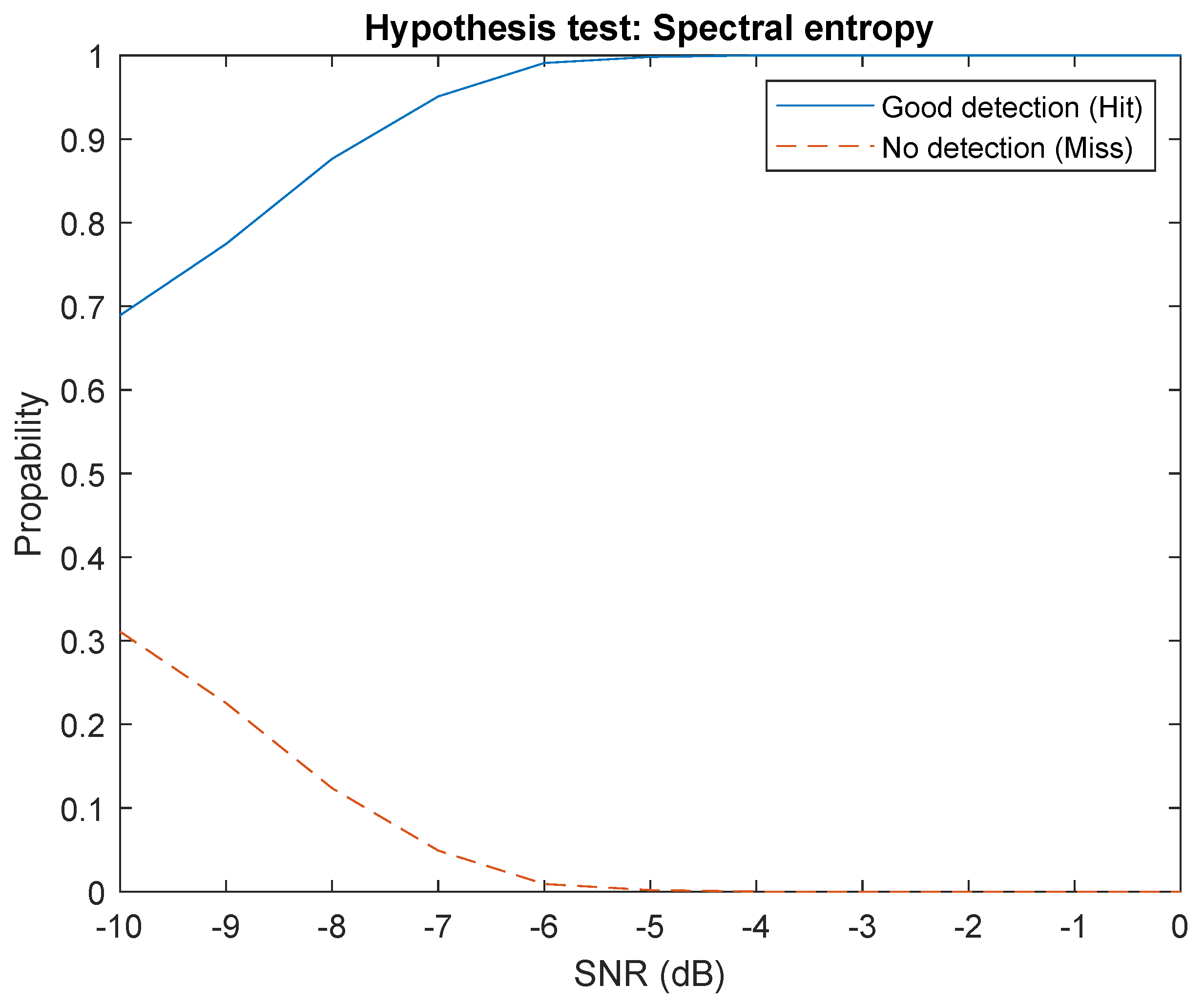
We propose a novel approach for drone detection and classification based on RF communication link analysis. Our approach analyses large signal record including several packets and can be decomposed of two successive steps: signal detection and drone classification. On one hand, the signal detection step is based on Power Spectral Entropy (PSE), a measure of the energy distribution uniformity in the frequency domain. It consists of detecting a structured signal such as a communication signal with a lower PSE than a noise one. On the other hand, the classification step is based on a so-called physical-layer protocol statistical fingerprint (PLSPF). This method extracts the packets at the physical layer using hysteresis thresholding, then computes statistical features for classification based on extracted packets. It consists of performing traffic analysis of communication link between the drone and its controller. Conversely to classic drone traffic analysis working at data link layer (or at upper layers), it performs traffic analysis directly from the corresponding I/Q signal, i.e., at the physical layer. The approach shows interesting properties such as scale invariance, frequency invariance, and noise robustness. Furthermore, the classification method allows us to distinguish WiFi drones from other WiFi devices due to underlying requirement of drone communications such as good reactivity in control. Finally, we propose different experiments to highlight theses properties and performances. The physical-layer protocol statistical fingerprint exploiting communication specificities could also be used in addition of RF fingerprinting method to perform authentication of devices at the physical-layer.
Keywords: drone detection; drone classification; RF sensing; physical-layer authentication drone detection; drone classification; RF sensing; physical-layer authentication