


Modeling the Effects of Urban Design on Emergency Medical Response Calls during Extreme Heat Events in Toronto, Canada
Abstract
1. Introduction
2. Materials and Methods
- M is metabolic heat conducted to the body surface (W m−2),
- R is short- and long-wave radiation absorbed by the human (W m−2),
- H is sensible heat flux (W m−2),
- L is long-wave radiation emitted by the human (W m−2), and
- E is evaporative heat loss (W m−2).
- -
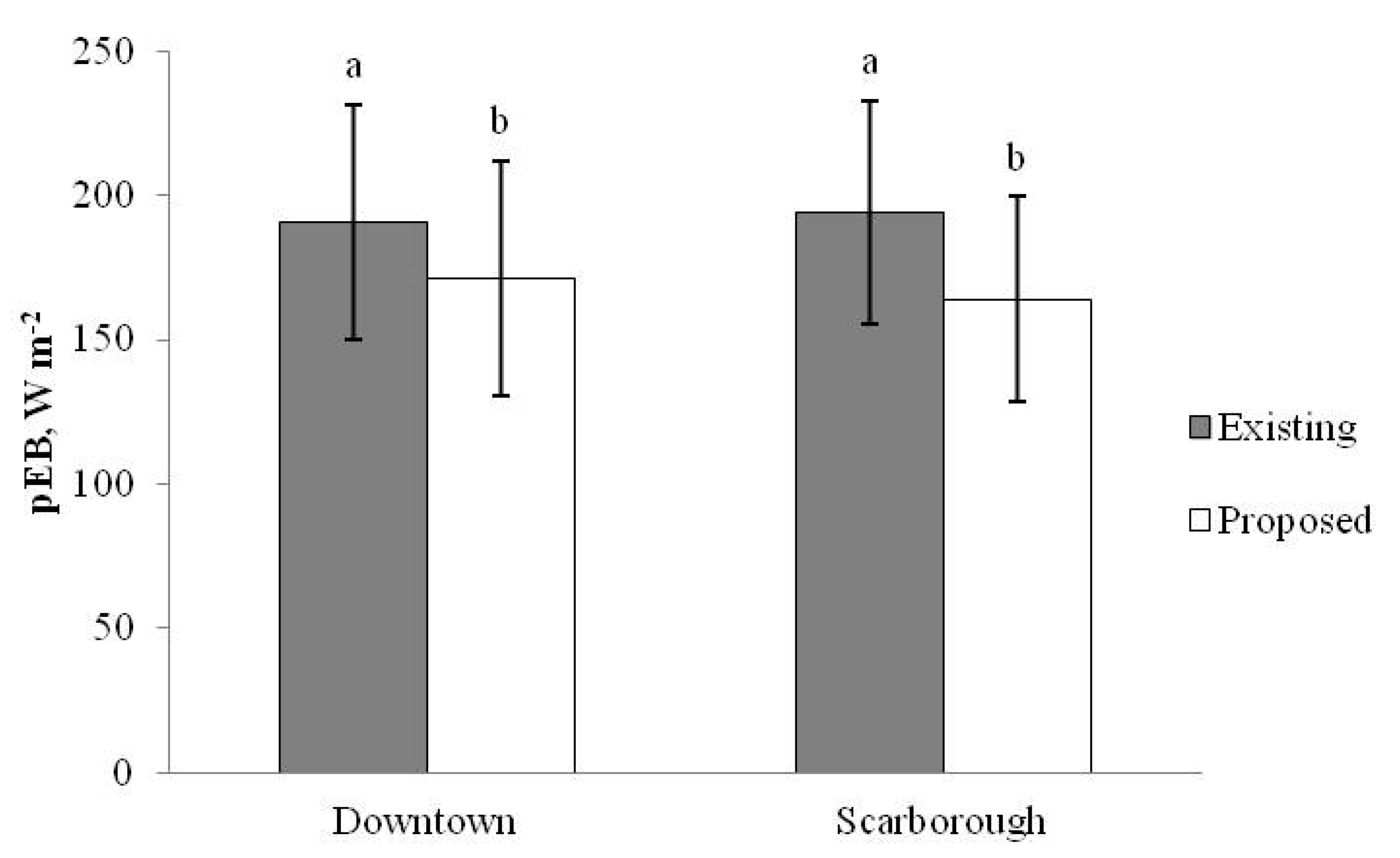
- Addition of deciduous trees, prioritizing areas to the south and west of high foot traffic routes (e.g., sidewalks, trails) and infrastructure (e.g., buildings <10 stories, parking lots, streets).
- -
- Re-alignment of rows of parking stalls from north–south to east–west to maximize shading of the parking lot.
- -
- Replacement of existing dark coloured (low albedo) asphalt pavements in roadways and parking lots with light coloured (high albedo) concrete pavements.
- -
- Replacement of traditional (dark coloured) roofing materials with either a green roof or light coloured (high albedo) roofing material. Note: although buildings are not accounted for in the calculation of EB in the present study, this design strategy would reduce the building’s emitted terrestrial radiation and its demand for air conditioning, which emits terrestrial radiation when in operation.
3. Results
- -
- convective heat loss is minimized as Ta approaches skin temperature (~33 °C) and convective heat gain occurs when Ta exceeds skin temperature [20],
- -
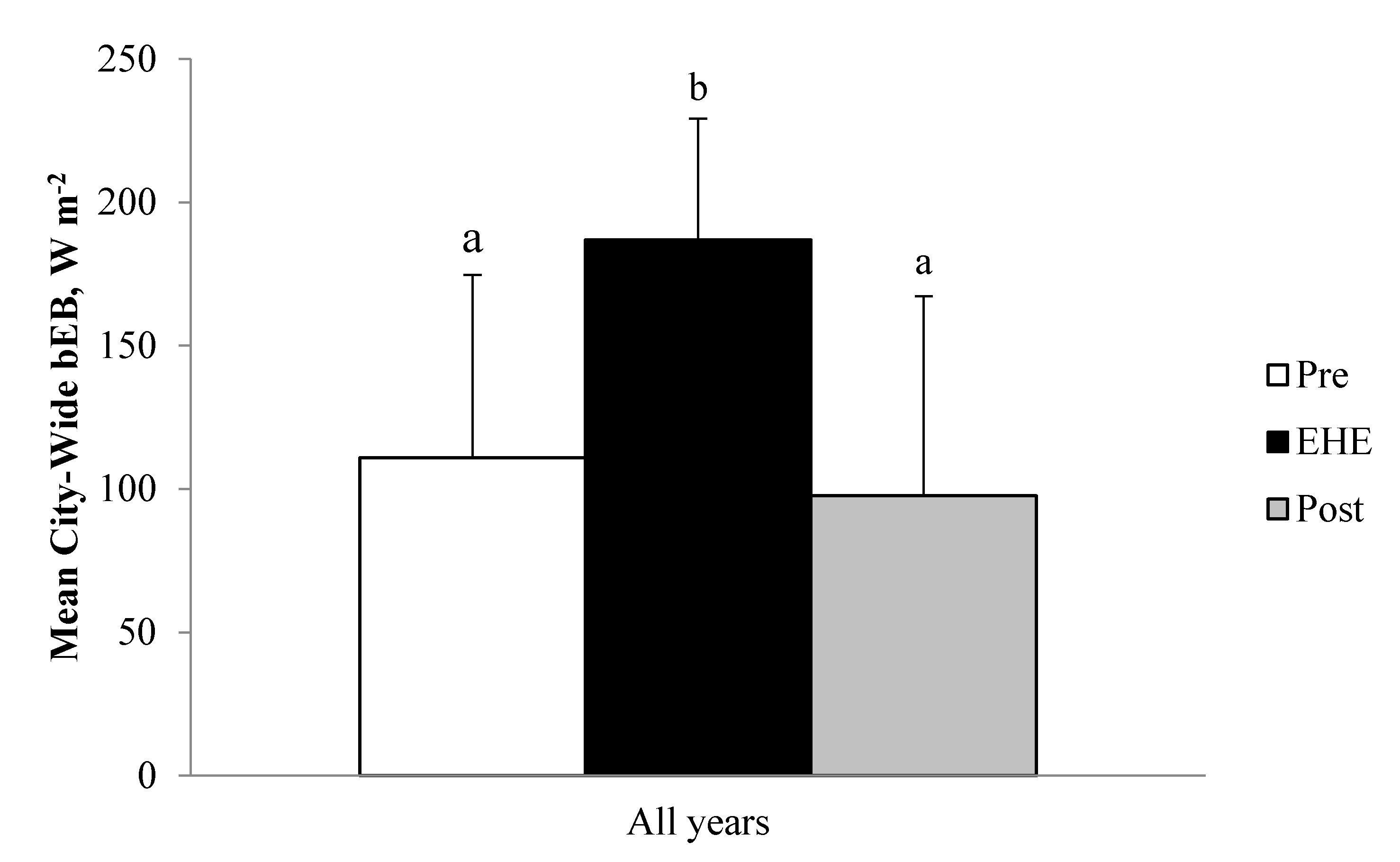
- mean Ta and Tmax during the hottest part (11h00–18h00) of EHE days in Toronto can reach mid- to high-30s (in °C), respectively, thus minimizing the ability of convective heat loss to cool a person down,
- -
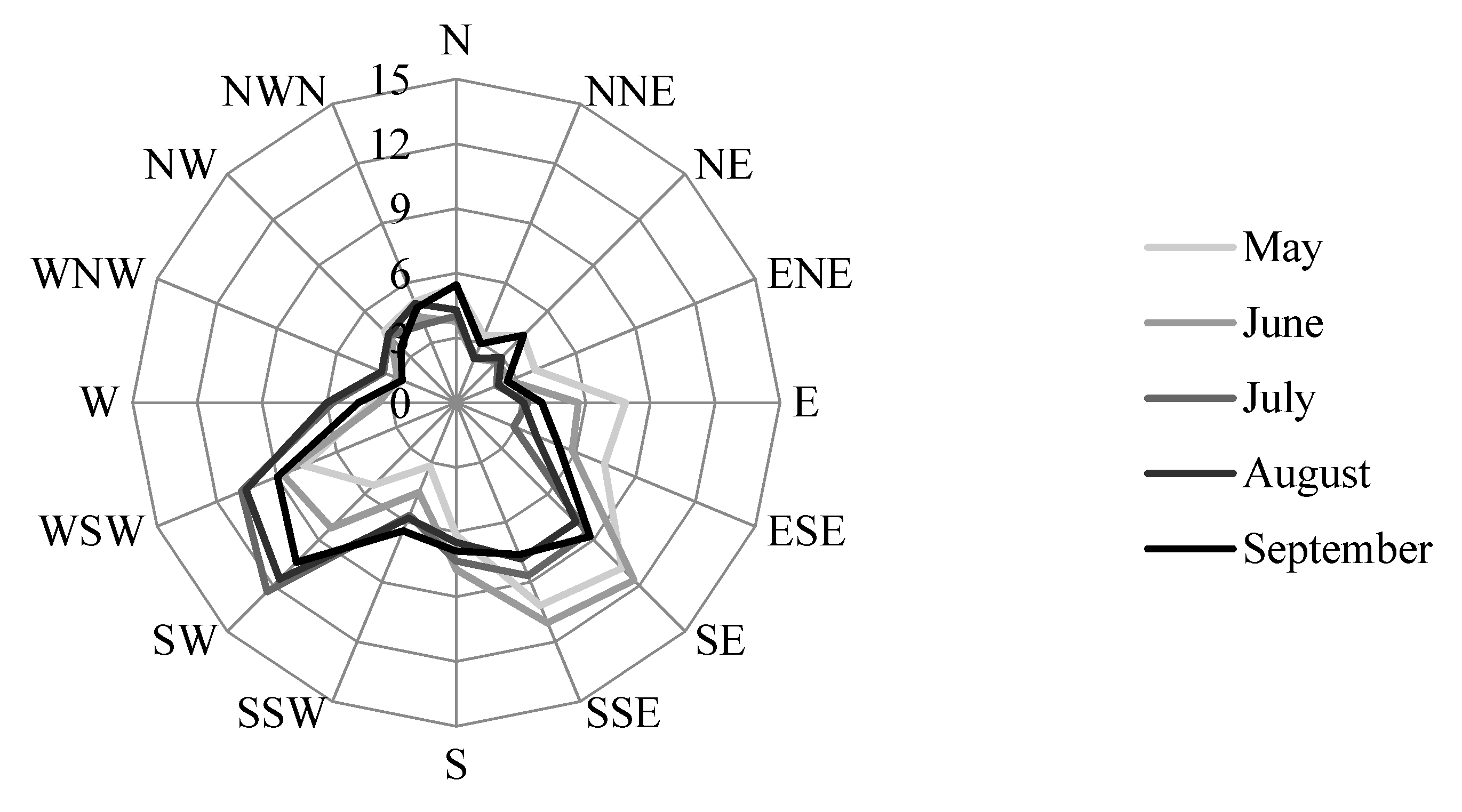
- the predominant winds during sunny summertime conditions are from the SE–WSW in Toronto (Figure 3) and thus inherently conflict with the ideal placement of shade trees to the south and west of outdoor areas populated by humans, and,
- -
- -
- The compounding effects of high vapor pressure and high temperatures during EHEs in Toronto result in minimal changes to overall energy budgets with higher winds, as the vapor gradient between the above the skin and the air is weak [18].
4. Discussion
5. Conclusions
Acknowledgments
Author Contributions
Conflicts of Interest
Appendix A
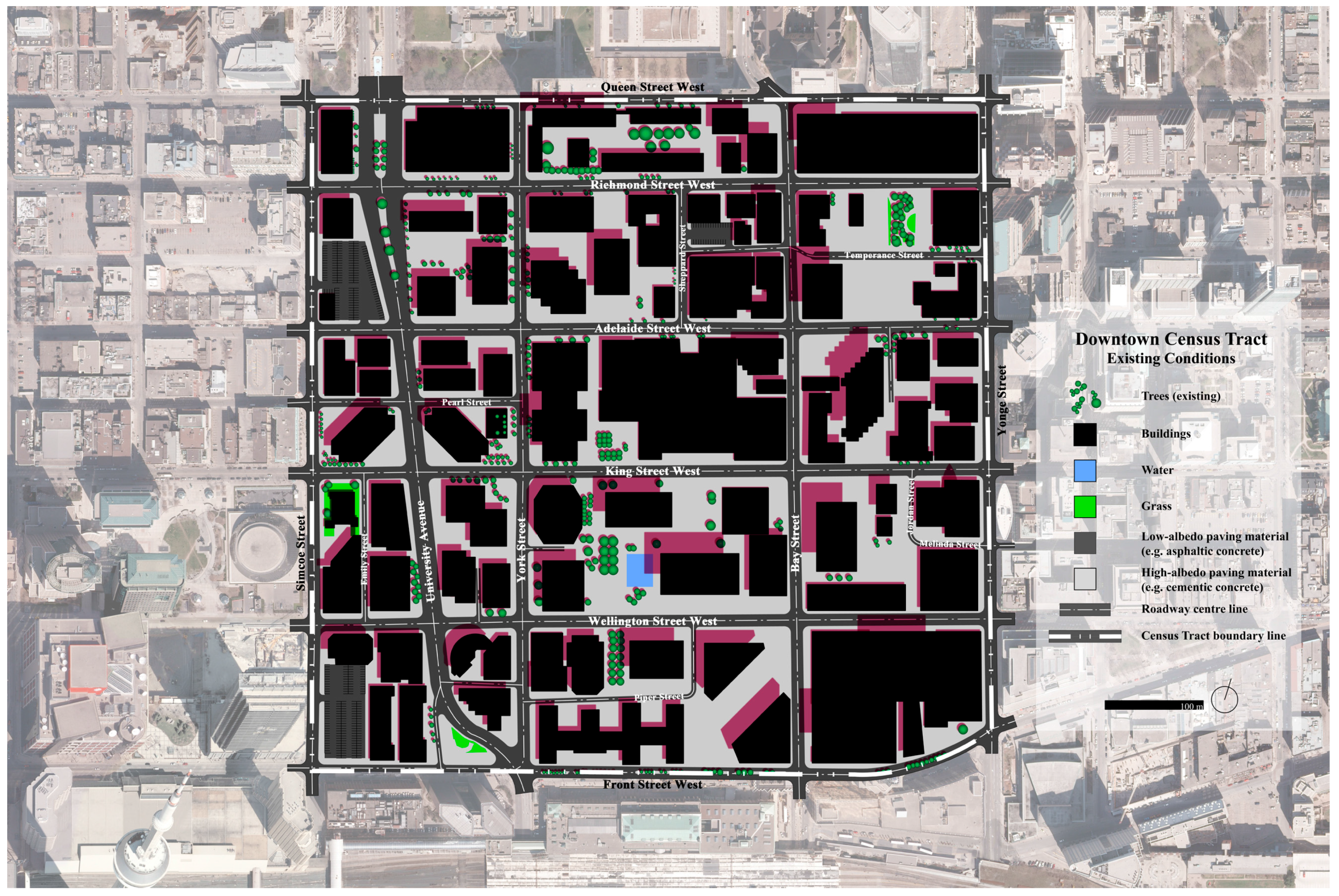
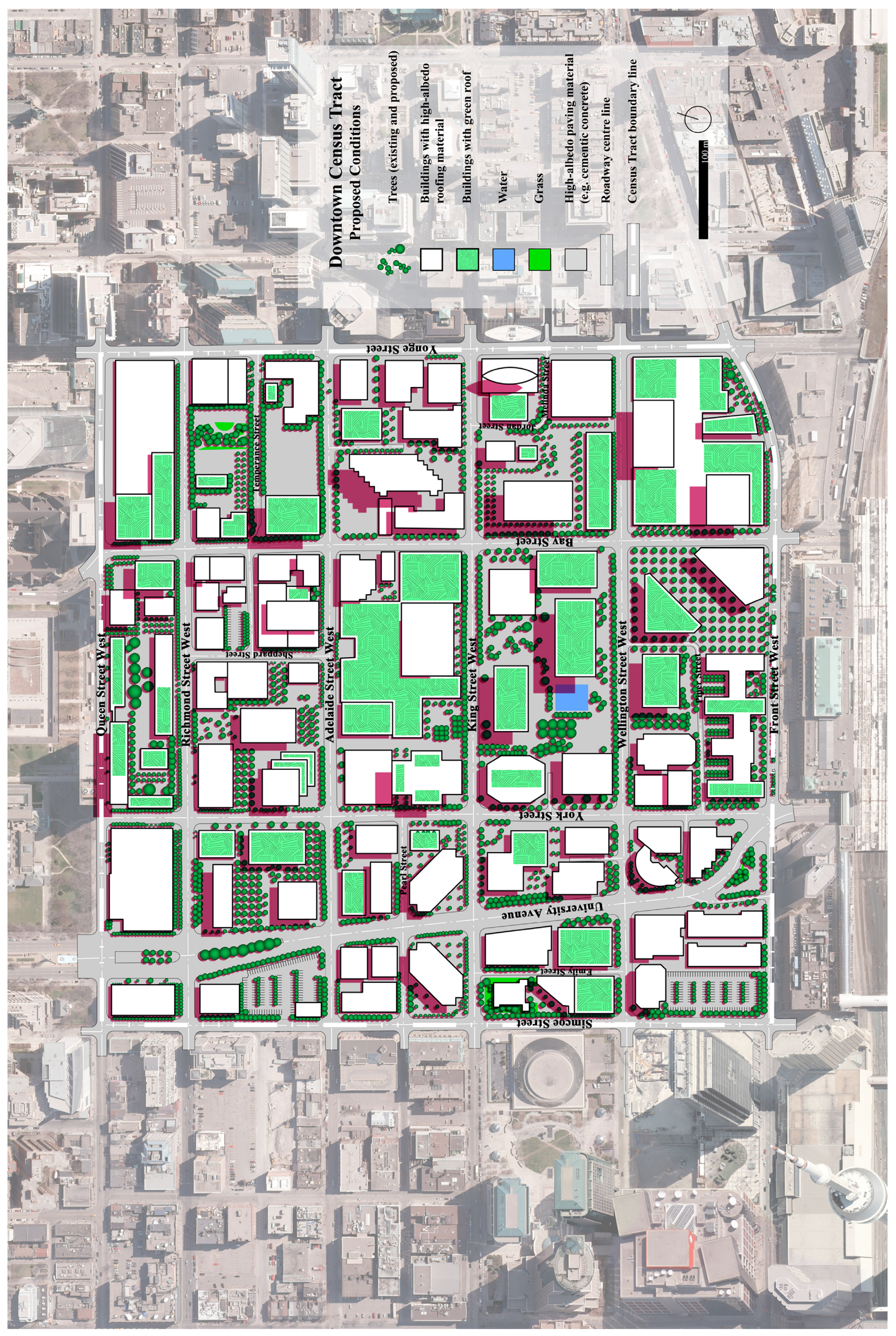
Appendix B
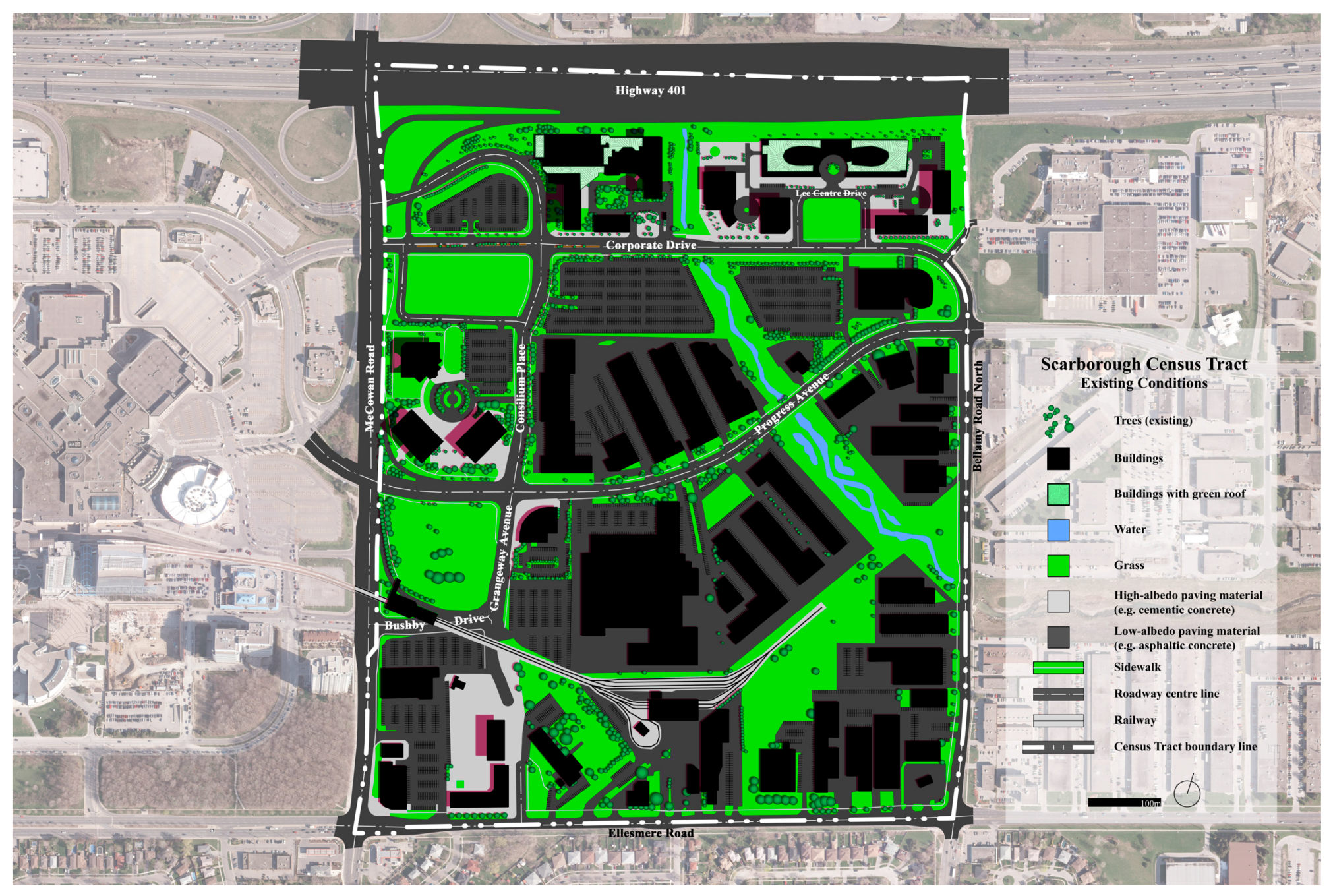
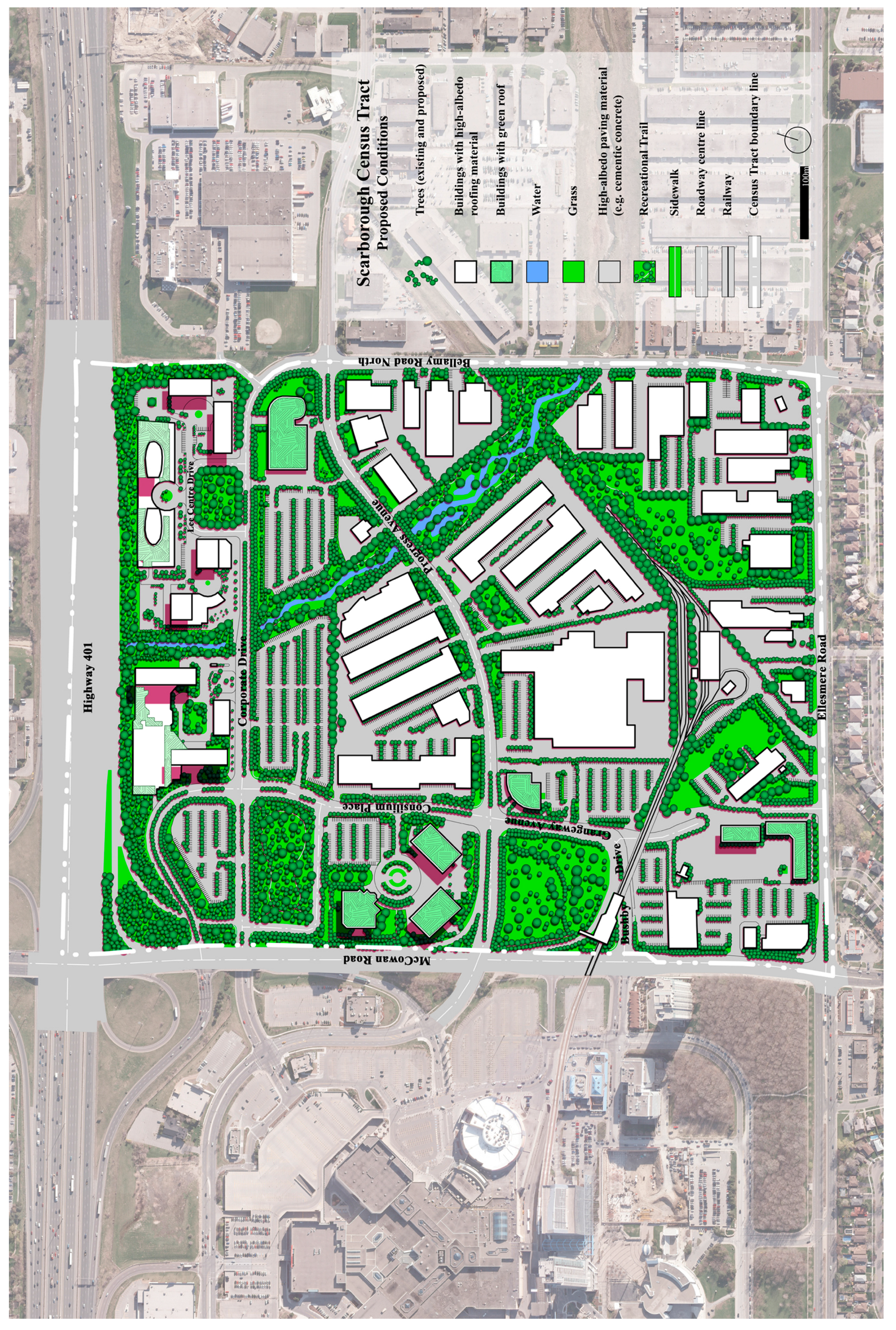
References
- Oke, T.R. The energetic basis of the urban heat island. Q. J. R. Meteorol. Soc. 1982, 108, 1–24. [Google Scholar] [CrossRef] [Scilit]
- Oke, T.R. Boundary Layer Climates; Methuen & Co.: London, UK, 1987; 435p. [Google Scholar]
- Chow, W.T.; Chuang, W.C.; Gober, P. Vulnerability to extreme heat in metropolitan Phoenix: Spatial, temporal, and demographic dimensions. Prof. Geogr. 2012, 64, 286–302. [Google Scholar] [CrossRef] [Scilit]
- Oleson, K.W.; Monaghan, A.; Wilhelmi, O.; Barlage, M.; Brunsell, N.; Feddema, J.; Hu, L.; Steinhoff, D.F. Interactions between urbanization, heat stress, and climate change. Clim. Chang. 2015, 129, 525–541. [Google Scholar] [CrossRef] [Scilit]
- Tan, J.; Zheng, Y.; Tang, X.; Guo, C.; Li, L.; Song, G.; Chen, H. The urban heat island and its impact on heat waves and human health in Shanghai. Int. J. Biometeorol. 2010, 54, 75–84. [Google Scholar] [CrossRef] [Scilit] [PubMed]
- Reid, C.E.; O’Neill, M.S.; Gronlund, C.J.; Brines, S.J.; Brown, D.G.; Diez-Roux, A.V.; Schwartz, J. Mapping community determinants of heat vulnerability. Environ. Health Perspect. 2009, 117, 1730–1736. [Google Scholar] [CrossRef] [Scilit] [PubMed]
- Meehl, G.; Tebaldi, C. More Intense, More Frequent, and Longer Lasting Heat Waves in the 21st Century. Science 2004, 305, 994–997. [Google Scholar] [CrossRef] [Scilit] [PubMed]
- Luber, G.; McGeehin, M. Climate Change and Extreme Heat Events. Am. J. Prev. Med. 2008, 35, 429–435. [Google Scholar] [CrossRef] [Scilit] [PubMed]
- Canadian Institute for Health Information. Urban Physical Environments and Health Inequalities. 2011. Available online: https://secure.cihi.ca/free_products/cphi_urban_physical_environments_en.pdf (accessed on 10 July 2017).
- Smoyer, K.; Rainham, D.; Hewko, J. Heat-stress-related mortality in five cities in Southern Ontario: 1980–1996. Int. J. Biometeorol. 2000, 44, 190–197. [Google Scholar] [CrossRef] [Scilit] [PubMed]
- Toronto Public Health. Differential and Combined Impacts of Winter and Summer Weather and Air Pollution Due to Global Warming on Human Mortality in South-Central Differential and Combined Impacts of Winter and Summer Weather and Air Pollution Due to Global Warming on Human Mortality in South-Central Canada, 2005, 233p. Available online: http://www.toronto.ca/health/hphe/pdf/weather_air_pollution_impacts.pdf (accessed on 10 July 2017).
- Semenza, J.; Rubin, C.; Falter, K.; Selanikio, J.; Flanders, W.; Howe, H.; Wilhelm, J. Heat-related Deaths during the July 1995 Heat Wave in Chicago. N. Engl. J. Med. 1996, 335, 84–90. [Google Scholar] [CrossRef] [Scilit] [PubMed]
- Robine, J.-M.; Cheung, S.; Le Roy, S.; Van Oyen, H.; Griffiths, C.; Michel, J.-P.; Herrmann, F. Death toll exceeded 70,000 in Europe during the summer of 2003. C. R. Biol. 2008, 331, 171–178. [Google Scholar] [CrossRef] [Scilit] [PubMed]
- Centers for Disease Control and Prevention. Heat-Related Deaths—United States, 1999–2003. Morb. Mortal. Wkly. Rep. 2006, 55, 796–798. [Google Scholar]
- Bassil, K.; Cole, D. Effectiveness of Public health interventions in reducing morbidity and mortality during heat episodes: A structured review. Int. J. Environ. Res. Pub. Health 2010, 7, 991–1001. [Google Scholar] [CrossRef] [Scilit] [PubMed]
- Toronto Public Health. Protecting Vulnerable People from Health Impacts of Extreme Heat, 2011, 44p. Available online: http://www.toronto.ca/health/hphe/air_quality/pdf/protecting_ppl_in_extreme_heat.pdf (accessed on 10 July 2017).
- Harlan, S.; Brazel, A.; Prashad, L.; Stefanov, W.; Larsen, L. Neighborhood microclimates and vulnerability to heat stress. Soc. Sci. Med. 2006, 63, 2847–2863. [Google Scholar] [CrossRef] [Scilit] [PubMed]
- Brown, R.D.; Vanos, J.; Kenny, N.; Lenzholzer, S. Designing urban parks that ameliorate the effects of climate change. Landsc. Urban Plan. 2015, 138, 118–131. [Google Scholar] [CrossRef] [Scilit]
- Brown, R.; Gillespie, T. Microclimatic Landscape Design: Creating Thermal Comfort and Energy Efficiency; John Wiley & Sons: New York, NY, USA, 1995; 193p. [Google Scholar]
- Brown, R.D. Design with Microclimate: The Secret to Comfortable Outdoor Space; Island Press: Washington, DC, USA, 2000; 179p. [Google Scholar]
- Brown, R.D. Ameliorating the effects of climate change: Modifying microclimates through design. Landsc. Urban Plan. 2011, 100, 372–374. [Google Scholar] [CrossRef] [Scilit]
- Vanos, J.K.; Warland, J.S.; Gillespie, T.J.; Slater, G.A.; Brown, R.D.; Kenny, N.A. Human energy budget modeling in urban parks in Toronto and applications to emergency heat stress preparedness. J. Appl. Meteorol. Climatol. 2012, 51, 1639–1653. [Google Scholar] [CrossRef] [Scilit]
- Graham, D.A.; Vanos, J.K.; Kenny, N.A.; Brown, R.D. The relationship between neighbourhood tree canopy cover and heat-related ambulance calls during extreme heat events in Toronto, Canada. Urban For. Urban Green. 2016, 20, 180–186. [Google Scholar] [CrossRef] [Scilit]
- Brown, R.D.; Gillespie, T.J. Estimating Outdoor thermal comfort using a cylindrical radiation thermometer and an energy budget model. Int. J. Biometeorol. 1986, 30, 43–52. [Google Scholar] [CrossRef] [Scilit] [PubMed]
- Kenny, N.; Warland, J.; Brown, R.; Gillespie, T. Part A: Assessing the performance of the COMFA outdoor thermal comfort model on subjects performing physical activity. Int. J. Biometeorol. 2009, 53, 415–428. [Google Scholar] [CrossRef] [Scilit] [PubMed]
- Kenny, N.; Warland, J.; Brown, R.; Gillespie, T. Part B: Revisions to the COMFA outdoor thermal comfort model for application to subjects performing physical activity. Int. J. Biometeorol. 2009, 53, 429–441. [Google Scholar] [CrossRef] [Scilit] [PubMed]
- Vanos, J.K.; Warland, J.S.; Gillespie, T.J.; Kenny, N.A. Review of the physiology of human thermal comfort while exercising in urban landscapes and implications for bioclimatic design. Int. J. Biometeorol. 2010, 54, 319–334. [Google Scholar] [CrossRef] [Scilit] [PubMed]
- Vanos, J.; Warland, J.; Gillespie, T.; Kenny, N. Improved predictive ability of climate-human-behaviour interactions with modifications to the COMFA outdoor energy budget model. Int. J. Biometeorol. 2012, 56, 1065–1074. [Google Scholar] [CrossRef] [Scilit] [PubMed]
- Vanos, J.; Warland, J.; Gillespie, T.; Kenny, N. Thermal comfort modelling of body temperature and psychological variations of a human exercising in an outdoor environment. Int. J. Biometeorol. 2012, 56, 21–32. [Google Scholar] [CrossRef] [Scilit] [PubMed]
- Environment Canada. National Climate Data and Information Archive; Government of Canada: Ottawa, ON, Canada, 2012.
- Environment Canada—Atmospheric Environment Services. Climate Normal Wind Direction Data for Toronto (1955–1970); Government of Canada: Ottawa, ON, Canada, 1970.
- Cohen, J. Statistical Power Analysis for the Behavioral Sciences; Academic Press: New York, NY, USA, 1969; 415p. [Google Scholar]
- Vanos, J. Modelling Outdoor Thermal Comfort of Humans Performing Physical Activity: Applications to Health and Emergency Prepareness. Ph.D. Thesis, University of Guelph, Guelph, ON, Canada, 2011; 143p. [Google Scholar]
- Harlan, S.L.; Ruddell, D.M. Climate change and health in cities: Impacts of heat and air pollution and potential co-benefits from mitigation and adaptation. Curr. Opin. Environ. Sustain. 2011, 3, 126–134. [Google Scholar] [CrossRef] [Scilit]
- Brown, R.; LeBlanc, R. Modifying Solar Radiation. In Landscape Architectural Graphics Standards—Student Edition; Hopper, L., Ed.; John Wiley & Sons: Hoboken, NJ, USA, 2007; pp. 40–43. [Google Scholar]
- Vanos, J.K.; Middel, A.; McKercher, G.R.; Kuras, E.R.; Ruddell, B.L. Hot playgrounds and children’s health: A multiscale analysis of surface temperatures in Arizona, USA. Landsc. Urban Plan. 2016, 146, 29–42. [Google Scholar] [CrossRef] [Scilit]
- Hardin, A.W.; Vanos, J.K. The influence of urban surface type on the absorbed radiation by a human under hot conditions. Int. J. Biometeorol. 2017, in press. [Google Scholar] [CrossRef] [Scilit] [PubMed]
- Erell, E.; Pearlmutter, D.; Boneh, D.; Kutiel, P.B. Effect of high-albedo materials on pedestrian heat stress in urban street canyons. Urban Clim. 2014, 10, 367–386. [Google Scholar] [CrossRef] [Scilit]
- Taleghani, M.; Sailor, D.; Ban-Weiss, G.A. Micrometeorological simulations to predict the impacts of heat mitigation strategies on pedestrian thermal comfort in a Los Angeles neighborhood. Environ. Res. Lett. 2016, 11, 024003. [Google Scholar] [CrossRef] [Scilit]
- Stone, B.; Hess, J.J.; Frumkin, H. Urban form and extreme heat events: Are sprawling cities more vulnerable to climate change than compact cities. Environ. Health Perspect. 2010, 118, 1425–1428. [Google Scholar] [CrossRef] [Scilit] [PubMed]

| CT Name | Area (ha) | Area of Toronto | Boundaries (N, S, E, W) |
|---|---|---|---|
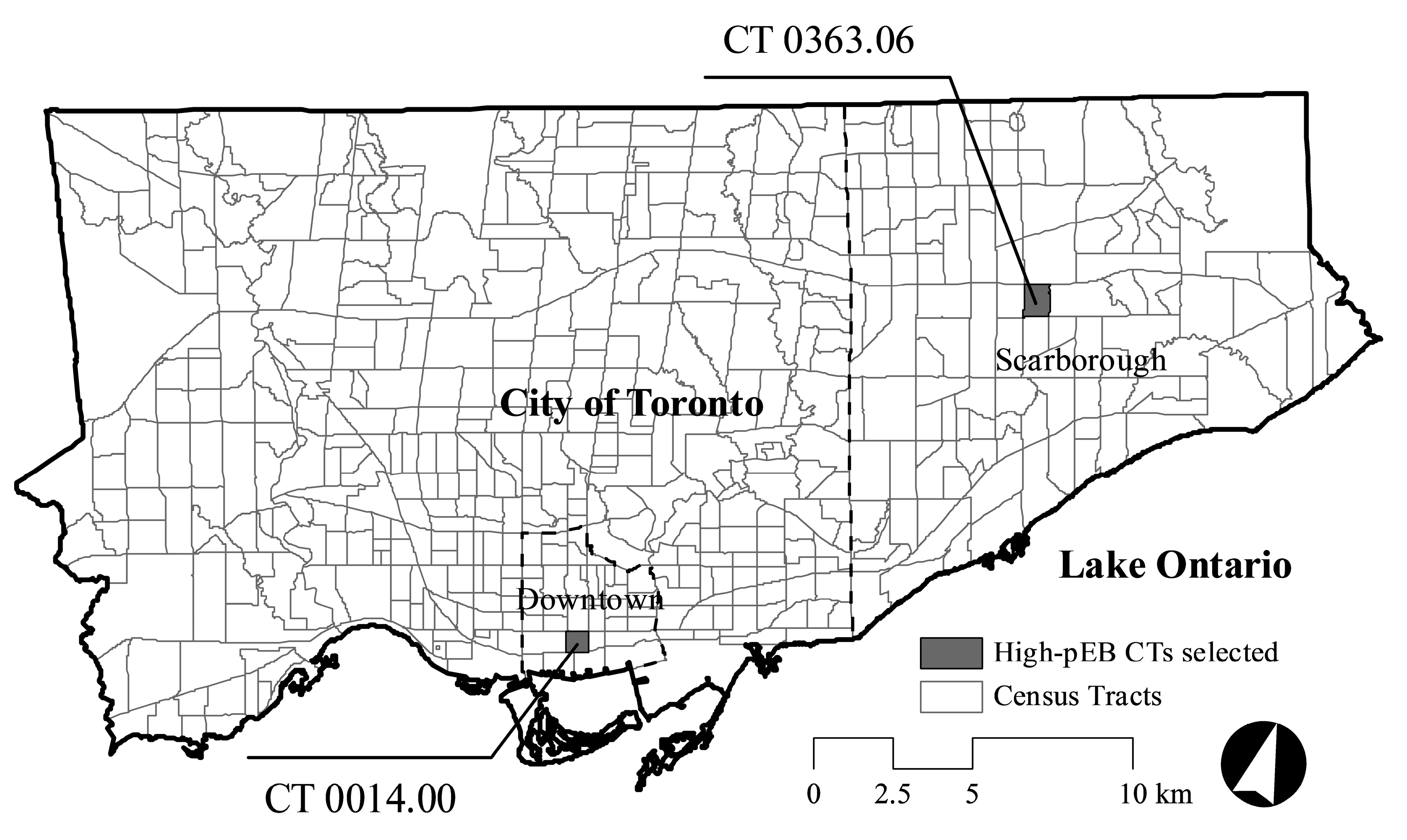
| Downtown | 47.2 | Downtown (south central) | Queen St. W, Front St. W, Yonge St., Simcoe St. |
| Scarborough | 82.9 | Scarborough (east) | Hwy. 401, Ellesmere Rd., Bellamy Rd. N, McCowan Rd. |
| Day Type | All Years | 2005 | 2006 | 2010a | 2010b |
|---|---|---|---|---|---|
| Pre | 25 | 6 | 5 | 7 | 7 |
| EHE | 18 | 4 | 5 | 4 | 5 |
| Post | 26 | 7 | 7 | 5 | 7 |
| Total | 69 | 17 | 17 | 16 | 19 |
| Day Type | Ta (°C) | Tmin (°C) | Tmax (°C) | RH (%) | υ1 (m s−1) |
|---|---|---|---|---|---|
| Mean Pearson + Buttonville | |||||
| Pre | 23.3 ± 3.8 a | 21.0 ± 3.2 a | 24.8 ± 4.0 a | 56.4 ± 16.0 | 4.2 ± 1.3 |
| EHE | 29.7 ± 2.5 b | 27.5 ± 2.7 b | 31.2 ± 2.6 b | 53.8 ± 9.9 | 4.2 ± 1.5 |
| Post | 23.3 ± 3.9 a | 21.4 ± 3.9 a | 24.6 ± 4.0 a | 56.0 ± 14.8 | 5.2 ± 2.2 |
| Study Period | City-Wide bEB (8 h) | Mean Ta (24 h) | Mean Ta (8 h) | Tmax (24 h) | Tmin (24 h) | |||||
|---|---|---|---|---|---|---|---|---|---|---|
| r | p | r | p | r | p | r | p | r | p | |
| 2005 | ||||||||||
| Total calls | 0.432 | 0.083 | 0.733 | 0.001 | 0.692 | 0.002 | 0.683 | 0.003 | 0.637 | 0.006 |
| Heat-related | 0.455 | 0.066 | 0.590 | 0.013 | 0.598 | 0.011 | 0.600 | 0.011 | 0.474 | 0.054 |
| 2006 | ||||||||||
| Total calls | 0.513 | 0.035 | 0.395 | 0.117 | 0.381 | 0.131 | 0.359 | 0.157 | 0.302 | 0.238 |
| Heat-related | 0.616 | 0.009 | 0.557 | 0.020 | 0.567 | 0.018 | 0.555 | 0.021 | 0.382 | 0.130 |
| 2010a | ||||||||||
| Total calls | 0.401 | 0.124 | 0.592 | 0.016 | 0.526 | 0.036 | 0.499 | 0.049 | 0.495 | 0.051 |
| Heat-related | 0.338 | 0.201 | 0.368 | 0.161 | 0.376 | 0.151 | 0.338 | 0.201 | 0.172 | 0.525 |
| 2010b | ||||||||||
| Total calls | 0.627 | 0.004 | 0.710 | 0.001 | 0.700 | 0.001 | 0.690 | 0.001 | 0.501 | 0.029 |
| Heat-related | 0.289 | 0.230 | 0.535 | 0.018 | 0.459 | 0.048 | 0.459 | 0.048 | 0.438 | 0.061 |
| Air Temperature | May | June | July | August | September |
|---|---|---|---|---|---|
| Mean Ta, °C | 12.9 | 17.8 | 20.8 | 19.9 | 15.3 |
| Tmin, °C | 6.9 | 11.9 | 14.8 | 14.0 | 9.6 |
| Tmax, °C | 18.8 | 23.7 | 26.8 | 25.6 | 21.0 |
| Summertime Bright Sunshine | May | June | July | August | September |
|---|---|---|---|---|---|
| Total bright sunshine, h mo−1 | 229.1 | 256.2 | 276.2 | 241.3 | 188.0 |
| Frequency of measurable bright sunshine, d mo−1 | 28.1 | 28.3 | 30.0 | 29.6 | 27.2 |
| Relative amount of bright sunshine, % of daylight hours | 50.3 | 55.5 | 59.1 | 55.7 | 50.0 |
© 2017 by the authors. Licensee MDPI, Basel, Switzerland. This article is an open access article distributed under the terms and conditions of the Creative Commons Attribution (CC BY) license (http://creativecommons.org/licenses/by/4.0/).
Share and Cite
Graham, D.A.; Vanos, J.K.; Kenny, N.A.; Brown, R.D. Modeling the Effects of Urban Design on Emergency Medical Response Calls during Extreme Heat Events in Toronto, Canada. Int. J. Environ. Res. Public Health 2017, 14, 778. https://doi.org/10.3390/ijerph14070778
Graham DA, Vanos JK, Kenny NA, Brown RD. Modeling the Effects of Urban Design on Emergency Medical Response Calls during Extreme Heat Events in Toronto, Canada. International Journal of Environmental Research and Public Health. 2017; 14(7):778. https://doi.org/10.3390/ijerph14070778
Chicago/Turabian StyleGraham, Drew A., Jennifer K. Vanos, Natasha A. Kenny, and Robert D. Brown. 2017. "Modeling the Effects of Urban Design on Emergency Medical Response Calls during Extreme Heat Events in Toronto, Canada" International Journal of Environmental Research and Public Health 14, no. 7: 778. https://doi.org/10.3390/ijerph14070778
APA StyleGraham, D. A., Vanos, J. K., Kenny, N. A., & Brown, R. D. (2017). Modeling the Effects of Urban Design on Emergency Medical Response Calls during Extreme Heat Events in Toronto, Canada. International Journal of Environmental Research and Public Health, 14(7), 778. https://doi.org/10.3390/ijerph14070778

