Prediction of the Maximum Temperature for Life Based on the Stability of Metabolites to Decomposition in Water

Abstract
1. Introduction
2. Method
2.1. Literature Information
2.2. Exclusion Criteria

2.3. Kinetic Analysis
2.4. Limits of Temperature Explored
3. Results
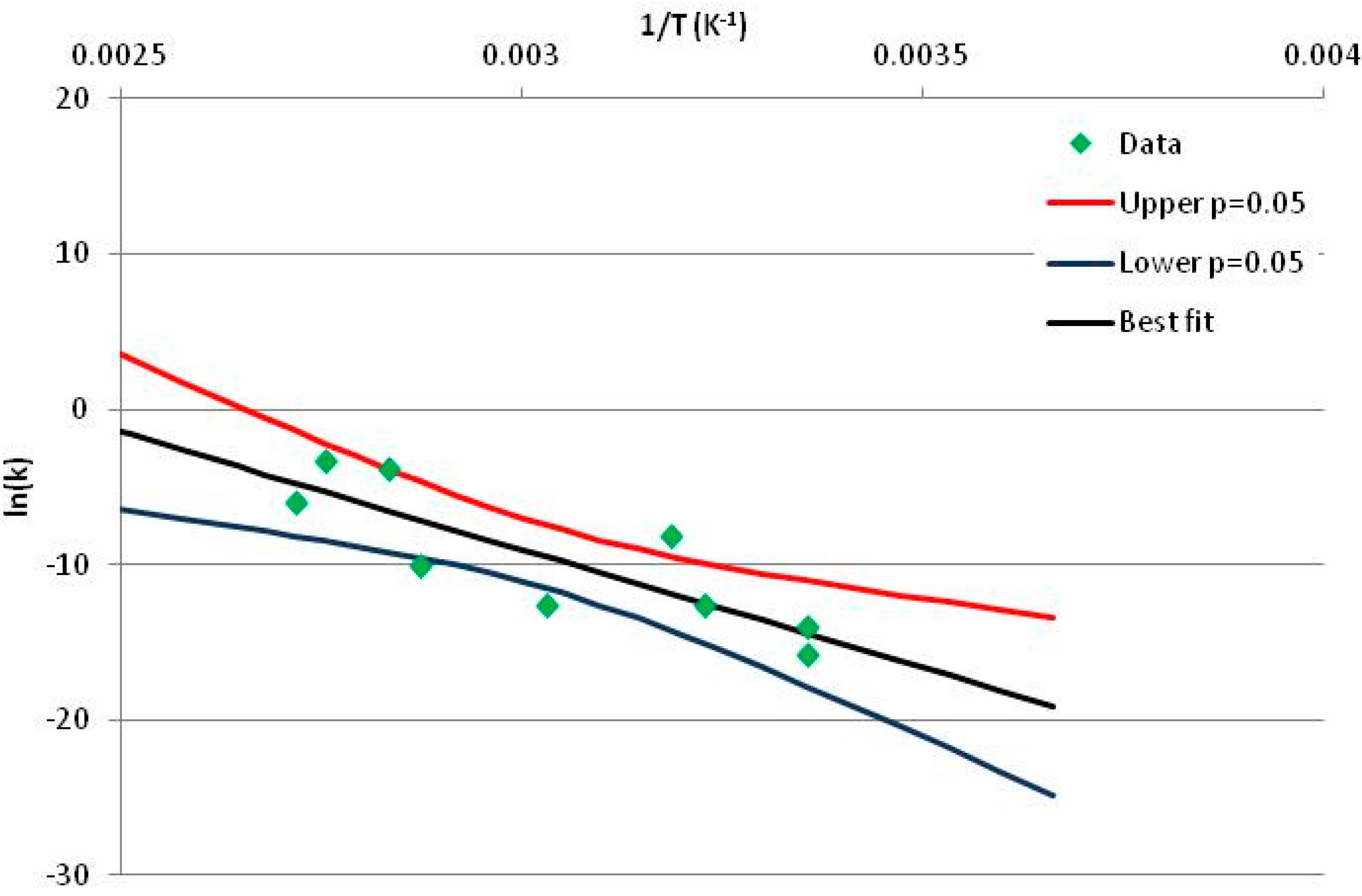
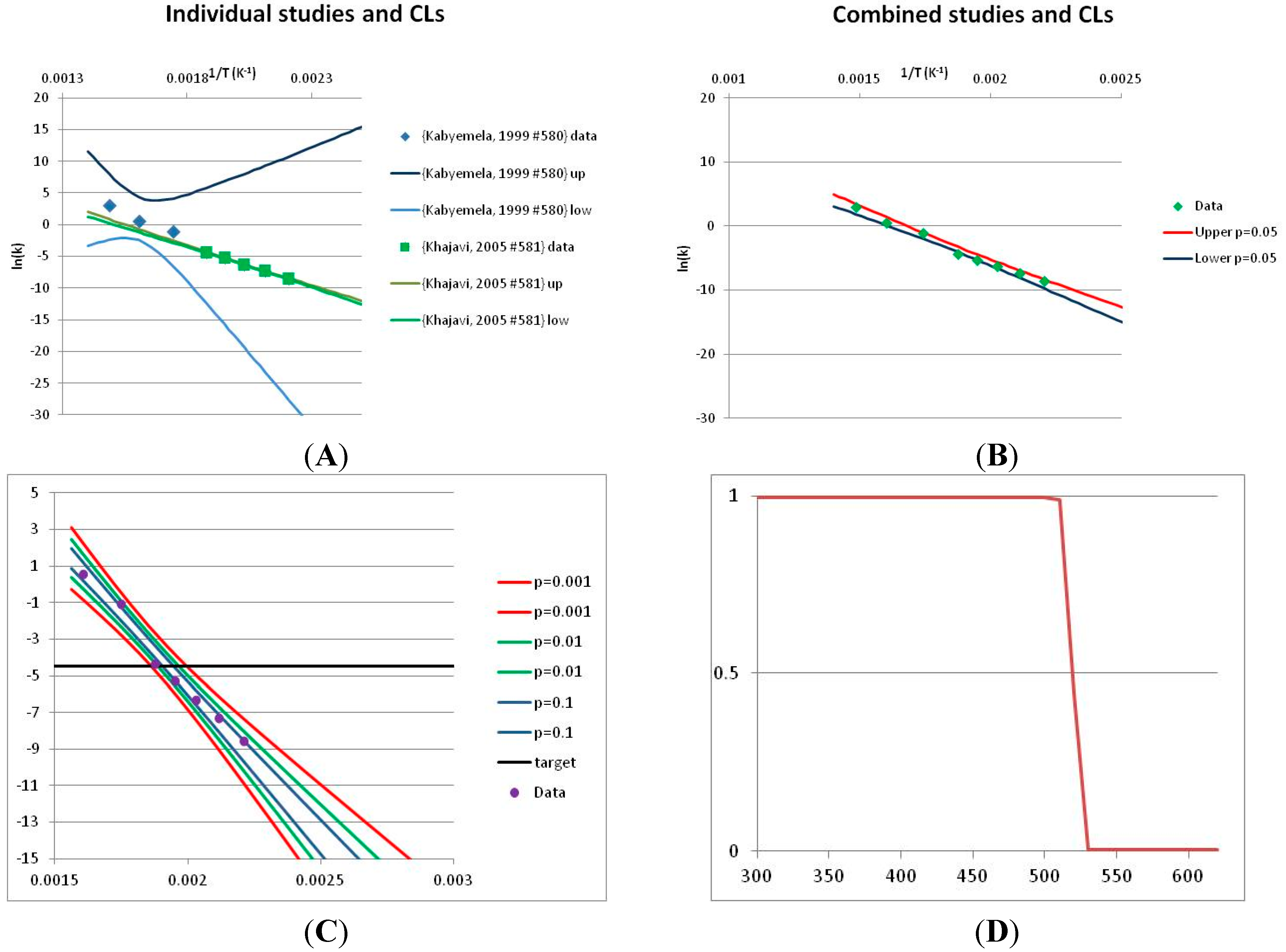
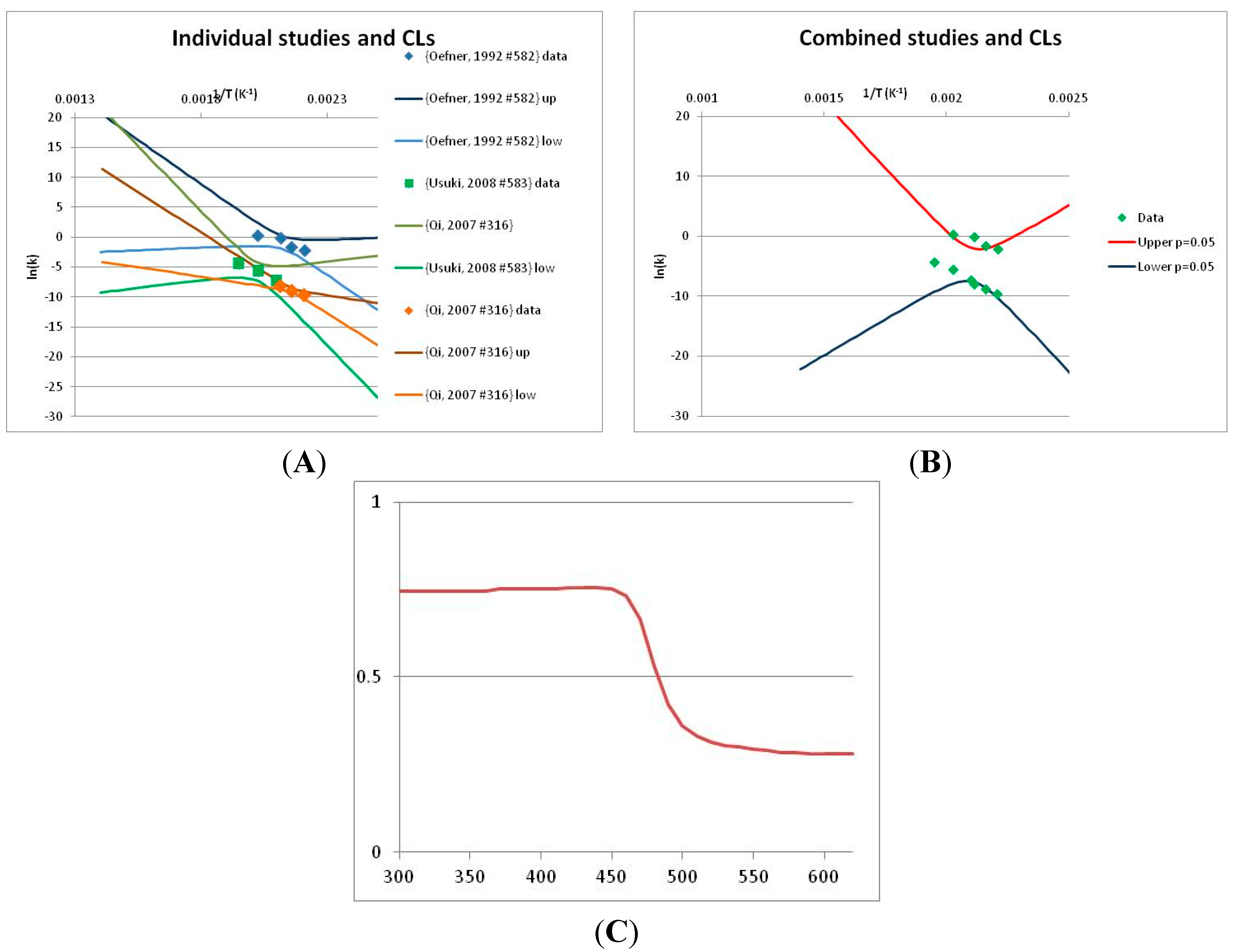
3.1. Illustration of the Method: Fructose and Xylose


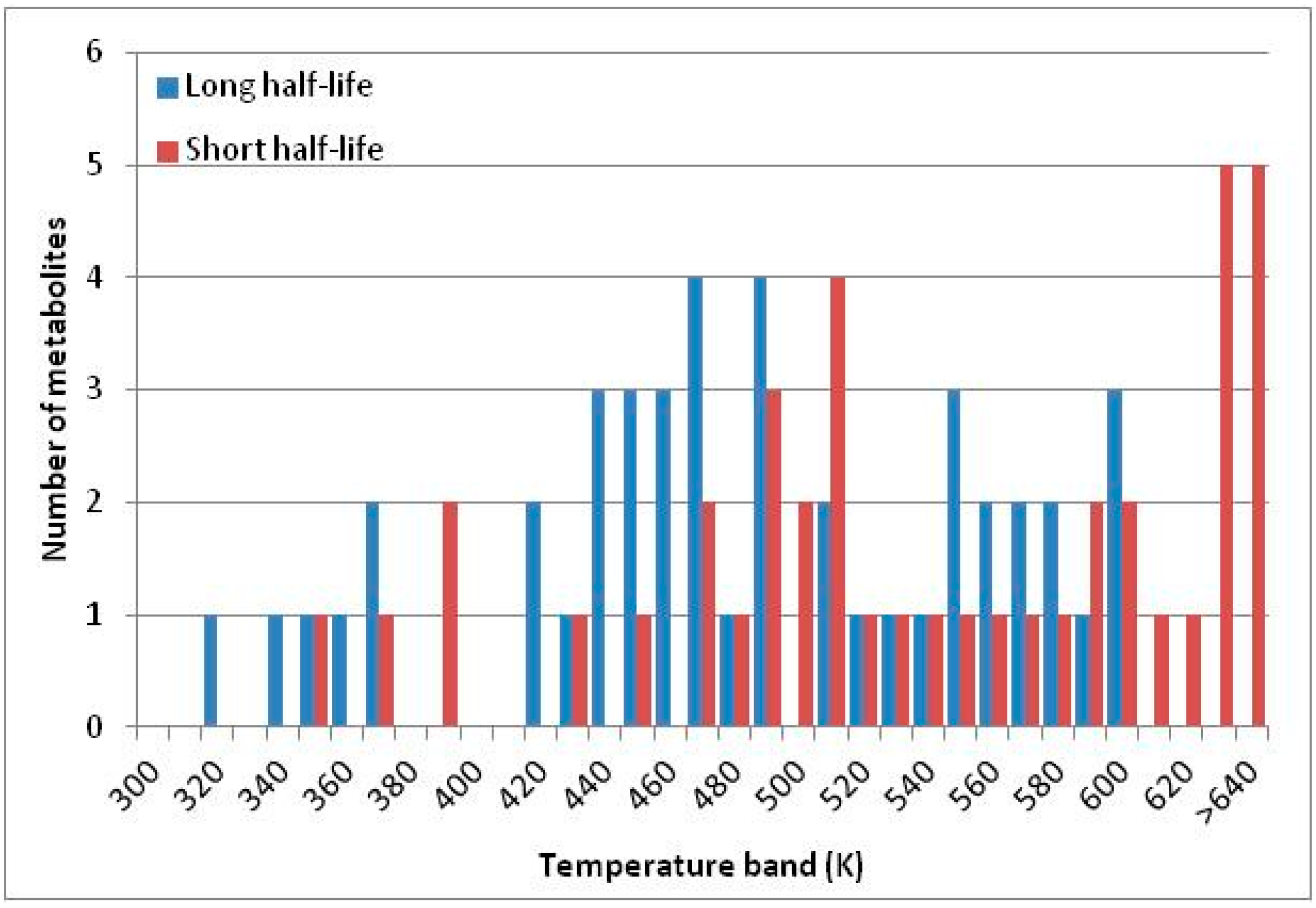
3.2. Definition of Stability

| Category | Code | Specific Metabolites Analysed in This Study | Half-Life | References for Half-Life | |
|---|---|---|---|---|---|
| Long | Short | ||||
| Amino acids | A | Alanine, Alpha-amino butyrate, Asparagine, Aspartate, Glycine, Histidine, Isoleucine, Leucine, Methionine, Phenylalanine, Proline, Serine, Threonine, Tyrosine, Valine | 200 | 20 | [56,57,58,59] |
| Sugars | S | Arabinose, Cellulobiose, Fructose, Galactose, Glucose, Isomaltose, Lactose, Lyxose, Maltose, Mannose, Melibiose, Palatinose, Ribose, Sucrose, Trehalose, Turanose, Xylose | 600 | 60 | [60] |
| Sugar derivatives | D | Glucosamine, N-acetyl glucosamine, | (a) | (a) | |
| Lipids | L | Long chain triglycerides, Phosphatidyl choline | 500 | 5000 | [61,62] |
| Nucleotides and their components | N | Adenine, Adenosine, Adenosine, Cytidine, Cytosine, Deoxyadenosine, Guanine, Thymidine, Uracil | 100 | 10 | [15] |
| Glycolytic intermediates | G | Dihydroxyacetone, Glyceraldehyde, Fructose-1,6-diphosphate, Pyruvate | 10 | 1 | [63,6465] |
| Tricarboxylic acid cycle intermediates | T | Fumarate, Oxaloacetate | 10 | 1 | [60,63] |
| Other intermediary metabolism components | I | 2-Dimethylaminoethanethiol Propionate (thioester analogue), Carbamoyl phosphate, Formic acid, Hypoxanthine, Malonate, Mandelic Acid, Orotic acid, Urea, Xanthine | (b) | (b) | |
| Energy carriers | E | AMP, ATP | 30 | 3 | [60,66] |
| Other carrier molecules | C | Coenzyme A, NADH | 500 (c) | 50 (c) | [67] |
3.3. Summary of Results


| Metabolite | Short Half-Life Vulnerable? | Category |
|---|---|---|
| 2-Dimethylaminoethanethiol Propionate (thio-ester analogue) | √ | Labile |
| Asparagine | - | Labile |
| ATP | - | Labile |
| Carbamoyl phosphate | √ | Labile |
| Deoxyadenosine | - | Labile |
| Glyceraldehyle | √ | Uncertain |
| Histidine | - | Uncertain |
| Long-chain triglycerides | √ | Uncertain |
| Lyxose | √ | Uncertain |
| NADH | √ | Labile |
| Oxaloacetate | √ | Uncertain |
| Palatinose | √ | Uncertain |
| Sucrose | √ | Uncertain |
| Xylose | √ | Uncertain |
4. Discussion
4.1. Pressure Effects
4.2. Limitations of This Study
5. Conclusions
Acknowledgments
Author Contributions
Appendix
| Compound | Metabolite Group Code | Degradation References | Combined Data | Degradation Notes | Metabolic Half-Life | Ref for Half-Life | Stability Confidence Curve | T(p = 0.5) – long | T(p = 0.5) – short |
|---|---|---|---|---|---|---|---|---|---|
| 2-Dimethylaminoethanethiol Propionate (thio-ester analogue) | I | [99] |  | Included as an analogue of Thioesters |  | 345.7 | 384.7 | ||
| Adenine | N | [100] |  |  | 586 | 668.8 | |||
| Adenosine | N | [101,102] |  | Includes deamination and cleavage of glycosidiv bond |  | 482.9 | 513.9 | ||
| Alanine | A | [103,104,105,106] |  | 20 | [56] |  | 568.4 | 597.8 | |
| Alpha-amino butyrate | A | [105] |  |  | 586.7 | 620 | |||
| AMP | E | [101] |  | 120 | [60] |  | 440.7 | 475.7 | |
| Arabinose | S | [49] |  | Marginal data quality, analysed anyway. |  | 480.6 | 528.5 | ||
| Asparagine (Side-chain) | A | [107] |  |  | 385.4 | 419.8 | |||
| Aspartate | A | [106,108,109] |  | 150 | [56] |  | 499.3 | 542.4 | |
| ATP | E | [25,101] |  | 45 1 | [60,66,110] |  | 414.5 | 442.3 | |
| Carbamoyl phosphate | I | [55] |  | 5 |  | 362 | 396.7 | ||
| Cellulobiose | S | [111] |  |  | 477.9 | 513.2 | |||
| Coenzyme A | C | [112] |  | 120 |  | 507.6 | 699 | ||
| Cytidine | N | [113] [skipped – inconsistent with three others] [114,115,116] |  | Data from Snider was inconsistent with other data sets, and so was excluded |  | 465.1 | 497 | ||
| Cytosine | N | [100,114,117] |  |  | 467.7 | 495.8 | |||
| Deoxyadenosine (deamination) | N | [118] |  |  | 377.5 | 463 | |||
| Dihydroxyacetone | G | [119] |  | 271 2.7 10 | [63] [64] [65] |  | 552.5 | 654.8 | |
| Formic acid | I | [120,121] |  |  | 614.4 | 692.6 | |||
| Fructose | S | [46,47] |  |  | 484 | 519.6 | |||
| Fructose-1,6-diphosphate | G | [122] |  | 0.6 10 | [64] [65] |  | 467.1 | 511.8 | |
| Fumarate | T | [123] |  | 310 0.9 4 | [63] [64] [124] |  | 643 | 720.1 | |
| Galactose | S | [47] |  |  | 495.6 | 520.6 | |||
| Glucosamine | D | [125] |  |  | 492.1 | 551.3 | |||
| Glucose | S | [46,47,50] |  | 600 | [60] |  | 499.6 | 537.3 | |
| Glyceraldehyde | G | [119] |  | 2.7 10 | [64] [65] |  | 420.9 | 685.3 | |
| Glycine | A | [103,105,106,126,127] |  | 30 | [56] |  | 533.9 | 608.8 | |
| Guanine | N | [100] |  |  | 551.5 | 605.7 | |||
| Histidine | A | [105,128] |  |  | 873.6 | 7626.1 | |||
| Hypoxanthine | I | [100] |  |  | 516.9 | 572.2 | |||
| Isoleucine | A | [103,105,128] |  |  | 582.3 | 620.8 | |||
| Isomaltose | S | [111] |  |  | 478.4 | 509.1 | |||
| Lactose | S | [111] |  |  | 450.9 | 499.4 | |||
| Leucine | A | [103,105,128,129,130] |  | 45 | [57,58] |  | 563.8 | 601.8 | |
| Long chain triglycerides | L | [131] |  |  | 340.1 | 397.8 | |||
| Lyxose | S | [49] |  |  | 474.9 | 518.2 | |||
| Malonate | I | [132,133] |  |  | 456.4 | 515.9 | |||
| Maltose | S | [47,111] |  |  | 470.3 | 509.7 | |||
| Mandelic Acid (racemization) | I |  |  | 605 | 665.2 | ||||
| Mannose | S | [47] |  |  | 463.9 | 515.7 | |||
| Melibiose | S | [111] |  |  | 462 | 494 | |||
| Methionine | A | [103,105,128] |  |  | 546.5 | 581.3 | |||
| N-acetyl glucosamine | D | [125] |  |  | 429.5 | 458.8 | |||
| NADH | C | [27,28,29,30,31] |  |  | 352.3 | 372.2 | |||
| Orotic acid | I | [134] |  |  | 605 | 665.2 | |||
| Oxaloacetate | T | [135] |  | 319 1000 | 2.7 |  | 328.5 | 355.8 | |
| Palatinose | S | [111] |  |  | 459.1 | 493.3 | |||
| Phenylalanine | A | [103,105,128,129] |  | 180 | [59] |  | 569.1 | 613.6 | |
| Phosphatidyl choline | L | [136] |  | 3000 (phosphatidyl glycerol) 3600 | [61,62] |  | 472.3 | 544.3 | |
| Proline | A | [105] |  |  | 601.1 | 640.1 | |||
| Pyruvate | G | [137] |  | 294 | [63] |  | 570.9 | 620.6 | |
| Ribose | S | [49,138] |  |  | 440.4 | 516.3 | |||
| Serine | A | [103,105,106,128] |  |  | 525.7 | 560.9 | |||
| Sucrose | S | [139] |  |  | 375.5 | 430.3 | |||
| Threonine | A | [105] |  |  | 516 | 554.7 | |||
| Thymidine | N | [100] |  |  | 552.4 | 597.1 | |||
| Trehalose | S | [111] |  |  | 496.1 | 525.8 | |||
| Turanose | S | [111] |  |  | 449.3 | 478.1 | |||
| Tyrosine | A | [128] |  |  | 589.5 | 710.4 | |||
| Uracil | N | [100] |  |  | 552.4 | 597.1 | |||
| Urea | I | [140] |  |  | 446.3 | 475.5 | |||
| Valine | A | [103,105,130] |  | 40 | [56] |  | 577.4 | 600.6 | |
| Xanthine | I | [100] |  |  | 595 | 660.5 | |||
| Xylose | S | [48,49,50] |  |  | 434 | 482.3 |
Conflicts of Interest
References
- Clarke, A. The thermal limits to life on Earth. Int. J. Astrobiol. 2014, 13, 141–154. [Google Scholar]
- Bains, W. Hypotheses, limits, models and Life. Life 2015, 5, 1–3. [Google Scholar]
- Clarke, A.; Morris, G.J.; Fonseca, F.; Murray, B.J.; Acton, E.; Price, H.C. A Low Temperature Limit for Life on Earth. PLoS One 2013, 8, e66207. [Google Scholar]
- Takai, K.; Nakamura, K.; Toki, T.; Tsunogai, U.; Miyazaki, M.; Miyazaki, J.; Hirayama, H.; Nakagawa, S.; Nunoura, T.; Horikoshi, K. Cell proliferation at 122 °C and isotopically heavy CH4 production by a hyperthermophilic methanogen under high-pressure cultivation. Proc. Natl. Acad. Sci. USA 2008, 105, 10949–10954. [Google Scholar]
- Kashefi, K.; Lovley, D.R. Extending the upper temperature limit for life. Science 2003, 301, 934. [Google Scholar]
- Deming, J.W.; Baross, J.A. Deep-sea smokers: Windows to a subsurface biosphere? Geochim. Cosmochim. Acta 1993, 57, 3219–3230. [Google Scholar]
- Cowan, D.A. The upper temperature for life—where do we draw the line? Trends Microbiol. 2004, 12, 58–60. [Google Scholar]
- Holden, J. Some like it hot: understanding the limits of life using hyperthermophilic microbes. In Proceedings of 37th COSPAR Scientific Assembly, Montreal, Canada, 13–20 July 2008; p. 1259.
- Kelley, D.S.; Girguis, P.R.; Wheat, G.; Cordes, E.; Schrenk, M.O.; Lin, M.; Baross, J.A.; Delaney, J.R. Towards Determining the Upper Temperature Limit to Life. Available online: http://adsabs.harvard.edu/abs/2007AGUFM.V23D..02K (accessed on 6 March 2015).
- Danson, M.J.; Hough, D.W. The enzymology of archebacterial pathways of central metabolism. In Biochemical Society Symposium: The archebacteria: Biochemistry and Biotechnology; Danson, M.J., Hough, D.W., Lunt, G.G., Eds.; Portland Press: London, UK, 1992; pp. 7–22. [Google Scholar]
- Katritzky, A.R.; Allin, S.M.; Siskin, M. Aquathermolysis: Reactions of organic compounds with superheated water. Acc. Chem. Res. 1996, 29, 399–406. [Google Scholar]
- Kruse, A.; Dinjus, E. Hot compressed water as reaction medium and reactant 2. Degradation reactions. J. Supercrit. Fluids 2007, 41, 361–379. [Google Scholar]
- Wolfenden, R. Degrees of Difficulty of Water-Consuming Reactions in the Absence of Enzymes. Chem. Rev. 2006, 106, 3379–3396. [Google Scholar]
- Savage, P.E. Organic chemical reactions in supercritical water. Chem. Rev. 1999, 99, 603–621. [Google Scholar]
- Neuhard, J.; Thomassen, E. Turnover of the Deoxyribonucleoside Triphosphates in Escherichia coli 15 T during Thymine Starvation. Eur. J. Biochem. 1971, 20, 36–43. [Google Scholar]
- Lang, E.W. Physical-chemical limits for the stability of biomolecules. Adv. Space Res. 1986, 6, 251–255. [Google Scholar]
- White, R.H. Hydrolytic stability of biomolecules at high temperatures and its implications for life at 250 °C. Nature 1984, 310, 430–432. [Google Scholar]
- Bernhardt, G.; Lüdemann, H.D.; Jaenicke, R.; König, H.; Stetter, K.O. Biomolecules are unstable under “black smoker” conditions. Naturwissenschaften 1984, 71, 583–586. [Google Scholar]
- Trent, J.D.; Chastain, R.A.; Yayanos, A.A. Possible artefactual basis for apparent bacterial growth at 250 °C. Nature 1984, 307, 737–740. [Google Scholar]
- Jaenicke, R. Protein stability and molecular adaptation to extreme conditions. Eur. J. Biochem. 1991, 202, 715–728. [Google Scholar]
- Committee on the origins and Evolution of Life. The limits of Organic Life in Planetary Systems; National Research Council: Washington, DC, USA, 2007. [Google Scholar]
- Schofield, L.R.; Patchett, M.L.; Parker, E.J. Expression, purification, and characterization of 3-deoxy-d-arabino-heptulosonate 7-phosphate synthase from Pyrococcus furiosus. Protein Expr. Purif. 2004, 34, 17–27. [Google Scholar]
- Daniel, R.M.; Danson, M.J. Assaying Activity and Assessing Thermostability of Hyperthermophilic Enzymes. Methods Enzymol. 2001, 334, 283–293. [Google Scholar]
- Daniel, R.M.; Cowan, D.A. Biomolecular stability and life at high temperatures. Cell. Mol. Life Sci. 2000, 57, 250–264. [Google Scholar]
- Daniel, R.M.; van Eckert, R. The stability of biomolecules and the implications for life at high temperatures. In The Subseafloor Biosphere at Mid-Ocean Ridges: AGU Monograph 144; Wilcock, W.S.D., Delong, E.F., Kelley, D.S., Baross, J.A., Cary, S.C., Eds.; American Geophysical Union: Washington, DC, USA, 2004. [Google Scholar]
- Consalvi, V.; Chiaraluce, R.; Politi, L.; Vaccaro, R.; De Rosa, M.; Scandurra, R. Extremely thermostable glutamate dehydrogenase from the hyperthermophilic archaebacterium Pyrococcus furiosus. Eur. J. Biochem. 1991, 202, 1189–1196. [Google Scholar]
- McComb, R.B.; Bond, L.W.; Burnett, R.W.; Keech, R.C.; Bowers, G.N., Jr. Determination of the molar absorptivity of NADH. Clin. Chem. 1976, 22, 141–150. [Google Scholar]
- Wu, J.T.; Wu, L.H.; Knight, J.A. Stability of NADPH: Effect of various factors on the kinetics of degradation. Clin. Chem. 1986, 32, 314–319. [Google Scholar]
- Hudson, R.C.; Ruttersmith, L.D.; Daniel, R.M. Glutamate dehydrogenase from the extremely thermophilic archebacterial isolate AN1. Biochem. Biophys. Acta 1993, 1202, 244–250. [Google Scholar]
- Robb, F.T.; Park, J.-B.; Adams, M.W.W. Characterization of an extremely thermostable glutame dehydrogenase: A key enzyme in the primary metabolism of the hyperthermophilic archaebacterium Pyrococcus furiosus. Biochem. Biophys. Acta 1992, 1120, 267–272. [Google Scholar]
- Walsh, K.A.J.; Daniel, R.M.; Morgan, H.W. A soluble NADH dehydrogenase (NADH:ferricyanide oxireductase) from Thermus aquaticus strain T351. Biochem. J. 1983, 209, 427–433. [Google Scholar]
- Nicotri, M.E. Factors involved in herbivore food preference. J. Exp. Mar. Biol. Ecol. 1980, 42, 13–26. [Google Scholar]
- Bratbak, G.; Dundas, I. Bacterial dry matter content and biomass estimations. Appl. Environ. Microbiol. 1984, 48, 755–757. [Google Scholar]
- Ricketts, T.R. On the chemical composition of some unicellular algae. Phytochemistry 1966, 5, 67–76. [Google Scholar]
- Bakken, L.R.; Olsen, R.A. Buoyant Densities and Dry-Matter Contents of Microorganisms: Conversion of a Measured Biovolume into Biomass. Appl. Environ. Microbiol. 1983, 45, 1188–1195. [Google Scholar]
- Lang, G.; Reiners, W.; Heier, R. Potential alteration of precipitation chemistry by epiphytic lichens. Oecologia 1976, 25, 229–241. [Google Scholar]
- Chandler, S.F.; Thorpe, T.A. Characterization of Growth, Water Relations, and Proline Accumulation in Sodium Sulfate Tolerant Callus of Brassica napus L. cv Westar (Canola). Plant Physiol. 1987, 84, 106–111. [Google Scholar]
- Black, M.; Corbineau, F.; Gee, H.; Côme, D. Water Content, Raffinose, and Dehydrins in the Induction of Desiccation Tolerance in Immature Wheat Embryos. Plant Physiol. 1999, 120, 463–472. [Google Scholar]
- Xiao, Y. Chemical Kinetic Estimate of the Maximum Temperature for Life; Department of Chemical Engineering And Biotechnology, University of Cambridge: Cambridge, UK, 2014. Available online: http://www.undergraduate.study.cam.ac.uk/courses/chemical-engineering (accessed on 19 March 2015).
- Yu, C. Chemical Kinetic Estimate of the Maximum Temperature for Life; Department of Chemical Engineering And Biotechnology, University of Cambridge: Cambridge, UK, 2014. Available online: http://www.undergraduate.study.cam.ac.uk/courses/chemical-engineering (accessed on 19 March 2015).
- Antal, M.J.; Allen, S.G.; Schulman, D.; Xu, X.; Divilio, R.J. Biomass gasification in supercritical water. Ind. Eng. Chem. Res. 2000, 39, 4040–4053. [Google Scholar]
- Chakinala, A.G.; Brilman, D.W.F.; van Swaaij, W.P.M.; Kersten, S.R.A. Catalytic and non-catalytic supercritical water gasification of microalgae and glycero. Ind. Eng. Chem. Res. 2010, 48, 1113–1122. [Google Scholar]
- Lu, Y.J.; Guo, L.J.; Ji, C.M.; Zhang, X.M.; Hao, X.H.; Yan, Q.H. Hydrogen production by biomass gasification in supercritical water: a parametric study. Intl. J. Hydrog. Energy 2006, 31, 822–831. [Google Scholar]
- Matsumura, Y.; Sasaki, M.; Okuda, K.; Takami, S.; Ohara, S.; Umetsu, M.; Adschiri, T. Supercritical water treatment of biomass for energy and material recovery. Combust. Sci. Technol. 2006, 178, 509–536. [Google Scholar]
- Peterson, A.A.; Vogel, F.; Lachance, R.P.; Froling, M.; Antal, J.M.J.; Tester, J.W. Thermochemical biofuel production in hydrothermal media: A review of sub- and supercritical water technologies. Energy Environ. Sci. 2008, 1, 32–65. [Google Scholar]
- Kabyemela, B.M.; Adschiri, T.; Malaluan, R.M.; Arai, K. Glucose and Fructose Decomposition in Subcritical and Supercritical Water: Detailed Reaction Pathway, Mechanisms, and Kinetics. Ind. Eng. Chem. Res. 1999, 38, 2888–2895. [Google Scholar]
- Khajavi, S.H.; Kimura, Y.; Oomori, T.; Matsuno, R.; Adachi, S. Degradation kinetics of monosaccharides in subcritical water. J. Food Eng. 2005, 68, 309–313. [Google Scholar]
- Oefner, P.J.; Lanziner, A.H.; Bonn, G.; Bobleter, O. Quantitative studies on furfural and organic acid formation during hydrothermal, acidic and alkaline degradation of D-xylose. Monatshefte für Chemie 1992, 123, 547–556. [Google Scholar]
- Usuki, C.; Kimura, Y.; Adachi, S. Degradation of Pentoses and Hexouronic Acids in Subcritical Water. Chem. Eng. Technol. 2008, 31, 133–137. [Google Scholar]
- Qi, J.; Xiuyang, L. Kinetics of non-catalysed decomposition of D-xylose in high temperature liquid water. Chin. J. Chem. Eng. 2007, 15, 666–669. [Google Scholar]
- Jing, Q.; LÜ, X. Kinetics of Non-catalyzed Decomposition of D-xylose in High Temperature Liquid Water. Chin. J. Chem. Eng. 2007, 15, 666–669. [Google Scholar]
- Bundy, F.P.; Bassett, W.A.; Weathers, M.S.; Hemley, R.J.; Mao, H.U.; Goncharov, A.F. The pressure-temperature phase and transformation diagram for carbon, updated through 1994. Carbon 1996, 34, 141–153. [Google Scholar]
- Tateyama, Y.; Ogitsu, T.; Kusakabe, K.; Tsuneyuki, S. Constant-pressure first-principles studies on the transition states of the graphite-diamond transformation. Phys. Rev. B 1996, 54, 14954–15001. [Google Scholar]
- Massant, J. How thermophiles cope with thermolabile metabolites. In Physiology and Biochemistry of Extremophiles; Gerday, G., Glansdorff, N., Eds.; ASM Press: Washington, DC, USA, 2007; pp. 57–74. [Google Scholar]
- Marbaix, A.Y.; Noel, G.; Detroux, A.M.; Vertommen, D.; Van Schaftingen, E.; Linster, C.L. Extremely Conserved ATP- or ADP-dependent Enzymatic System for Nicotinamide Nucleotide Repair. J. Biol. Chem. 2011, 286, 41246–41252. [Google Scholar]
- Yuan, J.; Doucette, C.D.; Fowler, W.U.; Feng, X.J.; Piazza, M.; Rabitz, H.A.; Wingreen, N.S.; Rabinowitz, J.D. Metabolomics-driven quantitative analysis of ammonia assimilation in E. coli. Mol. Syst. Biol. 2009, 5. [Google Scholar] [CrossRef]
- Pine, M.J. Steady-state measurement of the turnover of amino acid in the cellular proteins of growing Escherichia coli: Existence of two kinetically distinct reactions. J. Bacteriol. 1970, 103, 207–215. [Google Scholar]
- Pine, M.J. Turnover of intracellular proteins. Ann. Rev. Microbiol. 1972, 26, 103–126. [Google Scholar]
- Brown, K.D. Maintenance and Exchange of the Aromatic Amino Acid Pool in Escherichia coli. J. Bacteriol. 1971, 106, 70–81. [Google Scholar]
- Enjalbert, B.; Letisse, F.; Portais, J.-C. Physiological and Molecular Timing of the Glucose to Acetate Transition in Escherichia coli. Metabolites 2013, 3, 820–837. [Google Scholar]
- Kanfer, J.; Kennedy, E.P. Metabolism and Function of Bacterial Lipids: I. METABOLISM OF PHOSPHOLIPIDS IN ESCHERICHIA COLI B. J. Biol. Chem. 1963, 238, 2919–2922. [Google Scholar]
- Golden, N.G.; Powell, G.L. Stringent and Relaxed Control of Phospholipid Metabolism in Escherichia coli. J. Biol. Chem. 1972, 247, 6651–6658. [Google Scholar]
- Schaub, J.; Reuss, M. In vivo dynamics of glycolysis in Escherichia coli shows need for growth-rate dependent metabolome analysis. Biotechnol. Progress 2008, 24, 1402–1407. [Google Scholar]
- Taymaz-Nikerel, H.; de Mey, M.; Ras, C.; ten Pierick, A.; Seifar, R.M.; van Dam, J.C.; Heijnen, J.J.; van Gulik, W.M. Development and application of a differential method for reliable metabolome analysis in Escherichia coli. Anal. Biochem. 2009, 386, 9–19. [Google Scholar]
- Millard, P.; Massou, S.; Wittmann, C.; Portais, J.C.; Letisse, F. Sampling of intracellular metabolites for stationary and non-stationary 13C metabolic flux analysis in Escherichia coli. Anal. Biochem. 2014, 465, 38–49. [Google Scholar]
- Chapman, A.G.; Atkinson, D.E. Adenine Nucleotide Concentrations and Turnover Rates. Their Correlation with Biological Activity in Bacteria and Yeast. In Advances in Microbial Physiology; Wilkinson, J.F., Ed.; Elsevier: Amsterdam, The Netherlands, 1977; pp. 253–306. [Google Scholar]
- Vallari, D.S.; Jackowski, S. Biosynthesis and degradation both contribute to the regulation of coenzyme A content in Escherichia coli. J. Bacteriol. 1988, 170, 3961–3966. [Google Scholar]
- Legrain, C.; Demarez, M.; Glansdorff, N.; Piérard, A. Ammonia-dependent synthesis and metabolic channelling of carbamoyl phosphate in the hyperthermophylic archaeon Pyrococcus furiosus. Microbiology 1995, 141, 1093–1099. [Google Scholar]
- Sterner, R.; Kleemann, G.R.; Szadkowski, H.; Lustig, A.; Kirschner, K.; Hennig, M. Phosphoribosyl anthranilate isomerase from Thermutuga maritima is an extremely stable and activehomodime. Protein Sci. 1996, 5, 2000–2008. [Google Scholar]
- Sanchez, R.; Baetens, M.; van De Casteele, M.; Roovers, M.; Legrain, C.; Glansdorff, N. Ornithine Carbamoyltransferase from the Extreme Thermophile Thermus Thermophilus Analysis of the Gene and Characterisation of the Protein. Eur. J. Biochem. 1997, 248, 466–474. [Google Scholar]
- Daniel, R.M.; Danson, M.J. Did primitive microorganisms use non-hem iron proteins in place of NAD/P? J. Mol. Evol. 1995, 40, 559–563. [Google Scholar]
- Kengen, S.W.M.; Tuininga, J.E.; de Bok, F.A.M.; Stams, A.J.M.; de Vos, W.M. Purification and Characterization of a Novel ADP-dependent Glucokinase from the Hyperthermophilic Archaeon Pyrococcus furiosus. J. Biol. Chem. 1995, 270, 30453–30457. [Google Scholar]
- Dörr, C.; Zaparty, M.; Tjaden, B.; Brinkmann, H.; Siebers, B. The Hexokinase of the Hyperthermophile Thermoproteus tenax: ATP-dependent hexokinases and ADP-dependent glucokinases, two alternatives for glucose phjosphorylation in Archaea. J. Biol. Chem. 2003, 278, 18744–18753. [Google Scholar]
- Schönheit, P.; Brandis, A.; Thauer, R. Ferredoxin degradation in growing Clostridium pasteurianum during periods of iron deprivation. Arch. Microbiol. 1979, 120, 73–76. [Google Scholar]
- Kates, M. Biology of halophilic bacteria, Part II. Experientia 1993, 49, 1027–1036. [Google Scholar]
- Villanueva, L.; Damste, J.S.S.; Schouten, S. A re-evaluation of the archaeal membrane lipid biosynthetic pathway. Nat. Rev. Micro 2014, 12, 438–448. [Google Scholar]
- Le Noble, W.J.; Daka, M.R. Kinetics of reactions in solutions under pressure. 52. Effect of pressure on concerted and stepwise sigmatropic shifts. J. Am. Chem. Soc. 1978, 100, 5961–5962. [Google Scholar]
- Gonikberg, M.G. Chemical Equilibria and Reaction Rates at High Pressures (Tranls J. Schmorak); National Science Foundation: Washington, DC, USA, 1960. [Google Scholar]
- Eckert, C.A. High pressure kinetics in solution. Ann. Rev. Phys. Chem. 1972, 23, 239–264. [Google Scholar]
- Iyer, S.D.; Klein, M.T. Effect of pressure on the rate of butyronitrile hydrolysis in high-temperature water. J. Supercrit. Fluids 1997, 10, 191–200. [Google Scholar]
- Laidler, K.J.; Chen, D. The influence of pressure on the kinetics of the alkaline hydrolysis of esters and amides. Trans. Faraday Soc. 1958, 54, 1026–1033. [Google Scholar]
- Baliga, B.T.; Whalley, E. Pressure effect and mechanism in the acid-catalysed hydration of propylene and isobutylene. Can. J. Chem. 1964, 42, 1019–1026. [Google Scholar]
- Gay, D.L.; Whalley, E. Effect of pressure on the solvolysis of benzyl chloride in glycerol-water mixtures. Can. J. Chem. 1970, 48, 2021–2024. [Google Scholar]
- Mackinnon, M.; Lateef, A.B.; Hyne, J.B. Transition state volumes and solvolysis mechanisms. Can. J. Chem. 1970, 48, 2025–2030. [Google Scholar]
- Le Noble, W.J.; Srivastava, S.; Breslow, R.; Trainor, G. Effect of pressure on two cyclodextrin-promoted ester hydrolyses. J. Am. Chem. Soc. 1983, 105, 2745–2748. [Google Scholar]
- Taniguchi, Y.; Makimoto, S.; Suzuki, K.Z. Pressure effects on the hydrolysis of p-nitrophenyl and 2-naphthyl acetates catalysed by cyclodextrins. J. Phys. Chem. 1981, 85, 3469–3472. [Google Scholar]
- Koskikallio, J.; Pouli, D.; Whalley, E. Pressure effect and mechanism in acid catalysis. V. The hydrolysis of acetic anhydride. Can. J. Chem. 1959, 37, 1360–1366. [Google Scholar]
- Le Noble, W.J. Kinetics of reactions in solutions under pressure. In Progress in Physical Organic Chemistry v 5; Streitwieser, A.J., Taft, R.W., Eds.; Interscience Publishers: New York, NY, USA, 1967; pp. 207–330. [Google Scholar]
- Koskikallio, J.; Whalley, E. Effect of pressure on the spontaneous and the base-catalysed hydrolysis of epoxides. Trans. Faraday Soc. 1959, 37, 783–787. [Google Scholar]
- Osborn, A.R.; Whalley, E. Pressure effect and mechanism in acid catalysis. VII. Hydrolysis of methyl, ethyl and t-butyl acetates. Can. J. Chem. 1961, 39, 1101–1108. [Google Scholar]
- Farr, D. High pressure technology in the food industry. Trends Food Sci. Technol. 1990, 1, 14–16. [Google Scholar]
- Gross, M.; Jaenicke, R. Proteins under pressure. The influence of high hydrostatic pressure on structure, function and assembly of proteins and protein complexes. Eur. J. Biochem. 1994, 221, 617–630. [Google Scholar]
- Schmid, G.; Ludemann, H.-D.; Jaenicke, R. Oxidation of sulfhydryl groups in lactate dehydrogenase under high hydrostatic pressure. Eur. J. Biochem. 1978, 86, 219–224. [Google Scholar]
- Aoki, K.; Hiramatsu, K.; Tanaka, M.; Kaneshina, S. Bovine serum albumin exposed to high pressure. Biochem. Biophys. Acta 1968, 160, 368–377. [Google Scholar]
- Demazeau, G.; Rivalain, N. High hydrostatic pressure and biology: A brief review. Appl. Microbiol. Biotechnol. 2011, 89, 1305–1314. [Google Scholar]
- Shock, E.L. Do amino acids equilibrate in hydrothermal fluids? Geochim. Cosmochim. Acta 1990, 54, 1185–1189. [Google Scholar]
- Shock, E.L. Stability of peptides in high-temperature aqueous solutions. Geochim. Cosmochim. Acta 1992, 56, 3481–3491. [Google Scholar]
- Szwergold, B.S. Maillard Reactions in Hyperthermophilic Archaea: Implications for Better Understanding of Non-Enzymatic Glycation in Biology. Rejuvenation Res. 2013, 16, 259–272. [Google Scholar]
- Hussain, A.; Schurman, P. Thiol Esters 11: A Kinetic Study of Hydrolysis and Aminolysis of Propionyl Thiocholine Iodide and 2-Dimethylaminoethanethiol Propionate. J. Pharm. Sci. 1969, 58, 687–693. [Google Scholar]
- Levy, M.; Miller, S.L. The stability of the RNA bases: Implications for the origin of life. Proc. Natl. Acad. Sci. USA 1998, 95, 7933–7938. [Google Scholar]
- Kawamura, K. Monitoring Hydrothermal Reactions on the Millisecond Time Scale Using a Micro-Tube Flow Reactor and Kinetics of ATP Hydrolysis for the RNA World Hypothesis. Bull. Chem. Soc. Jpn. 2000, 73, 1805–1811. [Google Scholar]
- Stockbridge, R.B.; Schroeder, G.K.; Wolfenden, R. The rate of spontaneous cleavage of the glycosidic bond of adenosine. Bioorganic Chem. 2010, 38, 224–228. [Google Scholar]
- Abdelmoez, W.; Yoshida, H.; Nakahasi, T. Pathways of Amino Acid Transformation and Decomposition in Saturated Subcritical Water Conditions. Int. J. Chem. Reactor Eng. 2010, 8. [Google Scholar] [CrossRef]
- Cox, J.S.; Seward, T.M. The reaction kinetics of alanine and glycine under hydrothermal conditions. Geochim. Cosmochim. Acta 2007, 71, 2264–2284. [Google Scholar]
- Li, J.; Brill, T.B. Spectroscopy of Hydrothermal Reactions 25: Kinetics of the Decarboxylation of Protein Amino Acids and the Effect of Side Chains on Hydrothermal Stability. J. Phys. Chem. A 2003, 107, 5987–5992. [Google Scholar]
- Sato, N.; Quitain, A.T.; Kang, K.; Daimon, H.; Fujie, K. Reaction Kinetics of Amino Acid Decomposition in High-Temperature and High-Pressure Water. Ind. Eng. Chem. Res. 2004, 43, 3217–3222. [Google Scholar]
- Geiger, T.; Steven, C. Deamidation, Isomerization, and Racemization at Asparaginyl and Aspartyl Residues in Peptides. J. Biol. Chem. 1987, 262, 785–794. [Google Scholar]
- Cox, J.S.; Seward, T.M. The hydrothermal reaction kinetics of aspartic acid. Geochim. Cosmochim. Acta 2007, 71, 797–820. [Google Scholar]
- Faisal, M.; Sato, N.; Quitain, A.T.; Daimon, H.; Fujie, K. Reaction kinetics and pathway of hydrothermal decomposition of aspartic acid. Int. J. Chem. Kinet. 2007, 39, 175–180. [Google Scholar]
- Holms, W.H.; Hamilton, I.D.; Robertson, A.G. The rate of turnover of the adenosine triphosphate pool of Escherichia coli growing aerobically in simple defined media. Archiv für Mikrobiologie 1972, 83, 95–109. [Google Scholar]
- Oomori, T.; Khajavi, S.H.; Kimura, Y.; Adachi, S.; Matsuno, R. Hydrolysis of disaccharides containing glucose residue in subcritical water. Biochem. Eng. J. 2004, 18, 143–147. [Google Scholar]
- Buyske, D.A.; Handschumacher, R.E.; Schilling, E.D.; Strong, F.M. The Stability of Coenzyme A1. J. Am. Chem. Soc. 1954, 76, 3575–3577. [Google Scholar]
- Snider, M.J.; Gaunitz, S.; Ridgway, C.; Short, S.A.; Wolfenden, R. Temperature Effects on the Catalytic Efficiency, Rate Enhancement, and Transition State Affinity of Cytidine Deaminase, and the Thermodynamic Consequences for Catalysis of Removing a Substrate “Anchor”. Biochemistry 2000, 39, 9746–9753. [Google Scholar]
- Garrett, E.R.; Tsau, J. Solvolysis of cytosine and cytidine. J. Pharm. Sci. 1972, 61, 1052–1061. [Google Scholar]
- Lindahl, T.; Nyberg, B. Heat-induced deamination of cytosine residues in deoxyribonucleic acid. Biochemistry 1974, 13, 3405–3410. [Google Scholar]
- Frederico, L.A.; Kunkel, T.A.; Shaw, B.R. Cytosine Deamination in Mismatched Base Pair. Biochemistry 1993, 32, 6523–6530. [Google Scholar]
- Shen, J.-C.; Rideout, W.M.I.; Jones, P.A. The rate of hydrolytic deamination of 5-methylcytosine in double-stranded DNA. Nucl. Acids Res. 1994, 22, 972–976. [Google Scholar]
- Garrett, E.R.; Mehta, P.J. Solvolysis of adenine nucleosides. II. Effects of sugars and ademine substituents on alkaline solvolysis. J. Am. Chem. Soc. 1972, 94, 8542–8547. [Google Scholar]
- Kabyemela, B.M.; Adschiri, T.; Malaluan, R.; Arai, K. Degradation Kinetics of Dihydroxyacetone and Glyceraldehyde in Subcritical and Supercritical Water. Ind. Eng. Chem. Res. 1997, 36, 2025–2030. [Google Scholar]
- Yu, J.; Savage, P.E. Decomposition of Formic Acid under Hydrothermal Conditions. Ind. Eng. Chem. Res. 1998, 37, 2–10. [Google Scholar]
- Maiella, P.G.; Brill, T.B. Spectroscopy of Hydrothermal Reactions. 10. Evidence of Wall Effects in Decarboxylation Kinetics of 1.00 m HCO2X (X = H, Na) at 280−330 °C and 275 bar. J. Phys. Chem. A 1998, 102, 5886–5891. [Google Scholar]
- Myung, S.; Wang, Y.; Zhang, Y.H.P. Fructose-1,6-bisphosphatase from a hyper-thermophilic bacterium Thermotoga maritima: Characterization, metabolite stability, and its implications. Process Biochem. 2010, 45, 1882–1887. [Google Scholar]
- Bearne, S.L.; Wolfenden, R. Enzymatic hydration of an olefin: The burden borne by fumarase. J. Am. Chem. Soc. 1995, 117, 9588–9589. [Google Scholar]
- De Mey, M.; Taymaz-Nikerel, H.; Baart, G.; Waegeman, H.; Maertens, J.; Heijnen, J.J.; van Gulik, W.M. Catching prompt metabolite dynamics in Escherichia coli with the BioScope at oxygen rich conditions. Metab. Eng. 2010, 12, 477–487. [Google Scholar]
- Wang, R.; Kobayashi, T.; Adachi, S. Degradation of N-Acetyl-D-glucosamine and D-Glucosamine in Subcritical Water and Properties of the Degradation Products. Food Sci. Technol. Res. 2011, 17, 273–278. [Google Scholar]
- Qian, Y.; Engel, M.H.; Macko, S.A.; Carpenter, S.; Deming, J.W. Kinetics of peptide hydrolysis and amino acid decomposition at high temperature. Geochim. Cosmochim. Acta 1993, 57, 3281–3293. [Google Scholar]
- Snider, M.J.; Wolfenden, R. The rate of spontaneous decarboxylation of amino acids. J. Am. Chem. Soc. 2000, 122, 11507–11508. [Google Scholar]
- Abdelmoez, W.; Nakahasi, T.; Yoshida, H. Amino acid transformation and decomposition in saturated subcritical water. Ind. Eng. Chem. Res. 2007, 46, 5286–5294. [Google Scholar]
- Kawamura, K.; Yukioka, M. Kinetics of the racemization of amino acids at 225–275 °C using a real-time monitoring method of hydrothermal reactions. Thermochim. Acta 2001, 375, 9–16. [Google Scholar]
- Kobayashi, T.; Takase, K.; Adachi, S. Degradation kinetics of branched chain amino acids in subcritical water. Biosci. Biotechnol. Biochem. 2010, 74, 649–651. [Google Scholar]
- Kocsisova, T.; Juhasz, J.; Cvengros, J. Hydrolysis of fatty acid esters in subcritical water. Eur. J. Lipid Sci. Technol. 2006, 108, 652–658. [Google Scholar]
- Maiella, P.G.; Brill, T.B. Spectroscopy of Hydrothermal Reactions. 5. Decarboxylation Kinetics of Malonic Acid and Monosodium Malonate. J. Phys. Chem. 1996, 100, 14352–14355. [Google Scholar]
- Hall, G.A. The Kinetics of the Decomposition of Malonic Acid in Aqueous Solution. J. Am. Chem. Soc. 1949, 71, 2691–2693. [Google Scholar]
- Radzicka, A.; Wolfenden, R. A proficient enzyme. Science 1995, 267, 90–93. [Google Scholar]
- Gelles, E. Kinetics of the decarboxylation of oxaloacetic acid. J. Chem. Soc. (Resumed) 1956, 4736–4739. [Google Scholar]
- Grit, M.; Underberg, W.J.M.; Crommelin, D.J.A. Hydrolysis of saturated soybean phosphatidylcholine in aqueous liposome dispersions. J. Pharm. Sci. 1993, 82, 362–366. [Google Scholar]
- Belsky, A.J.; Maiella, P.G.; Brill, T.B. Spectroscopy of Hydrothermal Reactions 13. Kinetics and Mechanisms of Decarboxylation of Acetic Acid Derivatives at 100−260 °C under 275 bar. J. Phys. Chem. A 1999, 103, 4253–4260. [Google Scholar]
- Larralde, R.; Robertson, M.P.; Miller, S.L. Rates of decomposition of ribose and other sugars: implications for chemical evolution. Proc. Natl. Acad. Sci. USA 1995, 92, 8158–8160. [Google Scholar]
- Haghighat Khajavi, S.; Kimura, Y.; Oomori, T.; Matsuno, R.; Adachi, S. Kinetics on sucrose decomposition in subcritical water. LWT–Food Sci. Technol. 2005, 38, 297–302. [Google Scholar]
- Shaw, W.H.R.; Bordeux, J.J. The decomposition of urea in aqueous media. J. Am. Chem. Soc. 1955, 77, 4729–4733. [Google Scholar]
© 2015 by the authors; licensee MDPI, Basel, Switzerland. This article is an open access article distributed under the terms and conditions of the Creative Commons Attribution license (http://creativecommons.org/licenses/by/4.0/).
Share and Cite
Bains, W.; Xiao, Y.; Yu, C. Prediction of the Maximum Temperature for Life Based on the Stability of Metabolites to Decomposition in Water. Life 2015, 5, 1054-1100. https://doi.org/10.3390/life5021054
Bains W, Xiao Y, Yu C. Prediction of the Maximum Temperature for Life Based on the Stability of Metabolites to Decomposition in Water. Life. 2015; 5(2):1054-1100. https://doi.org/10.3390/life5021054
Chicago/Turabian StyleBains, William, Yao Xiao, and Changyong Yu. 2015. "Prediction of the Maximum Temperature for Life Based on the Stability of Metabolites to Decomposition in Water" Life 5, no. 2: 1054-1100. https://doi.org/10.3390/life5021054
APA StyleBains, W., Xiao, Y., & Yu, C. (2015). Prediction of the Maximum Temperature for Life Based on the Stability of Metabolites to Decomposition in Water. Life, 5(2), 1054-1100. https://doi.org/10.3390/life5021054