Anaerobic Power Assessment in Athletes: Are Cycling and Vertical Jump Tests Interchangeable?

Abstract
1. Introduction
2. Materials and Methods
2.1. Subjects
2.2. Data Collection
2.3. Statistical Analysis
3. Results
3.1. Dataset Description
3.2. Summary of Correlations
3.2.1. Power Values (Cross-Sectional Data)
3.2.2. Change Scores (Longitudinal Data)
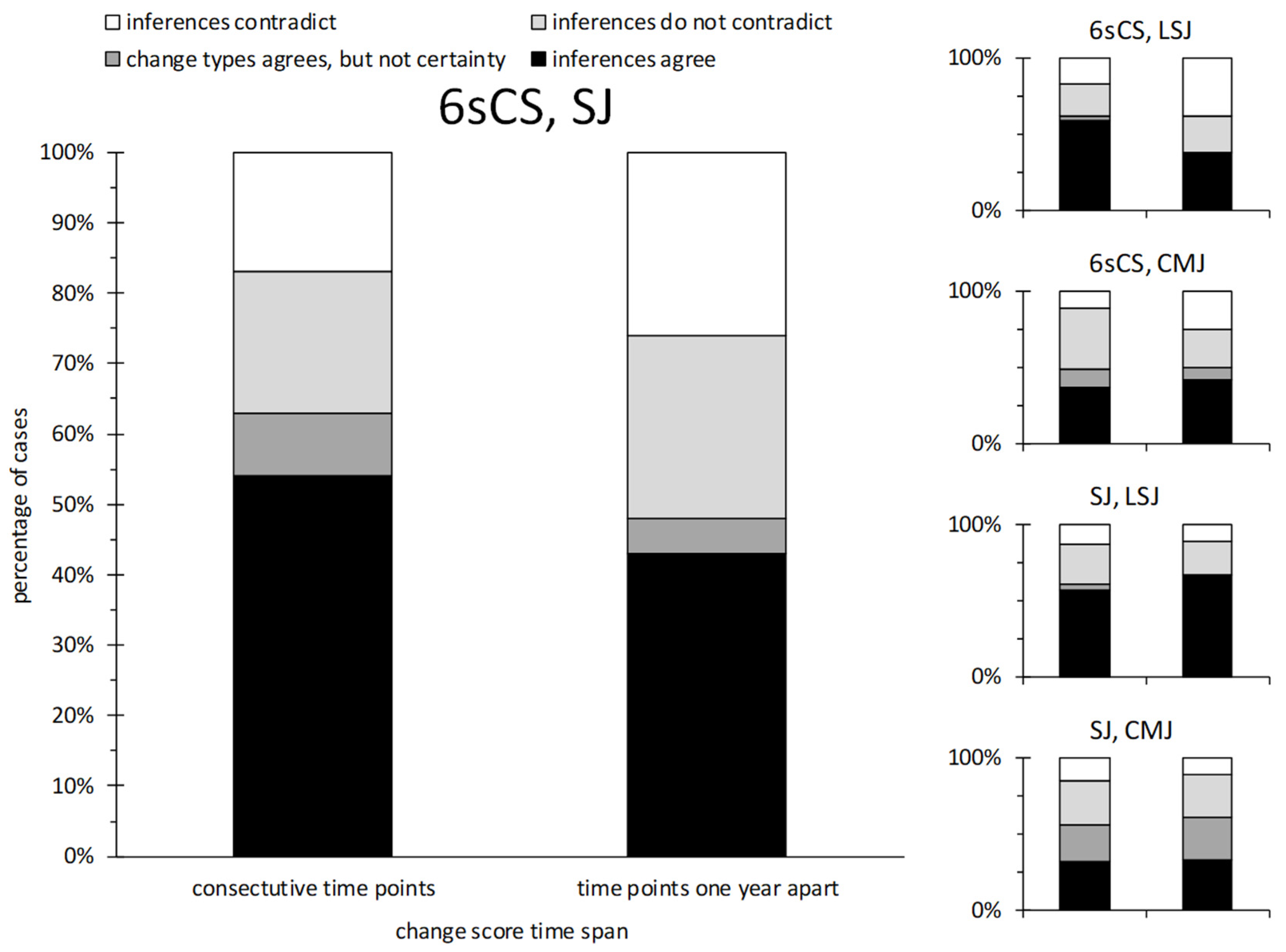
3.2.3. Magnitude-Based Inferences
4. Discussion
5. Conclusions
Author Contributions
Funding
Acknowledgments
Conflicts of Interest
References
- Scharer, C.; Lehmann, T.; Naundorf, F.; Taube, W.; Hubner, K. The faster, the better? Relationships between run-up speed, the degree of difficulty (D-score), height and length of flight on vault in artistic gymnastics. PLoS ONE 2019, 14, e0213310. [Google Scholar] [CrossRef] [Scilit]
- Gross, M.; Buchler Greeley, N.; Hubner, K. Prioritizing Physical Determinants of International Elite Pole Vaulting Performance. J. Strength Cond. Res. 2020, 34, 162–171. [Google Scholar] [CrossRef] [Scilit]
- Gross, M.; Schellenberg, F.; Lüthi, G.; Baker, M.; Lorenzetti, S. Performance determinants and leg kinematics in the BMX supercross start. J. Sci. Cycl. 2017, 6, 3–12. [Google Scholar]
- Pojskic, H.; Aslin, E.; Krolo, A.; Jukic, I.; Uljevic, O.; Spasic, M.; Sekulic, D. Importance of Reactive Agility and Change of Direction Speed in Differentiating Performance Levels in Junior Soccer Players: Reliability and Validity of Newly Developed Soccer-Specific Tests. Front. Physiol. 2018, 9, 506. [Google Scholar] [CrossRef] [Scilit]
- Chaabene, H.; Negra, Y.; Bouguezzi, R.; Mkaouer, B.; Franchini, E.; Julio, U.; Hachana, Y. Physical and Physiological Attributes of Wrestlers: An Update. J. Strength Cond. Res. 2017, 31, 1411–1442. [Google Scholar] [CrossRef] [Scilit] [PubMed]
- Hebert-Losier, K.; Supej, M.; Holmberg, H.C. Biomechanical factors influencing the performance of elite Alpine ski racers. Sports Med. 2014, 44, 519–533. [Google Scholar] [CrossRef] [Scilit] [PubMed]
- Maulder, P.S.; Bradshaw, E.J.; Keogh, J. Jump kinetic determinants of sprint acceleration performance from starting blocks in male sprinters. J. Sports Sci. Med. 2006, 5, 359–366. [Google Scholar] [PubMed]
- Spiteri, T.; Cochrane, J.L.; Hart, N.H.; Haff, G.G.; Nimphius, S. Effect of strength on plant foot kinetics and kinematics during a change of direction task. Eur. J. Sport Sci. 2013, 13, 646–652. [Google Scholar] [CrossRef] [Scilit]
- Emmonds, S.; Nicholson, G.; Begg, C.; Jones, B.; Bissas, A. Importance of Physical Qualities for Speed and Change of Direction Ability in Elite Female Soccer Players. J. Strength Cond. Res. 2019, 33, 1669–1677. [Google Scholar] [CrossRef] [Scilit]
- Supej, M.; Holmberg, H.C. Recent Kinematic and Kinetic Advances in Olympic Alpine Skiing: Pyeongchang and Beyond. Front. Physiol. 2019, 10, 111. [Google Scholar] [CrossRef] [Scilit]
- Gilgien, M.; Sporri, J.; Kroll, J.; Crivelli, P.; Muller, E. Mechanics of turning and jumping and skier speed are associated with injury risk in men’s World Cup alpine skiing: A comparison between the competition disciplines. Br. J. Sports Med. 2014, 48, 742–747. [Google Scholar] [CrossRef] [Scilit] [PubMed]
- Stone, M.; Stone, M.; Sands, W. Principles and Practice of Resistance Training; Human Kinetics: Champaign, IL, USA, 2007. [Google Scholar]
- Markovic, G.; Jaric, S. Is vertical jump height a body size-independent measure of muscle power? J. Sports Sci. 2007, 25, 1355–1363. [Google Scholar] [CrossRef] [Scilit] [PubMed]
- Heck, H.; Schulz, H.; Bartmus, U. Diagnostics of anaerobic power and capacity. Eur. J. Sport Sci. 2003, 3, 1–23. [Google Scholar] [CrossRef] [Scilit]
- McMaster, D.T.; Gill, N.; Cronin, J.; McGuigan, M. A brief review of strength and ballistic assessment methodologies in sport. Sports Med. 2014, 44, 603–623. [Google Scholar] [CrossRef] [Scilit] [PubMed]
- Vandewalle, H.; Peres, G.; Monod, H. Standard anaerobic exercise tests. Sports Med. 1987, 4, 268–289. [Google Scholar] [CrossRef] [Scilit] [PubMed]
- Driss, T.; Vandewalle, H. The measurement of maximal (anaerobic) power output on a cycle ergometer: A critical review. Biomed. Res. Int. 2013, 2013, 589361. [Google Scholar] [CrossRef] [Scilit]
- Van Praagh, E. Anaerobic fitness tests: What are we measuring? Med. Sport Sci. 2007, 50, 26–45. [Google Scholar] [CrossRef] [Scilit]
- Driss, T.; Vandewalle, H.; Monod, H. Maximal power and force-velocity relationships during cycling and cranking exercises in volleyball players. Correlation with the vertical jump test. J. Sports Med. Phys. Fit. 1998, 38, 286–293. [Google Scholar]
- Mendez-Villanueva, A.; Bishop, D.; Hamer, P. Reproducibility of a 6-s maximal cycling sprint test. J. Sci. Med. Sport 2007, 10, 323–326. [Google Scholar] [CrossRef] [Scilit]
- Coso, J.D.; Mora-Rodriguez, R. Validity of cycling peak power as measured by a short-sprint test versus the Wingate anaerobic test. Appl. Physiol. Nutr. Metab. 2006, 31, 186–189. [Google Scholar] [CrossRef] [Scilit]
- Markovic, G.; Dizdar, D.; Jukic, I.; Cardinale, M. Reliability and factorial validity of squat and countermovement jump tests. J. Strength Cond. Res. 2004, 18, 551–555. [Google Scholar] [CrossRef] [PubMed]
- Hübner, K.; Sonderegger, K.; Lüthy, F.; Tschopp, M. Explosivkraftniveau der unteren Extremitäten bei Schweizer Nachwuchsathleten. Schweizerische Zeitschrift Fur Sportmedizin Und Sporttraumatologie 2013, 61, 15–22. [Google Scholar]
- Nikolaidis, P.T.; Afonso, J.; Clemente-Suarez, V.J.; Alvarado, J.R.P.; Driss, T.; Knechtle, B.; Torres-Luque, G. Vertical Jumping Tests versus Wingate Anaerobic Test in Female Volleyball Players: The Role of Age. Sports (Basel) 2016, 4, 9. [Google Scholar] [CrossRef] [Scilit] [PubMed]
- Alemdaroglu, U. The relationship between muscle strength, anaerobic performance, agility, sprint ability and vertical jump performance in professional basketball players. J. Hum. Kinet. 2012, 31, 149–158. [Google Scholar] [CrossRef] [Scilit]
- Chiarlitti, N.A.; Delisle-Houde, P.; Reid, R.E.R.; Kennedy, C.; Andersen, R.E. Importance of Body Composition in the National Hockey League Combine Physiological Assessments. J. Strength Cond. Res. 2018, 32, 3135–3142. [Google Scholar] [CrossRef] [Scilit]
- Bertucci, W.M.; Hourde, C. Laboratory Testing and Field Performance in BMX Riders. J. Sports Sci. Med. 2011, 10, 417–419. [Google Scholar]
- Ziv, G.; Lidor, R. Vertical jump in female and male basketball players--a review of observational and experimental studies. J. Sci. Med. Sport 2010, 13, 332–339. [Google Scholar] [CrossRef] [Scilit]
- Samozino, P.; Morin, J.B.; Hintzy, F.; Belli, A. A simple method for measuring force, velocity and power output during squat jump. J. Biomech. 2008, 41, 2940–2945. [Google Scholar] [CrossRef] [Scilit]
- Knudson, D.V. Correcting the use of the term "power" in the strength and conditioning literature. J. Strength Cond. Res. 2009, 23, 1902–1908. [Google Scholar] [CrossRef] [Scilit]
- McLellan, C.P.; Lovell, D.I.; Gass, G.C. The role of rate of force development on vertical jump performance. J. Strength Cond. Res. 2011, 25, 379–385. [Google Scholar] [CrossRef] [Scilit]
- Burns, G.T.; Deneweth Zendler, J.; Zernicke, R.F. Validation of a wireless shoe insole for ground reaction force measurement. J. Sports Sci. 2019, 37, 1129–1138. [Google Scholar] [CrossRef] [Scilit] [PubMed]
- Samozino, P.; Rabita, G.; Dorel, S.; Slawinski, J.; Peyrot, N.; Saez de Villarreal, E.; Morin, J.B. A simple method for measuring power, force, velocity properties, and mechanical effectiveness in sprint running. Scand. J. Med. Sci. Sports 2015. [Google Scholar] [CrossRef] [Scilit] [PubMed]
- Hunter, J.P.; Marshall, R.N.; McNair, P.J. Relationships between ground reaction force impulse and kinematics of sprint-running acceleration. J. Appl. Biomech. 2005, 21, 31–43. [Google Scholar] [CrossRef] [Scilit] [PubMed]
- Orange, S.T.; Metcalfe, J.W.; Marshall, P.; Vince, R.V.; Madden, L.A.; Liefeith, A. Test-Retest Reliability of a Commercial Linear Position Transducer (GymAware PowerTool) to Measure Velocity and Power in the Back Squat and Bench Press. J. Strength Cond. Res. 2020, 34, 728–737. [Google Scholar] [CrossRef] [Scilit] [PubMed]
- Banyard, H.G.; Nosaka, K.; Sato, K.; Haff, G.G. Validity of Various Methods for Determining Velocity, Force, and Power in the Back Squat. Int. J. Sports Physiol. Perform. 2017, 12, 1170–1176. [Google Scholar] [CrossRef] [Scilit] [PubMed]
- Balsalobre-Fernandez, C.; Glaister, M.; Lockey, R.A. The validity and reliability of an iPhone app for measuring vertical jump performance. J. Sports Sci. 2015, 33, 1574–1579. [Google Scholar] [CrossRef] [Scilit]
- Vandewalle, H.; Peres, G.; Heller, J.; Panel, J.; Monod, H. Force-velocity relationship and maximal power on a cycle ergometer. Correlation with the height of a vertical jump. Eur. J. Appl. Physiol. Occup. Physiol. 1987, 56, 650–656. [Google Scholar] [CrossRef] [Scilit]
- Passfield, L.; Hopker, J.G.; Jobson, S.; Friel, D.; Zabala, M. Knowledge is power: Issues of measuring training and performance in cycling. J. Sports Sci. 2017, 35, 1426–1434. [Google Scholar] [CrossRef] [Scilit]
- Gardner, A.S.; Martin, D.T.; Jenkins, D.G.; Dyer, I.; Van Eiden, J.; Barras, M.; Martin, J.C. Velocity-specific fatigue: Quantifying fatigue during variable velocity cycling. Med. Sci. Sports Exerc. 2009, 41, 904–911. [Google Scholar] [CrossRef] [Scilit]
- Gardner, A.S.; Martin, J.C.; Martin, D.T.; Barras, M.; Jenkins, D.G. Maximal torque- and power-pedaling rate relationships for elite sprint cyclists in laboratory and field tests. Eur. J. Appl. Physiol. 2007, 101, 287–292. [Google Scholar] [CrossRef] [Scilit]
- Martin, J.C.; Wagner, B.M.; Coyle, E.F. Inertial-load method determines maximal cycling power in a single exercise bout. Med. Sci. Sports Exerc. 1997, 29, 1505–1512. [Google Scholar] [CrossRef] [Scilit] [PubMed]
- Allen, H.; Coggan, A. Training and Racing with a Power Meter; Velopress: Boulder, CO, USA, 2010. [Google Scholar]
- Gonzalez-Tablas, A.; Martin-Santana, E.; Torres, M. Designing a cost-effective power profile test for talent identification programs. J. Sci. Cycl. 2016, 5, 27–28. [Google Scholar]
- Çakir-Atabek, H. Relationship between anaerobic power, vertical jump and aerobic performance in adolescent track and field athletes. J. Phys. Educ. Sport 2014, 14, 643–648. [Google Scholar]
- Rouis, M.; Coudrat, L.; Jaafar, H.; Attiogbe, E.; Vandewalle, H.; Driss, T. Effects of ethnicity on the relationship between vertical jump and maximal power on a cycle ergometer. J. Hum. Kinet. 2016, 51, 209–216. [Google Scholar] [CrossRef] [Scilit]
- Gross, M.; Gross, T. Relationship between Cyclic and Non-Cyclic Force-Velocity Characteristics in BMX Cyclists. Sports (Basel) 2019, 7, 232. [Google Scholar] [CrossRef] [Scilit]
- Duss, R.; Hobi, N. Der prozentuale Anteil der konzentrischen Maximalkraft an der isometrischen Maximalkraft; Eidg. Technische Hochschule Zürich: Zürich, Switzerland, 2003. [Google Scholar]
- Hübner, K. Veränderung der Explosivkraft der unteren Extremitäten in Abhängigkeit vom Widerstand: Studie bei Schweizer Spitzensportlern aus Sportarten mit hohem Explosivkraftanteil (Changes in Explosive Strength of the Lower Extremity in Relation to Resistance: A Study on Elite Swiss Athletes from Sports with a High Explosive Strength Component). Ph.D. Thesis, Universität Leipzig, Leipzig, Germany, 2009. [Google Scholar]
- Wattbike. Full Test Guide (05/2015-v1.0EN). In Wattbike, 05/2015-v1.0EN ed.; Wattbike: Nottingham, UK, 2015. [Google Scholar]
- Hopker, J.; Myers, S.; Jobson, S.A.; Bruce, W.; Passfield, L. Validity and reliability of the Wattbike cycle ergometer. Int. J. Sports Med. 2010, 31, 731–736. [Google Scholar] [CrossRef] [Scilit]
- Driller, M.W.; Argus, C.K.; Shing, C.M. The reliability of a 30-s sprint test on the Wattbike cycle ergometer. Int. J. Sports Physiol. Perform. 2013, 8, 379–383. [Google Scholar] [CrossRef] [Scilit]
- Hopkins, W.G.; Marshall, S.W.; Batterham, A.M.; Hanin, J. Progressive statistics for studies in sports medicine and exercise science. Med. Sci. Sports Exerc. 2009, 41, 3–13. [Google Scholar] [CrossRef] [Scilit]
- Hopkins, W.G. A spreadsheet for monitoring an individual’s changes and trend. Sportscience 2017, 21, 5–9. [Google Scholar]
- Hopkins, W.G. A Spreadsheet for Monitoring an Individual’s Changes and Trend. Available online: https://sportscience.sportsci.org/resource/stats/xIndividualTrend.xlsx (accessed on 22 March 2020).
- Hautier, C.A.; Linossier, M.T.; Belli, A.; Lacour, J.R.; Arsac, L.M. Optimal velocity for maximal power production in non-isokinetic cycling is related to muscle fibre type composition. Eur. J. Appl. Physiol. Occup. Physiol. 1996, 74, 114–118. [Google Scholar] [CrossRef] [Scilit]
- Samozino, P.; Horvais, N.; Hintzy, F. Why does power output decrease at high pedaling rates during sprint cycling? Med. Sci. Sports Exerc. 2007, 39, 680–687. [Google Scholar] [CrossRef] [Scilit] [PubMed]



| Group | n | Age (y) | Body Height (m) | Body Mass (kg) |
|---|---|---|---|---|
| females | 7 | 23 ± 5 (18–31) | 1.68 ± 0.04 (1.63–1.74) | 63 ± 5 (56–71) |
| males | 13 | 25 ± 4 (18–31) | 1.83 ± 0.09 (1.71–2.01) | 87 ± 10 (70–110) |
| all | 20 | 25 ± 4 (18–31) | 1.78 ± 0.1 (1.63–2.01) | 79 ± 14 (56–110) |
| Group | 6sCS | SJ | LSJ | CMJ | |||||
|---|---|---|---|---|---|---|---|---|---|
| N * | W | W/kg ** | W | W/kg ** | W | W/kg ** | W | W/kg ** | |
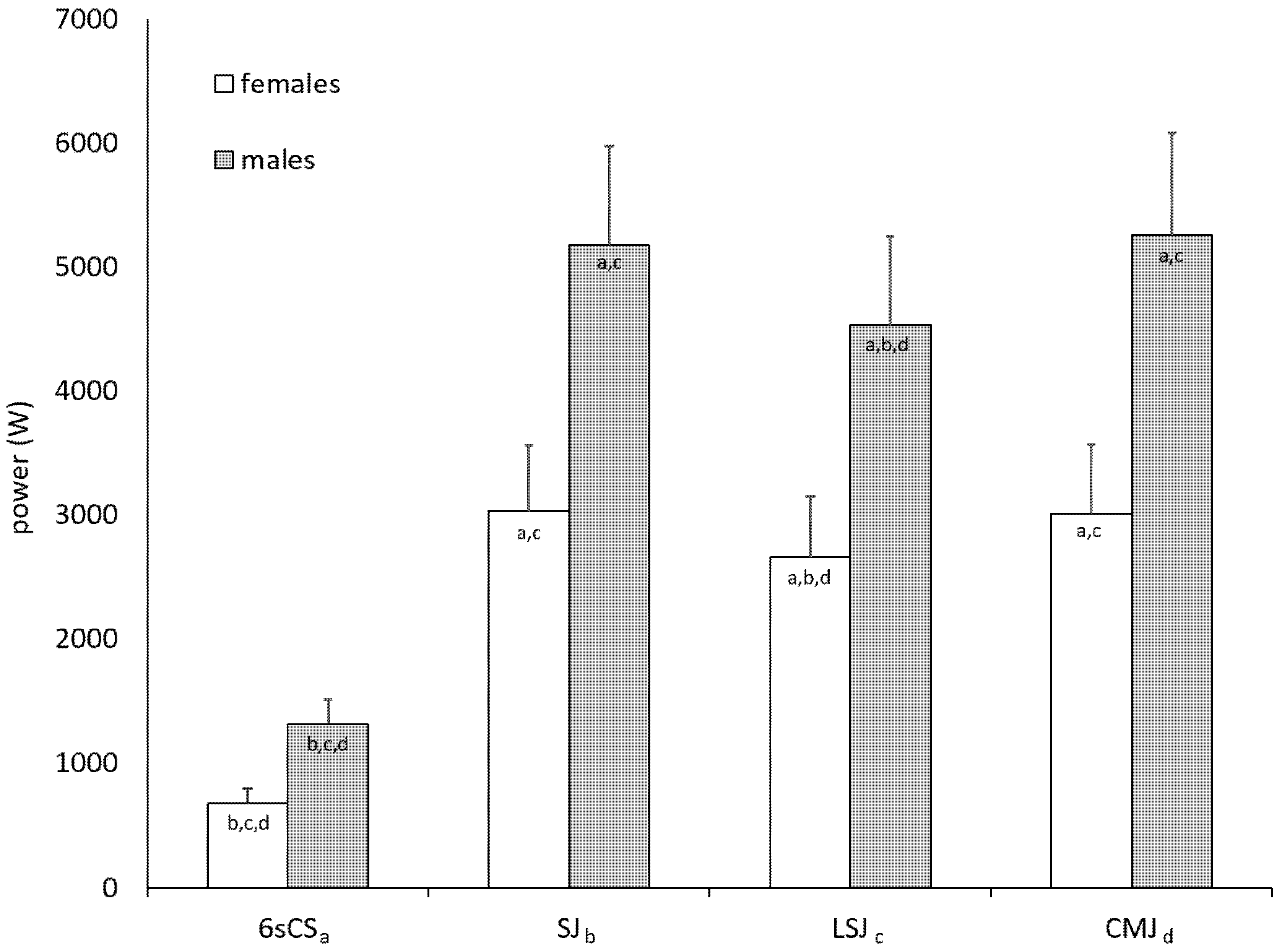
| females | 6 | 680 ± 118 | 10.5 ± 1.9 | 3030 ± 528 | 47 ± 8 | 2660 ± 493 | 41 ± 8 | 3014 ± 554 | 47 ± 7 |
| males | 10 | 1317 ± 197 | 15.5 ± 1.5 | 5179 ± 797 | 61 ± 6 | 4528 ± 720 | 53 ± 6 | 5262 ± 820 | 62 ± 6 |
| all | 16 | 1121 ± 345 | 14.0 ± 2.8 | 4518 ± 1233 | 57 ± 94 | 3953 ± 1089 | 50 ± 9 | 4570 ± 1284 | 57 ± 10 |
| Group | 6sCS, SJ | 6sCS, LSJ | 6sCS, CMJ | SJ, LSJ | SJ, CMJ | |||||
|---|---|---|---|---|---|---|---|---|---|---|
| W | W/kg * | W | W/kg * | W | W/kg * | W | W/kg * | W | W/kg * | |
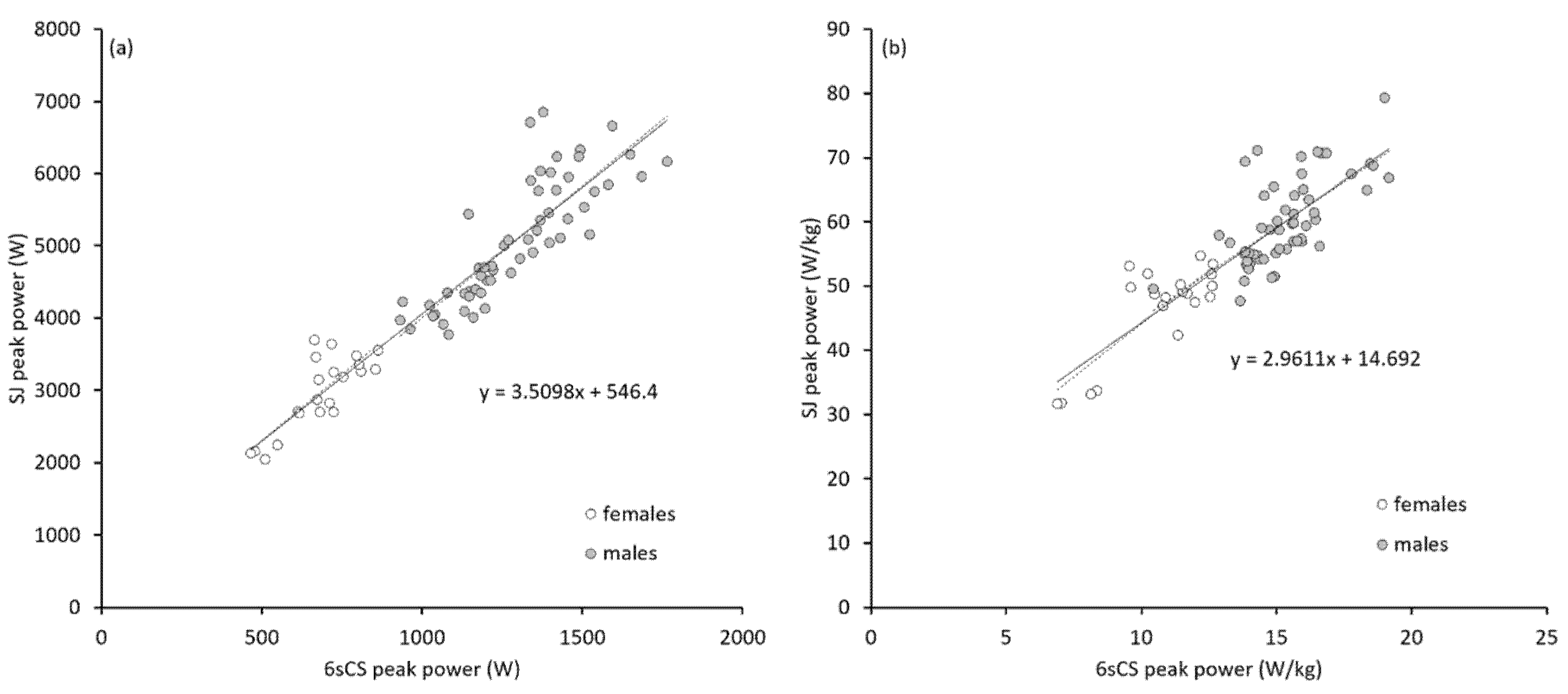
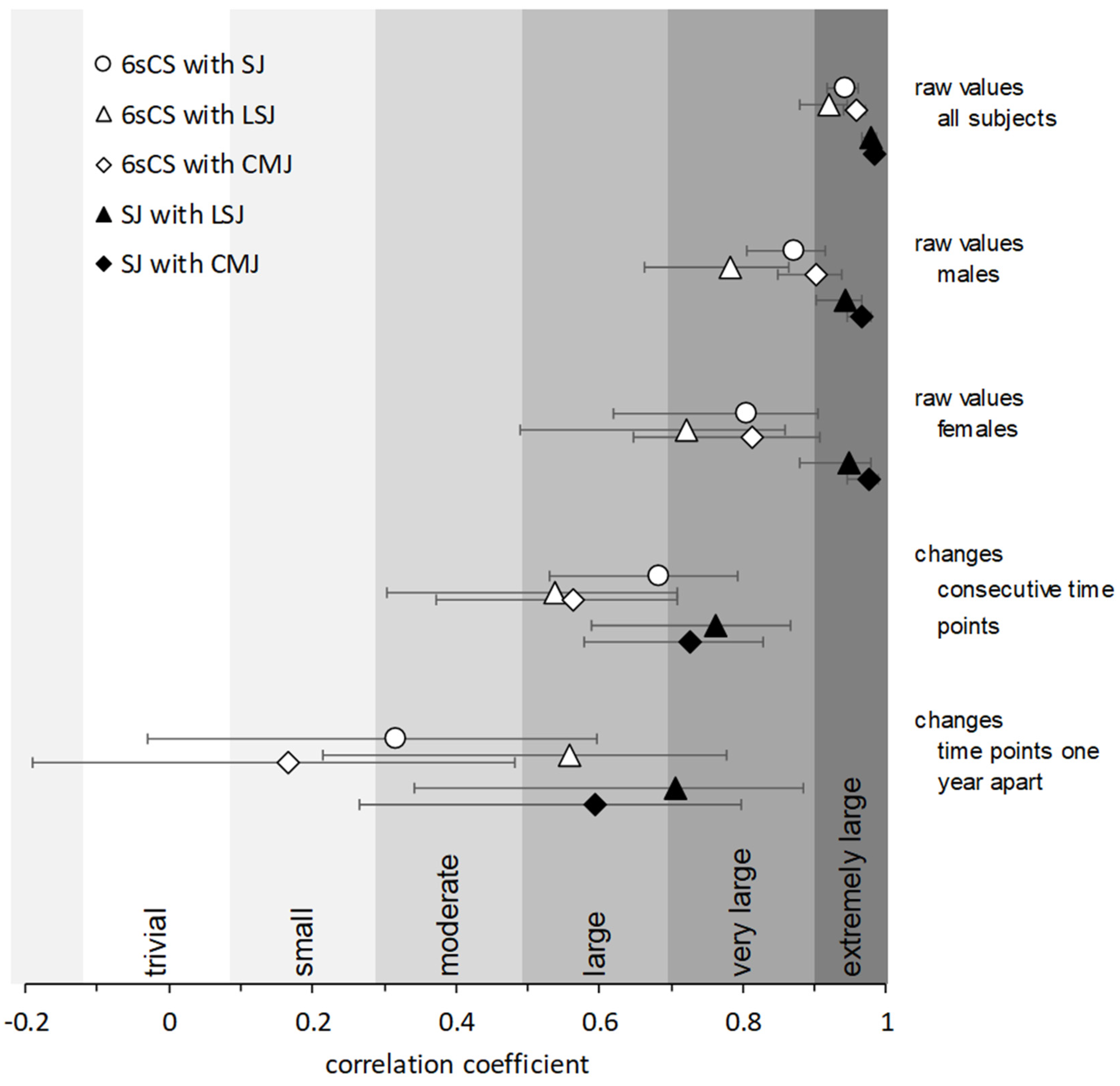
| females | 0.81 | 0.58 | 0.72 | 0.38 | 0.81 | 0.51 | 0.95 | 0.83 | 0.98 | 0.94 |
| males | 0.87 | 0.67 | 0.78 | 0.52 | 0.90 | 0.71 | 0.94 | 0.84 | 0.97 | 0.90 |
| all | 0.94 | 0.84 | 0.92 | 0.76 | 0.96 | 0.88 | 0.98 | 0.90 | 0.98 | 0.95 |
| 6sCS, SJ | 6sCS, LSJ | 6sCS, CMJ | SJ, LSJ | SJ, CMJ | |
|---|---|---|---|---|---|
| % Change * | % Change* | % Change * | % Change * | % Change * | |
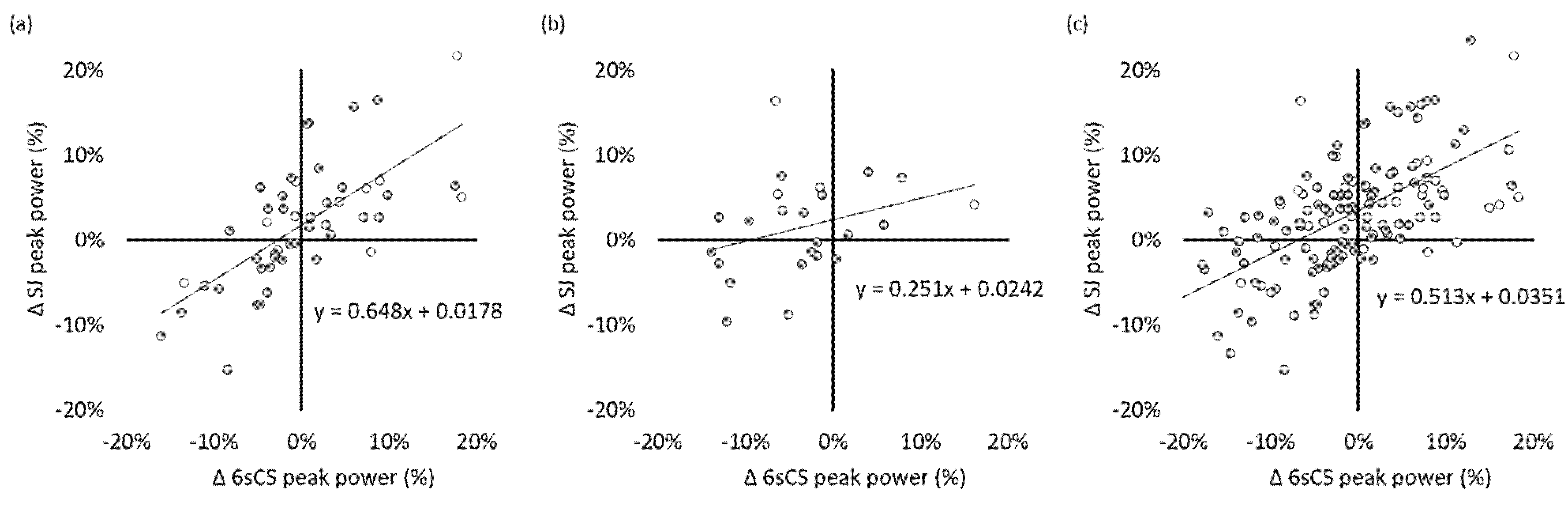
| consecutive time points | 0.68 | 0.54 | 0.56 | 0.76 | 0.73 |
| time points one year apart | 0.32 | 0.56 | 0.17 | 0.71 | 0.59 |
| all time point combinations | 0.61 | 0.47 | 0.48 | 0.69 | 0.71 |
© 2020 by the authors. Licensee MDPI, Basel, Switzerland. This article is an open access article distributed under the terms and conditions of the Creative Commons Attribution (CC BY) license (http://creativecommons.org/licenses/by/4.0/).
Share and Cite
Gross, M.; Lüthy, F. Anaerobic Power Assessment in Athletes: Are Cycling and Vertical Jump Tests Interchangeable? Sports 2020, 8, 60. https://doi.org/10.3390/sports8050060
Gross M, Lüthy F. Anaerobic Power Assessment in Athletes: Are Cycling and Vertical Jump Tests Interchangeable? Sports. 2020; 8(5):60. https://doi.org/10.3390/sports8050060
Chicago/Turabian StyleGross, Micah, and Fabian Lüthy. 2020. "Anaerobic Power Assessment in Athletes: Are Cycling and Vertical Jump Tests Interchangeable?" Sports 8, no. 5: 60. https://doi.org/10.3390/sports8050060
APA StyleGross, M., & Lüthy, F. (2020). Anaerobic Power Assessment in Athletes: Are Cycling and Vertical Jump Tests Interchangeable? Sports, 8(5), 60. https://doi.org/10.3390/sports8050060