1. Introduction
The most popular ceramic materials used in medical applications are alumina and zirconia [
1,
2,
3]. They are widely used as joint prosthesis elements, dental implants, and as porous shapes for bone defect treatment [
4,
5]. High chemical stability and advantageous mechanical properties are the most desirable features in implants for which their whole elements or chipped off fine fragments are chemically inert in the human body [
2,
6].
Despite high wear resistance and compressive strength, zirconia and alumina do not present significant fracture toughness [
7]. Therefore, it is necessary to improve fracture resistance in ceramics using crack inhibition methods, such as crack length increase, crack branching, or bridging [
8,
9]. While preparing composites, one can optimize the grain size, which affects residual stresses in the material and grain boundary strength to improve fracture resistance [
10]. For instance, tetragonal zirconia effectively inhibits cracking due to the martensitic transformation, induced by stresses at the crack tip; a change to a monoclinic structure results in a change in volume [
11,
12]. This phenomenon may improve fracture resistance due to the stress field and microcrack occurrence, making the material suitable for biomedical applications, where bio-inertness and relatively good mechanical properties are required [
1,
4].
Mechanical properties of bone implants are easily adaptable to obtain appropriate strength. The key challenge is a balance between mechanical and biological properties. Some materials are known for their bioactivity (hydroxyapatite, BioGlass
®), antimicrobial properties (e.g., hexagonal boron nitride, silver nanoparticles), and cellular response [
13,
14]. Our previous studies [
15,
16] showed that zirconia composites modified with bioactive fillers such as nanohydroxyapatite (HAp), copper-doped bioglass (BGCu), and hexagonal boron nitride (hBN) exhibited enhanced biological performance, namely improved antibacterial activity and apatite-forming ability [
17,
18,
19]. In particular, hydroxyapatite with its excellent biocompatibility, osteoconductivity, and chemical stability greatly supports bone regeneration and integration [
20,
21]. However, high-temperature sintering of ZrO
2/HAp composites can partially decompose HAp into tricalcium phosphate (TCP), thus adversely affecting their mechanical integrity and biological response [
15,
16,
22]. Such a decomposition causes calcium ions to be released in the biological environment and may induce cytotoxic effects by disrupting cellular homeostasis and increasing reactive oxygen species (ROS) production [
23]. Moreover, although a higher hydroxyapatite content supports the apatite layer formation, it also reduces cell viability, indicating a delicate balance between bioactivity and cytocompatibility. Other modifiers, e.g., BGCu and hBN, enhance antimicrobial properties of zirconia composites through mechanisms involving the copper ion release and bacterial membrane disruption [
24,
25]. Nevertheless, their contribution to the apatite layer formation remains limited.
The ongoing research on multifunctional materials combining zirconia matrix, nanohydroxyapatite, and antimicrobial agents (e.g., silver or copper nanoparticles) highlights the importance of optimizing the additive type and concentration to endow composites with antibacterial efficacy and biocompatibility. Further development of zirconia-based composites is essential for enhancing the implant–bone interface and ensuring long-term performance in biomedical applications.
Another important aspect of zirconia-based biomaterials is their resistance to subcritical crack growth, especially under prolonged mechanical loadings [
26,
27]. In our previous study, hydroxyapatite (HAp) was selected for the composite fabrication due to its promising biological response, disregarding its inherently poor mechanical performance. Homogeneous composites of yttria-stabilized zirconia (3 mol% Y
2O
3) with 20 and 40 wt.% Hap were synthesized using co-precipitation, wet mixing of nanopowders, and pressureless sintering [
28]. While the HAp addition reduced mechanical properties of the composites (in comparison to pure zirconia ceramics), they still exhibited significantly improved fracture toughness relative to pure HAp materials. The zirconia-rich composites obtained values of approx. 2.6 MPa∙m
1/2 and the HAp-containing variants reached 1.7 MPa∙m
1/2. Notably, the sintering temperature influenced both the phase composition and decomposition behaviour. The partial HAp degradation was observed at 1150 °C, and the emergence of cubic zirconia occurred in the 40 wt.% HAp composites. Although tetragonal zirconia (3Y-TZP) is known for its high strength, it is also highly susceptible to subcritical crack growth, which can significantly reduce the material strength over time under static loadings (
n values: 28 for 3Y-TZP, 13 for 3Y-ZrO
2). In contrast, the developed ZrO
2/HAp composites demonstrated markedly higher resistance to subcritical crack propagation (
n values: 64 for 3Y-ZrO
2-20HAp, 74 for 3Y-ZrO
2-40HAp). The strength–survival probability–time diagrams confirmed a reduced rate of strength degradation over extended periods (1 s to 1 year), which indicates superior long-term mechanical reliability of the composites. This characteristic is crucial in biomedical applications where implants must endure sustained loading without premature failure [
26].
Biological behaviour of zirconia-based composites requires thorough evaluation of their mechanical properties regarding biomedical applicability, particularly as load-bearing implants. Although bioactivity and cytocompatibility are key factors in successful integration with surrounding tissues, implantable materials must also meet mechanical requirements. Therefore, this study focused on examining the mechanical performance of the developed composites, such as fracture resistance, hardness, and flexural strength (not published before). Understanding how various bioactive additives influence both biological outcomes and mechanical integrity enables a holistic approach to material optimization. By addressing both aspects, the research aimed to develop multifunctional composites with high durability and enhanced functionality in clinical applications, e.g., as dental and orthopaedic implants.
The key novelty of the presented research is a systematic comparison of various bioactive and antibacterial additives, including hydroxyapatite (HAp), bioactive glass (BG), copper-doped bioactive glass (BGCu), and hexagonal boron nitride (hBN), with regard to their effect on the mechanical properties of zirconia-based composites.
Furthermore, the presented research evaluates the trade-off between bioactivity and mechanical properties, highlighting how bioactive modifiers affect the composites’ hardness and fracture toughness while maintaining superior parameters compared to materials based solely on hydroxyapatite.
2. Materials and Methods
In this study, the composite materials were obtained by incorporating four various bioactive modifiers. These were as follows: 1. synthetic hydroxyapatite (HAp; specific surface area of 21 m2/g, determined using the Brunauer–Emmett–Teller (BET) method; sourced from nGimat Co., Atlanta, GA, USA), 2. hexagonal boron nitride (hBN; specific surface area of 10 m2/g, BET; obtained from Sigma Aldrich, St. Louis, MO, USA), 3. self-synthesized bioglass (BG; specific surface area of 0.25 m2/g, BET), and 4. bioglass doped with copper (BGCu; specific surface area of 0.27 m2/g, BET). To prepare the ZrO2_HAp composites, we employed zirconia stabilized with 3 mol% Y2O3 (specific surface area of 137 m2/g, BET). In contrast, the hBN-, BG-, and BGCu-modified composites were based on commercial zirconia (TOSOH, Tokyo, Japan; specific surface area of 16 m2/g, BET).
Bioactive glasses BG and BGCu with molar compositions of 40SiO
2–6P
2O
5–54CaO and 40SiO
2–6P
2O
5–49CaO–5CuO (mol%), respectively, were produced by the classical glass batch melting method. The synthesis was carried out in a Nabertherm electric furnace according to the following temperature program: heating from 20 to 800 °C at a rate of 9 °C/min and soaking for 30 min at 800 °C, followed by heating from 800 to 1450 °C at a rate of 2 °C/min and soaking for 60 min at 1450 °C. Following melting, the glass batch was cast onto a steel plate and subjected to annealing at 500 °C. Then, glasses were ground in a corundum mortar for 15 min. The raw glass composition of the batches used to produce individual glass-forming oxides is presented in the table (
Table 1).
The composite powders were homogenized in an attritor mill for 1 h, using isopropanol as a liquid medium and 2 mm grinding balls. Subsequently, the powders were uniaxially pressed into disc-shaped specimens (20 mm in diameter) under a pressure of 200 MPa. The sintering process was conducted for 1 h without applied pressure at 1150 °C for the ZrO
2-HAp, ZrO
2-BG, and ZrO
2-BGCu composites and at 1450 °C for the ZrO
2-hBN variant. As a result of the aforementioned processes, seven materials were obtained: pure 3Y-ZrO
2, 3Y-TZP (Tosoh), 3Y-ZrO
2-20HAp (ZrO
2 with 20 wt.% HAp), 3Y-ZrO
2-40HAp (ZrO
2 with 40 wt.% HAp), 3Y-TZP-BG (ZrO
2 with 20 wt.% BG), 3Y-TZP-BGCu (ZrO
2 with 20 wt.% BGCu), and 3Y-TZP-hBN (ZrO
2 with 10 wt.% hBN). The ZrO
2 co-precipitation methodology and the composite synthesis were described in detail in our previous publication [
28]. Both the co-precipitated ZrO
2 and the commercial ZrO
2 were used as reference materials. To distinguish these materials in the manuscript, two designations were used:
- -
3Y-ZrO2 denominating co-precipitated ZrO2;
- -
3Y-TZP—commercial ZrO2.
The phase composition of the sintered materials was determined using an X-ray diffractometer (PANalytical, Empyrean, Almelo, The Netherlands. The measurements were conducted using monochromatic radiation with a wavelength corresponding to the Cu K(α1) emission line (1.54178 Å) in the angular range of 5–90° in the 2θ scale, with a goniometer step of 0.008°. The qualitative phase composition analysis was performed employing HighScore Plus software (PANalytical, v. 3.0e ) with reference to PDF-2 (2004) and ICSD Database FIZ Karlsruhe (2012), applying the Rietveld method.
Microstructural imaging of the sintered materials was performed using an Apreo 2 S scanning electron microscope (Thermo Fisher Scientific, Waltham, MA, USA) with APEX Software (v. 2.5.1001.0001) for energy-dispersive spectroscopy (EDS) analysis (EDAX, Tilburg, The Netherlands).
The relative density was determined via the Archimedes method in water with an analytical balance equipped with a hydrostatic weighing system. The measurements were conducted on three samples of each type.
The hardness and fracture toughness (K
Ic) were measured with the Vickers indentation technique (FV700, Future Tech Corp, Kawasaki, Japan). The indentation load was maintained at 9.81 N for Vickers hardness (HV) and 49.05 N for K
Ic measurements and applied for 10 s. The K
Ic values were calculated according to the Niihara equation, based on Palmqvist crack length and indentation size [
29]. Statistical analysis was based on a
t-test at a 95% confidence level. This allowed for an assessment of the significance of differences in the values.
The flexural strength measurements were performed in a biaxial loading system using a universal testing machine (EZ-LX series, Shimadzu, Kyoto, Japan) following the ASTM F394-78 (1996) standard [
30]. Ten samples of each material were tested.
3. Results
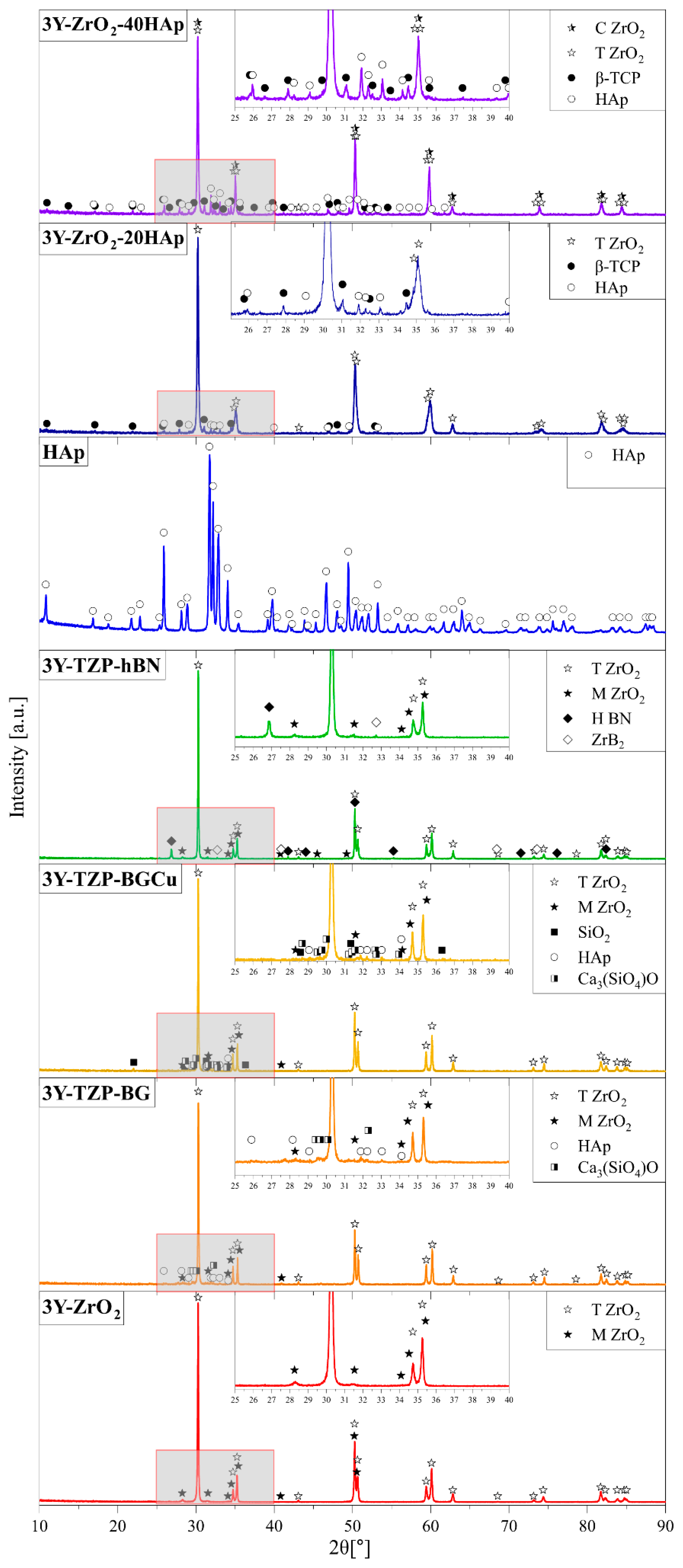
The sintered materials were tested for their phase composition using X-Ray diffraction. The results are presented in
Figure 1.
The 3Y-ZrO2 diffraction measurements revealed a monoclinic ZrO2 phase, likely resulting from the tetragonal phase transformation during the microsection preparation and/or the spontaneous surface transformation associated with uneven compressive stresses and the contact with corrosive environments (i.e., water vapor).
The HAp sinter displayed a single-phase system characteristic of hydroxyapatite.
The 3Y-ZrO
2-20% HAp composite, apart from hydroxyapatite, showed tricalcium phosphate (β-TCP) associated with the thermal decomposition of hydroxyapatite according to the following reaction:
It is worth noting that the nanometric tetragonal ZrO
2 can catalyze the HAp thermal decomposition [
31]. Over 65% of the original HAp decomposed, yet hydroxyapatite, which did not decompose, was also observed. The calcium zirconate phases reported in the literature were not noted.
The 3Y-ZrO2-40% HAp composite was characterized by the presence of a tetragonal ZrO2 phase and a cubic phase. The latter one may be related to the stabilization of tetragonal ZrO2 grains (located adjacent to the phosphate phases) by calcium oxide, a product of the HAp thermal decomposition. Less than 40% of the original HAp decomposed. The β-TCP amount formed via decomposition was estimated at 14% by weight, indicating a slight increase in this phase proportion when the HAp content was doubled as compared to 3Y-ZrO2-HAp (20%).
No significant changes in the phase composition of the base set were observed for the 3Y-TZP-hBN composite. The XRD studies confirmed the tetragonal and monoclinic ZrO2 phases, as well as the hexagonal hBN and ZrB2.
For the 3Y-TZP-BG and -BGCu composites, only the phases present in the system were assigned. In both composites, zirconia was assigned as the tetragonal and monoclinic phases. Additionally, partial recrystallization of the glassy phase was noted. The tricalcium silicate oxide phase and the hydroxyapatite phase were identified as formed during bioglass recrystallization. The BGCu composite also revealed the presence of cristobalite (SiO
2) [
32,
33].
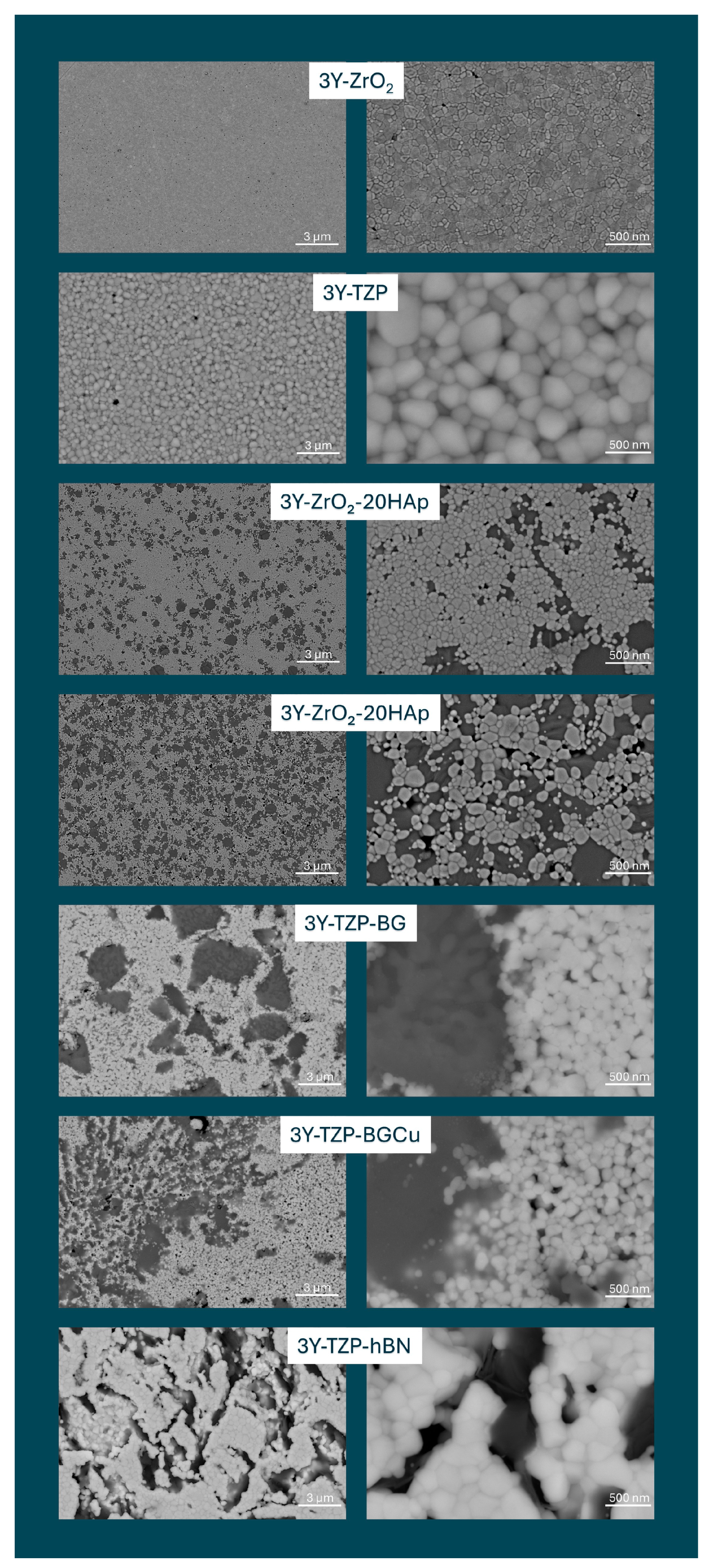
Microstructures of the sintered synthesized zirconia, commercial zirconia, and the composites are presented in the scanning electron microscopy images (
Figure 2). The mean grain size of the commercial zirconia was 400 nm, while the synthesized one was approx. 100 nm due to differences in the zirconia powders’ surface areas and their sintering temperatures.
In the case of composites modified with hydroxyapatite, the additive enhanced their porosity. In the zirconia-HAp composites, the additives were distributed uniformly.
The 3Y-TZP-BG, 3Y-TZP-BGCu composites revealed bioglass areas of approx. 20 μm in diameter. Zirconia grains were also separated by the glassy phase and porosity, visible mostly in the areas rich in glass. This phenomenon might result from the voids formed where the glass grains melted. The mean size of zirconia grains was 250 nm.
The 3Y-TZP-hBN material displayed relatively high porosity. The mean size of zirconia grains was 350 nm. The present pores were elongated, reaching a length of about 10 μm and a diameter of about 2 μm.
As a result of sintering commercial tetragonal zirconia, well-densified samples were obtained; their high Vickers hardness and relatively good fracture toughness values are presented in
Table 2. These results were consistent with the expected behaviour, i.e., the phase transformation from tetragonal to monoclinic structure. The samples exhibited a Vickers hardness of 11.80 GPa and fracture toughness of 6.18 MPa∙m
1/2. These are typical values for densely sintered 3 mol% yttria-stabilized tetragonal zirconia polycrystals (3Y-TZP).
In contrast, the synthesized zirconia powder reached final densification of approx. 95%, with mechanical properties about 30% weaker than the commercial material. Specifically, the HAp addition lowered mechanical performance. The incorporation of 20 wt.% HAp resulted in nearly a threefold decrease in hardness and approx. 40% reduction in fracture toughness. Increasing the HAp content to 40 wt.% led to a 15% decrease in hardness and a 40% drop in fracture toughness as compared to pure synthesized zirconia. Nevertheless, the fracture toughness of these composites remained higher than typical values reported for monolithic hydroxyapatite (i.e., 0.8–1.2 MPa∙m
1/2) [
34,
35].
In the composites modified with bioactive glasses, a significant decrease in hardness was observed—approx. 45% for bioglass (BG) and 30% for copper-doped bioglass (BGCu), relative to 3Y-TZP. The corresponding fracture toughness values were retained at 85% (BG) and 95% (BGCu) of the sintered commercial zirconia ones. On the other hand, the composite based on 3Y-TZP modified with hexagonal boron nitride (hBN) exhibited a drastic 95% reduction in hardness when compared to the pure 3Y-TZP. Importantly, it was impossible to determine the fracture toughness of the hBN-containing composite due to mechanical degradation and the brittleness of the material. Its high porosity made the material fracture under the applied indentation.
The statistical analysis proved that most of the differences in hardness between the tested composites were statistically significant, indicating a strong influence of the applied additives. In contrast, the fracture toughness values of the 3Y-TZP–BGCu composite overlapped with those of both pure 3Y-TZP and 3Y-TZP–BG, suggesting that the observed differences were not statistically significant. As the BGCu-modified composite retained fracture toughness comparable to zirconium dioxide, a favorable balance between mechanical properties and functional modification was achieved, despite the hardness reduction.
The flexural strength (σ) values presented in
Table 3 reveal notable differences between the commercial 3Y-TZP zirconia and the synthesized 3Y-ZrO
2, as well as their respective composites. The highest strength was recorded for the commercial 3Y-TZP, reaching 502 ± 130 MPa. This result was consistent with the well-documented high mechanical performance of fully sintered fine-grained 3Y-TZP ceramics. In contrast, the lab-synthesized 3Y-ZrO
2 exhibited a lower flexural strength of 354 ± 40 MPa. That value may be attributed to the differences in microstructure, grain size, or residual porosity stemming from the synthesis process (lower relative density than 3Y-TZP—
Table 2).
The composites based on 3Y-ZrO2 were sintered at lower temperatures to minimize the HAp decomposition, which would affect densification and mechanical performance. This was evident for the 3Y-ZrO2-20HAp and 3Y-ZrO2-40HAp samples, whose strength values dropped significantly to 179 ± 15 MPa and 93 ± 7 MPa, respectively. The increased HAp content lowered mechanical strength due to the poor properties of HAp itself, possible microstructural heterogeneities, and/or weak interfacial bonding.
Various bioactive phases incorporated into the materials based on commercial 3Y-TZP also reduced their strength, though not as drastically. The 3Y-TZP-BG composite retained a moderate strength of 273 ± 78 MPa, while 3Y-TZP-BGCu (copper-doped bioactive glass) showed 249 ± 27 MPa. The 3Y-TZP-hBN composite had the lowest strength of the 3Y-TZP-based materials (119 ± 9 MPa), potentially due to the lamellar structure of hBN, which can act as a crack propagation path if not properly aligned or bonded. All three 3Y-TZP-based composites exhibited high porosity, which could partially indicate strength reduction.
The calculated confidence intervals allowed us to conclude that the difference in strength between the commercial 3Y-TZP and the other materials was statistically significant. The composites with hydroxyapatite also exhibited strength values that differed significantly from those of pure ZrO2 and the other composites. The bio-glass composite revealed a value similar to that of the standalone 3Y-ZrO2, while the difference in strength between the bioglass composites and the copper–bioglass composite was statistically insignificant. To sum up, while 3Y-TZP remained the mechanically superior matrix, its modifications reduced strength. This highlighted the importance of maintaining a proper balance between mechanical integrity and added functionality (e.g., bioactivity or antibacterial properties) in the composite design.
The
n-parameter, describing the material’s susceptibility to subcritical crack growth, was determined for zirconia materials and composites with hydroxyapatite [
28]. A higher
n-value indicated lower sensitivity to slow crack propagation and, thus, improved long-term mechanical reliability. Our results showed that hydroxyapatite additions significantly reduced the subcritical cracking susceptibility in comparison to the pure tetragonal zirconia materials.
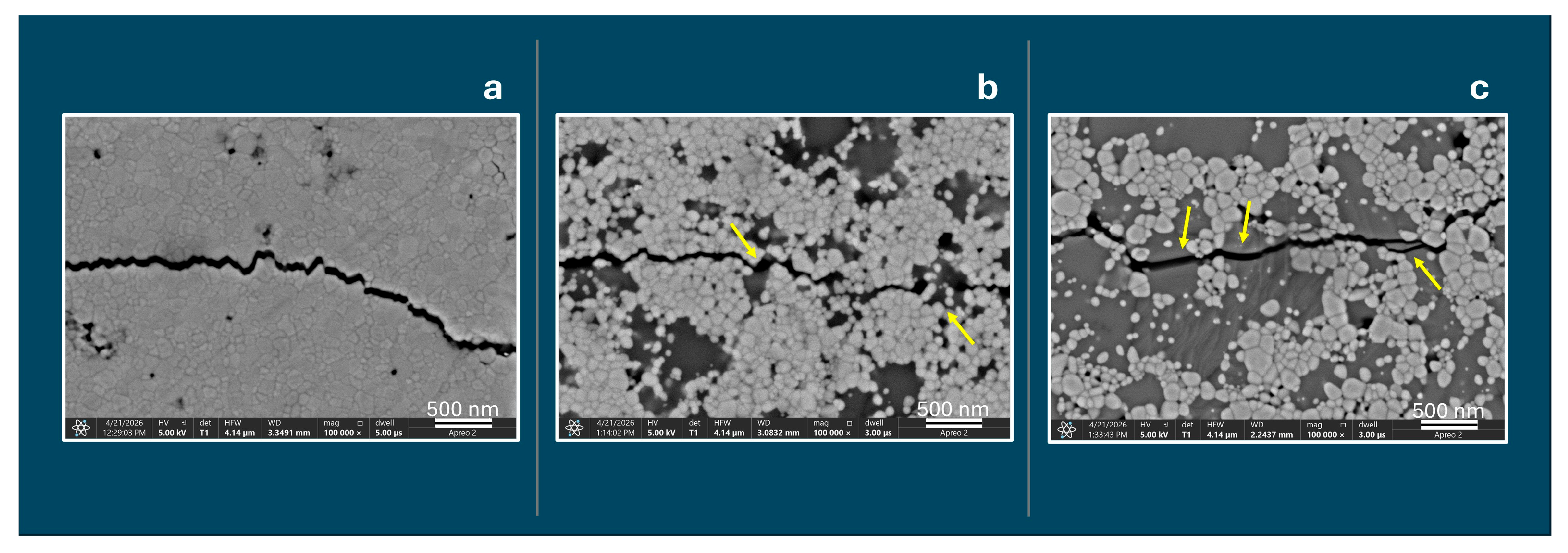
A microstructural analysis of crack manners in the hydroxyapatite composites is presented (
Figure 3) due to their high subcritical cracking resistance and low fracture toughness (K
Ic) compared to ZrO
2 matrix materials. Cracks in the materials were created using Vickers indentations at a load of 5 kG.
The cracks visible in the images were caused by fast fracture. In the fine-grained microstructure of pure 3Y-ZrO2, the preferred crack propagation path is along grain boundaries. The main mechanism increasing resistance to such high-energy fractures is the stress-induced phase transformation of tetragonal ZrO2 to the monoclinic phase, which is accompanied by local volume expansion and the generation of compressive stresses at the crack tip.
In the case of hydroxyapatite composites, grain boundaries are not the only path for crack propagation. Large HAp grains, which are present in the microstructure, may constitute areas of lower mechanical resistance, allowing crack propagation through the grain volume. Furthermore, the presence of the HAp phase may limit the effectiveness of the ZrO2 phase transformation, leading to a reduction in fracture toughness (KIc). Yellow arrows in the images indicate regions of crack propagation through hydroxyapatite grains, also with associated toughening mechanisms. Image 3b shows crack bridging, which was insufficient to inhibit crack propagation under rapid fracture conditions. Additionally, crack deflection at the ZrO2/HAp boundaries may also occur in composites, absorbing some of the fracture energy.
Subcritical cracking occurs at lower stress intensities than fast cracking, and its progression is primarily controlled by stress corrosion mechanisms associated with the presence of water vapor at the crack tip. Under these conditions, the role of the ZrO2 phase transformation may be limited, while microstructural mechanisms, such as crack bridging and deflection, become more important. The presence of large HAp grains favors these mechanisms, which can lead to increased resistance of composites to subcritical cracking.
4. Discussion
The obtained results confirmed that the mechanical properties of ZrO2-based composites strongly depended on the additive type and on the microstructural and phase changes occurring during sintering. A key challenge was the trade-off between improving biological properties and maintaining adequate mechanical strength.
The XRD analysis revealed both the tetragonal and monoclinic phases of ZrO2 in the reference materials. The presence of the monoclinic phase may result from stress-induced transformation, typical of 3Y-TZP and forming the basis for the transformation toughening mechanism. This phenomenon increased fracture toughness by generating compressive stresses in the crack tip region, which was reflected in the high mechanical properties of the reference material.
In the case of composites modified with hydroxyapatite, partial decomposition of HAp to β-TCP was observed, the extent of which depended on the additive content. The resulting formation of CaO could locally stabilize the cubic phase of ZrO2, particularly in the composite containing 40% HAp. At the same time, the SEM observations indicated increased porosity and uniform distribution of HAp within the matrix. However, the addition of hydroxyapatite deteriorated the mechanical properties. A significant decrease in hardness and flexural strength was observed with the increasing HAp content. This was attributable both to the low strength of hydroxyapatite itself and to porosity and weaker interfacial boundaries. Nevertheless, these composites exhibited higher fracture toughness than pure HAp and a significantly increased resistance to subcritical crack growth (high values of the parameter n), suggesting their potentially better long-term durability.
Microstructural analysis of cracks in hydroxyapatite composites allowed the observation of phenomena such as crack bridging and deflection, which could play a key role in the manner of crack propagation induced by stress corrosion cracking. The composites containing bioglass (BG and BGCu) were characterized by a distinct microstructure formation mechanism due to the liquid phase present during the sintering process. Partial crystallization of the glassy phase was observed, along with the presence of secondary phases, such as calcium silicates and hydroxyapatite. The composites’ microstructure was non-uniform, with visible regions rich in the glassy phase and porosity associated with its softening and solidification. As a result, there was a marked decrease in hardness, although resistance to brittle fracture was largely preserved. It is worth emphasizing that the BGCu composite exhibited mechanical properties comparable to the base material in terms of fracture toughness, while showing no statistically significant differences relative to BG. This suggested that the copper introduction did not compromise mechanical integrity and potentially enhanced its antibacterial functionality. In terms of flexural strength, these composites showed a moderate decrease in values compared to 3Y-TZP while remaining considerably stronger than HAp-based systems.
A distinct pattern of changes was observed in the composites with hBN. Their structure was characterized by high porosity and the presence of elongated pores, resulting from the layered architecture of hexagonal boron nitride. Such morphology promoted crack initiation and propagation, leading to a drastic reduction in hardness and flexural strength. In extreme cases, this even prevented the determination of fracture toughness, proving the detrimental effect of hBN in the absence of adequate control over its dispersion and interfacial interactions.
The differences in mechanical properties were further confirmed by statistical analysis. Confidence intervals showed that most of the changes, particularly in the case of hydroxyapatite composites, were statistically significant. The clear superiority of the commercial 3Y-TZP over all tested materials was evident. At the same time, the absence of significant differences between the BG and BGCu composites indicated that modifying the bioglass composition with copper ions did not negatively affect mechanical properties in a statistically significant manner.
With regard to a material’s applicability in bone implantology, the key challenge is combining adequate strength with high bioactivity and additional biological properties. The obtained results proved that 3Y-TZP maintains the highest mechanical properties. Moreover, its modification allowed for an expansion of functionality at the cost of partial loss of strength. Hydroxyapatite composites offered improved biological properties and increased resistance to long-term degradation, albeit at the cost of a considerable reduction in strength. The most favorable trade-off between mechanical and functional properties was demonstrated by the bioglass composites, particularly BGCu. The hBN composites, on the other hand, require further microstructural optimization before they can be considered for load-bearing applications.
5. Summary
The conducted study demonstrated that while 3Y-TZP (yttria-stabilized tetragonal zirconia polycrystals) remained a mechanically superior ceramic matrix, the incorporation of various bioactive and functional phases significantly affected its structural, microstructural, and mechanical performance. The commercial 3Y-TZP exhibited the highest densification and best mechanical properties, including high Vickers hardness (11.80 GPa), fracture toughness (6.18 MPa∙m1/2), and flexural strength (502 ± 130 MPa), confirming its suitability for load-bearing biomedical applications.
In contrast, the synthesized 3Y-ZrO2, despite achieving 95% densification, showed mechanical properties approx. 30% lower than the commercial material. This reduction was attributed to a finer grain size and differences in sintering behaviour. The hydroxyapatite (HAp) introduction into the zirconia matrix led to a significant mechanical degradation. The addition of 20 wt.% HAp caused a nearly threefold decrease in hardness and a 40% reduction in fracture toughness, while 40 wt.% HAp caused a further reduction in strength and densification. The XRD analysis revealed the thermal decomposition of HAp into β-TCP and CaO, with zirconia acting as a catalyst. The decomposition was more extensive in the 20% HAp composite than in the 40% variant, indicating that the decomposition was not directly proportional to HAp content.
The bioglass composites (BG and BGCu) exhibited partial re-crystallization of the glass phase, forming tricalcium silicate and hydroxyapatite phases. These materials maintained better mechanical integrity than the HAp-containing systems, with moderate reductions in hardness and fracture toughness. Notably, the BGCu composite retained 95% of the fracture toughness of pure zirconia, suggesting potential for bioactive applications with less compromise in performance. Zirconium phosphate formed in the BGCu composites further highlighted chemical interactions between glass and the zirconia matrix.
The composite with hexagonal boron nitride (hBN) exhibited the most severe mechanical degradation. Although hBN may offer functional benefits, such as enhancing tribological properties or thermal conductivity, its incorporation led to a drastic 95% reduction in hardness. Such hardness reduction resulted from the presence of elongated pores likely induced by the shape of hBN particles. This was also the reason why fracture toughness measurements were impossible to perform (no cracks were observed).
The microstructural observations confirmed the findings, showing increased porosity and phase segregation in all composite systems. Larger zirconia grains were found in the composites with glassy phases, while the synthesized zirconia maintained finer microstructures. Pores, particularly in the BG- and hBN-modified materials, were connected with the melted glass regions and additive morphology, respectively.
In conclusion, although the incorporation of bioactive phases like HAp, bioglass, and hBN into zirconia improves functional properties such as bioactivity and chemical reactivity, it comes at the cost of mechanical performance. Among the modified composites, bioglass-containing materials offer a more favourable balance between mechanical integrity and biofunctionality. The results emphasize a critical need for careful compositional and processing optimization to ensure that functional enhancements do not compromise the structural reliability required for biomedical applications.