


Operational Temperature Effect on Positioning Accuracy of a Single-Axial Moving Carrier

 and
and
Abstract
1. Introduction
2. Mathematical Theoretical Models and Experimental Methods
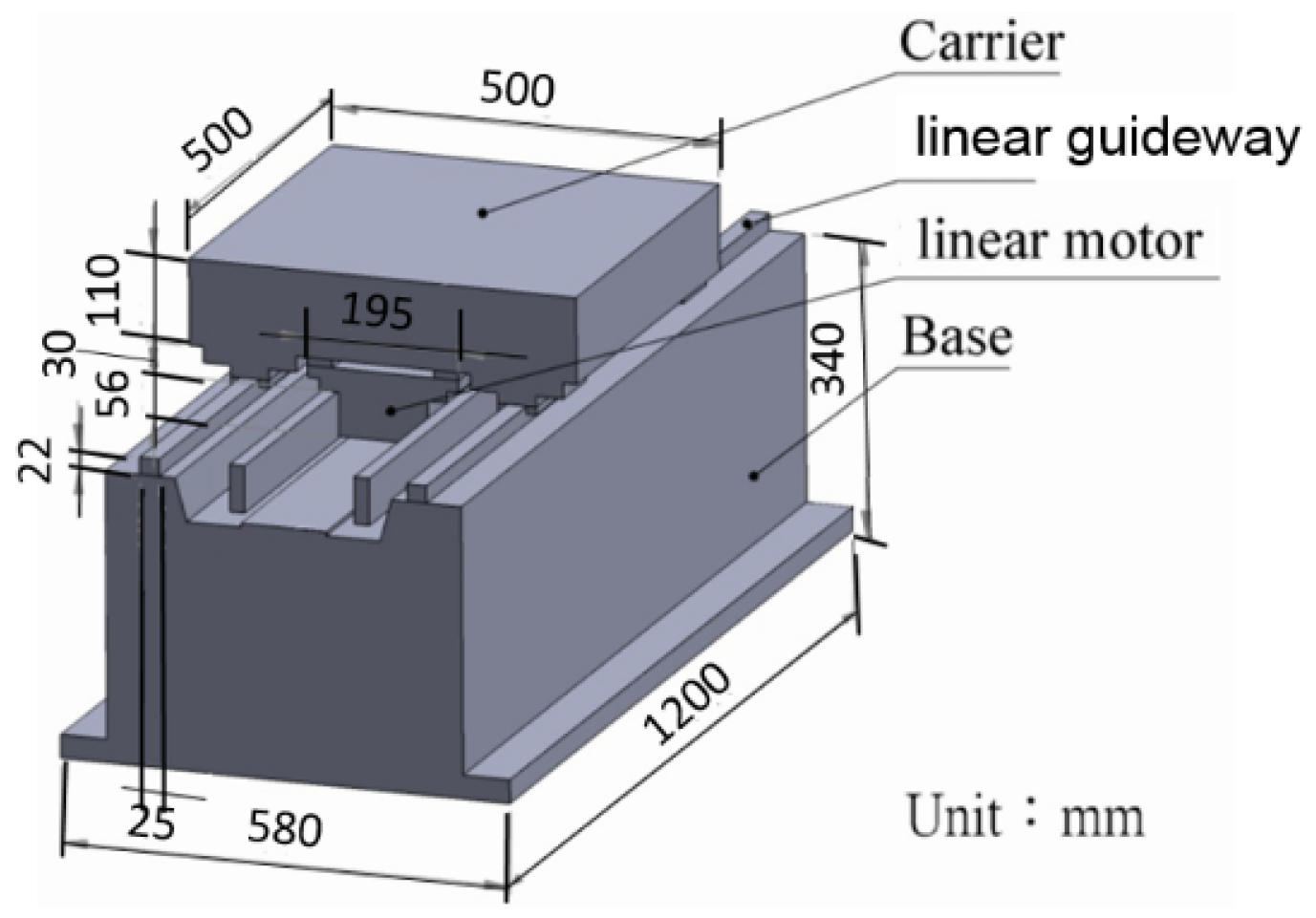
2.1. Structure of the Moving Carrier
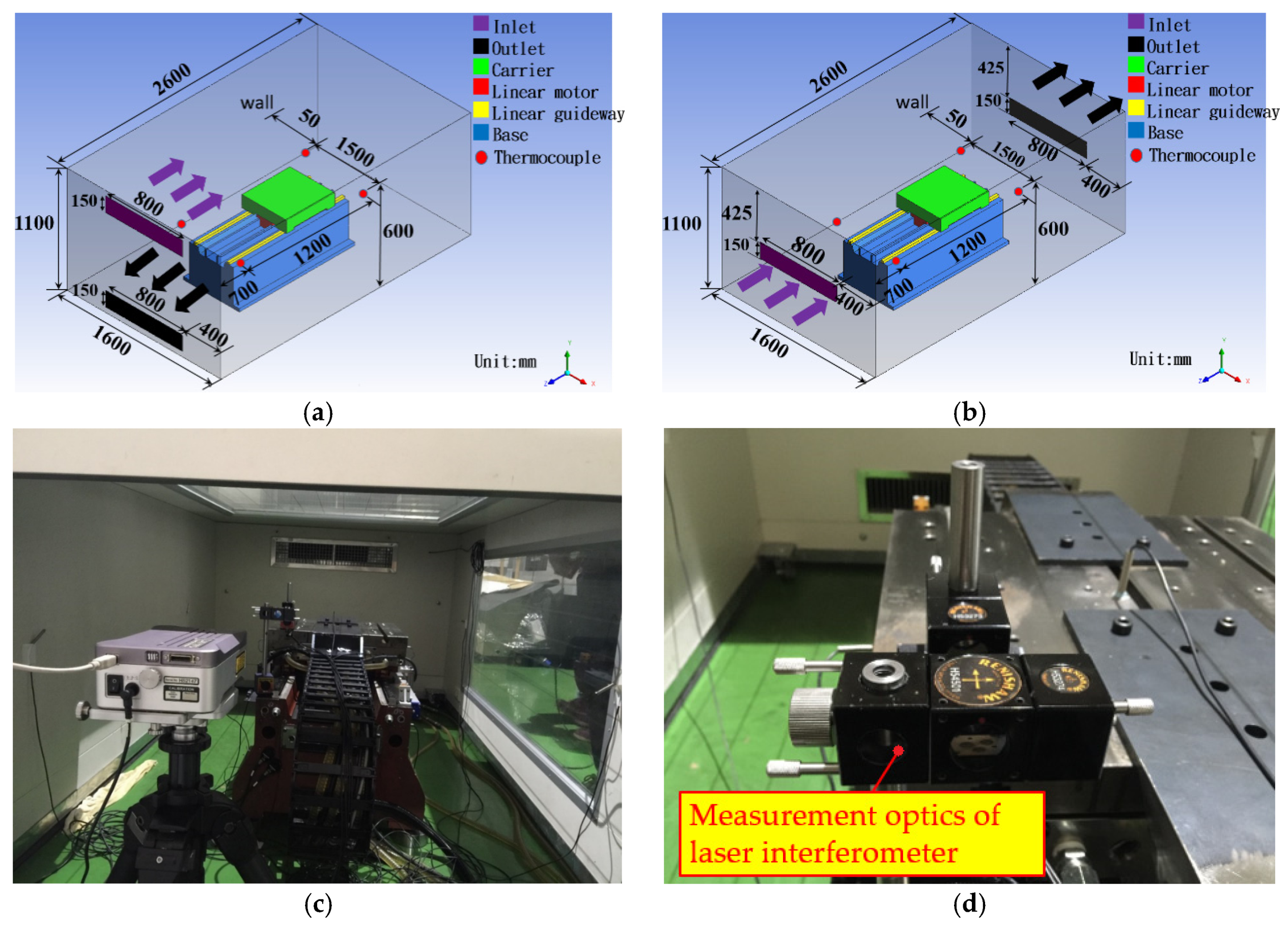
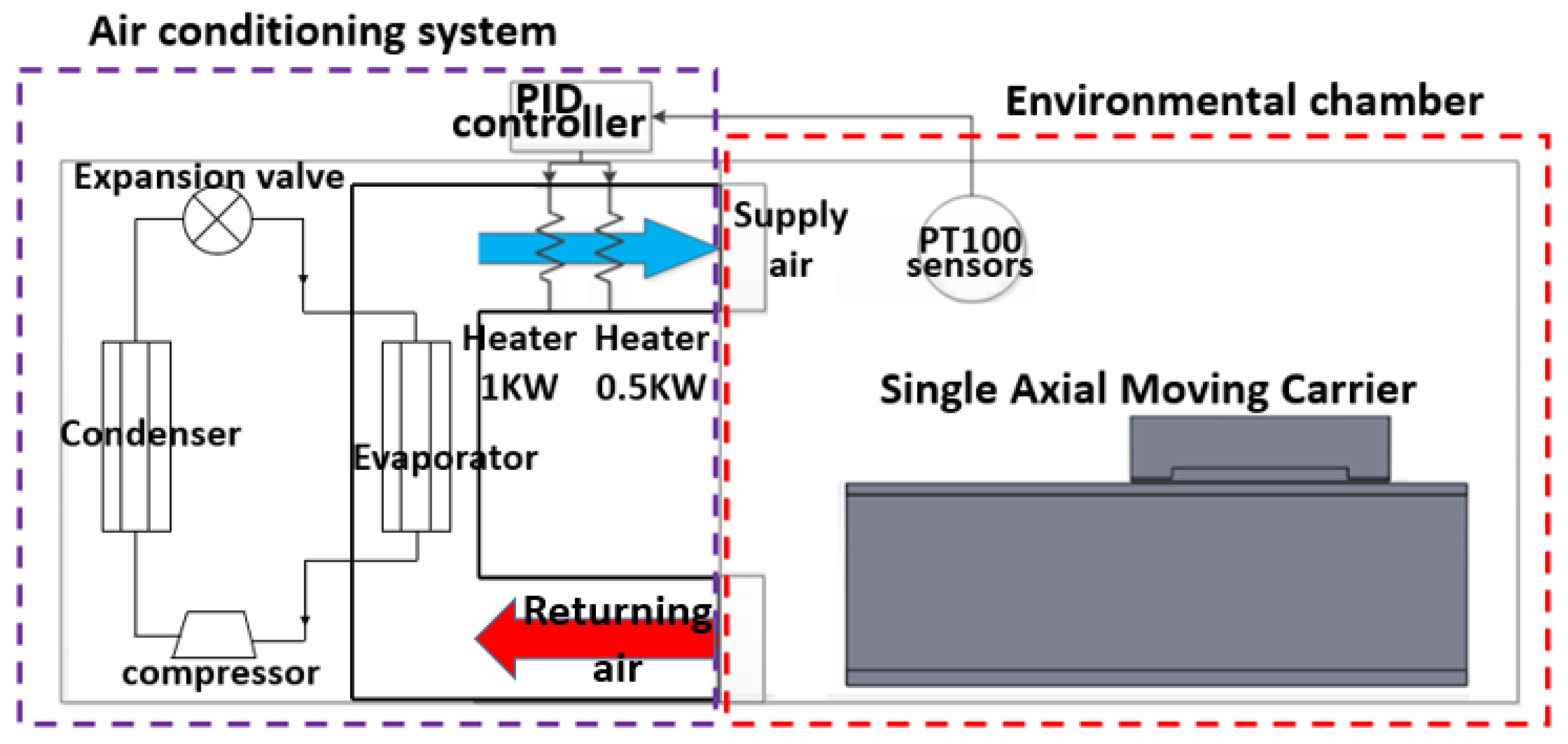
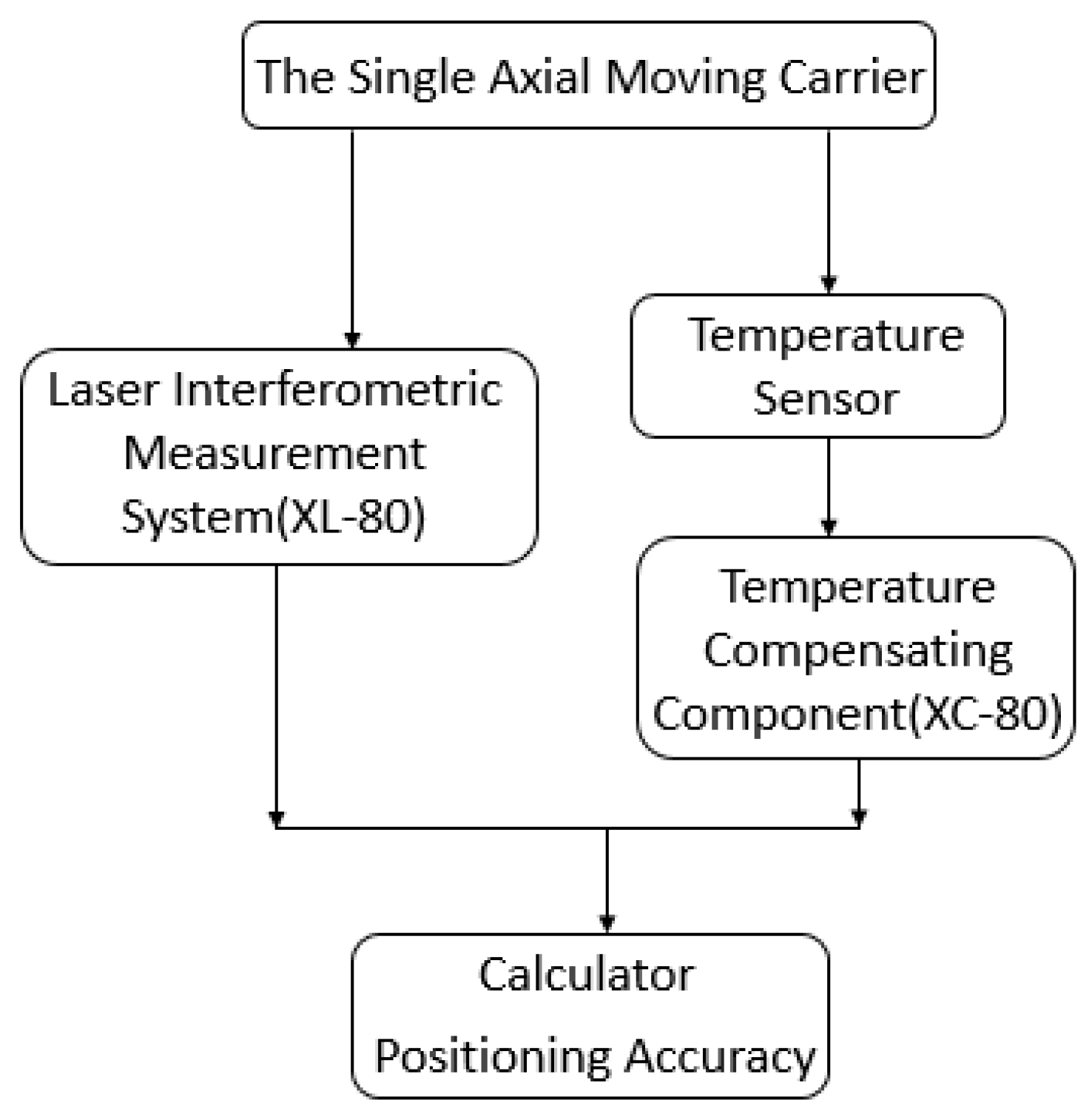
2.2. Positioning Accuracy Measurement of the Moving Carrier
- PT100 temperature sensorThe temperature sensors used in this paper are in line with the international IEC 751 standard for temperature sensors, with the temperature ranging from −200 to +850 °C, having a resistance of 100 ohms at 0 °C and 138.4 ohms at 100 °C. The measured temperature data were collected by a data log (GRAPHTEC GL-840-M) with an interval of 5 s.
- Laser measurement system
- Laser frequency stability of ±0.05 ppm over one year and ±0.02 ppm over 1 h is achieved by dynamic thermal control of the laser tube length to within a few nanometers.
- Linear measurement accuracy of ±0.5 ppm is achieved over the whole environmental range, i.e., from 0–40 °C (32–104 °F) and 650–1150 mbar. Readings can be taken up to 50 kHz, with a maximum linear measurement speed of 4 m/s and a linear resolution of 1 nm, even at maximum speed.
- The air velocity at the inlet vent was measured by a flow meter (Fluke 923) with an accuracy of ±2.5%.
3. Results and Discussions
3.1. Positioning Accuracies under Different Operational Temperature Conditions
3.2. Theoretical Models and Numerical Results of Flow and Temperature Fields
4. Conclusions
Acknowledgments
Author Contributions
Conflicts of Interest
References
- Yang, Z.; Chen, C.; Chen, F.; Li, G. Progress in the research of reliability technology of machine tools. J. Mech. Eng. 2013, 49, 130–139. [Google Scholar] [CrossRef] [Scilit]
- Lad, B.K.; Kulkarn, M.S. Reliability and maintenance based design of machine tools. Int. J. Perform. Eng. 2013, 9, 321–332. [Google Scholar]
- Zhang, Y.; Zheng, R.; Shen, G.; Chen, B. Reliability analysis for CNC machine tool based on failure interaction. Commun. Comput. Inf. Sci. 2011, 134, 489–496. [Google Scholar]
- Loganathan, M.K.; Gandhi, O.P. Reliability evaluation and analysis of CNC cam shaft grinding machine. J. Eng. Des. Technol. 2015, 13, 37–73. [Google Scholar] [CrossRef] [Scilit]
- Merrick, J.R.W.; Soyer, R.; Mazzuchi, T.A. A bayesian semiparametric analysis of the reliability and maintenance of machine tools. Technometrics 2003, 45, 58–69. [Google Scholar] [CrossRef] [Scilit]
- Ramesh, R.; Mannan, M.A.; Poo, A.N. Error compensation in machine tools—A review: Part II: Thermal errors. Int. J. Mach. Tools Manuf. 2000, 40, 1257–1284. [Google Scholar] [CrossRef] [Scilit]
- Mayr, J.; Jedrzejewski, J.; Uhlmann, E.; Alkan, D.M. Thermal issues in machine tools. CIRP Ann.—Manuf. Technol. 2012, 61, 771–791. [Google Scholar] [CrossRef] [Scilit]
- Ramesh, R.; Mannan, M.A.; Poo, A.N. Thermal error measurement and modeling in machine tools: Part I. Influence of varying operating conditions. Int. J. Mach. Tools Manuf. 2003, 43, 391–404. [Google Scholar] [CrossRef] [Scilit]
- Jenq-Shyong, C.; Wei-Yao, H. Characterizations and models for the thermal growth of a motorized high speed spindle. Int. J. Mach. Tools Manuf. 2003, 43, 1163–1170. [Google Scholar]
- Sun-Kyu, L.; Jae-Heung, Y.; Moon-Su, Y. Effect of thermal deformation on machine tool slide guide motion. Tribol. Int. 2003, 36, 41–47. [Google Scholar]
- Xia, J.; Wu, B.; Hu, Y.; Shi, T. Experimental research on factors influencing thermal dynamics characteristics of feed system. Precis. Eng. 2010, 34, 357–368. [Google Scholar]
- Mian, N.S.; Fletcher, S.; Longstaff, A.P.; Myers, A. Efficient estimation by FEA of machine tool distortion due to environmental temperature perturbations. Precis. Eng. 2013, 37, 372–379. [Google Scholar] [CrossRef] [Scilit]
- Tan, B.; Mao, X.; Liu, H.; Li, B.; He, S.; Peng, F.; Ling, Y. A thermal error model for large machine tools that considers environmental thermal hysteresis effects. Int. J. Mach. Tools Manuf. 2014, 82–83, 11–20. [Google Scholar]
- Wang, W.; Kececioglu, D.B. Fitting the Weibull log linear model to accelerated life-test data. IEEE Trans. Reliab. 2000, 49, 217–223. [Google Scholar] [CrossRef] [Scilit]
- Toshimichi, M.; Chenghe, Z.; Motonobu, N. Thermal deformation of machining center due to temperature change in the environment. Trans. Jpn. Soc. Mech. Eng. Ser. C 1991, 539, 2447–2452. [Google Scholar]
- Toshimichi, M.; Eiji, S. Analysis of thermal deformation of an ultra precision air spindle system. CIRP Ann.-Manuf. Tech. 1998, 47, 315–319. [Google Scholar]
- Fletcher, S.; Longstaff, A.P.; Myers, A. Flexible modeling and compensation of machine tool thermal errors. In Proceedings of the 20th Annual Meeting of American Society for Precision Engineering, Norfolk, VA, USA, 9–14 October 2005. [Google Scholar]
- Diaz-Elsayed, N.; Dornfeld, D.; Horvath, A. A comparative analysis of the environmental impacts of machine tool manufacturing facilities. J. Clean. Prod. 2015, 95, 223–231. [Google Scholar] [CrossRef] [Scilit]
- Diaz, N.; Helu, M.; Jayanathan, S.; Horvath, A.; Dornfeld, D. Environmental analysis of milling machine tool use in various manufacturing environments. In Proceedings of the 2010 IEEE International Symposium on Sustainable Systems and Technology (ISSST), Arlington, VA, USA, 17–19 May 2010; pp. 1–6. [Google Scholar]
- Jin, S.M.; Shi, M. A Study of the Airflow Field and Temperature Field in an Artificial Environmental Laboratory. Master’s Thesis, Nanjing Tech University, Nanjing, China, 2006. [Google Scholar]
- Li, Y.B.; Chou, W.; Lee, P.F.; Wang, X.C. Temperature homogeneity control of greenhouse based on CFD simulation model. Trans. Chin. Soc. Agric. Mach. 2012, 43, 156–161. [Google Scholar]
- Chang, H. A Study of the Control Mechanism and System of Micro-Nano Measurement Environment. Ph.D. Thesis, Hefei University of Technology, Heifei, China, 2009. [Google Scholar]
- Kashiwa: Precise vs. Insufficient Explanation. Available online: http://www.ic.u-tokyo.ac.jp/kashiwa/english/tips/tip17.html (accessed on 13 October 2016).
- Renishaw: Interferometry Explained. Available online: http://www.renishaw.com/en/interferometry-explained--7854 (accessed on 13 October 2016).
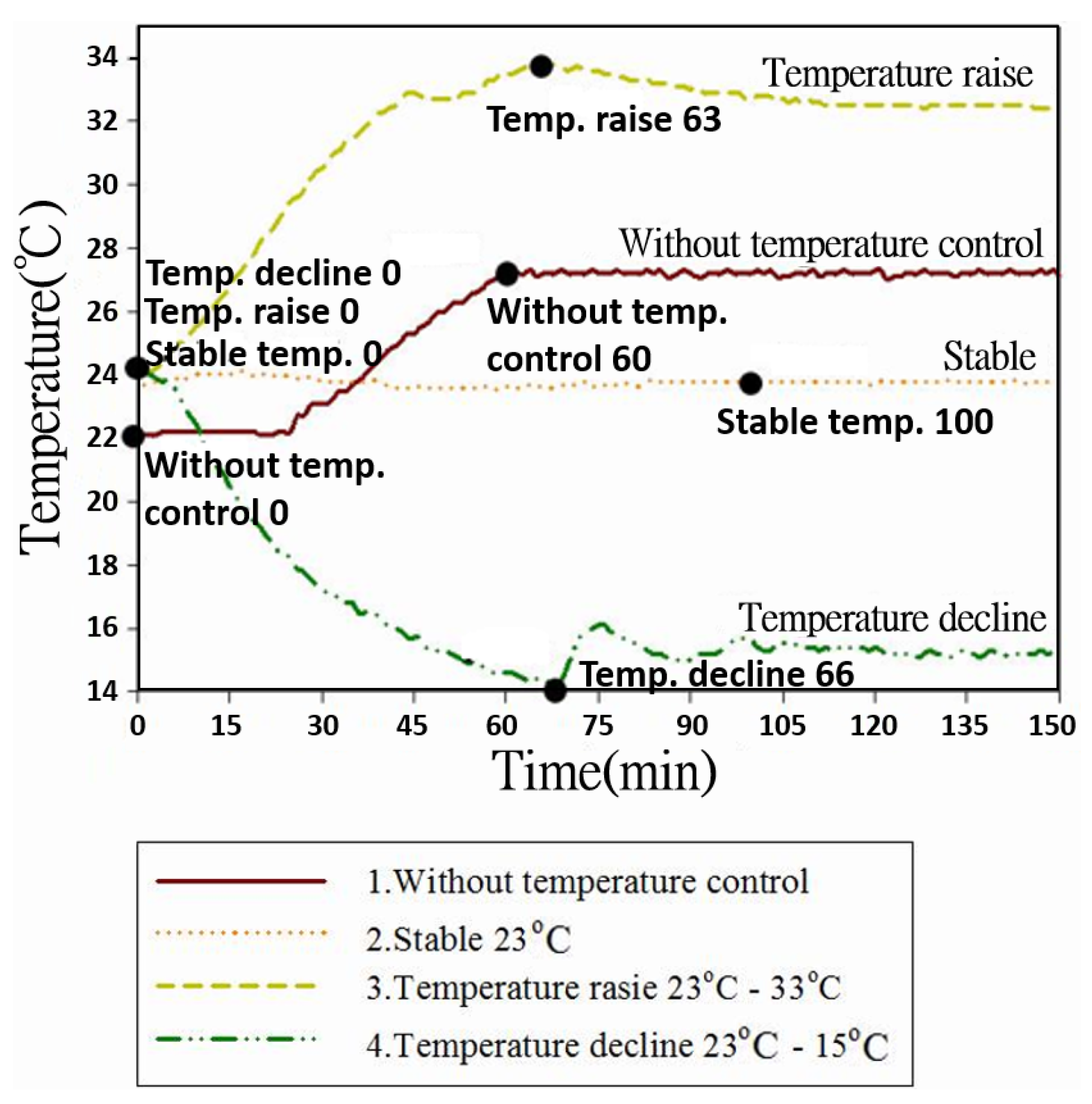
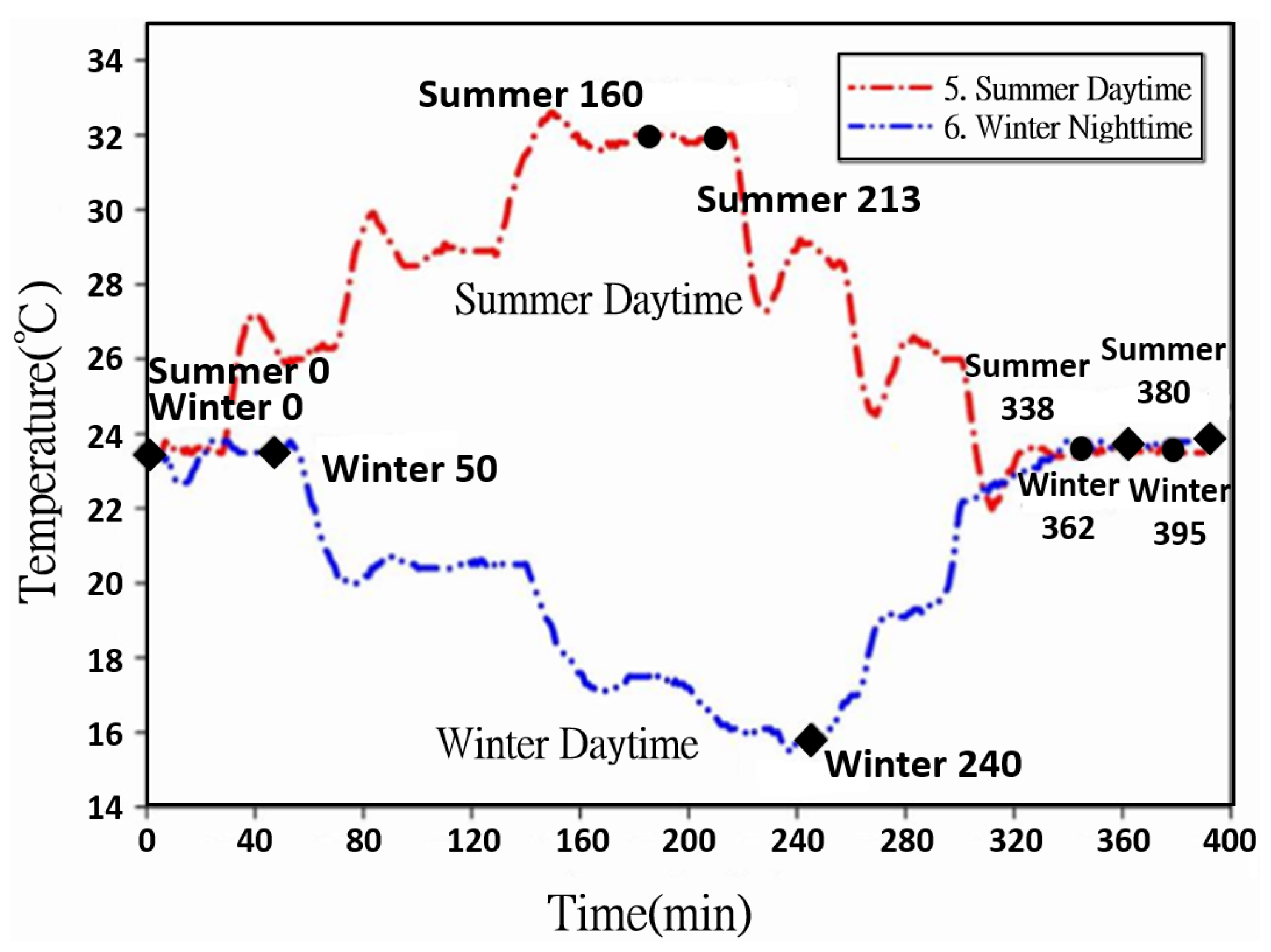
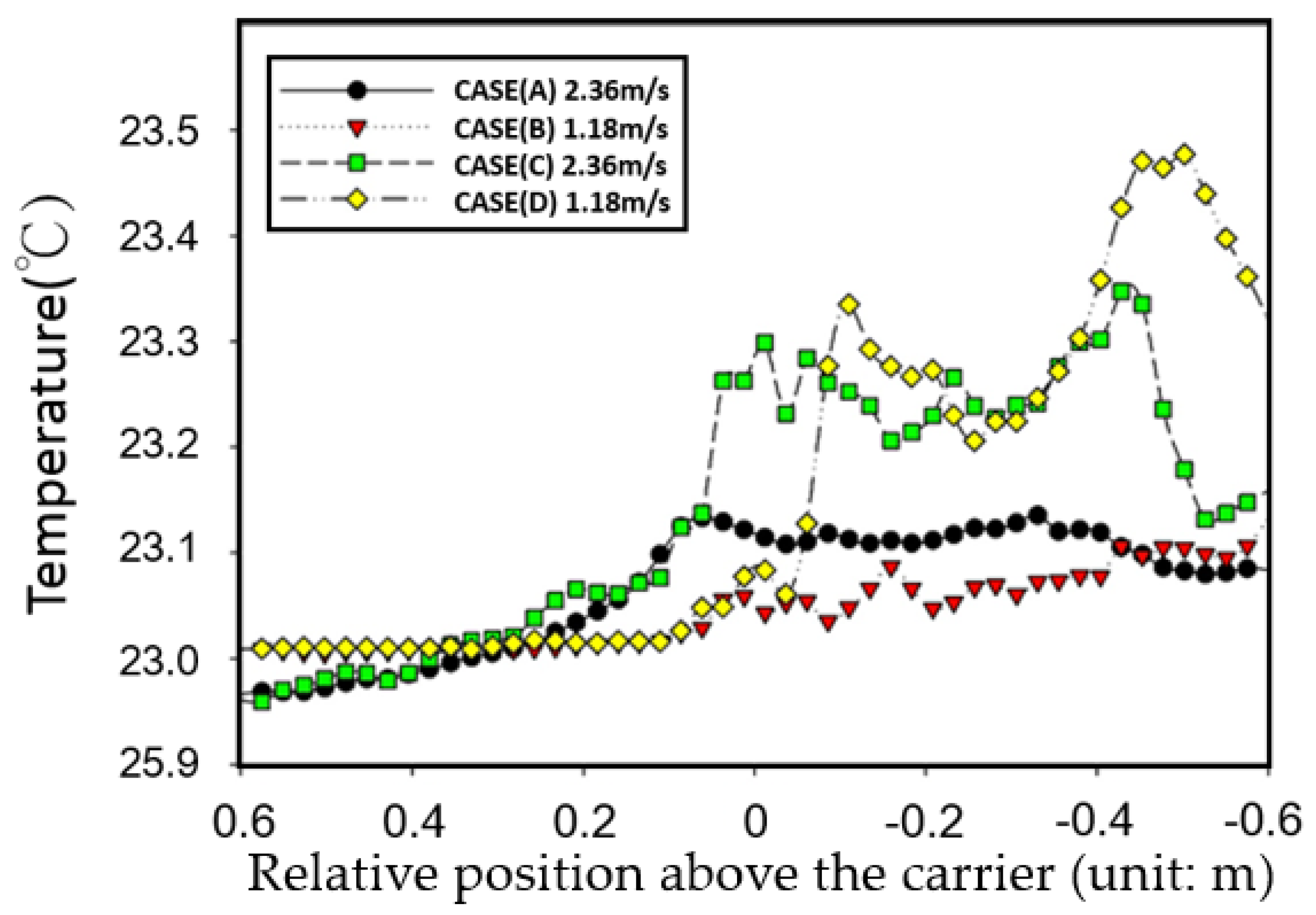
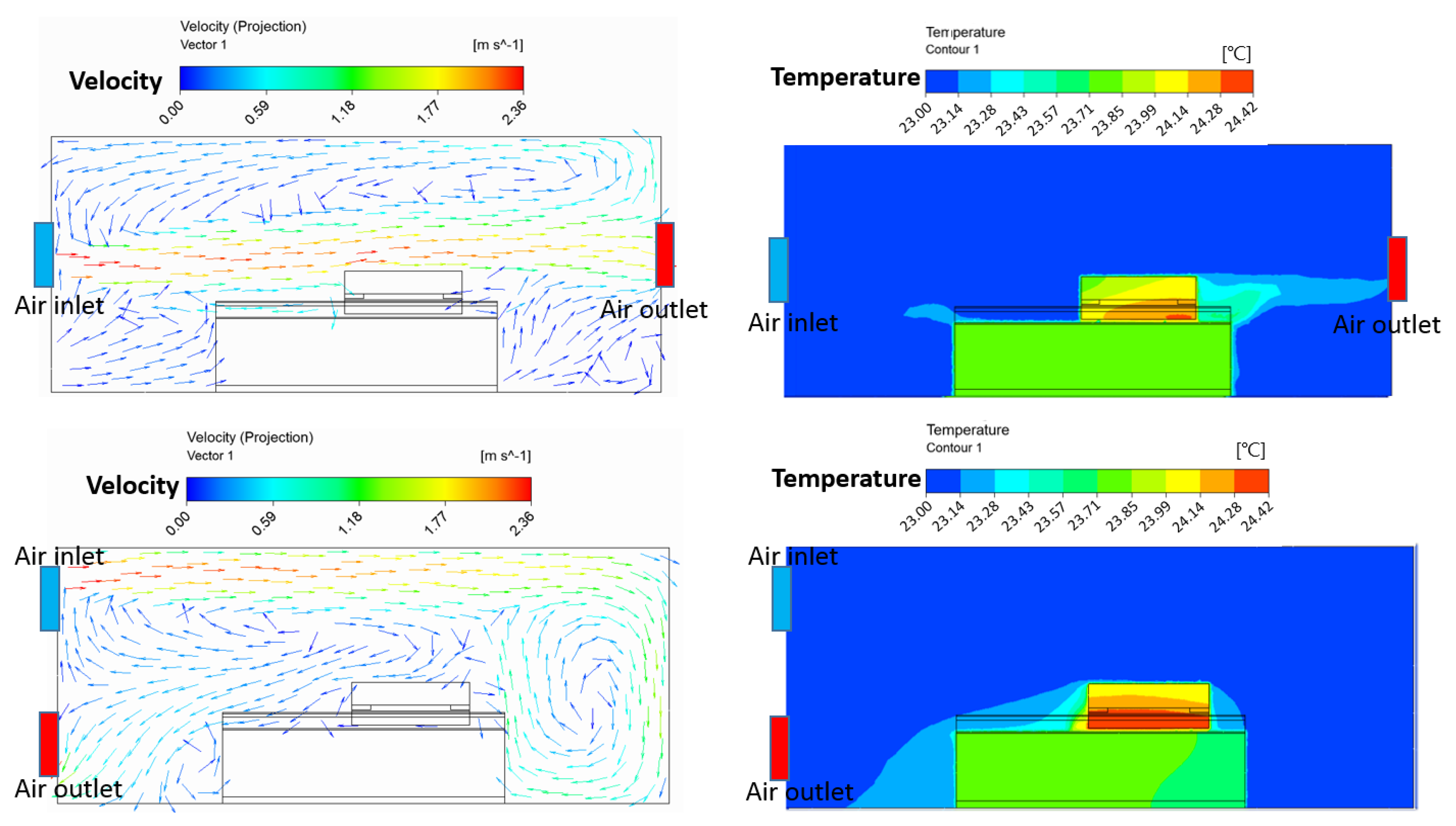

| No. | Time Point | Chamber Temperature (°C) | Time (min) | Positioning Accuracy (μm) | Variation of Positioning Accuracy (μm) | Variation Rate of Positioning Accuracy (μm/(min·°C)) |
|---|---|---|---|---|---|---|
| 1 | Without temp. control 0 | 22.7 | 0 | 18.30 | 0 | 0 |
| Without temp. control 60 | 27.8 | 60 | 17.37 | −0.93 | −0.00304 | |
| 2 | Stable temp. 0 | 23.7 | 0 | 17.96 | 0 | 0 |
| Stable temp. 100 | 23.8 | 100 | 16.14 | −1.82 | −0.18200 | |
| 3 | Temp. rise 0 | 23.8 | 0 | 16.14 | 0 | 0 |
| Temp. rise 63 | 33.3 | 63 | 20.69 | 4.55 | 0.00760 | |
| 4 | Temp. decline 0 | 23.6 | 0 | 14.93 | 0 | 0 |
| Temp. decline 66 | 15.7 | 66 | 22.94 | 8.01 | 0.01536 |
| No. | Time Point | Chamber Temperature (°C) | Time (min) | Positioning Accuracy (μm) | Variation of Positioning Accuracy (μm) | Variation Rate of Positioning Accuracy (μm/(min·°C)) |
|---|---|---|---|---|---|---|
| 5 | Summer 0 | 23.5 | 0 | 12.42 | 0 | 0 |
| Summer 180 | 31.5 | 180 | 11.85 | −0.57 | −0.00040 | |
| Summer 213 | 31.8 | 213 | 11.33 | −0.52 | -0.05253 | |
| Summer 338 | 23.5 | 338 | 15.74 | 4.41 | 0.00425 | |
| Summer 386 | 23.3 | 386 | 11.85 | −3.89 | −0.40521 | |
| 6 | Winter 0 | 23.7 | 0 | 13.42 | 0 | 0 |
| Winter 43 | 23.1 | 43 | 10.45 | −2.97 | −0.11512 | |
| Winter 249 | 15.4 | 249 | 24.06 | 13.61 | 0.00858 | |
| Winter 362 | 22.5 | 362 | 27.09 | 3.03 | 0.00378 | |
| Winter 391 | 22.7 | 391 | 26.61 | −0.48 | −0.08276 |
| Density | 1.1824 () |
|---|---|
| Specific heat | 1005 (J/(kg·K)) |
| Heat conductivity | 0.0261 (W/(m·K)) |
| Viscosity | 1.834 × 10⁻⁵ (kg/(m s)) |
| Coefficient of heat transfer | 0.00326 (W/·K)) |
| Prandtl number | 0.708 |
| Physical Properties | Cast Iron | Stainless Steel |
|---|---|---|
| Density () | 7850 | 7900 |
| Specific heat (J/(kg·K)) | 440 | 500 |
| Heat conductivity (W/(m·K)) | 46 | 16 |
| Thermal diffusivity ( | 0.0000133 | 0.0000041 |
| Thermal Expansion (μm/(m·K)) | 10.5 | 17 |
© 2017 by the authors. Licensee MDPI, Basel, Switzerland. This article is an open access article distributed under the terms and conditions of the Creative Commons Attribution (CC BY) license (http://creativecommons.org/licenses/by/4.0/).
Share and Cite
Li, K.-Y.; Luo, W.-J.; Huang, J.-Z.; Chan, Y.-C.; Pratikto; Faridah, D. Operational Temperature Effect on Positioning Accuracy of a Single-Axial Moving Carrier. Appl. Sci. 2017, 7, 420. https://doi.org/10.3390/app7040420
Li K-Y, Luo W-J, Huang J-Z, Chan Y-C, Pratikto, Faridah D. Operational Temperature Effect on Positioning Accuracy of a Single-Axial Moving Carrier. Applied Sciences. 2017; 7(4):420. https://doi.org/10.3390/app7040420
Chicago/Turabian StyleLi, Kun-Ying, Win-Jet Luo, Jun-Zheng Huang, Yung-Chao Chan, Pratikto, and Dini Faridah. 2017. "Operational Temperature Effect on Positioning Accuracy of a Single-Axial Moving Carrier" Applied Sciences 7, no. 4: 420. https://doi.org/10.3390/app7040420
APA StyleLi, K.-Y., Luo, W.-J., Huang, J.-Z., Chan, Y.-C., Pratikto, & Faridah, D. (2017). Operational Temperature Effect on Positioning Accuracy of a Single-Axial Moving Carrier. Applied Sciences, 7(4), 420. https://doi.org/10.3390/app7040420

