

Using Natural Gradients to Infer a Potential Response to Climate Change: An Example on the Reproductive Performance of Dactylis Glomerata L.

Abstract
1. Introduction
2. Results and Discussion
2.1. Results
2.1.1. General Results
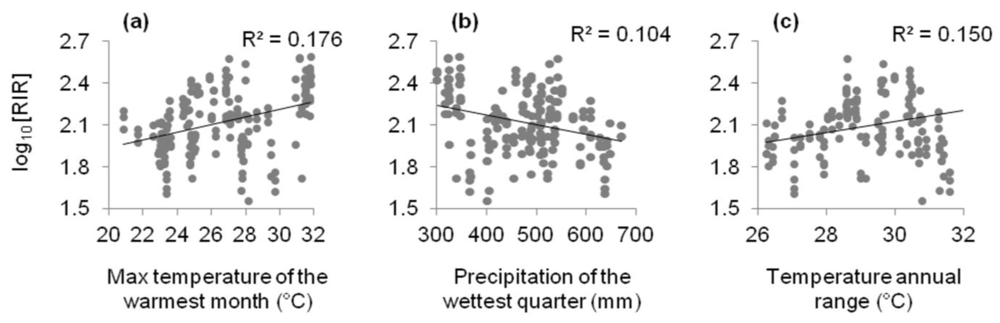
2.1.2. Relationships between Resource Investment in Reproduction and Climate Variables

| Variable | Intercept | β | F | P | R2 |
|---|---|---|---|---|---|
| Environmental energy | |||||
| Max temperature of warmest month | 2.971 | 0.072 | 12.413 | <0.001 | 0.176 |
| Mean temperature of wettest quarter | 3.377 | 0.091 | 11.757 | 0.001 | 0.167 |
| Mean temperature of warmest quarter | 3.377 | 0.091 | 11.757 | 0.001 | 0.167 |
| Annual mean temperature | 3.817 | 0.111 | 12.190 | <0.001 | 0.146 |
| Mean temperature of driest quarter | 4.396 | 0.109 | 11.518 | 0.001 | 0.146 |
| Mean temperature of coldest quarter | 4.396 | 0.109 | 11.518 | 0.001 | 0.146 |
| Min temperature of coldest month | 5.276 | 0.119 | 8.685 | 0.005 | 0.077 |
| Mean diurnal range | 3.819 | 0.096 | 1.273 | 0.264 | 0.020 |
| Water availability | |||||
| Precipitation of wettest quarter | 6.150 | −0.003 | 9.412 | 0.003 | 0.104 |
| Precipitation of wettest month | 6.019 | −0.007 | 6.379 | 0.014 | 0.102 |
| Annual precipitation | 6.252 | −0.001 | 8.642 | 0.005 | 0.093 |
| Precipitation of warmest quarter | 5.154 | −0.001 | 1.012 | 0.319 | 0.018 |
| Precipitation of driest quarter | 5.024 | −0.001 | 0.277 | 0.601 | 0.004 |
| Precipitation of coldest quarter | 5.024 | −0.001 | 0.277 | 0.601 | 0.004 |
| Precipitation of driest month | 4.776 | −0.001 | 0.080 | 0.779 | 0.002 |
| Climatic seasonality | |||||
| Temperature annual range | 1.980 | 0.097 | 9.470 | 0.003 | 0.150 |
| Temperature seasonality | 2.036 | 0.004 | 8.278 | 0.006 | 0.137 |
| Isothermality | 6.519 | −0.044 | 2.891 | 0.095 | 0.052 |
| Precipitation seasonality | 4.430 | 0.820 | 1.181 | 0.282 | 0.021 |
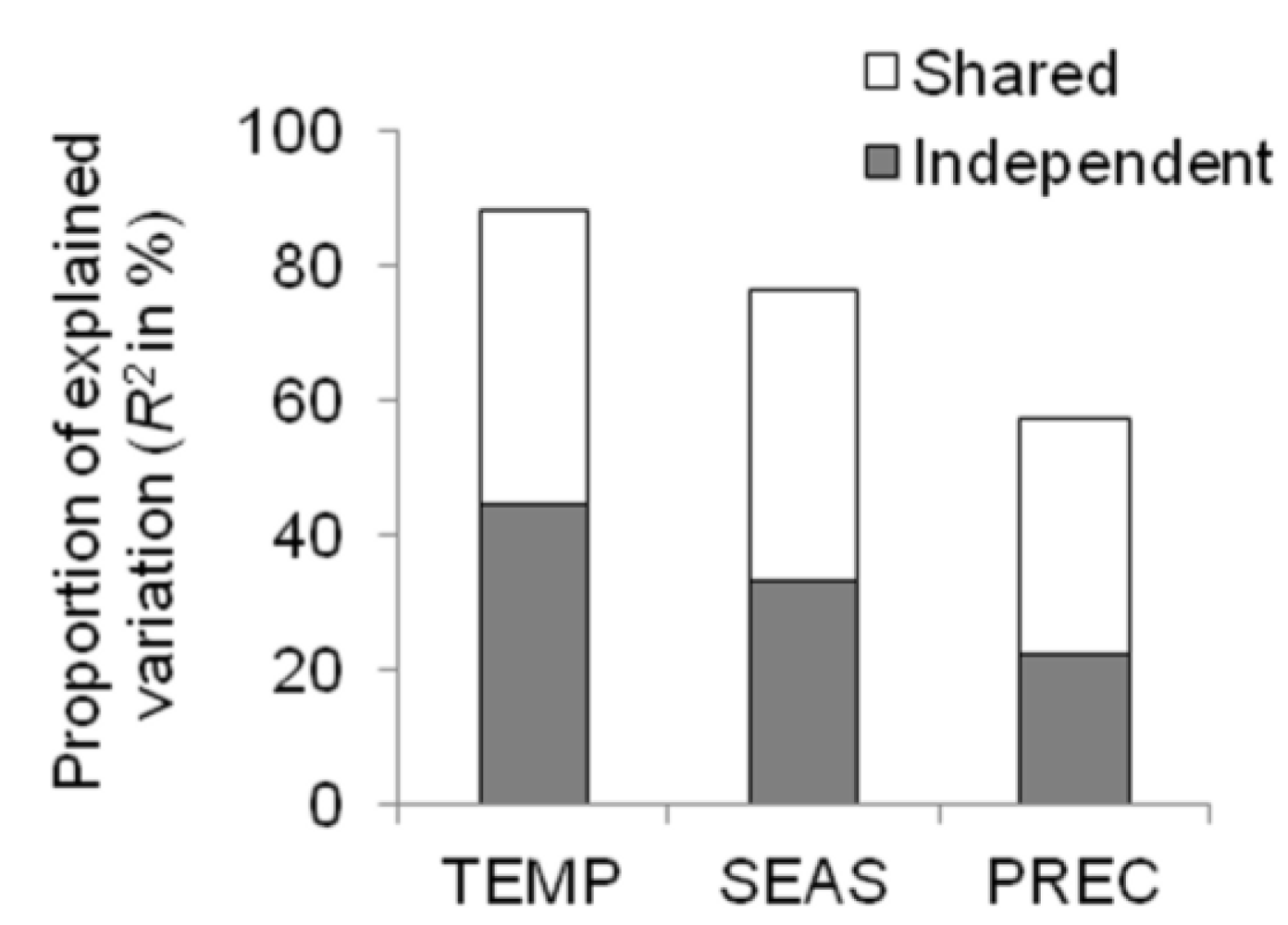
2.1.3. Multi-Model Inference and Hierarchical Partitioning
| Variable importance | Coefficients | 1st mod. | 2nd | 3rd | 4th |
|---|---|---|---|---|---|
| - | R2 | 0.18 | 0.15 | 0.14 | 0.13 |
| - | ΔAICc | 0 | 1.45 | 1.71 | 1.99 |
| Σ wi | Model wi | 0.52 | 0.25 | 0.22 | 0.14 |
| - | Intercept | 3.185 | 2.148 | 2.635 | 2.982 |
| 0.81 | TEMP | 0.060 | - | 0.045 | 0.070 |
| 0.23 | PREC | - | - | - | −0.001 |
| 0.46 | SEAS | - | 0.092 | 0.035 |
2.2. Discussion
3. Experimental Section
3.1. Case Study and Data Collection
3.2. Climate Model
3.3. Data Analysis
4. Conclusions
Acknowledgments
Supplementary Files
References
- Graae, B.J.; de Frenne, P.; Kolb, A.; Brunet, J.; Chabrerie, O.; Verheyen, K.; Pepin, N.; Heinken, T.; Zobel, M.; Shevtsova, A.; et al. On the use of weather data in ecological studies along altitudinal and latitudinal gradients. Oikos 2012, 121, 3–19. [Google Scholar] [CrossRef]
- Wilson, S.D.; Nilsson, C. Arctic alpine vegetation change over 20 years. Glob. Change Biol. 2009, 15, 1676–1684. [Google Scholar] [CrossRef]
- De Frenne, P.; Kolb, A.; Verheyen, K.; Brunet, J.; Chabrerie, O.; Decocq, G.; Diekmann, M.; Eriksson, O.; Heinken, T.; Hermy, M.; et al. Unravelling the effects of temperature, latitude and local environment on the reproduction of forest herbs. Glob. Ecol. Biogeogr. 2009, 18, 641–651. [Google Scholar] [CrossRef]
- Körner, C. Alpine Plant Life, 2nd ed; Springer: Berlin, Germany, 2003. [Google Scholar]
- Fukami, T.; Wardle, D.A. Long-term ecological dynamics: Reciprocal insights from natural and anthropogenic gradients. Proc. Roy. Soc. Lond. B Biol. Sci. 2005, 272, 2105–2115. [Google Scholar] [CrossRef]
- Körner, C. The use of 'altitude' in ecological research. Trends Ecol. Evol. 2007, 22, 569–574. [Google Scholar] [CrossRef]
- Sherry, R.A.; Zhou, X.H.; Gu, S.L.; Arnone, J.A.; Schimel, D.S.; Verburg, P.S.; Wallace, L.L.; Luo, Y.Q. Divergence of reproductive phenology under climate warming. Proc. Natl. Acad. Sci. U. S. A. 2007, 104, 198–202. [Google Scholar]
- Walker, M.D.; Wahren, C.H.; Hollister, R.D.; Henry, G.H.R.; Ahlquist, L.E.; Alatalo, J.M.; Bret-Harte, M.S.; Calef, M.P.; Callaghan, T.V.; Carroll, A.B.; et al. Plant community responses to experimental warming across the tundra biome. Proc. Natl. Acad. Sci. U. S. A. 2006, 103, 1342–1346. [Google Scholar]
- Dormann, C.F.; Woodin, S.J. Climate change in the Arctic: Using plant functional types in a meta-analysis of field experiments. Funct. Ecol. 2002, 16, 4–17. [Google Scholar] [CrossRef]
- Rees, M. Trade-offs among dispersal strategies in British plants. Nature 1993, 366, 150–152. [Google Scholar]
- Rees, M. Community structure in sand dune annuals: Is seed weight a key quantity? J. Ecol. 1995, 83, 857–863. [Google Scholar] [CrossRef]
- Guo, Q.F.; Brown, J.H.; Valone, T.J.; Kachman, S.D. Constraints of seed size on plant distribution and abundance. Ecology 2000, 81, 2149–2155. [Google Scholar] [CrossRef]
- Leishman, M.R. Does the seed size/number trade-off model determine plant community structure? An assessment of the model mechanisms and their generality. Oikos 2001, 93, 294–302. [Google Scholar]
- Hedhly, A.; Hormaza, J.I.; Herrero, M. Global warming and sexual plant reproduction. Trends Plant Sci. 2009, 14, 30–36. [Google Scholar] [CrossRef]
- De Frenne, P.; Brunet, J.; Shevtsova, A.; Kolb, A.; Graae, B.J.; Chabrerie, O.; Cousins, S.A.; Decocq, G.; de Schrijver, A.; Diekmann, M.; et al. Temperature effects on forest herbs assessed by warming and transplant experiments along a latitudinal gradient. Glob. Change Biol. 2011, 17, 3240–3253. [Google Scholar] [CrossRef]
- De Frenne, P.; Graae, B.J.; Kolb, A.; Brunet, J.; Chabrerie, O.; Cousins, S.A.O.; Decocq, G.; Dhondt, R.; Diekmann, M.; Eriksson, O.; et al. Significant effects of temperature on the reproductive output of the forest herb Anemone nemorosa L. Forest Ecol. Manag. 2010, 259, 809–817. [Google Scholar] [CrossRef]
- Dainese, M. Impact of land use intensity and temperature on the reproductive performance of Dactylis glomerata populations in the southeastern Alps. Plant Ecol. 2011, 212, 651–661. [Google Scholar] [CrossRef]
- Hovenden, M.J.; Wills, K.E.; Chaplin, R.E.; Vander Schoor, J.K.; Williams, A.L.; Osanai, Y.U.I.; Newton, P.C.D. Warming and elevated CO2 affect the relationship between seed mass, germinability and seedling growth in Austrodanthonia caespitosa, a dominant Australian grass. Glob. Change Biol. 2008, 14, 1633–1641. [Google Scholar] [CrossRef]
- Worldclim. Available online: http://www.worldclim.org/ (acceseed on 1 July 2012).
- Borrill, M. Temperate grasses. In Evolution of Crop Plants; Simmonds, N., Ed.; Longman: London, UK, 1976; pp. 137–142. [Google Scholar]
- Beddows, A. Dactylis glomerata L. J. Ecol. 1959, 47, 223–239. [Google Scholar] [CrossRef]
- Äeschimann, D.; Lauber, K.; Moser, D.M.; Theurillat, J.P. Flora Alpina; Zanichelli: Bologna, Italy, 2004. [Google Scholar]
- Moles, A.T.; Warton, D.I.; Warman, L.; Swenson, N.G.; Laffan, S.W.; Zanne, A.E.; Pitman, A.; Hemmings, F.A.; Leishman, M.R. Global patterns in plant height. J. Ecol. 2009, 97, 923–932. [Google Scholar]
- Breza, L.C.; Souza, L.; Sanders, N.J.; Classen, A.T. Within and between population variation in plant traits predicts ecosystem functions associated with a dominant plant species. Evol. Ecol. 2012, 2, 1151–1161. [Google Scholar] [CrossRef]
- HilleRisLambers, J.; Harpole, W.S.; Schnitzer, S.; Tilman, D.; Reich, P.B. CO2, nitrogen, and diversity differentially affect seed production of prairie plants. Ecology 2009, 90, 1810–1820. [Google Scholar] [CrossRef]
- Rajaniemi, T.K. Why does fertilization reduce plant species diversity? Testing three competition-based hypotheses. J. Ecol. 2002, 90, 316–324. [Google Scholar] [CrossRef]
- Benavides, R.; Montes, F.; Rubio, A.; Osoro, K. Geostatistical modelling of air temperature in a mountainous region of Northern Spain. Agr. Forest. Meteorol. 2007, 146, 173–188. [Google Scholar]
- Pinheiro, J.; Bates, D. Mixed Effects Models in S and S-Plus; Springer: New York, NY, USA, 2000. [Google Scholar]
- Pinheiro, J.; Bates, D.; DebRoy, S.; Sarkar, D. R Development Core Team, nlme: Linear and Nonlinear Mixed Effects Models. R Package Version 3.1-102; R Foundation for Statistical Computing: Vienna, Austria, 2011. [Google Scholar]
- R Development Core Team. R: A language and environment for statistical computing. R Foundation for Statistical Computing: Vienna, Austria. Available online: http://www.R-project.org/ (acceseed on 16 January 2012).
- Singer, J.; Willett, J. Applied Longitudinal Data Analysis: Modeling Change and Event Occurrence; Oxford University Press: Oxford, UK, 2003. [Google Scholar]
- Burnham, K.; Anderson, D. Model Selection and Multimodel Inference, A Practical Information—Theoretic Approach; Springer: Berlin, Germany, 2002. [Google Scholar]
- Barton, K. MuMIn: Multi-model inference. R package version 1.6.5. R Foundation for Statistical Computing: Vienna, Austria, 2011. Available online: http://CRAN.R-project.org/package=MuMIn (acceseed on 16 January 2012).
- Chevan, A.; Sutherland, M. Hierarchical partitioning. Am. Stat. 1991, 45, 90–96. [Google Scholar]
- Murray, K.; Conner, M. Methods to quantify variable importance: Implications for the analysis of noisy ecological data. Ecology 2009, 90, 348–355. [Google Scholar] [CrossRef]
- Walsh, C.; MacNally, R. hier.part: Hierarchical Partitioning. R Package Version 1.0-3; R Foundation for Statistical Computing: Vienna, Austria, 2008. [Google Scholar]
- Bretagnolle, F.; Thompson, J.D.; Lumaret, R. The influence of seed size variation on seed germination and seedling vigour in diploid and tetraploid dactylis glomerata L. Ann. Bot. 1995, 76, 607–615. [Google Scholar] [CrossRef]
- McKee, J.; Richards, A.J. Variation in seed production and germinability in common reed (Phragmites australis) in Britain and France with respect to climate. New Phytol. 1996, 133, 233–243. [Google Scholar] [CrossRef]
- Vera, M.L. Effects of altitude and seed size on germination and seedling survival of heathland plants in North Spain. Plant Ecol. 1997, 133, 101–106. [Google Scholar] [CrossRef]
- Kidson, R.; Westoby, M. Seed mass and seedling dimensions in relation to seedling establishment. Oecologia 2000, 125, 11–17. [Google Scholar] [CrossRef]
© 2012 by the authors; licensee MDPI, Basel, Switzerland. This article is an open access article distributed under the terms and conditions of the Creative Commons Attribution license (http://creativecommons.org/licenses/by/3.0/).
Share and Cite
Dainese, M. Using Natural Gradients to Infer a Potential Response to Climate Change: An Example on the Reproductive Performance of Dactylis Glomerata L. Biology 2012, 1, 857-868. https://doi.org/10.3390/biology1030857
Dainese M. Using Natural Gradients to Infer a Potential Response to Climate Change: An Example on the Reproductive Performance of Dactylis Glomerata L. Biology. 2012; 1(3):857-868. https://doi.org/10.3390/biology1030857
Chicago/Turabian StyleDainese, Matteo. 2012. "Using Natural Gradients to Infer a Potential Response to Climate Change: An Example on the Reproductive Performance of Dactylis Glomerata L." Biology 1, no. 3: 857-868. https://doi.org/10.3390/biology1030857
APA StyleDainese, M. (2012). Using Natural Gradients to Infer a Potential Response to Climate Change: An Example on the Reproductive Performance of Dactylis Glomerata L. Biology, 1(3), 857-868. https://doi.org/10.3390/biology1030857