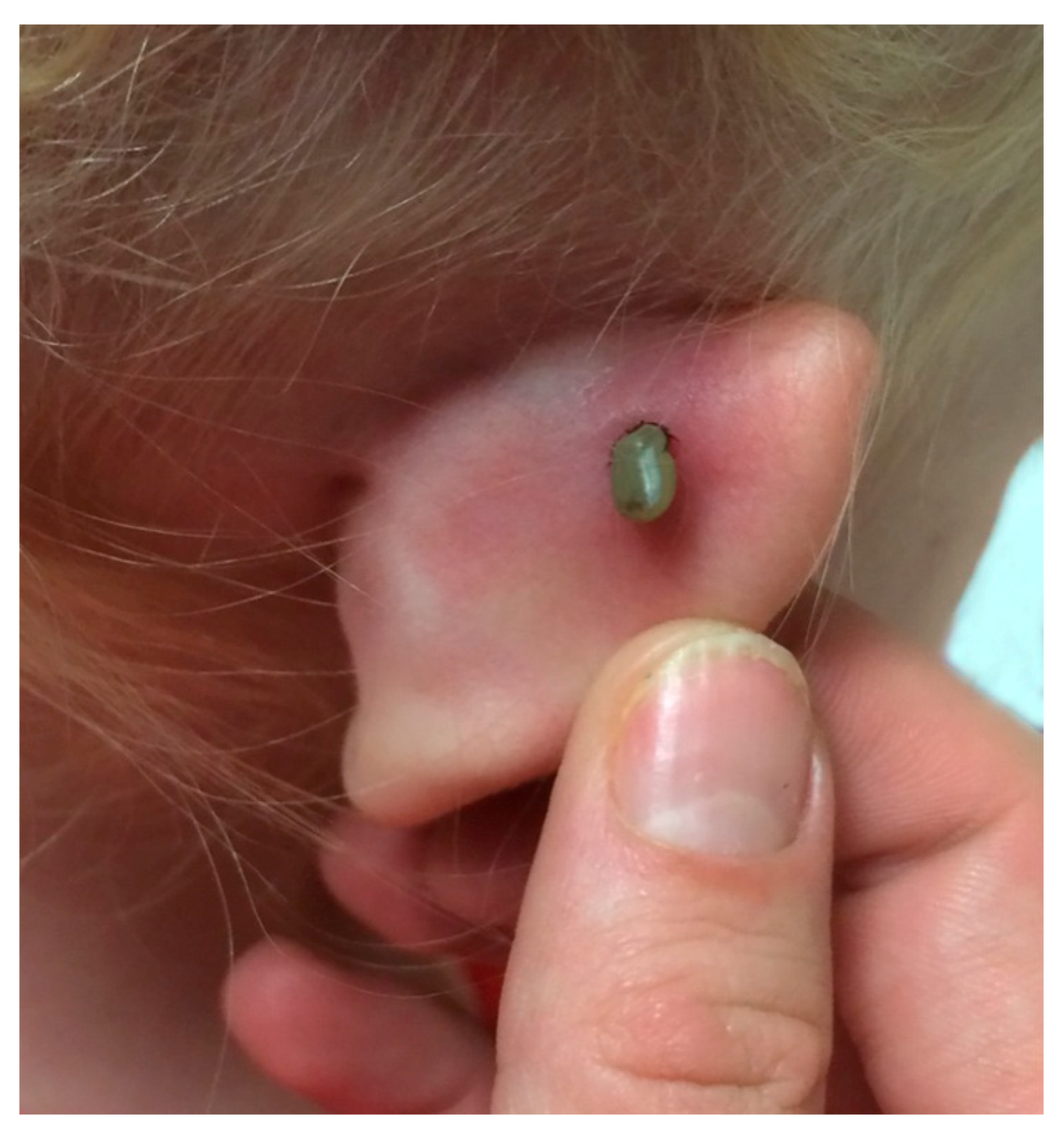
Human Babesiosis Caused by Babesia duncani Has Widespread Distribution across Canada

Abstract
1. Introduction
2. Materials and Methods
3. Results
4. Discussion
5. Conclusions
Author Contributions
Acknowledgments
Conflicts of Interest
References
- Vannier, E.; Krause, P.J. Human babesiosis. N. Engl. J. Med. 2012, 366, 2397–2407. [Google Scholar] [CrossRef] [Scilit] [PubMed]
- Akel, T.; Mobarakai, N. Hematologic manifestations of babesiosis. Ann. Clin. Microbiol. Antimicrob. 2017, 6. [Google Scholar] [CrossRef] [Scilit]
- Conrad, P.A.; Kjemtrup, A.M.; Carreno, R.A.; Thomford, J.; Wainwright, K.; Eberhard, M.; Quick, R.; Telford III, S.R.; Herwaldt, B.L. Description of Babesia duncani n. sp. (Apicomplexa: Babesiidae) from humans and its differentiation from other piroplasms. Int. J. Parasitol. 2006, 36, 779–789. [Google Scholar] [CrossRef] [Scilit] [PubMed]
- Bloch, E.M.; Levin, A.E.; Williamson, P.C.; Cyrus, S.; Shaz, B.H.; Kessler, D.; Gorlin, J.; Bruhn, R.; Lee, T.-H.; Montalvo, L.; et al. A prospective evaluation of chronic Babesia microti infection in seroreactive blood donors. Transfusion 2016, 56, 1875–1882. [Google Scholar] [CrossRef] [Scilit] [PubMed]
- Mehlhorn, H.; Schein, E. The piroplasms: Life cycle and sexual stages. Adv. Parasitol. 1985, 23, 37–103. [Google Scholar] [CrossRef]
- Poinar, G., Jr. Fossilized mammalian erythrocytes associated with tick reveal ancient piroplasms. J. Med. Entomol. 2017, 54, 1–6. [Google Scholar] [CrossRef] [Scilit] [PubMed]
- Skrabalo, Z.; Deanovic, Z. Piroplasmosis in man; report of a case. Doc. Med. Geogr. Trop. 1957, 9, 11–16. [Google Scholar] [PubMed]
- Gray, J.; von Stedingk, L.V.; Gürtelschmid, M.; Granström, M. Transmission studies of Babesia microti in Ixodes ricinus ticks and gerbils. J. Clin. Microbiol. 2002, 40, 1259–1263. [Google Scholar] [CrossRef] [Scilit] [PubMed]
- Liu, D.; Lu, X. Babesia. In Molecular Detection of Human Parasitic Pathogens, 1st ed.; Liu, D., Ed.; Taylor and Francis Group: Abingdon, UK, 2013; pp. 151–158. ISBN 978143981439812426. [Google Scholar]
- Hersh, M.H.; Ostfeld, R.S.; McHenry, D.J.; Tibbetts, M.; Brunner, J.L.; Killilea, M.E.; LoGiudice, K.; Schmidt, K.A.; Keesing, F. Co-infection of blacklegged ticks with Babesia microti and Borrelia burgdorferi is higher than expected and acquired from small mammal hosts. PLoS ONE. 2014, 9, e99348. [Google Scholar] [CrossRef] [Scilit] [PubMed]
- Scott, J.D.; Durden, L.A. Amblyomma dissimile Koch (Acari: Ixodidae) parasitizes bird captured in Canada. Syst. Appl. Acarol. 2015, 20, 854–860. [Google Scholar] [CrossRef] [Scilit]
- Scott, J.D.; Durden, L.A. First record of Amblyomma rotundatum tick (Acari: Ixodidae) parasitizing a bird collected in Canada. Syst. Appl. Acarol. 2015, 20, 155–161. [Google Scholar] [CrossRef] [Scilit]
- Scott, J.D. First record of locally acquired human babesiosis in Canada caused by Babesia duncani: A case report. Sage Open Med. Case Rep. 2017, 5, 1–4. [Google Scholar] [CrossRef] [Scilit] [PubMed]
- FDA Approves Tests to Screen for Tickborne Parasite in Whole Blood and Plasma to Protect the U.S. Blood Supply. Available online: https://www.prnewswire.com/news-release/fda-approves-first-to-screen-for-tickborne-parasite-in-whole-blood-and-plasma-to-protect-the-us-blood-supply-300609489.html (accessed on 6 March 2018).
- Bullard, J.M.P.; Ahsanuddin, A.N.; Perry, A.M.; Lindsay, L.R.; Iranpour, M.; Dibernardo, A.; Van Caeseele, P.G. The first case of locally acquired tick–borne Babesia microti infection in Canada. Can. J. Infect. Dis. Med. Microbiol. 2014, 25, e87–e89. [Google Scholar] [CrossRef] [Scilit] [PubMed]
- Prince, H.E.; Lapé-Nixon, M.; Patel, H.; Cindy, Y. Comparison of the B. duncani (WA1) IgG detection rates among clinical sera submitted to a reference laboratory for WA1 IgG testing and blood donor specimens from diverse geographic areas of the United States. Clin. Vaccine Immunol. 2010, 17, 1729–1733. [Google Scholar] [CrossRef] [Scilit] [PubMed]
- Wilson, M.; Glaser, K.C.; Adams–Fish, D.; Boley, M.; Mayda, M.; Rolestina, R.E. Development of droplet digital PCR for the detection of Babesia microti and Babesia duncani. Exp. Parasitol. 2015, 149, 24–31. [Google Scholar] [CrossRef] [Scilit] [PubMed]
- Krause, P.J.; Spielman, A.; Telford III, S.R.; Sikand, V.K.; McKay, K.; Christianson, D.; Pollack, R.J.; Brassard, P.; Magera, J.; Ryan, R.; Persing, D.H. Persistent parasitemia after acute babesiosis. N. Engl. J. Med. 1998, 339, 160–165. [Google Scholar] [CrossRef] [Scilit] [PubMed]
- Meldrum, S.C.; Birkhead, G.S.; White, D.J.; Benach, J.L.; Morse, D.L. Human babesiosis in New York state: An epidemiological description of 136 cases. Clin. Infect. Dis. 1992, 15, 1019–1023. [Google Scholar] [CrossRef] [Scilit] [PubMed]
- Belongia, E.A. Epidemiology and impact of coinfections acquired from Ixodes ticks. Vector Borne Zoonotic Dis. 2002, 2, 265–273. [Google Scholar] [CrossRef] [Scilit] [PubMed]
- Adelson, M.E.; Rao, R.-V.; Tilton, R.C.; Cabets, K.; Eskow, E.; Fein, L.; Occi, J.L.; Mordechai, E. Prevalence of Borrelia burgdorferi, Bartonella spp., Babesia microti, and Anaplasma phagocytophila in Ixodes scapularis ticks collected in northern New Jersey. J. Clin. Microbiol. 2004, 42, 2799–2801. [Google Scholar] [CrossRef] [Scilit] [PubMed]
- Stricker, R.B.; Burrascano, J.J.; Harris, N.S.; Horowitz, R.; Johnson, L.; Smith, V.; Phillips, S.E. Coinfection with Borrelia burgdorferi and Babesia microti: Bad or worse? J. Infect. Dis. 2005, 193, 901–902. [Google Scholar] [CrossRef] [Scilit] [PubMed]
- Krause, P.J.; Telford III, S.R.; Spielman, A.; Sikand, V.; Ryan, R.; Christianson, D.; Burke, G.; Brassard, P.; Pollack, R.; Peck, J.; Persing, D.H. Concurrent Lyme disease and babesiosis. JAMA. 1996, 275, 1657–1660. [Google Scholar] [CrossRef] [Scilit] [PubMed]
- Krause, P.J.; McKay, K.; Thompson, C.A.; Sikand, V.K.; Lentz, R.; Lepore, T.; Closter, L.; Christianson, D.; Telford, S.R.; Persing, D.; et al. Disease-specific diagnosis of coinfecting tickborne zoonoses: Babesiosis, human granulocyctic ehrlichiosis, and Lyme disease. Clin. Infect. Dis. 2002, 34, 1184–1191. [Google Scholar] [CrossRef] [Scilit] [PubMed]
- Horowitz, R.I. Lyme and other co-infections. In Why Can’t I Get Better? Solving the Mystery of Lyme and Chronic Disease, 1st ed.; Martin’s Press: New York, NY, USA, 2013; pp. 134–162. ISBN 978-1-250-01940-0. [Google Scholar]
- Middelveen, M.J.; Sapi, E.; Burke, J.; Filush, K.R.; Franco, A.; Fesler, M.C.; Stricker, R.B. Persistent Borrelia infection in patients with ongoing symptoms of Lyme disease. Healthcare 2018, 6, 33. [Google Scholar] [CrossRef] [Scilit] [PubMed]
- Curcio, S.R.; Tria, L.P.; Gucwa, A.L. Seroprevalence of Babesia microti in individuals with Lyme disease. Vector Borne Zoonotic Dis. 2016, 16, 737–743. [Google Scholar] [CrossRef] [Scilit] [PubMed]
- Benach, J.L.; Coleman, J.L.; Habicht, G.S.; MacDonald, A.; Grunwaldt, E.; Giron, J.A. Serological evidence for simutaneous occurrences of Lyme disease and babesiosis. J. Infect. Dis. 1985, 152, 473–477. [Google Scholar] [CrossRef] [Scilit] [PubMed]
- Berger, B.W. Dermatologic manifestations of Lyme disease. Rev. Infect. Dis. 1989, 11 (Suppl. 6), S1475–S1481. [Google Scholar] [CrossRef] [Scilit] [PubMed]
- Chagnon, S.L.; Naik, M.; Abdel-Hamid, H. Child neurology: Tick paralysis: A diagnosis not to miss. Neurology 2014, 82, e91–e93. [Google Scholar] [CrossRef] [Scilit] [PubMed]
- Shock, B.C.; Moncayo, A.; Cohen, S.; Mitchell, E.A.; Williamson, P.C.; Lopez, G.; Garrison, L.E.; Yabsley, M.J. Ticks Tick Borne Dis. 2014, 5, 373–380. [CrossRef] [Scilit] [PubMed]
- Scott, J.D.; Fernando, K.; Banerjee, S.N.; Durden, L.A.; Byrne, S.K.; Banerjee, M.; Mann, R.B.; Morshed, M.G. Birds disperse ixodid (Acari: Ixodidae) and Borrelia burgdorferi-infected ticks in Canada. J. Med. Entomol. 2001, 38, 493–500. [Google Scholar] [CrossRef] [Scilit] [PubMed]
- Scott, J.D.; Lee, M.K.; Fernando, K.; Durden, L.A.; Jorgensen, D.R.; Mak, S.; Morshed, M.G. Detection of Lyme disease spirochete, Borrelia burgdorferi sensu lato, including three novel genotypes in ticks (Acari: Ixodidae) collected from songbirds (Passeriformes) across Canada. J. Vect. Ecol. 2010, 35, 124–139. [Google Scholar] [CrossRef] [Scilit]
- LeBel, D.P.; Moritz, E.D.; O’Brien, J.J.; Lazarchick, J.; Tormos, L.M.; Duong, A.; Fontaine, M.J.; Squires, D.E.; Stramer, S.L. Cases of transfusion-transmitted babesiosis occurring in nonendemic areas: A diagnostic dilemma. Transfusion 2017, 57, 2348–2354. [Google Scholar] [CrossRef] [Scilit] [PubMed]
- Linden, J.V.; Prusinski, M.A.; Crowder, L.A.; Tonnetti, L.; Stramer, S.L.; Kessler, D.A.; White, J.; Shaz, B.; Olkowska, D. Transfusion-transmitted and community-acquired babesiosis in New York, 2004 to 2015. Transfusion 2018, 58, 660–668. [Google Scholar] [CrossRef] [Scilit] [PubMed]
- O’Brien, S.F.; Delage, G.; Lindsay, R.; Bernier, F.; Dubuc, S.; Germain, M.; Pilot, G.; Yi, Q.L.; Fearon, M.A. Seroprevalence of Babesia microti infection in Canadian blood donors. Transfusion 2016, 56, 237–243. [Google Scholar] [CrossRef] [Scilit] [PubMed]
- Kjemtrup, A.M.; Lee, B.; Fritz, C.L.; Evans, C.; Chervenak, M.; Conrad, P.A. Investigation of transfusion transmission of a WA1-type babesial parasite to a premature infant in California. Transfusion 2002, 42, 1482–1487. [Google Scholar] [CrossRef] [Scilit] [PubMed]
- Herwaldt, B.L.; Linden, J.V.; Bosserman, E.; Young, C.; Olkowska, D.; Wilson, M. Transfusion-associated babesiosis in the United States: A description of cases. Ann. Intern. Med. 2011, 155, 509–519. [Google Scholar] [CrossRef] [Scilit] [PubMed]
- Bloch, E.M.; Herwaldt, B.L.; Leiby, D.A.; Shaieb, A.; Herron, R.M.; Chervenak, M.; Reed, W.; Hunter, R.; Ryals, R.; Hagar, W.; et al. The third described case of transfusion-transmitted Babesia duncani. Transfusion 2012, 52, 1517–1522. [Google Scholar] [CrossRef] [Scilit] [PubMed]
- Leiby, D.A. Transfusion-transmitted Babesia spp.: Bull’s-eye on Babesia microti. Transfusion 2011, 24, 14–28. [Google Scholar] [CrossRef] [Scilit] [PubMed]
- Krause, P.J.; Vannier, E. Transplacental transmission of human babesiosis. Infect. Dis. Clin. Pract. 2012, 20, 365–367. [Google Scholar] [CrossRef] [Scilit]
- Cornett, J.K.; Malhotra, A.; Hart, D. Vertical transmission of babesiosis from a pregnant, splenectomized mother to her neonate. Infect. Dis. Clin. Pract. 2012, 20, 408–410. [Google Scholar] [CrossRef] [Scilit]
- Fox, L.M.; Winger, S.; Ahmed, A.; Arnold, A.; Chou, J.; Rhein, L.; Levy, O. Neonatal babesiosis: Case report and review of the literature. Pediatr. Infect. Dis. J. 2006, 25, 169–173. [Google Scholar] [CrossRef] [Scilit] [PubMed]


| By Province | Cases | By Year | Cases |
|---|---|---|---|
| Alberta | 25 | 2011 | 119 |
| British Columbia | 377 | 2012 | 145 |
| Manitoba | 41 | 2013 | 146 |
| New Brunswick | 10 | 2014 | 147 |
| Nova Scotia | 8 | 2015 | 162 |
| Newfoundland and Labrador | 4 | 2016 | 182 |
| Ontario | 365 | 2017 | 198 |
| Prince Edward Island | 7 | ||
| Québec | 269 | ||
| Saskatchewan | 13 | ||
| Totals | 1119 | 1119 |
© 2018 by the authors. Licensee MDPI, Basel, Switzerland. This article is an open access article distributed under the terms and conditions of the Creative Commons Attribution (CC BY) license (http://creativecommons.org/licenses/by/4.0/).
Share and Cite
Scott, J.D.; Scott, C.M. Human Babesiosis Caused by Babesia duncani Has Widespread Distribution across Canada. Healthcare 2018, 6, 49. https://doi.org/10.3390/healthcare6020049
Scott JD, Scott CM. Human Babesiosis Caused by Babesia duncani Has Widespread Distribution across Canada. Healthcare. 2018; 6(2):49. https://doi.org/10.3390/healthcare6020049
Chicago/Turabian StyleScott, John D., and Catherine M. Scott. 2018. "Human Babesiosis Caused by Babesia duncani Has Widespread Distribution across Canada" Healthcare 6, no. 2: 49. https://doi.org/10.3390/healthcare6020049
APA StyleScott, J. D., & Scott, C. M. (2018). Human Babesiosis Caused by Babesia duncani Has Widespread Distribution across Canada. Healthcare, 6(2), 49. https://doi.org/10.3390/healthcare6020049