
Ascorbic Acid Rejection Characteristics of Modified Platinum Electrodes: A Shelf Life Investigation
Abstract
1. Introduction
2. Experimental Section
2.1. Reagents and Solutions
2.2. Sensor Manufacture
2.3. Storage Conditions
2.4. AA Calibrations
2.5. Instrumentation and Software
3. Results and Discussion
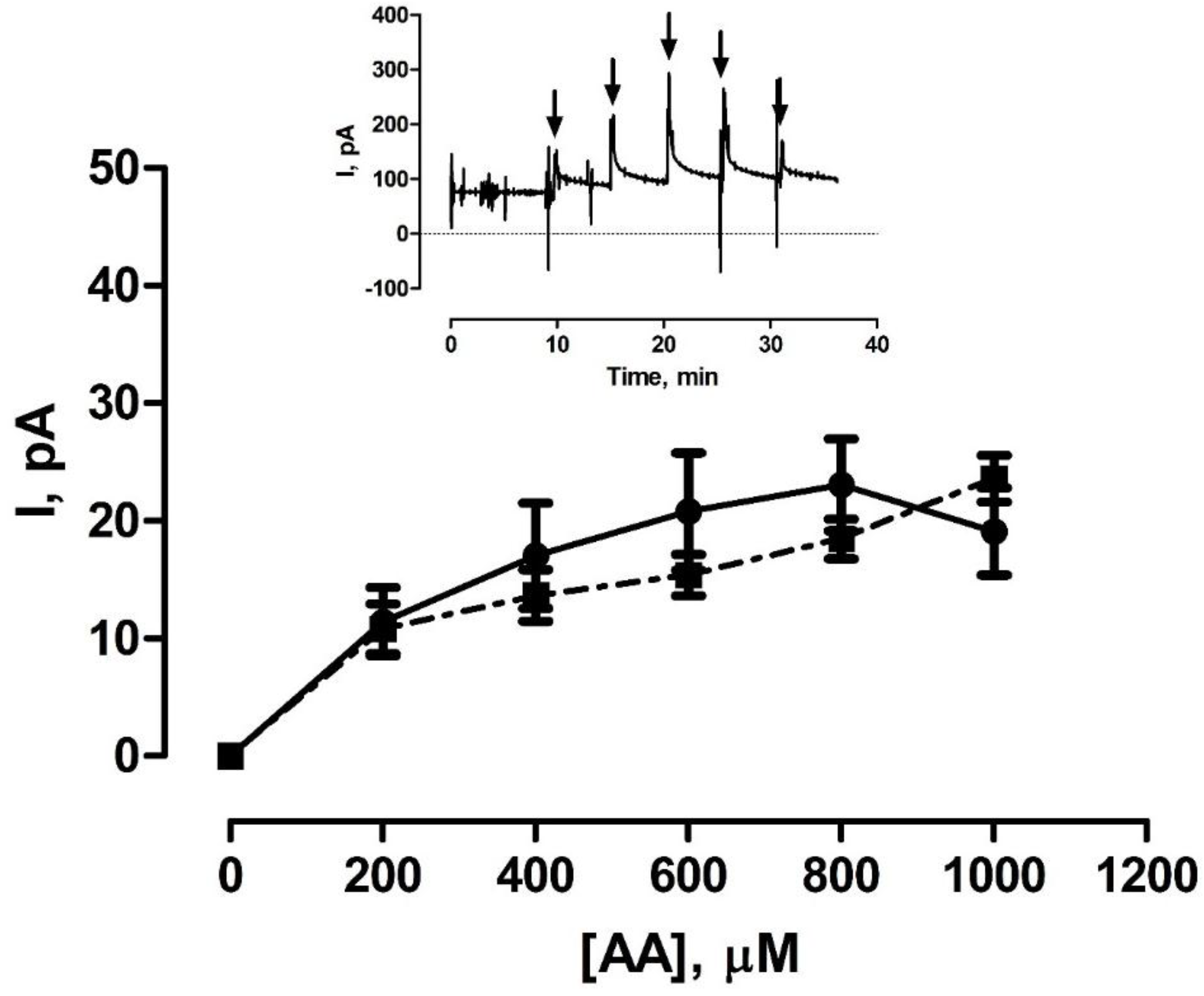
3.1. Shelf-Life Studies—Effect of Repeated AA Calibrations



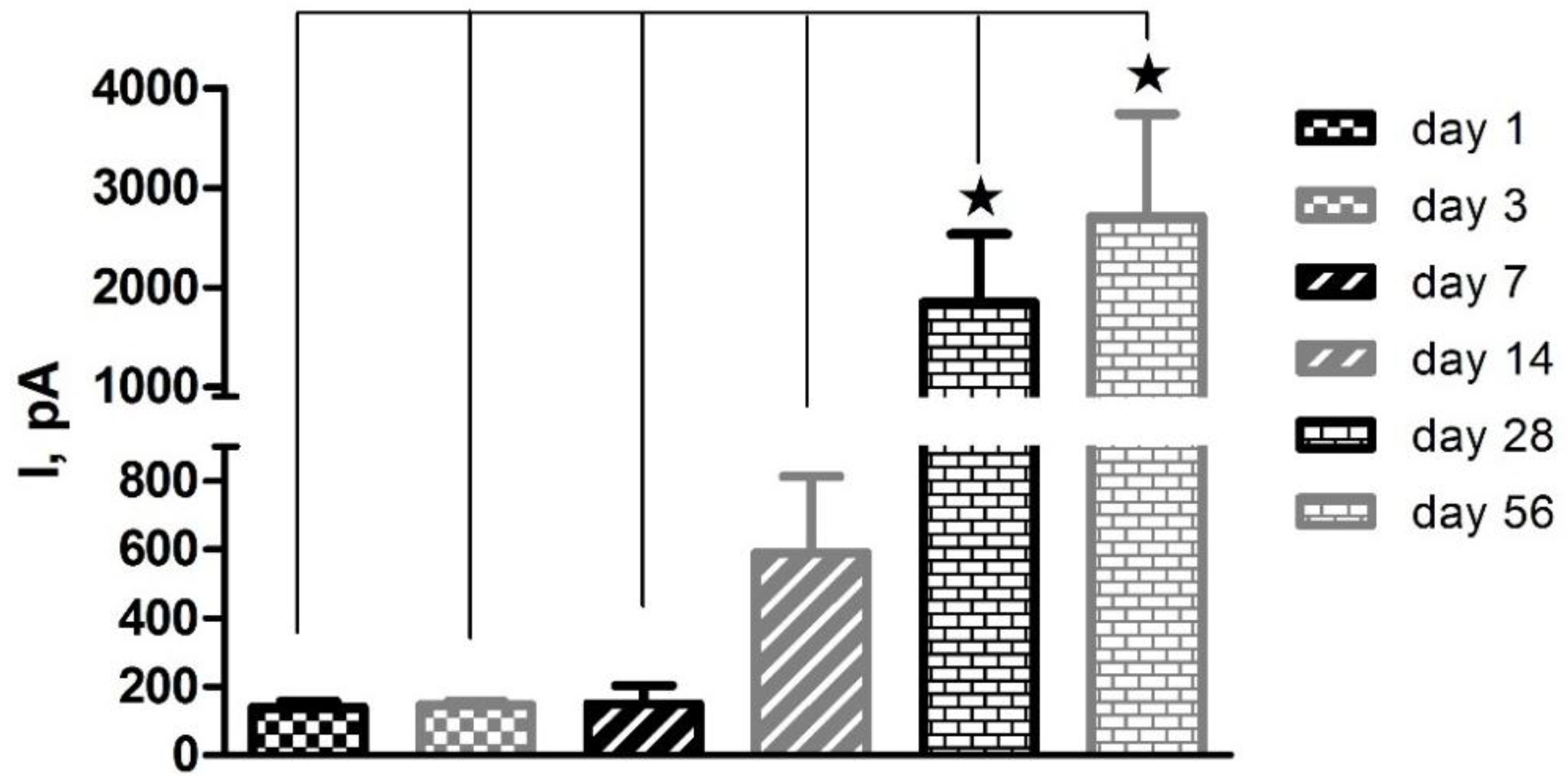
 ” denotes level of significance against day 1. “ns” denotes no significant change.
| Pt-PPD | Pt-Nafion® (5/2) | Pt-Nafion® (1/2)-PPD | Pt-Nafion® (2/1)-PPD | |||||||||
|---|---|---|---|---|---|---|---|---|---|---|---|---|
| Day | Mean I (pA) | SEM | Stats | Mean I (pA) | SEM | Stats | Mean I (pA) | SEM | Stats | Mean I (pA) | SEM | Stats |
| 1 | 138 | 19 | 131 | 29 | −59 | 10 | 2 | 10 | ||||
| 3 | 147 | 10 | ns | 260 | 211 | ns | 141 | 107 | ns | 8 | 1 | ns |
| 7 | 150 | 53 | ns | 592 | 328 | ns | 2583 | 944 | | 473 | 156 | |
| 14 | 590 | 224 | ns | 1254 | 902 | ns | 2910 | 1000 | | 1328 | 408 | |
| 28 | 1847 | 684 | | 1598 | 1099 | ns | 3299 | 1049 | | 2231 | 594 | |
| 56 | 2707 | 1031 | | 3239 | 1175 | | 6539 | 1504 | | 4434 | 665 | |

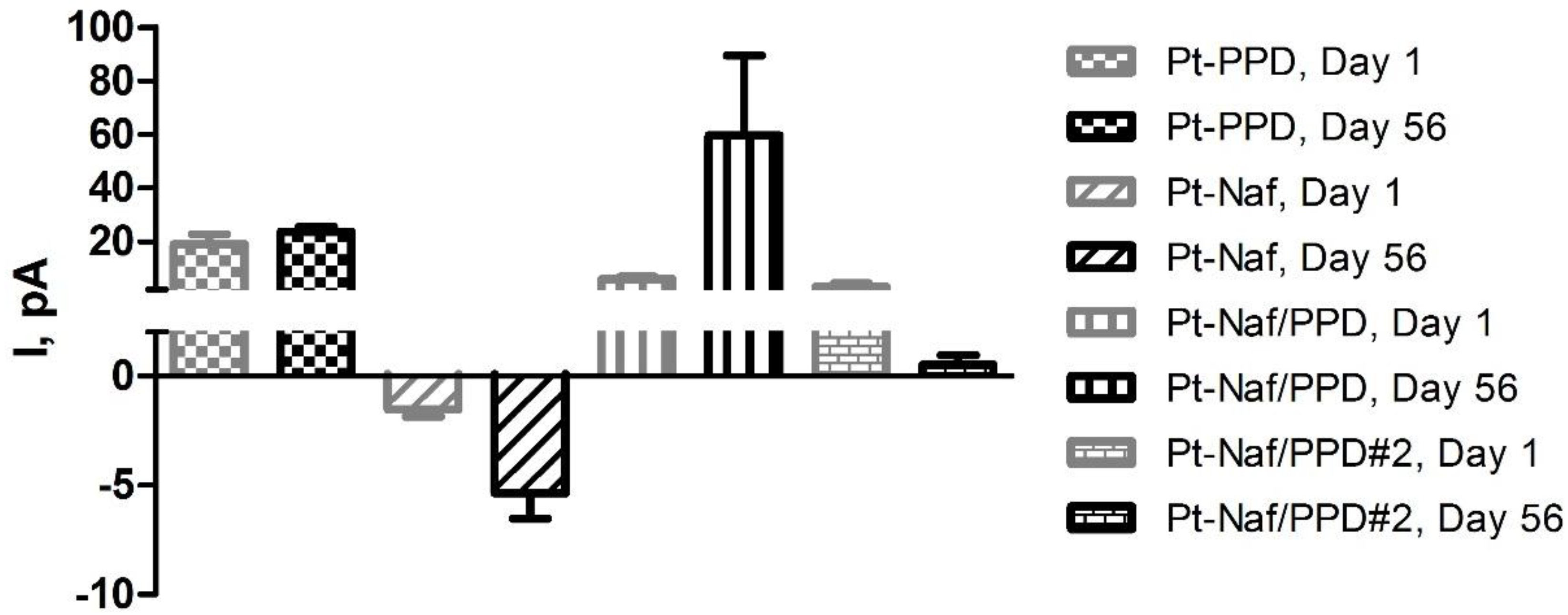
3.2. Shelf-Life Studies—Effect of Single AA Calibration


3.3. Effect of Various Storage Conditions on Shelf Life of Pt-PPD Electrodes
” denotes level of significance against day 1. “ns” denotes no significant change.
| 4 °C | 4 °C /N2 Saturated PBS | 4 °C /N2 Saturated | −20 °C | |||||||||
|---|---|---|---|---|---|---|---|---|---|---|---|---|
| Day | Mean I (pA) | SEM | Stats | Mean I (pA) | SEM | Stats | Mean I (pA) | SEM | Stats | Mean I (pA) | SEM | Stats |
| 1 | 19 | 4 | 18 | 7 | 251 | 27 | 139 | 23 | ||||
| 56 | 24 | 2 | ns | 1123 | 121 | | 295 | 105 | ns | 804 | 302 | |
| 168 | 3490 | 1276 | | 4057 | 122 | | 222 | 131 | ns | 1706 | 615 | |
4. Conclusions
Acknowledgments
Author Contributions
Conflicts of Interest
References
- Lowry, J.P.; O’Neill, R.D. Neuroanalytical chemistry in vivo using electrochemical sensors. Encycl. Sens. 2006, 10, 1–23. [Google Scholar]
- Miele, M.; Fillenz, M. In vivo determination of extracellular brain ascorbate. J. Neurosci. Methods 1996, 70, 15–19. [Google Scholar] [CrossRef] [PubMed]
- Alpat, S.; Alpat, S.K.; Telefoncu, A. A sensitive determination of dopamine in the presence of ascorbic acid using a Nafion-coated clinoptilolite-modified carbon paste electrode. Anal. Bioanal. Chem. 2005, 383, 695–700. [Google Scholar] [CrossRef] [PubMed]
- Cass, W.A.; Gerhardt, G.A.; Mayfield, R.D.; Curella, P.; Zahniser, N.R. Differences in dopamine clearance and diffusion in rat striatum and nucleus accumbens following systemic cocaine adminstration. J. Neurochem. 1992, 59, 259–266. [Google Scholar] [CrossRef] [PubMed]
- Friedemann, M.N.; Gerhardt, G.A. Regional effects of aging on dopaminergic function in the fischer-344 rat. Neurobiol. Aging 1992, 13, 325–332. [Google Scholar] [CrossRef] [PubMed]
- Friedemann, M.N.; Robinson, S.W.; Gerhardt, G.A. O-phenylenediamine-modified carbon fiber electrodes for the detection of nitric oxide. Anal. Chem. 1996, 68, 2621–2628. [Google Scholar] [CrossRef] [PubMed]
- Brown, F.O.; Lowry, J.P. Microelectrochemical sensors for in vivo brain analysis: An investigation of procedures for modifying pt electrodes using Nafion. Analyst 2003, 128, 700–705. [Google Scholar] [CrossRef] [PubMed]
- Brown, F.O.; Finnerty, N.J.; Lowry, J.P. Nitric oxide monitoring in brain extracellular fluid: Characterisation of Nafion®-modified Pt electrodes in vitro and in vivo. Analyst 2009, 134, 2012–2020. [Google Scholar] [CrossRef] [PubMed]
- Ariffin, A.A.; O’Neill, R.D.; Yahya, M.Z.A.; Zain, Z.M. Electropolymerization of ortho-phenylenediamine and its use for detection on hydrogen peroxide and ascorbic acid by electrochemical impedance spectroscopy. Int. J. Electrochem. Sci. 2012, 7, 10154–10163. [Google Scholar]
- Lowry, J.P.; McAteer, K.; el Atrash, S.S.; Duff, A.; O’Neill, R.D. Characterisation of glucose oxidase modified poly (phenylenediamine) coated electrodes in vitro and in vivo: Homogenous interference by ascorbic acid in hydrogen peroxide detection. Anal. Chem. 1994, 66, 1754–1761. [Google Scholar] [CrossRef]
- McMahon, C.P.; Rocchitta, G.; Kirwan, S.M.; Killoran, S.J.; Serra, P.A.; Lowry, J.P.; O’Neill, R.D. Oxygen tolerance of an implantable polymer/enzyme composite glutamate biosensor displaying polycation-enhanced substrate sensitivity. Biosens. Bioelectron. 2007, 22, 1466–1473. [Google Scholar] [CrossRef] [PubMed]
- Malitesta, C.; Palmisano, F.; Torsi, L.; Zambonin, P.G. Glucose fast-response amperometric sensor based on glucose-oxidase immobilised in an electropolymerized poly(ortho-phenylenediamine) film. Anal. Chem. 1990, 62, 2735–2740. [Google Scholar] [CrossRef] [PubMed]
- Chiba, K.; Ohsaka, T.; Ohnuki, Y.; Oyama, N. Electrochemical preparation of a ladder polymer containing phenazine rings. J. Electroanal. Chem. 1987, 219, 117–124. [Google Scholar] [CrossRef]
- Yano, J. Electrochemical and structural studies on soluble and conducting polymer from o-phenylenediamine. J. Polym. Sci. Part A Polym. Chem. 1995, 33, 2435–2441. [Google Scholar] [CrossRef]
- Losito, I.; Palmisano, F.; Zambonin, P.G. O-phenylenediamine electropolymerization by cyclic voltammetry combined with electrospray ionization-ion trap mass spectrometry. Anal. Chem. 2003, 75, 4988–4995. [Google Scholar] [CrossRef]
- Ferreira, N.R.; Ledo, A.; Frade, J.G.; Gerhardt, G.A.; Laranjinha, J.; Barbosa, R.M. Electrochemical measurement of endogenously produced nitric oxide in brain slices using Nafion/o-phenylenediamine modified carbon fiber microelectrodes. Anal. Chim. Acta 2005, 535, 1–7. [Google Scholar] [CrossRef]
- Park, J.K.; Tran, P.H.; Chao, J.K.; Ghodadra, R.; Rangarajan, R.; Thakor, N.V. In vivo nitric oxide sensor using non-conducting polymer-modified carbon fiber. Biosens. Bioelectron. 1998, 13, 1187–1195. [Google Scholar] [CrossRef] [PubMed]
- Brown, F.O.; Finnerty, N.J.; Bolger, F.B.; Millar, J.; Lowry, J.P. Calibration of no sensors for in vivo voltammetry: Laboratory synthesis of NO and the use of UV-visible spectroscopy for determining stock concentrations. Anal. Bioanal. Chem. 2005, 381, 964–971. [Google Scholar] [CrossRef] [PubMed]
- Finnerty, N.J.; O’Riordan, S.L.; Brown, F.O.; Serra, P.A.; O’Neill, R.D.; Lowry, J.P. In vivo characterisation of a Nafion®-modified Pt electrode for real-time nitric oxide monitoring in brain extracellular fluid. Anal. Methods 2012, 4, 550–557. [Google Scholar] [CrossRef]
- Finnerty, N.J.; O’Riordan, S.L.; Palsson, E.; Lowry, J.P. Brain nitric oxide: Regional characterisation of a real-time microelectrochemical sensor. J. Neurosci. Methods 2012, 209, 13–21. [Google Scholar] [CrossRef] [PubMed]
- Wynne, A.M.; Reid, C.H.; Finnerty, N.J. In vitro characterisation of ortho phenylenediamine and Nafion®-modified pt electrodes for measuring brain nitric oxide. J. Electroanal. Chem. 2014, 732, 110–116. [Google Scholar] [CrossRef]
- Bolger, F.B.; Bennett, R.; Lowry, J.P. An in vitro characterisation comparing carbon paste and Pt microelectrodes for real-time detection of brain tissue oxygen. Analyst 2011, 136, 4028–4035. [Google Scholar] [CrossRef] [PubMed]
- Serra, P.A.; Hebel, M.; Rocchitta, G.; Tate, R.F. Biotelemetry NET for Neurochemical Biosensor and Microsensor Applications: Design, Construction and Validation; Nova Science Publishers, Inc.: Hauppauge, NY, USA, 2009; pp. 119–144. [Google Scholar]
- Zhai, W.; Tian, X.; Yan, Y.; Xu, Y.; Zhao, Y.; Liu, Y. Preparation and characterization of a poly-o-phenylenediamine film modified glassy carbon electrode as a H2O2 sensor. Can. J. Chem. Revue Can. Chim. 2013, 91, 1077–1084. [Google Scholar] [CrossRef]
- O’Brien, K.B.; Killoran, S.J.; O’Neill, R.D.; Lowry, J.P. Development and characterization in vitro of a catalase-based biosensor for hydrogen peroxide monitoring. Biosens. Bioelectron. 2007, 22, 2994–3000. [Google Scholar] [CrossRef] [PubMed]
- Rothwell, S.A.; Killoran, S.J.; O’Neill, R.D. Enzyme immobilization strategies and electropolymerization conditions to control sensitivity and selectivity parameters of a polymer-enzyme composite glucose biosensor. Sensors 2010, 10, 6439–6462. [Google Scholar] [CrossRef] [PubMed]
- Rothwell, S.A.; O’Neill, R.D. Effects of applied potential on the mass of non-conducting poly(ortho-phenylenediamine) electro-deposited on eqcm electrodes: Comparison with biosensor selectivity parameters. Phys. Chem. Chem. Phys. 2011, 13, 5413–5421. [Google Scholar] [CrossRef] [PubMed]
- Killoran, S.J.; O’Neill, R.D. Characterization of permselective coatings electrosynthesized on Pt-Ir from the three phenylenediamine isomers for biosensor applications. Electrochim. Acta 2008, 53, 7303–7312. [Google Scholar] [CrossRef]
- Kirwan, S.M.; Rocchitta, G.; McMahon, C.P.; Craig, J.D.; Killoran, S.J.; O’Brien, K.B.; Serra, P.A.; Lowry, J.P.; O’Neill, R.D. Modifications of poly(o-phenylenediamine) permselective layer on Pt-Ir for biosensor application in neurochemical monitoring. Sensors 2007, 7, 420–437. [Google Scholar] [CrossRef]
- Lowry, J.P.; O’Neill, R.D. Partial characterisation of in vitro glucose oxidase-modified poly(phenylenediamine)-coated electrodes for neurochemical analysis in vivo. Electroanalysis 1994, 6, 369–379. [Google Scholar] [CrossRef]
- Geise, R.J.; Adams, J.M.; Barone, N.J.; Yacynych, A.M. Electropolymerized films to prevent interferences and electrode fouling in biosensors. Biosens. Bioelectron. 1991, 6, 151–160. [Google Scholar] [CrossRef]
- Hashemi, P.; Dankoski, E.C.; Petrovic, J.; Keithley, R.B.; Wightman, R.M. Voltammetric detection of 5-hydroxytryptamine release in the rat brain. Anal. Chem. 2009, 81, 9462–9471. [Google Scholar] [CrossRef] [PubMed]
- Chou, J.; Ilgen, T.J.; Gordon, S.; Ranasinghe, A.D.; McFarland, E.W.; Metiu, H.; Buratto, S.K. Investigation of the enhanced signals from cations and dopamine in electrochemical sensors coated with Nafion. J. Electroanal. Chem. 2009, 632, 97–101. [Google Scholar] [CrossRef]
- Crespi, F.; Mobius, C. In vivo selective monitoring of basal levels of cerebral dopamine using voltammetry with Nafion modified (NA-CRO) carbon fiber microelectrodes. J. Neurosci. Methods 1992, 42, 149–161. [Google Scholar] [CrossRef] [PubMed]
- Brazell, M.P.; Kasser, R.J.; Renner, K.J.; Feng, J.; Moghaddam, B.; Adams, R.N. Electrocoating carbon-fiber microelectrodes with Nafion improves selectivity for electroactive neurotransmitters. J. Neurosci. Methods 1987, 22, 167–172. [Google Scholar] [CrossRef] [PubMed]
- Zook, L.A.; Leddy, J. Density and solubility of Nafion: Recast, annealed, and commercial films. Anal. Chem. 1996, 68, 3793–3796. [Google Scholar] [CrossRef] [PubMed]
- Fan, Z.H.; Harrison, D.J. Permeability of glucose and other neutral species through recast perfluorosulfonated ionmer films. Anal. Chem. 1992, 64, 1304–1311. [Google Scholar] [CrossRef]
- Mercado, R.C.; Moussy, F. In vitro and in vivo mineralization of Nafion membrane used for implantable glucose sensors. Biosens. Bioelectron. 1998, 13, 133–145. [Google Scholar] [CrossRef] [PubMed]
- Barbosa, R.M.; Lourenco, C.F.; Santos, R.M.; Pomerleau, F.; Huettl, P.; Gerhardt, G.A.; Laranjinha, J. In vivo real-time measurement of nitric oxide in anesthetized rat brain. In Nitric Oxide, Part G: Oxidative and Nitrosative Stress in Redox Regulation of Cell Signaling; Cadenas, E., Packer, L., Eds.; Elsevier Academic Press Inc.: San Diego, CA, USA, 2008; Volume 441, pp. 351–367. [Google Scholar]
- Craig, J.D.; O’Neill, R.D. Comparison of simple aromatic amines for electrosynthesis of permselective polymers in biosensor fabrication. Analyst 2003, 128, 905–911. [Google Scholar] [CrossRef]
- McMahon, C.P.; Rocchitta, G.; Serra, P.A.; Kirwan, S.M.; Lowry, J.P.; O’Neill, R.D. Control of the oxygen dependence of an implantable polymer/enzyme composite biosensor for glutamate. Anal. Chem. 2006, 78, 2352–2359. [Google Scholar] [CrossRef] [PubMed]
- Rice, M.E.; Nicholson, C. Measurement of nanomolar dopamine diffusion using low-noise perfluorinated ionomer coated carbon-fiber microelectrodes and high-speed cyclic voltammetry. Anal. Chem. 1989, 61, 1805–1810. [Google Scholar] [CrossRef] [PubMed]
- Perez, S.; Bartroli, J.; Fabregas, E. Amperometric biosensor for the determination of histamine in fish samples. Food Chem. 2013, 141, 4066–4072. [Google Scholar] [CrossRef] [PubMed]
- Arslan, F.; Ustabas, S.; Arslan, H. An amperometric biosensor for glucose determination prepared from glucose oxidase immobilized in polyaniline-polyvinylsulfonate film. Sensors 2011, 11, 8152–8163. [Google Scholar] [CrossRef] [PubMed]
- Gyurcsanyi, R.E.; Cristalli, A.; Nagy, G.; Nagy, L.; Corder, C.; Pendley, B.D.; Ufer, S.; Nagle, H.T.; Neuman, M.R.; Lindner, E. Analytical perfomance characteristics of thin and thick film amperometric microcells. Fresnius J. Anal. Chem. 2001, 369, 286–294. [Google Scholar] [CrossRef]
- Sasso, S.V.; Pierce, R.J.; Walla, R.; Yacynych, A.M. Electropolymerized 1,2-diaminobenzene as a means to prevent interferences and fouling and to stabilize immobilized enzyme in electrochemical biosensors. Anal. Chem. 1990, 62, 1111–1117. [Google Scholar] [CrossRef]
© 2015 by the authors; licensee MDPI, Basel, Switzerland. This article is an open access article distributed under the terms and conditions of the Creative Commons Attribution license (http://creativecommons.org/licenses/by/4.0/).
Share and Cite
Wynne, A.M.; Finnerty, N.J. Ascorbic Acid Rejection Characteristics of Modified Platinum Electrodes: A Shelf Life Investigation. Chemosensors 2015, 3, 55-69. https://doi.org/10.3390/chemosensors3020055
Wynne AM, Finnerty NJ. Ascorbic Acid Rejection Characteristics of Modified Platinum Electrodes: A Shelf Life Investigation. Chemosensors. 2015; 3(2):55-69. https://doi.org/10.3390/chemosensors3020055
Chicago/Turabian StyleWynne, Andrea M., and Niall J. Finnerty. 2015. "Ascorbic Acid Rejection Characteristics of Modified Platinum Electrodes: A Shelf Life Investigation" Chemosensors 3, no. 2: 55-69. https://doi.org/10.3390/chemosensors3020055
APA StyleWynne, A. M., & Finnerty, N. J. (2015). Ascorbic Acid Rejection Characteristics of Modified Platinum Electrodes: A Shelf Life Investigation. Chemosensors, 3(2), 55-69. https://doi.org/10.3390/chemosensors3020055