
The Recolonization Concentration Concept: Using Avoidance Assays with Soil Organisms to Predict the Recolonization Potential of Contaminated Sites

Abstract
1. Introduction
2. Material and Methods
2.1. Test Soil
2.2. Test Organisms and Culture Conditions
3. Experimental Procedure
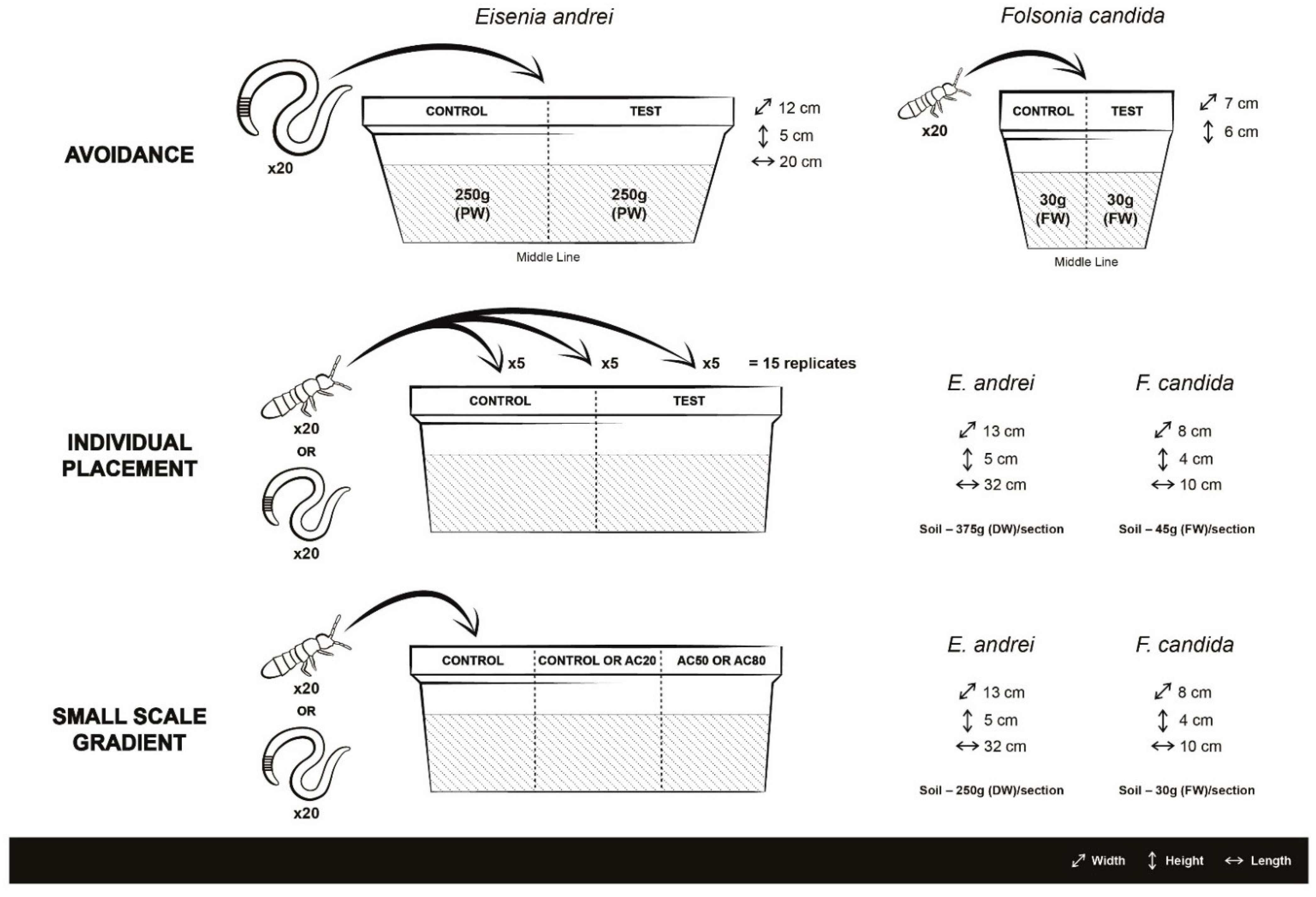
3.1. Avoidance Tests
3.2. Individual Placement Tests
3.3. Small-Scale Gradient Tests
4. Metal Analysis
5. Statistical Analysis
6. Results
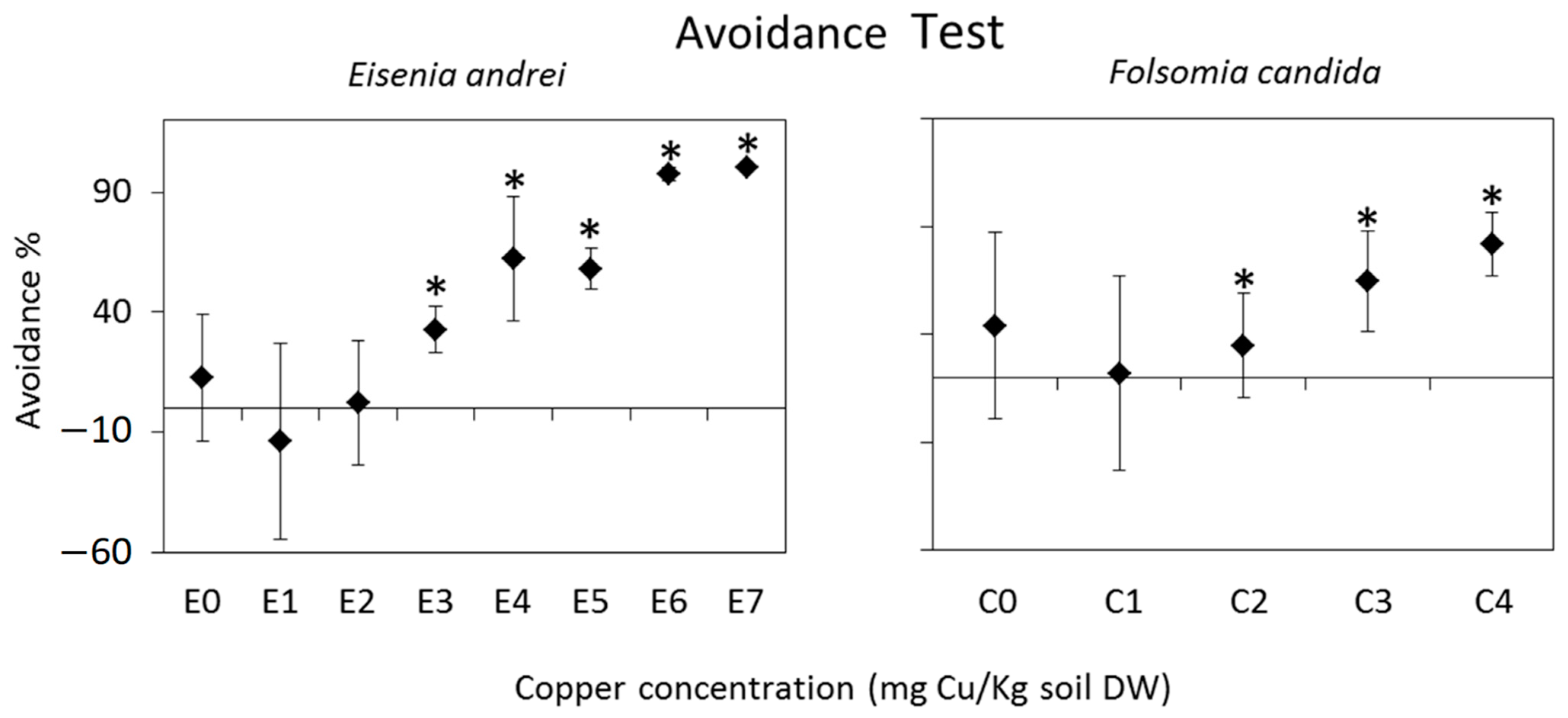
6.1. Avoidance Tests
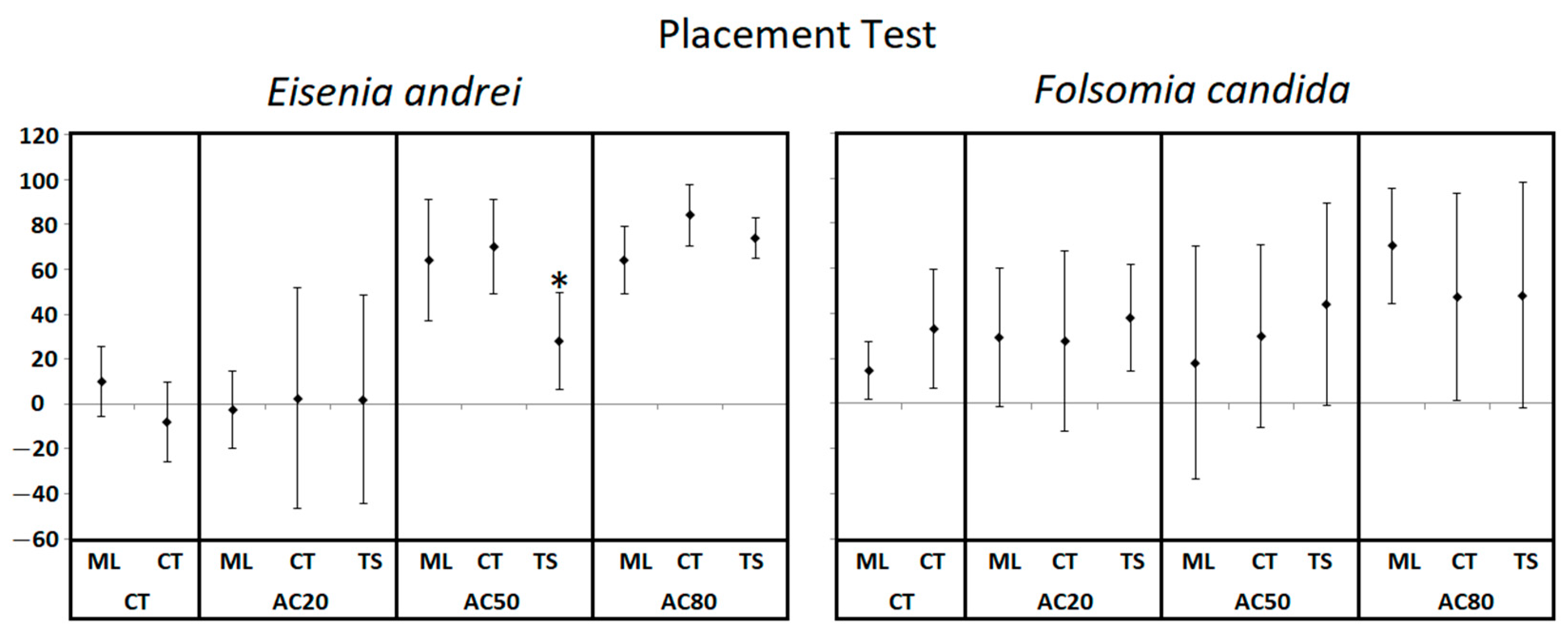
6.2. Individual Placement Test
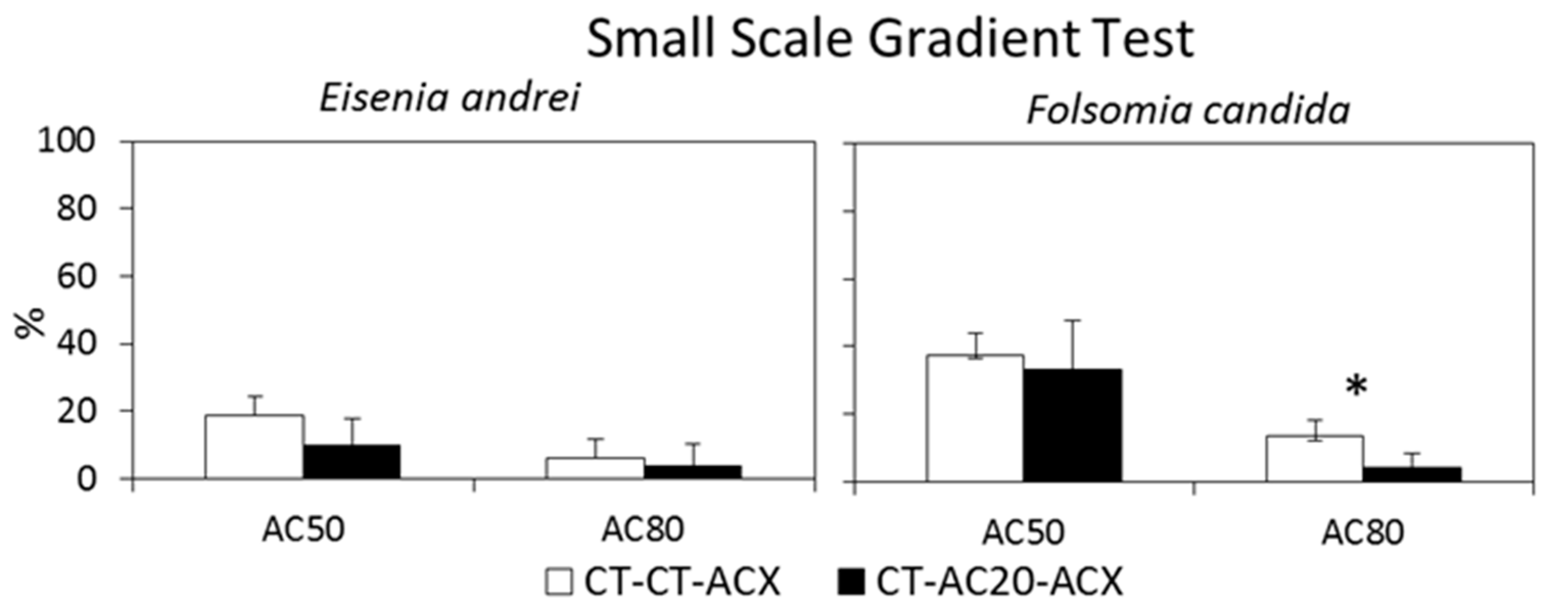
6.3. Small-Scale Gradient Tests
7. Discussion
8. Conclusions
Supplementary Materials
Author Contributions
Funding
Institutional Review Board Statement
Informed Consent Statement
Data Availability Statement
Conflicts of Interest
References
- Brock, T.; Arts, G.; Matlby, L.; Van den Brink, P. Aquatic risks of pesticides, ecological protection goals, and common aims in European Union legislation. Integr. Environ. Assess. Manag. 2006, 2, 20–46. [Google Scholar] [CrossRef]
- Nienstedt, K.M.; Brock, T.C.M.; van Wensem, J.; Montforts, M.; Hart, A.; Aagaard, A.; Alix, A.; Boesten, J.; Bopp, S.K.; Brown, C.; et al. Development of a framework based on an ecosystem services approach for deriving specific protection goals for environmental risk assessment of pesticides. Sci. Total Environ. 2012, 415, 31–38. [Google Scholar] [CrossRef] [Scilit] [PubMed]
- Van der Linden, A.M.A.; Boesten, J.J.T.; Brock, T.C.M.; Van Eekelen, G.M.A.; Horst, M.M.S.; Montforts, M.H.M.M.; Pol, J.W. Revised Proposal for the Risk Assessment of Persistence of Plant Protection Products in Soil; RIVM: Bilthoven, The Netherlands, 2008; ISBN 978-90-6960-198-4. [Google Scholar]
- Ockleford, C.; Adriaanse, P.; Berny, P.; Brock, T.; Duquesne, S.; Grilli, S.; Hernandez-Jerez, A.F.; Bennekou, S.H.; Klein, M.; Kuhl, T.; et al. Scientific Opinion addressing the state of the science on risk assessment of plant protection products for in-soil organisms. EFSA J. 2017, 15, e04690. [Google Scholar] [CrossRef] [Scilit] [PubMed]
- Lange, H.; Lahr, J.; Pol, V.; Wessels, Y.; Faber, J. Ecological vulnerability in wildlife: An expert judgment and multicriteria analysis tool using ecological traits to assess relative impact of pollutants. Environ. Toxicol. Chem. 2009, 28, 2233–2240. [Google Scholar] [CrossRef] [Scilit]
- Alvarez, T.; Frampton, G.; Goulson, D. The role of hedgerows in the recolonisation of arable fields by epigeal Collembola. Pedobiologia 2000, 44, 516–526. [Google Scholar] [CrossRef] [Scilit]
- Frampton GGould, P.; Van den Brink, P.; Hendy, E. Type ‘A’ and ‘B’ recovery revisited: The role of field-edge habitats for Collembola and macroarthropod community recovery after insecticide treatment. Environ. Pollut. 2006, 145, 874–883. [Google Scholar] [CrossRef] [Scilit]
- Marinissen, J.C.Y.; Van den Bosch, F. Colonization of new habitats by earthworms. Oecologia 1992, 91, 371–376. [Google Scholar] [CrossRef] [Scilit]
- Ojala, R.; Huhta, V. Dispersal of microarthropods in forest soil. Pedobiologia 2001, 45, 443–450. [Google Scholar] [CrossRef] [Scilit]
- Auclerc, A.; Ponge, J.F.; Barot, S.; Dubs, F. Experimental assessment of habitat preference and dispersal ability of soil springtails. Soil Biol. Biochem. 2009, 41, 1596–1604. [Google Scholar] [CrossRef] [Scilit]
- Caro, G.; Decaëns, T.; Mathieu, J. The dispersal of the earthworm Aporrectodea giardi responds faster to habitat quality than to cumulative use of habitat in experimental conditions. Appl. Soil Ecol. 2013, 71, 45–47. [Google Scholar] [CrossRef] [Scilit]
- Mathieu, J.; Barot, S.; Blouin, M.; Caro, G.; Decaëns, T.; Dubs, F.; Dupont, L.; Jouquet, P.; Nai, P. Habitat quality, conspecific density, and habitat pre-use affect the dispersal behaviour of two earthworm species, Aporrectodea icterica and Dendrobaena veneta, in a mesocosm experiment. Soil Biol. Biochem. 2010, 42, 203–209. [Google Scholar] [CrossRef] [Scilit]
- Fenoglio, S.; Cucco, M.; Bo, T.; Gay, P.; Malacarne, G. Colonisation by ground and edaphic invertebrates of soil patches with different pollution levels. Period. Biol. 2007, 109, 37–45. [Google Scholar]
- Holmstrup, M.; Hornum, H.D. Earthworm colonisation of abandoned arable soil polluted by copper. Pedobiologia 2012, 55, 63–65. [Google Scholar] [CrossRef] [Scilit]
- Forbes, V.E.; Calow, P.; Grimm, V.; Hayashi, T.; Jager, T.; Palmqvist, A.; Pastorok, R.; Salvito, D.; Sibly, R.; Spromberg, J.; et al. Integrating population modeling into ecological risk assessment. Integr. Environ. Assess. Manag. 2010, 6, 191–193. [Google Scholar] [CrossRef] [Scilit] [PubMed]
- Forbes, V.E.; Calow, P.; Sibly, R.M. The extrapolation problem and how population modeling can help. Environ. Toxicol. Chem. 2008, 27, 1987–1994. [Google Scholar] [CrossRef] [Scilit]
- Grimm, V.; Thorbek, P. Population models for ecological risk assessment of chemicals: Short introduction and summary of a special issue. Ecol. Model. 2014, 280, 1–4. [Google Scholar] [CrossRef] [Scilit]
- Hamda, N.T.; Forbes, V.E.; Stark, J.D.; Laskowski, R. Stochastic density-dependent matrix model for extrapolating individual-level effects of chemicals to the population: Case study on effects of Cd on Folsomia candida. Ecol. Model. 2014, 280, 53–64. [Google Scholar] [CrossRef] [Scilit]
- Meli, M.; Auclerc, A.; Palmqvist, A.; Forbes, V.E.; Grimm, V. Population-level consequences of spatially heterogeneous exposure to heavy metals in soil: An individual-based model of springtails. Ecol. Model. 2013, 250, 338–351. [Google Scholar] [CrossRef] [Scilit]
- Meli, M.; Palmqvist, A.; Forbes, V.E.; Groeneveld, J.; Grimm, V. Two pairs of eyes are better than one: Combining individual-based and matrix models for ecological risk assessment of chemicals. Ecol. Model. 2014, 280, 40–52. [Google Scholar] [CrossRef] [Scilit]
- ISO 17512-1; Soil Quality—Avoidance Test for Testing the Quality of Soils and Effects of Chemicals on Behaviour—Test with Earthworms (Eisenia fetida and Eisenia andrei). International Organization for Standardization: Paris, France, 2007.
- ISO 17512-2; Soil quality—Avoidance Test for Determining the Quality of Soils and Effects of Chemicals on Behaviour—Part 2: Test with Collembolans (Folsomia candida). International Organization for Standardization: Geneva, Switzerland, 2008.
- Natal-da-Luz, T.; Ribeiro, R.; Sousa, J.P. Avoidance tests with Collembola and earthworms as early screening tools for site-specific assessment of polluted soils. Environ. Toxicol. Chem. 2004, 23, 2188–2193. [Google Scholar] [CrossRef] [Scilit]
- Natal-da-Luz, T.; Römbke, J.; Paulo Sousa, J. Avoidance tests in site-specific risk assessment—Influence of soil propertires on the avoidance response of collembola and earthworms. Environ. Toxicol. Chem. 2008, 27, 1112–1117. [Google Scholar] [CrossRef] [Scilit] [PubMed]
- Niemeyer, J.C.; Moreira-Santos, M.; Nogueira, M.A.; Carvalho, G.M.; Ribeiro, R.; Silva, E.M.; Sousa, J.P. Environmental risk assessment of a metal-contaminated area in the Tropics. Tier I: Screening phase. J. Soils Sediments 2010, 10, 1557–1571. [Google Scholar] [CrossRef] [Scilit]
- Salminen, J.; Sulkava, P. Distribution of soil animals in patchily contaminated soil. Soil Biol. Biochem. 1996, 28, 1349–1355. [Google Scholar] [CrossRef] [Scilit]
- Haimi, J.; Paavola, S. Responses of two earthworm populations with different exposure histories to chlorophenol contamination. Environ. Toxicol. Chem. 1998, 17, 1114–1117. [Google Scholar] [CrossRef]
- Araújo, C.V.M.; Moreira-Santos, M.; Ribeiro, R. Stressor-driven emigration and recolonisation patterns in disturbed habitats. Sci. Total Environ. 2018, 643, 884–889. [Google Scholar] [CrossRef] [Scilit]
- LNEC-E 239; Solos—Análise Granulométrica por Peneiração Húmida. Laboratório Nacional de Engenharia Civil (LNEC): Lisboa, Portugal, 1970.
- ISO 11274; Soil Quality—Determination of Water-Retention Characteristic—Laboratory Methods. International Organization for Standardization: Paris, France, 2007.
- Kjeldahl, J. Neue Methode zul Bestimmung des Stickstoffs in organischen Körpern. Z. Anal. Chem. 1883, 22, 366–382. [Google Scholar] [CrossRef] [Scilit]
- ISO 11260; Soil Quality—Determination of Effective Cation Exchange Capacity and Base Saturation Level Using Barium Chloride Solution. International Organization for Standardization: Geneva, Switzerland, 2007.
- Sakuma, M. Probit analysis of preference data. Appl. Entomol. Zool. 1998, 33, 339–347. [Google Scholar] [CrossRef] [Scilit]
- Loureiro, S.; Soares, A.M.V.M.; Nogueira, A.J.A. Terrestrial avoidance behaviour tests as screening tool to assess soil contamination. Environ. Pollut. 2005, 138, 121–131. [Google Scholar] [CrossRef] [Scilit]
- Xing, Y.; Luo, J.; Zhang, J.; Li, B.; Gong, X.; Liu, Z.; Liu, C. Effects of single and combined exposures to copper and benzotriazole on Eisenia fetida. Chemosphere 2017, 186, 108–115. [Google Scholar] [CrossRef] [Scilit]
- Greenslade, P.; Vaughan, G.T. A comparison of Collembola species for toxicity testing of Australian soils. Pedobiologia 2003, 47, 171–179. [Google Scholar] [CrossRef] [Scilit]
- Criel, P.; Lock, K.; Van Eeckhout, H.; Oorts, K.; Smolders, E.; Janssen, C.R. Influence of soil properties on copper toxicity for two soil invertebrates. Environ. Toxicol. Chem. 2008, 27, 1748–1755. [Google Scholar] [CrossRef] [Scilit] [PubMed]
- Smolders, E.; Oorts, K.; Sprang, P.V.; Schoeters, I.; Janssen, C.R.; McGrath, S.P. Toxicity of trace metals in soi as affected by soil type and aging after contamination: Using calibrated bioavailability models to set ecological soil standards. Environ. Toxicol. Chem. 2009, 28, 1633–1641. [Google Scholar] [CrossRef] [Scilit] [PubMed]
- Arnold, R.E.; Hodson, M.E.; Black, S.; Davies, N.A. The influence of mineral solubility and soil solution concentration on the toxicity of copper to Eisenia fetida Savigny. Pedobiologia 2003, 2, 622–632. [Google Scholar] [CrossRef] [Scilit]
- Boiteau, G.; Lynch, D.H.; Mackinley, P. Avoidance tests with Folsomia candida for the assessment of copper contamination in agricultural soils. Environ. Pollut. 2011, 159, 903–906. [Google Scholar] [CrossRef] [Scilit] [PubMed]
- Heupel, K. Avoidance response of different collembolan species to Betanal. Eur. J. Soil Biol. 2002, 38, 273–276. [Google Scholar] [CrossRef] [Scilit]
- Bengtsson, G.; Rundgren, S.; Sjögren, M. Modelling dispersal distances in a soil gradient: The influence of metal resistance, competition, and experience. Oikos 1994, 71, 13–23. [Google Scholar] [CrossRef] [Scilit]
- Pereira, C.M.S.; Novais, S.C.; Soares, A.M.V.M.; Amorim, M.J.B. Dimethoate Affects Cholinesterases in Folsomia candida and Their Locomotion—False Negative Results of an Avoidance Behaviour Test. Sci. Total Environ. 2013, 443, 821–827. [Google Scholar] [CrossRef] [Scilit]
- Szabó, B.; Seres, A.; Bakonyi, G. Folsomia candida (collembola) locomotor activity pattern is changed by a neurotoxicant pesticide. Acta Zool. Acad. Sci. Hung. 2018, 64, 355–368. [Google Scholar] [CrossRef] [Scilit]
- Natal-da-Luz, T.; Amorim, M.J.B.; Römbke, J.; Sousa, J.P. Avoidance tests with earthworms and springtails: Defining the minimum exposure time to observe a significant response. Ecotoxicol. Environ. Saf. 2008, 71, 545–551. [Google Scholar] [CrossRef] [Scilit]



| Parameter | Value |
|---|---|
| Water-holding capacity | 36.2 ± 0.4% |
| Organic matter | 3.3 ± 0.1% |
| pH (KCl 1 M) | 6.9 |
| Total N | 0.83 mg/g |
| Cation-exchange capacity | 0.0125 cmol/g |
| Sand | 62.40% |
| Silt | 21.20% |
| Clay | 16.40% |
| Soil texture class | Sandy-loam |
| Soil type | Cambisol |
| Nominal (mg/kg) | n | Total Copper | Extractable Copper | ||
|---|---|---|---|---|---|
| (mg/kg) | (mg/kg) | ||||
| Eisenia andrei | E0/CT | 0 | 15 | 29.37 ± 2.64 | 0.06 ± 0.12 |
| E1 | 5 | 3 | 34.45 ± 3.77 | 0.05 ± 0.03 | |
| E2 | 10 | 3 | 48.25 ± 3.59 | 0.06 ± 0.1 | |
| E3 | 25 | 3 | 54.27 ± 7.49 | 0.58 ± 0.23 | |
| E4 | 50 | 3 | 89.12 ± 5.42 | 1.20 ± 0.07 | |
| E5 | 100 | 3 | 140.60 ± 3.71 | 5.42 ± 0.45 | |
| E6 | 200 | 3 | 239.99 ± 31.36 | 22.11 ± 2.60 | |
| E7 | 400 | 3 | 551.57 ± 30.6 | 73.2 ± 5.80 | |
| AC20 | 20 | 9 | 50.79 ± 4.48 | 0.42 ± 0.15 | |
| AC50 | 50 | 6 | 74.49 ± 9.59 | 1.90 ± 0.28 | |
| AC80 | 100 | 6 | 147.09 ± 15.43 | 5.66 ± 0.61 | |
| Folsomia candida | C0/CT | 0 | 9 | 30.21 ± 3.77 | 0 ± 0.16 |
| C1 | 100 | 3 | 185.29 ± 18.44 | 6.87 ± 0.44 | |
| C2 | 200 | 3 | 330.84 ± 21.46 | 26.15 ± 0.27 | |
| C3 | 800 | 3 | 1173.89 ± 22.30 | 159.25 ± 21.66 | |
| C4 | 1600 | 3 | 2257.49 ± 34.95 | 709.91 ± 77.53 | |
| AC20 | 300 | 6 | 382.36 ± 47.44 | 42.50 ± 9.80 | |
| AC50 | 1000 | 6 | 1061.51 ± 71.79 | 264.28 ± 46.70 | |
| AC80 | 3300 | 6 | 3765.78 ± 276.73 | 1466.79 ± 143.88 |
| ACx | Eisenia andrei | Folsomia candida |
|---|---|---|
| AC20 | 21.8 (3.9–39.7) | 301 (49.8–527) |
| AC50 | 49.5 (20.6–78.0) | 1008 (601–1890) |
| AC80 | 112 (70.9–237) | 3371 (1824–26,987) |
Publisher’s Note: MDPI stays neutral with regard to jurisdictional claims in published maps and institutional affiliations. |
© 2022 by the authors. Licensee MDPI, Basel, Switzerland. This article is an open access article distributed under the terms and conditions of the Creative Commons Attribution (CC BY) license (https://creativecommons.org/licenses/by/4.0/).
Share and Cite
Renaud, M.; Natal-da-Luz, T.; Ribeiro, R.; Sousa, J.P. The Recolonization Concentration Concept: Using Avoidance Assays with Soil Organisms to Predict the Recolonization Potential of Contaminated Sites. Toxics 2022, 10, 127. https://doi.org/10.3390/toxics10030127
Renaud M, Natal-da-Luz T, Ribeiro R, Sousa JP. The Recolonization Concentration Concept: Using Avoidance Assays with Soil Organisms to Predict the Recolonization Potential of Contaminated Sites. Toxics. 2022; 10(3):127. https://doi.org/10.3390/toxics10030127
Chicago/Turabian StyleRenaud, Mathieu, Tiago Natal-da-Luz, Rui Ribeiro, and José Paulo Sousa. 2022. "The Recolonization Concentration Concept: Using Avoidance Assays with Soil Organisms to Predict the Recolonization Potential of Contaminated Sites" Toxics 10, no. 3: 127. https://doi.org/10.3390/toxics10030127
APA StyleRenaud, M., Natal-da-Luz, T., Ribeiro, R., & Sousa, J. P. (2022). The Recolonization Concentration Concept: Using Avoidance Assays with Soil Organisms to Predict the Recolonization Potential of Contaminated Sites. Toxics, 10(3), 127. https://doi.org/10.3390/toxics10030127