
The Future of Destination Marketing Organizations in the Insight Era



Abstract
1. Introduction
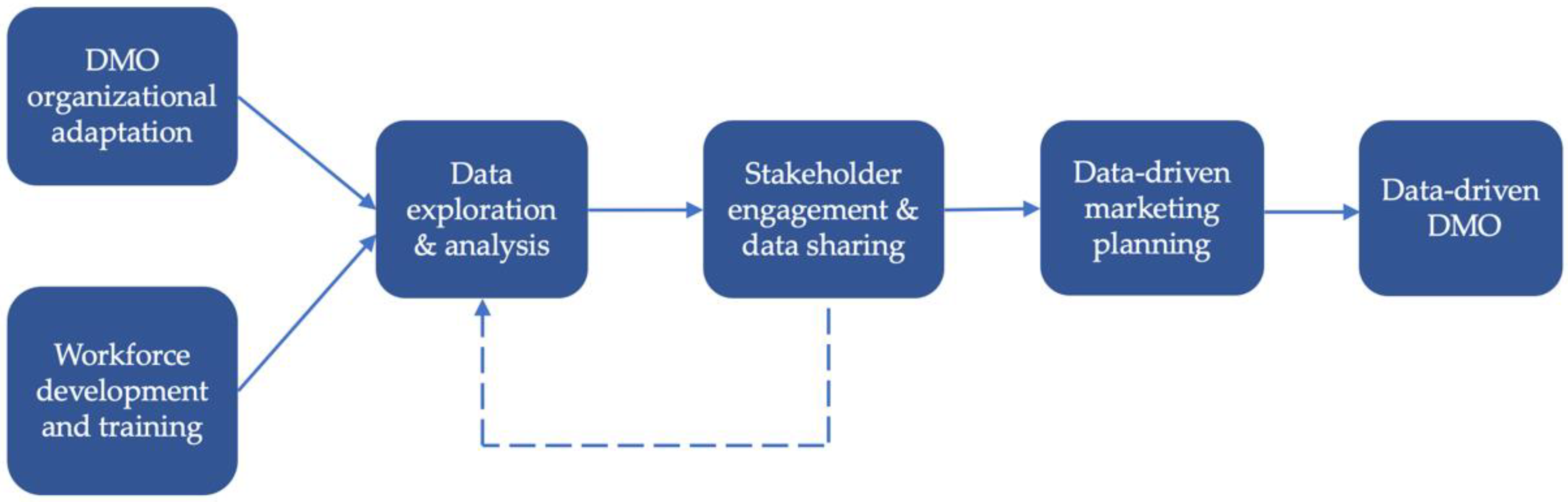
2. Conceptual Framework
3. Propositions
3.1. DMOs’ Organizational Adaptations and Workforce Training
3.2. Active Engagement with Destinations’ Stakeholders and Data Sharing
3.3. Leverage User-Generated-Data for Destination Marketing
3.4. The Power of DMO’s Data-Driven Decision-Making
4. Conclusions and Future Directions
Author Contributions
Funding
Institutional Review Board Statement
Informed Consent Statement
Data Availability Statement
Conflicts of Interest
References
- Castells, M. The Information Age. Media Stud. Read. 2010, 2, 152. [Google Scholar]
- Campbell, G. Bye Bye Big Data Era, the Insight ERA is Here. Open Data Science—Your News Source for AI, Machine Learning & More. 2019. Available online: https://opendatascience.com/bye-bye-big-data-era-the-insight-era-is-here/ (accessed on 24 January 2022).
- Morrison, A.M. Marketing and Managing Tourism Destinations, 2nd ed.; Routledge: New York, NY, USA, 2019. [Google Scholar]
- Sheehan, L.R.; Ritchie, J.R.B. Destination stakeholders: Exploring identity and salience. Ann. Tour. Res. 2005, 32, 711–734. [Google Scholar] [CrossRef] [Scilit]
- Arora, V. Destination Marketing Outlook 2022. Available online: https://research.skift.com/report/destination-marketing-outlook-2022/ (accessed on 14 March 2022).
- De Filippo, M.; Bencivenga, A.; Colangelo, D.; Pepe, A. The Digital Communication Strategies of Regional DMOs at the Time of COVID-19. Fuori Luogo. Riv. Sociol. Territ. Tur. Tecnol. 2020, 7, 81–87. [Google Scholar]
- Stankov, U.; Jovanović, T.; Pavluković, V.; Kalinić, Č.; Drakulić-Kovačević, N.; Cimbaljević, M. A regional survey of current practices on destination marketing organizations’ facebook pages: The case of Eu and U.S. Geogr. Pannonica 2018, 22, 81–96. [Google Scholar] [CrossRef] [Scilit]
- Allgeyer, T. The Importance of Twitter to Destination Marketing Organizations. Master’s Thesis, University of South Carolina, Columbia, SC, USA, 2019. [Google Scholar]
- World Tourism Organization. A Practical Guide to Tourism Destination Management. Available online: https://www.e-unwto.org/doi/book/10.18111/9789284412433 (accessed on 25 January 2022).
- Huang, A.; Chao, Y.; de la Mora Velasco, E.; Bilgihan, A.; Wei, W. When artificial intelligence meets the hospitality and tourism industry: An assessment framework to inform theory and management. J. Hosp. Tour. Insights. 2021. [CrossRef] [Scilit]
- Organization for Economic Co-Operation and Development. Using Artificial Intelligence to Detect, Respond and Recover from COVID-19. 2020. Available online: https://www.oecd.org/coronavirus/policy-responses/using-artificial-intelligence-to-help-combat-covid-19-ae4c5c21/ (accessed on 24 January 2022).
- Buhalis, D.; Law, R. Progress in information technology and tourism management: 20 years on and 10 years after the internet: The state of eTourism research. Tour. Manag. 2008, 29, 609–623. [Google Scholar] [CrossRef] [Scilit]
- Fernandes, N. Economic Effects of Coronavirus Outbreak (COVID-19) on the World Economy. IESE Business School Working Paper No. WP-1240-E. 2020. Available online: https://ssrn.com/abstract=3557504 (accessed on 24 January 2022).
- Sharma, K.; Jain, M.; Dhir, S. Analysing the impact of artificial intelligence on the competitiveness of tourism firms: A modified total interpretive structural modeling (m-TISM) approach. Int. J. Emerg. Mark. 2021, 17, 1067–1084. [Google Scholar] [CrossRef] [Scilit]
- Rudko, I.; Bashirpour Bonab, A.; Bellini, F. Organizational Structure and Artificial Intelligence. Modeling the Intraorganizational Response to the AI Contingency. J. Theor. Appl. Electron. Commer. Res. 2021, 16, 2341–2364. [Google Scholar] [CrossRef] [Scilit]
- Autor, D.H.; Dorn, D. The growth of low-skill service jobs and the polarization of the US labor market. Am. Econ. Rev. 2013, 103, 1553–1597. [Google Scholar] [CrossRef] [Scilit]
- De la Mora Velasco, E.; Huang, A.; Haney, A. An employee sharing model for the tourism and hospitality industry. Tour. Hosp. 2021, 2, 190–194. [Google Scholar] [CrossRef] [Scilit]
- Sheehan, L.; Vargas-Sánchez, A.; Presenza, A.; Abbate, T. The use of Intelligence in Tourism Destination Management: An emerging role for DMOs. Int. J. Tour. Res. 2016, 18, 549–557. [Google Scholar] [CrossRef] [Scilit]
- Gretzel, U. The Smart DMO: A new step in the digital transformation of destination management organizations. Eur. J. Tour. Res. 2022, 30, 3002. [Google Scholar] [CrossRef] [Scilit]
- Kumar, P.; Mishra, J.M.; Rao, Y.V. Analysing tourism destination promotion through Facebook by Destination Marketing Organizations of India. Curr. Issues Tour. 2022, 25, 1416–1431. [Google Scholar] [CrossRef] [Scilit]
- Önder, I.; Gunter, U.; Gindl, S. Utilizing Facebook statistics in tourism demand modeling and destination marketing. J. Travel Res. 2020, 59, 195–208. [Google Scholar] [CrossRef] [Scilit]
- Cimbaljević, M.; Stankov, U.; Demirović, D.; Pavluković, V. Nice and smart: Creating a smarter festival—The study of EXIT (novi sad, Serbia). Asia Pac. J. Tour. Res. 2021, 26, 415–427. [Google Scholar] [CrossRef] [Scilit]
- Wang, R.; Luo, J.; Huang, S.S. Developing an artificial intelligence framework for online destination image photos identification. J. Destin. Mark. Manag. 2020, 18, 100512. [Google Scholar] [CrossRef] [Scilit]
- Ma, Y.; Xiang, Z.; Du, Q.; Fan, W. Effects of user-provided photos on hotel review helpfulness: An analytical approach with deep leaning. Int. J. Hosp. Manag. 2018, 71, 120–131. [Google Scholar] [CrossRef] [Scilit]
- Maghded, H.S.; Ghafoor, K.Z.; Sadiq, A.S.; Curran, K.; Rawat, D.B.; Rabie, K. A novel AI-enabled framework to diagnose coronavirus COVID-19 using smartphone embedded sensors: Design study. In Proceedings of the IEEE 21st Int Conference on Info. Reuse and Integration for Data Science (IRI), Las Vegas, NV, USA, 11–13 August 2020; pp. 180–187. [Google Scholar]
- Kaefer, F. Bill Geist on the future of destination marketing and DMOS. In Insider's Guide Place Branding; Springer: Berlin, Germany, 2021; pp. 81–85. [Google Scholar]
- Lee, M.; Hong, J.H.; Chung, S.; Back, K.J. Exploring the Roles of DMO’s Social Media Efforts and Information Richness on Customer Engagement: Empirical Analysis on Facebook Event Pages. J. Travel Res. 2020, 60, 670–686. [Google Scholar] [CrossRef] [Scilit]
- Griffin, T.; Giberson, J.; Lee, S.H.M.; Guttentag, D.; Kandaurova, M.; Sergueeva, K.; Dimanche, F. Virtual reality and implications for destination marketing. In Proceedings of the 2017 ttra International Conference, Québec City, PQ, Canada, 20–22 June 2017. [Google Scholar]
- Chang, H.H.; Chiang, C.C. Is virtual reality technology an effective tool for tourism destination marketing? A flow perspective. J. Hosp. Tour. Technol. 2022, 13, 427–440. [Google Scholar] [CrossRef] [Scilit]
- Brynjolfsson, E.; McElheran, K. The rapid adoption of data-driven decision-making. Am. Econ. Rev. 2016, 106, 133–139. [Google Scholar] [CrossRef] [Scilit]
- Stewart, J. Models of priority-setting for public sector research. Res. Policy 1995, 24, 115–126. [Google Scholar] [CrossRef] [Scilit]
- Blichfeldt, B.S.; Hird, J.; Kvistgaard, P. Destination leadership and the issue of power. Tour. Rev. 2014, 69, 74–86. [Google Scholar] [CrossRef] [Scilit]
- Hall, C.M. Tourism and Politics: Policy, Power and Place; John Wiley & Sons: Hoboken, NJ, USA, 1994. [Google Scholar]
- Paolanti, M.; Mancini, A.; Frontoni, E.; Felicetti, A.; Marinelli, L.; Marcheggiani, E.; Pierdicca, R. Tourism destination management using sentiment analysis and geo-location information: A deep learning approach. Inf. Technol. Tour. 2021, 23, 241–264. [Google Scholar] [CrossRef] [Scilit]
- Flores-Ruiz, D.; Elizondo-Salto, A.; Barroso-González, M.D.L.O. Using social media in tourist sentiment analysis: A case study of Andalusia during the COVID-19 pandemic. Sustainability 2021, 13, 3836. [Google Scholar] [CrossRef] [Scilit]
- Ali, T.; Marc, B.; Omar, B.; Soulaimane, K.; Larbi, S. Exploring destination’s negative e-reputation using aspect based sentiment analysis approach: Case of Marrakech destination on TripAdvisor. Tour. Manag. Perspect. 2021, 40, 100892. [Google Scholar] [CrossRef] [Scilit]
- Micera, R.; Crispino, R. Destination web reputation as “smart tool” for image building: The case analysis of Naples city-destination. Int. J. Tour. Cities. 2017, 3, 406–423. [Google Scholar] [CrossRef] [Scilit]

Publisher’s Note: MDPI stays neutral with regard to jurisdictional claims in published maps and institutional affiliations. |
© 2022 by the authors. Licensee MDPI, Basel, Switzerland. This article is an open access article distributed under the terms and conditions of the Creative Commons Attribution (CC BY) license (https://creativecommons.org/licenses/by/4.0/).
Share and Cite
Huang, A.; De la Mora Velasco, E.; Haney, A.; Alvarez, S. The Future of Destination Marketing Organizations in the Insight Era. Tour. Hosp. 2022, 3, 803-808. https://doi.org/10.3390/tourhosp3030049
Huang A, De la Mora Velasco E, Haney A, Alvarez S. The Future of Destination Marketing Organizations in the Insight Era. Tourism and Hospitality. 2022; 3(3):803-808. https://doi.org/10.3390/tourhosp3030049
Chicago/Turabian StyleHuang, Arthur, Efrén De la Mora Velasco, Adam Haney, and Sergio Alvarez. 2022. "The Future of Destination Marketing Organizations in the Insight Era" Tourism and Hospitality 3, no. 3: 803-808. https://doi.org/10.3390/tourhosp3030049
APA StyleHuang, A., De la Mora Velasco, E., Haney, A., & Alvarez, S. (2022). The Future of Destination Marketing Organizations in the Insight Era. Tourism and Hospitality, 3(3), 803-808. https://doi.org/10.3390/tourhosp3030049