

Journal Menu
► ▼ Journal Menu-
- Biomolecules Home
- Aims & Scope
- Editorial Board
- Reviewer Board
- Topical Advisory Panel
- Early Career Editorial Board
- Instructions for Authors
- Special Issues
- Topics
- Sections & Collections
- Article Processing Charge
- Indexing & Archiving
- Editor’s Choice Articles
- Most Cited & Viewed
- Journal Statistics
- Journal History
- Journal Awards
- Conferences
- Editorial Office
Journal Browser
► ▼ Journal BrowserNeed Help?
Announcements
1 September 2026
MDPI INSIGHTS: The CEO’s Letter #38 – 2 Million Published Articles, Outstanding Reviewers, Michele Parrinello Award, AIS 2026 & WSF-12

Welcome to the MDPI Insights: The CEO's Letter.
In these monthly letters, I will showcase two key aspects of our work at MDPI: our commitment to empowering researchers and our determination to facilitating open scientific exchange.
Opening Thoughts

MDPI Reaches 2 million Published Articles
This month, MDPI reached an important milestone: the publication of our two-millionth article.
It is a number that would have been difficult to imagine in 1996, when MDPI’s first journal, Molecules, published its first volume of 74 papers. It took 25 years to reach our first million published articles in December 2022, and less than four years to reach the second million in August 2026.
From 74 Papers to Two Million Articles
The milestone also comes during our 30th anniversary year, providing another opportunity to reflect on how both MDPI and Open Access publishing have developed over the past three decades. Today, more than half of the world’s published research is Open Access, while MDPI has grown into a portfolio of journals supported by more than 70,000 Editorial Board Members. In 2025 alone, articles published in MDPI journals received 1.9 billion views and downloads.
While two million is an impressive number, what matters most is what sits behind it. Every article represents research conducted and shared by authors, editorial decisions made by academic editors, expertise contributed by reviewers, and the work of colleagues across MDPI supporting the publication and dissemination of research.
Many of the stories in this month’s CEO Letter reflect these communities. We recognize the contributions of the more than 209,000 reviewers who supported MDPI journals in 2025, celebrate scientific excellence through the inaugural Michele Parrinello Award, and look at how communities continue to develop through AIS 2026 and the 12th World Sustainability Forum.
“In 2025 alone, articles published in MDPI journals received 1.9 billion views and downloads”
Publishing at Scale, with Purpose
Reaching two million articles is an important milestone in MDPI’s history, but it is also a reminder of the responsibility that comes with publishing at this scale. As we look ahead, our focus remains on quality, research integrity, strong editorial standards, and providing researchers with reliable and efficient ways to share their work openly with the world.
Thank you to our authors, editors, reviewers, institutional partners, and colleagues around the world who have contributed to this journey.
Impactful Research

Recognizing Scientific Excellence: The Michele Parrinello Award
Supporting researchers means more than publishing and disseminating scientific work. It also means recognizing the researchers, editors, reviewers, and scholars whose contributions advance their fields.
I’m pleased to highlight the inaugural Michele Parrinello Award, which has been awarded to Prof. Ursula Röthlisberger of the École Polytechnique Fédérale de Lausanne (EPFL), Switzerland. Prof. Röthlisberger was recognized for her contributions to computational chemistry and molecular simulation, particularly her pioneering work in ab initio molecular dynamics and quantum mechanical/molecular mechanical (QM/MM) multiscale simulation methods.
Prof. Röthlisberger leads the Laboratory of Computational Chemistry and Biochemistry at EPFL, developing computational approaches to understand complex chemical, biological, and materials systems at the atomic level. Her work also extends to next-generation photovoltaic materials, demonstrating the interdisciplinary reach of computational science.
The Michele Parrinello Award was established in 2025 to honor Prof. Michele Parrinello's pioneering contributions to atomistic simulation and computational science. Presented biennially, it recognizes senior researchers who have made significant contributions across physics, chemistry, and materials science. The recipient receives a EUR 50,000 prize, commemorative medal, and certificate.
Awarding Scientific Excellence
The selection was overseen by an international Award Committee, chaired by Prof. Dr. Xin-Gao Gong of Fudan University and a group of researchers from institutions in China, Italy, the UK, and the USA. Nominations were evaluated based on rigor, integrity, and academic excellence. In announcing the winner, Prof. Gong highlighted the impact of Prof. Röthlisberger’s research across multiple scientific disciplines, alongside her contributions to education and leadership within the international research community.
Recognizing Contributions Across the Research Community
The Michele Parrinello Award is part of MDPI’s broader commitment to recognizing excellence across different disciplines, contributions, and career stages.
Our journal awards include:
- Best Paper Awards – recognizing outstanding published research
- Young Investigator Awards – supporting exceptional early-career researchers
- Best PhD Thesis Awards – recognizing promising emerging scholars
- Outstanding Reviewer Awards – acknowledging the essential contribution of peer reviewers
- Travel Awards – helping early-career researchers participate in international conferences
- Editor of Distinction Awards – recognizing exceptional contributions from Editorial Board Members.
Alongside these journal awards, MDPI supports flagship initiatives including the Tu Youyou Award, the World Sustainability Award, the Emerging Sustainability Leader Award, and now the Michele Parrinello Award.
Learn More:
Inside MDPI

Recognizing the People Behind Peer Review: MDPI’s 2025 Outstanding Reviewer Awards
Behind every published article is a network of people contributing their expertise to the scholarly record. Among them, reviewers play an essential role, providing independent assessment, feedback, and subject expertise that help editors make informed decisions and authors build on their research.
In 2025, more than 209,000 individuals contributed their expertise as reviewers for MDPI journals. This represents an enormous contribution of time and knowledge from researchers around the world, occurring often alongside their own research, teaching, and professional responsibilities.
I’m pleased to share the recipients of MDPI’s 2025 Outstanding Reviewer Awards, recognizing reviewers who have shown great dedication, expertise, and responsiveness throughout the peer-review process.
Outstanding Reviewers
As at July 2026, 181 MDPI journals have presented Outstanding Reviewer Awards to 412 recipients, highlighting their work across disciplines ranging from biology, chemistry, engineering, and medicine to environmental sciences, public health, and the social sciences. To learn more about the list of outstanding reviewers, please visit the following pages:
- Biology and Life Sciences;
- Business and Economics;
- Chemistry and Materials Science;
- Computer Science and Mathematics;
- Engineering;
- Environmental and Earth Sciences;
- Medicine and Pharmacology;
- Physical Sciences;
- Public Health and Healthcare;
- Social Sciences, Arts and Humanities.
While these awards highlight a select group of outstanding contributors, they also create an opportunity to acknowledge our entire reviewer community. Peer review depends on researchers sharing their knowledge and experience with others. Their feedback can improve manuscripts, support editors in making informed decisions, and contribute to maintaining the quality and integrity of the scientific record.
“Reviewers play an essential role, providing independent assessment, feedback, and subject expertise”
Supporting the Academic Community
The Outstanding Reviewer Awards are part of MDPI’s awards program, through which our journals recognize contributions across the academic community, including those from researchers, early-career scholars, reviewers, and Editorial Board Members.
Bringing these contributions to the forefront is important because much of the work that supports scholarly publishing happens behind the scenes. The time, expertise, and critical feedback provided by reviewers are essential to a rigorous and constructive peer-review process.
As MDPI celebrates its 30th anniversary, I would like to thank the more than 209,000 reviewers who contributed to our journals in 2025 and to congratulate the 412 Outstanding Reviewer Award recipients recognized for going above and beyond in supporting their respective research communities.
Coming Together for Science

AIS 2026: Growing a Community Around AI and Sensor Research
One of the most rewarding aspects of our conference program is seeing scientific communities develop over time. A conference may begin by bringing together researchers around an emerging field, but with each edition it can create new relationships, collaborations, and opportunities for researchers to reconnect and exchange ideas.
The 3rd International Conference on AI Sensors and Transducers (AIS 2026) is a good example of this growth.

“What stands out is the community developing around AIS”
This year’s conference took place from 2 to 7 August in Jeju, South Korea, welcoming over 560 participants – an increase of 225 attendees compared with 2025 and 160 compared with the inaugural conference of 2024. Across the program, participants contributed 373 presentations and 109 poster displays, including four plenary presentations, 52 keynote speeches, 192 invited talks, and 125 oral presentations.
Building an International Research Community
Beyond the numbers, what stands out is the community developing around AIS. Many researchers have now participated in all three editions of the conference, with delegates already expressing their intention to return for AIS 2027. The program also brought together established researchers from across the field for discussions on AI sensors and emerging sensing technologies.
 |
 |
Building Engagement in South Korea
This year’s conference reflects our continued engagement with the research community in South Korea. AIS 2026 welcomed 150 participants from the Korean academic community and strengthened our cooperation with the Korean Sensors Society.

This is an important part of what our conferences can achieve. By bringing researchers together in person, we create opportunities to present the latest research and build relationships between scholars, institutions, societies, and at MDPI that can continue after an event concludes.
Looking Ahead
With this momentum, AIS 2027 is planned for 29 July to 3 August 2027 in Kunming, Yunnan, China, with the participation of an international group of Conference Chairs already confirmed from institutions in Europe, North America, and Asia-Pacific.
Three editions into AIS, the continued growth of this conference shows what is possible when we invest consistently in scientific communities. The objective is not simply to organize larger conferences each year but to create spaces where researchers return, new collaborations develop, and scientific communities become stronger.
Many thanks to the Conference Chairs, speakers, sponsors, supporting organizations, participants, and all MDPI colleagues who contributed to AIS 2026. Growing an international event takes years of relationship-building and considerable work behind the scenes, and this year’s conference reflects that collective effort.

Closing Thoughts

World Sustainability Forum 12: Coming Together for a More Sustainable Future
Sustainability challenges rarely sit within a single discipline, institution, or country. Addressing them requires researchers, policymakers, industry, and communities to exchange ideas and work across traditional boundaries.
This is one of the ideas behind the World Sustainability Forum (WSF), which has now reached its 12th edition.
 |
 |
From 21 to 24 August, the 12th World Sustainability Forum (WSF-12) took place in Hong Kong, bringing together more than 300 experts, scholars, policymakers, and industry representatives from over 100 universities and research institutions across 53 countries and regions. The Forum received 543 abstract submissions, showcasing international interest in sustainability research.
Connecting Research, Policy, and Industry
Across four days, the scientific program featured 230 onsite presentations, including plenary, keynote, invited and oral presentations, together with 53 poster presentations. The program also included a plenary panel discussion, Connecting Sustainability Solutions Across Sectors, presenting perspectives from academia, government, and industry.
 |
 |
This interdisciplinary exchange is particularly important in sustainability research. Challenges relating to our cities, environment, energy systems, economies, and societies are increasingly interconnected, and progress depends on creating opportunities for different disciplines and sectors to learn from one another.
WSF-12 also generated opportunities for industry participation. As a Strategic Partner, the China National Petroleum Corporation (CNPC) E-Light International Communication Brand contributed to industry engagement throughout the Forum.

MDPI Sustainability Foundation Awards
Another highlight of WSF-12 was the presentation of three MDPI Sustainability Foundation Awards, celebrating the 2025 and 2026 winners of the World Sustainability Award and the 2026 winner of the Emerging Sustainability Leader Award.
 |
 |
 |
Recognizing researchers and emerging leaders in their fields is an important part of supporting scientific communities. These awards are an opportunity to celebrate individual achievements and highlight research that contributes to a more sustainable future.
Looking Ahead to WSF-13
After twelve editions, WSF is a great example of how a scientific community can develop over time. This is also what we hope to achieve through MDPI’s broader conference program. Scientific meetings should be more than individual events: by investing consistently in research communities, we can create spaces where people return, new relationships develop, different perspectives meet, and collaboration continues beyond the conference itself.

The next chapter is already taking shape. The 13th World Sustainability Forum(WSF-13) will take place from 8 to 11 June 2027 in Nice, France. Chaired by Prof. Dr. Adel Ben Youssef and organized by MDPI and the journal Sustainability in collaboration with Université Côte d’Azur, WSF-13 will continue the Forum’s interdisciplinary approach across the natural sciences, engineering, and social sciences.
Thank You
Many thanks to the Conference Chairs, speakers, strategic partners, sponsors, supporting organizations, participants, and all MDPI colleagues who contributed to WSF-12. Events of this scale require considerable coordination and collaboration behind the scenes, and the continued growth of WSF reflects the collective efforts of the MDPI Conference Department and a global community committed to sustainability research, innovation, and collaboration.

Chief Executive Officer
MDPI AG
28 August 2026
Biomolecules | Perspectives from Editorial Board Members in 2025–2026

As all of the articles published in our journal are open access, you have free and unlimited access to their full texts. We welcome you to read the Editorial Board Members’ Perspectives published in 2025 and 2026, which are listed below:
1. “An Addendum to the Chemiosmotic Theory of Mitochondrial Activity: The Role of RNA as a Proton Sink”
by Ramin M. Farahani
Biomolecules 2025, 15(1), 87; https://doi.org/10.3390/biom15010087
Full text available online: https://www.mdpi.com/2218-273X/15/1/87
2. “Molecular Insights in Endometrial Stromal Sarcomas: Exploring New Targets for Novel Therapeutic Approaches”
by Alice Costa, Annalisa Astolfi, Livia Gozzellino, Margherita Nannini, Gianandrea Pasquinelli and Maria Abbondanza Pantaleo
Biomolecules 2025, 15(2), 265; https://doi.org/10.3390/biom15020265
Full text available online: https://www.mdpi.com/2218-273X/15/2/265
3. “Rediscovery of PHI-1/PPP1R14B: Emerging Roles of Cellular PP1 Signaling Mediated by the PPP1R14B Gene Product in Multiple Cancers and Beyond”
by Masumi Eto
Biomolecules 2025, 15(3), 344; https://doi.org/10.3390/biom15030344
Full text available online: https://www.mdpi.com/2218-273X/15/3/344
4. “Research Progress on Anti-Aging with Natural Products: From Pathway Modulation to AI-Driven Discovery”
by Chang Hyung Lee and Sang-Han Lee
Biomolecules 2025, 15(10), 1384; https://doi.org/10.3390/biom15101384
Full text available online: https://www.mdpi.com/2218-273X/15/10/1384
5. “Order-to-Disorder and Disorder-to-Order Transitions of Proteins upon Binding to Phospholipid Membranes: Common Ground and Dissimilarities”
by Reinhard Schweitzer-Stenner
Biomolecules 2025, 15(2), 198; https://doi.org/10.3390/biom15020198
Full text available online: https://www.mdpi.com/2218-273X/15/2/198
6. “A Neural-Glial Model of the ApoE-SORT1-FABP7 Axis Tied to Sleep Disruption and Alzheimer’s Disease Pathophysiology”
by Carlos C. Flores, Yool Lee, Christopher J. Davis, Patrick Solverson and Jason R. Gerstner
Biomolecules 2025, 15(10), 1432; https://doi.org/10.3390/biom15101432
Full text available online: https://www.mdpi.com/2218-273X/15/10/1432
7. “RNA-Mediated Non-Mendelian Inheritance in Mice: The Power of Memory”
by Minoo Rassoulzadegan
Biomolecules 2025, 15(4), 605; https://doi.org/10.3390/biom15040605
Full text available online: https://www.mdpi.com/2218-273X/15/4/605
8. “Structural Biology in the AlphaFold Era: How Far Is Artificial Intelligence from Deciphering the Protein Folding Code?”
by Nicole Balasco, Luciana Esposito and Luigi Vitagliano
Biomolecules 2025, 15(5), 674; https://doi.org/10.3390/biom15050674
Full text available online: https://www.mdpi.com/2218-273X/15/5/674
9. “Challenges and Opportunities in Multi-Omics Data Acquisition and Analysis: Toward Integrative Solutions”
by Christopher L. Hemme, Janet Atoyan, Ang Cai and Chang Liu
Biomolecules 2026, 16(2), 271; https://doi.org/10.3390/biom16020271
Full text available online: https://www.mdpi.com/2218-273X/16/2/271
10. “Interactys-AI: Toward AI-Driven Structural Mapping of Virus–Host Interfaces for Antiviral Repurposing and Pandemic Preparedness”
by Christian Poitras, Ali Harake, Nathalie Grandvaux and Benoit Coulombe
Biomolecules 2026, 16(4), 541; https://doi.org/10.3390/biom16040541
Full text available online: https://www.mdpi.com/2218-273X/16/4/541
28 August 2026
Biomolecules | Selected Papers from Editorial Board Members in 2025–2026 (II)

As all of the articles published in our journal are open access, you have free and unlimited access to the full text. We welcome you to read our Editorial Board Member’s Papers published in 2025 and 2026, which are listed below:
1. “The Transformative Role of Nanotechnology in the Management of Diabetes Mellitus: Insights from Current Research”
by Natalia G. Vallianou, Maria Dalamaga, Argyro Pavlou, Eleni Rebelos, Nikolaos Nektarios Karamanolis, Eleftheria Papachristoforou, Evangelos Mavrothalassitis, Ioanna Eleftheriadou, Nikolaos Tentolouris and Dimitris Kounatidis
Biomolecules 2025, 15(5), 653; https://doi.org/10.3390/biom15050653
Full text available online: https://www.mdpi.com/2218-273X/15/5/653
2. “Revisiting the Lipid–Cancer Axis: PCSK9, ANGPTL3, and CETP as Emerging Biomarkers and Therapeutic Targets in Oncology”
by Dimitris C. Kounatidis, Natalia G. Vallianou, Fotis Panagopoulos, Antonios Bampiolakis, Vasileios Stamatopoulos, Maria Dalamaga, Iordanis Mourouzis and Constantinos Pantos
Biomolecules 2026, 16(6), 831; https://doi.org/10.3390/biom16060831
Full text available online: https://www.mdpi.com/2218-273X/16/6/831
3. “Isolation and Biophysical Characterization of Lipoxygenase-1 from Soybean Seed, a Versatile Biocatalyst for Industrial Applications”
by Ioanna Gerogianni, Antiopi Vardaxi, Ilias Matis, Maria Karayianni, Maria Zoumpanioti, Thomas Mavromoustakos, Stergios Pispas and Evangelia D. Chrysina
Biomolecules 2026, 16(1), 162; https://doi.org/10.3390/biom16010162
Full text available online: https://www.mdpi.com/2218-273X/16/1/162
4. “A Lipidomic Approach to Studying the Downregulation of Free Fatty Acids by Cytosolic Phospholipase A2 Inhibitors”
by Asimina Bourboula, Christiana Mantzourani, Ioanna Chalatsa, Christina Machalia, Evangelia Emmanouilidou, Maroula G. Kokotou and George Kokotos
Biomolecules 2025, 15(5), 626; https://doi.org/10.3390/biom15050626
Full text available online: https://www.mdpi.com/2218-273X/15/5/626
5. “Proteasome Inhibition Amplifies Endoplasmic Reticulum (ER) Stress Responses: Comparative Proteomics of Chinese Hamster Ovary Cell Lines”
by Christiana-Kondylo Sideri, David Ryan, Michael Henry, Esen Efeoglu and Paula Meleady
Biomolecules 2026, 16(2), 277; https://doi.org/10.3390/biom16020277
Full text available online: https://www.mdpi.com/2218-273X/16/2/277
6. “Serum CCL18 May Reflect Multiorgan Involvement with Poor Outcome in Systemic Sclerosis”
by Kristóf Filipánits, Gabriella Nagy, Dávid Kurszán Jász, Tünde Minier, Diána Simon, Szabina Erdő-Bonyár, Tímea Berki and Gábor Kumánovics
Biomolecules 2026, 16(1), 136; https://doi.org/10.3390/biom16010136
Full text available online: https://www.mdpi.com/2218-273X/16/1/136
7. “Engineered N-TIMP2 Variant Specifically Targeting MMP-9 Exhibits Potent Anti-Glioblastoma Activity”
by Mark Feldman, Naama Rotenberg and Julia M. Shifman
Biomolecules 2025, 15(10), 1470; https://doi.org/10.3390/biom15101470
Full text available online: https://www.mdpi.com/2218-273X/15/10/1470
8. “CLSI Validation of Exchangeable Copper Determination in Serum by ICP-MS: A Focus on Alzheimer’s Disease and Wilson Disease”
by Rosanna Squitti, Amit Pal, Irena D. Ivanova, Massimo Marianetti and Mauro Rongioletti
Biomolecules 2025, 15(6), 788; https://doi.org/10.3390/biom15060788
Full text available online: https://www.mdpi.com/2218-273X/15/6/788
9. “The Capacities of the Probiotic Strains L. helveticus MIMLh5 and L. acidophilus NCFM to Induce Th1-Stimulating Cytokines in Dendritic Cells Are Inversely Correlated with the Thickness of Their S-Layers”
by Valentina Taverniti, Paolo D’Incecco, Stefano Farris, Peter Riber Jonsen, Helene Skovsted Eld, Juliane Sørensen, Laura Brunelli, Giacomo Mantegazza, Stefania Arioli, Diego Mora et al.
Biomolecules 2025, 15(7), 1012; https://doi.org/10.3390/biom15071012
Full text available online: https://www.mdpi.com/2218-273X/15/7/1012
10. “Targeting Protein Tyrosine Phosphatase 1B: Recent Advances in Natural, Synthetic, and Multitarget Inhibitors for Diabetes Therapy”
by Laura Braconi, Lorenzo Mattolini, Maria Novella Romanelli, Elisabetta Teodori and Dina Manetti
Biomolecules 2026, 16(7), 1058; https://doi.org/10.3390/biom16071058
Full text available online: https://www.mdpi.com/2218-273X/16/7/1058
11. “A Distinct miRNA Profile in Intimal Hyperplasia of Failed Arteriovenous Fistulas Reveals Key Pathogenic Pathways”
by Carmen Ciavarella, Francesco Vasuri, Alessio Degiovanni, Lena Christ, Raffaella Mauro, Mauro Gargiulo and Gianandrea Pasquinelli
Biomolecules 2025, 15(8), 1064; https://doi.org/10.3390/biom15081064
Full text available online: https://www.mdpi.com/2218-273X/15/8/1064
12. “The Possible Role of Neurofilament Light Chain as a Serum Biomarker in Anorexia Nervosa: Clinical Implications”
by Andrea Amerio, Eleonora Martino, Antonella Strangio, Andrea Aguglia, Benedetta Conio, Samir Giuseppe Sukkar and Daniele Saverino
Biomolecules 2025, 15(12), 1644; https://doi.org/10.3390/biom15121644
Full text available online: https://www.mdpi.com/2218-273X/15/12/1644
13. “Systems-Level Integration of Multi-Omics Identifies Genetic Modifiers of TANGO2 Deficiency Disorder”
by Manuel Airoldi, Heather Bondi, Veronica Remori, Silvia Carestiato, Giovanni Battista Ferrero, Alfredo Brusco and Mauro Fasano
Biomolecules 2025, 15(12), 1742; https://doi.org/10.3390/biom15121742
Full text available online: https://www.mdpi.com/2218-273X/15/12/1742
14. “Expression of Reelin, Aβ1-42, Tau and FTH1 in Idiopathic Epiretinal Membranes: Exploring the Link Between Reelin and Neurodegenerative Biomarkers”
by Bijorn Omar Balzamino, Graziana Esposito, Pamela Cosimi, Rosanna Squitti, Giuseppina Amadoro, Valentina Latina, Guido Ripandelli, Andrea Cacciamani and Alessandra Micera
Biomolecules 2025, 15(8), 1187; https://doi.org/10.3390/biom15081187
Full text available online: https://www.mdpi.com/2218-273X/15/8/1187
15. “Molecular and Computational Studies Reveal That Per- and Polyfluoroalkyl Substances Can Impair Protamine–DNA Interaction, Potentially Inducing DNA Damage”
by Federica Musella, Maria Grazia Guarnieri, Simona Amore, Luigi Montano, Francesco Bertola, Salvatore Micali, Francesco Paolo Busardò, Carmen Di Giovanni, Gennaro Lettieri and Marina Piscopo
Biomolecules 2025, 15(9), 1279; https://doi.org/10.3390/biom15091279
Full text available online: https://www.mdpi.com/2218-273X/15/9/1279
16. “The Efficacy of Antihypertensive Drugs and miR-632 Inhibition on Parietal Remodeling in a Model of Marfan Thoracic Aortic Aneurysm”
by Sonia Terriaca, Maria Giovanna Scioli, Fabio Bertoldo, Paolo Nardi, Gian Paolo Novelli, Beatrice Belmonte, Tommaso D’Anna, Carmela Rita Balistreri, Calogera Pisano, Amedeo Ferlosio et al.
Biomolecules 2026, 16(6), 863; https://doi.org/10.3390/biom16060863
Full text available online: https://www.mdpi.com/2218-273X/16/6/863
17. “Endometriotic Follicular Fluid Affects Granulosa Cells’ Morphology and Increases Duplication Rate and Connexin-43 Expression”
by Loris Marin, Chiara Sabbadin, Giovanni Faggin, Claudia Maria Radu, Decio Armanini, Michele Paccagnella, Cristiano Salata, Luciana Bordin, Eugenio Ragazzi, Guido Ambrosini et al.
Biomolecules 2025, 15(4), 561; https://doi.org/10.3390/biom15040561
Full text available online: https://www.mdpi.com/2218-273X/15/4/561
18. “The Genetic Puzzle of the Stress-Induced Cardiomyopathy (Takotsubo Syndrome): State of Art and Future Perspectives”
by Domenico Lio, Letizia Scola, Giusi Irma Forte, Loredana Vaccarino, Manuela Bova, Patrizia Di Gangi, Giorgia Santini, Daniela di Lisi, Cristina Madaudo and Giuseppina Novo
Biomolecules 2025, 15(7), 926; https://doi.org/10.3390/biom15070926
Full text available online: https://www.mdpi.com/2218-273X/15/7/926
19. “Transcriptomic Analysis Reveals the Beneficial Effects of Spermidine in an ALS Mouse Model”
by Cristian Fiorucci, Marianna Nicoletta Rossi, Rachele Di Santo, Illari Salvatori, Silvia Scaricamazza, Stefano Giuliani, Olga Carletta, Ermes Filomena, Davide Laurenti, Roberto Mattioli et al.
Biomolecules 2026, 16(4), 566; https://doi.org/10.3390/biom16040566
Full text available online: https://www.mdpi.com/2218-273X/16/4/566
28 August 2026
Biomolecules | Selected Papers from Editorial Board Members in 2025–2026 (I)

As all of the articles published in our journal are open access, you have free and unlimited access to the full text. We welcome you to read our Editorial Board Member’s Papers published in 2025 and 2026, which are listed below:
1. “Nuclear Receptor-Targeted Therapies: Reprogramming Metabolism with TRβ, ERRα, and LXR Modulators”
by Carmen Di Giovanni and Antonio Lavecchia
Biomolecules 2026, 16(2), 272; https://doi.org/10.3390/biom16020272
Full text available online: https://www.mdpi.com/2218-273X/16/2/272
2. “The Matrisome as an Immunomodulator: A Role Far Beyond Its Structural Support”
by Taihao Quan
Biomolecules 2026, 16(3), 408; https://doi.org/10.3390/biom16030408
Full text available online: https://www.mdpi.com/2218-273X/16/3/408
3. “Ferroptosis and Cuproptosis in Cancer and Neurodegeneration: A Comprehensive Review of Modulation by Iron and Copper Chelators and Related Agents”
by Iogann Tolbatov and Alessandro Marrone
Biomolecules 2026, 16(3), 348; https://doi.org/10.3390/biom16030348
Full text available online: https://www.mdpi.com/2218-273X/16/3/348
4. “The Evolving Microbial Paradigm in Acne”
by Maurice A. M. van Steensel
Biomolecules 2026, 16(3), 430; https://doi.org/10.3390/biom16030430
Full text available online: https://www.mdpi.com/2218-273X/16/3/430
5. “Nuclear Mechanics and Nuclear Mechanotransduction in Cancer Cell Migration and Invasion”
by Claudia Tanja Mierke
Biomolecules 2026, 16(3), 457; https://doi.org/10.3390/biom16030457
Full text available online: https://www.mdpi.com/2218-273X/16/3/457
6. “A3 Adenosine Receptor Agonists as Multisystem Disease Modifiers: From Molecular Signaling to Clinical Translation”
by Pnina Fishman
Biomolecules 2026, 16(6), 907; https://doi.org/10.3390/biom16060907
Full text available online: https://www.mdpi.com/2218-273X/16/6/907
7. “Disulfidptosis vs. Ferroptosis: A Comprehensive Review of SLC7A11-Mediated Metal Dyshomeostasis and Cell Death”
by Iogann Tolbatov and Alessandro Marrone
Biomolecules 2026, 16(5), 671; https://doi.org/10.3390/biom16050671
Full text available online: https://www.mdpi.com/2218-273X/16/5/671
8. “Patterny: A Troupe of Decipherment Helpers for Intrinsic Disorder, Low Complexity and Compositional Bias in Proteins”
by Paul M. Harrison
Biomolecules 2025, 15(9), 1332; https://doi.org/10.3390/biom15091332
Full text available online: https://www.mdpi.com/2218-273X/15/9/1332
9. “Oral and Non-Oral Cholesterol-Lowering Drugs with PCSK9 and Other Biomolecules as Targets: Present Status and Future Prospects”
by Ajoy Basak
Biomolecules 2025, 15(4), 468; https://doi.org/10.3390/biom15040468
Full text available online: https://www.mdpi.com/2218-273X/15/4/468
10. “The Role of Connections Between Cellular and Tissue Mechanical Elements and the Importance of Applied Energy in Mechanotransduction in Cancerous Tissue”
by Frederick H. Silver
Biomolecules 2025, 15(4), 457; https://doi.org/10.3390/biom15040457
Full text available online: https://www.mdpi.com/2218-273X/15/4/457
11. “Deciphering the Fasciola hepatica Glycocode and Its Involvement in Host–Parasite Interactions”
by Jaclyn Swan, Timothy C. Cameron, Terry W. Spithill and Travis Beddoe
Biomolecules 2025, 15(9), 1235; https://doi.org/10.3390/biom15091235
Full text available online: https://www.mdpi.com/2218-273X/15/9/1235
12. “Modulation of Kv Channel Gating by Light-Controlled Membrane Thickness”
by Rohit Yadav, Juergen Pfeffermann, Nikolaus Goessweiner-Mohr, Toma Glasnov, Sergey A. Akimov and Peter Pohl
Biomolecules 2025, 15(5), 744; https://doi.org/10.3390/biom15050744
Full text available online: https://www.mdpi.com/2218-273X/15/5/744
13. “Optogenetics for Investigating and Targeting Hallmark Traits of Cancer”
by Hannah Kienbacher, Muhammad Hashim and Michael Grusch
Biomolecules 2026, 16(2), 217; https://doi.org/10.3390/biom16020217
Full text available online: https://www.mdpi.com/2218-273X/16/2/217
14. “Impact of D-Amino Acids in Schizophrenia”
by Serdar M. Dursun, Leman H. Dursun and Glen B. Baker
Biomolecules 2025, 15(9), 1270; https://doi.org/10.3390/biom15091270
Full text available online: https://www.mdpi.com/2218-273X/15/9/1270
15. “Pro-Inflammatory Cytokines Differentially Induce Intercellular Tunneling Nanotube Conduits and Cellular Migration in Pancreatic, Breast, and Colorectal Cancer Cells”
by Leili Baghaie, David A. Bunsick, Elizabeth Skapinker, Emilyn B. Aucoin, Abdulrahman M. Yaish, Yunfan Li, Izzah Wahab, Emma Negrea, Milda Gutauskaite, Tashai Berwick-Gardner et al.
Biomolecules 2026, 16(2), 292; https://doi.org/10.3390/biom16020292
Full text available online: https://www.mdpi.com/2218-273X/16/2/292
16. “Unraveling Osteoarthritis: Mechanistic Insights and Emerging Therapies Targeting Pain and Inflammation”
by Muskan Alad, Fajer Yousef, Laura M. Epure, Angelina Lui, Michael P. Grant, Geraldine Merle, Nicoletta Eliopoulos, Jake Barralet, John Antoniou and Fackson Mwale
Biomolecules 2025, 15(6), 874; https://doi.org/10.3390/biom15060874
Full text available online: https://www.mdpi.com/2218-273X/15/6/874
17. “Link N Directly Targets IL-1β to Suppress Inflammation and Regulate Sensory Pain in Intervertebral Disc Degeneration”
by Michael P. Grant, Muskan Alad, Fajer Yousef, Laura M. Epure, John Antoniou and Fackson Mwale
Biomolecules 2025, 15(4), 603; https://doi.org/10.3390/biom15040603
Full text available online: https://www.mdpi.com/2218-273X/15/4/603
18. “Impacts of Oxygen Tension on Developmental Competence of Preimplantation Embryos”
by Shayesteh Mehdinejadiani, Brad Link, John P. Kastelic and Jacob Thundathil
Biomolecules 2026, 16(3), 341; https://doi.org/10.3390/biom16030341
Full text available online: https://www.mdpi.com/2218-273X/16/3/341
19. “Applying the Lessons of Physiological Cell Culture to Human Embryo Culture for In Vitro Fertilization”
by Abigail Pokorski, Ricardo Alva, Jacob E. Wiebe and Jeffrey A. Stuart
Biomolecules 2026, 16(5), 618; https://doi.org/10.3390/biom16050618
Full text available online: https://www.mdpi.com/2218-273X/16/5/618
20. “Hypoxic Preconditioning: An Underestimated Endogenous Protective Strategy?”
by Jinqiao Liu, Changhong Ren, Tariq Kermalli, Yuchuan Ding, Xunming Ji, Guowei Lu and Sijie Li
Biomolecules 2026, 16(7), 976; https://doi.org/10.3390/biom16070976
Full text available online: https://www.mdpi.com/2218-273X/16/7/976
28 August 2026
Biomolecules | Selected Papers from Editorial Board Members in 2025–2026 (III)

As all of the articles published in our journal are open access, you have free and unlimited access to the full text. We welcome you to read our Editorial Board Member’s Papers published in 2025 and 2026, which are listed below:
1. “Conformational Propensities of a DNA Hairpin with a Stem Sequence from the c-MYC Promoter”
by Arees Garabet, Iztok Prislan, Nataša Poklar Ulrih, James W. Wells and Tigran V. Chalikian
Biomolecules 2025, 15(4), 483; https://doi.org/10.3390/biom15040483
Full text available online: https://www.mdpi.com/2218-273X/15/4/483
2. “Metabolomic Profiling of Extracellular Vesicles Reveals Distinct Metabolic Dysregulation and Treatment-Specific Signatures in Depression”
by Nikola Balic, Gordana Nedic Erjavec, Marcela Konjevod, Jorge Saiz, Tina Curkovic, Lucija Tudor, Dubravka Svob Strac, Alja Videtic Paska, Julija Smon, Magda Tusek-Znidaric, Marina Sagud et al.
Biomolecules 2026, 16(4), 533; https://doi.org/10.3390/biom16040533
Full text available online: https://www.mdpi.com/2218-273X/16/4/533
3. “Association of Lower COMT Activity Alleles with Aggressive Traits in Male Youth with Conduct Disorder Living in a Correctional Facility”
by Lucija Tudor, Josip Podobnik, Gordana Nedic Erjavec, Matea Nikolac Perkovic, Jaanus Harro, Margus Kanarik, Darko Marcinko, Dubravka Svob Strac, Melita Cusek, Vlatka Kovac et al.
Biomolecules 2025, 15(4), 554; https://doi.org/10.3390/biom15040554
Full text available online: https://www.mdpi.com/2218-273X/15/4/554
4. “Increased Interleukin-6 Levels in Responders with Treatment-Resistant Depression After Bright Light Therapy”
by Biljana Kosanovic Rajacic, Marina Sagud, Drazen Begic, Matea Nikolac Perkovic, Ana Kozmar, Dunja Rogic, Alma Mihaljevic Peles, Marija Bozicevic and Nela Pivac
Biomolecules 2025, 15(2), 295; https://doi.org/10.3390/biom15020295
Full text available online: https://www.mdpi.com/2218-273X/15/2/295
5. “Blood Concentrations of Folic Acid and Homocysteine Are Associated with Treatment-Resistant Depression Among Female Depressed Patients”
by Iva Radoš, Zrinka Vuksan-Ćusa, Jakov Milić, Marina Šagud, Ana Lončar Vrančić, Nenad Jakšić, Bjanka Vuksan-Ćusa and Nela Pivac
Biomolecules 2026, 16(1), 70; https://doi.org/10.3390/biom16010070
Full text available online: https://www.mdpi.com/2218-273X/16/1/70
6. “Structural Plasticity of Flavin-Dependent Thymidylate Synthase Controlled by the Enzyme Redox State”
by Ludovic Pecqueur, Murielle Lombard and Djemel Hamdane
Biomolecules 2025, 15(3), 318; https://doi.org/10.3390/biom15030318
Full text available online: https://www.mdpi.com/2218-273X/15/3/318
7. “Caffeine May Delay the Radiation-Induced Nucleoshuttling of the ATM Kinase and Reduce the Recognition of the DNA Double-Strand Breaks in Human Cells”
by Léonie Moliard, Juliette Restier-Verlet, Joëlle Al-Choboq, Adeline Granzotto, Laurent Charlet, Jacques Balosso, Michel Bourguignon, Laurent Pujo-Menjouet and Nicolas Foray
Biomolecules 2026, 16(1), 41; https://doi.org/10.3390/biom16010041
Full text available online: https://www.mdpi.com/2218-273X/16/1/41
8. “Brain Monoamine Deficits in the CD Mouse Model of Williams–Beuren Syndrome”
by Chloé Aman, Hélène Gréa, Alicia Rousseau, Anne-Emilie Allain, Susanna Pietropaolo, Philippe De Deurwaerdère and Valérie Lemaire
Biomolecules 2025, 15(10), 1382; https://doi.org/10.3390/biom15101382
Full text available online: https://www.mdpi.com/2218-273X/15/10/1382
9. “Structure-Aided Design of a LuxR-Type Quorum Sensing SuFEx-Based Potential Inhibitor: Covalent or Competitive Inhibition?”
by Laurent Soulère, Sylvie Reverchon, Jessica Baude, Emmanuel Chefdeville, Antoine Vauchez, Yves Queneau and William Nasser
Biomolecules 2026, 16(2), 305; https://doi.org/10.3390/biom16020305
Full text available online: https://www.mdpi.com/2218-273X/16/2/305
10. “The Effects of Microgravity on the Structure and Function of Cardiomyocytes”
by Luis Fernando González-Torres, Daniela Grimm and Marcus Krüger
Biomolecules 2025, 15(9), 1261; https://doi.org/10.3390/biom15091261
Full text available online: https://www.mdpi.com/2218-273X/15/9/1261
11. “Identification of an Immunoglobulin Paratope Binding to Keratan Sulfate and Expression of a Single-Chain Derivative for Imaging”
by Burak Boyraz, Rudolf Tauber and Jens Dernedde
Biomolecules 2025, 15(2), 178; https://doi.org/10.3390/biom15020178
Full text available online: https://www.mdpi.com/2218-273X/15/2/178
12. “Investigating Peripheral SIAH3 DNA Methylation in Adult Mental Disorders in Relation to Adverse Childhood Experiences”
by Annika Bender, Laurine Schweizer, Mirac Nur Musaoglu, Sarah Pasche, Ariane Wiegand, Susanne Edelmann and Vanessa Nieratschker
Biomolecules 2026, 16(7), 934; https://doi.org/10.3390/biom16070934
Full text available online: https://www.mdpi.com/2218-273X/16/7/934
13. “Metabolomics in the Context of Exercise in Subjects with Multimorbidity: A Pilot Study”
by Rebecca Bankamp, Simone Schweda, Nils Janzen , Andreas M. Nieß, Inga Krauß and Barbara Munz
Biomolecules 2025, 15(10), 1474; https://doi.org/10.3390/biom15101474
Full text available online: https://www.mdpi.com/2218-273X/15/10/1474
14. “Bullous Pemphigoid Develops Independently of DAP12”
by Manuela Pigors, Sabrina Patzelt, Maëlys Brudey, Shirin Emtenani, Stanislav Khil’chenko, Mayumi Kamaguchi, Niklas Reichhelm, Melissa Parker, Katja Bieber, Ralf J. Ludwig et al.
Biomolecules 2025, 15(11), 1549; https://doi.org/10.3390/biom15111549
Full text available online: https://www.mdpi.com/2218-273X/15/11/1549
15. “Dynamic Mechanical Load as a Trigger for Growth and Proliferation in Porcine Epithelial Cells”
by Stefan Kahlert, Constanze Nossol, Marcus Krüger, Sascha Kopp, Daniela Grimm, Simon L. Wuest and Hermann-Josef Rothkötter
Biomolecules 2025, 15(3), 455; https://doi.org/10.3390/biom15030455
Full text available online: https://www.mdpi.com/2218-273X/15/3/455
16. “Risk of Adverse Pregnancy Outcomes in Patients with Non-Communicable, Chronic Inflammatory Barrier Diseases Under Systemic Treatment: A Large-Scale Retrospective Cohort Study”
by Inga Catharina Brouer, Aida Zani, Philip Curman, Ralf J. Ludwig and Diamant Thaçi
Biomolecules 2026, 16(8), 1083; https://doi.org/10.3390/biom16081083
Full text available online: https://www.mdpi.com/2218-273X/16/8/1083
17. “Consequences of Adhesion Molecule Close Homolog of L1 Deficiency for Neurons and Glial Cells in the Mouse Spinal Cord After Injury”
by Igor Jakovcevski, Ayse Acar, Benjamin Schwindenhammer, Mohammad I. K. Hamad, Gebhard Reiss, Eckart Förster and Melitta Schachner
Biomolecules 2025, 15(9), 1247; https://doi.org/10.3390/biom15091247
Full text available online: https://www.mdpi.com/2218-273X/15/9/1247
18. “Cyclo-(His-Phe) Complexes with Copper and Zinc Nanoparticles Have Antimicrobial Properties and Targeted Anticancer Potential Against Osteosarcoma Cells”
by Chrysanthi Pinelopi Apostolidou, Georgios Charalambidis, Aikaterini Gialouri, Maria Chatzinikolaidou and Anna Mitraki
Biomolecules 2026, 16(2), 284; https://doi.org/10.3390/biom16020284
Full text available online: https://www.mdpi.com/2218-273X/16/2/284
19. “Decoding the Spectrum of Anorexia Nervosa: Clinical Impact, Molecular Insights, and Therapeutic Perspectives”
by Dimitris C. Kounatidis and Natalia G. Vallianou
Biomolecules 2025, 15(11), 1559; https://doi.org/10.3390/biom15111559
Full text available online: https://www.mdpi.com/2218-273X/15/11/1559
20. “Liver Injury Following Intravenous Methylprednisolone Pulse Therapy in Multiple Sclerosis: The Experience from a Single Academic Liver Center”
by Dimitris Kounatidis, Natalia G. Vallianou, Georgios Kontos, Hariklia Kranidioti, Nikolaos Papadopoulos, Alexandros Panagiotopoulos, Krystalia Dimitriou, Vasileios Papadimitropoulos, Melanie Deutsch, Spilios Manolakopoulos et al.
Biomolecules 2025, 15(3), 437; https://doi.org/10.3390/biom15030437
Full text available online: https://www.mdpi.com/2218-273X/15/3/437
27 August 2026
Meet Us at the BMES 2026 Annual Meeting, 21–24 October 2026, Orlando, USA
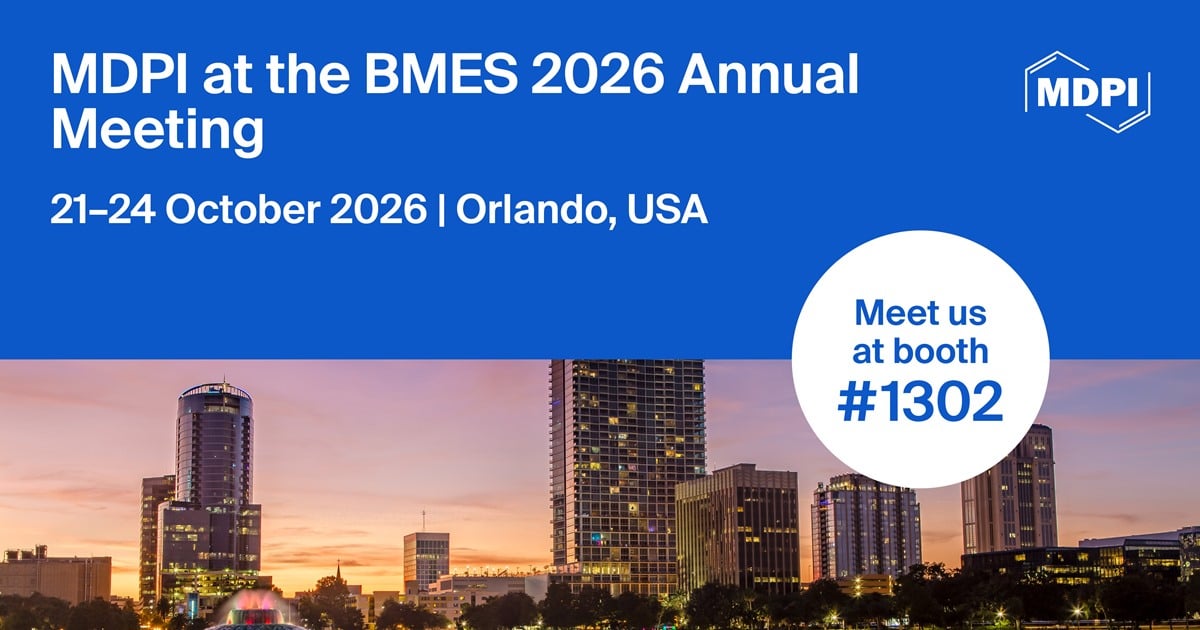
Conference: BMES 2026 Annual Meeting
Organization: Biomedical Engineering Society
Date: 21–24 October 2026
Place: Orlando, USA
We are delighted to invite you to the 2026 BMES Annual Meeting, taking place from 21 to 24 October 2026 in Orlando, FL. This year’s theme, “Engineers Empower Human Health”, highlights the central role of biomedical engineering in enabling transformative biomedical discoveries and addressing grand challenges in health and medicine.
The meeting will feature cutting-edge engineering and translational research that drives the development of next-generation therapeutics, medical devices, and integrative diagnostics. To foster the future of biomedical engineering, we will provide meaningful opportunities for trainees to connect, collaborate, and network with leaders across academia and the industry.
The following open access journals will be represented:
- Bioengineering;
- BioMedInformatics;
- BioChem;
- Biomolecules;
- Applied Mechanics;
- Biomimetics;
- Biomechanics;
- Biosensors;
- Micromachines;
- Antioxidants;
- Sensors;
- AI in Medicine.
If you are attending the BMES 2026 Annual Meeting, we invite you to visit us at our booth #1302. Our representatives will be available to discuss publishing opportunities, the benefits of open access, and answer any questions that you may have.
Join us in Orlando to discover what is next in biomedical engineering! For more information about the conference, please visit its official website at https://www.bmes.org/2026/annualmeeting.
5 August 2026
MDPI INSIGHTS: The CEO’s Letter #37 – Canada Summit, Sciforum Relaunch, 30 Years of Impactful Research & ISPRS 2026
Welcome to the MDPI Insights: The CEO's Letter.
In these monthly letters, I will showcase two key aspects of our work at MDPI: our commitment to empowering researchers and our determination to facilitating open scientific exchange.
Opening Thoughts

Reflections from the MDPI Canada Summit 2026 in Toronto (9–10 July)
As part of this year’s MDPI Summit events, we were delighted to host Editors-in-Chief (EiCs) and Editorial Board Members (EBMs) in Toronto for the MDPI Canada Summit 2026 this July.
Across the two days, we presented on topics including research integrity, editorial leadership, artificial intelligence, peer review, and the evolving role of the EiC. More importantly, the Summit created space for feedback and conversations with the academic community: these engagements continue play and important role in shaping how MDPI develops its journals and services.
Why Canada?
Canada has become one of the world’s leading Open Access (OA) nations. In 2025, 68% of Canadian research publications were published OA, with more than 73,000 OA articles produced during the year. Over the past five years alone, Canadian researchers have published more than 526,000 scholarly articles, showing both the scale and quality of Canadian research.
MDPI Toronto Office

“Canada has become one of the world’s leading Open Access nations”
Since opening in 2019, our Toronto office has grown to more than 85 colleagues supporting editorial operations, research integrity, marketing, societies, conferences, indexing, author services, and many other functions across North America. It was great to spend time with the team, see first-hand the energy and enthusiasm they bring to their work, and recognize the significant role they play in building relationships with the Canadian research community and delivering events such as this Summit.
MDPI and Canada
Today, Canada is an important part of the MDPI community:
- More than 53,800 articles from Canadian institutions published with MDPI since 1996
- More than 5,800 MDPI publications from Canadian researchers in 2025
- Nearly 1,900 Canadian Editorial Board Members, including 24 Editors-in-Chief; 49 Section Editors-in-Chief
- More than 30 Institutional Open Access Partnerships (IOAP) with universities across Canada

“The academic community is at the center of everything we do”
These numbers reflect the long-term partnerships with researchers, reviewers, editors, and institutions who continue to place their trust in MDPI.
Summit Program
Throughout the Summit, we presented and discussed topics against the following agenda:
- MDPI at 30: Introduction, Reflections and the Road Ahead – Stefan Tochev (CEO)
- Engagement with Academic Community and Society Partnerships – Karen Irwin (Associate Editorial Engagement Manager) and Carla Aloè (Head of Societies and Acquisition)
- Latest Developments in the Editorial Process – Summer Huggard (Operations Manager)
- Research Integrity and Publication Ethics – Renato Merki (Research Integrity Specialist)
- AI and Technology in Publishing – Dr. Barnaby Crook (Regional Engagement Editor)
- Panel Discussion – Bob Vrooman (Head of Business Development / Operations Manager, USA), Summer Huggard, Renato Merki, and myself

These presentations reinforce something we often say at MDPI: The academic community is at the center of everything we do. Each session concluded with a Q&A, allowing for discussions throughout the Summit to engage directly with our EiCs and EBMs.
Further Reading
I also had the opportunity to be interviewed by University Affairs about the evolving landscape of scholarly publishing, Open Access, and the importance of engaging with the research community. If you’re interested, you can read the interview in:
- English: University Affairs – MDPI Toronto Summit 2026: Bringing Together Leaders to Shape the Future of Scholarly Publishing
- Français: Affaires universitaires – Sommet MDPI de Toronto 2026
Thank You
As OA continues to grow around the world, events such as the MDPI Canada Summit remind us of the importance of meeting with our academic community in person. Listening to feedback, exchanging ideas, and building relationships are essential to ensuring that MDPI continues to evolve alongside the researchers, editors, reviewers, and institutions we serve.

Impactful Research

Five Journals, Five Different Stories of Success
Each year, the release of the Journal Citation Reports (JCR) provides an opportunity to look at the progress of our journal portfolio and, more importantly, the achievements of the research communities behind it.
A recent MDPI Blog article from Tommy Lax (Content Specialist, MDPI) highlights five journals whose 2025 Journal Impact Factor results show that success can take many forms – from achieving a first Impact Factor, to steady long-term growth, to leadership within highly competitive disciplines.
The featured journals include:
- Machine Learning & Knowledge Extraction (MAKE) – Among the 330 MDPI journals which received an Impact Factor in 2025, MAKE (ISSN 2504-4990) holds the accolade of having the highest rating of 8.4. The journal, which provides an advanced forum for the study of machine learning and its applications, is placed in Q1 for three subject categories: Computer science, artificial intelligence; Computer science, interdisciplinary applications; and Engineering, electrical & electronic.
- Antioxidants – Continuing its strong position across multiple scientific disciplines, Antioxidants (ISSN 2076-3921) was awarded an exceptional Impact Factor of 8.2. In addition, the journal was placed in Q1 in three subject categories: Biochemistry & molecular biology; Chemistry, medicinal; and Food science & technology.
- Biomass – This year, Biomass (ISSN 2673-8783) was recognized in the JCR for the first time, with a strong debut Impact Factor of 6.7. What makes this achievement even more impressive is the journal’s placement in Q1 of the category Engineering, chemical.
- Analytica – Remaining with the theme of growth, Analytica (ISSN 2673-4532), which provides an advanced forum for all aspects of fundamental and applied analytical chemistry, recorded one of the largest year-on-year increases in Journal Impact Factor, with a 7.4 – an astounding 3.8-point increase from its 2024 rating of 3.6.
- Batteries – Indexed in SCIE, Batteries (ISSN 2313-0105) received an updated Impact Factor of 6.3 this year, representing an increase of 1.5 versus last year, demonstrating consistent growth and increasing visibility over several years.
While citation metrics provide one perspective on journal performance, they tell only part of the story. Every milestone reflects the dedication of Editors-in-Chief, Editorial Board Members, reviewers, authors, and colleagues across MDPI who work together to uphold rigorous editorial standards and support high-quality research.
As a signatory of the Declaration on Research Assessment (DORA), MDPI supports a balanced approach to research evaluation. Journal-level metrics should be viewed alongside article-level indicators and the broader scientific and societal impact of published research.
Thank you to everyone whose commitment continues to strengthen our journals and advance Open Access across the global research community.
Inside MDPI

Building Better Tools for the Research Community: The Relaunch of Sciforum
Innovation at MDPI extends beyond journals. Over the past decade, we have continued to invest in products that support researchers, conference organizers, editors, reviewers, and institutions throughout the research lifecycle. As part of this ongoing investment, our Product and Engineering teams have been modernizing several of MDPI’s digital platforms. One important milestone in that journey is the relaunch of Sciforum, our conference management platform.
Read More: Sciforum Relaunch: Empowering Science through Seamless Event Management
Rather than simply updating an existing system, our product and engineering teams have rebuilt Sciforum, using a modern architecture designed to improve the user experience, support future growth, and continue to strengthen our position in the conference management market.
“Scalable technology is essential to delivering a high-quality experience”
Why We Rebuilt Sciforum
Technology must continue evolving alongside the needs of our users. The previous platform had served MDPI well for many years but had become difficult to extend and maintain. The new platform introduces a modular architecture that enables faster development, more flexibility, and a scalable foundation for future work.
Major improvements include:
- Simplified submission workflows
- Role-based dashboards
- A modern website builder
- Flexible pricing options
- Permanent data hosting
- A scalable architecture for future development

Supporting Our Conference Community
Sciforum is more than a software platform: it supports researchers, conference organizers, reviewers, speakers, and attendees by helping them organize, participate in, and share scientific meetings more efficiently. As MDPI continues to expand its conference activities worldwide, investing in modern, scalable technology is essential to delivering a high-quality experience for both our external partners and our internal teams.
Looking Ahead
The relaunch represents the beginning Sciforum’s next chapter. Planned improvements include: the Program Builder, Communication Hub, expanded payment options, Zoom integration, and a mobile application. These will continue to enhance the platform over the coming months.
Coming Together for Science

Highlights from ISPRS Congress 2026 – Toronto, Canada
In early July, I had the pleasure of attending the XXV ISPRS Congress in Toronto, one of the world’s leading gatherings for the geospatial and remote sensing research community. It was a great opportunity to meet researchers, editors, society leaders, and collaborators, while gaining insights into some of the latest developments in geospatial science and technology.
Over several days, I had the privilege of presenting the Jack Dangermond Award; speaking about MDPI’s approach to AI in publishing and our 30-year journey in Open Access publishing; participating in Editorial Board meetings; and engaging with members of the ISPRS community.
Below is a summary of these activities:
Celebrating excellence in research
One of the highlights of the week was presenting the Jack Dangermond Award for the best paper published in the ISPRS International Journal of Geo-Information (IJGI). Sponsored by MDPI and ESRI, the award recognizes an outstanding paper published over a four-year period and includes an ISPRS certificate together with a USD 10,000 prize.

Awards such as these remind us that journals are much more than publication platforms: they celebrate research that advances knowledge, inspires future work, and delivers meaningful impact for both science and society.
Presentations at ISPRS
I also had the pleasure to give two presentations during the congress:

1. The AI Revolution in Publishing: Challenges, Innovations, and MDPI’s Vision
The development of AI continues to transform scholarly publishing. During this session, I shared how MDPI is integrating AI responsibly, not to replace editorial judgement or peer review, but to support our staff by improving efficiency while maintaining scientific quality and research integrity.
2. MDPI: 30 Years of Open Access Publishing
I also had the opportunity to share MDP’s 30-year journey from a small publishing initiative to becoming a global Open Access publisher serving millions of researchers worldwide. As part of this session, my colleague Carla Aloè (Head of Societies and Acquisitions) introduced the ISPRS International Journal of Geo-Information (IJGI), sharing its development and contribution to the geospatial research community.

Meeting with Our Editorial Boards
Another rewarding aspect of the congress was meeting with the Editorial Boards of two of our journals:
- Remote Sensing
- ISPRS International Journal of Geo-Information
These discussions went beyond journal metrics. We heard ideas about editorial quality and emerging research areas, and we discussed reviewer engagement, diversity within editorial boards, and how journals can continue serving their communities for the future. These conversations are a great way to connect directly to the scientists who help shape our journals.


“One of our core missions has always been to make high-quality research openly accessible”
Partnerships matter
Scientific publishing is built on collaboration. Throughout the congress, our team welcomed researchers to the MDPI booth, met with authors and editors, and discussed opportunities for collaboration across our journals and society partnerships.
Special thanks to our MDPI colleagues who were present throughout the ISPRS congress supporting our Editorial Board meetings and the MDPI booth: Andy Tran, Carla Aloè, Carlo Cunanan, Diana Ribeiro Tosato, and Elena Duan.

Thank you to ISPRS for organizing this congress, to the researchers who shared their work, to our Editorial Board members, and to MDPI colleagues whose dedication continues to shape the journals and communities we support.
Closing Thoughts

Insights Into 30 Years of Impactful MDPI Research
As we celebrate 30 years of MDPI, it’s worth reflecting on the impact that the research we publish has on society. One of our core missions has always been to make high-quality research openly accessible so that it can inform new discoveries, public policy, education and innovation around the world.
A recent article on the MDPI Blog highlights several examples of MDPI publications that have gone beyond academic citations to help inform governments, international organizations and public policy discussions.
Research Creating Real-World Impact
The MDPI blog article features research that has contributed to topics including:
- protecting the Amazon rainforest through satellite mapping
- understanding climate change and urban heat inequality
- encouraging more young women to pursue STEM careers
- tackling obesity through healthier food environments
- shaping sustainable urban planning through the “15-minute city” concept
These examples remind us that publishing research is not only about producing articles: it is about helping knowledge reach the people who can use it to improve lives and address global challenges.
Thirty Years of Open Access
MDPI’s 30th Anniversary is also an opportunity to recognize the collective contribution of everyone across MDPI. Every manuscript processed, every review coordinated, every system developed, every conference organized, every partnership established and every article published contributes to a much larger purpose: helping scientific knowledge move further and faster.
You can explore the full article here: 30 Years of Impactful MDPI Research
You can also visit our 30th Anniversary page to learn more about MDPI’s journey over the past three decades.
Chief Executive Officer
MDPI AG
29 July 2026
Topics Webinar | Kinases, Cancer, Drugs and Artificial Intelligence, 10 August 2026

Today, we turn our focus to a field that has become central to modern oncology: the study and therapeutic targeting of protein kinases. Over the past two decades, kinases have emerged as one of the most clinically successful classes of drug targets in cancer. These enzymes act as critical molecular switches, governing a vast network of signaling pathways that control cell proliferation, survival, and metabolism. When dysregulated—whether through mutation, overexpression, or chromosomal translocation—kinases drive the hallmark behaviors of malignancy.
It is no exaggeration to say that the discovery of kinase inhibitors has transformed the therapeutic landscape. From the groundbreaking success of imatinib in chronic myeloid leukemia to the latest generation of highly selective ATP-competitive and allosteric inhibitors, we have seen how a deep understanding of kinase biology can translate into life-saving drugs. However, we are also acutely aware of the persistent challenges: acquired resistance, off-target toxicity, and the daunting complexity of kinase signaling networks. The question is no longer simply which kinase to target, but how to target it more intelligently, more selectively, and for the right patient at the right time.
This is where artificial intelligence enters the picture, and while much of our conversation will be anchored in kinase biology, we will explore how AI is beginning to accelerate drug discovery—from structure prediction to virtual screening. Yet let us be clear: biology remains the foundation. Our goal today is to ask how these powerful computational tools can help us navigate the complexity of the kinome and ultimately improve patient outcomes.
Date: 10 August 2026 at 4:00 p.m. CEST | 10:00 a.m. EDT
Webinar ID: 889 3819 0599
Register now for free!

Program:
|
Speaker/Presentation |
Time in CEST |
Time in EDT |
|
Dr. Jonas Cicenas Chair Introduction |
4:00–4:10 p.m. |
10:00–10:10 a.m. |
|
Dr. Jonas Cicenas AI and Machine Learning in Kinase Inhibitor Development |
4:10–4:30 p.m. |
10:10–10:30 a.m. |
|
Prof. Dr. Lee M. Graves Applying Affinity Proteomics to Profile Kinome Dynamics and Inhibitor Specificity |
4:30–4:50 p.m. |
10:30–10:50 a.m. |
|
Dr. Eglė Žalytė Targeting Kinases in Gynecological Cancers: From Molecular Pathways to Clinical Practice |
4:50–5:10 p.m. |
10:50–11:10 a.m. |
|
Q&A Session |
5:10–5:25 p.m. |
11:10–11:25 a.m. |
|
Dr. Jonas Cicenas Closing of Webinar |
5:25–5:30 p.m. |
11:25–11:30 a.m. |
After registering, you will receive a confirmation email containing information on how to join the webinar.
Registrations with academic institutional email addresses will be prioritized.
If you are unable to attend, please register anyway, and we will let you know when the recording is available to watch.
Webinar Chair and Keynote Speakers:
- Dr. Jonas Cicenas, 1 Faculty of Informatics, Engineering and Technologies, Kauno Kolegija Higher Education Institution, Lithuania; 2 SMK College of Applied Sciences, Kalvarijų, Lithuania; 3 UAB CDKjc, Kukučių, Lithuania;
- Prof. Dr. Lee M. Graves, Department of Pharmacology, University of North Carolina at Chapel Hill, NC;
- Dr. Eglė Žalytė, Institute of Biosciences, Life Sciences Center, Vilnius University, Lithuania.
Relevant Topics:
“Kinases in Cancer and Other Diseases, 2nd Edition”
Topic Editors: Dr. Jonas Cicenas and Dr. Anna M. Czarnecka
Abstract submission deadline: 31 July 2026
Manuscript submission deadline: 31 August 2026
“Kinases and GTPases in Cancer: The Role of Mutations and sRNAs”
Topic Editors: Dr. Jonas Cicenas and Prof. Dr. Lee M. Graves
Abstract submission deadline: 31 October 2027
Manuscript submission deadline: 31 December 2027
For more information about this webinar, please visit the following website:
https://sciforum.net/event/TOPICS-51.
If you have any questions about this event, please contact journal.webinar@mdpi.com.
Topics Webinar Secretariat
28 July 2026
Biomolecules | Highly Cited Papers in 2025–2026 in the “Biomacromolecules: Proteins, Nucleic Acids and Carbohydrates” Section

All of the articles published in Biomolecules (ISSN 2218-273X) are open access, meaning you have free and unlimited access to the full text. We invite you to read the most highly cited papers published in 2025 and 2026 in the section “Biomacromolecules: Proteins, Nucleic Acids and Carbohydrates”, which are listed below:
1. “Lactobacilli-Derived Microbe-Associated Molecular Patterns (MAMPs) in Host Immune Modulation”
by Salvatore Furnari, Ruben Ciantia, Adriana Garozzo, Pio Maria Furneri and Virginia Fuochi
Biomolecules 2025, 15(11), 1609; https://doi.org/10.3390/biom15111609
Full text available online: https://www.mdpi.com/2218-273X/15/11/1609
2. “Nav1.8 and Chronic Pain: From Laboratory Animals to Clinical Patients”
by Yu-Feng Xie
Biomolecules 2025, 15(5), 694; https://doi.org/10.3390/biom15050694
Full text available online: https://www.mdpi.com/2218-273X/15/5/694
3. “Hyaluronic Acid in Immune Response”
by Lech Chrostek and Bogdan Cylwik
Biomolecules 2025, 15(7), 1008; https://doi.org/10.3390/biom15071008
Full text available online: https://www.mdpi.com/2218-273X/15/7/1008
4. “The Versatility of Serine Proteases from Brazilian Bothrops Venom: Their Roles in Snakebites and Drug Discovery”
by Marcela Romanazzi, Eloise T. M. Filardi, Geovanna M. M. Pires, Marcos F. Cerveja, Guilherme Melo-dos-Santos, Isadora S. Oliveira, Isabela G. Ferreira, Felipe A. Cerni, Norival Alves Santos-Filho, Wuelton M. Monteiro et al.
Biomolecules 2025, 15(2), 154; https://doi.org/10.3390/biom15020154
Full text available online: https://www.mdpi.com/2218-273X/15/2/154
5. “The Role of Substance P in Corneal Homeostasis”
by Irmina Jastrzębska-Miazga, Bartosz Machna, Dorota Wyględowska-Promieńska and Adrian Smędowski
Biomolecules 2025, 15(5), 729; https://doi.org/10.3390/biom15050729
Full text available online: https://www.mdpi.com/2218-273X/15/5/729
6. “Heavy Chalcogen Properties of Sulfur and Selenium Enhance Nucleic Acid-Based Therapeutics”
by Stephen J. Dansereau and Jia Sheng
Biomolecules 2025, 15(2), 218; https://doi.org/10.3390/biom15020218
Full text available online: https://www.mdpi.com/2218-273X/15/2/218
7. “Electrostatic Effects on Tau Nanocondensates”
by Phoebe S. Tsoi, Lathan Lucas, Derek Rhoades, Josephine C. Ferreon and Allan Chris M. Ferreon
Biomolecules 2025, 15(3), 406; https://doi.org/10.3390/biom15030406
Full text available online: https://www.mdpi.com/2218-273X/15/3/406
8. “Scanning Tunneling Microscope Measurement of Proteasome Conductance”
by Sepideh Afsari, Eathen Ryan, Brian Ashcroft, Xu Wang and Stuart Lindsay
Biomolecules 2025, 15(4), 496; https://doi.org/10.3390/biom15040496
Full text available online: https://www.mdpi.com/2218-273X/15/4/496
9. “Presenilin-1 Familial Alzheimer Mutations Impair γ-Secretase Cleavage of APP Through Stabilized Enzyme–Substrate Complex Formation”
by Sujan Devkota, Masato Maesako and Michael S. Wolfe
Biomolecules 2025, 15(7), 955; https://doi.org/10.3390/biom15070955
Full text available online: https://www.mdpi.com/2218-273X/15/7/955
10. “Insights into Membrane Damage by α-Helical and β-Sheet Peptides”
by Warin Rangubpit, Hannah E. Distaffen, Bradley L. Nilsson and Cristiano L. Dias
Biomolecules 2025, 15(7), 973; https://doi.org/10.3390/biom15070973
Full text available online: https://www.mdpi.com/2218-273X/15/7/973
11. “Class IIa HDACs Are Important Signal Transducers with Unclear Enzymatic Activities”
by Claudio Brancolini
Biomolecules 2025, 15(8), 1061; https://doi.org/10.3390/biom15081061
Full text available online: https://www.mdpi.com/2218-273X/15/8/1061
28 July 2026
Meet Us at the 29th Annual Meeting of KSBNS: K-Brain 2026, 6–8 September 2026, Daejeon, Republic of Korea
Conference: The 29th Annual Meeting of KSBNS: K–Brain 2026
Date: 6–8 September 2026
Location: Daejeon, Republic of Korea
The 29th Annual Meeting of the Korean Society for Brain and Neural Sciences (KSBNS 2026) is one of Korea’s leading international conferences in the field of neuroscience, bringing together researchers, clinicians, educators, and industry professionals to share the latest advances in brain and neural sciences. The meeting promotes scientific exchange and interdisciplinary collaboration through plenary lectures, symposia, educational sessions, and poster presentations.
KSBNS 2026 will welcome leading neuroscientists from Korea and around the world to discuss cutting-edge research, foster international collaboration, and explore emerging developments across basic, translational, and clinical neuroscience.
MDPI will be attending KSBNS 2026 as an exhibitor and warmly invite researchers to visit our booth to discuss their latest research, explore our neuroscience journals, and learn more about publishing opportunities with us.
The following open access journals will be represented at the conference:
- Biomolecules;
- NeuroSci;
- Brain Sciences;
- CTN;
- JCM;
- JDAD;
- JDB;
- Neurology International;
- Neuroglia;
- Psychiatry International;
- SANPP;
- Marine Drugs.
We look forward to meeting researchers and engaging with the neuroscience community at KSBNS 2026. For more information about the conference, please visit the official website below: K-Brain 2026.
