
- Article

31 Pages
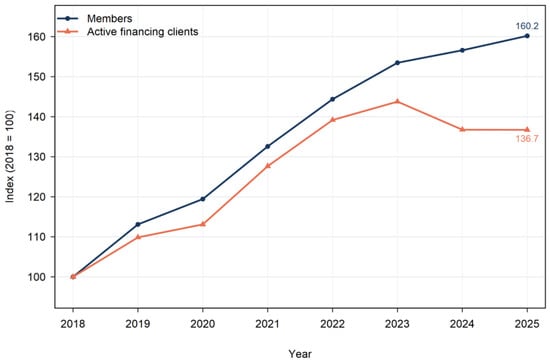
Growth in registered membership is often taken as evidence that microfinance expands financial inclusion, but it does not show whether members use financing or whether that financing keeps its value when prices rise. This study examines the Rural Development Scheme and Urban Poor Development Scheme (RDS-UPDS) of Islami Bank Bangladesh PLC over 2018–2025. It is a descriptive, single-program study based on eight annual observations from the bank’s annual reports. Financing and savings are adjusted for inflation using the national consumer price index, and real portfolio change is split into membership, activation, and depth components with an exact accounting identity. Licensed non-governmental microfinance institutions provide context only, not a causal comparison. Membership rose by 60%, from 1.11 to 1.78 million, but the share of members with active financing fell from 56.4% to 48.2%. Of the 33.9 log-point rise in real outstanding financing, membership growth accounted for 47.1 points and falling activation for −15.8 points; real financing per active client added only 2.6 points and declined after 2023, when repayment indicators also weakened. The program’s reach grew much faster than its active use. Managing activation, monitoring inflation-adjusted indicators, and reporting by scheme should be priorities.
Economies
20 October 2026