
- Article

18 Pages
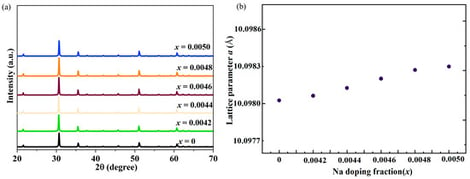
Wide-bandgap indium-oxide thermoelectric materials face a strong electrical–thermal transport trade-off and low structural reliability, limiting their thermoelectric efficiency and practical deployment on welding robots. To overcome these bottlenecks, gradient Na-doped In2O3 ceramics are fabricated by mechanical alloying combined with spark plasma sintering. A dual-functional modulation mechanism via monovalent alkali-metal doping is proposed to decouple thermoelectric performance. Unlike conventional high-valence doping that degrades the Seebeck coefficient and raises thermal conductivity, moderate Na substitution introduces shallow acceptor states, oxygen vacancies, or other compensating defects inside the bandgap, precisely tuning the Fermi level and carrier concentration within the optimal transport window. This mild electronic-structure reconstruction balances conductivity and Seebeck coefficient, boosting the power factor without carrier overflow or saturation. The ionic-size mismatch between Na+ and In3+ generates controllable point defects and uniform lattice strain, scattering multi-frequency phonons to suppress lattice thermal conductivity while avoiding excessive electronic thermal conductivity. Na doping also improves lattice bonding and thermomechanical properties, enhancing Vickers hardness to offset doping-induced mechanical deterioration. Supported by first-principles calculations, this work reveals the mechanism of shallow-level electronic modulation coupled with lattice-strain engineering. The optimized sample delivers good medium-temperature conversion efficiency and structural stability. This study achieves simultaneous improvement in thermoelectric and mechanical properties, fills the research gap for alkali-metal-modified In2O3, and offers theoretical guidance for high-performance oxide thermoelectric material design.
Inorganics
24 September 2026