Review

Consumer Smartwatch Technology in Health and Performance Research: Validity, Limitations, and Real-World Applications

1
School of Kinesiology, University of Michigan, Ann Arbor, MI 48109, USA
2
Department of Kinesiology, Division of Social Sciences, Hope College, Holland, MI 49423, USA
*
Author to whom correspondence should be addressed.
Sensors 2026, 26(14), 4486; https://doi.org/10.3390/s26144486
Submission received: 29 June 2026 / Revised: 10 July 2026 / Accepted: 13 July 2026 / Published: 15 July 2026
(This article belongs to the Special Issue Biomechanics Research in Sports with Wearable Sensors)

Abstract

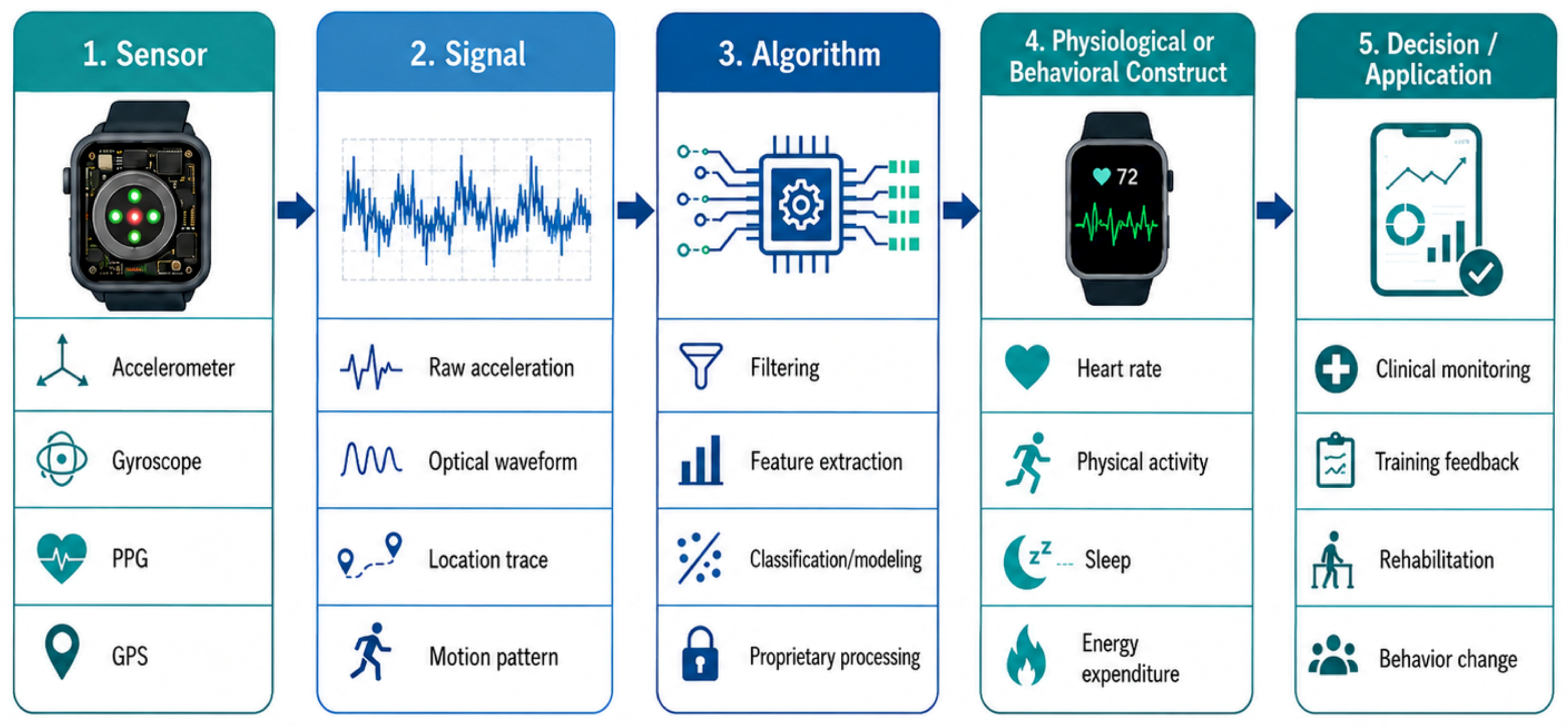
Consumer smartwatches are increasingly used to monitor health, physical activity, rehabilitation, and performance in real-world environments. Although these devices provide continuous and scalable data, many user-facing outputs are not direct physiological measurements, but estimates generated from sensor signals, proprietary algorithms, user characteristics, and contextual assumptions. This review article provides a practical framework for evaluating smartwatch-derived metrics by distinguishing between relatively direct sensor measurements and higher-level algorithmic outputs. We review how common and emerging metrics are generated, including cardiovascular measures, energy expenditure, aerobic capacity, sleep and readiness scores, body composition, movement mechanics, cuffless blood pressure, sweat loss and hydration, and non-invasive glucose monitoring. Across these domains, validity varies substantially by device, algorithm, population, activity type, environment, and intended application. Smartwatch-derived data may be most useful for tracking within-person trends and complementing laboratory, clinical, or self-reported assessments, but caution is warranted when using these outputs for precise physiological quantification, diagnostic classification, or cross-device comparisons. Future progress will require stronger validation frameworks, greater algorithmic transparency, standardized reporting, harmonized data infrastructure, and careful alignment between wearable metrics and meaningful health, rehabilitation, and performance decisions.
Keywords: smartwatch; wearable technology; digital health; sensor-derived metrics; validity; photoplethysmography; physical activity monitoring; health data; data interoperability; real-world monitoring smartwatch; wearable technology; digital health; sensor-derived metrics; validity; photoplethysmography; physical activity monitoring; health data; data interoperability; real-world monitoring