1. Introduction
β-thalassemia is a common inherited autosomal recessive disorder of red blood cells, characterized by null or reduced synthesis of adult hemoglobin. The primary pathological manifestation of thalassemia is anemia. Additionally, due to recurrent blood transfusions, individuals with thalassemia often develop complications such as iron overload, splenomegaly, and retarded growth. In addition to such common complications, thalassemia patients often present with some ocular abnormalities like peau d’orange pigmentation, ASs, pattern dystrophy, and optic nerve drusen, as well as PXE [
1].
ASs and the subsequent development of CNV are common ocular findings in β-thalassemia patients; however, CNV without prior AS manifestation is an uncommon presentation [
2]. The etiology of ocular abnormality in thalassemia and other hemoglobinopathy patients is not clear; it has been suggested that vascular obstruction impeding choriocapillaris circulation or excessive hemolysis generates free iron, thought to trigger inflammatory and oxidative responses in the retinal epithelium. In the case of thalassemia and sickle cell anemia, ASs are a recurrent phenomenon representing linear breaks in Bruch’s membrane that usually radiate from the optic disc and may extend in various directions, including nasal or temporal regions. A study by Aessopos et al. showed that in a cohort of 100 beta thalassemia patients, 20% of them developed ASs in their fundi [
3]. Though ocular complications like AS are common in thalassemia, occurrence of CNV is very rare.
In our thalassemia patient cohort, a 27-year-old β-thalassemia patient developed vision problems and was subsequently diagnosed with CNV, receiving treatment with anti-VEGF therapy. This case prompted us to investigate whether CNV is a pathophysiological condition directly associated with thalassemia or is triggered by co-existing genetic variants.
Case presentation: Our case study is a 27-year-old male β-thalassemia patient with decreased vision and visual distortion in his right eye (RE) for the past two months. At the age of 19 years, he was diagnosed as anemic, with a hemoglobin level of 7.3 g/dL. Preliminary genetic testing using DNA sequencing revealed a homozygous mutation in the beta globin gene
HBB:c.92+5G>C. At that time, he underwent monthly blood transfusions. Ultrasonography showed the presence of renal calculi and an enlarged spleen, leading to a splenectomy at the age of 24. The patient was regularly treated with hydroxyurea and folic acid. Notably, significant dynamic variations in High-Performance Liquid Chromatography (HPLC) parameters were observed between the pre-splenectomy and post-splenectomy periods (
Supplementary File S1; Table S1).
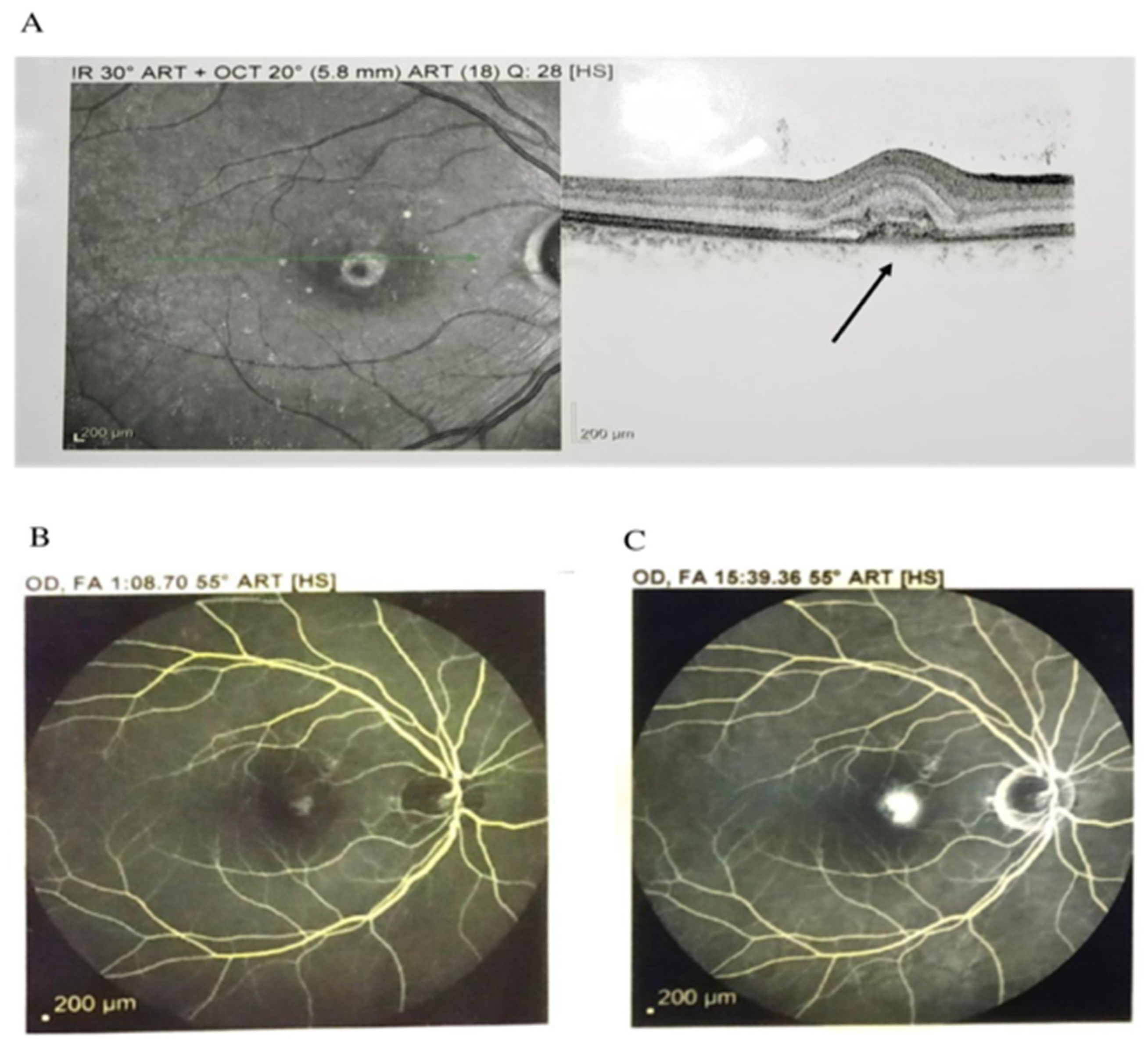
Ocular History: On presentation at the Eye Clinic, his best-corrected visual acuity was 6/9 in the RE and 6/6 in the left eye. Slit-lamp biomicroscopy revealed a focal foveal elevation with yellowish-brown discoloration. There were no signs of ASs in either eye. Optical coherence tomography (OCT) showed fibrovascular pigment epithelial detachment with subretinal fluid and hyperreflective material nasal to fovea with outer retinal layer damage in the RE (central retinal thickness, CRT 327 μm) (
Figure 1A). There was a normal foveal contour in the left eye (CRT: 279 μm) and the absence of CNV and AS on OCT. The fluorescein angiography revealed CNV in the RE; an active lesion adjacent to the fovea was identified with an increase in size and intensity in the late phase indicative of active leakage (
Figure 1B,C). The patient received three intravitreal injections of the anti-VEGF drug ranibizumab (0.5 mg/0.05 mL) in the RE. The lesion in the RE resolved completely without any signs of active leakage, and visual acuity returned to 6/6 in the RE.
The study was conducted with the due approval of the institutional ethical committee of The University of Burdwan, and informed consent was obtained from the patient.
Peripheral blood samples were collected, and genomic DNA was extracted. Library preparation was performed using the Agilent SureSelect XT Human All Exon V6 + UTR kit (Agilent Technologies, Santa Clara, CA, USA). Sequencing was carried out on the Illumina HiSeq 2500 platform, generating raw FASTQ data. Library preparation and sequencing were performed in National Institute of Biomedical Genomics (NIBMG), Kalyani, India. The quality of the raw reads was assessed using FASTQC, and low-quality reads were filtered out. High-quality reads were then aligned to the human reference genome (hg19) using the Burrows–Wheeler Aligner (BWA-0.7.5a) software package. PCR duplicates were removed using the Picard tool. Local realignment around INDELs, variant calling, and VCF generation was performed using the Genome Analysis Toolkit (GATK). Finally, the web-based application wANNOVAR (
https://wannovar.wglab.org/ (accessed on 22 January 2026)) was used to annotate the VCF.
To identify rare genetic variants potentially responsible for CNV development, we selected those with a minor allele frequency (MAF) below 1%, based on data from the 1000 Genomes Project (Phase III) and the Exome Aggregation Consortium (ExAC) databases. To evaluate the potential functional impact of the coding variants, we considered those variant with Combined Annotation Dependent Depletion (CADD) Phred score equal or greater than 20. After stringent filtering, a total of 311 variants spanning 290 unique genes were identified (
Supplementary File S2).
Finally, all selected genes were submitted to Phenolyzer under the disease/phenotype “choroidal neovascularization.” Phenolyzer analysis identified
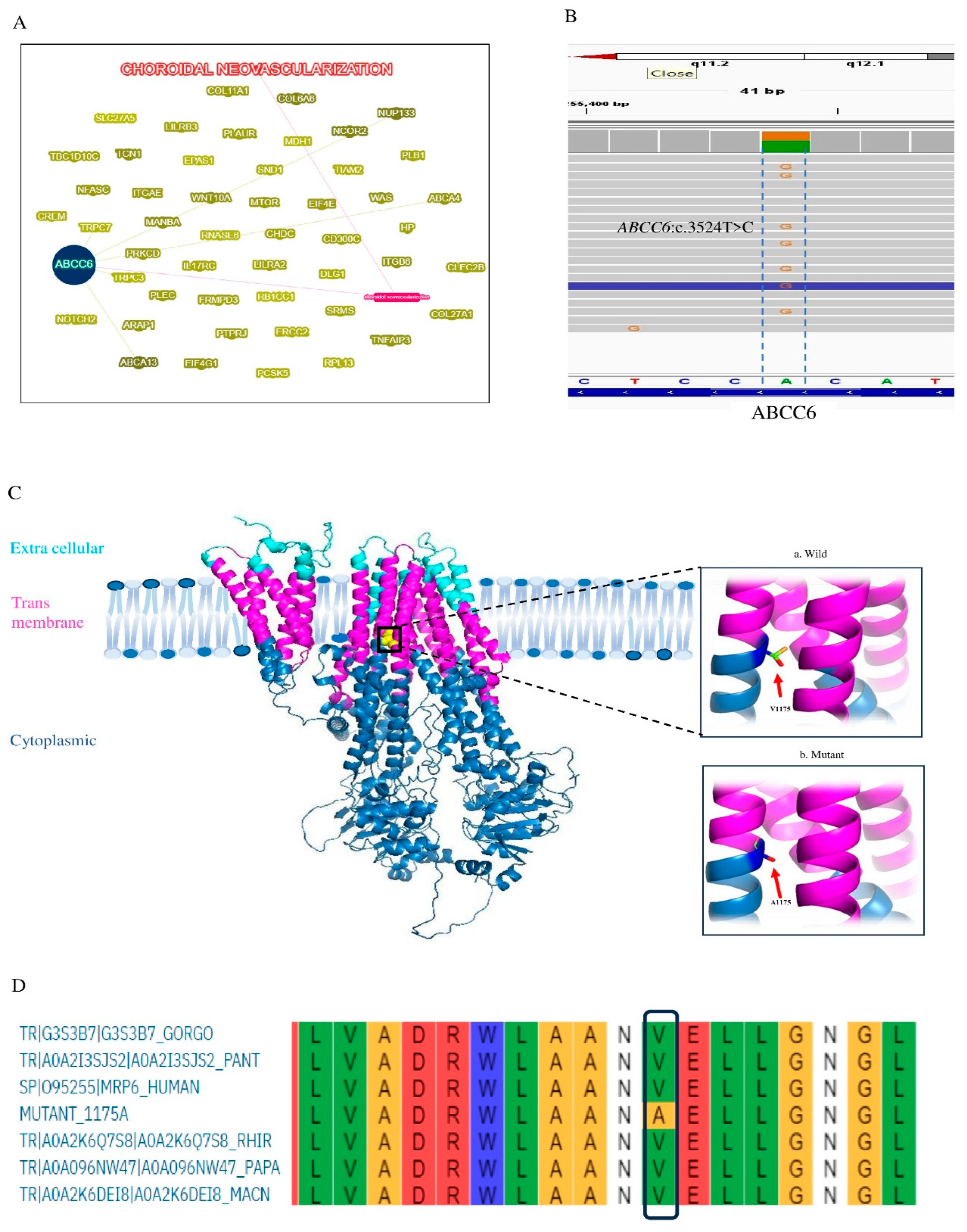
ABCC6 as a high-ranking seed gene with a top score of 0.94 (
Figure 2A,
Supplementary File S1: Figure S1). The variant in the
ABCC6 is a nonsynonymous variant,
ABCC6:c.3524T>C (rs376062004), in heterozygous condition with MAF of 0.0001 as per the ExAC database (
Figure 2B). The amino acid change for this variant accounts for valine to alanine (p.V1175A). Based on the Adjusted Criteria of American College of Medical Genetics (ACMG) 2015, the variant was classified as a pathogenic variant. Functional analysis using GeneCards and OMIM databases suggests that biallelic are associated with PXE and responsible for CNV manifestations [OMIM phenotype MIM number: 264800].
We obtained the wild-type ABCC6 protein sequence from UniProt and used SWISS-MODEL for 3D homology modelling. To visualize the protein 3D structure and to compare the alteration between wild and mutant proteins, PyMol software (
https://www.pymol.org/ (accessed on 22 January 2026)) was used. Homology modelling indicated that a valine-to-alanine amino acid change occurs at the junction of the transmembrane–cytoplasmic domain of the ABCC6 protein (
Figure 2C).
I-Mutant analysis predicted that the alteration from valine to alanine at the 1175 position decreases the stability of the ABCC6 protein, with ΔΔG value of −2.63. According to GERP++ analysis, this specific mutation had an estimated score of 4.56, signifying that the mutated position is located within a highly conserved region of the protein. Multiple sequence alignment with other mammalian orthologs species also confirmed the conserved nature of that particular amino acid (
Figure 2D).
2. Discussion
In this study, we identified a heterozygous variant, c.3524T>C, in the
ABCC6 gene in a β-thalassemia patient.
ABCC6 encodes a protein belonging to the ATP-binding cassette transporter superfamily, crucial for transporting various molecules and ions across the cell membrane [
4]. There are several reports showing thalassemia patient with ASs with PXE-like ocular findings, but in this present case, OCT and fluorescein angiography revealed that the patient had CNV without ASs, which is extremely rare in thalassemia patients.
Genetic investigation revealed a heterozygous variant,
ABCC6:c.3524T>C, that may have contributed to the development of CNV. ABCC6, a transmembrane transporter belongs to the multidrug resistance proteins (MRPs). The ABCC6 protein comprises 17 transmembrane helices, total 1503 amino acids, with a molecular mass of 165 kD [
5]. It is expressed in various tissues, including the liver, kidney, skin, retina, and vascular tissue. Mutations in the
ABCC6 gene result in PXE, which is a heritable connective tissue disorder marked by elastic fiber calcification. The impact of
ABCC6 disruption on retinal tissue remains unclear but it may be linked to metabolic disturbances influenced by modifying genetic or environmental factors. Loss or reduction of
ABCC6 function leads to decreased levels of inorganic pyrophosphate (PPi), resulting in pathological calcification of elastic fibers within connective tissues, including Bruch’s membrane in the eye. This mineralization process weakens the membrane, predisposing it to structural breaks and neovascularization. Thus, dysregulated calcification represents a key mechanistic link between
ABCC6 mutations, PXE, and retinal pathology in thalassemia-associated ocular complications [
6]. An early study by Gorgels et al. observed reduced HDL cholesterol levels in Abcc6
−/− mice, suggesting a link between altered plasma lipid composition and systemic changes in PXE. Retinal toxicity may arise from Bruch’s membrane changes, affecting nutrient supply to photoreceptors and causing secondary dysfunction and degeneration [
7,
8].
The ABCC6 gene contains 31 exons with around 188 documented mutations associated with PXE [
9]. Our study identified a rare mutation in the
ABCC6 gene (
ABCC6:c.3524T>C) located at a conserved position at the junction of the transmembrane and cytosolic domain of the ABCC6 protein. The variant has a CADD score of 22.9 and I-mutant predicted decreased stability of the protein. Furthermore, ACMG classified the variant as pathogenic. All this evidence indicates the pathogenicity and the important spatial location of the particular variant in the protein, which ultimately disrupts the normal function of the protein.
PXE is considered as a recessive disorder, requiring biallelic mutations for disease manifestation. However, our study has uncovered a heterozygous mutation,
ABCC6:c.3524T>C, raising questions about the development of PXE-mediated CNV in this case. Further clinical investigation revealed the occurrence of renal calculi at the age of 19, supporting the presence of PXE. Recent research conducted by Gliem, Martin et al. in 2020 [
10] has shed light on the role of monoallelic mutations in PXE manifestation. Their study demonstrated that approximately 8% of the cases they investigated, which exhibited PXE and atrophic lesions, were attributed to monoallelic mutations in the
ABCC6 gene. Another study by Martin, Ludovic et al. in 2008 identified 4 out of 5 patients who had developed PXE-like syndrome had a heterozygous mutation in the
ABCC6 gene, manifesting severe ophthalmologic complications [
11]. Due to the thalassemic state, the individual is experiencing tissue hypoxia in post-splenectomy period. Additionally, the patient harbours a heterozygous mutation in the
ABCC6 gene (
ABCC6:c.3524T>C) that could potentially lead to nutrient deprivation in retinal cells, causing retinal toxicity. The combination of these two factors might synergistically induce the expression of vascular endothelial growth factor, ultimately inducing retinal endothelial tip cells for neovascularization and eventually leading to ocular complications. Although the genetic investigation identified a potential causative variant, this study has certain limitations, as it describes a single case and the functional validation of the identified variant is yet to be confirmed. In this study, we represent a rare instance of CNV development without AS in a β-thalassemia patient. This underscores the importance of regular ocular examinations for early detection of CNV and highlights the value of genetic testing for CNV-like symptoms, which may contribute to a better understanding of the molecular mechanisms underlying CNV development in β-thalassemia patients.