
Article

Association Between Plasma Cystatin C Concentration and Urine Osmolality in Adults with Different Forms of Beta-Thalassemia: A Cross-Sectional Study in Vietnam

1
Clinical Hematology Department, Viet Tiep Friendship Hospital, Hai Phong 180000, Vietnam
2
Internal Medicine Department, Hai Phong University of Medicine and Pharmacy, Hai Phong 180000, Vietnam
3
Internal Medicine Department, Hai Phong Medical University Hospital, Hai Phong 180000, Vietnam
4
Hematology and Blood Transfusion Center, Military Hospital 103, Hanoi 100000, Vietnam
5
Hematology and Blood Transfusion Department, Vietnam Military Medical University, Hanoi 100000, Vietnam
6
Nephrology and Hemodialysis Department, Military Hospital 103, Hanoi 100000, Vietnam
7
Nephrology and Hemodialysis Department, Vietnam Military Medical University, Hanoi 100000, Vietnam
8
Nephrology, Urology and Dialysis Center, Bach Mai Hospital, Hanoi 100000, Vietnam
9
Organ Transplantation Center, Military Hospital 103, Hanoi 100000, Vietnam
*
Author to whom correspondence should be addressed.
Thalass. Rep. 2026, 16(2), 8; https://doi.org/10.3390/thalassrep16020008
Submission received: 12 February 2026 / Revised: 17 April 2026 / Accepted: 29 April 2026 / Published: 6 May 2026

Abstract

Objective: To determine plasma cystatin C concentrations, urine osmolality and their relationship with disease severity in beta-thalassemia patients. Methods: A cross-sectional study was conducted on 234 patients with beta-thalassemia, including equal numbers (78 each) of beta-thalassemia major, intermedia, and minor cases, along with 78 healthy individuals matched for age, sex, and body mass index, who served as the control group. Plasma cystatin C concentrations were quantified in all subjects using the ELISA method, and urine osmolality level was measured automatically on a FISKE 210 machine (USA). Results: The proportion of beta-thalassemia patients with increased plasma cystatin C concentration was 39.3% and the proportion with a decreased urine osmolality level was 67.5% compared with the control group. Plasma ferritin had predictive value for increased plasma cystatin C concentration (cut-off point: 567.5 ng/mL; AUC = 0.803) and decreased urine osmolality level (cut-off point: 488.15 ng/mL; AUC = 0.820), p < 0.001. Plasma cystatin C concentration increased gradually and urine osmolality level decreased gradually from minor beta-thalassemia to intermedia beta-thalassemia to major beta-thalassemia patients, with p < 0.001. Conclusions: Increased plasma cystatin C concentrations and decreased urine osmolality levels are common and are associated with severity in beta-thalassemia patients.

1. Introduction

Beta-thalassemia, one of the most common autosomal recessive disorders globally, results from either reduced (beta+) or absent (beta0) production of the beta-globin chain in the hemoglobin tetramer [1,2]. While the condition is particularly prevalent in regions such as the Mediterranean, the Middle East, the Transcaucasus, Central Asia, the Indian subcontinent, and the Far East [1,3], migration has led to its increased occurrence in Northern Europe, the Americas, the Caribbean, and Australia [2]. In Vietnam, approximately 13.8% of the population carries the thalassemia gene, with cases distributed nationwide and higher prevalence in the Northern and Central–South mountainous regions [4]. Beta-thalassemia is divided into three forms based on a clinical and hematological spectrum including: beta-thalassemia major, beta-thalassemia intermedia and beta-thalassemia minor [5].
Iron chelation therapy and blood transfusions are the mainstays of treatment for patients with beta-thalassemia [1,3,5]. With advances in treatment, the quality and length of life of patients with beta-thalassemia has improved, but patients are faced with an increasing number of complications including cardiopulmonary disorders, endocrine diseases, liver dysfunction, and renal complications [6,7,8]. Renal tubular and glomerular dysfunction and damage are the two most common early manifestations of renal complications of beta-thalassemia [8]. Serum cystatin C is widely recommended as a sensitive biomarker for estimating glomerular filtration rate (GFR), particularly for the early detection of renal impairment in patients with chronic diseases including beta-thalassemia [9,10,11]. Urine osmolality is an easy-to-measure, useful index not only for indirect assessment of reduced glomerular function but also for assessing reduced tubular function. Reduced urine osmolality has been observed in patients with beta-thalassemia even in the absence of overt renal damage [12]. However, the relationship between plasma cystatin C levels, urine osmolality, and disease severity in beta-thalassemia (especially in adults) remains insufficiently explored. For the above reasons, we conducted this study to determine plasma cystatin C concentration and urine osmolality in adults with different forms of beta-thalassemia.

2. Subjects and Methods

2.1. Subjects

A cross-sectional study was conducted on 234 adult patients with beta-thalassemia who were followed and treated at Viet Tiep Hospital in Hai Phong, Vietnam, over a three-year period from January 2020 to January 2023. Inclusion criteria were as follows: patients with a confirmed diagnosis of beta-thalassemia, including all three forms—beta-thalassemia major (TM), beta-thalassemia intermedia (TI), and beta-thalassemia minor (TMin); age ≥ 18 years; and both sexes. Exclusion criteria included individuals with pre-existing kidney disease prior to beta-thalassemia diagnosis, patients with acute infections or suspected surgical conditions, and pregnant or breastfeeding women. All eligible participants provided written informed consent prior to enrollment.
During the study period, only 78 patients diagnosed with TMin met the inclusion and exclusion criteria. To ensure balanced group sizes for comparison, we selected 78 patients each for the TM and TI groups from the hospital registry of eligible patients. In addition, a control group of 78 healthy individuals matched for age, sex, and body mass index (BMI) was included to evaluate changes in plasma cystatin C concentrations and urine osmolality.

2.2. Research Contents

All participants were interviewed regarding their medical history, time since beta-thalassemia diagnosis, current medications, and blood transfusion status. Blood pressure, height, weight, and BMI were recorded. A fasting morning blood sample, collected within 48 h of admission, was used for complete blood count analysis. Biochemical parameters—including glucose, urea, creatinine, total protein, albumin, aspartate aminotransferase (AST), alanine aminotransferase (ALT), and total and direct bilirubin—were measured. Iron-related indices, including serum iron, ferritin, and transferrin, were also determined.
Plasma cystatin C concentrations were measured in all 234 patients and 78 controls using an enzyme-linked immunosorbent assay (ELISA) (Human Cystatin C [CST3] ELISA Kit, ELK Biotechnology, Sugar Land, TX, USA). Estimated glomerular filtration rate (eGFR) was calculated based on plasma creatinine and/or cystatin C concentrations using the CKD-EPI equation for creatinine, cystatin C, or their combination [13]. The 24 h urine concentrations were also collected from both the patients and control groups. Urinary albumin and creatinine concentrations were determined for each patient. Albumin-to-creatinine ratio (ACR) was calculated based on these two indices. Urine osmolality was measured automatically on the FISKE 210 machine (Advanced Instruments, Norwood, MA, USA), in all subjects of the patient group and control group.
Assessment of increased plasma cystatin C concentration and decreased urine osmolality: Based on the distribution of the control group, reference ranges were defined using the 2.5th–97.5th percentiles. Plasma cystatin C concentration was considered increased when values exceeded the 97.5th percentile of the control group. Urine osmolality was considered decreased when values were below the 2.5th percentile of the control group.

2.3. Statistical Analysis

For normally distributed continuous variables, data were presented as mean ± standard deviation and analyzed using Student’s t-test or one-way ANOVA. Non-normally distributed data were reported as median with interquartile range and compared using the Mann–Whitney U test or Kruskal–Wallis test. Categorical variables were expressed as frequency (percentage) and evaluated using the Chi-square test or Fisher’s exact test. Receiver operating characteristic (ROC) curves were used to assess the predictive value of increased plasma cystatin C levels and reduced urine osmolality, with the area under the curve (AUC) calculated. Multivariable logistic regression analysis was performed using a forward selection criteria to identify independent predictors of increased plasma cystatin C concentration and decreased urine osmolality, while controlling for potential confounders. Statistical analyses were performed using SPSS software version 22.0 (Chicago, IL, USA), with a p-value of <0.05 considered statistically significant.

3. Results

Compared with healthy controls, patients with beta-thalassemia exhibited significantly lower plasma glucose levels and urine osmolality (UO), whereas plasma cystatin C concentrations were significantly higher (p < 0.01 to < 0.001). Among the patient group, elevated cystatin C levels were observed in 39.3% of cases, while 67.5% showed reduced UO relative to controls (Table 1).
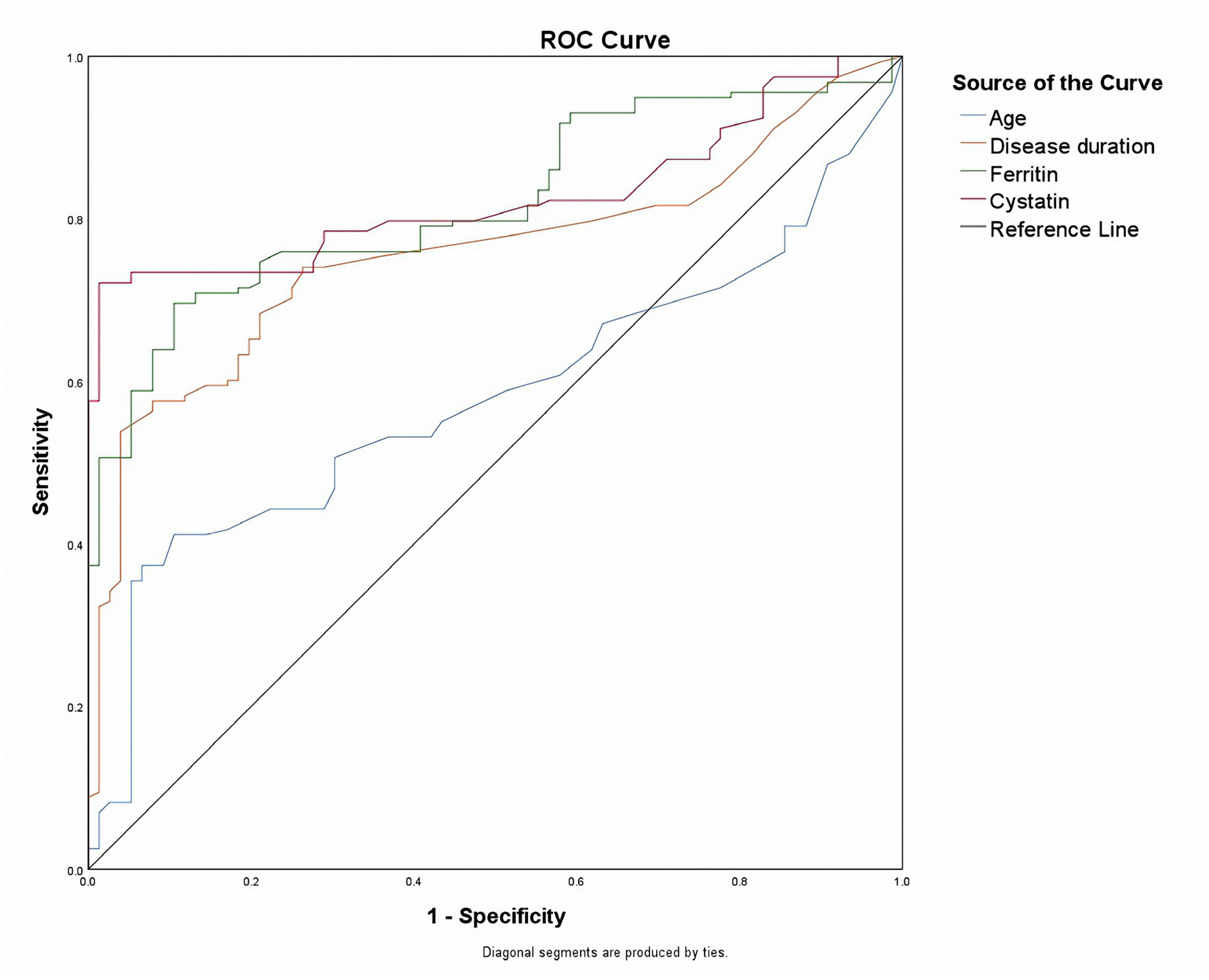
Receiver operating characteristic (ROC) curve analysis demonstrated that age, disease duration, plasma ferritin levels, and UO were significant associated with elevated plasma cystatin C concentrations in beta-thalassemia patients. Among these variables, ferritin and UO showed the strongest discriminatory ability, with AUC values of 0.803 and 0.896, respectively (both p < 0.001) (Figure 1).
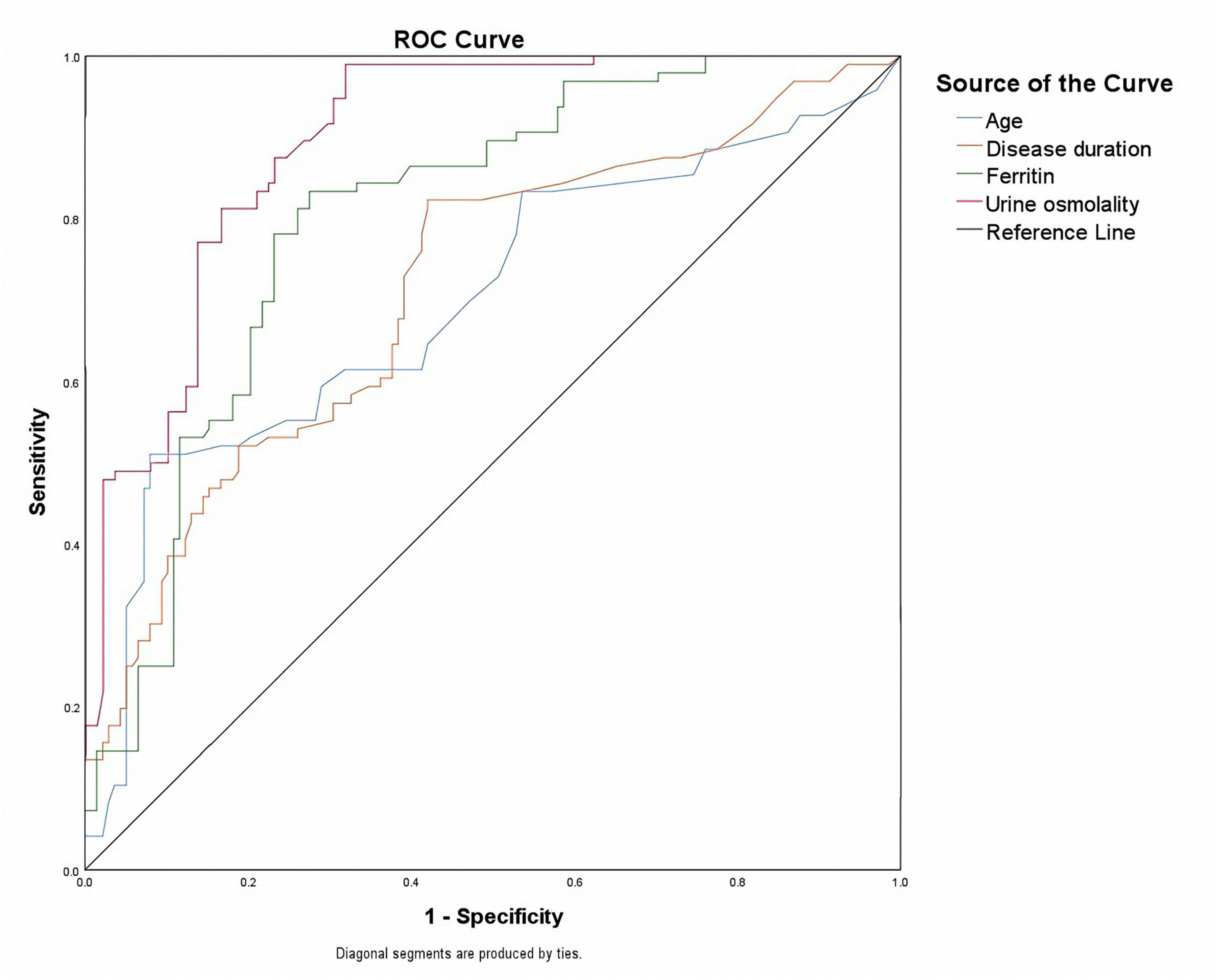
Similarly, age, disease duration, plasma ferritin, and cystatin C concentrations were significantly associated with decreased urine osmolality. Ferritin and cystatin C exhibited good predictive performance, with AUCs of 0.820 and 0.826, respectively (p < 0.001), indicating their strong association with impaired urinary concentrating capacity in beta-thalassemia patients (Figure 2).
Disease severity analysis revealed a progressive worsening of clinical and laboratory parameters. Patients with more severe beta-thalassemia had a longer time to diagnosis, higher frequencies of blood transfusion and iron chelation therapy, and significantly increased levels of urea, serum iron, ferritin, and cystatin C. In parallel, the proportions of patients presenting with elevated plasma cystatin C, reduced urine osmolality, and an eGFR < 60 mL/min/1.73 m2 increased with disease severity. Conversely, hemoglobin, transferrin, UO, eGFRCysC, and eGFRCysC–Crea values showed a gradual decline as disease severity increased (p < 0.05 to <0.001) (Table 2).
Multivariate logistic regression analysis identified that age, disease duration, and urine osmolality were significantly associated with elevated plasma cystatin C levels. Increasing age (OR = 1.052) and longer disease duration (OR = 1.010) were positively associated with higher cystatin C concentrations, whereas higher urine osmolality was inversely associated with cystatin C elevation (OR = 0.991) (Table 3).
Regarding factors associated with decreased urine osmolality; disease duration; serum creatinine, albumin, and ferritin; urine albumin-to-creatinine ratio (ACR); and plasma cystatin C were independently and positively associated with reduced UO (ORs = 1.025, 1.057, 1.235, 1.002, 2.022, and 117.759, respectively). In contrast, total bilirubin showed a negative association with decreased urine osmolality (OR = 0.979) (Table 4).

4. Discussion

4.1. Plasma Cystatin C Concentration and Urine Osmolality Level in Beta-Thalassemia Patients

Our results showed that the patient and control groups did not differ in plasma creatinine concentrations, but there were statistically significant differences in plasma cystatin C concentrations and UO levels. Several studies have compared the accuracy of eGFR based on blood cystatin C and creatinine [14,15,16,17]. Research has shown that cystatin C offers several advantages over creatinine for evaluating kidney function via estimated glomerular filtration rate (eGFR) [17]. As it is produced by all nucleated cells and freely filtered by the glomeruli, cystatin C levels are less influenced by factors such as age, sex, and muscle mass [15,16]. This makes it particularly valuable for detecting early-stage chronic kidney disease (eGFR 45–59 mL/min/1.73 m2), which may go unnoticed when using creatinine-based GFR estimates, as well as for patients with secondary kidney disease. The KDIGO 2024 guidelines also recommend using serum cystatin C to estimate GFR in individuals with abnormal muscle mass, including beta-thalassemia patients, who commonly have reduced muscle mass [18]. Our study results also showed that the concentration of plasma cystatin C increased, while the concentration of blood creatinine remained within normal limits. The use of cystatin C to estimate GFR, and thereby determine eGFR reduction in beta-thalassemia patients, is recommended. Uzun E. et al. [19] conducted a study on 118 children with beta-thalassemia (including 49 TM, 18 TI and 51 TMi) compared with 51 healthy children. The study results also showed that the serum cystatin C concentration in the patient group was significantly higher than the control group, with p < 0.01. Regarding UO, Capolongo G. et al. compared 40 adult patients with beta-thalassemia and 30 healthy people of similar age and sex. The findings revealed that urine osmolality was significantly lower in the patient group compared to the control group (p < 0.001) [20]. The ability to reabsorb and excrete substances to maintain homeostasis reflects the function of the renal tubules. There are many indicators to assess renal tubular function such as specific gravity, osmolality, and electrolyte concentration. In this study, we used UO because it is the most accurate indicator reflecting the ability of the renal tubules to concentrate or dilute urine. UO indirectly assesses the total number of dissolved molecules (such as urea, sodium, potassium, and creatinine) in a unit of urine and has higher accuracy than specific gravity.
We found that there were several indicators associated with increased plasma cystatin C concentrations and decreased UO levels in adults with beta-thalassemia. In addition to advanced age and long disease duration, ferritin concentration was a significant and closely related factor. Increased plasma ferritin was significantly associated with increased plasma cystatin C concentrations and decreased UO levels in patients with beta-thalassemia, with p < 0.001 (Figure 1 and Figure 2). Our multivariate logistic regression analysis also indicated that age, disease duration, and urine osmolality were factors associated with increased plasma cystatin C concentration, whereas disease duration, creatinine, albumin, total bilirubin, ferritin, urine ACR, and cystatin C were independently associated with decreased urine osmolality (Table 3 and Table 4). Our research results showed that up to 67.5% of patients had reduced UO, a result influenced by several confounding factors, including hydration status. Many hydration-related factors, often present in each patient, were not evaluated in this study, including: climate and environment (temperature and humidity); patient’s physical activity; and diet and nutrition. The timing of urine sample collection for measuring UO is also relevant to assessing the reabsorption function of the renal tubules. Our study was conducted on 24 h urine samples; therefore, it is less valuable than fasting urine samples used by some authors. Tabibzadeh N et al. confirmed that urine osmotic pressure is a predictor of GFR decline and end-stage renal disease, independent of glomerular function, in various types of kidney disease by using fasting urine samples to measure UO [21].
Increased plasma cystatin C and decreased UO levels reflect impaired glomerular filtration and reduced tubular reabsorptive capacity. Our findings highlight the role of iron overload, as well as the potential nephrotoxicity of treatment, in the development of renal complications in beta-thalassemia patients. Currently, research on renal complications in individuals with beta-thalassemia remains limited, with most studies focusing on pediatric populations and isolated investigations into early diagnostic markers for kidney dysfunction [6,8,12,14,18]. However, the mechanism of renal damage is relatively clear, and has been confirmed to be related to glomerular and tubular dysfunction [6,8] with or without renal tissue damage causing hematuria or nephrolithiasis [22,23]. Iron overload is a common manifestation in thalassemia patients [6,8]. The use of iron chelating agents is beneficial for beta-thalassemia patients; however, some drugs cause adverse renal events. Deferasirox, for example, has been reported to induce renal tubular epithelial cell injury [20,24]. Therefore, plasma ferritin may serve as a useful marker for predicting renal complications. To optimize treatment outcomes and minimize renal risk, iron chelation therapy should be individualized.

4.2. Plasma Cystatin C Concentration and Urine Osmolality Are Related to Different Forms of Beta-Thalassemia

Our results showed that an increased plasma cystatin C concentration, decreased UO level, and increased ACR were associated with severity in beta-thalassemia patients. Conversely, decreased GFR (calculated based on creatinine; cystatin C; or both creatinine and cystatin C) was also associated with severity in beta-thalassemia patients (Table 2). Thus, the rate and severity of renal complications increased gradually from the TMin patient group, then to the TI group and finally to the TM group. Our study results are consistent with the mechanism and progression of beta-thalassemia. The TM patient group had many disease characteristics related to renal complications that were different from the TI and TMin groups. The TM patients had a longer beta-thalassemia detection time, lower hemoglobin concentration, and higher blood transfusion rate than the TI and TMin patients, with p < 0.01 to 0.001. In particular, the rate of patients using iron chelating drugs and the iron and ferritin levels in the TM patients were also higher than in the TI and TMin patients, with p < 0.001 (Table 2). These research results raise the issue of needing to intervene in modifiable factors such as by reducing plasma iron and ferritin levels to prevent renal complications in beta-thalassemia patients in general, especially TM patients.
Chronic kidney disease is defined by KDIGO as evidence of kidney damage and/or reduced GFR < 60 mL/min/1.73 m2 for ≥3 consecutive months [17]. Determining the exact GFR in these patients is meaningful in clinical practice for management and treatment to reduce CKD progression. Our study results showed that when GFR was estimated based on serum creatinine, only 17.5% (41/234 patients) were identified as having reduced eGFR; however, when based on cystatin C, the rate of reduced eGFR was 40.2% (94/234 patients) (Table 2). Thus, as many as 22.7% (53/234 patients) were not managed and treated when their eGFR decreased. This discrepancy may be explained by the low BMI observed in our cohort (32.5% had BMI < 18.5 kg/m2), which is associated with reduced muscle mass and consequently lower serum creatinine levels. Creatinine is a byproduct of muscle metabolism; therefore, lower muscle mass leads to lower baseline creatinine levels, potentially masking reduced GFR. In contrast, cystatin C is less influenced by muscle mass, making it a more reliable marker in this population. Notably, 67.5% of patients had reduced UO, indicating impaired renal function, which was consistent with increased cystatin C levels [9,12,13]. Therefore, creatinine-based eGFR may underestimate renal impairment in beta-thalassemia patients. Based on our findings, we recommend that plasma cystatin C should be measured in beta-thalassemia patients, particularly those with BMI < 18.5 kg/m2, to improve the detection of renal dysfunction.
This study has several limitations: It is a cross-sectional study, so the variability of the studied biomarkers cannot be observed. Furthermore, the data are insufficient to provide an objective basis for adequately explaining the scientific arguments. The study was only conducted on patients with beta-thalassemia; no other group was included to obtain more comprehensive results. While renal tubular function (UO) was assessed, influencing factors such as hydration status, diuretics, and other contributing factors were not evaluated. In particular, UO was not assessed at multiple times of the day; therefore, the results are not entirely conclusive.

5. Conclusions

Increased plasma cystatin C concentration and decreased UO level were common and were associated with increased plasma ferritin concentration in beta-thalassemia patients of all three forms: minor beta-thalassemia, intermedia beta-thalassemia, and major beta-thalassemia. Plasma ferritin had predictive value for increased plasma cystatin C concentration (cut-off point: 567.5 ng/mL; AUC = 0.803) and decreased UO level (cut-off point: 488.15 ng/mL; AUC = 0.820). Plasma cystatin C concentration increased gradually and urine osmolality level decreased gradually from minor beta-thalassemia to intermedia beta-thalassemia to major beta-thalassemia patients. Using plasma cystatin C to estimate GFR has clinical benefits, avoiding missed renal complications in beta-thalassemia patients.

Author Contributions

Conceptualization: L.D.T.T.; methodology: L.D.T.T. and T.L.V.; formal analysis and investigation: L.D.T.T., A.N.N., H.N.T.T. and K.N.T.; writing—original draft preparation: L.D.T.T. and H.N.T.T.; writing—review and editing: T.L.V. and K.N.T.; supervision: T.L.V. and D.N.H. All authors have read and agreed to the published version of the manuscript.

Funding

This research received no specific grant or financial support from any funding agency in the public, commercial, or not-for-profit sectors.

Institutional Review Board Statement

The study was reviewed and approved by the Ethics Committee of the Vietnam Military Medical University, under approval number 1232/QĐ-HVQY.

Informed Consent Statement

All participants provided written informed consent prior to enrollment in the study. Human and animal rights: No animals were involved in this study. All procedures involving human participants were conducted in accordance with institutional and national ethical standards and complied with the Declaration of Helsinki (1975), as amended in 2008.

Data Availability Statement

The data that support the findings of this study are available from the corresponding author upon reasonable request.

Acknowledgments

We gratefully acknowledge the invaluable support provided by our affiliated hospital and university, which greatly contributed to the successful completion of this research.

Conflicts of Interest

The authors declare that they have no competing interests.

References

  1. Wheatherall, D.J.; Clegg, J.B. The Thalassemia Syndromes, 4th ed.; Blackwell Science Ltd.: Oxford, UK, 2001. [Google Scholar]
  2. Bajwa, H.; Basit, H. Thalassemia. In StatPearls [Internet]; StatPearls Publishing: Treasure Island, FL, USA, 2025. [Google Scholar]
  3. Agarwal, A.M.; Rets, A.V. Advances in Hemoglobinopathies and Thalassemia evaluation. Clin. Lab. Med. 2024, 44, 441–453. [Google Scholar] [CrossRef] [PubMed]
  4. Bach, K.Q.; Nguyen, H.T.; Nguyen, T.H.; Nguyen, M.B.; Nguyen, T.A. Thalassemia in Viet Nam. Hemoglobin 2022, 46, 62–65. [Google Scholar] [CrossRef] [PubMed]
  5. Origa, R. Beta-thalassemia. Genet. Med. 2017, 19, 609–619. [Google Scholar] [CrossRef]
  6. Lee, J.-S.; Rhee, T.-M.; Jeon, K.; Cho, Y.; Lee, S.-W.; Han, K.-D.; Seong, M.-W.; Park, S.-S.; Lee, Y.K. Epidemiologic trends of Thalassemia, 2006–2018: A nationwide population-based study. J. Clin. Med. 2022, 11, 2289. [Google Scholar] [CrossRef]
  7. Sleiman, J.; Tarhini, A.; Bou-Fakhredin, R.; Saliba, A.N.; Cappellini, M.D.; Taher, A.T. Non-transfusion-dependent Thalassemia: An update on complications and management. Int. J. Mol. Sci. 2018, 19, 182. [Google Scholar] [CrossRef]
  8. Demosthenous, C.; Vlachaki, E.; Apostolou, C.; Eleftheriou, P.; Kotsiafti, A.; Vetsiou, E.; Mandala, E.; Perifanis, V.; Sarafidis, P. Beta-thalassemia: Renal complications and mechanisms: A narrative review. Hematology 2019, 24, 426–438. [Google Scholar] [CrossRef] [PubMed]
  9. Pottel, H.; Björk, J.; Rule, A.D.; Ebert, N.; Eriksen, B.O.; Dubourg, L.; Vidal-Petiot, E.; Grubb, A.; Hansson, M.; Lamb, E.J.; et al. Cystatin C-based equation to estimate GFR without the inclusion of race and sex. N. Engl. J. Med. 2023, 388, 333–343. [Google Scholar] [CrossRef]
  10. Shlipak, M.G.; Inker, L.A.; Coresh, J. Serum cystatin C for estimation of GFR. JAMA 2022, 328, 883–884. [Google Scholar] [CrossRef]
  11. Hamdy, M.; Shaheen, I.; El-Gammal, Z.M.M.; Ramadan, Y.M. Detection of renal insufficiency in a cohort of patients with beta-thalassemia major using cystatin-C. J. Pediatr. Hematol. Oncol. 2021, 43, e1082–e1087. [Google Scholar] [CrossRef]
  12. Arian, M.; Oghazian, M.B.; El Dine, M.H.N.; Valinejadi, A.; Badiee, Z.; Soleimani, M.; Sahebkar, A. Biochemical markers of early renal dysfunction in patients with β-thalassemia major: A systematic review and meta-analysis. Curr. Med. Chem. 2025, 32, 2572–2597. [Google Scholar] [CrossRef]
  13. Inker, L.A.; Schmid, C.H.; Tighiouart, H.; Eckfeldt, J.H.; Feldman, H.I.; Greene, T.; Kusek, J.W.; Manzi, J.; Van Lente, F.; Zhang, Y.L.; et al. CKD-EPI Investigators. Estimating glomerular filtration rate from serum creatinine and cystatin C. N. Engl. J. Med. 2012, 367, 20–29. [Google Scholar] [CrossRef]
  14. Abenavoli, C.; Provenzano, M.; Ksiazek, S.H.; Hu, L.; Cuna, V.; La Manna, G.; Comai, G.; Baraldi, O. Role of estimated glomerular filtration rate in clinical research: The never-ending matter. Rev. Cardiovasc. Med. 2024, 25, 1. [Google Scholar] [CrossRef]
  15. Skidmore, M.; Spencer, S.; Desborough, R.; Kent, D.; Bhandari, S. Cystatin C as a marker of kidney function in children. Biomolecules 2024, 14, 938. [Google Scholar] [CrossRef]
  16. Spencer, S.; Desborough, R.; Bhandari, S. Should cystatin C eGFR become routine clinical practice? Biomolecules 2023, 13, 1075. [Google Scholar] [CrossRef]
  17. Gottlieb, E.R.; Estiverne, C.; Tolan, N.V.; Melanson, S.E.; Mendu, M.L. Estimated GFR with cystatin C and creatinine in clinical practice: A retrospective cohort study. Kidney Med. 2023, 5, 100600. [Google Scholar] [CrossRef]
  18. Kidney Disease: Improving Global Outcomes (KDIGO) CKD Work Group. KDIGO 2024 clinical practice guideline for the evaluation and management of chronic kidney disease. Kidney Int. 2024, 105, S117–S314. [Google Scholar] [CrossRef] [PubMed]
  19. Uzun, E.; Balcı, Y.I.; Yüksel, S.; Aral, Y.Z.; Aybek, H.; Akdağ, B. Glomerular and tubular functions in children with different forms of beta thalassemia. Ren. Fail. 2015, 37, 1414–1418. [Google Scholar] [CrossRef] [PubMed]
  20. Capolongo, G.; Zacchia, M.; Beneduci, A.; Costantini, S.; Cinque, P.; Spasiano, A.; De Luca, G.; Di Pietro, M.E.; Ricchi, P.; Trepiccione, F.; et al. Urinary metabolic profile of patients with transfusion-dependent β-Thalassemia major undergoing Deferasirox therapy. Kidney Blood Press. Res. 2020, 45, 455–466. [Google Scholar] [CrossRef]
  21. Tabibzadeh, N.; Wagner, S.; Metzger, M.; Flamant, M.; Houillier, P.; Boffa, J.-J.; Vrtovsnik, F.; Thervet, E.; Stengel, B.; Haymann, J.-P.; et al. Fasting Urinary Osmolality, CKD Progression, and Mortality: A Prospective Observational Study. Am. J. Kidney Dis. 2019, 73, 596–604. [Google Scholar] [CrossRef]
  22. Piccoli, G.B.; Roggero, S.; De Pascale, A.; Vigotti, F.N.; Piga, A.; Veltri, A. Microhematuria in a patient with beta-thalassemia major: A casual or a causal association? Kidney Int. 2014, 86, 450–452. [Google Scholar] [CrossRef] [PubMed][Green Version]
  23. Efthimia, V.; Neokleous, N.; Agapidou, A.; Economou, M.; Vetsiou, E.; Teli, A.; Perifanis, V. Nephrolithiasis in beta thalassemia major patients treated with deferasirox: An advent or an adverse event? A single Greek center experience. Ann. Hematol. 2013, 92, 263–265. [Google Scholar] [CrossRef] [PubMed]
  24. Badeli, H.; Baghersalimi, A.; Eslami, S.; Saadat, F.; Rad, A.H.; Basavand, R.; Papkiadeh, S.R.; Darbandi, B.; Kooti, W.; Peluso, I. Early kidney damage markers after Deferasirox treatment in patients with Thalassemia major: A case-control study. Oxidative Med. Cell. Longev. 2019, 2019, 5461617. [Google Scholar] [CrossRef] [PubMed]
Figure 1. Receiver operating characteristic (ROC) analysis of urine osmolality, ferritin, disease duration, and age and their association with increased plasma cystatin C concentration. The curves illustrate the diagnostic performance of each factor, with the area under the curve (AUC), p-value, cut-off, Youden’s index, sensitivity, and specificity as follows: urine osmolality (AUC = 0.896, 95%CI: 0.858–0.935, p < 0.001, cut-off = 507 mOsm, Youden’s index = 1.646, sensitivity = 81.3%, and specificity = 83.3%); ferritin (AUC = 0.803, 95%CI: 0.746–0.859, p < 0.001, cut-off = 567.5 ng/mL, Youden’s index = 1.558, sensitivity = 83.3%, and specificity = 72.5%); disease duration (AUC = 0.714, 95%CI: 0.646–0.782, p < 0.001, cut-off = 17.5 years, Youden’s index = 1.403, sensitivity = 82.3%, and specificity = 58.0%); and age (AUC = 0.698, 95%CI: 0.627–0.769, p < 0.001, cut-off = 46.5 years, Youden’s index = 1.431, sensitivity = 51.0%, and specificity = 92.0%).
Thalassrep 16 00008 g001
Figure 2. Receiver operating characteristic (ROC) analysis of cystatin C, ferritin, disease duration, and age and their association with decreased urine osmolality. The curves illustrate the diagnostic performance of each factor, with the area under the curve (AUC), p-value, cut-off, Youden’s index, sensitivity, and specificity as follows: cystatin C (AUC = 0.826, 95%CI: 0.774–0.878, p < 0.001, cut-off = 1.05 mg/L, Youden’s index = 1.682, sensitivity = 73.4%, and specificity = 94.7%); ferritin (AUC = 0.820, 95%CI: 0.767–0.872, p < 0.001, cut-off = 488.15 ng/mL, Youden’s index = 1.577, sensitivity = 70.9%, and specificity = 86.8%); disease duration (AUC = 0.759, 95%CI: 0.697–0.820, p < 0.001, cut-off = 17.5 years, Youden’s index = 1.477, sensitivity = 74.1%, and specificity = 73.7%); and age (AUC = 0.580, 95%CI: 0.508–0.653, p = 0.047, cut-off = 42.5 years, Youden’s index = 1.308, sensitivity = 37.3%, and specificity = 93.4%).
Thalassrep 16 00008 g002
Table 1. Comparison of some clinical and laboratory indicators between the patient group and the control group.
CharacteristicsControl Group (n = 78)Patient Group (n = 234)p
Age, years, median (IQR)35.5 (30–40)32 (24–53.75)0.125
Gender, n (%)
-
Male
30 (38.5)76 (32.5)0.334
-
Female
48 (61.5)158 (67.5)
BMI, kg/m2
-
<18.5
21 (26.9)76 (32.5)0.653
-
18.5–22.9
55 (70.5)152 (65.0)
-
≥23
2 (2.6)6 (2.6)
-
Mean ± SD
19.76 ± 1.5119.35 ± 1.880.078
Glucose, mmol/L, median (IQR)5.4 (5.12–5.75)5.02 (4.5–6.0)0.004
Blood urea, mmol/L, median (IQR)5.00 (4.31–5.59)4.41 (3.71–5.5)0.068
Plasma creatinine, µmol/L, median (IQR)58.3 (51.1–64.9)55.2 (46.27–66.3)0.111
Cystatin C, mg/L, median (IQR)0.76 (0.65–0.87)1.12 (0.86–1.51)<0.001
Increased cystatin C *, n (%)-92 (39.3)-
UO, mOsm, median (IQR)991.5 (843–1168)549 (380.25–681)<0.001
Reduced UO *, n (%)-158 (67.5)-
Abbreviations: BMI: body mass index; UO: urine osmolality. (*): compared with healthy control group. Bold value: significant differences; IQR: interquartile range; SD: standard deviation.
Table 2. Comparison of clinical characteristics and laboratory parameters of patient groups with different forms of beta-thalassemia.
CharacteristicsAll (n = 234)TMin (n = 78)TI (n = 78)TM (n = 78)p
Age, years, median (IQR)32 (24–53.75)32 (25.75–48.5)33 (27–53.75)29 (21–56)0.106
Gender, n (%)
-
Male
76 (32.5)22 (28.2)21 (26.9)33 (42.3)0.075
-
Female
158 (67.5)56 (71.8)57 (73.1)45 (57.7)
BMI (kg/m2)
-
<18.5
76 (32.5)19 (24.4)22 (28.2)35 (44.9)0.059
-
18.5–22.9
152 (65)57 (73.1)53 (67.9)42 (53.8)
-
≥23
6 (2.6)2 (2.6)3 (3.8)1 (1.3)
-
Mean ± SD
19.35 ± 1.8819.58 ± 1.9519.7 ± 1.9918.79 ± 1.570.004
Hypertension, n (%)45 (19.2)16 (20.5)13 (16.7)16 (20.5)0.781
Disease duration (years)
-
<5
137 (58.5)66 (84.6)47 (60.3)24 (30.8)
-
5 to <10
41 (17.5)11 (14.1)20 (25.6)10 (12.8)<0.001
-
10 to <15
33 (14.1)1 (1.3)8 (10.3)24 (30.8)
-
≥15
23 (9.8)0 (0)3 (3.8)20 (25.6)
-
Median (IQR) (months)
36 (9–117)11 (7.75–40)34.5 (10–73)142 (21.5–180.75)<0.001
Anemia, n (%)232 (99.1)76 (97.4)78 (100)78 (100)0.330
Blood transfusion (n, %)133 (56.8)26 (33.3)51 (65.4)56 (71.8)<0.001
Iron chelation therapy, n (%)77 (32.9)7 (9.0)24 (30.8)46 (59)<0.001
RBC, T/L, mean ± SD3.8 ± 0.923.96 ± 1.013.89 ± 0.833.54 ± 0.860.01
Hemoglobin, g/L, mean ± SD80.78 ± 16.7984.95 ± 21.1779.86 ± 13.077.53 ± 14.390.018
Hematocrit, L/L, mean ± SD0.26 ± 0.050.27 ± 0.060.26 ± 0.040.25 ± 0.040.069
WBC, G/L, median (IQR)8.1 (5.66–10.25)7.65 (5.6–9.52)7.75 (5.6–9.6)9.1 (6.5–15.4)0.008
Platelet, G/L, median (IQR)287.5 (221–475)250.5 (220–342)264.5 (219–435.25)382 (243–731)<0.001
Glucose, mmol/L, median (IQR)5.02 (4.5–6.0)4.9 (4.4–5.82)5.0 (4.41–5.85)5.35 (4.7–6.33)0.064
Blood urea, mmol/L, median (IQR)4.41 (3.71–5.5)4.1 (3.3–5.17)4.49 (3.75–5.7)4.6 (4.0–5.9)0.016
Creatinine, µmol/L, median (IQR)55.2 (46.27–66.3)57.3 (49.32–71.3)55.2 (47.9–68.37)52.9 (42.62–65.9)0.09
Protein, g/L, mean ± SD71.59 ± 6.9669.84 ± 5.9171.11 ± 7.3173.82 ± 7.070.001
Albumin, g/L, mean ± SD40.32 ± 5.0138.53 ± 4.3940.74 ± 5.5141.70 ± 4.59<0.001
AST, U/L, median (IQR)34.35 (22.3–53)27.75 (21.55–46.3)33.35 (21.4–49.9)41.7 (28–69.92)<0.001
ALT, U/L, median (IQR)24.05 (15.02–47.32)22.6 (12.77–40.07)22.7 (14.65–36.3)30.9 (19.92–57.3)0.014
Total bilirubin, µmol/L, median (IQR)27.85 (13.3–52.97)17.85 (12.37–36.02)29.95 (13.3–53.05)43.5 (14.57–71)0.001
Direct bilirubin, µmol/L, median (IQR)4.7 (2.5–7.4)4.1 (1.55–7.02)4.4 (2.5–7.4)5.95 (3.1–8.8)0.009
Iron, µmol/L, median (IQR)22.25 (12.8–32.3)17.95 (10.62–27)21.75 (14.02–30.45)27.05 (16.47–39.55)0.001
Ferritin, ng/mL, median (IQR)488.15 (214–1657)280.78 (103.97–577.95)516.8 (183.28–1251.65)1280.9 (316.1–2843.15)<0.001
Transferrin, g/L, mean ± SD1.84 ± 0.612.13 ± 0.681.72 ± 0.581.68 ± 0.46<0.001
Urine albumin, mg/L, median (IQR)5.87 (3.75–10.83)5.84 (2.8–7.96)5.52 (3.12–9.11)6.96 (4.35–15.69)0.015
Urine creatinine, g/L, median (IQR)7.05 (4.23–9.35)7.44 (4.06–9.72)6.58 (4.2–9.11)7.08 (4.53–9.56)0.544
Urine ACR, mg/g, median (IQR)0.74 (0.47–1.57)0.71 (0.38–0.99)0.74 (0.38–1.28)1.02 (0.59–2.3)0.006
UO, mOsm, median (IQR)549 (380.25–681)665 (531.75–864)555.5 (429.75–676)388 (292–523.75)<0.001
Reduced UO *, n (%)158 (67.5)35 (44.9)51 (65.4)72 (92.3)<0.001
Cystatin C, mg/L, median (IQR)1.12 (0.86–1.51)0.89 (0.77–1.3)1.15 (0.92–1.44)1.5 (0.99–2.15)<0.001
Increased cystatin * C, n (%)92 (39.3)19 (24.4)27 (34.6)46 (59)<0.001
eGFRCrea (mL/min/1.73 m2)
-
Median (IQR)
100.1 (71.86–125.88)101.02 (70.73–133.26)100.5 (75.19–124.03)96.44 (57.81–118.98)0.363
-
<60, n (%)
41 (17.5)8 (10.3) 13 (16.7)20 (25.6)0.04
eGFRCysC (mL/min/1.73 m2)
-
Median (IQR)
70.5 (43–93.75)91 (56.25–115)68 (50–89)47 (27.5–83)<0.001
-
<60, n (%)
94 (40.2)20 (25.6)30 (38.5)44 (56.4)<0.001
eGFRCysC-Crea (mL/min/1.73 m2)
-
Median (IQR)
94 (69–108)98 (82.75–120)91.5 (72–103.5)74 (48–105)<0.001
-
<60, n (%)
40 (17.1)4 (5.1)7 (9)29 (37.2)<0.001
Abbreviations: TMin: Beta-thalassemia minor; TI: Beta-thalassemia intermedia; TM: Beta-thalassemia major; BMI: Body mass index; RBC: Red blood cell; WBC: White blood cell; AST: Aspartate aminotransferase; ALT: Alanine transaminase; ACR: Albumin-to-creatinine ratio; UO: Urine osmolality; eGFR: Estimated Glomerular Filtration Rate. (*): Compared with healthy control group. Bold value: significant differences; IQR: Interquartile range; SD: Standard deviation.
Table 3. Multivariate logistic regression analysis of independent factors associated with increased plasma cystatin C concentration.
Factors *OR95% CIp
Age (year)1.0521.027–1.077<0.001
Disease duration (months)1.011.003–1.0160.005
Urine osmolality (mOsm)0.9910.988–0.994<0.001
(*) Forward selection criteria. Bold value: significant differences.
Table 4. Multivariate logistic regression analysis of independent factors associated with decreased urine osmolality.
Factors *OR95% CIp
Disease duration (months)1.0251.012–1.037<0.001
Creatinine (µmol/L)1.0571.023–1.0930.001
Albumin (g/L)1.2351.103–1.383<0.001
Total bilirubin (µmol/L)0.9790.962–0.9950.012
Ferritin (ng/mL)1.0021.001–1.003<0.001
Urine ACR (mg/g)2.0221.055–3.8750.034
Cystatin C (mg/L)117.75918.169–763.22<0.001
Abbreviations: ACR: Albumin-to-creatinine ratio. (*) Forward selection criteria. Bold value: significant differences.
Disclaimer/Publisher’s Note: The statements, opinions and data contained in all publications are solely those of the individual author(s) and contributor(s) and not of MDPI and/or the editor(s). MDPI and/or the editor(s) disclaim responsibility for any injury to people or property resulting from any ideas, methods, instructions or products referred to in the content.