Review

Radionuclide Removal in Rare Earth Mineral Processing: A Review of Existing Methods and Emerging Biochemical Approaches Using Siderophores


by
Emmanuel Atta Mends
and
Pengbo Chu
*
Department of Mining and Metallurgical Engineering, University of Nevada, Reno 1664 N, Virginia St., Reno, NV 89557, USA
*
Author to whom correspondence should be addressed.
Minerals 2025, 15(12), 1308; https://doi.org/10.3390/min15121308
Submission received: 31 October 2025 / Revised: 26 November 2025 / Accepted: 10 December 2025 / Published: 15 December 2025

Abstract

The extraction of rare earth elements is becoming increasingly essential due to their many applications in current and emerging advanced material technologies. However, in many rare earth deposits, rare earth minerals are associated with radionuclides; specifically, thorium and uranium. The radioactive nature of these elements is a major concern during processing. Techniques such as solvent extraction and precipitation have been employed in this regard to minimize the radioactivity levels and address any related processing or environmental concerns. However, they face various challenges such as high chemical reagent consumption, secondary waste generation, and limited selectivity, which hinder either their scalability or sustainability. The current study provides a literature review about these technologies to provide critical insights on their applications and discuss the challenges hampering their extensive use in the mining industry. Biotechnology is also evaluated and highlighted as a promising, cost-effective, and low-environmental-impact option for the selective recovery of radionuclides from rare earth elements. Specifically, pyoverdine siderophores were discussed due to their catecholates and hydroxamate moieties which have high affinity for radionuclides to enhance selective recovery during rare earth processing. Conversely, integration of this approach into existing mineral processing flowsheets is a constraint. Hence, future studies should focus on optimizing the kinetics of siderophore synthesis and explore a hybrid approach to combine the biotechnological and conventional techniques.

1. Introduction

The global production of rare earth elements (REEs) is expected to increase due to their increasing utilization in a wide range of technologies [1]. The processing of the rare earths from various resources has therefore garnered significant scientific and economic interest [2]. However, processing some rare earth resources can pose potential radiation or toxicity risks to human health and the environment. This is as a result of the occurrence and association of naturally occurring radioactive isotopes, commonly thorium and uranium ions, with the rare earth elements in certain minerals [3,4]. These radionuclides have similar chemical characteristics to trivalent rare earth elements, and typically occur in rare earth minerals as gangue elements through lattice substitution [5,6]. It is therefore imperative that, during the extraction or processing of such rare earth minerals, separation and remediation stages are incorporated into the process in order to ensure a more stable and environmentally friendly residue for disposal as tailings [7].
This could lessen the strict regulations that are currently associated with the handling, extraction process, and overall treatment of such rare earth resources [8]. Conversely, the removal of thorium, uranium, and other radionuclides from the final rare earth product could also improve its purity and quality for subsequent applications [9].
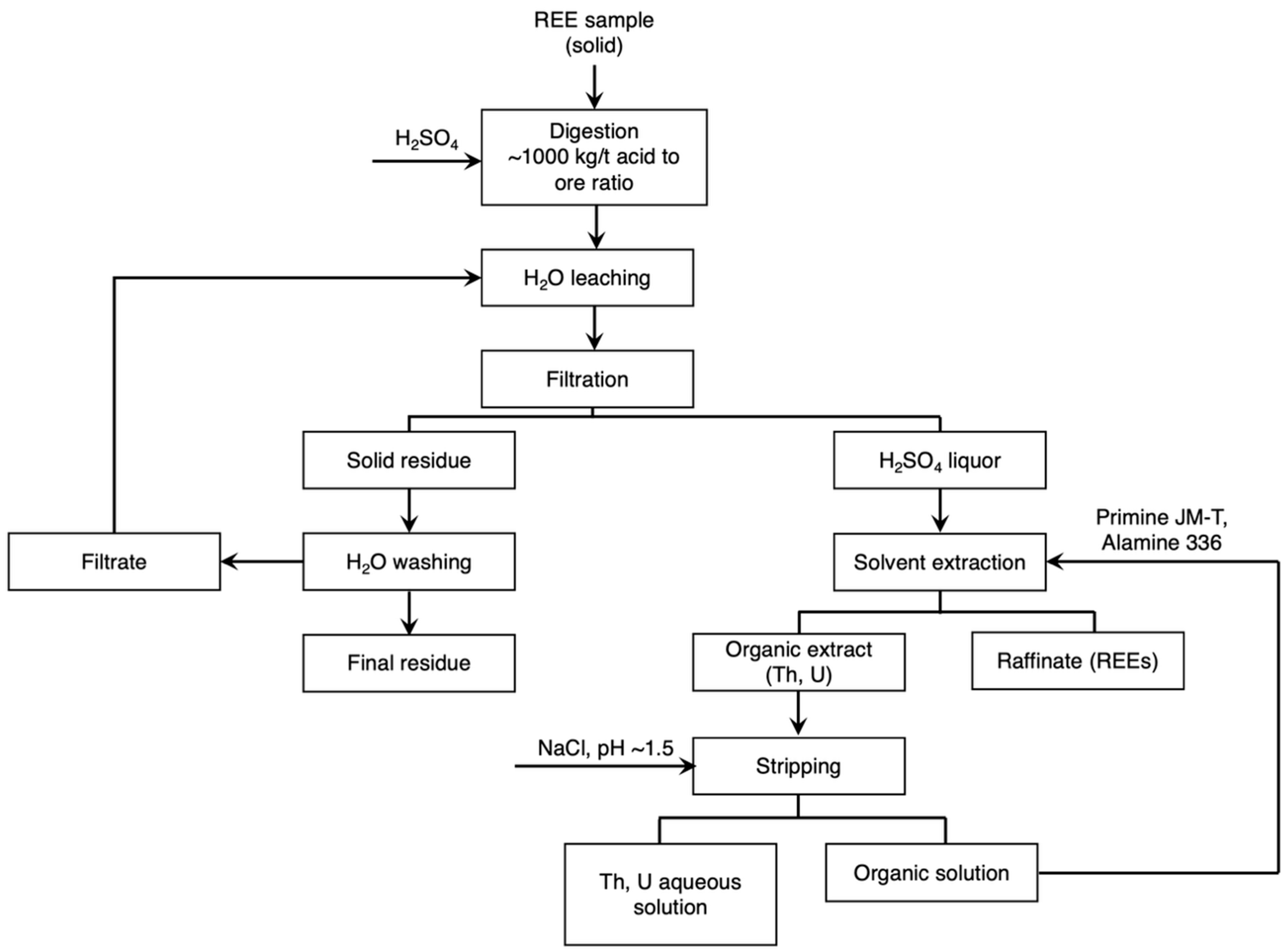
Currently, solvent extraction and precipitation processes are used for the separation of thorium and uranium from rare earth elements, under controlled operating conditions [9,10]. The solvent extraction systems have been extensively used due to their capability to accommodate huge volumes of aqueous solutions containing REEs. Figure 1 demonstrates the process flow for the processing of rare earth resources having uranium and thorium. The process relies on the transfer of particular ions of economic interest from the aqueous phase to an organic phase for subsequent redissolution (stripping) using an acid or deionized water [7]. Extractants including carboxylic acid, organophosphorus acids, amines, quaternary ammonium salts, and tributyl phosphate (TBP) aid in this transfer mechanism [11]. Many other extractants have been tested to separate thorium and uranium from REEs; however, partial selectivity, costs, and the nature of the feed liquor (nitrate, chloride, or sulfate) influence their use [9]. For precipitation, on the other hand, the radionuclides (radioactive elemental forms of thorium and uranium) are selectively extracted by pH alteration with a chemical reagent to form less soluble compounds of thorium and uranium that precipitate out of the aqueous solution, leaving behind the REEs. The technique is therefore straightforward and considered cost-effective but requires supplementary processes to improve the separation efficiency due to the complex mineral association of the rare earths [9]. The constraints of these techniques have consequently prompted the need to develop more suitable alternatives.
In this regard, the present review examines the current separation methods as well as any recent technological advancements made in these techniques, to address the knowledge gap. Moreover, the study critically discusses biotechnology, underscoring the potential use of microorganisms. The mechanisms of biosorption and bioleaching, alongside the critical role of specific microorganisms for the selective removal of thorium and uranium during rare earth processing, are appraised in the literature, with emphasis on oxidative dissolution, metal tolerance to toxicity, and metal binding affinities. This review specifically delves into microbe-mediated interactions regarding pyoverdine siderophores, due to their high affinity for radionuclides and comparatively faster kinetics that hint at favorable feasibility or implementation. Prior to these discussions, the occurrence and classification of radionuclides in different rare earth ore minerals are summarized to provide an overview. The conventional processes are also reviewed.

2. Radionuclides: Occurrence and Classification in Rare Earth Minerals

Currently, only three rare earth minerals (monazite (RE)PO4, bastnasite (RE)(CO3)F, and xenotime (YPO4)) are commonly utilized in rare earth element production [13]. Monazite and bastnasite minerals typically host light rare earths including Ce, La, Pr, and Nd, while yttrium and other heavy rare earth elements are primarily sourced from xenotime [14,15]. Gadolinium, holmium, erbium, ytterbium, and dysprosium are other rare earth elements that are reasonably abundant in xenotime [16]. Conversely, the isotopes of radionuclides (238U, 235U, and 232Th) and their decay series are also often associated with rare earth minerals, especially xenotime and monazite, and occur geologically in some rare earth deposits. Some studies associate their co-occurrence to similarities in their ionic radii and charge. This is because trivalent light rare earth elements (Ce3+, Nd3+, and La3+) that dominate the crystal lattice of monazite and xenotime minerals have very similar ionic radii to tetravalent radionuclide ions (Th4+, 1.06 Å; U4+, 1.00 Å). Depending on the coordination number, this can influence heavy rare earth element groups such as yttrium. Consequently, in a study by Shannon & Prewitt (1969), they found that the effective ionic radii for light rare earths having a coordination number of 8 by oxygen atoms ranged from 1.18 to 1.07 Å and that of the heavy rare earths ranged from 1.07 to 0.97 Å, with trivalent yttrium having 1.015 Å [17]. Hence, during hydrothermal alteration or magmatic crystallization, they easily substitute and occupy the trivalent ionic sites in the crystal lattice of the rare earth mineral with minimal disruption, as divalent (Ca2+, 1.12 Å) and monovalent (Na+, 1.16 Å) cations are readily available for coupled substitution to ensure charge balance [18]. Other studies provided some insights [19,20]. The different decay series that are similarly radioactive in nature occur over a period of geologic time as a result of a sequence of alpha and beta emissions. These emissions and the loss of radioactive energy disrupt the atomic nuclei, which leads to the formation of a series of stable decay products (often with longer half-life). The different decay chains, mechanisms, and energies were discussed extensively by Cowart & Burnett (1994) [21] and Carvalho et al. (2014) [22].
Table 1 presents the concentration of radionuclides in different ore types or minerals [23]. The concentrations vary extensively. For instance, xenotime often contains up to 5% uranium, while monazite is enriched to up to 16% uranium and up to 20% thorium. Bastnasite only contains minor concentrations of uranium and a small amount of thorium [9]. For instance, only 0.002% Th and 0.02% U are found in the bastnasite rare earth oxide (REO) deposits of California, United States [24]. They occur with other gangue minerals such as barite, magnetite, calcite, fluorite, and quartz [25,26,27]. However, due to strict regulations and environmental thresholds associated with the handling and processing radioactive materials, thorium and uranium are usually of key interest during REE processing. Ion-adsorption clay minerals are another type of rare earth oxides, with trace amounts (about 0.002 to 0.003%) of thorium (ThO2) and uranium (U3O8) [28]. Yttrium and other heavy REEs are abundant in these rare earth deposits, which are located in southern China and serve as a primary producer of heavy rare earth elements globally [10]. It is important to note that the various rare earth deposits exhibit significant geological variability, which directly influences the composition and distribution of the radionuclides in them [5]. Typically, carbonate type minerals such as bastnäsite are generally low in radionuclide impurities. This makes them more favorable for conventional processing with minimal remediation requirements. In contrast, phosphate minerals including monazite and xenotime often contain high concentrations of thorium and uranium, necessitating additional separation steps and stricter environmental controls. Silicate minerals present intermediate challenges, with thorium commonly occurring as the dominant radionuclide. Oxide minerals are particularly complex due to their multi-element associations, which usually complicate extraction and increase the need for selective separation strategies; understanding the mineral type is therefore very important.
The low concentration of these radioactive elements in upstream mining units such as blasting, hauling, and crushing results in fairly low emission of radioactivity [21]. For instance, if a worker is exposed to 500 ppm (0.05%) thorium and 50 ppm (0.005%) uranium ore but remains one meter away from the ore mass for the duration of a working year, the cumulative exposure amounts to 2.4 mSv, which is less than the 20 mSv dosage limit, according to Chambers et al. (2012) [33]. However, beneficiation or pre-treatment processes could concentrate and increase the content of radioactive elements in the downstream stages as well as residues such as tailings and slags [9,24,29,30,33]. Smołka-Danielowska & Walencik-Łata (2021) and Lagae Capelle et al. (2025) studied the occurrence and association between radionuclides and rare earth elements in secondary resources such as mine wastes [19,34]. They correspondingly noted that the radionuclides have high mobility and are soluble in acidic or low-pH environments; this is characteristic of mine tailings or in the presence of complexing anions such as sulfates, and also characteristic of acid mine drainage (AMD). The separation or removal of radionuclides these streams is therefore crucial to minimize potential environmental effects and also necessary to comply with legislative or state regulations and assessments on toxicity (ecotoxicity), in relation to the transport, handling, and disposal. Equally, removing these radioactive ions enhances the purity of the final rare earth elements or products to improve the economic gains of rare earth production.

3. Separation and Remediation Techniques

Kim et al. (2025) recently reviewed general metallurgical processes for the extraction of rare earth elements from various resources [35]. Other investigations have provided more specific insights into the separation and removal of radionuclides from rare earth elements during such extraction processes [36,37,38,39,40,41,42]. The common extraction technique or processing routes, in this regard, focus mostly on physio-chemical procedures including precipitation, sorption, leaching, and solvent extraction. Solvent extraction has been widely used for decades for the separation and purification of rare earths [43,44,45]. Mainly, amine compounds or organophosphorus acids are employed as extractants for the variety of sulfate, nitrate, and chloride leachates [11]. Some neutral organophosphorus compounds are also considered. For the acidic organophosphorus compounds, Di-(2-ethylhexyl) phosphoric acid (D2EHPA) and 2-ethylhexyl phosphoric acid mono-2-ethylhexyl ester (EHEHPA) are very common and extensively used [46,47,48]. EHEHPA is frequently used to separate a mixture of rare earth elements in chloride leach solutions into distinct REE products. D2EHPA, on the other hand, is normally used to separate LREEs from medium rare earths and the HREEs between Sm and Nd, or transfer rare earth ions from sulfate leachates to chloride solutions for additional separation or purification. Both reagents work best in moderately acidic leachates via ion exchange [49,50].
Their affinity for extracting trivalent REEs is therefore minimal, whereas they easily concentrate tetravalent cerium ions together with thorium and uranium. Ce(IV) is recovered during downstream stripping to minimize overall REE losses. However, it is challenging to strip U(VI) and Th(IV) from D2EHPA and EHEHPA, albeit using sodium carbonate. In highly acidic solutions, another type of organophosphorus extractant known as Cyanex 272 (bis-2,4,4-trimethylpentyl phosphonic acid), has been discovered to be more effective [51,52]. Tong et al. (2013) researched the efficiency of EHEHPA, Cyanex 272, and D2EHPA for the removal of thorium from varying concentrations of sulfuric acid [53]. The removal of thorium decreased as acid concentration increased, from D2EHPA to EHEHPA and finally to Cyanex 272. Their findings suggested that the mechanism of the Cyanex extraction was likely by cationic exchange.
Gupta et al. (2002) examined the separation of thorium, uranium, and rare earth elements in acidic media using a different type of Cyanex, Cyanex 923 (a combination of tri-alkyl phosphine oxides) [54]. Uranium was found to be easily separated from rare earths in HCl and potentially H2SO4 leachates. However, the use of Cyanex 923 to separate thorium is also not effective. Similar findings were reached by Lu et al. (1998) throughout their inquiry [55]. Regarding neutral organophosphorus extractants, tri-n-butyl phosphate (TBP) is common. This type of extractant is typically used for nitrate leachates, and has a far greater extraction of uranium, U(VI), than thorium or REEs. In a nitrate leach solution, Menzies & Rigby (1961) efficiently extracted uranium and separated it from thorium and the rare earths using about 5 volume percent of TBP mixed with xylene [26]. Following that, thorium was then extracted and separated from the rare earths using a more concentrated TBP solution (about 40% v/v), also mixed in xylene.
The stripping of loaded U(VI) and Th was achieved using concentrated HCl (UO2Cl2⋅2TBP and ThCl4⋅3TBP, respectively), according to Sato (1966) [56]. Tri-iso-amyl phosphate, calixarene, and tris(2-ethylhexyl) phosphate are other types of neutral extractants. Yanling et al. (2012) used a calixarene derivative to effectively separate and extract thorium from a nitrate leachate containing REEs (mainly La, Nd, and Yb) [57]. Considering the high separation factors (greater than 26), their findings suggest that the synthesized calixarene derivative could be employed to effectively separate thorium from rare earth solutions. Separation of Th and La by the calixarene derivative improved with the addition of KNO3, while Th and Yb separation reduced. The total REE losses, however, were less than 10%.
The separation of thorium and uranium using amine compounds has also been extensively researched. Zhu & Cheng (2011) found that amine compounds were favorable for recovering Th(IV) and U(IV) from sulfate leachates containing rare earths [58]. Between primary, secondary, and tertiary compounds of amine or quaternary amine salts, tertiary amines (such as Alamine 336) have the highest selectivity for radioactive elements, especially uranium. The primary types of amines (commonly, Primene JM-T) favor the selectivity of thorium over uranium and trivalent rare earths. El-Yamani & Shabana (1985) demonstrated that primary amines require highly acidic ranges, i.e., H2SO4 concentration over ~1 M [59]. Secondary amines were studied by Crouse & Brown (1959) [60]. They concluded that secondary amines performed poorly for the selective removal of thorium and uranium compared to tertiary, due to the strong association of secondary amine compounds to phosphates. This explains their limited industrial applications.
Given that uranium is best extracted by tertiary amines and thorium by primary amines, using a combination of primary and tertiary amines is a feasible technique for extracting both radioactive elements simultaneously from REEs. This approach could reduce the number of solvent extraction stages, as discussed by Garcia et al. (2020), to improve the economics and simplicity of the overall extraction process [9]. This was observed by Amaral & Morais (2010), using a mixture of Primene JM-T and Alamine 336 [61]. They successfully recovered 99.9% Th and 99.5% U with <0.1% REE losses in one step, while processing monazite samples leached with sulfuric acid. Conversely, though solvent extraction has been proven effective for the separation of radioactive elements from rare earth leach solutions, the extractants are very costly and degradable, and thus, tailored primarily for separating the individual REEs.
For precipitation, thorium, uranium, and rare earths are frequently separated by exploiting the difference in pHs using oxalic acid (H2C2O4) or alkali-based reagents such as calcium hydroxide (Ca(OH)2), ammonium hydroxide (NH4OH), sodium bicarbonate (NaHCO3), sodium carbonate (Na2CO3), magnesium oxide (MgO), and sodium hydroxide (NaOH) [10,54]. Xu (1995) states that, for sulfate and chloride leach solutions (leachate), the optimal precipitation pH ranges from 6.8 to 8.0 for trivalent rare earth hydroxides but decreases from LREEs to HREEs, with the exception of scandium [62]. Thorium precipitates at lower pH range (2.5–5.5), especially in chloride solutions, whereas the precipitation of uranium occurs at between 5.5 and 7.0 [10]. It is therefore evident that thorium precipitation from rare earth elements can be attained easily via precipitation; however, separating uranium from rare earth elements using the same method could be challenging because of the similarities in precipitation pH range [9]. Table 2 highlights the different precipitation pH ranges for separating thorium, uranium, and rare earth elements.
It can be noted that sulfate leachates have relatively lower pH ranges for the precipitation of thorium and uranium than chloride leachates. For instance, Vijayalakshmi et al. (2001) used NH4OH to completely precipitate thorium from a sulfate leachate at pH 1 [63]. Subsequent investigations found that uranium could be separated at pH 4.5 (approximate), which is significantly lower than the pH for REE precipitation. However, in such acidic media, the co-precipitation of light rare earths (about 63% Nd, 45% La, and 64% Ce) was observed.
In rare earth ores with phosphate minerals like apatite [64,65], significant phosphate concentrations are observed in the sulfate leachate. The reaction between the phosphates and H2SO4 at high leaching temperatures produces H3PO4, which subsequently dehydrates to form pyrophosphoric acid (H4P2O7). Therefore, multiple reactions occur (Equations (1)–(4)). This results in the formation of insoluble thorium pyrophosphate (ThP2O7). Consequently, the precipitation pH of thorium, rare earths, and uranium decreases [65,66]. Hence, as shown in Table 2, the composition of the rare earth ore can significantly influence the optimum precipitation pH required for selective separation.
2REPO4 + 3H2SO4 = RE2(SO4)3 + 2H3PO4
2H3PO4 = H4P2O7 + H2O↑
ThO2 + 2H2SO4 = Th(SO4)2 + 2H2O↑
Th(SO4)2 + H4P2O7 = ThP2O7 + 2H2SO4
M+ + RE3+ + 2SO42− + xH2O = MRE(SO4)2.xH2O↓
The nature or valency of cerium in rare earth ores can similarly influence the feasibility of precipitation. Cerium usually makes up roughly fifty percent of all trivalent rare earths [67]. Trivalent REEs have low solubility in sulfate solutions, and hence, double salt precipitation is employed to separate them from impurities [68]. However, trivalent REEs precipitate out as double salts from the sulfate leachate with potassium (K), sodium (Na), and ammonium (NH4) valence electrons (Equation (5), M+ represents Na+, K+, and NH4+). This affects the purity of the final product. Thorium might also co-precipitate with the double salts of the trivalent REEs in significant concentrations, even though it does not form double salts with sulfate and sodium. Because uranium (UO22+) and trivalent rare earth ions differ greatly, its co-precipitation is less. However, there is substantial co-precipitation of uranium if it is present as U(IV). In a study by Wylie (1947), about 70 to 99% of Ce(III) ions co-precipitated as double salts with about 40%–97% of U(IV) [69]. Therefore, during processing, it is preferential to oxidize the trivalent REEs or Ce(III) to Ce(IV) in order to decrease operation costs, reduce co-precipitation of the impurities, and simplify the downstream processes.
RE2(SO4)3 + 3H2C2O4 ⟶ RE2(C2O4)3↓ + 3H2SO4
UO2SO4 + H2C2O4 ⟶ UO2(C2O4) + H2SO4
UO2(C2O4) + H2SO4 ⟶ UO2SO4 + 2CO2 + 3H2O
Th(SO4)2 + 2H2C2O4 ⟶ Th(C2O4)2↓ + 2H2SO4
Th(C2O4)2 + 4Na2CO3 + 2NaHCO3 ⟶ Na6Th(CO3)5 + 2NaC2O4 + CO2 + H2O
Garcia et al. (2020) described the necessity of a secondary step if the precipitation procedure or reagent is selective for a single radioactive element, and also proposed a number of feasible precipitation methods for treating the various leachates [9]. They stated, using Equations (6)–(10), that at a low temperature of about 30 °C and oxalic acid concentration of 30%, about 99% Th co-precipitates with the REEs (98%). Uranium is left in the remaining solution. The solid oxalate residue is subsequently leached using sodium bicarbonate and sodium carbonate solution to selectively recover thorium (99%), whereas the rare earth elements stay in the solid state as carbonates. This is similar to the approach by Amer et al. (2013) [70]. They also proposed a method for processing monazite concentrates by using oxalate precipitation to separate/extract uranium, thorium, and rare earths. Similarly, uranium stayed in the sulfate solution, whereas 98% Th and 99% REE precipitated at a temperature of 60 °C and pH of 0.7 out of a sulfuric acid solution containing about 2.5 g/L thorium, 0.15 g/L uranium, and 24 g/L rare earths. Using 150 g/L NaHCO3 and Na2CO3 at a ratio of 1:3, the thorium oxalate precipitate was selectively dissolved in a solution at 75 °C, as they formed a stable complex with the carbonates. Other studies additionally discussed this approach for selectively recovering thorium from REE carbonates by using only sodium carbonate at a high concentration of about 224 g/L [10,71]. The approach worked efficiently at room temperatures and thorium (~98%) was completely reintroduced into the aqueous solution, with minimal REE losses (<3%). However, the content of thorium (ThO) to REE was relatively low (0.04 percent) compared to the ratios in recent investigations (approximately 10 percent).
Rare earth ores are occasionally leached with nitric acid, resulting in nitrate leachates. The separation of thorium and uranium from REEs in this medium has also been investigated [9]. Uranium (U(VI)) in a nitrate medium formed an insoluble precipitate of ß-UO2(OH)2 at a pH range of 6.0–7.5, according to research performed by Kang et al. (2002) on the precipitation of uranium in nitrate medium [72]. The study examined a broad pH range using sodium hydroxide (1.0 M) and perchloric acid (0.1 M) as pH modifiers. Uranium precipitation increased rapidly then decreased as pH increased above the optimal. More importantly, the separation occurred in a single phase or batch. It is similarly possible to recover the radioactive elements from chloride leachates in a single step using similar hydroxide reagents. For example, at a pH of 2.5, thorium was precipitated out using hydrated lime (Ca(OH)2), with minimal REE losses via co-precipitation. Using hydrated lime, Yu et al. (2013) further extracted uranium and thorium from a chloride leachate produced from the processing of carbonatite and monazite rare earth ore rocks [73]. They added hydrogen peroxide (H2O2) to enhance the oxidation of iron (Fe) present in such ores. They found that this also improved precipitation, and about 90% Fe, 80% U, 99% Th, and residual phosphate gangue were efficiently extracted from the REEs (with co-precipitation of <2%). The benefit of this one-step separation procedure is the simplicity and utilization of lesser amounts of the precipitation reagents. However, in large-scale and rigorous operations, achieving the precise pH for one-off selective precipitation could be sluggish or challenging.
In contrast to precipitation, which focuses on selective recovery by enhancing insolubility, leaching primarily entails improving metal extraction by increasing ion solubility [74,75]. Leaching therefore facilitates the separation of specific rare earth elements from complex matrices through their dissolution into the aqueous phase using strong acids such as sulfuric acid (H2SO4), nitric acid (HNO3), or hydrochloric acid (HCl) [76]. However, these acids are not particularly selective, due to the function by protonation where the H+ ions protonate the oxygen atoms (PO43−, CO32−, or O2−/OH groups) in the mineral lattice to weaken the metal-oxygen bonds. This disrupts the crystal structure and non-selectively releases the majority of the associated metal cations [77]. Moreover, the conjugate anions of these acids are often either weakly coordinated, delocalized, or easily displaced by water molecules. This ultimately results in minimal to no selectivity during complexation. Conversely, organic carboxylate acids (with one to four carboxylic groups) and certain carbonic reagents have been investigated in recent years for selective leaching processes due to their capacity to form multiple bonds (ring structures) with specific metal ions [78]. This creates more stable chelates that separate the specific elements from existing gangues, as reported by some studies for rare earth oxalates [78,79,80].
Lapidus & Doyle (2015) explored the feasibility of selectively leaching Th and U at low temperatures using an oxalate solution from a monazite feedstock, with 18.5 wt.% rare earth content (mainly Ce, La, and Nd) [81]. The uranium and thorium content were 0.08 and 3.94%, respectively. Figure 1 presents their thermodynamic speciation data showing the predominant thorium and uranium species at the various oxalate concentrations and pH levels. In lower oxalate concentrations (less than 0.03 M), insoluble thorium phosphate species (Th(HPO4)2 or Th3(PO4)4) predominate. This was dependent on the pH of the solution, and at pH of about 3.5, thorium dissolved in the 0.03 M oxalate solution. The ionic solubility was also greatly influenced by the phosphate ions. Interestingly, at more acidic pH levels, an insoluble thorium oxalate hydrate is more prevalent and thus, re-precipitation occurred [81,82]. This limited the reactions between thorium, uranium, and the carboxylic complexes to reduce selectivity.
To address this, Garcia et al. (2020) discussed the incorporation of baking using an alkaline reagent prior to oxalate leaching [9]. This limits re-precipitation as hydroxide forms of the rare earth elements and radioactive components were catalyzed. In some cases, ammonium carbonate was used after baking. Sequential leaching was also tested by Whitty-Leveille et al. (2018) [83]. They examined carbonated systems using Na2CO3 and NaHCO3 followed by hydrochloric acid to selectively dissolve approximately 65% U, then the REEs and Th. Typically, an excess amount of reagent is required for such systems. The approach ultimately requires further steps which complicates its feasibility. Hence, emerging and recent investigations have looked at technologies like advanced membrane filtration, selective biosorbents, and bioelectrochemical systems, as reported by Lagae Capelle et al. (2025) and Tan et al. (2024) [34,84].

4. Prospects in Microbial Technology: Utilization of Siderophores

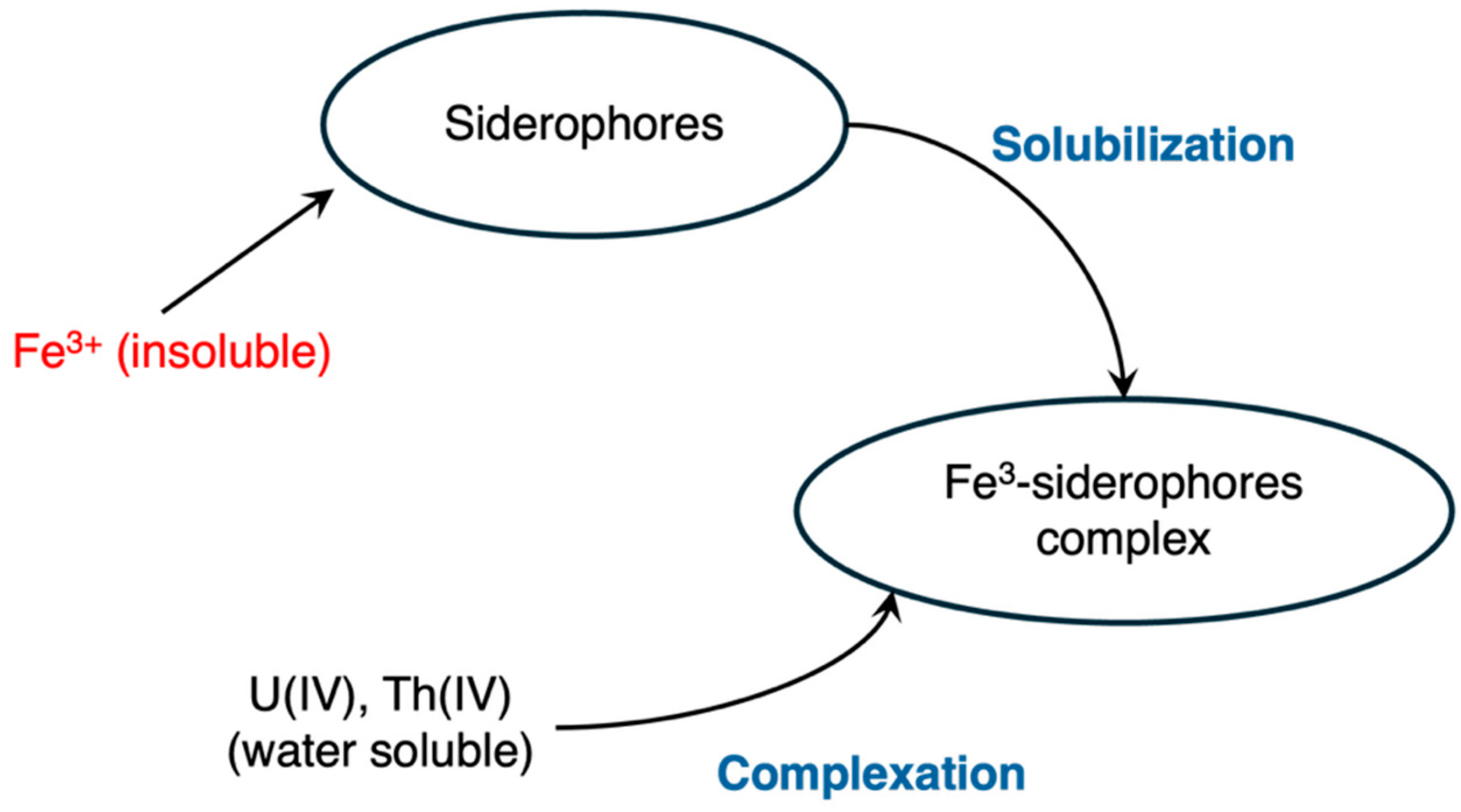
Historically, iron and sulfur-oxidizing microorganisms have been employed for the bioleaching of primary uranium ores or minerals. Some studies have investigated the use of fungi. However, only a few studies have focused on thorium. Kaksonen et al. (2020) extensively reviewed the bioleaching of uranium, focusing on acidophilic microorganisms that catalyze the synthesis of soluble sulfuric acid and ferric ions [85]. They established that uranium, if present in the ore as U(VI), is readily soluble in sulfate solutions as uranyl ions (UO22+) and requires no prior oxidation. U(IV), on the other hand, requires an oxidant or oxidizing media since it is more stable. This form is more prevalent in rare earth ores as well as Th(IV). Conversely, this makes it ideal to use acidophilic bacteria that generate both sulfuric acid and an oxidant in the form of ferric ions for the processing of thorium and uranium ions (Figure 2).
Tan et al. (2024) illustrated the diverse biological pathways that drive interactions between ribonucleic metal-reducing bacterium and sulfate-reducing bacterium [84]. More recent studies have found that the organic acids secreted by filamentous fungi species, especially Aspergillus and Penicillium spp., can contribute to the solubilization of thorium, uranium, and other metal ions through acidolysis and complexolysis [86]. Even though the ligands of organic acids have low molecular weight, they exhibit strong complexation abilities and form stable coordinate-covalent bonds with protonated metal ions of thorium and uranium. In the case of uranium, this is because the uranyl ions have only one uranium atom double bonded with two axial oxygen atoms. These bonds mainly occupy only two axial coordination positions around the atom, which leaves six vacancies or equatorial positions for ligand binding with other molecules. Thus, the equatorial planes perpendicular to the atom can bond with up to six ligands and form either quadrangular, pentagonal, or hexagonal biconical complexes. This is attributed to their orbital hybridization of the 5f-6d, as indicated by Wang et al. (2022) [87,88]. Conversely, organic molecules of ligands with hydroxyl (OH) or carboxyl (COOH) functional groups form more stable bonds with uranium atoms as their oxygen atoms also have lone pairs of electrons.
Thorium hydrolyzes easily and typically exits in aqueous solutions as Th4+ ions without closely bonded oxygen atoms [89]. Hence, thorium bonds freely with surrounding molecules. Th4+ also has a larger ionic radius of approximately 108 pm (1.08 Å) and a higher positive charge. It can therefore function as a Lewis acid and bond with nearby electron pairs, especially negatively charged molecules with oxygen atoms such as COOH− and OH− groups in organic acids. It is noteworthy that organic acids with carboxyl groups (carboxylic acids) are more effective. Unlike hydroxyl groups, carboxyl groups rapidly donate H+ ions in solution. This aids in acidolysis. For instance, oxalic and citric acids dissociate fully to oxalate (C2O42−), citrate (C6H5O73−), and H+ ions. Therefore, during contact with minerals containing Th and U, the protons, respectively, release Th4+ and UO22+ ions into the leach solution [90]. Then, the anionic oxalate or citrate ligands would form stable complexes with the soluble ions, such as Th(C2O2)2·H2O, UO2C2O4·3H2O, and (U(C2O4)2·6H2O), as described by Bhatti & Tuovinen (2025) [86]. This is graphically illustrated in Figure 2.
Kamal et al. (2012) accordingly investigated the leachability of uranium from REE-bearing phosphate ore samples using Aspergillus niger and Penicillium species [91]. Sucrose was the source of carbon and the main energy source for cell growth in the culture. The results revealed that the oxalic and citric acids generated by the invertase enzyme of the fungal substrates during microbial oxidation dissolved and complexed only 24%–28% uranium, 16%–18% REEs, and about 30% phosphate. The poor selectivity and low recovery rates were likely due to the formation of insoluble calcium phosphates (Ca3(PO4)2) which enclosed the uranium and REE ions, as they occur similarly in the crystal lattice of the mineral (as Ca5(PO4)3F, Ca5(PO4)3OH, and Ca5(PO4)3Cl), and have similar solubilization potential to the phosphates. In addition, citric acid preferentially forms mildly soluble calcium-citrate complexes. The solubility of this complex decreases with time as the citric acid concentration in the medium increases. This affects the solubility of gypsum (CaSO4·2H2O) and passivates the mineral surface and consequently reduces the dissolution of REEs and uranium in the mineral matrix. In subsequent studies, at a growing temperature of 37 °C, about 83% uranium was dissolved by a strain of Aspergillus niger that was isolated from the same uranium mine. This is true for other studies [31,32].
Similar findings were observed by Amin et al. (2018); however, the sample contained no additional radionuclides except for uranium, which is impractical in conventional REE processing [92]. Hassanien et al. (2014) investigated monazite ore samples and Th-U concentrates using both one-step and two-step bioleaching procedures [93]. They compared bioleaching with Aspergillus ficuum and Pseudomonas aeruginosa to the chemical leaching of rare elements from both samples. Maximum rare earth extraction was achieved in the single step approach, as Aspergillus ficuum extracted 60.6% REEs and Pseudomonas aeruginosa dissolved about 53% of the REEs. This was a result of the generated biogenic acids. They found that the pH of the filtrate reduced from about 4 to 3 during the growth of Aspergillus ficuum substrates and from roughly 8 to 6 for Pseudomonas aeruginosa. In earlier studies, Ruijter et al. (2002) explained that the invertase enzyme of the substrates was responsible for incomplete oxidation during cell growth that results in the production of H+ ions, citric, oxalic, and amino acids, and other metabolites [94]. Due to the toxicity of some metal ions in the feed samples to the microorganisms, the pH of the leaching medium increased slightly. This was followed by a further decrease in the concentration of organic acids as a result of the available organic acids being consumed by the solubilized metals during complexolysis. The maximum leaching efficiency of REEs from monazite during the two-step procedure was 55% for Aspergillus ficuum and about 48% for Pseudomonas aeruginosa. The reduction in the concentration of the acids in the two-step approach was mainly associated with the dissolution of the metal oxides in the ore into soluble salts. Hence, the pH increased over the leaching period. Relative to the conventional chemical leaching approach, either of the studied bioleaching processes demonstrated superior REE recovery at reduced operational costs. However, the performance of Aspergillus ficuum was significantly influenced by key parameters such as the carbon source, initial pH, incubation temperature, agitation speed, and pulp density. For these reasons, additional mechanistic and optimization studies would be necessary [93].
The current findings from these investigations and several others [85,86,95,96], however, suggest that biogenic organic acids produced by fungal microorganisms have limited efficiency for the complete and selective extraction of REEs from resources containing radionuclides; specifically, thorium and uranium. Moreover, the low concentrations of ferrous ions in rare earth minerals significantly limits the efficiency of acidophilic microorganisms, such as Acidithiobacillus ferrooxidans and Leptospirillum ferrooxidans, which rely on the oxidation of ferrous iron as the energy source for metabolic activities that generate an acidic-oxidizing medium. This is because iron is rather predominantly present in its ferric form due to the formation of REE-minerals during oxidative geologic activities. Conversely, the low ferrous ion content affects acid generation and the redox reactions necessary for metal solubilization from rare earths.
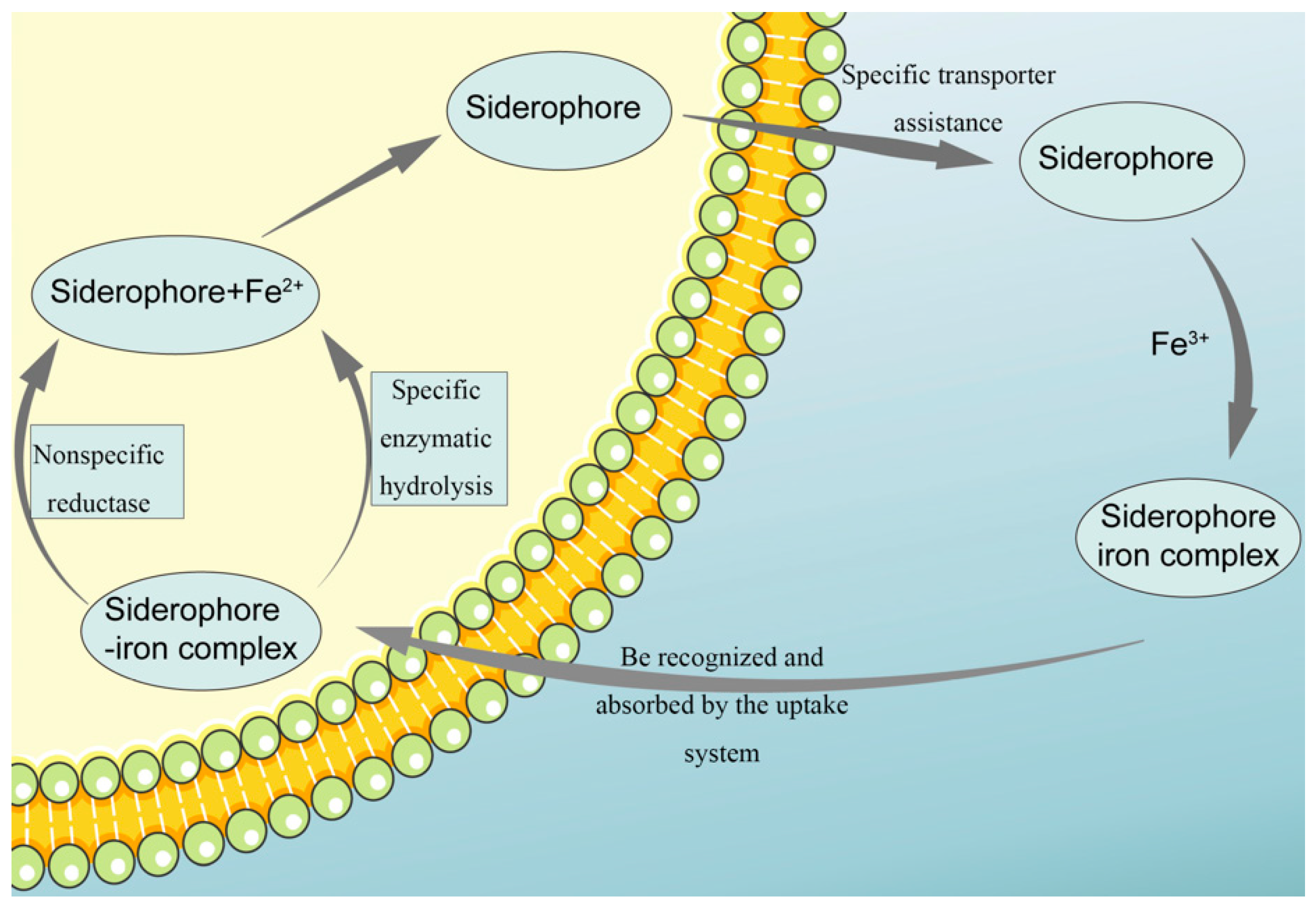
The current review proposes the exploitation of siderophores to address these fundamental limitations. Siderophores are element-specific ligands typically produced by certain genera of fungi and bacteria under iron-deficient conditions. The low content of ferrous ions in most rare earths is therefore not a constraint, as they mainly rely on extracellular ferric ions. Siderophores, according to Xie et al. (2024), can be categorized into three main groups based on their chelation or functional groups: hydroxamates, carboxylates, and catecholates [97]. Some siderophores, particularly pyoverdines, occur with mixed groups. Xie et al. (2024) further explained the synthesis mechanism of siderophores through either the nonribosomal-independent synthesis pathway (NIS) or the nonribosomal peptide synthetase (NRPS) pathway [97]. The graphical representation of this mechanism is presented in Figure 3. Primarily, the nonribosomal peptide synthetases pathway relies on multi-modular protein enzymes to sequentially construct peptide chains through a thiol-templated mechanism. The sequence incorporates amino acids and defines the structure of the siderophores as well as its metal-chelation properties. NIS, on the other hand, utilizes citrate and other derivates (activated as a result of adenylation processes) to synthesize siderophores having both carboxylate and hydroxamate groups.
The hydroxamate type of siderophores are very common in nature and mainly have hydroxamic acid as their functional group, according to Hussien (2025) [95]. They occur in both fungi and bacteria. Xie et al. (2024) reported their metal uptake mechanism (Figure 3) to show their high affinity for metal ions, with stability constants as high as 1032 Lmol−1 for ferric ions [97]. Common fungal species such as Aspergillus niger and Aspergillus fumigatus typically synthesize these siderophores from hydroxylated and alkylated ornithine, while acylated hydroxylated alkylamines are responsible for their generation in bacteria such as Pseudomonas stutzeri. The carboxylate types of siderophores are relatively rare in nature. They utilize their carboxyl and hydroxyl functional groups to chelate metal ions under neutral to alkaline conditions. Specific microbial species including Ensifer meliloti (bacteria), Staphylococcus aureus (bacteria), Rhizopus microspores (fungal plant), and Alfalfa rhizobia (bacteria) produce them.
Catecholate types or catechol amides use the catechol moiety to bind ferric and other metal ions through its hydroxyl group [98,99]. Currently, they only exist in bacteria (Escherichia coli and Klebsiella pneumoniae) and exhibit high metal affinity (with iron chelation constants up to 1052 Lmol−1), lipophilicity, and extreme pH tolerance [97].
Kalinowski et al. (2004) discussed pyoverdine types of siderophores [100]. These types exhibited distinct chelation moieties in the same molecule (carboxyl groups, catechol through pyochelin strains, and hydroxamic acid) which enabled them to form non-symmetric complexes with metal ions, including ferric ions. Hussien (2025) further described pyoverdines as yellowish-green, fluorescent pigments that are soluble in water [95]. Their fluorescent nature is due to the dihydroxyquinoline chromophores present in the pigments. Currently, about 40 distinct pyoverdines have been reported. The majority consists of monoamide molecules (associated with the NH2 group for cellular stability) and peptide chains of about six to twelve amino acids typically linked to the carboxyl group of the chromophores. The chromophores, especially for Gram-negative Pseudomonas species with 2,3-diamino-6,7-dihydroxyquinoline, have catechol sites for metal ion chelation. Hussien (2025) explained that the peptide chains provided two hydroxamic acid groups as ligand sites [95]. This explains the affinity of Pseudomonas aeruginosa and P. fluorescens for metal ions.
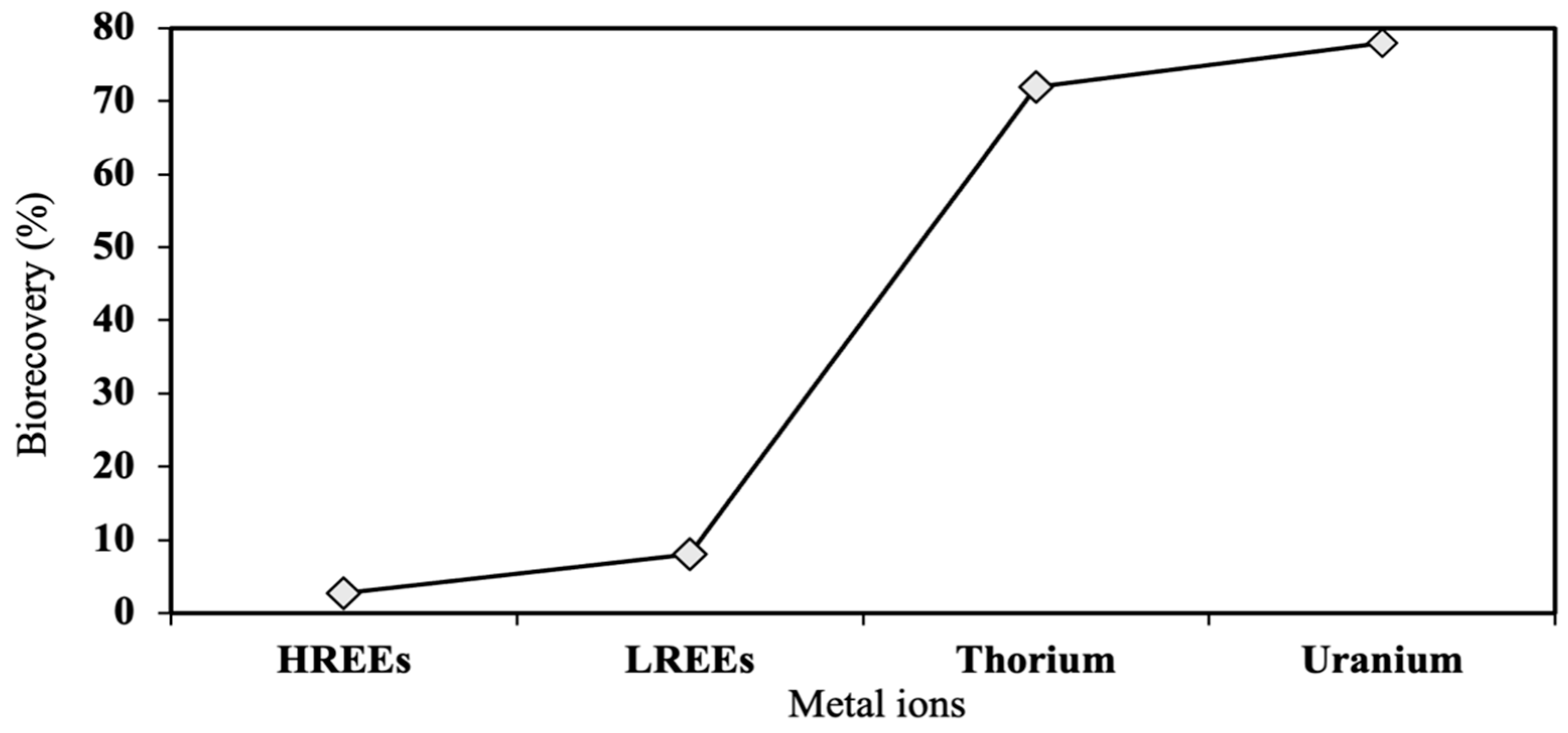
Desouky et al. (2016) accordingly studied the recovery of rare earths from Th-U concentrates using the bioproducts of Aspergillus ficuum and Pseudomonas aeruginosa [101]. Organic acids produced by the Aspergillus ficuum species leached about 20% thorium, 30% uranium, 33% cerium, 2.5% yttrium, and 20% lanthanum. The pH was relatively low at about 3, and the main dissolution mechanism was acidolysis. Therefore, the approach was non-selective and inefficient for maximum metal recovery. Conversely, the pH for the Pseudomonas aeruginosa species was higher (pH 5.3) and siderophores formed, which ensured that the main microbial activity was by complexolysis through the pyoverdines. It is important to note that Pseudomonas aeruginosa can metabolize other bioproducts such as pyocyanin (at low oxygen concentrations), rhamnolipids (at low nitrogen concentrations and during stationary growth), and hydrogen cyanide [101]. However, the conditions of their metabolism vary from that of pyoverdines, as defined by Hussien (2007) [102]; specifically, the low ferrous ion content and the extraction of the siderophores at the exponential phase, where the cells under binary fission using available adenosine triphosphates enabled the production of pyoverdines. In addition, by using a rotary shaker at 175 rpm, sufficient free oxygen necessary for cell growth was ensured, as the chromophore hydroxylase is aerobic. Other parameters, such as pH and temperature, have little stimulus on the bioproducts formed; but can significantly influence the kinetics of the growth phase. Consequently, after only 24 h, the siderophores bioleached and complexed with about 65% thorium, 68% uranium, ~5.4% cerium, ~1.2% yttrium, and 4.3% lanthanum. The recovery curve is illustrated in Figure 4, to highlight the selective recovery of the radionuclides. Clearly, the pyoverdine siderophores were more selective for the radionuclides than the organic acids produced by Aspergillus ficuum. The marginal recovery rates can be associated with the pH and temperature. The authors worked at room temperature, which slowed the elongation rate of the nonribosomal peptide proteins and pH 5.3, which affects the iron receptors, supposedly due to protonation. Hussien et al. (2013) suggested producing the siderophores at neutral pH and a temperature of 30 °C to ensure optimal growth and enhanced yields [103].
Th4+ + PYH4 = nH+ + PYH(4−n)Th(4−n)+
UO22+ + PYH4 = nH+ + PYH(4−n)UO2(2−n)+
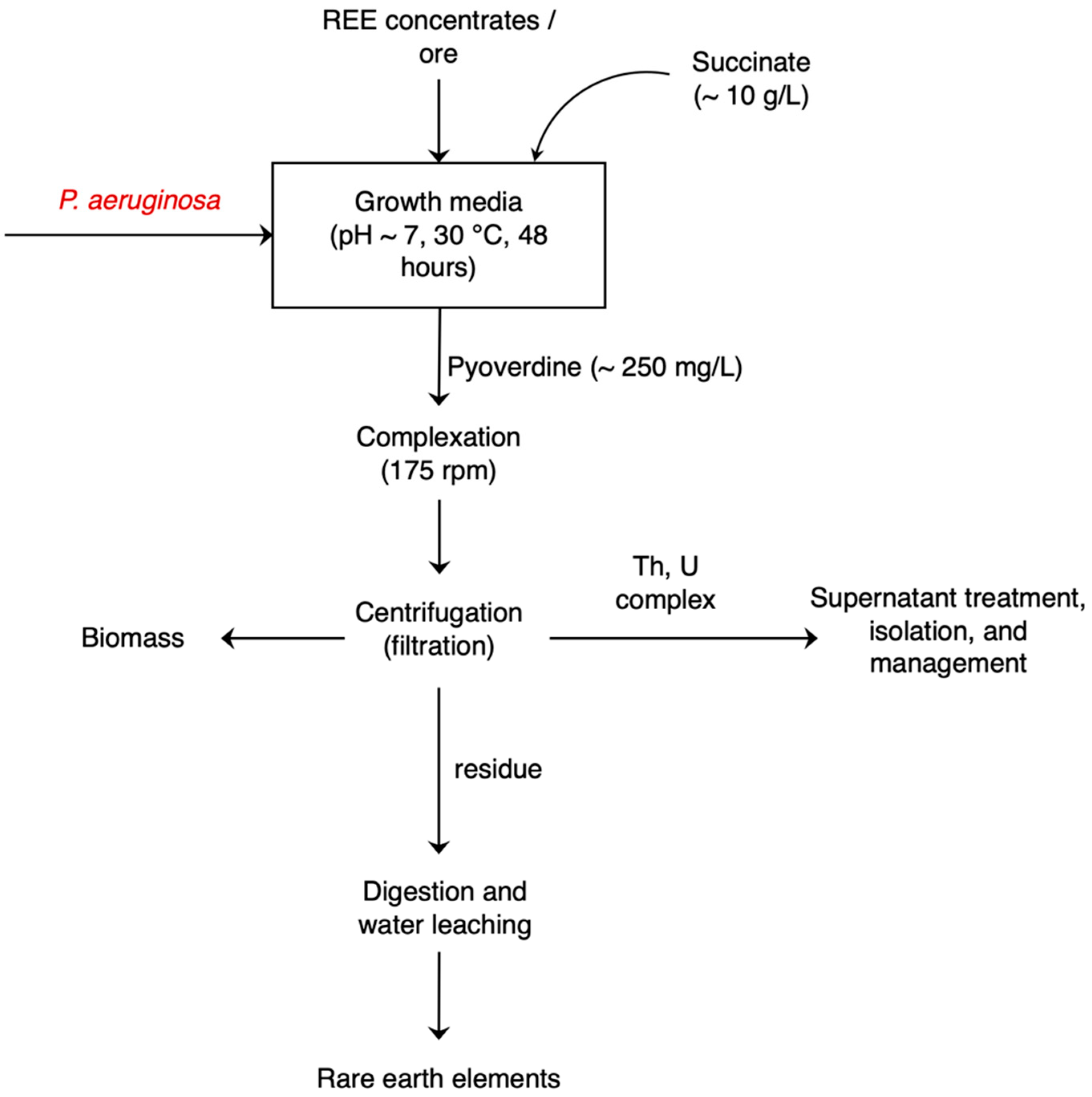
Hussien et al. (2013) initially used 16S rDNA sequencing to explain that the siderophores of Pseudomonas aeruginosa, specifically pyoverdines, produced catecholate and hydroxamate moieties which have affinity for radionuclides [103,104]. In their experiment, close to 253 mg of pyoverdines (PYH4) was produced per liter of the medium, at a pH of 7 and temperature of 30 °C, and after only 48 h of incubation. Succinate performed better compared to glucose and other carbon sources. This was similar to findings by Linget et al. (1992) [105]. Upon contact with monazite and Th-U concentrate samples, the pyoverdine moieties, respectively, complexed and recovered about 87.4% and 90.2% thorium, Th(IV). These results demonstrate the superior selectivity and kinetics of the siderophores compared to direct chemical organic acid leaching which has recoveries of about 20%–30% Th and 30%–68% U under acidic conditions (pH 3–4).
Equations 11 and 12 correspondingly show the complexation reactions for Th4+ and UO22+, where n represents the number of proton ions released (typically 0 to 4) [95]. These findings demonstrate the potential of using siderophores to separate thorium and uranium from other metal ions, either for remediation purposes or during rare earth processing. Consequently, this review hypothesizes that Pseudomonas aeruginosa species can be integrated into current rare earth processing streams as a pre-processing step for resources with significant levels of radionuclides. These microbial species have relatively faster kinetics and prefer ferric ions, which are readily available in such ores. Figure 5 schematically illustrates the integration step and other subsequent processes. Ideally, for maximum pyoverdine production, the bioreactor should be operated at neutral pH and a temperature of 30 °C using succinate as the carbon source, and harvested during the exponential phase. The approach potentially ensures the dissolution of radionuclides, leaving the REEs in the solid mineral matrix for conventional alkaline or acid leaching. It is worth noting that minimal REE losses (<5.5%) were reported by studies investigating monazite ores and concentrates. To further minimize these losses and better tailor the approach for other rare earth minerals such as bastnaesites, current academic and industrial research should focus on ore-specific microbial leaching studies using Pseudomonas aeruginosa and other variants or genera. Equally, extensive techno-economic analysis and environmental impact assessment studies would be essential to validate the feasibility of the approach in large-scale processes as well as quantify projected environmental credits.

5. Conclusions

The separation of radioactive elements, such as thorium and uranium, from rare earth elements is a critical step in the processing of REE-bearing minerals or resources. This is not only to reduce the radiological hazards associated with these elements, but simultaneously, to improve the purity of rare earth products and also to help the operation meet regulatory standards for rare earth mining and processing. In conventional processes for the extraction of rare earth elements, precipitation and solvent extraction techniques have been employed to selectively remove thorium and uranium. These techniques require large volumes of reagents and typically generate secondary waste streams. This influences process efficiency and sustainability, especially for rare earth resources with high uranium and thorium content. Selective leaching has also been investigated to an extent in recent years, and the approach seems promising. However, its limitation in complex mineral matrices constrains their extensive application. In addition, despite advances in biotechnological approaches, there is limited research and understanding on the binding mechanisms of siderophores and other microbial metabolites. The current review suggests a potential future direction is the utilization of pyoverdine siderophores from Pseudomonas aeruginosa, due to their high affinity for thorium and uranium. The production, extraction, and utilization of the siderophores appeared feasible due to their favorable optimal conditions. However, the costs associated with integrating and maintaining microbial activity under harsh processing conditions could potentially constrain its immediate industrial adaptation. Conversely, future research correspondingly ought to evaluate the economic and environmental aspects of processes using pyoverdine siderophores.

Funding

The funding for this study including the APC was provided by Empowered Startups.

Data Availability Statement

The raw data supporting the conclusions of this article will be made available by the authors on request.

Acknowledgments

The authors would like to acknowledge the support of Charl Keyter and Empowered Startups.

Conflicts of Interest

The authors declare no conflicts of interest.

References

  1. Owusu-Fordjour, E.Y.; Yang, X. Bioleaching of rare earth elements challenges and opportunities: A critical review. J. Environ. Chem. Eng. 2023, 11, 110413. [Google Scholar] [CrossRef]
  2. Penaloza, I.; Tita, A.; McNew, E.; Chu, P. Barite resources, production and recovery using froth flotation: A review. Miner. Eng. 2023, 203, 108327. [Google Scholar] [CrossRef]
  3. Findeiß, M.; Schäffer, A. Fate and environmental impact of thorium residues during rare earth processing. J. Sustain. Metall. 2017, 3, 179–189. [Google Scholar] [CrossRef]
  4. Yin, X.; Martineau, C.; Demers, I.; Basiliko, N.; Fenton, N.J. The potential environmental risks associated with the development of rare earth element production in Canada. Environ. Rev. 2021, 29, 354–377. [Google Scholar] [CrossRef]
  5. Patel, K.S.; Sharma, S.; Maity, J.P.; Martín-Ramos, P.; Fiket, Ž.; Bhattacharya, P.; Zhu, Y. Occurrence of uranium, thorium and rare earth elements in the environment: A review. Front. Environ. Sci. 2023, 10, 1058053. [Google Scholar] [CrossRef]
  6. Degueldre, C.; Joyce, M.J. Evidence and uncertainty for uranium and thorium abundance: A review. Prog. Nucl. Energy 2020, 124, 103299. [Google Scholar] [CrossRef]
  7. Talan, D.; Huang, Q.; Liang, L.; Song, X. Conceptual process development for the separation of thorium, uranium, and rare earths from coarse coal refuse. Miner. Process. Extr. Metall. Rev. 2023, 44, 330–345. [Google Scholar] [CrossRef]
  8. Keith-Roach, M.; Grundfelt, B.; Kousa, A.; Pohjolainen, E.; Magistrati, P.; Aggelatou, V.; Olivieri, N.; Ferrari, A. Past Experience of Environmental, Health and Safety Issues in REE Mining and Processing Industries and an Evaluation of Related EU and International Standards and Regulations; EURARE: Keyworth, UK, 2015. [Google Scholar]
  9. García, A.C.; Latifi, M.; Amini, A.; Chaouki, J. Separation of radioactive elements from rare earth element-bearing minerals. Metals 2020, 10, 1524. [Google Scholar] [CrossRef]
  10. Zhu, Z.; Pranolo, Y.; Cheng, C.Y. Separation of uranium and thorium from rare earths for rare earth production—A review. Miner. Eng. 2015, 77, 185–196. [Google Scholar] [CrossRef]
  11. Singh, H.; Gupta, C. Solvent extraction in production and processing of uranium and thorium. Miner. Process. Extr. Metullargy Rev. 2000, 21, 307–349. [Google Scholar] [CrossRef]
  12. Amaral, J.C.; Sá, M.L.; Morais, C.A. Recovery of uranium, thorium and rare earth from industrial residues. Hydrometallurgy 2018, 181, 148–155. [Google Scholar] [CrossRef]
  13. Kaphle, K.P. Rare earth elements, their occurrences and industrial uses. Nepal Geol. Soc. 2013, 30, 49–56. [Google Scholar]
  14. Sastri, V.S.; Bünzli, J.-C.; Rao, V.R.; Rayudu, G.V.S.; Perumareddi, J.R. Modern Aspects of Rare Earths and Their Complexes; Elsevier: Amsterdam, The Netherlands, 2003. [Google Scholar]
  15. Höppe, H. Rare-Earth Elements: Solid State Materials: Chemical, Optical and Magnetic Properties; Walter de Gruyter GmbH & Co KG: Berlin, Germany, 2024. [Google Scholar]
  16. Balaram, V. Sources and Applications of Rare Earth Elements. Environmental Technologies to Treat Rare Earth Elements Pollution: Principles and Engineering; IWA Publishing: London, UK, 2022; Volume 113, pp. 75–113. [Google Scholar]
  17. Shannon, R.T.; Prewitt, C.T. Effective ionic radii in oxides and fluorides. Struct. Sci. 1969, 25, 925–946. [Google Scholar] [CrossRef]
  18. Kanazawa, Y.; Kamitani, M. Rare earth minerals and resources in the world. J. Alloys Compd. 2006, 408, 1339–1343. [Google Scholar] [CrossRef]
  19. Smołka-Danielowska, D.; Walencik-Łata, A. The occurrence of selected radionuclides and rare earth elements in waste at the mine heap from the Polish Mining Group. Minerals 2021, 11, 504. [Google Scholar] [CrossRef]
  20. Sheppard, M.I. The Environmental Behaviour of Radium; Atomic Energy of Canada Ltd.; Whiteshell Nuclear Research: Pinawa, MB, Canada, 1980. [Google Scholar]
  21. Cowart, J.; Burnett, W. The distribution of uranium and thorium decay-series radionuclides in the environment—A review. J. Environ. Qual. 1994, 23, 651–662. [Google Scholar] [CrossRef]
  22. Carvalho, F.; Chambers, D.; Fernandes, S.; Fesenko, S.; Goulet, R.; Howard, B.; Kim, C.-K.; Martin, P.; Moore, W.S.; Phaneuf, M.; et al. The Environmental Behaviour of Radium, revised ed.; International Atomic Energy Agency: Wien, Austria, 2014. [Google Scholar]
  23. Ragheb, M.; Tsoukalas, L. Global and USA thorium and rare earth elements resources. In Proceedings of the 2nd Thorium Energy Alliance Conference, the Future Thorium Economy, Google Campus, Mountain View, CA, USA, 29–30 March 2010. [Google Scholar]
  24. Park, B. Management of thorium and uranium in mining and processing of rare earth minerals. In Proceedings of the 51st Annual Conference of Metallurgists, Niagara, ON, Canada, 30 September–3 October 2012; 2012. [Google Scholar]
  25. Araujo, I.P. Flotation of Barite from Mountain Pass Carbonatite Ore; University of Nevada: Reno, NV, USA, 2023. [Google Scholar]
  26. Nili, S.; Thella, J.S.; Sharifian, S.; Chu, P.; Vasquez, V.R.; Vahidi, E. Economic viability and environmental impact: A dual approach to sustainable REE production from bastnasite using a density-based sorting machine. Sci. Total Environ. 2025, 983, 179696. [Google Scholar] [CrossRef]
  27. Thella, J.; McNew, E.; Emmanuel, M.; Thella, C.; Chu, P. A Laboratory Study to Simulate Ore Sorting for a Rare Earth Ore. Min. Metall. Explor. 2024, 41, 1909–1918. [Google Scholar] [CrossRef]
  28. Wang, G.; Tang, J. Pollution and suggestions for controlling measurement of the three types of waste in rare earth production. In Proceedings of the Conference for Chinese Rare Earth Comprehensive Exploitation and Environment Protection; ResearchGate: Berlin, Germany, 2007. [Google Scholar]
  29. Jordens, A.; Cheng, Y.P.; Waters, K.E. A review of the beneficiation of rare earth element bearing minerals. Miner. Eng. 2013, 41, 97–114. [Google Scholar] [CrossRef]
  30. Gupta, C.K.; Krishnamurthy, N. Extractive metallurgy of rare earths. Int. Mater. Rev. 1992, 37, 197–248. [Google Scholar] [CrossRef]
  31. Keekan, K.K.; Jalondhara, J.C.; Abhilash. Extraction of Ce and Th from monazite using REE tolerant Aspergillus niger. Miner. Process. Extr. Metall. Rev. 2017, 38, 312–320. [Google Scholar] [CrossRef]
  32. Osman, Y.; Gebreil, A.; Mowafy, A.M.; Anan, T.I.; Hamed, S.M. Characterization of Aspergillus niger siderophore that mediates bioleaching of rare earth elements from phosphorites. World J. Microbiol. Biotechnol. 2019, 35, 93. [Google Scholar] [CrossRef] [PubMed]
  33. Chambers, D.; Lowe, L.; Feasby, D. Radiological aspects of naturally occuring radioactive materials (NORM) in the ore processing and production of rare earth element concentrates. In Proceedings of the 51st Annual Conference of Metallurgists, COM, Niagara Falls, ON, Canada, 30 September–3 October 2012; 2012. [Google Scholar]
  34. Lagae Capelle, E.; Coudert, L.; Hermassi, M.; Neculita, C.M.; Demers, I. Mine Water Treatment Methods for Rare Earth Elements and Associated Radionuclides. Mine Water Environ. 2025, 144, 722–746. [Google Scholar] [CrossRef]
  35. Kim, J.; Choi, J.; Lee, S. A Review of Rare Earth Elements Recovery from Bastnaesite Ore: From Beneficiation to Metallurgical Processing. J. Sustain. Metall. 2025, 11, 773–798. [Google Scholar] [CrossRef]
  36. Talan, D.; Huang, Q. Separation of thorium, uranium, and rare earths from a strip solution generated from coarse coal refuse. Hydrometallurgy 2020, 197, 105446. [Google Scholar] [CrossRef]
  37. Kanojia, A.; Nyembwe, J.K.; Petranikova, M.; Vollmer, T.R.; Ekberg, C. Solvent Extraction and Isolation Strategies for Uranium, Thorium, and Radium in Rare Earth Element Recovery from Ores: A Review. Solvent Extr. Ion Exch. 2025, 43, 671–707. [Google Scholar] [CrossRef]
  38. Basque, J.; Lavoie, J.; Reynier, N.; Larivière, D. Quantitative separation of thorium from rare earth elements and uranium in a rare earth element sulfuric acid leachate using cloud point extraction. Microchem. J. 2023, 190, 108724. [Google Scholar] [CrossRef]
  39. Huang, M.; Liu, D.; Xiu, T.; Liu, Z.; Liu, Z. Aluminum-assisted acid leaching for Uranium/Thorium from High-Fluorine niobium Slag: Occurrence states and Behaviors in mineralogy. Sep. Purif. Technol. 2025, 372, 133503. [Google Scholar] [CrossRef]
  40. Baghaliannejad, R.; Aghahoseini, M.; Amini, M.K. Determination of rare earth elements in uranium materials by ICP-MS and ICP-OES after matrix separation by solvent extraction with TEHP. Talanta 2021, 222, 121509. [Google Scholar] [CrossRef]
  41. Zhou, H.; Huang, Z.; Zhang, X.; Bu, X.; Du, Y.; Shi, W.; Yuan, L. Enabling the extraction of high-purity thorium from rare earth ores by simple one-step crystallization. Chem. Eng. J. 2025, 519, 165158. [Google Scholar] [CrossRef]
  42. Özkan, B.; Altaş, Y.; İnan, S. Extraction and purification of thorium and rare earth elements from bastnaesite mineral: A comprehensive leaching and precipitation study. J. Radioanal. Nucl. Chem. 2025, 334, 541–550. [Google Scholar] [CrossRef]
  43. Thakur, N. Separation of rare earths by solvent extraction. Miner. Process. Extr. Metullargy Rev. 2000, 21, 277–306. [Google Scholar] [CrossRef]
  44. Traore, M.; Gong, A.; Wang, Y.; Qiu, L.; Bai, Y.; Zhao, W.; Liu, Y.; Chen, Y.; Liu, Y.; Wu, H.; et al. Research progress of rare earth separation methods and technologies. J. Rare Earths 2023, 41, 182–189. [Google Scholar] [CrossRef]
  45. Dmitrieva, E.; Anokhina, T.; Tsebrikova, G.S.; He, T.; Baulin, V.E.; Volkov, A.V.; Tsivadze, A.Y. Membrane Methods of Isolation and Separation of Rare Earth Elements (A Review). Pet. Chem. 2025, 65, 113–156. [Google Scholar] [CrossRef]
  46. Mohammadi, M.; Forsberg, K.; Kloo, L.; De La Cruz, J.M.; Rasmuson, Å. Separation of Nd (III), Dy (III) and Y (III) by solvent extraction using D2EHPA and EHEHPA. Hydrometallurgy 2015, 156, 215–224. [Google Scholar] [CrossRef]
  47. Li, Z.; Zhang, Z.; Qi, S.; Zhao, L.; Pan, J.; Feng, Z.; Huang, X. Stripping and recovery of U and Th from EHEHPA in rare earth separation plant. Sep. Purif. Technol. 2024, 331, 125423. [Google Scholar] [CrossRef]
  48. Mishra, B.B.; Devi, N. Study on the extraction and separation of samarium from chloride medium using D2EHPA and [P66614][D2EHP] and their application to monazite ore. Trans. Indian Inst. Met. 2020, 73, 2247–2257. [Google Scholar] [CrossRef]
  49. Rodríguez Varela, R.; Chagnes, A.; Forsberg, K. Third-Phase Formation in Rare Earth Element Extraction with D2EHPA: Key Factors and Impact on Liquid Membrane Extraction Performance. Membranes 2025, 15, 188. [Google Scholar] [CrossRef]
  50. Jiang, F.; Yin, S.; Srinivasakannan, C.; Li, S.; Peng, J. Separation of lanthanum and cerium from chloride medium in presence of complexing agent along with EHEHPA (P507) in a serpentine microreactor. Chem. Eng. J. 2018, 334, 2208–2214. [Google Scholar] [CrossRef]
  51. El-Hefny, N.; El-Nadi, Y.; Daoud, J. Equilibrium and mechanism of samarium extraction from chloride medium using sodium salt of CYANEX 272. Sep. Purif. Technol. 2010, 75, 310–315. [Google Scholar] [CrossRef]
  52. Belova, V.; Voshkin, A.A.; Egorova, N.S.; Khol’kin, A.I. Extraction of rare earth metals from nitrate solutions with a binary extractant based on Cyanex 272. Russ. J. Inorg. Chem. 2010, 55, 629–633. [Google Scholar] [CrossRef]
  53. Menzies, I.; Rigby, F. Separation of thorium from uranium and rare-earth elements by solvent extraction with tri-n-butyl phosphate-xylene. J. Appl. Chem. 1961, 11, 104–113. [Google Scholar] [CrossRef]
  54. Gupta, B.; Malik, P.; Deep, A. Extraction of uranium, thorium and lanthanides using Cyanex-923: Their separations and recovery from monazite. J. Radioanal. Nucl. Chem. 2002, 251, 451–456. [Google Scholar] [CrossRef]
  55. Lu, J.; Wei, Z.; Li, D.; Ma, G.; Jiang, Z. Recovery of Ce (IV) and Th (IV) from rare earths (III) with Cyanex 923. Hydrometallurgy 1998, 50, 77–87. [Google Scholar] [CrossRef]
  56. Sato, T. Extraction of uranium (VI) from hydrochloric acid solutions by long-chain aliphatic amines. J. Appl. Chem. 1966, 16, 143–148. [Google Scholar] [CrossRef]
  57. Li, Y.; Lu, Y.; Bai, Y.; Liao, W. Extraction and separation of thorium and rare earths with 5, 11, 17, 23-tetra (diethoxyphosphoryl)-25, 26, 27, 28-tetraacetoxycalix [4] arene. J. Rare Earths 2012, 30, 1142–1145. [Google Scholar] [CrossRef]
  58. Zhu, Z.; Cheng, C.Y. A Review of Uranium Solvent Extraction: Its Present Status and Future Trends; Alta Metallurgical Services: Castlemaine, VIC, Australia, 2011. [Google Scholar]
  59. El-Yamani, I.; Shabana, E. Studies on extraction of thorium (IV) from sulfate media with mixtures of long-chain primary amines and tributyl phosphate. J. Radioanal. Nucl. Chem. 1985, 88, 273–280. [Google Scholar] [CrossRef]
  60. Crouse, D.J.; Brown, K.B. The amex process for extracting thorium ores with alkyl amines. Ind. Eng. Chem. 1959, 51, 1461–1464. [Google Scholar] [CrossRef]
  61. Amaral, J.C.; Morais, C.A. Thorium and uranium extraction from rare earth elements in monazite sulfuric acid liquor through solvent extraction. Miner. Eng. 2010, 23, 498–503. [Google Scholar] [CrossRef]
  62. Xu, G. Rare Earths; Metallurgical Industry: Beijing, China, 1995. [Google Scholar]
  63. Vijayalakshmi, R.; Mishra, S.L.; Singh, H.; Gupta, C.K. Processing of xenotime concentrate by sulphuric acid digestion and selective thorium precipitation for separation of rare earths. Hydrometallurgy 2001, 61, 75–80. [Google Scholar] [CrossRef]
  64. Kogel, J.E. Industrial Minerals & Rocks: Commodities, Markets, and Uses; SME: Bratislava, Slovakia, 2006. [Google Scholar]
  65. Fourest, B.; Lagarde, G.; Perrone, J.; Brandel, V.; Dacheux, N.; Genet, M. Solubility of thorium phosphate-diphosphate. New J. Chem. 1999, 23, 645–649. [Google Scholar] [CrossRef]
  66. Sanding, A.; Bruno, J. The solubility of (UO2)3(PO4)2·4H2O(s) and the formation of U (VI) phosphate complexes: Their influence in uranium speciation in natural waters. Geochim. Cosmochim. Acta 1992, 56, 4135–4145. [Google Scholar] [CrossRef]
  67. Zepf, V. Rare Earth Elements: What and Where They Are, in Rare Earth Elements: A New Approach to the Nexus of Supply, Demand and Use: Exemplified Along the Use of Neodymium in Permanent Magnets; Springer: Berlin/Heidelberg, Germany, 2013; pp. 11–39. [Google Scholar]
  68. Han, K.N. Characteristics of precipitation of rare earth elements with various precipitants. Minerals 2020, 10, 178. [Google Scholar] [CrossRef]
  69. Wylie, A. Coprecipitation of uranous sulphate with rare-earth double sulphates. Nature 1947, 160, 830. [Google Scholar] [CrossRef]
  70. Amer, T.; Abdella, W.M.; Wahab, G.M.A.; El-Sheikh, E.M. A suggested alternative procedure for processing of monazite mineral concentrate. Int. J. Miner. Process. 2013, 125, 106–111. [Google Scholar] [CrossRef]
  71. Santos, E.A.; Ladeira, A.C. Recovery of uranium from mine waste by leaching with carbonate-based reagents. Environ. Sci. Technol. 2011, 45, 3591–3597. [Google Scholar] [CrossRef]
  72. Kang, M.J.; Han, B.E.; Hahn, P.S. Precipitation and adsorption of uranium (VI) under various aqueous conditions. Environ. Eng. Res. 2002, 7, 149–157. [Google Scholar]
  73. Yu, B.; Verbaan, N.; Pearse, G.; Britt, S. Beneficiation and extraction of REE from GEOMEGA resources’ Montviel project. In Proceedings of the Rare Earth Elements (COM 2013), West Westmount, QC, Canada, 27–31 October 2013; p. 30. [Google Scholar]
  74. Walawalkar, M.; Nichol, C.K.; Azimi, G. Process investigation of the acid leaching of rare earth elements from phosphogypsum using HCl, HNO3, and H2SO4. Hydrometallurgy 2016, 166, 195–204. [Google Scholar] [CrossRef]
  75. Kumar, M.; Kumar, M.; Kim, M.-S.; Jeong, J.; Yoo, K. Leaching of Metals from Waste Printed Circuit Boards (WPCBs) Using Sulfuric and Nitric Acids. Environ. Eng. Manag. J. (EEMJ) 2014, 13, 2601–2607. [Google Scholar]
  76. Lazo, D.E. Selective Complexation Leaching of Rare Earth Minerals: A New Hydrometallurgical Route Inspired by Geochemical Process; Curtin University: Perth, Australia, 2019. [Google Scholar]
  77. Balomenos, E. Recovering of REEs from unconventional resources—Bauxite Residue. Authorea Prepr. 2023, 75–98. [Google Scholar]
  78. Liu, P.; Wang, X.; Zhang, W. Impact of organic acids on extraction of rare earth elements: Mechanisms and optimization. J. Rare Earths 2025, in press. [Google Scholar] [CrossRef]
  79. Banerjee, R.; Chakladar, S.; Mohanty, A.; Chakravarty, S.; Chattopadhyay, S.K.; Jha, M. Review on the environment friendly leaching of rare earth elements from the secondary resources using organic acids. Geosyst. Eng. 2022, 25, 95–115. [Google Scholar] [CrossRef]
  80. Yudaev, P.; Chistyakov, E. Chelating extractants for metals. Metals 2022, 12, 1275. [Google Scholar] [CrossRef]
  81. Lapidus, G.; Doyle, F. Selective thorium and uranium extraction from monazite: I. Single-stage oxalate leaching. Hydrometallurgy 2015, 154, 102–110. [Google Scholar] [CrossRef]
  82. Lapidus, G.; Doyle, F. Selective thorium and uranium extraction from monazite: II. Approaches to enhance the removal of radioactive contaminants. Hydrometallurgy 2015, 155, 161–167. [Google Scholar] [CrossRef]
  83. Whitty-Léveillé, L.; Reynier, N.; Larivière, D. Rapid and selective leaching of actinides and rare earth elements from rare earth-bearing minerals and ores. Hydrometallurgy 2018, 177, 187–196. [Google Scholar] [CrossRef]
  84. Tan, J.P.; Clyde, C.W.; Ng, C.C.; Yeap, S.K.; Yong, C.Y. Advancements in microbial-mediated radioactive waste bioremediation: A review. J. Environ. Radioact. 2024, 280, 107530. [Google Scholar] [CrossRef]
  85. Kaksonen, A.H.; Lakaniemi, A.-M.; Tuovinen, O.H. Acid and ferric sulfate bioleaching of uranium ores: A review. J. Clean. Prod. 2020, 264, 121586. [Google Scholar] [CrossRef]
  86. Bhatti, T.M.; Tuovinen, O.H. Bioleaching of uranium from ores and rocks using filamentous fungi. Front. Microbiol. 2025, 16, 1523962. [Google Scholar] [CrossRef]
  87. Wang, Y.; Wang, J.; Ding, D.; Li, G.; Sun, J.; Hu, N.; Li, F.; Ma, J.; Zhang, H.; Ding, Y.; et al. Hyphae and organic acids of Aspergillus Niger promote uranium recovery by destroying the ore surface and increasing the porosity and permeability of ores. Nucl. Eng. Technol. 2024, 56, 1880–1886. [Google Scholar] [CrossRef]
  88. Agbo, P.; Rees, J.A.; Abergel, R.J. Actinide biological inorganic chemistry: The overlap of 5f orbitals with biology. Exp. Theor. Approaches Actin. Chem. 2018, 445–489. [Google Scholar]
  89. Torapava, N.; Persson, I.; Eriksson, L.; Lundberg, D. Hydration and hydrolysis of thorium (IV) in aqueous solution and the structures of two crystalline thorium (IV) hydrates. Inorg. Chem. 2009, 48, 11712–11723. [Google Scholar] [CrossRef] [PubMed]
  90. Teksöz, S.; Acar, C.i.d.; Ünak, P. Hydrolytic behavior of Th4+, UO22+, and Ce3+ ions at various temperatures. J. Chem. Eng. Data 2009, 54, 1183–1188. [Google Scholar] [CrossRef]
  91. Kamal, H.M.; Mahdy, H.M.A.; Hassanein, R.A.; Mahmoud, K.F.; Abouzeid, M.A. Microbial leaching of some valuable elements from Egyptian phosphate rock. Nucl. Sci. Sci. J. 2012, 1, 155–165. [Google Scholar] [CrossRef]
  92. Amin, M.M.; Elaassy, I.E.; El-Feky, M.G.; Kawady, N.A.; Talaat, M.S.; Sallam, A.S.M. Recovery of uranium from low-grade ore using microorganism isolated from uraniferous rock sample. Sep. Sci. Technol. 2018, 53, 2232–2237. [Google Scholar] [CrossRef]
  93. Hassanien, W.A.G.; Desouky, O.A.N.; Hussien, S.S.E. Bioleaching of some rare earth elements from Egyptian monazite using Aspergillus ficuum and Pseudomonas aeruginosa. Walailak J. Sci. Technol. (WJST) 2014, 11, 809–823. [Google Scholar]
  94. Ruijter, G.; Kubicek, C.; Visser, J. Production of Organic Acids by Fungi. In Industrial Applications; Springer: Berlin/Heidelberg, Germany, 2002; pp. 213–230. [Google Scholar]
  95. Hussien, S.S. Advances in Microbial Leaching as a Non-conventional Technique for Metal Recovery from Ores: A Review. Geomicrobiol. J. 2025, 42, 255–267. [Google Scholar] [CrossRef]
  96. Jalali, J.; Lebeau, T. The role of microorganisms in mobilization and phytoextraction of rare earth elements: A review. Front. Environ. Sci. 2021, 9, 688430. [Google Scholar] [CrossRef]
  97. Xie, B.; Wei, X.; Wan, C.; Zhao, W.; Song, R.; Xin, S.; Song, K. Exploring the biological pathways of siderophores and their multidisciplinary applications: A comprehensive review. Molecules 2024, 29, 2318. [Google Scholar] [CrossRef]
  98. Khairnar, A.; Goyal, A.K. Iron Harvesters: Exploring Microbial Siderophores and Their Diverse Applications in Biomedicine. Biomed. Mater. Devices 2025, 3, 277–287. [Google Scholar] [CrossRef]
  99. Mayegowda, S.B.; Gadilingappa, M.N. Microbial Siderophores: A New Insight on Healthcare Applications. BME Front. 2025, 6, 0112. [Google Scholar] [CrossRef]
  100. Kalinowski, B.E.; Oskarsson, A.; Albinsson, Y.; Arlinger, J.; Ödegaard-Jensen, A.; Andlid, T.; Pedersen, K. Microbial leaching of uranium and other trace elements from shale mine tailings at Ranstad. Geoderma 2004, 122, 177–194. [Google Scholar] [CrossRef]
  101. Desouky, O.A.; El-Mougith, A.A.; Hassanien, W.A.; Awadalla, G.S.; Hussien, S.S. Extraction of some strategic elements from thorium–uranium concentrate using bioproducts of Aspergillus ficuum and Pseudomonas aeruginosa. Arab. J. Chem. 2016, 9, S795–S805. [Google Scholar] [CrossRef]
  102. Hussien, S. Biological Control of Plant Diseases by Fungi or Bacteria. Master’s Thesis, Botany Department, Faculty of Science, Zagazig University, Zagazig, Egypt, 2007. [Google Scholar]
  103. Hussien, S.S.; Desouky, O.A.; Abdel-Haliem, M.E.; El-Mougith, A.A. Uranium (VI) complexation with siderophores-pyoverdine produced by Pseudomonas fluorescens SHA 281. Int. J. Nucl. Energ. Sci. Eng. (IJNESE) 2013, 3, 95–102. [Google Scholar] [CrossRef]
  104. Schalk, I.J. Bacterial siderophores: Diversity, uptake pathways and applications. Nat. Rev. Microbiol. 2025, 23, 24–40. [Google Scholar] [CrossRef]
  105. Linget, C.; Collinson, S.; Azadi, P.; Dell, A.; Page, W.; Abdallah, M.A. Structure of azoverdin, a pyoverdin-like siderophore of Azomonas macrocytogenes ATCC 12334. Tetrahedron Lett. 1992, 33, 1889–1892. [Google Scholar] [CrossRef]
Figure 1. Processing of REEs, U, and Th via solvent extraction, adapted from Amaral et al. (2018) [12].
Minerals 15 01308 g001
Figure 2. Graphical representation of potential radionuclide complexation pathways.
Minerals 15 01308 g002
Figure 3. Mechanism of siderophores for ion chelation, by Xie et al. (2024) [97].
Minerals 15 01308 g003
Figure 4. Efficiency of P. aeruginosa siderophores, adapted from Desouky et al. (2016) [101].
Minerals 15 01308 g004
Figure 5. The proposed flowsheet for microbial processing with pyoverdine siderophores.
Minerals 15 01308 g005
Table 1. Content of rare earth oxides, thorium, and uranium in rare earth minerals.
Ore TypesMineralChemical FormulaComposition (Weight Percent)Reference
REO UO2 ThO2
Carbonate ancylitesSr(REE,Ce,La)(CO3)2OH.H2O460.1<0.4[29]
parisiteCa(Ce,La)2(CO3)3F2590.0–0.30.0–0.5
bastnasite(Ce,La)CO3F740.0–0.90.0–0.3
Oxide perovskite(Ca,REE)TiO3<37<0.050–2[29]
euxenite(Y,Ca,Ce,U,Th)(Nb,Ta,Ti)2O615–350.0–0.50.0–0.5
brannerite(U,REE,Ca)(Ti,Fe)2O66<0.002-
fergusonite(Y,REE)NbO430–500.0–0.50.0–0.5
Silicate allanite(Ca,Ce,La,Y)2(Al,Fe)3(SiO4)3(OH)30-0.3[30]
cheralite(REE,Th,Ca)(P,Si)O45-<30
Ion-adsorption clays -0.05–0.5< 0.002<0.002[28]
Phosphate monazite(Ce,La,Nd,Th)PO435–720–160–20[29,31,32]
xenotimeYPO4~600–5-
britholite(REE,Ca)5(SiO4,PO4)3(F, OH)56-<1.5
Table 2. Optimal precipitation pH ranges for sulfate and chloride leachates.
ElementspH RangeReference
Sulfate LeachatesChloride Leachates
Th1.0–2.04.8–5.8[9]
U~6.05.5–7.0
REE3.0–5.56.8–8.0
Disclaimer/Publisher’s Note: The statements, opinions and data contained in all publications are solely those of the individual author(s) and contributor(s) and not of MDPI and/or the editor(s). MDPI and/or the editor(s) disclaim responsibility for any injury to people or property resulting from any ideas, methods, instructions or products referred to in the content.