Abstract
This paper presents an overview of cosine and sine Apostol-type Frobenius–Euler–Fibonacci polynomials, as well as several identities that are associated with these polynomials. By applying a partial derivative operator to the generating functions, the authors obtain derivative formulae and finite combinatorial sums involving these polynomials and numbers. Additionally, the paper establishes connections between cosine and sine Apostol-type Frobenius–Euler–Fibonacci polynomials of order and several other polynomial sequences, such as the Apostol-type Bernoulli–Fibonacci polynomials, the Apostol-type Euler–Fibonacci polynomials, the Apostol-type Genocchi–Fibonacci polynomials, and the Stirling–Fibonacci numbers of the second kind. The authors also provide computational formulae and graphical representations of these polynomials using the Mathematica program.
Keywords:
Golden calculus; cosine-Apostol-type Frobenius–Euler–Fibonacci polynomials; sine-Apostol-type Frobenius Euler-Fibonacci polynomials; generating functions MSC:
11B68; 11B83; 05A15; 05A19
1. Introduction
Formal research on special polynomials and their associated special numbers has been conducted by numerous scholars. Specifically, the generating functions of these polynomials have been utilized to derive various identities, sum formulae, and symmetric formulae containing these polynomials. Recently, several researchers [1,2,3,4,5] have developed generating functions for new families of special polynomials, including Hermite, Bernoulli, Euler, and Genocchi polynomials. These authors have established the fundamental properties of these polynomials and derived a variety of identities and relationships between trigonometric functions and two parametric kinds of special polynomials using generating functions. The partial derivative operator has been employed to obtain derivative formulae and finite combinatorial sums that involve the mentioned polynomials and numbers. Additionally, these special polynomials facilitate the straightforward derivation of several important identities.
For any , and , the Apostol-type Frobenius–Euler polynomials of order are defined (see [3,6,7,8]) as follows:
For , are called the Apostol-type Frobenius–Euler numbers of order . From (1), we see that
and
where are the wth Apostol–Euler polynomials of order .
The generalized -Stirling numbers of the second kind are provided by (see [9])
for and , where yields the usual Stirling numbers of the second kind given by (see [4,10])
The Apostol-type Bernoulli polynomials of order , the Apostol-type Euler polynomials of order , and the Apostol-type Genocchi polynomials of order are introduced by (see [5,9])
and
respectively.
Obviously, we have
The field of Golden calculus, also known as F-calculus, traces its origins back to the nineteenth century, when its diverse applications in areas like mathematics, physics, and engineering came to light. The concepts and notation used in Golden calculus are derived from various sources [12,13,14,15].
The Fibonacci sequence is introduced as follows:
where , . Fibonacci numbers can be written explicitly in terms of
where and ; is called the Golden ratio. In many different disciplines of science and mathematics, the Golden ratio is a number that occurs frequently. The various properties of the Golden ratio have been extensively studied by Pashaev and Nalci [14]. Other references include Pashaev [15], Krot [16], and Pashaev and Ozvatan [17].
The definition of F-factorial is
where . The binomial theorem for the F-analogues, also known as the Golden binomial theorem, is expressed as
using Golden binomial coefficients, known as Fibonomials
with w and l being nonnegative integers, . The Fibonomial coefficients have the following identity:
The F-derivative is introduced as follows:
The Golden exponential functions of the first and second variety are
and
where
Shortly, we use the following notations throughout the paper:
and
respectively.
The expressions and satisfy the following identity (see [13]):
The Apostol-type Bernoulli–Fibonacci polynomials of order , the Apostol-type Euler–Fibonacci polynomials of order , and the Apostol-type Genocchi–Fibonacci polynomials of order are defined by (see [18,19,20]):
and
respectively.
Clearly, we have
In [19], Kızılateş and Öztürk defined two parametric types of the Apostol Bernoulli–Fibonacci polynomials, the Apostol Euler–Fibonacci polynomials, and the Apostol Genocchi–Fibonacci polynomials of order and obtained some properties for these type of polynomials using Golden calculus. In [21], the authors introduced the generalized Apostol-type Frobenius–Euler–Fibonacci polynomials and numbers using (14) and (15). With this definition, the authors defined Frobenius–Euler–Fibonacci polynomials of the Apostol type in two variables, but in this paper, we give a different generalization of these polynomials.
Given the aforementioned studies, we propose a new class of two-variable polynomials, which includes those defined by Equation (1) through the application of Golden calculus. We introduce the use of generating functions to define parametric Apostol-type Frobenius–Euler–Fibonacci polynomials using the principles of Golden calculus. By employing the associated generating functions and functional equations, we establish numerous properties for these particular polynomials. We present several properties of this polynomial family, such as recurrence relations, summation formulae, and derivative relations, by utilizing their generating function and functional equation. Furthermore, we establish connections between parametric kinds of the Apostol-type Frobenius–Euler–Fibonacci polynomials of order and various other polynomial sequences, including the Apostol-type Bernoulli–Fibonacci polynomials, the Apostol-type Euler–Fibonacci polynomials, the Apostol-type Genocchi–Fibonacci polynomials, and the Stirling–Fibonacci numbers of the second kind. Finally, we give zeros and graphical illustrations for the parametric kinds of Apostol-type Frobenius–Euler–Fibonacci polynomials.
2. Two Parametric Kinds of Apostol-Type Frobenius–Euler–Fibonacci Polynomials

According to Krot’s definition [16], the Fibonomial convolution of two sequences involves the following: Let and be two sequences with their respective generating functions
then their Fibonomial convolution is defined as
Therefore, the generating function takes the form
Let The functions and are defined by Taylor series as follows:
and
Here
By means of the above definitions of and and the numbers , we can define two parametric types of the Apostol-type Frobenius–Euler–Fibonacci polynomials of order as follows.
Definition 1.
Let . Two parametric kinds of cosine-Apostol-type Frobenius–Euler–Fibonacci polynomials and sine-Apostol-type Frobenius–Euler–Fibonacci polynomials
, are defined by
and
respectively.
Note that, for we get
and
We commence with the fundamental properties of these polynomials.
Theorem 1.
Let . Then, we have
and
Proof.
Theorem 2.
Let . Then, we have
and
Theorem 3.
Let . Then, we get
and
Proof.
Theorem 4.
Let . Then, we have
and
Theorem 5.
Let . The following formulae hold true:
and
Theorem 6.
The following formulae for the parametric kinds of cosine-Apostol-type Frobenius–Euler–Fibonacci polynomials and sine-Apostol-type Frobenius–Euler–Fibonacci polynomials hold true:
and
Theorem 7.
Let and r be any real numbers. Then, we have
- (i)
- (ii)
Proof.
By substituting into in the generating function of cosine Apostol-type Frobenius–Euler–Fibonacci polynomials, we have
In a similar method, we find the following equation:
(ii) We also can find the following equations:
Corollary 1.
Let . Then, we have
and
Corollary 2.
For in Theorem 7, we have
and
3. Summation Formulae for Parametric Kinds of Apostol-Type Frobenius–Euler–Fibonacci Polynomials

In this section, we explore the Apostol-type Frobenius–Euler–Fibonacci polynomials, specifically focusing on their parametric forms, as well as examining connections with other polynomial sequences, such as Apostol-type Bernoulli–Fibonacci polynomials, Euler–Fibonacci polynomials, Genocchi–Fibonacci polynomials, and Stirling–Fibonacci numbers of the second kind.
Theorem 8.
For the following results hold true:
and
Proof.
We set
Theorem 9.
For the following relations hold true:
and
Proof.
Consider the following identity:
Evaluating the following fraction using the above identity, we find
Theorem 10.
For the following relations hold true:
and
Proof.
Theorem 11.
The following relations hold true:
and
Proof.
Theorem 12.
The following relations hold true:
and
Proof.
Theorem 13.
The following relations hold true:
and
Proof.
Theorem 14.
Let α and γ be nonnegative integers. The following relation holds true: of order α holds true:
and
4. Approximate Roots for Cosine Apostol-Type Frobenius–Euler–Fibonacci Polynomials and Their Application
In this section, certain zeros of the two parametric kinds of cosine-Apostol-type Frobenius–Euler–Fibonacci polynomials and beautifully graphical representations are shown.
A few of them are
and
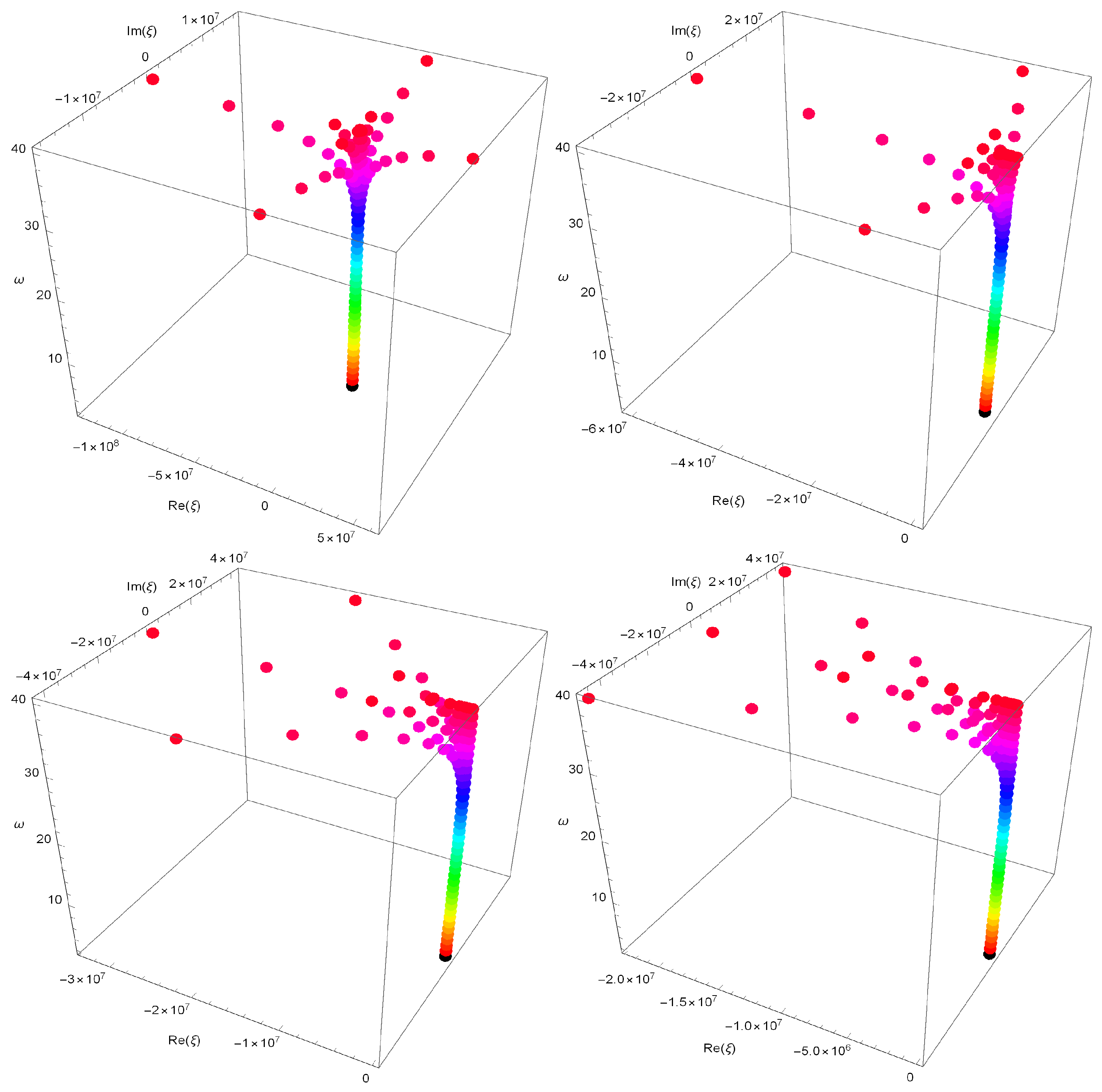
We investigate the beautiful zeros of the two parametric kinds of cosine-Apostol-type Frobenius–Euler–Fibonacci polynomials using a computer. We plot the zeros of the two parametric kinds of cosine-Apostol-type Frobenius–Euler–Fibonacci polynomials for (Figure 1).
Figure 1.
Zeros of .
In Figure 1 (top-left), we chose and . In Figure 1 (top-right), we chose and . In Figure 1 (bottom-left), we chose , and . In Figure 1 (bottom-right), we chose and .
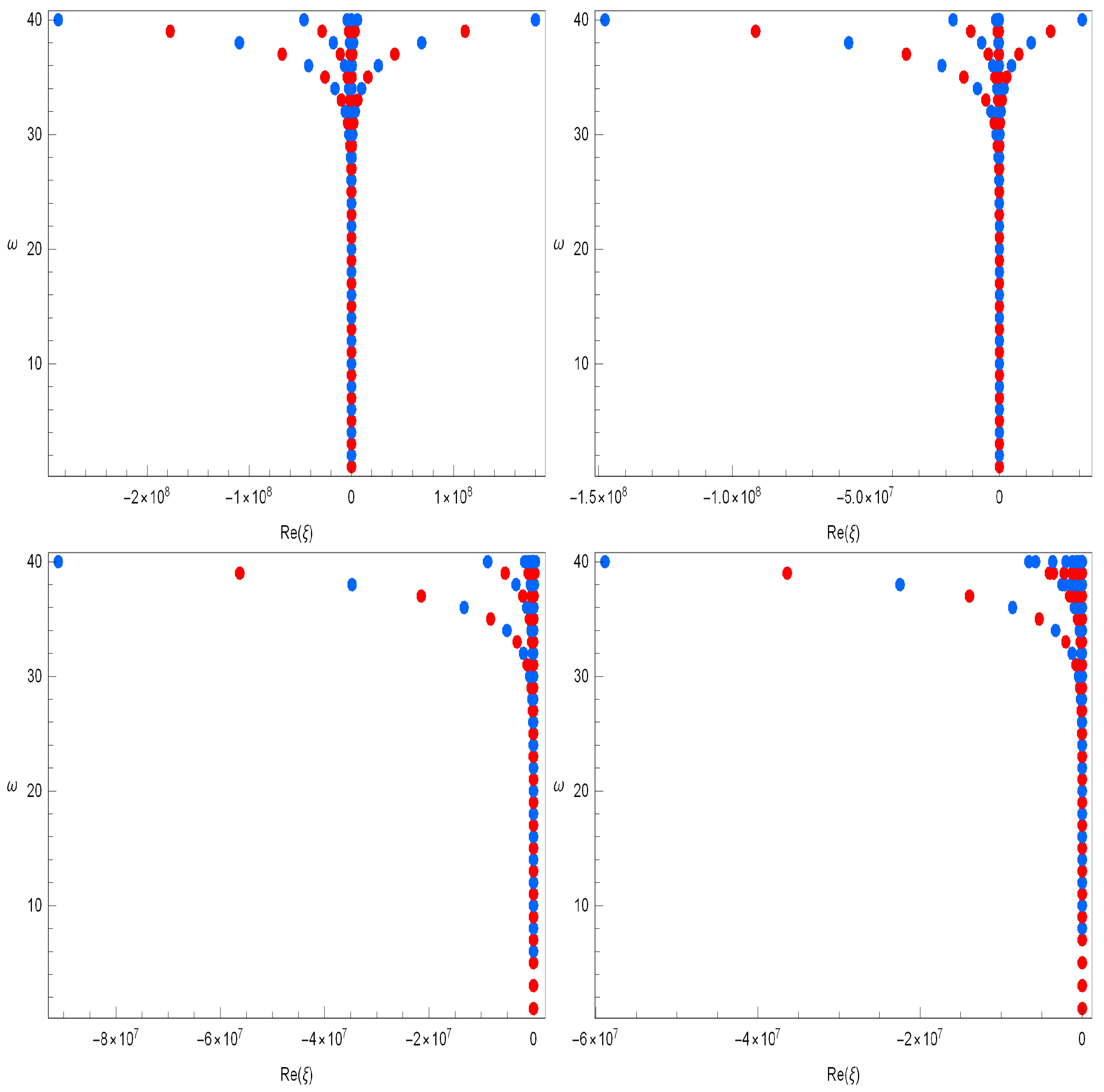
Plots of real zeros of the two parametric kinds of cosine-Apostol-type Frobenius–Euler–Fibonacci polynomials for are presented (Figure 2).
Figure 2.
Real zeros of .
In Figure 2 (top-left), we chose and . In Figure 2 (top-right), we chose and . In Figure 2 (bottom-left), we chose , and . In Figure 2 (bottom-right), we chose and .
Next, we calculated an approximate solution satisfying the two parametric kinds of cosine-Apostol-type Frobenius–Euler–Fibonacci polynomials for . The results are given in Table 1.
Table 1.
Approximate solutions of .
5. Approximate Roots for Sine Apostol-Type Frobenius–Euler–Fibonacci Polynomials and Their Application
In this section, certain zeros of the two parametric kinds of sine-Apostol-type Frobenius–Euler–Fibonacci polynomials and beautifully graphical representations are shown.
A few of them are
and
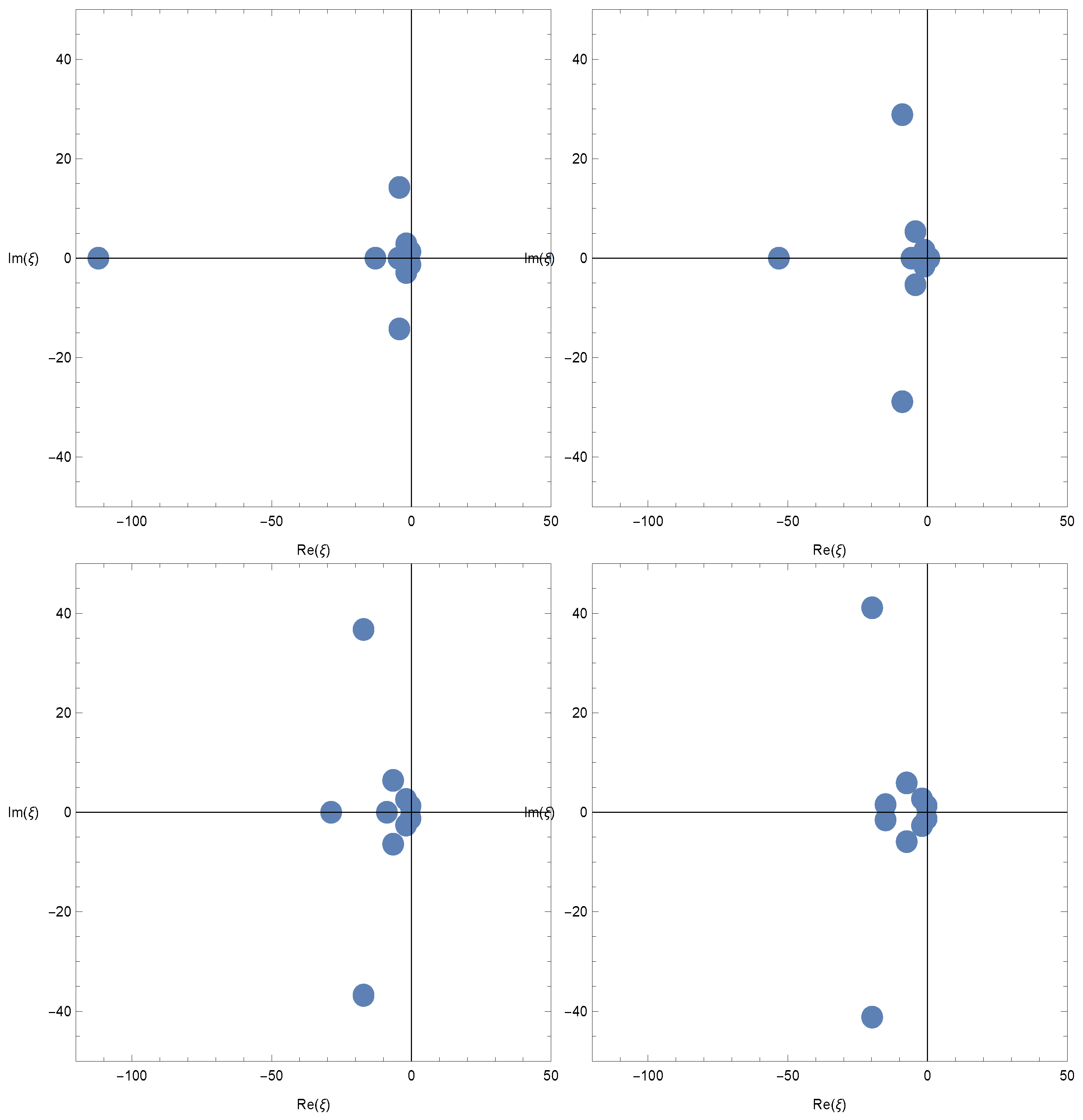
We plot the zeros of the two parametric kinds of sine-Apostol-type Frobenius–Euler–Fibonacci polynomials for (Figure 3).
Figure 3.
Zeros of .
In Figure 3 (top-left), we chose and . In Figure 3 (top-right), we chose and . In Figure 3 (bottom-left), we chose , and . In Figure 3 (bottom-right), we chose and .
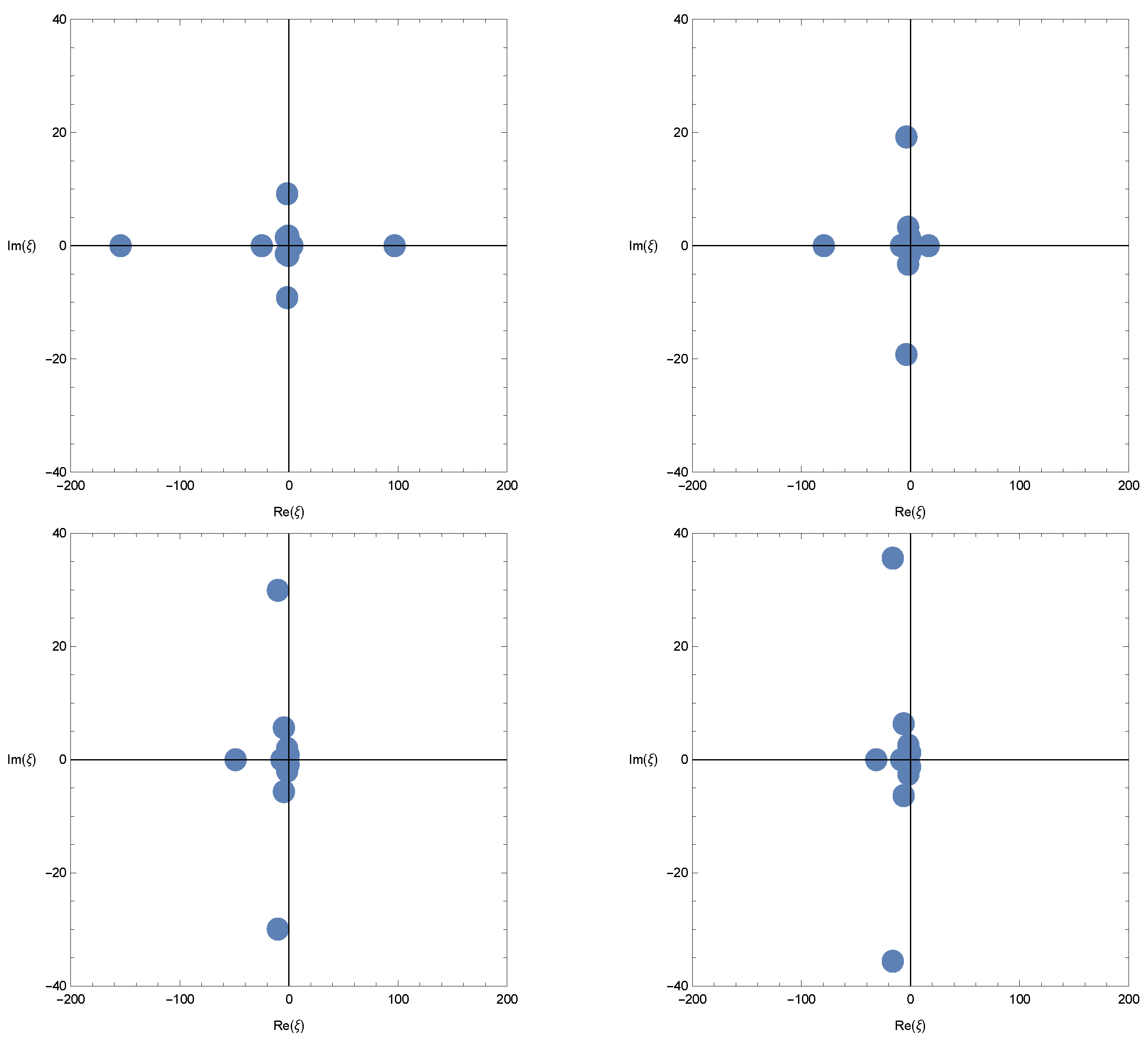
Stacks of zeros of the two parametric kinds of sine-Apostol-type Frobenius–Euler–Fibonacci polynomials for , forming a 3D structure, are presented (Figure 4).
Figure 4.
Zeros of .
In Figure 4 (top-left), we chose and . In Figure 4 (top-right), we chose and . In Figure 4 (bottom-left), we chose , and . In Figure 4 (bottom-right), we chose and .
Next, we calculated an approximate solution satisfying two parametric kinds of sine-Apostol-type Frobenius–Euler–Fibonacci polynomials for . The results are given in Table 2.
Table 2.
Approximate solutions of .
6. Conclusions
The employment of special polynomials in scientific fields is extensive and diverse, encompassing areas such as signal processing, geoscience, engineering, and quantum mechanics. These polynomials play a crucial role in numerical analysis and computational techniques, facilitating the resolution of intricate issues spanning various scientific domains. In numerous studies, researchers in the field of applied mathematics have utilized generating functions and function equations of special polynomials to investigate various topics. The results of these investigations have been documented in numerous research papers. In this article, we aim to introduce the F-analogues of the Apostol-type Frobenius–Euler polynomials defined by Kılar and Simsek [22], using Golden calculus. We have obtained several fundamental properties of these newly established polynomials. Some of the main results in the paper generalize the recently published paper [23]. Furthermore, we have provided zeroes and graphical illustrations for the parametric kinds of Apostol-type Frobenius–Euler–Fibonacci polynomials. The results of this article have the potential to motivate researchers and readers to conduct further research on these special numbers and polynomials.
Author Contributions
Conceptualization, H.G., W.A.K., C.K. and C.S.R.; formal analysis, H.G., W.A.K., C.K. and C.S.R.; funding acquisition, H.G. and W.A.K.; investigation, W.A.K. and C.K.; methodology, H.G., W.A.K., C.K. and C.S.R.; project administration, H.G., W.A.K., C.K. and C.S.R.; software, H.G., W.A.K., C.K. and C.S.R.; writing—original draft, W.A.K. and C.K.; writing—review and editing, H.G., W.A.K., C.K. and C.S.R. All authors have read and agreed to the published version of the manuscript.
Funding
This research received no external funding.
Data Availability Statement
No data were used to support this study.
Conflicts of Interest
The authors declare no conflicts of interest.
References
- Alam, N.; Khan, W.A.; Ryoo, C.S. A note on Bell-based Apostol-type Frobenius-Euler polynomials of complex variable with its certain applications. Mathematics 2022, 10, 2109. [Google Scholar] [CrossRef]
- Lyapin, A.P.; Akhtamova, S.S. Recurrence relations for the sections of the generating series of the solution to the multidimensional difference equation. Vestn. Udmurtsk. Univ. Mat. Mekh. 2021, 31, 414–423. [Google Scholar] [CrossRef]
- Carlitz, L. Eulerian numbers and polynomials. Mat. Mag. 1959, 32, 164–171. [Google Scholar] [CrossRef]
- Cakić, N.P.; Milovanović, G.V. On generalized Stirling number and polynomials. Math. Balk. N. Ser. 2004, 18, 241–248. [Google Scholar]
- Luo, Q.M.; Srivastava, H.M. Some generalization of the Apostol-Genocchi polynomials and Stirling numbers of the second kind. Appl. Math. Comput. 2011, 217, 5702–5728. [Google Scholar] [CrossRef]
- Kurt, B.; Simsek, Y. On the generalized Apostol-type Frobenius-Euler polynomials. Adv. Differ. Equ. 2013, 2013, 1. [Google Scholar] [CrossRef]
- Kim, D.S.; Kim, T. Some new identities of Frobenius-Euler numbers and polynomials. J. Inequal. Appl. 2012, 2012, 307. [Google Scholar] [CrossRef]
- Ryoo, C.S. A note on the Frobenius Euler polynomials. Proc. Jangjeon Math. Soc. 2011, 14, 495–501. [Google Scholar]
- Luo, Q.M.; Srivastava, H.M. Some generalizations of the Apostol-Bernoulli and Apostol-Euler polynomials. J. Math. Anal. Appl. 2005, 308, 290–302. [Google Scholar] [CrossRef]
- Jamei, M.J.; Milovanović, G.; Dagli, M.C. A generalization of the array type polynomials. Math. Morav. 2022, 26, 37–46. [Google Scholar] [CrossRef]
- Simsek, Y. Generating functions for generalized Stirling type numbers, Array type polynomials, Eulerian type polynomials and their applications. J. Fixed Point Theory Appl. 2013, 2013, 87. [Google Scholar] [CrossRef]
- Kus, S.; Tuglu, N.; Kim, T. Bernoulli F-polynomials and Fibo-Bernoulli matrices. Adv. Differ. Equ. 2019, 2019, 145. [Google Scholar] [CrossRef]
- Özvatan, M. Generalized Golden-Fibonacci Calculus and Applications. Ph.D. Thesis, Izmir Institute of Technology, Urla/Izmir, Turkey, 2018. [Google Scholar]
- Pashaev, O.K.; Nalci, S. Golden quantum oscillator and Binet–Fibonacci calculus. J. Phys. A Math. Theor. 2012, 45, 23. [Google Scholar] [CrossRef]
- Pashaev, O.K. Quantum calculus of Fibonacci divisors and infinite hierarchy of bosonic-fermionic golden quantum oscillators. Internat. J. Geom. Methods Modern Phys. 2021, 18, 32. [Google Scholar] [CrossRef]
- Krot, E. An introduction to finite fibonomial calculus. Centr. Eur. J. Math. 2004, 2, 754–766. [Google Scholar] [CrossRef]
- Pashaev, O.K.; Ozvatan, M. Bernoulli-Fibonacci Polynomials. arXiv 2020, arXiv:2010.15080. [Google Scholar]
- Gulal, E.; Tuglu, N. Apostol-Bernoulli-Fibonacci polynomials, Apostol-Euler-Fibonacci polynomials and their generating functions. Turk. J. Math. Comput. Sci. 2023, 15, 202–210. [Google Scholar] [CrossRef]
- Kızılateş, C.; Öztürk, H. On parametric types of Apostol Bernoulli-Fibonacci Apostol Euler-Fibonacci and Apostol Genocchi-Fibonacci polynomials via Golden calculus. AIMS Math. 2023, 8, 8386–8402. [Google Scholar] [CrossRef]
- Tuğlu, N.; Ercan, E. Some properties of Apostol Bernoulli Fibonacci and Apostol Euler Fibonacci Polynomials. In Proceedings of the ICMEE-2021, Ankara, Turkey, 16–18 September 2021; pp. 32–34. [Google Scholar]
- Alatawi, M.A.; Khan, W.A.; Kızılateş, C.; Ryoo, C.S. Some Properties of Generalized Apostol-type Frobenius-Euler-Fibonacci polynomials. Mathematics 2024, 12, 800. [Google Scholar] [CrossRef]
- Kılar, N.; Simsek, Y. Two Parametric Kinds of Eulerian-Type Polynomials Associated with Euler’s Formula. Symmetry 2019, 11, 1097. [Google Scholar] [CrossRef]
- Urieles, A.; Ramirez, W.; Ha, L.C.P.; Ortegac, M.J.; Arenas-Penaloza, J. On F-Frobenius-Euler polynomials and their matrix approach. J. Math. Comput. Sci. 2024, 32, 377–386. [Google Scholar] [CrossRef]
Disclaimer/Publisher’s Note: The statements, opinions and data contained in all publications are solely those of the individual author(s) and contributor(s) and not of MDPI and/or the editor(s). MDPI and/or the editor(s) disclaim responsibility for any injury to people or property resulting from any ideas, methods, instructions or products referred to in the content. |
© 2024 by the authors. Licensee MDPI, Basel, Switzerland. This article is an open access article distributed under the terms and conditions of the Creative Commons Attribution (CC BY) license (https://creativecommons.org/licenses/by/4.0/).