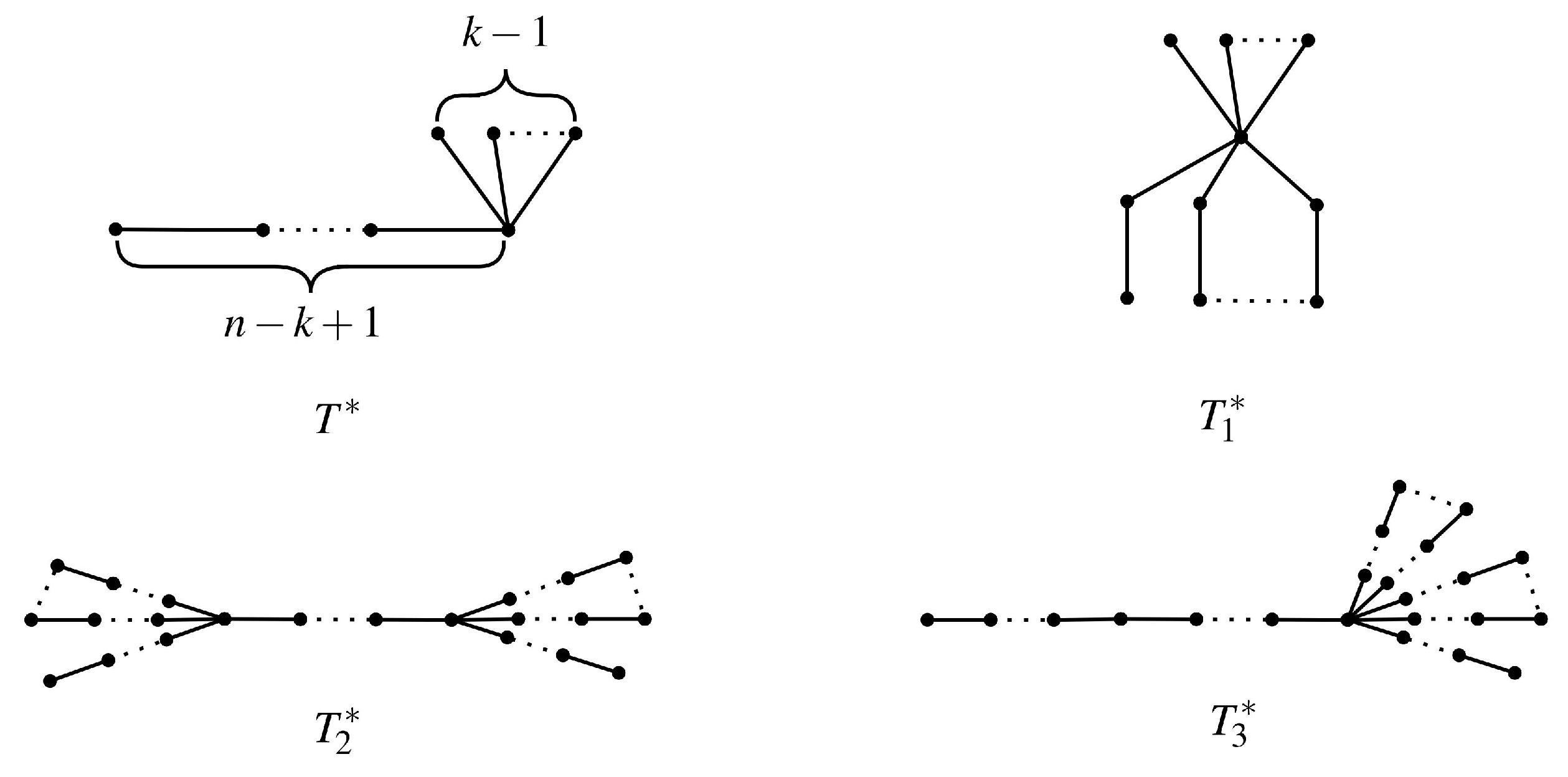
In this section, we will give the proof of Theorem 1.
Proof of Theorem 1. If , then . If , then , and with equality if and only if by Remark 1. If , then . Thus, we only need to consider . Obviously, is unbalanced since the only balanced is the one with . And . Let be a unit eigenvector corresponding to . By arranging the vertices of appropriately, we can assume that such that , where corresponds to the vertex for . Note that must be an eigenvector of if X is an eigenvector. Then we divide the proof into the following two cases.
Case 1. There exists a nonnegative eigenvector. Obviously, since .
Claim 1. Up to replacing with another vertex such that , we have .
It is trivial when
. If
, then there is a vertex
such that
. Let
P be the unique path in
T between
and
. Then we assert that
. Otherwise, we will divide into the following two cases. If
, then we can construct a new unbalanced signed graph
by reversing the signs of the positive edges
and the negative edges
whose negative edges also form a spanning tree with
k pendant vertices, where
. Thus,
If
, then
X is also an eigenvector of
corresponding to
. However,
for any
, a contradiction. If
, then we can construct a new unbalanced signed graph
by reversing the sign of the positive edge
and the negative edge
for any
whose negative edges also form a spanning tree with
k pendant vertices such that
by Lemma 1, a contradiction. Thus,
. And then we just need to exchange the subscripts
and
, as desired.
Claim 1 means that . Note that there are at least two vertices of T with degree greater than three if . Next, we will show that .
Otherwise, there is a positive integer
such that
. Let
P be the path from
to
in
T. Since
, there is a vertex
such that
and
. Then we first assert that
. Otherwise, we can construct a new unbalanced signed graph
by reversing the sign of the positive edge
and the negative edge
whose negative edges also form a spanning tree with
k pendant vertices such that
by Lemma 1, a contradiction. Let
and
. Then
for any
and
. Next, we will divide into the following three cases. If
, then
which implies
for any
, and then
, a contradiction. If
, i.e.,
, then we claim that
. Otherwise, let
. If
, then we can construct a new unbalanced signed graph
by reversing the sign of the positive edge
and the negative edge
whose negative edges also form a spanning tree with
k pendant vertices such that
by Lemma 1, a contradiction. So,
. However,
which implies
for any
, and then
, a contradiction. Thus, by the characteristic equation we obtain
It shows that
. And then
since
. So
, a contradiction. Now, we assume that
, i.e.,
. Let
. By a similar discussion, we have
for any
. By the characteristic equation we obtain
Thus,
and
. And then
. So
, a contradiction.
By Claim 2, for any positive integer . Let p and q be the minimum and maximum subscripts such that , respectively. It is obvious that and .
Claim 3. Up to replacing with another vertex such that , we have .
It is trivial when . Now, we consider . Note that since , i.e., . Let , , and . Then we assert that . Otherwise, we can construct a new unbalanced signed graph by reversing the sign of the positive edge and the negative edge whose negative edges also form a spanning tree with k pendant vertices such that by Lemma 1, a contradiction. Thus, we just need to exchange the subscripts and , as desired.
Otherwise,
. Let
by Claim 3
, and
. By the characteristic equation we obtain
Then
and
. And
by
. So,
since
. Thus,
, a contradiction.
If
for any vertex
, then
(see
Figure 1). Next, assume that there is a positive integer
such that
and
. Let
be the unique path in
T which contains
and
, and let
be the unique path in
T which contains
and
. Suppose that
and
such that
. If
, then we can construct a new unbalanced signed graph
by reversing the sign of the positive edge
and the negative edge
whose negative edges also form a spanning tree with
k pendant vertices such that
by Lemma 1, a contradiction. Let
. If
, then we can construct a new unbalanced signed graph
by reversing the signs of the positive edges
and
and the negative edges
and
whose negative edges also form a spanning tree with
k pendant vertices, and
If
, then
X is also the unit eigenvector corresponding to
and
that is,
and
. Let
and
. Since
we have
We assert that
. Otherwise,
, which implies that
, a contradiction. If
, then
by (1) and (2), that is,
. If
, let
, then
that is,
. Thus,
and
So,
which means that
. Next, we will consider that following two cases.
Subcase 1.1. , i.e.,
. Note that
We have
, and then
, a contradiction.
Subcase 1.2. . Let
, i.e.,
. Since
we have
. This leads to
for any
. So,
, which means that
, a contradiction.
Case 2. There are no nonnegative eigenvectors. For a fixed eigenvector , let and . Clearly, , and there must exist a vertex v such that . Let , and . Note that . For convenience, set and for , then and . Obviously, for .
Subcase 2.1. or . By symmetry, we just consider .
Claim 5. .
It is trivial when
. If
, then there is a vertex
such that
. Let
P be the unique path in
T between
and
. If
, then we can construct a new unbalanced signed graph
by reversing the signs of the positive edges
and the negative edges
whose negative edges also form a spanning tree with
k pendant vertices, where
. Thus,
If
, then
X is also an eigenvector of
corresponding to
. However,
for any
, a contradiction. If
, then we can construct a new unbalanced signed graph
by reversing the sign of the positive edge
and the negative edge
for any
whose negative edges also form a spanning tree with
k pendant vertices such that
by Lemma 1, a contradiction.
Claim 5 means that . Note that there are at least two vertices of T with degree greater than three if . Next, we will show that .
Otherwise, there is a vertex such that . Let P be the path from to in T. Since , there is a vertex such that . We can construct a new unbalanced signed graph by reversing the sign of the positive edge and the negative edge whose negative edges also form a spanning tree with k pendant vertices such that by Lemma 1, a contradiction.
By Claim 6, for any . Let q be the maximum subscripts such that . Evidently, .
Claim 7. For any vertex with , we have .
Otherwise, there is a positive integer
t (
) such that
and
. Let
P be the path between
and
in
T. If
, then there must be a vertex
such that
and we can construct a new unbalanced signed graph
by reversing the signs of the positive edges
,
and the negative edges
,
whose negative edges also form a spanning tree with
k pendant vertices. Thus,
a contradiction. If
and
, then
and we can construct a new unbalanced signed graph
by reversing the sign of the positive edge
and the negative edge
whose negative edges also form a spanning tree with
k pendant vertices such that
by Lemma 1, a contradiction. If
and
, then there must be a vertex
such that
. We can construct a new unbalanced signed graph
by reversing the signs of the positive edges
,
and the negative edges
,
whose negative edges also form a spanning tree with
k pendant vertices, then
a contradiction.
Let p be the minimum subscript such that . If , then the subscripts of vertices of are consecutive. If , then by Claim 7. Let r () be the minimum subscript such that . Then and we exchange the subscripts of and . We continue this procedure until the subscripts of vertices of are consecutive. Without loss of generality, it is not restrictive to assume that by Claims 5–7.
Claim 8.
Otherwise, Recall that ; thus, there must exist vertices and such that , where and . Note that . Then we can construct a new unbalanced signed graph by reversing the sign of the positive edge and the negative edge whose negative edges also form a spanning tree with k pendant vertices such that by Lemma 1, a contradiction.
By Claim 8, let . Then the following claim holds.
Otherwise,
. Let
P be the path between
and
in
T. If
, then there is a vertex
such that
. Note that
. If
, then we can construct a new unbalanced signed graph
by reversing the signs of the positive edges
,
and the negative edges
,
whose negative edges also form a spanning tree with
k pendant vertices and
a contradiction. If
, then we can construct a new unbalanced signed graph
by reversing the sign of the positive edge
and the negative edge
whose negative edges also form a spanning tree with
k pendant vertices and
If
, then
X is also an eigenvector of
corresponding to
. However,
a contradiction. Next, we assume that
. Note that
. If
, then we can construct a new unbalanced signed graph
by reversing the sign of the positive edge
and the negative edge
whose negative edges also form a spanning tree with
k pendant vertices such that
by Lemma 1, a contradiction. If
, let
such that
. Thus,
and we can construct a new unbalanced signed graph
by reversing the signs of the positive edges
,
and the negative edges
,
whose negative edges also form a spanning tree with
k pendant vertices and
If
, then
X is also an eigenvector of
corresponding to
. However,
a contradiction.
If , then . If , then we just need to exchange the subscripts of and by Claim 9. Without loss of generality, it is not restrictive to assume that .
Claim 10. for .
Suppose by way of contradiction that there exist positive integers and such that . Let P be the path which contains and in T, and such that . Obviously, . Then we can construct a new unbalanced signed graph by reversing the sign of the positive edge and the negative edge whose negative edges also form a spanning tree with k pendant vertices such that by Lemma 1, a contradiction.
By Claims 5–10, we can immediately obtain that
depicted in
Figure 1.
Subcase 2.2. and . Recall that must be an eigenvector of if X is an eigenvector. So, without loss of generality, assume that is the vertex such that . Let and .
Claim 11. If , then .
Assume to the contrary that
. Then there is a vertex
such that
is the unique path between
and
in
T. Since
,
. If
, then we can construct a new unbalanced signed graph
by reversing the sign of the positive edge
and the negative edge
for all
whose negative edges also form a spanning tree with
k pendant vertices and
If
, then
X is also an eigenvector of
corresponding to
. However, for any
, we have
a contradiction. If
, let
, then we can construct a new unbalanced signed graph
by reversing the sign of the positive edge
and the negative edge
whose negative edges also form a spanning tree with
k pendant vertices such that
by Lemma 1, a contradiction.
By Claim 11, we divide the proof into the following two cases.
Subcase 2.2.1. . Note that by Claim 11.
Claim 12. for any .
Otherwise, suppose that
such that
. We assert that
. Otherwise, let
, then we can construct a new unbalanced signed graph
by reversing the sign of the positive edge
and the negative edge
whose negative edges also form a spanning tree with
k pendant vertices such that
by Lemma 1, a contradiction. Now, we can construct a new unbalanced signed graph
by reversing the sign of the positive edge
and the negative edge
for all
whose negative edges also form a spanning tree with
k pendant vertices and
If
, then
X is also an eigenvector of
corresponding to
. However, for any
, we have
a contradiction.
Claim 13. for any .
Assume to the contrary that there is a vertex
such that
. If
, then by the characteristic equation we obtain
These mean that
and
. By Claim 12, for any vertex
, we have
which means that
, a contradiction. Now, we assume that
. Recall that
and let
. Then we can construct a new unbalanced signed graph
by reversing the sign of the positive edge
and the negative edge
whose negative edges also form a spanning tree with
k pendant vertices such that
by Lemma 1, a contradiction.
Otherwise,
. We first assume that
and
. Then there is a vertex
such that
since
. And we can construct a new unbalanced signed graph
by reversing the sign of the positive edge
and the negative edge
for all
and reversing the sign of the positive edge
and the negative edge
for all
whose negative edges also form a spanning tree with
k pendant vertices and
a contradiction. Now we assume that
and
. Let
be the path between
and
in
T. Then we can construct a new unbalanced signed graph
by reversing the sign of the positive edge
and the negative edge
for all
and reversing the sign of the positive edge
and the negative edge
for all
whose negative edges also form a spanning tree with
k pendant vertices and
a contradiction. Finally, let
and
. Note that
. Then we can construct a new unbalanced signed graph
by reversing the sign of the positive edge
and the negative edge
whose negative edges also form a spanning tree with
k pendant vertices such that
by Lemma 1, a contradiction.
It is not restrictive to assume that by Claim 14. Let .
If
, then the result obviously holds. Now, we assume that
. Assume to the contrary that
. By Claim 12, there is a vertex
such that
is the path between
and
in
T. If
, then we can construct a new unbalanced signed graph
by reversing the signs of the positive edges
,
and the negative edges
,
whose negative edges also form a spanning tree with
k pendant vertices and
If
, then
X is also an eigenvector of
corresponding to
. However,
a contradiction. If
, then there exists a vertex
. If
, then we can construct a new unbalanced signed graph
by reversing the signs of the positive edges
,
and the negative edges
,
whose negative edges also form a spanning tree with
k pendant vertices and
If
, then
X is also an eigenvector of
corresponding to
. However,
a contradiction. If
, then we can construct a new unbalanced signed graph
by reversing the signs of the positive edges
,
and the negative edges
,
whose negative edges also form a spanning tree with
k pendant vertices and
a contradiction.
Claim 16. .
Otherwise,
. Then there is a vertex
such that
. Let
P be the path from
to
w in
T. Assume that
at first. We assert that
. Otherwise, let
. Then we can construct a new unbalanced signed graph
by reversing the sign of the positive edge
and the negative edge
whose negative edges also form a spanning tree with
k pendant vertices such that
by Lemma 1, a contradiction. Since
,
. Then we can construct a new unbalanced signed graph
by reversing the signs of the positive edge
and the negative edges
for all
whose negative edges also form a spanning tree with
k pendant vertices and
If
, then
X is also an eigenvector of
corresponding to
. However,
for any
, a contradiction. Now, we assume that
. Note that at least one of
and
holds since
. If
, then we can construct a new unbalanced signed graph
by reversing the signs of the positive edges
,
and the negative edges
,
for all
and
whose negative edges also form a spanning tree with
k pendant vertices and
a contradiction. If
, then we can construct a new unbalanced signed graph
by reversing the signs of the positive edges
,
and the negative edges
,
for all
whose negative edges also form a spanning tree with
k pendant vertices and
If
, then
X is also an eigenvector of
corresponding to
. However,
a contradiction.
Claim 16 shows that
for any
, which means that
T must be a starlike tree. Since
, there is a vertex
such that
. Let
. We assert that
. Otherwise, we can construct a new unbalanced signed graph
by reversing the signs of the positive edges
,
and the negative edges
,
whose negative edges also form a spanning tree with
k pendant vertices and
a contradiction. If
, set
, then either
or
. If
, then we can construct a new unbalanced signed graph
by reversing the signs of the positive edges
,
,
and the negative edges
,
,
whose negative edges also form a spanning tree with
k pendant vertices and
a contradiction. If
, then we can construct a new unbalanced signed graph
by reversing the signs of the positive edges
,
,
and the negative edges
,
,
whose negative edges also form a spanning tree with
k pendant vertices and
If
, then
X is also an eigenvector of
corresponding to
. However,
a contradiction. These show that
and
, where
is the spanning tree shown in
Figure 1. Let
such that
, then we can construct a new unbalanced signed graph
by reversing the sign of the positive edge
and the negative edge
whose negative edges also form a spanning tree with
k pendant vertices such that
by Lemma 1. As we continue the above procedure inductively, we obtain that
.
Subcase 2.2.2. . Note that since .
Otherwise,
. Let
be the unique path between
and
in
T, where
. If
, then we can construct a new unbalanced signed graph
by reversing the sign of the positive edge
and the negative edge
for all
whose negative edges also form a spanning tree with
k pendant vertices and
a contradiction. Now we assume that
and
. Then we can construct a new unbalanced signed graph
by reversing the sign of the positive edge
and the negative edge
whose negative edges also form a spanning tree with
k pendant vertices such that
by Lemma 1, a contradiction.
Let .
If
, then the result obviously holds. Now assume that
. Assume to the contrary that
. There is a vertex
such that
or
is the path containing
,
and
in
T. We first consider the case of
. If
, then we can construct a new unbalanced signed graph
by reversing the signs of the positive edges
and the negative edges
whose negative edges also form a spanning tree with
k pendant vertices and
a contradiction. If
, then there exists a vertex
. If
, then we can construct a new unbalanced signed graph
by reversing the signs of the positive edges
and the negative edges
whose negative edges also form a spanning tree with
k pendant vertices and
If
, then
X is also an eigenvector of
corresponding to
. However,
a contradiction. If
, then we can construct a new unbalanced signed graph
by reversing the signs of the positive edges
and the negative edges
whose negative edges also form a spanning tree with
k pendant vertices and
a contradiction. Then we consider the case of
. Similar to the above, we can obtain the contradiction.
It is not restrictive to assume that
by Claim 17. Let
. If
, then
T is a starlike tree. Now, we consider
and
. Let
be the unique path between
and
w in
T. If
, then we assert that
for any
. Assume to the contrary that
and
, then we can construct a new unbalanced signed graph
by reversing the sign of the positive edge
and the negative edge
whose negative edges also form a spanning tree with
k pendant vertices such that
by Lemma 1, a contradiction. Similarly, we can obtain that
for any
if
. And either
or
. We first consider
and
. Let
. If
, let
be the unique path between
and
in
T. Note that
and
v may be the same vertex. Let
. If
, then for any
, we can construct a new unbalanced signed graph
by reversing the signs of the positive edge
and the negative edge
whose negative edges also form a spanning tree with
k pendant vertices such that
by Lemma 1, a contradiction. If
, then we can construct a new unbalanced signed graph
by reversing the signs of the positive edges
and the negative edges
for all
whose negative edges also form a spanning tree with
k pendant vertices and
If
, then
X is also an eigenvector of
corresponding to
. However,
a contradiction. If
, we can similarly obtain the contradiction. Thus,
. So, we only need to consider
. Similarly, we can obtain that
. Then
, where
is the spanning tree shown in
Figure 1.
Let
. Then
. For any
, we have
. Then we can construct a new unbalanced signed graph
by reversing the sign of the positive edge
and the negative edge
whose negative edges also form a spanning tree with
k pendant vertices such that
by Lemma 1, a contradiction. As we continue the above procedure inductively, we obtain that
, where
is depicted in
Figure 1. One can easily observe that
. In this case, we have
. Therefore,
. This completes the proof.□