
Article

New Inequalities and Approximations of Cusa–Huygens Type

School of Electrical Engineering, University of Belgrade, Bulevar kralja Aleksandra 73, 11000 Belgrade, Serbia
*
Author to whom correspondence should be addressed.
Axioms 2025, 14(12), 920; https://doi.org/10.3390/axioms14120920
Submission received: 3 November 2025 / Revised: 28 November 2025 / Accepted: 10 December 2025 / Published: 14 December 2025
(This article belongs to the Special Issue Numerical Methods and Approximation Theory)

Abstract

In this paper, we introduce a real parameter in some Cusa–Huygens-type inequalities. Using the concept of stratification, we obtain new inequalities and approximations.

1. Introduction

The well known Cusa’s inequality is
3 sin x 2 + cos x < x ,
for x 0 , π / 2 , [1,2,3]. Huygens gave the first proof of this inequality [4]. Cusa’s inequality is used for obtaining the approximation
3 sin x 2 + cos x x ,
for x 0 , π / 2 . The previous approximation is called Cusa’s approximation [5,6], see also [7,8,9,10].
Extensions and generalisations of the Cusa–Huygens inequality have been considered in many papers [5,11,12,13,14,15,16,17,18,19,20,21,22,23,24,25,26,27,28,29,30,31,32,33,34,35,36,37,38,39,40,41,42,43,44,45,46,47,48,49,50]. In [11], Zhu obtained and proved the following theorems:
Theorem 1.
Let 0 < x < π / 2 . Then,
sin x x 2 + cos x 3 < 1 180 x 4 sin x x 2 / 7
holds with the best constant 1 / 180 .
Theorem 2.
Let 0 < x < π / 2 . Then,
sin x x 2 + cos x 3 < 2 3 2 π ( sin x x cos x ) ( π 2 12 ) / ( 3 π 2 π 3 )
holds with the best constant ( 2 / 3 2 / π ) .
In this paper, we improve the previous two theorems using the concept of stratification [6,51,52,53,54,55,56,57].
In Theorem 5, we give the lower bound for the function sin x x 2 + cos x 3 from Theorem 1, as well as a new proof that the constant 1 / 180 is the best possible for the inequality from Theorem 1.
In Section 3.1, we provide a new proof that the constant ( 2 / 3 2 / π ) is the best possible for the inequality from Theorem 2.
In Theorems 6 and 11, we give some generalisations of Theorems 1 and 2, respectively.
Additionally, in Theorems 10 and 16 and their corollaries, we give some new approximations of the function sin x x 2 + cos x 3 .

2. Preliminaries

2.1. Stratification

Let { φ p ( x ) } p P be a family of functions that we consider for x S R and p P R . The family of functions { φ p ( x ) } p P is increasingly stratified on the set S with respect to the parameter  p P if
( x S ) ( p 1 , p 2 P ) p 1 < p 2 φ p 1 ( x ) < φ p 2 ( x ) ,
i.e., decreasingly stratified on the set S with respect to the parameter  p P if
( x S ) ( p 1 , p 2 P ) p 1 < p 2 φ p 1 ( x ) > φ p 2 ( x ) ,
see [6,51,52,53,54,55,56,57]. According to [55], for the stratified family of functions { φ p ( x ) } p P , it is significant to determine, if it exists, a function φ p 0 ( x ) for which holds
inf p P sup x S | φ p ( x ) | = sup x S φ p 0 ( x ) .
The function φ p 0 ( x ) is called the minimax approximant of the family { φ p ( x ) } p P .
The approximation φ p 0 ( x ) 0 is called the minimax approximation with the error d 0 = sup x S | φ p 0 ( x ) | .

2.2. A Parametric Method

In this paper, to determine the sign of the functions φ p ( x ) , we use the parametric method for proving some analytic inequalities [52] (for applications of the method see also [6,51,56,57]).
The parametric method from [52] is based on the analysis of the function g : S P , which is defined by
g ( x ) = p φ p ( x ) = 0 ,
if such a function exists. In [52], based on the monotonicity of the function g, the following theorems are proved.
Theorem 3.
Let { φ p ( x ) } p P be a family of functions for x S = ( a , b ) R and let P R ( P ) , satisfying the following conditions:
1.
the family of functions { φ p ( x ) } p P is increasingly (decreasingly) stratified on the interval ( a , b ) ;
2.
there exists a continuous monotonically increasing function g : ( a , b ) P that satisfies ( ) ;
3.
there exist limits lim x a g ( x ) = A and lim x b g ( x ) = B in R ¯ such that ( A , B ) P .
Then, it holds:
(i)
If p A , then
( x ( a , b ) ) φ p ( x ) φ A ( x ) < 0 ( x ( a , b ) ) φ p ( x ) φ A ( x ) > 0 .
(ii)
If p ( A , B ) , then the equality φ p ( x ) = 0 has a unique solution x 0 ( p ) ( a , b ) and it holds that
x a , x 0 ( p ) φ p ( x ) > 0 x a , x 0 ( p ) φ p ( x ) < 0
and
x x 0 ( p ) , b φ p ( x ) < 0 x x 0 ( p ) , b φ p ( x ) > 0 .
(iii)
If p B , then
( x ( a , b ) ) φ p ( x ) φ B ( x ) > 0 ( x ( a , b ) ) φ p ( x ) φ B ( x ) < 0 .
Theorem 4.
Let { φ p ( x ) } p P be a family of functions for x S = ( a , b ) R and let P R ( P ) , satisfying the following conditions:
1.
the family of functions { φ p ( x ) } p P is increasingly (decreasingly) stratified on the interval ( a , b ) ;
2.
there exists a continuous monotonically decreasing function g : ( a , b ) P that satisfies (1);
3.
there exist limits lim x b g ( x ) = A and lim x a g ( x ) = B in R ¯ such that ( A , B ) P .
Then, it holds:
(i)
If p A , then
( x ( a , b ) ) φ p ( x ) φ A ( x ) < 0 ( x ( a , b ) ) φ p ( x ) φ A ( x ) > 0 .
(ii)
If p ( A , B ) , then the equality φ p ( x ) = 0 has a unique solution x 0 ( p ) ( a , b ) and it holds that
x a , x 0 ( p ) φ p ( x ) < 0 x a , x 0 ( p ) φ p ( x ) > 0
and
x x 0 ( p ) , b φ p ( x ) > 0 x x 0 ( p ) , b φ p ( x ) < 0 .
(iii)
If p B , then
( x ( a , b ) ) φ p ( x ) φ B ( x ) > 0 ( x ( a , b ) ) φ p ( x ) φ B ( x ) < 0 .
Let us note that in [52], the case when a function g has exactly one local minimum on the observed interval S = ( a , b ) R was also considered.

2.3. A Method for Proving Mixed Trigonometric Polynomial Inequalities

We use the method for proving mixed trigonometric polynomial (MTP) inequalities from [51,58,59]. A function
f ( x ) = i = 1 n α i x p i cos q i x sin r i x ,
where α i R { 0 } , p i , q i , r i N 0 and n N , for x R , we call an MTP function. An inequality f ( x ) > 0 for x S R , we call an MTP inequality.
The method for proving MTP inequalities from [51,58,59] is based on the following:
(1)
Transformation of a given MTP function f ( x ) in the following form:
f ( x ) = i = 1 m β i x s i t r i g i ( k i x ) ,
where β i R { 0 } , s i , k i N 0 , m N , t r i g i = cos or t r i g i = sin , see Table 1 [51].
(2)
Approximation of each function t r i g i ( k i x ) by a Taylor polynomial using the following estimates:
( ) cos ( k i x ) > T 4 i + 2 cos , 0 ( k i x ) , if β i > 0 , cos ( k i x ) < T 4 i cos , 0 ( k i x ) , if β i < 0 , sin ( k i x ) > T 4 i + 3 sin , 0 ( k i x ) , if β i > 0 , sin ( k i x ) < T 4 i + 1 sin , 0 ( k i x ) , if β i < 0
where T n ϕ , a denote the Taylor expansion of order n of a function ϕ in a neighbourhood of the point a ( i N 0 ), see Lemmas 1.1 and 1.2 from [58].
By applying ( ) , we determine a polynomial
P ( x ) = i = 1 m β i x s i T ϑ i t r i g i , a ( k i x ) ,
where
ϑ i = 4 i + 2 , i f   t r i g i = cos a n d β i > 0 , 4 i , i f   t r i g i = cos a n d β i < 0 , 4 i + 3 , i f   t r i g i = sin a n d β i > 0 , 4 i + 1 , i f   t r i g i = sin a n d β i < 0
for which it holds that P ( x ) is downward polynomial approximation of the function f ( x ) in the sense
f ( x ) > P ( x )
for x S and x > 0 .
(3)
Searching for the values 1 , 2 , , m ( i N 0 ), if there exist, such that P ( x ) > 0 for x S . If there exist values 1 , 2 , , m such that P ( x ) > 0 for x S , then we have proof that
f ( x ) > 0
for x S and x > 0 .
For determining the sign of the polynomial P ( x ) , we use Sturm’s theorem ([60]; Section 6.4 [61]; [62]), see also [63,64,65,66,67,68].
In this paper, an application of the previously described method for proving MTP inequalities is given in Lemma 2. The other MTP inequalities could be proved analogously.

3. Main Results

3.1. New Results Related to Theorem 1

Based on Theorem 1, we form the family of functions
{ φ ( x ) } p P ,
for P = R , defined on [ 0 , π / 2 ] with
φ p ( x ) = sin x x + 2 + cos x 3 p x 4 sin x x 2 / 7 , x ( 0 , π / 2 ] , 0 , x = 0 .
Note that Theorem 1 claims that
φ A ( x ) > 0
for A = 1 / 180 and x ( 0 , π / 2 ) .
Lemma 1.
The family of functions { φ p ( x ) } p R is decreasingly stratified on the interval ( 0 , π / 2 ) .
Proof. 
It holds that d φ p ( x ) d p = x 4 sin x x 2 / 7 < 0 for x ( 0 , π / 2 ) . □
Let us note that for x ( 0 , π / 2 ) , it holds that
φ p ( x ) = sin x x + 2 + cos x 3 p x 4 sin x x 2 / 7 = 0 p = g ( x ) = 1 3 x cos x + 3 sin x 2 x x 5 sin x x 2 / 7 .
Lemma 2.
The function g ( x ) is increasing on the interval ( 0 , π / 2 ) .
Proof. 
The function g ( x ) has the first derivative
g ( x ) = f ( x ) 21 x 6 sin x sin x x 2 / 7 ,
where
f ( x ) = 5 x 2 cos 2 x 41 x cos x sin x 4 x 2 cos x 52 x sin x 99 cos 2 x 7 x 2 + 99
is a mixed trigonometric polynomial (MTP) function. Let us examine the sign of the function f ( x ) by applying the method for proving MTP inequalities from [58,59].
It holds that
f ( x ) = 4 x 2 cos x + 5 x 2 2 cos 2 x 9 x 2 2 52 x sin x 41 x 2 sin 2 x 99 2 cos 2 x + 99 2 .
One downward polynomial approximation of the function f ( x ) on the interval 0 , π / 2 is given by
P ( x ) = 4 x 2 T 4 1 cos , 0 x + 5 2 x 2 T 4 2 + 2 cos , 0 2 x 9 2 x 2 52 x T 4 3 + 1 sin , 0 x 41 2 x T 4 4 + 1 sin , 0 2 x 99 2 T 4 5 cos , 0 2 x + 99 2 ,
where 1 , 2 , , 5 N 0 .
For example, for ( 1 , 2 , 3 , 4 , 5 ) = ( 3 , 2 , 3 , 3 , 3 ) (it is possible to find some other values 1 , 2 , 3 , 4 , 5 such that P ( x ) > 0 on the interval ( 0 , π / 2 ) ), it can be proved that
P ( x ) = 4 x 2 T 12 cos , 0 x + 5 2 x 2 T 10 cos , 0 2 x 9 2 x 2 52 x T 13 sin , 0 x 41 2 x T 13 sin , 0 2 x 99 2 T 12 cos , 0 2 x + 99 2 = 4201 155675520 x 14 31 415800 x 12 + 17 25200 x 10 = P ( x ) = x 10 4201 155675520 x 4 31 415800 x 2 + 17 25200 > 0
on the interval ( 0 , π / 2 ) : by applying Sturm’s theorem to the polynomial
4201 155675520 x 4 31 415800 x 2 + 17 25200
we conclude that this polynomial does not have zeros on the segment 0 , π / 2 , i.e., the polynomial P ( x ) does not have zeros and is positive on the interval 0 , π / 2 . Hence, it holds that
f ( x ) > 0
on the interval 0 , π / 2 . Thus,
g ( x ) > 0
on the interval 0 , π / 2 . □
Notice that
lim x 0 + g ( x ) = A = 1 180 = 0.00555 .
Let
B = lim x π / 2 g ( x ) = 16 π 3 2 5 / 7 3 π 33 / 7 = 0.00561 .
With the new constant B, we obtain one improvement of Theorem 1:
Theorem 5.
Let 0 < x < π / 2 . Then it holds
B x 4 sin x x 2 / 7 < sin x x 2 + cos x 3 < A x 4 sin x x 2 / 7
with the best constants A = 1 180 and B = 16 π 3 2 5 / 7 3 π 33 / 7 .
Based on Lemmas 1 and 2, the first and the second condition of Theorem 3 are satisfied. Since there exist limits lim x 0 g ( x ) = A and lim x π / 2 g ( x ) = B , the third condition of Theorem 3 is also satisfied. Based on this, we obtain the following generalisation of Theorem 1.
Theorem 6.
(i) If p ( , A ] , then
x ( 0 , π / 2 ) sin x x 2 + cos x 3 < A x 4 sin x x 2 / 7 p x 4 sin x x 2 / 7 .
(ii) If p ( A , B ) , then the equation g ( x ) = p has a unique solution x 0 ( p ) ( 0 , π / 2 ) and it holds that
x ( 0 , x 0 ( p ) ) p x 4 sin x x 2 / 7 < sin x x 2 + cos x 3
and
x ( x 0 ( p ) , π / 2 ) sin x x 2 + cos x 3 < p x 4 sin x x 2 / 7 .
(iii) If p [ B , + ) , then
x ( 0 , π / 2 ) p x 4 sin x x 2 / 7 B x 4 sin x x 2 / 7 < sin x x 2 + cos x 3 .
In the following, we will show that the family φ p ( x ) p R has a unique minimax approximant. For that purpose, we consider the family d φ p ( x ) d x p R , for 0 < x < π / 2 , which is defined by
d φ p ( x ) d x = 2 7 7 6 x 2 sin x + 7 2 x cos x 7 2 sin x sin x x 5 / 7 + p x cos x + 13 sin x x 2 sin x x 5 / 7 .
Let us notice that for x ( 0 , π / 2 ) , it holds that
d φ p ( x ) d x = 0 p = g 1 ( x ) = 7 6 sin x x 5 / 7 x 2 sin x + 3 x cos x 3 sin x x 4 x cos x + 13 sin x .
Lemma 3.
The function g 1 ( x ) is increasing on the interval ( 0 , π / 2 ) .
Proof. 
The function g 1 ( x ) has the first derivative
g 1 ( x ) = f 1 ( x ) 6 x 6 sin x x 2 / 7 26 x cos x sin x + x 2 169 cos 2 x + 169
where
f 1 ( x ) = 24 x 3 1089 x cos 3 x + 5 x 4 328 x 2 + 1287 sin x cos 2 x + + 39 x 3 + 1089 x cos x + 7 x 4 + 541 x 2 1287 sin x
is an MTP function. By applying the method for proving MTP inequalities analogously as in Lemma 2, it can be proved that
f 1 ( x ) > 0
on the interval 0 , π / 2 . Thus,
g 1 ( x ) > 0
on the interval 0 , π / 2 . □
Let us notice that
lim x 0 + g 1 ( x ) = 1 180 = A .
Let
C = lim x π / 2 g 1 ( x ) = 14 · 2 5 / 7 12 π 2 39 π 33 / 7 = 0.00568 .
Theorem 7.
For p ( A , C ) , the function φ p ( x ) from the family { φ p ( x ) } p R has exactly one minimum at the point x p = g 1 1 ( p ) ( 0 , π / 2 ) .
Proof. 
Based on Taylor’s expansion
d φ p ( x ) d x = 1 45 + 4 p x 3 + o ( x 3 ) ,
there exists a right neighbourhood U 0 of the point 0 such that
p ( A , C ) x U 0 d φ p ( x ) d x < 0 .
Based on Taylor’s expansion
d φ p ( x ) d x = 4 7 2 2 / 7 π 2 5 / 7 7 π 2 84 24 2 π 5 / 7 + 13 π 4 16 p + o x π 2 ,
there exists a left neighbourhood V π / 2 of the point π / 2 such that
p ( A , C ) x V π / 2 d φ p ( x ) d x > 0 .
Since the function φ p ( x ) , for p ( A , C ) , is decreasing in a right neighbourhood of point 0, increasing in a left neighbourhood of point π / 2 and, based on the monotonicity of function g 1 ( x ) , has exactly one stationary point on the interval ( 0 , π / 2 ) , it holds that this function has exactly one minimum on interval ( 0 , π / 2 ) and that minimum is attained at the point x p = g 1 1 ( p ) ( 0 , π / 2 ) . □
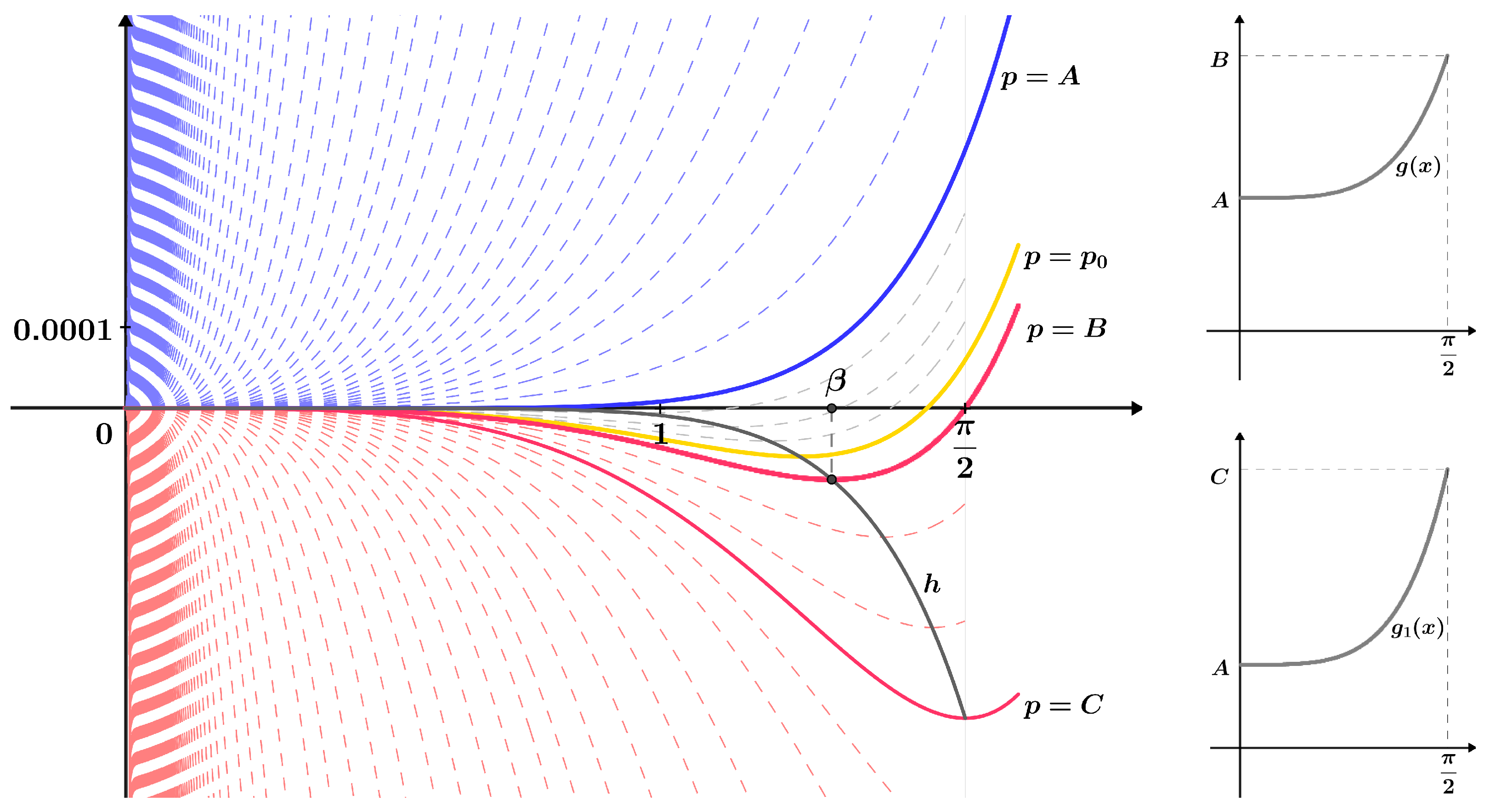
Figure 1 illustrates the family { φ ( x ) } p R and corresponding functions g and g 1 .
According to the previous theorem, for functions from the observed family and for values of parameter p [ A , C ] , it holds that
max x [ 0 , π / 2 ] | φ p ( x ) | = | φ p ( x p ) | o r max x [ 0 , π / 2 ] | φ p ( x ) | = | φ p ( π / 2 ) | ,
where x p is the point at which a local minimum of a function φ p ( x ) is attained.
For p R [ A , C ] , it holds that
max x [ 0 , π / 2 ] | φ p ( x ) | = | φ p ( π / 2 ) | .
Let us notice that based on the stratification, it holds that
p ( , B ) max x [ 0 , π / 2 ] | φ p ( x ) | max x [ 0 , π / 2 ] | φ B ( x ) |
and
p ( A , + ) max x [ 0 , π / 2 ] | φ p ( x ) | max x [ 0 , π / 2 ] | φ A ( x ) | .
Therefore, it holds that
inf p R sup x [ 0 , π / 2 ] | φ p ( x ) | = min p [ A , B ] max x [ 0 , π / 2 ] | φ p ( x ) | .
In order to determine the minimax approximant, in the following text we will consider two functions.
For p [ A , C ] , it holds that φ p ( x p ) = φ g 1 ( x p ) ( x p ) and therefore, based on Theorem 7, the function
h ( x ) = φ g 1 ( x ) ( x ) : ( 0 , π / 2 ) R
determines the set of points in which the functions from the observed family have minimum. The following assertions holds.
Theorem 8.
The function
h ( x ) = sin x x + 2 3 + 1 3 cos x + 7 6 x 2 sin 2 x + 3 x sin x cos x 3 sin 2 x x 2 cos x + 13 x sin x ,
is monotonically decreasing for x ( 0 , π / 2 ) .
Proof. 
By applying the method for proving MTP inequalities analogously as in Lemma 2, it can be proved that
h ( x ) < 0
on the interval 0 , π / 2 . □
Let
α = g 1 1 ( A + ) = 0 , β = g 1 1 ( B ) = 1.321 . . . , γ = g 1 1 ( C ) = π / 2 .
Note that the functions φ A ( x ) , φ B ( x ) and φ C ( x ) have minimum at the points α , β and γ , respectively.
There exist values
h ( α + ) = 0 , h ( β ) = 0.0000879 , h ( γ ) = 7 π 2 + 104 π 396 156 π = 0.000318 .
For p ¯ [ A , C ] , there exist x ¯ ( 0 , π / 2 ) such that the function φ p ¯ ( x ) has minimum at the point x ¯ and, therefore, it holds that p ¯ = g 1 ( x ¯ ) . It is evident that φ p ¯ ( π / 2 ) = φ g 1 ( x ¯ ) ( π / 2 ) . For the function
H ( x ) = φ g 1 ( x ) ( π / 2 ) : ( 0 , π / 2 ) R ,
the following assertion holds.
Theorem 9.
The function
H ( x ) = 2 π + 2 3 + 7 π 4 96 · x 2 sin x + 21 x cos x 21 sin x x 4 x cos x + 13 sin x 2 π 2 7 sin x x 5 7 ,
is monotonically decreasing for x ( 0 , π / 2 ) .
Proof. 
The function H ( x ) has the first derivative
H ( x ) = 2 2 / 7 π 26 / 7 96 · f ( x ) x 6 sin x x 2 / 7 169 + x 2 169 cos 2 x + 26 x cos x sin x
where
f ( x ) = 24 x 3 + 1089 x cos 3 x + 5 x 4 + 328 x 2 1287 sin x cos 2 x + + 39 x 3 1089 x cos x + 7 x 4 541 x 2 + 1287 sin x
is an MTP function. By applying the method for proving MTP inequalities analogously as in Lemma 2, it can be proved that
f ( x ) < 0
on the interval 0 , π / 2 . Thus,
H ( x ) < 0
on the interval 0 , π / 2 . □
There exist values
H ( α + ) = π 33 7 2 2 7 + 1920 π 5760 2880 π = 0.000318 , H ( β ) = 0 , H ( γ ) = 7 π 2 + 104 π 396 156 π = 0.000381 .
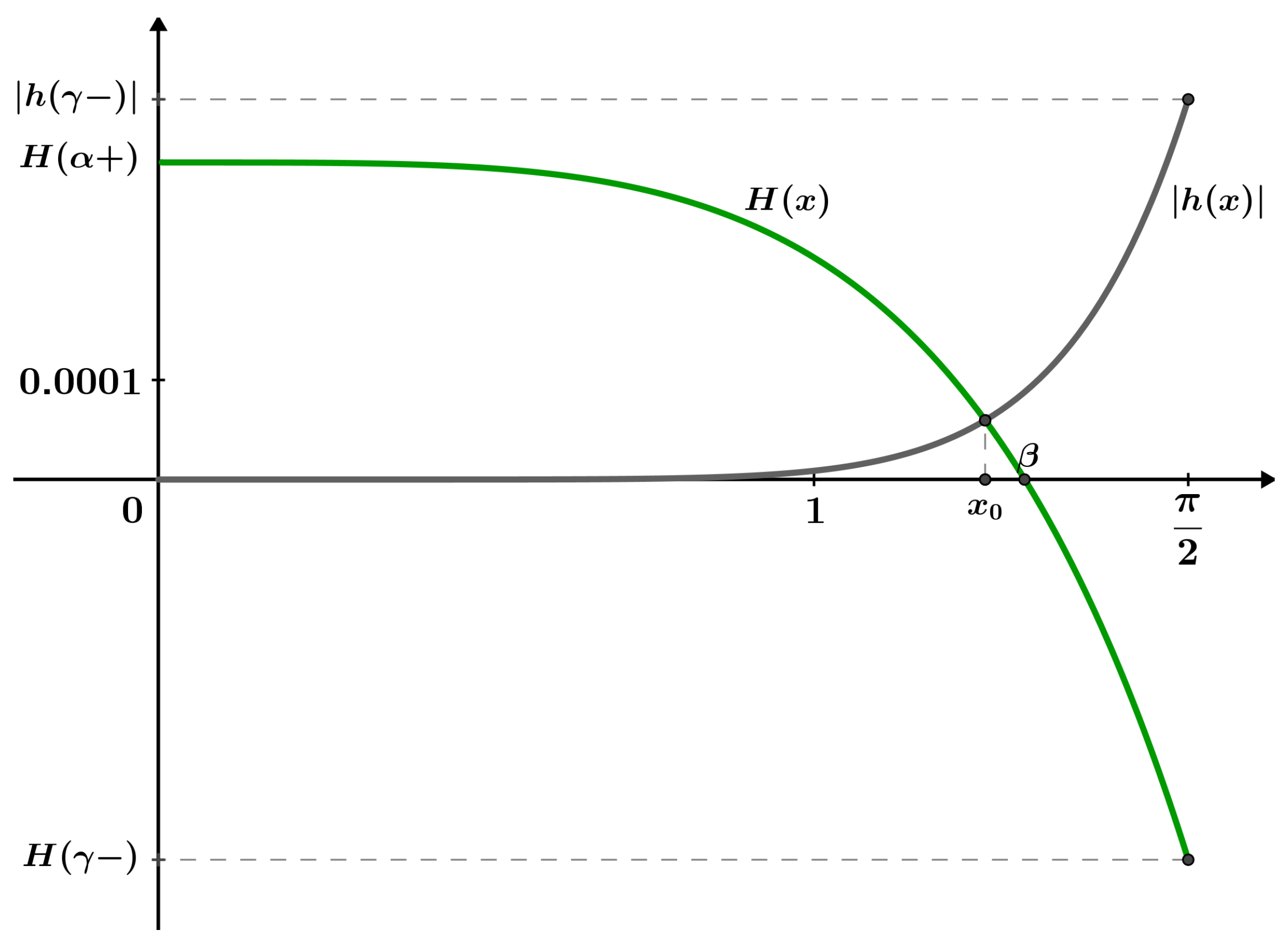
Figure 2 illustrates the graphs of the functions | h ( x ) | and H ( x ) .
The following assertion holds.
Theorem 10.
The equation
| h ( x ) | = H ( x )
has a unique solution x 0 ( 0 , π / 2 ) , which can be numerically determined with x 0 = 1.26105 .
For the value of the parameter
p 0 = g 1 ( x 0 ) = 0.0056039
the function
φ p 0 ( x ) = sin x x + 2 + cos x 3 p 0 x 4 sin x x 2 / 7
is the minimax approximant of the family { φ p ( x ) } p R .
Proof. 
Based on Theorems 8 and 9 and (3) and (4), the equation | h ( x ) | = H ( x ) has a unique solution x 0 ( 0 , π / 2 ) , which can be numerically determined with x 0 = 1.26105 using the computer algebra system Maple.
We will show that for p 1 p 0 ( p 1 P ) , it holds that
sup x [ 0 , π / 2 ] | φ p 1 ( x ) | > sup x [ 0 , π / 2 ] | φ p 0 ( x ) | ,
which is enough to conclude that inf p R sup x [ 0 , π / 2 ] | φ p ( x ) | = sup x [ 0 , π / 2 ] φ p 0 ( x ) .
Based on the stratification of the family, we conclude that if p 1 < p 0 , then
sup x [ 0 , π / 2 ] | φ p 1 ( x ) | = φ p 1 ( π / 2 ) > φ p 0 ( π / 2 ) = sup x [ 0 , π / 2 ] | φ p 0 ( x ) |
and if p 1 > p 0 , then
sup x [ 0 , π / 2 ] | φ p 1 ( x ) | > | φ p 1 ( x p 0 ) | > | φ p 0 ( x p 0 ) | = sup x [ 0 , π / 2 ] | φ p 0 ( x ) | .
Therefore, the function φ p 0 ( x ) is the minimax approximant of the family { φ p ( x ) } p R . □
Corollary 1.
For x ( 0 , π / 2 ) and p 0 = 0.0056039 , we obtain the minimax approximation
sin x x 2 + cos x 3 p 0 · x 4 sin x x 2 / 7 ,
with the approximation error
d 0 = sup x [ 0 , π / 2 ] | φ p 0 ( x ) | = 5.94877 10 5 .

3.2. New Results Related to Theorem 2

Based on Theorem 2, we form the family of functions
{ ψ ( x ) } p P
for P = R , defined on [ 0 , π / 2 ] with
ψ p ( x ) = sin x x + 2 + cos x 3 p ( sin x x cos x ) ( π 2 12 ) / ( 3 π 2 π 3 ) , x ( 0 , π / 2 ] , 0 , x = 0 .
Note that Theorem 2 claims that
ψ A ( x ) > 0
for A = ( 2 / 3 2 / π ) and x ( 0 , π / 2 ) .
Lemma 4.
The family of functions { ψ p ( x ) } p R is decreasingly stratified on the interval ( 0 , π / 2 ) .
Proof. 
It holds that d ψ p ( x ) d p = sin x x cos x ( π 2 12 ) / ( 3 π 2 π 3 ) < 0 for x ( 0 , π / 2 ) . □
Let us note that for x ( 0 , π / 2 ) , it holds that
ψ p ( x ) = sin x x + 2 + cos x 3 p ( sin x x cos x ) ( π 2 12 ) / ( 3 π 2 π 3 ) = 0 p = g ( x ) = x cos x + 3 sin x 2 x 3 x ( sin x x cos x ) ( π 2 12 ) / ( 3 π 2 π 3 ) .
Lemma 5.
The function g ( x ) is decreasing on the interval ( 0 , π / 2 ) .
Proof. 
The function p = g ( x ) has the first derivative
g ( x ) = 1 3 π 3 9 π 2 · ( sin x x cos x ) ( π 3 4 π 2 + 12 ) / ( 3 π 2 π 3 ) x 2 f ( x ) ,
where
f ( x ) = ( x 2 6 π 3 + 18 2 x 2 π 2 12 x 2 ) x sin x cos x + 2 x 2 π 2 12 x sin x + ( 4 x 2 3 π 3 + 9 9 x 2 π 2 36 x 2 ) cos 2 x + 3 x 2 π 3 9 π 2 + 36 x 2 .
is an MTP function. Since f ( 0 ) = 0 and f ( π / 2 ) = 0 , we consider the following two cases:
Case 1.
If x 0 , π / 4 , since f ( π / 4 ) 0 , by applying the method for proving MTP inequalities analogously as in Lemma 2, it can be proved that
f ( x ) < 0
on the interval 0 , π / 4 .
Case 2.
x π / 4 , π / 2 , we introduce the function
f 1 ( t ) = f ( π / 2 x )
for which, by applying the method for proving MTP inequalities analogously as in Lemma 2, it can be proved that
f 1 ( t ) < 0
for t 0 , π / 4 . Therefore,
f ( x ) < 0
on the interval π / 4 , π / 2 .
Based on previous two cases
f ( x ) < 0
on the interval 0 , π / 2 . Thus,
g ( x ) < 0
on the interval 0 , π / 2 . □
Notice that
lim x π / 2 g ( x ) = A = 2 π 6 3 π = 0.030046 .
Let
B = lim x 0 + g ( x ) = + .
Based on Lemma 4 and Lemma 5, the first and the second condition of Theorem 4 are satisfied. Since there exist limits lim x 0 g ( x ) = B and lim x π / 2 g ( x ) = A , the third condition of Theorem 4 is also satisfied. Based on this, we obtain the following generalisation of Theorem 2.
Theorem 11.
(i) If p ( , A ] , then
x ( 0 , π / 2 ) sin x x 2 + cos x 3 < A ( sin x x cos x ) ( π 2 12 ) / ( 3 π 2 π 3 ) p ( sin x x cos x ) ( π 2 12 ) / ( 3 π 2 π 3 ) .
(ii) If p ( A , + ) , then the equation g ( x ) = p has a unique solution x 0 ( p ) ( 0 , π / 2 ) and it holds that
x ( 0 , x 0 ( p ) ) sin x x 2 + cos x 3 < p ( sin x x cos x ) ( π 2 12 ) / ( 3 π 2 π 3 )
and
x ( x 0 ( p ) , π / 2 ) p ( sin x x cos x ) ( π 2 12 ) / ( 3 π 2 π 3 ) < sin x x 2 + cos x 3 .
In the following, we will show that the family ψ p ( x ) p R has a unique minimax approximant. For that purpose, we consider the family d ψ p ( x ) d x p R , for 0 < x < π / 2 , which is defined by
d ψ p ( x ) d x = ( π 2 π 3 4 x 2 3 cos 2 x + x 2 6 x sin x cos x x 2 + 3 3 p x 3 sin x π 2 12 sin x x cos x π 2 12 3 π 2 π 3 ) / ( 3 π 2 ( π 3 ) ( x cos x sin x ) x 2 ) .
Let us notice that for x ( 0 , π / 2 ) , it holds that
d ψ p ( x ) d x = 0 p = g 1 ( x ) = 1 3 π 2 ( π 3 x 2 3 π + 9 sin 2 x + + π 3 x 2 + 6 π 18 x sin x cos x + + 9 3 π x 2 cos 2 x ) / ( π 2 12 x 3 sin x sin x x cos x ( π 2 12 ) / ( 3 π 2 π 3 ) ) .
For the function g 1 ( x ) , the following theorem holds.
Theorem 12.
The function g 1 ( x ) has exactly one minimum on the interval ( 0 , π / 2 ) at the point c = 1.29610 .
Proof. 
The function g 1 ( x ) has the first derivative
g 1 ( x ) = 1 3 π 2 12 sin x x cos x ( π 2 12 ) / ( π 3 3 π 2 ) x 4 sin 2 x f 1 ( x )
where
f 1 ( x ) = π 3 2 π 2 12 x 4 + 10 π 3 + 27 π 2 + 36 x 2 + 9 π 3 27 π 2 sin x cos 2 x + π 3 + 2 π 2 + 12 x 4 + 7 π 3 18 π 2 36 x 2 9 π 3 + 27 π 2 sin x + 4 π 3 9 π 2 36 x 2 15 π 3 + 45 π 2 x cos 3 x + 7 π 3 + 18 π 2 + 36 x 2 + 15 π 3 45 π 2 x cos x
is an MTP function.
We will show that the function f 1 ( x ) has exactly one zero on the interval ( 0 , π / 2 ) . Let us notice that the function f 1 ( x ) changes the sing at the endpoints of the segment 1.29 , 1.3 . By applying the method for proving MTP inequalities analogously as in Lemma 2, it can be proved that
(1)
f 1 ( x ) < 0 on the interval 0 , 1.29 .
(2)
f 1 ( x ) > 0 on the interval 1.3 , π / 2 .
(3)
f 1 ( x ) > 0 on the interval 1.29 , 1.3 .
Based on (1), (2) and (3), according to the method for isolating zeros from [52], the function f 1 ( x ) has exactly one zero on the interval 0 , π / 2 , i.e., more precisely on the interval 1.29 , 1.3 , which can be numerically determined with c = 1.29610 using the computer algebra system Maple. □
Let us notice that
lim x 0 + g 1 ( x ) = + = B
and
lim x π / 2 g 1 ( x ) = A .
For c = 1.29610 the function g 1 ( x ) has the minimum
C = g 1 ( c ) = 0.029171 < A .
It can shown that holds.
Lemma 6.
There exists x A = 1.02795 ( 0 , c ) such that g 1 : ( 0 , x A ) ( A , + ) is bijection.
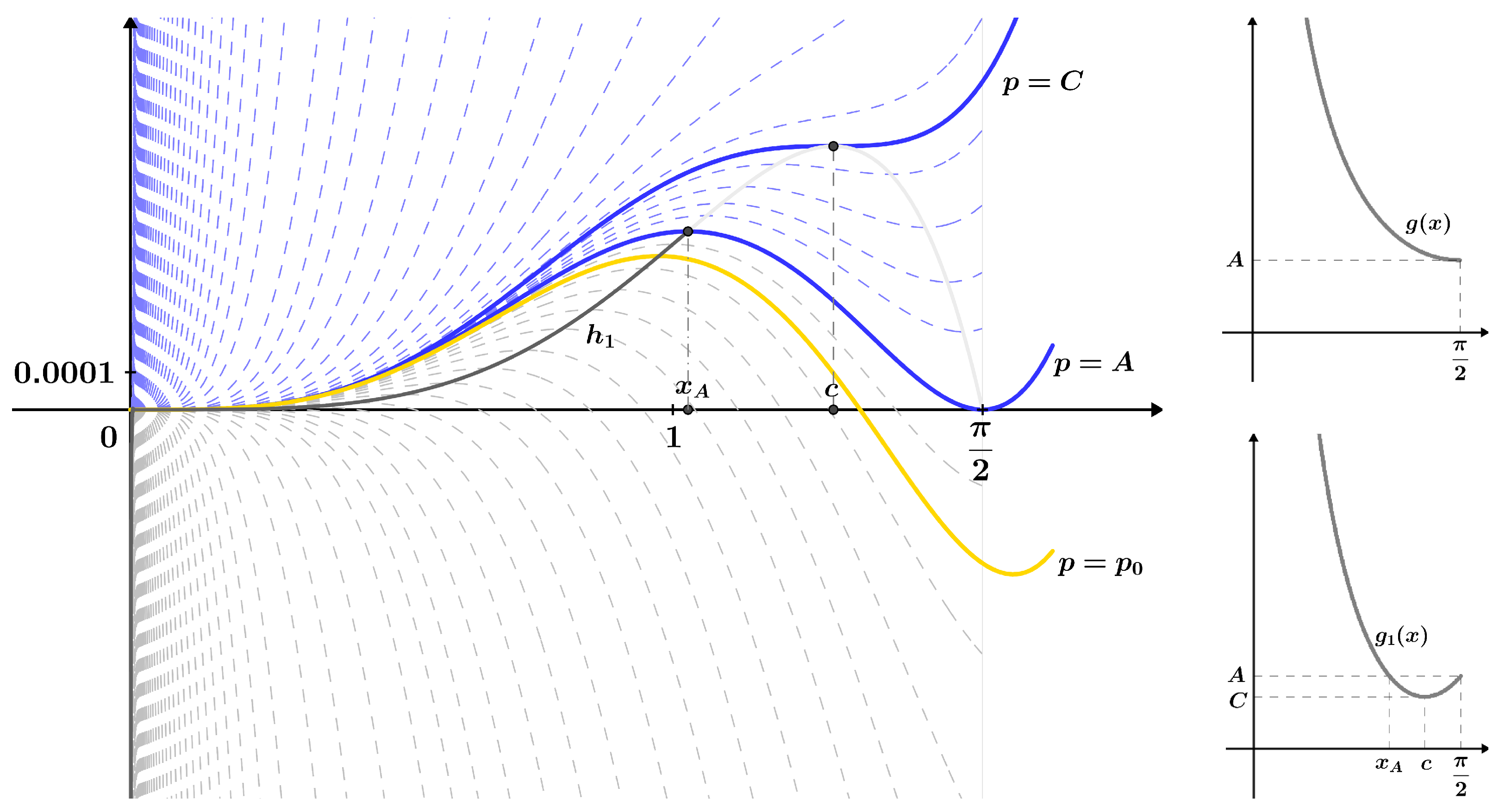
Figure 3 illustrates the family { ψ ( x ) } p R and corresponding functions g and g 1 .
In the following text, we consider the function g 1 on the interval ( 0 , x A ) , where the function g 1 is monotonic.
Theorem 13.
For each p ( A , + ) , the function ψ p ( x ) from the observed family has exactly one maximum at the point x p = g 1 1 ( p ) ( 0 , x A ) .
Proof. 
For p ( A , + ) , it holds the following:
(i)
ψ p (0) = 0;
(ii)
ψ p ( π / 2 ) < 0 (based on the stratification and the fact that lim x π / 2 ψ A ( x ) = 0 );
(iii)
on the interval ( 0 , π / 2 ) , the function ψ p ( x ) has exactly one zero (since the function g ( x ) is monotonic on the interval ( 0 , π / 2 ) );
(iv)
the function ψ p ( x ) has exactly one stationary point (since the function g 1 ( x ) is monotonic on the interval ( 0 , x A ) ).
Based on ( i ) ( i v ) , the assertion follows. □
According to the previous theorem, for functions from the observed family and for values of the parameter p [ A , + ) , it holds that
max x [ 0 , π / 2 ] | ψ p ( x ) | = | ψ p ( x p ) | o r max x [ 0 , π / 2 ] | ψ p ( x ) | = | ψ p ( π / 2 ) | ,
where x p is the point at which a local maximum of a function ψ p ( x ) is attained.
For p < A , it holds that
max x [ 0 , π / 2 ] | ψ p ( x ) | max x [ 0 , π / 2 ] | ψ A ( x ) | .
Therefore, it holds that
inf p R sup x [ 0 , π / 2 ] | ψ p ( x ) | = inf p [ A , + ) max x [ 0 , π / 2 ] | ψ p ( x ) | .
In order to determine the minimax approximant, in the following text we will consider two functions.
For p ( A , + ) , it holds that ψ p ( x p ) = ψ g 1 ( x p ) ( x p ) and therefore, based on Theorem 13, the function
h 1 ( x ) = ψ g 1 ( x ) ( x ) : ( 0 , x A ) R
determines the set of points in which the functions from the observed family have maximum.
The following assertion holds.
Theorem 14.
The function
h 1 ( x ) = ( ( ( 4 π 3 9 π 2 36 ) x 2 3 π 3 + 9 π 2 ) cos 2 x + + ( ( π 3 2 π 2 12 ) x 3 + ( 6 π 3 + 18 π 2 ) x ) sin x cos x + ( 2 π 2 24 ) x 3 sin x + ( π 3 + 36 ) x 2 + 3 π 3 9 π 2 ) / ( 3 π 2 12 x 3 sin x )
is monotonically increasing for x ( 0 , x A ) .
Proof. 
By applying the method for proving MTP inequalities analogously as in Lemma 2, it can be proved that
h 1 ( x ) > 0
on the interval ( 0 , 1.03 ) ( 0 , x A ) . □
It also holds that
lim x 0 + h 1 ( x ) = 0 .
For p ¯ ( A , + ) , there exists x ¯ ( 0 , x A ) such that the function ψ p ¯ ( x ) has maximum at the point x ¯ and, therefore, it holds that p ¯ = g 1 ( x ¯ ) . It is evident that ψ p ¯ ( π / 2 ) = ψ g 1 ( x ¯ ) ( π / 2 ) . For the function
H 1 ( x ) = ψ g 1 ( x ) ( π / 2 ) : ( 0 , x A ) R ,
the following assertion holds.
Theorem 15.
The function
H 1 ( x ) = 2 π + 2 3 π 2 ( ( ( π 3 ) x 2 3 π + 9 ) sin 2 x + ( ( π + 3 ) x 3 + ( 6 π 18 ) x ) cos x sin x + ( 3 π + 9 ) x 2 cos 2 x ) / ( 3 ( π 2 12 ) x 3 sin x ( sin x x cos x ) π 2 12 π 2 π 3 )
is monotonically increasing for x ( 0 , x A ) .
Proof. 
The function H 1 ( x ) has the first derivative
H 1 ( x ) = 1 3 ( π 2 12 ) · ( sin x x cos x ) π 2 12 π 2 ( π 3 ) x 4 sin 2 x f ( x )
where
f ( x ) = ( 4 π 3 9 π 2 36 x 3 + 15 π 3 + 45 π 2 x ) cos 3 x + + ( π 3 2 π 2 12 x 4 + 10 π 3 + 27 π 2 + 36 x 2 + 9 π 3 27 π 2 ) sin x cos 2 x + + ( 7 π 3 + 18 π 2 + 36 x 3 + 15 π 3 45 π 2 x ) cos x + + ( π 3 + 2 π 2 + 12 x 4 + 7 π 3 18 π 2 36 x 2 9 π 3 + 27 π 2 ) sin x
is an MTP function. By applying the method for proving MTP inequalities analogously as in Lemma 2, it can be proved that
f ( x ) < 0
on the interval ( 0 , 1.03 ) ( 0 , x A ) . Thus,
H 1 ( x ) > 0
on the interval ( 0 , 1.03 ) ( 0 , x A ) . □
There exist values
lim x 0 + H 1 ( x ) = , H 1 ( x A ) = 0 .
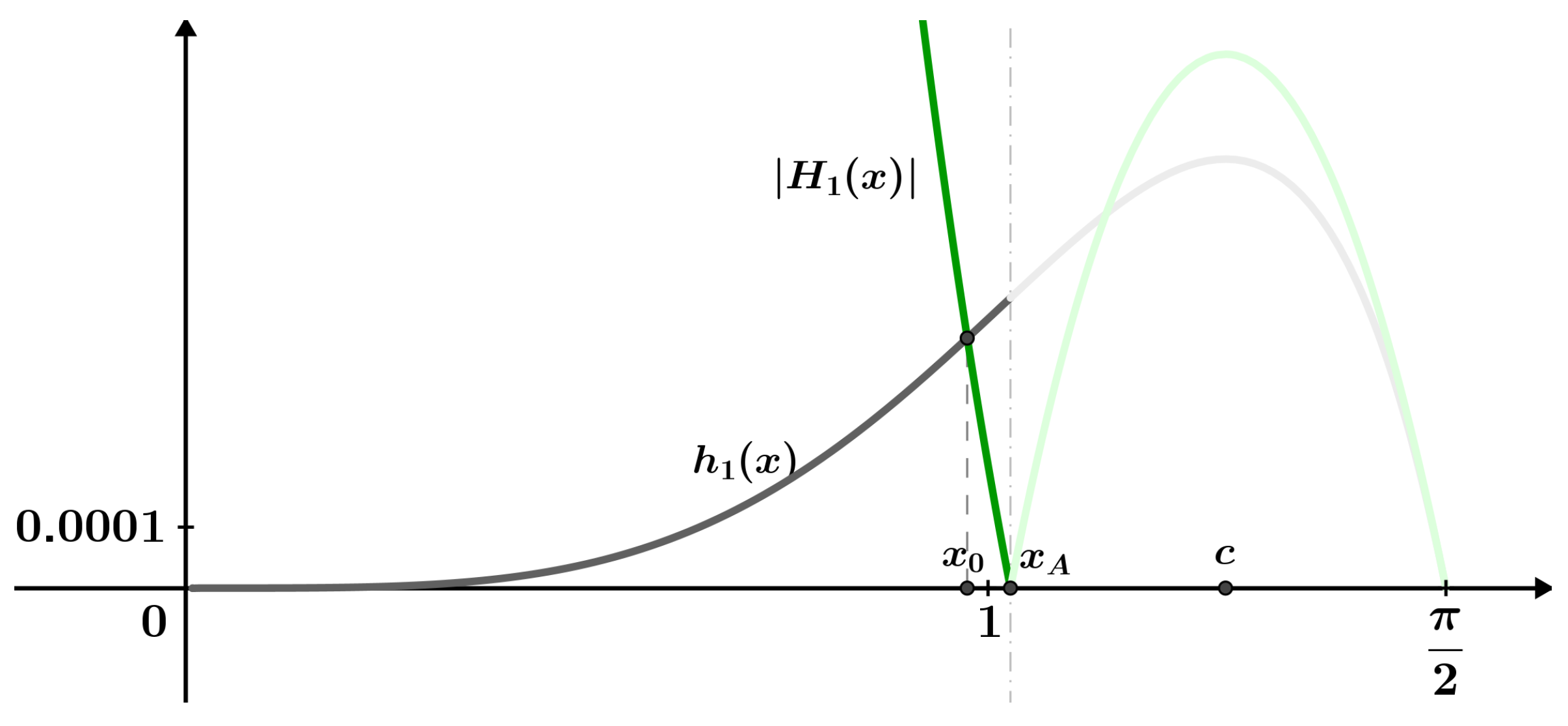
Figure 4 illustrates the graphs of the functions h 1 ( x ) and | H 1 ( x ) | .
The following assertion holds.
Theorem 16.
The equation
h 1 ( x ) = | H 1 ( x ) |
has a unique solution x 0 ( 0 , x A ) , which can be numerically determined with x 0 = 0.97411 .
For the value of the parameter
p 0 = g 1 ( x 0 ) = 0.030456
the function
ψ p 0 ( x ) = sin x x + 2 + cos x 3 p 0 ( sin x x cos x ) ( π 2 12 ) / ( 3 π 2 π 3 )
is the minimax approximant of the family { ψ p ( x ) } p R .
Proof. 
Based on Theorems 14 and 15 and (5) and (6), the equation h 1 ( x ) = | H 1 ( x ) | has a unique solution x 0 ( 0 , x A ) , which can be numerically determined with x 0 = 0.97411 using the computer algebra system Maple.
We will show that for p 1 p 0 ( p 1 P ) , it holds that
sup x [ 0 , π / 2 ] | ψ p 1 ( x ) | > sup x [ 0 , π / 2 ] | ψ p 0 ( x ) | ,
which is enough to conclude that inf p R sup [ 0 , π / 2 ] | ψ p ( x ) | = sup x [ 0 , π / 2 ] ψ p 0 ( x ) .
Based on the stratification of the family, we conclude that if p 1 > p 0 , then
sup x [ 0 , π / 2 ] | ψ p 1 ( x ) | = | ψ p 1 ( π / 2 ) | > | ψ p 0 ( π / 2 ) | = sup x [ 0 , π / 2 ] | ψ p 0 ( x ) |
and if p 1 < p 0 , then
sup x [ 0 , π / 2 ] | ψ p 1 ( x ) | ψ p 1 ( x p 0 ) > ψ p 0 ( x p 0 ) = sup x [ 0 , π / 2 ] | ψ p 0 ( x ) | .
Therefore, the function ψ p 0 ( x ) is the minimax approximant of the family { ψ p ( x ) } p R . □
Corollary 2.
For x ( 0 , π / 2 ) and p 0 = 0.030456 , we obtain the minimax approximation
sin x x 2 + cos x 3 p 0 · ( sin x x cos x ) ( π 2 12 ) / ( 3 π 2 π 3 ) ,
with the approximation error
d 0 = sup x [ 0 , π / 2 ] | ψ p 0 ( x ) | = 4.10100 10 4 .

4. Conclusions

In this paper, by using methods from [52], an improvement of Cusa–Huygens-type inequalities from [11] is given, and therefore, new Cusa–Huygens-type inequalities and approximations are obtained. The presented method for determining approximations could be applied to many inequalities in the theory of analytical inequalities [1,2,69,70].

Author Contributions

Conceptualization, B.M., M.M. and T.L.; methodology, B.M., M.M. and T.L.; software, B.M., M.M. and T.L.; validation, B.M., M.M. and T.L.; formal analysis, B.M., M.M. and T.L.; investigation, B.M., M.M. and T.L.; data curation, B.M., M.M. and T.L.; writing—original draft preparation, B.M., M.M. and T.L.; writing—review and editing, B.M., M.M. and T.L.; visualisation, B.M., M.M. and T.L. All authors have read and agreed to the published version of the manuscript.

Funding

This work was financially supported by the Ministry of Science, Technological Development and Innovation of the Republic of Serbia under contract numbers: 451-03-137/2025-03/200103 (for the first and third) and 451-03-136/2025-03/200103 (for the second author). The research was partially conducted in the premises of the Palace of Science, Miodrag Kostić Endowment.

Data Availability Statement

Data are contained within the article.

Acknowledgments

The authors wish to express their gratitude to the referees for their thorough reading of the paper and their valuable suggestions and comments.

Conflicts of Interest

The authors declare no conflicts of interest.

Abbreviations

The following abbreviations are used in this manuscript:
MTPMixed Trigonometric Polynomial

References

  1. Mitrinović, D. Analytic Inequalities; Springer: Berlin, Germany, 1970. [Google Scholar]
  2. Milovanović, G.; Rassias, M. (Eds.) Analytic Number Theory, Approximation Theory and Special Functions; Springer: New York, NY, USA, 2014. [Google Scholar]
  3. Neuman, E.; Sándor, J. On some inequalities involving trigonometric and hyperbolic functions with emphasis on the Cusa-Huygens, Wilker, and Huygens inequalities. Math. Inequal. Appl. 2010, 13, 715–723. [Google Scholar] [CrossRef]
  4. Sándor, J.; Bencze, M. On Huygen’s Trigonometric Inequality. RGMIA Res. Rep. Collect. 2005, 8, 1–4. [Google Scholar]
  5. Várilly, J.C.; Villarino, M.B. Huygens and π. SSRN 2024. Available online: https://ssrn.com/abstract=5767520 (accessed on 15 November 2025). [CrossRef]
  6. Malešević, B.; Mićović, M.; Jovanović, D. New Cusa-Huygens Inequalities and Approximations. Montes Taurus J. Pure Appl. Math. 2024, 6, 375–386. [Google Scholar]
  7. Wrench, J.W., Jr. With Editorial Note. Queries-Replies No. 41. Math. Comput. 1949, 3, 561–563. [Google Scholar]
  8. Dantzig, T. On the Approximate Division of a Circumference. Am. Math. Mon. 1928, 35, 185–187. [Google Scholar] [CrossRef]
  9. Frame, J.S. Some Trigonometric, Hyperbolic and Elliptic Approximations. Am. Math. Mon. 1954, 61, 623–626. [Google Scholar] [CrossRef]
  10. Vahlen, K.T. Konstruktionen und Approximationen in Systematischer Darstellung; BG Teubner: Leipzig, Germany, 1911; pp. 188–190. [Google Scholar]
  11. Zhu, L. New Inequalities of Cusa-Huygens Type. Mathematics 2021, 9, 2101. [Google Scholar] [CrossRef]
  12. Zhu, L. An unity of Mitrinovic–Adamovic and Cusa–Huygens inequalities and the analogue for hyperbolic functions. Rev. R. Acad. Cienc. Exactas Fís. Nat. Ser. A Math. 2019, 113, 3399–3412. [Google Scholar] [CrossRef]
  13. Zhu, L. On Frame’s inequalities. J. Inequal. Appl. 2018, 2018, 94. [Google Scholar] [CrossRef]
  14. Zhu, L. New Cusa-Huygens type inequalities. AIMS Math. 2020, 5, 5320–5331. [Google Scholar] [CrossRef]
  15. Zhu, L. A source of inequalities for circular functions. Comput. Math. Appl. 2009, 58, 1998–2004. [Google Scholar] [CrossRef]
  16. Sun, Z.-J.; Zhu, L. Simple proofs of the Cusa-Huygens-type and Becker-Stark-type inequalities. J. Math. Inequal. 2013, 7L4, 563–567. [Google Scholar] [CrossRef]
  17. Malešević, B.; Nenezić, M.; Zhu, L.; Banjac, B.; Petrović, M. Some new estimates of precision of Cusa-Huygens and Huygens approximations. Appl. Anal. Discrete Math. 2021, 15, 243–259. [Google Scholar] [CrossRef]
  18. Bagul, Y.J.; Chesneau, C.; Kostić, M. On the Cusa-Huygens inequality. Rev. R. Acad. Cienc. Exactas Fís. Nat. Ser. A Math. 2021, 115, 29. [Google Scholar] [CrossRef]
  19. Bagul, Y.J.; Chesneau, C. Refined forms of Oppenheim and Cusa-Huygens type inequalities. Acta Comment. Univ. Tartu. Math. 2020, 24, 183–194. [Google Scholar] [CrossRef]
  20. Bagul, Y.J.; Chesneau, C.; Kostić, M. The Cusa-Huygens inequality revisited. Novi Sad J. Math. 2020, 50, 149–159. [Google Scholar] [CrossRef]
  21. Bagul, Y.J.; Banjac, B.; Chesneau, C.; Kostić, M.; Malešević, B. New Refinements of Cusa-Huygens Inequality. Results Math. 2021, 76, 107. [Google Scholar] [CrossRef]
  22. Bagul, Y.J.; Chesneau, C. Sharp Extensions of a Cusa-Huygens Type Inequality. Armen. J. Math. 2024, 16, 1–12. [Google Scholar] [CrossRef]
  23. Dhaigude, R.M.; Chesneau, C.; Bagul, Y.J. About Trigonometric-polynomial Bounds of Sinc Function. Math. Sci. Appl. E-Notes 2020, 8, 100–104. [Google Scholar] [CrossRef]
  24. Chouikha, A.R.; Chesneau, C.; Bagul, Y.J. Some refinements of well-known inequalities involving trigonometric functions. J. Ramanujan Math. Soc. 2021, 36, 193–202. [Google Scholar]
  25. Chouikha, A.R. On natural approaches related to classical trigonometric inequalities. Open J. Math. Sci. 2023, 7, 299–320. [Google Scholar] [CrossRef]
  26. Chouikha, A.R. New sharp inequalities related to classical trigonometric inequalities. J. Inequal. Spec. Funct. 2020, 11, 27–35. [Google Scholar]
  27. Sándor, J.; Oláh-Gál, R. On Cusa-Huygens type trigonometric and hyperbolic inequalities. Acta Univ. Sapientiae Math. 2012, 4, 145–153. [Google Scholar]
  28. Wu, Y.; Bercu, G. New refinements of Becker-Stark and Cusa-Huygens inequalities via trigonometric polynomials method. Rev. R. Acad. Cienc. Exactas Fís. Nat. Ser. A Math. 2021, 115, 87. [Google Scholar] [CrossRef]
  29. Chen, C.-P.; Malešević, B. Sharp inequalities related to the Adamović-Mitrinović, Cusa, Wilker and Huygens results. Filomat 2023, 37, 6319–6334. [Google Scholar] [CrossRef]
  30. Chen, C.-P.; Mortici, C. The relationship between Huygens’ and Wilker’s inequalities and further remarks. Appl. Anal. Discrete Math. 2023, 17, 92–100. [Google Scholar] [CrossRef]
  31. Mortici, C. The natural approach of Wilker-Cusa-Huygens inequalities. Math. Inequal. Appl. 2011, 14, 535–541. [Google Scholar] [CrossRef]
  32. Yang, Z.-H.; Chu, Y.-M.; Song, Y.-Q.; Li, Y.-M. A Sharp Double Inequality for Trigonometric Functions and Its Applications. Abstr. Appl. Anal. 2014, 2014, 1–9. [Google Scholar] [CrossRef]
  33. Yang, Z.-H.; Chu, Y.-M. A Note on Jordan, Adamović-Mitrinović, and Cusa Inequalities. Abstr. Appl. Anal. 2014, 2014, 1–12. [Google Scholar] [CrossRef]
  34. Yang, Z.-H. Refinements of a two-sided inequality for trigonometric functions. J. Math. Inequal. 2013, 7, 601–615. [Google Scholar] [CrossRef]
  35. Bercu, G. Fourier series method related to Wilker-Cusa-Huygens inequalities. Math. Inequal. Appl. 2019, 22, 1091–1098. [Google Scholar] [CrossRef]
  36. Nelsen, R.B. Elementary Proofs of the Trigonometric Inequalities of Huygens, Cusa, and Wilker. Math. Mag. 2020, 93, 276–283. [Google Scholar] [CrossRef]
  37. Szyszkowicz, M. Approximations of pi and squaring the circle. J. Multidiscip. Eng. Sci. Technol. 2015, 2, 330–332. [Google Scholar]
  38. Zhao, T. On a unified generalization of Cusa-Huygens and Mitrinović-Adamović inequalities. Appl. Anal. Discrete Math. 2025, 19, 370–393. [Google Scholar] [CrossRef]
  39. Sun, J.-L.; Chen, C.-P. Sharp Shafer-Fink, Lazarević and Cusa type inequalities for the Gudermannian and inverse Gudermannian functions. Appl. Anal. Discrete Math. 2025, 19, 130–149. [Google Scholar] [CrossRef]
  40. Sun, J.-L.; Chen, C.-P. Sharp Wilker, Huygens, Adamović-Mitrinović, Cusa and Shafer-Fink type inequalities involving the sine integral. Appl. Anal. Discrete Math. 2024, 18, 510–528. [Google Scholar] [CrossRef]
  41. Nowicka, M.; Witkowski, A. New approach to the Huygens, Wilker, Cusa and Mitrinović–Adamović type inequalities. Bull. Pol. Acad. Sci. Math. 2024, 72, 119–125. [Google Scholar] [CrossRef]
  42. Sándor, J. Sharp Cusa-Huygens and related inequalities. Notes Number Theory Discrete Math. 2013, 19, 50–54. [Google Scholar]
  43. Jekl, J. Wilker’s, Cusa-Huygens’, and Fink-Mortici’s type inequalities for parabolic trigonometric functions. J. Math. Inequal. 2025, 19, 65–80. [Google Scholar] [CrossRef]
  44. Bagul, Y.J.; Thool, S.B.; Chesneau, C.; Dhaigude, R.M. Refinements of some classical inequalities involving sinc and hyperbolic sinc functions. Ann. Math. Sil. 2022, 37, 1–15. [Google Scholar] [CrossRef]
  45. Sándor, J. Variations on the Cusa-Huygens inequality. Adv. Stud. Contemp. Math. 2018, 28, 177–186. [Google Scholar]
  46. Bhayo, B.A.; Klén, R.; Sándor, J. New Trigonometric And Hyperbolic Inequalities. Miskolc Math. Notes 2017, 18, 125–137. [Google Scholar] [CrossRef][Green Version]
  47. Huang, L.-H.; Yin, L. Cusa-Huygens type inequality and a correction for generalized trigonometric functions. Ital. J. Pure Appl. Math. 2022, 48, 641–649. [Google Scholar]
  48. Nantomah, K. Cusa-Huygens, Wilker and Huygens Type Inequalities for Generalized Hyperbolic Functions. Earthline J. Math. Sci. 2021, 5, 277–289. [Google Scholar] [CrossRef]
  49. Klén, R.; Vuorinen, M.; Zhang, X. Inequalities for the generalized trigonometric and hyperbolic functions. J. Math. Anal. Appl. 2014, 409, 521–529. [Google Scholar] [CrossRef]
  50. Wang, M.-K.; Hong, M.-Y.; Xu, Y.-F.; Shen, Z.-H.; Chu, Y.-M. Inequalities for generalized trigonometric and hyperbolic functions with one parameter. J. Math. Inequal. 2020, 14, 1–21. [Google Scholar] [CrossRef]
  51. Banjac, B.; Malešević, B.; Mićović, M.; Mihailović, B.; Savatović, M. The best possible constants approach for Wilker-Cusa-Huygens inequalities via stratification. Appl. Anal. Discrete Math. 2024, 18, 244–288. [Google Scholar] [CrossRef]
  52. Malešević, B.; Mićović, M.; Mihailović, B. A Parametric Method for Proving Some Analytic Inequalities. Axioms 2024, 13, 520. [Google Scholar] [CrossRef]
  53. Malešević, B.; Mićović, M.; Mihailović, B.; Lutovac, T. A New Approach to Selecting Constants for Some Analytic Inequalities. J. Math. Inequal. 2025, 19, 223–245. [Google Scholar] [CrossRef]
  54. Malešević, B.; Mićović, M.; Mihailović, B.; Lutovac, T.; Šešum Čavić, V. The Best Constants in Some New Sharp Bounds for Sinc Function. Afr. Mat. 2025, 36, 81. [Google Scholar] [CrossRef]
  55. Malešević, B.; Mihailović, B. A minimax approximant in the theory of analytic inequalities. Appl. Anal. Discrete Math. 2021, 15, 486–509. [Google Scholar] [CrossRef]
  56. Malešević, B.; Mihailović, B.; Nenezić Jović, M.; Mićović, M.; Milinković, L. Some generalisations and minimax approximants of D’Aurizio trigonometric inequalities. Acta Univ. Sapientiae Math. 2024, 16, 263–277. [Google Scholar] [CrossRef]
  57. Mićović, M.; Malešević, B. Jordan-Type Inequalities and Stratification. Axioms 2024, 13, 262. [Google Scholar] [CrossRef]
  58. Malešević, B.; Makragić, M. A Method for Proving Some Inequalities on Mixed Trigonometric Polynomial Functions. J. Math. Inequal. 2016, 10, 849–876. [Google Scholar] [CrossRef]
  59. Lutovac, T.; Malešević, B.; Mortici, C. The natural algorithmic approach of mixed trigonometric-polynomial problems. J. Inequal. Appl. 2017, 2017, 116. [Google Scholar] [CrossRef]
  60. Sturm, J.C.F. Mémoire sur la résolution des équations numériques. Bull. Des Sci. Ferussac 1829, 11, 419–425. [Google Scholar]
  61. Cutland, N. Computability: An Introduction to Recursive Function Theory; Cambridge University Press: Cambridge, UK, 1980. [Google Scholar]
  62. Poonen, B. Undecidable problems: A sampler. Chapter 10. In Interpreting Gödel: Critical Esssays; Kennedy, J., Ed.; Cambridge University Press: Cambridge, UK, 2014; pp. 211–241. [Google Scholar]
  63. Alzer, H.; Kwong, M.K. On two trigonometric inequalities of Askey and Steinig. N. Y. J. Math. 2020, 26, 28–36. [Google Scholar]
  64. Alzer, H.; Kwong, M.K. A refinement of Vietoris’ inequality for cosine polynomials. Anal. Appl. 2016, 14, 615–629. [Google Scholar] [CrossRef]
  65. Alzer, H.; Kwong, M.K. Sharp upper and lower bounds for a sine polynomial. Appl. Math. Comput. 2016, 275, 81–85. [Google Scholar] [CrossRef]
  66. Alzer, H.; Kwong, M.K. Inequalities for trigonometric sums. J. Anal. 2024, 32, 1801–1817. [Google Scholar] [CrossRef]
  67. Kwong, M.K. An improved Vietoris sine inequality. J. Approx. Theory 2015, 189, 29–42. [Google Scholar] [CrossRef]
  68. Mondal, S.R.; Nisar, K.S.; Abdeljawad, T. On the Study of Trigonometric Polynomials Using Sturm Sequence. Hindawi J. Math. 2020, 2020, 7068176. [Google Scholar]
  69. Qi, F.; Niu, D.-W.; Guo, B.-N. Refinements, Generalizations, and Applications of Jordan’s Inequality and Related Problems. J. Inequal. Appl. 2009, 2009, 271923. [Google Scholar] [CrossRef]
  70. Raigorodskii, A.; Rassias, M.T. (Eds.) Trigonometric Sums and Their Applications; Springer: Berlin/Heidelberg, Germany, 2020. [Google Scholar]
Figure 1. Some functions from the family { φ ( x ) } p R and corresponding functions g and g 1 .
Axioms 14 00920 g001
Figure 2. The graphs of the functions | h ( x ) | and H ( x ) .
Axioms 14 00920 g002
Figure 3. Some functions from the family { ψ p ( x ) } p R and corresponding functions g and g 1 .
Axioms 14 00920 g003
Figure 4. The graphs of the functions h 1 ( x ) and | H 1 ( x ) | .
Axioms 14 00920 g004
Disclaimer/Publisher’s Note: The statements, opinions and data contained in all publications are solely those of the individual author(s) and contributor(s) and not of MDPI and/or the editor(s). MDPI and/or the editor(s) disclaim responsibility for any injury to people or property resulting from any ideas, methods, instructions or products referred to in the content.