Memetic Algorithm for Energy Optimization in Point-to-Point Robotized Operations




Abstract
1. Introduction
- An ML-based model can be used for regressing the value of energy use in the given moment, using the information about IR speed and position,
- An MA algorithm can be developed to lower the energy use of IR in point-to-point-based operations.
2. Materials and Methods
2.1. Determining the Energy Use of the Robot to Be Used as a Fitness Function
- —total energy consumed by the robot during the movement, J;
- —energy consumed by the i-th joint, J;
- —torque of the i-th joint, ;
- —angular velocity of the i-th joint, ;
- —time step between two measurements, .
- Tool center position (TCP) given as the x, y, and z coordinates of the end of the IR relative to the origin placed in the base of the IR;
- Quarternions (, , , and ) and Euler angles (, , —encoded as X, Y, and Z, respectively) that define the rotation of the TCP;
- Speed of each individual joint;
- Torque of each individual joint.
- —the measurement time between two data points,
- Acceleration of each axis,
- The change in the linear position of TCP since the last measurement,
- The change in each of the Euler’s angles,
- The linear speeds and accelerations of TCP;
- The angular speeds and accelerations,
- The total energy that the robot used in the movement per Equation (1).
2.2. Feature Importance
2.3. Evolutionary Optimization Algorithms
3. Results
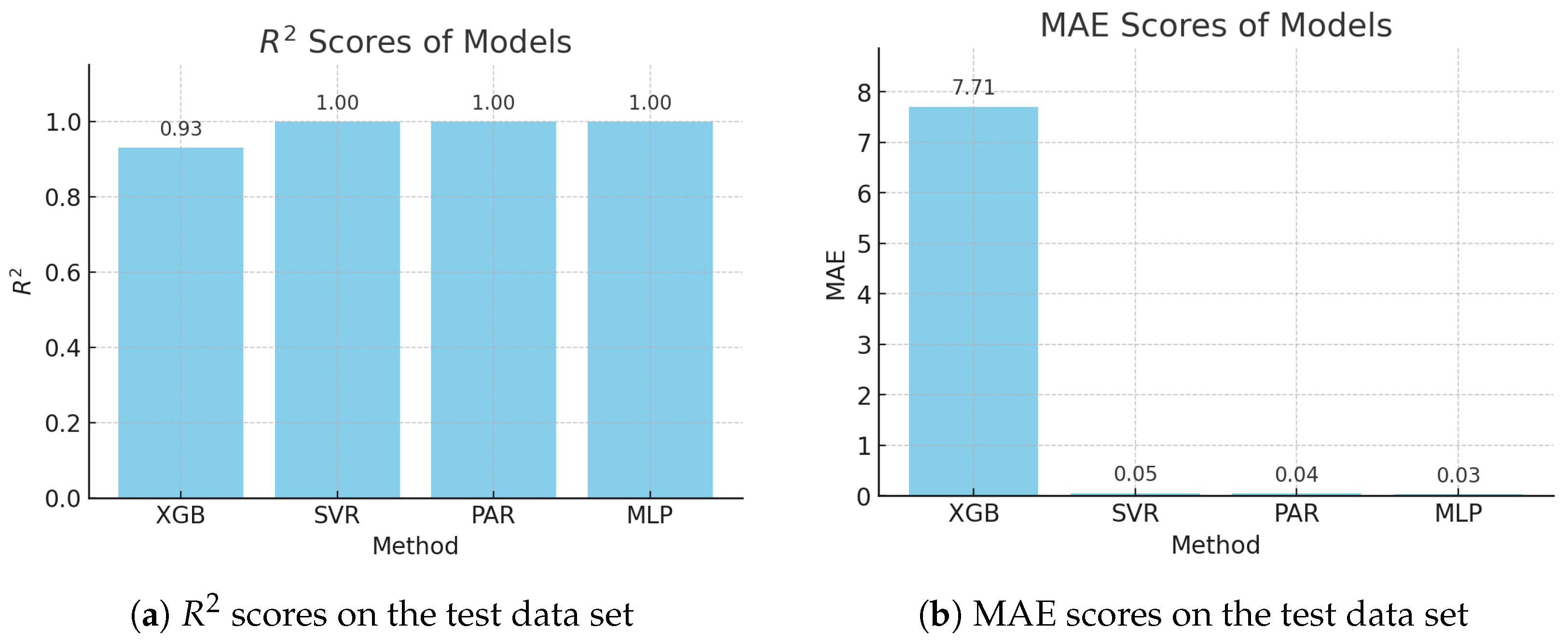
3.1. Regression Model Results
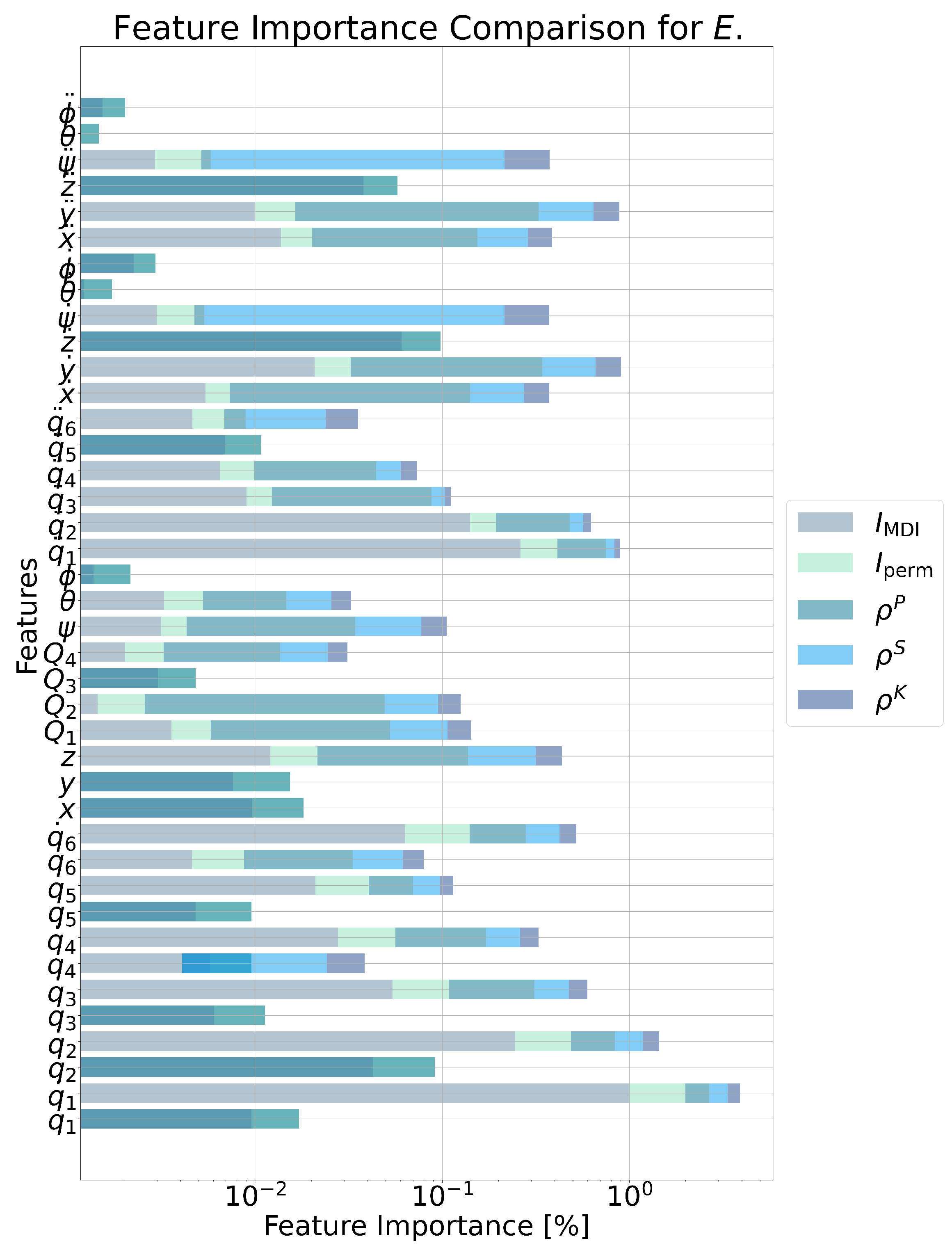
3.2. Feature Importance Results
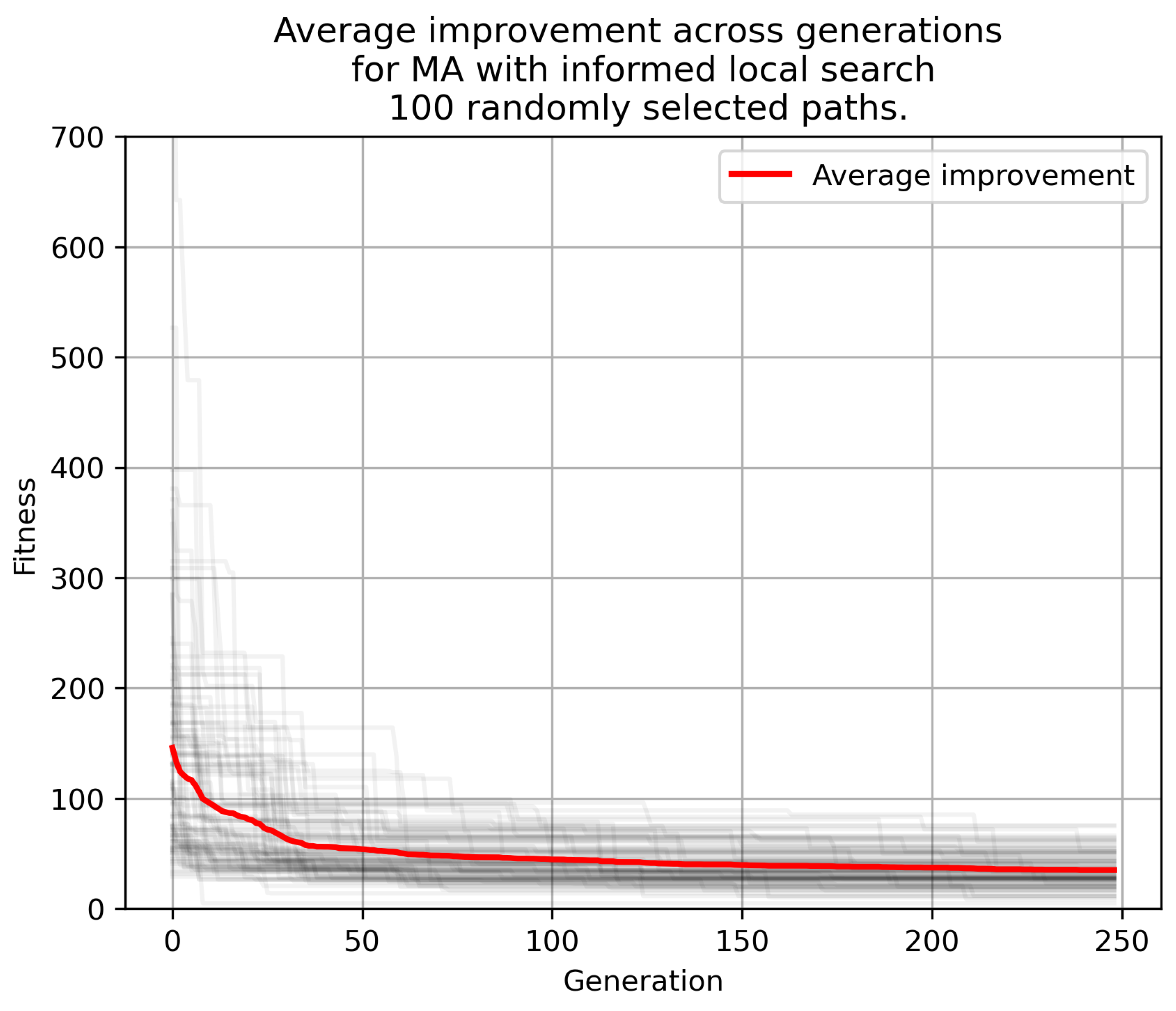
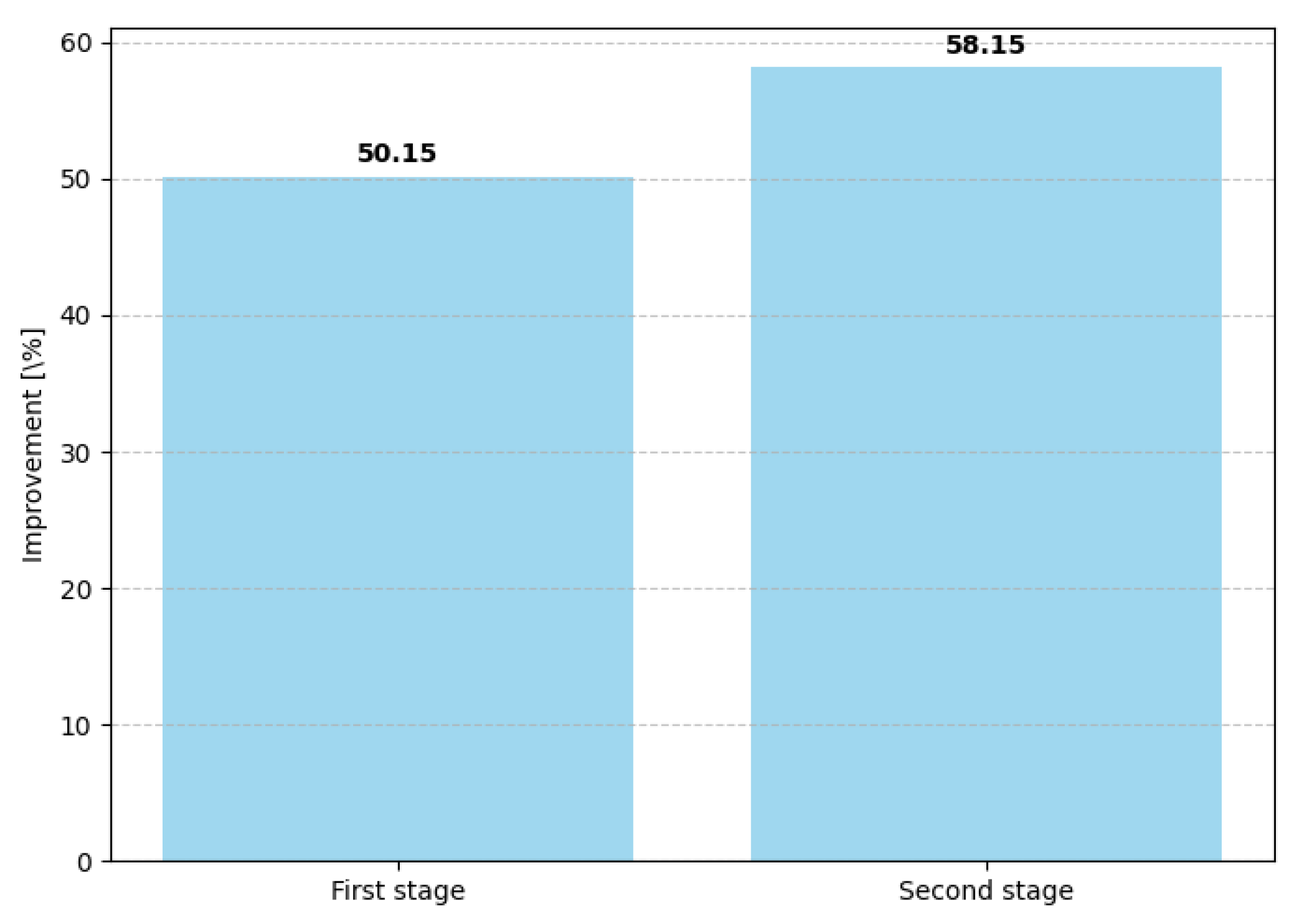
3.3. Comparison of Evolutionary Algorithms
4. Conclusions
Supplementary Materials
Author Contributions
Funding
Institutional Review Board Statement
Informed Consent Statement
Data Availability Statement
Acknowledgments
Conflicts of Interest
Abbreviations
| ANN | Artificial Neural Network |
| BN | Batch Normalization |
| DE | Differential Evolution |
| GA | Genetic Algorithm |
| GA+VNS | Genetic Algorithm combined with Variable Neighborhood Search |
| IMDI | Impurity-Based Importance (variant of MDI) |
| IR | Industrial Robot |
| IRM | Industrial Robotic Manipulator |
| LBFGS | Limited-memory Broyden–Fletcher–Goldfarb–Shanno |
| LSTM | Long Short-Term Memory |
| MA | Memetic Algorithm |
| MAE | Mean Absolute Error |
| MAPE | Mean Absolute Percentage Error |
| MDI | Mean Decrease in Impurity |
| ML | Machine Learning |
| MLP | Multilayer Perceptron |
| PAR | Passive-Aggressive Regressor |
| PPM | Planar Parallel Manipulator |
| PSO | Particle Swarm Optimization |
| R2 | Coefficient of Determination |
| RMSE | Root Mean Square Error |
| SMB | Serial Measurement Board |
| SVR | Support Vector Regression |
| SVM | Support Vector Machine |
| TCP | Tool Center Position |
| VNS | Variable Neighborhood Search |
| XGB | Extreme Gradient Boosting |
| Standard Deviation |
Appendix A
Appendix A.1
| Listing A1. RAPID module used for generating random robot joint configurations and executing motion commands. |
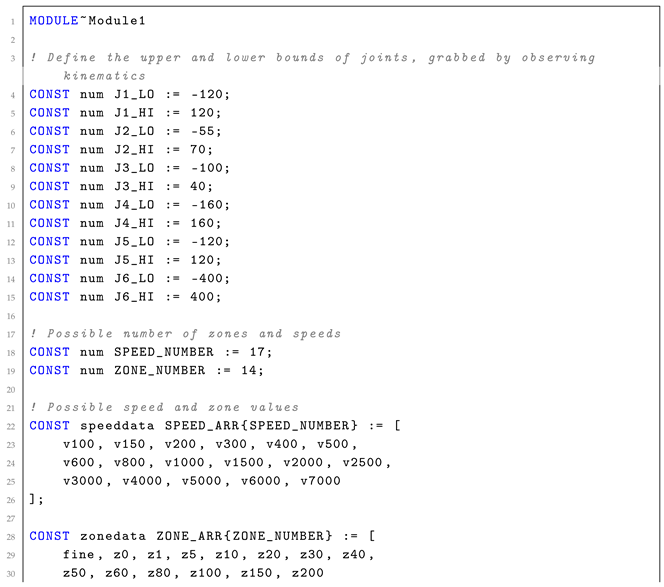 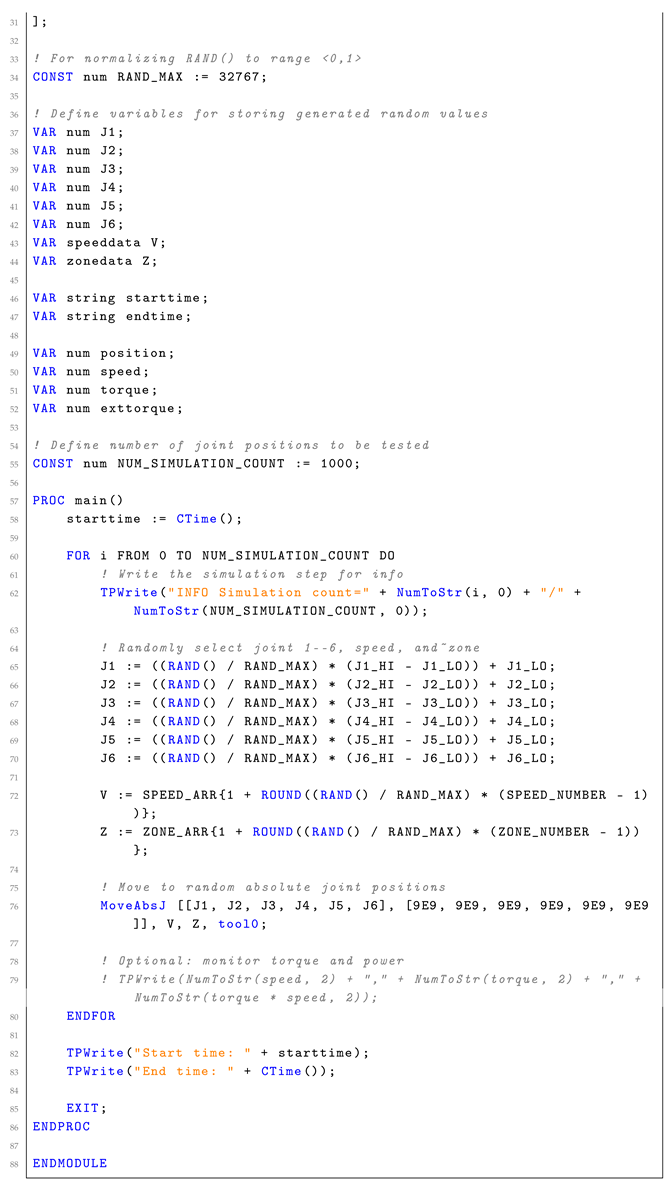 |
Appendix A.2
| Listing A2. RAPID module for real-time measurement and logging of joint and TCP data during execution. |
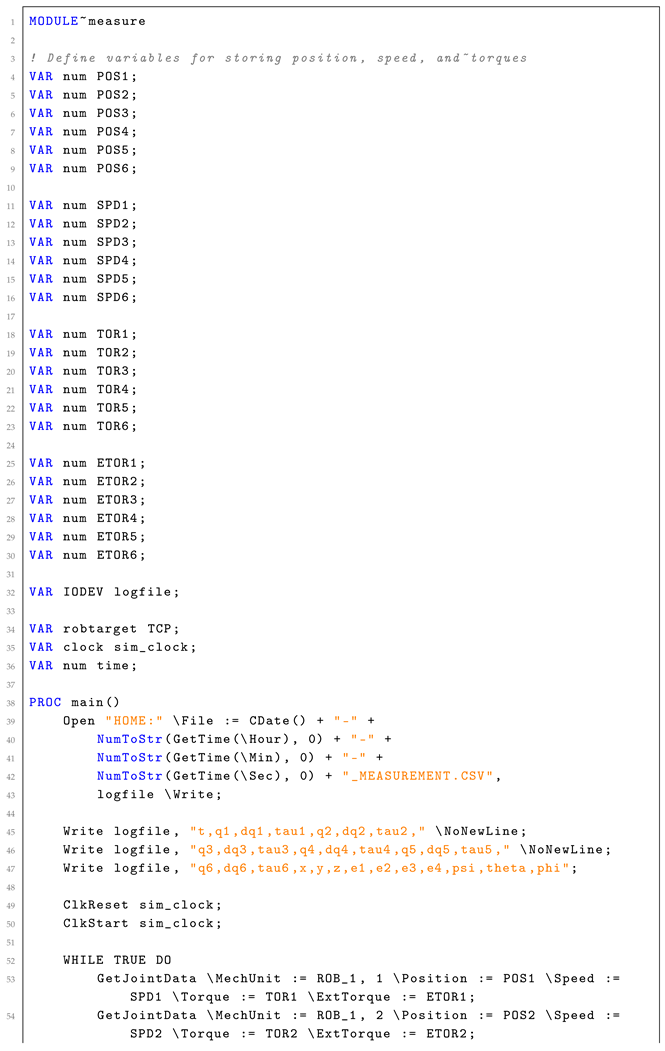 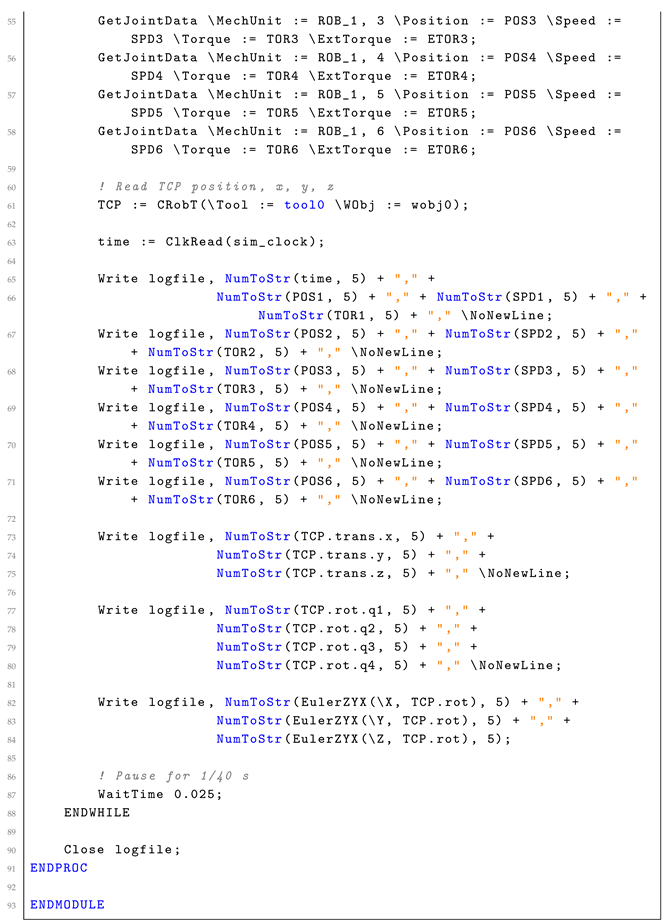 |
References
- International Federation of Robotics. World Robotics 2024—Press Conference Presentation; Technical Report; Presentation Slides; International Federation of Robotics (IFR): Frankfurt, Germany, 2024. [Google Scholar]
- Vysockỳ, A.; Papřok, R.; Šafařík, J.; Kot, T.; Bobovskỳ, Z.; Novák, P.; Snášel, V. Reduction in robotic arm energy consumption by particle swarm optimization. Appl. Sci. 2020, 10, 8241. [Google Scholar] [CrossRef]
- Garriz, A.; Domingo, C. Trajectory Optimization in Terms of Energy and Performance of an Industrial Robot in the Manufacturing Industry. Sensors 2022, 22, 7538. [Google Scholar] [CrossRef]
- Shrivastava, A.; Dalla, P. Failure control and energy optimization of multi-axes space manipulator through genetic algorithm approach. J. Braz. Soc. Mech. Sci. Eng. 2021, 43, 445. [Google Scholar] [CrossRef]
- Nonoyama, Y.; Matsuda, S.; Takahashi, R. Energy-Efficient Robot Configuration and Motion Planning Using Genetic Algorithm and Particle Swarm Optimization. Energies 2022, 15, 2074. [Google Scholar] [CrossRef]
- Luneckas, M.; Bacevičius, L.; Damaševičius, R. Hexapod Robot Gait Switching for Energy Consumption and Cost of Transport Management Using Heuristic Algorithms. Appl. Sci. 2021, 11, 1139. [Google Scholar] [CrossRef]
- Lu, Y.; Wang, Y.; Chen, X. Human–robot collaborative scheduling in energy-efficient welding shop. IEEE Trans. on Ind. Inf. 2023, 20, 936–971. [Google Scholar] [CrossRef]
- Baressi Šegota, S.; Horvat, T.; Grbac, I. Path optimization of robotic manipulators using differential evolution for improved energy efficiency. Int. J. Adv. Robot. Syst. 2020, 17, 1–12. [Google Scholar] [CrossRef]
- Jin, Y.; Olhofer, M.; Sendhoff, B. A framework for evolutionary optimization with approximate fitness functions. IEEE Trans. Evol. Comput. 2002, 6, 481–494. [Google Scholar] [CrossRef]
- Gadaleta, M.; Berselli, G.; Pellicciari, M.; Grassia, F. Extensive experimental investigation for the optimization of the energy consumption of a high payload industrial robot with open research dataset. Robot. Comput.-Integr. Manuf. 2021, 68, 102046. [Google Scholar] [CrossRef]
- Zhang, M.; Yan, W. A data-driven method for optimizing the energy consumption of industrial robots. Energy Rep. 2021, 7, 8747–8756. [Google Scholar] [CrossRef]
- Gao, Y.; Li, J.; Sun, B. Energy optimization of a planar parallel manipulator using long short-term memory network. IEEE Access 2020, 8, 175964–175972. [Google Scholar]
- Lin, X.; Zhang, K.; Luo, W. BN-LSTM-based energy consumption modeling approach for an industrial robot manipulator. Robot. Comput.-Integr. Manuf. 2024, 85, 102629. [Google Scholar] [CrossRef]
- Zhang, M.; Jiang, H.; Wang, X.; Chen, J. An integrated deep-learning-based approach for energy consumption prediction of machining systems. Sustainability 2023, 15, 5781. [Google Scholar] [CrossRef]
- Jaramillo-Morales, J.; López, C.; Suárez, J. Energy estimation for differential drive mobile robots on straight and rotational trajectories. Int. J. Adv. Rob. Sys. 2020, 17, 880–888. [Google Scholar] [CrossRef]
- Baressi Šegota, S.; Anđelić, N.; Šercer, M.; Meštrić, H. Dynamics modeling of industrial robotic manipulators: A machine learning approach based on synthetic data. Mathematics 2022, 10, 1174. [Google Scholar] [CrossRef]
- Cardona, M.; Serrano, F.E. Lagrange-Euler Approach. In Rehabilitation Robotics: Kinematics, Dynamics, and Control Techniques; Springer: Berlin/Heidelberg, Germany, 2025; pp. 77–89. [Google Scholar]
- Adam, M.S.; Nordin, R.; Abdullah, N.F.; Abu-Samah, A.; Amodu, O.A.; Alsharif, M.H. Optimizing disaster response through efficient path planning of mobile aerial base station with genetic algorithm. Drones 2024, 8, 272. [Google Scholar] [CrossRef]
- Dax, M.; Green, S.R.; Gair, J.; Gupte, N.; Pürrer, M.; Raymond, V.; Wildberger, J.; Macke, J.H.; Buonanno, A.; Schölkopf, B. Real-time inference for binary neutron star mergers using machine learning. Nature 2025, 639, 49–53. [Google Scholar] [CrossRef] [PubMed]
- ABB Robotics. RobotStudio Operating Manual; Operating Manual for ABB RobotStudio, Document ID 3HAC032104-001, Revision V; ABB Group: Zurich, Switzerland, 2017. [Google Scholar]
- ABB Robotics. Technical Reference Manual: RAPID Instructions, Functions and Data Types; Technical Reference for the RAPID Programming Language, Document ID 3HAC050917-001, Revision F, RobotWare 6.06; ABB Group: Västerås, Sweden, 2017. [Google Scholar]
- Ostovar, A.; Davari, D.D.; Dzikuć, M. Determinants of design with multilayer perceptron neural networks: A comparison with logistic regression. Sustainability 2025, 17, 2611. [Google Scholar] [CrossRef]
- Mekala, S.; Dasari, K.; Katta, D. DNS DDoS Amplification Attack Detection Using Multi-Layer Perceptron Classification Algorithm. In Proceedings of the 2024 IEEE 3rd World Conference on Applied Intelligence and Computing (AIC), Gwalior, India, 27–28 July 2024; pp. 1355–1360. [Google Scholar]
- Ren, X.; Wang, N.; Pan, J.; Bu, L. Combining style generative adversarial networks with particle swarm optimisation-support vector regression to design affective social robot for public health intervention. J. Eng. Des. 2025, 36, 160–190. [Google Scholar] [CrossRef]
- Wang, Y.; Hong, M.; Chai, H.; Zhang, Y.; Wang, G.; Wu, C.; Guo, M. Research on Foot Contact State Detection Technology of Wheel-Legged Robot. Sensors 2024, 24, 3956. [Google Scholar] [CrossRef]
- Alqarni, M.; Ashour, A.A.; Shafie, A.; Alqarni, A.; Felemban, M.F.; Shukr, B.S.; Alzubaidi, M.A.; Algahtani, F.S. Intelligence computational analysis of letrozole solubility in supercritical solvent via machine learning models. Sci. Rep. 2024, 14, 21677. [Google Scholar] [CrossRef]
- Rahaman, M.; Cajes, N.; Gupta, B.B.; Nedjah, N.; Chui, K.T. Real-Time Machine Learning Techniques in Robotics for Detecting Phishing Attacks. In Proceedings of the 2025 IEEE International Conference on Real-time Computing and Robotics (RCAR), Toyama, Japan, 1–6 June 2025; pp. 1124–1129. [Google Scholar]
- Khajezadeh, H.; Pour, M.S.; Manthouri, M. Effective Detection and Classification of Robot Execution Failures using Extreme Gradient Boosting (XGboost) Algorithm. In Proceedings of the IEEE 2024 10th International Conference on Control, Instrumentation and Automation (ICCIA), Kashan, Iran, 5–7 November 2024; pp. 1–6. [Google Scholar]
- Kaushal, A.; Sharma, A.K.; Gupta, K. Decentralised coordination in swarm robots through xgboost-enhanced colour light communication. Arab. J. Sci. Eng. 2024, 49, 16253–16269. [Google Scholar] [CrossRef]
- He, Y.X.; Lyu, S.H.; Jiang, Y. Interpreting deep forest through feature contribution and mdi feature importance. ACM Trans. Knowl. Discov. Data 2024, 20, 15. [Google Scholar] [CrossRef]
- Geeitha, S.; Ravishankar, K.; Cho, J.; Easwaramoorthy, S.V. Integrating cat boost algorithm with triangulating feature importance to predict survival outcome in recurrent cervical cancer. Sci. Rep. 2024, 14, 19828. [Google Scholar] [CrossRef]
- O’brien, P.C. Comparing two samples: Extensions of the t, rank-sum, and log-rank tests. J. Am. Stat. Assoc. 1988, 83, 52–61. [Google Scholar]
- Ragano, A.; Martinez, H.B.; Hines, A. Beyond Correlation: Evaluating Multimedia Quality Models with the Constrained Concordance Index. IEEE Trans. Multimed. 2025, 27, 5604–5616. [Google Scholar] [CrossRef]
- Alhijawi, B.; Awajan, A. Genetic algorithms: Theory, genetic operators, solutions, and applications. Evol. Intell. 2024, 17, 1245–1256. [Google Scholar] [CrossRef]
- Baressi Šegota, S. Determining the Energy-Optimal Path of Six-Axis Industrial Robotic Manipulators Using Machine Learning and Memetic Algorithms. Ph.D. Thesis, Faculty of Engineering, University of Rijeka, Rijeka, Croatia, 2025. [Google Scholar]
- Londe, M.A.; Pessoa, L.S.; Andrade, C.E.; Resende, M.G. Biased random-key genetic algorithms: A review. Eur. J. Oper. Res. 2025, 321, 1–22. [Google Scholar] [CrossRef]
- Pesaramelli, R.S.; Sujatha, B. Principle correlated feature extraction using differential evolution for improved classification. Aip Conf. Proc. 2024, 2919, 070001. [Google Scholar]
- Alexakis, K.; Benekis, V.; Kokkinakos, P.; Askounis, D. Genetic algorithm-based multi-objective optimisation for energy-efficient building retrofitting: A systematic review. Energy Build. 2025, 328, 115216. [Google Scholar] [CrossRef]
- Mahmud, T.; Datta, N.; Chakma, R.; Das, U.K.; Aziz, M.T.; Islam, M.; Salimullah, A.H.M.; Hossain, M.S.; Andersson, K. An approach for crop prediction in agriculture: Integrating genetic algorithms and machine learning. IEEE Access 2024, 12, 173583–173598. [Google Scholar] [CrossRef]
- Ab Wahab, M.N.; Nazir, A.; Khalil, A.; Ho, W.J.; Akbar, M.F.; Noor, M.H.M.; Mohamed, A.S.A. Improved genetic algorithm for mobile robot path planning in static environments. Expert Syst. Appl. 2024, 249, 123762. [Google Scholar] [CrossRef]



| Reference | Approach | Improvement [%] |
|---|---|---|
| Vysocky et al. [2] | GA, PSO, Bezier curves | 40 |
| Garriz and Domingo [3] | Kalman | 20 |
| Shrivastava and Dalla [4] | GA | 38 |
| Nonoyama et al. [5] | K-ROSET, GA, PSO | 18 |
| Luneckas et al. [6] | Red Fox | 21 |
| Lu et al. [7] | MA − GA + VNS | 10 |
| Reference | Approach | Score |
|---|---|---|
| Zhang & Yan [11] | ANN | R-score = 0.97 |
| Gao et al. [12] | LSTM | MAPE = 2.5% |
| Lin et al. [13] | BN-LSTM | RMSE = 3.67 |
| Jiang et al. [14] | LSTM | MAPE = 4.24% |
| Jaramillo et al. [15] | Numeric | Accuracy = 82.15% |
| Hyperparameter | Values |
|---|---|
| Hidden layer sizes | (10), (50), (100), (10, 10), (50, 50), (100, 100), |
| (10, 10, 10), (50, 50, 50), (100, 100, 100), | |
| (10, 10, 10, 10), (50, 50, 50, 50), (100, 100, 100, 100) | |
| Activation function | identity, logistic, tanh, relu |
| Solver | lbfgs, adam |
| Alpha | 0.0001, 0.001, 0.01, 0.1 |
| Learning rate type | constant, adaptive, invscaling |
| Initial learning rate | 0.01, 0.1, 1 |
| Hyperparameter | Values |
|---|---|
| Kernel | linear, poly, rbf, sigmoid |
| Degree | 2, 3, 4 |
| scale, auto | |
| C | 0.1, 0.5, 1, 10 |
| 0.1, 0.2, 0.5, 1 |
| Hyperparameter | Values |
|---|---|
| C | 0.1, 0.5, 1, 10 |
| fit_intercept | True, False |
| Tolerance | , , |
| Loss | epsilon_insensitive, squared_epsilon_insensitive |
| 0.1, 0.2, 0.5, 1 |
| Hyperparameter | Values |
|---|---|
| n_estimators | 10, 50, 100 |
| max_depth | 3, 4, 5, 6, 7 |
| learning_rate | 0.01, 0.1, 1 |
| subsample | 0.5, 0.75, 1 |
| colsample_bytree | 0.5, 0.75, 1 |
| colsample_bylevel | 0.5, 0.75, 1 |
| colsample_bynode | 0.5, 0.75, 1 |
| reg_alpha | 0, 0.1, 0.5, 1 |
| reg_lambda | 0, 0.1, 0.5, 1 |
| Method | Optimized Hyperparameters | ||||||||||||
|---|---|---|---|---|---|---|---|---|---|---|---|---|---|
| MLP | HLS | Solver | 0.999 | 0.001 | 0.022 | 0.010 | |||||||
| (10, 10) | identity | const. | 0.1 | LBFGS | |||||||||
| PAR | C | F.I. | Tol. | 0.999 | 0.001 | 0.044 | 0.011 | ||||||
| 0.1 | 0.1 | True | True | ||||||||||
| SVR | C | Degree | Kernel | 0.999 | 0.001 | 0.040 | 0.006 | ||||||
| 10 | 2 | 0.1 | scale | linear | |||||||||
| XGB | max(d) | n | Subs. | 0.928 | 0.013 | 8.050 | 1.663 | ||||||
| 1 | 1 | 1 | 0.1 | 6 | 100 | 0 | 0.5 | 0.5 | |||||
| Recombination | P | P(M) | F | Improvement [%] | |
|---|---|---|---|---|---|
| Random | 0.95 | 0.05 | - | 50.15 | 0.23 |
| Random | 0.95 | 0.01 | - | 33.61 | 0.24 |
| Random | 0.90 | 0.05 | - | 38.03 | 0.27 |
| Random | 0.90 | 0.01 | - | 33.01 | 0.22 |
| Average | 0.95 | 0.05 | - | 44.42 | 0.22 |
| Average | 0.95 | 0.01 | - | 33.19 | 0.23 |
| Average | 0.90 | 0.05 | - | 48.85 | 0.22 |
| Average | 0.90 | 0.01 | - | 33.78 | 0.20 |
| Differential | 0.95 | - | 0.05 | 37.84 | 0.27 |
| Differential | 0.95 | - | 0.15 | 36.78 | 0.26 |
| Differential | 0.90 | - | 0.05 | 35.91 | 0.25 |
| Differential | 0.90 | - | 0.15 | 36.18 | 0.26 |
| Gene | [%] | ||||
|---|---|---|---|---|---|
| 0.00, 0.62, −0.12, −0.12, −1.18, 0.00, | −14.32 | 120.32 | 75.21 | 24.52 | 67.39 |
| −0.00, −0.10, −0.08, 0.08, 0.00, −0.14, | −22.92 | 131.78 | |||
| 9.45, 1.60, 5.85, 1.25, 7.85, −4.00, | 5.73 | 123.19 | |||
| 3.30, 7.00, −4.70, −9.20, −3.85, −5.05, | 40.11 | 140.37 | |||
| 8.15, 1.30, 7.60, 3.65, −7.50, −7.65, | 48.70 | 114.59 | |||
| 1.00, 6.75, 4.30, 7.45, −5.55, 6.40 | −54.43 | 166.16 | |||
| 1.12, 1.42, 0.04, 0.74, −0.74, −0.08, | 28.65 | 166.16 | 37.57 | 19.44 | 48.25 |
| −0.16, 0.65, −0.12, −1.06, −0.02, 0.13, | −28.65 | 117.46 | |||
| −1.25, 8.75, 5.20, 1.40, 2.35, 5.25, | 37.24 | 117.46 | |||
| −9.40, 0.25, −8.30, 0.25, −2.95, 3.20, | 20.05 | 163.29 | |||
| 3.05, −5.80, 1.35, −4.35, −6.25, 3.60, | 51.57 | 166.16 | |||
| 8.25, −7.40, 0.00, −8.95, 4.90, −1.85 | 37.24 | 114.59 | |||
| −0.24, −0.00, 0.98, 0.00, −1.20, 0.43, | 22.91 | 114.59 | 92.20 | 25.16 | 72.71 |
| 0.03, −0.00, −0.85, 1.15, −1.02, 0.38, | −40.11 | 120.32 | |||
| 2.20, 3.20, 6.60, 2.00, −6.45, 5.95, | 22.92 | 137.51 | |||
| −3.25, −3.70, 3.90, −1.05, −1.35, −0.05, | −20.05 | 126.05 | |||
| 4.30, 8.05, 2.95, 1.05, −3.55, −5.20, | −25.78 | 128.92 | |||
| −9.70, −2.15, −1.25, 8.25, −1.70, 7.45 | −20.05 | 114.59 | |||
| −0.01, 0.94, 0.00, 0.00, −0.08, 0.15, | −42.97 | 143.24 | 38.76 | 18.00 | 53.56 |
| 0.01, 0.00, 0.00, 0.13, 0.18, 0.00, | 28.65 | 146.10 | |||
| 6.70, −8.45, −1.30, 0.20, −4.10, −8.00, | 31.51 | 154.69 | |||
| 4.50, 0.35, −8.25, 7.00, −8.50, 8.65, | 51.57 | 117.46 | |||
| 1.85, 4.60, −1.90, 4.45, −3.55, 7.45, | −40.11 | 123.19 | |||
| 6.15, 5.95, −6.50, −7.20, −9.70, 3.90 | 22.92 | 143.24 | |||
| −0.00, −0.02, 0.00, −0.97, 0.10, −0.19, | −40.11 | 143.24 | 38.39 | 29.26 | 23.78 |
| 0.00, 1.00, −0.01, 0.08, 0.00, 0.00, | −22.92 | 154.69 | |||
| −7.95, 5.90, 4.70, −9.25, −7.45, −7.05, | 51.57 | 140.37 | |||
| 8.80, −8.80, −1.35, 7.15, 0.25, 1.45, | 8.59 | 137.51 | |||
| −4.40, −0.40, −0.15, 5.60, 4.65, −3.55, | 25.78 | 134.65 | |||
| −3.15, −8.65, −9.05, 6.00, −1.55, −1.70 | 20.06 | 131.78 |
Disclaimer/Publisher’s Note: The statements, opinions and data contained in all publications are solely those of the individual author(s) and contributor(s) and not of MDPI and/or the editor(s). MDPI and/or the editor(s) disclaim responsibility for any injury to people or property resulting from any ideas, methods, instructions or products referred to in the content. |
© 2025 by the authors. Licensee MDPI, Basel, Switzerland. This article is an open access article distributed under the terms and conditions of the Creative Commons Attribution (CC BY) license.
Share and Cite
Baressi Šegota, S.; Frank, D.; Lorencin, I.; Anđelić, N. Memetic Algorithm for Energy Optimization in Point-to-Point Robotized Operations. Machines 2026, 14, 35. https://doi.org/10.3390/machines14010035
Baressi Šegota S, Frank D, Lorencin I, Anđelić N. Memetic Algorithm for Energy Optimization in Point-to-Point Robotized Operations. Machines. 2026; 14(1):35. https://doi.org/10.3390/machines14010035
Chicago/Turabian StyleBaressi Šegota, Sandi, Domagoj Frank, Ivan Lorencin, and Nikola Anđelić. 2026. "Memetic Algorithm for Energy Optimization in Point-to-Point Robotized Operations" Machines 14, no. 1: 35. https://doi.org/10.3390/machines14010035
APA StyleBaressi Šegota, S., Frank, D., Lorencin, I., & Anđelić, N. (2026). Memetic Algorithm for Energy Optimization in Point-to-Point Robotized Operations. Machines, 14(1), 35. https://doi.org/10.3390/machines14010035