A Synthetic Data-Driven Approach for Oil Spill Detection: Fine-Tuning YOLOv11-Seg with LIC-Based Ocean Flow Modeling

 ,
,  , and
, and
Abstract
1. Introduction
- -
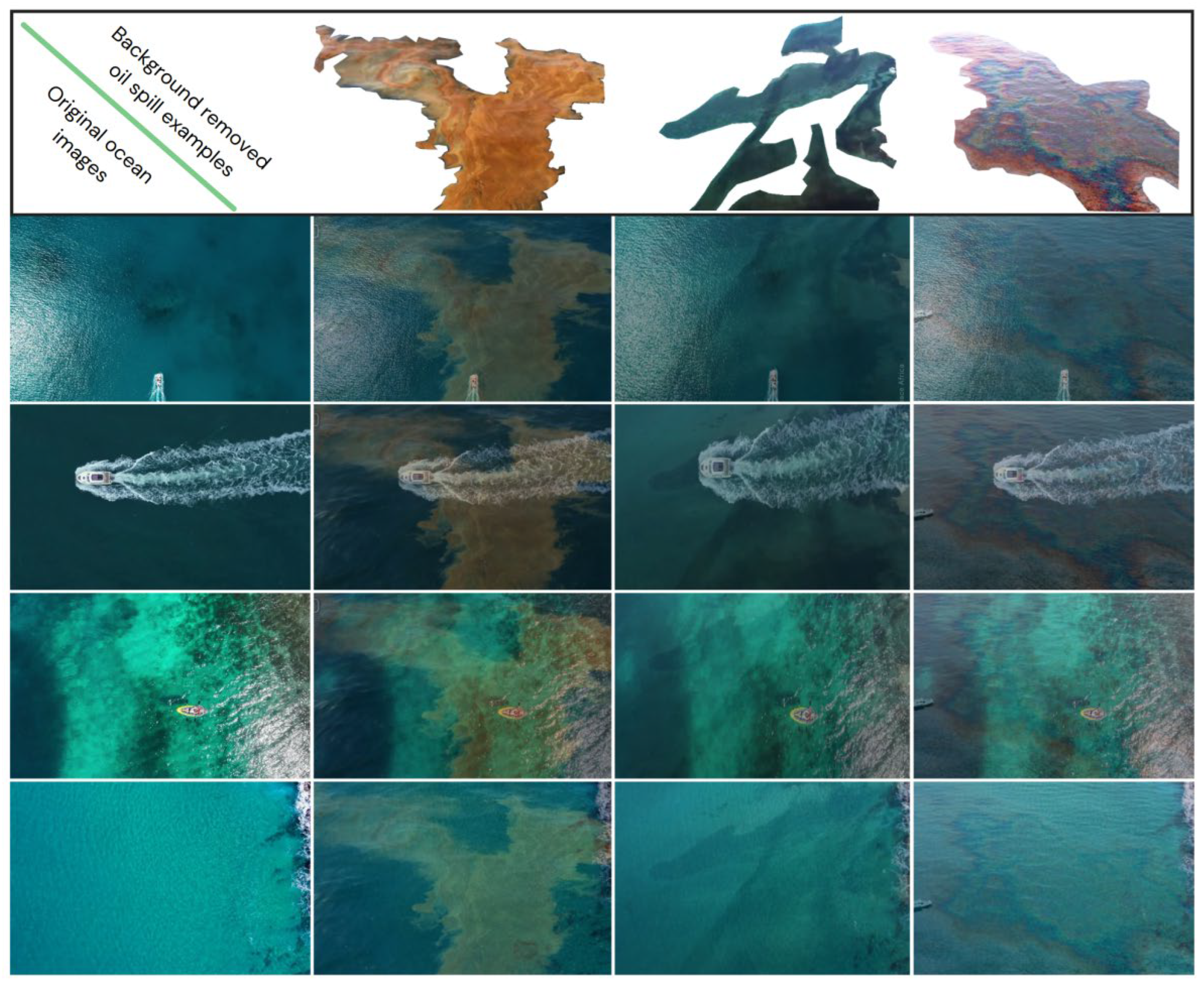
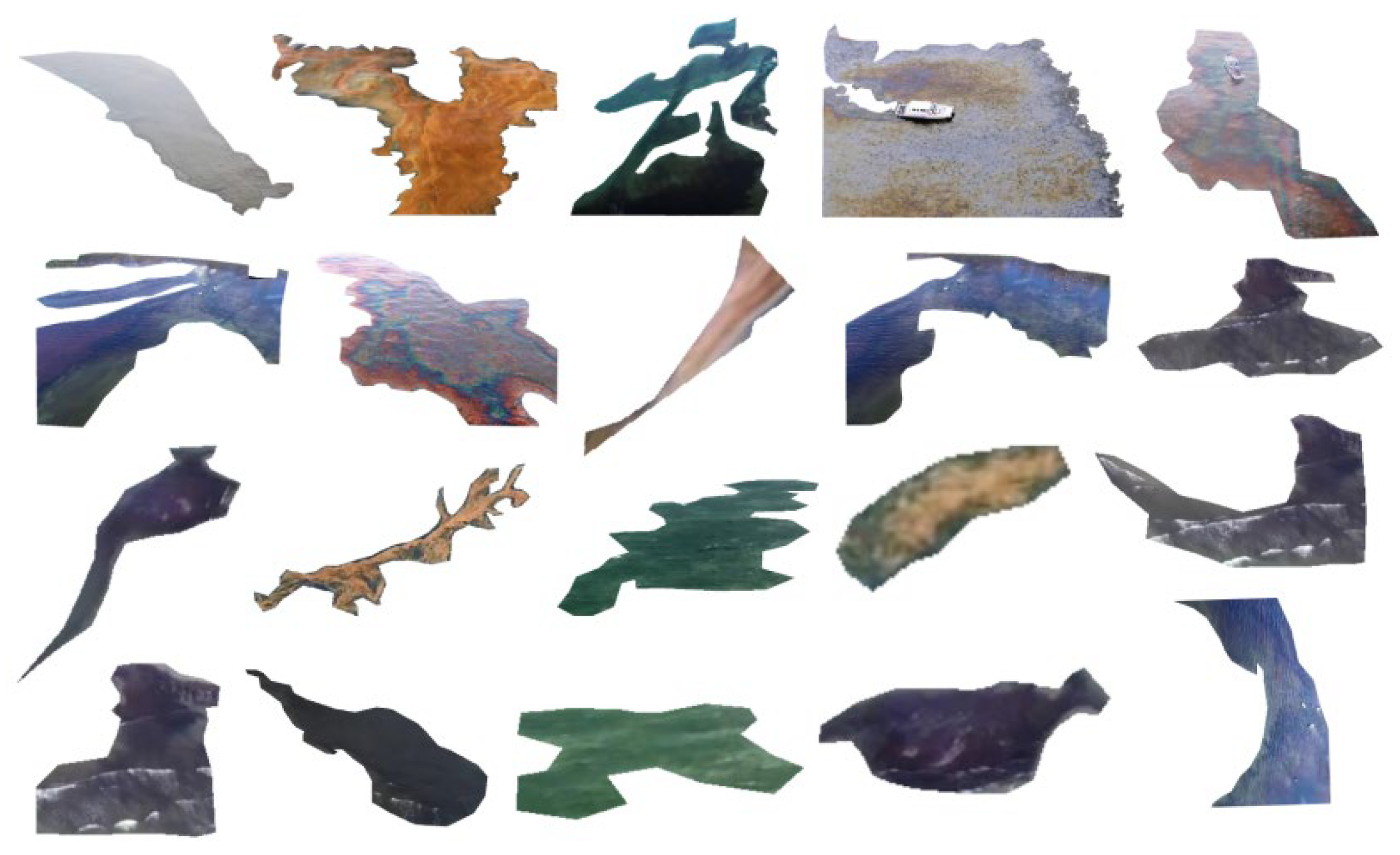
- Development of a custom optical oil spill dataset by integrating blending-based data augmentation techniques that combine source oil spill images with target ocean surface imagery to enhance data diversity and realism.
- -
- Implementation of the SOTA segmentation framework through fine-tuning the YOLOv11m-seg model using the proposed custom dataset.
- -
- LIC method integration to increase ocean wave flow for better object detection and segmentation.
2. Related Works
2.1. Remote Sensing Data for Oil Spill Detection
2.2. Traditional Monitoring and Classical Machine Learning Methods
2.3. Deep Learning and Computer Vision Approaches
3. Proposed Method
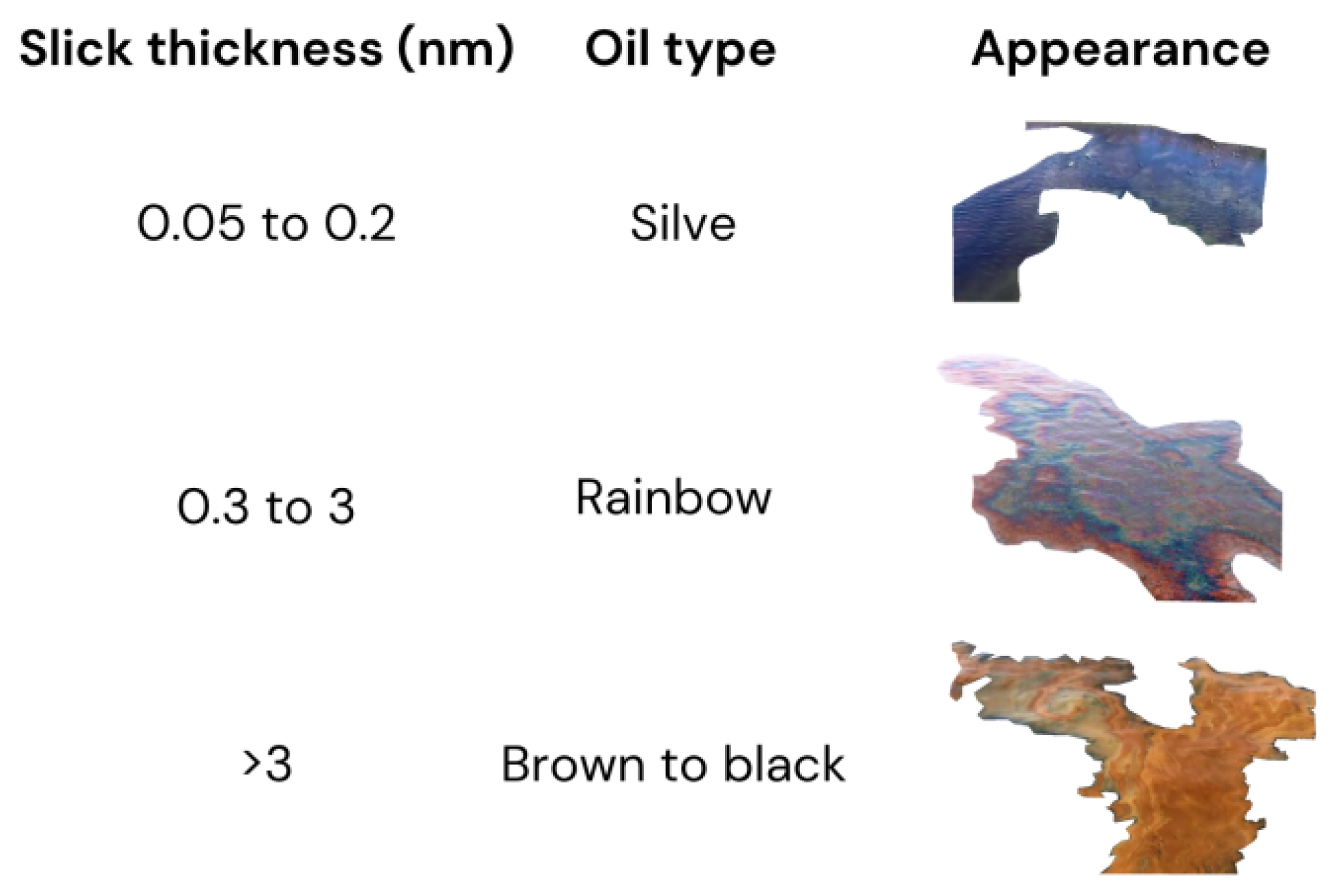
3.1. Dataset Description
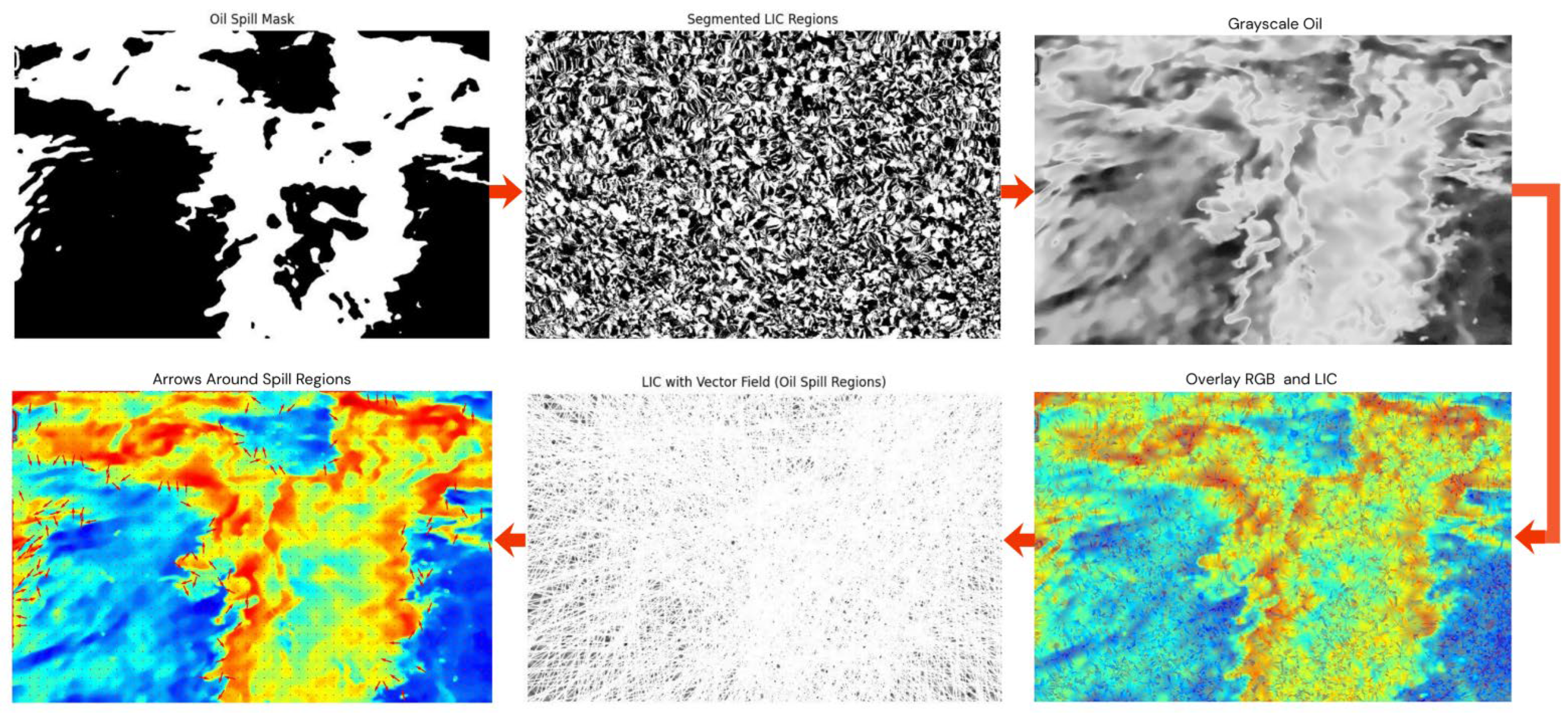
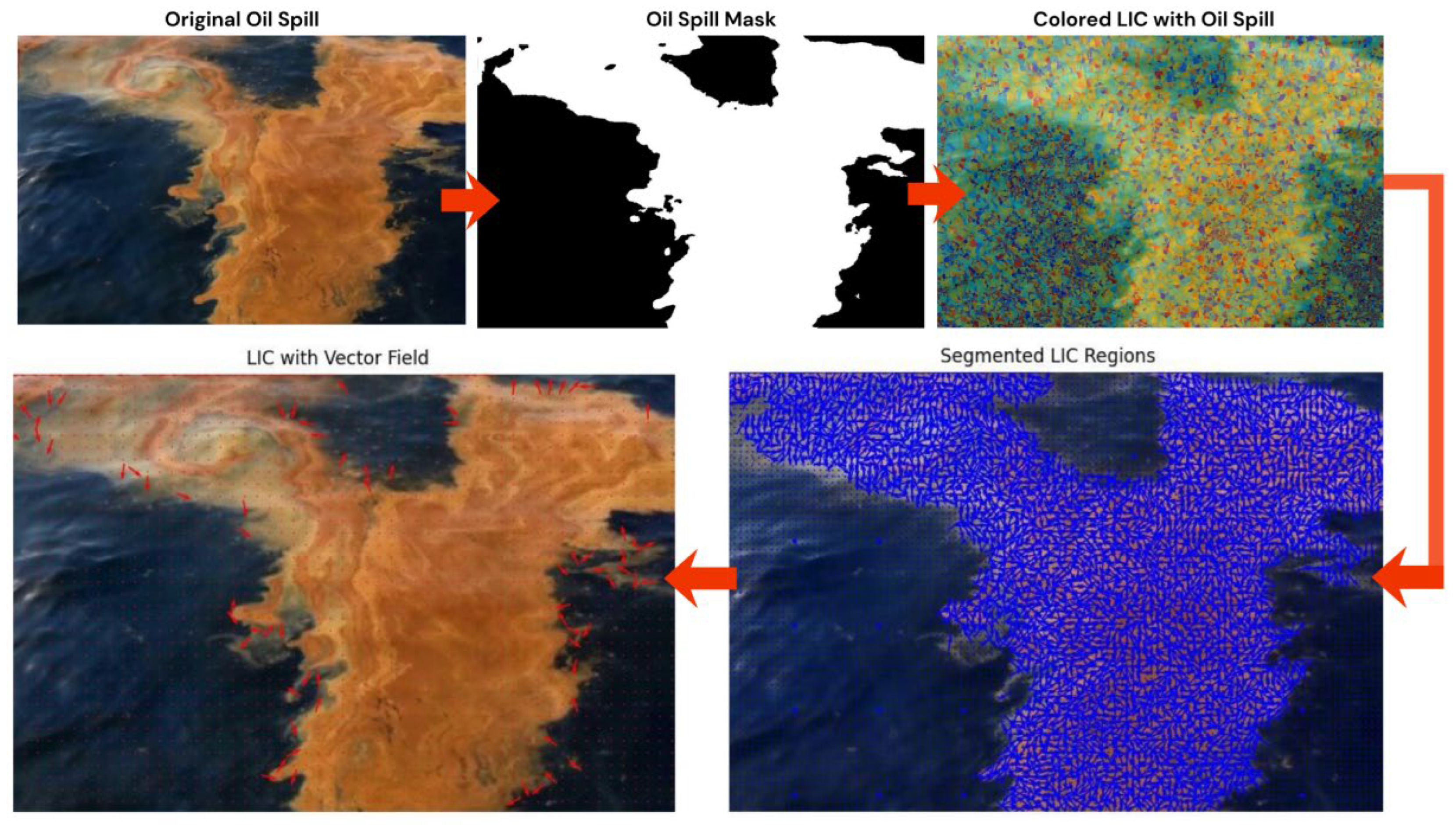
3.2. Line Integral Convolution (LIC) Application for Estimation of Wave Flow in Ocean
3.3. Vector Field Representation in the Image
3.4. Field Line and Parametrization
3.5. Convolution Along the Field Line
4. Mathematical Application for Improving Oil Spill Extraction
4.1. Gradient Field Computation
4.2. Line Integral Convolution (LIC)
- -
- (): The starting pixel coordinates.
- -
- = Normalized gradient directions.
Initialization of LIC Integration Parameters
4.3. Combining Results
- -
- is the gamma-corrected image
- -
- is the combined edge map
- -
- is the integral convolution map.
5. Experimental Results and Analysis
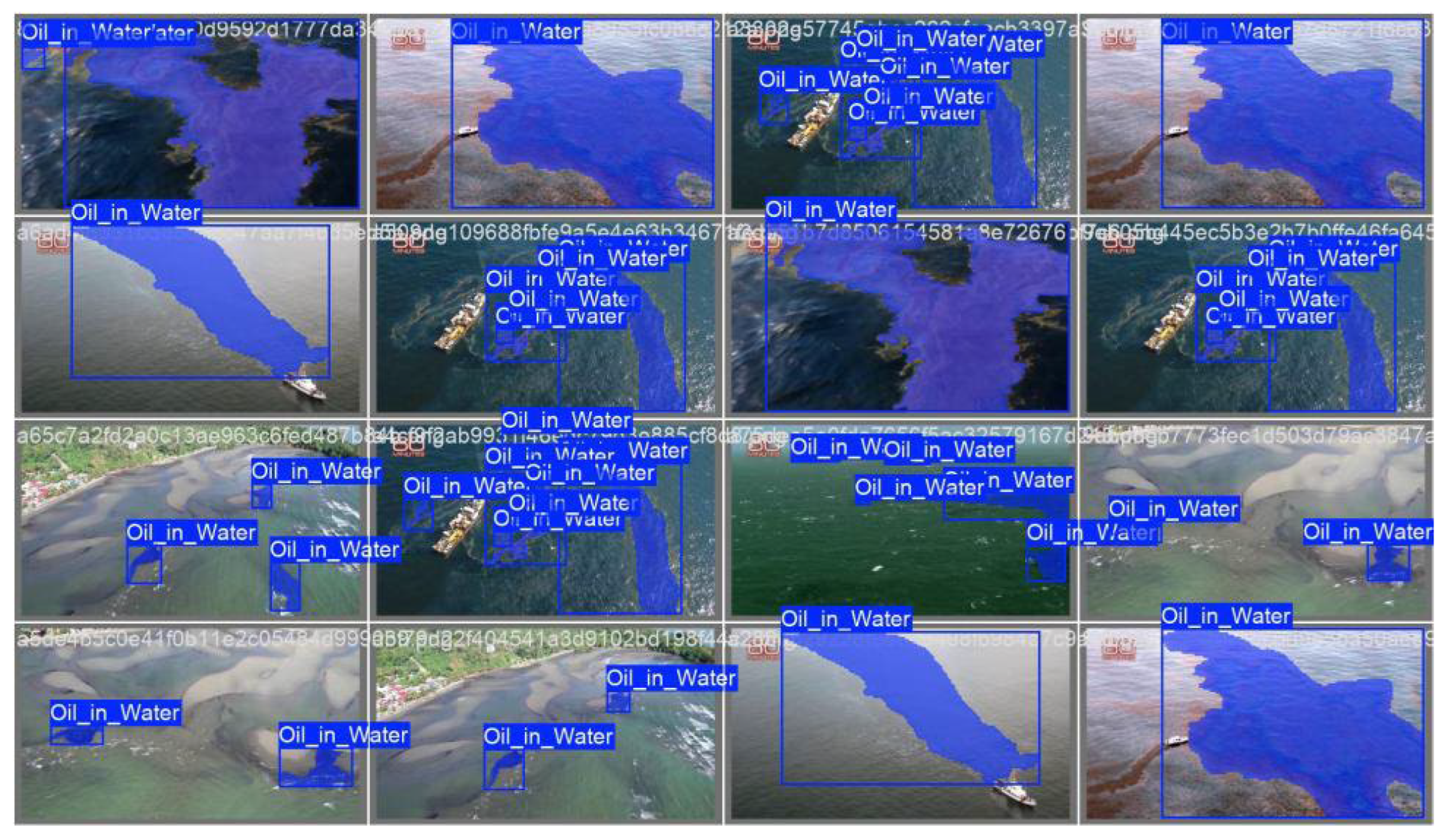
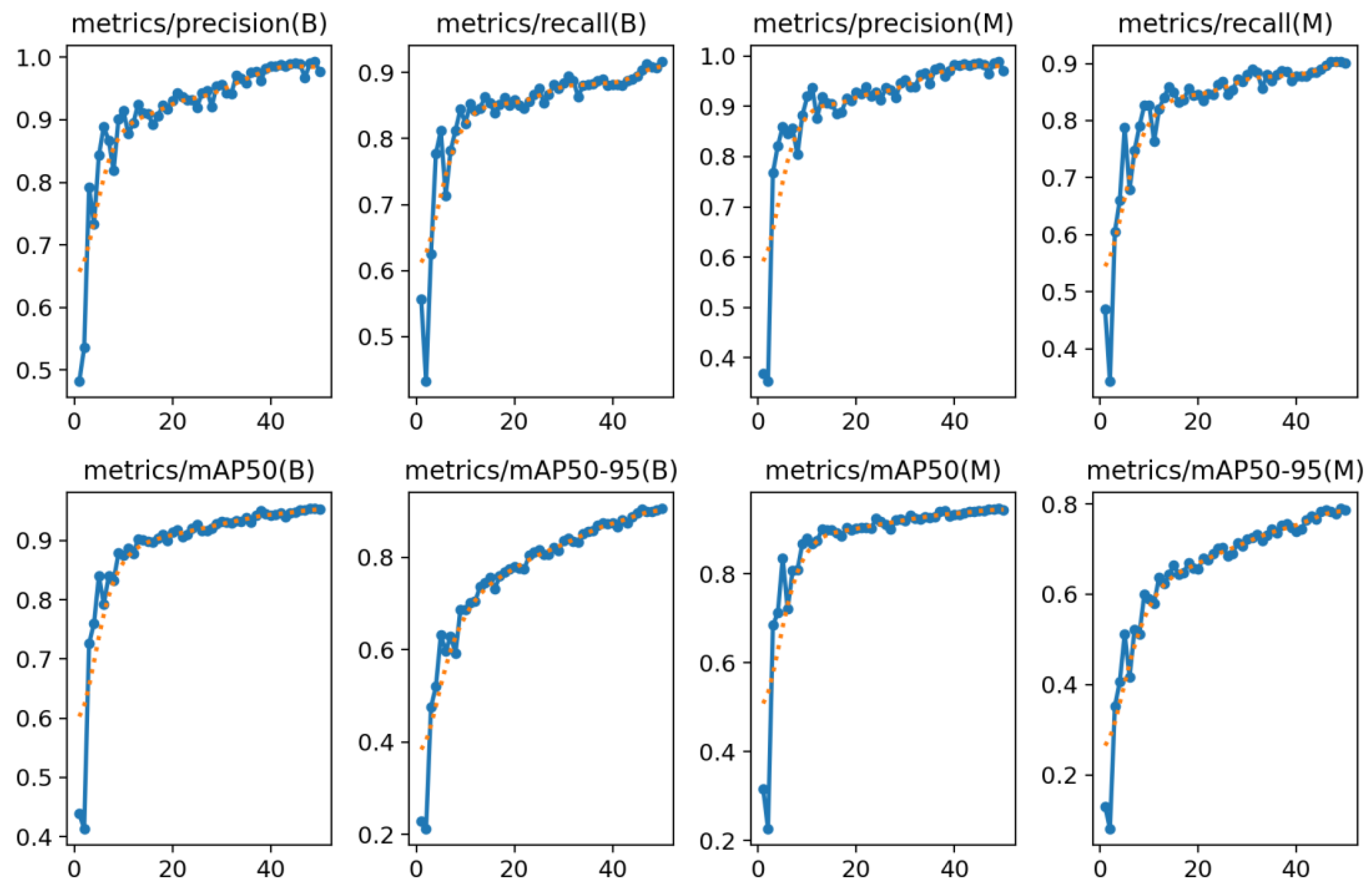
5.1. Model Training
5.2. Evaluation Metrics
6. Discussion
7. Conclusions
Author Contributions
Funding
Data Availability Statement
Acknowledgments
Conflicts of Interest
References
- Jiao, Z.; Jia, G.; Cai, Y. A New Approach to Oil Spill Detection That Combines Deep Learning with Unmanned Aerial Vehicles. Comput. Ind. Eng. 2019, 135, 1300–1311. [Google Scholar] [CrossRef]
- Available online: https://www.itopf.org/knowledge-resources/data-statistics/statistics/ (accessed on 23 October 2025).
- Available online: https://www.noaa.gov/education/resource-collections/ocean-coasts/oil-spills (accessed on 5 November 2025).
- Yekeen, S.T.; Balogun, A.-L.; Yusof, K.B.W. A novel deep learning instance segmentation model for automated marine oil spill detection. ISPRS J. Photogramm. Remote Sens. 2020, 167, 190–200. [Google Scholar]
- Grau, M.V.; Groves, T. The oil spill process: The effect of coast guard monitoring on oil spills. Environ. Resour. Econ. 1997, 10, 315–339. [Google Scholar] [CrossRef]
- Senga, H.; Kato, N.; Ito, A.; Niou, H.; Yoshie, M.; Fujita, I.; Igarashi, K.; Okuyama, E. Spilled oil tracking autonomous buoy system. Adv. Robot. 2009, 23, 1103–1129. [Google Scholar] [CrossRef]
- Griffo, G.; Piper, L.; Lay-Ekuakille, A.; Pellicanò, D. Design of buoy station for marine pollutant detection. Measurement 2014, 47, 1024–1029. [Google Scholar]
- Akhmedov, F.; Khujamatov, H.; Abdullaev, M.; Jeon, H.-S. A Novel Oil Spill Dataset Augmentation Framework Using Object Extraction and Image Blending Techniques. Remote Sens. 2025, 17, 336. [Google Scholar] [CrossRef]
- Akhmedov, F.; Nasimov, R.; Abdusalomov, A. Developing a Comprehensive Oil Spill Detection Model for Marine Environments. Remote Sens. 2024, 16, 3080. [Google Scholar] [CrossRef]
- Cao, Y.; Xu, L.; Clausi, D. Exploring the potential of active learning for automatic identification of marine oil spills using 10-year (2004–2013) RADARSAT data. Remote Sens. 2017, 9, 41. [Google Scholar] [CrossRef]
- Xu, L.; Li, J.; Brenning, A. A comparative study of different classification techniques for marine oil spill identification using RADARSAT-1 imagery. Remote Sens. Environ. 2014, 141, 14–23. [Google Scholar] [CrossRef]
- Kim, T.S.; Park, K.A.; Li, X.; Lee, M.; Hong, S.; Lyu, S.J.; Nam, S. Detection of the hebei spirit oil spill on SAR imagery and its temporal evolution in a coastal region of the Yellow sea. Adv. Space Res. 2015, 56, 1079–1093. [Google Scholar] [CrossRef]
- Ozkan, C.; Osmanoglu, B.; Sunar, F.; Staples, G.; Kalkan, K.; Balık Sanlı, F. Testing the generalization efficiency of oil slick classification algorithm using multiple Sar data for deepwater horizon oil spill. ISPRS Int. Arch. Photogramm. Remote Sens. Spat. Inf. Sci. 2012, XXXIX-B7, 67–72. [Google Scholar] [CrossRef]
- Skrunes, S.; Brekke, C.; Eltoft, T. Characterization of marine surface slicks by radarsat-2 multipolarization features. IEEE Trans. Geosci. Remote Sens. 2014, 52, 5302–5319. [Google Scholar] [CrossRef]
- Marghany, M. Automatic Mexico gulf oil spill detection from Radarsat-2 SAR satellite data using genetic algorithm. Acta Geophys. 2016, 64, 1916–1941. [Google Scholar] [CrossRef]
- Marghany, M. Automatic Detection of oil spill disasters along gulf of Mexico using RADARSAT-2 SAR data. J. Indian Soc. Remote Sens. 2017, 45, 503–511. [Google Scholar] [CrossRef]
- Song, D.; Ding, Y.; Li, X.; Zhang, B.; Xu, M. Ocean oil spill classification with RADARSAT-2 SAR based on an optimized wavelet neural network. Remote Sens. 2017, 9, 799. [Google Scholar] [CrossRef]
- Joseph, M.; Jayasri, P.V.; Dutta, S.; Kumari, E.V.S.S.; Prasad, A.V.V. Oil spill detection from RISAT-1 imagery using texture analysis. In Proceedings of the 2016 Asia-Pacific Microwave Conference (APMC), New Delhi, India, 5–9 December 2016. [Google Scholar]
- Chaudhary, V.; Kumar, S. Marine oil slicks detection using spaceborne and airborne SAR data. Adv. Space Res. 2020, 66, 854–872. [Google Scholar] [CrossRef]
- Lin, Y.; Yu, J.; Zhang, Y.; Wang, P.; Ye, Z. Dynamic analysis of oil spill in Yangtze estuary with HJ-1 imagery. In Geo-Informatics in Resource Management and Sustainable Ecosystem; Communications in Computer and Information Science; Springer: Berlin/Heidelberg, Germany, 2016; Volume 569, pp. 345–356. [Google Scholar]
- De Carolis, G.; Adamo, M.; Pasquariello, G. Thickness estimation of marine oil slicks with near-infrared MERIS and MODIS imagery: The Lebanon oil spill case study. In Proceedings of the International Geoscience and Remote Sensing Symposium, Munich, Germany, 22–27 July 2012; pp. 3002–3005. [Google Scholar]
- Adamo, M.; de Carolis, G.; de Pasquale, V.; Pasquariello, G. Detection and tracking of oil slicks on sun-glittered visible and near infrared satellite imagery. Int. J. Remote Sens. 2009, 30, 6403–6427. [Google Scholar] [CrossRef]
- Pérez-García, Á.; Rodríguez-Molina, A.; Hernández, E.; López, J.F. Spectral indices survey for oil spill detection in coastal areas. IEEE J. Sel. Top. Appl. Earth Obs. Remote Sens. 2024, 17, 15359–15372. [Google Scholar] [CrossRef]
- Dubucq, D.; Sicot, G.; Lennon, M.; Miegebielle, V. Detection and discrimination of the thick oil patches on the sea surface. Int. Arch. Photogramm. Remote Sens. Spatial Inf. Sci. 2016, XLI-B8, 417–421. [Google Scholar] [CrossRef]
- Pisano, A.; Bignami, F.; Santoleri, R. Oil spill detection in glint-contaminated near-infrared MODIS imagery. Remote Sens. 2015, 7, 1112–1134. [Google Scholar] [CrossRef]
- Mera, D.; Bolon-Canedo, V.; Cotos, J.M.; Alonso-Betanzos, A. On the use of feature selection to improve the detection of sea oil spills in SAR images. Comput. Geosci. 2017, 100, 166–178. [Google Scholar] [CrossRef]
- Terrance, V.; Graham, W.T. Dataset augmentation in feature space. In Proceedings of the International Conference on Machine Learning (ICML), Workshop Track, Sydney, Australia, 6–11 August 2017. [Google Scholar]
- Li, Y.; Cui, C.; Liu, Z.; Liu, B.; Xu, J.; Zhu, X.; Hou, Y. Detection and monitoring of oil spills using moderate/high-resolution remote sensing images. Arch. Environ. Contam. Toxicol. 2017, 73, 154–169. [Google Scholar]
- Tian, W.; Bian, X.; Shao, Y.; Zhang, Z. On the detection of oil spill with China’s HJ-1C SAR image. Aquat. Procedia 2015, 3, 144–150. [Google Scholar]
- Tong, S.; Liu, X.; Chen, Q.; Zhang, Z.; Xie, G. Multi-feature based ocean oil spill detection for polarimetric SAR data using random forest and the self-similarity parameter. Remote Sens. 2019, 11, 451. [Google Scholar] [CrossRef]
- El-Magd, I.A.; Zakzouk, M.; Abdulaziz, A.M.; Ali, E.M. The potentiality of operational mapping of oil pollution in the mediterranean sea near the entrance of the suez canal using sentinel-1 SAR data. Remote Sens. 2020, 12, 1352. [Google Scholar] [CrossRef]
- Bayramov, E.; Kada, M.; Buchroithner, M. Monitoring oil spill hotspots, contamination probability modelling and assessment of coastal impacts in the Caspian Sea using SENTINEL-1, LANDSAT-8, RADARSAT, ENVISAT and ERS satellite sensors. J. Oper. Oceanogr. 2018, 11, 27–43. [Google Scholar] [CrossRef]
- Yu, Q.; Clausi, D.A. IRGS: Image segmentation using edge penalties and region growing. IEEE Trans. Pattern Anal. Mach. Intell. 2008, 30, 2126–2139. [Google Scholar] [CrossRef]
- Zhang, B.; Perrie, W.; Li, X.; Pichel, W.G. Mapping sea surface oil slicks using RADARSAT-2 quad-polarization SAR image. Geophys. Res. Lett. 2011, 38, 415–421. [Google Scholar] [CrossRef]
- Del Frate, F.; Petrocchi, A.; Lichtenegger, J.; Calabresi, G. Neural networks for oil spill detection using ERS-SAR data. IEEE Trans. Geosci. Remote Sens. 2000, 38, 2282–2287. [Google Scholar] [CrossRef]
- Chen, S.; Wang, H.; Xu, F.; Jin, Y.-Q. Target classification using the deep convolutional networks for SAR images. IEEE Trans. Geosci. Remote Sens. 2016, 54, 4806–4817. [Google Scholar] [CrossRef]
- Xu, Q.; Li, X.; Wei, Y.; Tang, Z.; Cheng, Y.; Pichel, W.G. Satellite observations and modeling of oil spill trajectories in the Bohai sea. Mar. Pollut. Bull. 2013, 71, 107–116. [Google Scholar] [CrossRef]
- Hasan, M.; Ullah, S.; Khan, M.J.; Khurshid, K. Comparative analysis of SVM, ANN and CNN for classifying vegetation species using hyperspectral thermal infrared data. Int. Arch. Photogramm. Remote Sens. Spat. Inf. Sci. 2019, 42, 1861–1868. [Google Scholar] [CrossRef]
- Topouzelis, K.; Singha, S. Oil Spill Detection Using Space-Borne Sentinel-1 SAR Imagery; Elsevier: Amsterdam, The Netherlands, 2017. [Google Scholar]
- Loos, E.; Brown, L.; Borstad, G.; Mudge, T.; Alvarez, M. Characterization of oil slicks at sea using remote sensing techniques. In Proceedings of the IEEE Oceans, Hampton Roads, VA, USA, 14–19 October 2012; pp. 1–4. [Google Scholar]
- De Kerf, T.; Sels, S.; Samsonova, S.; Vanlanduit, S. Oil spill drone: A dataset of drone-captured, segmented RGB images for oil spill detection in port environments. arXiv 2024, arXiv:2402.18202. [Google Scholar] [CrossRef]
- Jiang, Z.; Zhang, J.; Ma, Y.; Mao, X.; Du, K. Research on dual-driven identification of oil-spill type based on optical and thermal characteristics. IEEE Trans. Geosci. Remote Sens. 2024, 62, 4209618. [Google Scholar] [CrossRef]
- Jiang, Z.; Zhang, J.; Ma, Y.; Mao, X.; Du, K.; Huang, X. Research on cross-spatiotemporal remote sensing detection of marine oil spills and emulsions based on coupling optical and thermal response characteristics. IEEE Trans. Geosci. Remote Sens. 2024, 62, 4209721. [Google Scholar] [CrossRef]
- Jiang, Z.; Zhang, J.; Ma, Y.; Mao, X. Research on remote sensing quantitative inversion of oil spills and emulsions using fusion of optical and thermal characteristics. IEEE J. Sel. Top. Appl. Earth Obs. Remote Sens. 2025, 18, 8472–8489. [Google Scholar] [CrossRef]



| Satellite Name | Operator | Polarization | References |
|---|---|---|---|
| RADARSAT-1 | Canadian Space Agency (CSA) | Single-HH | [10,11,12,13] |
| RADARSAT-2 | Canadian Space Agency (CSA) | Quad | [14,15,16,17] |
| RISAT-1 | India | Quad | [10,12] |
| Kompsat-5 | Korea | Dual | [18,19] |
| Sentinel-1 | European Space Agency (ESA) | Dual | [18,19,20,21] |
| Indices | Formulas | References | |
|---|---|---|---|
| FI | (1) | [24] | |
| RAI | (2) | [24,25] | |
| SWIR | (3) | [26,27] | |
| (4) | |||
| Attribute/Parameter | Description |
|---|---|
| Data source | Google images, public YouTube videos |
| Scene types | Ocean, oil spills |
| Ocean scenes | Open sky/cloudy/rainy/foggy |
| Oil spill type | Crude oils/Refined oils/Medium oils/Heavy oils |
| Spill characteristics | Surface oil |
| Total images | 18,136 |
| Dataset split (Train/Val) | 80%/20% |
| Training images | 14,508 |
| Validation images | 3627 |
| Input resolution | |
| Backbone | Cross-Stage Partial Networks |
| Optimizer | Adam |
| Initial learning rate | Le-5 |
| Classes name | “Oil in water” |
| Annotation tool | Makesenseai(polygon) |
| Annotation format | Yolo txt (csv) |
| Framework compatibility | PyTorch (version 12.6) |
| Number of epochs | 50 |
| ) | The number of instances correctly identified as belonging to the positive class. |
| ) | The number of instances correctly identified as not belonging to the positive class. |
| ) | The number of instances incorrectly identified as belonging to the positive class. |
| ) | The number of instances that belong to the positive class but were not recognized as such by the model. |
| mean Average Precision (mAP@0.50:0.95) | mAP is a ranking measure that evaluates the quality of a rank. |
| Our Proposed Approach | De Kerf et al. [41] | ||
|---|---|---|---|
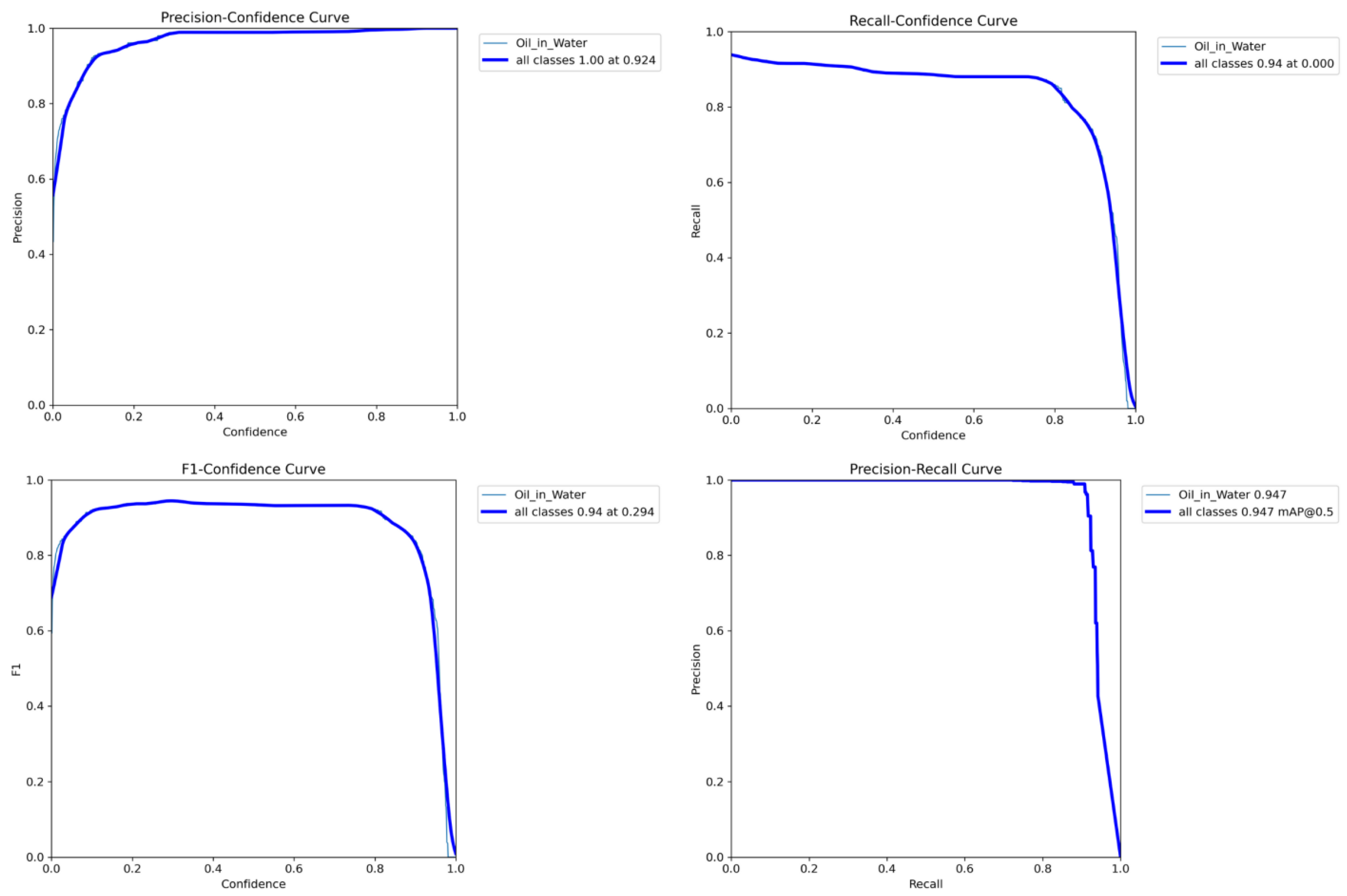
| F1-score | 0.94 | Confidence 0.924 | 0.72 |
| Precision | >1.00 | Confidence 0.000 | 0.77 |
| Recall | 0.94 | Peak F1 at confidence 0.294 | 0.79 |
| IoU@0.50 (IoU = 0.50) | 0.947 | Area under Precision-Recall | 0.69 |
| IoU@0.50-0.95 (Mean IoU) | ~0.80–0.85 | Training results | |
| Configuration | mAP@0.50 | mAP@0.50:0.95 | F1-Score | mIoU |
|---|---|---|---|---|
| Baseline (real data) | 0.83 | 0.71 | 0.85 | 0.81 |
| +Synthetic data (no LIC) | 0.91 | 0.79 | 0.91 | 0.89 |
| Full framework (+LIC) | 0.947 | 0.85 | 0.94 | 0.947 |
| Methods | Oil Spill Class | mIoU | Precision | Recall | F1-Score |
|---|---|---|---|---|---|
| U-Net | 80.13 | 86.33 | 87.65 | 90.34 | 88.97 |
| E-Net | 70.23 | 79.52 | 83.64 | 81.42 | 82.51 |
| DeepLabV3 | 84.71 | 89.58 | 91.63 | 91.82 | 91.72 |
| Ours | 85.0 | 94.7 | 94.0 (at 0.294) | 94.0 | 94.0 |
| Method | Data Type | mIoU (%) | F1-Score | Precision |
|---|---|---|---|---|
| U-Net | Optical | 86.33 | 88.97 | 87.65 |
| E-Net | Optical | 79.52 | 82.51 | 83.64 |
| DeepLabV3 | Optical | 89.58 | 91.72 | 91.63 |
| [41] | Optical | - | 0.72 | 0.77 |
| [28] | SAR | 88.4 | - | - |
| [34] | SAR | - | - | - |
| [36] | SAR | 91.2 | - | - |
| Proposed (ours) | Optical | 0.947 | 0.94 | 0.94 |
Disclaimer/Publisher’s Note: The statements, opinions and data contained in all publications are solely those of the individual author(s) and contributor(s) and not of MDPI and/or the editor(s). MDPI and/or the editor(s) disclaim responsibility for any injury to people or property resulting from any ideas, methods, instructions or products referred to in the content. |
© 2026 by the authors. Licensee MDPI, Basel, Switzerland. This article is an open access article distributed under the terms and conditions of the Creative Commons Attribution (CC BY) license.
Share and Cite
Akhmedov, F.; Abdikhafizovich, K.T.; Bolikulov, F.; Makhmudov, F. A Synthetic Data-Driven Approach for Oil Spill Detection: Fine-Tuning YOLOv11-Seg with LIC-Based Ocean Flow Modeling. J. Mar. Sci. Eng. 2026, 14, 608. https://doi.org/10.3390/jmse14070608
Akhmedov F, Abdikhafizovich KT, Bolikulov F, Makhmudov F. A Synthetic Data-Driven Approach for Oil Spill Detection: Fine-Tuning YOLOv11-Seg with LIC-Based Ocean Flow Modeling. Journal of Marine Science and Engineering. 2026; 14(7):608. https://doi.org/10.3390/jmse14070608
Chicago/Turabian StyleAkhmedov, Farkhod, Khujakulov Toshtemir Abdikhafizovich, Furkat Bolikulov, and Fazliddin Makhmudov. 2026. "A Synthetic Data-Driven Approach for Oil Spill Detection: Fine-Tuning YOLOv11-Seg with LIC-Based Ocean Flow Modeling" Journal of Marine Science and Engineering 14, no. 7: 608. https://doi.org/10.3390/jmse14070608
APA StyleAkhmedov, F., Abdikhafizovich, K. T., Bolikulov, F., & Makhmudov, F. (2026). A Synthetic Data-Driven Approach for Oil Spill Detection: Fine-Tuning YOLOv11-Seg with LIC-Based Ocean Flow Modeling. Journal of Marine Science and Engineering, 14(7), 608. https://doi.org/10.3390/jmse14070608