


Abstract
Plastic debris occurring in freshwater environments, which can either come from the surrounding terrestrial areas or transported from upstream, has been identified as one of the main sources and routes of plastic pollution in marine systems. The ocean is the final destination of land- based microplastic sources, but compared to marine environments, the occurrence and effects of microplastics in freshwater ecosystems remain largely unknown. A thorough examination of scientific literature on abundance, distribution patterns, and characteristics of microplastics in freshwater environments in Mediterranean tributary rivers has shown a substantial lack of information and the need to apply adequate and uniform measurement methods.
1. Introduction
Among environmental pollutants, microplastics (MPs) are currently receiving much attention as they have been found in all matrices of aqueous environments and their ingestion by animals has been widely observed [1,2,3,4]. The risks related to MPs derive from the multitude of chemical additives contained in the plastic raw materials and from all contaminants (such as chlorinated pesticides, polycyclic aromatic hydrocarbons, dioxins, metals etc.) [5] absorbed from surrounding media. MPs can act as a vector of pollutants and a source of exposure to wildlife, also leading to risks to human health [2,3].
Most of marine litter and MPs in the sea come from land: the rivers, in particular, are responsible for up to 80% of the plastic load floating on seas all over the world [6]. As for the Mediterranean, the highest amounts of MPs have been found at sites subjected to heavy riverine run-off and at lagoons [7,8]. Several studies have demonstrated the presence of MPs in freshwater environments, including beaches, surface waters, and sediments of rivers, lakes, and reservoirs [9,10,11,12,13,14,15,16,17,18] emphasizing the ubiquity of this form of pollution and the risks to freshwater ecosystems [19]. Studies also presented have shown that MPs are present in different layers of the river-bed and of the water column (e.g. [20] or [21]).
Classified according to the annual discharge, the ten largest Mediterranean tributary rivers are the Rhone, Po, Drin-Bojana, Nile, Neretva, Ebro, Tiber, Adige, Seyhan, and Ceyhan. These rivers account for half of the mean annual water discharge into the Mediterranean, with the Rhone and Po contributing a third [22,23]. The discharge into the Adriatic Sea, the North-western Basin, and the Aegean Sea represents 76% of the total, with the Adriatic accounting for about one third of the total [23]. Other rivers can be considered important, even if of relatively small dimensions, because they are characterized by the crossing of regions rich in civil or industrial settlements or densely populated, therefore of concern for many forms of pollution. Examples in this context are the Arno and Vjosa rivers [23].
Given this pattern of tributary rivers and the importance of what they convey in determining sea pollution levels, knowing the level of MP contamination of these rivers represents the starting point for assessing the status of the Mediterranean. This in turn generates important information on pollution sources and hotspots and provides significant data to territorial managers and decision makers on where to intervene in order to mitigate risks and damages and to begin restoration.
This review considers the current literature on the occurrence of MPs in the Mediterranean tributary rivers, considering parameters such as environmental matrices levels and patterns, organisms’ exposure, as well as risks and evidencing information gaps.
2. Discussion
All data on MP contamination in river environments from different studies on Mediterranean tributaries are reported in Table 1. The data available are graphically reported in Figure 1.

Table 1.
Field data and laboratory analytical methods for microplastics (MPs) in environments of Mediterranean Sea tributary rivers.
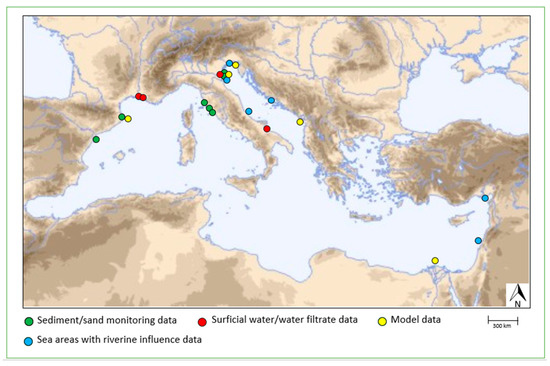
Figure 1.
Map showing the geographical locations for data available on microplastic contamination in Mediterranean tributary rivers.
In the table, together with the name of the river, the geographical area, the drainage basin, the matrices analysed in the study, and the results in qualitative and quantitative terms, a summary of the analytical method is also taken into consideration. The latest updated information was necessary here, however this review did not focus on analytical methods, due to the considerable variety of analytical processes and ways of expressing the results, found in the compilation of the table itself. This aspect, which may seem pleonastic in a reasoned review of data on the presence of contamination in a large area, is recognized by many authors as one of the most critical [7,24,25,26,27,28,29].
To the best of our knowledge, data reported in Table 1 indicates that, despite a large number of important freshwater inputs in the Mediterranean Sea, studies on the occurrence of MPs of tributary rivers are very limited, almost all are very recent, and mainly concern the final part of the rivers. This is probably attributable to the fact that MP monitoring is a relatively new topic compared, for example, to chemical contamination. In general, large rivers around the world have so far received relatively little attention, as noted by a review of scientific literature by Campanale and colleagues [36]. There are no systematic studies on entire rivers from the source to the mouth and especially for Mediterranean tributaries, considering the actual inputs. The monitoring data available (Table 1) are limited to the following Mediterranean tributary rivers: Osa, Ombrone, Albegna, Cecina, Po, Tet, Ebro, Ofanto, and Rhone. The levels reported are extremely variable: among the lowest values in beach and sediment samples, there are those measured in the Po [33,34], the highest ones refer to the Tet and Ebro [37,40], both flowing in the north-western Mediterranean. The available data regarding the values of MPs in water are scarce and, in general, poorly comparable. An example is the article by Schmidt and colleagues [38] in whose analysis microfibers were not quantified; an underestimation of real data should be taken into account when comparing these results, since fibres are often the most abundant form of MPs (for instance 40%–90% in Tet River [37] and 70% in the Ebro [40]). The level reported by Van der Wal et al. [35] for the Po River is the average maximum number detected in the study.
Some studies attribute to agricultural practices (even fraudulently) a large part of the load of plastics found in the water and river sediment samples [31,35]. The use of plastic pipes for irrigation and plastic sheets for the protection of crops, which were then abandoned in the fields, instead of being properly disposed of, found a correspondence among the levels and patterns of MPs in sediments and river water [28,32].
Concerning the studies of floating MPs reported in Table 1, several authors given the large variability in results from one sampling time to the other, emphasize the need of performing replicate sampling to gain a better understanding of spatial and temporal distribution patterns [33,36,37].
The Isonzo, Timavo, Rizâna, and Dragonja rivers, flowing in the northern Adriatic have not been directly monitored. Indirectly, however, the data on the presence of MPs reported for sediments collected in the Gulf of Trieste (133.3 items/kg dry sediment shoreline and 155.6 items/kg dry sediment infralittoral) provide an indication of the importance of the contribution of these rivers [41]. The same considerations, still relative to the Adriatic area, are valid for the Livenza and Lemene rivers, Adige, Reno, Lamone, Fiumi Uniti, Bevano, and Pescara, although not directly monitored, of which the order of magnitude of the contribution of MPs can be deduced from the values found in the sediments of marine areas subject to their influence [42,43,44,45]. In particular, very high levels of MPs were found in the sampling stations located between the mouth of the Livenza and Lemene rivers (700 items/kg dry sediment, [44]) and between the mouth of the United Rivers and the Bevano river, (1512 ± 187 items/kg dry sediment [43]. Other Mediterranean areas affected by rivers have been monitored for the presence of MPs, such as stretches of coastline in Turkey [46] and Lebanon [47].
As for the Nile River, one of the major tributaries of the Mediterranean, in recent literature no data on the actual MP contamination have been found. A global circulation model ranked this river fourth among those that, at a global level, contribute to the input of MPs in marine environments [48]. Other models have calculated the MPs that rivers export, focusing also on the Mediterranean area. The river export of MPs to coastal seas (calculated for the year 2000) showed a wide range that reflected the variation of socio-economic development and technologies applied in the sewage treatment [49]. MPs export to the Mediterranean Sea was by far the highest figure (5.6 kilotonnes), compared to those calculated for the Black Sea (4.1 kilotonnes), for the European part of the Atlantic Ocean 2.7 (kilotonnes), the North Sea (1.1 kilotonnes), and the Baltic Sea (0.9 kilotonnes). The study also estimates that the input attributable to the Rhone is 163 t MPs per year [49].
A further model [50] estimates water concentrations of MPs for the Po River equal to 0.0035 g/m3: according to this estimate, the MPs concentrations of this Mediterranean tributary would be similar to other European rivers (Rhone, 0.0043 g/m3, and Danube, 0.0041 g/m3). The application of this model also confirms that river export of MPs to the oceans varies considerably among regions. Furthermore, in general, the study points out that the fragmentation of macroplastics is the main source of MPs in rivers and predicts that by the year 2050 export of MPs might increase by 50% unless adequate mitigating actions are applied [50].
As regards overall, the contribution to plastic litter pollution, an average of 208 t per year was estimated to enter the Mediterranean from the Rhone [51], 1349 t from the Po, 575 t by Buna/Bojana, 283 t by Neretva; and 191 t by Adige [52].
Data on organisms are even rarer than those on water and sediments; mainly these are related to exposure experiments [3,53,54,55] or, more recently, aimed to assess the risk in the case of organisms intended for human consumption [2]. Few studies consider the ecological effects of MPs in whole ecosystems, in their spatial complex, in the biotic and abiotic compartments and in what happens at the level of entire food chains [56,57,58]. The above statement is generally valid for knowledge concerning the spread and effects of MPs, but in particular for freshwater environments.
The contamination of a multitude of different marine organisms has been demonstrated by monitoring all over the world: for example in plankton [59], elasmobranchs [60,61], whales [1,62], teleosts [63,64], and molluscs [2,65,66,67].
On widening the horizons outside the Mediterranean tributaries, even at a global level, there are very few monitoring studies on river organisms. The occurrence of microplastics in the digestive tract of the gudgeons (Gobio gobio) was investigated in specimens from French rivers: freshwater fish ingest MPs, with 12% of collected fish found to be contaminated [68]. The occurrence of MPs was also studied in digestive tracts of fishes from the Amazon River estuary, finding particles in 14 out of 46 species considered [4,69].
Recently, Hamed et al. 2019 [55] exposed early juvenile Nile Tilapia (Oreochromis niloticus) to MPs, evidencing an accumulation in the whole body and effects like anaemia and perturbations in the biochemical parameters. This is the only example of an exposure experiment involving riverine fish, ecotoxicological experiments being mainly concerned with MP ingestion and the effects in various marine species (for example [3,53,54]). However, most experiments were conducted by exposing organisms to microspheres at high concentrations [70] for short periods; this situation does not reflect the reality of natural environments, since the microspheres represent a very small part of the MPs present [71].
3. Conclusions
Literature studies analysed show various critical issues regarding the assessment of MPs in freshwater environments in general and in Mediterranean tributary rivers in particular.
First of all, there are limited data on the presence of MPs in water or sediment of the largest Mediterranean tributary rivers (Rhone, Po, Drin-Bojana, Nile, Neretva, Ebro, Tiber, Adige, Seyhan, and Ceyhan). There are no data for other rivers, such as the Arno and Vjosa for example, characterized by crossing regions rich in civil or industrial settlements or densely populated. In any case, the available data are limited to a few sampling points, often close to the river mouth, and to single matrices or compartments. There are no systematic studies on the entire course of a river or involving various environmental compartments and biota, addressing different discharge conditions of the rivers. Making comparisons between results of studies made with such different approaches is difficult; however, it is possible to draw in-depth elements, such as, in some cases, the agricultural origin of plastic contamination.
Few studies address the problem of MPs from an ecological point of view, which is considering an entire environment, with its communities, food webs, and its balances, as a whole.
Other critical aspects emerged are represented by the need to:
- (1)
- carry out sampling campaigns articulated in space and repeated over time, given the extreme variability reported by many studies and the emergence of the scarce significance of point-like monitoring. Long term monitoring has to be carried out on a regular basis to improve the data on MP occurrence, in order to identify sources and contamination dynamics and to mitigate the effects.
- (2)
- harmonize protocols for sampling, MP identification and expression of results, necessary to compare the results from different studies and integrate them to draw general conclusions. A standardized methodology for measuring the MPs should also address the different layers and harmonized sampling methods should be uniform net sizes and units (e.g. particles per volume, mass per volume, mass per second, etc.).
Once the MP pollution in Mediterranean tributary rivers has been better evaluated, the results can be the basis for strategies to manage and mitigate problems. Particular attention should be paid to the management of plastic materials in agriculture, a field in which information to operators on the management of plastic materials used in the fields and their correct disposal and control plans would be highly desirable.
Effective and complete monitoring data on rivers should be disseminated to the general population, which, erroneously, may be led to think that the problem of plastic pollution only affects the sea, given the greatest media attention. The general population could obtain an attitude of attention and protection, aimed at avoiding incorrect and harmful practices, being aware of the pollution levels of rivers and the associated risk for the balance of the ecosystem and for species.
Author Contributions
Conceptualization, C.G., T.M. and A.C.; Investigation, C.G., L.G. and G.P.; Writing–Original Draft Preparation, C.G.; Writing–Review and Editing, C.G., G.P., T.M., A.C., L.G.; Supervision, A.C., L.G. All authors have read and agreed to the published version of the manuscript.
Funding
This research received no external funding.
Conflicts of Interest
All the authors declare no conflict of interest.
References
- Fossi, M.C.; Marsili, L.; Baini, M.; Giannetti, M.; Coppola, D.; Guerranti, C.; Caliani, I.; Minutoli, R.; Lauriano, G.; Finoia, M.G.; et al. Fin whales and microplastics: The Mediterranean Sea and the Sea of Cortez scenarios. Environ. Pollut. 2016, 209, 68–78. [Google Scholar] [CrossRef] [PubMed]
- Renzi, M.; Guerranti, C.; Blašković, A. Microplastic contents from maricultured and natural mussels. Mar. Pollut. Bull. 2018, 131, 248–251. [Google Scholar] [CrossRef] [PubMed]
- Scopetani, C.; Cincinelli, A.; Martellini, T.; Lombardini, E.; Ciofini, A.; Fortunati, A.; Pasquali, V.; Ciattini, S.; Ugolini, A. Ingested microplastic as a two-way transporter for PBDEs in Talitrus saltator. Environ. Res. 2018, 167, 411–417. [Google Scholar] [CrossRef] [PubMed]
- Andrade, M.C.; Winemiller, K.O.; Barbosa, P.S.; Fortunati, A.; Chelazzi, D.; Cincinelli, A.; Giarrizzo, T. First account of plastic pollution impacting freshwater fishes in the Amazon: Ingestion of plastic debris by piranhas and other serrasalmids with diverse feeding habits. Environ. Pollut. 2019, 244, 766–773. [Google Scholar] [CrossRef]
- Rios, L.M.; Moore, C.; Jones, P.R. Persistent organic pollutants carried by synthetic polymers in the ocean environment. Mar. Pollut. Bull. 2007, 54, 1230–1237. [Google Scholar] [CrossRef]
- Allsopp, M.; Walters, A.; Santillo, D.; Johnston, P. Plastic Debris in the World’s Oceans; Greenpeace: Amsterdam, The Netherlands, 2006. [Google Scholar]
- Martellini, T.; Guerranti, C.; Scopetani, C.; Ugolini, A.; Chelazzi, D.; Cincinelli, A. A snapshot of microplastics in the coastal areas of the Mediterranean Sea. Trends Anal. Chem. 2018, 109, 173–179. [Google Scholar] [CrossRef]
- Cincinelli, A.; Martellini, T.; Guerranti, C.; Scopetani, C.; Chelazzi, D.; Giarrizzo, T. A potpourri of microplastics in the sea surface and water column of the Mediterranean Sea. Trends Anal. Chem. 2019, 110, 321–326. [Google Scholar] [CrossRef]
- Zbyszewski, M.; Corcoran, P.L. Distribution and degradation of fresh water plastic particles along the beaches of Lake Huron, Canada. Water Air Soil Pollut. 2011, 220, 365–372. [Google Scholar] [CrossRef]
- Castaneda, R.A.; Avlijas, S.; Simard, M.A.; Ricciardi, A. Microplastic pollution in St. Lawrence River sediments. Can. J. Fish. Aquat. Sci. 2014, 71, 1767–1771. [Google Scholar] [CrossRef]
- Lechner, A.; Keckeis, H.; Lumesberger-Loisl, F.; Zens, B.; Krusch, R.; Tritthart, M.; Glas, M.; Schludermann, E. The Danube so colourful: A potpourri of plastic litter outnumbers fish larvae in Europe’s second largest river. Environ. Pollut. 2014, 188, 177–181. [Google Scholar] [CrossRef]
- Bartsch, W.M.; Axler, R.P.; Host, G.E. Evaluating a Great Lakes scale landscape stressor index to assess water quality in the St. Louis River area of concern. J. Gt. Lakes Res. 2015, 41, 99–110. [Google Scholar] [CrossRef]
- Mani, T.; Hauk, A.; Walter, U.; Burkhardt-Holm, P. Microplastics profile along the Rhine River. Sci. Rep. 2015, 5, 17988. [Google Scholar] [CrossRef] [PubMed]
- Zhang, K.; Gong, W.; Lv, J.; Xiong, X.; Wu, C. Accumulation of floating microplastics behind the three Gorges Dam. Environ. Pollut. 2015, 204, 117–123. [Google Scholar] [CrossRef] [PubMed]
- Biginagwa, F.J.; Mayoma, B.S.; Shashoua, Y.; Syberg, K.; Khan, F.R. First evidence of microplastics in the African Great Lakes: Recovery from Lake Victoria Nile perch and Nile tilapia. J. Gt. Lakes Res. 2016, 42, 146–149. [Google Scholar] [CrossRef]
- Anderson, P.J.; Warrack, S.; Langen, V.; Challis, J.K.; Hanson, M.L.; Rennie, M.D. Microplastic contamination in Lake Winnipeg, Canada. Environ. Pollut. 2017, 225, 223–231. [Google Scholar] [CrossRef]
- Jabeen, K.; Su, L.; Li, J.; Yang, D.; Tong, C.; Mu, J.; Shi, H. Microplastics and mesoplastics in fish from coastal and fresh waters of China. Environ. Pollut. 2017, 221, 141–149. [Google Scholar] [CrossRef]
- Mahon, A.M.; Officer, R.; Nash, R.; O’Connor, I. Scope, Fate, Risks and Impacts of Microplastic Pollution in Irish Freshwater Systems. Report No. 210. EPA Research. 2017. Available online: https://www.epa.ie/pubs/reports/research/water/research210.html (accessed on 11 November 2019).
- Scherer, C.; Weber, A.; Lambert, S.; Wagner, M. Interactions of microplastics with freshwater biota. In Freshwater Microplastics: Emerging Environmental Contaminants? Wagner, M., Lambert, S., Eds.; Springer Nature: Heidelberg, Germany, 2017. [Google Scholar]
- Dris, R.; Gasperi, J.; Rocher, V.; Tassin, B. Synthetic and non-synthetic anthropogenic fibers in a river under the impact of Paris Megacity: Sampling methodological aspects and flux estimations. Sci. Total Environ. 2018, 618, 157–164. [Google Scholar] [CrossRef]
- Liedermann, M.; Gmeiner, P.; Pessenlehner, S.; Haimann, M.; Hohenblum, P.; Habersack, H. A Methodology for Measuring Microplastic Transport in Large or Medium Rivers. Water 2018, 10, 414. [Google Scholar] [CrossRef]
- Struglia, M.V.; Mariotti, A.; Filograsso, A. River discharge into the Mediterranean Sea: Climatology and aspects of the observed variability. J. Clim. 2004, 17, 4740–4751. [Google Scholar] [CrossRef]
- Ludwig, W.; Dumont, E.; Meybeck, M.; Heussner, S. River discharges of water and nutrients to the Mediterranean and Black Sea: Major drivers for ecosystem changes during past and future decades? Prog. Oceanogr. 2009, 80, 199–217. [Google Scholar] [CrossRef]
- Vianello, A.; Boldrin, A.; Guerriero, P.; Moschino, V.; Rella, R.; Sturaro, A.; Da Ros, L. Microplastic particles in sediments of Lagoon of Venice, Italy: First observations on occurrence, spatial patterns and identification. Estuar. Coast. Shelf Sci. 2013, 130, 54–61. [Google Scholar] [CrossRef]
- Santos, R.G.; Andrades, R.; Boldrini, M.A.; Martins, A.S. Debris ingestion by juvenile marine turtles: An underestimated problem. Mar. Pollut. Bull. 2015, 93, 37–43. [Google Scholar] [CrossRef] [PubMed]
- Van Cauwenberghe, L.; Devriese, L.; Galgani, F.; Robbens, J.; Janssen, C. Microplastics in sediments: A review of techniques, occurrence and effects. Mar. Environ. Res. 2015, 111, 5–17. [Google Scholar] [CrossRef] [PubMed]
- Woodall, L.C.; Gwinnett, C.; Packer, M.; Thompson, R.C.; Robinson, L.F.; Paterson, G.L.J. Using a forensic science approach to minimize environmental contamination and to identify microfibers in marine sediments. Mar. Pollut. Bull. 2015, 95, 40–46. [Google Scholar] [CrossRef]
- Besley, A.; Vijver, M.G.; Behrens, P.; Bosker, T. Standardized method for sampling and extraction methods for quantifying microplastics in beach sand. Mar. Pollut. Bull. 2017, 114, 77–83. [Google Scholar] [CrossRef]
- Horton, A.A.; Walton, A.; Spurgeon, D.J.; Lahive, E.; Svendsen, C. Microplastics in freshwater and terrestrial environments: Evaluating the current understanding to identify the knowledge gaps and future research priorities. Sci. Total Environ. 2017, 586, 127–141. [Google Scholar] [CrossRef]
- Cannas, S.; Fastelli, P.; Guerranti, C.; Renzi, M. Plastic litter in sediments from the coasts of south Tuscany (Tyrrhenian Sea). Mar. Pollut. Bull. 2017, 119, 372–375. [Google Scholar] [CrossRef]
- Guerranti, C.; Cannas, S.; Scopetani, C.; Fastelli, P.; Cincinelli, A.; Renzi, M. Plastic litter in aquatic environments of Maremma Regional Park (Tyrrhenian Sea, Italy): Contribution by the Ombrone river and levels in marine sediments. Mar. Pollut. Bull. 2017, 117, 366–370. [Google Scholar] [CrossRef]
- Blašković, A.; Guerranti, C.; Fastelli, P.; Anselmi, S.; Renzi, M. Plastic levels in sediments closed to Cecina river estuary (Tuscany, Italy). Mar. Pollut. Bull. 2018, 135, 105–109. [Google Scholar] [CrossRef]
- Atwood, E.C.; Falcieri, F.M.; Piehl, S.; Bochow, M.; Matthies, M.; Franke, J.; Carniel, S.; Sclavo, M.; Laforsch, C.; Siegert, F. Coastal accumulation of microplastic particles emitted from the Po River, Northern Italy: Comparing remote sensing and hydrodynamic modelling with in situ sample collections. Mar. Pollut. Bull. 2019, 138, 561–574. [Google Scholar] [CrossRef]
- Piehl, S.; Mitterwallner, V.; Atwood, E.C.; Bochow, M.; Laforscha, C. Abundance and distribution of large microplastics (1–5 mm) within beach sediments at the Po River Delta, northeast Italy. Mar. Pollut. Bull. 2019, 149, 110515. [Google Scholar] [CrossRef]
- Van der Wal, M.; van der Meulen, M.; Tweehuijsen, G.; Peterlin, M.; Palatinus, A.; Kovač Viršek, M. Identification and Assessment of Riverine Input of (Marine) Litter; Final Report for the European Commission DG Environment under Framework Contract; Eunomia Research & Consulting Ltd.: Bristol, UK, 2015. [Google Scholar]
- Campanale, C.; Stock, F.; Massarelli, C.; Kochleus, C.; Bagnuolo, G.; Reifferscheid, G.; Uricchio, V.F. Microplastics and their possible sources: The example of Ofanto river in Southeast Italy. Environ. Pollut. 2020, 258, 113284, in press. [Google Scholar] [CrossRef]
- Constant, M.; Kerhervé, P.; Mino-Vercellio-Verollet, M.; Dumontier, M.; Sànchez Vidald, A.; Canals, M.; Heussner, S. Beached microplastics in the Northwestern Mediterranean Sea. Mar. Pollut. Bull. 2019, 142, 263–273. [Google Scholar] [CrossRef]
- Schmidt, N.; Thibault, D.; Galgani, F.; Paluselli, A.; Sempere, R. Occurrence of microplastics in surface waters of the Gulf of Lion (NW Mediterranean Sea). Prog. Oceanogr. 2018, 163, 214–220. [Google Scholar] [CrossRef]
- De Alencastro, L.F. Evaluation de la Pollution Par Les Plastiques Dans Les Eaux de Surface en Suisse; Rapport Final. Sur mandat de l’Office fédéral de l’environnement (OFEV); Ecole Polytechnique Fédérale de Lausanne: Lausanne, Switzerland; pp. 22–23.
- Simon-Sánchez, L.; Grelaud, M.; Garcia-Orellana, J.; Ziveri, P. River Deltas as hotspots of microplastic accumulation: The case study of the Ebro River (NW Mediterranean). Sci. Total Environ. 2019, 687, 1186–1196. [Google Scholar] [CrossRef]
- Laglbauer, B.J.; Franco-Santos, M.R.; Andreu-Cazenave, M.; Brunelli, L.; Papadatou, M.; Palatinus, A.; Grego, M.; Deprez, T. Macrodebris and microplastics from beaches in Slovenia. Mar. Pollut. Bull. 2014, 89, 356–366. [Google Scholar] [CrossRef]
- Mistri, M.; Infantini, V.; Scoponi, M.; Granata, T.; Moruzzi, L.; Massara, F.; De Donati, M.; Munari, C. Small plastic debris in sediments from the Central Adriatic Sea: Types, occurrence and distribution. Mar. Pollut. Bull. 2017, 124, 435–440. [Google Scholar] [CrossRef]
- Lots, F.A.E.; Behrens, P.; Vijver, M.G.; Horton, A.A.; Bosker, T. A large-scale investigation of microplastic contamination: Abundance and characteristics of microplastics in European beach sediment. Mar. Pollut. Bull. 2017, 123, 219–226. [Google Scholar] [CrossRef]
- Renzi, M.; Blaskovic, A.; Fastelli, P.; Marcelli, M.; Guerranti, C.; Cannas, S.; Barone, L.; Massara, F. Is the microplastic selective according to the habitat? Records in amphioxus sands, Maerl bed habitats and Cymodocea nodosa habitats. Mar. Pollut. Bull. 2018, 130, 179–183. [Google Scholar] [CrossRef]
- Munari, C.; Scoponi, M.; Mistri, M. Plastic debris in the Mediterranean Sea: Types, occurrence and distribution along Adriatic shorelines. Waste Manag. 2017, 67, 385–391. [Google Scholar] [CrossRef]
- Gündogdu, S.; Çevik, C. Mediterranean dirty edge: High level of meso and macroplastics pollution on the Turkish coast. Environ. Pollut. 2019, 255, 113351. [Google Scholar] [CrossRef] [PubMed]
- Kazour, M.; Sharif, J.; Christelle, I.; Gaby, K.; Rachid, A. Microplastics pollution along the Lebanese coast (Eastern Mediterranean Basin): Occurrence in surface water, sediments and biota samples. Sci. Total Environ. 2019, 696, 133933. [Google Scholar] [CrossRef] [PubMed]
- Lebreton, L.C.M.; Greer, S.D.; Borrero, J.C. Numerical modelling of floating debris in the world’s oceans. Mar. Pollut. Bull. 2012, 64, 653–661. [Google Scholar] [CrossRef] [PubMed]
- Siegfried, M.; Koelmans, A.A.; Besseling, E.; Kroeze, C. Export of microplastics from land to sea. A modelling approach. Water Res. 2017, 127, 249–257. [Google Scholar] [CrossRef] [PubMed]
- van Wijnen, J.A.; Ragas, M.J.; Kroeze, C. Modelling global river export of microplastics to the marine environment: Sources and future trends. Sci. Total Environ. 2019, 673, 392–401. [Google Scholar] [CrossRef] [PubMed]
- Faure, F.; Demars, C.; Wieser, O. Plastic pollution in Swiss surface waters: Nature and concentrations, interaction with pollutants. Environ. Chem. 2015, 12, 582–591. [Google Scholar] [CrossRef]
- Liubartseva, S.; Coppini, G.; Lecci, R.; Creti, S. Regional approach to modelling the transport of floating plastic debris in the Adriatic Sea. Mar. Pollut. Bull. 2016, 103, 115–127. [Google Scholar] [CrossRef]
- Green, D.S.; Boots, B.; Sigwart, J.; Jiang, S.; Rocha, C. Effects of conventional and biodegradable microplastics on a marine ecosystem engineer (Arenicola marina) and sediment nutrient cycling. Environ. Pollut. 2016, 208, 426–434. [Google Scholar] [CrossRef]
- Ogonowski, M.; Schur, C.; Jarsen, A.; Gorokhova, E. The effects of natural and anthropogenic microparticles on individual Fitness in Daphnia magna. PLoS ONE 2016, 11, e0155063. [Google Scholar] [CrossRef]
- Hamed, M.; Soliman, H.A.M.; Osman, A.G.M.; El-Din, A.; Sayed, H. Assessment the effect of exposure to microplastics in Nile Tilapia (Oreochromis niloticus) early juvenile: I. blood biomarkers. Chemosphere 2019, 228, 345–350. [Google Scholar] [CrossRef]
- Farrell, P.; Nelson, K. Trophic level transfer of microplastic: Mytilus edulis (L.) to Carcinus maenas (L.). Environ. Pollut. 2013, 177, 1–3. [Google Scholar] [CrossRef] [PubMed]
- Athey, S.N.; Albotra, S.D.; Gordon, C.A.; Monteleone, B.; Seaton, P.; Andrady, A.L.; Taylor, A.R.; Brander, S.M. Trophic transfer of microplastics in an estuarine food chain and the effects of a sorbed legacy pollutant. Limnol. Oceanogr. Lett. 2020, 5, 154–162. [Google Scholar] [CrossRef]
- Lorenz, C.; Roscher, L.; Meyer, M.S.; Hildebrandt, L.; Prume, J.; Martin, G.J.; Löder, S.; Primpke; Gerdts, G. Spatial distribution of microplastics in sediments and surface waters of the southern North Sea. Environ. Pollut. 2019, 252, 1719–1729. [Google Scholar] [CrossRef] [PubMed]
- De Lucia, G.A.; Caliani, I.; Marra, S.; Camedda, A.; Coppa, S.; Alcaro, L.; Campani, T.; Giannetti, M.; Coppola, D.; Cicero, A.M.; et al. Amount and distribution of neustonic micro-plastic off the western Sardinian coast (Central-Western Mediterranean Sea). Mar. Environ. Res. 2014, 100, 10–16. [Google Scholar] [CrossRef]
- Fossi, M.C.; Coppola, D.; Baini, M.; Giannetti, M.; Guerranti, C.; Marsili, L.; Panti, C.; de Sabata, E.; Clò, S. Large filter feeding marine organisms as indicators of microplastic in the pelagic environment: The case studies of the Mediterranean basking shark (Cetorhinus maximus) and fin whale (Balaenoptera physalus). Mar. Environ. Res. 2014, 100, 17–24. [Google Scholar] [CrossRef]
- Valente, T.; Sbrana, A.; Scacco, U.; Jacomini, C.; Bianchi, J.; Palazzo, L.; de Lucia, G.A.; Silvestri, C.; Matiddi, M. Exploring microplastic ingestion by three deep-water elasmobranch species: A case study from the Tyrrhenian Sea. Environ. Pollut. 2019, 253, 342–350. [Google Scholar] [CrossRef]
- Fossi, M.C.; Panti, C.; Coppola, D.; Matteo, M.; Marsili, L.; Minutoli, R.; Guerranti, C. Are baleen whales exposed to microplastics threat? The case study of the Mediterranean Fin whale. Comp. Biochem. Physiol. Part A 2012, 163, S25–S26. [Google Scholar] [CrossRef]
- Neves, D.; Sobral, P.; Ferreira, J.L.; Pereira, T. Ingestion of microplastics by commercial fish off the Portuguese coast. Mar. Pollut. Bull. 2015, 101, 119–126. [Google Scholar] [CrossRef]
- Giani, M.; Baini, M.; Galli, M.; Casini, S.; Fossi, M.C. Microplastics occurrence in edible fish Dario species (Mullus barbatus and Merluccius merluccius) collected in three different geographical sub-areas of the Mediterranean Sea. Mar. Pollut. Bull. 2019, 140, 129–137. [Google Scholar] [CrossRef]
- Abidli, S.; Lahbib, Y.; El Menif, N.T. Microplastics in commercial molluscs from the lagoon of Bizerte (Northern Tunisia). Mar. Pollut. Bull. 2019, 142, 243–252. [Google Scholar] [CrossRef]
- Hermabessiere, L.; Paul-Pont, I.; Cassone, A.-L.; Himber, C.; Receveur, J.; Jezequel, R.; El Rakwe, M.; Rinnert, E.; Riviere, G.; Lambert, C.; et al. Microplastic contamination and pollutant levels in mussels and cockles collected along the channel coasts. Environ. Pollut. 2019, 250, 807–819. [Google Scholar] [CrossRef] [PubMed]
- Li, J.; Lusher, A.L.; Rotchell, J.M.; Deudero, S.; Turra, A.; Bråte, I.L.N.; Chengjun, S.; Hossain, M.S.; Li, Q.; Kolandhasamy, P.; et al. Using mussel as a global bioindicator of coastal microplastic pollution. Environ. Pollut. 2019, 244, 522–533. [Google Scholar] [CrossRef] [PubMed]
- Sanchez, W.; Bender, C.; Porcher, J.-M. Wild gudgeons (Gobio gobio) from French rivers are contaminated by microplastics: Preliminary study and first evidence. Environ. Res. 2014, 128, 98–100. [Google Scholar] [CrossRef]
- De Souza, T.; Pegado, S.; Schmid, K.; Winemiller, K.O.; Chelazzi, D.; Cincinelli, A.; Dei, L.; Giarrizzo, T. First evidence of microplastic ingestion by fishes from the Amazon River estuary. Mar. Pollut. Bull. 2018, 133, 814–821. [Google Scholar]
- Phuong, N.N.; Zalouk-Vergnoux, A.; Poirier, L.; Kamari, A.; Chatel, A.; Mouneyrac, C.; Lagarde, F. Is there any consistency between the microplastics found in the field and those used in laboratory experiments? Environ. Pollut. 2016, 211, 111–123. [Google Scholar] [CrossRef]
- Guerranti, C.; Martellini, T.; Perra, G.; Scopetani, C.; Cincinelli, A. Microplastics in cosmetics: Environmental issues and needs for global bans. Environ. Toxicol. Pharmacol. 2019, 68, 75–79. [Google Scholar] [CrossRef]
© 2020 by the authors. Licensee MDPI, Basel, Switzerland. This article is an open access article distributed under the terms and conditions of the Creative Commons Attribution (CC BY) license (http://creativecommons.org/licenses/by/4.0/).