1. Introduction
The demand for reliable, high-speed underwater communication is steadily growing due to the increasing deployment of autonomous underwater vehicles (AUVs), remotely operated vehicles (ROVs), smart ocean monitoring systems, offshore industrial operations, and naval applications [
1,
2]. Traditional underwater communication technologies, primarily acoustic and radio-frequency (RF) systems, face severe limitations in such environments. Acoustic links, although capable of spanning long distances, suffer from low bandwidth, high latency, susceptibility to multipath fading, and interference from natural and industrial noise sources [
3]. RF-based systems, on the other hand, are strongly attenuated in water, particularly in saline conditions, and can therefore operate effectively only over very short ranges [
4]. These drawbacks significantly constrain applications that require real-time, high-data-rate, and secure underwater connectivity. To overcome these challenges, underwater wireless optical communication (UWOC) has emerged as a promising alternative. By transmitting information via modulated optical signals in the visible and near-infrared spectrum, UWOC systems offer substantially higher data rates, lower latency, and reduced power consumption compared to acoustic or RF methods [
5,
6], enabling advanced underwater applications such as real-time video streaming, inter-vehicle coordination, and environmental monitoring [
7]. The potential of UWOC to support Internet of Underwater Things (IoUT) architectures [
8] has further intensified research interest in this domain.
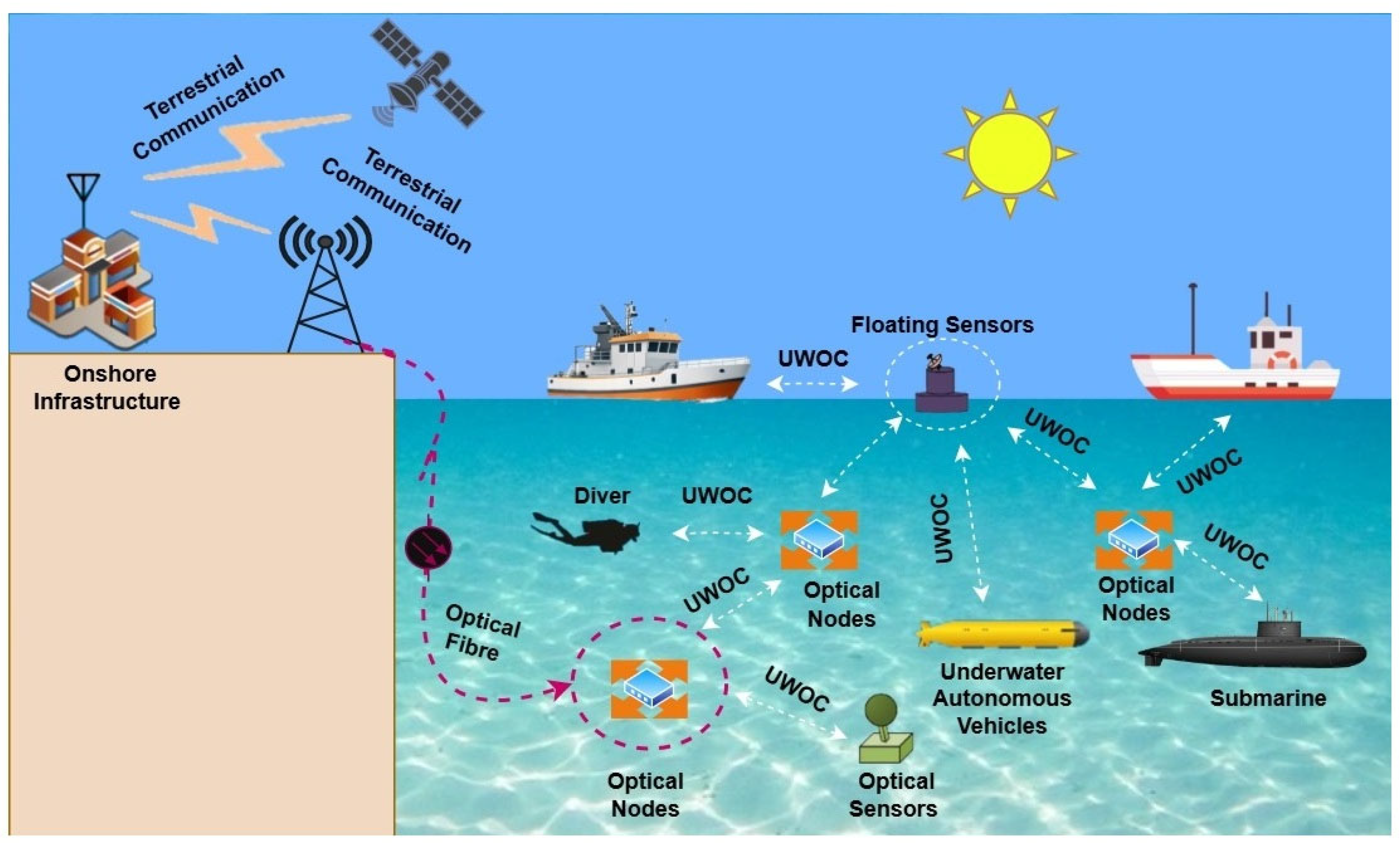
Figure 1 presents a conceptual illustration of a heterogeneous underwater communication scenario in which UWOC links interconnect divers, optical sensors, autonomous underwater vehicles, submarines, and surface platforms. Despite the inherent advantages of UWOC, its practical deployment is still constrained by underwater channel impairments such as absorption, scattering, turbulence, and especially salinity variations [
9,
10]. Saline water introduces additional attenuation and refractive index fluctuations that directly affect optical signal propagation leading to increased bit error rates (BERs) and reduced communication reliability [
11]. These effects are particularly pronounced in coastal and deep-sea environments where salinity levels vary significantly with depth and geographical location. Addressing these challenges requires advanced system designs that enhance robustness against environmentally induced degradation.
In this context, multiplexing and diversity techniques have proven highly effective in terrestrial and free-space optical communication systems. Polarization division multiplexing (PDM) enables capacity enhancement by exploiting orthogonal polarization states [
12,
13], while multiple-input multiple-output (MIMO) architectures improve throughput and link reliability through spatial diversity [
14,
15]. Although both techniques are well established in other communication domains, their joint application in UWOC systems under realistic salinity conditions remains underexplored.
Motivated by this research gap, this work introduces a salinity-aware PDM-MIMO UWOC architecture designed to enable high-speed and robust underwater communication in realistic marine environments. Using continuous-wave lasers at 1550 nm with non-return-to-zero (NRZ) modulation, the proposed system transmits two parallel 1 Gbps data streams over orthogonal polarization states. A hybrid OptiSystem-MATLAB simulation framework is employed to evaluate system performance under varying transmission distances and salinity levels. The results demonstrate significant BER reduction and enhanced transmission robustness compared to conventional non-MIMO and single-polarization UWOC configurations.
2. Related Works
The last few years have witnessed remarkable progress in UWOC systems. In this section, we summarize key developments and highlight the research gaps addressed by this work. In 2019 [
16], experimental investigations demonstrated the potential of LED-based underwater optical communication, where blue LEDs were shown to be effective for marine and military applications, and comparisons were made between free-space and underwater optical links using different modulation formats. In the same year [
17], other researchers simplified the Beam Spread Function (BSF) model for UWOC, enabling more practical derivations of key metrics such as bit error rate (BER), capacity, and outage probability. Another study in 2019 examined the impact of underwater turbulence, showing how system parameters such as link span, beam divergence, and receiver aperture influence received intensity under different turbulence regimes [
18].
In 2020 [
19], salinity was identified as a critical factor in optical propagation. Experimental studies proposed a saline channel model that revealed increased attenuation with higher salinity levels, underscoring the importance of environmental factors on UWOC performance. Researchers [
20] have also demonstrated the application of Spread Spectrum (SS) techniques to extend transmission range, providing an innovative alternative to conventional modulation formats.
In 2021 [
21], authors have introduced a deep learning-based scheme for joint channel classification, estimation, and signal detection in UWOC systems. This study addressed the complexities of varying underwater channel conditions and demonstrated the effectiveness of deep learning in enhancing UWOC performance under diverse environmental scenarios. In the same year [
22], authors have investigated the practical environmental challenges faced by UWOC systems, such as temperature variation and flow turbulence. This research set up a UWOC system using a 450 nm blue light laser source and conducted experiments under various conditions, providing valuable data on the system’s resilience to environmental factors. In another work [
23], authors have evaluated the performance of a MIMO-based DC biased Optical Orthogonal Frequency Division Multiplexing (DCO-OFDM) scheme in UWOC, highlighting its potential to counter turbulence-induced fading. This study’s focus on spatial multipath diversity techniques offered new insights into enhancing communication range and performance in UWOC systems. In 2022 [
24], authors have introduced an innovative approach to UWOC by proposing an oblique optical link model that considers the layering of temperature and salinity with depth in ocean water. This model is pivotal in understanding how different depths in seawater, with varying temperatures and salinities, affect optical properties and consequently UWOC system performance. The study reveals that communication quality is poorer when the optical transmitter is located at the mixed layer than at the thermocline. In another work [
25], authors have involved the development and implementation of a UWOC system capable of achieving over 50 m of communication at 80 Mbps in deep sea environments. This research constructs a mathematical model of UWOC and describes the design method and system implementation process in detail. The study introduces three innovative methods: the atmospheric equivalent channel, water quality measurement, and calculation of distance in the deep sea. In 2023 [
26], authors proposed a detailed UWOC channel model and introduced the concept of an effective communication space validated through lake experiments to better characterize performance across water qualities. In the same year [
27], authors have analyzed the impact of variable transmitter aperture areas in underwater visible light communication (VLC) systems, showing that adaptive aperture control can mitigate pointing errors and improve BER in high-speed LED-based links. In 2024 [
28], authors carried out a feasibility analysis of line-of-sight UWOC links using link budget formulations for different configurations, demonstrating that point-to-point links offer superior range compared to diffused or retro-reflector setups. Authors [
29] also introduced Aqua-Sense, a relay-assisted UWOC system for IoUT monitoring, leveraging diversity combining schemes (EGC, MLC, SC) to extend coverage and improve packet success rates under turbulence and misalignment. In 2025 [
30], authors conducted a comprehensive performance analysis of multiple modulation techniques (OOK, PPM, QPSK, DPSK, 32-PSK, 64-QAM) under varied aquatic environments. Their findings highlighted the trade-off between communication range and spectral efficiency and further demonstrated the potential of MIMO and polarization states in boosting capacity. To synthesize key trends and highlight the research gap,
Table 1 summarizes representative UWOC studies with emphasis on salinity analysis, multiplexing/diversity schemes, and performance metrics relevant to underwater sensor and actuator networks.
This work evaluates the performance of the proposed PDM-MIMO-based UWOC link. The main contributions of this study are summarized as follows.
- (a)
The proposed UWOC system uniquely combines PDM and MIMO technologies to enhance transmission robustness under salinity variations.
- (b)
A distinctive aspect of our research is the extensive evaluation of the UWOC system under different salinity levels, ranging from 32 to 36 parts per thousand (ppt). Salinity is a critical factor that affects light propagation in underwater environments, and its impact on communication systems is profound. By assessing the system’s performance across this range of salinity levels, the study provides valuable insights into the system’s effectiveness and robustness under diverse underwater conditions.
- (c)
The study demonstrates the system’s enhanced performance in high-salinity environments, a scenario often encountered in real-world underwater operations. The results indicate that the combined use of PDM and MIMO technologies in the UWOC system significantly mitigates the attenuating effects of saline water, ensuring reliable and efficient communication even in high-salinity conditions.
The rest of the paper is divided as follows:
Section 3 presents the UWOC channel modeling used in this work,
Section 4 presents the proposed PDM-MIMO-UWOC modeling,
Section 5 presents the results and discussion, whereas the conclusion of this manuscript is presented in
Section 6.
3. UWOC Channel Modeling
The propagation of light in underwater environments is strongly influenced by absorption, scattering, turbulence, and salinity. These impairments determine the attenuation, reliability, and overall performance of UWOC links.
3.1. Absorption and Scattering
When an optical beam propagates underwater, photons interact with water molecules and suspended particles, leading to absorption and scattering. The overall power loss is quantified by the extinction coefficient [
31]:
where
a(
λ) denotes absorption and
b(
λ) denotes scattering, with both dependent on wavelength
λ.
The absorption coefficient can be expressed as follows [
32]:
where
aw,
aphy,
ag, and
an, represent contributions from pure water, phytoplankton, dissolved organic matter, and non-algal particulates, respectively, each scaled by their concentration factors. Scattering occurs either through Rayleigh scattering, dominant when particle size is much smaller than the wavelength, or Mie scattering, significant when particle size is comparable to or larger than the wavelength. In oceanic waters, both mechanisms coexist, with Rayleigh scattering prevailing in clearer waters and Mie scattering dominating in turbid conditions.
3.2. Turbulence Effects
Refractive index fluctuations caused by temperature gradients, salinity variations, and pressure changes induce turbulence. This results in random intensity fluctuations, or scintillation, at the receiver. For weak turbulence, the probability density of received irradiance can be modeled by a log-normal distribution:
where
is the normalized irradiance,
is the log-amplitude mean, and
is the log-amplitude variance representing turbulence strength.
3.3. Effect of Salinity
Salinity is a critical parameter in aquatic environments, typically ranging from 31 to 37 ppt in oceans. Variations in dissolved salts change the refractive index of seawater, thereby altering both absorption and scattering characteristics. An increase in salinity generally leads to stronger attenuation and reduced link reliability. For modeling purposes, salinity-induced attenuation can be incorporated into the extinction coefficient as
where
is the baseline extinction coefficient,
S is the salinity level in ppt, and
is the salinity-dependent loss factor determined empirically.
3.4. MIMO Channel Representation
For a MIMO-based UWOC system with
transmitters and
receivers, the received signal at the
receiver is modeled as follows [
33]:
where
is the signal from the
transmitter,
is the channel coefficient representing absorption, scattering, turbulence, and salinity effects, and
is additive noise.
In matrix form, the system can be expressed as
where
is
is the channel matrix,
is the transmitted vector, and
is the received vector. This model forms the analytical basis for evaluating the proposed PDM-MIMO UWOC system, where polarization multiplexing is incorporated into each channel gain element of
.
4. System Model
This section describes the studied UWOC system model used for performance evaluation. The considered system consists of a salinity-affected UWOC link employing PDM and MIMO spatial diversity. Two independent data streams are transmitted over orthogonal polarization states and multiple spatial channels through an underwater optical medium characterized by absorption, scattering, turbulence, and salinity-dependent attenuation. The system model studied focuses on evaluating BER performance as a function of transmission distance, salinity level, and MIMO configuration order. The underlying physical channel effects are described in the preceding section, while the practical realization and simulation implementation of this system model are presented in the subsequent section.
Table 2 summarizes the key variables and symbols used in the studied PDM–MIMO UWOC system model and the corresponding performance analysis.
5. Proposed PDM-MIMO-UWOC Architecture and Simulation Framework
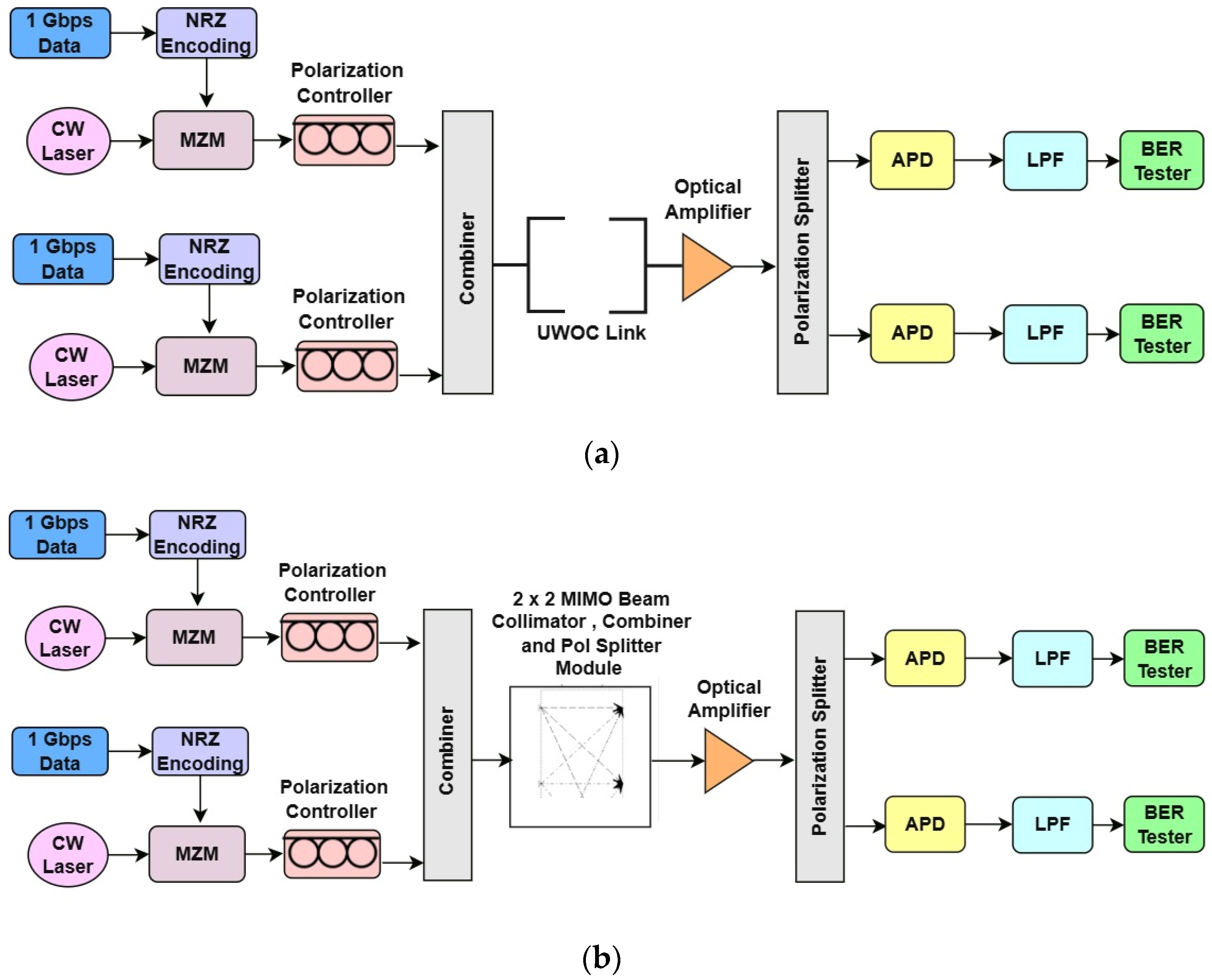
The proposed UWOC system, illustrated in
Figure 2, combines PDM with MIMO configurations to improve both spectral efficiency and transmission robustness in saline environments. Two data channels, each operating at 1 Gbps, are generated using Continuous Wave (CW) lasers with an input power of 20 dB at a wavelength of 1550 nm. The binary sequences, defined with a length of 1024 and sampled at 64 samples/bit, are encoded using the NRZ format before modulation by Mach-Zehnder Modulators (MZMs).
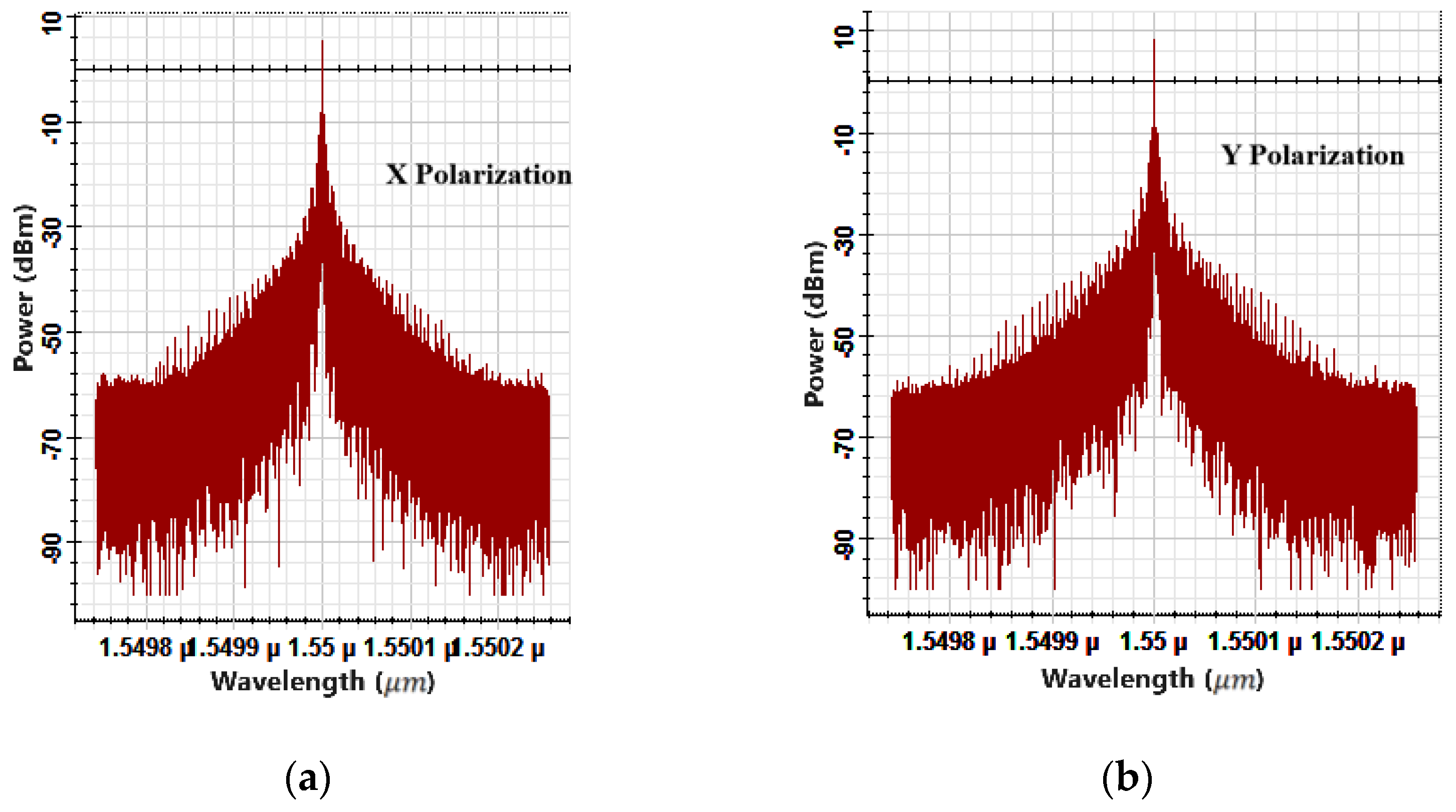
Following modulation, the signals are directed through polarization controllers to realize PDM. The controllers apply phase shifts of 0 degree and 90 degrees corresponding to X- and Y-polarizations, respectively.
The resulting optical spectra of the two polarizations are depicted in
Figure 3. The combined signals propagate through the UWOC link, which is modeled in MATLAB™ to account for the combined effects of absorption, scattering, turbulence, and salinity variations, as described in
Section 3. For spatial multiplexing, both
and
schemes, MIMO configurations are implemented. The system behavior follows the channel representation of Equation (6) where the channel matrix
incorporates salinity-dependent attenuation coefficients.
From a system-level perspective, the proposed architecture integrates PDM with MIMO by treating the two orthogonal polarization states as independent signal dimensions within each spatial channel. In a PDM-MIMO UWOC system, each transmitter–receiver pair supports two parallel polarization channels, and the overall channel can be represented by an extended channel matrix that incorporates both spatial and polarization-dependent gains. The received signal vector includes contributions from multiple transmitters and orthogonal polarization states, with channel coefficients accounting for absorption, scattering, turbulence, and salinity-induced attenuation. This unified formulation provides the analytical basis for evaluating the performance gains of the combined PDM-MIMO architecture beyond implementation-specific simulation configurations.
In underwater optical environments, polarization states can be altered by absorption, multiple scattering, and refractive index fluctuations caused by salinity variations and turbulence. These effects may result in partial depolarization and polarization mode coupling, which can degrade transmission quality by reducing polarization orthogonality and introducing inter-polarization interference. In the proposed system, PDM is combined with MIMO spatial diversity to enhance robustness against polarization-related impairments. Although dynamic polarization rotation is not modeled explicitly as an independent parameter, its impact is implicitly captured through the salinity- and turbulence-dependent channel coefficients. The additional spatial diversity provided by the MIMO architecture helps mitigate polarization-induced degradation, thereby preserving reliable signal detection and improved Bit Error Rate (BER) performance.
At the receiver, the optical signals are amplified using a 13 dB optical amplifier to compensate for propagation losses. The amplifier gain is set to 13 dB to provide a balanced trade-off between compensating for underwater propagation losses and limiting noise amplification. While higher optical amplifier gain can increase the received signal power, it also amplifies amplified spontaneous emission (ASE) noise and may lead to receiver saturation or reduced signal-to-noise ratio, particularly in high-gain regimes. Therefore, the selected gain represents a practical operating point that enhances detection reliability without introducing excessive noise or nonlinear effects. A polarization splitter separates the orthogonal polarization components, which are detected by Avalanche Photodiodes (APDs). The resulting electrical signals are passed through Low Pass Filters (LPFs) to suppress high-frequency noise. Finally, BER testers compare the received sequences with the original data streams to quantify link performance. The overall system is implemented using a hybrid simulation approach in OptiSystem™ 21.0 and MATLAB™ R2024b, enabling accurate representation of both optical device behavior and underwater channel dynamics. The complete set of simulation parameters used for the proposed PDM-MIMO UWOC link is provided in
Table 3.
6. Results and Discussion
This section presents and analyzes the performance of the proposed PDM-MIMO UWOC system under different configurations and environmental conditions.
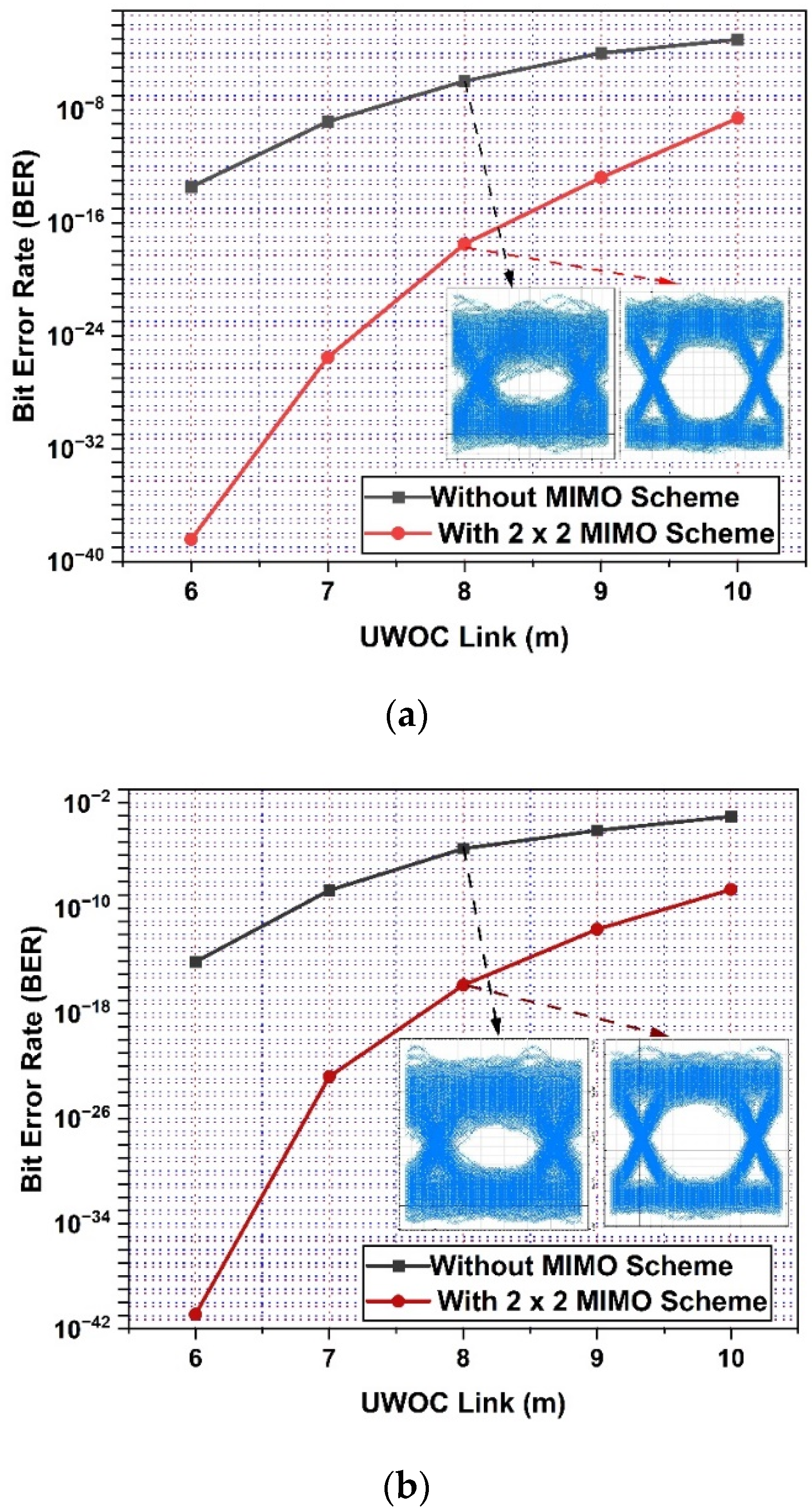
Figure 4 compares the BER performance of the system with and without the
MIMO scheme. At an 8 m link distance, the non-MIMO configuration records a BER near
, while the MIMO-enabled system achieves a substantially lower BER in the order of
–
for both channels. The corresponding eye diagrams confirm this improvement, showing wider eye openings with reduced noise and distortion in the MIMO case. These results demonstrate the effectiveness of the
MIMO configuration in mitigating scattering and turbulence, thereby significantly improving signal integrity. The extended performance of the
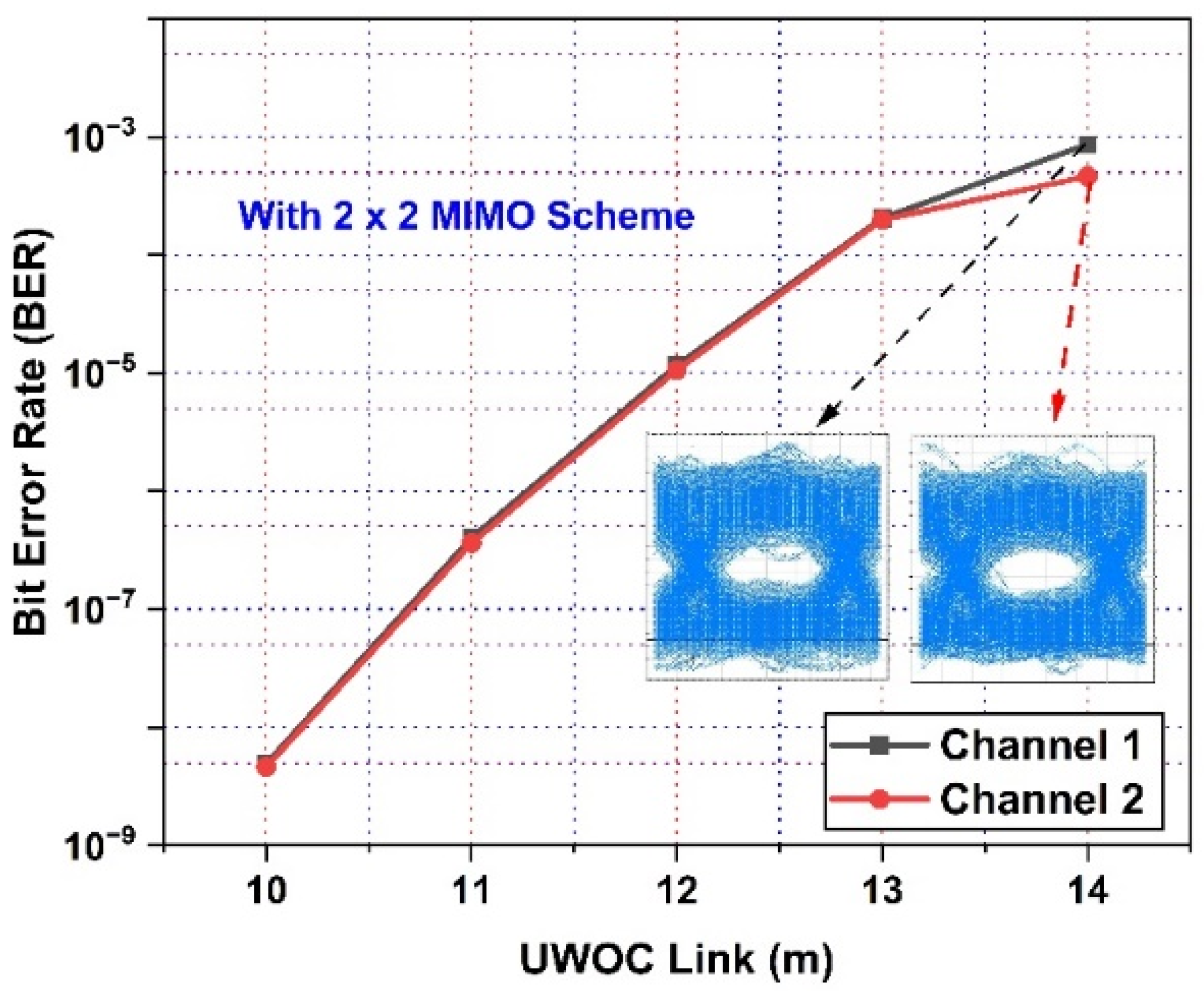
scheme is shown in
Figure 5.
Both channels maintain BER values below , up to 14 m, with Channel 1 exhibiting slightly better performance than Channel 2. The eye diagrams at these distances remain sufficiently open, indicating that reliable communication can be sustained even as link distance increases. This confirms the robustness of the MIMO approach for moderate underwater ranges.
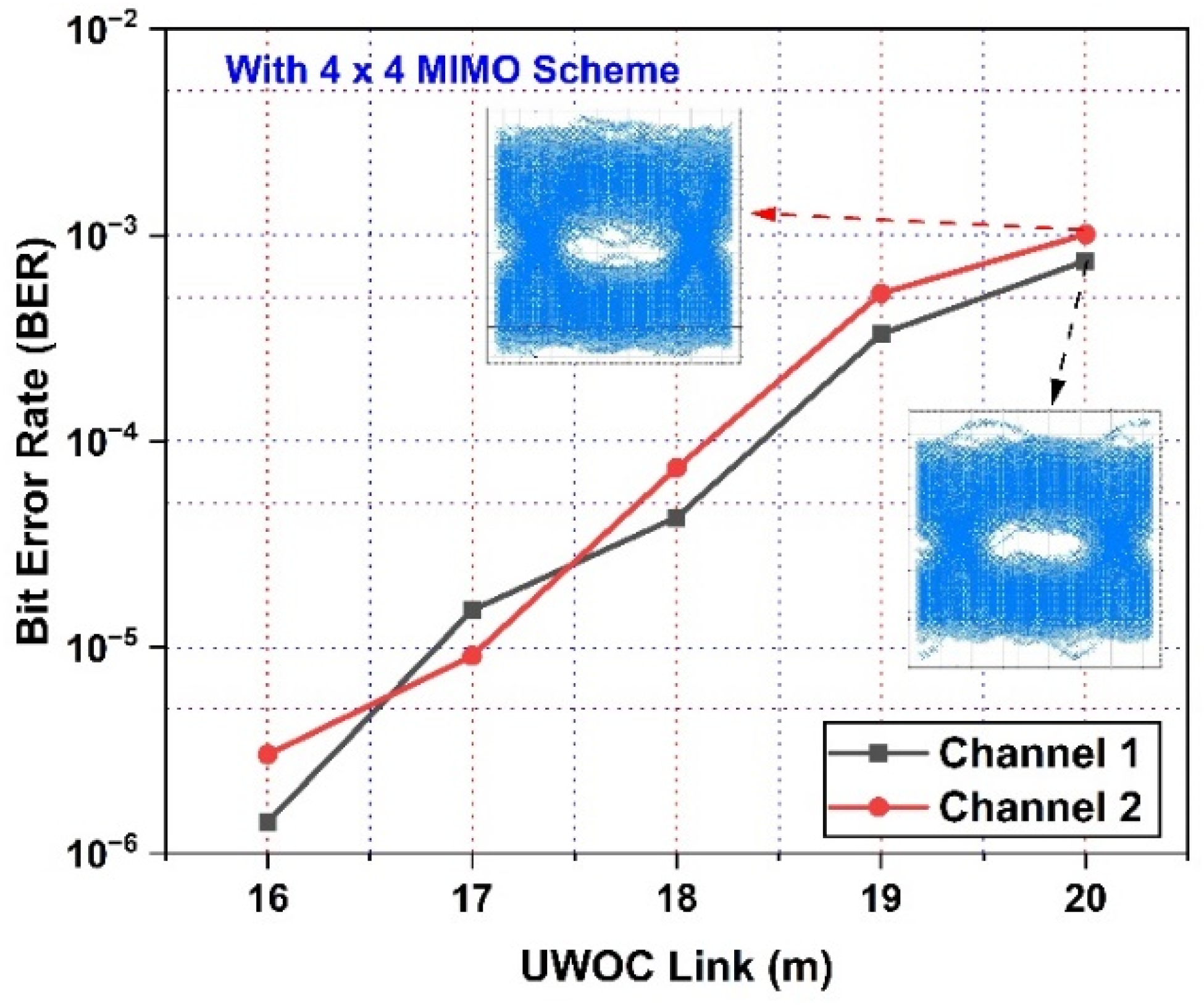
Figure 6 illustrates the performance of the
MIMO configuration. Compared with the
case, the
scheme extends the operational link range to 20 m while maintaining BER values within
. Although the eye diagrams exhibit some narrowing at longer distances, they remain open enough to enable accurate symbol detection. These findings validate that increasing spatial diversity from
to
further enhances system capacity and range, albeit with a gradual increase in BER due to accumulated channel impairments.
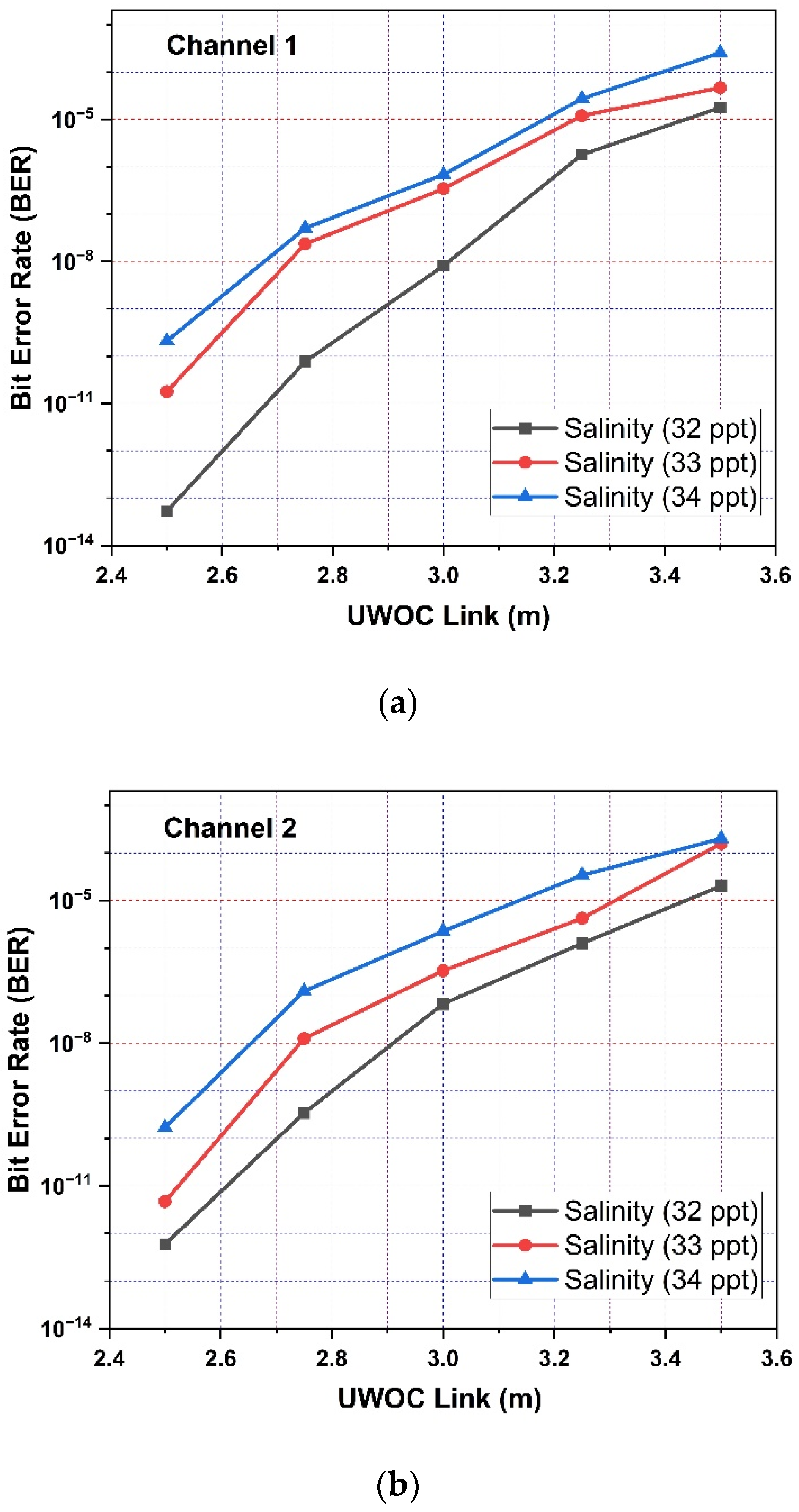
The influence of salinity on the
system is shown in
Figure 7. BER performance was evaluated for salinity levels of 32–34 ppt across link distances up to 3.6 m. At 32 ppt, both channels achieve exceptionally low BER values
, with gradual increases as distance extends. Higher salinity levels introduce noticeable degradation: at 34 ppt, the BER rises to approximately
at 3.6 m. This trend confirms that elevated salinity increases scattering and absorption, thereby reducing link reliability. Nevertheless, even at higher salinity, the system maintains BER values that remain acceptable for many robust communication applications. Beyond these observations, the underlying mitigation mechanisms can be explained as follows. Increased salinity in underwater environments intensifies absorption and scattering while inducing refractive index fluctuations that contribute to turbulence and partial depolarization. These effects reduce the received signal-to-noise ratio (SNR) and introduce both inter-symbol and inter-polarization interference, leading to BER degradation. In the proposed architecture, polarization division multiplexing provides parallel polarization channels that not only enhance spectral efficiency but also introduce polarization diversity, improving resilience against polarization instability. MIMO spatial diversity mitigates salinity-induced fading by averaging channel impairments across multiple transmission paths, thereby reducing the probability of deep fades and stabilizing the received signal. As salinity increases, the combined exploitation of polarization and spatial diversity helps preserve signal integrity by compensating for salinity-induced channel fluctuations rather than relying solely on increased transmission power. Consequently, the observed BER improvements under higher salinity conditions reflect the effectiveness of diversity-based mitigation inherent in the PDM-MIMO architecture. The results demonstrate three key findings. First, PDM combined with MIMO provides substantial gains in BER performance and transmission distance compared with non-MIMO systems. Second, scaling the MIMO configuration from
to
extends operational range from 14 m to 20 m while maintaining acceptable BER. Finally, the analysis under varying salinity levels highlights the importance of environmental adaptation, as salinity directly impacts signal attenuation. These findings validate the proposed architecture as a viable solution for high-speed, reliable underwater links and provide practical insights for designing UWOC systems for real-world conditions such as coastal and deep-sea environments.
7. Contribution to Sensor and Actuator Networks
The proposed salinity-aware PDM-MIMO UWOC framework directly supports the requirements of underwater sensor and actuator networks by enabling reliable, low-latency, and high-capacity optical links under varying salinity conditions. The demonstrated robustness against salinity-induced degradation is particularly relevant for distributed underwater sensing, autonomous vehicle coordination, and real-time control applications. By enhancing communication reliability without increasing system complexity, the proposed architecture aligns with the performance and scalability needs of emerging underwater sensor and actuator network deployments.
8. Research Significance and Impact on Future Work
The proposed PDM-MIMO UWOC framework provides a comprehensive perspective on underwater broadband communication by jointly examining polarization diversity, spatial diversity, and salinity-dependent channel effects within a unified modeling approach. In contrast to most existing UWOC studies, which typically investigate theoretical channel models, modulation techniques, or diversity schemes in isolation, this work integrates these aspects and evaluates their combined influence on system performance. Such integration is essential for advancing UWOC research, as salinity-induced turbulence and polarization-related effects are often simplified or neglected despite their significant impact on link reliability in marine environments. By demonstrating notable BER improvements and extended transmission distances using PDM-MIMO configurations under varying salinity conditions, this study establishes a useful performance reference for the design of robust underwater optical links. The results further highlight the importance of incorporating environmental parameters into UWOC system modeling and motivate continued exploration of hybrid diversity techniques and adaptive transmission strategies.
Despite the promising performance demonstrated in this study, several limitations should be acknowledged. First, the analysis is based on a simulation framework, and experimental validation under realistic underwater conditions is not included. Second, salinity effects are incorporated through an effective attenuation-based model, which does not explicitly capture polarization-dependent scattering, depolarization phenomena, refractive index anisotropy, or spatial and temporal salinity gradients commonly observed in real ocean environments. These factors may introduce additional inter-polarization coupling and partially reduce polarization orthogonality, potentially affecting the robustness of polarization-division multiplexing in practical deployments. Third, the system operates at a wavelength of 1550 nm, which experiences higher absorption in water compared to the blue-green spectral window typically used in practical UWOC systems. Finally, dynamic effects such as transmitter–receiver misalignment, hardware non-idealities, and time-varying channel conditions are not considered.
Future research can build upon these findings by pursuing experimental validation, refining salinity- and polarization-aware channel modeling, optimizing wavelength selection, and developing adaptive transmission protocols tailored for underwater sensor networks, autonomous underwater vehicles, and industrial marine applications. This work helps bridge an existing research gap and contributes toward the development of resilient and high-speed underwater optical communication systems.
9. Conclusions
This work presented a UWOC system that integrates PDM with MIMO configurations to enhance transmission capacity, robustness, and reliability under saline underwater conditions. The system was modeled using MATLAB™ for channel propagation and OptiSystem™ for transmitter and receiver design. The results confirm that combining PDM with MIMO substantially improves system performance compared with conventional non-MIMO UWOC links. The MIMO configuration achieved dramatic reductions in BER, improving signal integrity by several orders of magnitude, while maintaining robust performance up to 14 m. Extending the scheme to further increased the operational range to 20 m with BER values within acceptable limits. These findings validate the proposed architecture as a practical and scalable approach to mitigating the impairments caused by absorption, scattering, turbulence, and salinity in underwater channels. Beyond quantitative improvements, this study underscores the broader significance of PDM-MIMO integration for underwater communication networks. By enabling higher data rates and longer transmission distances under realistic conditions, the approach holds strong potential for applications in marine research, defense, environmental monitoring, and the emerging IoUT. Future work will focus on experimental validation in diverse water types, the integration of adaptive modulation and coding, and the exploration of hybrid architectures combining optical, acoustic, and RF links for seamless underwater connectivity. Moreover, future work will also investigate wavelength optimization and experimental validation in blue-green spectral bands to assess the proposed architecture under more typical underwater operating conditions.