A Framework for Understanding the Impact of Integrating Conceptual and Quantitative Reasoning in a Quantum Optics Tutorial on Students’ Conceptual Understanding

Abstract
1. Introduction, Framework, and Goals
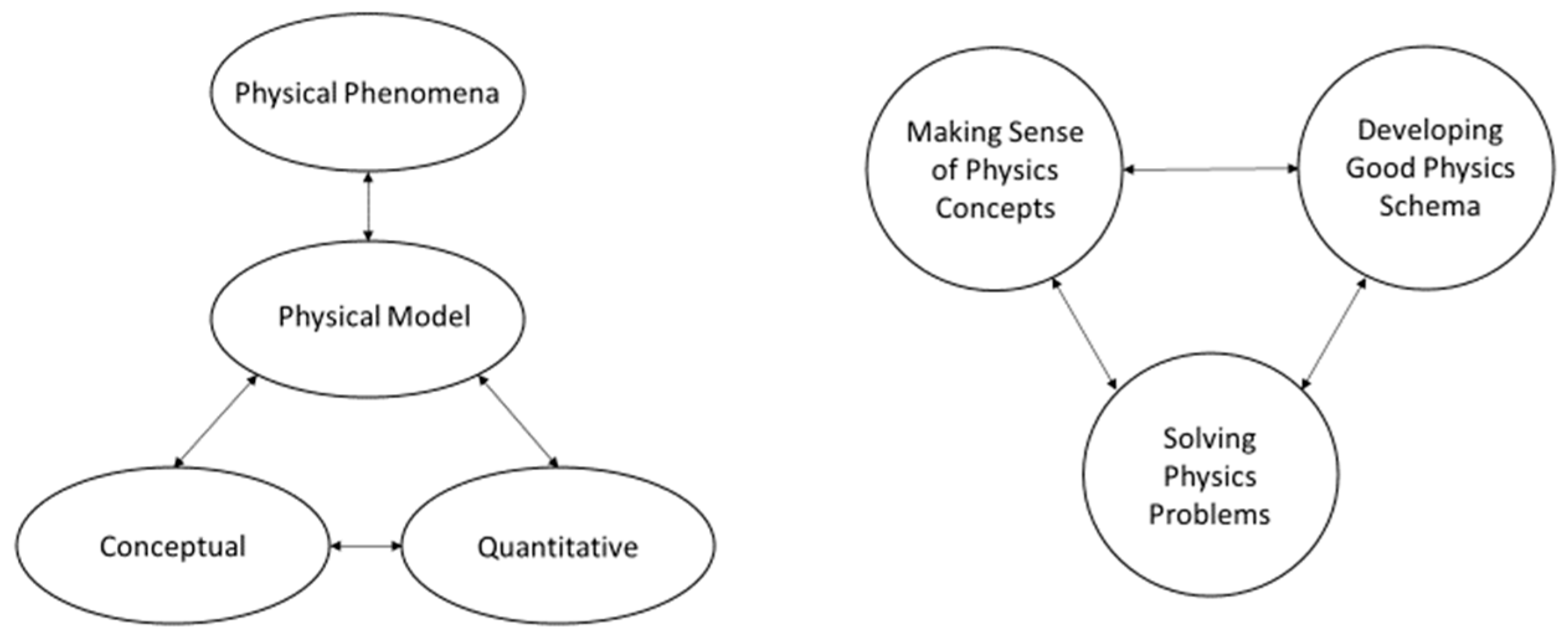
1.1. Background on Expertise in Physics
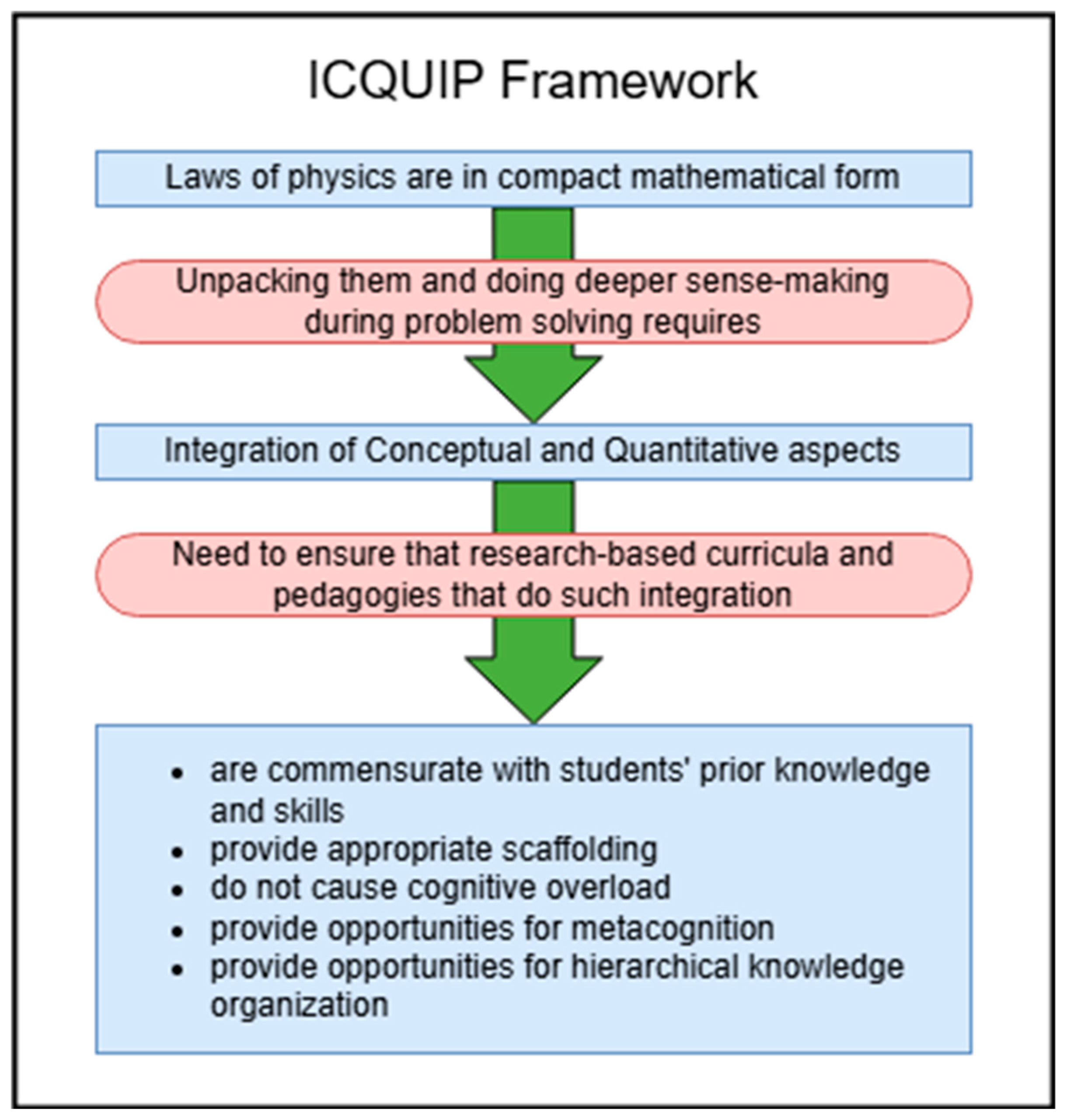
1.2. The ICQUIP Framework and Research Focus
1.3. Developing Expertise in Quantum Optics Using Mach Zehnder Interferometer and Goal of the Investigation
1.4. Research Objective, Questions and Hypotheses
2. Methodology
2.1. Participants
- -
- Hybrid QuILT group: N = 10 (matched pre/post), first-year physics Ph.D. students
- -
- Conceptual QuILT group: N = 27 (matched pre/post), first-year physics Ph.D. students enrolled simultaneously in a graduate QM course and Teaching of Physics course
- -
- Note: Conceptual QuILT group in Ref. (Marshman & Singh, 2016, 2017): N = 45 (matched pre/post), first-year physics Ph.D. students enrolled simultaneously in a graduate QM course and Teaching of Physics course (these results for two years administration only include a subset of pre-/post-questions)
- -
- Hybrid QuILT group A: N = 24 (pre-test), N = 20 (post-test), junior/senior physics majors
- -
- Hybrid QuILT group B: N = 15 (pre-test), N = 16 (post-test), junior/senior physics majors
- -
- Conceptual QuILT group: N = 26 (pre-test), N = 20 (post-test), junior/senior physics majors
2.2. Materials
2.2.1. QuILT Versions
2.2.2. Assessment Instrument
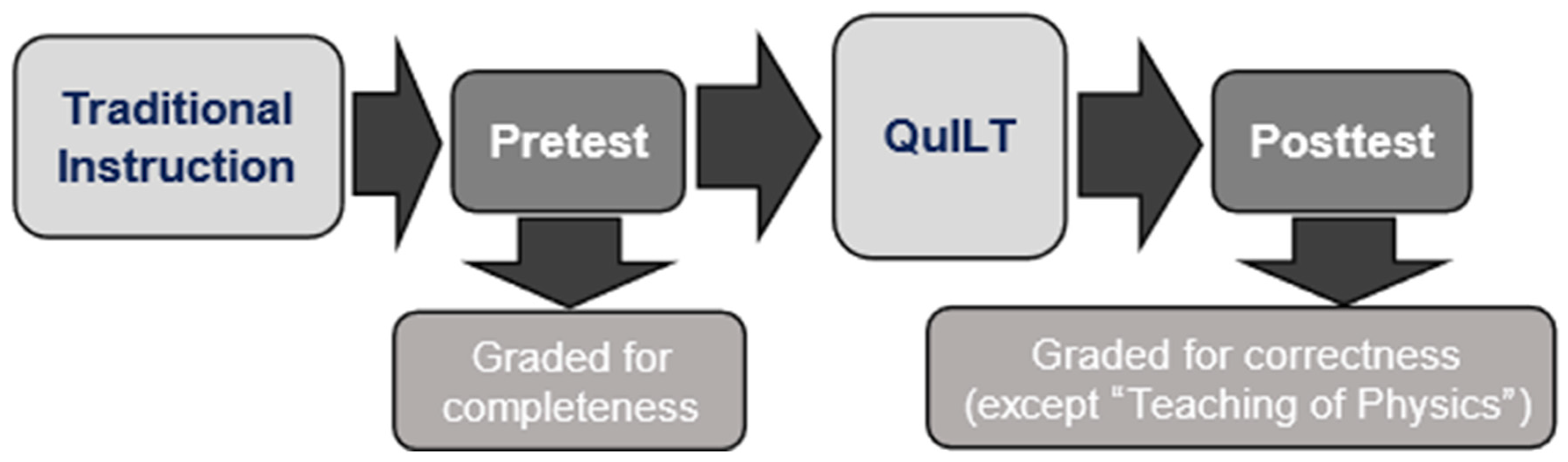
2.3. Procedure
2.4. How the QuILT Supports Metacognition
2.5. Data Analysis
3. Results and Discussion
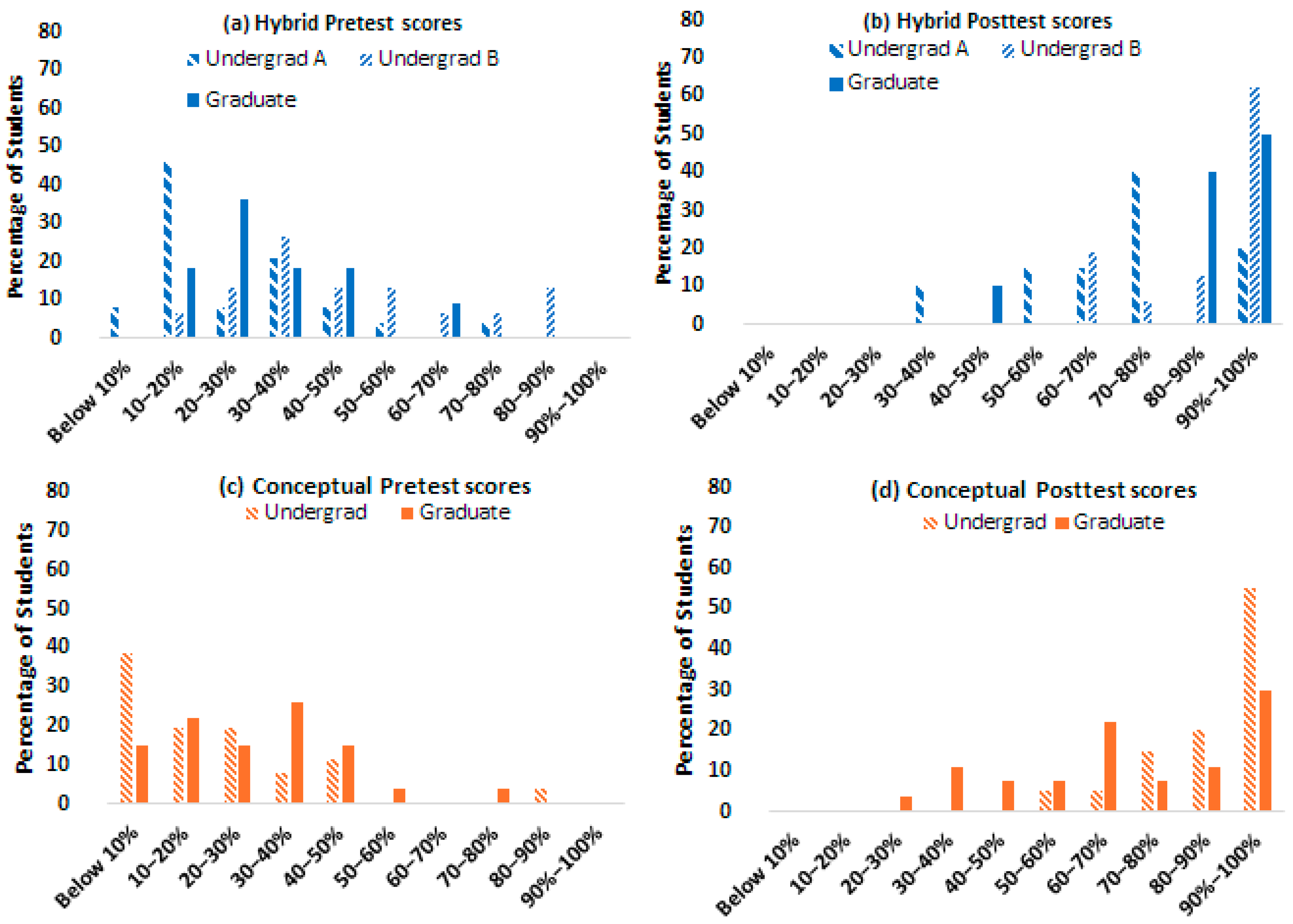
3.1. RQ1: How Does the Integration of Conceptual and Quantitative Reasoning in a Hybrid QuILT Affect Graduate Students’ Conceptual Understanding of Quantum Optics Compared to a Purely Conceptual QuILT?
3.2. RQ2: How Does the Integration of Conceptual and Quantitative Reasoning in a Hybrid QuILT Affect Undergraduate Students’ Conceptual Understanding of Quantum Optics Compared to a Purely Conceptual QuILT?
3.3. RQ3: What Role Does Students’ Prior Knowledge Play in Determining Whether They Benefit from the Integrated Conceptual–Quantitative Approach Versus the Conceptual-Only Approach?
3.3.1. Comparison of Pre-/Post-Test Performance of Different Groups That Learned from Hybrid MZI QuILT
3.3.2. Comparison of Performance of All Five Groups Together on Each Question
4. Broader Discussion
4.1. Interpretation of Results Through ICQUIP Framework
4.2. Limitations
4.3. Future Directions
5. Conclusions
Supplementary Materials
Author Contributions
Funding
Institutional Review Board Statement
Informed Consent Statement
Data Availability Statement
Conflicts of Interest
Appendix A

| Graduate Students | Undergraduates | |||||
|---|---|---|---|---|---|---|
| Q | Pre(%) | Post(%) | <g> | Pre(%) | Post(%) | <g> |
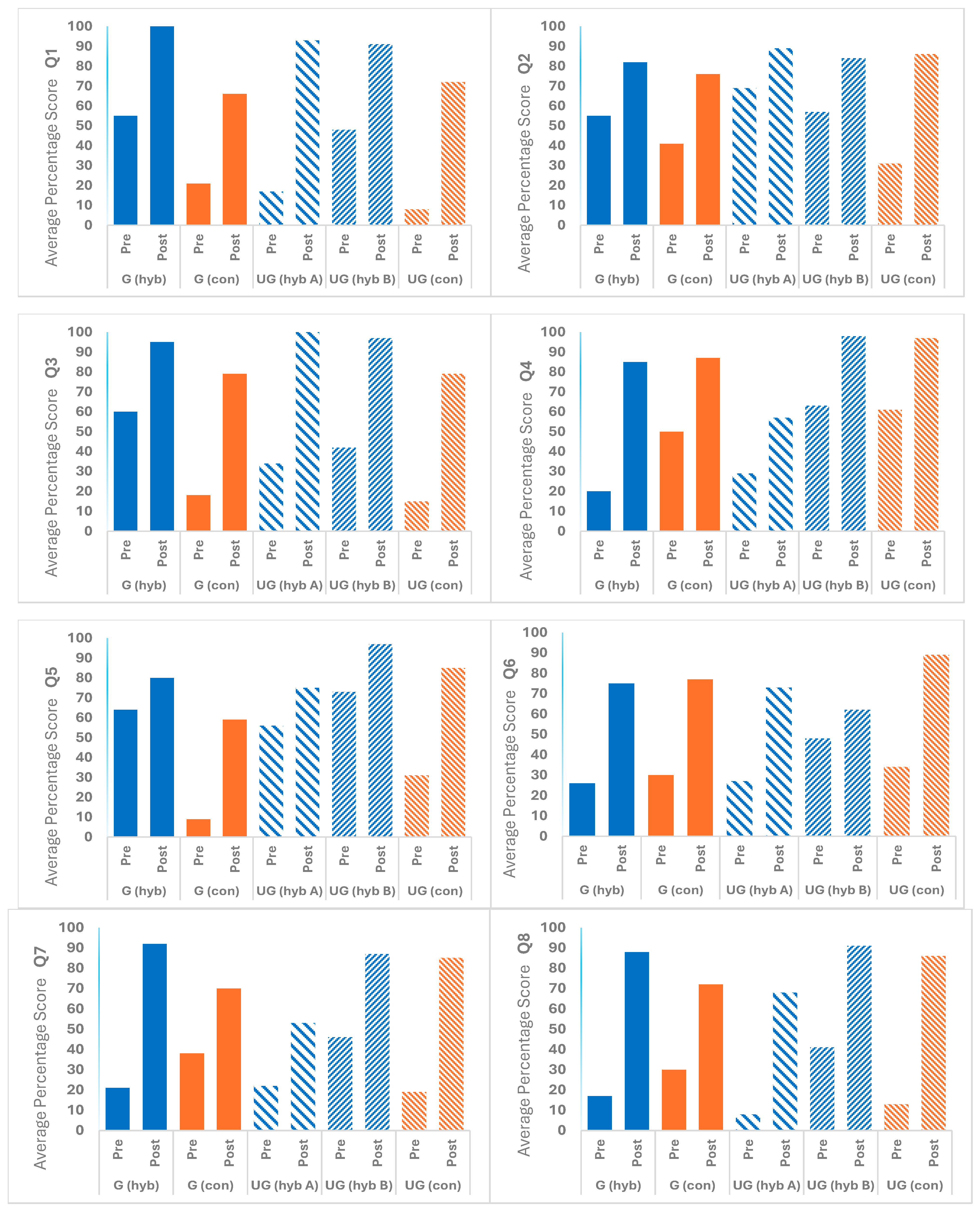
| 1 | 21 | 66 | 0.57 | 8 | 72 | 0.70 |
| 2 | 41 | 76 | 0.59 | 31 | 86 | 0.80 |
| 3 | 18 | 79 | 0.74 | 15 | 79 | 0.75 |
| 4 | 50 | 87 | 0.74 | 61 | 97 | 0.92 |
| 7 | 38 | 70 | 0.52 | 19 | 85 | 0.81 |
| 8 | 30 | 72 | 0.60 | 13 | 86 | 0.84 |
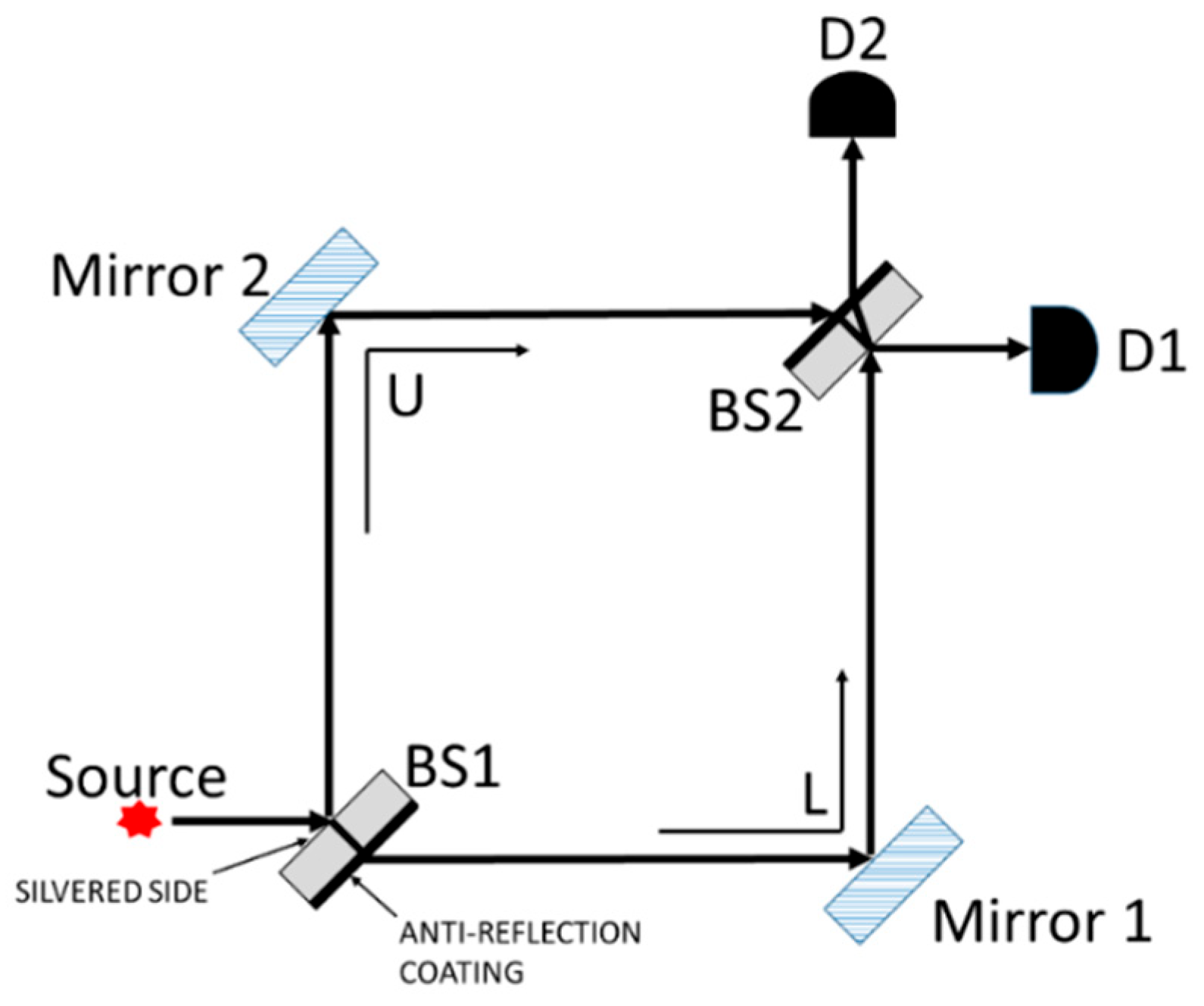
- The photons originate from a monochromatic coherent point source. (Note: Experimentally, a source can only emit nearly monochromatic photons such that there is a very small range of wavelengths coming from the source. Here, we assume that the photons have negligible “spread” in energy.)
- Assume that the photons propagating through both the U and L paths travel the same distance in vacuum to reach each detector.
- All angles of incidence are 45° with respect to the normal to the surface.
- For simplicity, we will assume that a photon can only reflect from one of the two surfaces of the identical half-silvered mirrors (beamsplitters) BS1 and BS2 because of an anti-reflection coating on one of the surfaces.
- Assume that beamsplitters BS1 and BS2 are infinitesimally thin so that there is no phase shift when a photon propagates through them.
- The phase shifter is ideal and non-reflective.
- Ignore the effect of polarization of the photons due to reflection by the beamsplitters or mirrors.
- The photodetectors D1 and D2 are point detectors located symmetrically with respect to the other components of the MZI as shown.
- All photodetectors are ideal and 100% efficient.
- Polarizers do not introduce phase shifts.
- All measurements are ideal projective measurements.

- The single photons are emitted from the source in a highly collimated stream, i.e., the width of the transverse Gaussian profile of each photon is negligible.
- A very large number () of single photons are emitted from the source one at a time and passes through beamsplitter BS1.
- 1.
- Consider the following statement about single photons emitted from the source in Figure A1:
- If the source emits photons one at a time, the number of photons reaching detectors D1 and D2 will be each.
Explain why you agree or disagree with this statement. - 2.
- Consider the following conversation between Student 1 and Student 2:
- Student 1: The beamsplitter BS1 causes the photon to split into two parts, and the energy of the incoming photon is also split in half. Each photon with half of the energy of the incoming photon travels along the U and L paths of the MZI and produces interference at detectors D1 and D2.
- Student 2: If we send one photon at a time through the MZI, there is no way to observe interference in the detectors D1 and D2. Interference is due to the superposition of waves from the U and L paths. A single photon must choose either the U or the L path.
Do you agree with Student 1, Student 2, both, or neither? Explain your reasoning.

- 3a.
- 3b.
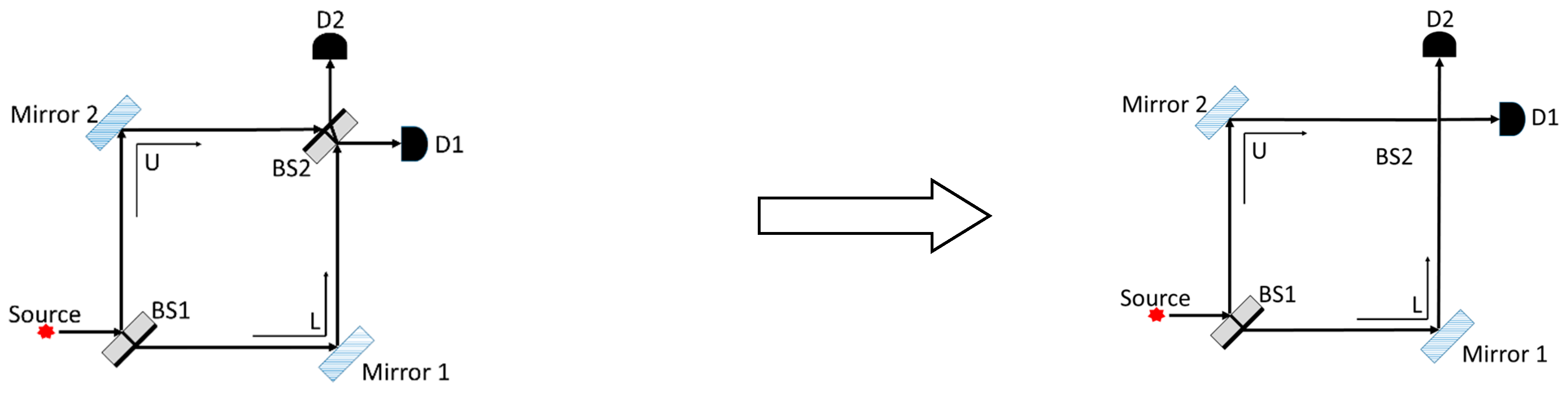
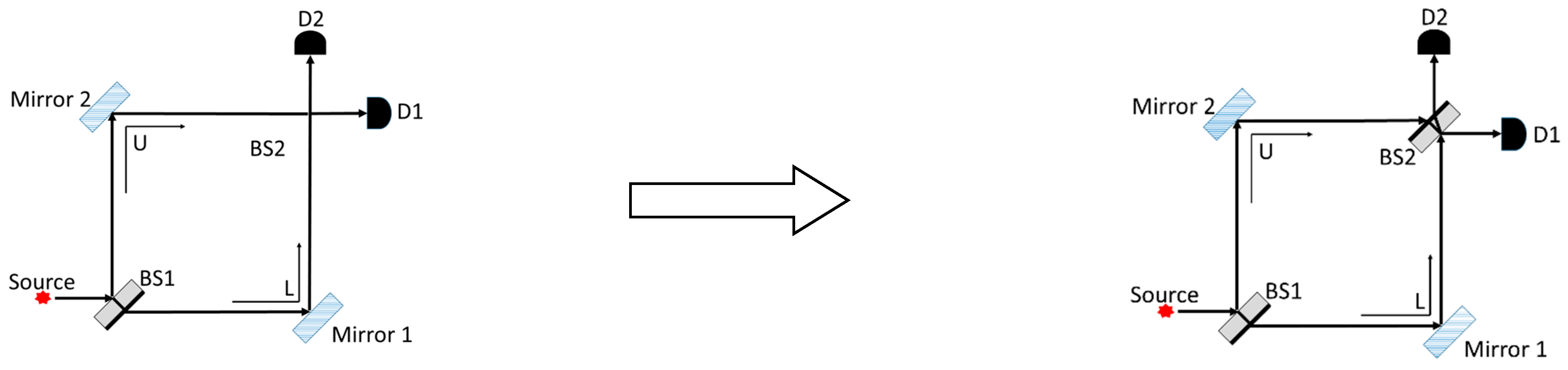
- Suppose we have an MZI set up initially without BS2. If we suddenly insert BS2 after the photon enters BS1 but before it reaches the point where BS2 is inserted (see Figure A3), with what probabilities do detectors D1 and D2 register the photon? Explain your reasoning. Assume that the situation after BS2 is inserted is identical to Figure A1.

- 4.
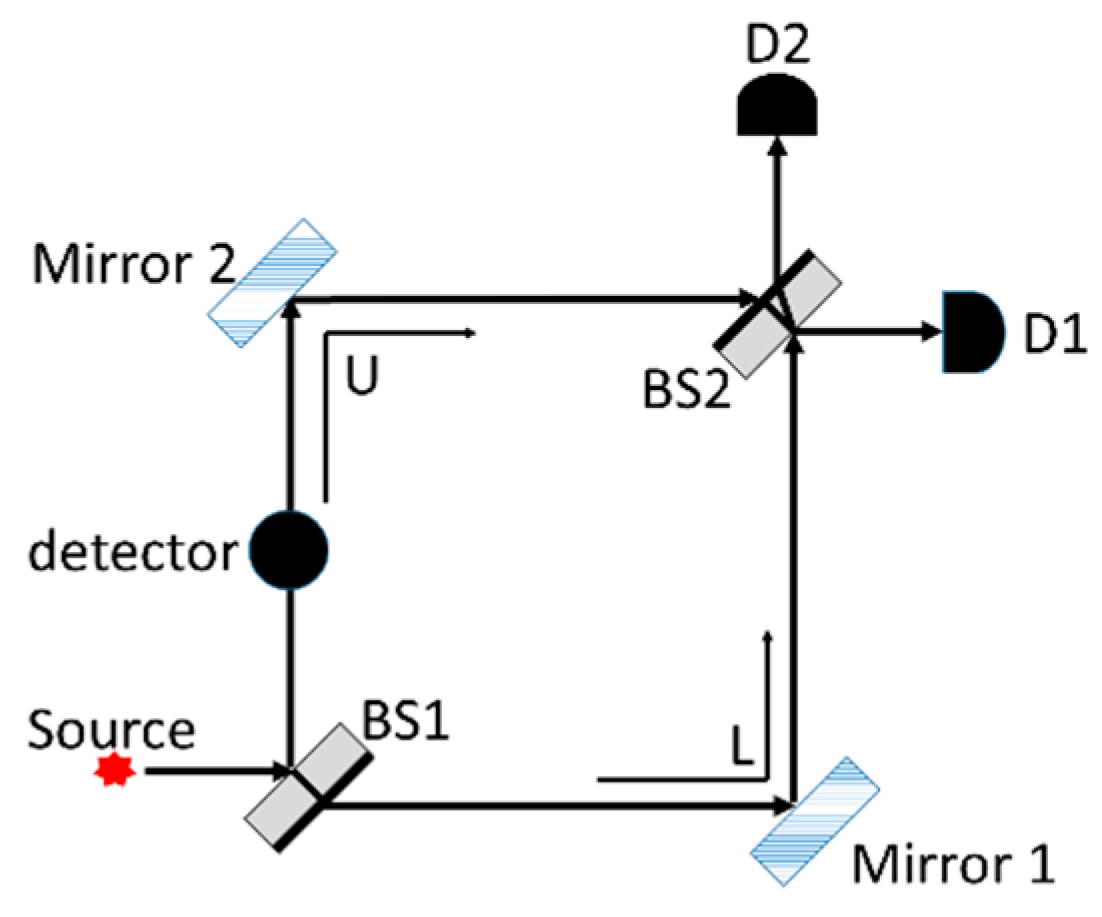
- Suppose we modify the setup shown in Figure A1 and insert a photodetector into the upper path between BS1 and mirror 2 as shown in Figure A4.
- (a)
- What is the fraction of single photons emitted by the source that reach each detector D1 and D2? Explain your reasoning.
- (b)
- If you place a phase shifter in the L path and change its thickness gradually to change the path length difference between the U and L paths, how would the phase shifter affect the fraction of photons arriving at detectors D1 and D2? Explain your reasoning.
- (c)
- If there is interference displayed in part 4(b) by any photons at detector D1, write down the percentage of the photons emitted by the source that display interference. You must explain your reasoning.
For all of the following questions, assume that the single-photon source emits photons that are polarized at +45°. - 5.
- Consider the following statement about a source emitting +45° polarized single photons:
- If we place additional polarizers in the paths of the MZI, the polarizers will absorb some photons and they will not arrive at the detectors. However, the polarizers will not affect whether interference is displayed at the detectors.
Explain why you agree or disagree with the statement.
- 6.
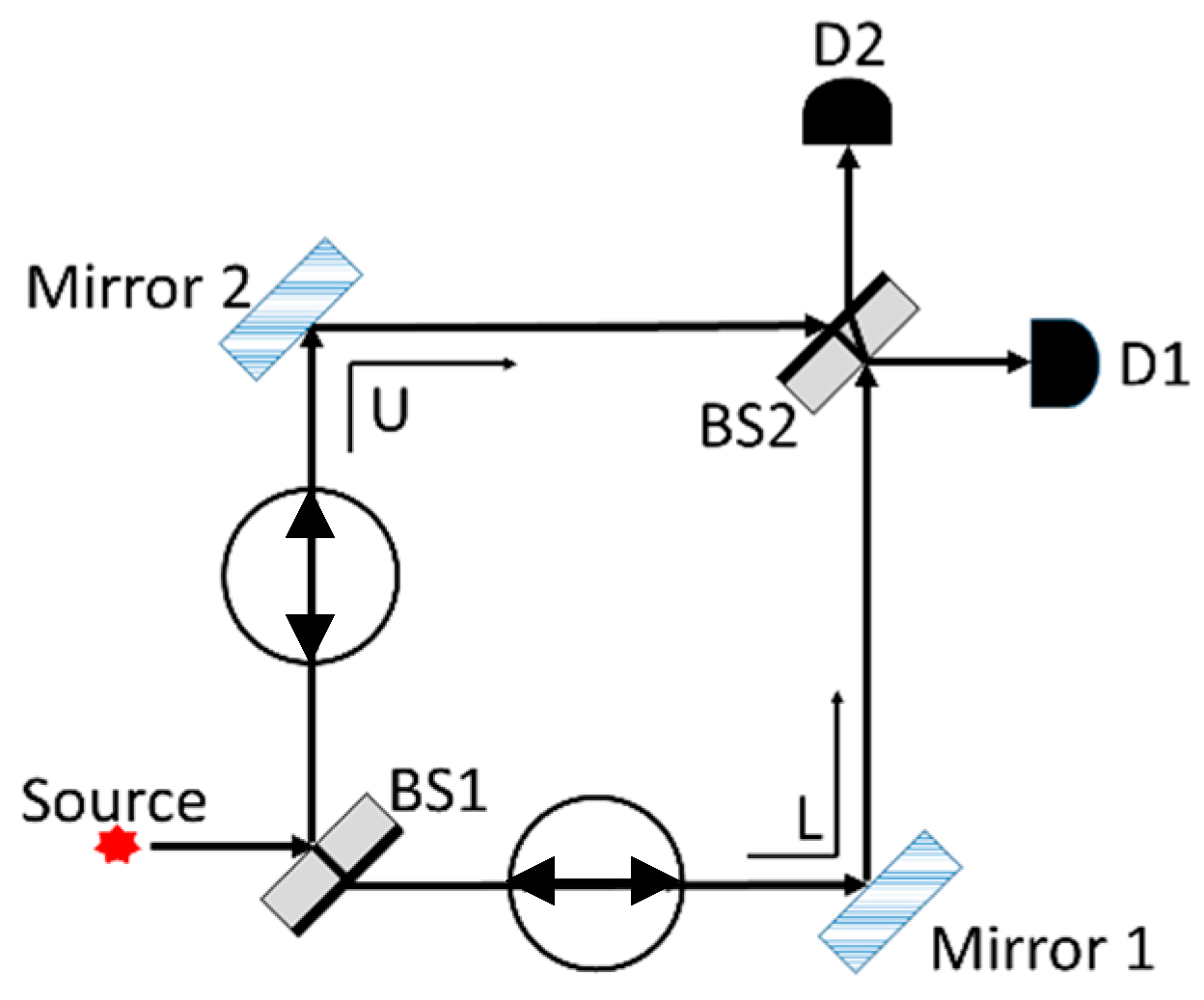
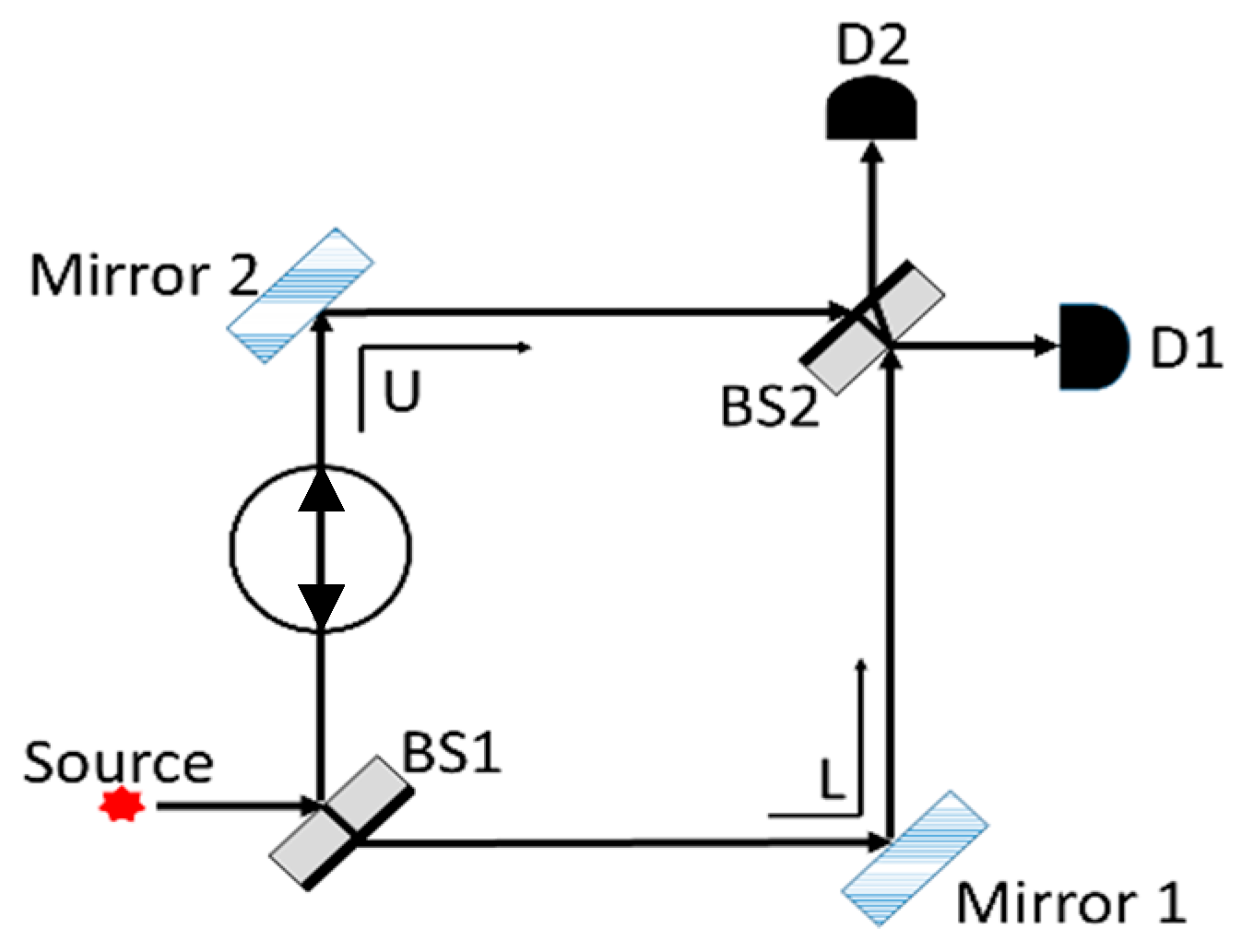
- You modify the setup shown in Figure A1 by inserting a polarizer with a vertical polarization axis as shown in Figure A5.
- (a)
- What is the fraction of single photons emitted by the source that reach each detector D1 and D2? Explain your reasoning.
- (b)
- If you place a phase shifter in the U path and change its thickness gradually to change the phase difference between the U and L paths, how would the phase shifter affect the fraction of photons arriving at detectors D1 and D2? Explain your reasoning.
- (c)
- If there is interference displayed by any photons in part 6(b) at detector D1, write down the percentage of the photons emitted by the source that displays interference. You must explain your reasoning.

- 7.
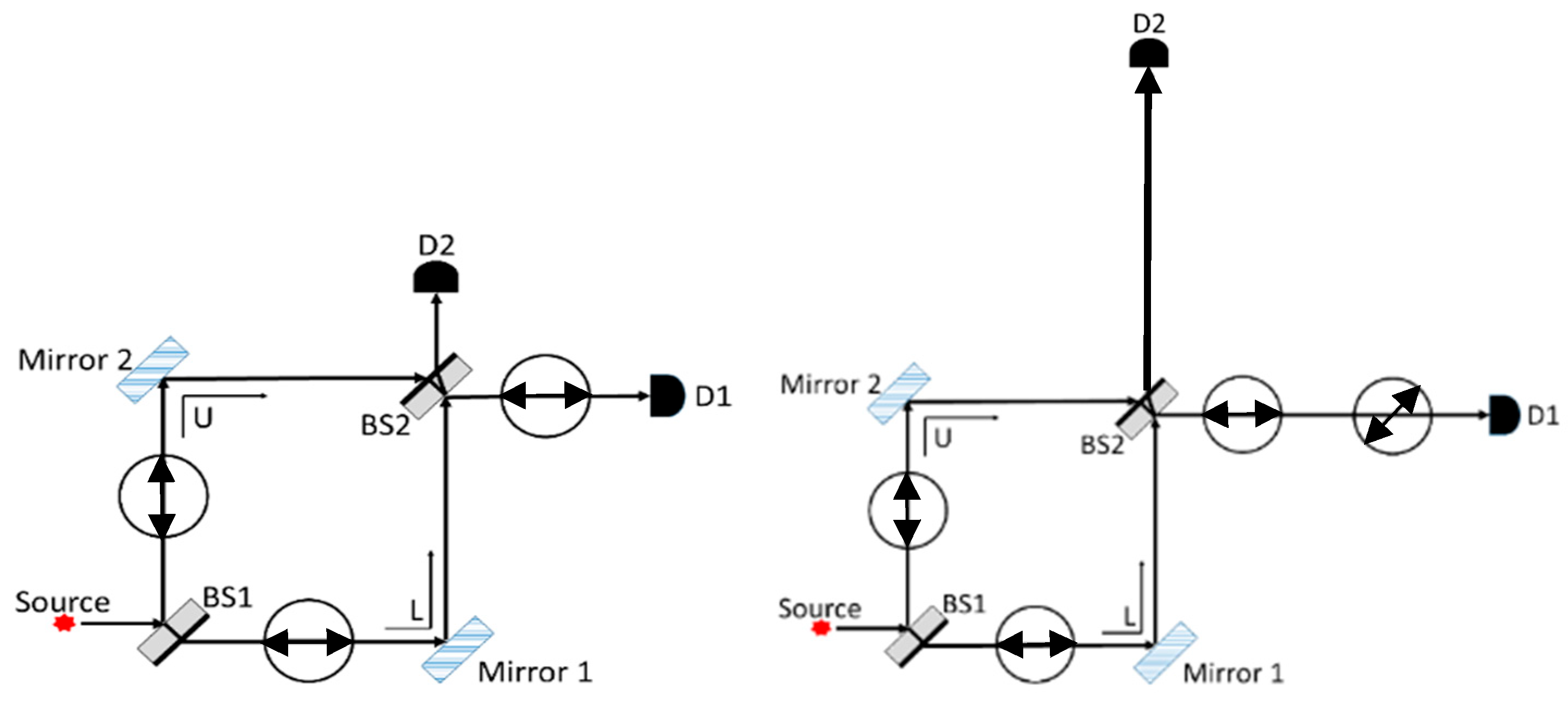
- You modify the setup shown in Figure A1 and insert polarizer 1 with a vertical polarization axis (between BS1 and mirror 2) and polarizer 2 with a horizontal polarization axis (between BS1 and mirror 1) in the U and L paths as shown in Figure A6.
- (a)
- What is the fraction of single photons emitted by the source that reaches each detector D1 and D2? Explain your reasoning.
- (b)
- If you place a phase shifter in the U path and change its thickness gradually to change the phase difference between the U and L paths, how would the phase shifter affect the fraction of photons arriving at detectors D1 and D2? Explain your reasoning.
- (c)
- If there is interference displayed by any photons in part 7(b) at detector D1, write down the percentage of the photons emitted by the source that displays interference. You must explain your reasoning.

- 8.
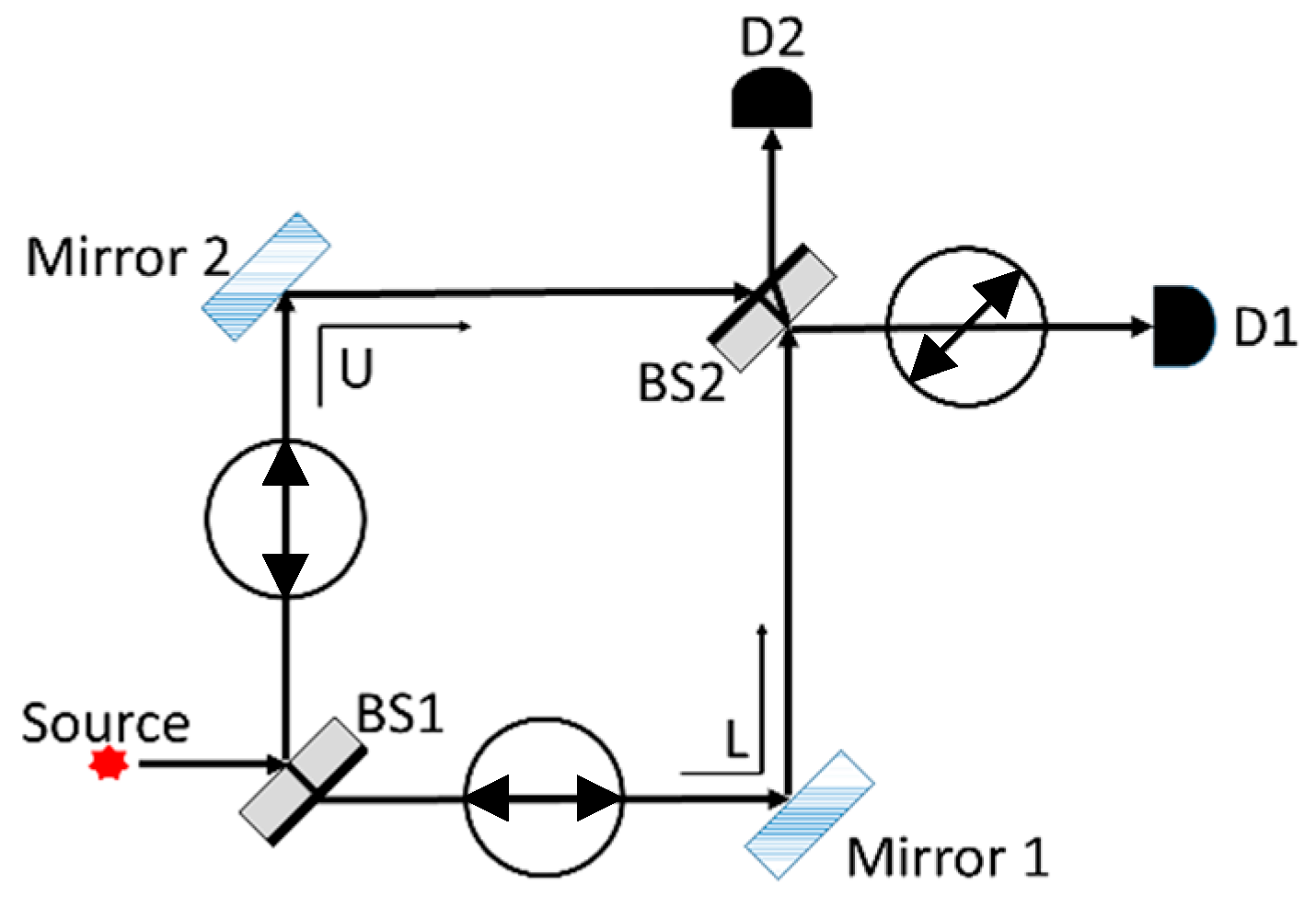
- You start with the setup shown in Figure A6 with polarizer 1 with a vertical polarization axis and polarizer 2 with a horizontal polarization axis inserted in the U and L paths, respectively. You modify the set up and insert polarizer 3 with a +45° polarization axis between BS2 and detector D1 (see Figure A7).
- (a)
- What is the fraction of single photons emitted by the source that reaches each detector D1 and D2? Explain your reasoning.
- (b)
- If you place a phase shifter in the U path and change its thickness gradually to change the phase difference between the U and L paths, how would the phase shifter affect the fraction of photons arriving at detectors D1 and D2? Explain your reasoning.
- (c)
- If there is interference displayed by any photons in part 8(b) at detector D1, write down the percentage of the photons emitted by the source that displays interference. You must explain your reasoning.

- 9.
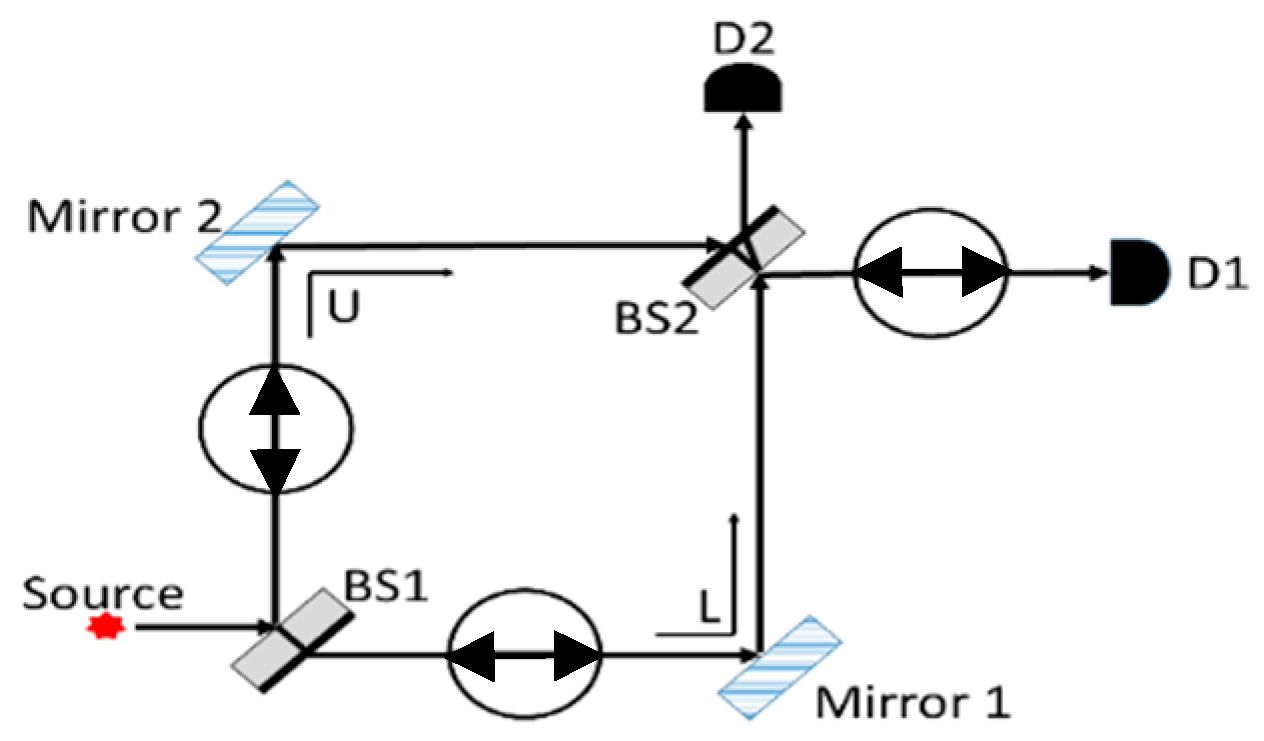
- You start with the setup shown in Figure A6 with polarizer 1 with a vertical polarization axis and polarizer 2 with a horizontal polarization axis inserted in the U and L paths, respectively. You modify the set up and insert polarizer 3 with a horizontal polarization axis between BS2 and the detector D1 (see Figure A8).
- (a)
- What is the fraction of single photons emitted by the source that reaches each detector D1 and D2? Explain your reasoning.
- (b)
- If you place a phase shifter in the U path and change its thickness gradually to change the phase difference between the U and L paths, how would the phase shifter affect the fraction of photons arriving at detectors D1 and D2? Explain your reasoning.
- (c)
- If there is interference displayed by any photons in part 9(b) at detector D1, write down the percentage of the photons emitted by the source that displays interference. You must explain your reasoning.

- 10.
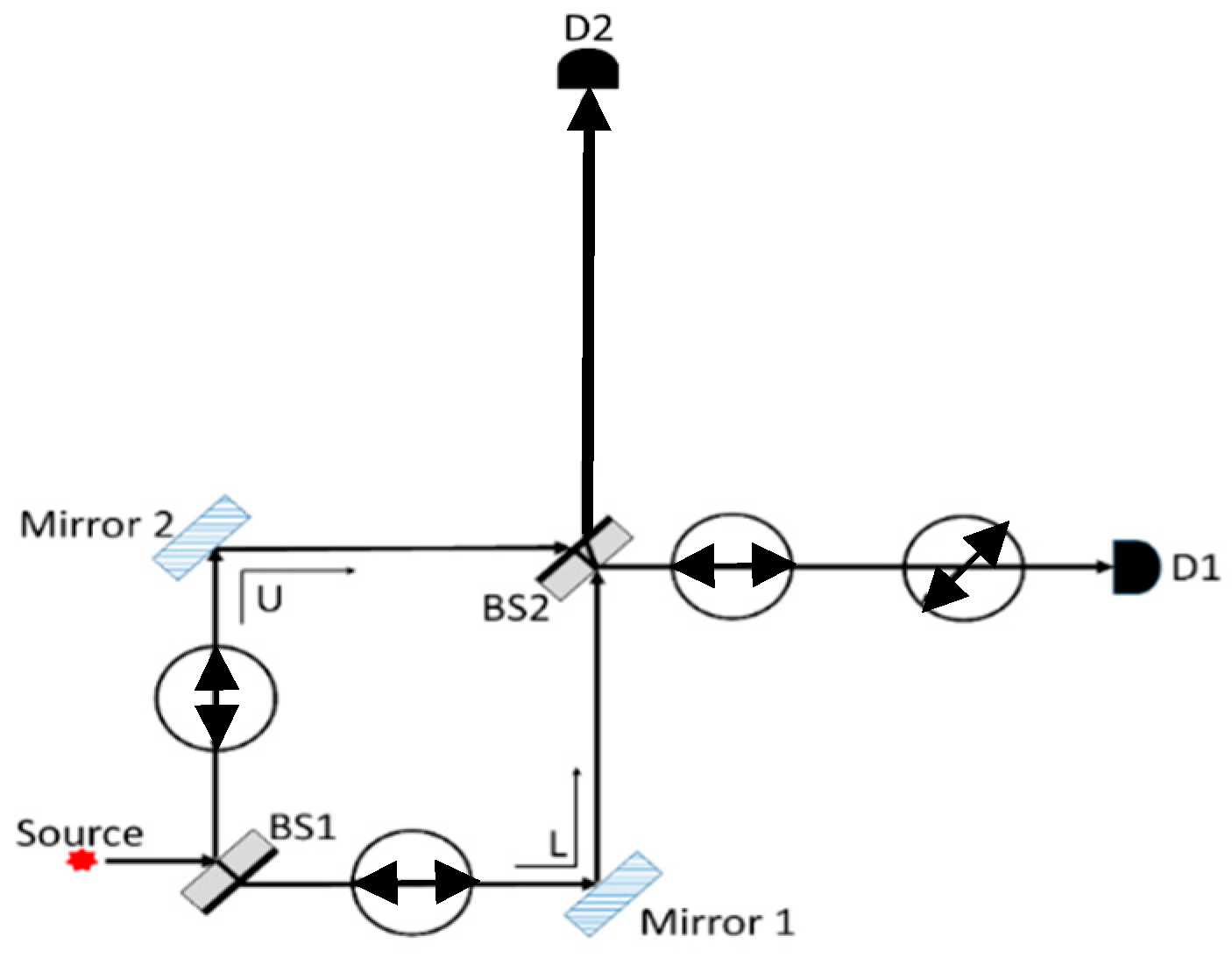
- You set up an MZI as shown in Figure A9, inserting polarizer 1 with a vertical polarization axis and polarizer 2 with a horizontal polarization axis in the U and L paths, respectively. You also insert polarizer 3 with a horizontal polarization axis and polarizer 4 with a 45° polarization axis between BS2 and detector D1 (see Figure A9).
- (a)
- What is the fraction of single photons emitted by the source that reaches each detector D1 and D2? Explain your reasoning.
- (b)
- If you place a phase shifter in the U path and change its thickness gradually to change the phase difference between the U and L paths, how would the phase shifter affect the fraction of photons arriving at detectors D1 and D2? Explain your reasoning.
- (c)
- If there is interference displayed by any photons in part 10(b) at detector D1, write down the percentage of the photons emitted by the source that displays interference. You must explain your reasoning.
- 11.
- Describe an experiment using a Mach–Zehnder Interferometer in which you could distinguish between a source emitting unpolarized photons and a source emitting +45° polarized photons.
References
- Asfaw, A., Blais, A., Brown, K. R., Candelaria, J., Cantwell, C., Carr, L. D., Combes, J., Debroy, D. M., Donohue, J. M., Economou, S. E., Edwards, E., Fox, M. F. J., Girvin, S. M., Ho, A., Hurst, H. M., Jacob, Z., Johnson, B. R., Johnston-Halperin, E., Joynt, R., … Singh, C. (2022). Building a quantum engineering undergraduate program. IEEE Transactions on Education, 65(2), 220–242. [Google Scholar] [CrossRef]
- Beck, M. (2012). Quantum mechanics: Theory and experiment. Oxford University Press. [Google Scholar]
- Berliner, D. (1994). Expertise: The wonder of exemplary performances. In Creating powerful thinking in teachers and students: Diverse perspectives (pp. 141–186). Holt, Rinehart and Winston. [Google Scholar]
- Bing, T. J., & Redish, E. F. (2007). The cognitive blending of mathematics and physics knowledge. AIP Conference Proceedings, 883, 26–29. [Google Scholar] [CrossRef]
- Bing, T. J., & Redish, E. F. (2009). Analyzing problem solving using math in physics: Epistemological framing via warrants. Physical Review Special Topics—Physics Education Research, 5(2), 020108. [Google Scholar] [CrossRef]
- Bing, T. J., & Redish, E. F. (2012). Epistemic complexity and the journeyman-expert transition. Physical Review Special Topics—Physics Education Research, 8(1), 010105. [Google Scholar] [CrossRef]
- Bitzenbauer, P. (2021a). Development of a test instrument to investigate secondary school students’ declarative knowledge of quantum optics. European Journal of Science and Mathematics Education, 9(3), 57–79. [Google Scholar] [CrossRef]
- Bitzenbauer, P. (2021b). Practitioners’ views on new teaching material for introducing quantum optics in secondary schools. Physics Education, 56(5), 055008. [Google Scholar] [CrossRef]
- Bitzenbauer, P. (2021c). Quantum physics education research over the last two decades: A bibliometric analysis. Education Sciences, 11(11), 699. [Google Scholar] [CrossRef]
- Bitzenbauer, P., & Meyn, J.-P. (2020). A new teaching concept on quantum physics in secondary schools. Physics Education, 55(5), 055031. [Google Scholar] [CrossRef]
- Bitzenbauer, P., Veith, J. M., Girnat, B., & Meyn, J.-P. (2022). Assessing engineering students’ conceptual understanding of introductory quantum optics. Physics, 4(4), 1180–1201. [Google Scholar] [CrossRef]
- Blais, A., Girvin, S. M., & Oliver, W. D. (2020). Quantum information processing and quantum optics with circuit quantum electrodynamics. Nature Physics, 16(3), 247–256. [Google Scholar] [CrossRef]
- Borish, V., & Lewandowski, H. J. (2023). Seeing quantum effects in experiments. Physical Review Physics Education Research, 19(2), 020144. [Google Scholar] [CrossRef]
- Branchetti, L., Cattabriga, A., & Levrini, O. (2019). Interplay between mathematics and physics to catch the nature of a scientific breakthrough: The case of the blackbody. Physical Review Physics Education Research, 15(2), 020130. [Google Scholar] [CrossRef]
- Brown, B., Zhu, G., & Singh, C. (2025). Investigating and improving student understanding of time dependence of expectation values in quantum mechanics using an interactive tutorial on Larmor precession. American Journal of Physics, 93(1), 52–57. [Google Scholar] [CrossRef]
- Chi, M. T. H., Feltovich, P. J., & Glaser, R. (1981). Categorization and representation of physics problems by experts and novices. Cognitive Science, 5(2), 121–152. [Google Scholar] [CrossRef]
- Chiofalo, M. L., Foti, C., Michelini, M., Santi, L., & Stefanel, A. (2022). Games for teaching/learning quantum mechanics: A pilot study with high-school students. Education Sciences, 12(7), 446. [Google Scholar] [CrossRef]
- Clark, R. E., Feldon, D. F., Van Merrienboer, J. J., Yates, K. A., & Early, S. (2018). Cognitive task analysis. In Handbook of research on educational communications and technology (pp. 577–593). Routledge. [Google Scholar]
- Cohen, J. (2013). Statistical power analysis for the behavioral sciences. Routledge. [Google Scholar]
- Colletti, L. (2023). An inclusive approach to teaching quantum mechanics in secondary school. Education Sciences, 13(2), 168. [Google Scholar] [CrossRef]
- Derman, A., Koçak, N., & Eilks, I. (2019). Insights into components of prospective science teachers’ mental models and their preferred visual representations of atoms. Education Sciences, 9(2), 154. [Google Scholar] [CrossRef]
- Dini, V., & Hammer, D. (2017). Case study of a successful learner’s epistemological framings of quantum mechanics. Physical Review Physics Education Research, 13(1), 010124. [Google Scholar] [CrossRef]
- diSessa, A. A. (1988). Knowledge in pieces. In G. Forman, & P. Pufall (Eds.), Constructivism in the computer age (pp. 49–70). Lawrence Erlbaum. [Google Scholar]
- diSessa, A. A. (1993). Toward an epistemology of physics. Cognition and Instruction, 10(2–3), 105–225. [Google Scholar] [CrossRef]
- diSessa, A. A. (2018). A friendly introduction to “knowledge in pieces”: Modeling types of knowledge and their roles in learning. Invited Lectures from the 13th International Congress on Mathematical Education, Hamburg, Germany. Available online: https://core.ac.uk/reader/484241457 (accessed on 29 September 2025).
- Dreyfus, B. W., Elby, A., Gupta, A., & Sohr, E. R. (2017). Mathematical sense-making in quantum mechanics: An initial peek. Physical Review Physics Education Research, 13, 020141. [Google Scholar] [CrossRef]
- Dufresne, R., Mestre, J., Thaden-Koch, T., Gerace, W., & Leonard, W. (2005). Knowledge representation and coordination in the transfer process. In Transfer of learning from a modern multidisciplinary perspective (pp. 155–215). Emerald Publishing Limited. [Google Scholar]
- Elby, A. (2001). Helping physics students learn how to learn. American Journal of Physics, 69(S1), S54–S64. [Google Scholar] [CrossRef]
- Ellerman, D. P. (2015). Why delayed choice experiments do not imply retrocausality. Quantum Studies: Mathematics and Foundations, 2, 183. [Google Scholar] [CrossRef]
- Ericsson, K. A., & Smith, J. (1991). Toward a general theory of expertise: Prospects and limits. Cambridge University Press. [Google Scholar]
- Fox, M. F. J., Zwickl, B. M., & Lewandowski, H. J. (2020). Preparing for the quantum revolution: What is the role of higher education? Physical Review Physics Education Research, 16(2), 020131. [Google Scholar] [CrossRef]
- Galvez, E. J. (2019, May 21–24). Quantum optics laboratories for teaching quantum physics. Fifteenth Conference on Education and Training in Optics and Photonics, Quebec City, QC, Canada. [Google Scholar]
- Galvez, E. J. (2023). A curriculum of table-top quantum optics experiments to teach quantum physics. Journal of Physics: Conference Series, 2448, 012006. [Google Scholar] [CrossRef]
- Galvez, E. J., Holbrow, C. H., Pysher, M. J., Martin, J. W., Courtemanche, N., Heilig, L., & Spencer, J. (2005). Interference with correlated photons: Five quantum mechanics experiments for undergraduates. American Journal of Physics, 73, 127–140. [Google Scholar] [CrossRef]
- Gire, E., & Manogue, C. (2012). Making sense of quantum operators, eigenstates and quantum measurements. AIP Conference Proceedings, 1413, 195–198. [Google Scholar] [CrossRef]
- Hake, R. R. (1998). Interactive-engagement versus traditional methods: A six-thousand-student survey of mechanics test data for introductory physics courses. American Journal of Physics, 66(1), 64–74. [Google Scholar] [CrossRef]
- Hammer, D. (1994). Epistemological beliefs in introductory physics. Cognition and Instruction, 12(2), 151–183. [Google Scholar] [CrossRef]
- Hasanovic, M. (2023, May 15–18). Quantum education: How to teach a subject that nobody fully understands. Seventeenth Conference on Education and Training in Optics and Photonics, Cocoa Beach, FL, USA. [Google Scholar]
- Henderson, C., & Beichner, R. (2009). Publishing PER articles in AJP and PRST-PER. American Journal of Physics, 77(7), 581–582. [Google Scholar] [CrossRef]
- Hennig, F., Tóth, K., Förster, M., & Bitzenbauer, P. (2024a). A new teaching-learning sequence to promote secondary school students’ learning of quantum physics using Dirac notation. Physics Education, 59(4), 045007. [Google Scholar] [CrossRef]
- Hennig, F., Tóth, K., Veith, J., & Bitzenbauer, P. (2024b). Mathematical sense making of quantum phenomena using Dirac notation: Its effect on secondary school students’ functional thinking about photons. EPJ Quantum Technology, 11(1), 61. [Google Scholar] [CrossRef]
- Holincheck, N., Rosenberg, J. L., Zhang, X., Butler, T. N., Colandene, M., & Dreyfus, B. W. (2024). Quantum science and technologies in K-12: Supporting teachers to integrate quantum in STEM classrooms. Education Sciences, 14(3), 219. [Google Scholar] [CrossRef]
- Hu, D., & Rebello, N. S. (2013a). Understanding student use of differentials in physics integration problems. Physical Review Special Topics-Physics Education Research, 9, 020108. [Google Scholar] [CrossRef]
- Hu, D., & Rebello, N. S. (2013b). Using conceptual blending to describe how students use mathematical integrals in physics. Physical Review Special Topics—Physics Education Research, 9(2), 020118. [Google Scholar] [CrossRef]
- Hu, D., & Rebello, N. S. (2014). Shifting college students’ epistemological framing using hypothetical debate problems. Physical Review Special Topics—Physics Education Research, 10(1), 010117. [Google Scholar] [CrossRef]
- Hutchins, E. (2014). The cultural ecosystem of human cognition. Philosophical Psychology, 27(1), 34–49. [Google Scholar] [CrossRef]
- Justice, P. (2019). Helping students learn quantum mechanics using research-validated learning tools [Ph.D. dissertation, University of Pittsburgh]. Available online: https://core.ac.uk/download/pdf/231921831.pdf (accessed on 18 May 2025).
- Justice, P., Marshman, E., & Singh, C. (2022, July 13–14). Impact of mathematical reasoning on students’ understanding of quantum optics. Physics Education Research Conference, Grand Rapids, MI, USA. [Google Scholar]
- Karam, R. (2014). Framing the structural role of mathematics in physics lectures: A case study on electromagnetism. Physical Review Special Topics—Physics Education Research, 10(1), 010119. [Google Scholar] [CrossRef]
- Karam, R. (2015). Introduction of the thematic issue on the interplay of physics and mathematics. Science & Education, 24(5), 487–494. [Google Scholar] [CrossRef]
- Karam, R., & Krey, O. (2015). Quod erat demonstrandum: Understanding and explaining equations in physics teacher education. Science & Education, 24(5), 661–698. [Google Scholar] [CrossRef]
- Karam, R., Uhden, O., & Höttecke, D. (2019). The “Math as Prerequisite” illusion: Historical considerations and implications for physics teaching. In G. Pospiech, M. Michelini, & B.-S. Eylon (Eds.), Mathematics in physics education (pp. 37–52). Springer International Publishing. [Google Scholar]
- Keebaugh, C., Marshman, E., & Singh, C. (2024). Challenges in sensemaking and reasoning in the context of degenerate perturbation theory in quantum mechanics. Physical Review Physics Education Research, 20(2), 020139. [Google Scholar] [CrossRef]
- Kim, E., & Pak, S.-J. (2002). Students do not overcome conceptual difficulties after solving 1000 traditional problems. American Journal of Physics, 70(7), 759–765. [Google Scholar] [CrossRef]
- Kotovsky, K., Hayes, J. R., & Simon, H. A. (1985). Why are some problems hard? Evidence from Tower of Hanoi. Cognitive Psychology, 17, 248–294. [Google Scholar] [CrossRef]
- Leonard, W. J., Dufresne, R. J., & Mestre, J. (1996). Using qualitative problem-solving strategies to highlight the role of conceptual knowledge in solving problems. American Journal of Physics, 64, 1495–1503. [Google Scholar] [CrossRef]
- Maries, A., Sayer, R., & Singh, C. (2020). Can students apply the concept of “which-path” information learned in the context of Mach–Zehnder interferometer to the double-slit experiment? American Journal of Physics, 88(7), 542–550. [Google Scholar] [CrossRef]
- Maries, A., & Singh, C. (2023). Helping students become proficient problem solvers part I: A brief review. Education Sciences, 13(2), 156. [Google Scholar] [CrossRef]
- Marshman, E., & Singh, C. (2014, July 30–31). Developing an interactive tutorial on a quantum eraser. Physics Education Research Conference (pp. 175–178), Minneapolis, MN, USA. [Google Scholar] [CrossRef]
- Marshman, E., & Singh, C. (2015). Framework for understanding the patterns of student difficulties in quantum mechanics. Physical Review Special Topics-Physics Education Research, 11(2), 020119. [Google Scholar] [CrossRef]
- Marshman, E., & Singh, C. (2016). Interactive tutorial to improve student understanding of single photon experiments involving a Mach–Zehnder interferometer. European Journal of Physics, 37(2), 024001. [Google Scholar] [CrossRef]
- Marshman, E., & Singh, C. (2017). Investigating and improving student understanding of quantum mechanics in the context of single photon interference. Physical Review Special Topics-Physics Education Research, 13(1), 010117. [Google Scholar] [CrossRef]
- Marshman, E., & Singh, C. (2022). QuILTs: Validated teaching–learning sequences for helping students learn quantum mechanics. In J. Borg Marks, P. Galea, S. Gatt, & D. Sands (Eds.), Physics teacher education: What matters? (pp. 15–35) Springer International Publishing. [Google Scholar] [CrossRef]
- Mazur, E. (1997). Peer instruction: A user’s manual. Prentice Hall. [Google Scholar]
- McDermott, L. C. (1991). Millikan lecture 1990: What we teach and what is learned—Closing the gap. American Journal of Physics, 59(4), 301–315. [Google Scholar] [CrossRef]
- McDermott, L. C. (2001). Oersted medal lecture 2001: “Physics education research—The key to student learning”. American Journal of Physics, 69(11), 1127–1137. [Google Scholar] [CrossRef]
- McLeod, S. (2010). The zone of proximal development and scaffolding. Recuperado el. Available online: https://www.simplypsychology.org/zone-of-proximal-development.html (accessed on 29 September 2025).
- Michelini, M., & Stefanel, A. (2023). Research studies on learning quantum physics. In M. F. Taşar, & P. R. L. Heron (Eds.), The international handbook of physics education research: Learning physics. AIP Publishing LLC. [Google Scholar] [CrossRef]
- Michelini, M., Stefanel, A., & Tóth, K. (2022). Implementing Dirac approach to quantum mechanics in a Hungarian secondary school. Education Sciences, 12(9), 606. [Google Scholar] [CrossRef]
- Newell, A., & Simon, H. A. (1972). Human problem solving. Prentice-Hall. [Google Scholar]
- Nikolaus, P., Dželalija, M., & Weber, I. (2024). Investigating students’ conceptual knowledge of quantum physics to improve the teaching and learning process. Education Sciences, 14(10), 1113. [Google Scholar] [CrossRef]
- Nita, L., Mazzoli Smith, L., Chancellor, N., & Cramman, H. (2023). The challenge and opportunities of quantum literacy for future education and transdisciplinary problem-solving. Research in Science & Technological Education, 41(2), 564–580. [Google Scholar]
- Nousiainen, M., & Koponen, I. T. (2020). Pre-service teachers’ declarative knowledge of wave-particle dualism of electrons and photons: Finding lexicons by using network analysis. Education Sciences, 10(3), 76. [Google Scholar] [CrossRef]
- Odden, T. O. B., & Russ, R. S. (2018). Sensemaking epistemic game: A model of student sensemaking processes in introductory physics. Physical Review Physics Education Research, 14(2), 020122. [Google Scholar] [CrossRef]
- Orszag, M. (2016). Quantum optics: Including noise reduction, trapped ions, quantum trajectories, and decoherence. Springer. [Google Scholar]
- PhysPort. (n.d.). PhysPort. Available online: https://www.physport.org/ (accessed on 18 May 2025).
- Posner, M. T., Poulin-Girard, A.-S., & Gregory, G. G. (2022). Special section guest editorial: Education and training in quantum sciences and technologies. Optical Engineering, 61(8), 081801. [Google Scholar] [CrossRef]
- Rangkuti, M. A., & Karam, R. (2022). Conceptual challenges with the graphical representation of the propagation of a pulse in a string. Physical Review Physics Education Research, 18(2), 020119. [Google Scholar] [CrossRef]
- Rebello, N. S., Cui, L., Bennett, A., Zollman, D., & Ozimek, D. (2017). Transfer of learning in problem solving in the context of mathematics and physics. In D. H. Jonassen (Ed.), Learning to solve complex scientific problems (pp. 223–246). Routledge. [Google Scholar]
- Redish, E. F., & Kuo, E. (2015). Language of physics, language of math: Disciplinary culture and dynamic epistemology. Science & Education, 24, 561–590. [Google Scholar] [CrossRef]
- Reif, F. (1995a). Millikan lecture 1994: Understanding and teaching important scientific thought processes. American Journal of Physics, 63(1), 17–32. [Google Scholar] [CrossRef]
- Reif, F. (1995b). Understanding and teaching important scientific thought processes. Journal of Science Education and Technology, 4(4), 261–282. [Google Scholar] [CrossRef]
- Reif, F. (2008). Scientific approaches to science education. Physics Today, 39(11), 48–54. [Google Scholar] [CrossRef]
- Schoenfeld, A. H. (2016). Learning to think mathematically: Problem solving, metacognition, and sense making in mathematics. The Journal of Education, 196(2), 1–38. [Google Scholar] [CrossRef]
- Scholz, R., Friege, G., & Weber, K.-A. (2018). Undergraduate quantum optics: Experimental steps to quantum physics. European Journal of Physics, 39(5), 055301. [Google Scholar] [CrossRef]
- Schraw, G. (1998). Promoting general metacognitive awareness. Instructional Science, 26(1), 113–125. [Google Scholar] [CrossRef]
- Schwartz, D. L., Bransford, J. D., & Sears, D. (2005). Efficiency and innovation in transfer. In Transfer of learning from a modern multidisciplinary perspective (Vol. 3, pp. 1–51). Information Age Publishing. [Google Scholar]
- Seskir, Z. C., Migdał, P., Weidner, C., Anupam, A., Case, N., Davis, N., Decaroli, C., Ercan, İ., Foti, C., Gora, P., Jankiewicz, K., La Cour, B. R., Malo, J. Y., Maniscalco, S., Naeemi, A., Nita, L., Parvin, N., Scafirimuto, F., Sherson, J. F., … Chiofalo, M. (2022). Quantum games and interactive tools for quantum technologies outreach and education. Optical Engineering, 61(8), 081809. [Google Scholar] [CrossRef]
- Silberman, D. M. (2023, May 15–18). Teaching quantum to high school students. Seventeenth Conference on Education and Training in Optics and Photonics, Cocoa Beach, FL, USA. [Google Scholar]
- Singh, C. (2001). Student understanding of quantum mechanics. American Journal of Physics, 69(8), 885–895. [Google Scholar] [CrossRef]
- Singh, C. (2002). When physical intuition fails. American Journal of Physics, 70(11), 1103–1109. [Google Scholar] [CrossRef]
- Singh, C. (2008). Assessing student expertise in introductory physics with isomorphic problems. II. Effect of some potential factors on problem solving and transfer. Physical Review Special Topics—Physics Education Research, 4(1), 010105. [Google Scholar] [CrossRef]
- Singh, C., Asfaw, A., & Levy, J. (2021). Preparing students to be leaders of the quantum information revolution. Physics Today. [Google Scholar] [CrossRef]
- Singh, C., Maries, A., Heller, K., & Heller, P. (2023). Instructional strategies that foster effective problem-solving. In The international handbook of physics education research: Learning physics. AIP Publishing LLC. [Google Scholar]
- Singh, C., & Marshman, E. (2015). Review of student difficulties in upper-level quantum mechanics. Physical Review Special Topics-Physics Education Research, 11(2), 020117. [Google Scholar] [CrossRef]
- Sirnoorkar, A., Bergeron, P. D. O., & Laverty, J. T. (2023). Sensemaking and scientific modeling: Intertwined processes analyzed in the context of physics problem solving. Physical Review Physics Education Research, 19(1), 010118. [Google Scholar] [CrossRef]
- Sternberg, R. J. (1998). Metacognition, abilities, and developing expertise: What makes an expert student? Instructional Science, 26(1), 127–140. [Google Scholar] [CrossRef]
- Sweller, J. (1988). Cognitive load during problem solving: Effects on learning. Cognitive Science, 12(2), 257–285. [Google Scholar] [CrossRef]
- Tóth, K., Michelini, M., & Bitzenbauer, P. (2024). Exploring the effect of a phenomenological teaching-learning sequence on lower secondary school students’ views of light polarisation. Physics Education, 59(3), 035009. [Google Scholar] [CrossRef]
- Tuminaro, J., & Redish, E. F. (2007). Elements of a cognitive model of physics problem solving: Epistemic games. Physical Review Special Topics-Physics Education Research, 3(2), 020101. [Google Scholar] [CrossRef]
- Tzanakis, C. (2016, July 18–22). Mathematics & physics: An innermost relationship. Didactical implications for their teaching & learning. History and Pedagogy of Mathematics, Montpellier, France. [Google Scholar]
- Ubben, M., & Bitzenbauer, P. (2023). Exploring the relationship between students’ conceptual understanding and model thinking in quantum optics. Frontiers in Quantum Science and Technology, 2, 1207619. [Google Scholar] [CrossRef]
- Uhden, O., Karam, R., Pietrocola, M., & Pospiech, G. (2012). Modelling mathematical reasoning in physics education. Science & Education, 21(4), 485–506. [Google Scholar] [CrossRef]
- Vygotsky, L. (1978). Mind in society: The development of higher psychological processes. Harvard University Press. [Google Scholar]
- Walsh, J. A., Fenech, M., Tucker, D. L., Riegle-Crumb, C., & La Cour, B. R. (2022). Piloting a full-year, optics-based high school course on quantum computing. Physics Education, 57(2), 025010. [Google Scholar] [CrossRef]




| Graduate Students | Undergraduates Group A | Undergraduates Group B | ||||||||||
|---|---|---|---|---|---|---|---|---|---|---|---|---|
| Q | Pre(%) N = 10 | Post(%) N = 10 | <g> | d | Pre(%) N = 24 | Post(%) N = 20 | <g> | d | Pre(%) N = 15 | Post(%) N = 16 | <g> | d |
| 1 | 55 | 100 | 1.00 | 0.67 | 17 | 93 | 0.91 | 1.21 | 48 | 91 | 0.81 | 0.54 |
| 2 | 55 | 82 | 0.60 | 0.40 | 69 | 89 | 0.64 | 0.40 | 57 | 84 | 0.64 | 0.46 |
| 3a | 60 | 95 | 0.89 | 0.49 | 34 | 100 | 1.00 | 1.18 | 55 | 100 | 1.00 | 0.74 |
| 3b | -- | -- | -- | -- | -- | -- | -- | -- | 28 | 94 | 0.92 | 0.53 |
| 3 (avg) | 60 | 95 | 0.89 | 0.49 | 34 | 100 | 1.00 | 1.18 | 42 | 97 | 0.95 | 1.89 |
| 4a | 10 | 82 | 0.80 | 2.33 | 44 | 60 | 0.29 | 0.34 | 77 | 100 | 1.00 | 0.92 |
| 4b | 20 | 90 | 0.88 | 1.98 | 29 | 56 | 0.36 | 0.54 | 73 | 100 | 1.00 | 0.85 |
| 4c | 30 | 82 | 0.74 | 1.22 | 13 | 56 | 0.49 | 1.01 | 40 | 94 | 0.90 | 1.39 |
| 4 (avg) | 20 | 85 | 0.81 | 2.06 | 29 | 57 | 0.39 | 0.70 | 63 | 98 | 0.95 | 1.36 |
| 5 | 64 | 80 | 0.45 | 0.37 | 56 | 75 | 0.43 | 0.49 | 73 | 97 | 0.88 | 0.73 |
| 6a | 5 | 68 | 0.67 | 3.21 | 10 | 60 | 0.55 | 1.97 | 23 | 47 | 0.31 | 0.69 |
| 6b | 36 | 85 | 0.76 | 1.19 | 48 | 95 | 0.90 | 1.29 | 80 | 81 | 0.06 | 0.03 |
| 6c | 36 | 73 | 0.57 | 0.83 | 23 | 65 | 0.55 | 1.20 | 40 | 59 | 0.32 | 0.50 |
| 6 (avg) | 26 | 75 | 0.66 | 1.83 | 27 | 73 | 0.63 | 1.97 | 48 | 62 | 0.27 | 0.53 |
| 7a | 5 | 95 | 0.95 | 6.32 | 40 | 83 | 0.71 | 1.09 | 77 | 91 | 0.60 | 0.44 |
| 7b | 18 | 90 | 0.88 | 2.07 | 13 | 40 | 0.31 | 0.66 | 40 | 88 | 0.79 | 1.13 |
| 7c | 41 | 91 | 0.85 | 1.29 | 13 | 35 | 0.26 | 0.55 | 20 | 81 | 0.77 | 1.55 |
| 7 (avg) | 21 | 92 | 0.90 | 2.85 | 22 | 53 | 0.39 | 0.93 | 46 | 87 | 0.75 | 1.36 |
| 8a | 23 | 91 | 0.88 | 2.21 | 17 | 65 | 0.58 | 1.53 | 47 | 88 | 0.77 | 1.44 |
| 8b | 18 | 90 | 0.88 | 2.07 | 4 | 80 | 0.79 | 2.40 | 53 | 97 | 0.93 | 1.20 |
| 8c | 9 | 82 | 0.80 | 2.13 | 2 | 58 | 0.57 | 1.79 | 23 | 88 | 0.84 | 1.99 |
| 8 (avg) | 17 | 88 | 0.86 | 2.62 | 8 | 68 | 0.65 | 2.39 | 41 | 91 | 0.85 | 2.16 |
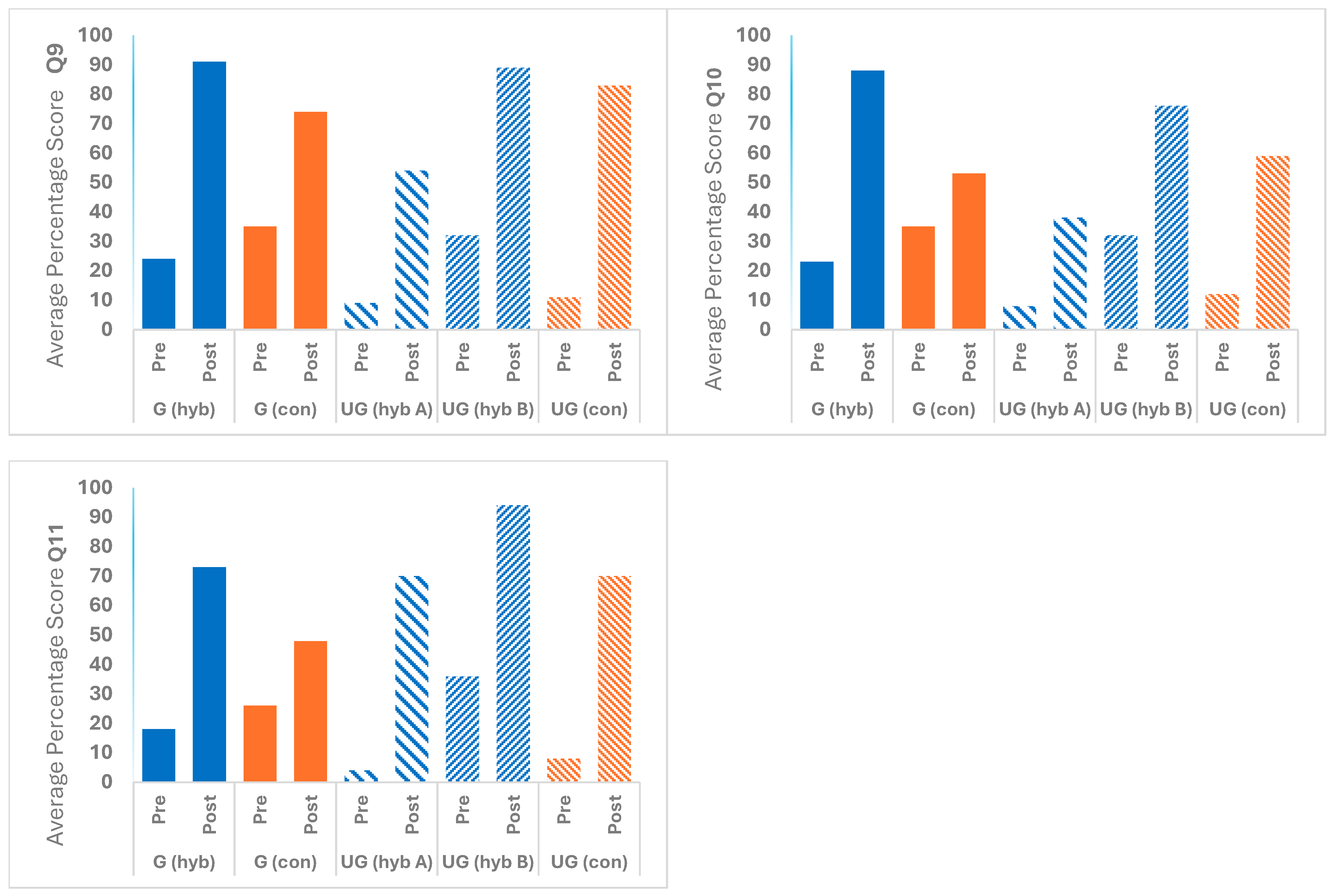
| 9a | 18 | 91 | 0.89 | 2.39 | 15 | 68 | 0.62 | 1.59 | 40 | 94 | 0.90 | 1.86 |
| 9b | 27 | 90 | 0.86 | 1.65 | 8 | 45 | 0.40 | 0.91 | 30 | 88 | 0.82 | 1.48 |
| 9c | 27 | 91 | 0.88 | 1.70 | 4 | 50 | 0.48 | 1.20 | 27 | 84 | 0.79 | 1.46 |
| 9 (avg) | 24 | 91 | 0.88 | 2.19 | 9 | 54 | 0.50 | 1.44 | 32 | 89 | 0.83 | 2.04 |
| 10a | 14 | 91 | 0.89 | 2.59 | 15 | 45 | 0.36 | 0.77 | 30 | 84 | 0.78 | 1.66 |
| 10b | 27 | 90 | 0.86 | 1.65 | 4 | 35 | 0.32 | 0.84 | 33 | 75 | 0.63 | 0.92 |
| 10c | 27 | 82 | 0.75 | 1.31 | 4 | 35 | 0.32 | 0.84 | 33 | 69 | 0.53 | 0.76 |
| 10 (avg) | 23 | 88 | 0.84 | 2.36 | 8 | 38 | 0.33 | 1.05 | 32 | 76 | 0.64 | 1.34 |
| 11 | 18 | 73 | 0.67 | 1.31 | 4 | 70 | 0.69 | 2.08 | 36 | 94 | 0.90 | 1.54 |
| Average | 33 | 87 | 0.80 | 3.46 | 27 | 70 | 0.60 | 2.61 | 48 | 88 | 0.77 | 2.46 |
| Graduate Students | Undergraduates | |||||||
|---|---|---|---|---|---|---|---|---|
| Q | Pre(%) | Post(%) | <g> | d | Pre(%) | Post(%) | <g> | d |
| 5 | 9 | 59 | 0.55 | 1.26 | 31 | 85 | 0.78 | 1.31 |
| 6 | 30 | 77 | 0.67 | 1.74 | 34 | 89 | 0.84 | 2.16 |
| 9 | 35 | 74 | 0.60 | 1.15 | 11 | 83 | 0.80 | 2.63 |
| 10 | 35 | 53 | 0.28 | 0.48 | 12 | 59 | 0.54 | 1.43 |
| 11 | 26 | 48 | 0.30 | 0.48 | 8 | 70 | 0.68 | 1.66 |
Disclaimer/Publisher’s Note: The statements, opinions and data contained in all publications are solely those of the individual author(s) and contributor(s) and not of MDPI and/or the editor(s). MDPI and/or the editor(s) disclaim responsibility for any injury to people or property resulting from any ideas, methods, instructions or products referred to in the content. |
© 2025 by the authors. Licensee MDPI, Basel, Switzerland. This article is an open access article distributed under the terms and conditions of the Creative Commons Attribution (CC BY) license (https://creativecommons.org/licenses/by/4.0/).
Share and Cite
Justice, P.D.; Marshman, E.; Singh, C. A Framework for Understanding the Impact of Integrating Conceptual and Quantitative Reasoning in a Quantum Optics Tutorial on Students’ Conceptual Understanding. Educ. Sci. 2025, 15, 1314. https://doi.org/10.3390/educsci15101314
Justice PD, Marshman E, Singh C. A Framework for Understanding the Impact of Integrating Conceptual and Quantitative Reasoning in a Quantum Optics Tutorial on Students’ Conceptual Understanding. Education Sciences. 2025; 15(10):1314. https://doi.org/10.3390/educsci15101314
Chicago/Turabian StyleJustice, Paul D., Emily Marshman, and Chandralekha Singh. 2025. "A Framework for Understanding the Impact of Integrating Conceptual and Quantitative Reasoning in a Quantum Optics Tutorial on Students’ Conceptual Understanding" Education Sciences 15, no. 10: 1314. https://doi.org/10.3390/educsci15101314
APA StyleJustice, P. D., Marshman, E., & Singh, C. (2025). A Framework for Understanding the Impact of Integrating Conceptual and Quantitative Reasoning in a Quantum Optics Tutorial on Students’ Conceptual Understanding. Education Sciences, 15(10), 1314. https://doi.org/10.3390/educsci15101314