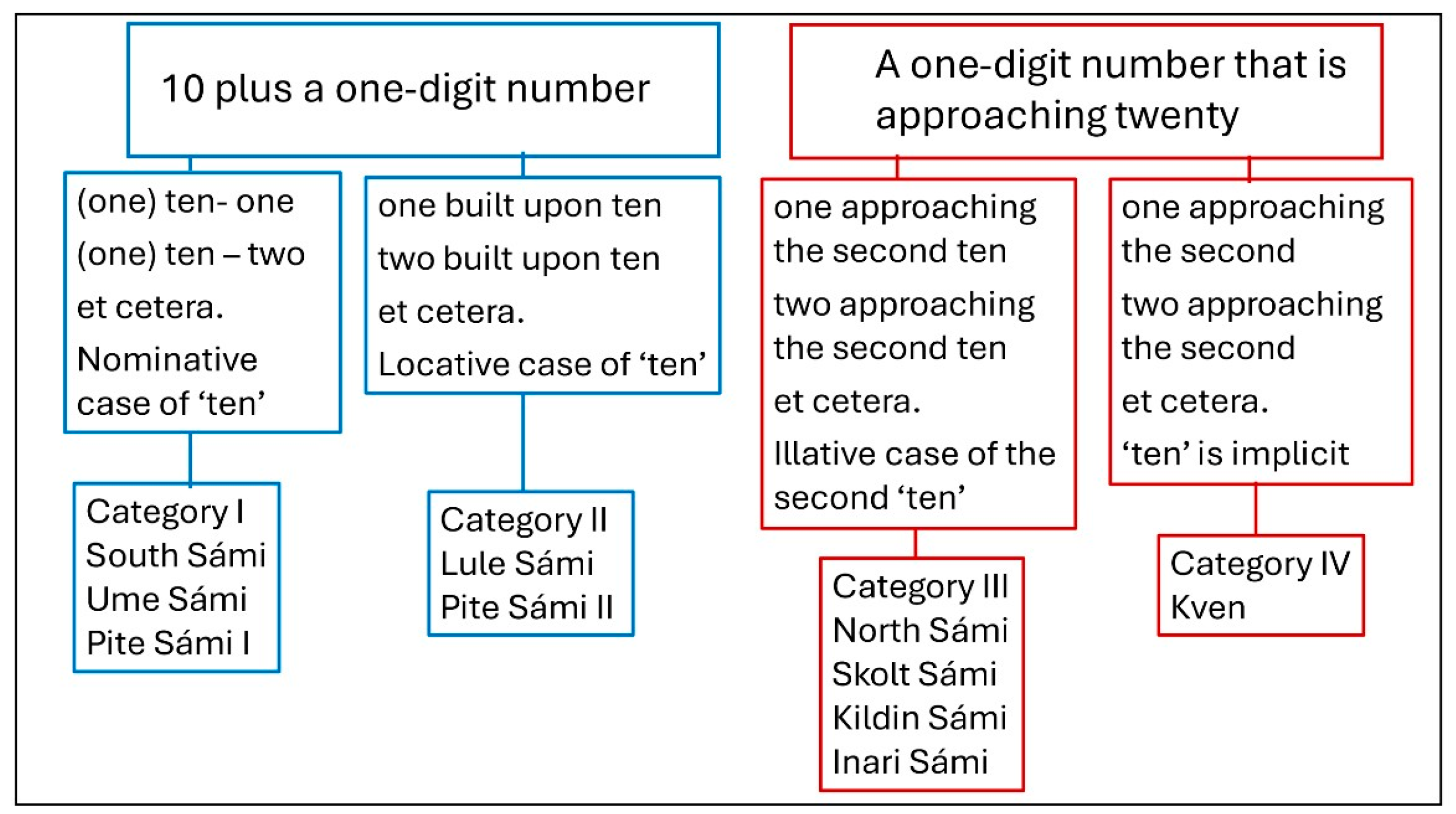
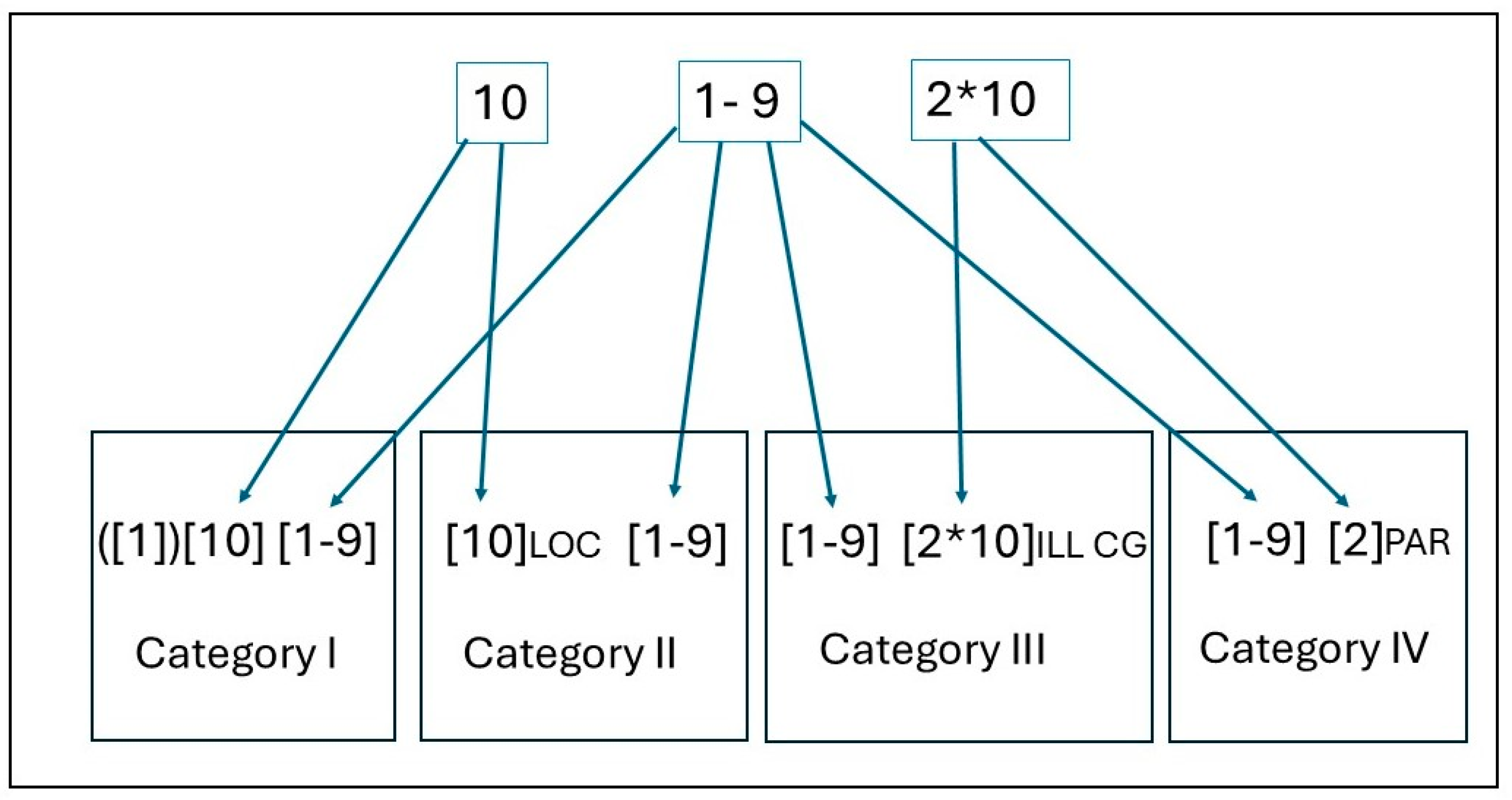
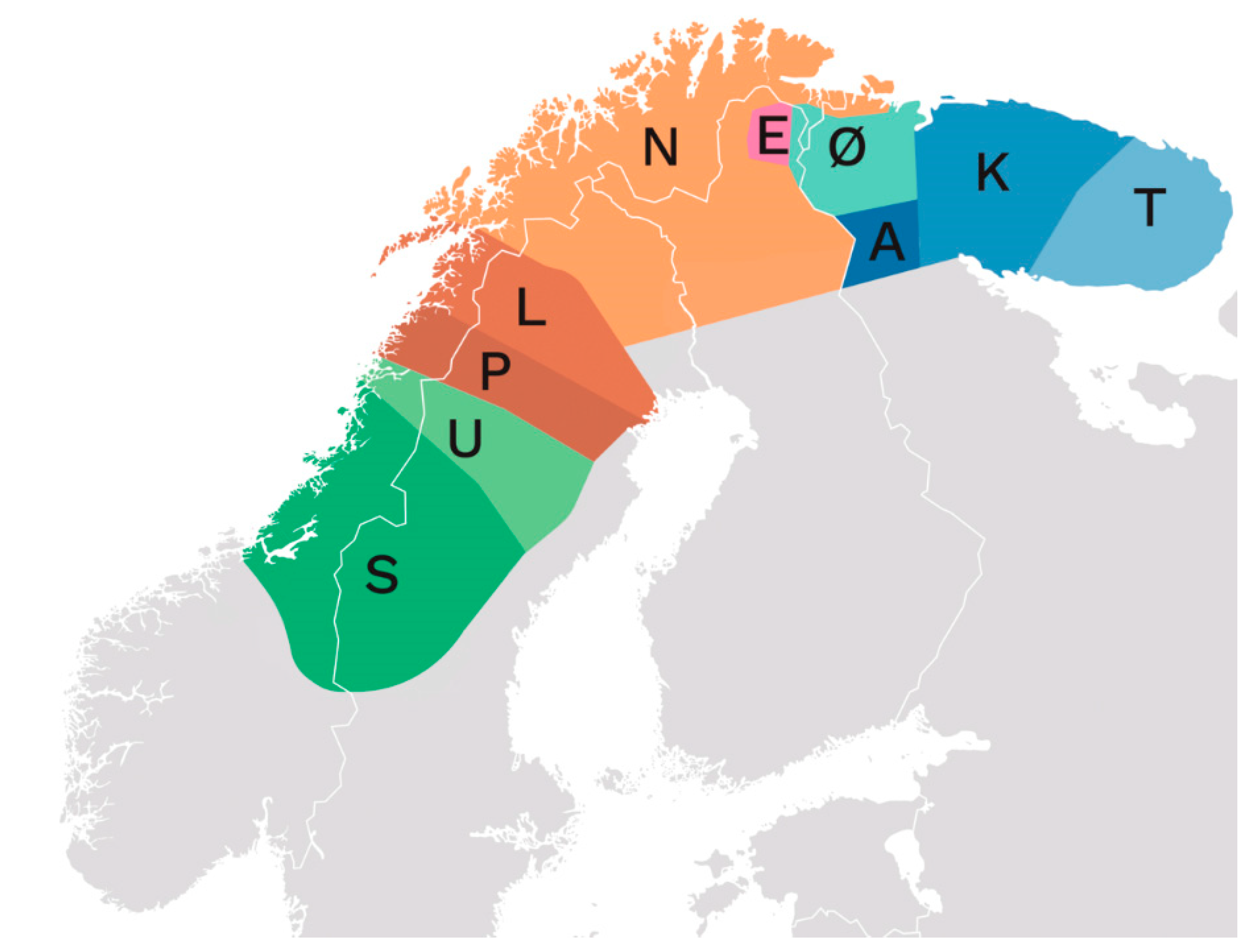
Why Should We Count in Sámi and Kven?

Abstract
1. Introduction
1.1. Sámi Languages and Education in Norway
1.1.1. The Current Situation of Sámi Languages
1.1.2. The Current Situation of Sámi Mathematics Education
1.2. Revitalization, Reversing, and Regeneration of Language
… Northern Sami and, to some extent, Kven and Lule and Southern Sami language communities, are gaining new language users. The investigation conducted by the [Truth and Reconciliation] Commission shows that revitalisation initiatives are not working satisfactorily and that the languages lack an adequate framework and resources. The Sami parliament and the Sami and Kven organisations and institutions have significantly higher ambitions for language revitalisation than the Norwegian authorities.
1.3. Investigating and Representing Numerals in Multiple Languages
| (1) | čiežanuppelohkái | ||
| čieža- | nuppe- | lohkái | |
| ‘seven’- | ‘the second’CG- | ‘ten’ILL | |
| ‘seven toward the second ten’ | |||
1.4. Counting Systems in Different Languages
1.4.1. Languages with Base-10 Counting Systems
- Grouping by tens is a feature of many languages. For instance, the Swahili counting system from 11–19 is strictly regular (Zaslavsky, 1996). This is also the case for the Indigenous Mapuche numeral system (A. Huencho & E. Chandia, personal communication, 5 September 2025). However, our study focuses on the Sámi and Kven counting systems and comparisons with the Welsh base-10 counting systems, because these can be related to research about Western European minority students’ understanding of the base-10 system.
1.4.2. The Norwegian and Swedish Counting System
1.4.3. The Finno-Ugric Systems of Counting
1.4.4. The Welsh Systems of Counting
- Children whose first language is Welsh, who have a Welsh home environment and who receive Welsh-language schooling;
- Children who receive Welsh-language schooling but have English-speaking parents, an English-speaking home environment, and English as their first language;
- Children whose first language is English and who receive an English-medium education.
2. Materials and Methods of Analysis
- North Sámi (davvisámegiella) is definitely endangered;
- Lule Sámi (julevsámegiella) is severely endangered in Norway and Sweden;
- South Sámi (åarjelsaemiengïele) is severely endangered in Norway and Sweden;
- Inari Sámi (anarâškielâ) is severely endangered in Finland;
- Pite Sámi (bidumsámegiella) is critically endangered in Norway and Sweden;
- Ume Sámi (ubmejesámiengiälla) is critically endangered in Sweden and extinct in Norway;
- Skolt Sámi (sääʹmǩiõll) is severely endangered in Finland and almost extinct in Norway and Russia;
- Kildin Sámi (кӣллт cāмь кӣлл/kiillt saamʹ kiill) is severely endangered in Russia;
- Ter Sámi (cāмькӣллis/saa’mekiill) is almost extinct in Russia;
- Akkala Sámi is almost extinct or extinct in Russia.
2.1. Sámi Counting Systems
| (2) | lågenanniellja | |
| lågenan- | niellja | |
| ‘ten’-LOC | ‘four’ | |
| ‘upon ten, four’ | ||
2.2. The Kven Counting System
2.3. Analysis
3. Results
3.1. The Structures of Sámi and Kven Numerals
3.2. Comparisons with the Standard Welsh Counting System
4. Discussion
5. Conclusions
Author Contributions
Funding
Institutional Review Board Statement
Informed Consent Statement
Data Availability Statement
Acknowledgments
Conflicts of Interest
References
- Antonsen, L. (2021). «Lei niogtredve go byggiimet» Om unormerte lån fra norsk i samisk talespråk. In K. Hagen, G. Kristoffersen, Ø. A. Vangsnes, & T. A. Åfarli (Eds.), Språk i arkiva—Ny forskning om eldre talemål frå LIA-prosjektet (pp. 179–200). Novus forlag. Available online: https://omp.novus.no/index.php/novus/catalog/view/19/29/1044 (accessed on 13 December 2024).
- Aunio, P., Hautamäki, J., Heiskari, P., & van Luit, J. E. H. (2006a). The early numeracy test in finnish: Children’s norms. Scandinavian Journal of Psychology, 47, 369–378. [Google Scholar] [CrossRef] [PubMed]
- Aunio, P., Niemivirta, M., Hautamäki, J., Van Luit, J. E. H., Shi, J., & Zhang, M. (2006b). Young children’s number sense in China and Finland. Scandinavian Journal of Educational Research, 50(5), 483–502. [Google Scholar] [CrossRef]
- BBC Cymru Wales. (2002). Some basic rules of Welsh grammar. BBC. Available online: https://www.bbc.co.uk/wales/learnwelsh/pdf/welshgrammar_allrules.pdf (accessed on 12 December 2024).
- Brekke, G. (2002). Kartlegging av matematikkforståelse. Introduksjon til diagnostisk undervisning i matematikk. University of Sout-Eastern Norway. Available online: https://web01.usn.no/~panderse/KIMhefter/kimgammeldiag.pdf (accessed on 10 November 2025).
- Broderstad, E. G. (2022). Sámi education betweenlaw and politics—TheSámi-Norwegian context. In T. A. Olsen, & H. Sollid (Eds.), Indigenising education and citizenship. Perspectives on policies and practices from sápmi and beyond (pp. 53–73). Scandinavian University Press. [Google Scholar] [CrossRef]
- Dannemark, N. (2014). Norske talord i samisk tale i Guovdageaidnu. Maal Og Minne, 106(2), 131–154. Available online: https://ojs.novus.no/index.php/MOM/article/view/221/219 (accessed on 8 December 2024).
- Dowker, A., Bala, S., & Lloyd, D. (2008). Linguistic influences on mathematical development: How important is the transparency of the counting system? Philosophical Psychology, 21(4), 523–538. [Google Scholar] [CrossRef]
- Edmonds-Wathen, C. (2019). Linguistic methodologies for investigating and representing multiple languages in mathematics education research. Research in Mathematics Education, 21(2), 119–134. [Google Scholar] [CrossRef]
- Edmonds-Wathen, C., Owens, K., & Bino, V. (2019). Identifying vernacular language to use in mathematics teaching. Language and Education, 33(1), 17. [Google Scholar] [CrossRef]
- Fyhn, A. B., Partapuoli, Á. K., & Ravna, P. (2024). Hvorfor det er nødvendig med en samisk parallell likeverdig læreplan i matematikk. Rapport fra faggruppe nedsatt av Sametinget [Report]. Sámediggi—The Sámi Parliament. Available online: https://sametinget.no/_f/p1/i4c928b3b-9279-45ba-ae6d-2dcc914fbdf2/hvorfor-det-er-nodvendig-med-en-samisk-parallell-likeverdig-lareplan-i-matematikk.pdf (accessed on 23 April 2024).
- Giellatekno. (2024). Generer samiske tallord. Giellatekno. Available online: https://giellatekno.uit.no/num.nob.html (accessed on 23 November 2024).
- Helander, N. Ø. (2012). Norgga beale oahppoplána doaibmi guovttegielatvuohta—Mo dan meroštallat. Sámi Diedalaš Áigečálá, 8(2), 47–53. Available online: https://site.uit.no/aigecala/sda-2-2012-nils-oivind-helander/ (accessed on 4 November 2024).
- Hohepa, M. K. (2006). Biliterate practices in the home: Supporting indigenos language regeneration. Journal of Language, Identity, and Education, 5(4), 293–301. [Google Scholar] [CrossRef]
- Høybråten, D., Bjørklund, I., Gurák, A. K., Hermanstrand, H., Kjølaas, P. O., Lane, P., Myrvoll, M., Niemi, E., Semb, A. J., Somby, L. I., Syse, A., & Zachariassen, K. (2023). Sannhet og forsoning—Grunnlag for et oppgjør med fornorskingspolitikk og urett mot samer, kvener/norskfinner og skogfinner. Rapport til Stortinget fra Sannhets og forsoningskommisjonen. Sannhets- og Forsoningskommisjonen. Available online: https://www.stortinget.no/globalassets/pdf/sannhets--og-forsoningskommisjonen/rapport-til-stortinget-fra-sannhets--og-forsoningskommisjonen.pdf (accessed on 15 November 2024).
- Jannok Nutti, Y. (2013). Indigenous teachers’ experiences of the implementation of culture-based mathematics activities in Sámi school. Mathematics Education Research Journal, 25, 57–72. [Google Scholar] [CrossRef]
- Karlsen, A. H., & Somby, D. N. (2023). Logut. Alie Hætta Karlsen. Available online: https://www.youtube.com/watch?v=MdJPKZZuf2A (accessed on 15 November 2024).
- Knutsen-Duolljá, S.-E., Gaski, H., & Theil, R. (2024, May 21). samisk (E. Bolstad, Ed.). Store Norske Leksikon. Available online: https://snl.no/samisk (accessed on 15 November 2024).
- Lipka, J. (2024, October 14–16). How yup’ik counting is a pathway to mathematics, culture, and creativity. 2nd Indigenous Mathematics Education Conference—IndigMEC2, Guovdageaidnu, Norway. Available online: https://samas.no/en/a/research/academic-events/indigmec2-conference (accessed on 14 November 2025).
- Meaney, T. (2003). An indigemous community doing mathematics curriculum development. Mathematics Education Research Journal, 13(1), 3–14. [Google Scholar] [CrossRef]
- Menninger, K. (1969). Number words and number symbols [zahlwort und ziffer]. The MIT Press. (Original work published 1958). [Google Scholar]
- Miller, K. F., & Stiegler, J. W. (1987). Counting in Chinese: Cultural variation in a basic cognitive skill. Cognitive Development, 2(3), 27. [Google Scholar] [CrossRef]
- Minde, H. (2005). Assimilation of the Sámi—Implementation and consequences. Gáldu Čála—Journal of Indigenous Peoples Rights, 2(3), 6–33. Available online: http://galdu.custompublish.com/getfile.php/3307993.2388.dvvstfwfxw/mindeengelsk (accessed on 8 November 2025).
- Ministry of Local Government and Regional Development. (2007). The sami act. Ministry of Local Government and Regional Development. Available online: https://www.regjeringen.no/en/dokumenter/the-sami-act-/id449701/ (accessed on 3 November 2024).
- Mortensen Krane, M. (2024). Stortingsvedtak. The Storting. Available online: https://www.stortinget.no/no/Saker-og-publikasjoner/Vedtak/Vedtak/Sak/?p=94524 (accessed on 10 December 2024).
- Mullis, I. V. S., Martin, M. O., Beaton, A. E., Gonzalez, E. J., Kelly, D. L., & Smith, T. A. (1998). Mathematics achievement in the primary school years: IEA’s third international mathematics and science report. TIMSS & PIRLS International Study Center. Available online: https://timssandpirls.bc.edu/timss1995i/TIMSSPDF/amtimss.pdf (accessed on 10 December 2024).
- Mullis, I. V. S., Martin, M. O., Foy, P., Kelly, D. L., & Fishbein, B. (2020). TIMSS 2019 international results in mathematics and science. Boston College, TIMSS & PIRLS International Study Center. Available online: https://timssandpirls.bc.edu/timss2019/international-results/ (accessed on 10 October 2025).
- NAOB. (2024). tvenne. Det Norske Akademis Ordbok (NAOB). Available online: https://naob.no/ordbok/tvenne (accessed on 1 October 2025).
- NAOB. (2025). tjue. Det Norske Akademis Ordbok (NAOB). Available online: https://naob.no/ordbok/tjue (accessed on 1 October 2025).
- Nelson, D., & Toivonen, I. (2000). Counting and the grammar: Case and numerals in Inari Sámi. In D. Nelson, & P. Foulkes (Eds.), Leeds working papers in linguistics (Vol. 8, pp. 179–192). Leeds University. Available online: https://www.researchgate.net/publication/239486556_Counting_and_the_Grammar_Case_and_Numerals_in_Inari_Sami (accessed on 13 October 2025).
- Nesheim, A. (1952). Samisk og norsk i lyngen. In A. Nesheim (Ed.), Sameliv. Samisk selskaps årbok 1951–1952. Sámi ællin. Sámi særvi jakkigir’ji 1951–1952 (pp. 123–129). Merkur Boktrykkeri. [Google Scholar]
- Nickel, K. P. (1994). Samisk grammatikk 2 (Vol. 2). Davvi Girji. [Google Scholar]
- Nilstun, C. (2025). partitiv (E. Bolstad, Ed.). Store Norske Leksikon. Available online: https://snl.no/partitiv (accessed on 10 October 2025).
- Oahpa! (2025a). Consonant gradation. UiT-The Arctic University of Norway. Available online: https://oahpa.no/sme/gramm/stadieveksling.eng.html (accessed on 1 October 2025).
- Oahpa! (2025b). The illative. UiT-The Arctic University of Norway. Available online: https://oahpa.no/sme/gramm/substantiv.eng.html#The+Illative (accessed on 1 October 2025).
- Oahpa! (2025c). The locative. UiT-The Arctiv University of Norway. Available online: https://oahpa.no/sme/gramm/substantiv.eng.html#The+Locative (accessed on 2 October 2025).
- Owen, K., Lean, G., Paraide, P., & Muke, C. (2018). History of number. Evidence from papua new guinea and oceania. Springer. [Google Scholar] [CrossRef]
- Pinxten, R. (2016). Multimathemacy: Anthropology and mathematics education. Springer. Available online: https://link.springer.com/book/10.1007/978-3-319-26255-0 (accessed on 10 November 2024).
- Planas, N., & Civil, M. (2013). Language-as-resource and language-as-political: Tensions in the bilingual mathematics classroom. Mathematics Education Research Journal, 25, 361–378. [Google Scholar] [CrossRef]
- Quencasten. (2023). Kvenfestivalens minikurs i kvensk—Episode 2—Tall. Quencasten. Available online: https://www.youtube.com/watch?v=qa0s8S2Ljgg (accessed on 10 December 2024).
- Ravna, E. (2017). Oaniduvvon logut 1. ovttas/aktan/aktesne. Available online: https://ovttas.no/sites/default/files/shortnumb1_30.wav (accessed on 1 November 2025).
- Salminen, T. (2010). Europe and the caucasus. In C. Moseley, & A. Nicolas (Eds.), Atlas of the world’s languages in danger. UNESCO. Available online: https://unesdoc.unesco.org/ark:/48223/pf0000187026 (accessed on 22 November 2024).
- Sállto. (2023). BidumBagõ—pitesamisk/bokmål ordbok. Pitesamisk—Bokmål/bokmål—Pitesamisk. Available online: https://sallto.no/nytt/wp-content/uploads/2023/03/BidumBago_-_bidum-bokmal_2023-03.pdf (accessed on 2 November 2025).
- Sámediggi. (2017). Sámásmuinna2 sámástamujna2 sámásthmujna2 saemesthmunnjien2. Nimbus Communication AB. Available online: https://www.sametinget.se/6225 (accessed on 2 December 2024).
- Sámediggi. (2025). Læreplan i matematikk 1.-10.trinn—samisk plan. Fastsatt som forskrift av Sametinget 10.10.2025. Sámediggi. Available online: https://sametinget.no/_f/p1/i65d2a7d5-a22c-40b4-94e8-ce442ca4d0fc/lareplan-i-matematikk-1-10trinn-samisk-plan.pdf (accessed on 14 November 2025).
- Sámi Allaskuvla. (2024). About Sámi university of applied sciences. Available online: https://samas.no/en/node/204 (accessed on 1 December 2024).
- Simonsen, H. G. (2025). Apokope (E. Bolstad, Ed.). Store Norske Leksikon. Available online: https://snl.no/apokope (accessed on 10 October 2025).
- Sjaggo, A.-C. (2015). Pitesamisk grammatik- en jämförande studie med lulesamiska. Senter for Samiske Studier. [Google Scholar] [CrossRef][Green Version]
- Smith, L. T. (2012). Decolonizing methodologies: Research and indigenous peoples (2nd ed.). Bloomsbury Academic & Professional. [Google Scholar]
- Söderholm, E. (2017). Kvensk grammatikk (P. Conzett, Trans.). Cappelen Damm akademisk. [Google Scholar] [CrossRef][Green Version]
- Thanheiser, E., & Melhuish, K. (2018). Leveraging variation of historical number systems to build understanding of the base-ten place-value system. ZDM Mathematics Education, 51(1), 39–55. [Google Scholar] [CrossRef]
- Theil, R. (2024). kvensk (E. Bolstad, Ed.). Store Norske Leksikon. Available online: www.https://snl.no/kvensk (accessed on 14 November 2025).
- Thomas, E. M., & Gathercole, V. C. M. (2003, April 30–May 3). Minority language survival: Obsolescence or survival for welsh in the face of English dominance? The 4th International Symposium on Bilingualism, Tempe, AZ, USA. Available online: http://www.lingref.com/isb/4/174ISB4.PDF (accessed on 10 October 2025).
- Zaslavsky, C. (1996). The multicultural math classroom. Bringing in the world. Heinemann. [Google Scholar]



| Finnish | Hungarian | |
|---|---|---|
| 1 | yksi | eggy |
| 2 | kaksi | kettö |
| 3 | kolme | három |
| 4 | neljä | négy |
| 10 | kymmenen | tiz |
| 11 | yksi-toista | tizen-eggy |
| 12 | kaksi-toista | tizen-kettö |
| 13 | kolme-toista | tizen-harom |
| 20 | kaksi-kymmentä | búsz |
| 30 | kolme-kymmentä | harminc |
| 1–10 Standard Welsh | 11–20 Standard Welsh | 11–20 English Translation | ||
|---|---|---|---|---|
| 1 | un | 11 | un deg un | ‘one ten one’ |
| 2 | dau | 12 | un deg dau | ‘one ten two’ |
| 3 | tri | 13 | un deg tri | ’one ten three’ |
| 4 | pedwar | 14 | un deg pedwar | ‘one ten four’ |
| 5 | pump | 15 | un deg pump | ‘one ten five’ |
| 6 | chwech | 16 | un deg chwech | ‘one ten six’ |
| 7 | saith | 17 | un deg saith | ‘one ten seven’ |
| 8 | wyth | 18 | un deg wyth | ‘one ten eight’ |
| 9 | naw | 19 | un deg naw | ‘one ten nine’ |
| 10 | deg | 20 | dau ddeg | ‘two ten’ |
| South Sámi | Ume Sámi | |
|---|---|---|
| 1 | akte | aktta |
| 2 | göökte | guektte |
| 3 | golme | gulbma |
| 4 | njieljie | neälljie |
| 5 | vïjhte | vïjtta |
| 6 | govhte | guvtta |
| 7 | tjïjhtje | tjïjttja |
| 8 | gaektsie | gákttsie |
| 9 | uktsie | åkttsie |
| 10 | luhkie | luhkkie |
| 11 | luhkie-akte | luhkkie-aktta |
| 12 | luhkie-göökte | luhkkie-guektte |
| 13 | uhkie-golme | luhkkie-gulbma |
| 14 | luhkie-njieljie | luhkkie-nellje |
| 15 | luhkie-vïjhte | luhkkie-vïjtta |
| 16 | luhkie-govhte | luhkkie-guvtta |
| 17 | luhkie-tjïjhtje | luhkkie-tjïttja |
| 18 | luhkie-gaektsie | luhkkie-gákttsie |
| 19 | luhkie-uktsie | luhkkie-åkttsie |
| 20 | göökte-luhkie | guektte-luhkkie |
| Lule Sámi | Pite Sámi I | Pite Sámi II | |
|---|---|---|---|
| 1 | akta | akkta | akkta |
| 2 | guokta | guäkkte | guäkkte |
| 3 | gålmmå | gålbmå | gålbmå |
| 4 | niellja | nällje | nällje |
| 5 | vihtta | vihta | vihta |
| 6 | guhtta | guhta | guhta |
| 7 | giehtja | gietjav | gietjav |
| 8 | gáktsa | gákktse | gákktse |
| 9 | aktse | åkktse | åkktse |
| 10 | låhke | lågev | lågev |
| 11 | lågenan-akta | akkta-låk-akkta | akkta-lågenan |
| 12 | lågenan-guokta | akkta-låk-guäkkte | guäkkte-lågenan |
| 13 | lågenan-gålmmå | akkta-låk-gålbmå | gålbmå-lågenan |
| 14 | lågenan-niellja | akkta-låk-nällje | nällje-lågenan |
| 15 | lågenan-vihtta | akkta-låk-vihta | vihta-lågenan |
| 16 | lågenan-guhtta | akkta-låk-guhta | guhtta-lågenan |
| 17 | lågenan-gietja | akkta-låk-tjietjav | gietjav-lågenan |
| 18 | lågenan-gáktsa | akkta-låk-gákktse | gákktse-lågenan |
| 19 | lågenan-aktse | akkta-låk-åkktse | åkktse-lågenan |
| 20 | guokte-låhke | guäkkte-lågev | guäkkte-lågev |
| North Sámi | Inari Sámi | Skolt Sámi | Kildin Sámi | |
|---|---|---|---|---|
| 1 | okta | ohtâ | õhtt | э̄xxт |
| 2 | guokte | kyehti | kuõʹhtt | кӯxxт |
| 3 | golbma | kulmâ | kolmm | кo ̄ллм |
| 4 | njeallje | nelji | nellj | не̄лльй |
| 5 | vihtta | vittâ | vitt | выдт |
| 6 | guhtta | kuttâ | kutt | кyдт |
| 7 | čieža | čiččâm | čiččâm | кыджeмь |
| 8 | gávcci | käävci | käʹhcc | ка̄xxц |
| 9 | ovcci | oovce | åʹhcc | axxц |
| 10 | logi | love | lååi | лoaгкь |
| 11 | okta-nuppe-lohkái | ohto-nubá-loh | õhtt-m-lo | э̄xxт-эмп-лoaгкь |
| 12 | guokte-nuppe-lohkái | kyehti-nubá-loh | kuât-m-lo | kӯxxт-эмп-лoaгкь |
| 13 | golbma-nuppe-lohkái | kulmâ-nubá-loh | kolmm-ʼm-lo | кo ̄ллм-эмп-лoaгкь |
| 14 | njeallje-nuppe-lohkái | nelji-nubá-loh | nellj-m-lo | не̄лль-eмп-лoaгкь |
| 15 | vihtta-nuppe-lohkái | vit-nubá-loh | it-m-lo | выдт-эмп-лoaгкь |
| 16 | guhtta-nuppe-lohkái | kutt-nubá-loh | kut-m-lo | кyдт-эмп-лoaгкь |
| 17 | čieža-nuppe-lohkái | čiččâm-nubá-loh | čičču-m-blo/čin-m-lo | кыдж-eмп-лoaгкь |
| 18 | gávcci-nuppe-lohkái | käävci-nubá-loh | käc-m-lo | ка̄xxц-эмп-лoaгкь |
| 19 | ovcci-nuppe-lohkái | oovce-nubá-loh | åhcc-m-lo | axxц-эмп-лoaгкь |
| 20 | guokte-logi | kyeht-lov | kuâhtt-lo | кӯxxт-лoaгкь |
| North Sámi Formal Language | North Sámi Daily Speech | Inari Sámi | Skolt Sámi |
|---|---|---|---|
| -nuppe-lohkai | -nuppe-lot | -nubá-loh | -m-lo |
| Kven | |
|---|---|
| 1 | yksi |
| 2 | kaksi |
| 3 | kolme |
| 4 | nelje ~ neljä |
| 5 | viisi |
| 6 | kuusi |
| 7 | seittemen ~ seittemän |
| 8 | kahđeksen ~ kaheksan |
| 9 | yhđeksen ~ yheksän |
| 10 | kymmenen |
| 11 | yksi-toista |
| 12 | kaksi-toista |
| 13 | kolme-toista |
| 14 | nelje-toista ~ neljä-toista |
| 15 | viisi-toista |
| 16 | kuusi-toista |
| 17 | seittemen-toista ~ seittemän-toista |
| 18 | kahđeksen-toista ~ kaheksan-toista |
| 19 | yhđeksen-toista ~ yheksän-toista |
| 20 | kaksi-kymmentä |
| Group 1 Focus on the First ‘ten’ | Group 2 Focus on the Second ‘ten’. Explicit Morphemes | Group 3 Focus on the Second ‘ten’. Implicit Morphemes |
|---|---|---|
| Standard Welsh | North Sámi | Skolt Sámi |
| South Sámi | Inari Sámi | Kven |
| Ume Sámi | Kildin Sámi | |
| Pite Sámi | ||
| Lule Sámi |
| Language | Syllables | Exceptions |
|---|---|---|
| Skolt Sámi | 2 | 17 has 3 |
| Kildin Sámi | 3 | |
| Standard Welsh | 3 | 14 has 4 |
| South Sámi, Ume Sámi | 4 | |
| Kven | 4 | 17, 18, and 19 have 5 |
| Inari Sámi | 5 | 11, 15, and 16 have 4 |
| Inari Sámi (N&T) | 4 | |
| Lule Sámi, Pite Sámi | 5 | |
| North Sámi | 6 | |
| North Sámi oral speech | 5 |
Disclaimer/Publisher’s Note: The statements, opinions and data contained in all publications are solely those of the individual author(s) and contributor(s) and not of MDPI and/or the editor(s). MDPI and/or the editor(s) disclaim responsibility for any injury to people or property resulting from any ideas, methods, instructions or products referred to in the content. |
© 2025 by the authors. Licensee MDPI, Basel, Switzerland. This article is an open access article distributed under the terms and conditions of the Creative Commons Attribution (CC BY) license (https://creativecommons.org/licenses/by/4.0/).
Share and Cite
Fyhn, A.B.; Partapuoli, Á.K. Why Should We Count in Sámi and Kven? Educ. Sci. 2025, 15, 1549. https://doi.org/10.3390/educsci15111549
Fyhn AB, Partapuoli ÁK. Why Should We Count in Sámi and Kven? Education Sciences. 2025; 15(11):1549. https://doi.org/10.3390/educsci15111549
Chicago/Turabian StyleFyhn, Anne Birgitte, and Ánná Káisá Partapuoli. 2025. "Why Should We Count in Sámi and Kven?" Education Sciences 15, no. 11: 1549. https://doi.org/10.3390/educsci15111549
APA StyleFyhn, A. B., & Partapuoli, Á. K. (2025). Why Should We Count in Sámi and Kven? Education Sciences, 15(11), 1549. https://doi.org/10.3390/educsci15111549