Article

Latent Profile Analysis of Computational Thinking Skills: Associations with Creative STEM Project Production

1
Center for Creativity and Gifted Education, School of Education, St. John’s University, New York, NY 11439, USA
2
Science and Art Center, Ministry of National Education, Ankara 06420, Türkiye
Educ. Sci. 2025, 15(11), 1561; https://doi.org/10.3390/educsci15111561
Submission received: 15 August 2025 / Revised: 5 November 2025 / Accepted: 7 November 2025 / Published: 19 November 2025
(This article belongs to the Special Issue Creativity and Education)

Abstract

This study examines the performances of gifted and talented high schoolers in transforming computational thinking skills and mathematical knowledge into creative STEM project production. A mixed-methods sequential explanatory research design involving 112 participants was employed. In the first quantitative phase, the Computational Thinking Skills Scale was administered to assess problem-solving, creative thinking, algorithmic thinking, cooperative learning, and critical thinking skills. Latent profile analysis yielded three CTS profiles: high (29%), moderate (51%), and basic (20%). The qualitative phase used a case study to examine, latent profile participants’ project production experiences of computational thinking in problem-solving, cooperative learning, critical thinking, creative thinking, and algorithmic thinking, as well as the domain, outcomes, and dissemination of projects over 23 weekly sessions. The results indicated that while three latent profiles demonstrated comparable performances in problem-solving and cooperative learning, differences in creativity of project products and dissemination were associated with variations in algorithmic, critical, and creative thinking skills. Algorithmic and logical designs, mathematical models, prototypes, and patent applications produced by gifted high school students reflected the transformation of computational thinking skills into creative project productivity.

1. Introduction

This study’s approach positions creative projects (as indicated in gifted education programs) as constructing original generalized solutions, developing unique models, acquiring new knowledge, generating innovative ideas, and creating algorithmic designs related to a specific domain or domains. The project’s domain-specific creativity is the innovation and originality of produced outcomes, leading to scientific contributions and the creation of unique products such as publications, patents, simulations, cryptography algorithms, mathematical solution models, and algorithmic designs (Ministry of National Education [MoNE], 2023; Renzulli, 2021; Sternberg, 2024). This active, long-term effort and high-level performance process covers the dissemination of produced creative outcomes, such as securing patents and submitting to (inter)national project competitions (McIntosh, 2024). Domain-specific creativity, knowledge, skills, and abilities serve as pathways to developing expertise. Such pathways facilitate the transition from theoretical knowledge and practical skills to professional expertise for real-world applications such as designing simulations and creating prototypes (Ministry of National Education [MoNE], 2023; Cho, 2007; Sternberg, 1981, 1998).
Project production should mimic real-world professional practices aligned to be appropriate for students’ talents and potential (Renzulli, 2021). Engaging in professional practice that aligns with their skills and interests encourages them to make a positive and meaningful contribution to the world, enacting lasting change and ultimately making the world a better place (Preckel et al., 2024; Sternberg, 2024). It is dependent on gifted individuals establishing a sense of purpose to achieve this and finding meaning in life. Efforts and practices to produce solution models considering human values as creative expression of potential and generativity enhance the sense of meaning among gifted individuals (Falcó-Solsona et al., 2024; Rodríguez-Fernández & Sternberg, 2023). Encouraging gifted individuals to explore and utilize their talents in meaningful ways to contribute to society provides opportunities for them to carefully consider career paths that align with their interests, values, and strengths, and find fulfillment. Career success and fulfillment are merely passion and motivation (Renzulli, 2021; Sternberg, 2024).
Engagement in creative project production fosters passion and motivation for career paths and offers valuable field experiences within the Science, Technology, Engineering, and Mathematics (STEM) domains. Project production in the STEM domains with inquiry-based and research-driven approaches provides opportunities to model creative solutions for human challenges (Kim et al., 2023; McIntosh, 2024). This process maximizes the potential for professional fulfillment. Gifted individuals discern and manage their career paths as they identify and leverage their strengths and passions in project production practices (Sternberg, 2024). Such practices should have been strategically integrated and effectively designated (VanTassel-Baska, 2024). It is also essential to examine how students engage and perform in project production practices (Khalid et al., 2024; McIntosh, 2024).
Gifted adolescents are capable of achieving exceptional levels of creative project productivity in the STEM domains (Lubinski et al., 2023). Even though they possess this capability, not all are able to effectively transform their potential into tangible outcomes (Baneham et al., 2024; Nacaroğlu & Arslan, 2019). Producing and managing creative projects involves not only problem-solving but also manipulating data or algorithms, which align closely with computational thinking principles and skills. STEM discipline connections are becoming increasingly prevalent, necessitating the integration of computational concepts with other domains. Moreover, technological advancements are pervasive across various fields (Doleck et al., 2017; Fayanto et al., 2024; Özmutlu et al., 2021). Creative project production and computational thinking find common ground in navigating complex problem analysis, abstraction, and algorithm design. In this context, the present study used the following framework to integrate, conceptualize, and examine the intersection of computational thinking skills (CTS) in creative project production performance.

1.1. Computational Thinking Skills Framework of the Study

In this study, within the structure of creative project production, CTS is positioned in a practice-oriented process of creative productivity that bridges innovative outcomes. Computational thinking, characterized by its analytical nature, shares commonalities with mathematical thinking (Wing, 2008). Computational thinking comprises the following factors and skills: problem-solving, cooperative learning, critical thinking, creative thinking, and algorithmic thinking (Bedewy & Gabriel, 2015; Brennan & Resnick, 2012; Korkmaz et al., 2017; Sen et al., 2021; Yağcı, 2019).
CTS enables students to break down complex problems into manageable parts and employ algorithmic thinking to devise efficient step-by-step processes (Sen et al., 2021). CTS consists of multi-steps and variables (Fayanto et al., 2024) to approach problems with both structure and flexibility. This approach helps effectively tackle challenges, unleash creativity, and produce innovative, impactful products. In this study, CTS’s theoretical framework was considered and consists of the following factors (Yağcı, 2019):
Problem-solving (PS) was identified as a fundamental characteristic of cognitive structure (Newell & Simon, 1972) that involves seeking an algorithmic solution for addressing a problem defined within certain conditions. It fosters a deeper understanding of computational principles essential for developing practical algorithms and software solutions. The cognitive processes of PS, such as hypothesis generation, testing, and refinement, enable tackling complex problems systematically and effectively.
Cooperative learning (CL) was a strategic endeavor to maximize learning outcomes for individuals and within small-group contexts (Veenman et al., 2002). Collaborative effort among group members enhances the learning experience, suggesting that knowledge acquisition and cognitive development are significantly enriched through interactive and mutual learning processes. Cooperation plays a supportive role (Wang & Liao, 2017). Engaging with team members in developing ideas leads to motivation, which acts as a catalyst, enriching project production experiences (Özmutlu et al., 2021).
Critical thinking (CCT) involves employing cognitive skills or strategies that enhance the probability of eliciting a desired behavior. CCT is a reasoned process of solving complex problems involving analyzing, evaluating, synthesizing various sources and perspectives, and making decisions based on logical reasoning (Cho, 2007; Halpern, 2013). It is essential for engaging in more profound intellectual activity and evaluating problems by using and adapting existing knowledge and skills within the problem-solving process. CCT encompasses various multidimensional factors such as analysis, association, questioning, prediction, abstraction, inference, and generalization. These factors contribute to solutions that are both innovative and practical. In essence, CCT skills navigate an increasingly complex and dynamic world. (Doleck et al., 2017).
Creative thinking (CTT) is characterized as the enduring capability to express oneself, engage in inquiry, and utilize one’s imagination (Craft, 2003). CTT refers to the ability to think differently and generate and envision non-existent products due to this divergent thinking process (Guilford, 1959). The capacity to discover diverse solutions and to possess unique perspectives is linked to CTT (Snalune, 2015).
Algorithmic thinking (AT) is the capacity for abstraction beyond the mere utilization of computers and mathematics. This definition underscores the importance of efficiently understanding and applying algorithms and computational processes to solve problems (Cooper et al., 2000). It involves breaking down problems into manageable parts, identifying patterns, and devising step-by-step solutions (Doleck et al., 2017; Yadav et al., 2017). For problem-solving tasks, AT is applied through a structured five-stage process comprising description, abstraction, decomposition, algorithm design, and testing (Adorni et al., 2024), and forms a bridge between logical reasoning and practical application.
Both CTS and creative project production in the STEM domains require a comprehensive approach integrating various cognitive skills, including critical thinking, creativity, and logical reasoning (Denning, 2009; Ministry of National Education [MoNE], 2023). This common approach applies to the basic constructions of computer science, algorithmic design, and logical thinking (Kirwan et al., 2022).
CTS enriches the educational journey by providing students with authentic experiences in engineering and technology practices, facilitating innovative and creative problem-solving. Building on this, it enables the design of systematic, step-by-step procedures or algorithms that students can apply to address problems and produce creative project outcomes (Adorni et al., 2024; Barr & Stephenson, 2011; Poulakis & Politis, 2021). In the context of creative project production, this systematic approach serves as a framework for transforming potential into structured solutions, algorithm and flowchart design, modeling, and symbolic representation (Weinberg, 2013; Köse & Tüfekçi, 2015).

1.2. Creative Project Production of Gifted Students

In this study, creative project production refers to activities, efforts, and performances in which gifted students, guided by their interests, preferences, and abilities, examine, research, and interpret a selected field or topic; develop opinions; acquire new knowledge; generate original ideas; create useful models related to intellectual property and brand design; and make inferences. These projects are carried out under the guidance of a mentor teacher, either in groups or individually (Ministry of National Education [MoNE], 2024). The current study’s approach positions creative productivity as constructing original, meaningful, context-based models (Sternberg, 2024).
Science and Art Centers (SACs) under the Ministry of National Education (MoNE) admit students identified through a multistage process that includes teacher nomination, group screening, and individual intelligence/aptitude assessments (Ministry of National Education [MoNE], 2023). Within SACs, students progress through five stages of enrichment, culminating in the Project Production and Management Program (PPMP), an inquiry-driven and interdisciplinary program where advanced learners design and implement research-based projects. At this stage, students are encouraged to translate their high potential into tangible creative outcomes such as algorithm design, mathematical modeling, coding, and prototype development across STEM domains (Fischer & Müller, 2014; Ministry of National Education [MoNE], 2023). PPMP projects often address real-world challenges ranging from cybersecurity and environmental issues to mathematical modeling and data science, providing authentic opportunities for creative productivity (Manuel & Freiman, 2017; Ministry of National Education [MoNE], 2024; Redding & Grissom, 2021). This model promotes experiences that cultivate disciplinary expertise and CTS through authentic problem-solving (Sternberg, 1981, 1998; Kim et al., 2023; McIntosh, 2024; Miftah et al., 2024). While the program aims to foster original and interdisciplinary outcomes, some projects remain limited to conventional or replicated solutions, highlighting the need to explore how students’ CTS skills are associated with creative project production within these settings (Dağyar et al., 2022).

1.3. Related Studies

Studies have demonstrated the intersection between CTS and creative project production, showing that CTS processes extend beyond coding to creative design and innovation in STEM domains. A study revealed a statistically significant correlation between CTS and performance in STEM among talented students (Bounou et al., 2023). Other research highlighted that CTS predicts problem-solving ability (Zhu et al., 2023) and enhances performance by fostering system design and reasoning (Kang, 2024). CTS was also identified as a significant predictor of performance in mathematics (Lee et al., 2023); individuals with strong computational thinking abilities tend to implement new ideas and show higher creative tendencies (Li et al., 2024; Tang et al., 2020). Gifted students demonstrated and improved their mathematical CTS performance and creative productivity, particularly in information processing, representation, algorithmic reasoning, automation, and generalization, through inquiry-based models (Kim et al., 2023; Miftah et al., 2024). Engaging in CTS and self-regulated practices among gifted students enables them to apply abstraction, algorithmic, and logical thinking to solve complex, open-ended, and analytical problems (Samnia Hammod & Paz-Baruch, 2024; Sung et al., 2017; Weintrop et al., 2016). Such learning contexts allow students to use algorithmic design to transform mathematical knowledge into tangible artifacts, equipping talented learners with generative skills to create innovative STEM projects (Özbek et al., 2025; Weintrop et al., 2016). As a cognitive framework, CTS nurtures innovation in STEM and connects theoretical knowledge with practical implementation (Leonard et al., 2018; Miftah et al., 2024).
Each CTS component intersects with project production. Algorithmic thinking supports the design of logical sequences and mathematical models that can be transformed into working prototypes (Arseven, 2015). Problem-solving involves abstraction and reasoning essential for iterative refinement (Artigue & Blomhøj, 2013). Cooperative thinking promotes consensus-building and collaborative creativity among peers (Selby & Woollard, 2013). Creative thinking drives ideation and experimentation with novel approaches (Spiridon & Karagiannopoulou, 2015), while critical thinking enables the evaluation of efficiency and validity in outcomes (Desamparado et al., 2019). Integrating these CTS components into project-based practices enhances students’ cognitive and design capacities, linking computational processes with creative productivity and STEM innovation (Kang, 2024; Bounou et al., 2023; Li et al., 2024; Tang et al., 2020; Bedewy & Gabriel, 2015).
This research expands previous evidence on how gifted students implement computational thinking elements, strategies, and concepts (Sen et al., 2021), scientific process skills, mathematical modeling competencies, and reflective thinking skills in project production for real-life problem-solving (Ceylan, 2024; Özbek & Dağyar, 2022; Özbek et al., 2023). Theoretical frameworks and research indicated the critical role of CTS in driving creative projects that solve real-world challenges (Rodríguez-Fernández & Sternberg, 2023; Sen et al., 2021). Integrating real-world artifacts into STEM education significantly enhanced student engagement, demonstrating that practical project production activities are crucial for developing both CTS and creative productivity (Falcó-Solsona et al., 2024). Despite the intellectual and professional accomplishments of gifted adolescents, applying CTS in generating creative STEM projects addressing real-life problems needs to be more adequately studied (Lubinski et al., 2023; Özbek & Dağyar, 2024).
This research uniquely examined the latent profiles of CTS related to creative project production among gifted high school students. The study associated latent profiles with project performance and dissemination outcomes. By integrating quantitative and qualitative strands, the study provides a larger aspect of learning how CTS profiles are associated with creative productivity across STEM domains. This approach offers an evidence-based framework for domain-specific creative productivity.

1.4. Research Questions

(RQ1) What latent profiles of computational thinking skill patterns emerge among gifted youths across problem-solving, cooperative learning, critical thinking, creative thinking, and algorithmic thinking?
(RQ2) What do gifted youths across high, moderate, and basic latent profiles of computational thinking skills experience during their project production within problem-solving, cooperative learning, critical thinking, creative thinking, algorithmic thinking, and the domain, outcomes, and dissemination of projects? How is the distribution of CTS latent profiles related to the creative project productions among gifted youths?

2. Materials and Methods

A mixed-methods sequential explanatory research design was employed, initially utilizing a quantitative approach, followed by a qualitative investigation to gain deeper insights (Creswell & Clark, 2017). In the quantitative phase, a scale was administered to assess the CTS of gifted high schoolers, and then latent profile analysis (LPA) was used to yield their CTS profiles, which also formed the sampling frame for the qualitative phase. In the qualitative phase, a case study was conducted to analyze project productions of participants into three latent profiles based on their CTS scores, aiming to discern patterns of creative project production performances.

2.1. Participants

The study group for the initial phase comprised 112 gifted youths (see Table 1). To be eligible, participants had to be formally identified through a multistage standardized process by the MoNE, which includes teacher nominations, group ability screening, and individual aptitude or intelligence testing, and be currently enrolled in the final PPMP level at SACs (Ministry of National Education [MoNE], 2023). The criteria for random selection were based on completing the previous program level and enrolling in a mathematics domain at the PPMP level (Patton, 2022). CTS scores were analyzed using latent profile analysis, which yielded three CTS profiles: high (29%), moderate (51%), and basic (20%). These profiles formed the sampling frame for the qualitative phase. The in-depth examination of selected participants’ project production experiences was presented in this study to best represent the latent profiles (Patton, 2022). Participation was voluntary with consent.

2.2. Data Collection and Instruments

2.2.1. Quantitative Data

The Computational Thinking Skills Scale (CTSS) developed by Yağcı (2019) was used to measure the CTS of gifted high school students in this study. The instrument was previously validated with a sample of 785 high school students, demonstrating sound psychometric properties. The CTSS consists of 42 items rated on a five-point Likert scale, encompassing four dimensions: Problem-Solving (PS), Cooperative Learning and Critical Thinking (CCT), Creative Thinking (CTT), and Algorithmic Thinking (AT). Eight items belonging to the CL & CTT factor are reverse-scored. Exploratory and confirmatory factor analyses supported the factorial structure of the scale, with factor loadings ranging from 0.475 to 0.853 and a significant chi-square value (χ2 = 2679.07; df = 815; p < 0.001). The fit indices indicated an acceptable model fit (RMSEA = 0.075; SRMR = 0.081; NNFI = 0.91; CFI = 0.92; GFI = 0.90; AGFI = 0.88). Internal consistency was high across the full scale (α = 0.969) and across subscales (PS = 0.962; CCT = 0.937; CL & CTT = 0.937; AT = 0.828). Test–retest results further confirmed the stability and reliability of the instrument, validating its robustness (Yağcı, 2018, 2019).
In addition to the original validation by Yağcı (2019), the reliability of the CTSS in this study was examined using McDonald’s Omega (ω), a method recommended for multi-factor scales (Hayes & Coutts, 2020). The results indicated strong internal consistency for the overall scale (ω = 0.95) and for each subscale: PS (ω = 0.91), CL & CCT (ω = 0.90), CTT (ω = 0.91), and AT (ω = 0.81). These findings confirm the robustness of the CTSS for use with gifted high school students.

2.2.2. Qualitative Data

The existing forms developed based on the principles of the PPMP of SACs were used as qualitative instruments of this study (see Table 2). The items and guiding statements of the forms were aimed at examining the process of project production (Ministry of National Education [MoNE], 2023). Even though the forms are in use, expert opinions were obtained on the appropriateness of the forms for the study. Only the guidance statements related to the dissemination of the project were modified by extending the expressions, and the rest of the forms were used as they were.

2.3. Data Collection

In the initial phase, quantitative data were collected by administering the CTSS. The data obtained were then analyzed using LPA, which yielded three profiles, high (29%), moderate (51%), and basic (20%), that served as the sampling frame for the qualitative phase. Qualitative data were collected over 23 weekly sessions to obtain an in-depth examination of the participants’ project production experiences and outputs by these profiles (see Table 3). Participants who shared similar CTS latent profiles were allowed to form their teams voluntarily based on whom they preferred to collaborate with, expressed common interests for the field or domain of the project performed, and prior project experiences.
During each weekly project production session, the participants were required to carry out their project rigorously. Following the initial overview of the project production, the participants identified their project’s domain, theme, and problem. Each weekly session encompassed various activities, including filling out forms, accessing support for using printed and online resources, engaging in collaborative efforts, sharing feedback among peers, receiving teacher guidance, and expert opinion (Ministry of National Education [MoNE], 2023). The participants received feedback from field experts or mentors (physics, astronomy and space sciences, technology design, information technologies, aviation and space technologies, cyber security, and engineering) who were selected by teams in relation to the domain of their project production process. Field experts/mentors were blind to the CTS latent profiles of participants. The related section of the PE form was used for expert review to identify the suggestions that the participants received from the field experts concerning their own project fields. In that section of the PE form, there are guidance statements in the categories of what the teams did, what they plan to do, how they can improve their projects, and suggestions. The field expert or mentor’s role was to provide field-specific guidance rather than to provide instruction on CTS. All teams followed the project preparation guidelines established by the SACs.

2.4. Data Analyses

The latent profile analysis was conducted using Mplus 8.5 to yield profile patterns of CTS across problem-solving, cooperative learning, critical thinking, creative thinking, and algorithmic thinking (Muthén & Muthén, 2017). Model selection prioritized profile separation (Masyn, 2013; Nylund-Gibson & Choi, 2018). The three-profile solution, high profile (HP) (29%), moderate profile (MP) (51%), and basic profile (BP) (20%), was retained and reported.
The qualitative data analysis framework is presented in Table 4, showing how the codes derived aligned with the theoretical base of this research using a thematic analysis approach (Creswell & Creswell, 2017). This approach was used for interpreting patterns of project production data within the CTS and PPM framework of this research (see Table 4). Explanations and competencies were summarized for the CTS categories, as well as for the PPM categories: domain (PD), product (P), and dissemination (D). This framework shows how data was analyzed, sample excerpts, themes concluded, group/team member interactions, and the data sources from which these excerpts were obtained (Ayres, 2008; Fereday & Muir-Cochrane, 2006). The variety of project fields was an inherent feature of the creative production process, as each team selected its domain based on interests, prior experiences, and innovative ideas. Therefore, project performances were examined in terms of aspects such as whether the team coded the algorithm generating the identified variables, the scope of dissemination, and the originality of the outcomes, rather than their domains.
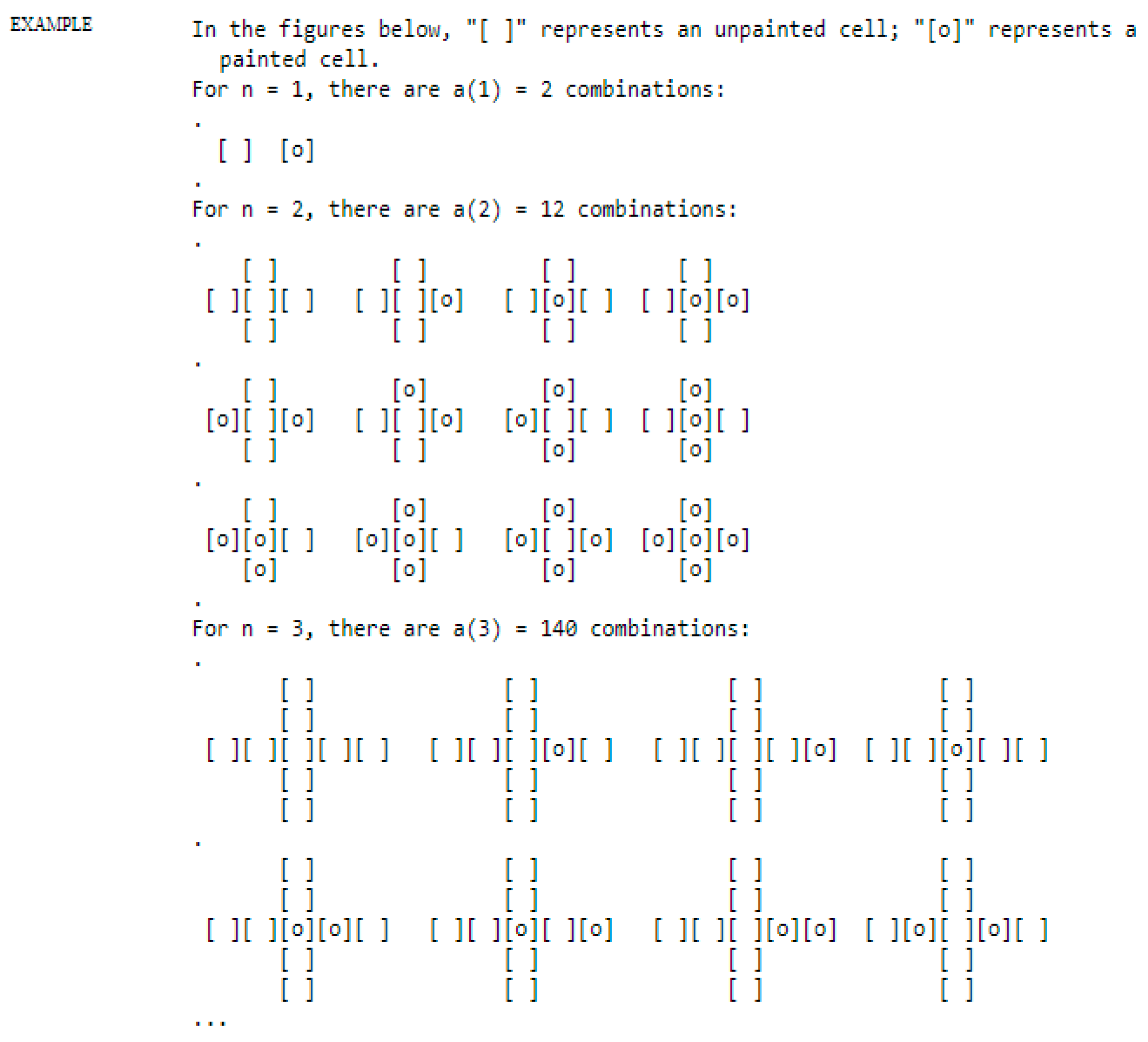
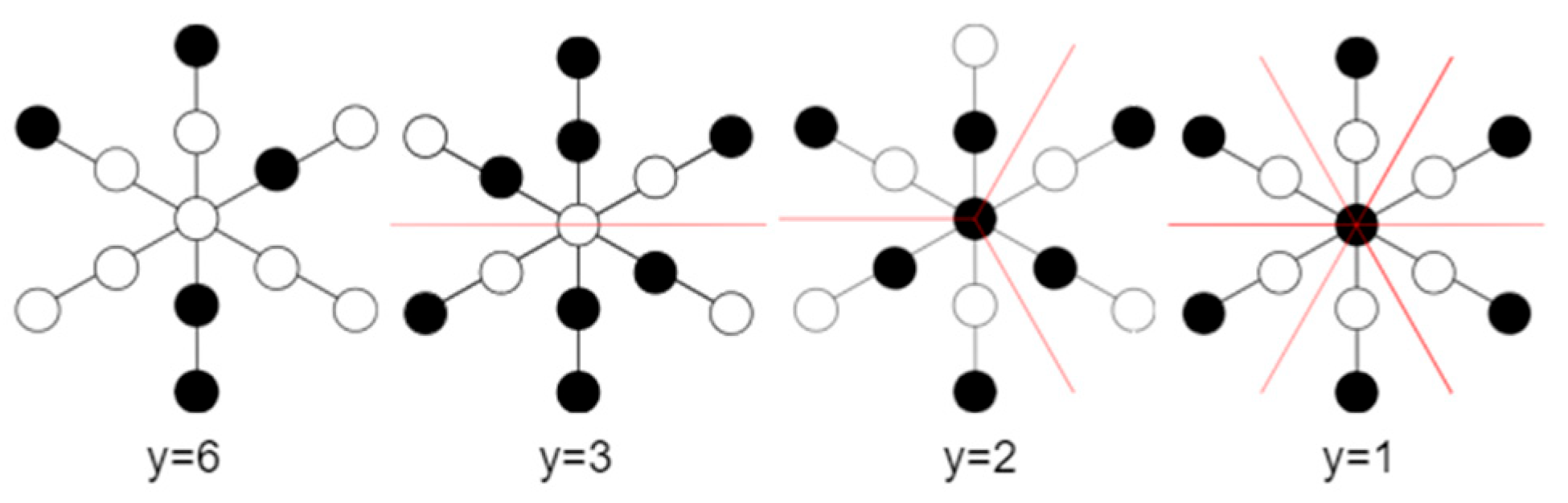
In Table 4, the PS factor of the CTS category was found as “Calculating the results step by step for each expanded variable of the initial problem and modeling them in the table and structuring the number tree in this way.” for the high profile (H1) team, since the quote which referred this factor was written on the project form (PF) data source as “For each extended variables, such as number of cells on the shape (4n − 3), cells to be painted (k) and the structure of the shape, combination values calculated first, then modeled on the table and finally number tree was constructed (H1PF).”. Team members could perform with PS skills, which included deciding what to do before creating a new product and determining what to do step by step when striving to achieve a goal in project production. Calculated combination values to construct a number tree by team H1 were shared as a product (see Figure 1).
In Table 4, the PD factor of the PPM category was determined as “Combinatoric based mathematical modeling.” for team H1 since the excerpt that referred to this factor was written in the introduction part of their project as “Calculating how many different situations such as placement, painting, weighting and making moves can occur under specified conditions leads to innovative applications in the fields of game theory, cryptology and mathematical modeling (H1PF).”. Team members of H1 were able to produce a project within the combinatoric sub-domain of the math discipline by connecting the related fields such as game theory and cryptology. Calculated possible different situations on marked/painted cells under specified conditions of rotating shape were drawn by the team (see Figure 1).

2.5. Validity and Reliability

For validity, expert evaluation, external verification, participant confirmation, detailed documentation of the research process, and data triangulation approaches were implemented (Creswell & Creswell, 2017). For reliability, inter-rater reliability calculated a κ value of 0.81 (p < 0.001), demonstrating a high level of agreement among coders. An intra-rater reliability was also calculated a κ value of 0.89 (p < 0.001), which shows high level of consistency in the ratings over time. Detailed descriptions, quotations from data sources, and a theoretical framework for data analysis were provided (Yin, 2017).

3. Results

3.1. Latent Profile Analysis of Computational Thinking Skills (RQ1)

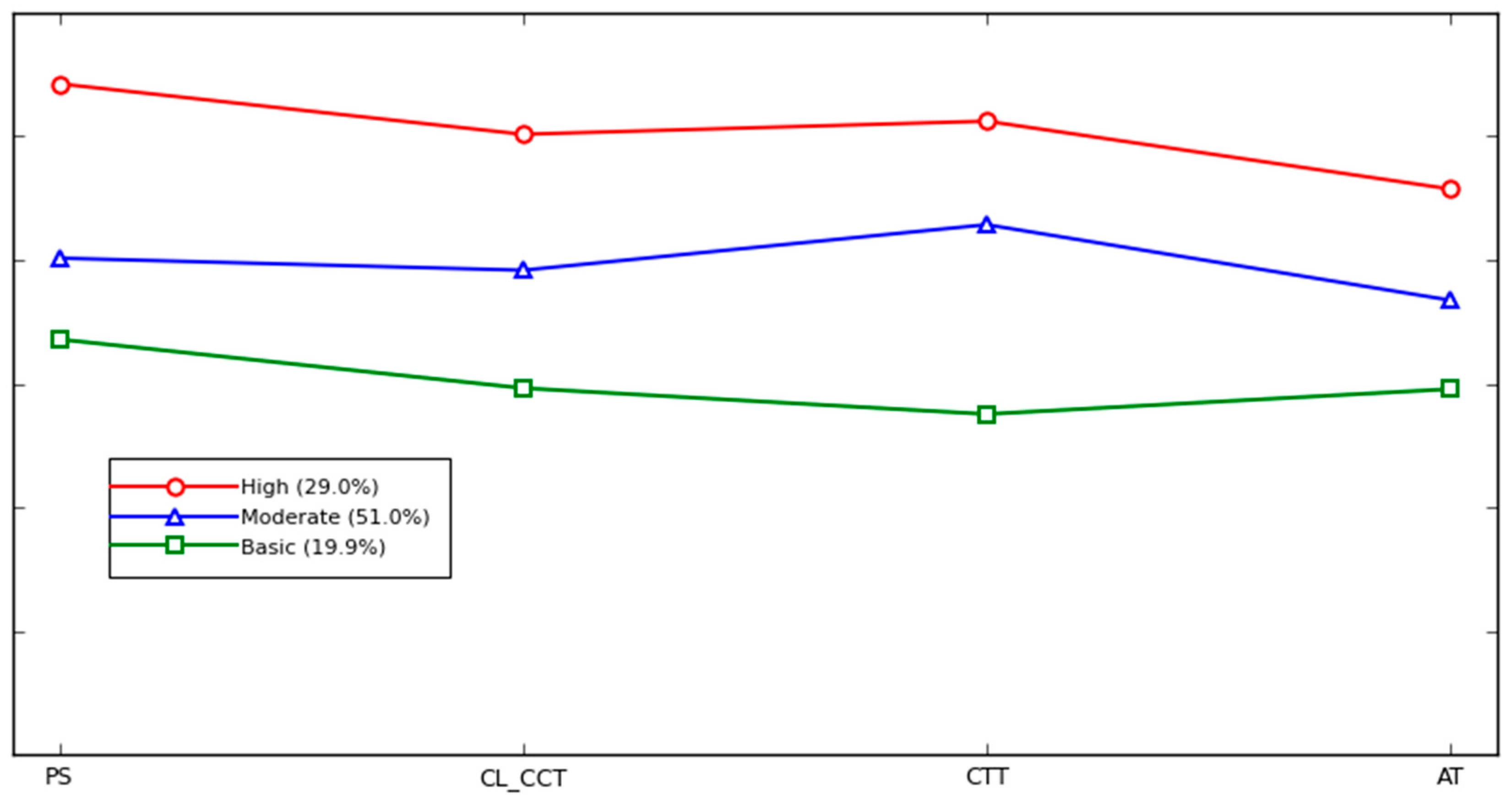
The LPA indicated a three-tier solution (see Figure 2). Tier proportions based on most-likely membership were 29% (Profile 1), 51% (Profile 2), and 20% (Profile 3). Classification was excellent (entropy = 0.97); average posterior probabilities for the assigned profiles were 0.999, 0.979, and 0.996 for Profiles 1–3, respectively. The parametric bootstrap LRT favored the three-tier model over other models. Profile 1 scored highest across PS, CL&CCT, CTT, and AT; profile 2 showed moderate levels; and profile 3 showed comparatively basic levels (see Table 5).
Building on the profiles derived from LPA, qualitative analyses examined how gifted students across these latent profiles engaged in creative project production.

3.2. Project Production Performances of CTS Profiles (RQ2)

In the second phase, creative project production performances of the high, medium, and basic profiles were analyzed (see Table 6 and Table 7). The overall comparative results across latent profiles were presented first, followed by the detailed experiences performed. Detailed results were presented for six teams, two from each latent profile, to provide a focused and in-depth exploration of the results. The detailed results for these sample teams were supported with figures drawn from the projects produced.

3.2.1. Overall Comparative Results Across CTS Profiles

The analysis of the high-, medium-, and basic-profile teams focused on how their performance across various factors associated with overall project productivity. It was observed that teams or individuals of high-profile CTS could enhance and support their projects by coding the algorithm that generates the terms of the number sequence they reached or by developing and coding the encryption, decryption, and key generation algorithm. An example supporting this finding is the PF’s results section: “The designed program successfully gives the output of the number sequence that can be formed for pre-determined values according to the input values entered by the user and the general term of that sequence.” This is illustrated by a visual representation related to the code. This evidence might underscore the critical role of CTS in translating theoretical concepts into practical project outcomes.
Contrary to this, teams or individuals with a basic-profile CTS were found to be capable of developing solutions to the fundamental problems their projects were based on and working cooperatively; yet, these solutions remained within the confines of pure mathematics. It was determined that the basic profile proposed ideas on the stages and contexts an algorithm could create. However, they needed help translating these ideas into practical applications. An example supporting this finding could be drawn from the suggestions section of the PF, “Creating an algorithm that can handle variable input paths and determine the amount of water these paths can hold, considering their shape and contours,” which indicates the development suggestions proposed by the team or individuals. This implies their recognition of potential areas for improvement in applying their CTS to real-world problems.
It has been found that the moderate profile engaged in planning to create codes/algorithms but could complete the coding process only with the support of their peers or computer science experts. This finding is supported by data exemplified in the methods section of the PF, “Self-reflection to discover simpler coding methods for identifying all favorable placements,” which could indicate that the team or individuals completed their projects and then wrote and added the code with peer support. This suggests a collaborative approach to problem-solving, where MP participants leverage external assistance to bridge gaps in their CTS, underscoring the importance of collaborative learning environments in enhancing computational thinking.
The BP was able to progress on their projects partially, resulting in both the originality of the project products and their dissemination needing to be expanded in scope. For instance, team B1 managed to draft a general term but noted that further calculations were needed for its finalization. Alternatively, some teams synthesized existing solutions in a new way. Consequently, the product’s dissemination was limited to a narrow scale, encompassing only the school or provincial levels. A similar observation can be made for the high- and moderate-profile teams, albeit with distinctions in the scale of dissemination. In other words, projects from the HP were disseminated nationally and internationally, whereas those from the MP were nationally or regionally.
It was revealed that HP teams performed more effectively by transforming their AT, CCT, and CTT skills into project production, considering the MP and BP teams. Even though all teams could perform and engage in PS and CL skills, the quantitative results indicated profile differences among the latent profiles. This suggests that project product and dissemination differences might originate from the remaining three skill factors. Additionally, it was determined that the project products of the HP were innovative in terms of STEM domain relevance and validation, and these products were capable of being disseminated nationwide and internationally, showcasing a broader impact.

3.2.2. Performances Across CTS Profiles

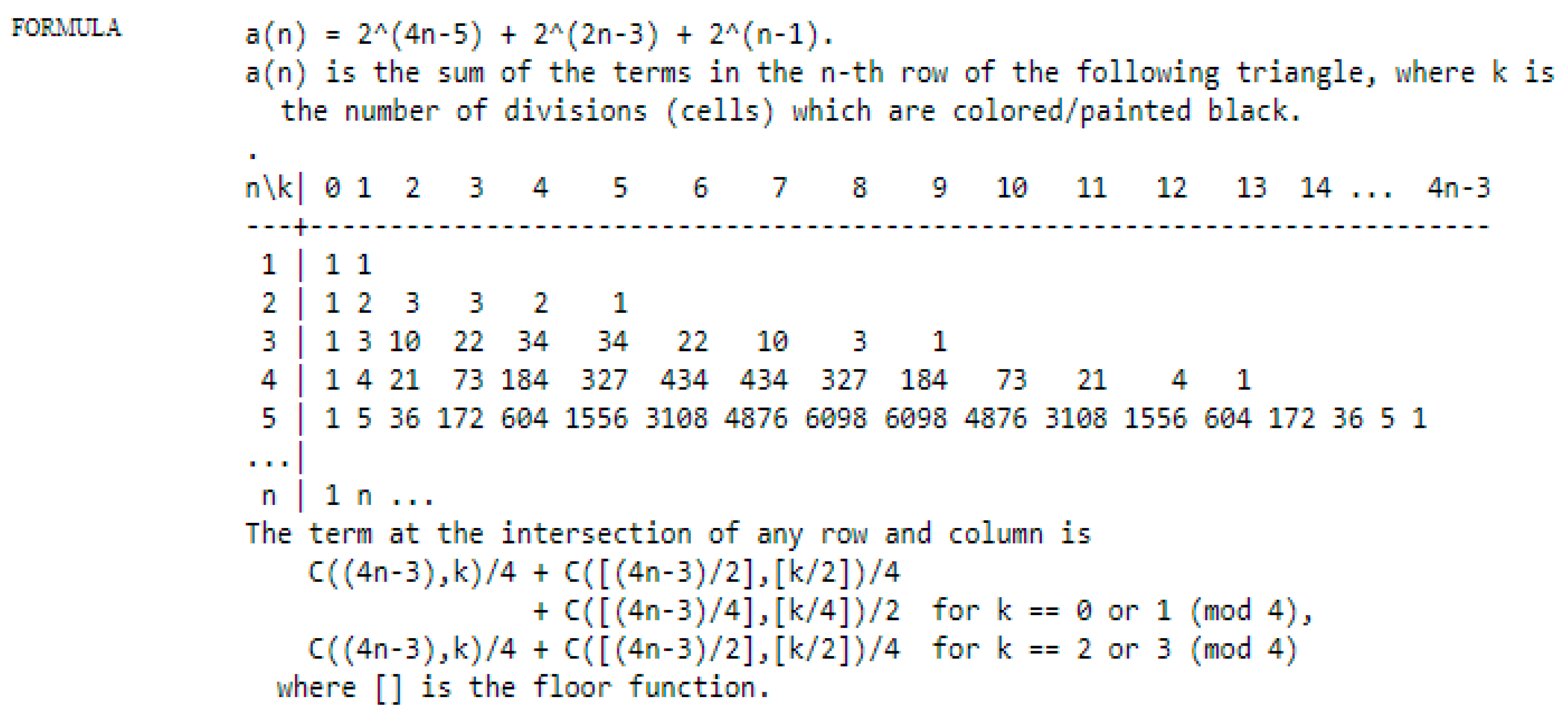
The dissemination (D) factor within the PPM category was exemplified by team H1’s performance in patenting a unique number sequence and participating in a mathematics project competition. Their PF highlighted this performance with the statement: “The original number tree and sequence, which calculates the sum of the nth row of the table, were disseminated through patenting.” (see Table 6 and Figure 3). Team H1 successfully submitted their innovative number sequence, denoted as a(n), to The On-Line Encyclopedia of Integer Sequences (OEIS), which was accepted and published. They also disseminated the project by submitting to a math project competition. The team also expanded the variables of their initial problem, such as structure, the number of cells (n), and the number of colored cells (k), to create an advanced generalized solution (see Figure 4).
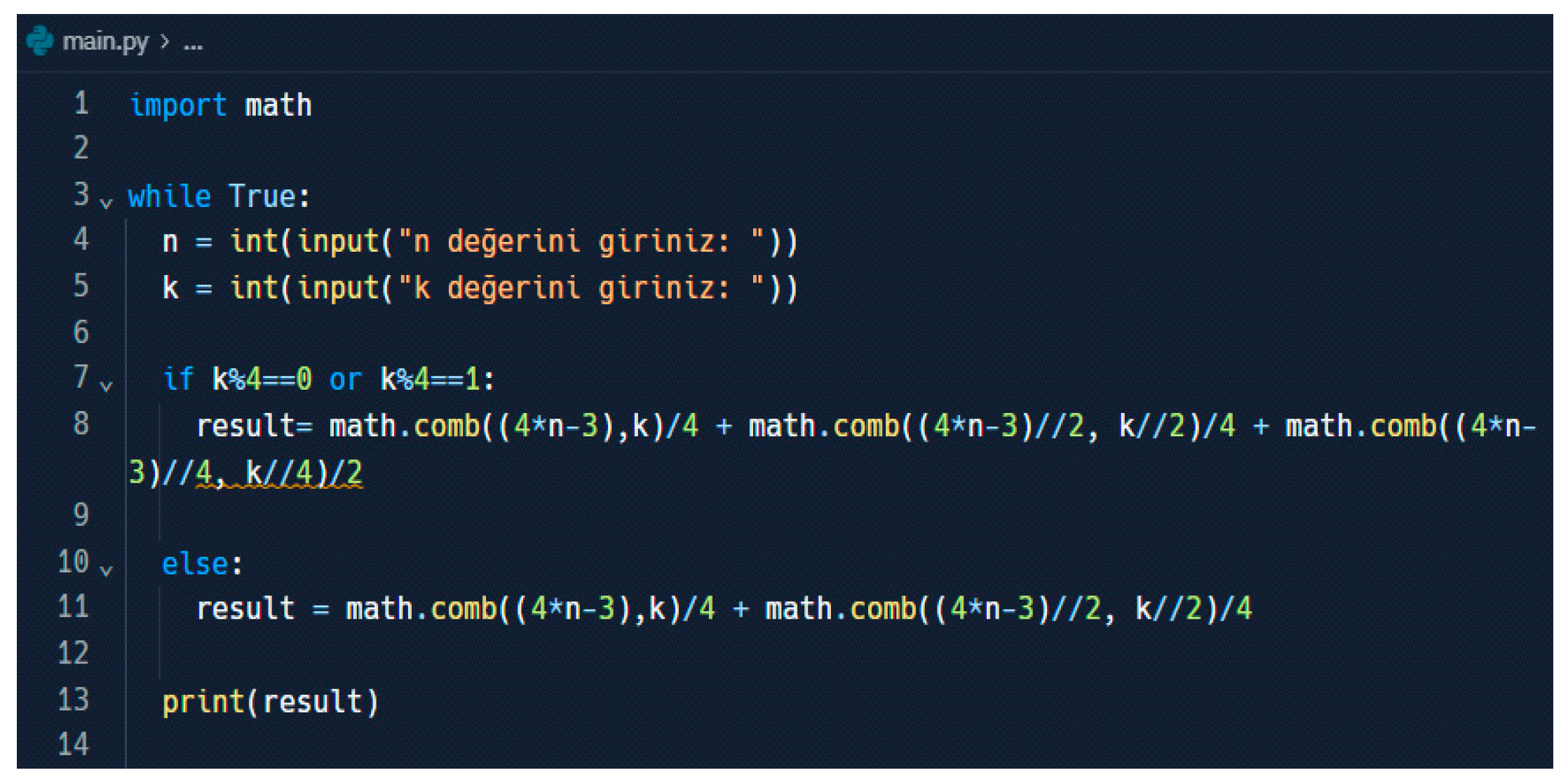
It was indicated that H1 could enhance, support, and illustrate their projects by coding the algorithm that generates the terms of the number sequence they reached (see Figure 5). The program designed by H1 gives the output of the number sequence that can be formed for pre-determined values according to the input values entered by the user and the general term of that sequence. They could transform CTS and theoretical concepts into practical project outcomes.
For H2, the PS factor within the CTS category was identified as involving a two-stage encryption and decryption process: initially using a pivotal code to ascertain the term from a digitally balanced string and subsequently constructing a stair model with the binary code of the term to implement logical conjunctions (see Table 7). The methodology behind this innovative approach was articulated in their project form (PF), stating: “The cryptology algorithm developed encrypts and decrypts in two separate stages. Initially, it uses a key, n, corresponding to the nth term of a digitally balanced string through a unique stair model that permits one or two steps at a move. This step replaces text terms with two distinct logical conjunctions, resulting in a UTF-8 code based on these conjunctions’ truth values. Applying this process to each letter encrypts the text.
The CL factor for H2 within the CTS category was identified as collaborating on developing a cryptography algorithm. This collaborative effort was exemplified by the team’s approach to algorithm development, where one member engaged in numerous initial trials to run the algorithm while others contributed by utilizing a design application with the appropriate commands. This theme of cooperative learning was encapsulated in the statements provided by the team members: “A code has been developed in the Python programming language for the encryption algorithm present in this project. This code facilitates the easy application of encryption, decryption, and selecting an appropriate key. (1st student)” and “For the chosen DDD term to enable the encryption algorithm to function correctly, it must meet two conditions. (2nd student)”.
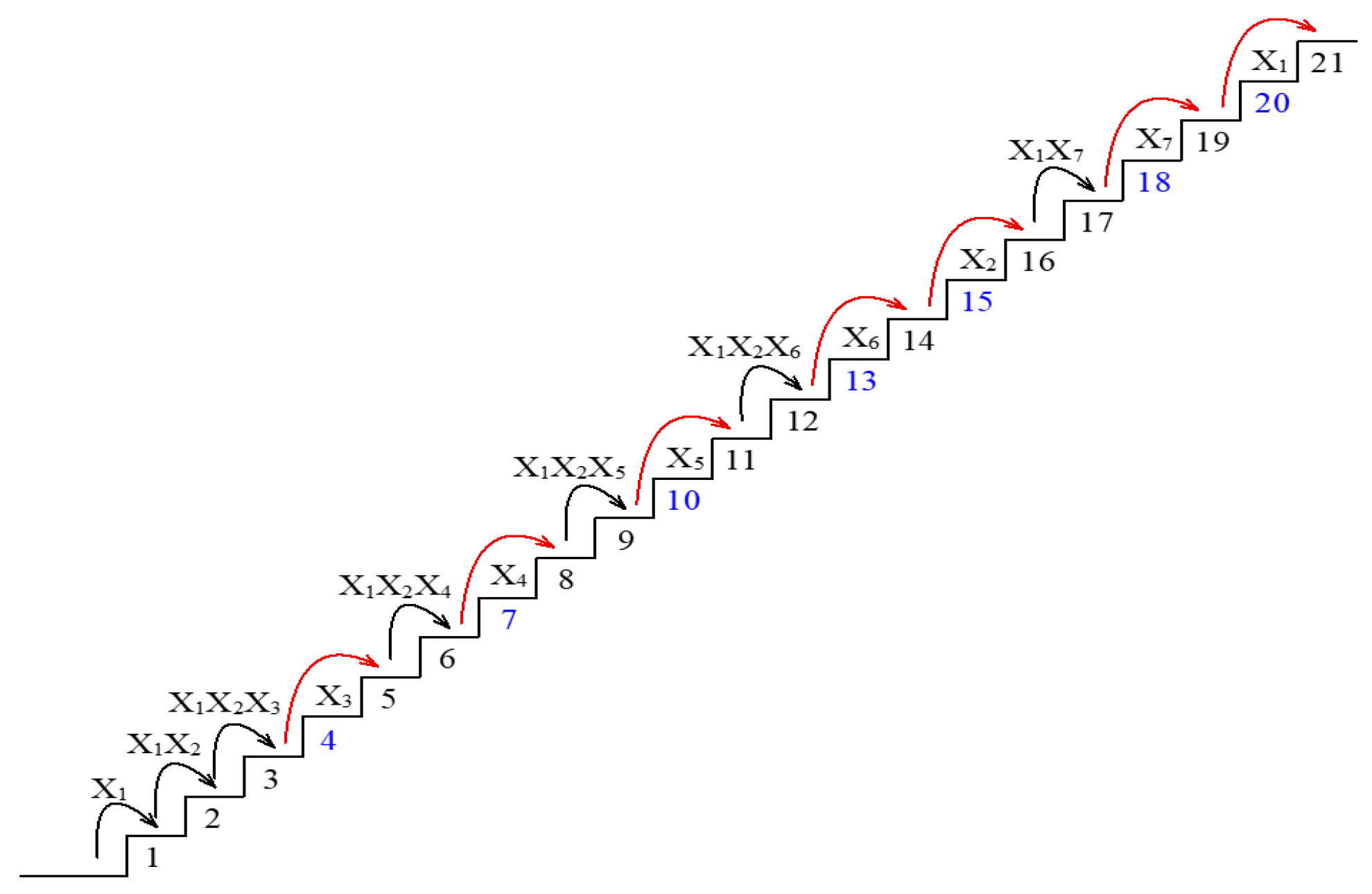
For the same H2, the CCT factor was identified as innovatively expanding the number sequence with a unique stair model. This innovative approach was elucidated in their PF, where they stated, “An encryption algorithm has been designed using a stair model created by the relationship established between the terms of a digitally balanced sequence and the combinatorial problem of ascending a staircase by taking either one or two steps at a time.” Team H2 employed a unique stair model for their encryption and decryption processes, which involved determining the message’s scrambling pattern using an n-key code. An illustrative example of this methodology is the 21-step model they constructed for the decryption phase (see Figure 6).
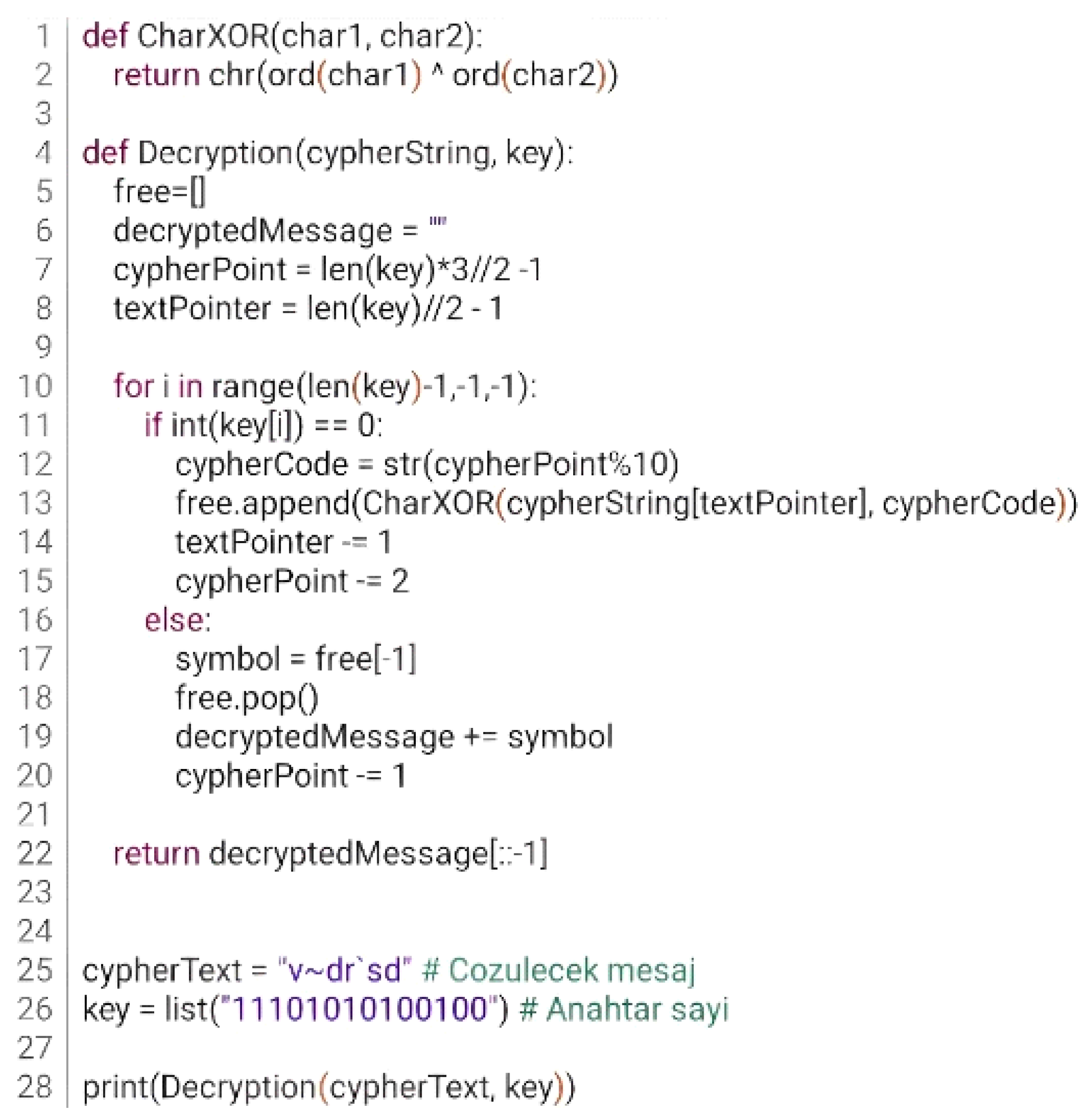
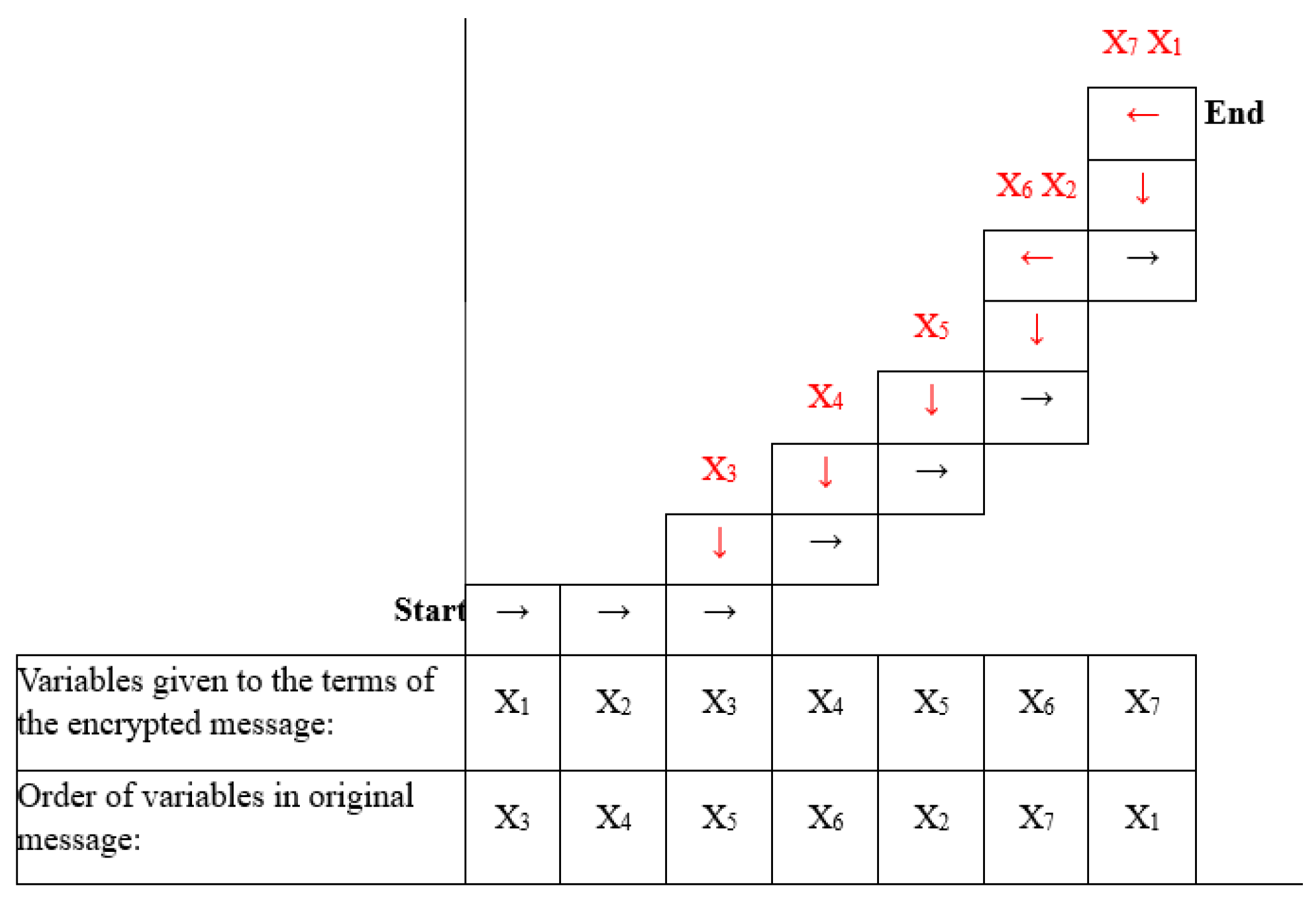
The CTT factor was identified as designing an original cryptology algorithm by applying digitally balanced strings, UTF-8 codes, logical conjunctions, and a stair model. This innovative approach was detailed in the PF: “Distinct from previous efforts, the terms of DDD, the UTF-8 coding system, a stair model, and the logical ‘and’ conjunction were employed. This approach signifies the creation of a unique encryption algorithm.” Team H2 demonstrated how variables were methodically arranged in the decryption process, showcasing the effective operation of their cryptology algorithm (see Figure 7).
The AT factor was identified for the CTS category as streamlining the encryption, decryption, and critical selection process through code design. The PF elaborated on this: “To facilitate a faster and more user-friendly experience, two separate codes have been developed in the Python programming language, one for encrypting messages and another for decrypting.” Team H2 crafted these codes to simplify the encryption and decryption processes, making them easily applicable (see Figure 8).
A further theme emerged within the same factor: implementing the developed algorithm for enhancing digital communication and data security. The associated commentary detailed: “The encryption algorithm resulting from this project can be utilized in cyber security applications within digital communication, financial systems, and the healthcare sector, offering a broad spectrum of practical implementations.”
For the PPM category, the PD factor was identified as “Cybersecurity and cryptology.” This classification was based on statements made by the students in the PF, which noted: “As technological risks escalate globally, encryption and information security gain importance. This project focuses on using mathematical methods, like integer sequences and logical conjunctions, to create a new encryption algorithm.
Within the PPM category, the PP factor was determined to be “Original cryptology, encryption, and decryption algorithm.” This determination was supported by a statement in the final project report’s results section, which declared: “As a result of this project, an original encryption algorithm has been presented, utilizing a two-stage algorithm with the A031443 number sequence (DBS) and the UTF-8 coding system.” This statement underscores the achievement of producing a novel product through a unique encryption and decryption methodology.
In the PPM category, the dissemination factor was identified as “Submitting to a project competition.” The statement indicated this, “The project was submitted to a project competition in the field of Mathematics-Cyber Security.” Team H2 entered their innovative cryptology algorithm into national project competition, explicitly targeting the mathematics–cyber security category.

4. Discussion

The integration of LPA with qualitative findings provided insight into how distinct CTS profiles are associated with creative project performances. The triangulation of quantitative and qualitative findings offers a more comprehensive understanding of the phenomenon studied and allows them to complement each other. The quantitative results provided latent profiles of CTS (high, medium, and basic), while qualitative themes illuminated how gifted youth engaged with CTS to produce and disseminate creative project outcomes. These convergences across a mixed-methods approach illustrate how profiles’ varied pathways are mirrored in both their project production trajectories and CTS patterns. This approach and aspect contribute to broader insights into how gifted high school students engage with STEM domains, creative productivity, and computational thinking.
The results indicated that creating and disseminating original project outcomes were associated with applying algorithmic, critical, and creative thinking skills through project productivity. The transformation of these computational thinking skills and mathematical knowledge into creative outcomes influenced the originality and scope of dissemination. Problem-solving and cooperative learning skills are scaffolded to maintain and complete the project production process. It might be considered one of the broader aspects of learning that computational thinking skills are one of the components of fostering creative project productivity. Consistently with prior evidence at the intersection of CTS and creative project production, showing that CTS predicts and enhances STEM performance, problem-solving, system design, and reasoning (Bounou et al., 2023; Kang, 2024; Lee et al., 2023; Zhu et al., 2023; Weintrop et al., 2016), the present study found that CTS is associated with creative project productivity. Students in the high CTS profile tended to implement novel ideas and exhibit stronger creative tendencies (Li et al., 2024; Tang et al., 2020).
Utilizing both theoretical knowledge (knowledge-of) and practical application (knowledge-how) to address real-world problems, mimicking the approach taken by professionals in the field, can enhance collaboration, critical thinking, creativity, and mathematical modeling, while preparing students to publish their work and create other innovative outputs (Renzulli, 2021). Programs should guide students through the STEM-based project design process to craft innovative solutions for life challenges, including the creation of a working prototype and obtaining a patent (McIntosh, 2024; Ministry of National Education [MoNE], 2023; VanTassel-Baska, 2024). This study bridges theoretical mathematics knowledge, CTS, and practical creative production in STEM to address real-world problems.
This research indicated that although gifted teams demonstrated similar proficiency in problem-solving and cooperative learning, the originality and dissemination breadth of their projects were associated with how they applied algorithmic, critical, and creative thinking. While quantitative results indicated profile differences in CTS levels, qualitative findings did not complement those for problem-solving and cooperative learning. Such complementarity between the two strands of data may reflect the contextual framework and applied performance of CTS, which involves the transformation of measured skills in project production. This conflict may suggest how team collaboration and interactions experienced could level out the differences detected among the latent profiles. Engaging in such creative projects provides authentic field experiences, promotes lifelong learning, and helps students translate talents into creative outputs that shape career decisions. This emphasis on applying talents to achieve broader societal benefits, such as solving global issues and enhancing human well-being, supports a sustainable model of success by encouraging creative productivity aligns with individual passions and addresses societal needs (Sternberg, 2024).
Building on these findings, this study extends evidence that inquiry-based approaches enhance both creative productivity and CTS (Kim et al., 2023; Miftah et al., 2024). The results align with the perspective that project production activities integrating real-world artifacts into STEM education and CTS contribute to creative output (Falcó-Solsona et al., 2024; Fayanto et al., 2024), while strengthening mathematical modeling competencies (Khalid et al., 2024) and higher-order thinking that supports creative productivity (Halpern, 2013; Li et al., 2024; Tang et al., 2020). CTS enhances project production in STEM among gifted students by coupling scientific process skills, representation, algorithmic reasoning, automation, and generalization (Ceylan, 2024; Grover & Pea, 2018; Israel-Fishelson & Hershkovitz, 2021; Leonard et al., 2018; Rodríguez-Fernández & Sternberg, 2023; Sen et al., 2021). As a cognitive framework, engaging in CTS nurtures innovation in STEM and connects theoretical knowledge with practical implementation to solve complex and analytical problems (Miftah et al., 2024; Samnia Hammod & Paz-Baruch, 2024; Sung et al., 2017).

4.1. Implications

The ability of gifted youth to produce creative project outputs in areas such as game theory, cybersecurity encryption, combinatorial mathematical models for real-world issues, and generalized solutions for global concerns in the STEM domains illustrates the vast potential of gifted youth to contribute significantly to various fields and highlights the importance of nurturing computational thinking skills. The ability of these individuals to translate their computational thinking skills into tangible products and patents such as new number sequences and trees underscores the importance of providing opportunities for gifted students to explore and expand their talents. This situation necessitates a shift toward programs on computational thinking skills practices inspiring creative project production.

4.2. Limitations

This study has several limitations related to its duration and the number of participants. The study also needs to improve its dissemination process. An extended follow-up period could offer valuable information on the long-term impacts, such as tracking the approval status of applications for the product produced.

5. Conclusions

In conclusion, this research makes a significant contribution to understanding how latent profiles of CTS are associated with creative project production. Using a mixed-methods design that incorporated latent profile analysis, three CTS profiles were identified, which differed in terms of algorithmic thinking, critical and creative thinking, problem-solving, and cooperative learning. This research bridges the application of CTS to STEM project production for creative productivity. The evidence suggests that proficiency in CTS is important for engaging in the multifaceted process of project production, encompassing everything from coding to the broader scope of conceptualizing and executing innovative ideas.
It was concluded that higher CTS profiles in algorithmic, critical, and creative thinking are associated with innovative project outcomes and broad dissemination, while problem-solving and cooperative learning skills are crucial for completing projects across all three profiles (high, moderate, and basic). The latent profile differences in problem-solving and cooperative learning factors did not complement the qualitative findings. This may reflect the contextual framework and applied performance of CTS, which involves transforming measured skills into project production. This conflict may suggest how team collaboration and interactions experienced could level out the differences detected among the latent profiles.
By transforming CTS into a creative project productivity, individuals can achieve milestones such as crafting algorithmic and logical designs, obtaining patents for innovative solutions, developing mathematical models for generalized applications, or creating prototypes and simulations to address global challenges. Overall, the findings delineate how distinct CTS latent profiles are associated with phases and qualities of creative project production.

Funding

The author received no financial support for the authorship and/or publication of this article.

Institutional Review Board Statement

The ethics approval and permission were obtained from the Akdeniz University Rectorate Social and Human Sciences Scientific Research and Publication Ethics Committee and MoNE, No: 116, 37380. According to institutional requirements and regulations, there is no ethical or informed consent concern if the implementation is conducted with students directly instructed by their educators.

Informed Consent Statement

Informed consent was obtained from all subjects involved in the study.

Data Availability Statement

The data are unavailable due to privacy or ethical restrictions.

Acknowledgments

During the preparation of this manuscript/study, the author used ChatGPT-5 to assist with formatting and to improve clarity through manuscript review. The author has reviewed and edited all AI-generated content and takes full responsibility for the content of this publication. Special thanks are given to The Scientific and Technological Research Council of Türkiye (TUBİTAK) and the Republic of Türkiye Ministry of National Education, General Directorate of Special Education, for their support.

Conflicts of Interest

The author declares no potential conflicts of interest with respect to the research, authorship, and/or publication of this article.

Abbreviations

The following abbreviations are used in this manuscript:
LPALatent Profile Analysis
STEMScience, Technology, Engineering, and Mathematics
CTSComputational Thinking Skills
PSProblem-Solving
CLCooperative Learning
CCTCritical Thinking
CTTCreative Thinking
ATAlgorithmic Thinking
SACsScience and Art Centers
PPMPProject Production and Management Program
CTSSComputational Thinking Skills Scale
MoNEMinistry of National Education

References

  1. Adorni, G., Artico, I., Piatti, A., Lutz, E., Gambardella, L. M., Negrini, L., Mondada, F., & Assaf, D. (2024). Development of algorithmic thinking skills in K–12 education: A comparative study of unplugged and digital assessment instruments. Computers in Human Behavior Reports, 15, 100466. [Google Scholar] [CrossRef]
  2. Arseven, A. (2015). Mathematical modelling approach in mathematics education. Universal Journal of Educational Research, 3(12), 973–980. [Google Scholar] [CrossRef]
  3. Artigue, M., & Blomhøj, M. (2013). Conceptualizing inquiry-based education in mathematics. ZDM Mathematics Education, 45(6), 797–810. [Google Scholar] [CrossRef]
  4. Ayres, L. (2008). Thematic coding and analysis. In L. M. Given (Ed.), The sage encyclopedia of qualitative research methods (pp. 867–868). SAGE. [Google Scholar]
  5. Baneham, J., Young, P., & Ledwith, C. (2024). Analysis and reconfiguration of the EM106-project and technical drawing for the purpose of second-level gifted education. Engineering Proceedings, 65(1), 9. [Google Scholar] [CrossRef]
  6. Barr, V., & Stephenson, C. (2011). Bringing computational thinking to K–12: What is involved and what is the role of the computer science education community? ACM Inroads, 2(1), 48–54. [Google Scholar] [CrossRef]
  7. Bedewy, D., & Gabriel, A. (2015). Examining perceptions of academic stress and its sources among university students. Health Psychology Open, 2(2), 1–9. [Google Scholar] [CrossRef] [PubMed]
  8. Bounou, A., Lavidas, K., Komis, V., Papadakis, S., & Manoli, P. (2023). Correlation between high School students’ computational thinking and their performance in STEM and language courses. Education Sciences, 13(11), 1101. [Google Scholar] [CrossRef]
  9. Brennan, K., & Resnick, M. (2012, April 13–17). New frameworks for studying and assessing the development of computational thinking. 2012 Annual Meeting of the American Educational Research Association (Vol. 1, p. 25), Vancouver, BC, Canada. [Google Scholar]
  10. Ceylan, Ö. (2024). Changes in scientific process skills and reflective thinking skills towards problem-solving of gifted students: A summer school practice. Reflective Practice, 25, 286–303. [Google Scholar] [CrossRef]
  11. Cho, S. (2007). Nurturing creative Problem-Solving ability of the gifted in Confucian society. The Journal of Gifted/Talented Education, 17(2), 392–411. [Google Scholar]
  12. Cooper, S., Dann, W., & Pausch, R. (2000, November 9–12). Developing algorithmic thinking with Alice. ISECON (Vol. 17, pp. 506–539), Philadelphia, PA, USA. [Google Scholar]
  13. Craft, A. (2003). Creative thinking in the early years of education. Early Years, 23(2), 143–154. [Google Scholar] [CrossRef]
  14. Creswell, J. W., & Clark, V. L. P. (2017). Designing and conducting mixed methods research. Sage. [Google Scholar]
  15. Creswell, J. W., & Creswell, J. D. (2017). Research design: Qualitative, quantitative, and mixed methods approaches. Sage Publications. [Google Scholar]
  16. Dağyar, M., Kasalak, G., & Özbek, G. (2022). Gifted and talented youth leadership, perfectionism, and lifelong learning. International Journal of Curriculum and Instruction, 14(1), 566–596. [Google Scholar]
  17. Denning, P. (2009). The profession of IT beyond computational thinking. Communications of the ACM, 52(6), 28. [Google Scholar] [CrossRef]
  18. Desamparado, C. T., Mendoza, M. P., Minguito, M. M., & Moneva, J. C. (2019). Learning styles and academic performance of students in English subjects. International Journal of Scientific and Research Publications, 9(1), 274–282. [Google Scholar] [CrossRef]
  19. Doleck, T., Bazelais, P., Lemay, D. J., Saxena, A., & Basnet, R. B. (2017). Algorithmic thinking, cooperativity, creativity, critical thinking, and problem-solving: Exploring the relationship between computational thinking skills and academic performance. Journal of Computers in Education, 4, 355–369. [Google Scholar] [CrossRef]
  20. Falcó-Solsona, P. J., Ledezma, C., Sala-Sebastià, G., & Font, V. (2024). Inquiry and mathematical modelling with real-archaeological objects in secondary education. Education Sciences, 14(3), 304. [Google Scholar] [CrossRef]
  21. Fayanto, S., Degeng, I. N. S., Patmantharab, S., & Ulfa, S. (2024). Design instructional collaborative problem solving based on computational thinking skills for students’ scientific creativity skills: A framework for effective teaching. International Journal of Curriculum and Instruction, 16(2), 308–332. [Google Scholar]
  22. Fereday, J., & Muir-Cochrane, E. (2006). Demonstrating rigor using thematic analysis: A hybrid approach of inductive and deductive coding and theme development. The International Journal of Qualitative Methods, 5(1), 80–92. [Google Scholar] [CrossRef]
  23. Fischer, C., & Müller, K. (2014). Gifted education and talent support in Germany. Center for Educational Policy Studies Journal, 4, 31–54. [Google Scholar] [CrossRef]
  24. Grover, S., & Pea, R. (2018). Computational thinking: A competency whose time has come. In S. Sentance, E. Barendsen, & C. Schulte (Eds.), Computer science education: Perspectives on teaching and learning in school (pp. 20–38). Bloomsbury Publishing. [Google Scholar]
  25. Guilford, J. P. (1959). Traits of creativity. In H. H. Anderson (Ed.), Creativity and its cultivation (pp. 142–161). Harper & Brothers Publishers. [Google Scholar]
  26. Halpern, D. F. (2013). Thought and knowledge: An introduction to critical thinking. Psychology Press. [Google Scholar]
  27. Hayes, A. F., & Coutts, J. J. (2020). Use omega rather than Cronbach’s alpha for estimating reliability. But…. Communication Methods and Measures, 14(1), 1–24. [Google Scholar] [CrossRef]
  28. Israel-Fishelson, R., & Hershkovitz, A. (2021). Studying interrelations of computational thinking and creativity: A scoping review (2011–2020). Computers & Education, 168, 104353. [Google Scholar] [CrossRef]
  29. Kang, J. (2024). Computational thinking and its role in problem-solving, system design, and understanding human behavior. International Journal of Technology and Design Education, 34(6), 987–1002. [Google Scholar] [CrossRef]
  30. Khalid, M. N., Santosa, Y. T., Toh, T. L., Wijaya, W. J., Sujadi, I., & Hendriana, H. (2024). Defragmenting students’ reflective thinking levels for mathematical problem solving: Does it work? Reflective Practice, 25(3), 319–351. [Google Scholar] [CrossRef]
  31. Kim, J., Im, H., Ahn, D., & Cho, S. (2023). How does an inquiry-based instructional approach predict the STEM creative productivity of specialized science high school students? Education Sciences, 13(8), 773. [Google Scholar] [CrossRef]
  32. Kirwan, C., Costello, E., & Donlon, E. (2022). ADAPTTER: Developing a framework for teaching computational thinking in second-level schools by design research. TechTrends, 66(3), 495–509. [Google Scholar] [CrossRef]
  33. Korkmaz, O., Çakir, R., & Özden, M. Y. (2017). Validity and reliability study of the computational thinking scales (CTS). Computers in Human Behavior, 72, 558–569. [Google Scholar] [CrossRef]
  34. Köse, U., & Tüfekçi, A. (2015). Algoritma ve akış şeması kavramlarının öğretiminde akıllı bir yazılım sistemi kullanımı [Usage of an intelligent software system in teaching algorithm and flowchart concepts]. Pegem Eğitim ve Öğretim Dergisi [Pegem Journal of Education and Instruction], 5(5), 569–586. [Google Scholar] [CrossRef]
  35. Lee, S. W. Y., Tu, H. Y., Chen, G. L., & Lin, H. M. (2023). Exploring the multifaceted roles of mathematics learning in predicting students’ computational thinking competency. International Journal of STEM Education, 10(1), 64. [Google Scholar] [CrossRef]
  36. Leonard, J., Mitchell, M., Barnes-Johnson, J., Unertl, A., Outka-Hill, J., Robinson, R., & Hester-Croff, C. (2018). Preparing teachers to engage rural students in computational thinking through robotics, game design, and culturally responsive teaching. Journal of Teacher Education, 69(4), 386–407. [Google Scholar] [CrossRef]
  37. Li, J. W., Leung, S. K., Wang, M. D., & Yuen, M. (2024). Developing talented children’s computational thinking through multimodal literacies in pop-up storybooks: A case study in Hong Kong. Education Sciences, 14(12), 1377. [Google Scholar] [CrossRef]
  38. Lubinski, D., Benbow, C. P., McCabe, K. O., & Bernstein, B. O. (2023). Composing meaningful lives: Exceptional women and men at age 50. Gifted Child Quarterly, 67(4), 278–305. [Google Scholar] [CrossRef]
  39. Manuel, D., & Freiman, V. (2017). Differentiating instruction using a virtual environment: A study of mathematical problem posing among gifted and talented learners. Global Education Review, 4(1), 78–98. [Google Scholar]
  40. Masyn, K. E. (2013). Latent class analysis and finite mixture modeling. In T. D. Little (Ed.), The Oxford handbook of quantitative methods (Vol. 2: Statistical analysis, pp. 551–611). Oxford University Press. [Google Scholar]
  41. McIntosh, J. S. (2024). Feats and flops: A creative engineering unit for advanced and gifted students (2nd ed.). Routledge. [Google Scholar]
  42. Miftah, R., Dahlan, J. A., Kurniawati, L., Herman, T., & Cahyo, A. N. (2024). Improving gifted students’ mathematical computational thinking abilities through the inquiry training model. Journal of Engineering Science and Technology, 19(4), 77–85. [Google Scholar]
  43. Ministry of National Education (MoNE). (2023). Bilim ve sanat merkezleri yönergesi [Science and art centers directive]. Available online: https://dhgm.meb.gov.tr/meb_iys_dosyalar/2024_01/10220042_2794ocak2024.pdf (accessed on 5 April 2025).
  44. Ministry of National Education (MoNE). (2024). Bilim ve sanat merkezleri ögrenci tanılama ve yerlestirme kilavuzu [Science and art centers identification manual]. Available online: https://orgm.meb.gov.tr/meb_iys_dosyalar/2024_10/25215053_20242025bilimvesanatmerkezleriogrencitanilamaveyerlestirmekilavuzu.pdf (accessed on 5 April 2025).
  45. Muthén, L. K., & Muthén, B. O. (2017). Mplus user’s guide (8th ed.). Muthén & Muthén. [Google Scholar]
  46. Nacaroğlu, O., & Arslan, M. (2019). Evaluation of students’ opinions on the project studies in science and art centers. Journal of Theory & Practice in Education, 15(3), 220–236. [Google Scholar] [CrossRef]
  47. Newell, A., & Simon, H. A. (1972). Human problem solving (Vol. 104, No. 9). Prentice-Hall. [Google Scholar]
  48. Nylund-Gibson, K., & Choi, A. Y. (2018). Ten frequently asked questions about latent class analysis. Translational Issues in Psychological Science, 4(4), 440–461. [Google Scholar] [CrossRef]
  49. OEIS Foundation Inc. (2023). The on-line encyclopedia of integer sequences. Available online: https://oeis.org/ (accessed on 5 January 2024).
  50. Özbek, G., & Dağyar, M. (2022). Examining gifted students’ evaluations of their education programs in terms of their project production and management. Frontiers in Psychology, 13, 833395. [Google Scholar] [CrossRef]
  51. Özbek, G., & Dağyar, M. (2024). A longitudinal investigation of gifted students’ creative project production and management for real-life problem solving. Asia Pacific Education Review (APER), 26, 411–427. [Google Scholar] [CrossRef]
  52. Özbek, G., Karaaslan, G., & Karabulut, E. (2025). Evaluation of creative project production performance in mathematical logic and computational thinking skills among gifted high school students. Acta Psychologica, 260, 105328. [Google Scholar] [CrossRef] [PubMed]
  53. Özbek, G., Köse, E., & Cho, S. (2023). Gifted youths’ mathematical modelling-based project production: Structure, triggers, and contributing factors. Thinking Skills and Creativity, 50, 101396. [Google Scholar] [CrossRef]
  54. Özmutlu, M., Atay, D., & Erdoğan, B. (2021). Collaboration and engagement based coding training to enhance children’s computational thinking self-efficacy. Thinking Skills and Creativity, 40, 100833. [Google Scholar] [CrossRef]
  55. Patton, M. Q. (2022). Impact-driven qualitative research and evaluation. In U. Flick (Ed.), The SAGE handbook of qualitative research design (pp. 1165–1180). Sage Publications. [Google Scholar]
  56. Poulakis, E., & Politis, P. (2021). Computational thinking assessment: Literature review. In T. Tsiatsos, S. Demetriadis, A. Mikropoulos, & V. Dagdilelis (Eds.), Research on e-learning and ICT in education: Technological, pedagogical and instructional perspectives (pp. 111–128). Springer. [Google Scholar] [CrossRef]
  57. Preckel, F., Vock, M., & Olszewski-Kubilius, P. (2024). Giftedness and talent: What educators and psychologists need to know. Hogrefe Publishing GmbH. [Google Scholar]
  58. Redding, C., & Grissom, J. A. (2021). Do Students in Gifted Programs Perform Better? Linking Gifted Program Participation to Achievement and Nonachievement Outcomes. Educational Evaluation and Policy Analysis, 43(3), 520–544. [Google Scholar] [CrossRef]
  59. Renzulli, J. (2021). The major goals of gifted education and talent development programs. Academia Letters, 2585. [Google Scholar] [CrossRef]
  60. Rodríguez-Fernández, M. I., & Sternberg, R. J. (2023). The search for meaning in the life of the gifted. Gifted Education International, 40, 119–140. [Google Scholar] [CrossRef]
  61. Samnia Hammod, H., & Paz-Baruch, N. (2024). Self-regulated learning while solving mathematical problems among mathematically gifted and talented students’. High Ability Studies, 35(2), 201–229. [Google Scholar] [CrossRef]
  62. Selby, C. C., & Woollard, J. (2013). Computational thinking: The developing definition (technical report). University of Southampton. Available online: https://eprints.soton.ac.uk/id/eprint/356481 (accessed on 10 September 2025).
  63. Sen, C., Ay, Z. S., & Kiray, S. A. (2021). Computational thinking skills of gifted and talented students in integrated STEM activities based on the engineering design process: The case of robotics and 3D robot modeling. Thinking Skills and Creativity, 42, 100931. [Google Scholar] [CrossRef]
  64. Snalune, P. (2015). The benefits of computational thinking. ITNOW, 57(4), 58–59. [Google Scholar] [CrossRef]
  65. Spiridon, K., & Karagiannopoulou, E. (2015). The relationship between learning approaches and academic achievement in psychology students. Psychology and Behavioral Sciences, 4(1), 28–34. [Google Scholar] [CrossRef][Green Version]
  66. Sternberg, R. J. (1981). A Componential theory of intellectual giftedness. Gifted Child Quarterly, 25(2), 86–93. [Google Scholar] [CrossRef]
  67. Sternberg, R. J. (1998). Abilities are forms of developing expertise. Educational Researcher, 27(3), 11–20. [Google Scholar] [CrossRef]
  68. Sternberg, R. J. (2024). Wrong suffix: Gifted education for a career choice should focus on “Gifting” rather than on being “Gifted”. Gifted Education International, 40, 261–272. [Google Scholar] [CrossRef]
  69. Sung, W., Ahn, J., & Black, J. B. (2017). Introducing computational thinking to young learners: Practicing computational perspectives through embodiment in mathematics education. Technology, Knowledge and Learning, 22(3), 443–463. [Google Scholar] [CrossRef]
  70. Tang, X., Yin, Y., Lin, Q., Hadad, R., & Zhai, X. (2020). Assessing computational thinking: A systematic review of empirical studies. Computers & Education, 148, 103798. [Google Scholar] [CrossRef]
  71. VanTassel-Baska, J. (2024). Whither thou goest, gifted education? Gifted Child Today, 47(2), 151–155. [Google Scholar] [CrossRef]
  72. Veenman, S., Benthum, N., Bootsma, D., Dieren, J., & Kemp, N. (2002). Cooperative learning and teacher education. Teaching and Teacher Education, 18, 87–103. [Google Scholar] [CrossRef]
  73. Wang, Y. H., & Liao, H. C. (2017). Learning performance enhancement using computer-assisted language learning by collaborative learning groups. Symmetry, 9(8), 141. [Google Scholar] [CrossRef]
  74. Weinberg, A. E. (2013). Computational thinking: An investigation of the existing scholarship and research [Doctoral dissertation, Colorado State University]. Available online: https://mountainscholar.org/handle/10217/78883 (accessed on 5 April 2025).
  75. Weintrop, D., Beheshti, E., Horn, M. S., Orton, K., Jona, K., Trouille, L., & Wilensky, U. (2016). Defining computational thinking for mathematics and science classrooms. Journal of Science Education and Technology, 25, 127–147. [Google Scholar] [CrossRef]
  76. Wing, J. M. (2008). Computational thinking and thinking about computing. Philosophical Transactions of the Royal Society of London A: Mathematical, Physical and Engineering Sciences, 366(1881), 3717–3725. [Google Scholar] [CrossRef]
  77. Yadav, A., Stephenson, C., & Hong, H. (2017). Computational thinking for teacher education. Communications of the ACM, 60(4), 55–62. [Google Scholar] [CrossRef]
  78. Yağcı, M. A. (2018). A study on computational-thinking and high school students’ computational-thinking skill levels. International Online Journal of Educational Sciences, 10(2), 81–96. [Google Scholar] [CrossRef]
  79. Yağcı, M. A. (2019). Valid and reliable tool for examining computational thinking skills. Education and Information Technologies, 24, 929–951. [Google Scholar] [CrossRef]
  80. Yin, R. K. (2017). Case study research: Design and methods (4th ed.). Sage. [Google Scholar]
  81. Zhu, Z., Zhang, Y., Zhu, W., & Ma, J. (2023, July 17–20). Computational thinking and academic achievement: The mediator roles of problem-solving ability and learning anxiety. 2023 International Symposium on Educational Technology (ISET) (pp. 94–98), Ho Man Tin, Hong Kong. [Google Scholar] [CrossRef]
Figure 1. The Structure and calculated rotational combination values of the shape of the high profile team. Note. Calculated possible situations on marked/painted cells with specified conditions.
Education 15 01561 g001
Figure 2. Estimated CTS factors by latent profiles (high, moderate, and basic).
Education 15 01561 g002
Figure 3. Dissemination of team H1’s project by publishing the created number sequence and tree.
Education 15 01561 g003
Figure 4. Expanding structure, number of cells (n), and colored cells (k) variables for advanced generalized solution.
Education 15 01561 g004
Figure 5. Visual representation related to the code which gives the output for a pre-determined value.
Education 15 01561 g005
Figure 6. Deciphering process; Phase two of team H2. Note. A 21-step stair model was constructed to determine the locations of original terms before scrambling.
Education 15 01561 g006
Figure 7. Deciphering process of team H2; Table of term rankings based on given X values.
Education 15 01561 g007
Figure 8. Code in the Python programming language for deciphering process.
Education 15 01561 g008
Table 1. Participants’ gender, grade level, age, and years of experience at SACs.
CharacteristicsCategoryParticipants
f%
GenderFemale5952.7
Male5347.3
Grade95851.8
103531.3
111311.6
1265.4
Age14–158676.8
16–182623.2
Years of Experience at SACs4–66658.9
7–104641.1
Total112100.0
Table 2. Qualitative data collection forms.
FormsAim, Structure, and ContentSample Items and Statements
Project form (PF)It was utilized to identify the projects produced and determine participants’ progress on their projects. The PF contained 12 guiding statements designed to assist students in documenting every aspect of their project, from the thematic domain and title to the resources used and the dissemination process, all compiled as a comprehensive log.Guidance statements included directives such as “Identify the assumptions of the problem that need clarification: …”, “Outline how the project intends to rectify deficiencies: …”, “Define the objectives to be accomplished through the project: …”, and “Describe the methodologies and validation processes: …”.
Project production and management observation form (PO)This form consists of three (3) demographic details of the participant, observation and evaluation aspects concerning the project, and a concise project summary. The second section comprises 21 distinct items, including specific actions.Applies for a patent for the original product” and “Transforms the project outcomes into tangible products.”
Project tracking and evaluation form (PE)This form is structured into three main sections: demographic information, the project follow-up, and the project evaluation process. The follow-up section details the timeline of checks conducted at various stages, starting from the project’s initiation date, the progress made by each check, the outcome of these checks, and the project’s completion status. Aspects of the evaluation section include items like “Creating a suitable plan and schedule for the project: …” and “Implementing the project according to the planned schedule: ….”.
Table 3. Data collection.
(1) Quantitative Phase(2) Qualitative Phase
ToolsAdministration of CTSS Administration of PF, PO, and PE
ProcessLatent profile analysis WeeklyProject production and management sessions.
1–3Introductory review activities of project production.
4–6Determining the project domain, discipline(s) and sub-content; connecting the project with discipline(s).
7–9Identifying the real-world problem (specifying the problem situation).
10–15Working on the projects (using appropriate methods to find a solution model).
16–20Converting the results into a product (product of finalized project, achieving original results, and transformation of knowledge and skills into outputs).
21–23Reporting and dissemination (reporting project, confirming the results, publishing the results nationally/internationally).
Table 4. Framework for analyzing qualitative data within CTS and PPM.
Data Analyzing Framework of CTS Towards PPMExample Data Analysis Based on Framework
CategoryFactorSkillsExcerptTheme of ExcerptData
Source
LPA
CTSProblem-Solving
(PS)
- Deciding what to do before creating a new product.
- Determining what to do step by step when striving to achieve a goal.
For each extended variable, combination values were calculated first, then modeled on the table, and finally, a number tree was constructed.Calculating the results step by step for each expanded variable of the initial problem, modeling them in the table, and structuring the number tree in this way.PFHigh/H1
Cooperative Learning
(CL)
- Trying to understand different opinions related to how to solve a problem.
- Communicating with group members in a cooperative learning group.
A program was created that defined the generalized solution to the computer by coding it in Python and gives the result for the n and k values entered by the user. (1st student)”
The data calculated through this program is modeled in the table. (2nd student)”
Supporting each other with different ways of building the number tree (while the first student calculates the possible combinations, the second one controls by creating and using the program coded in Python 3.12).PO
Critical Thinking
(CCT)
- Need to look for a better solution.The initial problem was extended in a new perspective such as number of cells on the shape ( 4 n 3 ), cells to be painted (k) and the structure of the shape.Expanding the variables of the initial problem, such as structure, number of the cells (n), and colored cells (k).PF, PO
Creative Thinking
(CTT)
- Coming up with new ideas that nobody has thought of before.
- Finding a solution that has not been used before.
The original number sequence and triangle that provide the combination numbers depending on the number of cells on the shape (4n-3), cells to be painted (k), and the structure of the shape.Discovering an original number sequence and tree for the combination values based on variables.PF, PO
Algorithmic Thinking
(AT)
- Thinking about how to achieve goals more quickly concerning all subjects.
- Applying the solutions found to other problems.
A program was created by coding in Python and gives the result for the n and k values entered by the user.
Modeling and mapping spatial data and examining how many combinations the land cover can be structured using developed solution model.”
Designing the code to calculate the combination values outputs of the inputs more efficiently in terms of variables n and k.
Mathematical modeling on polar ice caps real-life problem by applying the resulting generalized solution.
PF
PPMProject Domain (PD)- Discipline(s) and sub-content.
- Connecting the project with discipline(s).
Calculating how many different situations such as placement, painting, weighting, and moving can occur under specified conditions leads to innovative applications in game theory, cryptology, and mathematical modeling.”Combinatoric-based mathematical modeling.PF, PE
Product (P)- Product of finalized project.
- Transformation of knowledge and skills into outputs
The project results are the original number triangle, number sequence, and reaching the generalized solution.”Original number tree and sequence a(n).PF, PE
Dissemination (D)- Publishing the results nationally/internationally.
- Disseminating the produced project.
The original number tree and sequence, which gives the sum of an nth row of the table, was aimed to be disseminated by patenting.Patenting the number sequence (OEIS Foundation Inc., 2023).
Submitting to national project competition.
PF, PE
Table 5. Means on CTS factors by latent profile.
CTS FactorsProfile 1 (High) 29%Profile 2 (Moderate) 51%Profile 3 (Basic) 20%
PS4.711 (0.092)4.007 (0.073)3.679 (0.061)
CL&CCT4.507 (0.099)3.958 (0.156)3.482 (0.285)
CTT4.560 (0.061)4.142 (0.042)3.377 (0.069)
AT4.286 (0.095)3.837 (0.165)3.478 (0.137)
Note. Residual variances constrained equal across profiles: PS = 0.045; CL&CCT = 0.253; CTT = 0.021; AT = 0.198 (all p < 0.01).
Table 6. Examination of the CTS towards the project production of the high, moderate, and basic latent profiles.
CategoryFactorLatent
Profile
TeamProject Production Performance
CTSProblem-Solving
(PS)
H
(High)
H1Calculating the results step by step for each expanded variable of the initial problem, modeling them in the table, and structuring the number tree.
M
(Moderate)
M1Assessing each condition by increasing the variables separately when solving the problem.
B
(Basic)
B1Thinking about Dyck paths, which might cause a water capacity problem.
Cooperative Learning
(CL)
HH1Supporting each other with different ways of building the number tree (while the first student calculates the possible combinations, the second one controls by creating and using the program coded in Python).
MM1Communicating with group members to draw the path and record the numbers.
BB1Trying to understand each other’s different opinions
Critical Thinking
(CCT)
HH1Expanding the variables of the initial problem, such as structure, number of cells (n), and colored cells (k).
MM1Looking for a better solution for categorizing the related paths.
BB1Application based on the heights of each path.
Creative Thinking
(CTT)
HH1Discovering an original number sequence and tree for the combination values based on variables.
MM1Solving the problem by using a different method of recursive relation.
BB1Trying to find a new water capacity formula for random paths.
Algorithmic Thinking
(AT)
HH1Designing the code to calculate the combination values outputs of the inputs more efficiently in terms of variables n and k, and applying the resulting generalized solution on the polar ice problem.
MM1Thinking about achieving the generalized solution more quickly concerning all variables.
BB1Planning out how to frame the rule in the mind before performing the calculation.
PPMProject Domain (PD)HH1Algorithm and logical design.
MM1Combinatoric-based mathematical modeling.
BB1Polar glacier model with graph theory.
Product (P)HH1Original number tree and sequence a(n).
MM1General solution model and new method.
BB1Model on polar glacier structures.
Dissemination (D)HH1Patenting the number sequence (OEIS Foundation Inc., 2023); submitting to a national math project competition.
MM1Submitting to a national project competition.
BB1Center-wide presentation.
Table 7. Project production performances across CTS profiles.
CategoryFactorLatent
Profile
TeamPerformance
CTSProblem-Solving
(PS)
H
(High)
H2Involving a two-stage encryption and decryption process: using the key code, obtaining the term of the digitally balanced string, and constructing a stair model with the binary code of the term.
M
(Moderate)
M2Following certain move principles for working placement.
B
(Basic)
B2Trying to use existing number sequences on possible scores.
Cooperative Learning
(CL)
HH2Communicating with group members cooperatively on constructing cryptology algorithms (while one member engaged in many initial trials to run the algorithm, others contributed by running a design application using appropriate commands).
MM2Learning the 3D placement by extending the 2D version in cooperative learning groups.
BB2Not making the necessary effort to create a table for scores in cooperative learning.
Critical Thinking
(CCT)
HH2Expanding the number sequence with a unique stair model in a creative way.
MM2Expanding the placement from a 2D unit square grid to a 3D cube in a creative way.
BB2Applying the rule of number sequence developed by others around.
Creative Thinking
(CTT)
HH2Designing original cryptology algorithm by applying digitally balanced string, UTF-8 codes, logical conjunction, and stair system.
MM2Coming up with a new general solution based on the nth row and mth column of the unit squares of a chessboard-like grid.
BB2Solving the problem by synthesizing similar problems.
Algorithmic Thinking
(AT)
HH2Designing code for more accessible encryption, decryption, and appropriate key selection. Applying the resulting algorithm on digital communication data security.
MM2Self-questioning is needed to determine whether there is an easier way to count all the good placements.
BB2Trying to synthesize the solutions that have been found to other problems.
PPMProject Domain (PD)HH2Cybersecurity and encryption.
MM2Mathematical modeling on chess pieces.
BB2Number theory applications.
Product (P)HH2Original cryptology, encryption, and decryption algorithm.
MM2Simulation of 2D and 3D placement models.
BB2Application of the theory into practice.
Dissemination (D)HH2Submitting to a national project competition; submitting to a journal.
MM2A center-wide presentation will be held to discuss how to improve the proof.
BB2Center-wide discussion.
Disclaimer/Publisher’s Note: The statements, opinions and data contained in all publications are solely those of the individual author(s) and contributor(s) and not of MDPI and/or the editor(s). MDPI and/or the editor(s) disclaim responsibility for any injury to people or property resulting from any ideas, methods, instructions or products referred to in the content.