Overcoming the Final Hurdle: Understanding Undergraduate Nursing Students’ Journey to Completing Their Final Year ‘Dissertation’ Project


Abstract
1. Introduction
- To identify the cognitive, practical, and emotional challenges nursing students experience throughout their dissertation journey.
- To examine the role and quality of support systems (supervisory, peer, and institutional) in facilitating dissertation completion.
- To elicit students’ intrinsic motivations and drivers for topic selection and sustained engagement with the dissertation process.
- To identify any perceived gaps in preparatory research skills and curriculum scaffolding that may impact students’ dissertation readiness.
2. Theoretical and Conceptual Framework for Understanding Students’ Dissertation Journey
2.1. Theoretical Framework
2.2. Conceptual Framework
3. Materials and Methods
3.1. Design
3.2. Data Collection
3.3. Analysis
3.4. Ethics
4. Results
- Theme 1: The multifaceted challenges of the dissertation journey
- 1.1 Subtheme: Out of depth: unpreparedness and self-efficacy
“I also felt that I wasn’t prepared for how to write a dissertation, and I was scared I was going to do it wrong.”
“We did not have adequate enough teaching on how to write a good dissertation until the start of 3rd year. We knew the basics but not enough to confidently write a high-level dissertation.”
“We had a module in 2nd year in which the assessment required us to understand research methods. Because of this, I had a brief understanding about the differences between and the types of qualitative and quantitative methods.”
“I was nervous about completing a big project that was so open in terms of topic areas. I was apprehensive to pick a topic of focus as I was unsure of what would meet the criteria the best. I was expecting it to be a challenge and would require a lot of self-motivation.”
“Picking my topic took time as I was indecisive. I felt overwhelmed when undertaking the literature review as I did not know what was expected of me.”
“I felt overwhelmed by the task load. I also felt that I wasn’t prepared for how to write a dissertation and I was scared I was going to do it wrong.”
“There were times when I felt overwhelmed, mainly because I didn’t take as structured an approach as I would have liked. I started late last year and ended up doing most of the work within a short time frame, which made things stressful.”
“I made a set goal of the amount of words to complete each day, I introduced this later in my dissertation and I think if I done this form the start it would have helped me a lot.”
“The most challenging aspect so far has been time management and maintaining focus over a long period.”
“It’s a rewarding experience once completed, but trying to remain calm during stressful periods can be difficult.”
- 1.2 Subtheme: The challenges of managing emotional and relational consequences
“This was incredibly difficult and for a few months I felt that all I did was do placement, sleep and study, when my daughter was having chemo, I’d be sitting by her while she lay in my bed, studying at my desk for days at a time.”
“I did find it really hard to manage the workload with working in placement 3 days, uni 2 days some weeks and working 1 day only leaving me with one day for uni work, and family life.”
- Theme 2: The essential role of critical relationships
- 2.1 Subtheme: The quality and nature of support
“I think the supervision could have been more frequent and flexible. I would have preferred the option to choose a supervisor … From speaking to other students, it was clear that the level of support varied depending on the supervisor.”
“I felt very unsure at points in my dissertation if I was doing this correctly and if my method was correct, however with support from my supervisor I was able to overcome this.”
“My supervisor was brilliant he simplified things he checked my understanding and without his help none of my work would have been possible.”
“I also asked for support when I needed it—whether that was academic guidance or emotional support—which helped me manage the pressure more effectively.”
“Utilise everyone for help, pick people’s minds and stay in touch with your supervisor often even if only briefly.”
“Peers, librarians, other academics and other qualified practitioners. Peers and academics, as they are studying or teach on the same course as yourself.”
“I did ask my peers for guidance and clarification on things if I was unsure...”
“I relied on peers to ensure I was on the same track when writing sections.”
- 2.2 Subtheme: Bridging Gaps in Dissertation Knowledge, Skills, and Support
“The literature review was definitely the most challenging for me as I didn’t realise how time consuming it would be when I started it.”
“I found topic selection difficult, as there were endless options. I also found the literature review difficult as I felt I was unaware of what I needed to do at times. For example, I was unsure of how to include appraisal of literature in this section, with a limited word count.”
“I found it difficult to structure the work clearly and bring all the sections together in a cohesive way. Keeping track of references and staying organised also proved difficult, especially when switching between different tasks or sections.”
“We were given information on the dissertation introducing it, but I feel this could have come earlier.”
“Start higher level research lessons earlier on into the course don’t leave the teaching until last minute.”
“I feel this could be introduced in the induction (year 1) a member from the library team could come and explain the Harvard referencing system and how to use it appropriately and offer some support with how to search resources.”
- Theme 3: Personal transformation and outcomes
- 3.1 Subtheme: Skill development and future impact
“I definitely feel that I would like to carry out more research on the topic I chose and also ensure that my practice is evidence based.”
“I will definitely continue to research the topic that I covered in my dissertation and would love to go into this field of nursing.”
“Completing the dissertation has developed several important skills, including problem-solving, critical analysis. time management, which are essential skills for any research project.”
“I feel more confident completing a literate review and methodology as I really struggled and was unsure of this at first.”
“I feel like writing a dissertation is not my strength; however, I’ve been able to manage my time and plan and learned about data, research methodology, abstract, limitations and strengths, ethics and challenges around that.”
“Yes, definitely I feel even more strongly about advocating about dual diagnosis.”
“I already enjoyed research and want a research lead career alongside working in clinical practice. It has helped me to make this more achievable.”
- 3.2 Subtheme: Internal drivers of success
“I chose my dissertation topic based on a combination of personal and professional interest. …I also saw its relevance to future practice and felt that researching it could contribute to my development and understanding in a meaningful way.”
“I had aspirations to work in this area of care, also the particular patient group interested me and motivated me to want to understand their behaviours as well as ways we can support the patients.”
“I have a job within the neonatal unit and want to continue my professional development in improving service.”
“I feel even more strongly about advocating for dual diagnosis.”
“I have always been a massive advocate for women’s health and the inequalities that surround it.”
5. Discussion
5.1. Liminal Journey of Dissertation
5.2. Multifaceted Challenges Within the Journey
5.3. The Support Ecosystems and Motivation
5.4. Research Identity Transformation
5.5. Implications and Recommendations for Nursing Education
5.6. Strengths, Limitations, and Future Research
6. Conclusions
Author Contributions
Funding
Institutional Review Board Statement
Informed Consent Statement
Data Availability Statement
Conflicts of Interest
References
- Aguayo-González, M., Leyva-Moral, J. M., San Rafael, S., Fernandez, M. I., & Gómez-Ibáñez, R. (2020). Graduated nurses’ experiences with baccalaureate thesis writing: A qualitative study. Nursing & Health Sciences, 22, 563–569. [Google Scholar] [CrossRef]
- Amoo, T. B., & Gbadamosi, O. (2021). Nursing and midwifery students’ attitudes towards research: A descriptive study. Asian Journal of Nursing Education and Research, 11(3), 375–380. [Google Scholar] [CrossRef]
- Braun, V., & Clarke, V. (2019). Reflecting on reflexive thematic analysis. Qualitative Research in Sport, Exercise and Health, 11(4), 589–597. [Google Scholar] [CrossRef]
- Braun, V., Clarke, V., Boulton, E., Davey, L., & McEvoy, C. (2021). The online survey as a qualitative research tool. International Journal of Social Research Methodology, 24(6), 641–654. [Google Scholar] [CrossRef]
- Cardwell, R., Nelson, K., Duncan, R., Copnell, B., & Moss, C. (2024). Being effective and supervising for thesis success in nursing coursework master degrees: A qualitative descriptive study. Journal of Advanced Nursing, 80(12), 5050–5063. [Google Scholar] [CrossRef]
- Chye, S. M., Kok, Y. Y., Chen, Y. S., & Er, M. H. (2024). Building resilience among undergraduate health professions students: Identifying influencing factors. BMC Medical Education, 24, 1168. [Google Scholar] [CrossRef]
- Creswell, J., & Poth, C. N. (2017). Qualitative inquiry and research design (4th ed.). Sage. [Google Scholar]
- Cruz Araújo, A. A., de Godoy, S., Arena Ventura, C. A., Rodolfo Silva, Í., Santos de Almeida, E. W., & Costa Mendes, I. A. (2022). Reflections on nursing students fear and anxiety arising from clinical practicums. Investigación y Educación en Enfermería, 40(3), e13. [Google Scholar] [CrossRef]
- Deci, E. L., & Ryan, R. M. (1985). Intrinsic motivation and self-determination in human behavior. Plenum. [Google Scholar]
- Devonport, T. J., & Lane, A. M. (2006). Cognitive appraisal of dissertation stress among undergraduate students. The Psychological Record, 56(2), 259–266. [Google Scholar] [CrossRef][Green Version]
- Ecclestone, K. (2019). The dangerous rise of therapeutic education. Routledge, Taylor & Francis Group. [Google Scholar]
- Efstathiou, M., Kakaidi, V., Tsitsas, G., Mantzoukas, S., Gouva, M., & Dragioti, E. (2025). The prevalence of mental health issues among nursing students: An umbrella review synthesis of meta-analytic evidence. International Journal of Nursing Studies, 163, 104993. [Google Scholar] [CrossRef] [PubMed]
- Fernández-Cano, M., Arreciado Marañón, A., & Feijoo-Cia, M. (2021). The Bachelor’s thesis in nursing: Characteristics and students’ approach and satisfaction. Nurse Education in Practice, 53, 103067. [Google Scholar] [CrossRef] [PubMed]
- Gallart, A., Bardallo, M. D., de Juan, M. Á., Rodríguez, E., Fuster, P., & Monforte-Royo, C. (2015). Impact of the Bachelor’s thesis on the nursing profession. Nurse Education Today, 35(1), 16–17. [Google Scholar] [CrossRef]
- Henttonen, A., Fossum, B., Scheja, M., Teräs, M., & Westerbotn, M. (2021). Nursing students’ expectations of the process of writing a bachelor’s thesis in Sweden: A qualitative study. Nurse Education in Practice, 54, 103095. [Google Scholar] [CrossRef]
- Hunker, D. F., Gazza, E. A., & Shellenbarger, T. (2014). Evidence-based knowledge, skills, and attitudes for scholarly writing development across all levels of nursing education. Journal of Professional Nursing, 30(4), 341–346. [Google Scholar] [CrossRef]
- Jaensson, M., Wätterbjörk, I., Isaksson, A.-K., & Falk-Brynhildsen, K. (2024). Nursing students’ expectations of group supervision while writing a bachelor thesis: A pre-post survey. Nurse Education Today, 139, 106257. [Google Scholar] [CrossRef]
- Jefferies, D., McNally, S., Roberts, K., Wallace, A., Stunden, A., D’Souza, S., & Glew, P. (2018). The importance of academic literacy for undergraduate nursing students and its relationship to future professional clinical practice: A systematic review. Nurse Education Today, 60, 84–91. [Google Scholar] [CrossRef]
- Johansson, L., & Marit, S. (2018). Research methods in nursing students’ bachelor’s theses in Sweden: A descriptive study. Nurse Education Today, 66, 187–193. [Google Scholar] [CrossRef] [PubMed]
- Karlsen Dogan, E. I., Kjendsli, M., Ekiz, P., & Fjørtoft, A. K. (2025). The bachelor’s thesis in nursing education: A scoping review. Nurse Education in Practice, 85, 104371. [Google Scholar] [CrossRef] [PubMed]
- Karlsholm, G., Strand, L. B., André, B., & Grønning, K. (2024). Learning evidence-based practice by writing the bachelor’s thesis—A prospective cohort study in undergraduate nursing education. Nurse Education Today, 139, 106239. [Google Scholar] [CrossRef] [PubMed]
- Kaufhold, K. (2025). The dynamics of building academic writing knowledge in interaction. Journal of English for Academic Purposes, 75, 101518. [Google Scholar] [CrossRef]
- Kawengian, G. E., & Subekti, A. S. (2024). “I’m afraid my thesis has many mistakes”: Thesis writing anxiety, its contributing factors, and alleviating strategies. Journal of English Teaching and Learning Issues, 7(1), 17. [Google Scholar] [CrossRef]
- Kelley, K., Clark, B., Brown, V., & Sitzia, J. (2003). Good practice in the conduct and reporting of survey research. International Journal for Quality in Health Care, 15(3), 261–266. [Google Scholar] [CrossRef]
- Lavoie-Tremblay, M., Sanzone, L., Aubé, T., & Paquet, M. (2021). Sources of stress and coping strategies among undergraduate nursing students across all years. Canadian Journal of Nursing Research, 54(3), 261–271. [Google Scholar] [CrossRef] [PubMed]
- Lin, H., Yan, M., Fang, Y., & Wang, Y. (2024). Barriers to the completion of bachelor thesis for bachelor nursing students during their internship: A qualitative study from dual student and faculty perspectives. Nurse Education Today, 132, 105997. [Google Scholar] [CrossRef]
- Norton, L., Norton, B., & Shannon, L. (2013). Revitalising assessment design: What is holding new lecturers back? Higher Education, 66(2), 233–251. [Google Scholar] [CrossRef]
- Nursing and Midwifery Council. (2018). Future nurse: Standards of proficiency for registered nurses. Available online: https://www.nmc.org.uk/globalassets/sitedocuments/education-standards/future-nurse-proficiencies.pdf (accessed on 2 April 2026).
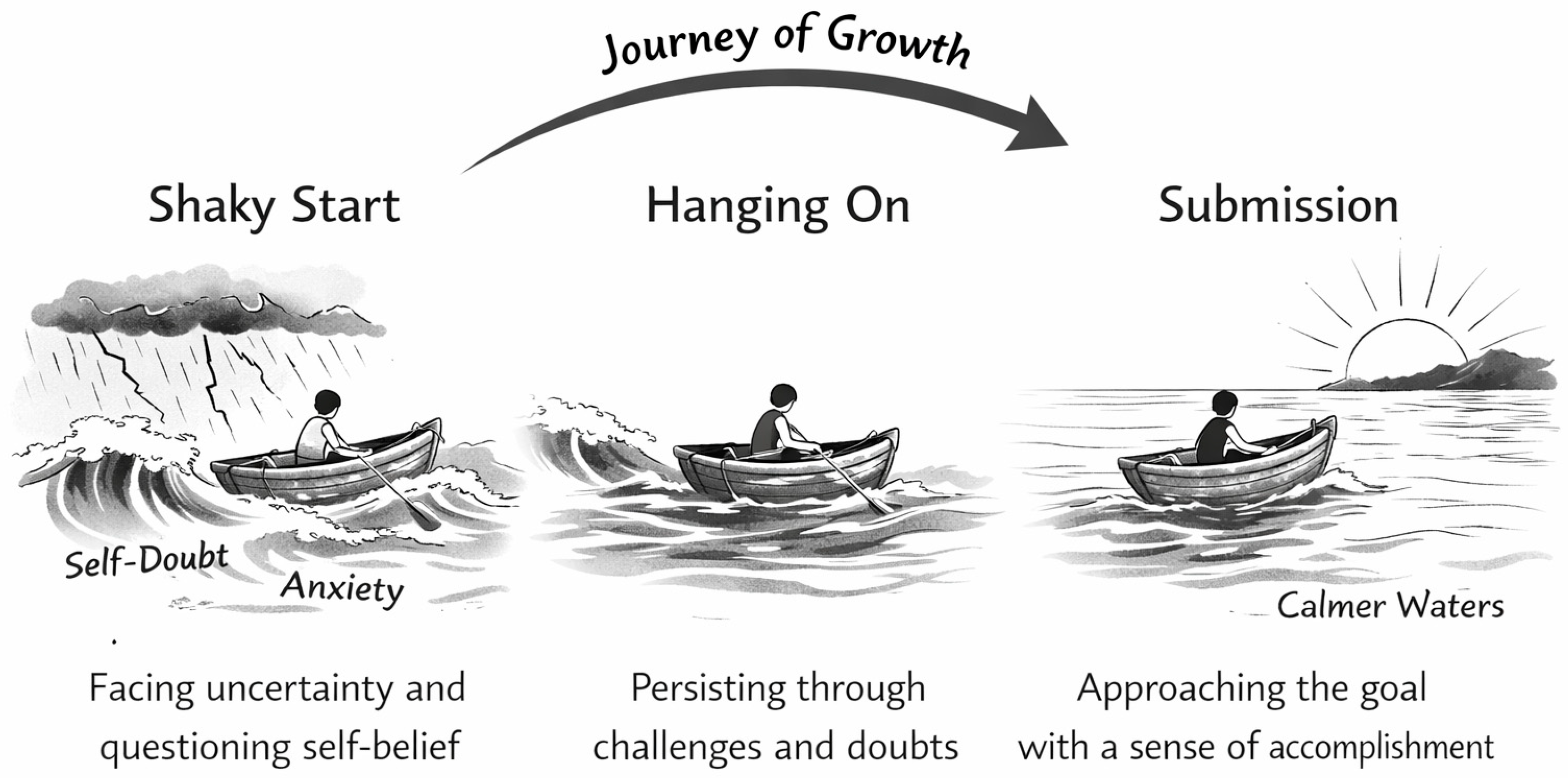
- Open AI ChatGPT. (2026). Image creation by AI tool for the authors’ idea about a vessel in passage in January 2026. Available online: https://chatgpt.com/s/m_697f477f6c108191a43a5e0ffa6f1277 (accessed on 2 January 2026).
- Padagas, R., & Hajan, B. (2020). Academic reading and writing needs of undergraduate nursing students in research. International Journal of Learning Teaching and Educational Research, 19(5), 318–335. [Google Scholar] [CrossRef]
- Pravita, A. R., & Kuswandono, P. (2022). Writing anxiety and academic procrastination on undergraduate thesis writing: The role of self-regulation. JEELS (Journal of English Education and Linguistics Studies), 9(1), 1–25. [Google Scholar] [CrossRef]
- Quality Assurance Agency. (2024). UK quality code for higher education 2024. Quality Assurance Agency. [Google Scholar]
- Ramluggun, P., & Morning, D. (2025). Integrating self-care into nursing education and practice: Strategies for sustainable wellbeing. Education Sciences, 15(6), 721. [Google Scholar] [CrossRef]
- Roberts, L. D., & Seaman, K. (2018). Good undergraduate dissertation supervision: Perspectives of supervisors and dissertation coordinators. International Journal for Academic Development, 23(1), 28–40. [Google Scholar] [CrossRef]
- Roe-Prior, P. (2022). Evidence-based practice. Journal for Nurses in Professional Development, 38(3), 177–178. [Google Scholar] [CrossRef] [PubMed]
- Scholefield, D., & Cox, G. (2016). Evaluation of a model of dissertation supervision for 3rd year B.Sc. undergraduate nursing students. Nurse Education in Practice, 17, 78–85. [Google Scholar] [CrossRef]
- Todd, M., Bannister, P., & Clegg, S. (2004). Independent inquiry and the undergraduate dissertation: Perceptions and experiences of final-year social science students. Assessment & Evaluation in Higher Education, 29(3), 335–355. [Google Scholar] [CrossRef]
- Toraman, A., Hamaratçılar, G., Tülü, B., & Erkin, Ö. (2017). Nursing students’ attitudes toward research and development within nursing: Does writing a bachelor thesis make a difference? International Journal of Nursing Practice, 23(2), e12517. [Google Scholar] [CrossRef] [PubMed]
- Turner, V., Abrahams, R., & Harris, A. (1969). The ritual process: Structure and anti-structure (1st ed.). Routledge. [Google Scholar] [CrossRef]


| 1. Before starting your dissertation, what were your expectations about writing up your dissertation? |
| 2. Did you feel prepared to undertake your final year project? Can you tell us why or why not? |
| 3. What motivated you to choose your dissertation topic? |
| 4. What has been the most challenging aspect of your dissertation so far and why? (e.g., topic selection, literature review, methodology, and time management) |
| 5. Were there moments when you felt overwhelmed or stuck? If so, why, and what helped you overcome these challenges? |
| 6. How did you manage balancing dissertation work with other academic/placement and personal commitments? |
| 7. How would you describe your experience with dissertation supervision? (e.g., frequency of meetings and clarity of guidance) |
| Variable | Category | Number of Participants | % |
|---|---|---|---|
| Nursing Programme | Adult nursing | 7 | 29.2% |
| Mental health | 10 | 41.7% | |
| Children | 5 | 20.8% | |
| Learning disability | 2 | 8.3% | |
| Gender | Female | 21 | 87.5% |
| Male | 2 | 8.3% | |
| Other | 1 | 4.2% | |
| Age | 18–24 | 10 | 41.7% |
| 25–35 | 8 | 33.3% | |
| 36–45 | 4 | 16.7% | |
| 45 | 2 | 8.3% |
Disclaimer/Publisher’s Note: The statements, opinions and data contained in all publications are solely those of the individual author(s) and contributor(s) and not of MDPI and/or the editor(s). MDPI and/or the editor(s) disclaim responsibility for any injury to people or property resulting from any ideas, methods, instructions or products referred to in the content. |
© 2026 by the authors. Licensee MDPI, Basel, Switzerland. This article is an open access article distributed under the terms and conditions of the Creative Commons Attribution (CC BY) license.
Share and Cite
Ramluggun, P.; Shao, C.H.; Harper, L.; Skarparis, K.; Greenshields, S. Overcoming the Final Hurdle: Understanding Undergraduate Nursing Students’ Journey to Completing Their Final Year ‘Dissertation’ Project. Educ. Sci. 2026, 16, 597. https://doi.org/10.3390/educsci16040597
Ramluggun P, Shao CH, Harper L, Skarparis K, Greenshields S. Overcoming the Final Hurdle: Understanding Undergraduate Nursing Students’ Journey to Completing Their Final Year ‘Dissertation’ Project. Education Sciences. 2026; 16(4):597. https://doi.org/10.3390/educsci16040597
Chicago/Turabian StyleRamluggun, Pras, Chun Hua Shao, Lynette Harper, Katy Skarparis, and Sarah Greenshields. 2026. "Overcoming the Final Hurdle: Understanding Undergraduate Nursing Students’ Journey to Completing Their Final Year ‘Dissertation’ Project" Education Sciences 16, no. 4: 597. https://doi.org/10.3390/educsci16040597
APA StyleRamluggun, P., Shao, C. H., Harper, L., Skarparis, K., & Greenshields, S. (2026). Overcoming the Final Hurdle: Understanding Undergraduate Nursing Students’ Journey to Completing Their Final Year ‘Dissertation’ Project. Education Sciences, 16(4), 597. https://doi.org/10.3390/educsci16040597