

Loneliness and Well-Being in Children and Adolescents during the COVID-19 Pandemic: A Systematic Review


Abstract
1. Introduction
1.1. Loneliness and Well-Being before the Pandemic
1.2. Loneliness and Well-Being during the Pandemic
1.3. Current Study
2. Materials and Methods
2.1. Search Strategy and Inclusion Criteria
2.2. Study Selection
3. Data Extraction
3.1. Quality Assessment
3.2. Analytic Plan
4. Results
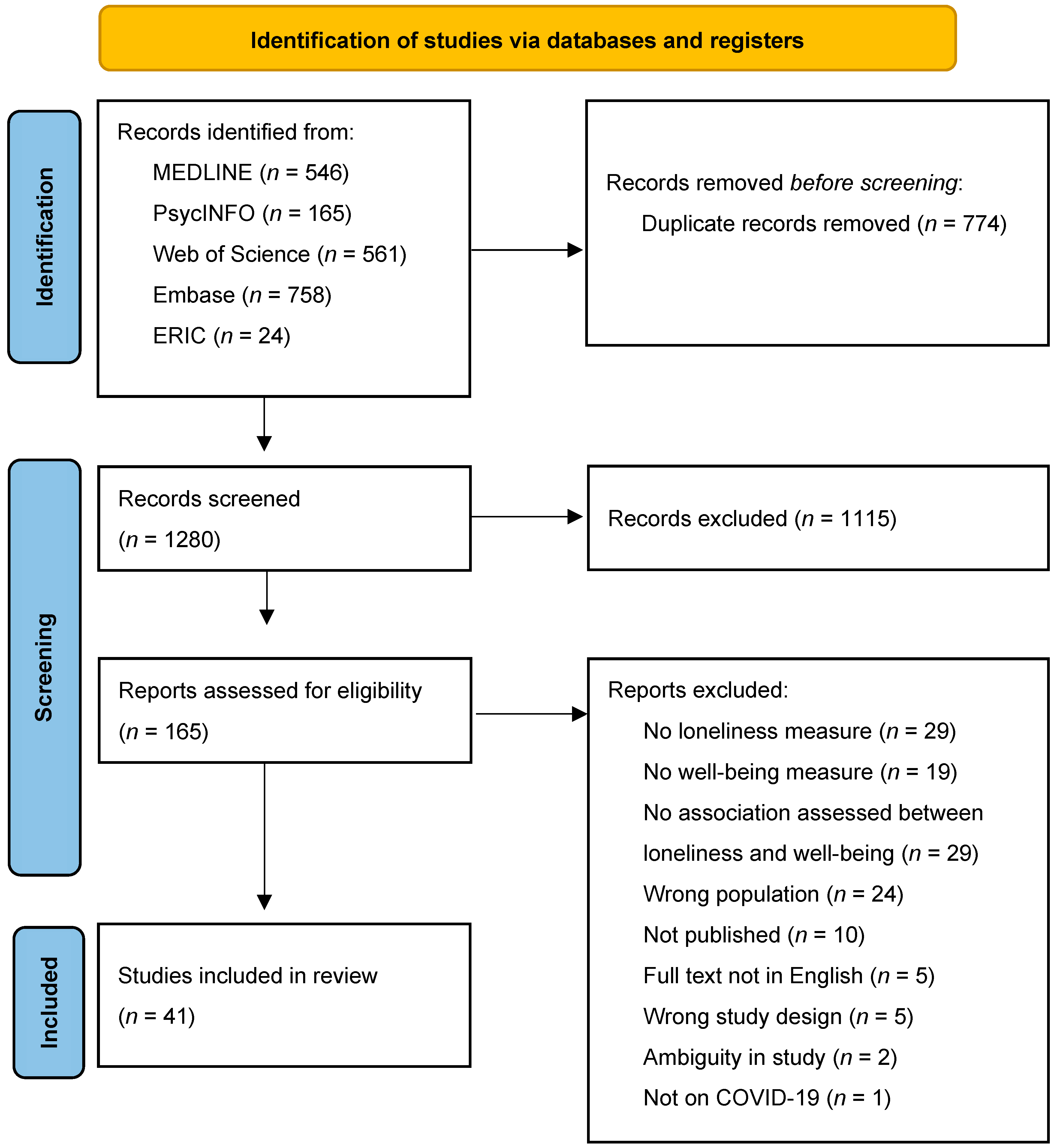
4.1. Study Selection
4.2. Summary of Studies and Quality Assessment
5. Prevalence of Loneliness
5.1. Associations between Loneliness and Well-Being
5.1.1. Cross-Sectional Results
5.1.2. Longitudinal Results
5.2. Potential Moderating Study Characteristics
6. Discussion
Supplementary Materials
Author Contributions
Funding
Institutional Review Board Statement
Informed Consent Statement
Data Availability Statement
Conflicts of Interest
References
- UNESCO. Global Monitoring of School Closures. 2021. Available online: https://en.unesco.org/covid19/educationresponse#durationschoolclosures (accessed on 2 June 2022).
- Harris, J.R. Where is the child’s environment? A group socialization theory of development. Psychol. Rev. 1995, 102, 458–489. [Google Scholar] [CrossRef]
- De Jong, G.J.; van Tilburg, T.; Dykstra, P.A. Loneliness and Social Isolation. In The Cambridge Handbook of Personal Relationships; Vangelisti, A.L., Perlman, D., Eds.; Cambridge University Press: Cambridge, UK, 2006; pp. 485–500. [Google Scholar]
- Perlman, D.; Peplau, L.A. Toward a Social Psychology of Loneliness. In Personal Relationships in Disorder; Gilour, R., Duck, S., Eds.; Academic Press: London, UK, 1981; pp. 31–56. [Google Scholar]
- Baumeister, R.F.; Leary, M.R. The need to belong: Desire for interpersonal attachments as a fundamental human motivation. Psychol. Bull. 1995, 117, 497–529. [Google Scholar] [CrossRef]
- Hawkley, L.C.; Cacioppo, J.T. Loneliness matters: A theoretical and empirical review of consequences and mechanisms. Ann. Behav. Med. 2010, 40, 218–227. [Google Scholar] [CrossRef] [PubMed]
- Lempinen, L.; Junttila, N.; Sourander, A. Loneliness and friendships among eight-year-old children: Time-trends over a 24-year period. J. Child Psychol. Psychiatry 2018, 59, 171–179. [Google Scholar] [CrossRef]
- Surkalim, D.L.; Luo, M.; Eres, R.; Gebel, K.; van Buskirk, J.; Bauman, A.; Ding, D. The prevalence of loneliness across 113 countries: Systematic review and meta-analysis. BMJ 2022, 376, e067068. [Google Scholar] [CrossRef]
- Twenge, J.M.; Haidt, J.; Blake, A.B.; McAllister, C.; Lemon, H.; Le Roy, A. Worldwide increases in adolescent loneliness. J. Adolesc. 2021, 93, 257–269. [Google Scholar] [CrossRef]
- Qualter, P.; Brown, S.L.; Munn, P.; Rotenberg, K.J. Childhood loneliness as a predictor of adolescent depressive symptoms: An 8-year longitudinal study. Eur. Child Adolesc. Psychiatry 2010, 19, 493–501. [Google Scholar] [CrossRef]
- Danneel, S.; Geukens, F.; Maes, M.; Bastin, M.; Bijttebier, P.; Colpin, H.; Verschueren, K.; Goossens, L. Loneliness, social anxiety symptoms, and depressive symptoms in adolescence: Longitudinal distinctiveness and correlated change. J. Youth Adolesc. 2020, 49, 2246–2264. [Google Scholar] [CrossRef]
- Kessler, R.C.; Amminger, G.P.; Aguilar-Gaxiola, S.; Alonso, J.; Lee, S.; Ustun, T.B. Age of onset of mental disorders: A review of recent literature. Curr. Opin. Psychiatry 2007, 20, 359–364. [Google Scholar] [CrossRef]
- Solmi, M.; Radua, J.; Olivola, M.; Croce, E.; Soardo, L.; Salazar de Pablo, G.; Shin, J.I.; Kirkbride, J.B.; Jones, P.; Kim, J.H.; et al. Age at onset of mental disorders worldwide: Large-scale meta-analysis of 192 epidemiological studies. Mol. Psychiatry 2022, 27, 281–295. [Google Scholar] [CrossRef]
- Page, M.J.; McKenzie, J.E.; Bossuyt, P.M.; Boutron, I.; Hoffmann, T.C.; Mulrow, C.D.; Shamseer, L.; Tetzlaff, J.M.; Akl, E.A.; Brennan, S.E.; et al. The PRISMA 2020 statement: An updated guideline for reporting systematic reviews. Syst. Rev. 2021, 10, 105906. [Google Scholar] [CrossRef] [PubMed]
- Ernst, M.; Niederer, D.; Werner, A.M.; Czaja, S.J.; Mikton, C.; Ong, A.D.; Rosen, T.; Brähler, E.; Beutel, M.E. Loneliness before and during the COVID-19 pandemic: A systematic review with meta-analysis. Am. Psychol. 2022, 77, 660–677. [Google Scholar] [CrossRef] [PubMed]
- Loades, M.E.; Chatburn, E.; Higson-Sweeney, N.; Reynolds, S.; Shafran, R.; Brigden, A.; Linney, C.; McManus, M.N.; Borwick, C.; Crawley, E. Rapid systematic review: The impact of social isolation and loneliness on the mental health of children and adolescents in the context of COVID-19. J. Am. Acad. Child Adolesc. Psychiatry 2020, 59, 1218–1239.e3. [Google Scholar] [CrossRef]
- Buecker, S.; Horstmann, K.T. Loneliness and social isolation during the COVID-19 pandemic. Eur. Psychol. 2021, 26, 272–284. [Google Scholar] [CrossRef]
- Kauhanen, L.; Wan Mohd Yunus, W.M.A.; Lempinen, L.; Peltonen, K.; Gyllenberg, D.; Mishina, K.; Gilbert, S.; Bastola, K.; Brown, J.S.L.; Sourander, A. A systematic review of the mental health changes of children and young people before and during the COVID-19 pandemic. Eur. Child Adolesc. Psychiatry 2022, 1, 1–9. [Google Scholar] [CrossRef]
- Viner, R.; Russell, S.; Saulle, R.; Croker, H.; Stansfield, C.; Packer, J.; Nicholls, D.; Goddings, A.L.; Bonell, C.; Hudson, L.; et al. School closures during social lockdown and mental health, health behaviors, and well-being among children and adolescents during the first COVID-19 wave: A systematic review. JAMA Pediatr. 2022, 176, 400–409. [Google Scholar] [CrossRef]
- Ma, L.; Mazidi, M.; Li, K.; Li, Y.; Chen, S.; Kirwan, R.; Zhou, H.; Yan, N.; Rahman, A.; Wang, W.; et al. Prevalence of mental health problems among children and adolescents during the COVID-19 pandemic: A systematic review and meta-analysis. J. Affect. Disord. 2021, 293, 78–89. [Google Scholar] [CrossRef]
- Racine, N.; McArthur, B.A.; Cooke, J.E.; Eirich, R.; Zhu, J.; Madigan, S. Global prevalence of depressive and anxiety symptoms in children and adolescents during COVID-19: A meta-analysis. JAMA Pediatr. 2021, 175, 1142. [Google Scholar] [CrossRef] [PubMed]
- Nearchou, F.; Flinn, C.; Niland, R.; Subramaniam, S.S.; Hennessy, E. Exploring the impact of COVID-19 on mental health outcomes in children and adolescents: A systematic review. Int. J. Environ. Res. Public Health 2020, 17, 8479. [Google Scholar] [CrossRef]
- Samji, H.; Wu, J.; Ladak, A.; Vossen, C.; Stewart, E.; Dove, N.; Long, D.; Snell, G. Review: Mental health impacts of the COVID-19 pandemic on children and youth—A systematic review. Child Adolesc. Ment. Health 2022, 27, 173. [Google Scholar] [CrossRef]
- Chaabane, S.; Doraiswamy, S.; Chaabna, K.; Mamtani, R.; Cheema, S. The impact of COVID-19 school closure on child and adolescent health: A rapid systematic review. Children 2021, 8, 415. [Google Scholar] [CrossRef]
- Theberath, M.; Bauer, D.; Chen, W.; Salinas, M.; Mohabbat, A.B.; Yang, J.; Chon, T.Y.; Bauer, B.A.; Wahner-Roedler, D.L. Effects of COVID-19 pandemic on mental health of children and adolescents: A systematic review of survey studies. SAGE Open Med. 2022, 10, 20503121221086712. [Google Scholar] [CrossRef] [PubMed]
- Erzen, E.; Çikrikci, Ö. The effect of loneliness on depression: A meta-analysis. Int. J. Soc. Psychiatry 2018, 64, 427–435. [Google Scholar] [CrossRef] [PubMed]
- Hards, E.; Loades, M.E.; Higson-Sweeney, N.; Shafran, R.; Serafimova, T.; Brigden, A.; Reynolds, S.; Crawley, E.; Chatburn, E.; Linney, C.; et al. Loneliness and mental health in children and adolescents with pre-existing mental health problems: A rapid systematic review. Br. J. Clin. Psychol. 2022, 61, 313–334. [Google Scholar] [CrossRef] [PubMed]
- Covidence Systematic Review Software, Veritas Health Innovation. 2022. Available online: www.covidence.org (accessed on 28 June 2022).
- Cauberghe, V.; Van Wesenbeeck, I.; De Jans, S.; Hudders, L.; Ponnet, K. How adolescents use social media to cope with feelings of loneliness and anxiety during COVID-19 lockdown. Cyberpsychol. Behav. Soc. Netw. 2021, 24, 250–257. [Google Scholar] [CrossRef] [PubMed]
- National Institutes of Health. Quality Assessment Tool for Observational Cohort and Cross-Sectional Studies. 2021. Available online: https://www.nhlbi.nih.gov/health-topics/study-quality-assessment-tools (accessed on 2 June 2022).
- Boursier, V.; Gioia, F.; Musetti, A.; Schimmenti, A. COVID-19-related fears, stress and depression in adolescents: The role of loneliness and relational closeness to online friends. J. Hum. Behav. Soc. Environ. 2022, 1, 1–23. [Google Scholar] [CrossRef]
- Dondi, A.; Fetta, A.; Lenzi, J.; Morigi, F.; Candela, E.; Rocca, A.; Cordelli, D.; Lanari, M. Sleep disorders reveal distress among children and adolescents during the Covid-19 first wave: Results of a large web-based Italian survey. Ital. J. Pediatr. 2021, 47, 1–10. [Google Scholar] [CrossRef]
- Dubois-Comtois, K.; Suffren, S.; St-Laurent, D.; Milot, T.; Lemelin, J.P. Child psychological functioning during the COVID-19 lockdown: An ecological, family-centered approach. J. Dev. Behav. Pediatr. 2021, 42, 532–539. [Google Scholar] [CrossRef]
- Ellis, W.E.; Dumas, T.M.; Forbes, L.M. Physically isolated but socially connected: Psychological adjustment and stress among adolescents during the initial COVID-19 crisis. Can. J. Behav. Sci. Rev. Can. Des Sci. Du Comport. 2020, 52, 177–187. [Google Scholar] [CrossRef]
- Espinoza, G.; Hernandez, H.L. Adolescent loneliness, stress and depressive symptoms during the COVID-19 pandemic: The protective role of friends. Infant Child Dev. 2022, 31, e2305. [Google Scholar] [CrossRef] [PubMed]
- Fernandes, M.D.S.V.; Silva, T.M.; Noll, P.R.E.S.; Almeida, A.A.D.; Noll, M. Depressive symptoms and their associated factors in vocational–technical school students during the COVID-19 pandemic. Int. J. Environ. Res. Public Health 2022, 19, 3735. [Google Scholar] [CrossRef]
- Fogarty, A.; Brown, S.; Gartland, D.; Mensah, F.; Seymour, M.; Savopoulos, P.; FitzPatrick, K.; Papadopoullos, S.; Giallo, R. Psychosocial factors associated with adolescent depressive and anxiety symptoms during the COVID-19 pandemic. Int. J. Behav. Dev. 2022, 46, 308–319. [Google Scholar] [CrossRef]
- Gilsbach, S.; Herpertz-Dahlmann, B.; Konrad, K. Psychological impact of the COVID-19 pandemic on children and adolescents with and without mental disorders. Front. Public Health 2021, 9, 679041. [Google Scholar] [CrossRef] [PubMed]
- Hou, T.; Xie, Y.; Mao, X.; Liu, Y.; Zhang, J.; Wen, J.; Chen, Y.; Luo, Z.; Cai, W. The mediating role of loneliness between social support and depressive symptoms among Chinese rural adolescents during COVID-19 uutbreak: A comparative study between left-behind and non-left-behind students. Front. Psychiatry 2021, 12, 740094. [Google Scholar] [CrossRef]
- Jones, S.E.; Ethier, K.A.; Hertz, M.; DeGue, S.; Le, V.D.; Thornton, J.; Lim, C.; Dittus, P.J.; Geda, S. Mental health, suicidality, and connectedness among high school students during the COVID-19 pandemic—Adolescent Behaviors and Experiences Survey, United States, January–June 2021. MMWR Suppl. 2022, 71, 16–21. [Google Scholar] [CrossRef] [PubMed]
- Kayaoğlu, K.; Başcıllar, M. Determining the relationship between loneliness and depression in adolescents during the COVID-19 pandemic: A cross-sectional survey. J. Child Adolesc. Psychiatr. Nurs. 2022, 35, 315–321. [Google Scholar] [CrossRef]
- Kilinçel, S.; Muratdagi, G. Evaluation of factors affecting social media addiction in adolescents during the COVID-19 pandemic. Ann. Clin. Anal. Med. 2021, 12, 447–451. [Google Scholar] [CrossRef]
- Laslo-Roth, R.; George-Levi, S.; Rosenstreich, E. Protecting children with ADHD against loneliness: Familial and individual factors predicting perceived child’s loneliness. Personal. Individ. Differ. 2021, 180, 110971. [Google Scholar] [CrossRef]
- Li, S.H.; Beames, J.R.; Newby, J.M.; Maston, K.; Christensen, H.; Werner-Seidler, A. The impact of COVID-19 on the lives and mental health of Australian adolescents. Eur. Child Adolesc. Psychiatry 2022, 31, 1465–1477. [Google Scholar] [CrossRef]
- Li, J.; Zhan, D.; Zhou, Y.; Gao, X. Loneliness and problematic mobile phone use among adolescents during the COVID-19 pandemic: The roles of escape motivation and self-control. Addict. Behav. 2021, 118, 106857. [Google Scholar] [CrossRef] [PubMed]
- Liu, J.; Zhou, T.; Yuan, M.; Ren, H.; Bian, X.; Coplan, R.J. Daily routines, parent-child conflict, and psychological maladjustment among Chinese children and adolescents during the COVID-19 pandemic. J. Fam. Psychol. 2021, 35, 1077–1085. [Google Scholar] [CrossRef]
- Low, N.; Mounts, N.S. Economic stress, parenting, and adolescents’ adjustment during the COVID-19 pandemic. Fam. Relat. 2021, 71, 90–107. [Google Scholar] [CrossRef]
- Murata, S.; Rezeppa, T.; Thoma, B.; Marengo, L.; Krancevich, K.; Chiyka, E.; Hayes, B.; Goodfriend, E.; Deal, M.; Zhong, Y.; et al. The psychiatric sequelae of the COVID-19 pandemic in adolescents, adults, and health care workers. Depress. Anxiety 2021, 38, 233–246. [Google Scholar] [CrossRef]
- Oosterhoff, B.; Palmer, C.A.; Wilson, J.; Shook, N. Adolescents’ motivations to engage in social distancing during the COVID-19 pandemic: Associations with mental and social health. J. Adolesc. Health 2020, 67, 179–185. [Google Scholar] [CrossRef]
- Palmer, C.A.; Oosterhoff, B.; Massey, A.; Bawden, H. Daily associations between adolescent sleep and socioemotional experiences during an ongoing stressor. J. Adolesc. Health 2022, 70, 970–977. [Google Scholar] [CrossRef] [PubMed]
- Pan, Y.; Yang, Z.; Han, X.; Qi, S. Family functioning and mental health among secondary vocational students during the COVID-19 epidemic: A moderated mediation model. Personal. Individ. Differ. 2021, 171, 110490. [Google Scholar] [CrossRef]
- Pfetsch, J.S.; Schultze-Krumbholz, A.; Lietz, K. Can acting out online improve adolescents’ well-being during contact restrictions? A first insight into the dysfunctional role of cyberbullying and the need to belong in well-being during COVID-19 pandemic-related contact restrictions. Front. Psychol. 2021, 12, 6369. [Google Scholar] [CrossRef]
- Sette, S.; Zava, F.; Baumgartner, E.; Laghi, F.; Coplan, R.J. Examining links between social withdrawal subtypes and internalizing problems among Italian primary school children. Eur. J. Dev. Psychol. 2022, 1, 1–19. [Google Scholar] [CrossRef]
- Sette, S.; Zuffiano, A.; Lopez-Perez, B.; McCagh, J.; Caprara, G.V.; Coplan, R.J. Links between child shyness and indices of internalizing problems during the COVID-19 pandemic: The Protective role of positivity. J. Genet. Psychol. 2022, 183, 91–106. [Google Scholar] [CrossRef]
- Soneson, E.; Puntis, S.; Chapman, N.; Mansfield, K.L.; Jones, P.B.; Fazel, M. Happier during lockdown: A descriptive analysis of self-reported wellbeing in 17,000 UK school students during Covid-19 lockdown. Eur. Child Adolesc. Psychiatry 2022, 1, 1–16. [Google Scholar] [CrossRef]
- Varela, J.J.; Hernández, C.; Miranda, R.; Barlett, C.P.; Rodriguez-Rivas, M.E. Victims of Cyberbullying: Feeling Loneliness and Depression among Youth and Adult Chileans during the Pandemic. Int. J. Environ. Res. Public Health 2022, 19, 5886. [Google Scholar] [CrossRef] [PubMed]
- Wang, J.; Yang, Y.; Lin, H.; Richards, M.; Yang, S.; Liang, H.; Chen, X.; Fu, C. Impact of psychosocial stressors on emotional and behavioral problems in Chinese adolescents during the COVID-19 period: The explanatory value of loneliness. Transl. Pediatr. 2021, 10, 2929–2940. [Google Scholar] [CrossRef]
- Yilmaz, M.B.; Orhan, F.; Zeren, S.G. Adolescent emotion scale for online lessons: A study from Turkey. Educ. Inf. Technol. 2022, 27, 3403–3420. [Google Scholar] [CrossRef] [PubMed]
- Zhu, S.; Zhuang, Y.; Lee, P.; Li, J.C.; Wong, P.W.C. Leisure and problem gaming behaviors among children and adolescents during school closures caused by COVID-19 in Hong Kong: Quantitative cross-sectional survey study. JMIR Serious Games 2021, 9, e26808. [Google Scholar] [CrossRef]
- Alt, P.; Reim, J.; Walper, S. Fall from grace: Increased loneliness and depressiveness among extraverted youth during the German COVID-19 lockdown. J. Res. Adolesc. 2021, 31, 678–691. [Google Scholar] [CrossRef]
- Cooper, K.; Hards, E.; Moltrecht, B.; Reynolds, S.; Shum, A.; McElroy, E.; Loades, M. Loneliness, social relationships, and mental health in adolescents during the COVID-19 pandemic. J. Affect. Disord. 2021, 289, 98–104. [Google Scholar] [CrossRef]
- Houghton, S.; Kyron, M.; Hunter, S.C.; Lawrence, D.; Hattie, J.; Carroll, A.; Zadow, C. Adolescents’ longitudinal trajectories of mental health and loneliness: The impact of COVID-19 school closures. J. Adolesc. 2022, 94, 191–205. [Google Scholar] [CrossRef] [PubMed]
- Houghton, S.; Kyron, M.; Lawrence, D.; Hunter, S.C.; Hattie, J.; Carroll, A.; Zadow, C.; Chen, W. Longitudinal trajectories of mental health and loneliness for Australian adolescents with-or-without neurodevelopmental disorders: The impact of COVID-19 school lockdowns. J. Child Psychol. Psychiatry 2022, 63, 1332–1343. [Google Scholar] [CrossRef]
- Magson, N.R.; Freeman, J.Y.A.; Rapee, R.M.; Richardson, C.E.; Oar, E.L.; Fardouly, J. Risk and protective factors for prospective changes in adolescent mental health during the COVID-19 pandemic. J. Youth Adolesc. 2021, 50, 44–57. [Google Scholar] [CrossRef]
- Rogers, A.A.; Ha, T.; Ockey, S. Adolescents’ perceived socio-emotional impact of COVID-19 and implications for mental health: Results from a U.S.-based mixed-methods study. J. Adolesc. Health 2021, 68, 43–52. [Google Scholar] [CrossRef]
- Schwartz-Mette, R.A.; Duell, N.; Lawrence, H.R.; Balkind, E.G. COVID-19 distress impacts adolescents’ depressive symptoms, NSSI, and suicide risk in the rural, northeast US. J. Clin. Child Adolesc. Psychol. 2022, 1, 1–14. [Google Scholar] [CrossRef]
- Szelei, N.; Devlieger, I.; Verelst, A.; Spaas, C.; Jervelund, S.S.; Primdahl, N.L.; Skovdal, M.; Opaas, M.; Durbeej, N.; Osman, F.; et al. Migrant students’ sense of belonging and the COVID-19 pandemic: Implications for educational inclusion. Soc. Incl. 2022, 10, 172–184. [Google Scholar] [CrossRef]
- Westrupp, E.M.; Greenwood, C.J.; Fuller-Tyszkiewicz, M.; Olsson, C.A.; Sciberras, E.; Mikocka-Walus, A.; Melvin, G.A.; Evans, S.; Stokes, M.A.; Wood, A.G.; et al. Parent and child mental health trajectories April 2020 to May 2021: Strict lockdown versus no lockdown in Australia. Aust. N. Z. J. Psychiatry 2021, 1, 1491–1502. [Google Scholar] [CrossRef]
- Zhu, S.; Zhuang, Y.; Lee, P.; Wong, P.W.C. The changes of suicidal ideation status among young people in Hong Kong during COVID-19: A longitudinal survey. J. Affect. Disord. 2021, 294, 151–158. [Google Scholar] [CrossRef] [PubMed]
- Zuccolo, P.F.; Casella, C.B.; Fatori, D.; Shephard, E.; Sugaya, L.; Gurgel, W.; Farhat, L.C.; Argeu, A.; Teixeira, M.; Otoch, L.; et al. Children and adolescents’ emotional problems during the COVID-19 pandemic in Brazil. Eur. Child Adolesc. Psychiatry 2022, 1, 1–13. [Google Scholar] [CrossRef] [PubMed]
- Dunn, C.; Sicouri, G. The relationship between loneliness and depressive symptoms in children and adolescents: A meta-analysis. Behav. Change 2022, 39, 134–145. [Google Scholar] [CrossRef]
- Eccles, A.M.; Qualter, P. Review: Alleviating loneliness in young people—A meta-analysis of interventions. Child Adolesc. Ment. Health 2021, 26, 17–33. [Google Scholar] [CrossRef] [PubMed]
- Taylor, R.D.; Oberle, E.; Durlak, J.A.; Weissberg, R.P. Promoting positive youth development through school-based social and emotional learning interventions: A meta-analysis of follow-up effects. Child Dev. 2017, 88, 1156–1171. [Google Scholar] [CrossRef]
- Alegría, M.; Baum, R.; McCabe, M.A.; Williams, J.L. School-Based Strategies for Addressing the Mental Health and Well-Being of Youth in the Wake of COVID-19; The National Academies Press, National Academies of Sciences, Engineering, and Medicine: Washington, DC, USA, 2021. [Google Scholar] [CrossRef]
- Vaillancourt, T.; McDougall, P.; Comeau, J.; Finn, C.; Blais, J.M. COVID-19 school closures and social isolation in children and youth: Prioritizing relationships in education. Facets 2021, 6, 1795–1813. [Google Scholar] [CrossRef]
- Vaillancourt, T. Physical Activity—The Forgotten Core Area of Child Development during the Pandemic. The Globe and Mail. 2021. Available online: https://www.theglobeandmail.com/canada/article-physical-activity-the-forgotten-core-area-of-child-development-during/ (accessed on 4 November 2022).
- McGuine, T.; Biese, K.; Hetzel, S.; Schwarz, A.; Reardon, C.; Bell, D.; Brooks, A.; Dickman, J.; Watson, A. A multi-year assessment of sport participation during the COVID-19 pandemic on the health of adolescent athletes. J. Athl. Train. 2022. [Google Scholar] [CrossRef] [PubMed]
- Exner-Cortens, D.; Gaias, L.; Splett, J.W.; Jones, J.; Walker, W. Embedding equity into school mental health theory, research, and practice: An introduction to the special issue series. Psychol. Sch. 2022, 59, 1941–1947. [Google Scholar] [CrossRef]
- Wong, J.; Yi, P.X.; Quek, F.Y.X.; Lua, V.Y.Q.; Majeed, N.M.; Hartanto, A. A four-level meta-analytic review of the relationship between social media and well-being: A fresh perspective in the context of COVID-19. Curr. Psychol. 2022, 1, 1–15. [Google Scholar] [CrossRef]


| Sample | Measures | Results | Additional Characteristics | ||||||
|---|---|---|---|---|---|---|---|---|---|
| Author, Country | Type | N (% Males/Boys) | Age Range; M (SD); Type | Loneliness Measure | Well-Being Measure(s) | Loneliness M (SD) or N (%) | Association between Loneliness and Well-Being | Data Collection Timing/School Closure | Qual (/9) |
| Boursier et al. [31], Italy | Com | 544 (28.1) | 13–20; 16.22 (1.83); Adol | Italian Loneliness Scale-self-report | Depression subscale of Depression-Anxiety Stress Scale-21 Multidimensional Assessment of COVID-19 related fears -self-report | 2.11 (0.6) Min = 1 Max = 4 | Dep: r = 0.564, p < 0.001 Loneliness→Depression β = 0.721, se = 0.054, p < 0.001 COVID-19 Anx: r = 0.294, p < 0.001 COVID-19 Anx→Loneliness β = 0.198, se = 0.302, p < 0.001 | January–March 2021, school closure unclear | 6 |
| Cauberghe et al. [29], Belgium | Com | 2165 (34.4) | 13–19; 15.51 (1.59); Adol | Revised UCLA Loneliness Scale-6 items-self-report | General Anxiety Disorder Scale-7 Center of Epidemiological Studies Depression Scale -self-report | Boys: 2.62 (0.76) Girls: 2.92 (0.77) | Anx: r = 0.523, p < 0.01 Happiness (vs. Depression): r = −0.590, p < 0.01 Loneliness→Happiness β = −0.616, p < 0.01 | 16–30 April 2020, during school closure | 6 |
| Dondi et al. [32], Italy | Both | 6210 (NA) | Up to age 18; NA; Both | Single item of child feeling lonely-parent-report | Single items from Sleep Disturbance Scale for Children -difficulty falling asleep (sleep disorder) -maintaining sleep -nightmares -parent-report | No: 32.4% Yes, not putting it into words: 31.6% Yes, putting it into words: 36.0% | Loneliness→Sleep Falling asleep: -Yes not putting into words: OR: 1.85 (se = 0.14) -Yes putting into words: OR: 1.97 (se = 0.15) Staying Asleep: -Yes not putting into words: OR: 1.83 (se = 0.16) -Yes putting into words: OR: 2.11 (se = 0.18) Nightmares: -Yes not putting into words: OR: 2.10 (se = 0.21) -Yes putting into words: OR: 2.05 (se = 0.20) p < 0.01 for all | 1 September–15 October 2020, school closure unclear | 5 |
| Dubois-Comtois et al. [33], Canada | Com | 144 (51.4) | 9–12; 10.44 (1.09); Both | Negative Experienced Aloneness Scale of the Loneliness and Aloneness Scale for Children and Adolescents-self-report | Fear of COVID-19 Scale (anxiety toward COVID-19)-self-report Child Behavior Checklist (externalizing)-parent-report Youth-Self Report (internalizing)-self-report | 33.65 (6.88) Min = 12 Max = 48 | Aversion to Aloneness and: Internalizing: r = 0.35, p < 0.001 Loneliness→Internalizing b = 0.27, se = 0.08, β = 0.26, p = 0.001, 95% CI [0.11, 0.43] Externalizing: r = 0.17, p < 0.05 Loneliness→Externalizing b = 0.02, se = 0.08, β = 0.002, p = 0.82, 95% CI [−0.14, 0.18] COVID-19 Anx: r = 0.32, p < 0.001 Loneliness→COVID-19 Anx b = 0.22, se = 0.07, β = 0.26, p = 0.002, 95% CI [0.08, 0.35] | 18 April–18 May 2020, during school closure | 5 |
| Ellis et al. [34], Canada | Com | 1054 (21.9) | 14–18; 16.68 (0.78); Adol | Revised UCLA Loneliness Scale-self-report | Brief Symptom Inventory-self-report | Boys: 2.26 (se = 0.15) Girls: 2.85 (se = 0.06) Min = 1 Max = 4 | Dep: r = 0.53, p < 0.01 | 4–16 April 2020, during school closure | 6 |
| Espinoza and Hernandez [35], US | Com | 993 (41) | 14–18; 16.09 (1.24); Adol | Items adapted from Asher and Wheeler Loneliness Scale-self-report | Center for Epidemiologic Studies Depression Scale-self-report | 2.56 (1.03) Min = 1 Max =5 | Dep: r = 0.61, p < 0.001 | 15 April–May 2020; school closure unclear | 6 |
| Fernandes et al. [36], Brazil | Com | 343 (44.3) | 14–18; 16.1 (0.9); Adol | COVID-19 related measure with social isolation item-self-report | Children’s Depression Inventory-self-report | Social Isolation: -Extremely isolated: 8.5% -Very isolated: 20.1% -Moderately isolated: 41.4% -Slightly isolated: 19.8% -Not at all: 10.2% | Isolation (vs. No Isolation)→Dep (vs. No Dep) PR (Prevalence Ratio): 2.04, 95% CI [1.00–4.14] | April–July 2021, school closure unclear | 6 |
| Fogarty et al. [37], Australia | Com | 257 (45.5) | 14–17; 15.7 (0.87); Adol | COVID-19 CRISIS Tool, single item on feeling lonely -self-report Scale of 0–4 dichotomized: 0–1 = 0, 2–4 = 1 | Patient Health Questionnaire-Adolescent The Generalised Anxiety Disorder Scale-7 -self-report | 38.7% said moderately to extremely lonely | Dep: r = 0.56, p < 0.001 Loneliness→Dep β = 0.31, b = 3.88, 95% CI [2.61, 5.15], p < 0.001 Anxiety: r = 0.44, p < 0.001 Loneliness→Anx β = 0.16, b = 1.44, 95% CI [0.44, 2.43], p = 0.005 | July–September 2022 (during second lockdown), during school closure | 7 |
| Gilsbach et al. [38], Germany | Both | 195 147 Clinical Group with Diagnosed Mental Disorder (43.6) 48 Non-Clinical (66.7) | 6–18; Clinical: 13.3 (3.0) Non-Clinical: 13.5 (3.0); Both | Single item on impact of COVID-19 on loneliness -parent-report -self-report | NA; compared clinical to non-clinical sample | M (SD) NA Min = −2 (not at all) Max = 2 (very much) | Mean difference in Loneliness between Clinical and Non-Clinical samples: -Self-report: F(1, 137) = 0.25, p = 0.62 -Parent-report: F(1, 116) = 1.71, p = 0.19 | Spring 2020, school closure unclear | 6 |
| Hou et al. [39], China | Com | 826 (57.1) | Senior high school up to 18; NA; Adol | UCLA Loneliness Scale-self-report | Patient Health Questionnaire-9-self-report | 47.92 (8.55) Min = 0 Max = 60 | Dep: r = 0.425, p < 0.001 Loneliness→Dep β = 0.337, p < 0.001, | April–May 2020, school closure unclear | 7 |
| Jones et al. [40], US | Com | 7705 (49.6) | Grades 9 to 12; NA; Adol | Single item about feeling close to persons at school-self-report | Single items: -how often mental health not good during pandemic -how often mental health not good during last 30 days -considering suicide past 12 months -attempt suicide past 12 months -self-report | Agree, felt close: 46.6%Not sure or disagree: 53.4% | Overall: Compared to students who did not feel close to persons at school, students who felt close: -Lower prevalence of poor mental health during pandemic: 28.4% vs. 45.2% -Lower prevalence of poor mental health last 30 days: 23.5% vs. 37.8% -Lower prevalence of having seriously considered suicide: 14.0% vs. 25.6% -Lower prevalence of having attempted suicide: 5.8% vs. 11.9% p < 0.05 for all | January–June 2021, school closure unclear | 5 |
| Kayaoğlu and Başcıllar [41], Turkey | Com | 423 (36.4) | 10–19; 15.23 (2.23); Adol | UCLA Loneliness Scale-short form-self-report | Children’s Depression Inventory-self-report | 16.43 (4.93) Min = 7 Max = 52 | Dep: r = 0.084, p = 0.03 | Not provided, but during the COVID-19 Pandemic | 8 |
| Kilinçel and Muratdagi [42], Turkey | Com | 1142 (63.2) | 12–18; 15.6 (2.8); Adol | UCLA Loneliness Scale-self-report | State-Trait Anxiety Inventory-self-report Social Media Disorder Scale-self-report | NA | State Anx: r = 0.380, p < 0.01 Social Media Disorder: r = 0.093, p < 0.01 Loneliness→Social Media Disorder β = 0.150, p = 0.001 | 29–30 March 2022, online school assessed | 5 |
| Laslo-Roth et al. [43], Israel | Both | 280; ADH-D: 166 (71) No ADH-D: 114 (57) | NA; ADHD: 9.33 (2.45) No ADHD: 9.89 (2.2); Child | Single item of child seeming to be lonely-parent-report | ADHD diagnosis | 2.71 (1.27) Min = 1 Max = 5 | ADHD status→Loneliness Step 1: β = 0.22, p < 0.01 Step 2: β = 0.05, NS | During COVID-19 pandemic but details not provided, school closure unclear | 6 |
| Li et al. [44], Australia | Com | 760 (28) | 12–18; 14.8 (1.26); Adol | Single item from UCLA Loneliness Scale-self-report | Asked if previously diagnosed with anxiety and/or depression Warwick Edinburgh Mental Well-Being Scale short-form Body Preoccupation Scale of the Illness Attitude Scales -self-report | Frequency of feeling alone: -Hardly ever: 17.1% -Some of the time: 30.7% -Often: 51.4% | Mean Loneliness by Diagnosis vs. No Diagnosis: t(663) = −5.61, p < 0.01 -Diagnosis: M = 5.63, SD = 2.30 -No Diagnosis: M = 4.56, SD = 2.44 Loneliness and: Health Anx: r = 0.20, p < 0.01 Overall Well-Being: r = −0.59, p < 0.01 | 2 June–5 August 2020, during school closure | 4 |
| Li et al. [45], China | Com | 1034 (61.2) | 12–19; 15.76 (1.20); Adol | UCLA Loneliness Scale-self-report | Mobile Phone Addiction Index-self-report | 44.88 (10.19) Min = 20 Max = 100 | Mobile Addiction: r = 0.14, p < 0.001 β = 0.14 se = 0.03, p < 0.001, | 22–29 May 2020, school closure unclear | 7 |
| Liu et al. [46], China | Com | 1594 (49.4) | 9–16; 13.13 (1.54); Both | Loneliness and Aloneness Scale for Children and Adolescents -Peer loneliness -Family Loneliness-self-report | Center for Epidemiologic Studies Depression Scale for Children-self-report | -Peer Loneliness: 1.32 (0.46) -Family Loneliness: 1.78 (0.68) Min = 1 Max = 4 | Peer loneliness and dep: r = 0.49, p < 0.001 Family loneliness and dep: r = 0.58, p < 0.001 | April 2020, school closure unclear | 6 |
| Low and Mounts [47], US | Com | 272 (NA) | 12–18; NA; Adol | UCLA Loneliness Questionnaire—parent-report | Revised Child Anxiety and Depression Scale-parent-report | 0.95 (0.73) Min = 0 Max = 3 | Internalizing: r = 0.90, p < 0.01 | June–November 2020, during school closure | 6 |
| Murata et al. [48], US | Com | 583 (20) | NA; 15.80 (1.40); Adol | Feelings of loneliness since the COVID-19 pandemic-self-report | Patient Health Questionnaire Generalized Anxiety Disorder (GAD-7) -self-report | 6.9 (2.3) Min = 1 Max = 10 | Loneliness→Dep: β = 0.376, 98% CI [0.24, 0.52], p < 0.001, Loneliness→Anx: β = 0.57, 98%CI [0.41, 0.74], p < 0.001, | 27 April–13 July 2020; school closure unclear | 5 |
| Oosterhoff et al. [49], US | Com | 683 (22.7) | 13–18; 16.35 (1.13); Adol | Interpersonal Needs Questionnaire (Belongingness)-self-report | Patient-Reported Outcomes Measurement Information-short-fixed-form -Depression scale -Anxiety scale -self-report | 4.21 (1.49) Min = 1 Max = 7 | Dep: r = −0.45, p < 0.05 (depression related to higher belongingness) Anx: r = −0.21, p < 0.05 (anxiety related to higher belongingness) | 29–30 March 2022; school closure unclear | 7 |
| Palmer et al. [50], US | Com | 459 (18.7) | 13–18; 16.24 (1.26); Adol | Single item on how lonely from Positive and Negative Affect Schedule-X-self-report | Positive and Negative Affect Schedule-for children UCLA Post-Traumatic Stress-Reaction Index Pittsburgh Sleep Quality Index National Sleep Foundation Sleep Diary Consensus Sleep Diary Single item on bad dreams -self-report | 2.82 (1.36) Min = 1 Max = 5 | Internalizing: Positive Affect: r = −0.33, p < 0.01 Negative Affect: r = 0.63, p < 0.01 Others: Post-Traumatic Stress-Symptoms: r = 0.61, p < 0.01 Nightmares: r = 0.12, p < 0.01 Sleep onset: r = 0.17, p < 0.01 Sleep quality: r = 0.21, p < 0.01 | 1–5 April 2020, during school closure | 7 |
| Pan et al. [51], China | Com | 5783 (60.75) | NA; NA; Adol | UCLA Loneliness Questionnaire-self-report | Mental Health of Middle School Students-self-report (higher scores mean worse mental health) | 42.77 (8.75) Min = 20 Max = 80 | Overall Mental Health: r = 0.578, p < 0.01 Loneliness→Overall Mental Health β = 0.036, p < 0.001 | May 2020, during school closure | 4 |
| Pfetsch et al. [52], Germany | Com | 205 (43) | 14–19; 15.83 (1.44); Adol | UCLA-Revised (10 items) subscales: -feelings of isolation -lack of proximity -self-report | Short Warwick-Edinburgh Mental Well-Being Scale-self-report | NA | Overall Well-Being: -Loneliness isolation: r = −0.67, p < 0.001 Isolation→Well-being Model 3: b = −0.21, se = 0.07, β = −0.28, p < 0.001 Model 4: b = −0.20, se = 0.07, β = −0.26, p < 0.01 -Loneliness proximity: r = −0.52, p < 0.001 Proximity→Well-being Model 3: b = −0.10, se = 0.07, β = −0.10, p > 0.05 Model 4: b = −0.09, se = 0.07, β = −0.10, p > 0.05 | Middle of March–beginning April 2021, during school closure | 7 |
| Sette et al. [53], Italy | Com | 748 (48.3) | 7–11; 8.91 (1.07); Child | Loneliness and Social Dissatisfaction Questionnaire-self-report | Children’s Depression Inventory Social Anxiety Scale for Children-Revised -self-report | 1.47 (0.67) Min = 1 Max = 5 | Dep: r = 0.65, p < 0.001 Social Anx: r = 0.52, p < 0.001 | December 2020–April 2021, both school closure and reopened assessed | 7 |
| Sette et al. [54], Italy, Spain, UK | Com | 236 (44.49) | 6–12; 9.25 (1.2); Child | Adapted from Asher et al.-self-report | The Children’s Depression Inventory-Short Form Spence Children’s Anxiety Scale (SCAS-Child)-self-report | 1.57 (0.57) Min = 1 Max = 5 | Dep: r = 0.62, p < 0.001 Anx: r = 0.41, p < 0.001 | 23 April–25 June 2020, during school closure | 6 |
| Soneson et al. [55], UK | Com | 16,940 (38.9) | 8 to 18; NA; Both | -General loneliness (reference) -Change in loneliness during lockdown -self-report | Single item on mental well-being | NA | General Loneliness (Never, Sometimes, Often) by Mental Well-Being (Worse, Same, Better) -Never and worse: 22.8% -Never and same: 61.0% -Never and better: 61.3% -Sometime and worse: 47.5% -Sometimes and same: 31.9% -Sometimes and better: 32.2% -Often and worse: 30.0% -Often and same: 7.2% -Often and better: 6.5% Change in Loneliness (Much Less, Slightly Less, Same, Slightly More, Much More) by Mental Well-Being (Worse, Same, Better) -Much less and worse: 5.7% -Much less and same: 9.3% -Much less and better: 23.7% -Slightly less and worse: 11.7% -Slightly less and same: 14.1% -Slightly less and better: 21.0% -Same and worse: 24.4% -Same and same: 55.2% -Same and better: 34.7% -Slightly more and worse: 42.2% -Slightly more and same: 18.7% -Slightly more and better: 18.1% -Much more and worse: 16.0% -Much more and same: 2.7% -Much more and better: 2.5% | May–July 2020, both school closure and reopened assessed | 4 |
| Varela et al. [56], Chile | Com | 2370 (18.27) total but only subsample 15–18 | 15–18; NA; Adol | Single item on fear of loneliness-self-report | Patient Health Questionnaire-9-self-report | N/A Min = 0 Max = 3 | Fear of Loneliness→Dep Dep: b = 3.790 [4.358], se = (0.196, [0.161]), p < 0.001 (brackets = weighted values) | December 2020, school closure unclear | 8 |
| Wang et al. [57], China | Com | 6587 (49.9) | NA; 15.50 (1.70); Adol | Single item on loneliness from Children’s Depression Inventory-self-report | Strengths and Difficulties Questionnaire-self-report | No: 66.1% Yes = 33.9%Min = Never Max = Many times or always | Overall Well-Being: (higher difficulties) Loneliness→Difficulties Model 1: b = 5.41, se = 0.25, β = 0.45, p < 0.001 Model 2: b = 5.95, se = 0.20, β = 0.50, p < 0.001 Model 3: b = 6.23, se = 0.18, β = 0.52, p < 0.001 | 16 April–14 May 2020, during school closure | 5 |
| Yilmaz et al. [58], Turkey | Com | 3655 (39.4) | Grade 6 to 11; NA; Adol | Developed a scale that included Loneliness Subscale-self-report (4 items) | Developed a scale that included Anxiety Subscale-self-report (4 items) | 2.96 (1.19) Min = 1 Max = 5 | Anx: r = 0.353, p < 0.001 | June 2020, during school closure | 4 |
| Zhu et al. [59], Hong Kong | Com | 1346 (47.3) | 8–17; 12.6 (1.32); Both | Single item about feeling lonely-self-report | Game Addiction Scale-self-report | 0.52 (0.87) Min = 0 Max = 3 | Loneliness→Game Addiction Primary Students: -Excessive Game Addiction: aOR: 0.71, 95% CI [0.65–0.78], p < 0.001 -Pathological Game Addiction: aOR: 0.94, 95%CI [0.80, 1.12], p > 0.05 Secondary Students: -Excessive Game Addiction: aOR: 1.00, 95%CI [0.95–1.05], p > 0.05 -Pathological Game Addiction: aOR: 0.88, 95% CI [0.9–0.99], p < 0.01. | June 2020, schools reopened | 6 |
| Sample | Measures | Results | Study Characteristics | ||||||
|---|---|---|---|---|---|---|---|---|---|
| Author, Country | Type | N (% Males/ Boys) | Age Range; M (SD); Type | Loneliness Measure | Well-Being Measure(s) | Loneliness M (SD) or N (%) | Association between Loneliness and Well-Being | Data Collection Timing/School Closure | Qual (/10) |
| Alt et al. [60], Germany | Com | 843 (42.7) | 14–17; 16.11 (0.78) Adol | Single item from UCLA Loneliness Scale-self-report | State-Trait Depression Scale -Anhedonia -Negative Mood -self-report | T1: 2.10 (1.15) T2: 2.27 (1.30) Min = 1 Max = 5 Change significant at p < 0.001 | T1: Loneliness and: -Anhedonia: r = 0.51, p < 0.01 -Negative Mood: r = 0.55, p < 0.01 T2: Loneliness and: -Anhedonia: r = 0.44, p < 0.01 -Negative Mood: r = 0.53, p < 0.01 Change in T1 to T2 Loneliness with: Change in T1 to T2 Anhedonia: r = 0.32, p < 0.01 Change in T1 to T2 Negative Mood: r = 0.40, p < 0.01 Summary: Higher rise in loneliness→stronger increase in: -Negative Mood: β = 0.44, p < 0.001, r = 0.49, 95% CI [0.39, 0.54] -Anhedonia: β = 0.38, p < 0.001, r = 0.43, 95% CI [0.37, 0.54] | T1: October 2018–August 2019 T2: May 2020–July 2020, during both school closure and reopening | 9 |
| Cooper et al. [61], UK | Com | Total: 894 T1: 451 (51.2) T2: 443 (49.9) | 11–16; T1: 13.37 (1.64) T2: 13.28 (1.68); Adol | UCLA Short Loneliness Scale-self-report | Strengths and Difficulties Questionnaire -Internalizing -Externalizing -self-report | Total: T1: 6.85 (20.01) Longitudinal Group: T1: 6.65 (1.92) T2: 6.75 (2.06) Min = 4 Max = 12 | T1: -Internalizing: r = 0.43, p < 0.001 -Conduct Problems: r = 0.25, p < 0.001 -Hyperactivity-Inattention: r = 0.27, p < 0.001 T1 Loneliness→T2 (controlling for T1 well-being): -Internalizing: β = 0.02, 95% CI [−0.05, 0.09], p = 0.568 -Conduct Problems: β = 0.03,95% CI [−0.04, 0.11], p = 0.384 -Hyperactivity-Inattention: β = 0.00, 95% CI [−0.07, 0.07], p = 0.983 | T1: March to June 2020 T2: 1 month later (some during lockdown, some after), both closure and reopen assessed | 6 |
| Houghton et al. [62], Australia | Com | 785 (41.2) | 10–17; 14.1(1.31); both | Perth A-Loneness Scale: -Quality of friendship -Feelings of isolation -Positive attitudes toward being alone -Negative attitudes toward being alone -self-report | Children’s Depression Inventory-2 short version Warwick-Edinburgh Mental Well-Being Scale Strengths and Difficulties Questionnaire -Internalizing -Externalizing -self-report | T2: -Isolation: 10.38 (4.73) -Friendship: 27.78 (6.22) -Positive: 20.75 (5.98) -Negative:17.93 (5.56) T3: -Isolation: 10.67 (5.03) -Friendship: 27.85 (6.33) -Positive: 21.29 (6.04) -Negative:18.05 (5.67) T4: -Isolation: 10.67 (5.03) -Friendship: 27.65 (6.41) -Positive: 220.01 (5.75) -Negative:17.66 (5.42) Min = 6 Max = 36 Summary: Compared to T2 (Pre-COVID-19): -increase in positive attitudes at T3 (closure) and T4 (reopening) -increase in isolation at T4 but not T3 -no change in friendship and negative attitudes | Summary of within time correlations: -Dep and Internalizing: isolation (+), friendship (-), positive attitudes (+), negative attitudes (-) -Overall Well-Being: isolation (-), friendship (+), positive attitudes (-) except at T3 and T4; negative attitudes (-) -Externalizing: isolation (+), friendship (-), negative attitudes (+) Summary of across time associations: -T2→T3 (pre-COVID-19 to lockdown) and T3→T4 (lockdown to reopening) found friendship and positive attitudes associated with better well-being (e.g., depression, overall well-being) | T1: 18 months pre-COVID-19 lockdown T2: 6 months pre-COVID-19 lockdown T3: March 2020, school closure T4: 3 months after school reopening; Both closure and reopening assessed | 9 |
| Houghton et al. [63], Australia | Both | 476 NDD: 238 (55.0)No NDD: 238 (55.0) | 10–16; NA; Both | Perth A-Loneness Scale: -Quality of friendship -Feelings of isolation -Positive attitudes toward being alone -Negative attitudes toward being alone -self-report | N/A (NDD vs. No NDD) | M (SD) NA Min = 6 Max = 36 | Summary of change in loneliness by NDD and no NDD with T2 as reference: Isolation: -T3: NDD no change, no NDD increase -T4: NDD/no NDD no change Friendship: -T3 and T4: NDD/no NDD no change Positive attitudes: -T3: NDD/no NDD no change -T4: NDD no change, no NDD increase Negative attitudes: -T3 and T4: NDD/no NDD no change | T1: Pre-COVID-19 November 2018 T2: Pre-COVID-19 April–May 2019 T3: March 2020, school closure T4: 4 weeks after school reopening July–August 2020, both school closure and reopen assessed | 8 |
| Magson et al. [64], Australia | Com | 248 (49.2) | 13–16; 14.4 (0.5); Adol | T2: The Social Connectedness Scale-self-report | T1 and T2: Depression: Short Mood and Feelings Questionnaire-Child Version General Anxiety subscale of Spence Children’s Anxiety Scale -self-report | 2.92 (1.29) Min = 1 Max = 6 | T2 Social Disconnection and Dep: T1: r = 0.35, p < 0.001 T2: r = 0.62, p < 0.001 T2 Social Disconnection and Anx: T1: r = 0.33, p < 0.001 T2: r = 0.47, p < 0.001 Social Disconnection as moderator predicting difference between: T1 Dep→T2 Dep: F = 42.06, R2 = 0.146, β = −0.95, t(245) = 5.41, p < 0.001 T1 Anx→T2 Anx: F = 10.27, R2= 0.040, β = −0.54, t(246) = −3.20, p < 0.001 Summary of moderation: social disconnection moderated change in depression and anxiety from T1 to T2; higher social connection during the COVID-19 pandemic reported fewer depressive symptoms and anxiety from T1 to T2 | T1: 2019, 12 months before COVID-19 T2: 5–14 May 2020 (2 months after stay-at-home order), during school closure and online school assessed | 9 |
| Rogers et al. [65], US | Com | 407 (50.1) | 14–17; 15.42 (1.16); Adol | Three-item Loneliness Scale-self-report | Children’s Depression Inventory-short version Generalized Anxiety Disorder Scale -self-report | T1: 1.30 (0.47) T2: 1.44 (0.53) Min = 1.00 Max = 3.00 Change significant: t(406) = 5.52, p < 0.001; | Dep: -Within time: T1 r = 0.69; T2 r = 0.64 -Across time: T1 Dep with T2 Loneliness r = 0.50; T2 Dep with T1 Loneliness r = 0.54 Anx: -Within time: T1 r = 0.71; T2 r = 0.62 -Across time: T1 Anx with T2 Loneliness r = 0.50; T2 Anx with T1 Loneliness r = 0.42 all p < 0.001 | T1: October 2019 T2: 11–25 April 2020, during school closure | 8 |
| Schwartz-Mette et al. [66], US | Com | 362 (33) | Middle school students: 12.61 (0.93)High school students: 16.04 (1.16); Adol | T2: Ecological Momentary Assessment (EMA) of loneliness 3 times a day for 7 days-self-report | T1 and T3: Center for Epidemiological Studies-Depression scale Non-Suicidal Self-Injury (NSSI) adapted from Prinstein et al. T1 and T3 Suicide Behaviors Questionnaire-Revised T2: EMA of COVID-19 Health Anxiety | 2.82 (1.16) Min = 1 Max = 5 | Dep: T1: r = 0.48, p < 0.001 T3: r = 0.60, p < 0.001 NSSI: T1: r = 0.20, p < 0.001 T3: r = 0.19, p < 0.01 Suicide Risk: T1: r = 0.38, p < 0.001 T3: r = 0.38, p < 0.001 Health Anxiety: r = 0.34, p < 0.001 Summary of Interactions: T2 loneliness moderated: -T1 depression→T3 depression and T1 suicide risk→T3 suicide risk for individuals with higher levels at T1 -T1 NSSI→T3 NSSI for individuals with lower NSSI at T1 | T1: January/February 2020 T2: March 2020 (EMA), during COVID-19 T3: June 2020, during school closure | 5 |
| Szelei et al. [67], European Countries | Com | Total: 751 (55.0) T2 (before closure): 366 (58.7) T2 (after school closure): 385 (36.1) Sensitivity analysis: 320 | 11–18; 14.82 (1.57); Adol | Psychosocial Sense of School Membership short version-self-report | Post-traumatic stress symptoms through Children’s Revised Impact of Events Scale-8—self-report | For subsample who completed T2 before school closures: T1: 42.02 (9.72) T2: 40.31 (10.99) For subsample who completed T2 after school closures: T1: 43.09 (9.73) T2: 42.75 (10.37) Min = 9 Max = 45 Mean levels changes of loneliness for students who completed before school closure vs. after school closure was not significant (i.e., change not due to school closure) | Change in trauma→change in school belonging: Overall Sample: b = −0.061, se = 0.057, t = −1.062, p = 0.288 Subsample for sensitivity analysis (n = 320): b = −0.429, se = 0.193, t = −2.221, p = 0.027 Change in trauma x COVID-19 school closure→Change in school belonging COVID: b = 0.472 se = 0.213, t = 2.219, p = 0.029 Summary: No impact of change in trauma by change in school belonging for overall sample. Sensitivity analyses on sample with mix of school closure showed as trauma symptoms increased, school belonging decreased only for students who completed T2 after school closure. | T1 and T2: 3–6 months apart T2: n = 336 before school closure T2: n = 386 after school closure (T2 was an intervention period that overlapped the pandemic for some students) Subsample for sensitivity analysis had mix of before and after closure | 7 |
| Westrupp et al. [68], Australia | Com | 1082 (48) | 0–18; 8.7 (5.2); Both | Single item on loneliness from the CoRonavIrus Health Impact Survey-parent-report | Short Mood and Feelings Questionnaire Adapted Brief Spence Children’s Anxiety Scale -parent-report | During baseline: Full Sample: 2.3 (1.0) Locked-down Victorian Sample: 2.3 (1.0) Non-Victorian Sample: 2.4 (1.0) Min = 1 Max = 5 | Summary of loneliness→Dep and Anx: Baseline loneliness predicted elevated trajectories of Dep and Anx among locked-down Victorian sample and non-Victorian sample; Locked-down Victorian samples had peak in mental health symptoms compared to other areas. | T1: 8–28 April 2020 T2 onwards: 14 time points every 2–4 weeks until 19 May 2021; both school closure and reopening assessed | 7 |
| Zhu et al. [69], Hong Kong | Com | 1491 (46.61) | 10–17; 13.04 (0.86); Both | T2: single item on feeling lonely-self-report | T1 and T2: Suicide ideation-single item from Patient Health Questionnaire-9-self-report | 0.51 (0.86) Min = 0 Max = 3 | Suicide ideation (SI) comparing pre-COVID-19 to during COVID-19: -Non-SI: (65.0%) -Recovered SI: (14.0%) -Occurrent SI: (10.7%) -Recurrent SI: (10.4%) Summary of group mean differences in loneliness: Loneliness was highest in Occurrent and Recurrent groups compared to Non-SI and Recovered SI groups, but the former two groups were not different from one another | T1: Sept 2019 T2: June 2020, during schools reopened | 5 |
| Zuccolo et al. [70], Brazil | Com | 5795 (50.77) Follow up: 3224 (51.27) | 5–17; Baseline: 10.7 (3.63) Follow up: 10.6 (3.61); Both | Single item of child feeling lonely-parent-report | Revised Children’s Anxiety and Depression Scale-parent-report | Baseline group proportions: Never/almost never: 33.04% A few times: 53.10% Often: 13.86% Follow up group proportions: Never/almost never: 32.25% A few times: 52.96% Often: 14.79% | Summary of T1 Loneliness→T1 Dep/Anx: Baseline (T1) feeling lonely a few times or often significantly predicted higher Dep and Anx compared to never/almost never lonely (p < 0.001 for all) Summary of T1 Loneliness→T2 Dep/Anx Baseline (T1) feeling lonely a few times or often significantly predicted higher Dep and Anx compared to never/almost never lonely (p < 0.001 for all) | T1: June–November 2020 T2: Every 15 days until June 2021 | 6 |
Disclaimer/Publisher’s Note: The statements, opinions and data contained in all publications are solely those of the individual author(s) and contributor(s) and not of MDPI and/or the editor(s). MDPI and/or the editor(s) disclaim responsibility for any injury to people or property resulting from any ideas, methods, instructions or products referred to in the content. |
© 2023 by the authors. Licensee MDPI, Basel, Switzerland. This article is an open access article distributed under the terms and conditions of the Creative Commons Attribution (CC BY) license (https://creativecommons.org/licenses/by/4.0/).
Share and Cite
Farrell, A.H.; Vitoroulis, I.; Eriksson, M.; Vaillancourt, T. Loneliness and Well-Being in Children and Adolescents during the COVID-19 Pandemic: A Systematic Review. Children 2023, 10, 279. https://doi.org/10.3390/children10020279
Farrell AH, Vitoroulis I, Eriksson M, Vaillancourt T. Loneliness and Well-Being in Children and Adolescents during the COVID-19 Pandemic: A Systematic Review. Children. 2023; 10(2):279. https://doi.org/10.3390/children10020279
Chicago/Turabian StyleFarrell, Ann H., Irene Vitoroulis, Mollie Eriksson, and Tracy Vaillancourt. 2023. "Loneliness and Well-Being in Children and Adolescents during the COVID-19 Pandemic: A Systematic Review" Children 10, no. 2: 279. https://doi.org/10.3390/children10020279
APA StyleFarrell, A. H., Vitoroulis, I., Eriksson, M., & Vaillancourt, T. (2023). Loneliness and Well-Being in Children and Adolescents during the COVID-19 Pandemic: A Systematic Review. Children, 10(2), 279. https://doi.org/10.3390/children10020279