Perspective

Sympathy-Empathy and the Radicalization of Young People

by
Nathalie Lavenne-Collot
1,2,3,
Nolwenn Dissaux
1,2,
Nicolas Campelo
4,5,
Charlotte Villalon
1,
Guillaume Bronsard
1,2,6,7,
Michel Botbol
2,8 and
David Cohen
4,9,*
1
Service de Psychiatrie de l’Enfant et de l’Adolescent, Centre Hospitalier Universitaire de Brest, 29200 Brest, France
2
Faculté de Médecine, Université de Bretagne Occidentale, 29200 Brest, France
3
Laboratoire du Traitement de l’Information Médicale, Inserm U1101, 29200 Brest, France
4
Service de Psychiatrie de l’Enfant et de l’Adolescent, Assistance Publique-Hôpitaux de Paris, Hôpital Pitié-Salpêtrière, 75006 Paris, France
5
Laboratoire de Psychologie Clinique, Psychopathologie, Psychanalyse (EA 4056), Institut de Psychologie, Université Paris Descartes, Sorbonne Paris Cité, 92100 Boulogne-Billancourt, France
6
Département de Sciences Humaines et Sociales, Laboratoire Soins Primaires, Santé Publique, Registre des Cancers de Bretagne Occidentale (EA 7479), 29200 Brest, France
7
Laboratoire de Santé Publique (EA3279), Aix Marseille Université, 13005 Marseille, France
8
Professeur Émérite de Psychiatrie de l’Enfant et de l’Adolescent, Université de Bretagne Occidentale, 29000 Brest, France
9
CNRS, UMR 7222, Institut des Systèmes Intelligents et de Robotiques, Sorbonne Université, 75006 Paris, France
*
Author to whom correspondence should be addressed.
Children 2022, 9(12), 1889; https://doi.org/10.3390/children9121889

Submission received: 15 October 2022 / Revised: 17 November 2022 / Accepted: 25 November 2022 / Published: 2 December 2022
(This article belongs to the Special Issue Behavioral and Mental Health Problems in Children)

Abstract

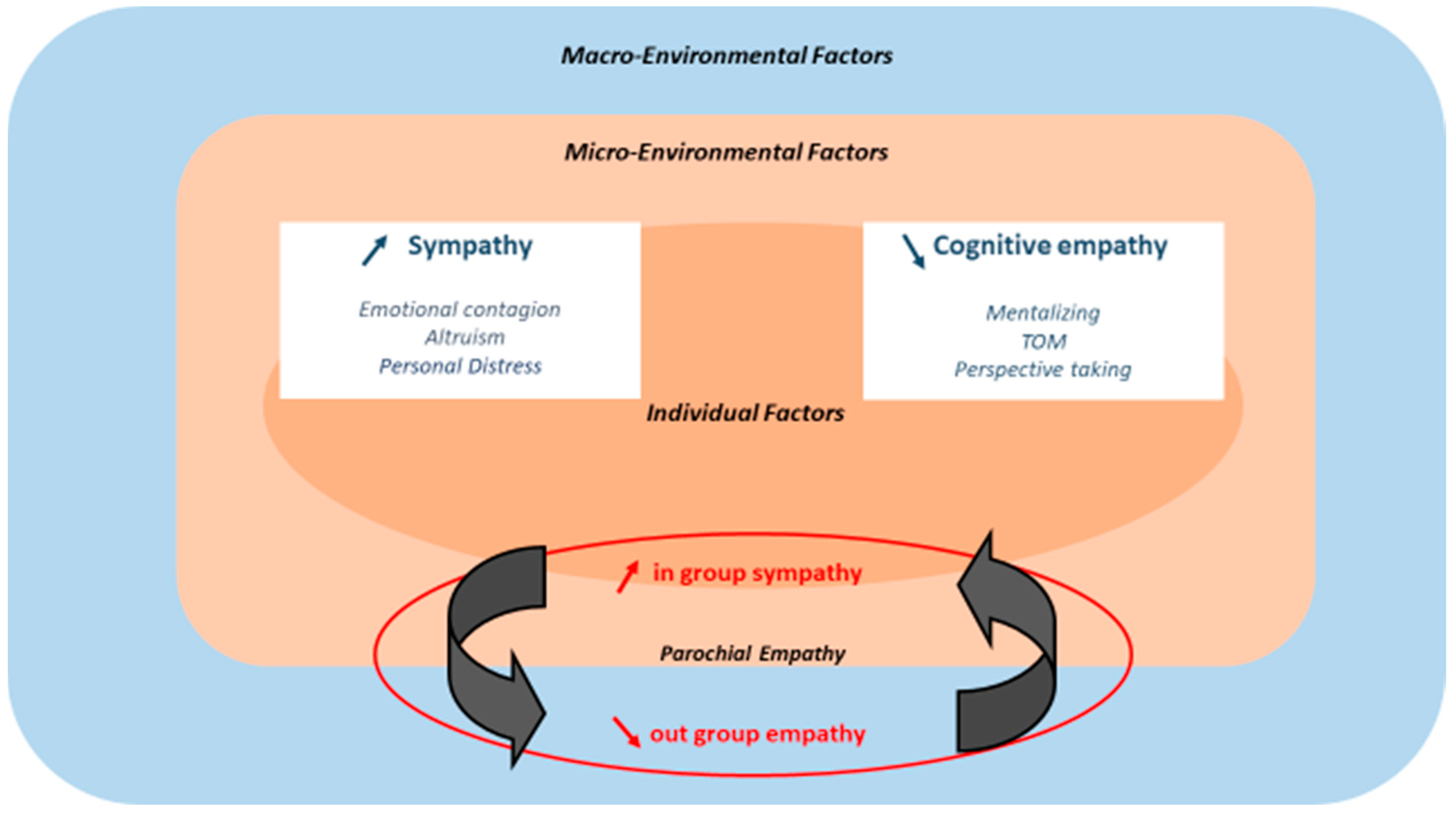
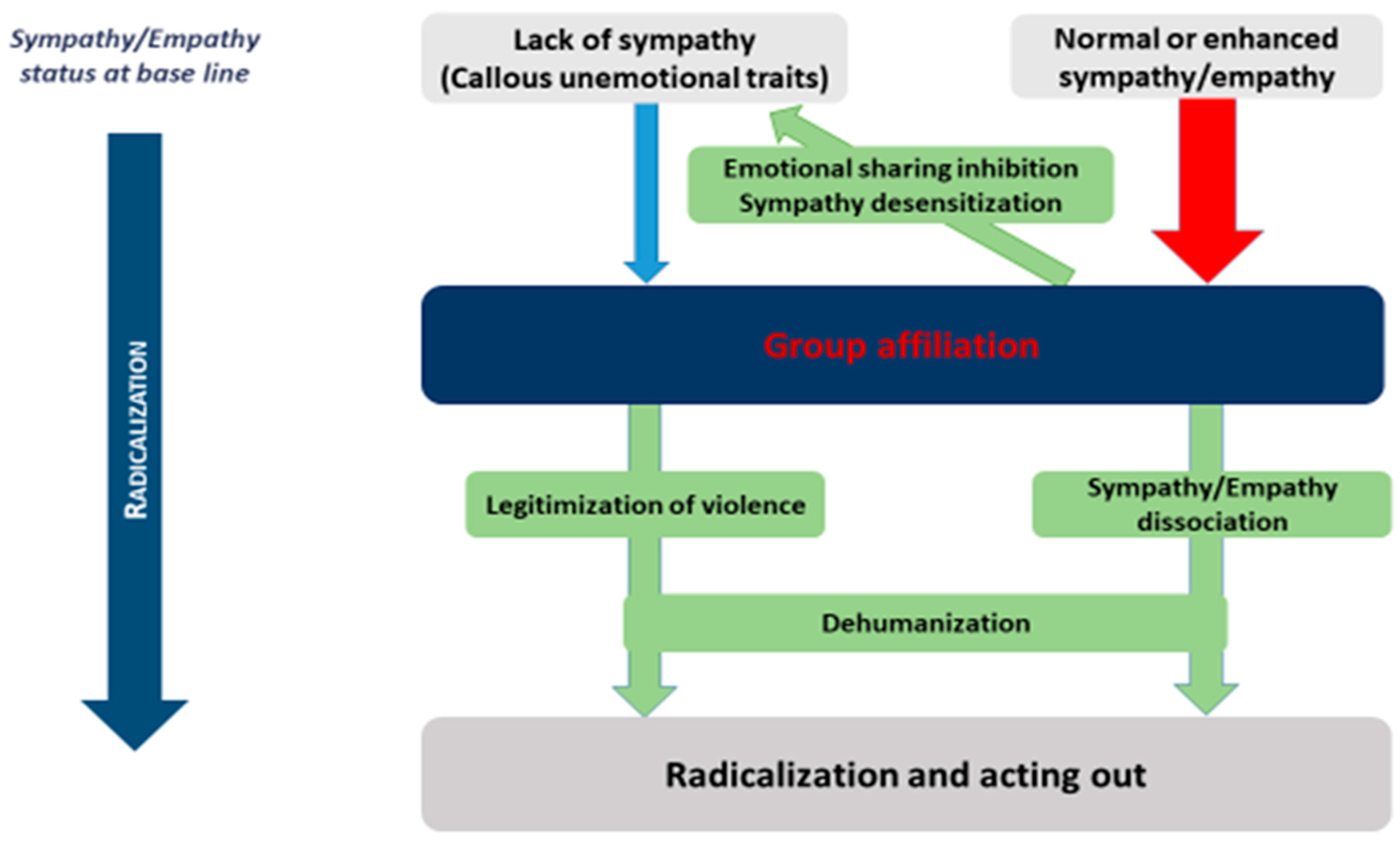
Background: The sympathy-empathy (SE) system is commonly considered a key faculty implied in prosocial behaviors, and SE deficits (also called callous-unemotional traits, CUTs) are associated with nonprosocial and even violent behaviors. Thus, the first intuitive considerations considered a lack of SE among young people who undergo radicalization. Yet, their identification with a cause, their underlying feelings of injustice and grievance, and the other ways in which they may help communities, suggest that they may actually have a lot of empathy, even an excess of it. As a consequence, the links between SE and radicalization remain to be specified. This critical review aims to discuss whether and how SE is associated with developmental trajectories that lead young people to radicalization. Method: We first recall the most recent findings about SE development, based on an interdisciplinary perspective informed by social neuroscience. Then, we review sociological and psychological studies that address radicalization. We will critically examine the intersections between SE and radicalization, including neuroscientific bases and anthropologic modulation of SE by social factors involved in radicalization. Results: This critical review indicates that the SE model should clearly distinguish between sympathy and empathy within the SE system. Using this model, we identified three possible trajectories in young radicalized individuals. In individuals with SE deficit, the legitimization of violence is enough to engage in radicalization. Concerning individuals with normal SE, we hypothesize two trajectories. First, based on SE inhibition/desensitization, individuals can temporarily join youths who lack empathy. Second, based on an SE dissociation, combining emotional sympathy increases for the in-group and cognitive empathy decreases toward the out-group. Conclusions: While confirming that a lack of empathy can favor radicalization, the counterintuitive hypothesis of a favorable SE development trajectory also needs to be considered to better specify the cognitive and affective aspects of this complex phenomenon.
Keywords: radicalization; empathy; callous unemotional traits; adolescence; violent extremism radicalization; empathy; callous unemotional traits; adolescence; violent extremism