_Bryant.png)
Framework for Evaluating LLM Performance in Undergraduate Calculus



Abstract
1. Introduction
- Curriculum Alignment: evaluate whether model reasoning follows pedagogically valid patterns.
- Failure Prediction: flag brittle responses to complex or under specified prompts.
- Retrieval Tuning: quantify how retrieval strategies affect the robustness of generated solutions.
- Training Prioritization: identify operations and concepts where models consistently struggle.
1.1. Motivation: Need for Reasoning Centered Interpretability
1.2. Calculus as a Case Study
1.3. Contributions
- 1.
- Interpretability framework for LLMs in mathematics: We introduce a domain-grounded interpretability framework that decomposes LLM-generated solutions into semantically annotated reasoning steps and evaluates sensitivity to prompt phrasing through controlled ablations.
- 2.
- Structured metrics for reasoning analysis: We define and operationalize quantitative metrics such as reasoning complexity, robustness, phrase sensitivity, and step count that enable a fine-grained evaluation of model behavior beyond correctness.
- 3.
- Empirical case study using real calculus exams: We apply the framework to a series of Calculus I–III university exams, benchmarking LLM performance against human student scores and examining the effects of knowledge augmented configurations.
- 4.
- Insights into pedagogical alignment and model limitations: Our analysis reveals common reasoning failures, sensitivity to linguistic variation, and gaps in conceptual understanding, offering guidance for responsible classroom use and instructional alignment.
- 5.
- Qualitative interpretation of reasoning behavior: We present a discussion of model behavior through reasoning flow decomposition and qualitative case studies, identifying both successful multi-step reasoning patterns and concrete failure modes, grounding the quantitative metrics in interpretable examples.
2. Related Works
2.1. Explainable AI in Education
2.2. Reasoning Chains in NLP
2.3. LLMs in Mathematics
3. Interpretability Framework and Quantitative Evaluation
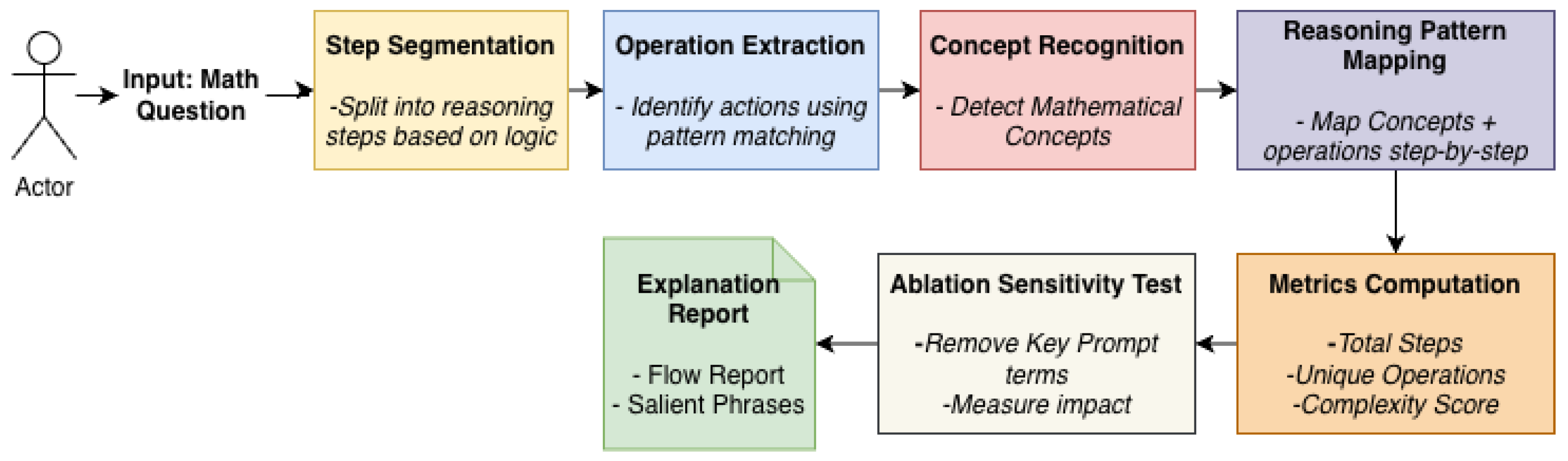
3.1. Structured Reasoning Flow Analysis
- Mathematical Operation: fundamental actions such as differentiation, substitution, simplification, or integration.
- Conceptual Tag: domain-specific concepts including the chain rule, directional derivatives, or the Fundamental Theorem of Calculus.
- Cognitive Complexity: an estimate of abstraction or difficulty level (low, medium, high) derived from symbolic depth and syntactic complexity.
3.2. Sensitivity Ablation and Input Salience
- Mathematical Operation (e.g., , , coordinate vectors);
- Instructional keywords (e.g., “find”, “compute”, “evaluate”);
- Numerical and coordinate references (e.g., );
- Linguistic features (e.g., punctuation, casing, or word order).
- TF-IDF Weighted Cosine Similarity: outputs are vectorized using TF-IDF representations, and cosine similarity is computed to assess semantic shifts in topic and terminology.
- Normalized Edit Distance (Levenshtein Distance): measures token-level changes between original and ablated responses, reflecting structural or syntactic perturbations.
- Phrase Sensitivity: the maximum divergence observed across all ablations, reflecting the most influential input token or phrase for each question.
- Robustness Score: the average semantic similarity across ablated responses, capturing the overall output stability for each question.
3.3. Quantitative Metrics and Aggregation
- Robustness measures the model’s consistency in producing correct answers across variations in input phrasing or question structure. A robust LLM maintains its performance even when questions are paraphrased or perturbed. High robustness indicates stability and reliability in real-world or noisy user settings. The standard deviation helps assess performance volatility across questions, which are then aggregated at exam-levels. Formally, robustness is defined as shown below:where is the TF-IDF vector of the original response, is the TF-IDF vector of the i-th ablated response, and n is the total number of ablations per question.
- Impact Factor identifies which parts of the input question most strongly influence the LLM’s response, which are derived from ablation or attention analysis. By pinpointing key tokens or phrases that the model relies upon, researchers can understand the model’s focus areas and whether it attends to relevant information pertaining to mathematical reasoning. This insight helps interpret how the model reasons and can highlight potential biases or errors in understanding, improving transparency at the question level.
- Complexity evaluates the difficulty of the reasoning involved, considering factors such as the number of mathematical operations, nested logic, and conceptual constructs required. This metric contextualizes the model’s performance by linking reasoning demands to output quality at the question level, which we also aggregate at the exam level to understand the complexity of the overall exam. Understanding complexity allows researchers to identify which question types challenge the model and where interpretability methods should focus to better explain intricate reasoning paths.
- Reasoning Pattern Trace captures the sequence and types of logical or mathematical operations the LLM applies during problem solving. It provides a structured map of the model’s thought process, revealing whether it uses appropriate methods such as substitution, differentiation, or evaluation at each step for each question. This trace is crucial for interpretability because it allows researchers to verify the correctness and coherence of the model’s reasoning flow, allowing debugging and refinement.
- Complexity captures the semantic and syntactic difficulty of the questions based on token length, number of operations, or concept depth. This metric contextualizes performance, and higher complexity correlates with increased cognitive load. Comparing performance across complexity levels helps diagnose whether models struggle disproportionately with harder questions. We aggregated the complexity results per question and assigned the overall exam a complexity score. Formally, the complexity score is computed as shown below:where is the number of unique mathematical operations, is the number of unique conceptual tags, and is the mean syntactic depth per reasoning step. Weights were calibrated to reflect cognitive load consistent with Bloom’s Taxonomy Apply and Analyze levels [31,32].
- Step Count represents the average number of reasoning or computational steps taken (or inferred) by the model in its answer for each question and aggregated at the exam level. Higher step counts suggest multi-hop reasoning or deeper logical chaining. This metric evaluates not only correctness but also how the model arrives at an answer that is important for interpretability and alignment with human-like problem solving. Formally, the step count per exam is shown below:where is the number of discrete reasoning steps segmented by the rule-based parser for question q, and is the number of questions in the exam.
- Phrase Sensitivity measures the extent to which minor changes in wording or phrasing impact the model’s output. Low phrase sensitivity implies semantic understanding beyond surface patterns. High phrase sensitivity indicates an over-reliance on specific phrasing or keywords, which undermines generalization. This metric is essential for gauging robustness to natural language variability for each question and then aggregated at the exam level. Formally, phrase sensitivity is defined as shown below:This captures the single most influential input element: the ablation that produced the largest semantic divergence from the original output.
4. Experimental Setup
4.1. Real World Data
4.2. Grading Rubric
- Correct substitution and integral setup: 3 points;
- Correct integration steps: 4 points;
- Correct final answer: 1 point;
- Proper notation (e.g., changing limits or including /): 1 point;
- Clarity of substitution steps and back-substitution: 1 point.
4.3. Baseline Model Selection and Prompt Engineering
4.4. Knowledge Augmented Retrieval Strategies
4.4.1. Retrieval-Augmented Generation
4.4.2. Contextual Retrieval
- Unified architecture: Contextual retrieval does not require a separate dense retriever (e.g., FAISS), simplifying the system and reducing latency.
- Instructional alignment: Since the same LLM handles both retrieval selection and answer generation, the method is more aligned with user intent, particularly in educational domains where nuanced understanding is key.
- Improved fluency and coherence: The model can better maintain consistency across answer reasoning, because it directly “sees” and “reasons” over the inserted passages in a single forward pass.
- Minimal hallucination risk: By grounding responses in the explicitly provided context, factual accuracy can improve without reliance on parametric memory.
- Lower infrastructure overhead: No need to deploy, train, or maintain separate retrieval systems or indexes.
- Baseline: zero-shot prompting without retrieval.
- RAG: retrieval-augmented generation with a vector store of textbook and lecture notes.
- Contextual Retrieval: dynamically selected semantically aligned passages as external context from textbook and lecture notes.
4.5. Implementation and Technical Environment
5. Results and Analysis
5.1. Baseline Model Selection
5.2. Baseline Comparison with Student Performance
5.3. Baseline Consistency Across Multiple Runs
5.4. RAG and Contextual Retrieval Results
6. Discussion: Interpreting Problem Solving Behavior of LLMs
6.1. Reasoning Flow Analysis Results
| LLM Attention Analysis Report: Gradient and Directional Derivative Problem | |
| Timestamp: 20250724_182112 | Model:gemma3:latest |
Question Analyzed: For ,
| |
Ablation Analysis Results:
| |
Reasoning Flow Analysis:
| |
Detailed Reasoning Steps:
|
6.2. Quantitative Evaluation of the Interpretability Framework
6.3. Qualitative Case Studies: Successful and Failed Reasoning Patterns
7. Pedagogy and Future Work
7.1. Educational Theory Linkage: Cognitive and Metacognitive Alignment
7.2. Expert Feedback on LLM Solutions
7.3. Pedagogical Implications
- Instructor scenario: Before distributing a set of LLM-generated worked examples on the chain rule, an instructor runs the framework over the candidate solution set. Questions with a complexity score above 20 are flagged as potentially too dense for students to follow; questions with a phrase sensitivity score above 0.5 are flagged as likely to produce inconsistent guidance if students rephrase them, which is a common behavior. The instructor can then review or replace flagged items before sharing them with the class.
- Tutoring system scenario: An intelligent tutoring system displays the reasoning flow graph alongside the LLM-generated answer. Students can trace the model’s step-by-step operations and identify the exact step where their own solution path diverges, supporting targeted self-correction and metacognitive reflection without requiring direct instructor intervention.
- AI literacy scenario: Students learning to critically evaluate AI outputs use the phrase sensitivity scores to observe concretely how a minor rephrasing of the same calculus problem changes the model’s response. This hands-on exercise builds awareness of LLM brittleness and reinforces responsible AI use as part of STEM education.
7.4. Limitations and Future Deployment
- Assistive, not Replacive: LLMs should augment, rather than substitute, core learning processes.
- Failure Aware: Educators must be cognizant of common LLM failure modes, including hallucinated steps, misinterpretations, and omitted justifications.
- Transparent and Interactive: Interfaces should offer traceable reasoning paths and interactive feedback mechanisms that promote active engagement and critical reflection.
8. Conclusions
Author Contributions
Funding
Institutional Review Board Statement
Informed Consent Statement
Data Availability Statement
Acknowledgments
Conflicts of Interest
References
- Sharma, S.; Mittal, P.; Kumar, M.; Bhardwaj, V. The role of large language models in personalized learning: A systematic review of educational impact. Discov. Sustain. 2025, 6, 243. [Google Scholar] [CrossRef]
- Wang, S.; Xu, T.; Li, H.; Zhang, C.; Liang, J.; Tang, J.; Yu, P.S.; Wen, Q. Large language models for education: A survey and outlook. arXiv 2024, arXiv:2403.18105. [Google Scholar] [CrossRef]
- Mirzadeh, I.; Alizadeh, K.; Shahrokhi, H.; Tuzel, O.; Bengio, S.; Farajtabar, M. Gsm-symbolic: Understanding the limitations of mathematical reasoning in large language models. arXiv 2024, arXiv:2410.05229. [Google Scholar]
- Sun, Y.; Yin, Z.; Huang, X.; Qiu, X.; Zhao, H. Error classification of large language models on math word problems: A dynamically adaptive framework. arXiv 2025, arXiv:2501.15581. [Google Scholar] [CrossRef]
- Hendrycks, D.; Burns, C.; Kadavath, S.; Arora, A.; Basart, S.; Tang, E.; Song, D.; Steinhardt, J. Measuring mathematical problem solving with the math dataset. arXiv 2021, arXiv:2103.03874. [Google Scholar] [CrossRef]
- Wei, J.; Wang, X.; Schuurmans, D.; Bosma, M.; Xia, F.; Chi, E.; Le, Q.V.; Zhou, D. Chain-of-thought prompting elicits reasoning in large language models. Adv. Neural Inf. Process. Syst. 2022, 35, 24824–24837. [Google Scholar]
- Lightman, H.; Kosaraju, V.; Burda, Y.; Edwards, H.; Baker, B.; Lee, T.; Leike, J.; Schulman, J.; Sutskever, I.; Cobbe, K. Let’s verify step by step. In Proceedings of the International Conference on Learning Representations, Vienna, Austria, 7–11 May 2024; Volume 2024, pp. 39578–39601. [Google Scholar]
- Maity, S.; Deroy, A. Human-Centric eXplainable AI in Education. arXiv 2024, arXiv:2410.19822. [Google Scholar]
- Schneider, J. Explainable Generative AI (GenXAI): A Survey, Conceptualization, and Research Agenda. arXiv 2024, arXiv:2404.09554. [Google Scholar] [CrossRef]
- Gupta, P.; Ding, B.; Guan, C.; Ding, D. Generative AI: A systematic review using topic modelling techniques. Data Inf. Manag. 2024, 8, 100066. [Google Scholar] [CrossRef]
- Rosé, C.P.; McLaughlin, E.A.; Liu, R.; Koedinger, K.R. Explanatory learner models: Why machine learning (alone) is not the answer. Br. J. Educ. Technol. 2019, 50, 2943–2958. [Google Scholar] [CrossRef]
- Chinta, S.V.; Wang, Z.; Yin, Z.; Hoang, N.; Gonzalez, M.; Quy, T.L.; Zhang, W. FairAIED: Navigating Fairness, Bias, and Ethics in Educational AI Applications. arXiv 2024, arXiv:2407.18745. [Google Scholar]
- U.S. Department of Education. Artificial Intelligence and the Future of Teaching and Learning. Available online: https://www.ed.gov/sites/ed/files/documents/ai-report/ai-report.pdf (accessed on 4 April 2026).
- Memarian, B.; Doleck, T. Fairness, Accountability, Transparency, and Ethics (FATE) in Artificial Intelligence (AI) and higher education: A systematic review. Comput. Educ. Artif. Intell. 2023, 5, 100152. [Google Scholar] [CrossRef]
- Adadi, A.; Berrada, M. Peeking Inside the Black-Box: A Survey on Explainable Artificial Intelligence (XAI). IEEE Access 2018, 6, 52138–52160. [Google Scholar] [CrossRef]
- Wang, R.; Si, S.; Yu, F.; Wiesmann, D.; Hsieh, C.J.; Dhillon, I. Large Language Models are Interpretable Learners. arXiv 2024, arXiv:2406.17224. [Google Scholar] [CrossRef]
- Clancey, W.J.; Hoffman, R.R. Methods and standards for research on explainable artificial intelligence: Lessons from intelligent tutoring systems. Appl. AI Lett. 2021, 2, e53. [Google Scholar] [CrossRef]
- Escalante, H.J.; Escalera, S.; Guyon, I.; Baró, X.; Güçlütürk, Y.; Güçlü, U.; van Gerven, M.; van Lier, R. Explainable and Interpretable Models in Computer Vision and Machine Learning; Springer: Berlin/Heidelberg, Germany, 2018. [Google Scholar]
- Linardatos, P.; Papastefanopoulos, V.; Kotsiantis, S. Explainable ai: A review of machine learning interpretability methods. Entropy 2020, 23, 18. [Google Scholar] [CrossRef]
- Chen, S.; Wang, W.; Chen, X.; Lu, P.; Yang, Z.; Du, Y. Llama-lora neural prompt engineering: A deep tuning framework for automatically generating chinese text logical reasoning thinking chains. Data Intell. 2024, 6, 375–408. [Google Scholar] [CrossRef]
- Wu, Y. Evaluating ChatGPT: Strengths and limitations in NLP problem solving. Highlights Sci. Eng. Technol. 2024, 94, 319–325. [Google Scholar] [CrossRef]
- Yu, F.; Zhang, H.; Tiwari, P.; Wang, B. Natural language reasoning, a survey. ACM Comput. Surv. 2024, 56, 1–39. [Google Scholar] [CrossRef]
- Wang, X.; Kapanipathi, P.; Musa, R.; Yu, M.; Talamadupula, K.; Abdelaziz, I.; Chang, M.; Fokoue, A.; Makni, B.; Mattei, N.; et al. Improving natural language inference using external knowledge in the science questions domain. In Proceedings of the AAAI Conference on Artificial Intelligence, Honolulu, HI, USA, 27 January–1 February 2019; Volume 33, pp. 7208–7215. [Google Scholar]
- Ishay, A.; Yang, Z.; Lee, J. Leveraging large language models to generate answer set programs. arXiv 2023, arXiv:2307.07699. [Google Scholar] [CrossRef]
- Jiang, Z.; Peng, H.; Feng, S.; Li, F.; Li, D. Llms can find mathematical reasoning mistakes by pedagogical chain-of-thought. arXiv 2024, arXiv:2405.06705. [Google Scholar]
- Yu, L.; Jiang, W.; Shi, H.; Yu, J.; Liu, Z.; Zhang, Y.; Kwok, J.T.; Li, Z.; Weller, A.; Liu, W. Metamath: Bootstrap your own mathematical questions for large language models. arXiv 2023, arXiv:2309.12284. [Google Scholar]
- Lewkowycz, A.; Andreassen, A.; Dohan, D.; Dyer, E.; Michalewski, H.; Ramasesh, V.; Slone, A.; Anil, C.; Schlag, I.; Gutman-Solo, T.; et al. Solving quantitative reasoning problems with language models. Adv. Neural Inf. Process. Syst. 2022, 35, 3843–3857. [Google Scholar]
- Liu, C.; Yang, S. Application of large language models in engineering education: A case study of system modeling and simulation courses. Int. J. Mech. Eng. Educ. 2024, 54, 03064190241272728. [Google Scholar] [CrossRef]
- Bernabei, M.; Colabianchi, S.; Falegnami, A.; Costantino, F. Students’ use of large language models in engineering education: A case study on technology acceptance, perceptions, efficacy, and detection chances. Comput. Educ. Artif. Intell. 2023, 5, 100172. [Google Scholar] [CrossRef]
- Kang, K.; Yang, Y.; Wu, Y.; Luo, R. Integrating large language models in bioinformatics education for medical students: Opportunities and challenges. Ann. Biomed. Eng. 2024, 52, 2311–2315. [Google Scholar] [CrossRef]
- Forehand, M. Bloom’s taxonomy. Emerg. Perspect. Learn. Teach. Technol. 2010, 41, 47–56. [Google Scholar]
- Plass, J.L.; Moreno, R.; Brünken, R. (Eds.) Cognitive Load Theory; Cambridge University Press: Cambridge, UK, 2010. [Google Scholar]
- Gao, Y.; Xiong, Y.; Gao, X.; Jia, K.; Pan, J.; Bi, Y.; Dai, Y.; Sun, J.; Wang, H.; Wang, H. Retrieval-augmented generation for large language models: A survey. arXiv 2023, arXiv:2312.10997. [Google Scholar]
- He, J.; Liu, G.; Zhu, B.; Zhang, H.; Zheng, H.; Wang, X. Context-Guided Dynamic Retrieval for Improving Generation Quality in RAG Models. arXiv 2025, arXiv:2504.19436. [Google Scholar] [CrossRef]
- Ibrahim, N.; Aboulela, S.; Ibrahim, A.; Kashef, R. A survey on augmenting knowledge graphs (KGs) with large language models (LLMs): Models, evaluation metrics, benchmarks, and challenges. Discov. Artif. Intell. 2024, 4, 76. [Google Scholar] [CrossRef]
- Arslan, M.; Ghanem, H.; Munawar, S.; Cruz, C. A Survey on RAG with LLMs. Procedia Comput. Sci. 2024, 246, 3781–3790. [Google Scholar] [CrossRef]
- Shuster, K.; Poff, S.; Chen, M.; Kiela, D.; Weston, J. Retrieval augmentation reduces hallucination in conversation. arXiv 2021, arXiv:2104.07567. [Google Scholar] [CrossRef]
- Upadhyay, R.; Viviani, M. Enhancing Health Information Retrieval with RAG by prioritizing topical relevance and factual accuracy. Discov. Comput. 2025, 28, 27. [Google Scholar] [CrossRef]
- Li, J.; Yuan, Y.; Zhang, Z. Enhancing llm factual accuracy with rag to counter hallucinations: A case study on domain-specific queries in private knowledge-bases. arXiv 2024, arXiv:2403.10446. [Google Scholar] [CrossRef]
- Henkel, O.; Levonian, Z.; Li, C.; Postle, M. Retrieval-augmented generation to improve math question-answering: Trade-offs between groundedness and human preference. In Proceedings of the 17th International Conference on Educational Data Mining, Atlanta, GA, USA, 14–17 July 2024; pp. 315–320. [Google Scholar]
- Wu, X. Enhancing LLMs’ Mathematical Reasoning through Retrieval-Augmented Generation in the Casting Domain. Master’s Thesis, Jönköping University, School of Engineering, Jönköping AI Lab, Jönköping, Sweden, 2025. Available online: https://urn.kb.se/resolve?urn=urn:nbn:se:hj:diva-67880 (accessed on 4 April 2026).
- Zhang, W.; Zhang, J. Hallucination mitigation for retrieval-augmented large language models: A review. Mathematics 2025, 13, 856. [Google Scholar] [CrossRef]
- Asbai, A. Mitigating Hallucination in Large Language Model Code Generation for Higher Education: An Evaluation of Retrieval Augmented Generation. Master’s Thesis, KTH Royal Institute of Technology, Stockholm, Sweden, 2024. [Google Scholar]
- Dixit, P.; Oates, T. Sbi-rag: Enhancing math word problem solving for students through schema-based instruction and retrieval-augmented generation. arXiv 2024, arXiv:2410.13293. [Google Scholar]
- Zhang, T.; Zhao, L. MMR: Math Multi-step Reasoning in Medical Dialogue Generation. In Proceedings of the 2024 5th International Symposium on Artificial Intelligence for Medicine Science, Wuhan, China, 25–27 October 2024; pp. 348–351. [Google Scholar]
- Yao, C.; Fujita, S. Adaptive control of retrieval-augmented generation for large language models through reflective tags. Electronics 2024, 13, 4643. [Google Scholar] [CrossRef]
- Xu, K.; Zhang, K.; Li, J.; Huang, W.; Wang, Y. Crp-rag: A retrieval-augmented generation framework for supporting complex logical reasoning and knowledge planning. Electronics 2024, 14, 47. [Google Scholar] [CrossRef]
- Dimitrova, M. Retrieval-Augmented Generation (RAG): Advances and Challenges. Probl. Eng. Cybern. Robot 2025, 83, 32–57. [Google Scholar] [CrossRef]
- Öztürk, E.; Mesut, A. Performance analysis of chroma, qdrant, and faiss databases. In Proceedings of the International Scientific Conference UNITECH 2024, Gabrovo, Bulgaria, 21–22 November 2024. [Google Scholar] [CrossRef]
- Nussbaum, Z.; Morris, J.X.; Duderstadt, B.; Mulyar, A. Nomic embed: Training a reproducible long context text embedder. arXiv 2024, arXiv:2402.01613. [Google Scholar]
- Integrated Intelligence. LLM Performance in Undergraduate Calculus. Available online: https://github.com/Integrated-Intelligence/LLM-Performance-in-Undergraduate-Calculus (accessed on 4 April 2026).
- Team, G.; Mesnard, T.; Hardin, C.; Dadashi, R.; Bhupatiraju, S.; Pathak, S.; Sifre, L.; Rivière, M.; Kale, M.S.; Love, J.; et al. Gemma: Open models based on gemini research and technology. arXiv 2024, arXiv:2403.08295. [Google Scholar] [CrossRef]
- Nguyen, T.; Liu, H.; Li, Y.; Cai, M.; Ojha, U.; Lee, Y.J. Yo’llava: Your personalized language and vision assistant. Adv. Neural Inf. Process. Syst. 2024, 37, 40913–40951. [Google Scholar]
- Molenaar, I.; van Boxtel, C.A.; Sleegers, P.J. Metacognitive scaffolding in an innovative learning arrangement. Instr. Sci. 2011, 39, 785–803. [Google Scholar] [CrossRef]
- Krathwohl, D.R. A revision of Bloom’s taxonomy: An overview. Theory Pract. 2002, 41, 212–218. [Google Scholar] [CrossRef] [PubMed]


| Variant | Prompt Text | Element Removed |
|---|---|---|
| Original | Find the gradient of at point | — |
| Ablation 1 | Find the gradient of | Coordinate reference |
| Ablation 2 | Find the gradient at point | Function expression |
| Ablation 3 | Compute the gradient of at point | Instructional keyword “find” |
| Ablation 4 | Find the gradient of at point | Symbolic notation |
| Metric | Interpretation |
|---|---|
| Robustness | Measures model stability to variations in question phrasing. |
| Impact Factor | Identifies tokens or critical elements most influential to the model’s output. |
| Step Count | Reflects the depth and complexity of the model’s multi-step reasoning. |
| Complexity | Quantifies the difficulty and reasoning demands of the question. |
| Reasoning Pattern Trace | Captures the model’s reasoning approach and patterns through the question. |
| Phrase Sensitivity | Measures how sensitive the model’s response is to changes in phrasing. |
| Metric | Notes |
|---|---|
| Robustness | Measures model stability to phrasing variations across all questions in an exam. |
| Complexity | Based on individual question features (e.g., steps, nested logic). |
| Step Count | Inferred from reasoning path per question, then averaged. |
| Phrase Sensitivity | Measures change in output with paraphrasing per question. |
| Criteria | Points Awarded | Description |
|---|---|---|
| Correct Method/Setup | 30% | Select appropriate approach (e.g., product rule, substitution, Taylor series, etc.). Correct identification of limits, bounds, or parameterization. |
| Execution/Computation | 40% | Accurate algebra, arithmetic, and calculus steps. Logical progression of work. Minor algebraic or sign errors receive partial credit. |
| Correct Final Answer | 10% | Correct numeric or symbolic answer with appropriate simplification. No credit if work is largely incorrect even if the final answer is correct. |
| Mathematical Notation & Units | 10% | Proper use of notation (integral signs, , etc.). Include units where appropriate. |
| Clarity/Explanation | 10% | Steps are shown clearly. Reasoning is explained when needed (e.g., why a series converges). |
| Component | Instruction |
|---|---|
| Role | You are an undergrad student taking an exam. Answer each question thoroughly, completely and show all steps. |
| Notation | Do NOT use LaTeX or math markup of any kind. Use plain, human readable math notation only (e.g., , not \frac{x^2}{4}). |
| Format | Do not include any $$, \(\), or backslashes. Write math as it would appear on paper using keyboard characters. |
| Course Exam | Gemma Score | Gemma Average (%) | Class Average (%) |
|---|---|---|---|
| Calculus I | |||
| Exam 1 | 44/70 | 62.9 | 88.8 |
| Exam 2 | 48/70 | 94.2 | 82.1 |
| Final Exam | 74/100 | 74.0 | 73.0 |
| Calculus II | |||
| Exam 1 | 49/60 | 80.0 | 89.6 |
| Exam 2 | 52/60 | 86.6 | 85.2 |
| Final Exam | 72/90 | 80.0 | 72.9 |
| Calculus III | |||
| Exam 1 | 84/100 | 84.0 | 78.0 |
| Exam 2 | 74/100 | 74.0 | 80.3 |
| Final Exam | 112/150 | 74.6 | 71.3 |
| Exam | Model Configuration | Score % |
|---|---|---|
| Calculus I Exam I | Human Student Average | 88.8 |
| Gemma (Baseline) | 62.9 | |
| Gemma + RAG | 70.0 | |
| Gemma + Contextual Retrieval | 65.7 | |
| Calculus II Exam I | Human Student Average | 89.6 |
| Gemma (Baseline) | 80.0 | |
| Gemma + RAG | 81.7 | |
| Gemma + Contextual Retrieval | 75 | |
| Calculus III Exam II | Human Student Average | 80.3 |
| Gemma (Baseline) | 74.0 | |
| Gemma + RAG | 52.0 | |
| Gemma + Contextual Retrieval | 64.0 |
| Course | Exam | Model | Robustness | Complexity | Step Count | Phrase Sensitivity |
|---|---|---|---|---|---|---|
| Calc I | Exam I | B | 0.726 | 18.7 | 6.1 | 0.488 |
| R | 0.671 | 17.9 | 5.9 | 0.503 | ||
| C | 0.752 | 19.3 | 6.4 | 0.445 | ||
| Exam II | B | 0.682 | 19.2 | 6.3 | 0.422 | |
| R | 0.608 | 17.6 | 6.0 | 0.468 | ||
| C | 0.710 | 18.9 | 6.2 | 0.399 | ||
| Exam III | B | 0.719 | 18.4 | 6.1 | 0.451 | |
| R | 0.702 | 18.9 | 6.2 | 0.465 | ||
| C | 0.731 | 19.1 | 6.3 | 0.442 | ||
| Calc II | Exam I | B | 0.681 | 18.3 | 6.1 | 0.451 |
| R | 0.706 | 18.7 | 6.4 | 0.432 | ||
| C | 0.699 | 18.9 | 6.3 | 0.428 | ||
| Exam II | B | 0.702 | 18.8 | 6.2 | 0.417 | |
| R | 0.729 | 19.2 | 6.5 | 0.430 | ||
| C | 0.709 | 19.1 | 6.4 | 0.430 | ||
| Exam III | B | 0.693 | 18.6 | 6.2 | 0.447 | |
| R | 0.723 | 19.0 | 6.3 | 0.443 | ||
| C | 0.686 | 18.8 | 6.1 | 0.442 | ||
| Calc III | Exam I | B | 0.682 | 17.18 | 5.8 | 0.459 |
| R | 0.721 | 17.51 | 5.9 | 0.471 | ||
| C | 0.736 | 17.36 | 5.9 | 0.469 | ||
| Exam II | B | 0.693 | 17.82 | 6.0 | 0.465 | |
| R | 0.732 | 17.91 | 6.1 | 0.486 | ||
| C | 0.757 | 17.79 | 6.1 | 0.494 | ||
| Exam III | B | 0.684 | 16.95 | 5.7 | 0.460 | |
| R | 0.716 | 17.22 | 5.9 | 0.476 | ||
| C | 0.692 | 17.20 | 5.9 | 0.476 |
Disclaimer/Publisher’s Note: The statements, opinions and data contained in all publications are solely those of the individual author(s) and contributor(s) and not of MDPI and/or the editor(s). MDPI and/or the editor(s) disclaim responsibility for any injury to people or property resulting from any ideas, methods, instructions or products referred to in the content. |
© 2026 by the authors. Licensee MDPI, Basel, Switzerland. This article is an open access article distributed under the terms and conditions of the Creative Commons Attribution (CC BY) license.
Share and Cite
Dakshit, S.; Sinha Roy, S. Framework for Evaluating LLM Performance in Undergraduate Calculus. Informatics 2026, 13, 82. https://doi.org/10.3390/informatics13060082
Dakshit S, Sinha Roy S. Framework for Evaluating LLM Performance in Undergraduate Calculus. Informatics. 2026; 13(6):82. https://doi.org/10.3390/informatics13060082
Chicago/Turabian StyleDakshit, Sagnik, and Sushmita Sinha Roy. 2026. "Framework for Evaluating LLM Performance in Undergraduate Calculus" Informatics 13, no. 6: 82. https://doi.org/10.3390/informatics13060082
APA StyleDakshit, S., & Sinha Roy, S. (2026). Framework for Evaluating LLM Performance in Undergraduate Calculus. Informatics, 13(6), 82. https://doi.org/10.3390/informatics13060082