


Triple A: How Analytics, AI, and Algorithms Are Improving Inventory Management in Healthcare



Abstract
1. Introduction
Conceptual Framework: The Triple A Approach
2. Background and Theoretical Context
2.1. Algorithmic Approaches in Healthcare Inventory Management
2.2. AI and Analytics in Healthcare Inventory Management
2.2.1. Impacts of AI on Healthcare Inventory Management
2.2.2. How Analytics Improves Inventory Management in Healthcare
3. Materials and Methods
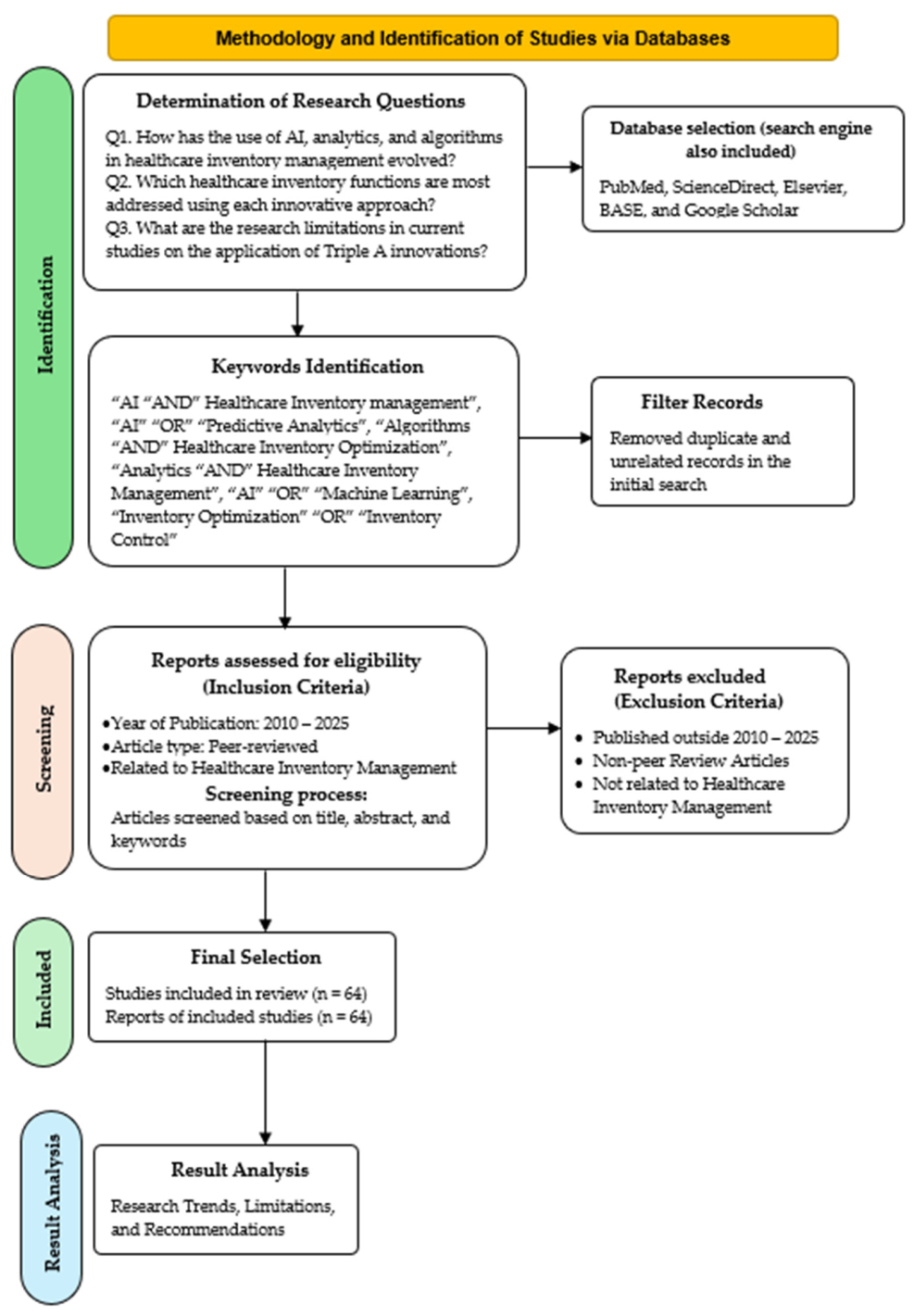
- How have Triple A approaches in healthcare inventory management evolved, and what patterns emerge when examined as an integrated system?
- Across which inventory functions and healthcare contexts are Triple A approaches most and least developed, and where do the most consequential gaps exist?
- What are the key implementation barriers to Triple A adoption, and what strategies and future directions can bridge the gap between demonstrated capability and real-world application?
3.1. Literature Sources
3.2. Keywords Identification, Inclusion, and Exclusion Criteria
3.3. Literature Selection
3.4. Synthesis Framework
4. Results and Discussion
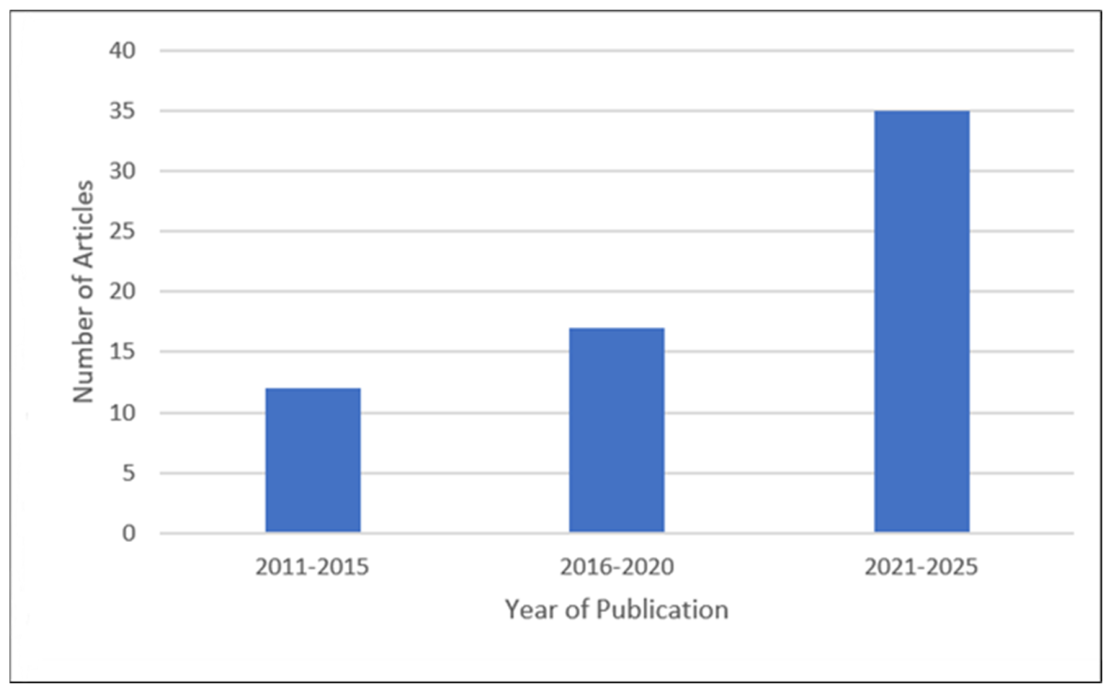
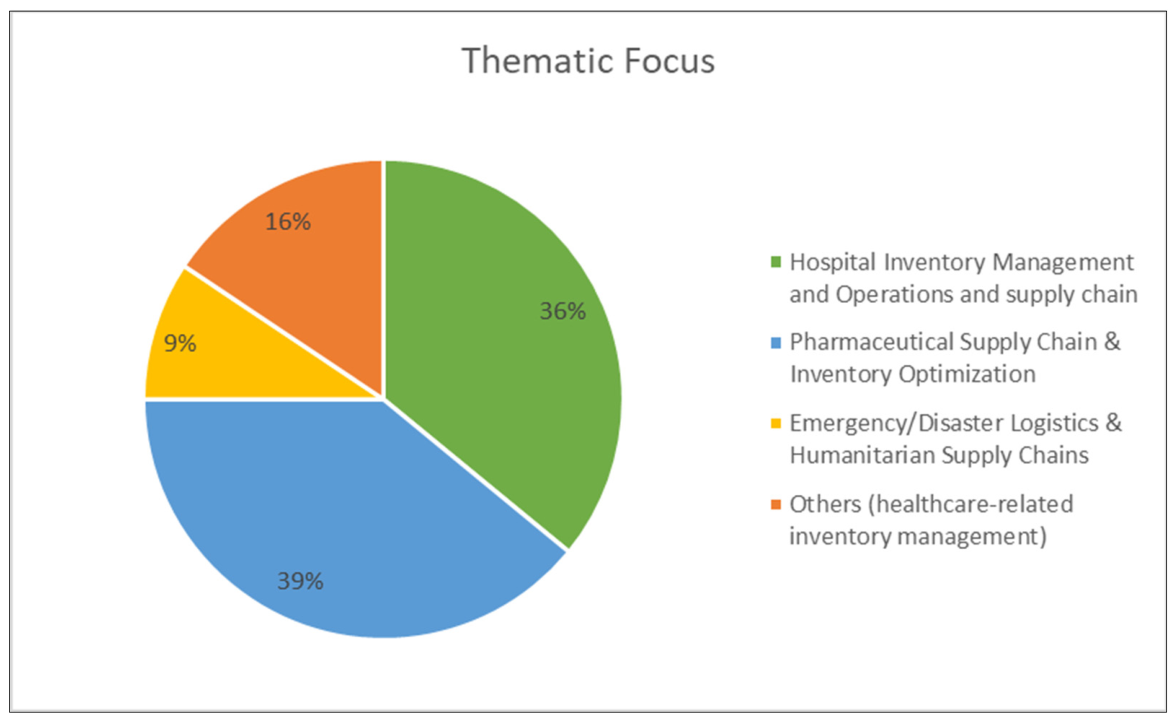
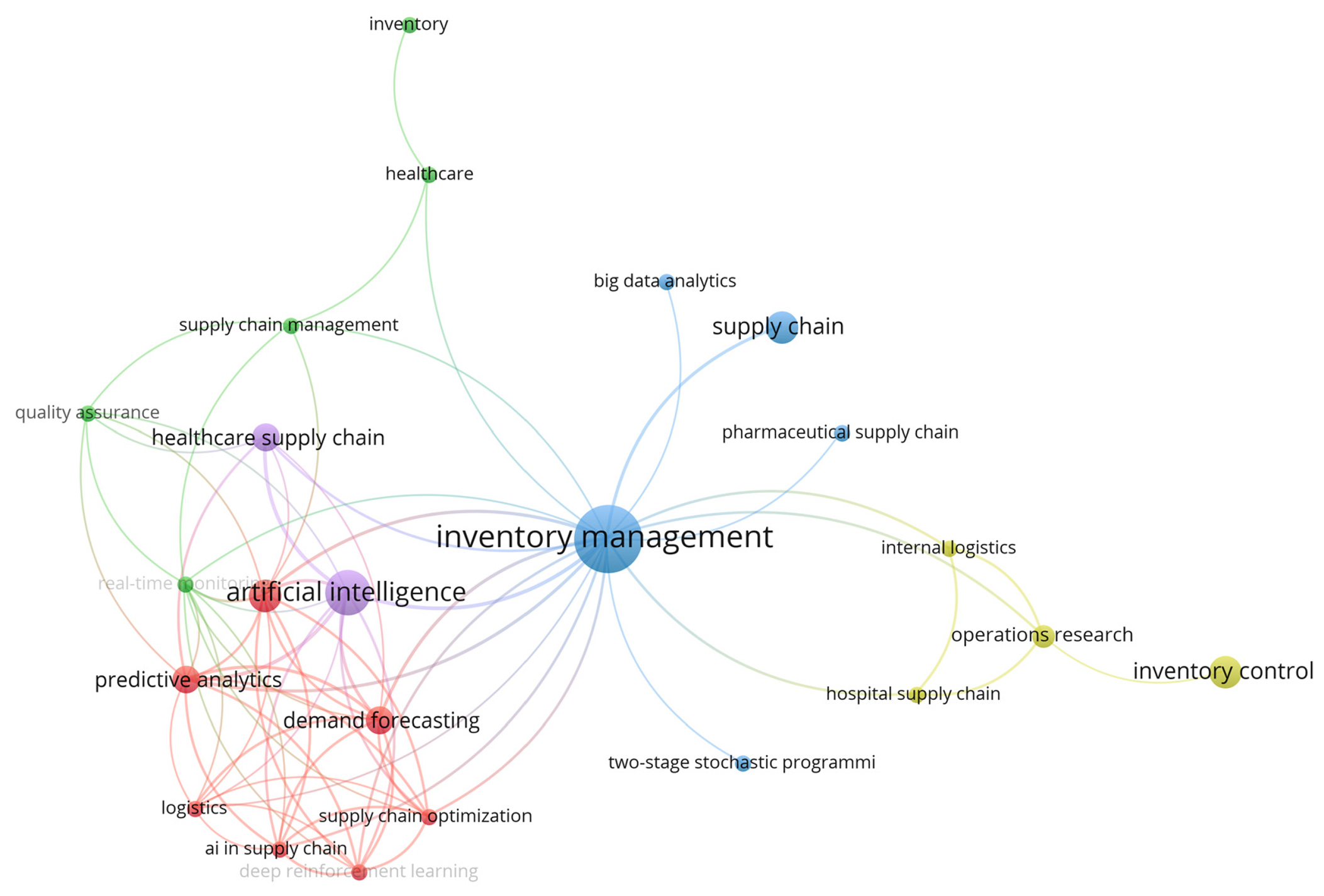
4.1. Descriptive Analysis of the Articles
4.2. Content Review
4.2.1. Healthcare Inventory Models and Strategies
Demand Forecasting

| Strategy/Model | Triple A Category | Purpose | Limitations | Healthcare Context | Inventory Function | Key References |
|---|---|---|---|---|---|---|
| Economic Order Quantity (EOQ) | Mathematical Algorithm | Minimize total ordering and holding costs by identifying optimal order quantity | Assumes constant demand, fixed lead times, and stable costs; unsuitable for perishable drugs or dynamic demand | Pharmaceutical; Hospital | Procurement | [5,7] |
| Vendor-Managed Inventory (VMI) | Algorithm/Prescriptive Analytics | Optimize inventory levels via supplier-led replenishment; reduce stockouts and sustainability impacts | Requires strong data integration, supplier collaboration, and trust | Pharmaceutical; Hospital | Procurement; Tracking & Control | [8,50] |
| Point-of-Use Strategy | Descriptive/Prescriptive Analytics | Ensure immediate availability of critical items near point of care; reduce stockouts and wastage | Dependent on accurate usage tracking; performance deteriorates with poor data quality; high implementation cost | Hospital | Tracking & Control | [1,3,32] |
| ABC-VED Analysis | Descriptive/Diagnostic Analytics | Classify inventory by monetary consumption value (ABC) and clinical criticality (VED) to prioritize replenishment | Static classification; may not capture dynamic demand patterns or newly introduced products | Hospital; Pharmaceutical | Classification | [28] |
| Just-in-Time (JIT) | Predictive/Prescriptive Analytics | Minimize waste and holding costs; enable rapid demand response through lean replenishment | Vulnerable to supply disruptions; requires reliable suppliers and accurate demand signals | Hospital; Pharmaceutical | Procurement; Tracking & Control | [2] |
| Multi-Echelon Inventory Models | Mathematical Algorithm | Optimize inventory levels and flow across multiple supply chain layers under uncertainty | High data and computational complexity; difficult to implement across diverse healthcare networks | Hospital; Pharmaceutical | Procurement; Tracking & Control | [15,16,34,51,52] |
| Stochastic Programming | Mathematical Algorithm | Model and optimize inventory decisions under uncertainty in demand, supply, and lead times | High computational complexity; challenging real-world implementation; requires probability distribution assumptions | Hospital; Pharmaceutical; Emergency | Forecasting; Procurement | [13,14,15,16,17] |
| Robust Optimization | Mathematical Algorithm | Optimize inventory decisions under worst-case uncertainty without requiring explicit distributional assumptions | Conservative solutions may reduce efficiency under stable conditions; computationally intensive | Emergency; Humanitarian | Procurement; Forecasting | [37] |
| Linear Programming (MILP/MINLP) | Mathematical Algorithm | Optimize multi-objective inventory decisions, cost, service level, sustainability, under linear or nonlinear constraints | Assumes linearity or simplified relationships; may not capture real-world complexity | Pharmaceutical; Hospital | Procurement; Forecasting | [8,9,10,41] |
| Discrete-Event Simulation | Prescriptive Analytics | Test replenishment policy performance under various demand and supply scenarios; support complex system evaluation | Requires extensive data; may not capture all variabilities; requires model validation | Hospital; Pharmaceutical | Tracking & Control; Forecasting | [27,53,54] |
| Genetic Algorithm/Metaheuristic Optimization | Algorithm | Determine near-optimal reorder quantities, order points, and rotation policies for perishable and multi-product inventory | Computationally intensive for large-scale systems; solutions may not be globally optimal | Hospital; Pharmaceutical | Tracking & Control; Procurement | [11,12,55,56] |
| Two-Stage Stochastic/Markovian Decision Models | Algorithm/Predictive Analytics | Determine optimal inventory and production policies for perishable pharmaceuticals under patient-driven demand uncertainty | Tailored to specific settings; limited generalizability across diverse healthcare contexts | Pharmaceutical; Hospital | Forecasting; Procurement | [13,14,33] |
| Deep Reinforcement Learning (DRL) | AI/Machine Learning | Automate replenishment and optimize ordering decisions under dynamic demand and variable lead times for perishable items | High computational cost; requires large high-quality datasets; risk of model degradation without regular updates | Pharmaceutical; Hospital | Forecasting; Procurement | [19,38,48,49,57] |
| Multi-Agent Reinforcement Learning (MARL) | AI/Machine Learning | Coordinate ordering decisions across multiple hospital units by capturing demand dependencies | Complex to implement; requires real-time data sharing across units; high computational demand | Hospital | Procurement; Forecasting | [19] |
| LSTM/Neural Network Forecasting | AI/Predictive Analytics | Improve demand forecast accuracy for medical supplies by capturing non-linear temporal patterns | Requires large historical datasets; computational overhead; risk of overfitting on limited data | Hospital; Pharmaceutical | Forecasting | [18,29,35] |
| Semi-Supervised/Supervised ML Classification | AI/Machine Learning | Identify, classify, and prioritize medical supplies in pharmaceutical and hospital warehouses to improve inventory accuracy | Assumes data completeness; limited performance under fragmented or inconsistent datasets | Pharmaceutical; Hospital | Classification | [20,58,59] |
| Computer Vision (Faster R-CNN/Deep Learning) | AI/Machine Learning | Automate medical item identification, counting, and stock level optimization based on consumption patterns | High implementation cost; requires adequate lighting and camera infrastructure; limited scalability to legacy systems | Pharmaceutical; Hospital | Tracking & Control; Classification | [24,25,60] |
| Big Data Analytics & Predictive Forecasting | Analytics/AI | Reduce forecasting errors for medical and emergency supplies through large-scale data processing and pattern recognition | Generalizability concerns when trained on simulation or limited real-world data; requires robust data infrastructure | Pharmaceuticals; Hospital; Emergency | Forecasting | [21,35,38,40,46] |
| IoT-Based Asset Tracking Systems | Machine Learning & IoT/Prescriptive Analytics | Enable real-time tracking, condition monitoring (temperature, humidity, expiry), and automated alerts for perishable supplies | High device cost; interoperability issues; cybersecurity risks; reliance on sensor accuracy | Hospital; Pharmaceutical | Tracking & Control | [4,61,62] |
| Blockchain-Enabled Inventory Model | Blockchain with AI/Analytics | Provide secure, transparent, and tamper-proof tracking and traceability across supply chain nodes | High implementation cost; integration challenges with existing systems; scalability limits; data governance concerns | Pharmaceutical; Hospital | Tracking & Control | [36] |
| Hybrid IoT + AI (Neural Network/CNN) | AI/Machine Learning & IoT | Combine real-time sensor data with AI models for automated inventory control, replenishment, and anomaly detection | Complex integration; high infrastructure cost; real-world validation at scale remains limited | Hospital | Tracking & Control | [62] |
| Lean Six Sigma with Analytics | Prescriptive Analytics | Identify and eliminate inventory inefficiencies through structured process improvement combined with data analysis | Requires sustained organizational commitment; primarily a process tool rather than a predictive model | Hospital | Tracking & Control; Procurement | [26,30] |
| Group Purchasing Organization (GPO) Models | Algorithm/Prescriptive Analytics | Leverage collective buying power to reduce procurement costs, standardize ordering, and streamline contracting across member institutions | Effectiveness tied to supplier relationships and organizational trust; may limit flexibility for individual providers | Hospital | Procurement | [63,64] |
| Network-Flow/Multi-Echelon Procurement Optimization | Mathematical Algorithm | Determine optimal purchasing quantities from regular and outsourced suppliers across hospitals and distribution centers to reduce cost while managing perishability | Data-intensive; assumes stable supplier relationships; limited applicability in disrupted supply environments | Hospital; Pharmaceutical | Procurement | [41,52] |
| Emergency Supply Pre-Positioning Models | Algorithm/Analytics | Optimize pre-positioning and rotation of medical supplies for disaster and emergency response under uncertain demand | Highly context-specific; demand distributions in crises are often unknowable; limited real-world validation | Emergency; Humanitarian | Procurement; Forecasting | [37,42,43,44,45] |
| AI-ERP Integration | AI/Prescriptive Analytics | Automate inventory management and leverage predictive analytics within enterprise resource planning systems to improve operational efficiency | Integration complexity with legacy ERP systems; high implementation cost; change management requirements | Hospital; Pharmaceutical | Forecasting; Procurement; Tracking & Control | [6,22,39,47] |
| Cloud-Based Analytics Platforms | Analytics/AI | Enable scalable, accessible deployment of predictive and prescriptive analytics without on-premises infrastructure investment | Data privacy and security concerns; dependence on internet connectivity; vendor lock-in risks | General Healthcare; Pharmaceutical | Forecasting; Tracking & Control | [4,31,59] |
Inventory Tracking and Control
Inventory Classification
Procurement and Purchasing
4.3. Limitations and Future Directions
Implementation Barriers and Practical Guidance for Healthcare Managers
5. Conclusions
Supplementary Materials
Author Contributions
Funding
Data Availability Statement
Conflicts of Interest
References
- De Vries, J. The Shaping of Inventory Systems in Health Services: A Stakeholder Analysis. Int. J. Prod. Econ. 2011, 133, 60–69. [Google Scholar] [CrossRef]
- Balkhi, B.; Alshahrani, A.; Khan, A. Just-in-Time Approach in Healthcare Inventory Management: Does It Really Work? Saudi Pharm. J. 2022, 30, 1830–1835. [Google Scholar] [CrossRef]
- Neve, B.V.; Schmidt, C.P. Point-of-Use Hospital Inventory Management with Inaccurate Usage Capture. Health Care Manag. Sci. 2022, 25, 126–145. [Google Scholar] [CrossRef] [PubMed]
- Al Khatib, I.; Alasheh, S.; Shamayleh, A. The Drivers of Complexity in Inventory Management Within the Healthcare Industry. Int. J. Serv. Sci. Manag. Eng. Technol. 2024, 15, 1–26. [Google Scholar] [CrossRef]
- Essila, J.C. Strategies for Reducing Healthcare Supply Chain Inventory Costs. Benchmarking Int. J. 2023, 30, 2655–2669. [Google Scholar] [CrossRef]
- Badhan, I.A.; Neeroj, M.H.; Chowdhury, I. The effect of AI-driven inventory management systems on healthcare outcomes and supply chain performance: A data-driven analysis. Frontline Mark. Manag. Econ. J. 2024, 4, 15–52. [Google Scholar] [CrossRef]
- Kelle, P.; Woosley, J.; Schneider, H. Pharmaceutical Supply Chain Specifics and Inventory Solutions for a Hospital Case. Oper. Res. Health Care 2012, 1, 54–63. [Google Scholar] [CrossRef]
- Weraikat, D.; Zanjani, M.K.; Lehoux, N. Improving Sustainability in a Two-Level Pharmaceutical Supply Chain through Vendor-Managed Inventory System. Oper. Res. Health Care 2019, 21, 44–55. [Google Scholar] [CrossRef]
- Rastegar, M.; Tavana, M.; Meraj, A.; Mina, H. An Inventory-Location Optimization Model for Equitable Influenza Vaccine Distribution in Developing Countries during the COVID-19 Pandemic. Vaccine 2021, 39, 495–504. [Google Scholar] [CrossRef]
- Uthayakumar, R.; Priyan, S. Pharmaceutical Supply Chain and Inventory Management Strategies: Optimization for a Pharmaceutical Company and a Hospital. Oper. Res. Health Care 2013, 2, 52–64. [Google Scholar] [CrossRef]
- Yadav, A.S.; Ahlawat, N.; Sharma, N.; Swami, A.; Navyata. Healthcare Systems of Inventory Control for Blood Bank Storage with Reliability Applications Using Genetic Algorithm. Adv. Math. Sci. J. 2020, 9, 5133–5142. [Google Scholar] [CrossRef]
- Forcina, A.; Petrillo, A.; Di Bona, G.; De Felice, F.; Silvestri, A. An Innovative Model to Optimise Inventory Management: A Case Study in Healthcare Sector. Int. J. Serv. Oper. Manag. 2017, 27, 549–568. [Google Scholar] [CrossRef]
- Li, J.; Liu, L.; Hu, H.; Zhao, Q.; Guo, L. An Inventory Model for Deteriorating Drugs with Stochastic Lead Time. Int. J. Environ. Res. Public Health 2018, 15, 2772. [Google Scholar] [CrossRef]
- Nikzad, E.; Bashiri, M.; Oliveira, F. Two-Stage Stochastic Programming Approach for the Medical Drug Inventory Routing Problem under Uncertainty. Comput. Ind. Eng. 2019, 128, 358–370. [Google Scholar] [CrossRef]
- Dillon, M.; Oliveira, F.; Abbasi, B. A Two-Stage Stochastic Programming Model for Inventory Management in the Blood Supply Chain. Int. J. Prod. Econ. 2017, 187, 27–41. [Google Scholar] [CrossRef]
- Pathy, S.R.; Rahimian, H. A Resilient Inventory Management of Pharmaceutical Supply Chains under Demand Disruption. Comput. Ind. Eng. 2023, 180, 109243. [Google Scholar] [CrossRef]
- Roshan, M.; Tavakkoli-Moghaddam, R.; Rahimi, Y. A Two-Stage Approach to Agile Pharmaceutical Supply Chain Management with Product Substitutability in Crises. Comput. Chem. Eng. 2019, 127, 200–217. [Google Scholar] [CrossRef]
- Kalusivalingam, K.; Sharma, A.; Patel, N.; Singh, V. Optimizing Inventory Management with AI: Leveraging Deep Reinforcement Learning and Neural Networks for Enhanced Demand Forecasting and Stock Replenishment. Int. J. AI ML 2020, 1. Available online: https://cognitivecomputingjournal.com/index.php/IJAIML-V1/article/view/43 (accessed on 28 January 2026).
- Saha, E.; Rathore, P. A Smart Inventory Management System with Medication Demand Dependencies in a Hospital Supply Chain: A Multi-Agent Reinforcement Learning Approach. Comput. Ind. Eng. 2024, 191, 110165. [Google Scholar] [CrossRef]
- Pan, Q.; Liu, Y.; Wei, S. A Semi-Supervised Learning Approach to Classify Drug Attributes in a Pharmacy Management Database: A STROBE-Compliant Study. Medicine 2025, 104, e41601. [Google Scholar] [CrossRef]
- Sabahat Khan, F.; Al Masum, A.; Adam, J.; Rashidul Karim, M.; Afrin, S.; Author, C. AI in Healthcare Supply Chain Management: Enhancing Efficiency and Reducing Costs with Predictive Analytics. J. Comput. Sci. Technol. Stud. 2024, 6, 85–93. Available online: https://al-kindipublishers.org/index.php/jcsts/article/view/8265 (accessed on 14 March 2026). [CrossRef]
- Kotha, K.R.; Tokachichu, S.C.; Padakanti, S. Synergizing Ai and ERP for Predictive Supply Chain Management and Quality Assurance in Healthcare. Int. J. Multidiscip. Res. 2024, 1–12. Available online: https://www.ijfmr.com/papers/2024/5/29762.pdf (accessed on 14 March 2026).
- Kalusivalingam, K.; Sharma, A.; Patel, N.; Singh, V. Enhancing Supply Chain Resilience through AI: Leveraging Deep Reinforcement Learning and Predictive Analytics. Int. J. AI ML 2022, 3. Available online: https://www.cognitivecomputingjournal.com/index.php/IJAIML-V1/article/view/68 (accessed on 28 January 2026).
- Riaz, W.; Ullah, A.; Ji, J. Multi-Scale Attention Networks with Feature Refinement for Medical Item Classification in Intelligent Healthcare Systems. Sensors 2025, 25, 5305. [Google Scholar] [CrossRef]
- Tavakoli, M.J.; Fazl, F.; Sedighi, M.; Naseri, K.; Ghavami, M.; Taghipour-Gorjikolaie, M. Enhancing Pharmacy Warehouse Management with Faster R-CNN for Accurate and Reliable Pharmaceutical Product Identification and Counting. Int. J. Intell. Syst. 2025, 2025, 8883735. [Google Scholar] [CrossRef]
- Knowles, M.; Gay, S.S.; Konchan, S.K.; Mendes, R.; Rath, S.; Deshpande, V.; Farber, M.A.; Wood, B.C. Data Analysis of Vascular Surgery Instrument Trays Yielded Large Cost and Efficiency Savings. J. Vasc. Surg. 2021, 73, 2144–2153. [Google Scholar] [CrossRef] [PubMed]
- Saha, E.; Ray, P.K. Modelling and Analysis of Healthcare Inventory Management Systems. Opsearch 2019, 56, 1179–1198. [Google Scholar] [CrossRef]
- Kumar, S.; Chakravarty, A. ABC-VED Analysis of Expendable Medical Stores at a Tertiary Care Hospital. Med. J. Armed Forces India 2015, 71, 24–27. [Google Scholar] [CrossRef]
- Merkuryeva, G.; Valberga, A.; Smirnov, A. Demand Forecasting in Pharmaceutical Supply Chains: A Case Study. Procedia Comput. Sci. 2019, 149, 3–10. [Google Scholar] [CrossRef]
- O’Mahony, L.; McCarthy, K.; O’Donoghue, J.; Teeling, S.P.; Ward, M.; McNamara, M. Using Lean Six Sigma to Redesign the Supply Chain to the Operating Room Department of a Private Hospital to Reduce Associated Costs and Release Nursing Time to Care. Int. J. Environ. Res. Public Health 2021, 18, 11011. [Google Scholar] [CrossRef] [PubMed]
- Albayrak Ünal, Ö.; Erkayman, B.; Usanmaz, B. Applications of Artificial Intelligence in Inventory Management: A Systematic Review of the Literature. Arch. Comput. Methods Eng. 2023, 30, 2605–2625. [Google Scholar] [CrossRef]
- Bijvank, M.; Vis, I.F.A. Inventory Control for Point-of-Use Locations in Hospitals. J. Oper. Res. Soc. 2012, 63, 497–510. [Google Scholar] [CrossRef]
- Vila-Parrish, A.R.; Ivy, J.S.; King, R.E.; Abel, S.R. Patient-Based Pharmaceutical Inventory Management: A Two-Stage Inventory and Production Model for Perishable Products with Markovian Demand. Health Syst. 2012, 1, 69–83. [Google Scholar] [CrossRef]
- Saedi, S.; Erhun Kundakcioglu, O.; Henry, A.C. Mitigating the Impact of Drug Shortages for a Healthcare Facility: An Inventory Management Approach. Eur. J. Oper. Res. 2016, 251, 107–123. [Google Scholar] [CrossRef]
- Liu, L.; Zhu, G.; Zhao, X. Application of Medical Supply Inventory Model Based on Deep Learning and Big Data. Int. J. Syst. Assur. Eng. Manag. 2022, 13, 1216–1227. [Google Scholar] [CrossRef]
- Gao, Y.; Gao, H.; Xiao, H.; Yao, F. Vaccine Supply Chain Coordination Using Blockchain and Artificial Intelligence Technologies. Comput. Ind. Eng. 2023, 175, 108885. [Google Scholar] [CrossRef] [PubMed]
- Che, A.; Li, J.; Chu, F.; Chu, C. Optimizing Emergency Supply Pre-Positioning for Disaster Relief: A Two-Stage Distributionally Robust Approach. Comput. Oper. Res. 2024, 166, 106607. [Google Scholar] [CrossRef]
- Kaur, A.; Prakash, G. Intelligent Inventory Management: AI-Driven Solution for the Pharmaceutical Supply Chain. Soc. Impacts 2025, 5, 100109. [Google Scholar] [CrossRef]
- Long, P.; Lu, L.; Chen, Q.; Chen, Y.; Li, C.; Luo, X. Intelligent Selection of Healthcare Supply Chain Mode—An Applied Research Based on Artificial Intelligence. Front. Public Health 2023, 11, 1310016. [Google Scholar] [CrossRef]
- Paramasivan, A. Transforming Healthcare Supply Chains: AI for Efficient Drug Distribution and Inventory Management. IJSAT-Int. J. Sci. Technol. 2023, 1–15. Available online: https://www.ijsat.org/papers/2023/3/1236.pdf (accessed on 14 March 2026).
- Perez, H.D.; Hubbs, C.D.; Li, C.; Grossmann, I.E. Algorithmic Approaches to Inventory Management Optimization. Processes 2021, 9, 102. [Google Scholar] [CrossRef]
- Zhou, Q.S.; Olsen, T.L. Inventory Rotation of Medical Supplies for Emergency Response. Eur. J. Oper. Res. 2017, 257, 810–821. [Google Scholar] [CrossRef]
- Zhao, Y.; Ni, J.; Li, Z. Optimizing Call Option Purchasing for Perishable Emergency Supplies through Rotation Strategies: A Stackelberg Game Approach. Optim. Eng. 2025, 26, 2121–2144. [Google Scholar] [CrossRef]
- He, L.; Cuevas, J.L.T.; Kokash, M.Z.; Banimustafa, E.A.; Khasawneh, M.T. Optimization in Pharmaceutical Supply Chain Inventory Management for Disaster Planning. In IISE Annual Conference; Institute of Industrial and Systems Engineers (IISE): Norcross, GA, USA, 2017; pp. 1583–1588. [Google Scholar]
- Chen, D.; Wanbon, R. Disaster Preparedness: Hospital Pharmacy Strategy for Prioritized Inventory Management and Drug Procurement on Vancouver Island. Disaster Med. Public Health Prep. 2023, 17, e235. [Google Scholar] [CrossRef]
- Wang, Y.; Kung, L.A.; Byrd, T.A. Big Data Analytics: Understanding Its Capabilities and Potential Benefits for Healthcare Organizations. Technol. Forecast. Soc. Change 2018, 126, 3–13. [Google Scholar] [CrossRef]
- Naveena, M.; Ellaturu, N.; Kumari, T.L.; Bambuwala, S.; Rajalakshmi, M. Ai-Driven Solutions for Supply Chain Management. J. Inform. Educ. Res. 2024, 4, 861–868. [Google Scholar] [CrossRef]
- Zwaida, T.A.; Pham, C.; Beauregard, Y. Optimization of Inventory Management to Prevent Drug Shortages in the Hospital Supply Chain. Appl. Sci. 2021, 11, 2726. [Google Scholar] [CrossRef]
- Abbasi, N.; Nizamullah, F.N. AI in Healthcare: Using Cutting-Edge Technologies to Revolutionize Vaccine Development and Distribution. JURIHUM J. Inov. Dan Hum. 2023, 1, 17–29. Available online: https://www.researchgate.net/profile/Nasrullah-Abbasi/publication/383918499_AI_IN_HEALTHCARE_USING_CUTTING-EDGE_TECHNOLOGIES_TO_REVOLUTIONIZE_VACCINE_DEVELOPMENT_AND_DISTRIBUTION/links/66e1126d64f7bf7b19a5d600/AI-IN-HEALTHCARE-USING-CUTTING-EDGE-TECHNOLOGIES-TO-REVOLUTIONIZE-VACCINE-DEVELOPMENT-AND-DISTRIBUTION.pdf (accessed on 14 March 2026).
- Adirektawon, S.; Theeraroungchaisri, A.; Sakulbumrungsil, R.C. Efficiency of Inventory in Thai Hospitals: Comparing Traditional and Vendor-Managed Inventory Systems. Logistics 2024, 8, 89. [Google Scholar] [CrossRef]
- Stecca, G.; Baffo, I.; Kaihara, T. Design and Operation of Strategic Inventory Control System for Drug Delivery in Healthcare Industry. IFAC-PapersOnLine 2016, 49, 904–909. [Google Scholar] [CrossRef]
- Perlman, Y.; Levner, I. Perishable Inventory Management in Healthcare. J. Serv. Sci. Manag. 2014, 7, 11–17. [Google Scholar] [CrossRef]
- Nallusamy, S.; Paul, C.M.P.; Dolia, P.B. Development of Inventory Model for Health Care System in Multi-Speciality Hospitals Using Arena. Indian J. Public Health Res. Dev. 2018, 9, 276–282. [Google Scholar] [CrossRef]
- Buschiazzo, M.; Mula, J.; Campuzano-Bolarin, F. Simulation Optimization for the Inventory Management of Healthcare Supplies. Int. J. Simul. Model. 2020, 19, 255–266. [Google Scholar] [CrossRef]
- Saracoglu, I.; Topaloglu, S.; Keskinturk, T. A Genetic Algorithm Approach for Multi-Product Multi-Period Continuous Review Inventory Models. Expert Syst. Appl. 2014, 41, 8189–8202. [Google Scholar] [CrossRef]
- Sinha, A.K.; Zhang, W.J.; Tiwari, M.K. Co-Evolutionary Immuno-Particle Swarm Optimization with Penetrated Hyper-Mutation for Distributed Inventory Replenishment. Eng. Appl. Artif. Intell. 2012, 25, 1628–1643. [Google Scholar] [CrossRef]
- Ahmadi, E.; Mosadegh, H.; Maihami, R.; Ghalehkhondabi, I.; Sun, M.; Süer, G.A. Intelligent Inventory Management Approaches for Perishable Pharmaceutical Products in a Healthcare Supply Chain. Comput. Oper. Res. 2022, 147, 105968. [Google Scholar] [CrossRef]
- Durmuş, A.; Aydin, Ö.; Dalkiliç, F. Optimizing Healthcare Inventory Management Using Machine Learning for Efficient Classification of Medical Supplies. Opsearch 2025, 4, 1–19. [Google Scholar] [CrossRef]
- Maathavan, K.S.K.; Venkatraman, S. A Secure Encrypted Classified Electronic Healthcare Data for Public Cloud Environment. Intell. Autom. Soft Comput. 2022, 32, 765–779. [Google Scholar] [CrossRef]
- Allahham, M.; Sharabati, A.A.A.; Hatamlah, H.; Ahmad, A.Y.B.; Sabra, S.; Daoud, M.K. Big Data Analytics and AI for Green Supply Chain Integration and Sustainability in Hospitals. WSEAS Trans. Environ. Dev. 2023, 19, 1218–1230. [Google Scholar] [CrossRef]
- Lee, C.K.M.; Na, C.M.; Kit, N.C. IoT-Based Asset Management System for Healthcare-Related Industries. Int. J. Eng. Bus. Manag. 2015, 7, 1–9. [Google Scholar] [CrossRef]
- Zonayed, M.; Tasnim, R.; Jhara, S.S.; Mimona, M.A.; Hussein, M.R.; Mobarak, M.H.; Salma, U. Machine Learning and IoT in Healthcare: Recent Advancements, Challenges & Future Direction. Adv. Biomark. Sci. Technol. 2025, 7, 335–364. [Google Scholar] [CrossRef]
- Hu, Q.; Schwarz, L.B.; Uhan, N.A. The Impact of Group Purchasing Organizations on Healthcare-Product Supply Chains. Manuf. Serv. Oper. Manag. 2012, 14, 7–23. [Google Scholar] [CrossRef]
- Rego, N.; Claro, J.; Pinho de Sousa, J. A Hybrid Approach for Integrated Healthcare Cooperative Purchasing and Supply Chain Configuration. Health Care Manag. Sci. 2014, 17, 303–320. [Google Scholar] [CrossRef] [PubMed]
| Category | Definition | Examples in Healthcare Inventory | Distinguishing Features |
|---|---|---|---|
| Algorithms | Step-by-step computational procedures with deterministic or stochastic logic applied to optimize inventory decisions | EOQ, MILP, genetic algorithms, stochastic programming, robust optimization | Rule-based; operate under defined constraints; typically, do not adapt based on new data without explicit re-optimization |
| Artificial Intelligence (AI) | Computational systems that learn patterns from data to make predictions, classifications, or autonomous decisions | Deep reinforcement learning, LSTM, Faster R-CNN, random forest, multi-agent RL | Data-driven; adaptive; capable of handling non-linear, high-dimensional inputs |
| Analytics | Systematic examination of data to extract insights, forecast outcomes, or support decisions across descriptive, predictive, and prescriptive levels | ABC-VED analysis, demand forecasting, regression, simulation, Lean Six Sigma, RFID-enabled real-time tracking | Insight-oriented; spans descriptive to prescriptive; often combined with algorithmic or AI methods |
| Triple A Integration | Deployment of two or more Triple A components within a unified inventory management function | IoT + neural network for tracking; stochastic programming + simulation for blood management; RL + predictive analytics for replenishment | Hybrid approaches often outperform single-method solutions; integration is the source of resilience |
| Color Code * | Clusters | Keywords | Count |
|---|---|---|---|
 | 1 | Demand forecasting, predictive analytics, machine learning, logistics, AI in supply chain, deep reinforcement learning, supply chain optimization | 7 |
 | 2 | Inventory management, supply chain, big data analytics, pharmaceutical supply chain, two-stage stochastic programming | 5 |
 | 3 | Healthcare, inventory, quality assurance, real-time monitoring, supply chain management | 5 |
 | 4 | Hospital supply chain, internal logistics, inventory control, operations research | 4 |
 | 5 | Artificial intelligence, healthcare supply chain | 2 |
Disclaimer/Publisher’s Note: The statements, opinions and data contained in all publications are solely those of the individual author(s) and contributor(s) and not of MDPI and/or the editor(s). MDPI and/or the editor(s) disclaim responsibility for any injury to people or property resulting from any ideas, methods, instructions or products referred to in the content. |
© 2026 by the authors. Licensee MDPI, Basel, Switzerland. This article is an open access article distributed under the terms and conditions of the Creative Commons Attribution (CC BY) license.
Share and Cite
Johnson, L.L.; Ebakivie, O. Triple A: How Analytics, AI, and Algorithms Are Improving Inventory Management in Healthcare. Logistics 2026, 10, 103. https://doi.org/10.3390/logistics10050103
Johnson LL, Ebakivie O. Triple A: How Analytics, AI, and Algorithms Are Improving Inventory Management in Healthcare. Logistics. 2026; 10(5):103. https://doi.org/10.3390/logistics10050103
Chicago/Turabian StyleJohnson, Laquanda Leaven, and Oghenetejiri Ebakivie. 2026. "Triple A: How Analytics, AI, and Algorithms Are Improving Inventory Management in Healthcare" Logistics 10, no. 5: 103. https://doi.org/10.3390/logistics10050103
APA StyleJohnson, L. L., & Ebakivie, O. (2026). Triple A: How Analytics, AI, and Algorithms Are Improving Inventory Management in Healthcare. Logistics, 10(5), 103. https://doi.org/10.3390/logistics10050103

