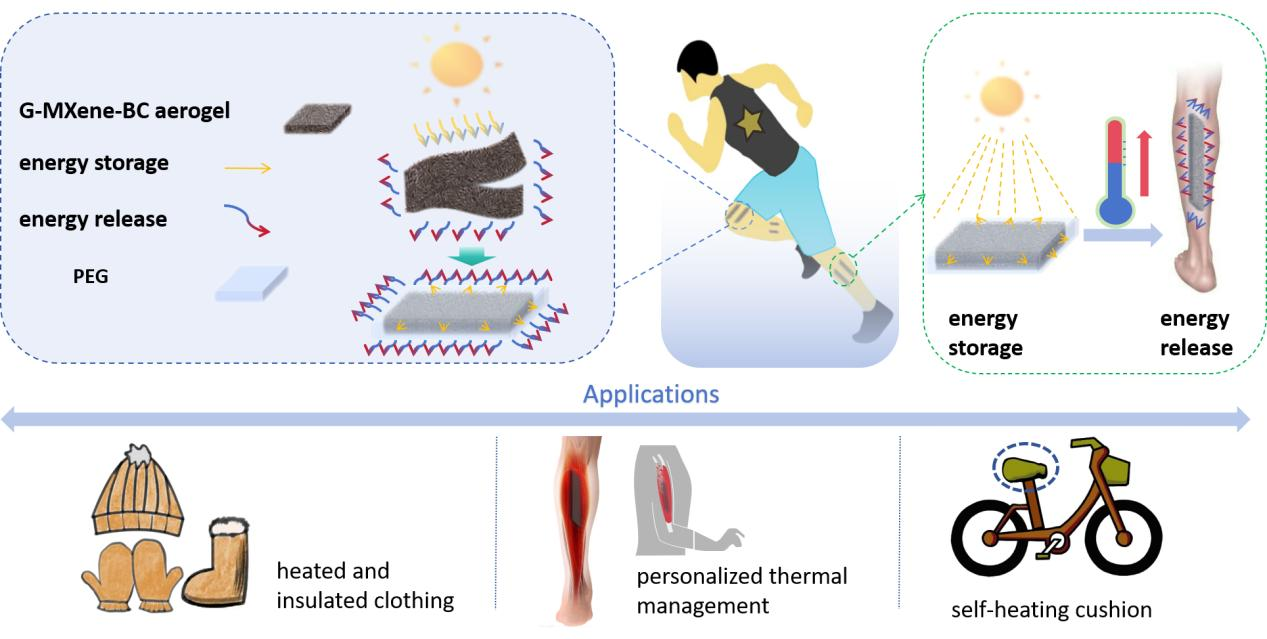

Preparation and Evaluation of MXene/Graphene-Integrated Cellulose Aerogel Composite for Self-Heating Thermoregulation in Athletic Warm-Up Optimization
 , and
, and
Abstract
1. Introduction
2. Results and Discussion
2.1. Analysis of G-M-BC/PEG Composite Aerogels
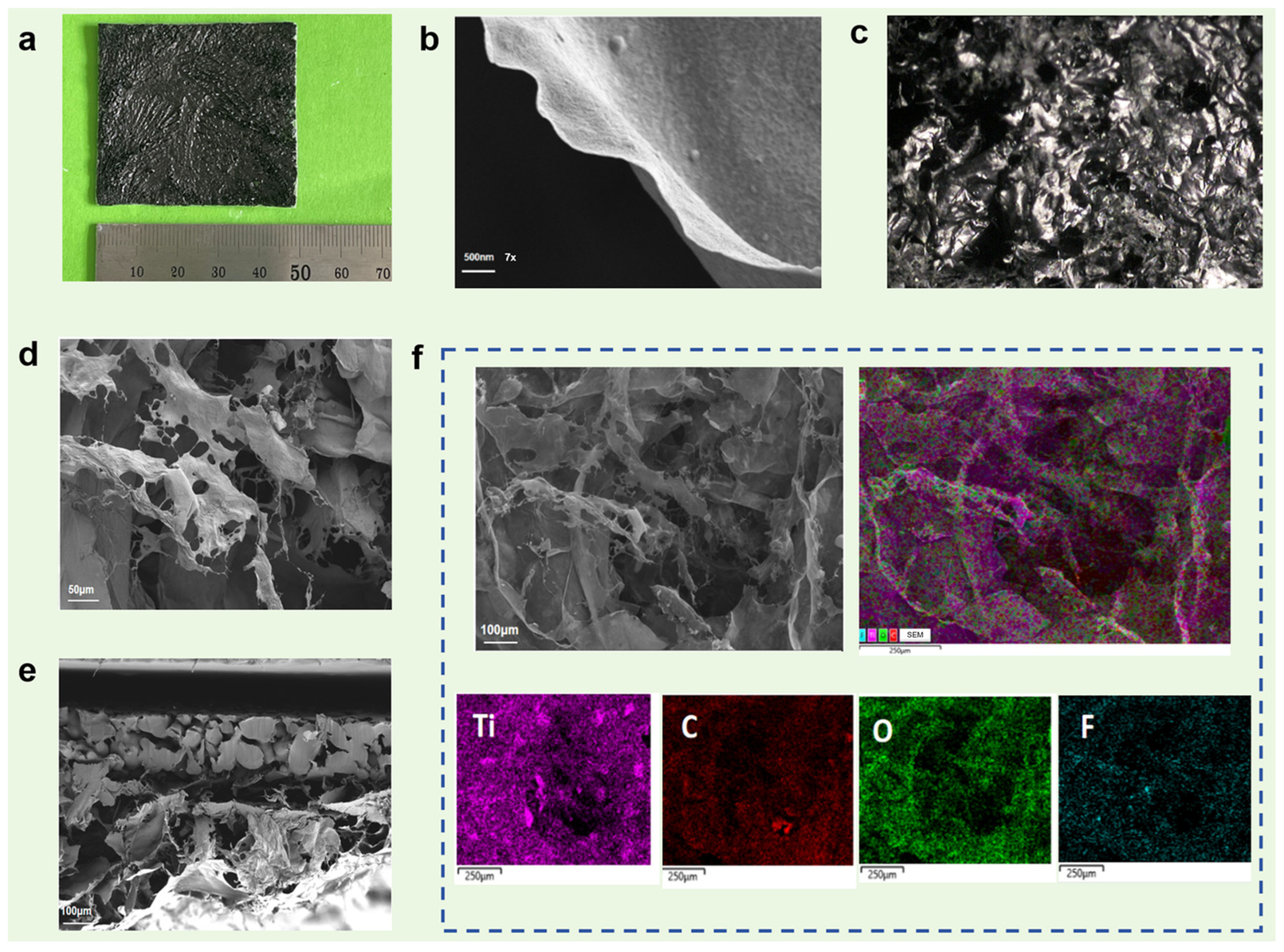
2.1.1. Microstructures
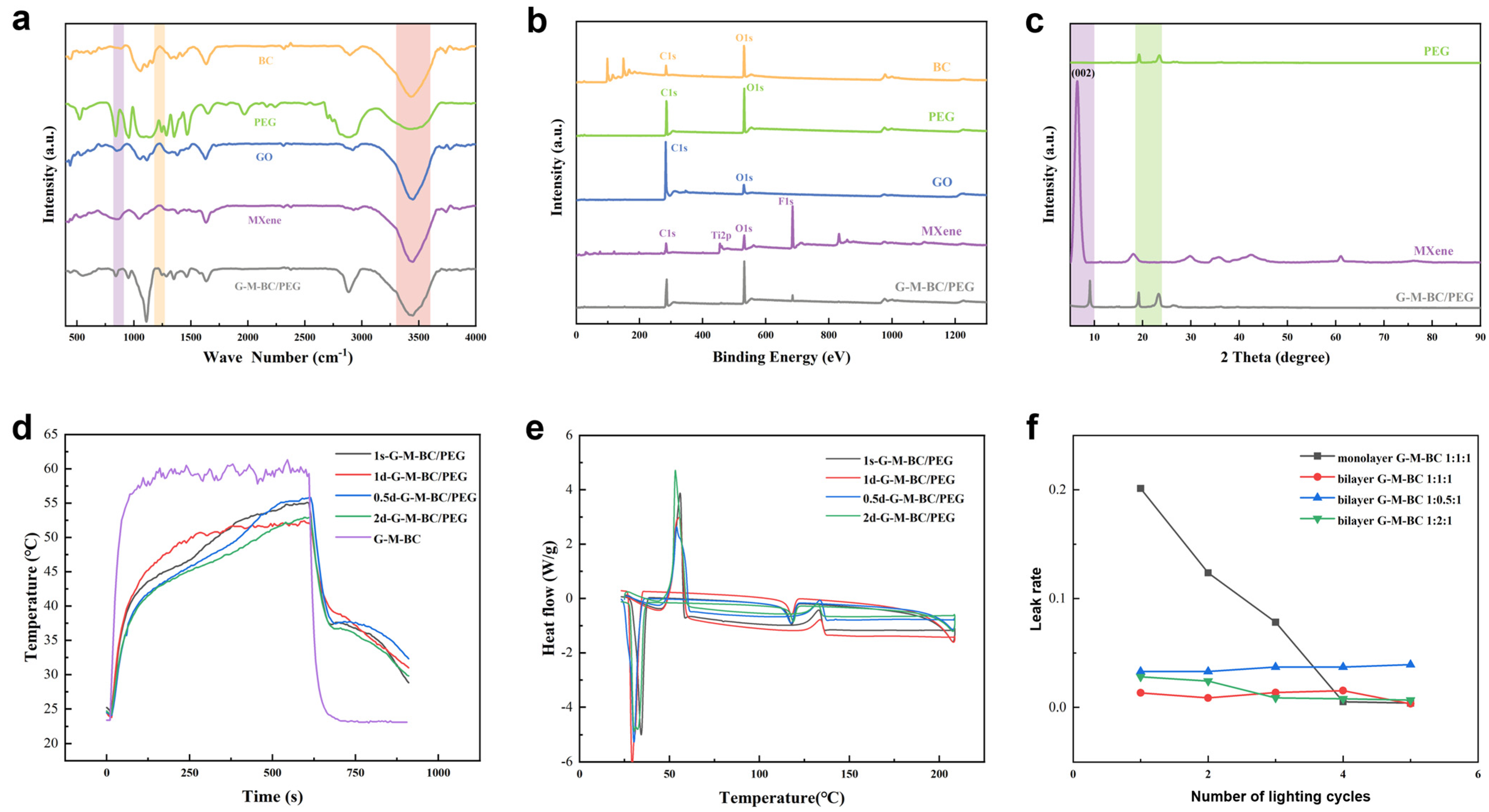
2.1.2. Characterization Properties
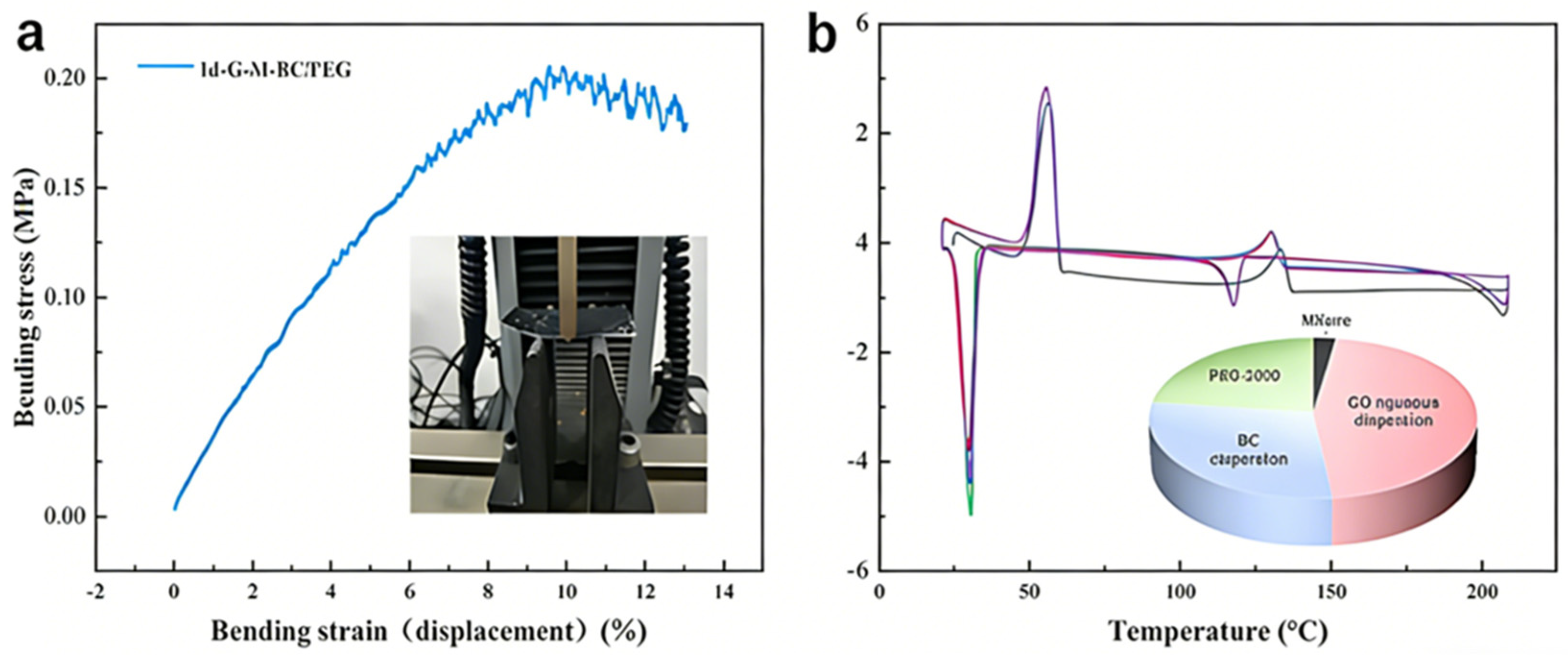
2.1.3. Mechanical Properties
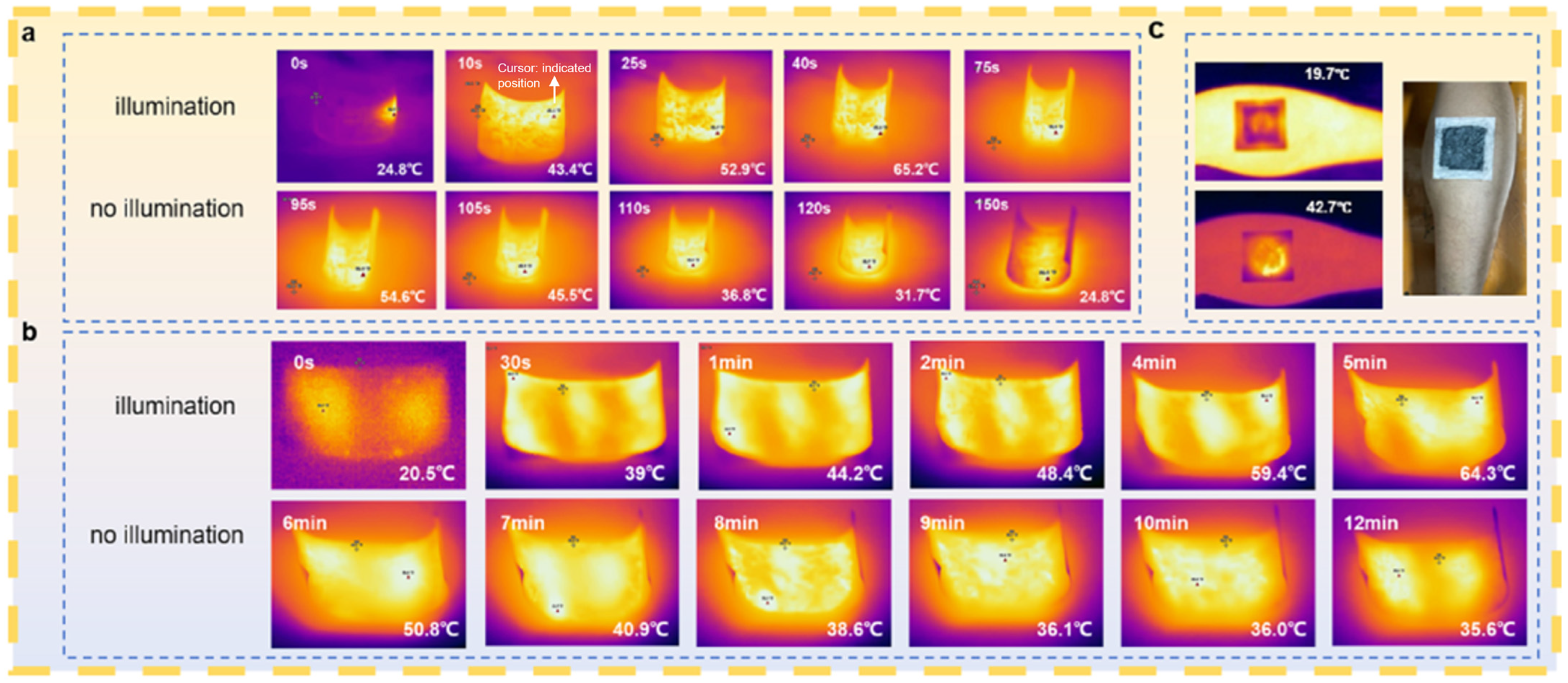
2.2. Solar Thermal Effect of Aerogels
2.3. Analysis of Warm-Up Effectiveness and Sports Performance Indicators
2.3.1. Thermoregulation
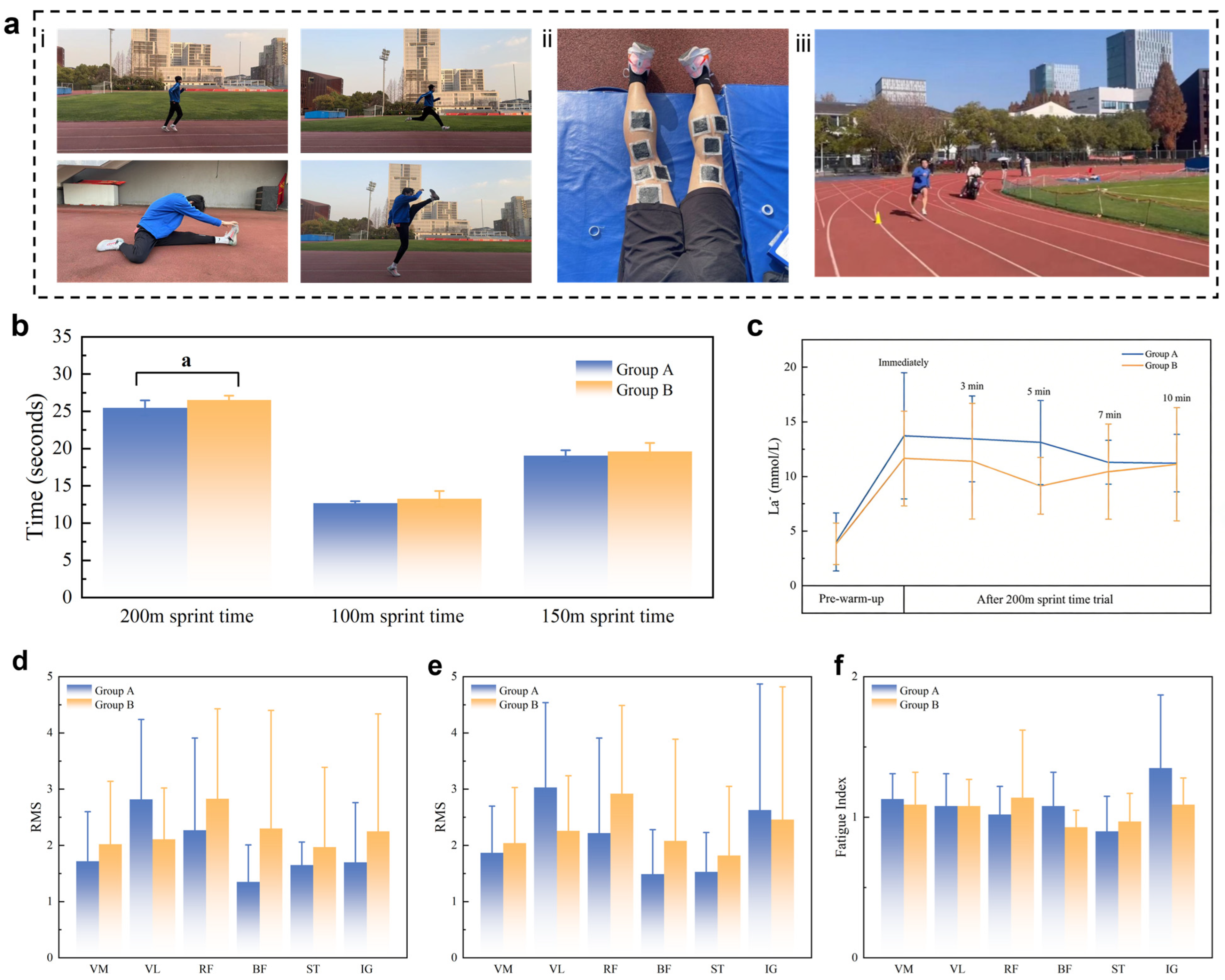
2.3.2. Sports Performance Enhancement
2.3.3. Neuromuscular Activation
2.3.4. Summary of Multidimensional Effects
- Thermoregulation: The material effectively elevated and sustained muscle surface temperature, preserving the thermal benefits of an active warm-up.
- Sports performance enhancement: It significantly improved 200 m sprint time and accelerated initial blood lactate accumulation, indicating enhanced explosive power and glycolytic energy turnover.
- Neuromuscular activation: Although no statistically significant differences in EMG parameters were observed, the observed trends—such as the dominant role of the VL in the active phase and the sustained contribution of the IG during fatigue—suggest that the device may facilitate more efficient muscle recruitment and delay fatigue, with potential implications for injury risk reduction.
3. Conclusions
4. Materials and Methods
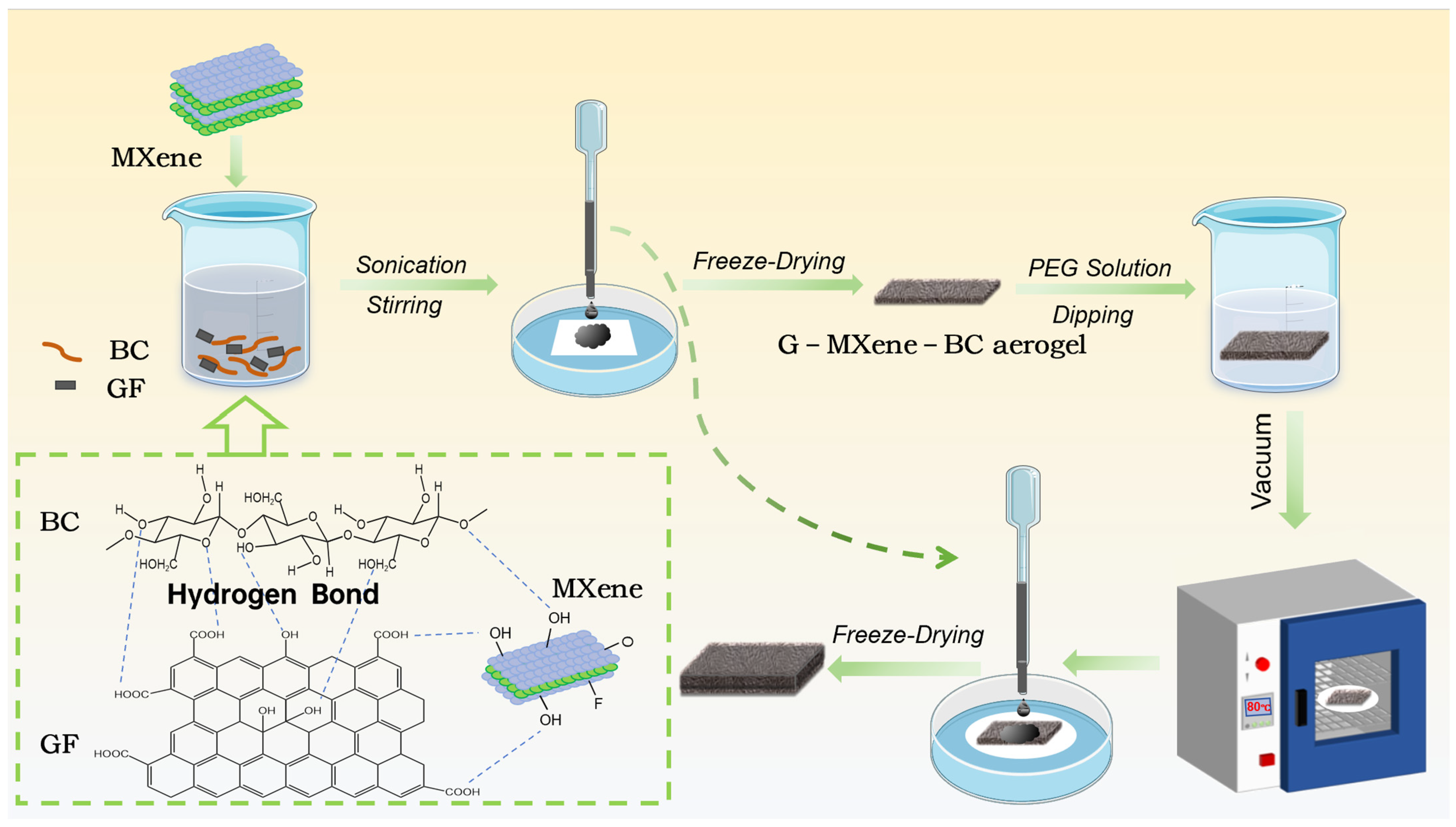
4.1. Preparation and Characterization of G-M-BC/PEG Composite Aerogels
4.1.1. Materials
4.1.2. Synthesis of MXene Nanosheets
4.1.3. Preparation of the Monolayer G–MXene–BC Aerogel
4.1.4. Fabrication of G-M-BC/PEG Composite Aerogels by Combining Phase Change Material PEG
4.1.5. Characterization
4.2. Applications of the G-M-BC/PEG Composite Aerogels in the Warm-Up Transition Phase of the 200-Meter Sprint
4.2.1. Test Indicators
4.2.2. Procedures
Supplementary Materials
Author Contributions
Funding
Institutional Review Board Statement
Informed Consent Statement
Data Availability Statement
Conflicts of Interest
References
- Kapnia, A.Κ.; Dallas, C.N.; Gerodimos, V.; Flouris, A.D. Impact of Warm-Up on Muscle Temperature and Athletic Performance. Res. Q. Exerc. Sport 2023, 94, 460–465. [Google Scholar] [CrossRef] [PubMed]
- Mohr, M.; Krustrup, P.; Nybo, L.; Nielsen, J.J.; Bangsbo, J. Muscle Temperature and Sprint Performance during Soccer Matches—Beneficial Effect of Re-warm-up at Half-time. Scand. J. Med. Sci. Sports 2004, 14, 156–162. [Google Scholar] [CrossRef]
- Silva, L.M.; Neiva, H.P.; Marques, M.C.; Izquierdo, M.; Marinho, D.A. Effects of Warm-Up, Post-Warm-Up, and Re-Warm-Up Strategies on Explosive Efforts in Team Sports: A Systematic Review. Sports Med. 2018, 48, 2285–2299. [Google Scholar] [CrossRef]
- Park, H.-K.; Jung, M.-K.; Park, E.; Lee, C.-Y.; Jee, Y.-S.; Eun, D.; Cha, J.-Y.; Yoo, J. The Effect of Warm-Ups with Stretching on the Isokinetic Moments of Collegiate Men. J. Exerc. Rehabil. 2018, 14, 78–82. [Google Scholar] [CrossRef]
- Silvers-Granelli, H.; Mandelbaum, B.; Adeniji, O.; Insler, S.; Bizzini, M.; Pohlig, R.; Junge, A.; Snyder-Mackler, L.; Dvorak, J. Efficacy of the FIFA 11+ Injury Prevention Program in the Collegiate Male Soccer Player. Am. J. Sports Med. 2015, 43, 2628–2637. [Google Scholar] [CrossRef]
- Silvers-Granelli, H.J.; Bizzini, M.; Arundale, A.; Mandelbaum, B.R.; Snyder-Mackler, L. Does the FIFA 11+ Injury Prevention Program Reduce the Incidence of ACL Injury in Male Soccer Players? Clin. Orthop. Relat. Res. 2017, 475, 2447–2455. [Google Scholar] [CrossRef]
- Mujika, I.; De Txabarri, R.G.; Maldonado-Martín, S.; Pyne, D.B. Warm-Up Intensity and Duration’s Effect on Traditional Rowing Time-Trial Performance. Int. J. Sports Physiol. Perform. 2012, 7, 186–188. [Google Scholar] [CrossRef]
- Bishop, D. Warm Up II: Performance Changes Following Active Warm Up and How to Structure the Warm Up. Sports Med. 2003, 33, 483–498. [Google Scholar] [CrossRef] [PubMed]
- West, D.J.; Dietzig, B.M.; Bracken, R.M.; Cunningham, D.J.; Crewther, B.T.; Cook, C.J.; Kilduff, L.P. Influence of Post-Warm-up Recovery Time on Swim Performance in International Swimmers. J. Sci. Med. Sport 2013, 16, 172–176. [Google Scholar] [CrossRef] [PubMed]
- Chapman, C.L.; Roberts, B.M.; Schafer, E.A.; Castellani, J.W.; Friedl, K.E.; Potter, A.W.; Looney, D.P. Occupational Cold Stress and Rewarming Alters Skin Temperature Thresholds for Manual Dexterity Decrements: An Exploratory Study. Physiol. Rep. 2025, 13, e70342. [Google Scholar] [CrossRef]
- McGowan, C.J.; Pyne, D.B.; Thompson, K.G.; Rattray, B. Warm-Up Strategies for Sport and Exercise: Mechanisms and Applications. Sports Med. 2015, 45, 1523–1546. [Google Scholar] [CrossRef]
- Cowper, G.; Goodall, S.; Hicks, K.; Burnie, L.; Briggs, M. The Impact of Passive Heat Maintenance Strategies between an Active Warm-up and Performance: A Systematic Review and Meta-Analysis. BMC Sports Sci. Med. Rehabil. 2022, 14, 154. [Google Scholar] [CrossRef] [PubMed]
- Raccuglia, M.; Lloyd, A.; Filingeri, D.; Faulkner, S.H.; Hodder, S.; Havenith, G. Post-Warm-up Muscle Temperature Maintenance: Blood Flow Contribution and External Heating Optimisation. Eur. J. Appl. Physiol. 2016, 116, 395–404. [Google Scholar] [CrossRef]
- Faulkner, S.H.; Ferguson, R.A.; Gerrett, N.; Hupperets, M.; Hodder, S.G.; Havenith, G. Reducing Muscle Temperature Drop after Warm-up Improves Sprint Cycling Performance. Med. Sci. Sports Exerc. 2013, 45, 359–365. [Google Scholar] [CrossRef]
- Cook, C.; Holdcroft, D.; Drawer, S.; Kilduff, L.P. Designing a Warm-Up Protocol for Elite Bob-Skeleton Athletes. Int. J. Sports Physiol. Perform. 2013, 8, 213–215. [Google Scholar] [CrossRef]
- Russell, M.; West, D.J.; Briggs, M.A.; Bracken, R.M.; Cook, C.J.; Giroud, T.; Gill, N.; Kilduff, L.P. A Passive Heat Maintenance Strategy Implemented during a Simulated Half-Time Improves Lower Body Power Output and Repeated Sprint Ability in Professional Rugby Union Players. PLoS ONE 2015, 10, e0119374. [Google Scholar] [CrossRef]
- McGowan, C.J.; Thompson, K.G.; Pyne, D.B.; Raglin, J.S.; Rattray, B. Heated Jackets and Dryland-Based Activation Exercises Used as Additional Warm-Ups during Transition Enhance Sprint Swimming Performance. J. Sci. Med. Sport 2016, 19, 354–358. [Google Scholar] [CrossRef]
- Wilkins, E.L.; Havenith, G. External Heating Garments Used Post-Warm-up Improve Upper Body Power and Elite Sprint Swimming Performance. Proc. Inst. Mech. Eng. Part P J. Sports Eng. Technol. 2017, 231, 91–101. [Google Scholar] [CrossRef]
- Cowper, G.; Barwood, M.; Goodall, S. Improved 2000-m Rowing Performance in a Cool Environment with an External Heating Garment. Int. J. Sports Physiol. Perform. 2021, 16, 103–109. [Google Scholar] [CrossRef] [PubMed]
- Cowper, G.; Goodall, S.; Hicks, K.M.; Burnie, L.; Fox, K.; Duffy, D.; Briggs, M.A. The Influence of Passive Heating Garments Worn in Temperate and Cold Conditions Prior to Simulated Performance for Male Soccer Substitutes. Physiol. Rep. 2025, 13, e70189. [Google Scholar] [CrossRef] [PubMed]
- Yu, Z.; Jiang, L.; Liu, R.; Zhao, W.; Yang, Z.; Zhang, J.; Jin, S. Versatile Self-Assembled MXene-Au Nanocomposites for SERS Detection of Bacteria, Antibacterial and Photothermal Sterilization. Chem. Eng. J. 2021, 426, 131914. [Google Scholar] [CrossRef]
- Liang, Y.; Zhang, H.; Yuan, H.; Lu, W.; Li, Z.; Wang, L.; Gao, L.-H. Conjugated Polymer and Triphenylamine Derivative Codoped Nanoparticles for Photothermal and Photodynamic Antimicrobial Therapy. ACS Appl. Bio Mater. 2020, 3, 3494–3499. [Google Scholar] [CrossRef]
- Yang, Y.; Deng, Y.; Huang, J.; Fan, X.; Cheng, C.; Nie, C.; Ma, L.; Zhao, W.; Zhao, C. Size-Transformable Metal–Organic Framework–Derived Nanocarbons for Localized Chemo-Photothermal Bacterial Ablation and Wound Disinfection. Adv. Funct. Mater. 2019, 29, 1900143. [Google Scholar] [CrossRef]
- Naguib, M.; Mochalin, V.N.; Barsoum, M.W.; Gogotsi, Y. 25th Anniversary Article: MXenes: A New Family of Two-Dimensional Materials. Adv. Mater. 2014, 26, 992–1005. [Google Scholar] [CrossRef]
- Hussein, E.A.; Zagho, M.M.; Rizeq, B.R.; Younes, N.N.; Pintus, G.; Mahmoud, K.A.; Nasrallah, G.K.; Elzatahry, A.A. Plasmonic MXene-Based Nanocomposites Exhibiting Photothermal Therapeutic Effects with Lower Acute Toxicity than Pure MXene. Int. J. Nanomed. 2019, 14, 4529–4539. [Google Scholar] [CrossRef]
- Pang, J.; Mendes, R.G.; Bachmatiuk, A.; Zhao, L.; Ta, H.Q.; Gemming, T.; Liu, H.; Liu, Z.; Rummeli, M.H. Applications of 2D MXenes in Energy Conversion and Storage Systems. Chem. Soc. Rev. 2019, 48, 72–133. [Google Scholar] [CrossRef]
- Ji, X.; Jiang, Y.; Liu, T.; Lin, S.; Du, A. MXene Aerogel-Based Phase Change Film for Synergistic Thermal Management Inspired by Antifreeze Beetles. Cell Rep. Phys. Sci. 2022, 3, 100815. [Google Scholar] [CrossRef]
- Anasori, B.; Lukatskaya, M.R.; Gogotsi, Y. 2D Metal Carbides and Nitrides (MXenes) for Energy Storage. Nat. Rev. Mater. 2017, 2, 16098. [Google Scholar] [CrossRef]
- Naguib, M.; Kurtoglu, M.; Presser, V.; Lu, J.; Niu, J.; Heon, M.; Hultman, L.; Gogotsi, Y.; Barsoum, M.W. Two-Dimensional Nanocrystals Produced by Exfoliation of Ti3AlC2. Adv. Mater. 2011, 23, 4248–4253. [Google Scholar] [CrossRef] [PubMed]
- Xu, D.; Li, Z.; Li, L.; Wang, J. Insights into the Photothermal Conversion of 2D MXene Nanomaterials: Synthesis, Mechanism, and Applications. Adv. Funct. Mater. 2020, 30, 2000712. [Google Scholar] [CrossRef]
- Wu, N.; Yang, Y.; Wang, C.; Wu, Q.; Pan, F.; Zhang, R.; Liu, J.; Zeng, Z. Ultrathin Cellulose Nanofiber Assisted Ambient-Pressure-Dried, Ultralight, Mechanically Robust, Multifunctional MXene Aerogels. Adv. Mater. 2023, 35, 2207969. [Google Scholar] [CrossRef]
- Ma, C.; Mai, T.; Wang, P.-L.; Guo, W.-Y.; Ma, M.-G. Flexible MXene/Nanocellulose Composite Aerogel Film with Cellular Structure for Electromagnetic Interference Shielding and Photothermal Conversion. ACS Appl. Mater. Interfaces 2023, 15, 47425–47433. [Google Scholar] [CrossRef]
- Liu, L.-X.; Chen, W.; Zhang, H.-B.; Zhang, Y.; Tang, P.; Li, D.; Deng, Z.; Ye, L.; Yu, Z.-Z. Tough and Electrically Conductive Ti3C2Tx MXene–Based Core–Shell Fibers for High–Performance Electromagnetic Interference Shielding and Heating Application. Chem. Eng. J. 2022, 430, 133074. [Google Scholar] [CrossRef]
- Ullah, Z.; Raza, N.; Sajid, M.; Sonil, N.I. Graphite-Coated Elastomer-Based Supremely Stretchable Strain Sensors for Real-Time Fracture Monitoring and Healing. Mater. Today Commun. 2025, 46, 112757. [Google Scholar] [CrossRef]
- Wang, W.; Cai, T.; Shao, C.; Xiao, Y.; Xiang, Y.; Jiang, Y. MXene-Based Responsive Hydrogels and Applications in Wound Healing. ChemistrySelect 2024, 9, e202402073. [Google Scholar] [CrossRef]
- Liu, H.; Chen, K.; Wu, R.; Pan, S.; Zhang, C. Laser-Induced Graphene-Based Flexible Substrate with Photothermal Conversion and Photoresponse Performance on Polyimide Film. ACS Appl. Mater. Interfaces 2023, 15, 46550–46558. [Google Scholar] [CrossRef]
- Panchamiya, V.P.; Kuchimanchi, A.; Kulkarni, K.G.; Havaldar, S.N. A Review on Phase Change Materials: Development, Types, and Applications. J. Phys. Conf. Ser. 2023, 2426, 012033. [Google Scholar] [CrossRef]
- Fang, Y.; Liu, S.; Li, X.; Hu, X.; Wu, H.; Lu, X.; Qu, J. Biomass Porous Potatoes/MXene Encapsulated PEG-Based PCMs with Improved Photo-to-Thermal Conversion Capability. Sol. Energy Mater. Sol. Cells 2022, 237, 111559. [Google Scholar] [CrossRef]
- Wang, Y.; Zhang, W.; Cao, J. Wood-framed Binary Eutectic Polyethylene Glycol (BEPEG) as Phase Change Materials for Thermal Storage. Polym. Compos. 2023, 44, 2710–2722. [Google Scholar] [CrossRef]
- Liu, H.; Zhang, X.; Zhang, S.; Kou, Y.; Fu, H.; Zhou, F.; Wu, Z.; Shi, Q. Intrinsically Flexible Phase Change Fibers for Intelligent Thermal Regulation. Angew. Chem. Int. Ed. 2024, 63, e202408857. [Google Scholar] [CrossRef]
- Dong, J.; Shi, W.; Liu, J. Flexible Polyurethane-Based Phase Change Materials with Excellent Thermal Management for Human Thermal Therapy. J. Mater. Sci. 2024, 59, 14833–14845. [Google Scholar] [CrossRef]
- Rajavel, K.; Yu, X.; Zhu, P.; Hu, Y.; Sun, R.; Wong, C. Exfoliation and Defect Control of Two-Dimensional Few-Layer MXene Ti3C2Tx for Electromagnetic Interference Shielding Coatings. ACS Appl. Mater. Interfaces 2020, 12, 49737–49747. [Google Scholar] [CrossRef] [PubMed]



Disclaimer/Publisher’s Note: The statements, opinions and data contained in all publications are solely those of the individual author(s) and contributor(s) and not of MDPI and/or the editor(s). MDPI and/or the editor(s) disclaim responsibility for any injury to people or property resulting from any ideas, methods, instructions or products referred to in the content. |
© 2026 by the authors. Licensee MDPI, Basel, Switzerland. This article is an open access article distributed under the terms and conditions of the Creative Commons Attribution (CC BY) license.
Share and Cite
Qian, X.; Ling, L.; Xu, D.; Lu, J.; Liu, H.; Yuan, M.; Lu, T.; Wang, L.; Du, A.; Qin, L. Preparation and Evaluation of MXene/Graphene-Integrated Cellulose Aerogel Composite for Self-Heating Thermoregulation in Athletic Warm-Up Optimization. Gels 2026, 12, 320. https://doi.org/10.3390/gels12040320
Qian X, Ling L, Xu D, Lu J, Liu H, Yuan M, Lu T, Wang L, Du A, Qin L. Preparation and Evaluation of MXene/Graphene-Integrated Cellulose Aerogel Composite for Self-Heating Thermoregulation in Athletic Warm-Up Optimization. Gels. 2026; 12(4):320. https://doi.org/10.3390/gels12040320
Chicago/Turabian StyleQian, Xinran, Lanqing Ling, Dengyun Xu, Jialu Lu, Haohan Liu, Meng Yuan, Tianfeng Lu, Lejun Wang, Ai Du, and Lili Qin. 2026. "Preparation and Evaluation of MXene/Graphene-Integrated Cellulose Aerogel Composite for Self-Heating Thermoregulation in Athletic Warm-Up Optimization" Gels 12, no. 4: 320. https://doi.org/10.3390/gels12040320
APA StyleQian, X., Ling, L., Xu, D., Lu, J., Liu, H., Yuan, M., Lu, T., Wang, L., Du, A., & Qin, L. (2026). Preparation and Evaluation of MXene/Graphene-Integrated Cellulose Aerogel Composite for Self-Heating Thermoregulation in Athletic Warm-Up Optimization. Gels, 12(4), 320. https://doi.org/10.3390/gels12040320