
Article

Authoritarian Aggression: A Unique Predictor of Attitudes to Sex- and Gender-Based Crime
1
Psy.D Program, Michigan School of Psychology, Farmington Hills, MI 48334, USA
2
Department of Psychology, University of Michigan—Flint, Flint, MI 48502, USA
*
Author to whom correspondence should be addressed.
Sexes 2026, 7(1), 12; https://doi.org/10.3390/sexes7010012
Submission received: 28 December 2025 / Revised: 13 February 2026 / Accepted: 18 February 2026 / Published: 24 February 2026
(This article belongs to the Section Sexual Behavior and Attitudes)

Abstract

A recently developed nonpartisan authoritarian aggression scale (NAAS) has a robust nomological network that includes attitudes toward women and LGBTQ+ individuals. The current research was meant to further validate the scale by demonstrating its ability to predict unique variance in attitudes relating to sex crimes (i.e., rape myth acceptance) and anti-transgender hate crimes when controlling for potentially relevant cognitive (i.e., need for cognition, intolerance of uncertainty) and cultural (i.e., Christian nationalism) variables. A sample of 100 U.S. participants was recruited from Prolific and completed an online survey via Qualtrics. A series of correlation analyses showed that the NAAS was significantly related to all of the other predictor variables as well as both the sex and hate crime outcomes at the bivariate level, adding to the nomological network of the NAAS. Multiple regression analyses showed that the combination of predictors explained significant variance in both outcomes and that the NAAS was the only predictor to explain unique variance in both sex crime and anti-transgender hate crime attitudes. The results imply that authoritarian aggression poses a danger for women, transgender individuals, and victims of sex crimes and hate crimes more broadly. Future research should examine ways of attenuating authoritarian aggression in individuals and communities to protect those who are vulnerable due to their sex, sexual orientation, or gender identity.

1. Introduction

Authoritarianism is characterized by a willingness to subvert democracy, deny the legitimacy of political rivals, and undermine the rights of marginalized groups, such as women and transgender individuals [1]. Indeed, research has consistently shown that authoritarianism is related to sexist and misogynist attitudes [2,3,4], as well as hostility toward transgender and nonbinary individuals [5,6,7]. In an era where the United States government is widely perceived to be controlled by an increasingly authoritarian regime [8] and the rights of vulnerable groups such as women and transgender individuals are increasingly threatened [9,10], it is imperative to understand the psychological motivators of such social problems. The current research aims to better understand the attitudes and beliefs related to sex crimes and hate crimes against these marginalized groups.
Authoritarianism has long been conceptualized as consisting of three factors relating to conformity (conventionalism), hierarchy (submission), and punitive social control (aggression) [11]. Evidence suggests that authoritarian aggression may be the strongest of the three components in predicting the propensity to be discriminatory, prejudicial, and intolerant [12,13,14,15]. This is why recent research was conducted to develop a unidimensional and nonpartisan authoritarian aggression scale (the NAAS; [16]). Across two studies, the NAAS demonstrated solid convergent validity by correlating in expected directions with constructs like social dominance orientation, political conservatism, hostile sexism, racial bias, and opposition to prison reform. A third experimental study supported its predictive validity, finding that individuals higher in authoritarian aggression were more likely to endorse targeting immigrant groups under experimental conditions [16]. Factor analyses supported the unidimensional structure of the scale, strong psychometric properties related to reliability and validity, and a robust nomological network, including sexist and anti-LGBTQ+ attitudes.
However, more research must be done to expand the nomological network of the NAAS and to demonstrate its ability to predict attitudes regarding sex crimes and gender-based violent crimes both at the bivariate level and above-and-beyond other relevant predictors. Conducting such research is particularly prudent when considering that participant authoritarianism has been shown to interact with victim sexual orientation to influence mock sentencing decisions [17]. Additionally, there remains a gap in the literature connecting such attitudes to specific sex- and gender-related offenses such as rape and anti-transgender hate crimes. Accordingly, the current research examines the degree to which authoritarian aggression predicts the propensity to minimize sex crimes (rape myth acceptance [18]) and hate crimes against transgender individuals.

1.1. Additional Variables

In order to both build the nomological network of the NAAS and provide a rigorous test of its ability to predict sex crime and hate crime attitudes, it is important to select additional variables for the current model that represent social and cognitive constructs that were not included in the initial development of the NAAS but are likely to be related to both the NAAS and to the current study’s outcomes.

1.1.1. Christian Nationalism

Christian nationalism is a political and cultural ideology that fuses national identity with a particular vision of Christianity, asserting that the United States is divinely favored and should be governed according to that vision [19]. Rather than reflecting personal religiosity or church involvement, Christian nationalism functions as an ideological framework that sacralizes the nation and legitimizes hierarchical social arrangements, including traditional gender roles and in-group moral authority [20]. Empirical research has demonstrated that Christian nationalism predicts exclusionary and punitive attitudes independent of religious practice, indicating that it operates as a distinct sociopolitical belief system rather than a measure of religious devotion [20].
A growing body of evidence links Christian nationalism to authoritarian aggression, defined as support for coercive or punitive actions aimed at rendering conformity and protecting perceived social order [21]. Christian nationalism aligns closely with ideological orientations characterized by threat sensitivity, moral absolutism, and deference to authority, which facilitate the justification of aggression against perceived norm violators [22]. Armaly et al. provide direct empirical evidence that Christian nationalism predicts support for political violence, particularly when individuals perceive their religious or national identity as under threat [23]. These findings suggest Christian nationalism may legitimize aggressive responses by framing coercive action as morally necessary to defend a sacred national order.
Christian nationalism is also theoretically and empirically connected to rape myth acceptance through its strong association with patriarchal gender ideology and authoritarian belief systems. Research indicates that Christian nationalism predicts endorsement of traditional gender roles, male authority, and restrictive norms surrounding women’s sexuality [20]. These beliefs parallel the ideological foundations of rape myths, which function to minimize sexual violence, shift responsibility to victims, and normalize male sexual entitlement [24]. Meta-analyses and empirical studies demonstrate that sexism and authoritarianism are significant predictors of rape myth acceptance, supporting the expectation that ideologies emphasizing hierarchy and moral absolutism are associated with greater tolerance for sexual violence [25,26]. Together, this literature supports a plausible pathway by which Christian nationalism indirectly contributes to rape-supportive attitudes.
Finally, Christian nationalism has been linked to hate-related attitudes and biased interpretations of bias-motivated violence through its emphasis on in-group moral superiority and out-group threat. Prior research indicates that Christian nationalism predicts more negative attitudes toward immigrants, indicating heightened intolerance toward perceived outsiders [27]. Complementing this finding, Leander et al. demonstrated that individuals high in Christian nationalism were less likely to recognize violence against marginalized groups as hate crimes and more likely to sympathize with perpetrators [28]. These patterns suggest that Christian nationalism not only fosters out-group hostility but also shapes interpretive frameworks that minimize or excuse bias-motivated aggression. Additionally, social dominance orientation (SDO) has been consistently linked to nationalism, and more recently, Christian nationalism [29]. In the development of the NAAS, SDO was repeatedly established as part of the nomological network; however, Christian nationalism was not explicitly measured. As such, Christian nationalism was selected as a correlate in this study for its link to SDO and to further expand the nomological network of the NAAS.

1.1.2. Need for Cognition

Need for cognition [30] is a personality trait in which an individual enjoys effortful thinking, thus leading the individual to seek out activities that involve complex thinking and problem-solving rather than activities that involve less effortful thinking. Prior research reveals the need for cognition as a significant predictor of authoritarian attitudes, such that lower need for cognition is associated with higher levels of authoritarianism [31]. Lower need for cognition has also been shown to have a negative correlation with rape myth acceptance [32]. Research on need for cognition further suggests that low need for cognition is related to increased propensity for victim blaming, which suggests it may also be related to perceptions of hate crimes as well [33].

1.1.3. Intolerance of Uncertainty

Intolerance of uncertainty (IU) is the tendency of an individual to consider the possibility of a negative event occurring unacceptable, irrespective of the probability of occurrence [34]. Some recent theoretical work on ideological cognition helps clarify how IU may translate into authoritarian aggression and hate-directed attitudes. Research suggests that ideological thinking is characterized by a more rigid style marked by resistance to evidence-based beliefs [35]. Within this framework, authoritarian aggression can be explained as a behavioral expression of IU-driven ideological rigidity, which may be further associated with antagonisms toward out-groups and suggest a link with hate-crime attitudes.
Further research germane to intolerance of uncertainty suggests that rape myth acceptance functions as a cognitive schema that becomes influential when rape cases are uncertain, and this may cause individuals to become more likely to blame victims and refuse to label incidents as rape, particularly when situational details lack clarity [36]. These findings suggest that uncertainty amplifies reliance on pre-existing beliefs that simplify complex situations. Taken together, IU appears to function as a foundational cognitive vulnerability that increases reliance on predictability and simplification.

1.2. Overview and Hypotheses

The current research is intended to test the ability of authoritarian aggression—as measured by the recently validated NAAS—to uniquely predict attitudes about sex crimes (operationalized as rape myth acceptance) and anti-transgender hate crimes over-and-above variance predicted by other potentially relevant social and cognitive constructs while simultaneously expanding the nomological network of the NAAS. By doing so, the current study seeks to provide evidence of the NAAS’ utility for studying practical phenomena related to sex, gender, and sexuality. As such, the current research hypotheses are:
Hypothesis 1.
The NAAS will be significantly correlated with each of the other predictors and with both rape myth acceptance and hate crime beliefs at the bivariate level.
Hypothesis 2.
The NAAS will predict significant unique variance in rape myth acceptance over-and-above that explained by the other predictors in a multiple regression analysis.
Hypothesis 3.
The NAAS will predict significant unique variance in anti-transgender hate crime beliefs over-and-above that explained by the other predictors in a multiple regression analysis.

2. Materials and Methods

2.1. Power Analysis and Sample

The primary analyses for the current study were two linear multiple regression analyses with four predictors each. A power analysis was performed for such an analysis with a Bonferroni-corrected alpha-level (α = 0.025) and power at the low end of conventional standards (1 − β = 0.80) in order to detect medium-sized effects (f2 = 0.15). The suggested sample size was N = 100.
Participants (N = 100) were recruited from Prolific with location restricted to the United States and were paid 2.00 USD. One participant failed a single attention check and was excluded from analyses but still paid. The valid sample was 54.5% men and 45.5% women (no participants identified as nonbinary), 77% non-Hispanic white, 52.5% Christian, and 34.3% religiously unaffiliated. The median education level was a bachelor’s degree, and the median household income was between 50,000 and 99,999 USD. Data collection took place from late October to early November 2025.

2.2. Measures

2.2.1. Authoritarian Aggression

Authoritarian aggression was measured using the 15-item, unidimensional NAAS [16]. Participants responded to each item on a 1 (“strongly disagree”) to 7 (“strongly agree”) scale. An example item is “Violence is necessary to protect society from dangerous individuals”. Item responses were summed and then divided by the number of items in the scale to produce a composite variable with values from 1.00 to 7.00 (M = 3.18, SD = 1.59) with higher scores corresponding to higher levels of authoritarian aggression. The scale was found to have a very high internal reliability in the current sample (Cronbach’s α = 0.957).

2.2.2. Christian Nationalism

Christian nationalism was measured using the six-item, unidimensional instrument created by Whitehead and Perry [19]. Participants responded to each item on a 1 (“strongly disagree”) to 7 (“strongly agree”) scale. An example item is “The federal government should advocate Christian values”. Item responses were summed and then divided by the number of items in the scale to produce a composite variable with values from 1.00 to 7.00 (M = 3.16, SD = 1.86) with higher scores corresponding to higher levels of Christian nationalism. The scale was found to have a very high internal reliability in the current sample (Cronbach’s α = 0.922).

2.2.3. Need for Cognition

Need for cognition was measured using the 18-item, unidimensional instrument developed by Cacioppo and Petty [30]. Participants responded to each item on a 1 (“strongly disagree”) to 7 (“strongly agree”) scale. An example item is “I usually end up deliberating about issues even when they do not affect me personally”. Item responses were summed and then divided by the number of items in the scale to produce a composite variable with values from 1.00 to 7.00 (M = 4.65, SD = 1.35) with higher scores corresponding to higher levels of NFC. The scale was found to have a very high internal reliability in the current sample (Cronbach’s α = 0.964).

2.2.4. Intolerance of Uncertainty

Intolerance of uncertainty was measured using the 7-item inhibitory anxiety subscale of the instrument developed by Carleton et al. [34]. This subscale was selected to measure the unique dimension of inhibitory anxiety. Participants responded to each item on a 1 (“strongly disagree”) to 7 (“strongly agree”) scale. An example item is “Unforeseen events upset me greatly”. Item responses were summed and then divided by the number of items in the scale to produce a composite variable with values from 1.00 to 7.00 (M = 5.16, SD = 1.08) with higher scores corresponding to higher levels of intolerance of uncertainty/inhibitory anxiety. The scale was found to have a high internal reliability in the current sample (Cronbach’s α = 0.804). The inhibitory anxiety sub-scale was selected, rather than the full instrument, as it provides the strongest conceptual relationship with our outcomes.

2.2.5. Rape Myth Acceptance

Rape myth acceptance was measured using the 6-item “She Asked for It” subscale of the instrument developed by McMahon & Farmer [37]. This subscale was selected to measure the unique dimension of victim blaming. Participants responded to each item on a 1 (“strongly disagree”) to 7 (“strongly agree”) scale. An example item is “If a woman is raped while she is drunk, she is at least somewhat responsible for what happened”. Item responses were summed and then divided by the number of items in the scale to produce a composite variable with values from 1.00 to 7.00 (M = 2.33, SD = 1.41) with higher scores corresponding to more acceptance of rape myths. The scale was found to have a high internal reliability in the current sample (Cronbach’s α = 0.898). The “She Asked for It” sub-scale was selected, rather than the full instrument, as it provides the strongest conceptual relationship with victim blaming.

2.2.6. Anti-Transgender Hate Crime Beliefs

Anti-transgender hate crime beliefs were measured using a version of the 8-item, unidimensional instrument developed by Cabeldue et al. [38]. Participants responded to each item on a 1 (“strongly disagree”) to 7 (“strongly agree”) scale. An example item is “Anti-transgender hate crimes receive too much attention”. Item responses were summed and then divided by the number of items in the scale to produce a composite variable with values from 1.00 to 7.00 (M = 2.99, SD = 1.98) with higher scores corresponding to more dismissive attitudes about the importance of anti-transgender hate crimes. The scale was found to have a high internal reliability in the current sample (Cronbach’s α = 0.976).

2.3. Procedure

Participants responded to a post on Prolific and followed a link to a survey hosted on Qualtrics where they first completed an informed consent document. Next participants completed the measures in a randomized order to control for order effects. Finally, they read a short debriefing statement and were rerouted back to Prolific to receive payment.

3. Results

3.1. Correlation Analyses

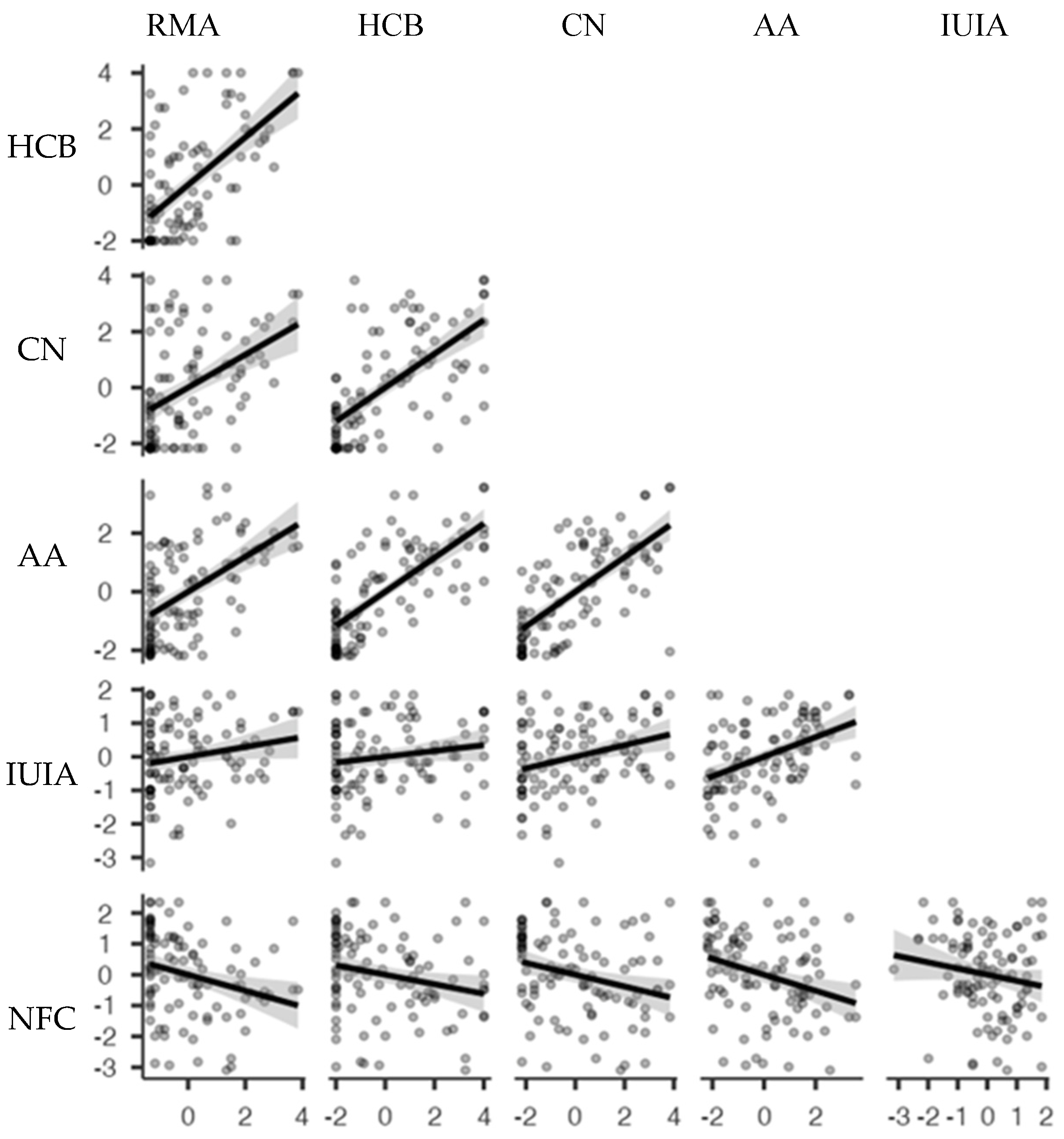
A series of fifteen Pearson zero-order bivariate correlations were conducted between all pairwise combinations of the mean-centered versions of need for cognition, intolerance of uncertainty inhibitory anxiety, authoritarian aggression, Christian nationalism, hate crime beliefs, and rape myth acceptance. For brevity’s sake, reporting of the relationships will be reported based on significance and direction with significant positive correlations first, significant negative correlations second, and nonsignificant correlations last. The strength and direction of the relationship (correlation coefficient/r), the 95% confidence interval for the strength and direction of the relationship, proportion of shared variance (r2), and significance value (p) will be reported for each relationship. A summary of these correlations can be found in Table 1, and a correlation matrix of all relationships appears in Figure 1.
Significant positive relationships were found for each of the following pairs of variables: authoritarian aggression and Christian nationalism, r = 0.69, 95% CIr [0.57, 0.78], r2 = 0.48. p < 0.001; authoritarian aggression and intolerance of uncertainty inhibitory anxiety, r = 0.43, 95% CIr [0.26, 0.58], r2 = 0.19, p < 0.001; authoritarian aggression and rape myth acceptance, r = 0.53, 95% CIr [0.37, 0.66], r2 = 0.28, p < 0.001; authoritarian aggression and hate crime beliefs, r = 0.72, 95% CIr [0.62, 0.81], r2 = 0.52, p < 0.001; Christian nationalism and intolerance of uncertainty inhibitory anxiety, r = 0.30, 95% CIr [0.11, 0.47], r2 = 0.09, p = 0.003; Christian nationalism and rape myth acceptance, r = 0.45, 95% CIr [0.27, 0.59], r2 = 0.20, p < 0.001; Christian nationalism and hate crime beliefs, r = 0.64, 95% CIr [0.51,0.75], r2 = 0.41; p < 0.001; and hate crime beliefs and rape myth acceptance, r = 0.61, 95% CIr [0.47, 0.72], r2 = 0.37, p < 0.001. For each of these pairs of variables, an increase in one variable predicted an increase in the other. The most common theme within these positive relationships is that authoritarian aggression is associated with increased nationalism, cognitive intolerance, and minimization of sex crimes and gender-based hate crimes, providing support for Hypothesis 1.
Significant negative relationships were found for each of the following pairs of variables: need for cognition and authoritarian aggression, r = −0.31, 95% CIr [−0.47, −0.12], r2 = 0.09, p = 0.002; need for cognition and Christian nationalism, r = −0.23, 95% CIr [−0.41, −0.03], r2 = 0.05, p = 0.024; need for cognition and rape myth acceptance, r = −0.27, 95% CIr [−0.45, −0.08], r2 = 0.07, p = 0.007; and need for cognition and hate crime beliefs, r = −0.23, 95% CIr [−0.41, −0.03], r2 = 0.05, p = 0.024. For each of these pairs of variables, an increase in one variable predicted a decrease in the other. All four of these relationships involved need for cognition, which was associated decreased authoritarian and nationalistic attitudes and less minimization of sex crimes and gender-based hate crimes. Though it is worth noting that the sizes of these effects are generally smaller than the positive relationships reported in the previous paragraph.
Nonsignificant relationships were found for each of the following pairs of variables: need for cognition and intolerance of uncertainty inhibitory anxiety, r = −0.16, 95% CIr [−0.35, 0.04], r2 = 0.03, p = 0.114; intolerance of uncertainty inhibitory anxiety and hate crime beliefs, r = 0.159, 95% CIr [−0.04, 0.35], r2 = 0.03, p = 0.117; intolerance of uncertainty inhibitory anxiety and rape myth acceptance, r = 0.19, 95% CIr [−0.01, 0.38], r2 = 0.04, p = 0.058.

3.2. Linear Multiple Regressions

Two linear multiple regression analyses were conducted with need for cognition, intolerance of uncertainty, authoritarian aggression, and Christian nationalism as predictors. Rape myth acceptance was the dependent variable in the first model, and anti-transgender hate crime beliefs was the dependent variable in the second model. For these analyses, all variables were mean-centered. A Shapiro–Wilk test of normality was conducted with a strict alpha level of 0.01 due to the study being well-powered with results showing that under such criteria the assumption was not violated, p = 0.014. The multicollinearity assumption was also tested, and it was found that the assumption was not violated as all VIFs were below 5.00 (highest value = 2.20). The values for the assumption checks were identical in both models because they used the same set of predictors.

3.2.1. Rape Myth Acceptance as DV

The full model predicted a significant 30.7% of the variance in rape myth acceptance, F(4, 94) = 34.1, p = < 0.001. Among individual predictors, only authoritarian aggression predicted significant unique variance in rape myth acceptance, F(1, 94) = 10.90, b = 0.374, 95% CIb = [0.149, 0.599], p < 0.001. When accounting for the effects of all other predictors, higher authoritarian aggression predicted increased rape myth acceptance, supporting Hypothesis 2.
The unique effects of all other predictors were nonsignificant: need for cognition, F(1, 94) = 1.59, b = −0.119, 95% CIb = [−0.307, 0.069], p = 0.211; intolerance of uncertainty inhibitory anxiety, F(1, 94) = 0.274, b = −0.065, 95% CIb = [−0.313, 0.182], p = 0.602; and Christian nationalism, F(1, 94) = 1.363, b = 0.106, 95% CIb = [−0.074, 0.286], p = 0.246. When accounting for the effects of all other predictors, these variables did not predict unique variance in rape myth acceptance.

3.2.2. Anti-Transgender Hate Crime Beliefs as DV

The full model predicted a significant 59.2% of the variance in anti-transgender hate crime beliefs, F(4, 94) = 34.1, p < 0.001. Among individual predictors, the unique effects of both authoritarian aggression, F(1, 94) = 40.07, b = 0.771, 95% CIb = [0.122, 0.529], p < 0.001, and Christian nationalism, F(1, 94) = 8.75, b = 0.288, 95% CIb = [0.095, 0.048], p = 0.004, were both significant. Higher levels of each predicted greater tendency to minimize anti-transgender hate crimes. These results also support Hypothesis 3.
The unique effect of intolerance of uncertainty inhibitory anxiety was also significant but in the opposite direction, F(1, 94) = 6.66, b = −0.346, 95% CIb = [−0.613, −0.080], p = 0.011. When accounting for the effects of all other predictors, those higher in intolerance of uncertainty inhibitory anxiety were less likely to minimize anti-transgender hate crimes. However, the unique effect of need for cognition was nonsignificant, F(1, 94) = 0.003, b = 0.102, 95% CIb = [−0.197, 0.208], p = 0.956.
Note: Supplemental analyses were conducted at the reviewer’s request with participant gender added as a predictor in both regression models. The significance and direction of other predictors was not changed by this addition. In both cases, participant gender was a significant unique predictor. Output for both supplemental models is included on the project’s OSF site.

4. Discussion

The current research was intended to further validate the recently developed NAAS by expanding its nomological network and demonstrating its unique ability to predict attitudes relating to sex crimes and anti-transgender hate crimes when controlling for potentially relevant cognitive and cultural variables. To do so, 100 participants were recruited from Prolific, and completed a survey using Qualtrics. Participants completed multiple self-report measures, measuring their levels of authoritarian aggression, Christian nationalism, need for cognition, intolerance of uncertainty, rape myth acceptance, and anti-transgender hate crime beliefs.
The results showed that the NAAS was significantly related to all of the other predictor variables as well as both the sex and hate crime outcomes at the bivariate level, supporting Hypothesis 1 and adding to the nomological network of the NAAS. Results from the multiple regression analyses showed that the combination of predictors explained significant variance in both outcomes and that the NAAS was the only predictor to explain unique variance in both sex crime and anti-transgender hate crime attitudes, supporting Hypotheses 2 and 3. Supporting these hypotheses is noteworthy, because they were supported despite the shared variance and conceptual overlap between authoritarian aggression and Christian nationalism (r = 0.69). However, specific efforts were made during the development and validation of the NAAS to remove partisan language to allow for the prediction of unique variance separate from culturally embedded ideologies such as Christian nationalism. Christian nationalism and intolerance of uncertainty inhibitory anxiety were significant unique predictors for anti-transgender hate crime beliefs, but not for rape myth acceptance. The results regarding Christian nationalism make sense in light of its stronger bivariate correlation with hate crime beliefs (r = 0.64) vs. rape myth acceptance (r = 0.45), but the negative unique relationship between intolerance of uncertainty and hate crime beliefs in the regression model requires more study in future research.

4.1. Integration with Prior Research and Theory

Given that all hypotheses were supported, the current research provides further evidence that authoritarian aggression may be the strongest component of authoritarianism in terms of its ability to predict discrimination, prejudice, and intolerance [12,13,14,15]. Additionally, the findings of this study further support prior research demonstrating the relationship between authoritarianism and sexist/misogynistic attitudes [2,3,4]. The study also elucidates the relationship between authoritarianism and hostility toward transgender and nonbinary individuals [5,6,7]. These findings, along with the significant correlations authoritarian aggression had with Christian nationalism, need for cognition, and intolerance of uncertainty, add to the robust nomological network previously validated by the NAAS through the validation of the NAAS in predicting unique variance in the minimization of sex crimes and anti-transgender crimes above other cognitive and cultural variables included in the study.
The present findings further clarify the role of authoritarian aggression as a central motivational predictor of attitudes that minimize sexual violence and dismiss anti-transgender hate crimes. Although cognitive traits such as need for cognition and intolerance of uncertainty were related to these outcomes at the bivariate level, they did not consistently account for unique variance once authoritarian aggression was included in the regression models. This pattern suggests that harm-minimizing attitudes are driven less by limitations in cognitive engagement or ambiguity tolerance and more by motivational orientations toward punishment, dominance, and social control. Dual-process models of ideology emphasize that authoritarian aggression reflects affective and motivational needs, particularly threat sensitivity and a preference for hierarchical social arrangements over deliberative cognitive styles [20,21], making it especially relevant to understanding attitudes toward violence against marginalized groups.
The parallel relationship between authoritarian aggression and both rape myth acceptance and dismissive attitudes toward anti-transgender hate crimes highlights the possibility of shared ideological processes underlying these outcomes. Although these attitudes are often examined in separate studies, both attitudes function to minimize harm by reframing violence as exaggerated, justified, or unworthy of institutional attention. Rape myth acceptance has been shown to undermine victim credibility and normalize sexual violence, while dismissive attitudes toward hate crimes are associated with reduced recognition of bias-motivated harm and weaker institutional responses to victimization [10,24]. The fact that authoritarian aggression uniquely predicted both outcomes suggests that dominance-oriented and punitive worldviews shape how individuals interpret and evaluate harm across different social domains.
Importantly, the present findings extend prior research linking authoritarian aggression to prejudice and support for intergroup hostility by demonstrating its relevance to attitudes with direct implications for responses to sex- and gender-based violence. Previous work has shown that authoritarian aggression predicts support for intergroup violence and group-based dominance, and the current study builds on this literature by showing that it also predicts subtler attitudinal forms of harm minimization [15]. Altogether, these findings suggest that authoritarian aggression plays a central role in shaping how violence against marginalized groups is evaluated, legitimized, or dismissed.

4.2. Practical Implications

The results of the current study demonstrate significant practical implications for public policy, criminal justice, and mental health interventions. Research shows that transgender individuals and individuals identifying as part of the LGBTQ+ population are disproportionately impacted by hate crimes, many of which go unreported [39]. Many of these individuals report that the political climate and attitudes toward transgender individuals contributed to underreporting and avoidance of the criminal justice system all together [39,40]. Similarly, many survivors of sexual assault report that societal norms and attitudes towards them contribute to why they did not report or disclose their assaults to law enforcement [41]. Additional clinical implications may also include increased understanding of how members of marginalized groups recognize and feel threatened by attitudes such as authoritarianism in the general population [42]. Understanding the attitudes that contribute to minimization of hate crimes and sexual assault can increase support efforts for advocacy and mental health services for these individuals.
The present findings have important implications for understanding how attitudes that minimize sexual violence and dismiss hate crimes may be sustained and legitimized within broader ideological frameworks. Research on authoritarian aggression and group-based dominance suggests that individuals who endorse punitive social control and hierarchical intergroup relations are more likely to justify aggression toward perceived out-groups [15,21]. When such orientations are present, rape myth acceptance and dismissive attitudes toward hate crimes may function as interpretive frameworks that allow individuals to downplay the severity of harm, shift responsibility away from perpetrators, or frame violence as exaggerated or undeserving of concern [25]. From a practical standpoint, this suggests that interventions focused solely on increasing knowledge or awareness may be insufficient if they fail to address the motivational and ideological processes that legitimize harm.
The present research also has implications for institutional responses to sexual violence and hate crimes. Victims’ experiences within the justice system are shaped not only by formal policies but also by the attitudes of those responsible for interpreting, investigating, and adjudicating acts of harm. Prior research indicates that when harm is minimized or reframed through ideological justifications, victims may experience secondary victimization and reduced confidence in legal institutions [10]. Recognizing authoritarian aggression as a contributor to such attitudes highlights the importance of addressing punitive worldviews and dominance-oriented beliefs in professional training contexts. Interventions that emphasize accountability for harm and challenge the normalization of violence may be particularly important for improving institutional responses to sexual violence and hate crimes.
The current results demonstrate the importance of broad, societal interventions to reduce authoritarian aggression and Christian nationalism to ensure justice for victims of sex crimes and hate crimes. Understanding these attitudes may provide meaningful future directions for research related to screening for jurors in sexual assault or hate crime cases. This is particularly true in the light of research suggesting that biased perceptions of hate crimes may reflect supremacism [28]. Thus, this research further demonstrates the importance of societal efforts to prevent widespread adoption of attitudes such as authoritarian aggression and rape myth acceptance. Moreover, it may be helpful to expand the nomological network of the NAAS to include additional correlates, such as symbolic threat, which has previously been shown to be relevant to racially biased assessments of public health crises [43], or moral foundations, which have previously been shown to predict xenophobic perceptions of economic inequality [44].

4.3. Limitations and Future Directions

The current research has several limitations that should be addressed in future work. First, the correlational and cross-sectional design precludes causal conclusions. While theory suggests authoritarian aggression shapes attitudes, it is possible that holding minimizing attitudes reinforces authoritarian aggression or that a third variable influences both. Second, this study relies on self-report measures collected from online convenience samples. Even though platforms like Prolific use more diverse participant pools than other convenience sampling methods, future research should replicate these findings using nationally representative samples and include behavioral measures to measure real-world applications. Online sampling platforms come with their own set of limitations regarding bias and professional survey takers; however, they can be mitigated when following the steps to ensure accurate and ethical data collection [45]. Additionally, the sample consisted only of individuals from the United States, and future research may seek to examine these issues in other nations, as the attitudes and constructs measured in this study are not unique to the United States. Future research could expand the sample population to other countries to provide more cross-cultural validation. Addressing these limitations will continue to increase the validity and applicability of the NAAS. Future research should also explore strategies for reducing authoritarian aggression at both individual and community levels to better safeguard those who are vulnerable because of their sex, sexual orientation, or gender identity in line with the practical implications noted above.

5. Conclusions

Research examining attitudes toward sex crimes and violent crimes that target individuals based on their sex, gender, or sexuality provides an important foundation for understanding why people are motivated to commit such crimes or to contribute to their perpetuation through minimization. It is our hope that the current research demonstrates the particular utility of the NAAS in studying such processes and more broadly provides further evidence of the necessity of considering authoritarian aggression and closely related constructs.

Author Contributions

Conceptualization, A.S.F.; methodology, all authors; data curation and formal analysis, A.S.O., B.A.K. and A.S.F.; resources, A.S.F.; writing—original draft preparation, all authors; writing—review and editing, all authors; visualization, A.S.O. and B.A.K.; revisions, B.A.K., A.R.N. and A.S.O., supervision, A.S.F. Revisions to content based on peer review were primarily handled by B.A.K. with support from A.S.O., while revisions to technical aspects were primarily handled by A.R.N. with support from A.S.A. Revisions were supervised by A.S.F. All authors have read and agreed to the published version of the manuscript.

Funding

This research received no external funding.

Institutional Review Board Statement

This study was conducted in accordance with the Declaration of Helsinki, and approved by Beyond Bound, a private Institutional Review Board contracted by Michigan School of Psychology (approval code: BB2510AF-141; approval date: 25 October 2025).

Informed Consent Statement

Informed consent was obtained from all subjects involved in this study.

Data Availability Statement

The data presented in this study are available on request from the corresponding author.

Conflicts of Interest

The authors declare no conflicts of interest.

References

  1. Antje. Authoritarianism: How You Know It When You See It. The Commons. Available online: https://commonslibrary.org/authoritarianism-how-you-know-it-when-you-see-it/ (accessed on 17 April 2023).
  2. Begany, J.J.; Milburn, M.A. Psychological predictors of sexual harassment: Authoritarianism, hostile sexism, and rape myths. Psychol. Men Masculinity 2002, 3, 119–126. [Google Scholar] [CrossRef]
  3. Bondi, G.M. Authoritarianism, Hostility Toward Women, Attitudes Toward Violence, Rape Myth Acceptance, and Sexual Aggression. Ph.D. Thesis, Old Dominion University, Norfolk, VI, USA, 2007. [Google Scholar] [CrossRef]
  4. Christopher, A.N.; Zabel, K.L.; Miller, D.E. Personality, authoritarianism, social dominance, and ambivalent sexism: A mediational model. Individ. Differ. Res. 2013, 11, 70–80. [Google Scholar] [CrossRef]
  5. Coneo, A.M.C.; Navarro, M.C.; Molinares, N.Q. Sexual-specific disgust sensitivity mechanisms in homonegativity and transnegativity: The mediating role of right-wing authoritarianism. Psychol. Sex. 2023, 14, 203–218. [Google Scholar] [CrossRef]
  6. Perez-Arche, H.; Miller, D.J. What predicts attitudes toward transgender and nonbinary people? An exploration of gender, authoritarianism, social dominance, and gender ideology. Sex Roles 2021, 85, 172–189. [Google Scholar] [CrossRef]
  7. Prusaczyk, E.; Hodson, G. The roles of political conservatism and binary gender beliefs in predicting prejudices toward gay men and people who are transgender. Sex Roles 2020, 82, 438–446. [Google Scholar] [CrossRef]
  8. Burston, D. ‘It can’t happen here’: Trump psychotherapy, authoritarianism and American politics. Psychother. Politics Int. 2017, 15, e1399. [Google Scholar] [CrossRef]
  9. Berg, J.A.; Woods, N.F. Overturning Roe v. Wade: Consequences for midlife women’s health and well-being. Women’s Midlife Health 2023, 9, 2. [Google Scholar] [CrossRef]
  10. MWalters, A.; Paterson, J.; Brown, R.; McDonnell, L. Hate crimes against trans people: Assessing emotions, behaviors, and attitudes toward criminal justice agencies. J. Interpers. Violence 2020, 35, 4583–4613. [Google Scholar] [CrossRef]
  11. Altemeyer, B. Right-Wing Authoritarianism; University of Manitoba Press: Winnipeg, MB, Canada, 1981. [Google Scholar]
  12. Altemeyer, B. The Authoritarian Specter; Harvard University Press: Cambridge, MA, USA, 1996. [Google Scholar]
  13. Dunwoody, P.T.; Funke, F. The Aggression–Submission–Conventionalism scale: Testing a new three-factor measure of authoritarianism. J. Soc. Political Psychol. 2016, 4, 571–600. [Google Scholar] [CrossRef]
  14. Pettigrew, T.F. Social psychological perspectives on Trump supporters. J. Soc. Political Psychol. 2017, 5, 107–116. [Google Scholar] [CrossRef]
  15. Womick, J.; Rothmund, T.; Azevedo, F.; King, L.A.; Jost, J.T. Group-based dominance and authoritarian aggression predict support for Donald Trump in the 2016 U.S. presidential election. Soc. Psychol. Personal. Sci. 2019, 10, 643–652. [Google Scholar] [CrossRef]
  16. Franks, A.S.; Maaz, I.B.; Kozlowski, B.A.; Attia, M.H.; Olson, A.S.; Naqvi, A.R.; Hermiz, J.J.; Amos, A.S.; Bellisario, F.J.; Brown, D.B.; et al. Validation of a unidimensional nonpartisan authoritarian aggression scale. OSF Preprints 2025. [Google Scholar] [CrossRef]
  17. Cramer, R.J.; Wakeman, E.E.; Chandler, J.F.; Mohr, J.J.; Griffin, M.P. Hate crimes on trial: Judgments about violent crime against gay men. Psychiatry Psychol. Law 2013, 20, 202–215. [Google Scholar] [CrossRef]
  18. Burt, M.R. Cultural myths and supports for rape. J. Personal. Soc. Psychol. 1980, 38, 217. [Google Scholar] [CrossRef] [PubMed]
  19. Whitehead, A.L.; Perry, S.L. Taking America Back for God: Christian Nationalism in the United States; Oxford University Press: New York, NY, USA, 2020. [Google Scholar]
  20. Whitehead, A.L.; Perry, S.L. Is a ‘Christian America’ a more patriarchal America? Religion, politics, and traditionalist gender ideology. Can. Rev. Sociol. 2019, 56, 151–177. [Google Scholar] [CrossRef] [PubMed]
  21. Duckitt, J.; Sibley, C.G. Personality, ideology, prejudice, and politics: A dual-process motivational model. J. Personal. 2010, 78, 1861–1894. [Google Scholar] [CrossRef]
  22. Jost, J.T.; Glaser, J.; Kruglanski, A.W.; Sulloway, F.J. Political conservatism as motivated social cognition. Psychol. Bull. 2003, 129, 339–375. [Google Scholar] [CrossRef]
  23. Armaly, M.T.; Buckley, D.T.; Enders, A.M. Christian nationalism and political violence: Victimhood, racial identity, conspiracy, and support for the capitol attacks. Soc. Sci. Q. 2022, 44, 937–960. [Google Scholar] [CrossRef]
  24. Edwards, K.M.; Turchik, J.A.; Dardis, C.M.; Reynolds, N.; Gidycz, C.A. Rape myths: History, individual- and institutional-level presence, and implications for change. Sex Roles 2011, 65, 761–774. [Google Scholar] [CrossRef]
  25. Suarez, E.; Gadalla, T.M. Stop blaming the victim: A meta-analysis on rape myths. J. Interpers. Violence 2010, 25, 2010–2035. [Google Scholar] [CrossRef]
  26. Manoussaki, K.; Hayne, A. Ambivalent sexism, right wing authoritarianism and rape myth acceptance in Scotland. Int. J. Gender Women’s Stud. 2015, 3, 88–100. [Google Scholar] [CrossRef]
  27. Stroope, S. Christian nationalism and views of immigrants in the United States. Socius 2021, 7, 2378023120985116. [Google Scholar] [CrossRef]
  28. NLeander, P.; Egan, P.J.; Bowes, S.M. Biased hate crime perceptions can reveal supremacist sympathies. Proc. Natl. Acad. Sci. USA 2020, 117, 19072–19079. [Google Scholar] [CrossRef]
  29. Dennen, J.; Djupe, P.A. Are Christian nationalists antisemitic and why? Soc. Sci. Q. 2023, 104, 299–314. [Google Scholar] [CrossRef]
  30. Cacioppo, J.T.; Petty, R.E. The need for cognition. J. Personal. Soc. Psychol. 1982, 42, 116. [Google Scholar] [CrossRef]
  31. Kelemen, L.; Szabó, Z.P.; Mészáros, N.; Forgas, J.P.; László, J. Social cognition and democracy: The relationship between system justification, just world beliefs, authoritarianism, need for closure, and need for cognition in Hungary. J. Soc. Polit. Psychol. 2014, 2, 197–219. [Google Scholar] [CrossRef]
  32. Eyssel, F.; Bohner, G. Schema effects of rape myth acceptance on judgments of guilt and blame in rape cases. J. Interpers. Violence 2011, 26, 1579–1605. [Google Scholar] [CrossRef]
  33. Cramer, R.J.; Kehn, A.; Pennington, C.R.; Wechsler, H.J.; Clark, J.W., III; Nagle, J. An examination of sexual orientation- and transgender-based hate crimes in the post–Matthew Shepard era. Psychol. Public Policy Law 2013, 19, 355–368. [Google Scholar] [CrossRef][Green Version]
  34. Carleton, R.N.; Norton, M.P.J.; Asmundson, G.J. Fearing the unknown: A short version of the intolerance of uncertainty scale. J. Anxiety Disord. 2007, 21, 105–117. [Google Scholar] [CrossRef]
  35. Zmigrod, L. Mental computations of ideological choice and conviction: The utility of integrating psycho-economics and bayesian models of belief. Psychol. Inq. 2022, 33, 107–116. [Google Scholar] [CrossRef]
  36. Nyúl, B.; Nariman, H.S.; Szabó, M.; Ferenczy, D.; Kende, A. Rape myth acceptance is lower and predicts harsher evaluations of rape among impacted people. Soc. Psychol. Bull. 2022, 16, e3897. [Google Scholar] [CrossRef]
  37. McMahon, S.; Farmer, G.L. An updated measure for assessing subtle rape myths. Soc. Work Res. 2011, 35, 71–81. [Google Scholar] [CrossRef]
  38. Cabeldue, M.K.; Cramer, R.J.; Kehn, A.; Crosby, J.W.; Anastasi, J.S. Measuring attitudes about hate: Development of the hate crime beliefs scale. J. Interpers. Violence 2018, 33, 3656–3685. [Google Scholar] [CrossRef]
  39. Gauthier, J.; Medina, K.; Dierkhising, C. Analysis of hate crimes in transgender communities. J. Hate Stud. 2021, 17, 4. [Google Scholar] [CrossRef]
  40. Buckley, C.; Radhakrishnan, A.; Boran, L.; Brennan, M.; Travers, Á. Barriers and facilitators of help-seeking for LGBTQ+ survivors of sexual violence: A systematic review. Trauma Violence Abus. 2025, 15248380251355902. [Google Scholar] [CrossRef]
  41. Orchowski, L.M.; Grocott, L.; Bogen, K.W.; Ilegbusi, A.; Amstadter, A.B.; Nugent, N.R. Barriers to reporting sexual violence: A qualitative analysis of #WhyIDidntReport. Violence Against Women 2022, 28, 3530–3553. [Google Scholar] [CrossRef] [PubMed]
  42. Franks, A.S.; Nguyen, R.; Xiao, Y.J.; Abbott, D.M. Psychological distress and behavioral vigilance in response to minority stress and threat among members of the Asian American and Pacific Islander community during the COVID-19 pandemic. Eur. J. Investig. Health Psychol. Educ. 2024, 14, 488–504. [Google Scholar] [CrossRef]
  43. Franks, A.; Xiao, Y.J.; Hesami, F. Racial framing of pandemic outcomes and support for COVID-19 mitigation policies. Anal. Soc. Issues Public Policy 2022, 22, 130–149. [Google Scholar] [CrossRef]
  44. Franks, A.S. Economic issues are moral issues 2. Anal. Soc. Issues Public Policy 2020, 20, 7–25. [Google Scholar] [CrossRef]
  45. Fowler, C.; Jiao, J.; Pitts, M. Frustration and ennui among Amazon MTurk workers. Behav. Res. Methods 2022, 55, 3009–3025. [Google Scholar] [CrossRef]
Figure 1. Correlation Matrix of Scatterplots for All Mean-Centered Study Variables. Note: RMA = Rape Myth Acceptance, HCB = Hate Crime Beliefs, CN = Christian Nationalism, IUIA = Intolerance of Uncertainty (Inhibitory Anxiety Subscale), NFC = Need for Cognition.
Sexes 07 00012 g001
Table 1. Correlations Among All Study Variables.
Variable1. RMA2. HCB3. CN4. AA5. IUIA6. NFC
1. RMA1.00[0.47, 0.72][0.27, 0.59][0.37, 0.66][−0.01, 0.38][−0.45, −0.08]
2. HCB0.611.00[0.51, 0.75][0.62, 0.81][−0.04, 0.35][−0.41, −0.03]
3. CN0.450.641.00[0.57, 0.78][0.11, 0.47][−0.44, −0.07]
4. AA0.530.720.691.00[0.58, 0.26][−0.47, −0.12]
5. IUIA0.190.160.300.431.00[−0.35, 0.04]
6. NFC−0.27−0.23−0.26−0.31−0.161.00
Values below the diagonal are point estimates for Pearson’s r. Values above the diagonal are 95% confidence intervals for r. Correlations are significant at the p < 0.05 level if the 95% CI does not include 0. Bold indicates significance at p < 0.001. RMA = Rape Myth Acceptance, HCB = Hate Crime Beliefs, CN = Christian Nationalism, IUIA = Intolerance of Uncertainty (Inhibitory Anxiety Subscale), NFC = Need for Cognition.
Disclaimer/Publisher’s Note: The statements, opinions and data contained in all publications are solely those of the individual author(s) and contributor(s) and not of MDPI and/or the editor(s). MDPI and/or the editor(s) disclaim responsibility for any injury to people or property resulting from any ideas, methods, instructions or products referred to in the content.