Article

Sexuality in the Elderly in Chile


by
Jhonny Acevedo Ayala
1,*,
Constanza Bartolucci Konga
2,
Francisca Molero Rodríguez
2,
Marcelo Vásquez León
1 and
Eliana Espinoza Alarcón
1
1
Department of Primary Care and Family Health, School of Medicine, University of Chile, Santiago 8380453, Chile
2
Iberoamerican Institute of Sexology, 08921 Barcelona, Spain
*
Author to whom correspondence should be addressed.
Submission received: 28 June 2025 / Revised: 30 October 2025 / Accepted: 3 November 2025 / Published: 29 January 2026
(This article belongs to the Section Sexual Behavior and Attitudes)

Abstract

Population aging is a reality in Chile that affects the course of life, quality of life, and sexuality of older adults. The objective of this study is to identify the dimensions, characteristics, and underlying contents of sexuality in older adults participating in community-based organizations in Chile. A qualitative study was conducted using grounded theory, based on ten focus groups with N of 85 participants aged 60 and over. Groups of women, men, and mixed groups were organized in the northern, central, and south-central zones of the country. The data were entered and analyzed using MAXQDA 2023 software. The results identified 10 dimensions and 42 sub-dimensions related to the sexuality of older adults. A structural educational deficit in the subject was identified, characterized by a lack of training for health care personnel and care gaps at the primary health care level, among other issues. It is concluded that sexuality in older adults is an emerging issue and a human right subject to social discrimination, with limitations to its full experience which must be studied and addressed to improve sexuality as part of changes in quality of life.

1. Introduction

The World Health Organization (WHO) understands sexuality as “… a central aspect of being human throughout life and encompasses sex, gender identities and roles, sexual orientation, eroticism, pleasure, intimacy and reproduction. Sexuality is experienced and expressed in thoughts, fantasies, desires, beliefs, attitudes, values, behaviors, practices, roles, and relationships” [1]. Sexuality can include all of these dimensions; however, not all of them are always experienced or expressed. Sexuality is influenced by the interaction of biological, psychological, social, economic, political, cultural, ethical, legal, historical, religious, and spiritual factors [1].
However, evidence indicates that sexuality in older adults is generally not part of the planned actions in health services at the primary level of care, or Primary Health Care (PHC). This is partly due to training deficits among health care professionals at the primary care level regarding the sexual sphere of older adults [2,3,4], and Chile is no exception. This is relevant, as the primary level serves as the gateway to the health care system.
Prevailing conceptions include the sexuality of older adults as an essential part of their identity, a source of well-being and pleasure capable of enriching their lives [5]. This is enhanced by an association between an active sex life and a better personal quality of life and partner satisfaction [2,3,6,7], which, in addition to intercourse, is mediated by the existence of kisses, hugs, flirting, caresses, masturbation, and physical or emotional acts of intimacy [8].
Evidence shows the impact of myths on sexuality in this life stage [2,3], which adds to social stereotypes of asexuality [9,10]. Therefore, the WHO’s ideal conception of sexuality does not always align with practice, as it depends on educational and economic levels, social-religious stigmas [3], optimal physical and mental health, a stable partner, preserved cognitive function, and a good perception of body image [11,12,13], which is not always the case.
Towards the end of the 21st century, Chile projects a population decrease in those under 15 and those aged 15–60. By 2050, it is expected that those over 60 will outnumber those under 15 for the first time in the country [14,15]. This has necessitated the implementation of public policies for healthy aging in the territories; however, these policies do not adequately consider the sexual health of older adults (OA).
According to the sixth national survey on the quality of life in old age in Chile, 60% of people aged 60 and over consider sexual life to be important; 50.1% of men and 22.5% of women reported having an active sex life [16]. This is consistent with the study by Hernández Carrasco et al. (52.53%) [17] conducted in the context of urban PHC, and with the Chilean study by Sepúlveda Concha et al. (48.3%) [18] conducted in the context of community groups of OA.
In Chile, the importance that OA gives to their sexuality is noteworthy [16]; a significant portion has an active sex life [17], and their sexuality is not part of public health policy. This, combined with the limited information and research, led the researchers to undertake this investigation.
The objective of the present study was to identify the dimensions, characteristics, and underlying contents of sexuality in older adults participating in community-based organizations in Chile.

2. Materials and Methods

2.1. Participants

This was a qualitative study conducted with N of 85 older adults, with an average of eight participants per group, organized into men’s, women’s, and mixed-gender groups, who participated in community groups in six communes in Chile.
The group participation was as follows: a mixed group from the northern zone (seven women and two men), and groups from the central zone (Santiago Metropolitan Region), with two groups in the municipality of Pedro Aguirre Cerda (one group of eight women; and another of five men); three groups in the municipality of Maipú (one group of nine women; one group of ten women, and a third group of six men), and three groups in the municipality of Ñuñoa (one group of 11 women; one group of eight men, and another of seven men). And finally, a group from the south-central zone of the country (12 women).
In general, the municipalities where the study was conducted have over 100,000 inhabitants, with urbanized cities and living conditions typical of developed urban centers. The main differences between zones are that the northern zone of the country (the municipality of Vallenar), located near the Atacama Desert, is a mining area with high temperatures throughout the year and low rainfall. The central zone includes the Santiago Metropolitan Region (municipalities of Maipú, Ñuñoa, and Pedro Aguirre Cerda), which is characterized by high population density, high industrial-productive and service development, with temperatures appropriate for each season and intermediate rainfall. The south-central zone (municipality of Talca) is a silvo-agricultural municipality, characterized by higher rainfall and lower temperatures in winter, as well as higher temperatures in summer.
The inclusion criteria for the study were: being 60 years of age or older, participating in community groups, residing in the selected zones, and being self-reliant. The exclusion criteria were older adults with severe or total dependency, residing in long-term care facilities, with severe cognitive impairment and/or Alzheimer’s according to a registered medical diagnosis.

2.2. Procedure

The focus group modality was used at the community level, based on a semi-structured question guide with an approximate duration of 45 min in Spanish (the predominant language of the Chilean population). Ten focus groups were conducted between April and November 2023.
Focus groups were chosen because they enabled the collection of qualitative data from a small group of people in a conversation centered on a specific topic. Furthermore, focus groups enable the simultaneous collection of data from multiple individuals, with less pressure on participants, creating an environment that facilitates the expression of perceptions, ideas, opinions, and thoughts, which are obtained more quickly and efficiently. They also foster greater cohesion among participants, which helps them feel safe sharing information [19,20,21,22].
To uncover the latent and underlying meanings in the narratives of the older adults, the Grounded Theory methodology was applied [23], to investigate aspects that were “grounded” in the information collected and systematically analyzed [24]. For this, a non-probabilistic theoretical sampling by convenience was used, which is more consistent with grounded theory and the study’s objective.
The sample of older adults was determined by the process of studying the phenomenon rather than by a numerical definition of participants. That is, group interviews were conducted as the initial data were analyzed, and the iterative process itself led to information saturation for the emerging dimensions and sub-dimensions, and thus, theoretical saturation of the sample (85 people in 10 focus groups). This was in line with various authors who suggest that a sample can reach saturation with three to six focus groups [25,26,27].
For recruitment, the principal investigator contacted health professionals working in the mentioned municipalities, who assisted in convening the participants. A second method involved directly contacting social leaders of older adult clubs in select municipalities to invite them to participate in the study. In both cases, the place, day, and time of the focus groups were coordinated. These locations provided privacy, comfort, and conditions necessary for the in-person realization of the focus groups.
The focus groups were conducted by three researchers trained in qualitative methods, who followed a semi-structured guide prepared for this purpose. The narratives were transcribed by an external party unaffiliated with the research, who delivered the anonymized transcriptions to protect the participants’ sensitive data. The texts were entered into and analyzed in the MAXQDA 2023 software system by another member of the research team.

2.3. Data Analysis

The data processing in the software began with the entry of the first transcriptions into the MAXQDA program for information processing and subsequent analysis. It began with information from the northern zone (Vallenar), followed by the Metropolitan Region (Maipú, Pedro Aguirre Cerda, and Ñuñoa), and concluded with the south-central zone (Talca).
The sequential incorporation of the transcriptions into the program also involved a process of iteration and constant comparison, first through deductive processes that fractured and analyzed the data, from which categories or dimensions emerged through open coding. This was followed by an inductive process, from which other categories or dimensions, as well as subcategories or sub-dimensions, emerged, deepening the analysis of the findings.
The described process allowed for the generation of axial coding that explained the relationship between the dimensions and/or sub-dimensions. The sessions ceased once theoretical saturation was reached, where no new data emerged that could contribute new information to the analysis. This allowed for the refinement and selection of the central dimensions with their sub-dimensions (selective coding), which is presented in Table 1.
Table 1 is the qualitative representation of the dimensions and sub-dimensions that captured the interest and opinions of the participants across all groups. Therefore, it represents the qualitative weight of the topics, from the most discussed to the least discussed. A number of crosses was assigned, from the most discussed (integral sexuality with twelve crosses) to the least mentioned (society, older adults, and sexuality with one cross).

2.4. Bias Control and Ethical Considerations

Bias control measures in the research included a clear planning of processes, the organization of tasks within the research team, and constant reflection throughout the entire research process. This constant reflection also included field notes of key ideas or questions, participants’ behaviors or reactions, recording of emerging themes or concepts, and questioning any preconceived ideas that could bias the analysis throughout the process.
The research was approved by the ethics committee of the Faculty of Medicine of the University of Chile, which also approved the informed consent that was read and voluntarily signed by the participants of each focus group, authorizing the audio recordings.
The autonomy of the participants was respected; they were given the freedom to leave the group session at any time they wished by informing the facilitator.
Neither the coordinators of the group sessions in the municipalities nor the participants received monetary payment for this work.
The English translations were performed using Gemini AI 2.5 Pro.

3. Results

Of the 85 participants in the focus groups, 67% were women and 33% were men. Among the women, 84% had a high school education, whereas 67% of the men had a technical education. Of the total number of men and women, only 5% had university studies.
Regarding marital status, 39% were widowed, 32% were married, and 25% were divorced, a distribution that is similar for both men and women. One hundred percent had public health insurance, and the vast majority resided in the central zone of the country. Regarding the place of residence of the interviewees, 73% resided in the central zone of the Santiago Metropolitan Region, 14% in the south-central zone, and 13% in the northern zone.

3.1. Word Cloud

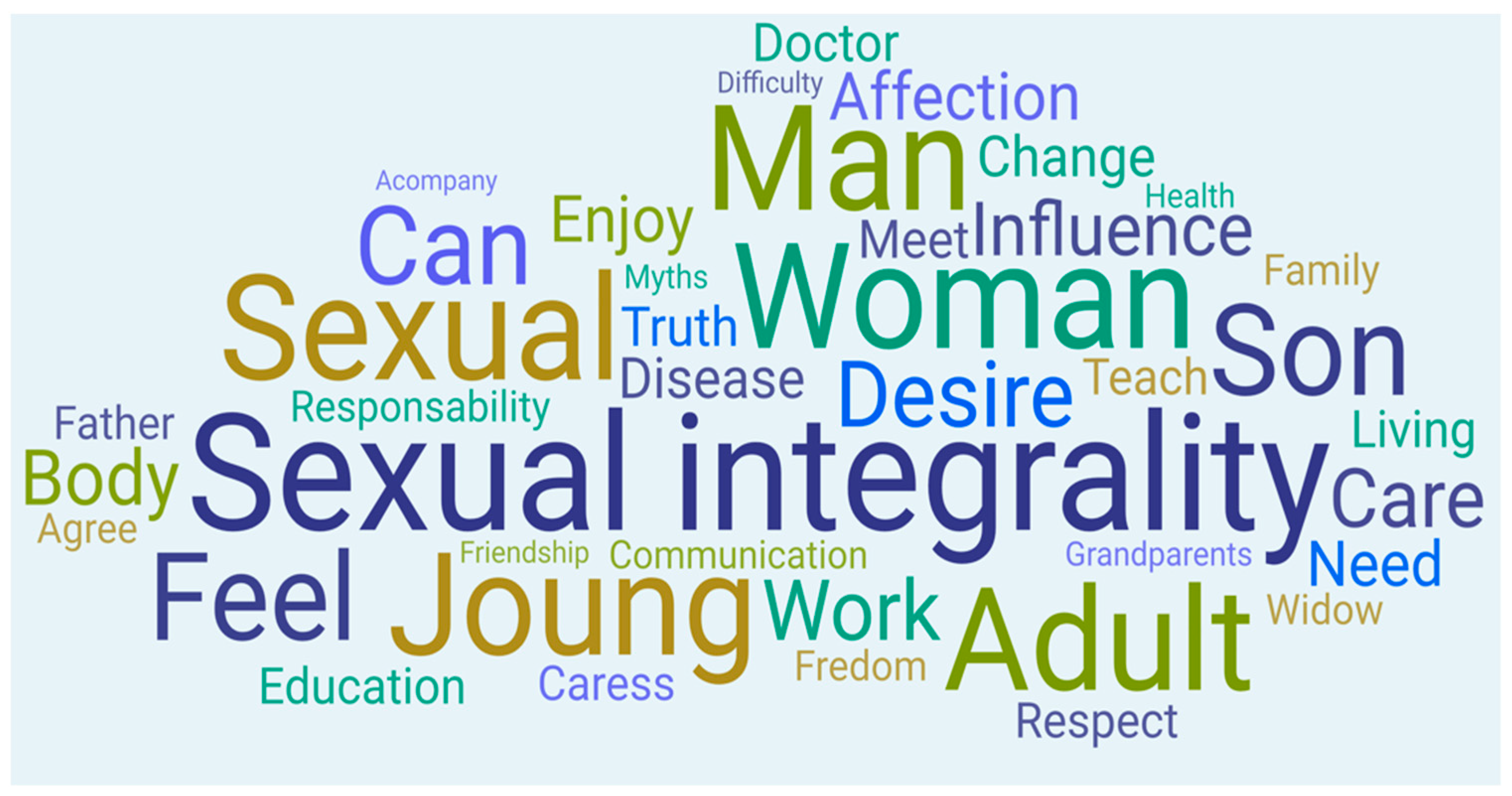
From the narratives provided by all participants, a word cloud was created (Figure 1) using the WordArt.com program, 2025. It displayed the words spoken in conversations, from the most frequently used (largest size) to the least mentioned (smallest size).
As seen in the cloud, the most used term by participants was “sexual integrity,” followed by the word “woman,” then a group of words such as “man,” “desire,” “adult,” and “sexual.” These were followed by words like “feelings,” “son,” and “influence.” Subsequently, a group of words such as “change,” “work,” and “responsibility” are followed by a large group of related words, including “respect,” “illnesses,” “care,” “needs,” and “family,” among others.

3.2. Dimensions and Sub-Dimensions

As shown in Table 1, the research identified 10 emergent dimensions and 42 sub-dimensions from the participants’ narratives. The dimensions represent the iteration of themes and their contents as expressed by all the older adults participating, who did not show significant divergences in their views, either in general or by geographical zone.
“Integral sexuality” was the dimension that prompted the most dialogue and opinions throughout all focus group sessions, while the “society, older adults, and sexuality” dimension generated the least.
It is possible to see the relationship between the word cloud and Table 1, as integral sexuality (the largest word in the cloud) is the dimension with the highest qualitative weighting in the table of dimensions and sub-dimensions.

3.2.1. Dimension: Integral Sexuality and the Elderly

The “integral sexuality” dimension emerged as the most discussed topic, and the result is consistent with the word cloud found and with findings published by other research, which demonstrates the depth, extent, and breadth that the topic holds for older adults.
  • Sub-dimensions
Gender Identity: Understood by the participants as diverse experiences, thoughts, and feelings of participation in the development of sexuality and sexual health:
“I, as a woman, also go to bed tired. Sometimes I prepare myself mentally to be able to say today I want to be with my partner and make love.”
(Mixed Group Maipú: 131)
Love Relationships: Understood as integral sexuality, composed of values and a couple’s love:
“Sexuality has curves and each curve is a deep love.”
(Men’s Group Ñuñoa: 10)
“At least I am enjoying my sexuality, my husband is 60 years old, he is very affectionate, attentive, concerned about me and our daughters… he is sexually active, and if I say no, he accepts it. There is respect, and I wish for it to always stay that way.”
(Women’s Group Talca: 82)
Satisfaction and Fullness: An expression of being fulfilled with one’s partner in ways that go beyond the sexual act, and includes the psycho-emotional and spiritual:
“Satisfying is not the same as making love; having sex is not necessarily satisfying the other(s). Sometimes, you have to have sex, so the man doesn’t get angry; sometimes it is only satisfaction for him.”
(Women’s Group Maipú: 16)
Caresses: Acts to which older adults attribute high value, with or without coital activity:
“It is having sex in a different way than when one is young, it is a relationship where more affection is felt, it is caressing each other, it is being together for all life.”
(Mixed Group Vallenar: 3)

3.2.2. Dimension: Problems and Sexuality in the Elderly

Problems in sexuality emerge with age: health issues, physical exhaustion, loss of desire, among others.
  • Sub-dimensions
Transformations and Changes: Arise as the explanation from some interlocutors about social changes that affect older adults:
“The economic aspect influences mental health, not having an adequate house, with a room with privacy, the overcrowding forces you to repress yourself.”
(Men’s Group Ñuñoa: 19)
“Now sexuality is more transparent, more open; before it was more hidden. I was a virgin until almost thirty years old. Romance was in the presence of others, or our siblings.”
(Women’s Group Maipú: 25)
Decrease in Sexual Capacity and Power: Refers to the loss of sexual capacity and power that occurs with age, or with serious illnesses, the use of medication, trauma, upbringing issues, abuse, and rape, among others:
“When one is young, one is not full of ailments like now, diabetes, hypertension… as the years go by, the thing is different.”
(Women’s Group Pedro Aguirre Cerda: 5)
“I got prostate cancer, they operated on me, it was not branched cancer, it was encapsulated, and that saved me. All this affected my sexuality.”
(Men’s Group Ñuñoa: 18)
“I don’t know if diabetics and hypertensives lower their level of sexuality. I am diabetic and hypertensive, with my husband, nothing happens; he just comes home purely to sleep. It’s a boring life.”
(Mixed Group Ñuñoa: 97)

3.2.3. Dimension: Sex and Orgasm According to Elderly People

Sex and orgasm are a binomial that remains alive in older adults as something necessary for mental and sexual health and quality of life. This is influenced by health deterioration, social stigmas, widowhood, myths and beliefs, as well as changes typical of this life stage, such as a decrease in sexual intensity and frequency, among others. In this dimension, there were no deeper symbolic representations that viewed sex and its differences as an art of feeling mental enjoyment through pleasure with a partner.
  • Sub-dimensions
Sexual Relations: Understood as the capacity to have coital activity to satisfy the biological need for sexual desire:
“I have no problem reaching orgasm. We do a little of everything, masturbation, penetration, at this age, when one doesn’t have problems with children, one is more relaxed.”
(Women’s Group Pedro Aguirre Cerda: 8)
“Yes, we have sexual relations every one or two weeks, it depends on the mood.”
(Women’s Group Pedro Aguirre Cerda: 3)
Affectionate Relationships: A valued concept related to affectionate sexual behaviors in couples, sometimes of greater value than coital activity:
“Showing affection is part of sexuality, it’s a complement in living together.”
(Men’s Group Pedro Aguirre Cerda: 8)
“Yes, the other part is needed, the affection and fondness.”
(Women’s Group Talca: 22)
Forced Coital Loss: Occurs and is explained by the unilateral decision of one partner to no longer have coital relations:
“20 years ago, sex died for me, I separated from my husband, and goodbye, no more sex.”
(Women’s Group Pedro Aguirre Cerda: 77)
Non-coital Relations: This concept explains coital inactivity, where sexuality is expressed as sharing, living together, caressing, and expressing bodily love without coital relations:
“I have been married for 41 years… since I got sick with my kidneys, we haven’t had sex. My husband takes care of me, and I don’t feel what I felt before.”
(Women’s Group Pedro Aguirre Cerda: 13)

3.2.4. Dimension: Values, Sexuality, and Older Adults

This refers to the values that society accepts from a moral perspective regarding the sexuality of older adults.
  • Sub-dimensions
Communication: Participants valued communication in shaping their children’s sexuality, in social relationships, in intra-family education, and in schools. Communication is valued as a means of expressing caring, affection, and love within a couple.
“We have sex because we both want to, we reach orgasm, I feel alive.”
(Women’s Group Pedro Aguirre Cerda: 5)
Feelings: This is the affective and emotional part, accompanied by affection and good treatment in the couple’s relationship, positive aspects for good sexuality:
“Sexuality is a path of many suns, sexuality is feeling and attraction with the motive of finding a partner.”
(Men’s Group Ñuñoa: 7)
Satisfaction and Happiness: Understood as joint sexual development, of sexual enjoyment, harmony, and fullness, which is reinforced by the psycho-emotional and spiritual stability of the couple:
“For me, sexuality allows for the satisfaction of a person’s needs; as a man, it allows me the desire to love, to show affection, which is healthy.”
(Mixed Group Vallenar: 22)
Respect: Understood as a value exercised in the couple’s relationship for the way of being, of thinking, for values, feelings, and emotions; or for wanting or not wanting to have sexual relations:
“Sexuality in a couple is basically love, trust, respect, responsibility, loyalty, and honesty.”
(Women’s Group Ñuñoa: 50)

3.2.5. Dimension: Desire(s), Attraction in Older Adults

Desire appears in older adults as something important, linked to beliefs, myths, or sexual discrimination. There is a consensus that it should be kept alive, with a different intensity than when they were young. It is a cornerstone concept of femininity, masculinity, and coquetry.
  • Sub-dimensions
Sexual Desire: Accompanies sexual activity. It is inherent to people and must be kept alive, according to the participants, with nuances typical of this stage of life:
“I have desire, we connect, and he takes the initiative.”
(Women’s Group Pedro Aguirre Cerda: 8)
“To feel sexual desire with a partner similar to oneself, who gets along with you, is to think of a second chance.”
(Men’s Group Ñuñoa: 5)
Intensity of Desire: This is key for the good development of sexual or coital activity, which varies with advancing age:
“The intensity changes with maturity and the passing of the years. The intensity at 20 is not the same as at 70, but the affection remains the same.”
(Men’s Group Ñuñoa: 17)
“I have sexual desire, and I say God, you made me with sexual desire, he touches me, takes the initiative, we connect sexually.”
(Women’s Group Pedro Aguirre Cerda: 8)
“Penetration when one is diabetic is affected even though the desire does not diminish.”
(Mixed Group Ñuñoa: 35)
Eroticization: Described as important and necessary, individually and as a couple:
“Massaging each other, being affectionate, masturbating, is eroticization. I believe that older people do it.”
(Women’s Group Maipú: 21)
“I say that the sensation and eroticization exist, I feel it.”
(Men’s Group Ñuñoa: 36)

3.2.6. Dimension: Health Care at CESFAM or Other Centers and the Elderly

This reflects the experiences lived in sexual health care, generally with discrimination or rejection of the topic of sexuality by doctors and other health professionals, in whom a lack of preparation on the subject is apparent (diagnosis, treatment, use of drugs), which affects the sexual and mental health of older adults.
  • Sub-dimensions
Illness: Recognized as a condition that affects sexual performance in older couples:
“Illnesses affect a lot, you can’t have sexual relations when you are sick, the ailments of diabetes and arterial hypertension affect you.”
(Women’s Group Maipú: 29)
“With the years, the different illnesses have an influence, with older age the sexual appetite decreases and all that.”
(Women’s Group Pedro Aguirre Cerda: 15)
“Sexuality depends on one’s health and care, on not having illnesses, on not smoking or drinking.”
(Men’s Group Ñuñoa: 17)
Sexual Health: Mentioned as a state of an individual or a couple’s sexual well-being when feeling harmony, respect, affection, and active sexual activity. Frequency is not relevant to the sexual health of men, but it is for women, ideally weekly or no more than two weeks apart:
“We have been a couple for 42 years; we maintain sexual relations once or twice a week.”
(Women’s Group Pedro Aguirre Cerda: 5)
“Sex goes with emotion, and that, together with the physical, allows one to have a full sexuality; both go together.”
(Maipú Men’s Group: 6)
Mental Health: Has a direct relationship with sexual health. It is affected by the loss of sexual activity, as well as machismo, work-related or economic problems, stress, fatigue, illnesses, etc., which distance the couple’s relationship:
“The CESFAM has harmed me a lot, I got sick anyway. In sexuality, the same thing happens, nobody helps you.”
(Mixed Group Ñuñoa: 21)
“Better living conditions, housing, and education favor good mental and sexual health.”
(Men’s Group Ñuñoa: 19)
Abandonment by Doctors and Health Professionals: Participants generally make a profound criticism of the health system and health professionals. There is a feeling of abandonment regarding sexuality and sexual problems, as they do not take charge and show a lack of preparation in this matter:
“They never ask us anything, it is very necessary to address sexuality topics, one has no one to resolve doubts with, nor anyone to ask.”
(Women’s Group Maipú: 38)
“I would like doctors to ask if we have any sexuality problems, or for one to be able to ask them too.”
(Women’s Group Maipú: 39)
“Sexuality topics are not touched upon in the CESFAMs.”
(Men’s Group Ñuñoa: 46)
“The professionals are not prepared, and older people don’t ask because they don’t have time.”
(Women’s Group Ñuñoa: 44)

3.2.7. Dimension: Education, Training in Sexuality in the Elderly

Refers to the learning of key sexuality concepts associated with family, parents, schools, and society, which influences the formation of sexuality in children and young people.
  • Sub-dimensions
Family and Sexuality: Parents and grandparents cannot evade or delegate this responsibility, without myths or taboos, without religious influences and dogmas, for a healthy future sexuality and sexual health:
“Education should be given in schools, but each family has its own ethical and moral structure; this education must be in the family.”
(Men’s Group Ñuñoa: 27)
“I was raised by my grandmother, and she did not take charge of my sexual education; they were forbidden topics.”
(Mixed Group Vallenar: 50)
Upbringing: Refers to past upbringing models and how these negatively influenced the sexuality of older adults:
“Perhaps there are many concerns and, because of their upbringing, people do not dare to consult other people, they don’t even dare to ask a doctor.”
(Women’s Group Ñuñoa: 19)
“It depends on both parents; the upbringing one has from childhood from one’s parents influences a lot.”
(Women’s Group Maipú: 25)
“In upbringing, mothers wouldn’t let the boys do anything because it was the girls’ job.”
(Mixed Group Pedro Aguirre Cerda: 148)
Sex Education in Schools: Older adults saw this as mandatory in the country’s schools:
“There is a lack of education in sexuality in older adults… with better sex education, stimuli, and the way to face it improve.”
(Mixed Group Ñuñoa: 42)
“They made you see sex as morbid, sex was a sin, sex was dirty, sex was bad because the man only wanted you to have sex.”
(Mixed Group Pedro Aguirre Cerda: 70)
Misinformation: Reference is made to the lack of information for parents and children of past generations:
“We men had to look for information from our peers, in women’s magazines, because in my house sex was not talked about, it was a taboo, it was morbid and dirty.”
(Mixed Group Pedro Aguirre Cerda: 154)
Social Networks: Mentioned in the context of meeting partners through social networks like Facebook, Tinder, to have sex or start relationships:
“There are people who meet on Facebook, they get to know each other little by little, and they get married. I don’t like social networks for this.”
(Women’s Group Maipú: 40)

3.2.8. Dimension: Difference(s), Sexuality, and the Elderly

This refers to the differences that exist between older adults and young people, between older men and women, in the way sexuality is accepted, in sexual experiences, in the different illnesses they face, or in sexual capacity, among others.
  • Sub-dimensions
Generational Gap: Refers to the educational differences, in freedoms, values, etc., that exist in sexuality compared to today’s youth:
“In my time… romances were long, your parents had to know, you couldn’t run off because they wouldn’t let you go anywhere without a companion.”
(Mixed Group Pedro Aguirre Cerda: 70)
“Today young people are freer, we see licentiousness, today they talk about and do things in sexuality that you couldn’t before.”
(Men’s Group Ñuñoa: 21)
Acceptance of Differences: Refers to differences in life stages, physical and mental capacities in the couple, all of which affect sexuality:
“There must be patience in the couple, not being stubborn, even if there are differences, you have to try not to be contrary, and you must give in.”
(Mixed Group Vallenar: 25)
“After 60 years together, it’s not the same anymore, one seems like a disgusting person.”
(Mixed Group Vallenar: 12)
“When the woman marries a man older than her, and they don’t pay attention to her, they cheat on the husband and look for fun elsewhere. Now if there’s no sex in the house, they look for it outside.”
(Women’s Group Talca: 25)
Youth and Easy Sex: Seen as a criticism towards young people for the casualness and freedom with which they experience sexuality:
“Now everything is easy, I don’t criticize it either, but sex is very fast; they don’t value intimacy. There is nothing more intimate than giving your body to another, so they don’t respect it; it’s like a game.”
(Mixed Group Pedro Aguirre Cerda: 72)

3.2.9. Dimension: Sexuality and the Rights of the Elderly

This dimension is seen as a series of values and rights that exist at a social level and that relate to or affect the sexuality of older adults.
  • Sub-dimensions
Freedom: In general, there is consensus on the existence of a freer sexuality among young people, who have sex without prejudice, sometimes with licentiousness. It is also seen as a loss in women oppressed by machismo or prohibitive religious prejudices. Sometimes, it is seen as a loss of freedom in a woman oppressed by her spouse, or the freedom driven by feminism:
“Perhaps the greater information that young people handle makes them freer in their sexuality and to identify with different sexual behaviors.”
(Women’s Group Ñuñoa: 21)
“My daughter reproaches me for not having had more freedom, which affected her socially and prevented her from having sexual relations.”
(Mixed Group Vallenar: 62)
Mistreatment/Sexual Abuse: There were accounts ranging from sexual abuse, social discrimination, mistreatment due to machismo, and religious dogmas:
“I have never said this. At 5 years old, I was violated by a man; there was no penetration, but he abused me a lot. Even though I got married, I suffered a lot… having sex was suffering. Fortunately, my husband had prostate cancer, and sexual activity ceased.”
(Mixed Group Ñuñoa: 28)
“Even if they hold a thousand marches, rapists will continue to exist; the issue is how we fix society, and that the laws are hardened for this type of people.”
(Mixed Group Pedro Aguirre Cerda: 112)
Machismo: Mentioned as a form of upbringing, a stereotype learned within the family, mixed with roles, myths, and beliefs that marked sexuality:
“Machismo marks you, it hurts you when they treat you badly… it makes a person become disappointed, and for desire to be lost.”
(Mixed Group Vallenar: 21)
“I regret not having helped my wife more; with time, I realized my machismo and not having cooperated more with her.”
(Men’s Group Ñuñoa: 10)
Feminism: Understood as an expression of a right, as a current feminist movement, which, although shared, has differences regarding the ways or forms of exercising it:
“Now women do that (feminism), and if there’s no sex at home, they look for it outside.”
(Women’s Group Talca: 26)
“It seems fine to me that women enjoy sex, carefully, well-informed, with responsibility and empowered in this sense.”
(Women’s Group Maipú: 29)

3.2.10. Dimension: Society, Elderly, and Sexuality

In this dimension, the importance of social and cultural phenomena in the sexuality of older adults is highlighted, with different variables that positively or negatively influence the sexual sphere.
  • Sub-dimensions
Biopsychosocial Approach: Economic problems they face are highlighted; the low acceptance of sexual diversity, the lack of sex education, and the discrimination they experience. The lack of biopsychosocial training of current doctors is questioned:
“It is required that doctors have a more biopsychosocial, holistic view.”
(Women’s Group Maipú: 50)
“Social pressure affects the psyche, living in neighborhoods with criminals affects sexuality.”
(Men’s Group Ñuñoa: 43)
Culture: Understood as a concept that impacts sexuality, as it transmits myths, beliefs, experiences, family treatment or mistreatment, as well as positive or negative family experiences that influence the expression of future sexuality:
“It is very hard for me to accept that same-sex relationships are normal.”
(Mixed Group Ñuñoa: 16)
“Culture influences ageism, sexuality is still a taboo in Chile, it is not talked about or educated on in childhood, adolescence, and youth.”
(Women’s Group Maipú: 17)
Future and Sexuality: Participants view sexuality positively towards the future; they believe in experiences of growth, technological and scientific development that they think will positively affect sexuality, health, and sexual capacity:
“Sexuality with science will be better in the future.”
(Men’s Group Ñuñoa: 25)
“I believe that sexuality will be better in the future, with more education and culture, it will be discussed more, and it will be more open to talk about it.”
(Women’s Group Maipú: 48)

4. Discussion

The objective of this research was to identify the dimensions, characteristics, and underlying contents in the sexuality of older adults who participate in territorial organizations in Chile, which, in light of the findings, will be discussed to examine the concordances, differences, or new findings worth discussing in the area of older adults’ sexuality.
This research confirmed the importance that older adults give to sexuality, as has been shown in other studies [6,28,29,30,31], and in this investigation, 10 emergent dimensions and 42 sub-dimensions were found in the older adults participating in community groups.
In this research, both older men and women were willing and open to talk about sexuality, which differs from the findings of Soares and Meneghel, where one of the dimensions found was “difficulty in talking about sexuality/sex.” However, similar to this investigation, gender differences were found in the topic [32].
The main category or dimension found—“integral sexuality”—is not an isolated phenomenon, as other authors have also commented on the importance that older adults give to sexuality in old age, according to gender identities, experiences, and feelings of a unique and particular sexual activity that is felt as integral or is part of their life [31,33,34,35].
The narratives about sexuality revealed older adults with traditional gender roles according to the broad and hierarchical approach of the conception of sex [33], such as machismo in men or the silence and marital subjugation of women. Narratives marked socially and culturally by the gold standard of vaginal penetration and coitus were also found [6,36]. However, as in other studies, this research confirmed the existence of sexual-affective relationships, love relationships, non-coital relationships, and caresses, without disregarding masturbation [30,34,37,38,39].
Similarly to the research by Gore-Gorszewska G. [40], the “problems and sexuality” dimension represented a sexuality that transitions into this life stage with a natural decrease in sexual activity and coitus in older adults [41], which coincides with other studies demonstrating the importance of affectivity in relation to a decrease in coital activity, which increases in the absence of a partner [42,43]. This was consistent with other studies that showed that sexual activity is greater when in a relationship [18,44,45,46].
From another perspective, the research found conservative sociocultural ideas associated with gender and masculinity, which are in line with other research showing how older men coexist with physical or biological erection problems, absence of a partner, or others, which deteriorate the image of masculinity and generate negative emotions [47,48].
In addition to the above, there are studies that have suggested that illnesses such as prostate cancer negatively influence the physical, psychosocial, and emotional capacity of men, for which biopsychosocial programs should be managed to support older men living with this condition [49]. However, these changes should not be assumed as a reduction in the opportunity to enjoy sex in old age [50].
While the macho representation of experiencing sexuality and the sexual act to satisfy the man exists in women [33,51], this study also found a more updated experience that prioritizes the woman’s sexual satisfaction, detached from a conservative orientation and rather focused on sexual satisfaction, in some cases with feelings of deep love towards their partners, which is above sociocultural differences [35,52].
The “sex and orgasm” dimensions accounted for intimate relationships of desire, physical pleasure, and emotional intimacy; unlike the findings of Vieira K [52], where due to ignorance, taboo, and cultural pressure, older adults experienced guilt and shame for feeling sexual desire.
The “integral sexuality” and “values and sexuality” dimensions revealed the relationship between sexual activity and value-based, emotional, and communicational aspects (sex as emotional intimacy), which is consistent with the findings of Arias-Castillo L et al. [31] There were also scripts typical of an evolution of sexuality based on experiences of mutual equality and honesty, and deep feelings within the couple, which increases sexual satisfaction and aligns with other research [33,36,53].
The value-based strength of relationships in this life stage left deep marks on some participants, for example, from a deceased partner who had marked their lives, where the indelible memory of a life partner leads them to the extreme of not wanting to face a new life partner again, and therefore, depriving themselves of new experiences in sexuality.
In relation to the “education and training in sexuality” dimension, the lack of sex education has negatively impacted the sexuality of these older adults, which is consistent with other research [2,35]. This was compounded by the conservative formation of Catholic religious dogma, which, according to the participants, prevents them from living a free sexuality at this age [54]. In this sense, the relationship between a higher educational level and an active, quality sexuality has been demonstrated [16,18,55,56].
As in other studies [33,47], most of these older adults referred to a heteronormative condition, which was added to a homophobic stance anchored in the conservative formal education of their families of origin, related to the “Education and training in sexuality” dimension. There was also a great contrast with the perception they had of young people (dimension “Differences and sexuality”) and a lack of recognition of sexual rights or sexual diversity (dimension “Sexuality and rights”).
The foregoing is something that needs to be reflected upon, given the existence of research that has shown the presence of emerging issues that demand greater inclusion, such as sexuality in LGBT+ older adults [57], or studies in sexual minorities like older gay or bisexual men with HIV or mental health problems [58]. Added to this is research related to ethnic minorities in old age, which requires counseling competencies in health teams [59].
The relationship between biopsychosocial, cultural, and emotional aspects with changes in sexuality and sexual quality of life stands out, configuring integral relationships of love and fulfillment. This is consistent with the findings of Domínguez and Barbagallo [60], in which older adults continued to value sexuality, the expression of desire, and identity, with new meanings arising from openness, exploration, curiosity, valued relationships, and adaptations to this life stage.
Alterations in identity or inappropriate sexual behaviors represented in other research [53] did not appear in this study. Rather, the findings align with studies indicating that both quality of life and sexual well-being are experienced differently depending on sociodemographic, health, and lifestyle factors [57].
This study, like other research [9,32,39,61,62,63,64], showed that older adults are sexual beings who value the exercise of sexuality as something necessary and important at this stage of life. Nevertheless, there is a society that sees them as asexual beings and discriminates against them due to socio-normative standards, the existence of myths or beliefs, and the existence of stereotypes that make sexuality in this life stage invisible [10].
While the reasons for coital activity are the same across different age groups and genders, men generally have physical-biological reasons, and women have emotional reasons. In older women, physical capacity and sexual satisfaction tend to decline, which corroborates that sexuality is experienced differently in each life stage and that there are biopsychosocial aspects underlying these differences [65].
Unlike other research [66,67], there are persistent narratives that do not account for successful aging rooted in the retention of youth, coupled with a redefinition of self-image away from aesthetics and based on “affirmative aging.” Instead, there are feelings of loss in some cases, or of the decline of sexuality in others, for reasons of abuse in childhood or adolescence, or abandonment by partners in the case of some women.
The research confirmed the dissatisfaction produced by various diseases on the quality of sexual life [2,3,7], resulting from arterial hypertension, type 2 diabetes mellitus, prostate cancer, and erectile dysfunction in men, and breast cancer in women. A study in older European men showed a higher prevalence of premature ejaculation associated with prostate problems, poorer sexual function, deterioration of couple relationships, and loss of quality of life [68].
As in other investigations, a relationship was found between better sexual health and having a partner, physical capacity, a healthy diet, and good mental health (including cognitive function, memory, and intelligence) [7,44].
The participants highlighted the lack of attention from professionals at the CESFAMs regarding sexuality, which is consistent with Acevedo et al. [69] and Sepúlveda et al. [18] in Chile, who substantiate the avoidance of these consultations by doctors or health personnel at the primary care level. This is complemented by findings from research indicating a lack of guidance on sexuality aimed at older adults [12,18].
On the other hand, this research corroborated the lack of preparation or training of health personnel in the sexuality of older adults [32,70,71], negative attitudes of these individuals towards this type of care [7,35,72], and a deficit or absence in the delivery of educational content on the matter by health personnel [2,3,4,7,9,12,18,35]. Nevertheless, the effectiveness of educational programs in old age has been demonstrated [73,74].
According to the “Values and sexuality” dimension, it is key to re-signify the sexual rights of older adults in tune with various authors [18,38,69,75,76], who, among other things, promote the prevention and elimination of sexual abuse from public and care policies, as the research found stories of damage to sexual and emotional quality of life throughout the life course, including in older adulthood.
Evidence showed that the integrality and sexual health of older adults can be improved by fostering resilience, promoting good physical and mental health, and minimizing the ageism that older adults often self-inflict [77]. This is in line with smart cities that improve the autonomy, mobility, and connectivity of older adults at a country level, in sync with public policies for active and healthy aging [78].
Although the results found show an updated reality of the sexuality of older adults residing in the three selected geographical zones that configured the analyzed dimensions and sub-dimensions, this is a limitation that could be improved with more groups in more regions or by extending to other methods and research that contribute to the sexuality and sexual quality of life of older adults.

5. Conclusions

This research successfully identifies the dimensions, characteristics, and underlying content of sexuality in older adults.
Accordingly, sexuality in older adults in Chile is an emerging issue, which goes hand in hand with the population aging that the country is currently experiencing. For this reason, advocacy must be made to consider it an essential human right based on the biopsychosocial, cultural, and emotional aspects of older adults in the country.
The country must advance in technological innovations and in the way health personnel are trained to address sexual health needs in old age, which demands optimal care from a biopsychosocial and integral perspective. Chile is no exception, as this research adds to the limited evidence in the country that indicates serious problems in the sexuality education of older adults.
National and international evidence points to the growing need to improve access and opportunity for sexual health care for older adults at the primary care level. This makes it pertinent to incorporate this training in undergraduate and postgraduate programs, as well as in the preparation of health personnel at the primary care level as a strategy for permanent and continuous training.
The ten dimensions and sub-dimensions identified in this research reveal content that emerged as needs, contributing to national and international scientific evidence. In the case of Chile, these should be considered by public policy (both health and non-health related) to improve the quality of life for older adults.
Undoubtedly, these findings make a significant contribution to managers, academics, and researchers, and they open up a wide range of possible future explorations related to sexuality in old age.

Author Contributions

Conceptualization, J.A.A., C.B.K. and M.V.L.; methodology, J.A.A.; soft-ware, J.A.A.; validation, J.A.A., C.B.K., F.M.R. and M.V.L.; formal analysis, J.A.A.; methodology, J.A.A.; software, J.A.A.; validation, J.A.A., C.B.K., F.M.R. and M.V.L.; formal analysis, J.A.A.; investigation, J.A.A., M.V.L. and E.E.A.; writing—original draft preparation, J.A.A.; writing—review and editing, J.A.A., C.B.K., F.M.R. and M.V.L.; funding acquisition, J.A.A. All authors have read and agreed to the published version of the manuscript.

Funding

This research was funded by the Outreach Department of the Faculty of Medicine at the University of Chile in Santiago, Chile, which is part of the project awarded to the lead author, entitled” Sexuality in Older Adulthood: Challenges from Outreach and Community Engagement, Teaching, and University Research.” (Center Execution 570377). The project funds a publication between 1000 and 1200 CHF.

Institutional Review Board Statement

This study was conducted in accordance with the Declaration of Helsinki and approved by the Ethics Committee of the Faculty of Medicine of the Universidad de Chile (protocol code No. 174-2020 XXX and Minutes file: No. 176, approval date 26 January 2021). The project and the documents mentioned in the preceding paragraph have been analyzed in the light of the postulates of the Declaration of Helsinki, of postulates of the Declaration of Helsinki, the International Ethical Guidelines for Human Biomedical Research on Human Subjects CIOMS 2016, and the Good Clinical Practice Guidelines of ICH 1996, Clinical Practice Guidelines 1996.

Informed Consent Statement

Informed consent was obtained from all subjects involved in the study.

Data Availability Statement

The data are available in Spanish, as reported by the MAXQDA 2023 software.

Conflicts of Interest

The authors declare no conflicts of interest.

Abbreviations

The following abbreviations are used in this manuscript:
WHOWorld Health Organization
PHCPrimary Health Care
PAHOPan American Health Organization
CEHFHealth Care in Family Health Centers

References

  1. World Health Organization. Health Topics. Sexual Health. 2006. Available online: https://www.who.int/teams/sexual-and-reproductive-health-and-research/key-areas-of-work/sexual-health/defining-sexual-health (accessed on 20 October 2025).
  2. Rodríguez-Martín, B.; Mencía, S. Percepciones de la sexualidad en personas mayores: Una revisión sistemática de estudios cualitativos. Rev. Esp. Salud Públ. 2019, 93, 213435056. [Google Scholar]
  3. Ricoy-Cano, A.J.; Obrero-Gaitán, E.; Caravaca-Sánchez, F.; De La Fuente-Robles, Y.M. Factors Conditioning Sexual Behavior in Older Adults: A Systematic Review of Qualitative Studies. J. Clin. Med. 2020, 9, 1716. [Google Scholar] [CrossRef]
  4. Navarro, E. Intervenciones para Mejorar la Sexualidad en Adultos Mayores: Una Revisión Bibliográfica; Universidad de Alicante: Alicante, Spain, 2021. [Google Scholar]
  5. Acevedo, J.; Bartolucci, K. Sexualidad en el Adulto Mayor; Acevedo, J., Bartolucci, K., Vásquez, M., Eds.; Universidad de Chile: Santiago, Chile, 2019; pp. 1–49. Available online: https://uchile.cl/publicaciones/157210/sexualidad-en-el-adulto-mayor (accessed on 28 July 2025).
  6. Gewirtz-Meydan, A.; Ayalon, L. Why Do Older Adults Have Sex? Approach and Avoidance Sexual Motives Among Older Women and Men. J. Sex Res. 2018, 56, 870–881. [Google Scholar] [CrossRef]
  7. López-Ramos, H.; Medina-Rico, M.; Hernández, P.; Silva, J. Sexualidad en el adulto mayor, conductas y retos—Revisión de la literatura. Rev. Urol. Colomb. Colomb. Urol. J. 2018, 28, 121–129. [Google Scholar] [CrossRef]
  8. Sinković, M.; Towler, L. Sexual Aging: A Systematic Review of Qualitative Research on the Sexuality and Sexual Health of Older Adults. Qual. Health Res. 2018, 29, 1239–1254. [Google Scholar] [CrossRef]
  9. Bortolozzi, A.; Ramos, T. Saúde sexual e envelhecimento: Revisão da literatura e apontamentos para a Educação Sexual. Rev. Ibero-Am. Estud. Educ. 2020, 15, 2699–2712. [Google Scholar] [CrossRef]
  10. Soto, C.E.G.; Castañeda, R.F.G.; Lima, C.F.D.M.; Soto, J.A.G. Influencias del mundo y el cuerpo en la sexualidad del adulto mayor. Enferm. Glob. 2024, 23, 404–428. [Google Scholar] [CrossRef]
  11. de Souza Júnior, E.V.; Therrier, S.; Silva Cdos, S.; Peloso-Carvalho Bde, M.; Siqueira, L.R.; Sawada, N.O. Sexualidad y sintomatología depresiva en ancianos residentes en el nordeste de Brasil. Enferm. Glob. 2021, 20, 170–216. [Google Scholar] [CrossRef]
  12. de Souza Júnior, E.V.; Cruz, D.P.; Fernandes da Silva Filho, B.; Silva Cdos, S.; Siqueira, L.R.; Sawada, N.O. Influencia de la sexualidad en la salud mental de las personas mayores. Enferm. Actual Costa Rica 2021, 42. [Google Scholar] [CrossRef]
  13. Zúñiga, M.P.; García, R.; Araya, A.X. Fragilidad y su correlación con calidad de vida y utilización de los servicios de salud en personas mayores que viven en la comunidad. Rev. Med. Chil. 2019, 147, 870–876. [Google Scholar] [CrossRef]
  14. Albala, C. El envejecimiento de la población chilena y los desafíos para la salud y el bienestar de las personas mayores. Rev. Méd. Clín. Las Condes 2020, 31, 7–12. [Google Scholar] [CrossRef]
  15. Apella, I.R.; Joubert, C.J.E.; Packard, T.G.; Zumaeta Aurazo, M. Grupo Banco Mundial. 2019. p. 1–214. Retos y Oportunidades del Envejecimiento en Chile. Available online: https://documentos.bancomundial.org/es/publication/documents-reports/documentdetail/591471558704698806/retos-y-oportunidades-del-envejecimiento-en-chile (accessed on 24 August 2024).
  16. Pontificia Universidad Católica de Chile y Caja de Los Andes. Chile y sus Mayores. Quinta Encuesta Nacional de Calidad de Vida en la Vejez. 2019, pp. 1–139. Available online: https://www.senama.gob.cl/storage/docs/QUINTA_ENCUESTA_NACIONAL_DE_CALIDAD_DE_VIDA_EN_LA_VEJEZ_2019._CHILE_Y_SUS_MAYORES_2019.pdf (accessed on 6 October 2025).
  17. Hernández Carrasco, M.; de la Fuente Ballesteros, S.L.; García Granja, N.; Hidalgo Benito, A.; García Álvarez, I.; Cano Pazos, M. Características de la esfera sexual en pacientes adultos mayores. Med. Fam. Semer. 2019, 45, 37–43. [Google Scholar] [CrossRef]
  18. Sepúlveda, C.; Lozano, P.; López, C.; Acevedo, J.; Buccioni, R. La sexualidad en personas mayores de la región metropolitana y de o’higgins en chile. Rev. Chil. Aten. Primaria Salud Fam. 2024, 3, 1–18. [Google Scholar] [CrossRef]
  19. Sim, J. Focus Group Interviews in Education and Psychology. Physiotherapy 1996, 82, 645. [Google Scholar] [CrossRef]
  20. Peters, D.A. Improving quality requires consumer input: Using focus groups. J. Nurs. Care Qual. 1993, 7, 34–41. [Google Scholar] [CrossRef] [PubMed]
  21. Sanz-Marcos, P. Uso de focus groups en investigación científica: Guía práctica para investigadores. Infonomy 2025, 3, 1–11. [Google Scholar] [CrossRef]
  22. Krueger, R. Designing and Conducting Focus Group Interviews. 2002. Available online: https://www.eiu.edu/ihec/Krueger-FocusGroupInterviews.pdf (accessed on 9 October 2025).
  23. de la Espriella, R.; Restrepo, C.G. Teoría fundamentada. Rev. Colomb. Psiquiatr. 2020, 49, 127–133. [Google Scholar] [CrossRef]
  24. Vasilachis De Gialdino, I. Estrategias de Investigación Cualitativa; Gedisa Editorial: Barcelona, Spain, 2006; pp. 1–22. [Google Scholar]
  25. García Calvente, M.M.; Mateo Rodríguez, I. The focus group as a qualitative research technic in health: Its design and practical application. Atención Primaria Soc. Española Med. Fam. Comunitaria 2000, 25, 183–186. [Google Scholar]
  26. Morgan, D. Focus Groups as Qualitative Research; SAGE Publications, Inc.: South Oaks, CA, USA, 2012. [Google Scholar]
  27. Onwuegbuzie, A.; Collins, K. A Typology of Mixed Methods Sampling Designs in Social Science Research. Qual. Rep. 2015, 12, 281–316. [Google Scholar] [CrossRef]
  28. Ayalon, L.; Levkovich, I.; Gewirtz-Meydan, A.; Karkabi, K. A Life Course Perspective on the Ways Older Men and Women Discuss Sexual Issues. Arch. Sex. Behav. 2018, 48, 911–919. [Google Scholar] [CrossRef]
  29. DeLamater, J. Sexual Expression in Later Life: A Review and Synthesis. J. Sex Res. 2012, 49, 125–141. [Google Scholar] [CrossRef] [PubMed]
  30. Træen, B.; Štulhofer, A.; Janssen, E.; Carvalheira, A.A.; Hald, G.M.; Lange, T.; Graham, C. Sexual Activity and Sexual Satisfaction Among Older Adults in Four European Countries. Arch. Sex. Behav. 2018, 48, 815–829. [Google Scholar] [CrossRef] [PubMed]
  31. Arias-Castillo, L.; Ceballos-Osorio, J.; Ochoa, J.J.; Reyes-Ortiz, C.A. Correlates of Sexuality in Men and Women Aged 52–90 Years Attending a University Medical Health Service in Colombia. J. Sex. Med. 2009, 6, 3008–3018. [Google Scholar] [CrossRef]
  32. Soares, K.G.; Meneghel, S.N. O silêncio da sexualidade em idosos dependentes. Cine Saúde Colet 2021, 26, 129–136. [Google Scholar] [CrossRef] [PubMed]
  33. Fileborn, B.; Hinchliff, S.; Lyons, A.; Heywood, W.; Minichiello, V.; Brown, G.; Malta, S.; Barrett, C.; Crameri, P. The Importance of Sex and the Meaning of Sex and Sexual Pleasure for Men Aged 60 and Older Who Engage in Heterosexual Relationships: Findings from a Qualitative Interview Study. Arch. Sex. Behav. 2017, 46, 2097–2110. [Google Scholar] [CrossRef]
  34. Kleinplatz, P.J.; Ménard, A.D.; Paquet, M.P.; Paradis, N.; Campbell, M.; Zuccarino, D.; Mehak, L. The components of optimal sexuality: A portrait of “great sex”. Can. J. Hum. Sex. 2009, 18, 1–13. [Google Scholar]
  35. Tetley, J.; Lee, D.M.; Nazroo, J.; Hinchliff, S. Let′s talk about sex—What do older men and women say about their sexual relations and sexual activities? A qualitative analysis of ELSA Wave 6 data. Ageing Soc. 2016, 38, 497–521. [Google Scholar] [CrossRef]
  36. Syme, M.L.; Cohn, T.J.; Stoffregen, S.; Kaempfe, H.; Schippers, D. “At My Age … ”: Defining Sexual Wellness in Mid- and Later Life. J. Sex Res. 2018, 56, 832–842. [Google Scholar] [CrossRef]
  37. Thorpe, R. Tensions and contradictions: Women’s stories of ageing and sexuality in the context of the past. Sexualities 2018, 22, 969–986. [Google Scholar] [CrossRef]
  38. Herbenick, D.; Reece, M.; Schick, V.; Sanders, S.A.; Dodge, B.; Fortenberry, J.D. Sexual Behavior in the United States: Results from a National Probability Sample of Men and Women Ages 14–94. J. Sex. Med. 2010, 7, 255–265. [Google Scholar] [CrossRef]
  39. Fileborn, B.; Lyons, A.; Hinchliff, S.; Brown, G.; Heywood, W.; Dow, B.; Malta, S.; Minichiello, V. Improving the sexual lives of older Australians: Perspectives from a qualitative study. Australas. J. Ageing 2017, 36, E36–E42. [Google Scholar] [CrossRef] [PubMed]
  40. Gore-Gorszewska, G. “What Do You Mean by Sex?” A Qualitative Analysis of Traditional versus Evolved Meanings of Sexual Activity among Older Women and Men. J. Sex Res. 2020, 58, 1035–1049. [Google Scholar] [CrossRef]
  41. Lee, D.M.; Nazroo, J.; O’cOnnor, D.B.; Blake, M.; Pendleton, N. Sexual Health and Well-being Among Older Men and Women in England: Findings from the English Longitudinal Study of Ageing. Arch. Sex. Behav. 2015, 45, 133–144. [Google Scholar] [CrossRef]
  42. Souza Júnior, E.V.D.; Siqueira, L.R.; Silva Filho, B.F.D.; Chaves, Â.B.; Santos, J.S.D.; Guedes, C.A.; Sawada, N.O. Efeitos das vivências em sexualidade na ansiedade e na qualidade de vida de pessoas idosas. Esc. Anna Nery 2022, 26, e20210371. [Google Scholar] [CrossRef]
  43. Silva NCMda Storti, L.B.; Lima, G.S.; Reis, R.K.; Araújo TFde Kusumota, L. Sexuality and assessment of physical and psychological symptoms of older adults in outpatient care. Rev. Bras. Enferm. 2021, 74, e20200998. [Google Scholar] [CrossRef] [PubMed]
  44. Li, T.; Luo, Y.; Meng, Y.; Yue, J.; Nie, M.; Fan, L.; Tong, C. Sexual Activity and Related Factors of Older Women in Hunan, China: A Cross-Sectional Study. J. Sex. Med. 2021, 19, 302–310. [Google Scholar] [CrossRef]
  45. Cismaru-Inescu, A.; Hahaut, B.; Adam, S.; Nobels, A.; Beaulieu, M.; Vandeviver, C.; Keygnaert, I.; Nisen, L. Sexual Activity and Physical Tenderness in Older Adults: Prevalence and Associated Characteristics from a Belgian Study. J. Sex. Med. 2022, 19, 569–580. [Google Scholar] [CrossRef]
  46. Thompson, E.H.; Langendoerfer, K.B. Older Men’s Blueprint for “Being a Man”. Men Masc. 2015, 19, 119–147. [Google Scholar] [CrossRef]
  47. Watson, W.K.; Stelle, C.; Bell, N. Older Women in New Romantic Relationships: Understanding the Meaning and Importance of Sex in Later Life. Int. J. Aging Hum. Dev. 2016, 85, 33–43. [Google Scholar] [CrossRef]
  48. Katz, A.; Dizon, D.S. Sexuality After Cancer: A Model for Male Survivors. J. Sex. Med. 2016, 13, 70–78. [Google Scholar] [CrossRef] [PubMed]
  49. Deacon, S.; Minichiello, V.; Plummer, D. SEXUALITY AND OLDER PEOPLE: REVISITING THE ASSUMPTIONS. Educ. Gerontol. 1995, 21, 497–513. [Google Scholar] [CrossRef]
  50. Forbes, M.K.; Eaton, N.R.; Krueger, R.F. Sexual Quality of Life and Aging: A Prospective Study of a Nationally Representative Sample. J. Sex Res. 2016, 54, 137–148. [Google Scholar] [CrossRef]
  51. Yan, E.; Wu, A.M.-S.; Ho, P.; Pearson, V. Older Chinese men and women′s experiences and understanding of sexuality. Cult. Health Sex. 2011, 13, 983–999. [Google Scholar] [CrossRef]
  52. Vieira, K. Sexualidade e Qualidade de Vida do Idoso: Desafios Contemporâneos e Repercussões Sociais; Universidade Federal da Paraíba: João Pessoa, Brazil, 2012; Available online: https://repositorio.ufpb.br/jspui/handle/tede/6908 (accessed on 24 August 2024).
  53. Srinivasan, S.; Glover, J.A.; Tampi, R.R.; Tampi, D.; Sewell, D.D. Sexuality and the Older Adult. Curr. Psychiatry Rep. 2019, 21, 97. [Google Scholar] [CrossRef]
  54. de Souza Júnior, E.V.; Souza, C.S.; Santos Gda, S.; Silva Cdos, S.; Cruz, D.P.; Sawada, N.O. Correlational analysis between elderly people’s sexuality and quality of life. Texto Contexto Enferm. 2022, 31, e20200629. [Google Scholar]
  55. González Pedraza Avilés, A. Características de la actividad sexual de los adultos mayores y su relación con su calidad de vida. Rev. Espec. Méd.-Quirúrgicas 2010, 15, 72–79. [Google Scholar]
  56. Buono, M.D.; Zaghi, P.; Padoani, W.; Scocco, P.; Urciuoli, O.; Pauro, P.; De Leo, D. Sexual feelings and sexual life in an Italian sample of 335 elderly 65 to 106-year-olds. Arch. Gerontol. Geriatr. 1998, 26, 155–162. [Google Scholar] [CrossRef]
  57. von Humboldt, S.; Cabras, E.; Low, G.; Leal, I. Sexual Well-Being and Aging Patterns: Findings of a Cluster Analysis among Older Adults in Portugal and Spain. Eur. J. Investig. Health Psychol. Educ. 2024, 14, 2013–2028. [Google Scholar] [CrossRef] [PubMed]
  58. Batista, I.C.; Pereira, H. Mental health, resilience and HIV in older gay and bisexual men. Educ. Gerontol. 2020, 46, 525–539. [Google Scholar] [CrossRef]
  59. Harris, H.L. Ethnic minority elders: Issues and interventions. Educ. Gerontol. 1998, 24, 309–323. [Google Scholar] [CrossRef]
  60. Dominguez, L.J.; Barbagallo, M. Ageing and sexuality. Eur. Geriatr. Med. 2016, 7, 512–518. [Google Scholar] [CrossRef]
  61. Gewirtz-Meydan, A.; Levkovich, I.; Mock, M.; Gur, U.; Karkabi, K.; Ayalon, L. Sex for seniors: How physicians discuss older adult’s sexuality. Isr. J. Health Policy Res. 2020, 9, 8. [Google Scholar] [CrossRef]
  62. Evangelista Ada, R.; Moreira, A.C.A.; Freitas, C.A.S.L.; Val DRdo Diniz, J.L.; Azevedo, S.G.V. Sexualidade de idosos: Conhecimento/atitude de enfermeiros da Estratégia Saúde da Família. Rev. Esc. Enferm. USP 2019, 53. [Google Scholar] [CrossRef] [PubMed]
  63. Gonzáles-Soto, C.E.; Guerrero-Castañeda, R.F. Análisis de la producción científica de la sexualidad del adulto mayor: Una revisión integrativa. Rev. Baiana Enferm. 2022, 36. [Google Scholar] [CrossRef]
  64. OMS/OPS. Informe Mundial Sobre Edadismo; OMS/OPS: Washington, DC, USA, 2021; pp. 1–116. Available online: https://iris.paho.org/handle/10665.2/55871?show=full (accessed on 24 August 2024).
  65. Wyverkens, E.; Dewitte, M.; Deschepper, E.; Corneillie, J.; Van der Bracht, L.; Van Regenmortel, D.; Van Cleempoel, K.; De Boose, N.; Prinssen, P.; T’sJoen, G. YSEX? A Replication Study in Different Age Groups. J. Sex. Med. 2018, 15, 492–501. [Google Scholar] [CrossRef]
  66. Sandberg, L. Affirmative old age—The ageing body and feminist theories on difference. Int. J. Ageing Later Life 2013, 8, 11–40. [Google Scholar] [CrossRef]
  67. Towler, L.B.; Graham, C.A.; Bishop, F.; Hinchliff, S. Older adults′ embodied experiences of aging and their perceptions of societal stigmas toward sexuality in later life. Soc. Sci. Med. 2021, 287, 114355. [Google Scholar] [CrossRef]
  68. Ettala, O.O.; Syvänen, K.T.; Korhonen, P.E.; Kaipia, A.J.; Vahlberg, T.J.; Boström, P.J.; Aarnio, P.T. High-Intensity Physical Activity, Stable Relationship, and High Education Level Associate with Decreasing Risk of Erectile Dysfunction in 1000 Apparently Healthy Cardiovascular Risk Subjects. J. Sex. Med. 2014, 11, 2277–2284. [Google Scholar] [CrossRef]
  69. Acevedo, J.; Solari, A.; Concha, M.; Román, D. Literature review on sexuality in the elderly: What is being taught and with what technologies. Medwave 2024, 24, e2710. [Google Scholar] [CrossRef]
  70. Moana, B.; Crawford, R.; Isaac, D. Discussing sexual health with older clients: Are primary health care nurses sufficiently prepared? Whitireia Nurs. Health J. 2017, 24, 63–67. [Google Scholar]
  71. Montenegro Martínez, G.; Carmona Montoya, A.; Franco-Giraldo, Á. Modelos para el análisis de políticas públicas en salud reportados en publicaciones científicas. Gac. Sanit. 2021, 35, 270–281. [Google Scholar] [CrossRef]
  72. Caro, A.I. The role of prison nursing: An integrative review. Rev. Esp. Sanid. Penit. 2021, 23, 76–85. [Google Scholar] [CrossRef] [PubMed]
  73. Santos Silva, I.M.; Paula Pinto, M.; Gonçalves, D. Educational Programs and Sexual Counselling for Postmenopausal Sexual Dysfunction: A Systematic Review and Meta-Analysis. J. Sex Med. 2022, 19, 54–63. [Google Scholar] [CrossRef]
  74. Flores, T.R.; Gomes, A.P.; Soares, A.L.G.; Nunes, B.P.; Assunção, M.C.F.; Gonçalves, H.; Bertoldi, A.D. Aconselhamento por profissionais de saúde e comportamentos saudáveis entre idosos: Estudo de base populacional em Pelotas, sul do Brasil, 2014. Epidemiol. Serviços Saúde 2018, 27, e201720112. [Google Scholar] [CrossRef]
  75. Fallas, M.P.F.; Correas, N.V.M.; Taborda, T.S.; Bermúdez, J.P.J.; Chen, Y.-Y.L. Abuso en el adulto mayor. Rev. Clín. Esc. Med. UCR-HSJD 2021, 10, 1–8. [Google Scholar] [CrossRef]
  76. Olloa Cuellar, J.F.; Barcia Briones, M. La violencia intrafamiliar en el adulto mayor. Rev. Cognosis 2019, 4, 81–92. [Google Scholar] [CrossRef]
  77. Gitlitz, T.; Ayalon, L. The mediating role of self-directed ageism in sexual health among Jewish-Israeli older people. Geriatr. Nurs. 2023, 54, 341–349. [Google Scholar] [CrossRef] [PubMed]
  78. Ivan, L.; Beu, D.; van Hoof, J. Smart and Age-Friendly Cities in Romania: An Overview of Public Policy and Practice. Int. J. Environ. Res. Public Health 2020, 17, 5202. [Google Scholar] [CrossRef]
Figure 1. Word cloud from the conversations of all focus groups.
Sexes 07 00004 g001
Table 1. Emerging dimensions.
DimensionQualitative Weighting
1. Integral Sexuality and the Elderly
Subdimensions: gender identity, love relationships, satisfaction and fulfillment, caresses.
++++++Very high
2. Problems and sexuality in the Elderly
Subdimensions: transformations and changes, decreased sexual capacity and power.
++++++Very high
3. Sex and orgasm according to Elderly People
Subdimensions: sexual relationships, affective relationships, forced coital loss, non-coital relationships.
++++++Very high
4. Values and sexuality in the Elderly
Subdimensions: communication, feelings, satisfaction and happiness, respect.
++++++Very high
5. Desire(s), sexual attraction in Elderly People. Subdimensions: sexual desire, intensity of desire, eroticization.++++Medium
6. Health Care in Family Health Centers (CESFAM) or others, and Elderly Persons
Subdimensions: diseases, mental and sexual health, medical neglect, and health professionals.
++++Medium
7. Education, training in sexuality according to Elderly People
Subdimensions: family and sexuality, parenting, sex education in schools, misinformation, social networks.
+++Low
8. Difference(s), sexuality and the Elderly
Subdimensions: sex and gender differences, generation gap, acceptance of differences, youth, and easy sex.
+++Low
9. Sexuality and the Rights of the Elderly
Subdimensions: freedom, mistreatment/sexual abuse, machismo, feminism.
++Low
10. Society, Elderly, and Sexuality
Subdimensions: biopsychosocial approach, culture, future, and sexuality.
+Low
Disclaimer/Publisher’s Note: The statements, opinions and data contained in all publications are solely those of the individual author(s) and contributor(s) and not of MDPI and/or the editor(s). MDPI and/or the editor(s) disclaim responsibility for any injury to people or property resulting from any ideas, methods, instructions or products referred to in the content.