1. Introduction
The sixth generation (6G) of wireless communication systems is expected to revolutionize mobile network services with its promise of Ultra-Reliable and Low-Latency Communications (URLLC) [
1]. New Key Performance Indicators (KPIs) have been defined, including sub-millisecond-level latency and increased data transmission capacity. According to the International Telecommunication Union’s (ITU) vision for international mobile telecommunications 2030 (IMT-2030), reliability over the air interface could range between
and
or even
for industrial applications [
2]. Furthermore, the integration of Artificial Intelligence (AI) into network functions will enhance the user experience by enabling intelligent decision-making and management of the complexity of 6G. Reliability is further enhanced by AI-powered predictive maintenance, which enables real-time communication among machines, anticipates potential failures and optimizes operational performance within industrial environments [
3]. This advancement is particularly important for mission-critical applications, such as remote surgery, autonomous vehicles and extended reality (XR), where users anticipate a consistently high Quality of Experience (QoE) [
4]. As video streaming represents a significant share of global data traffic, enhancing this QoE for end users has become a key performance metric in emerging network paradigms. However, achieving reliable and dynamically adaptive video delivery across a massive number of heterogeneous devices presents significant challenges, due to the distributed nature of the whole edge–cloud continuum infrastructure.
Addressing these challenges requires a fundamental rethinking of network architectures, where computation, intelligence, and control are no longer centralized but distributed across the edge–cloud continuum. In this context, the architecture of 6G networks is decentralized, integrating advanced technologies such as Multi-Access Edge Computing (MEC) and Edge AI to satisfy stringent requirements for high availability, reliability, and low latency in mission-critical applications. By allowing computation near end users, MEC significantly shortens response times, thus supporting latency-sensitive use cases, including gaming and intelligent vehicular communication systems [
5]. Complementing this, Edge AI empowers the network edge with localized processing capabilities, facilitating real-time data analysis and predictive maintenance to optimize performance. This approach helps prevent service disruptions by identifying potential issues and thereby increasing service reliability [
3]. However, the distributed deployment of Edge AI brings technical challenges, such as synchronization issues between servers, necessitating the need for a resilient coordination framework. The continuous exchange of real-time information on processing and memory resources is crucial to maintaining seamless functionality [
6]. As a result, reliability in 6G systems increasingly depends on precise orchestration between distributed computing entities and on communication mechanisms capable of efficiently handling large volumes of real-time monitoring data. While such architectures enable unprecedented responsiveness and scalability, they also expose new challenges related to coordination, resilience, and service continuity across heterogeneous environments.
Beyond architectural and infrastructural advances, the evolution from 5G to 6G also introduces a fundamental shift in the way network performance is evaluated and optimized. To address the recognized limitations of 5G networks, the vision for 6G moves towards a more user-centric approach [
7]. Rather than focusing on the operational approach used today to solely enhance network capabilities, 6G aims to place users in the center, allowing them to define, customize and control their interaction with the services and applications. This shift requires networks to support highly personalized and adaptive services that respond intelligently to the needs and situational contexts of users [
8]. The user-centric approach can ensure a high QoE for each individual user, whereas 5G networks focus mainly on guaranteeing the Quality of Service (QoS), independent of the user that utilizes the service [
9]. This distinction highlights a critical gap in existing reliability approaches, which focus primarily on network-centric metrics and fail to capture the subjective and contextual dimensions of the user experience. Realizing and supporting this level of personalization requires a network infrastructure that is continuously stable, highly scalable and inherently reliable, allowing efficient processing of contextual and behavioral user data. A key enabler of this architecture, inspired by the 5G core’s openness and standardized Application Programming Interfaces (APIs), is the ability to deploy network functions decoupled from fixed physical locations. This flexibility allows for the creation, scaling, and migration of services throughout the edge–cloud continuum. Consequently, reliability mechanisms in 6G must evolve from static, infrastructure-oriented guarantees to adaptive, AI-driven functions that explicitly take into account user intent and perceived QoS.
In this paper, expanding on recent user-centric AI frameworks for 6G reliability, we propose and implement a user-centric reliability function by analyzing its impact on a video streaming application. The main contributions of this work are summarized as follows:
User-centric reliability modeling:We propose a novel reliability function that explicitly integrates QoE metrics into the reliability control loop, shifting the focus from traditional network-centric indicators to user-perceived service quality.
Multi-layer monitoring framework: We design a comprehensive monitoring approach that correlates telemetry from the edge–cloud continuum, network, and application planes, enabling holistic and context-aware reliability assessment in 6G environments.
Real-world video streaming validation: We implement a cloud-native video streaming platform using open-source tools and conduct Proof of Concept (PoC) experiments under heterogeneous workloads and memory constraints, demonstrating how reliability degradation can be predicted and mitigated in practice.
AI-driven reliability prediction and adaptive resource management: We perform a machine learning evaluation, comparing classical and deep learning models that predict reliability degradation in video streaming services and support dynamic application-layer resource scaling across the edge–cloud continuum to preserve QoE under high traffic loads and constrained resource conditions.
This approach to reliability differs from traditional ones, which rely on monolithic or single-layer solutions that assess reliability using isolated QoS metrics, such as packet loss. Although prior studies have explored AI-assisted reliability, QoS-to-QoE mapping, and resource management in 6G networks, these mechanisms typically treat QoE as an indirect or post-hoc indicator and do not incorporate it as an explicit control signal within an orchestration framework. In this work, reliability is instead grounded in the users’ perspective and their unique needs and intentions by examining their subjective QoE-related metrics that are directly used to drive orchestration decisions. By focusing on these user-defined requirements and leveraging correlated multi-layer telemetry, the proposed function dynamically selects and deploys appropriate predictive models to improve latency reduction, resource utilization, and overall network dependability. This user-centric predictive approach fosters trust in automation while strengthening the reliability of the system [
10]. At the application layer, reliability is achieved by ensuring adequate provisioning of resources for Virtual Network Functions (VNFs), which are required to operate continuously throughout the service lifecycle [
11]. Unlike static scaling policies, the proposed intelligent scaling mechanisms leverage QoE-driven predictions to anticipate traffic variations and potential failures, balancing performance and energy efficiency without excessive resource activation. As a result, the system achieves proactive, intent-aware reliability assurance across the edge–cloud continuum, creating a robust and efficient communication environment that users can rely on confidently.
The remainder of the paper is organized as follows. In
Section 2, we present in detail the proposed architecture of network function for AI-driven user-centric reliability on 6G networks, also including the multi-layered monitoring and data collection techniques.
Section 3 provides experimental scenarios designed as a PoC to evaluate the performance and adaptability of the intelligent video streaming system under memory-constrained conditions and varying workloads. Next, in
Section 4, we conduct an ML-based analysis and discuss the results obtained from the experimental setup while trying to enhance the end-user’s QoE. Finally,
Section 5 concludes the paper by summarizing the key findings and proposing future directions.
2. User-Centric Reliability Function
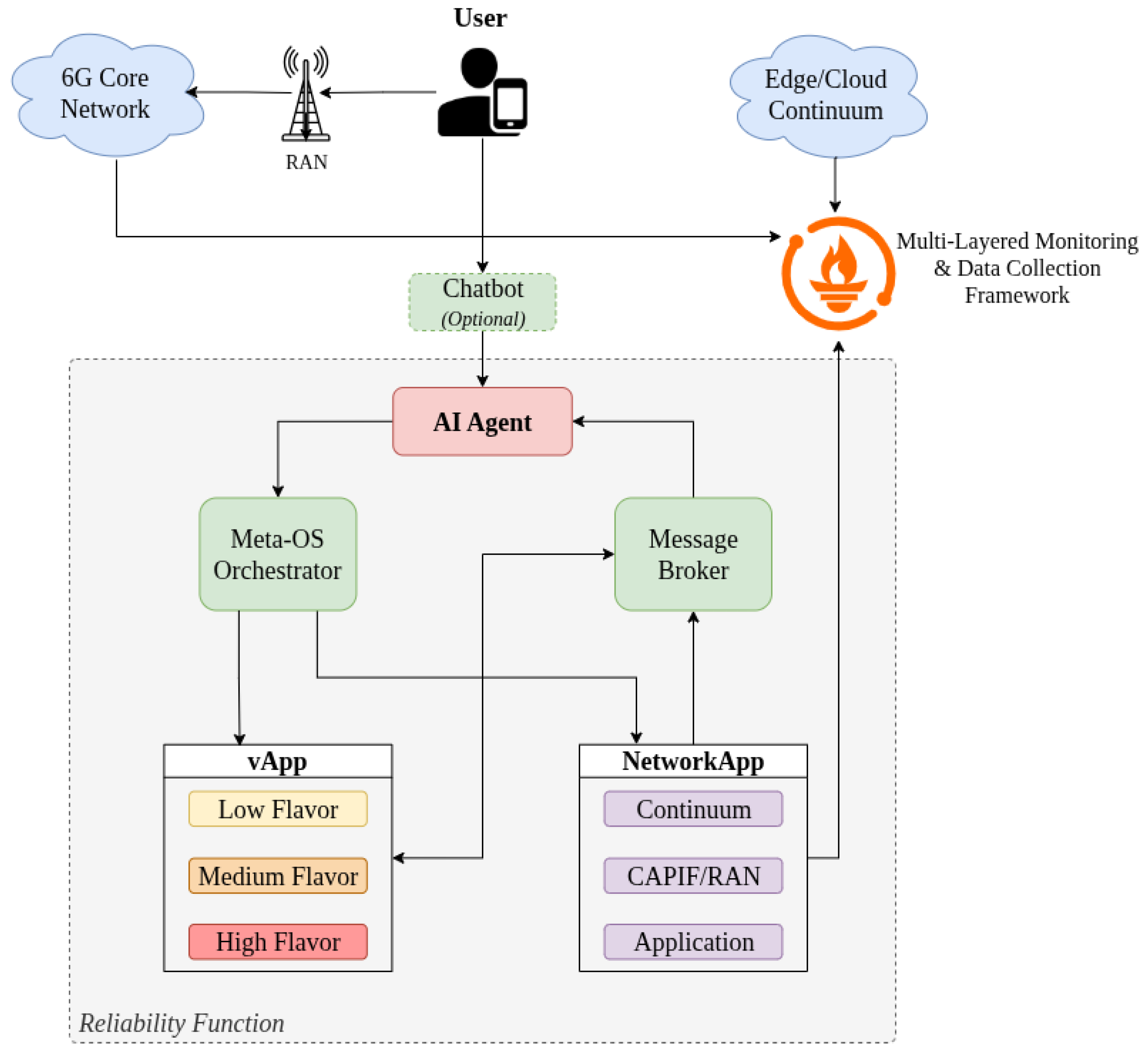
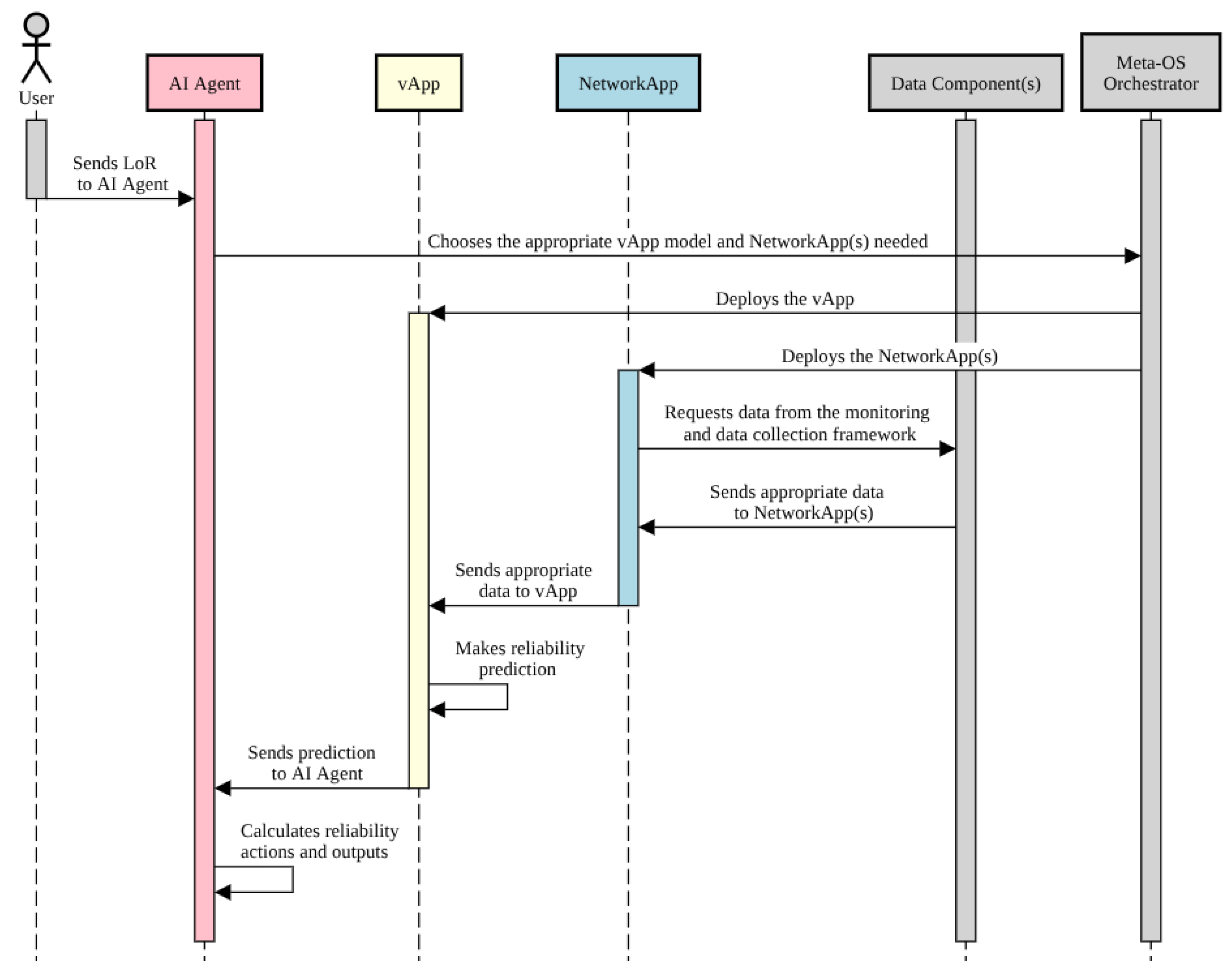
Considering that each user or tenant has different requirements in terms of trust level from a 6G system, it is necessary for the 6G system to be capable of being adapted to the specific needs and requirements of each user. These unique needs and intents of the user correspond to the desired Level of Reliability (LoR). Therefore, the 6G system should not only be reliable in a static way, but it should also become user-centric and capable of dynamically adapting the reliability level to the trust level requirements of each tenant. It should be noted that, in certain advanced implementations beyond the scope of this work, the LoR could also be derived through advanced human-machine interaction channels. Such channels can include conversational agents or Large Language Models (LLMs) capable of eliciting, interpreting, and formalizing user intent and requirements.
The user-centric reliability function aims to preserve the overall trustworthiness of the network by dynamically managing and continuously optimizing service reliability based on the provided LoR. It operates dynamically according to the intent of the user, leveraging AI-based mechanisms to respond to variations in the network environment and infrastructural capabilities. It oversees reliability across the full lifecycle of network services, from deployment to decommissioning. Through this lifecycle-oriented management, the desired LoR is consistently preserved as the network evolves and transforms.
2.5. Multi-Layered Monitoring and Data Collection
The multi-layered monitoring and data collection framework is designed to feed the user-centric reliability function, and specifically the NetworkApps, with data from all planes of the 6G ecosystem [
12]. Monitoring probes are placed in all possible layers, including the infrastructure (edge–cloud continuum), the network (5G/6G core system), and the application/service. Regarding the infrastructure plane, monitoring data may originate from physical nodes, hypervisors, virtual machines, containerized environments, and orchestration systems, covering hardware-level indicators such as Central Processing Unit (CPU) utilization, memory consumption, network interface activity, and energy metrics. Devices like User Equipments (UEs) may interface with portable network servers that integrate both Radio Access Network (RAN) and core functions, enabling telemetry from both physical and virtual resources. At the network plane, analytics can be derived from entities including the Network Data Analytics Function (NWDAF) and the User Plane Function (UPF), providing visibility into UE mobility patterns, traffic load conditions, session management behavior, traffic class differentiation, and network slice utilization. Finally, at the application/service plane, workload-related indicators are captured, such as concurrent request volume, user-to-application traffic exchanges, service latency measurements, and QoS/QoE metrics, which collectively reflect the perceived user experience.
The proposed framework integrates state-of-the-art open-source technologies to enable observability across the entire 6G ecosystem. OpenCAPIF, which is one of the most widely used Common API Framework (CAPIF) [
18] implementations, provides standardized and secure API exposure within the 5G/6G core, ensuring unified access to network functions. Prometheus [
19] serves as the core telemetry engine, collecting real-time metrics across distributed cloud and edge environments. To enhance observability, durability and global querying, Thanos [
20] extends Prometheus with long-term storage, high availability and federated data views across geographically dispersed components. Kepler [
21] is integrated for energy telemetry collection at the infrastructure level, enabling sustainability-aware decision-making in the reliability function. Together, these open-source tools provide a unified and extensible telemetry pipeline that feeds the reliability function with fine-grained data from almost all operational planes.
A key feature of the proposed reliability function is its ability to correlate this telemetry originating from different operational planes. For instance, variations in user location or device characteristics at the application plane can influence radio access conditions at the network plane and consequently impact resource utilization and performance within the infrastructure plane. By gathering indicators such as Channel Quality Indicator (CQI), Signal-to-Interference-plus-Noise Ratio (SINR), end-to-end delay, and traffic volume, and associating them with user-centric QoE metrics, such as frame rate in video streaming services or real-time latency, the reliability function can trace how lower-layer dynamics affect perceived service quality, while simultaneously detecting early signals of degradation or anomalous behavior. This holistic cross-plane correlation enhances the training process of AI/ML models, enabling the prediction of reliability-related anomalies or performance-breaking points and facilitating timely alerts that trigger proactive mitigation measures, such as scaling, migration, or service reconfiguration.
The monitoring framework also allows for user-centric interpretation of reliability by incorporating service and user-related characteristics. For example, different video quality demands in terms of resolution and frame rate, variations in radio conditions such as Reference Signal Received Power (RSRP) and Reference Signal Received Quality (RSRQ), or changes in 5G QoS Identifiers (5QI) values, reflecting different service requirements, can all affect the perceived QoE. Correlating these indicators with infrastructure and application metrics allows the reliability function to adapt its decisions to individual user intents.
4. ML-Based Analysis
To deepen the analysis of the validation methodology described previously, we conducted an extensive ML-based evaluation using all the different scenarios. This analysis aimed to quantify how memory constraints, the number of streamers and the number of clients influence system reliability and to determine whether early indicators of degradation can be learned directly from this telemetry exported by the experimental streaming infrastructure. In particular, we focused on low and medium vApp flavors, which correspond to lightweight and moderately complex inference pipelines within the proposed reliability function. These vApp flavors are representative of practical deployments where reliability predictions are generated at runtime and directly consumed by the AI Agent to trigger orchestration actions according to the LoR-dependent control policy. Although the control policy parameters associated with each LoR tier (e.g., mitigation thresholds, action step sizes and cooldown periods) are formally defined in the proposed architecture, the present evaluation aimed at the reliability inference capability of the vApp flavors and not at the quantitative analysis of closed-loop control behavior and policy parameter tuning. The entire workflow was implemented in Python, leveraging a classical machine learning pipeline designed to process raw monitoring traces, extract time-dependent features, and train multiple models capable of distinguishing reliable from unreliable operational states.
4.3. Results
The cross-scenario evaluation provides a perspective on how the different learning models behave under varying memory constraints and workload intensities.
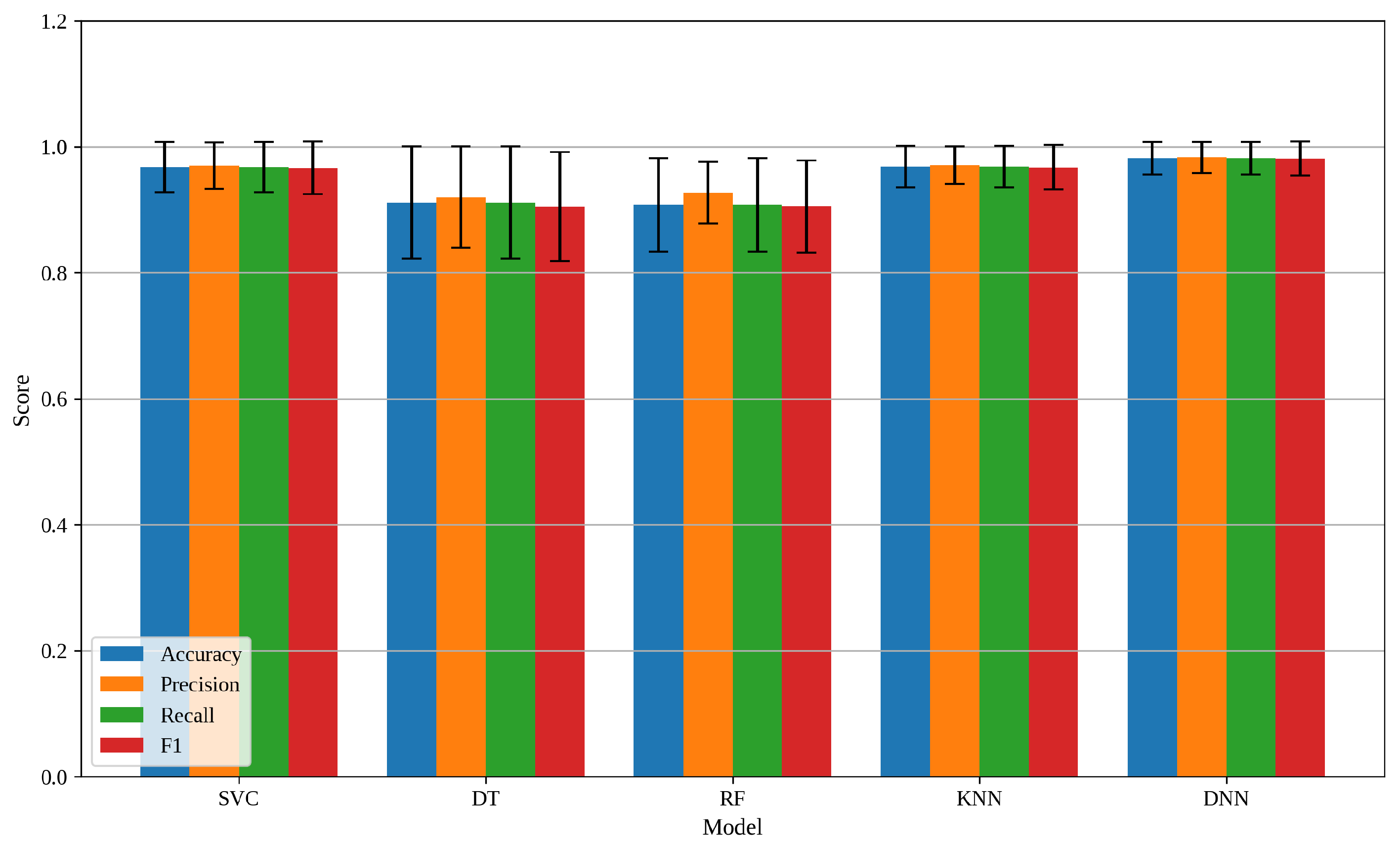
Figure 4 presents the aggregated results across all six scenarios, summarizing global accuracy, precision, recall, and F1-score (including standard deviations) for each model across all folds. In parallel,
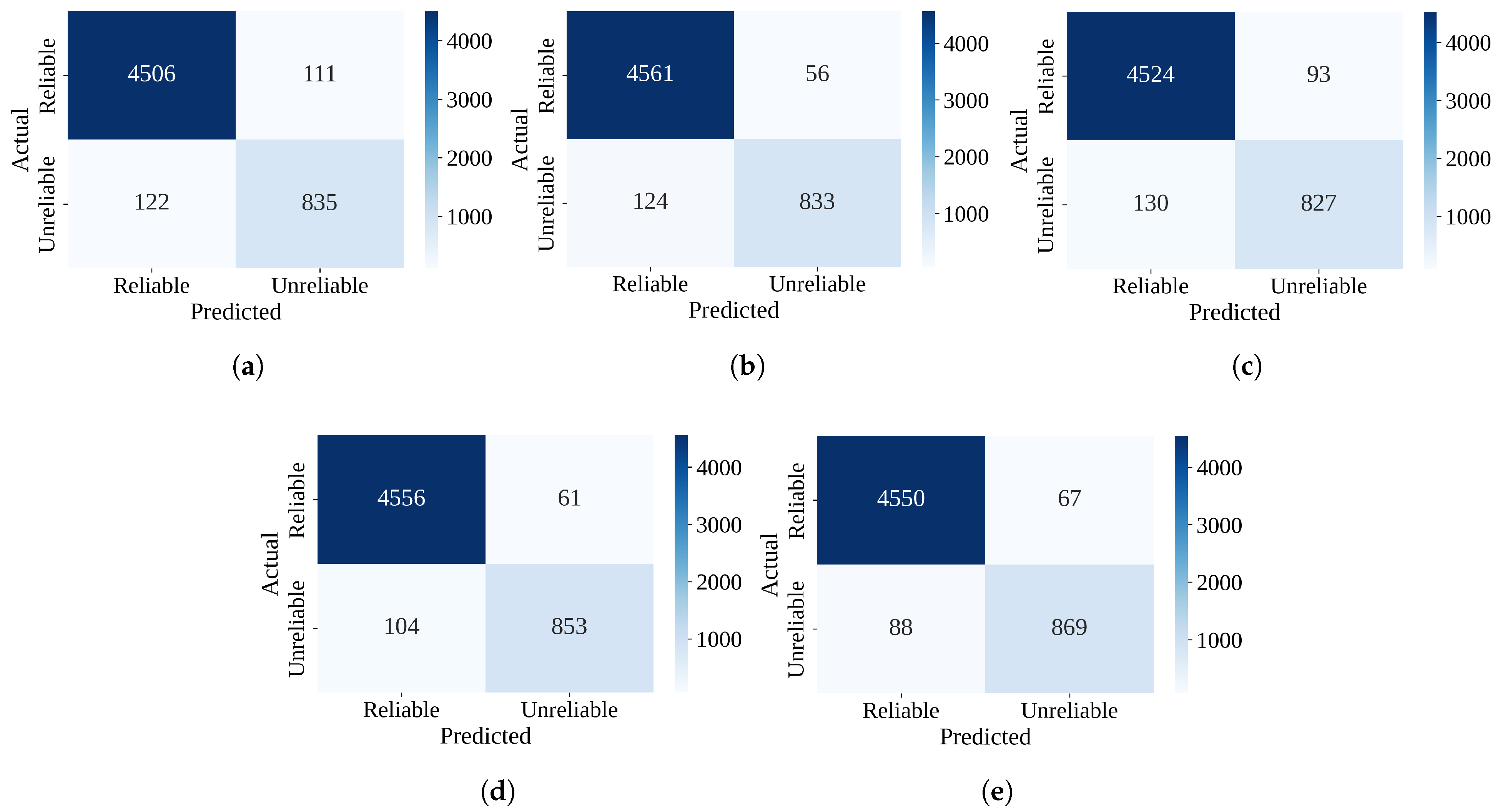
Figure 5 shows the corresponding confusion matrices computed from the same aggregated results. Together, these figures reveal consistent and interpretable patterns that highlight both the strengths of the underlying monitoring design and the ability of AI-driven methods to detect reliability degradation in resource-constrained video streaming environments.
Across all scenarios, the DNN provides the most stable and high-performing behavior, achieving accuracy levels that remain consistently above 0.97. As shown in
Figure 4, the DNN trace displays minimal variability across scenarios, indicating its representational capacity enables it to generalize effectively across heterogeneous operational contexts. Furthermore,
Figure 5 illustrates that the DNN produces the fewest false negatives (i.e., instances where unreliable states are misclassified as reliable), aligning with the expectation that deep learning models, given sufficient non-linear structure, can better capture the temporal evolution embedded in the derived statistical features.
From a reliability perspective, the most important advantage of the DNN is its improved recall, particularly for the unreliable class. While classical ML models tend to exhibit slightly lower recall, indicating a higher tendency to misclassify early degradation signals, DNN demonstrates a better ability to correctly detect windows preceding reliability failures. As we already mentioned, this is especially important for proactive reliability management, where false negatives (i.e., missing an imminent degradation event) are considerably more harmful than false positives.
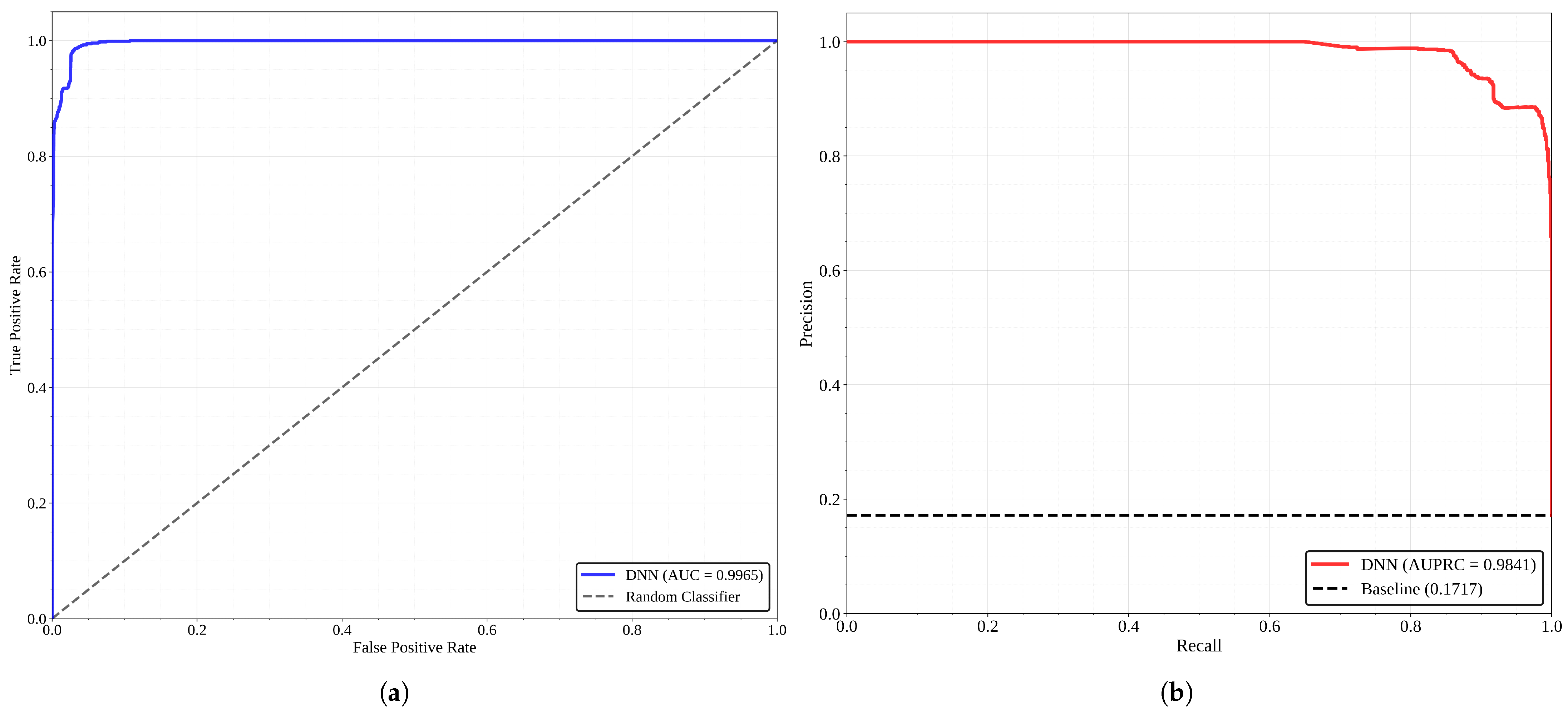
Although the mentioned metrics provide an initial indication of performance, the datasets considered in this work exhibit strong class imbalance, with unreliable states representing a minority of samples in all scenarios. To provide a threshold-independent evaluation and assess robustness to imbalance, we additionally report Receiver Operating Characteristic (ROC) and Precision-Recall (PR) curves for the DNN model, as presented in
Figure 6. The achieved area under the ROC curve (AUROC) of 0.9965 confirms that the DNN maintains excellent separability between reliable and unreliable operational states across a wide range of decision thresholds. However, as ROC analysis can remain optimistic in imbalanced settings, we further examine the area under the PR curve (AUPRC). The DNN achieves an AUPRC of 0.9841, significantly higher than the baseline precision of 0.1717 corresponding to the class prevalence of unreliable states. This result demonstrates that the model is highly effective in identifying rare reliability degradation events while maintaining strong precision, even under severe class imbalance.
Beyond classification accuracy, the reliability function requires well-calibrated probability estimates, as these outputs are directly consumed by the AI Agent to trigger orchestration actions according to the LoR-dependent control policy. To assess calibration quality, we computed the Expected Calibration Error (ECE) for the DNN across all six scenarios, as reported in
Table 5. The obtained ECE values are consistently low, with an average of 0.029, indicating that the predicted probabilities closely match the observed empirical frequencies. In particular, calibration improves in the less constrained 200 MiB scenarios, where the system exhibits more stable behavior. These results demonstrate that the DNN provides reliable confidence estimates, which is a critical requirement for trust-aware and user-centric reliability orchestration in 6G networks.
To complement the aggregated comparison,
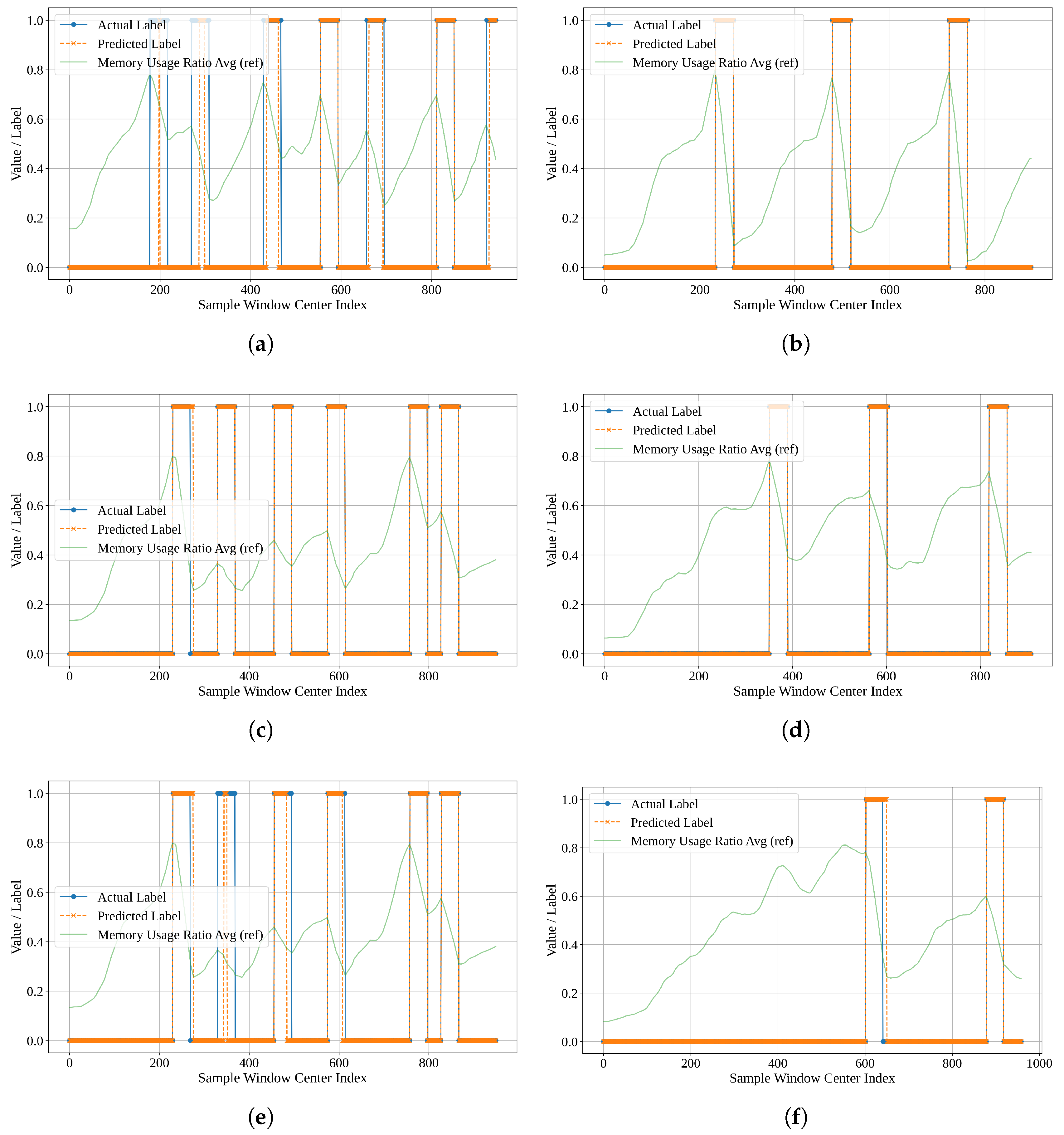
Figure 7 provides a detailed scenario-by-scenario analysis of the DNN’s performance in the held-out test sets. Specifically, the plots visualize the predicted reliability labels compared to the actual ones, along with the corresponding average memory usage ratio, allowing us to interpret how the DNN responds to the temporal evolution of resource constraints. Across all scenarios, the model demonstrates a remarkable ability to correctly predict transitions from reliable to unreliable states, confirming its strength under unseen operational conditions.
Across all six scenarios, the visual representation of the DNN predictions reveals another important feature: the model consistently identifies the first transition into the unreliable state with high accuracy, effectively providing an estimate of the Time Till First Major Failure (TTFMF) or, equivalently, the Mean Time to Failure (MTTF) at the window granularity. This capability is clearly visible in
Figure 7, where the predicted label switches to the unreliable state at the very first occurrence of a degradation event, regardless of whether the system operates under strict (100 MiB) or relaxed (200 MiB) memory constraints. The DNN neither delays the detection nor exhibits premature triggering. Instead, it aligns almost perfectly with the actual onset of reliability degradation. Although the reliability label corresponds to the service state at the window endpoint, the temporal analysis shows that the model identifies the transition into the unreliable state at its earliest manifestation in the monitoring data. As a result, the effective forecast horizon can be interpreted as the number of windows by which degradation precursors are detected before a fully manifested failure. In the evaluated scenarios, this corresponds to a minimum lead time of one window before the first failure event. As such, the DNN not only classifies reliability states accurately, but also offers early situational awareness, enabling the reliability function to predict and mitigate upcoming QoE degradation. From a user-centric perspective, the ability to detect degradation early translates directly into maintaining perceived service continuity, particularly for users who consume higher quality video with a lower tolerance for interruptions.
Overall, the results indicate that the proposed ML pipeline is capable of discriminating between reliable and unreliable operational states, with DNN consistently outperforming the classical ML baselines across most metrics and scenarios. Reliability degradations are consistently detected with near-perfect recall, which is crucial for proactive reliability management in video streaming applications. No significant over-prediction is observed, confirming that the DNN captures degradation patterns with the stability required for deployment as part of a real-time vApp within the proposed user-centric reliability function. These results demonstrate that the DNN is well-positioned to support medium LoR vApp flavors, providing accurate and reliable predictions across the full range of scenarios considered in this work. From an orchestration perspective, the ability of DNN to accurately detect the onset of service degradation and track transitions between reliable and unreliable states provides a timely and robust control signal to the AI Agent, enabling effective dynamic service-level adaptation under the LoR-driven orchestration framework.
Author Contributions
Conceptualization, C.B. and P.A.K.; Methodology, C.B. and D.U.; Software, C.B. and A.V.; Validation, C.B., D.U. and P.A.K.; Formal analysis, C.B. and D.U.; Investigation, C.B., D.U. and P.A.K.; Resources, D.U. and A.V.; Data curation, D.U.; Writing—original draft, C.B., D.U. and A.V.; Writing—review & editing, P.A.K.; Visualization, C.B. and A.V.; Supervision, P.A.K.; Project administration, P.A.K.; Funding acquisition, P.A.K. All authors have read and agreed to the published version of the manuscript.
Funding
The work presented in this paper is (partially) supported by the SAFE-6G project that has received funding from the Smart Networks and Services Joint Undertaking (SNS JU) under the European Union’s Horizon Europe research and innovation programme under Grant Agreement No 101139031.
Data Availability Statement
The original data presented in the study are openly available in Zenodo at
https://doi.org/10.5281/zenodo.17523181 (accessed on 20 December 2025). The algorithms and methodologies are fully described to ensure reproducibility.
Conflicts of Interest
The authors declare no conflicts of interest.
References
- Shamsabadi, A.A.; Yadav, A.; Gadallah, Y.; Yanikomeroglu, H. Exploring the 6G potentials: Immersive, hyper-reliable, and low-latency communication. IEEE Veh. Technol. Mag. 2025, 20, 74–82. [Google Scholar] [CrossRef]
- International Telecommunication Union Radiocommunication Sector. Framework and Overall Objectives of the Future Development of IMT for 2030 and Beyond; ITU: Geneva, Switzerland, 2023. [Google Scholar]
- Chataut, R.; Nankya, M.; Akl, R. 6G Networks and the AI Revolution-Exploring Technologies, Applications, and Emerging Challenges. Sensors 2024, 24, 1888. [Google Scholar] [CrossRef] [PubMed]
- Mohammed, S.M.; Al-Barrak, A.; Mahmood, N.T. Enabling Technologies for Ultra-Low Latency and High-Reliability Communication in 6G Networks. Ing. Syst. d’Inf. 2024, 29, 1195–1208. [Google Scholar] [CrossRef]
- Gunasekaran, K.; Dhanasekaran, S.; Kumar, R.V.; Aswath, S. Advanced Beamforming and Multi-Access Edge Computing: Empowering Ultra-Reliable and Low-Latency Applications in 6G Networks. Int. J. Commun. Syst. 2024, 38, e6027. [Google Scholar] [CrossRef]
- Rodriguez, F.; Ahmad, I.; Huusko, J.; Seppänen, K. Towards dependable 6G networks. TechRxiv 2022. [Google Scholar] [CrossRef]
- Drampalou, S.F.; Uzunidis, D.; Vetsos, A.; Miridakis, N.I.; Karkazis, P. A User-Centric Perspective of 6G Networks: A Survey. IEEE Access 2024, 12, 190255–190294. [Google Scholar] [CrossRef]
- SAFE-6G. A Smart and Adaptive Framework for Enhancing Trust in 6G Networks. Smart Networks and Services Joint Undertaking (SNS JU) Under the European Union’s Horizon Europe Research and Innovation Programme Under Grant Agreement No 101139031. 2023. Available online: https://safe-6g.eu/ (accessed on 20 December 2025).
- Betzelos, C.; Uzunidis, D.; Karkazis, P.; Leligou, H.C. Enhancing Reliability in 6G Networks Based on User-Driven AI. In Proceedings of the 29th International Workshop on Computer Aided Modeling and Design of Communication Links and Networks (CAMAD), Athens, Greece, 21–23 October 2024. [Google Scholar]
- Taleghani, E.S.; Valencia, R.I.M.; Orozco, A.L.S.; Villalba, L.J.G. Trust Evaluation Techniques for 6G Networks: A Comprehensive Survey with Fuzzy Algorithm Approach. Electronics 2024, 13, 3013. [Google Scholar] [CrossRef]
- Ortin, J.; Serrano, P.; Garcia-Reinoso, J.; Banchs, A. Analysis of Scaling Policies for NFV Providing 5G/6G Reliability Levels with Fallible Servers. IEEE Trans. Netw. Serv. Manag. 2022, 19, 1287–1305. [Google Scholar] [CrossRef]
- SAFE-6G Consortium. D4.1-SAFE-6G Project Deliverable: Cognitive Coordinator, AI Agents and User-Centric Functions; SAFE-6G Project: European Union. 2025. Available online: https://safe-6g.eu/wp-content/uploads/2025/07/D4.1_SAFE-6G_v1.0.pdf (accessed on 20 December 2025).
- Trakadas, P.; Masip-Bruin, X.; Facca, F.M.; Spantideas, S.T.; Giannopoulos, A.E.; Kapsalis, N.C.; Martins, R.; Bosani, E.; Ramon, J.; Prats, R.G.; et al. A Reference Architecture for Cloud-Edge Meta-Operating Systems Enabling Cross-Domain, Data-Intensive, ML-Assisted Applications: Architectural Overview and Key Concepts. Sensors 2022, 22, 9003. [Google Scholar] [CrossRef] [PubMed]
- Rossini, R.; Velivassaki, T.H.; Voulkidis, A.; Zahariadis, T.; Karkazis, P.; Skias, D.; Montanera, E.P.P. Open Source in NExt Generation Meta Operating Systems (NEMO). In Proceedings of the 9th International Conference on Smart and Sustainable Technologies (SpliTech), Split, Croatia, 25–28 June 2024. [Google Scholar]
- aerOS EU HE Project: Autonomous, ScalablE, TRustworthy, Intelligent European Meta Operating System for the IoT Edge-Cloud Continuum. Available online: https://aeros-project.eu/ (accessed on 20 December 2025).
- Vaño, R.; Lacalle, I.; Sowiński, P.; S-Julián, R.; Palau, C.E. Cloud-Native Workload Orchestration at the Edge: A Deployment Review and Future Directions. Sensors 2023, 23, 2215. [Google Scholar] [CrossRef] [PubMed]
- Horn, G.; Verginadis, Y.; Ledakis, G.; Papageorgopoulos, N.; Veloudis, S. An Implemented Architecture for a Meta Operating System Managing Distributed Applications Across Heterogeneous Resources. In Advanced Information Networking and Applications. AINA 2025; Lecture Notes on Data Engineering and Communications Technologies; Barolli, L., Ed.; Springer: Cham, Switzerland, 2025; Volume 250. [Google Scholar]
- 3GPP. Common API Framework for 3GPP Northbound APIs; Technical Report (TR) 23.222 V19.1.0; 3GPP: Sophia Antipolis, France, 2017. [Google Scholar]
- Prometheus. Monitoring System & Time Series Database. Available online: https://prometheus.io/ (accessed on 20 December 2025).
- Thanos. Highly Available Prometheus Setup with Long Term Storage Capabilities. Available online: https://thanos.io/ (accessed on 20 December 2025).
- Kepler Project. Kepler. Available online: https://github.com/sustainable-computing-io/kepler (accessed on 20 December 2025).
- MediaMTX. The Modern Streaming Server. Available online: https://github.com/bluenviron/mediamtx (accessed on 20 December 2025).
- Schulzrinne, H.; Rao, A.; Lanphier, R. Real-Time Streaming Protocol (RTSP). IETF RFC 2326. 1998. Available online: https://datatracker.ietf.org/doc/html/rfc2326 (accessed on 20 December 2025).
- Drampalou, S.; Uzunidis, D.; Vetsos, A.; Karkazis, P.; Koumaras, H. An Open-Source Framework and Dataset for Multi-layer Monitoring and Predictive Autoscaling of 6G Video Streaming, Zenodo: Geneva, Switzerland, 2025. [CrossRef]
| Disclaimer/Publisher’s Note: The statements, opinions and data contained in all publications are solely those of the individual author(s) and contributor(s) and not of MDPI and/or the editor(s). MDPI and/or the editor(s) disclaim responsibility for any injury to people or property resulting from any ideas, methods, instructions or products referred to in the content. |