


A Hydrometallurgical Process for Cu Recovery from Printed Circuit Boards †
 , ,
, ,  and
and
Abstract
1. Introduction
2. Materials and Methods
2.1. Solid Characterization and Pretreatment Leaching
2.2. Leaching of Copper
2.3. Extraction and Stripping of Copper
3. Results
3.1. Pretreatment Leaching
3.2. Leaching of Copper
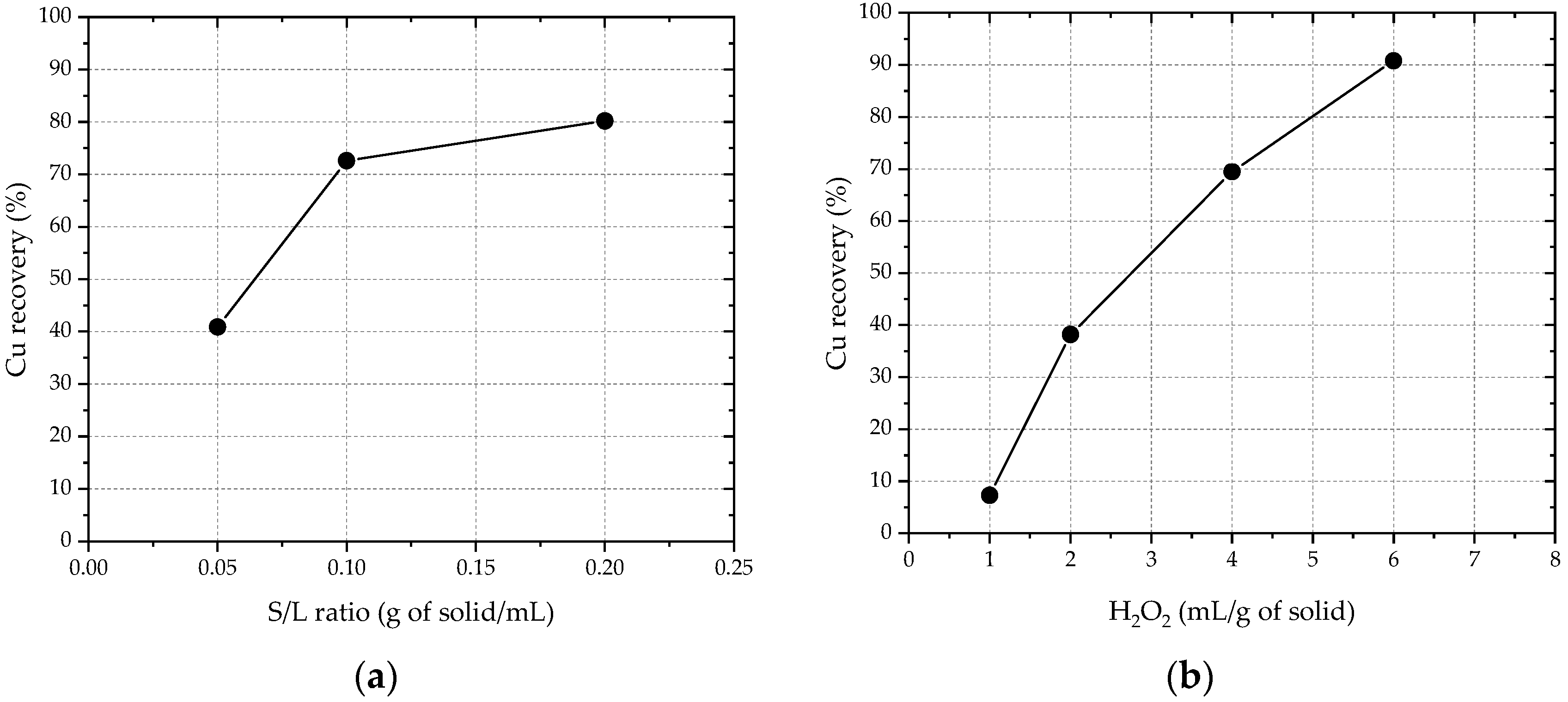
- A total of 2 M H2SO4 as leaching agent;
- A total of 3 mL/g H2O2 (30% w/w) as oxidizing agent;
- An S/L ratio of 0.1 g/mL;
- Two stages;
- Residence time of 4 h;
- No agitation.
3.3. Extraction and Stripping of Copper
4. Conclusions
- The PCB metallic fraction, after the removal of the plastic material, is a remarkable copper resource as its copper content exceeds 20% and can be treated hydrometallurgically.
- More than 98% of copper was recovered from the dust by oxidative leaching in two stages, using 2 M H2SO4, 3 mL H2O2 (30% w/w)/g dust, and a solid/liquid ratio of 0.1 g/mL of dust.
- The optimum pH for the copper solvent extraction with ACORGA M5640 was 1.5.
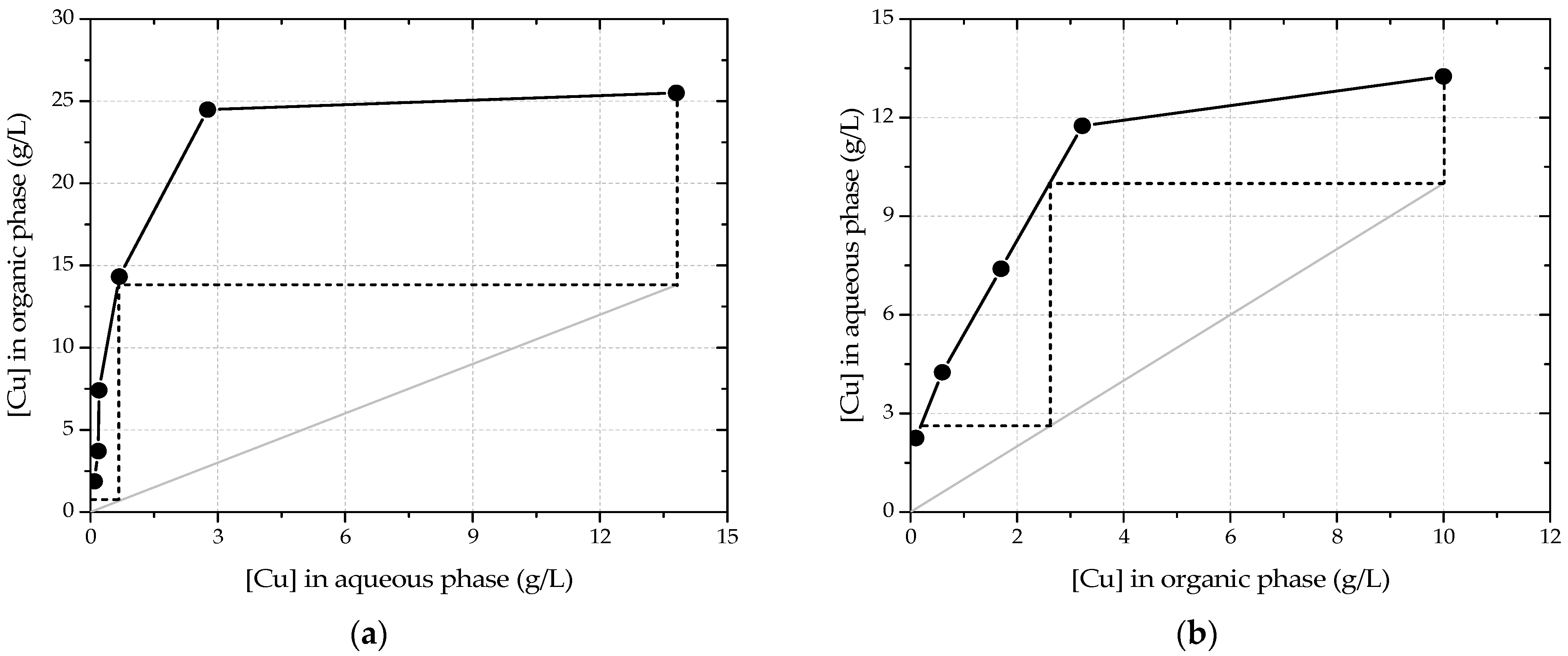
- Copper was extracted quantitatively from the pregnant solution in two stages by ACORGA M5640 organic reagent at equilibrium pH 1.5 and an A/O ratio of 1:1.
- Copper was stripped off the loaded organic phase quantitatively in two stages by 2 M HCl and at an A/O ratio of 1:1.
- The concentration of copper in the stripped liquor was 7.4 g/L, with all other impurities being less than 0.2 mg/L, thus allowing copper electrowinning.
Funding
Acknowledgments
References
- Robinson, B.H. E-waste: An assessment of global production and environmental impacts. Sci. Total Environ. 2009, 408, 183–191. [Google Scholar] [CrossRef] [Scilit] [PubMed]
- Watari, T.; Nansai, K.; Nakajima, K. Major metals demand, supply, and environmental impacts to 2100: A critical review. Resour. Conserv. Recy. 2021, 164, 105–107. [Google Scholar] [CrossRef] [Scilit]
- Khaliq, A.; Rhamdhani, M.A.; Brooks, G.; Masood, S. Metal extraction processes for electronic waste and existing industrial routes: A review and Australian perspective. Resources 2014, 3, 152–179. [Google Scholar] [CrossRef] [Scilit]
- Cui, J.; Zhang, L. Metallurgical recovery of metals from electronic waste: A review. J. Hazard. Mater. 2008, 158, 228–256. [Google Scholar] [CrossRef] [Scilit] [PubMed]
- Andrews, D.; Raychaudhuri, A.; Frias, A. Environmentally sound technologies for recycling secondary lead. J. Power Sources 2000, 88, 124–129. [Google Scholar] [CrossRef] [Scilit]
- European Copper Institute. Available online: www.copperalliance.eu (accessed on 25 May 2021).
- Hageluken, C. Improving Metal Returns and eco-efficiency in electronics recycling—A holistic approach for interface optimization between pre-processing and integrated metals smelting and refining. In Proceedings of the IEEE International Symposium on Electronics and the Environment, San Francisco, CA, USA, 8–11 May 2006. [Google Scholar]
- Biswajit, D.; Chowdhury, R.; Ghosh, S.K. Sustainability of metal recovery from E-waste. Front. Environ. Sci. Eng. 2018, 12, 2. [Google Scholar]

| Metal | Initial Dust (% wt.) | Metallic Fraction after Separation (%wt.) | Solid Product after Pretreatment Leaching (%wt.) |
|---|---|---|---|
| Sn | 5.01 | 12.74 | 1.30 |
| Cu | 5.19 | 23.86 | 37.60 |
| Fe | 8.17 | 17.84 | 10.67 |
| Zn | 1.90 | 3.36 | 1.68 |
| Ni | 0.76 | 1.48 | 1.77 |
| Pb | 1.53 | 6.28 | 7.45 |
| Al | 3.18 | 3.29 | 1.04 |
| Total | 26.50 | 68.85 | 61.51 |
| H2SO4 Concentration | Cu Leaching Efficiency % |
|---|---|
| 1 M | 62.4 |
| 2 M | 66.0 |
| 4 M | 45.6 |
| Leaching Stage | Cu Recovery % |
|---|---|
| 1 | 34.4 |
| 2 | 63.7 |
| Total | 98.1 |
| Metal | Concentration before Purification (g/L) | Concentration after Purification (g/L) |
|---|---|---|
| Cu | 18.8 | 13.8 |
| Fe | 2.6 | 0.44 |
| Zn | 1.0 | 0.32 |
| Ni | 1.17 | 0.40 |
| pH | Cu (mg/L) | Fe (mg/L) | Zn (mg/L) | Ni (mg/L) |
|---|---|---|---|---|
| 1.5 | 1460 | 405 | 305 | 375 |
| HCl (M) | Cu (mg/L) | Fe (mg/L) | Zn (mg/L) | Ni (mg/L) |
|---|---|---|---|---|
| 2 | 7400 | 0.16 | 0.06 | 0.01 |
Publisher’s Note: MDPI stays neutral with regard to jurisdictional claims in published maps and institutional affiliations. |
© 2021 by the authors. Licensee MDPI, Basel, Switzerland. This article is an open access article distributed under the terms and conditions of the Creative Commons Attribution (CC BY) license (https://creativecommons.org/licenses/by/4.0/).
Share and Cite
Vlasopoulos, D.; Oustadakis, P.; Agatzini-Leonardou, S.; Tsakiridis, P.; Remoundaki, E. A Hydrometallurgical Process for Cu Recovery from Printed Circuit Boards. Mater. Proc. 2021, 5, 56. https://doi.org/10.3390/materproc2021005056
Vlasopoulos D, Oustadakis P, Agatzini-Leonardou S, Tsakiridis P, Remoundaki E. A Hydrometallurgical Process for Cu Recovery from Printed Circuit Boards. Materials Proceedings. 2021; 5(1):56. https://doi.org/10.3390/materproc2021005056
Chicago/Turabian StyleVlasopoulos, Dimitrios, Paschalis Oustadakis, Styliani Agatzini-Leonardou, Petros Tsakiridis, and Emmanouella Remoundaki. 2021. "A Hydrometallurgical Process for Cu Recovery from Printed Circuit Boards" Materials Proceedings 5, no. 1: 56. https://doi.org/10.3390/materproc2021005056
APA StyleVlasopoulos, D., Oustadakis, P., Agatzini-Leonardou, S., Tsakiridis, P., & Remoundaki, E. (2021). A Hydrometallurgical Process for Cu Recovery from Printed Circuit Boards. Materials Proceedings, 5(1), 56. https://doi.org/10.3390/materproc2021005056

