Figure 1.
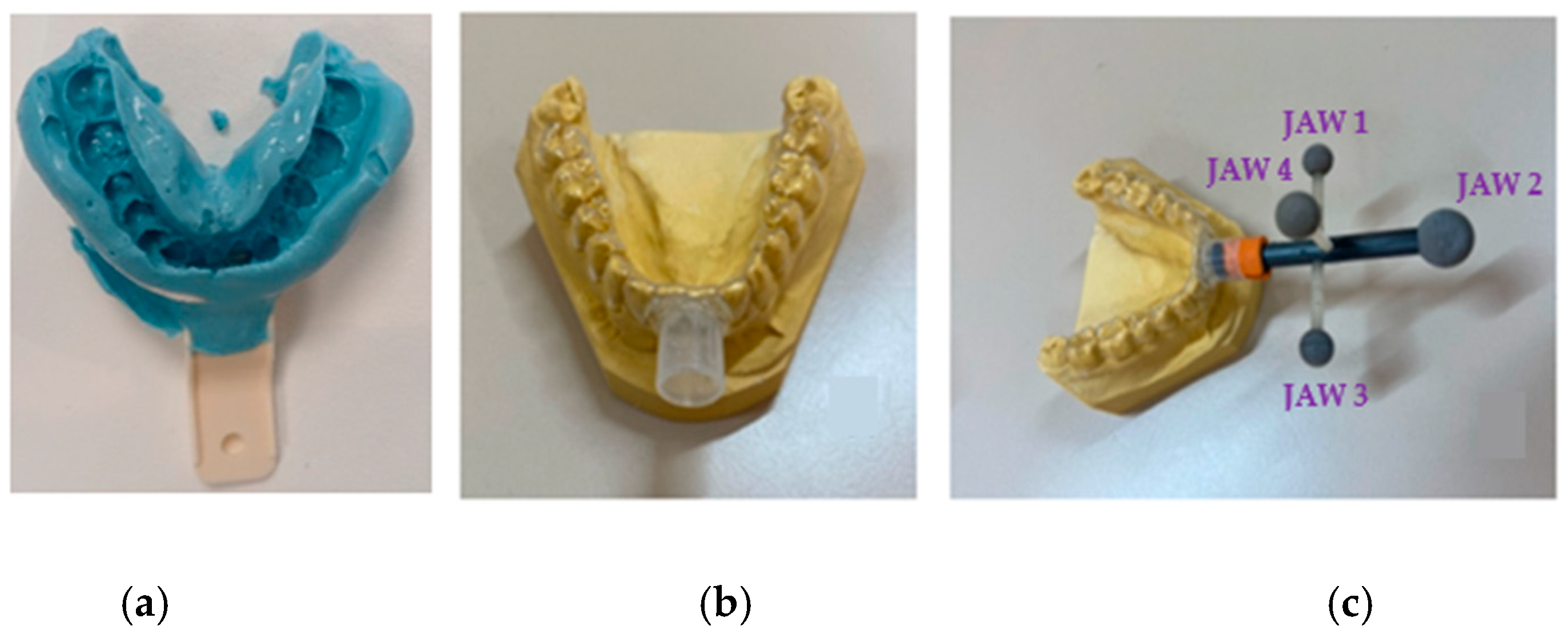
(a) Dental arch print in alginate; (b) personalized dental splint on the plaster model (the splint is transparent and covers the entire dental arch to ensure stability); (c) personalized dental splint with the jaw cluster fixed on it.
Figure 1.
(a) Dental arch print in alginate; (b) personalized dental splint on the plaster model (the splint is transparent and covers the entire dental arch to ensure stability); (c) personalized dental splint with the jaw cluster fixed on it.
Figure 2.
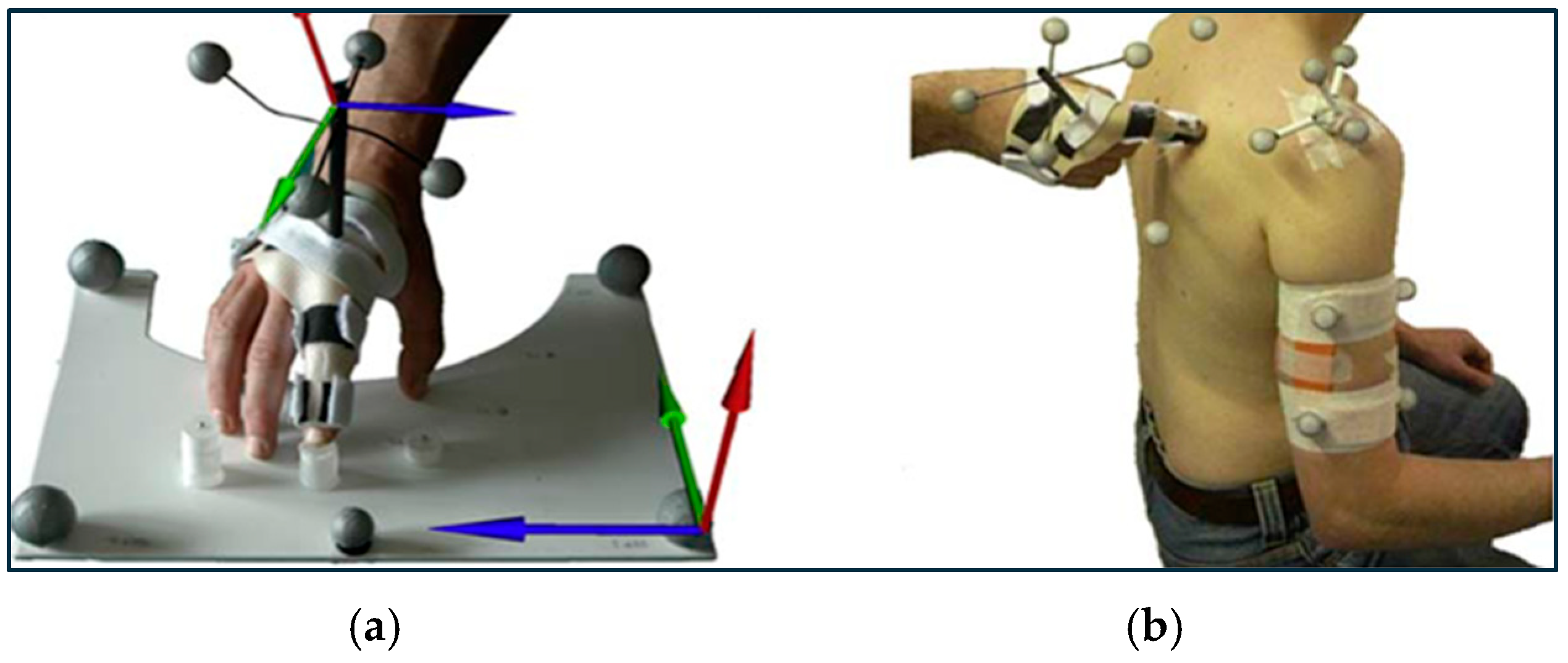
(a) Gantlet and finger pulp calibration. The arrows define the anatomical frames of the A-Palp and the calibration board.; (b) AL static calibration (20).
Figure 2.
(a) Gantlet and finger pulp calibration. The arrows define the anatomical frames of the A-Palp and the calibration board.; (b) AL static calibration (20).
Figure 3.
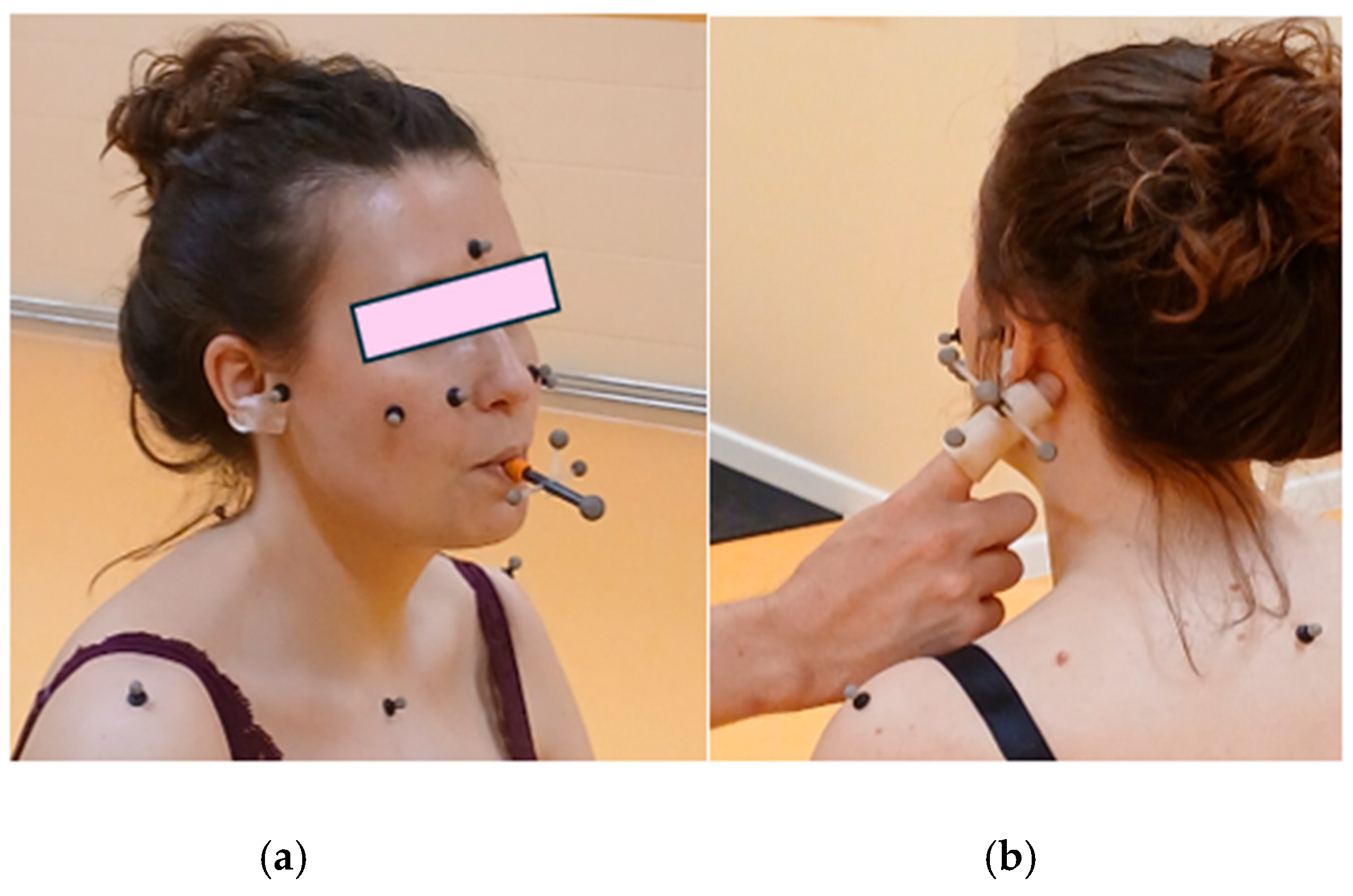
(a) Subject sitting straight on the stool, looking forward, with the personalized dental splint in the mouth and self-reflecting markers on Als. (b) Examiner performing palpation with the A-Palp on 5 supplementary Anatomical Landmarks, here the left mastoid process.
Figure 3.
(a) Subject sitting straight on the stool, looking forward, with the personalized dental splint in the mouth and self-reflecting markers on Als. (b) Examiner performing palpation with the A-Palp on 5 supplementary Anatomical Landmarks, here the left mastoid process.
Figure 4.
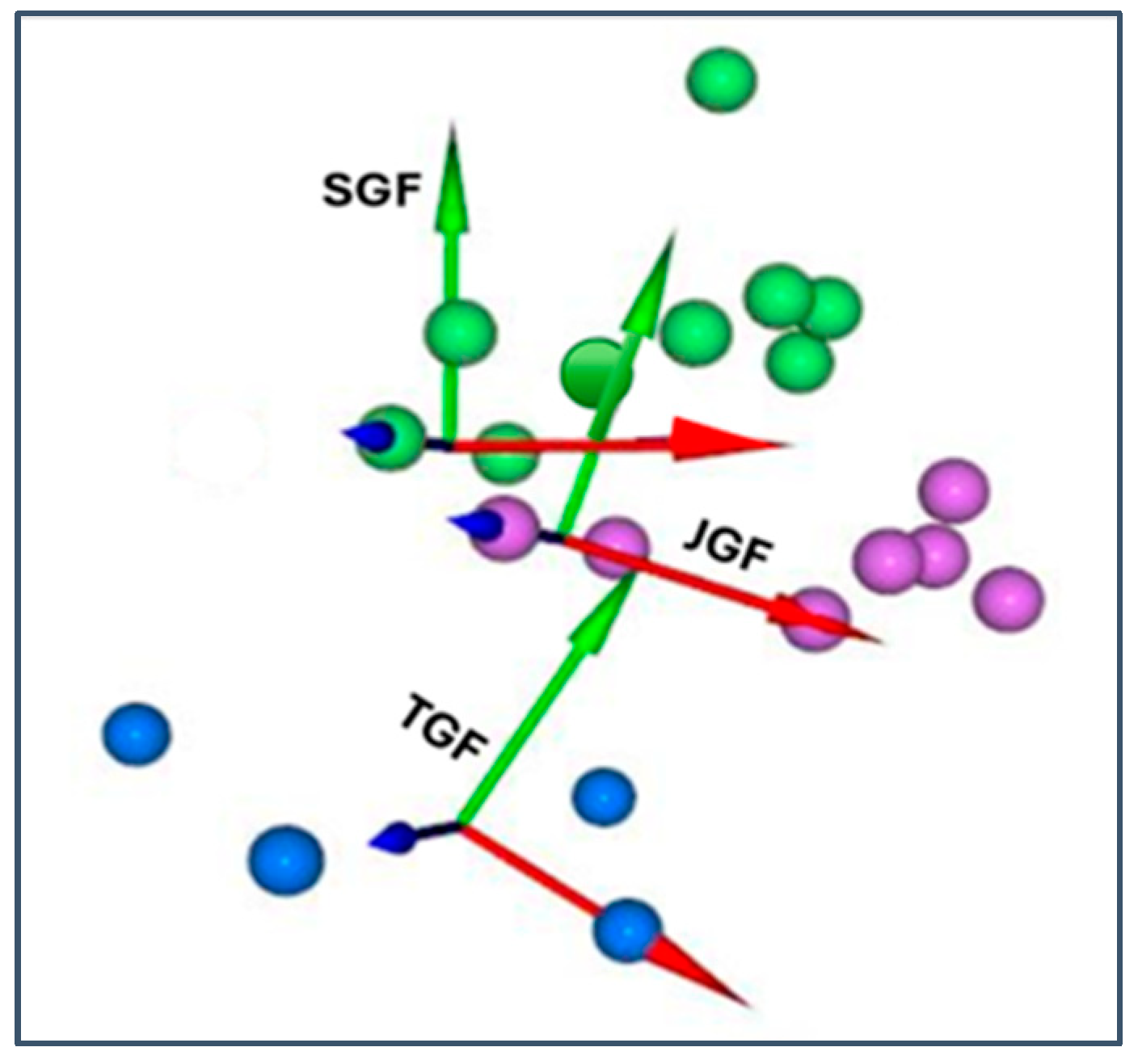
Screen shot of a right lateral view of the ALs and AFs built in LhpFusionBox. Green balls: skull Anatomical Landmarks (ALs), SGF: Skull Global Frame. Purple balls: jaw ALs, JGF: Jaw Global Frame. Blue balls: thorax ALs, TGF: Thorax Global Frame.
Figure 4.
Screen shot of a right lateral view of the ALs and AFs built in LhpFusionBox. Green balls: skull Anatomical Landmarks (ALs), SGF: Skull Global Frame. Purple balls: jaw ALs, JGF: Jaw Global Frame. Blue balls: thorax ALs, TGF: Thorax Global Frame.
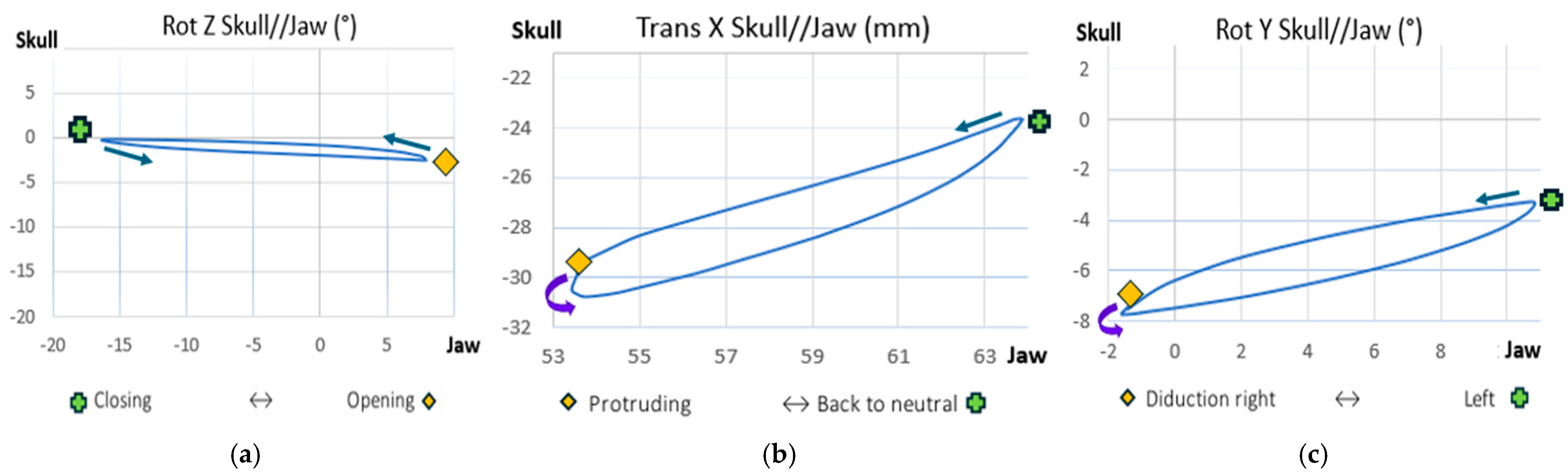
Figure 5.
(
a): Amplitude of rotation in degrees of the skull relative to the jaw around the Z-axis during mouth opening and closing movements.

Start of the opening movement;

start of the closing movement; (
b): Amplitude of translation of the skull relative to the jaw on the X-axis during pro-trusion and retrusion movements.

Start of the protrusion movement;

start of the retrusion movement; (
c): Amplitude of rotation of the skull relative to the jaw around the Y-axis during laterotrusion movements.

Start of the laterotrusion movement to the left;

start of the laterotrusion movement to the right. The arrows indicate the direction of movement.
Figure 5.
(
a): Amplitude of rotation in degrees of the skull relative to the jaw around the Z-axis during mouth opening and closing movements.

Start of the opening movement;

start of the closing movement; (
b): Amplitude of translation of the skull relative to the jaw on the X-axis during pro-trusion and retrusion movements.

Start of the protrusion movement;

start of the retrusion movement; (
c): Amplitude of rotation of the skull relative to the jaw around the Y-axis during laterotrusion movements.

Start of the laterotrusion movement to the left;

start of the laterotrusion movement to the right. The arrows indicate the direction of movement.
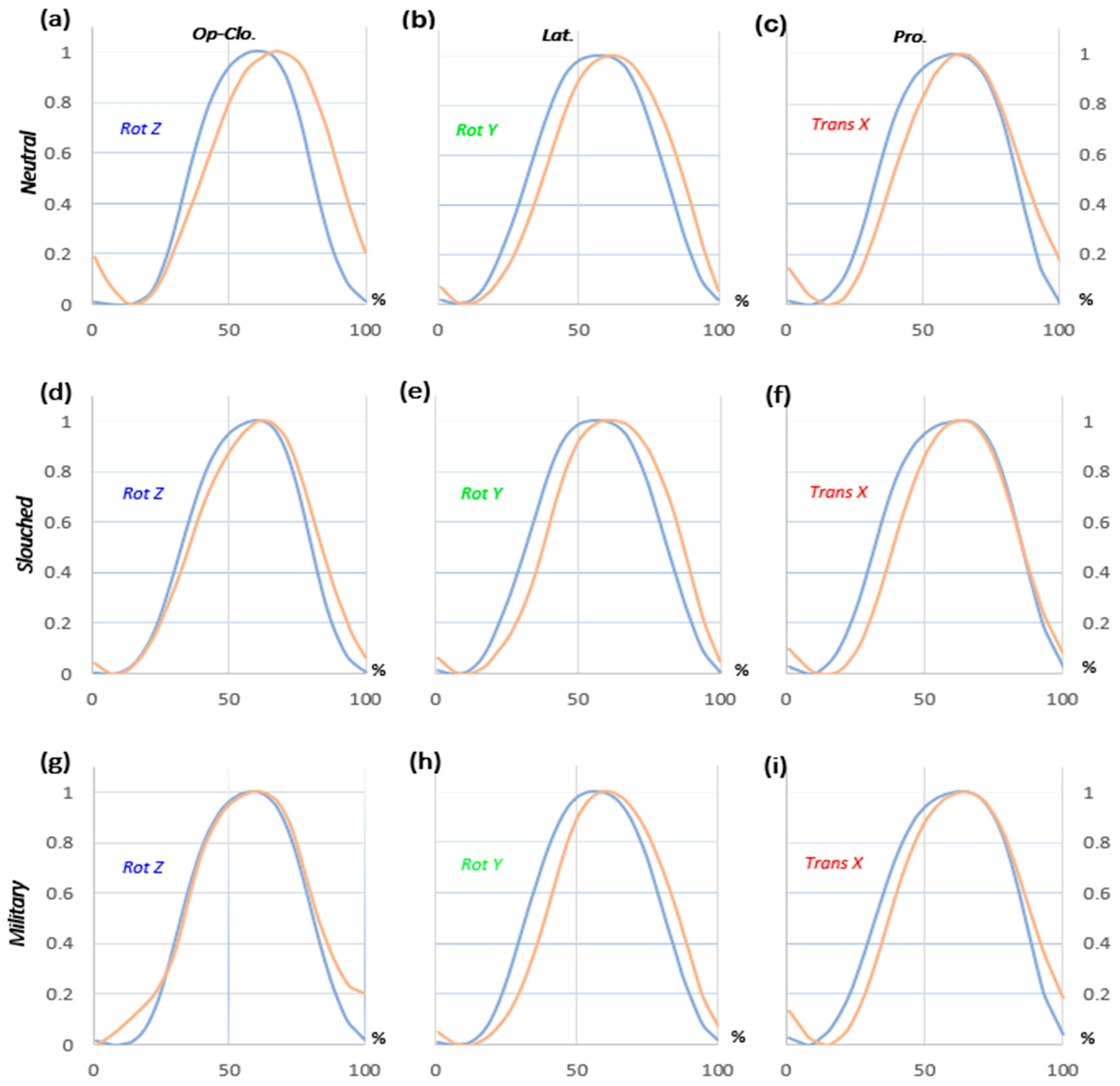
Figure 6.
Graphs of the normalized amplitudes (between 0 and 1) of the jaw (—) and the skull (—). Amplitude of rotation around the Z-axis during the mouth opening–closing motion cycle for the neutral (a), slouched (d) and military positions (g). Amplitude of rotation around Y-axis during the laterotrusion motion cycle for the neutral (b), slouched (e) and military positions (h). Amplitude of translations on X-axis during the protrusion motion cycle for the neutral (c), slouched (f) and military positions (i).
Figure 6.
Graphs of the normalized amplitudes (between 0 and 1) of the jaw (—) and the skull (—). Amplitude of rotation around the Z-axis during the mouth opening–closing motion cycle for the neutral (a), slouched (d) and military positions (g). Amplitude of rotation around Y-axis during the laterotrusion motion cycle for the neutral (b), slouched (e) and military positions (h). Amplitude of translations on X-axis during the protrusion motion cycle for the neutral (c), slouched (f) and military positions (i).
Table 1.
Anatomical Landmarks (ALs) palpated and glued on the subjects. In green, ALs palpated on the skull. In blue, ALs palpated on the thorax. In purple, ALs on the cluster of the mandible.
Table 1.
Anatomical Landmarks (ALs) palpated and glued on the subjects. In green, ALs palpated on the skull. In blue, ALs palpated on the thorax. In purple, ALs on the cluster of the mandible.
| LTRAG | Left tragus | LAT | Left acromial tip | JAW 1 |
| RTRAG | Right tragus | RAT | Right acromial tip | JAW 2 |
| LIOF | Left infraorbital foramen | JN | Jugular notch | JAW 3 |
| RIOF | Right infraorbital foramen | TH2 | Spinous process of TH2 | JAW 3 |
| LZA | Left zygomatic angle | | | |
| RZA | Right zygomatic angle | | | |
| GL | Glabella | | | |
Table 2.
Supplementary ALs palpated with the A-Palp on the subjects. In green, ALs palpated on the skull. In purple, ALs palpated on the mandible.
Table 2.
Supplementary ALs palpated with the A-Palp on the subjects. In green, ALs palpated on the skull. In purple, ALs palpated on the mandible.
| RMP | Right mastoid process | MP | Mental protuberance |
| LMP | Left mastoid process | RAN | Right gonion |
| | | LAN | Left gonion |
Table 3.
Intra- and inter-examiner reliability on the spatial location of palpated ALs, according to Jaw Global Frame, Skull Global Frame or Thorax Global Frame. Mean difference (MD), standard deviation (SD) and standard error (SE) in mm. Palpated ALs with the A-Palp device are in bold.
Table 3.
Intra- and inter-examiner reliability on the spatial location of palpated ALs, according to Jaw Global Frame, Skull Global Frame or Thorax Global Frame. Mean difference (MD), standard deviation (SD) and standard error (SE) in mm. Palpated ALs with the A-Palp device are in bold.
| Intra-Examiner | Inter-examiner |
|---|
| | Examiner A | Examiner B | Examiner C |
|---|
| ALs | MD | SD | SE | MD | SD | SE | MD | SD | SE | MD | SD | SE |
|---|
| Jaw1 | 0.4 | 1.8 | 0.9 | −4.2 | 2.3 | 1.2 | 0.0 | 0.1 | 0.0 | −1.3 | 2.5 | 1.3 |
| Jaw2 | −0.2 | 2.2 | 1.1 | −3.1 | 1.4 | 0.9 | −0.1 | 1.2 | 0.6 | −1.1 | 1.7 | 1.0 |
| Jaw3 | −0.2 | 2.5 | 1.4 | −2.7 | 2.3 | 1.3 | −0.4 | 1.9 | 1.2 | −1.1 | 1.4 | 1.0 |
| Jaw4 | −0.7 | 1.3 | 0.9 | −3.7 | 1.8 | 0.9 | −0.6 | 0.8 | 0.3 | −1.6 | 1.7 | 1.0 |
| GL | −0.1 | 11.3 | 6.3 | 3.8 | 1.7 | 1.0 | −1.5 | 0.6 | 0.3 | 0.7 | 2.7 | 1.5 |
| RIOF | 1.7 | 11.7 | 6.6 | −4.3 | 2.6 | 1.5 | −2.7 | 1.9 | 1.0 | −1.8 | 3.1 | 1.9 |
| RZA | 1.6 | 5.9 | 3.5 | −2.6 | 4.5 | 2.4 | −1.1 | 3.6 | 2.1 | −0.7 | 2.1 | 1.4 |
| RTRAG | −1.1 | 1.7 | 1.0 | −2.7 | 7.4 | 4.1 | −2.5 | 1.1 | 0.9 | −2.1 | 0.8 | 0.6 |
| LIOF | −0.5 | 14.5 | 8.4 | −2.5 | 1.1 | 0.7 | −1.5 | 0.7 | 0.3 | −1.5 | 1.0 | 0.6 |
| LZA | −0.6 | 9.9 | 5.5 | −0.3 | 1.7 | 0.9 | −0.2 | 0.2 | 0.0 | −0.4 | 0.2 | 0.3 |
| LTRAG | −2.9 | 2.3 | 1.3 | −0.8 | 0.4 | 0.3 | −2.6 | 3.6 | 1.9 | −2.1 | 1.1 | 0.7 |
| JN | 1.2 | 5.4 | 2.9 | −3.0 | 1.7 | 1.1 | −5.2 | 5.4 | 3.2 | −2.3 | 3.3 | 1.8 |
| LAT | −7.3 | 6.9 | 4.2 | −9.0 | 5.2 | 2.3 | −20.3 | 12.7 | 7.2 | −12.2 | 7.1 | 4.0 |
| RAT | −0.8 | 1.8 | 0.9 | −5.2 | 7.4 | 4.3 | −4.3 | 3.5 | 2.0 | −3.4 | 2.3 | 1.2 |
| TH2 | −12.6 | 21.8 | 12.8 | −26.7 | 12.4 | 7.3 | −22.7 | 16.0 | 9.4 | −20.7 | 7.2 | 4.2 |
| RJA | 0.9 | 1.2 | 0.9 | 2.5 | 2.6 | 1.3 | −2.9 | 1.4 | 0.6 | 0.1 | 2.8 | 1.5 |
| MP | −0.4 | 5.8 | 3.5 | −3.3 | 1.8 | 1.2 | 2.4 | 1.0 | 0.7 | −0.5 | 2.9 | 1.4 |
| LJA | −2.4 | 4.5 | 2.7 | 3.7 | 3.9 | 2.2 | −1.0 | 2.8 | 1.8 | 0.1 | 3.2 | 1.9 |
| LMP | 1.1 | 3.8 | 2.3 | 14.0 | 23.6 | 13.5 | −0.5 | 1.4 | 0.9 | 4.9 | 8.0 | 4.7 |
| RMP | 5.3 | 18.7 | 11.1 | −0.4 | 5.3 | 3.2 | −4.4 | 1.9 | 1.3 | 0.1 | 4.9 | 2.6 |
| Mean | −0.9 | 6.8 | 3.0 | −2.5 | 4.6 | 2.6 | −3.6 | 3.1 | 1.8 | −2.3 | 3.0 | 1.7 |
Table 4.
Inter and intra-examiner Root Mean Square Palpation Error (RMSPE), Mean Difference (MD) with a Confidence Interval set at 95% [CI 95%] between the kinematic data for the mandible and the skull rotation around respectively the Z-, X- and Y- axes of the Skull Global Frame (SGF), and Z-, X- and Y- axes of the Thorax Global Frame (TGF) (in degrees).
Table 4.
Inter and intra-examiner Root Mean Square Palpation Error (RMSPE), Mean Difference (MD) with a Confidence Interval set at 95% [CI 95%] between the kinematic data for the mandible and the skull rotation around respectively the Z-, X- and Y- axes of the Skull Global Frame (SGF), and Z-, X- and Y- axes of the Thorax Global Frame (TGF) (in degrees).
| Rot Z Jaw in SGF | Inter | Intra |
| Exam 1 | Exam 2 | Exam 3 |
| RMSPE | MD [CI 95%] | RMSPE | MD [CI 95%] | RMSPE | MD [CI 95%] | RMSPE | MD [CI 95%] |
| 1.0 | 1.0 [0.9; 1.2] | 2.1 | 2.2 [1.9; 2.5] | 2.8 | 2.8 [2.4; 3.1] | 0.9 | 0.2 [0.2; 02] |
| Rot Z Skull in TGF | Inter | Intra |
| Exam 1 | Exam 2 | Exam 3 |
| RMSPE | MD [CI 95%] | RMSPE | MD [CI 95%] | RMSPE | MD [CI 95%] | RMSPE | MD [CI 95%] |
| 0.2 | 0.2 [0.2; 0.2] | 0.3 | 0.3 [0.3; 0.3] | 0.0 | 0.3 [0.3; 0.3] | 0.3 | 0.7 [0.6; 0.8] |
| Rot X Jaw in SGF | Inter | Intra |
| Exam 1 | Exam 2 | Exam 3 |
| RMSPE | MD [CI 95%] | RMSPE | MD [CI 95%] | RMSPE | MD [CI 95%] | RMSPE | MD [CI 95%] |
| 0.0 | 0.4 [0.3; 0.4] | 0.1 | 0.2 [0.1; 0.2] | 0.4 | 1.0 [0.8; 1.1] | 0.1 | 0.3 [0.2; 0.3] |
| Rot X Skull in TGF | Inter | Intra |
| Exam 1 | Exam 2 | Exam 3 |
| RMSPE | MD [CI 95%] | RMSPE | MD [CI 95%] | RMSPE | MD [CI 95%] | RMSPE | MD [CI 95%] |
| 0.0 | 0.2 [0.1; 0.2] | 0.0 | 0.2 [0.1; 0.2] | 0.1 | 0.2 [0.1; 0.2] | 0.0 | 0.1 [0.1; 0.1] |
| Rot Y Jaw in SGF | Inter | Intra |
| Exam 1 | Exam 2 | Exam 3 |
| RMSPE | MD [CI 95%] | RMSPE | MD [CI 95%] | RMSPE | MD [CI 95%] | RMSPE | MD [CI 95%] |
| 0.1 | 0.5 [0.5; 0.6] | 0.1 | 0.7 [0.6; 0.9] | 0.1 | 0.3 [0.2; 0.3] | 0.1 | 0.6 [0.5; 0.7] |
| Rot Y Skull in TGF | Inter | Intra |
| Exam 1 | Exam 2 | Exam 3 |
| RMSPE | MD [CI 95%] | RMSPE | MD [CI 95%] | RMSPE | MD [CI 95%] | RMSPE | MD [CI 95%] |
| 0.1 | 0.1 [0.1; 0.2] | 0.0 | 0.2 [0.2; 0.3] | 0.0 | 0.1 [0.1; 0.1] | 0.1 | 0.1 [0.1; 0.1] |
Table 5.
Mean +/− standard deviation of the main rotations in degrees and the translations in millimeters of the jaw compared to the skull and the skull compared to the thorax around the X-axis, Y-axis and Z-axis, for the opening/closing, protrusion and full length laterotrusion motion cycle, in neutral, slouched and military positions.
Table 5.
Mean +/− standard deviation of the main rotations in degrees and the translations in millimeters of the jaw compared to the skull and the skull compared to the thorax around the X-axis, Y-axis and Z-axis, for the opening/closing, protrusion and full length laterotrusion motion cycle, in neutral, slouched and military positions.
| Position | Neutral | Slouched | Military |
| Opening/closing |
| | Rot Z | Trans X | Trans Y | Rot Z | Trans X | Trans Y | Rot Z | Trans X | Trans Y |
| Jaw | −27.0+/−6.3 | −13.7+/−4.2 | −6.4+/−3 | −26.9+/−6.4 | −13.0+/−4.1 | −6.6+/−3.2 | −25.2+/−7.1 | −11.9+/−5.3 | −6.1+/−3.4 |
| Skull | 2.2+/−3.2 | 2+/−1.5 | <1 | 1.9+/−3.1 | 1.7+/−1.7 | <1 | 1.6+/−2.1 | 1.7+/−1.5 | <1 |
| Protrusion | |
| | Rot Z | Trans X | | Rot Z | Trans X | | Rot Z | Trans X | |
| Jaw | 3.8+/−1.9 | 10.3+/−2.7 | 4.0+/−2.2 | 10.4+/−2.6 | 4.1+/−2 | 10.6+/−2.8 |
| Skull | <1 | 8.9+/−6.2 | <1 | 8.1+/−5.7 | <1 | 6.4+/−4.5 |
| Left laterotrusion full length |
| | Rot Y | Trans Z | | Rot Y | Trans Z | | Rot Y | Trans Z | |
| Jaw | 12.3+/−3.1 | −5.8+/−2.9 | 12.5+/−3 | −7.0+/−3.6 | 12.3+/−3.1 | −5.9+/−2.8 |
| Skull | 4.2+/−4.8 | −1.5+/−2.0 | 3.1+/−2.7 | −1.7+/−2.1 | 3.5+/−3.4 | −1.6+/−1.6 |
| Right laterotrusion full length |
| Jaw | −11.1+/−4.7 | 5.9+/−2.8 | | −11.3+/−4.6 | 7.1+/−3.5 | | −11.1+/−4.7 | 5.8+/−2.9 | |
| Skull | −3.9+/−4.8 | 2.0+/−2.5 | −2.8+/−2.7 | 2.2+/−2.6 | −3.2+/−3.4 | 1.9+/−2.0 |
Table 6.
Repeated-measures ANOVA for normally distributed data or Friedman test for non-parametric data ◊: p values intra-subject by head position, p values inter-subject by gender.
Table 6.
Repeated-measures ANOVA for normally distributed data or Friedman test for non-parametric data ◊: p values intra-subject by head position, p values inter-subject by gender.
| | Jaw | Skull |
|---|
| | Opening–closing motion |
| | p Head position | p Gender | p Head position | p Gender |
| Rot Z | 0.233 | 0.406 | 0.549 ◊ | / |
| Trans X | 0.064 | 0.720 | 0.702 | 0.329 |
| Trans Y | 0.382 | 0.642 | / | / |
| | Laterotrusion |
| Rot Y | 0.476 | 0.762 | 0.353 ◊ | / |
| Trans Z | 0.111 | 0.221 | 0.567 ◊ | / |
| | Protrusion |
| Trans X | 0.826 | 0.648 | 0.779 ◊ | / |
| Rot Z | 0.715 | 0.633 | / | / |
Table 7.
Power estimation of the sample size of 0.692, for an error of type I or α = 0.2, 12 subjects, 3 positions examined, maximum amplitude difference observed 2.5° +/− 3.5 for the rotation of the jaw around the Z-axis during the opening of the mouth.
Table 7.
Power estimation of the sample size of 0.692, for an error of type I or α = 0.2, 12 subjects, 3 positions examined, maximum amplitude difference observed 2.5° +/− 3.5 for the rotation of the jaw around the Z-axis during the opening of the mouth.
| Type I Error α | Number of Subjects | Number of Groups | Maximum Difference Between Two Groups | Within Group Standard Deviation | Power |
|---|
| 0.2 | 12 | 3 | 2.5 | 3.5 | 0.692 |
Table 8.
Relationship between maximum amplitude of the jaw in relation to the skull and the skull in relation to the thorax: coefficient of determination (R2).
Table 8.
Relationship between maximum amplitude of the jaw in relation to the skull and the skull in relation to the thorax: coefficient of determination (R2).
| Opening/Closing Rot Z | Laterotrusion Rot Y | Protrusion Trans X |
|---|
| 0.913 | 0.958 | 0.874 |
Table 9.
Mean percentage (%) of the amplitudes of the skull compared to the amplitudes of the jaw.
Table 9.
Mean percentage (%) of the amplitudes of the skull compared to the amplitudes of the jaw.
| Opening–closing | Rot Z | Mean | % skull |
| Jaw | −26.4 |
| Skull | 1.9 | 7.2 |
| Laterotrusion | Rot Y | Mean | % skull |
| Jaw | 12.3 |
| Skull | 3.6 | 29.2 |
| Protrusion | Trans X | Mean | % skull |
| Jaw | 10.4 |
| Skull | 5.5 | 52.8 |




 ,
, 


 Start of the opening movement;
  start of the closing movement; (b): Amplitude of translation of the skull relative to the jaw on the X-axis during pro-trusion and retrusion movements.