Article

Knee Joint Mechanics with a Tensioned Cable Brace During Lateral Shuffle Movements: An Exploratory Study


1
Human Performance Laboratory, University of Calgary, Calgary, AB T2N 1N4, Canada
2
Faculty of Kinesiology, University of Calgary, Calgary, AB T2N 1N4, Canada
3
Schulich School of Engineering, University of Calgary, Calgary, AB T2N 1N4, Canada
*
Author to whom correspondence should be addressed.
Biomechanics 2026, 6(1), 13; https://doi.org/10.3390/biomechanics6010013
Submission received: 27 November 2025 / Revised: 11 January 2026 / Accepted: 15 January 2026 / Published: 2 February 2026
(This article belongs to the Section Sports Biomechanics)

Abstract

Background/Objectives: Noncontact knee ligament injuries, including anterior cruciate ligament (ACL) ruptures and medial collateral ligament (MCL) sprains, are prevalent in sports that involve frequent cutting and pivoting. Conventional rigid knee braces can offer stability but often compromise comfort and performance, whereas soft sleeve-type supports provide minimal mechanical protection. The purpose of this study was to evaluate the acute biomechanical effects of a tensioned cable knee bracing system on peak knee valgus angle and external knee abduction moment during a controlled lateral shuffle task. Methods: Ten physically active adults (mean age 21.7 ± 3.8 years) performed submaximal lateral shuffle movements under three conditions: unbraced, sleeve-only (zero-tension), and a novel tensioned cable brace. Three-dimensional knee kinematics and ground reaction forces were collected, and peak knee valgus angle and external abduction moment were calculated during the eccentric phase of each movement. Results: Wearing the knee brace under tension significantly reduced knee valgus angle (4.5° vs. 7.9°) and peak external knee abduction moment (1.6 vs. 2.0–2.1 Nm/kg) compared to the unbraced condition. Conclusions: These findings indicate that the tensioned cable brace effectively reduced frontal plane knee loading during a lateral shuffle task, indicating its potential as an effective bracing approach.

1. Introduction

Acute sport-related traumatic knee injuries, most notably non-contact anterior cruciate ligament (ACL) ruptures and medial collateral ligament (MCL) sprains, occur frequently in field and court sports requiring rapid cutting, pivoting, and landing movements [1]. These injuries are associated with substantial clinical consequences, including joint instability, prolonged rehabilitation, and an elevated risk of post-traumatic osteoarthritis (PTOA) [2]. Athletes in sports such as soccer, basketball, and volleyball are particularly vulnerable due to the high valgus loading imposed on the knee during multidirectional movements [3].
The burden of knee ligament injury, especially ACL rupture, is considerable [4]. In the United States alone, more than 200,000 non-contact ACL injuries occur annually, many accompanied by concomitant damage to structures such as the MCL or meniscus. The combined direct and indirect financial costs exceed $7 billion per year [4,5,6,7]. Beyond the economic burden, ACL injury often leads to profound personal and athletic consequences, including heightened risk of early-onset osteoarthritis [7,8], premature withdrawal from sport, persistent performance deficits, and reinjury rates reaching 37% after return to activity [9]. Subsequent knee injury, sport attrition, long-term loss of function, and progression to osteoarthritis are well-documented sequelae following an initial ACL rupture [10]. Given these substantial physical, psychological, and financial impacts [11,12], there is strong motivation to develop effective strategies for both primary prevention (preventing a first injury) and secondary prevention (preventing reinjury and long-term decline).
Current prevention approaches for ACL and MCL injury primarily target modifiable biomechanical risk factors, particularly reducing the external peak knee abduction moment, linked to ACL injury risk, and minimizing excessive frontal-plane knee motion that loads the MCL [13]. Movement retraining and strength-based interventions may influence these factors; however, their practical effectiveness is limited by challenges with program adherence, resource requirements, and long-term implementation in applied sport environments.
Knee bracing offers an alternative preventive strategy and has traditionally been used in post-injury contexts to facilitate healing and reduce pain [14,15]. Braces are commonly categorized as prophylactic (for prevention) or functional (for post-injury support) [16]. Prophylactic knee braces aim to resist valgus forces and restrict mediolateral knee displacement, thereby reducing MCL strain during high-risk tasks [17]. This is speculated to be achieved through the application of a motion restricting rigid frame that allows flexion through a hinge mechanism, thus providing constraint-based support. Although the overall evidence supporting rigid prophylactic braces is modest, they appear to pose minimal risk and may provide some degree of protection [18]. Nevertheless, traditional braces have notable limitations. Rigid designs can negatively affect performance by reducing sprint speed, agility, and jump height [19,20] and are often associated with discomfort. They may also alter lower-limb biomechanics, including reductions in knee flexion and changes in movement patterns during gait and dynamic sport tasks [21,22,23,24].
Consequently, biomechanical evaluations of knee braces often assess their influence on joint kinematics and kinetics during tasks that mimic ligament-injury mechanisms, such as lateral cutting or single-leg landing [25,26,27]. Knee ligament injuries most frequently occur during braking and landing phases of rapid direction-change tasks, when frontal-plane knee loading and joint instability are greatest. Video-based analyses of non-contact anterior cruciate ligament injuries highlight the importance of additional support during these deceleration phases in injury mechanisms [28,29,30,31]. Accordingly, examining knee mechanics during the eccentric phase of a lateral shuffle provides a biomechanically relevant framework for evaluating knee stability during injury-prone movements.
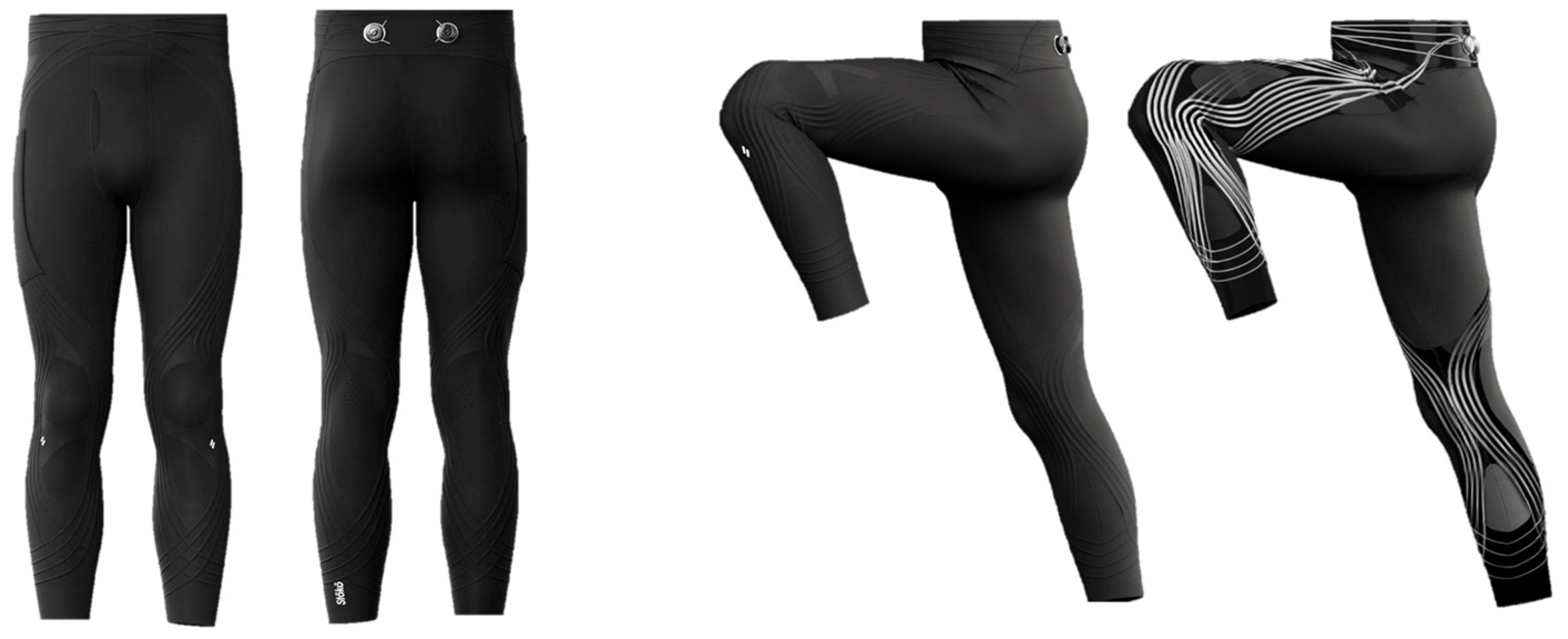
Existing work suggests braces may reduce extra- and intra-articular ligament loading by improving neuromuscular coordination [9] or reducing valgus knee angles [21]. Advances in materials and manufacturing have led to the development of new bracing technologies intended to provide targeted support without restricting athletic performance. One such device is the Stoko K1 knee bracing system, which incorporates an adjustable network of tensioned Dyneema® (Avient Corporation; Avon Lake, OH, USA) cables within a compression garment (Figure 1). This design enables customizable mediolateral knee support while preserving mobility and comfort, potentially improving adherence through its unobtrusive construction. Unlike rigid braces that provide fixed mechanical resistance, the Stoko K1 system aims to reduce excessive knee valgus and external knee abduction moments while maintaining the freedom of movement required for high-intensity sport activity. When compared to traditional rigid frame, hinge, constraint-based support systems, the Stoko K1 system utilizes high-strength cables that mimic the muscles and ligaments of the lower limbs. The adjustability of these cables and their application through apparel instead of through a rigid frame are speculated to provide a customizable support system that is functional and more comfortable. Functionally, the support is applied at the location where evolution intended to provide the support. Allowing for adjustability is speculated increase comfort and reduce injury rates as in a previous study it was demonstrated that the incidence of stress fractures and pain at different locations can be reduced by 1.5–13.4% when comparing a comfortable to a control insert [32]. Although early investigation of the device has shown promising subjective comfort and biomechanical effects, empirical evidence remains limited [27].
Therefore, the purpose of this study was to evaluate the acute biomechanical effects of the Stoko K1 bracing system on peak knee valgus angle and external peak knee abduction moment during a controlled lateral shuffle task. It was hypothesized that the tensioned bracing condition would reduce peak valgus angles and external peak knee abduction moments during the eccentric (braking) phase of the shuffle.

2. Materials and Methods

2.1. Participants

Ten physically active adults (8 males, 2 females), aged 18–30 years (mean: 21.7 ± 3.8 years; mean body mass: 70.3 ± 9.5 kg), were recruited for this study. Inclusion criteria required participants to engage in physical activity at least three times per week and to have no major lower-limb injuries in the preceding six months. Exclusion criteria included previous ACL reconstruction, recent lower-limb surgery, or active knee pain requiring medical care. All participants provided written informed consent prior to testing. The study was approved by the Conjoint Health Research Ethics Board at the University of Calgary (REB22-1415) and conducted in accordance with the Declaration of Helsinki.

2.2. Experimental Protocol

A modified version of a previously validated submaximal lateral shuffle test [28] was used to quantify knee valgus angle and external peak knee abduction moment during dynamic lateral movement while wearing the Stoko K1 knee bracing system. Participants shuffled across a distance equal to three times their leg length between two fixed target points to standardize foot placement. The starting position was marked on the floor, and the endpoint was aligned with the center of the force plate. Shuffle speed was standardized using a metronome.
To determine submaximal shuffle pace, participants first completed a maximal shuffle test. They began at 40 beats per minute (bpm), and tempo increased in increments of 4 bpm until they could no longer maintain synchronization with the metronome. The tempo was then reduced by 1 bpm until participants successfully performed five consecutive synchronized shuffles. Submaximal shuffle speed was set at 80% of this maximum bpm and used for all subsequent trials. This procedure also ensured adequate familiarization with task mechanics, tempo coordination, and spatial constraints prior to data collection. Each participant completed the submaximal shuffle test under three experimental conditions: (1) Unbraced, (2) Zero-Tension, in which the brace was worn with no applied cable tension, and (3) Braced, using self-selected cable tension.
The Unbraced condition was always performed first because the compression garment and motion-capture markers could not be removed and reapplied without compromising marker placement consistency. Performing the Unbraced condition first ensured identical marker placement across the subsequent Zero-Tension and Braced conditions, thereby minimizing variability due to marker repositioning. To mitigate potential order effects, the order of the Zero-Tension and tensioned Braced conditions was randomized. The Zero-Tension condition served as a secondary control to differentiate the effects of garment wear from those attributable specifically to cable tension.
Participants adjusted the brace tension using the manufacturer’s recommended procedure, including video, text-based, and researcher-provided guidance. They were instructed to select a level of tension that felt supportive but not uncomfortable. Adjustments were typically repeated 2–3 times to achieve an optimal fit, after which the chosen tension level was kept constant for all braced trials. Adequate rest intervals were provided between trials to minimize fatigue.

2.3. Data Collection

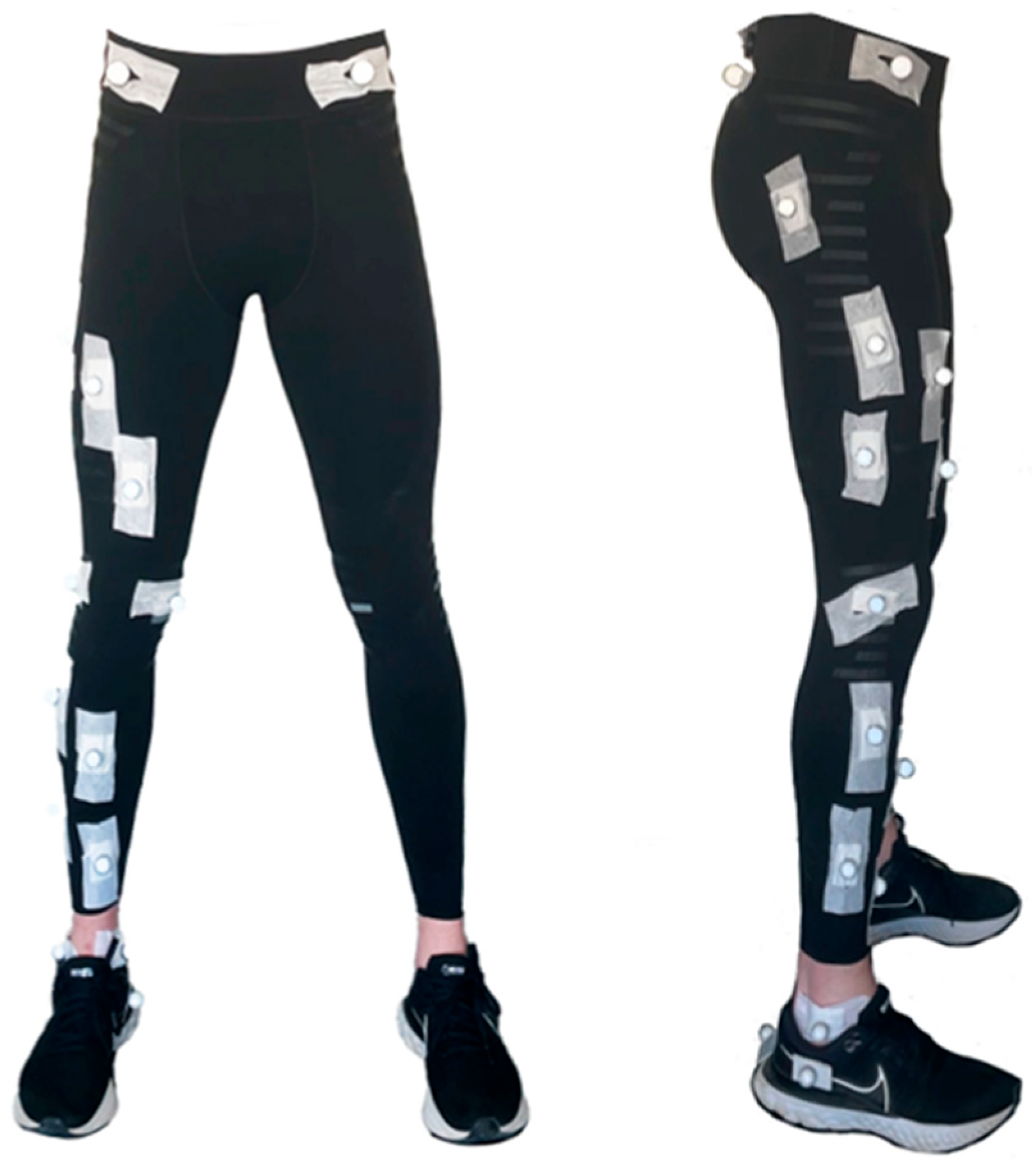
Three-dimensional kinematic data were collected using an eight-camera motion capture system (Vicon Vero, Vicon, Denver, CO, USA; 250 Hz). A unilateral marker set was applied to the right leg, including static markers for joint center identification and four tracking markers per segment for the thigh and shank. Bilateral pelvic markers were used to track pelvis motion (Figure 2). Ground reaction forces were recorded at 1000 Hz using a three-dimensional force plate (Kistler, Winterthur, Switzerland) synchronized with the motion capture system. Data were collected continuously during all trials.

2.4. Data Processing and Analysis

Marker trajectories were processed in Nexus v1.14 (Vicon, Denver, CO, USA), and kinematic analyses were performed in Visual3D (Version 2024a, HAS-Motion, Kingston, ON, Canada). Force data were down sampled to 250 Hz to match kinematic sampling frequency. Kinematic and kinetic data were filtered using a sixth-order low-pass Butterworth filter with a cutoff frequency of 30 Hz; A 30 Hz low-pass filter was applied to both kinematic and kinetic data to preserve physiologically meaningful high-frequency components during rapid lateral shuffle movements [33], consistent with recommendations to process force and motion data with the same filter to avoid attenuating true joint moments [34]. The primary outcome measures were peak knee valgus angle and external peak knee abduction moment normalized to body mass (Nm/kg). The external knee abduction moment was extracted during the eccentric phase of the shuffle, defined as the interval between initial ground contact and peak knee flexion. All outcome variables were averaged across five consecutive shuffles.
Statistical analyses were performed in SPSS statistics (version 29; SPSS Inc., Chicago, IL, USA). Data normality and homogeneity of variance were evaluated using the Shapiro–Wilk test. Depending on normality results, either a one-way repeated-measures ANOVA or its nonparametric equivalent was used to compare biomechanical outcomes across conditions. When a significant main effect was present, pairwise comparisons were performed using Bonferroni corrected paired t-tests (α = 0.016) to identify differences between the conditions (Unbraced vs. Braced, Zero-Tension vs. Braced, Unbraced vs. Zero-Tension). Descriptive statistics are reported as mean ± standard deviation (SD).

3. Results

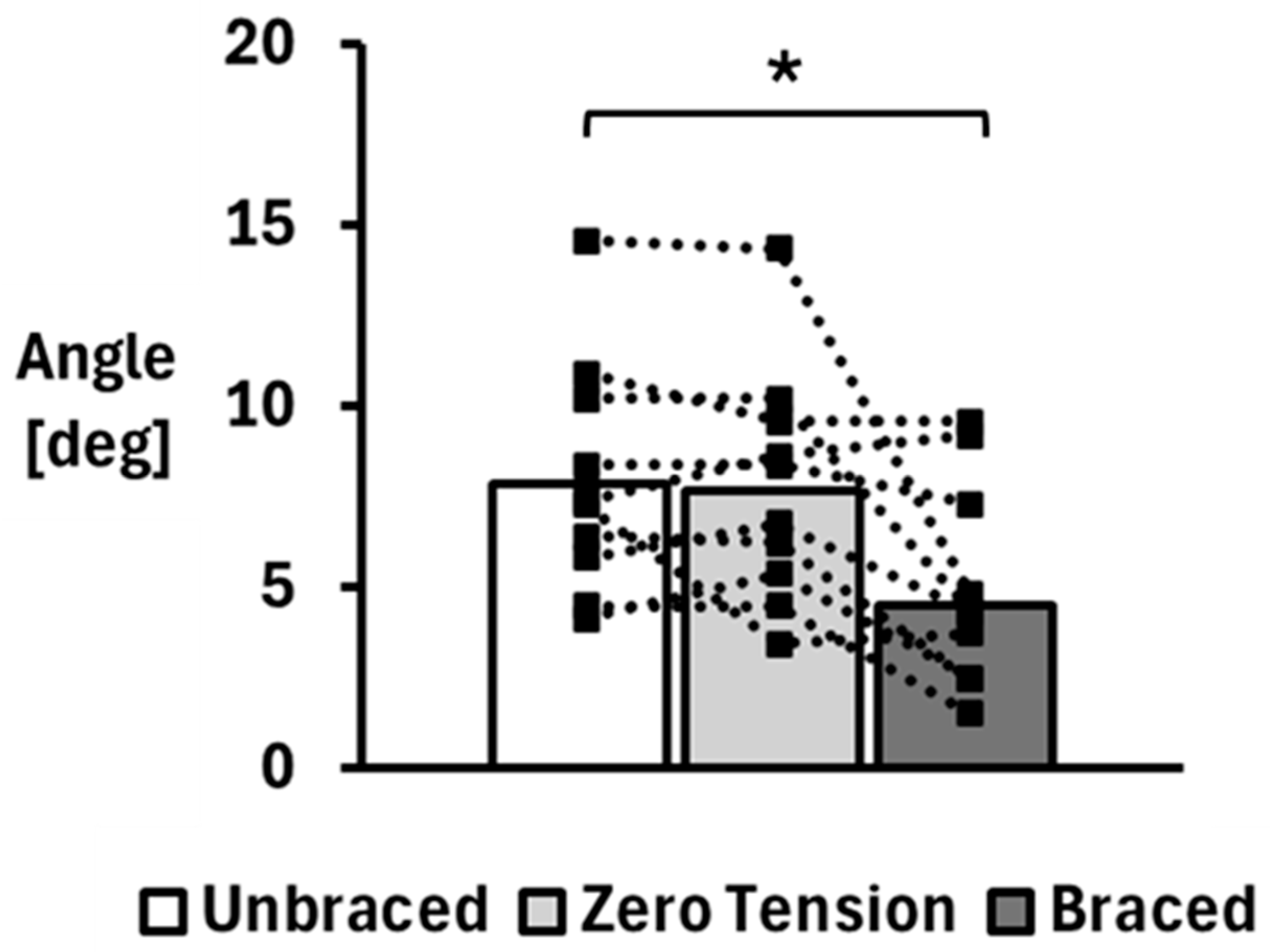
All variables were normally distributed across conditions (Shapiro–Wilk W(10) > 0.9, p > 0.05). There was a significant main effect of bracing condition on knee valgus angle (p = 0.004, ƞ2 = 0.459). Pairwise comparisons showed that the Braced condition produced significantly lower knee valgus angles than the Unbraced condition (Unbraced = 7.87 ± 2.8°, Braced = 4.49 ± 2.3°; p = 0.015, d = 0.992; Figure 3). The comparison between the Braced and Zero-Tension conditions approached significance but did not meet the corrected p-value (Braced = 4.49 ± 2.3°, Zero-Tension = 7.65 ± 2.5°; p = 0.019, d = 0.919). Although the Braced vs. Zero-Tension comparison did not meet the corrected threshold, nine of ten participants showed lower knee valgus angles when the brace was worn under tension compared with un-tensioned bracing, with an average decrease of 3.16° (Figure 3). No significant difference was observed between the Unbraced and Zero-Tension conditions (p = 0.653, d = 0.068).
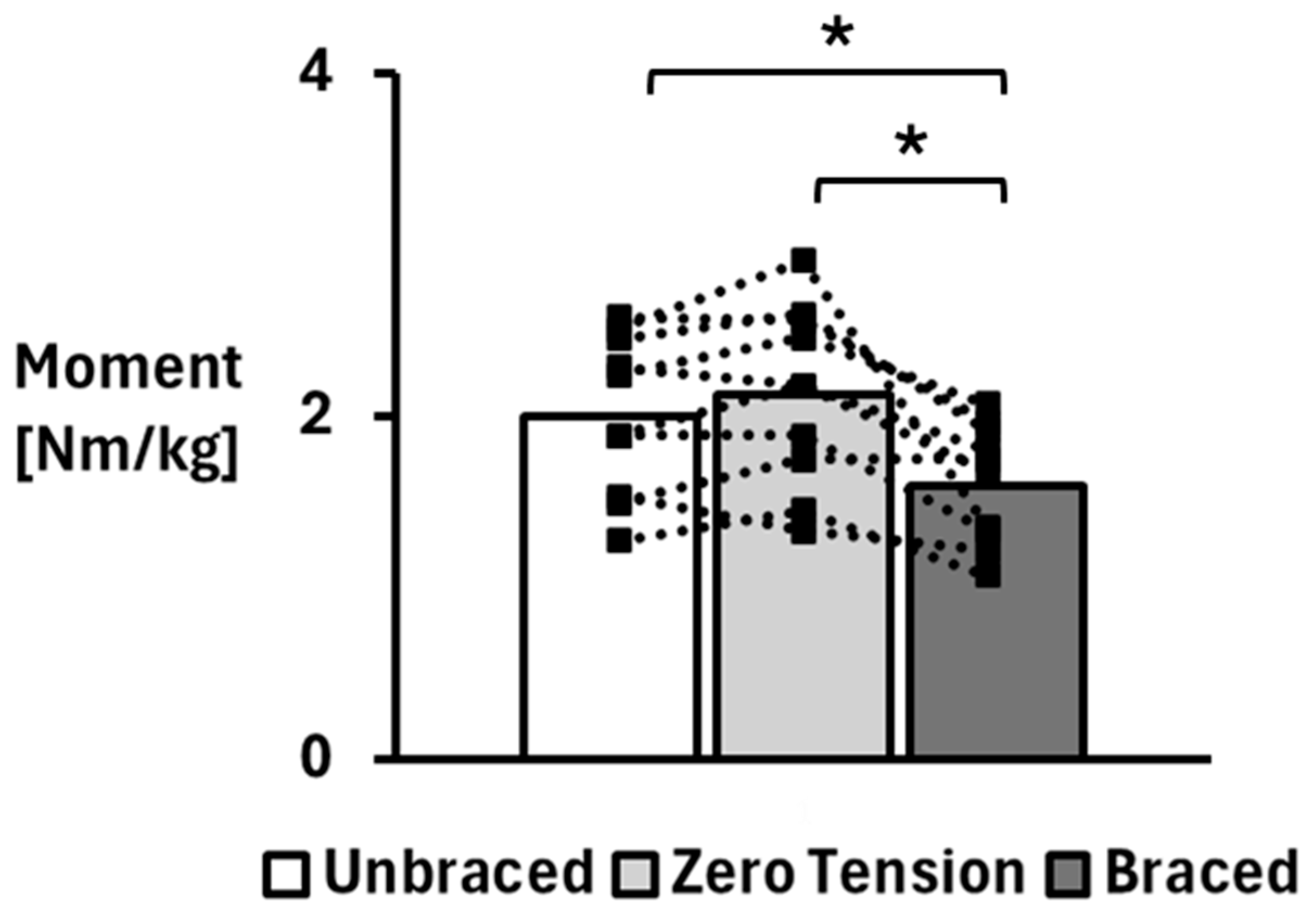
A significant main effect of bracing condition was also observed on peak external knee abduction moment (p = 0.003, η2 = 0.582). Pairwise comparisons showed that the Braced condition produced significantly lower peak knee abduction moment than both the Unbraced (Braced = 1.6 ± 0.4 Nm/kg, Unbraced = 2.0 ± 0.5 Nm/kg; p = 0.008, d = 1.615) and Zero-Tension (Braced = 1.6 ± 0.4 Nm/kg, Zero-Tension = 2.1 ± 0.5 Nm/kg; p = 0.004, d = 1.167) conditions. No significant difference was observed between the Unbraced and Zero-Tension conditions (p = 0.087, d = 0.233; Figure 4).

4. Discussion

This study examined the acute biomechanical effects of a tensioned knee brace system on peak knee valgus angle and external peak knee abduction moment during the eccentric phase of a lateral shuffle maneuver. The tensioned brace produced significant reductions in both peak valgus angle and peak external knee abduction moment, supporting the hypothesis that the brace enhances mediolateral stability and reduces knee loading. These findings are consistent with prior work demonstrating brace-induced reductions in valgus angle across various brace types [21]. While sagittal-plane kinematics were not a primary outcome variable, they were evaluated to determine whether knee flexion was affected by brace condition. No differences were observed in peak knee flexion across the Unbraced (62.24 ± 9.02), Zero-Tension (62.94 ± 8.49), and Braced conditions (62.97 ± 7.67; p > 0.05), indicating that the tensioned cable brace provides targeted frontal-plane support without restricting sagittal-plane motion. Taken together, these results suggest that the tensioned brace may offer a biomechanically favorable approach to supporting the knee during rapid lateral movements, with potential advantages over traditional semi-rigid knee braces, which have been shown to restrict sagittal-plane knee motion [23].
Reductions in valgus angle observed here mirror previous investigations involving both rigid and soft bracing in ACL-deficient individuals, which identified valgus mitigation independent of brace construction [35]. This aligns with established injury-prevention strategies, such as neuromuscular training programs, that successfully decrease excessive valgus motion, a key modifiable risk factor for ACL injury [18,36]. The significant reduction in external knee abduction moment observed in the current work are noteworthy given its association with elevated ACL injury risk, especially among female athletes [37]. Thus, from both primary and secondary prevention perspectives, lowering this moment may reduce mechanical loading on intra-articular and extra-articular structures during high-risk maneuvers.
Although most participants exhibited the expected reductions, individual variability was apparent. One participant demonstrated increased valgus angle despite bracing, and another showed increased abduction moment despite reduced valgus motion. Such variability is not unexpected in small samples and may reflect differences in neuromuscular control strategies, movement coordination, anthropometrics, or subjective responses to bracing (e.g., perceived stability or confidence). Future work should investigate how factors such as athlete training history, limb dominance, brace tension, and task familiarity influence brace responsiveness. Establishing tailored tensioning protocols may further improve consistency of biomechanical outcomes.
Mechanistically, both knee valgus angle and external knee abduction moment contribute to mediolateral knee instability and have been implicated in ACL injury mechanisms [37]. Although the precise thresholds that precipitate ligament injury remain uncertain, reductions in external abduction moment, whether achieved through neuromuscular training, targeted feedback, or bracing, may help reduce mechanical contributors to injury onset. While the present study cannot infer direct injury-risk mitigation, the observed decreases in abduction moment during the eccentric phase of a high-risk maneuver support the potential utility of the brace as a biomechanical intervention [38].
Several limitations should be considered. The relatively small sample size (N = 10) limits generalizability; however, post hoc power analyses indicated adequate power to detect differences in both primary outcomes (power = 0.95 for valgus angle; power = 0.87 for abduction moment). Additionally, the participants were recreationally active but not trained athletes, who may exhibit different neuromuscular activation strategies [39] and may respond differently to bracing. Future studies should evaluate the brace among trained and elite athletes and assess its influence on performance, efficiency, movement variability, and subjective comfort.
Another limitation is the lack of direct assessment of tibiofemoral translation or rotation, both of which are central to ACL injury mechanisms. Prior research has shown that sleeve-type braces generally have minimal influence on these parameters, whereas rigid braces more effectively limit tibial displacement [40]. Given the flexible construction of the brace tested here, similar minimal effects on rotational or translational control would be expected, though this remains to be confirmed experimentally.
Finally, the study design required that the Unbraced condition be performed first for practical and methodological reasons, which may introduce potential order effects. Specifically, given testing time constraints, it was not feasible to remove and reapply motion-capture markers for all three conditions without compromising marker placement consistency. Although the Zero-Tension and tensioned Braced conditions were randomized and no significant differences were observed between the Unbraced and Zero-Tension trials potential order effects cannot be entirely ruled out. Accordingly, the findings should be interpreted with consideration of this limitation.
Taken together, these results suggest that the tensioned brace may offer a biomechanically favorable approach to supporting the knee during rapid lateral movements, while maintaining a cautious interpretation regarding clinical or injury-related implications. Additional research across a broader range of athletic populations is needed to determine its performance implications, long-term adoption, and comparative effectiveness relative to traditional bracing approaches.

5. Conclusions

This study evaluated the acute biomechanical effects of the Stoko K1 knee brace during a lateral shuffle change-of-direction maneuver. The tensioned brace resulted in significant reductions in peak knee valgus angle and external knee abduction moment, demonstrating targeted mediolateral stabilization without restricting natural movement. These findings suggest that non-rigid, cable-tensioned bracing systems may offer a viable alternative to traditional rigid braces.
The integration of tensioned cable systems into a wearable compression garment represents an innovative direction in knee-brace design, offering measurable biomechanical benefits in controlled settings and potential utility for athletes seeking non-restrictive support during dynamic movement. While the observed reductions in knee loading are promising, their implications for injury-risk mitigation or sport performance remain to be confirmed in larger, sport-specific trials. Future research should examine brace function during unanticipated cutting and landing tasks, its effects on performance and muscle activation, and long-term user adherence and comfort.

Author Contributions

A.G. contributed to the study design, interpretation of results, and writing the manuscript. P.M. contributed to the study design, data collection, data analysis, interpretation of results, and writing the manuscript. S.R.N. and M.J.J. contributed to the study design, interpretation of results, and revising the manuscript. All authors have read and agreed to the published version of the manuscript.

Funding

This research received no external funding.

Institutional Review Board Statement

All procedures performed in the study were in accordance with the ethical standards of the institutional and/or national research committee (University of Calgary Conjoint Health Research Ethics Board: REB22-1415) and with the 1964 Helsinki declaration and its later amendments or comparable ethical standards. Informed consent was obtained from all individual participants included in the study.

Informed Consent Statement

Written informed consent was obtained from all participants prior to participation in the study and for publication of this manuscript.

Data Availability Statement

De-identified data may be made available from the corresponding author upon reasonable request.

Acknowledgments

The authors would like to thank Ryan Bakker at Stoko for providing the product used in this study and for input on the study design.

Conflicts of Interest

The authors declare no conflicts of interest.

Abbreviations

The following abbreviations are used in this manuscript:
ACLAnterior Cruciate Ligament
MCLMedial Collateral Ligament
PTOAPost-Traumatic Osteoarthritis
SDStandard Deviation

References

  1. Koga, H.; Nakamae, A.; Shima, Y.; Iwasa, J.; Myklebust, G.; Engebretsen, L.; Bahr, R.; Krosshaug, T. Mechanisms for Noncontact Anterior Cruciate Ligament Injuries: Knee Joint Kinematics in 10 Injury Situations from Female Team Handball and Basketball. Am. J. Sports Med. 2010, 38, 2218–2225. [Google Scholar] [CrossRef]
  2. Rodriguez-Merchan, E.C.; Encinas-Ullan, C.A. Knee Osteoarthritis Following Anterior Cruciate Ligament Reconstruction: Frequency, Contributory Elements, and Recent Interventions to Modify the Route of Degeneration. Arch. Bone Jt. Surg. 2022, 10, 951–958. [Google Scholar] [CrossRef] [PubMed]
  3. Joseph, M.; Collins, C.L.; Henke, N.M.; Yard, E.E.; Fields, S.K.; Comstock, R.D. A Multisport Epidemiologic Comparison of Anterior Cruciate Ligament Injuries in High School Athletics. J. Athl. Train. 2013, 48, 810–817. [Google Scholar] [CrossRef]
  4. Bahr, R.; Clarsen, B.; Ekstrand, J. Why we should focus on the burden of injuries and illnesses, not just their incidence. Br. J. Sports Med. 2018, 52, 1018–1021. [Google Scholar] [CrossRef]
  5. Kaeding, C.C.; Léger-St-Jean, B.; Magnussen, R.A. Epidemiology and Diagnosis of Anterior Cruciate Ligament Injuries. Clin. Sports Med. 2017, 36, 1–8. [Google Scholar] [CrossRef] [PubMed]
  6. Musahl, V.; Karlsson, J. Anterior Cruciate Ligament Tear. N. Engl. J. Med. 2019, 380, 2341–2348. [Google Scholar] [CrossRef] [PubMed]
  7. Filbay, S.R.; Skou, S.T.; Bullock, G.S.; Le, C.Y.; Räisänen, A.M.; Toomey, C.; Ezzat, A.M.; Hayden, A.; Culvenor, A.G.; Whittaker, J.L.; et al. Long-term quality of life, work limitation, physical activity, economic cost and disease burden following ACL and meniscal injury: A systematic review and meta-analysis for the OPTIKNEE consensus. Br. J. Sports Med. 2022, 56, 1465–1474. [Google Scholar] [CrossRef]
  8. Friel, N.A.; Chu, C.R. The Role of ACL Injury in the Development of Posttraumatic Knee Osteoarthritis. Clin. Sports Med. 2013, 32, 1–12. [Google Scholar] [CrossRef]
  9. Rodriguez-Merchan, E.C.; Valentino, L.A. Return to Sport Activities and Risk of Reinjury Following Primary Anterior Cruciate Ligament Reconstruction. Arch. Bone Jt. Surg. 2022, 10, 648–660. [Google Scholar] [CrossRef]
  10. Whittaker, J.L.; Losciale, J.M.; Juhl, C.B.; Thorlund, J.B.; Lundberg, M.; Truong, L.K.; Miciak, M.; van Meer, B.L.; Culvenor, A.G.; Crossley, K.M.; et al. Risk factors for knee osteoarthritis after traumatic knee injury: A systematic review and meta-analysis of randomised controlled trials and cohort studies for the OPTIKNEE Consensus. Br. J. Sports Med. 2022, 56, 1406–1421. [Google Scholar] [CrossRef]
  11. Lohmander, L.S.; Englund, P.M.; Dahl, L.L.; Roos, E.M. The long-term consequence of anterior cruciate ligament and meniscus injuries: Osteoarthritis. Am. J. Sports Med. 2007, 35, 1756–1769. [Google Scholar] [CrossRef]
  12. Mather, R.C.; Koenig, L.; Kocher, M.S.; Dall, T.M.; Gallo, P.; Scott, D.J.; Bach, B.R.; Spindler, K.P.; The MOON Knee Group. Societal and Economic Impact of Anterior Cruciate Ligament Tears. J. Bone Jt. Surg. Am. 2013, 95, 1751–1759. [Google Scholar] [CrossRef]
  13. Franco, D.; Ambrosio, L.; Za, P.; Maltese, G.; Russo, F.; Vadalà, G.; Papalia, R.; Denaro, V. Effective Prevention and Rehabilitation Strategies to Mitigate Non-Contact Anterior Cruciate Ligament Injuries: A Narrative Review. Appl. Sci. 2024, 14, 20. [Google Scholar] [CrossRef]
  14. Linczeski, Z. A Systematic Review: The Effect of Prophylactic Braces on Reducing Risk Factors Related to ACL Injury in Athletes. Master’s Thesis, Northern Michigan University, Marquette, MI, USA, 2022. [Google Scholar]
  15. Paluska, S.A.; Mckeag, D.B. Knee Braces: Current Evidence and Clinical Recommendations for Their Use. Am. Fam. Physician 2000, 61, 411–418. [Google Scholar]
  16. Hewlett, J.; Kenney, J. Innovations in functional and rehabilitative knee bracing. Ann. Transl. Med. 2019, 7, S248. [Google Scholar] [CrossRef]
  17. Blecha, K.; Nuelle, C.W.; Smith, P.A.; Stannard, J.P.; Ma, R. Efficacy of Prophylactic Knee Bracing in Sports. J. Knee Surg. 2022, 35, 242–248. [Google Scholar] [CrossRef] [PubMed]
  18. Pietrosimone, B.G.; Grindstaff, T.L.; Linens, S.W.; Uczekaj, E.; Hertel, J. A systematic review of prophylactic braces in the prevention of knee ligament injuries in collegiate football players. J. Athl. Train. 2008, 43, 409–415. [Google Scholar] [CrossRef]
  19. Rishiraj, N.; Taunton, J.E.; Niven, B.; Lloyd-Smith, R.; Regan, W.; Woollard, R. Performance of healthy braced participants during aerobic and anaerobic capacity tasks. J. Athl. Train. 2011, 46, 395–402. [Google Scholar] [CrossRef]
  20. Mortaza, N.; Ebrahimi, I.; Jamshidi, A.A.; Abdollah, V.; Kamali, M.; Abas, W.A.B.W.; Abu Osman, N.A. The Effects of a Prophylactic Knee Brace and Two Neoprene Knee Sleeves on the Performance of Healthy Athletes: A Crossover Randomized Controlled Trial. PLoS ONE 2012, 7, e50110. [Google Scholar] [CrossRef] [PubMed]
  21. Gentile, J.M.; O’Brien, M.C.; Conrad, B.; Horodyski, M.; Bruner, M.L.; Farmer, K.W. A Biomechanical Comparison Shows No Difference Between Two Knee Braces used for Medial Collateral Ligament Injuries. Arthrosc. Sports Med. Rehabil. 2021, 3, e901–e907. [Google Scholar] [CrossRef] [PubMed]
  22. Ewing, K.A.; Begg, R.K.; Galea, M.P.; Lee, P.V.S. Effects of Prophylactic Knee Bracing on Lower Limb Kinematics, Kinetics, and Energetics During Double-Leg Drop Landing at 2 Heights. Am. J. Sports Med. 2016, 44, 1753–1761. [Google Scholar] [CrossRef]
  23. Wang, J.; Yang, J.; Huang, X.; Luo, Y.; Wu, D.; Huang, X.; Wang, S. The effect of knee braces on knee joint kinematics at different exercise speeds. Sports Biomech. 2024, 23, 3526–3537. [Google Scholar] [CrossRef]
  24. Evans-Pickett Davis-Wilson, H.C.; Johnston, C.D.; Blackburn, J.T.; Hackney, A.C.; Pietrosimone, B. Immediate Effects of Walking with a Knee Brace After Anterior Cruciate Ligament Reconstruction: A Biomechanical, Biochemical, and Structural Approach. J. Athl. Train. 2023, 58, 542–553. [Google Scholar] [CrossRef]
  25. Kiyak, G.; Uyan, A.S.; Arslan, E.; Acar, H.T.; Ercan, S.; Cetin, C. The effects of knee brace use on landing error, balance, and crossover hop test in healthy athletes. Turk. J. Sports Med. 2024, 59, 105–111. [Google Scholar] [CrossRef]
  26. Tse, C.; Bakker, R.; Ardell, J. Stoko K1: Supportive apparel to reinterpret lower extremity bracing. Presented at the North American Congress of Biomechanics, Ottawa, ON, Canada, 21–25 August 2022. [Google Scholar]
  27. Maurus, P.; Asmussen, M.J.; Cigoja, S.; Nigg, S.R.; Nigg, B.M. The Submaximal Lateral Shuffle Test: A reliability and sensitivity analysis. J. Sports Sci. 2019, 37, 2066–2074. [Google Scholar] [CrossRef]
  28. Tosarelli, F.; Buckthorpe, M.; Di Paolo, S.; Grassi, A.; Rodas, G.; Zaffagnini, S.; Nanni, G.; Della Villa, F. Video Analysis of Anterior Cruciate Ligament Injuries in Male Professional Basketball Players: Injury Mechanisms, Situational Patterns, and Biomechanics. Orthop. J. Sports Med. 2024, 12, 23259671241234880. [Google Scholar] [CrossRef] [PubMed]
  29. Bere, T.; Flørenes, T.W.; Krosshaug, T.; Koga, H.; Nordsletten, L.; Irving, C.; Muller, E.; Reid, R.C.; Senner, V.; Bahr, R. Mechanisms of anterior cruciate ligament injury in World Cup alpine skiing: A systematic video analysis of 20 cases. Am. J. Sports Med. 2011, 39, 1421–1429. [Google Scholar] [CrossRef]
  30. Petway, A.J.; Jordan, M.J.; Epsley, S.; Anloague, P.; Rimer, E. Mechanisms of anterior cruciate ligament tears in professional National Basketball Association players: A video analysis. J. Appl. Biomech. 2023, 39, 143–150. [Google Scholar] [CrossRef] [PubMed]
  31. Krosshaug, T.; Nakamae, A.; Boden, B.P.; Engebretsen, L.; Smith, G.; Slauterbeck, J.R.; Hewett, T.E.; Bahr, R. Mechanisms of anterior cruciate ligament injury in basketball: Video analysis of 39 cases. Am. J. Sports Med. 2007, 35, 359–367. [Google Scholar] [CrossRef] [PubMed]
  32. Mündermann, A.; Stefanyshyn, D.J.; Nigg, B.M. Relationship between footwear comfort of shoe inserts and anthropometric and sensory factors. Med. Sci. Sports Exerc. 2001, 33, 1939–1945. [Google Scholar] [CrossRef]
  33. Roewer, B.D.; Ford, K.R.; Myer, G.D.; Hewett, T.E. The ‘impact’ of force filtering cut-off frequency on the peak knee abduction moment during landing: Artefact or ‘artifiction’? Br. J. Sports Med. 2014, 48, 464–468. [Google Scholar] [CrossRef] [PubMed]
  34. Kristianslund, E.; Krosshaug, T.; van den Bogert, A.J. Effect of low pass filtering on joint moments from inverse dynamics: Implications for injury prevention. J. Biomech. 2012, 45, 666–671. [Google Scholar] [CrossRef]
  35. Focke, A.; Steingrebe, H.; Möhler, F.; Ringhof, S.; Sell, S.; Potthast, W.; Stein, T. Effect of Different Knee Braces in ACL-Deficient Patients. Front. Bioeng. Biotechnol. 2020, 8, 964. [Google Scholar] [CrossRef]
  36. Pangestuputra, W.; Changestu, D.A. Neuromuscular Training in ACL Injury Prevention: A Narrative Review. Orthop. J. Sports Med. 2024, 12, 2325967124S00394. [Google Scholar] [CrossRef]
  37. Myer, G.D.; Ford, S.L.; Foss, K.D.B.; Micheli, L.J.; Hewett, T.E. High knee abduction moments are common risk factors for patellofemoral pain (PFP) and anterior cruciate ligament (ACL) injury in girls: Is PFP itself a predictor for subsequent ACL injury? Br. J. Sports Med. 2015, 49, 118–122. [Google Scholar] [CrossRef] [PubMed]
  38. Sigurðsson, H.B.; Karlsson, J.; Snyder-Mackler, L.; Briem, K. Kinematics observed during ACL injury are associated with large early peak knee abduction moments during a change of direction task in healthy adolescents. J. Orthop. Res. 2021, 39, 2281–2290. [Google Scholar] [CrossRef]
  39. Ford, J.; Myer, G.D.; Shapiro, R.; Hewett, T.E. The effects of age and skill level on knee musculature co-contraction during functional activities: A systematic review. Br. J. Sports Med. 2008, 42, 561–566. [Google Scholar] [CrossRef]
  40. Giotis, D.; Tsiaras, V.; Ristanis, S.; Zampeli, F.; Mitsionis, G.; Stergiou, N.; Georgoulis, A.D. Knee braces can decrease tibial rotation during pivoting that occurs in high demanding activities. Knee Surg. Sports Traumatol. Arthrosc. 2011, 19, 1347–1354. [Google Scholar] [CrossRef] [PubMed]
Figure 1. Stoko K1 brace views and internal structure visualization. From (left) to (right): anterior view and posterior view of the lower-limb garment; lateral view of the garment; and lateral view with internal tension-cable pathways overlaid to illustrate the embedded support architecture and design.
Biomechanics 06 00013 g001
Figure 2. Supportive tension brace with marker set.
Biomechanics 06 00013 g002
Figure 3. Peak knee valgus angle during the eccentric phase (initial contact to peak knee flexion) of the lateral shuffle task across the three conditions. Bars show group means; dotted lines show individual participant responses. An asterisk (*) indicates a statistically significant difference between conditions (p < 0.05).
Biomechanics 06 00013 g003
Figure 4. Peak external knee abduction moment during the eccentric phase of the lateral shuffle task across conditions (Unbraced, Zero-Tension, Braced). Bars show group means; dotted lines show individual participant responses. An asterisk (*) indicates a statistically significant difference between conditions (p < 0.05).
Biomechanics 06 00013 g004
Disclaimer/Publisher’s Note: The statements, opinions and data contained in all publications are solely those of the individual author(s) and contributor(s) and not of MDPI and/or the editor(s). MDPI and/or the editor(s) disclaim responsibility for any injury to people or property resulting from any ideas, methods, instructions or products referred to in the content.