Article

Curve Analysis of Lower-Limb Kinematics During Transition Step Negotiation in Older Adult Women with a Fall History


1
Foot & Ankle Biomechanics Laboratory, University of Wisconsin–Milwaukee, University Services and Research Building, Room 285, 115 E Reindl Way, Glendale, WI 53212, USA
2
Human Motion Laboratory, University of Scranton, Scranton, PA 18510, USA
3
Biomechanics Laboratory, Department of Biomechanics and Motor Behavior, King Saud University, Riyadh 4545, Saudi Arabia
*
Author to whom correspondence should be addressed.
Biomechanics 2026, 6(1), 16; https://doi.org/10.3390/biomechanics6010016
Submission received: 7 December 2025 / Revised: 21 January 2026 / Accepted: 22 January 2026 / Published: 3 February 2026
(This article belongs to the Section Gait and Posture Biomechanics)

Abstract

Background: Older adult falls during step negotiation result in higher injury rates compared to level ground falls. Previous research on discrete events during step negotiations may not capture important age-related changes. Curve analysis techniques enable assessment of an entire time series and may further advance the understanding of older adult falls during step negotiation. The purpose of the current study was to investigate lower extremity kinematics during transition step negotiation in older women with fall history compared to young women using statistical parametric mapping (SPM). Methods: 15 older female adults with a fall history and 15 young female adults participated in the study. Participants performed walking trials along a 5.5 m raised walkway, descended a 17 cm step and continued walking 3 m. Data was processed from lead limb toe-off prior to the step, through lead limb weight acceptance of the transition step. SPM was used to perform independent t-test analysis of the three-dimensional lower extremity time series. Results: The older faller group showed significantly decreased lead hip abduction (9–19% of step negotiation, mean difference: 3.74°, p = 0.045), increased lead knee flexion (65–80% of step negotiation, mean difference: 5.8°, p = 0.012), and increased trail limb hip adduction (91–100% of step negotiation, mean difference: 3.92°, p = 0.046). Conclusions: The older faller group showed altered hip joint angles in the frontal plane and knee joint angles in the sagittal plane during early swing and late weight acceptance phases, which may reflect compensatory strategies for reduced strength and/or balance. Curve analysis provides additional insight into age-related kinematic changes during step negotiation that may be related to older adult fall risk.

1. Introduction

Approximately 28–35% of individuals aged 65 and older experience at least one fall each year [1], and the economic burden of fall-related incidents is significant and rising globally [2,3]. In 2020, USD 80 billion was spent on healthcare due to non-fatal related falls among older adults [4]. In addition to the acute pain and dysfunction associated with a fall, older adults also frequently face prolonged disability and a decreased quality of life following a fall [5,6]. In fact, falls are a primary cause of injury, disability, and premature mortality among older adults [7].
The three most common circumstances associated with falls among older adults are during level ground walking (50%), standing (9.6%), and step negotiation (6.8%) [8]. Although falls during walking on level ground and standing are more prevalent, falls that occur during step negotiation are associated with a 12% higher incidence of injury [9]. As a result of the high prevalence, personal burden, and economic cost associated with falls in older adults, numerous studies aimed at identifying the cause of falls in older adults have been conducted. Further, due to the fact that 30% of falls related to steps occur on the first or last step during the transition to level walking [10], several studies have focused on investigating transition step mechanics [11,12,13,14,15,16]. All the studies to date have been analyses of predetermined discrete events during the step negotiation (e.g., joint angles at initial contact). While discrete analyses are important and have improved the understanding of the effect of age on transition step mechanics, they cannot identify potentially important differences that occur throughout the step negotiation. Curve analysis techniques such as SPM have the ability to investigate joint angle differences over an entire time series [17], which may offer additional insights into age-related kinematic changes during transition step negotiation.
Therefore, the purpose of this study was to use SPM to investigate ankle, knee, and hip joint angle differences during transition step negotiation between older adult females with a history of at least one fall during the last year and young adult females. The study focused on women due to the fact that older adult women fall twice as often as older adult men and incur three times the medical costs [18]. Due to the decreased strength and balance associated with aging, we hypothesized that older females would demonstrate increased trail limb hip flexion and adduction, knee flexion, and ankle dorsiflexion joint angles as the lead limb is lowered to initial contact of the transition step. Similar changes were postulated for the lead limb during the lead limb weight acceptance phase of the transition step.

2. Materials and Methods

A total of 137 potential participants completed a study participation screening form, and 30 met the inclusion criteria and participated in the study. Participants were assigned to one of two groups: older women aged ≥65 years with a history of falls (OF, number = 15) and young women aged 18–40 years (YW, number = 15). The OF group had experienced at least one fall in the past year (mean: 1.5 falls, range: 1–3), were able to walk and step down a single 17 cm step without stopping or using an assistive device, and scored ≥ 5 on the Six-Item Screener for Cognitive Impairment [19]. A fall was defined as an unintended rest on the ground, floor, or another lower surface, not due to intrinsic events or hazards [20]. Potential participants for both groups were excluded if they had undergone recent lower back or lower extremity surgery, used medications affecting balance, had conditions impairing balance, or were pregnant. Informed written consent, approved by the UW-Milwaukee Institutional Review Board, was obtained from all participants prior to the study.
The modified Foot and Ankle Disability Index (FADI) [14,21], Rapid Assessment of Physical Activity (RAPA) [22], Five Times Sit-to-Stand (FTSS) test [23,24], and Falls Risk Assessment Score [25] were collected as descriptive data to describe participants’ lower extremity function, pain, mobility, and fall risk.
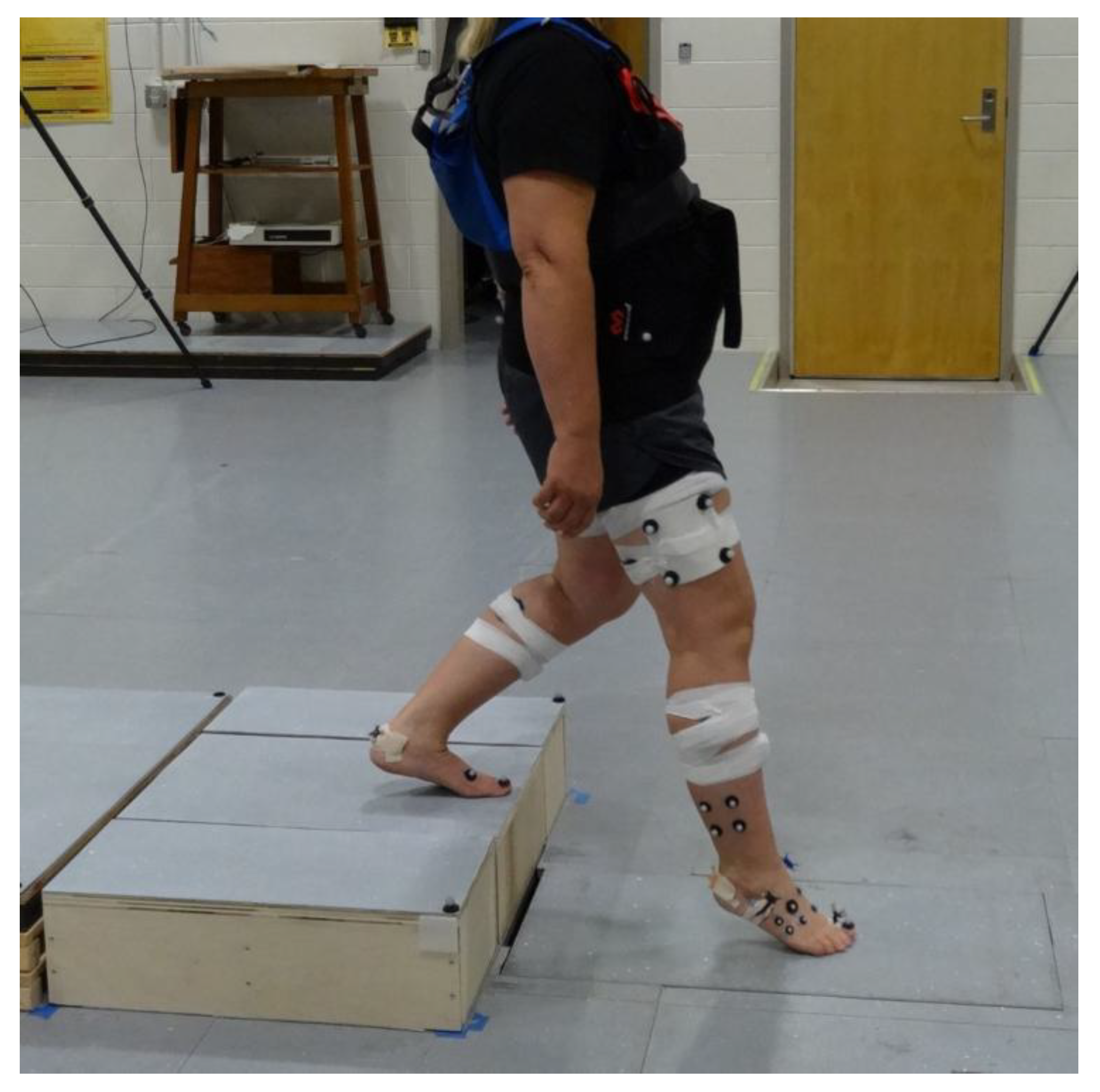
Retro-reflective markers or marker clusters were placed on the great toes, first and fifth metatarsals, calcanei, shanks, thighs, and pelvis, secured with double-sided adhesive tape [16]. A static standing calibration trial was conducted to define time-invariant positions of anatomical landmark markers. Following the calibration trial, the anatomical landmark markers were removed. Following practice trials to familiarize themselves with the task and establish their self-selected speed, participants completed seven successful barefoot transition step negotiation trials (Figure 1). A successful trial was defined as one in which the participant approached the step at their self-selected speed (±10%), stepped down with the right foot onto the force plate, and continued walking after the step down. Gait speed was monitored using electronic timing gates positioned along the walkway before the step.
Three-dimensional (3D) kinematic data during the transition step negotiation trials were collected at 200 Hz using a 14-camera motion capture system (Raptor 4, Motion Analysis Inc., Rohnart Park, CA, USA). Lead limb toe-off was determined via an over ground toe-off kinematics algorithm [26]. Force plates sampling at 2000 Hz embedded in the walkway under the step and at the base of the step (AMTI Inc., Watertown, MA, USA) were used to identify trail limb toe-off and lead limb initial contact events (20 N threshold). Synchronized kinematic and kinetic data were recorded using Cortex software (v. 7.0, Motion Analysis Inc., Rohnart Park, CA, USA).
Following completion of the trials, the synchronized tracked position data and ground reaction force data were exported to Visual3D (HAS-Motion, Kingston, ON, Canada) for further post processing. A Visual3D pipeline was used to filter the marker position data using a fourth-order, zero-lag Butterworth low-pass filter (6 Hz cutoff), reconstruct the 3D positions of the anatomical landmarks, define local coordinate systems within each segment, and calculate hip, knee, and ankle joint angles using the joint coordinate system technique [27]. Positive sagittal, frontal, and transverse plane rotations were defined as flexion (dorsiflexion for the ankle), adduction (inversion for the ankle), and medial rotation (adduction for the ankle), respectively. Of the seven successful trials collected, the first five with no obvious erroneous marker displacement were used for subsequent analysis.
The spm1d package for one-dimensional SPM [17,28] was used to investigate lower extremity joint angle differences between the OF and YW groups during the transition step negotiation. The analysis was performed from lead foot toe-off prior to step negotiation through lead foot weight acceptance after step negotiation. Lead limb weight acceptance was defined as the period between lead limb initial contact and trail limb toe-off. Prior to investigating the group differences, the normality of the data was assessed (spm1d.stats.normality.ttest2, MATLAB v. 24.2, Natick, MA, USA). All the data were normally distributed; therefore, independent t-tests (spm1d.stats.ttest2, MATLAB, v. 24.2, Natick, MA, USA) were performed. The dependent variables of interest were the sagittal, frontal, and transverse plane ankle and hip joint time series, and the sagittal plane knee joint time series. Significance for the statistical analysis was set at α = 0.05.

3. Results

Descriptive data are presented in Table 1. Statistical analysis of the descriptive data for this cohort in a previous study revealed no significant group differences in gait speed, height, body mass index, or activity level [14]. There were, however, significant differences between groups for the FADI, FRAS, and FTSS functional outcomes assessments. Compared to the YW group, the OF group exhibited lower FADI scores and higher FRAS and FTSS scores, indicating greater lower extremity dysfunction and increased fall risk [14].
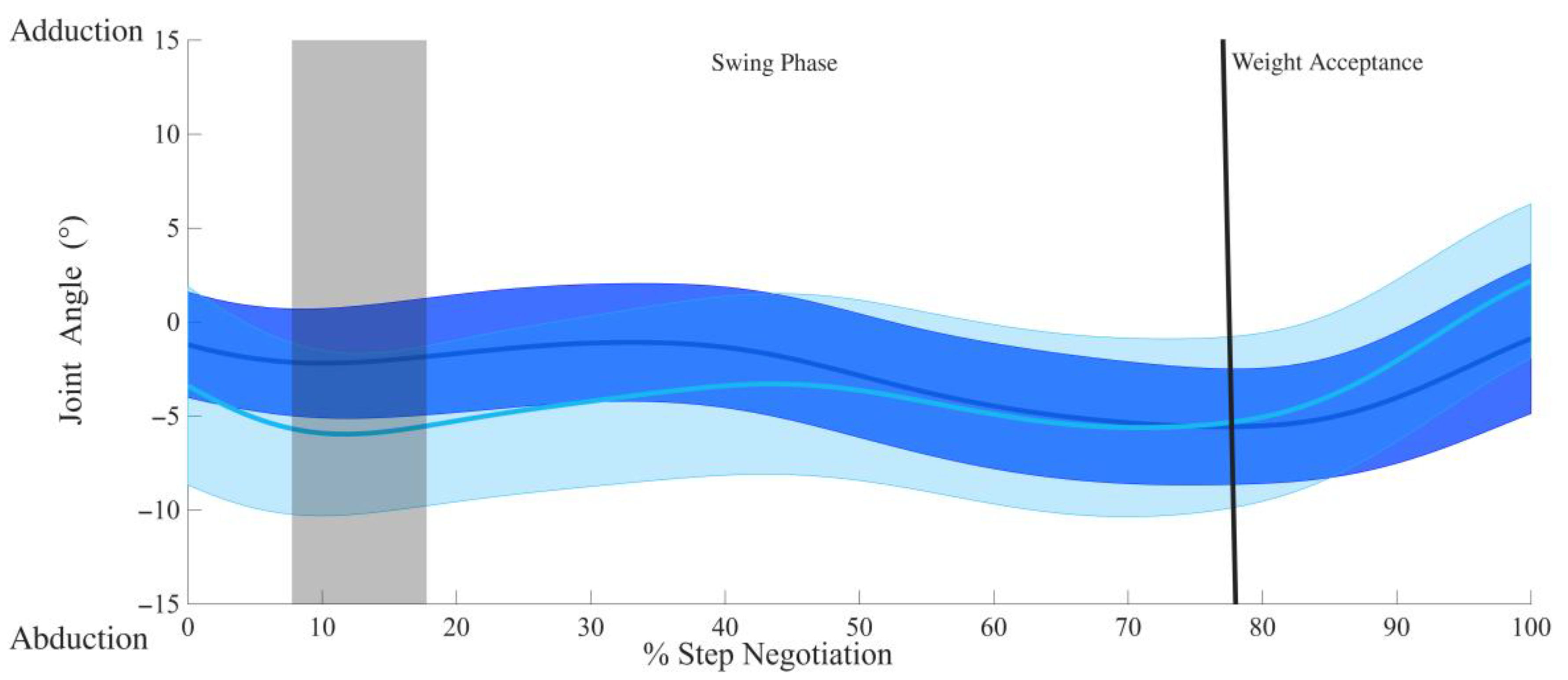
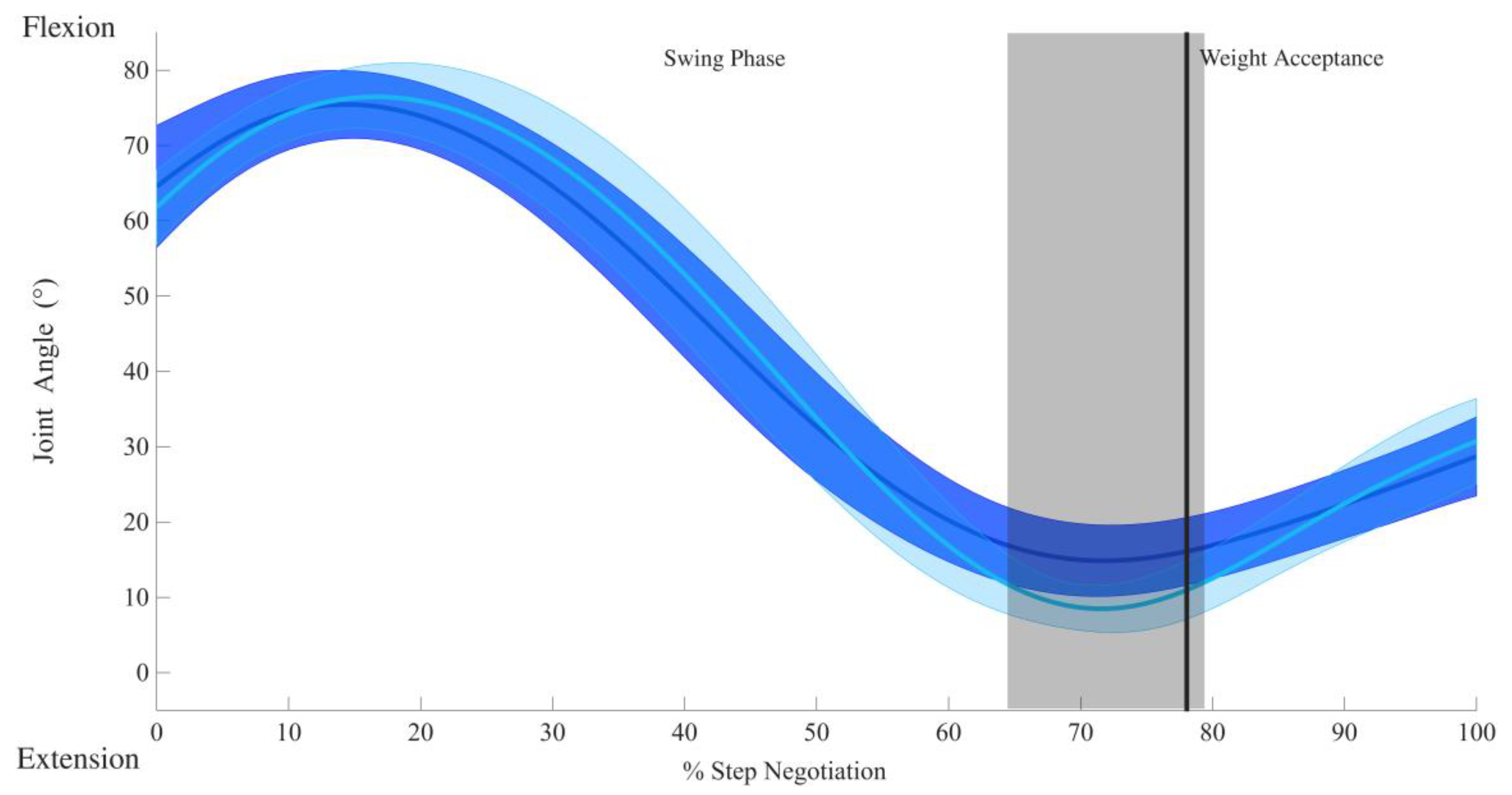
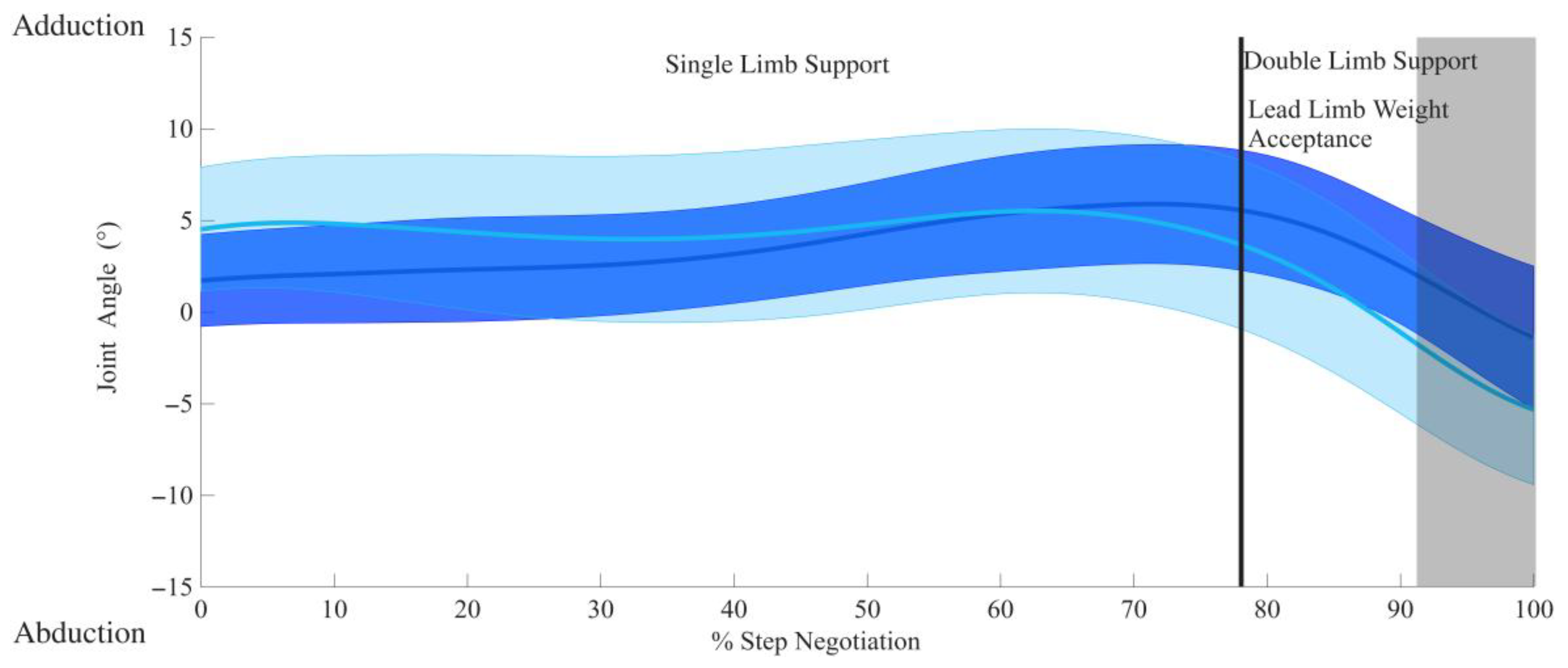
Lead limb independent t-test results revealed significantly decreased hip abduction angle from 9 to 19% (mean difference: 3.74°; p = 0.045) (Figure 2) and increased knee flexion angle from 65 to 80% (mean difference 5.8°; p = 0.012) (Figure 3) of the step negotiation in the OF group. Trail limb independent t-test results revealed significant differences between group hip frontal plane differences from 91 to 100% of the step negotiation (mean difference: 3.92°; p = 0.046) (Figure 4). There were no significant differences between groups in the lead limb ankle, trail limb ankle, or trail limb knee kinematics.

4. Discussion

The purpose of this study was to utilize SPM to identify hip, knee, and ankle kinematic differences between older female adults with a fall history and young female adults during transition step negotiation. It was hypothesized that older female adults with a fall history would have greater trail limb hip flexion and adduction, knee flexion, and ankle dorsiflexion angles as the lead limb was lowered to initial contact during the transition step (0–78% step negotiation) with similar changes in the lead limb as it accepted weight during the weight acceptance phase (78–100% step negotiation). The hypotheses were partially supported by decreased lead limb hip abduction from 9 to 19%, increased lead limb knee flexion from 65 to 80%, and increased trail limb hip adduction from 91 to 100% of step negotiation in the OF group.

4.1. Lead Limb Kinematics

The decreased OF group lead limb hip abduction angle from 9 to 19% of step negotiation occurred during early swing phase. The decreased hip abduction angle could make the swing limb longer resulting in lower foot clearance during the early swing phase of the transition step negotiation. This may be especially true given that there were no other significant lead or trail limb joint angle differences during this period. However, since the vertical height of the foot is likely increasing at this time, it is not clear if the difference would increase the risk of a trip or stumble.
The greater lead limb knee flexion angle in the OF group from 65 to 80% of step negotiation occurred at the end of the lead limb swing phase and beginning of lead limb weight acceptance. The increased knee flexion may represent a compensatory strategy to ensure adequate lead limb clearance during step descent and/or to create an earlier initial contact to limit time spent in single limb stance. These adjustments may help compensate for age-related declines in balance [29,30] and/or trail limb strength [14,31,32]. However, the increased lead limb knee flexion in the OF group during weight acceptance may place greater demand on the quadriceps, which could potentially elevate fall risk. This may be important given the significant difference in maximum isometric quadriceps strength previously reported in this cohort [14]. In the previous study, lead limb quadriceps strength measured via handheld dynamometry, was approximately 30% weaker in OF group compared to the YW group [14]. Although decreased maximal isometric quadriceps strength may be related to the kinematic differences observed during step negotiation, future studies incorporating curve analysis techniques, such as SPM, of the knee net joint moment and power time series will be important to further investigate the neuromuscular causes.

4.2. Trail Limb Kinematics

The significant increase in trail limb hip adduction angle in the OF group from 91% to 100% of step negotiation occurred during the end of lead limb weight acceptance. Throughout the weight acceptance period (78–100% step negotiation), the body is in double limb support, and the load is being transferred from the trail limb to the lead limb. During 91% to 100% of weight acceptance, the hips in both groups were moving into abduction (Figure 4). However, from 91% to approximately 96%, the OF group exhibited a more adducted hip trail limb angle, while the YW group demonstrated a hip abducted angle. From 96% to 100% of weight acceptance, the OF group remained in a less abducted position than the YW group. This indicates that while both groups were transitioning toward hip abduction, the OF maintained a more adducted hip position throughout late weight acceptance. This difference may have been related to the increased lead limb knee flexion during late swing and early weight acceptance. Greater lead limb knee flexion during step negotiation effectively shortens the functional length of the lead limb. Thus, to enable closer lead foot placement and maintain balance, there may have been compensatory adjustments in the supporting (trail) limb, including increased hip adduction [14]. Although the OF group trail limb hip adduction angle difference was not significant until late weight acceptance, it was more adducted at the beginning of weight acceptance. The more adducted (less abducted) trail hip in the OF group during weight acceptance may elevate fall risk by placing greater demand on the hip abductors. This may be important given the significant difference in maximum isometric hip abductor strength previously reported in this cohort [14]. In that study, trail limb hip abductor strength was approximately 37% weaker in the OF group compared to the YW group [14]. Once again, although decreased maximal isometric abductor strength may be related to the observed kinematic differences, future studies that incorporate curve analysis techniques, such as SPM, of the hip net joint moment and power time series to further identify the neuromuscular causes are warranted.

4.3. Comparison with Previous Studies

Comparison of the current study results to previous studies is difficult given that no previous studies have applied SPM to investigate transition step kinematics in older adults, and only one study has applied SPM to investigate stair descent [32]. The closest comparisons that can be made are with Walker et al. [32] and those studies that investigated joint angles at pre-defined instances (e.g., initial contact, minimum/maximum) during step negotiation [12,14,32,33,34].
The only previous study to utilize SPM investigated lead limb ankle joint kinematics during the stance phase of continuous step negotiation [32]. The study reported older adults with at least one fall in the last year were in a significantly less ankle dorsiflexed position during 17% to 34% of the stance phase. If the weight acceptance stance subphase is approximately the same duration during continuous and transition step negotiation, the difference reported by Walker et al. [32] may have occurred in a period of stance that was not investigated in the current study. In the current study, only the weight acceptance stance subphase, which ranged between 12% and 18% of lead limb stance phase, was investigated. However, the lack of significant difference between the groups from 0 to 16% of the stance phase in the Walker et al. [32] study may be consistent with the results of the current study. Unfortunately, because Walker et al. [31] did not partition the stance phase into subphases, it is not possible to determine the similarity of the weight acceptance stance subphase during continuous and transition step negotiation. Of the studies that investigated ankle angle differences at discrete points, Mian et al. [33] did not report significant lead limb peak angle differences between older and younger adults during continuous step descent stride, while Lythgo et al. [12] reported older adults made lead limb initial contact in a plantar flexed position (forefoot landing) and younger adults made initial contact in a dorsiflexed position (rearfoot landing) during transition step negotiation. A potential reason for the difference between the Lythgo et al. [12] and the current study results may have been footwear condition during the step negotiation. Participants in the Lythgo et al. [12] study wore their “everyday” shoes, while those in the current study were barefoot. It is possible that wearing shoes allows a rearfoot landing initial contact, if it is preferred by a participant, while step negotiation during a barefoot condition “forces” a forefoot landing due to discomfort associated with a rearfoot landing. This may be supported by the fact that 2% of the older adults and 23% of the younger adults in the Lythgo et al. [12] study made initial contact with the rearfoot versus in the current study in which all participants made initial contact with the forefoot [14].
Regarding knee kinematics, no previous studies have utilized SPM, however, several have investigated knee angle angles at discrete points during step descent. In a discrete analysis of the same cohort of participants as the current study, Gerstle et al. [14], reported that older adults exhibited greater lead limb knee flexion at initial contact compared to young adults. The SPM analysis of the same data in the current study revealed that the adjustment in lead limb knee flexion angle is made during late swing phase. In the other studies Saywell et al. [34] reported lower peak knee flexion during lead limb weight acceptance of a single step down, and Mian et al. [33] reported decreased lead limb peak flexion angles at the end of continuous step descent stance. Given that the current analysis only included the weight acceptance phase, the results cannot be compared with those of Mian et al. [33]. With respect to the Saywell et al. [34] study, the older adults in the current study were in a less flexed position than the young adults at the end of weight acceptance, the probable location of peak weight acceptance knee flexion (Figure 3), but the difference was not statistically significant. The difference in the stepping task (step down from standing versus step down from level walking) may have contributed to the difference between the studies.
As was the case with the knee, no previous studies have utilized SPM to investigate hip kinematics, however, several have investigated lead limb hip angles [14,33,34] at discrete points during step descent, but only Gerstle et al. [14] also investigated trail limb hip angles. The Gerstle et al. [14] discrete analysis of the same cohort of participants as the current study investigated sagittal and frontal plane hip angles at minimum lead limb clearance, trail limb step edge clearance, and initial lead limb contact. There were no significant differences between OF and YW at these important instances in the step negotiation. However, assessment of the entire step negotiation time series of the same cohort of participants using SPM, further revealed there were significant lead limb differences during early swing phase and trail limb during late weight acceptance that may be related to increased fall risk in older adults. With respect to the other two studies that investigated hip angles at discrete points during step descent, Saywell et al. [34] did not find peak lead limb hip adduction differences during weight acceptance between younger and older adults, and Mian et al. [33] reported greater peak lead limb hip adduction and internal rotation angles in late stance and in older adults compared to younger adults. The lack of significant lead limb frontal plane differences during weight acceptance in the current study is consistent with Saywell et al. [34], despite the difference in the stepping task (step down from standing versus step down from level walking). This may suggest that the frontal plane demands at the hip during weight acceptance are similar across these stepping tasks. Finally, the results of the current study and the Mian et al. [33] study cannot be compared given that the current analysis only included the weight acceptance phase (early stance) and the differences reported by Mian et al. [33] occurred during late stance. Interestingly, although Mian et al. [33] did not specifically examine the lead limb swing phase, the hip frontal plane figure presented in their study suggests that older adults maintained a more adducted (or less abducted) hip angle during early swing, which visually aligns with the results of the current study.
Although the between-group differences in joint angles observed in the present study were modest in magnitude (approximately 3–6°), they may still be clinically relevant. For example, previous studies have demonstrated that age-related reductions in lower-limb joint angular excursions of ~5° during walking can substantially reduce vertical toe clearance-by more than 2 cm in some cases-which may increase the risk of tripping over obstacles [35]. However, because clear clinical thresholds defining meaningful joint angle differences during step negotiation have not been established, the functional and clinical implications of the observed differences should be interpreted cautiously.

4.4. Limitations

Before drawing conclusions regarding the results of the current study, several limitations should be considered. First, because most older adult falls occur when not wearing shoes [36], participants completed the step negotiation while barefoot. However, as mentioned in the discussion barefoot step negotiation may “force” a forefoot landing strategy even for those that may choose a rearfoot landing strategy when wearing shoes. Thus, the results of the current study may not be generalizable to step negotiation during shod (footwear) conditions. Second, all the older adult participants were functionally independent and able to perform the step negotiation task without assistance; thus, the findings may not be generalizable to older adults with reduced mobility or those who require walking aid, who may exhibit different movement strategies and are at higher risk of falls. Third, while the inclusion criterion of at least one fall in the past year is commonly used to define “faller” versus “non-faller” older adults, an individual that fell only once in the past year may exhibit distinct movement characteristics or compensatory strategies compared to individuals who have fallen multiple times [37]. Thus, grouping these individuals together may increase within-group heterogeneity. Fourth, although the current study had adequate power to identify large effect sizes, it may not have been sufficiently powered to identify moderate effects sizes that could still be clinically meaningful. Fifth, the step negotiation task was conducted in a controlled laboratory environment. As a result, the observer effect and task awareness may have influenced participant behavior and movement patterns compared with their free-living environments. Sixth, the current study focused solely on the analysis of joint kinematic time series. Although previously published isometric muscle strength differences between this cohort of older and younger adults are consistent with the observed changes, future studies examining net joint kinetics (moment, power, work) and/or EMG time series using curve analysis techniques such as SPM are needed to identify the underlying causes of these kinematic differences. Finally, the decision to only assess the step negotiation task only with the right limb as the lead limb assumed symmetry between the limbs. Thus, the potential effects of limb dominance on stepping mechanics were not examined and therefore cannot be ruled out.

5. Conclusions

The current study used statistical parametric mapping to identify lower extremity kinematic differences between older women with a history of falls and younger women during transition step negotiation. The older fallers demonstrated altered joint angles in the frontal plane of both the lead and trail limb hips, and in the sagittal plane of the lead limb knee, during the transition step negotiation. Specifically, differences were observed during early lead limb swing (9–19%) and late weight acceptance (91–100%) for lead and trail limb hip kinematics, respectively, and from late swing into early weight acceptance (65–80%) for knee kinematics. The analysis of the entire step negotiation time series, versus pre-defined discrete points, provides additional insight into age-related kinematic changes during transition step negotiation that may be related to fall risk in older adults.

Author Contributions

Conceptualization, E.E.G., S.C.C., and Z.M.; methodology, E.E.G., S.C.C., Z.M., and M.S.A.; software, Z.M., S.C.C., and E.E.G.; validation, Z.M. and S.C.C.; formal analysis, Z.M. and S.C.C.; investigation, E.E.G.; resources, S.C.C.; data curation, Z.M., S.C.C., and E.E.G.; writing—original draft preparation, Z.M. and S.C.C.; writing—review and editing, Z.M., E.E.G., M.S.A., and S.C.C.; visualization, Z.M. and S.C.C.; supervision, S.C.C.; project administration, S.C.C.; funding acquisition, E.E.G. All authors have read and agreed to the published version of the manuscript.

Funding

This work was supported by UW-Milwaukee, College of Health Sciences, Student Research Grant Award, the American Society of Biomechanics Graduate Student Grant-in-Aid and the International Society of Biomechanics Student Matching Dissertation Grant.

Institutional Review Board Statement

This study was approved by the Institutional Review Board.

Informed Consent Statement

Written informed consent was obtained from all participants of this study.

Data Availability Statement

Available upon reasonable request.

Conflicts of Interest

The authors declare no conflicts of interest.

Abbreviations

The following abbreviations are used in this manuscript:
SPMStatistical Parametric Mapping
OFOlder women with a history of falls
YWYoung Women
FADIFoot and Ankle Disability Index
RAPARapid Assessment of Physical Activity
FTSSFive Times Sit-to-Stand

References

  1. World Health Organization. WHO Global Report on Falls Prevention in Older Age; World Health Organization: Geneva, Switzerland, 2008; ISBN 978-92-4-156353-6. [Google Scholar]
  2. Gill, T.M.; Murphy, T.E.; Gahbauer, E.A.; Allore, H.G. Association of Injurious Falls With Disability Outcomes and Nursing Home Admissions in Community-Living Older Persons. Am. J. Epidemiol. 2013, 178, 418–425. [Google Scholar] [CrossRef]
  3. Spaniolas, K.; Cheng, J.D.; Gestring, M.L.; Sangosanya, A.; Stassen, N.A.; Bankey, P.E. Ground Level Falls Are Associated with Significant Mortality in Elderly Patients. J. Trauma Inj. Infect. Crit. Care 2010, 69, 821–825. [Google Scholar] [CrossRef] [PubMed]
  4. Haddad, Y.K.; Miller, G.F.; Kakara, R.; Florence, C.; Bergen, G.; Burns, E.R.; Atherly, A. Healthcare Spending for Non-Fatal Falls among Older Adults, USA. Inj. Prev. 2024, 30, 272–276. [Google Scholar] [CrossRef] [PubMed]
  5. Hart, T.L.; Swartz, A.M.; Cashin, S.E.; Strath, S.J. How Many Days of Monitoring Predict Physical Activity and Sedentary Behaviour in Older Adults? Int. J. Behav. Nutr. Phys. Act. 2011, 8, 62. [Google Scholar] [CrossRef] [PubMed]
  6. Thiem, U.; Klaaßen-Mielke, R.; Trampisch, U.; Moschny, A.; Pientka, L.; Hinrichs, T. Falls and EQ-5D Rated Quality of Life in Community-Dwelling Seniors with Concurrent Chronic Diseases: A Cross-Sectional Study. Health Qual. Life Outcomes 2014, 12, 2. [Google Scholar] [CrossRef]
  7. Tinetti, M.E.; Williams, C.S. The Effect of Falls and Fall Injuries on Functioning in Community-Dwelling Older Persons. J. Gerontol. A. Biol. Sci. Med. Sci. 1998, 53, M112–M119. [Google Scholar] [CrossRef]
  8. Cai, Y.; Leveille, S.G.; Andreeva, O.; Shi, L.; Chen, P.; You, T. Characterizing Fall Circumstances in Community-Dwelling Older Adults: A Mixed Methods Approach. J. Gerontol. Ser. A 2023, 78, 1683–1691. [Google Scholar] [CrossRef]
  9. Duckham, R.L.; Procter-Gray, E.; Hannan, M.T.; Leveille, S.G.; Lipsitz, L.A.; Li, W. Sex Differences in Circumstances and Consequences of Outdoor and Indoor Falls in Older Adults in the MOBILIZE Boston Cohort Study. BMC Geriatr. 2013, 13, 133. [Google Scholar] [CrossRef]
  10. Templer, J. The Staircase: Studies of Hazards, Falls and Safer Design; MIT Press: Cambridge, MA, USA, 1995; ISBN 978-0-262-70057-3. [Google Scholar]
  11. Begg, R.K.; Sparrow, W.A. Gait Characteristics of Young and Older Individuals Negotiating a Raised Surface: Implications for the Prevention of Falls. J. Gerontol. Biol. Sci. Med. Sci. 2000, 55, M147–M154. [Google Scholar] [CrossRef]
  12. Lythgo, N.; Begg, R.; Best, R. Stepping Responses Made by Elderly and Young Female Adults to Approach and Accommodate Known Surface Height Changes. Gait Posture 2007, 26, 82–89. [Google Scholar] [CrossRef]
  13. van Dieen, J.H.; Pijnappels, M. Effects of Conflicting Constraints and Age on Strategy Choice in Stepping down during Gait. Gait Posture 2009, 29, 343–345. [Google Scholar] [CrossRef]
  14. Gerstle, E.E.; O’Connor, K.; Keenan, K.G.; Slavens, B.A.; Cobb, S.C. The Influence of Age and Fall History on Single Transition Step Kinematics. Clin. Biomech. 2021, 89, 105456. [Google Scholar] [CrossRef]
  15. Gerstle, E.E.; O’Connor, K.; Keenan, K.G.; Slavens, B.A.; Cobb, S.C. The Effect of Age and Fall History on Lower Extremity Neuromuscular Function During Descent of a Single Transition Step. J. Aging Phys. Act. 2023, 31, 249–256. [Google Scholar] [CrossRef]
  16. Gerstle, E.E.; O’Connor, K.; Keenan, K.G.; Slavens, B.A.; Cobb, S.C. The Influence of Women’s Age and Fall History on Foot and Lower Limb Kinematics during Transition Step Descent. J. Biomech. 2024, 166, 112056. [Google Scholar] [CrossRef]
  17. Pataky, T.C. One-Dimensional Statistical Parametric Mapping in Python. Comput. Methods Biomech. Biomed. Eng. 2012, 15, 295–301. [Google Scholar] [CrossRef] [PubMed]
  18. Burns, E.R.; Stevens, J.A.; Lee, R. The Direct Costs of Fatal and Non-Fatal Falls among Older Adults—United States. J. Saf. Res. 2016, 58, 99–103. [Google Scholar] [CrossRef] [PubMed]
  19. Callahan, C.M.; Unverzagt, F.W.; Hui, S.L.; Perkins, A.J.; Hendrie, H.C. Six-Item Screener to Identify Cognitive Impairment Among Potential Subjects for Clinical Research. Med. Care 2002, 40, 771. [Google Scholar] [CrossRef] [PubMed]
  20. Tinetti, M.E.; Speechley, M.; Ginter, S.F. Risk Factors for Falls among Elderly Persons Living in the Community. N. Engl. J. Med. 1988, 319, 1701–1707. [Google Scholar] [CrossRef]
  21. Hale, S.A.; Hertel, J. Reliability and Sensitivity of the Foot and Ankle Disability Index in Subjects With Chronic Ankle Instability. J. Athl. Train. 2005, 40, 35–40. [Google Scholar]
  22. Topolski, T.D.; LoGerfo, J.; Patrick, D.L.; Williams, B.; Walwick, J.; Patrick, M.B. The Rapid Assessment of Physical Activity (RAPA) among Older Adults. Prev. Chronic Dis. 2006, 3, A118. [Google Scholar]
  23. Lord, S.R.; Murray, S.M.; Chapman, K.; Munro, B.; Tiedemann, A. Sit-to-Stand Performance Depends on Sensation, Speed, Balance, and Psychological Status in Addition to Strength in Older People. J. Gerontol. Ser. A 2002, 57, M539–M543. [Google Scholar] [CrossRef] [PubMed]
  24. Abdollahi, M.; Rashedi, E.; Kuber, P.M.; Jahangiri, S.; Kazempour, B.; Dombovy, M.; Azadeh-Fard, N. Post-Stroke Functional Changes: In-Depth Analysis of Clinical Tests and Motor-Cognitive Dual-Tasking Using Wearable Sensors. Bioengineering 2024, 11, 349. [Google Scholar] [CrossRef] [PubMed]
  25. El Miedany, Y.; El Gaafary, M.; Toth, M.; Palmer, D.; Ahmed, I. Falls Risk Assessment Score (FRAS): Time to Rethink. J. Clin. Gerontol. Geriatr. 2011, 2, 21–26. [Google Scholar] [CrossRef]
  26. Zeni, J.A., Jr.; Richards, J.G.; Higginson, J.S. Two Simple Methods for Determining Gait Events during Treadmill and Overground Walking Using Kinematic Data. Gait Posture 2008, 27, 710–714. [Google Scholar] [CrossRef]
  27. Grood, E.S.; Suntay, W.J. A Joint Coordinate System for the Clinical Description of Three-Dimensional Motions: Application to the Knee. J. Biomech. Eng. 1983, 105, 136–144. [Google Scholar] [CrossRef]
  28. Pazhooman, H.; Pomeroy, R.L.; Alamri, M.S.; Mollaei, Z.; Cobb, S.C. Curve Analysis of Foot Coupling Kinematics in Runners with Plantar Heel Pain during Running Gait. Biomechanics 2025, 5, 34. [Google Scholar] [CrossRef]
  29. Mian, O.S.; Narici, M.V.; Minetti, A.E.; Baltzopoulos, V. Centre of Mass Motion during Stair Negotiation in Young and Older Men. Gait Posture 2007, 26, 463–469. [Google Scholar] [CrossRef]
  30. da Silva Costa, A.A.; Moraes, R.; Hortobágyi, T.; Sawers, A. Older Adults Reduce the Complexity and Efficiency of Neuromuscular Control to Preserve Walking Balance. Exp. Gerontol. 2020, 140, 111050. [Google Scholar] [CrossRef]
  31. Akbari, M.; Mousavikhatir, R. Changes in the Muscle Strength and Functional Performance of Healthy Women with Aging. Med. J. Islam. Repub. Iran 2012, 26, 125–131. [Google Scholar]
  32. Walker, E.M.; Hunt, N.L.; Holcomb, A.E.; Fitzpatrick, C.K.; Brown, T.N. Effect of Age on Ankle Biomechanics and Tibial Compression during Stair Descent. Gait Posture 2024, 112, 140–146. [Google Scholar] [CrossRef]
  33. Mian, O.S.; Thom, J.M.; Narici, M.V.; Baltzopoulos, V. Kinematics of Stair Descent in Young and Older Adults and the Impact of Exercise Training. Gait Posture 2007, 25, 9–17. [Google Scholar] [CrossRef] [PubMed]
  34. Saywell, N.; Taylor, D.; Boocock, M. During Step Descent, Older Adults Exhibit Decreased Knee Range of Motion and Increased Vastus Lateralis Muscle Activity. Gait Posture 2012, 36, 490–494. [Google Scholar] [CrossRef] [PubMed]
  35. Begg, R.K.; Sparrow, W.A. Ageing Effects on Knee and Ankle Joint Angles at Key Events and Phases of the Gait Cycle. J. Med. Eng. Technol. 2006, 30, 382–389. [Google Scholar] [CrossRef] [PubMed]
  36. Kelsey, J.L.; Procter-Gray, E.; Nguyen, U.S.; Li, W.; Kiel, D.P.; Hannan, M.T. Footwear and Falls in the Home Among Older Individuals in the MOBILIZE Boston Study. Footwear Sci. 2010, 2, 123–129. [Google Scholar] [CrossRef]
  37. Gallo da Silva, T.T.; Melo Filho, J.; Biesek, S.; Vojciechowski, A.S.; Borba, V.Z.C.; Gomes, A.R.S. Accuracy of Tools to Differentiate Single from Recurrent Fallers Pre-Frail Older Women. Front. Public Health 2022, 10, 716851. [Google Scholar] [CrossRef]
Figure 1. Protocol set-up. Transition step trials consisted of walking along a 5.5 m long raised walkway, stepping down a 17 cm step with their right (lead) foot and walking for an additional 3 m. Force plates embedded under the step and at the base of the step identified left (trail) limb toe-off and right (lead) limb initial contact, respectively.
Biomechanics 06 00016 g001
Figure 2. Lead limb hip frontal plane transition step kinematics. Dark blue line is OF group mean; light blue line is YW group mean. Shaded areas are ±1 SD. Black vertical bar at 78% is lead limb initial contact. Gray shaded boxes indicate areas of significant group differences.
Biomechanics 06 00016 g002
Figure 3. Lead limb knee sagittal plane transition step kinematics. Dark blue line is OF group mean; light blue line is YW group mean. Shaded areas are ±1 SD. Black vertical bar at 78% is lead limb initial contact. Gray shaded boxes indicate areas of significant group differences.
Biomechanics 06 00016 g003
Figure 4. Trail limb hip frontal plane transition step kinematics. Dark blue line is OF group mean; light blue line is YW group mean. Shaded areas are ±1 SD. Black vertical bar at 78% is lead limb initial contact. Gray shaded boxes indicate areas of significant group differences.
Biomechanics 06 00016 g004
Table 1. Descriptive variables (Mean ± SD).
VariableOFYW
Age (Years)71.5 ± 5.022.6 ± 3.2
Height (m)1.63 ± 0.061.65 ± 0.08
BMI (kg/m2)26.7 ± 4.726.2 ± 6.3
Gait Speed (m/s)0.99 ± 0.221.10 ± 0.17
Modified FADI a93.69 ± 9.13103.87 ± 0.52
FRAS b3.6 ± 1.70.3 ± 0.5
FTSS c (s)10.3 ± 1.77.4 ± 1.8
RAPA d7.1 ± 2.98.1 ± 2.5
a Modified Foot and Ankle Disability Index (FADI): Lower score = greater disability; b Falls Risk Assessment Score (FRAS): Fall risk cutoff ≥ 3.5; c Five Time Sit-to-Stand (FTSS): Increased time = higher risk of disability; d Rapid Assessment of Physical Activity (RAPA): Lower score = less active.
Disclaimer/Publisher’s Note: The statements, opinions and data contained in all publications are solely those of the individual author(s) and contributor(s) and not of MDPI and/or the editor(s). MDPI and/or the editor(s) disclaim responsibility for any injury to people or property resulting from any ideas, methods, instructions or products referred to in the content.