
Land-Use Regulations and Ecological Risk in Island Ecosystems: A GIS-Based Vulnerability–Threat Framework in the Seaflower Archipelago (Colombia)

 , , ,
, , ,
Abstract
1. Introduction
2. Materials and Methods
2.1. Study Area
2.2. Geographic Data
2.3. Spatial Analysis of Vulnerability in Island Ecosystems
2.4. Spatial Analysis of Land Planning Regulations as Anthropogenic Pressures
2.5. Qualitative Assessment of Ecological Risk on Island Ecosystems
3. Results
3.1. Vulnerability of Island Ecosystems in San Andrés, Providencia, and Santa Catalina
3.2. Land Planning Regulations as Anthropogenic Pressures on Island Ecosystems of San Andrés, Providencia, and Santa Catalina
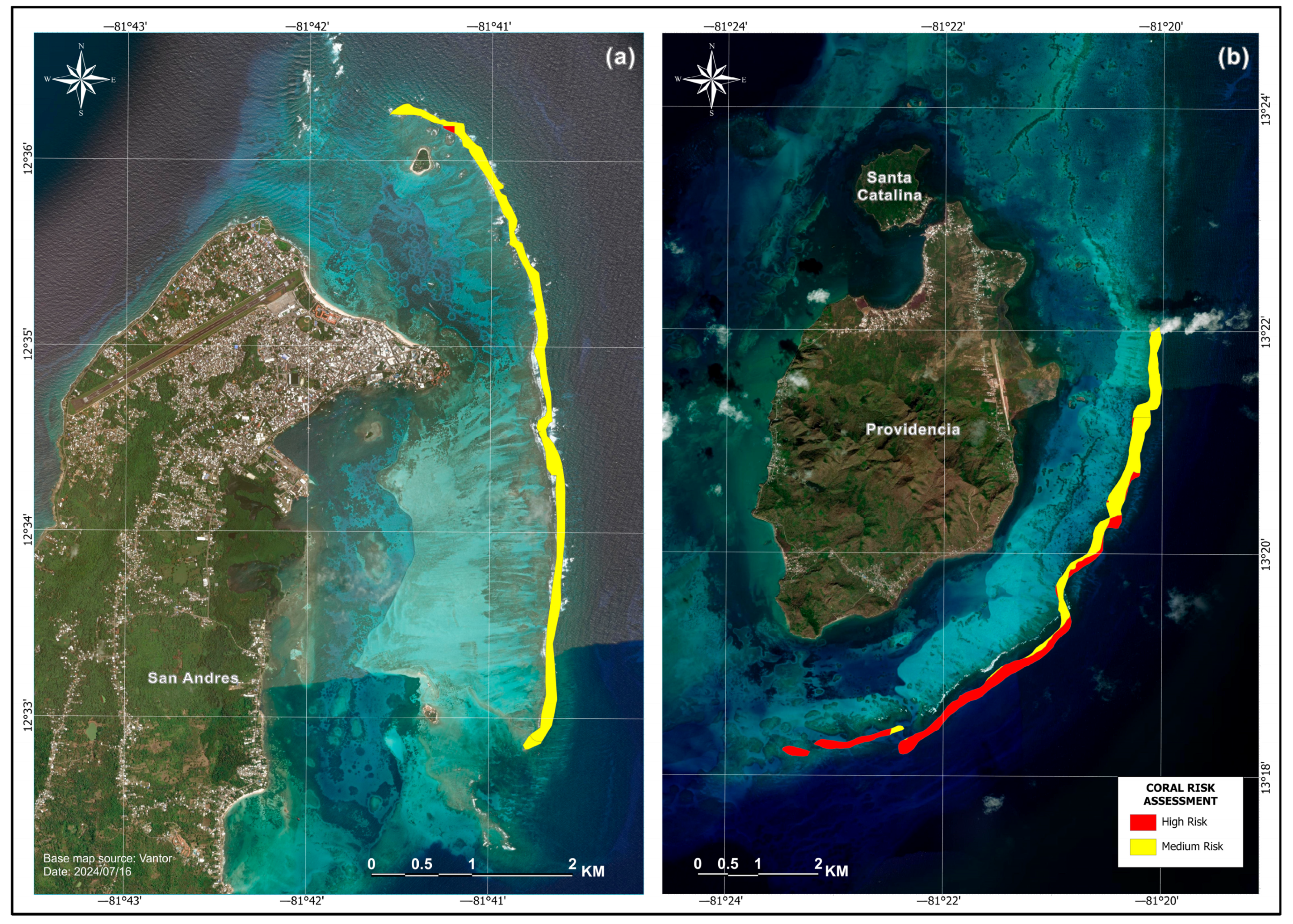
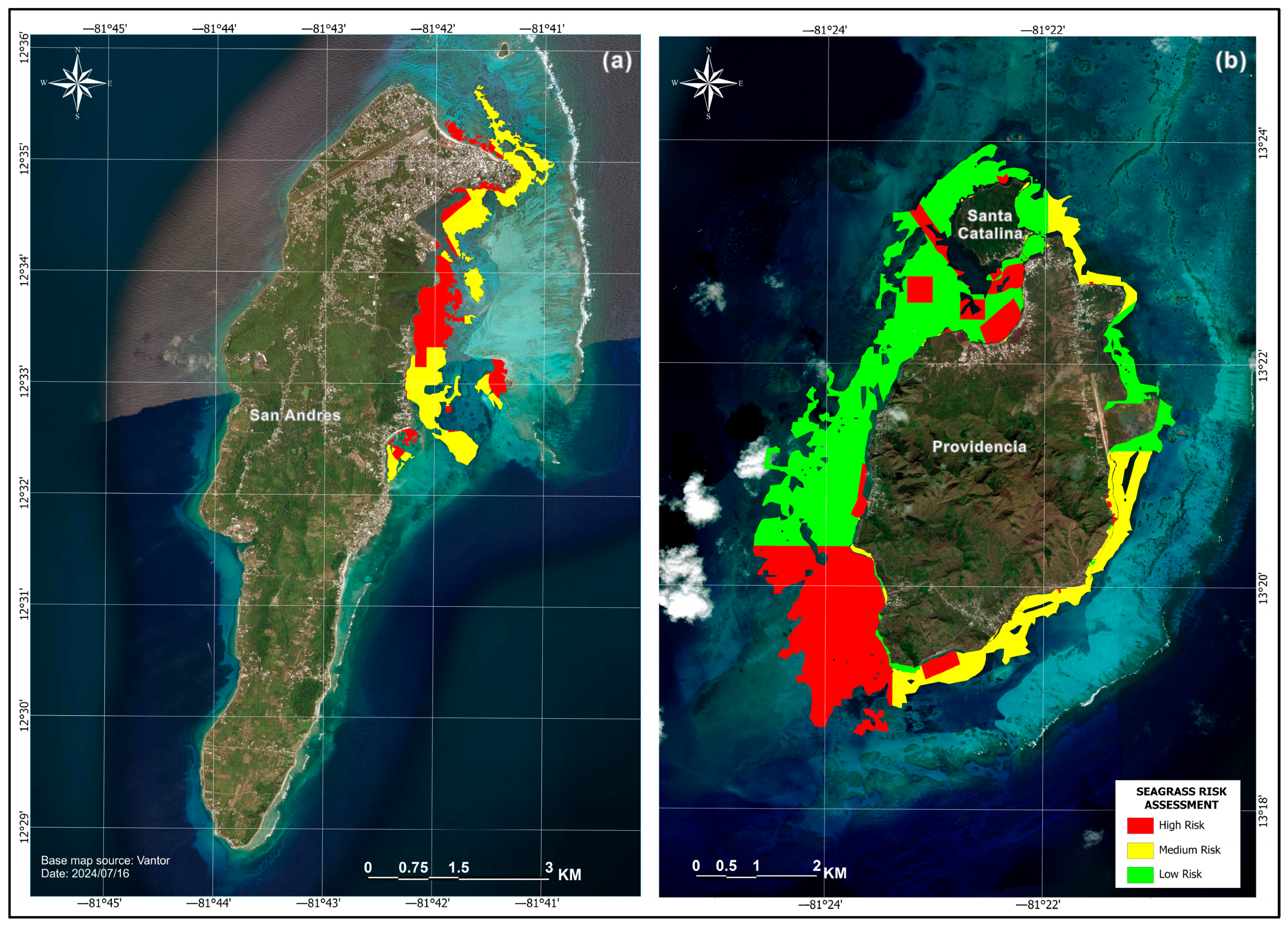
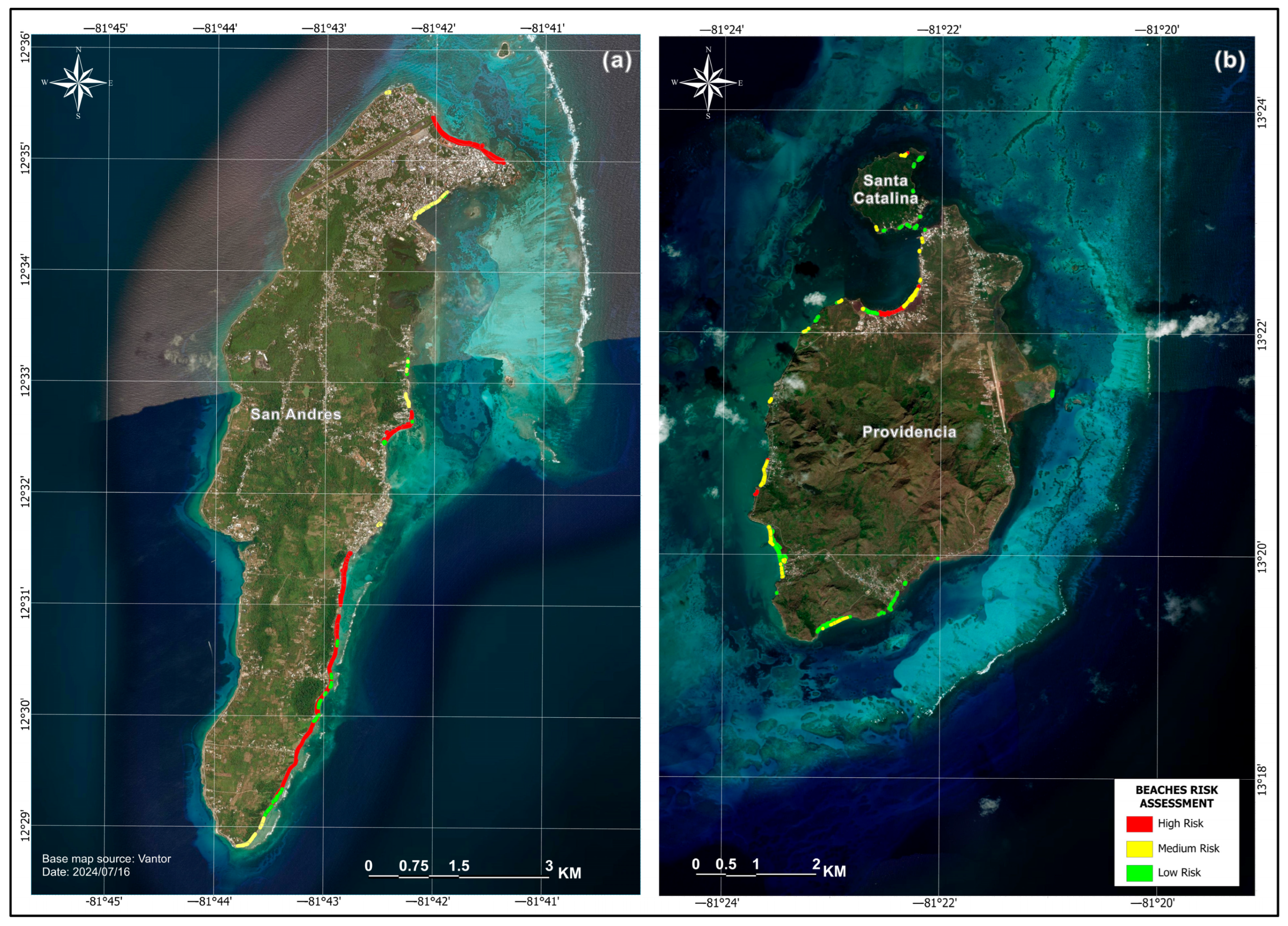
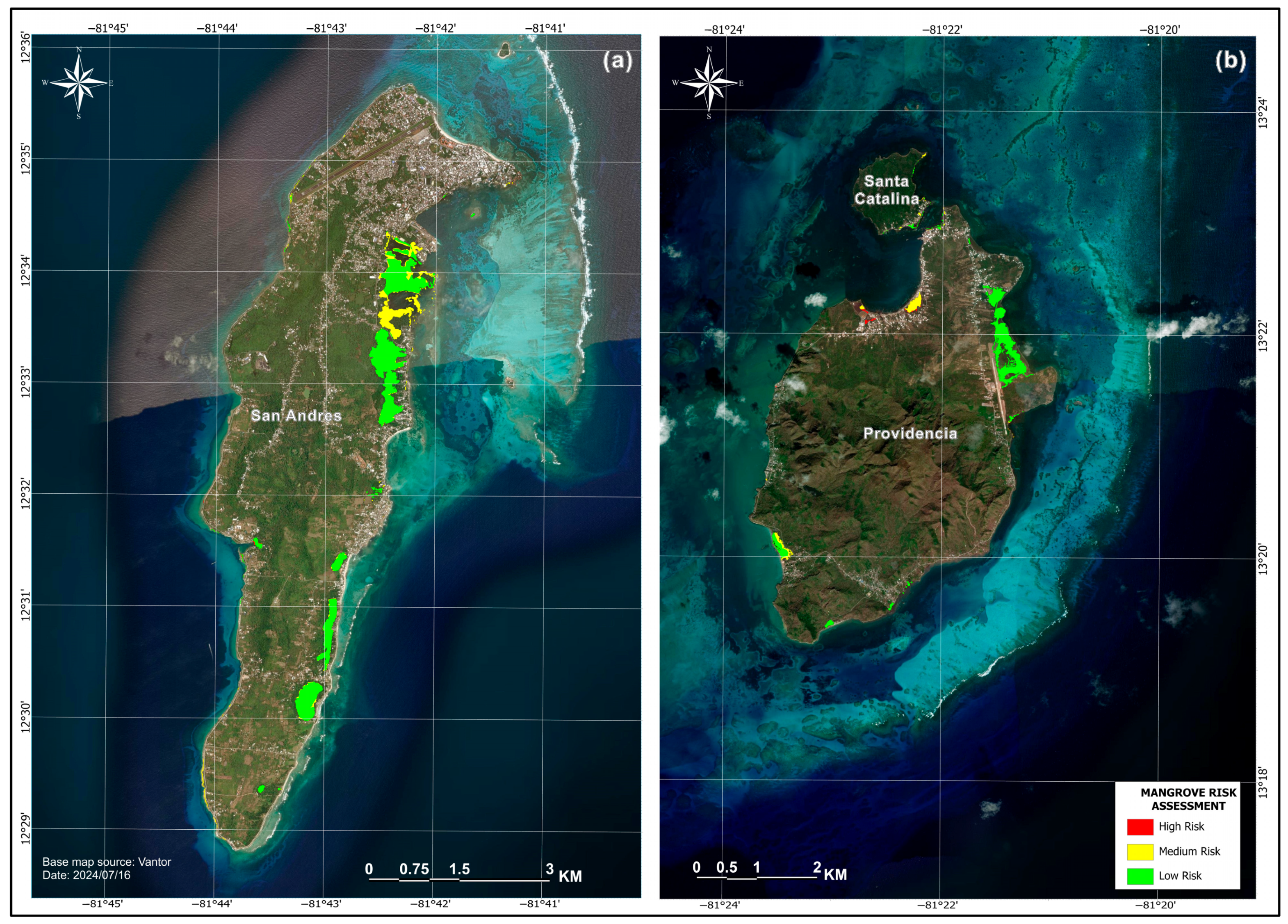
3.3. Ecological Risk in Island Ecosystems of San Andrés, Providencia, and Santa Catalina
4. Discussion
5. Conclusions
5.1. Main Findings
- Ecosystem-specific vulnerability patterns:
- 2.
- Direct correlation between zoning permissiveness and ecological risk:
- 3.
- The “adjacency effect” limits conservation effectiveness:
- 4.
- Effectiveness of restoration and protection measures in terrestrial ecosystems:
- 5.
- Vulnerability as a cumulative impact phenomenon:
- 6.
- Transferability of the vulnerability-threat interaction approach:
5.2. Management Implications
5.3. Directions for Future Research
Author Contributions
Funding
Institutional Review Board Statement
Informed Consent Statement
Data Availability Statement
Acknowledgments
Conflicts of Interest
References
- Fedoung Evariste, F.; Denis Jean, S.; Victor, K.; Claudia, M. Assessing Climate Change Vulnerability and Local Adaptation Strategies in Adjacent Communities of the Kribi-Campo Coastal Ecosystems, South Cameroon. Urban Clim. 2018, 24, 1037–1051. [Google Scholar] [CrossRef]
- García Acosta, V. La Perspectiva Histórica En La Antropología Del Riesgo y Del Desastre. Acercamientos Metodológicos. Relac. Estud. Hist. Soc. 2004, 25, 124–142. [Google Scholar]
- Kirch, L.; Luther, S.; Mucke, P.; Prütz, R.; Radtke, K.; Schrader, C. World Risk Report–Analysis and Prospects 2017; Bündnis Entwicklung Hilft: Berlin, Germany, 2017. [Google Scholar]
- Razafindrabe, B.H.N.; Kada, R.; Arima, M.; Inoue, S. Analyzing Flood Risk and Related Impacts to Urban Communities in Central Vietnam. Mitig. Adapt. Strateg. Glob. Change 2014, 19, 177–198. [Google Scholar] [CrossRef]
- Bennett, N.J.; Blythe, J.; Tyler, S.; Ban, N.C. Communities and Change in the Anthropocene: Understanding Social-Ecological Vulnerability and Planning Adaptations to Multiple Interacting Exposures. Reg. Environ. Change 2016, 16, 907–926. [Google Scholar] [CrossRef]
- Li, Y.; Zhang, X.; Zhao, X.; Ma, S.; Cao, H.; Cao, J. Assessing Spatial Vulnerability from Rapid Urbanization to Inform Coastal Urban Regional Planning. Ocean Coast. Manag. 2016, 123, 53–65. [Google Scholar] [CrossRef]
- Benitez-Capistros, F.; Hugé, J.; Koedam, N. Environmental Impacts on the Galapagos Islands: Identification of Interactions, Perceptions and Steps Ahead. Ecol. Indic. 2014, 38, 113–123. [Google Scholar] [CrossRef]
- Chi, Y.; Shi, H.; Wang, X.; Qin, X.; Zheng, W.; Peng, S. Impact Factors Identification of Spatial Heterogeneity of Herbaceous Plant Diversity on Five Southern Islands of Miaodao Archipelago in North China. Chin. J. Oceanol. Limnol. 2016, 34, 937–951. [Google Scholar] [CrossRef]
- Chi, Y.; Shi, H.; Wang, Y.; Guo, Z.; Wang, E. Evaluation on Island Ecological Vulnerability and Its Spatial Heterogeneity. Mar. Pollut. Bull. 2017, 125, 216–241. [Google Scholar] [CrossRef]
- Dahlin, K.M.; Asner, G.P.; Field, C.B. Linking Vegetation Patterns to Environmental Gradients and Human Impacts in a Mediterranean-Type Island Ecosystem. Landsc. Ecol. 2014, 29, 1571–1585. [Google Scholar] [CrossRef]
- Hernández-Delgado, E.A. The Emerging Threats of Climate Change on Tropical Coastal Ecosystem Services, Public Health, Local Economies and Livelihood Sustainability of Small Islands: Cumulative Impacts and Synergies. Mar. Pollut. Bull. 2015, 101, 5–28. [Google Scholar] [CrossRef]
- Lara-Lara, J.R.; Arreola-Lizárraga, J.A.; Calderón-Aguilera, L.E.; Camacho-Ibar, V.F.; De la Lanza-Espino, G.; Escofet-Giansone, A.; Espejel-Carbajal, M.I.; Guzmán-Arroyo, M.; Ladah, L.B.; López-Hernández, M.; et al. Los Ecosistemas Costeros, Insulares y Epicontinentales; SEMARNAT: Mexico City, Mexico, 2008. [Google Scholar]
- Tassara, D.A.; Garcia, M.C. Erosión Marina, Vulnerabilidad e Impactos Antrópicos En El Sudeste Bonaerense (Municipio de Mar Chiquita, Provincia de Buenos Aires, Argentina). Tiempo Y Espac. 2015, 33, 113–126. [Google Scholar]
- Ramos, A.; Guerrero, D.S. El Suelo Costero, Propuesta Para Su Reconocimiento; Procuraduría General de la Nación: Bogota, Colombia, 2010. [Google Scholar]
- Vitousek, P.M.; Mooney, H.A.; Lubchenco, J.; Melillo, J.M. Human Domination of Earth’s Ecosystems. Science 1997, 277, 494–499. [Google Scholar] [CrossRef]
- Keith, D.A.; Ba, T.; Tappan, G. Senegal y Mauritania: Gonakier Forests of Senegal River Floodplain; World Wildlife Fund: Geneva, Switzerland, 2013. [Google Scholar]
- Noss, R.F. Ecosystems as Conservation Targets. Trends Ecol. Evol. 1996, 11, 351. [Google Scholar] [CrossRef] [PubMed]
- Zhang, D.; Zhou, C.; He, B.-J. Spatial and Temporal Heterogeneity of Urban Land Area and PM2.5 Concentration in China. Urban Clim. 2022, 45, 101268. [Google Scholar] [CrossRef]
- Peng, J.; Qiao, R.; Wang, Q.; Yu, S.; Dong, J.; Yang, Z. Diversified Evolutionary Patterns of Surface Urban Heat Island in New Expansion Areas of 31 Chinese Cities. Npj Urban Sustain. 2024, 4, 14. [Google Scholar] [CrossRef]
- Shi, H.H.; Zheng, W.; Ding, D.W.; Lv, J.B. Valuation and Ecosystem Services of Typical Island. Mar. Environ. Sci. 2009, 28, 743–748. [Google Scholar]
- Chi, Y.; Liu, D.; Xing, W.; Wang, J. Island Ecosystem Health in the Context of Human Activities with Different Types and Intensities. J. Clean. Prod. 2021, 281, 125334. [Google Scholar] [CrossRef]
- Ferro-Azcona, H.; Espinoza-Tenorio, A.; Calderón-Contreras, R.; Ramenzoni, V.C.; De Las, M.; País, M.G.; Azahara Mesa-Jurado, M. Adaptive Capacity and Social-Ecological Resilience of Coastal Areas: A Systematic Review. Ocean Coast. Manag. 2019, 173, 36–51. [Google Scholar] [CrossRef]
- Viñals, M.J.; Planelles, M.; Alonso-Monasterio, P.; Morant, M. La Capacidad de Carga Recreativa En Pequeñas Islas Del Mediterráneo. Cuad. Tur. 2016, 37, 547–553. [Google Scholar]
- UNESCO. A Handbook for Measuring the Progress and Outcomes of Integrated Coastal and Ocean Management; UNESCO: Paris, France, 2006. [Google Scholar]
- Sun, B.; Ma, X.; de Jong, M.; Bao, X. Assessment on Island Ecological Vulnerability to Urbanization: A Tale of Chongming Island, China. Sustainability 2019, 11, 2536. [Google Scholar] [CrossRef]
- Sapta, S.; Sulistyantara, B.; Fatimah, I.S.; Faqih, A. Geospatial Approach for Ecosystem Change Study of Lombok Island under the Influence of Climate Change. Procedia Environ. Sci. 2015, 24, 165–173. [Google Scholar] [CrossRef]
- Ng, K.; Borges, P.; Phillips, M.R.; Medeiros, A.; Calado, H. An Integrated Coastal Vulnerability Approach to Small Islands: The Azores Case. Sci. Total Environ. 2019, 690, 1218–1227. [Google Scholar] [CrossRef] [PubMed]
- Calado, H.; Vergílio, M.; Fonseca, C.; Gil, A.; Moniz, F.; Silva, S.F.; Moreira, M.; Bragagnolo, C.; Silva, C.; Pereira, M. Developing a Planning and Management System for Protected Areas on Small Islands (The Azores Archipelago, Portugal): The SMARTPARKS Project. Rev. Gest. Costeira Integr. 2014, 14, 335–344. [Google Scholar] [CrossRef]
- Boldt, J.L.; Hazen, E.L.; Hunsicker, M.E.; Fu, C.; Perry, R.I.; Shan, X. Quantifying Ecosystem Responses to Environmental and Human Pressures in the Marine Ecosystem off the West Coast of Vancouver Island. Ecol. Indic. 2021, 132, 108232. [Google Scholar] [CrossRef]
- Chi, Y.; Zhang, Z.; Xie, Z.; Wang, J. How Human Activities Influence the Island Ecosystem through Damaging the Natural Ecosystem and Supporting the Social Ecosystem? J. Clean. Prod. 2020, 248, 119203. [Google Scholar] [CrossRef]
- Wu, Y.; Zhang, T.; Zhang, H.; Pan, T.; Ni, X.; Grydehøj, A.; Zhang, J. Factors Influencing the Ecological Security of Island Cities: A Neighborhood-Scale Study of Zhoushan Island, China. Sustain. Cities Soc. 2020, 55, 102029. [Google Scholar] [CrossRef]
- Zhai, T.; Wang, J.; Fang, Y.; Qin, Y.; Huang, L.; Chen, Y. Assessing Ecological Risks Caused by Human Activities in Rapid Urbanization Coastal Areas: Towards an Integrated Approach to Determining Key Areas of Terrestrial-Oceanic Ecosystems Preservation and Restoration. Sci. Total Environ. 2020, 708, 135153. [Google Scholar] [CrossRef]
- Nguyen, T.T.X.; Bonetti, J.; Rogers, K.; Woodroffe, C.D. Indicator-Based Assessment of Climate-Change Impacts on Coasts: A Review of Concepts, Methodological Approaches and Vulnerability Indices. Ocean Coast. Manag. 2016, 123, 18–43. [Google Scholar] [CrossRef]
- Burkhard, B.; Santos-Martin, F.; Nedkov, S.; Maes, J. An Operational Framework for Integrated Mapping and Assessment of Ecosystems and Their Services (MAES). One Ecosyst. 2018, 3, e22831. [Google Scholar] [CrossRef]
- Diaz Cuevas, P.; Ojeda Zújar, J.; Alvarez Francoso, J.I.; Prieto Campos, A. Sensibilidad de las playas en función de la accesibilidad de los potenciales usuarios turísticos (plazas regladas) en la costa andaluza y los procesos de erosión. In Proceedings of the 16th National Congress on Geographic Information Technologies, Alicante, Spain, 25–27 June 2014; University of Alicante, Department of Geography and GIS: Alicante, Spain, 2014; p. 14. [Google Scholar]
- Licuanan, W.Y.; Samson, M.S.; Mamauag, S.S.; David, L.T.; Borja-del Rosario, R.; Quibilan, M.C.C.; Siringan, F.P.; Sta Maria, M.a.Y.Y.; España, N.B.; Villanoy, C.L.; et al. I-C-SEA Change: A Participatory Tool for Rapid Assessment of Vulnerability of Tropical Coastal Communities to Climate Change Impacts. Ambio 2015, 44, 718–736. [Google Scholar] [CrossRef]
- Liyun, W.; Weibin, Y.; Zhirong, J.; Shihong, X.; Dongjin, H. Ecosystem Health Assessment of Dongshan Island Based on Its Ability to Provide Ecological Services That Regulate Heavy Rainfall. Ecol. Indic. 2018, 84, 393–403. [Google Scholar] [CrossRef]
- UNISDR. UNISDR Terminology on Disaster Risk Reduction; UNISDR: Geneva, Switzerland, 2009. [Google Scholar]
- Cabral, P.; Augusto, G.; Akande, A.; Costa, A.; Amade, N.; Niquisse, S.; Atumane, A.; Cuna, A.; Kazemi, K.; Mlucasse, R.; et al. Assessing Mozambique’s Exposure to Coastal Climate Hazards and Erosion. Int. J. Disaster Risk Reduct. 2017, 23, 45–52. [Google Scholar] [CrossRef]
- Birkmann, J. Risk and Vulnerability Indicators at Different Scales: Applicability, Usefulness and Policy Implications. Environ. Hazards 2007, 7, 20–31. [Google Scholar] [CrossRef]
- De Serio, F.; Armenio, E.; Mossa, M.; Petrillo, A.F. How to Define Priorities in Coastal Vulnerability Assessment. Geosci. Switz. 2018, 8, 415. [Google Scholar] [CrossRef]
- Menoni, S.; Margottini, C. (Eds.) Inside Risk: A Strategy for Sustainable Risk Mitigation; Springer: Milan, Italy, 2011; ISBN 978-88-470-1841-9. [Google Scholar]
- Fernandes, J.P.; Guiomar, N.; Gil, A. Strategies for Conservation Planning and Management of Terrestrial Ecosystems in Small Islands (Exemplified for the Macaronesian Islands). Environ. Sci. Policy 2015, 51, 1–22. [Google Scholar] [CrossRef]
- Fu, X.; Peng, Z.-R. Assessing the Sea-Level Rise Vulnerability in Coastal Communities: A Case Study in the Tampa Bay Region, US. Cities 2019, 88, 144–154. [Google Scholar] [CrossRef]
- Zhang, W.; Chang, W.J.; Zhu, Z.C.; Hui, Z. Landscape Ecological Risk Assessment of Chinese Coastal Cities Based on Land Use Change. Appl. Geogr. 2020, 117, 102174. [Google Scholar] [CrossRef]
- Aguilera, M.A.; Tapia, J.; Gallardo, C.; Núñez, P.; Varas-Belemmi, K. Loss of Coastal Ecosystem Spatial Connectivity and Services by Urbanization: Natural-to-Urban Integration for Bay Management. J. Environ. Manag. 2020, 276, 111297. [Google Scholar] [CrossRef]
- CORALINA; INVEMAR. Atlas de La Reserva de Biósfera Seaflower. Archipiélago de San Andrés, Providencia y Santa Catalina; Serie de Publicaciones Especiales de INVEMAR #28; Gómez-López, D.I., Segura-Quintero, C., Sierra-Correa, P.C., Garay-Tinoco, J., Eds.; INVEMAR: Santa Marta, Colombia; CORALINA: San Andrés, Colombia, 2012. [Google Scholar]
- Seaflower Foundation. Available online: https://seaflowerfoundation.org/reserva-de-la-biosfera.html (accessed on 19 October 2022).
- DANE—Proyecciones de Población. Available online: https://www.dane.gov.co/index.php/estadisticas-por-tema/demografia-y-poblacion/proyecciones-de-poblacion (accessed on 6 March 2025).
- Sanchez Jabba, A. Violencia y Narcotráfico En San Andrés; Documentos de Trabajo Sobre Economía Regional y Urbana; Observatorio Del Caribe Colombiano: Cartagena, Colombia, 2012. [Google Scholar] [CrossRef]
- Martins, V.N.; Pires, R.; Cabral, P. Modelling of Coastal Vulnerability in the Stretch between the Beaches of Porto de Mós and Falésia, Algarve (Portugal). J. Coast. Conserv. 2012, 16, 503–510. [Google Scholar] [CrossRef]
- Turschwell, M.P.; Connolly, R.M.; Dunic, J.C.; Sievers, M.; Buelow, C.A.; Pearson, R.M.; Tulloch, V.J.D.; Côté, I.M.; Unsworth, R.K.F.; Collier, C.J.; et al. Anthropogenic Pressures and Life History Predict Trajectories of Seagrass Meadow Extent at a Global Scale. Proc. Natl. Acad. Sci. USA 2021, 118, e2110802118. [Google Scholar] [CrossRef]
- Dunic, J.C.; Brown, C.J.; Connolly, R.M.; Turschwell, M.P.; Côté, I.M. Long-Term Declines and Recovery of Meadow Area across the World’s Seagrass Bioregions. Glob. Change Biol. 2021, 27, 4096–4109. [Google Scholar] [CrossRef]
- IUCN. Red List of Mangrove Ecosystems. Available online: https://iucn.org/node/33749/red-list-mangrove-ecosystems (accessed on 23 January 2026).
- UNGRD; PNUD. Guía Metodológica Para La Elaboración de Planes Departamentales Para La Gestión Del Riesgo; UNGRD: Bogota, Colombia; PNUD: Bogota, Colombia, 2012. [Google Scholar]
- Yanes, A.; Botero, C.M.; Arrizabalaga, M.; Vásquez, J.G. Methodological Proposal for Ecological Risk Assessment of the Coastal Zone of Antioquia, Colombia. Ecol. Eng. 2019, 130, 242–251. [Google Scholar] [CrossRef]
- Portz, L.; Manzolli, R.P.; Villate-Daza, D.A.; Fontán-Bouzas, Á. Where Does Marine Litter Hide? The Providencia and Santa Catalina Island Problem, SEAFLOWER Reserve (Colombia). Sci. Total Environ. 2022, 813, 151878. [Google Scholar] [CrossRef] [PubMed]
- INVEMAR. Informe Del Estado de Los Ambientes y Recursos Marinos y Costeros de Colombia—2020; Instituto de Investigaciones Marinas y Costeras (INVEMAR) Jose Benito Vives de Andreis: Santa Marta, Colombia, 2021; p. 268. [Google Scholar]
- Steibl, S.; Laforsch, C. Disentangling the Environmental Impact of Different Human Disturbances: A Case Study on Islands. Sci. Rep. 2019, 9, 13712. [Google Scholar] [CrossRef] [PubMed]
- Lukman, K.M.; Uchiyama, Y.; Quevedo, J.M.D.; Kohsaka, R. Tourism Impacts on Small Island Ecosystems: Public Perceptions from Karimunjawa Island, Indonesia. J. Coast. Conserv. 2022, 26, 14. [Google Scholar] [CrossRef]
- Rosa, B.; Ng, K.; Borges, P.; Calado, H. Exploring Coastal Vulnerability Assessment through the Lens of Physical and Human Vulnerabilities for the Azores: A First Approach. J. Coast. Res. 2024, 113, 1–5. [Google Scholar] [CrossRef]
- Baltranaitė, E.; Inácio, M.; Valença Pinto, L.; Bogdziewicz, K.; Rocha, J.; Gomes, E.; Pereira, P. Tourism Impacts on Marine and Coastal Ecosystem Services: A Systematic Review. Geogr. Sustain. 2025, 6, 100277. [Google Scholar] [CrossRef]
- Osorio-Cano, J.D.; Alcérreca-Huerta, J.C.; Navarro, B.A.; Álvarez-Silva, O. The Seaflower Biosphere Reserve: Research Advances on Ocean and Coastal Processes and Related Hazards for the Regional Management. Ocean Coast. Manag. 2024, 258, 107414. [Google Scholar] [CrossRef]
- Luijendijk, A.; Hagenaars, G.; Ranasinghe, R.; Baart, F.; Donchyts, G.; Aarninkhof, S. The State of the World’s Beaches. Sci. Rep. 2018, 8, 6641. [Google Scholar] [CrossRef]
- Intergovernmental Panel on Climate Change (IPCC). Land Degradation. In Climate Change and Land: IPCC Special Report on Climate Change, Desertification, Land Degradation, Sustainable Land Management, Food Security, and Greenhouse Gas Fluxes in Terrestrial Ecosystems; Intergovernmental Panel on Climate Change (IPCC), Ed.; Cambridge University Press: Cambridge, UK, 2022; pp. 345–436. ISBN 978-1-009-15798-8. [Google Scholar]
- Stelzenmüller, V.; Breen, P.; Stamford, T.; Thomsen, F.; Badalamenti, F.; Borja, A.; Buhl-Mortensen, L.; Carlstom, J.; D’Anna, G.; Dankers, N.; et al. Monitoring and Evaluation of Spatially Managed Areas: A Generic Framework for Implementation of Ecosystem Based Marine Management and Its Application. Mar. Policy 2013, 37, 149–164. [Google Scholar] [CrossRef]
- Zittis, G.; Zoumides, C.; Zemah-Shamir, S.; Tase, M.; Zotos, S.; Demirel, N.; Christoforidi, I.; Dindaroğlu, T.; Albayrak, T.; Ayhan, C.K.; et al. Insular Ecosystem Services in Peril: A Systematic Review on the Impacts of Climate Change and Other Drivers. Clim. Change 2025, 178, 127. [Google Scholar] [CrossRef]
- Hernández-Delgado, E.A. Coastal Restoration Challenges and Strategies for Small Island Developing States in the Face of Sea Level Rise and Climate Change. Coasts 2024, 4, 235–286. [Google Scholar] [CrossRef]
- Moustakas, A.; Zemah-Shamir, S.; Tase, M.; Zotos, S.; Demirel, N.; Zoumides, C.; Christoforidi, I.; Dindaroglu, T.; Albayrak, T.; Ayhan, C.K.; et al. Climate Land Use and Other Drivers’ Impacts on Island Ecosystem Services: A Global Review. Sci. Total Environ. 2025, 973, 179147. [Google Scholar] [CrossRef] [PubMed]
- Cartwright, J. Ecological Islands: Conserving Biodiversity Hotspots in a Changing Climate. Front. Ecol. Environ. 2019, 17, 331–340. [Google Scholar] [CrossRef]
- Weiskopf, S.R.; Rubenstein, M.A.; Crozier, L.G.; Gaichas, S.; Griffis, R.; Halofsky, J.E.; Hyde, K.J.W.; Morelli, T.L.; Morisette, J.T.; Muñoz, R.C.; et al. Climate Change Effects on Biodiversity, Ecosystems, Ecosystem Services, and Natural Resource Management in the United States. Sci. Total Environ. 2020, 733, 137782. [Google Scholar] [CrossRef]
- Hoppit, G.; Nurkse, K.; Beleem, I.; Cadoni, N.; Crowe, T.; Bekaert, M.; Bongiorni, L.; Dvorski, K.; Everaert, G.; Frau, F.; et al. Enhancing Marine Protected Areas with Effective Ecological and Environmental Data Integration. Ecol. Indic. 2025, 178, 114119. [Google Scholar] [CrossRef]
- Balbar, A.C.; Metaxas, A. The Current Application of Ecological Connectivity in the Design of Marine Protected Areas. Glob. Ecol. Conserv. 2019, 17, e00569. [Google Scholar] [CrossRef]
- Edgar, G.J.; Stuart-Smith, R.D.; Willis, T.J.; Kininmonth, S.; Baker, S.C.; Banks, S.; Barrett, N.S.; Becerro, M.A.; Bernard, A.T.F.; Berkhout, J.; et al. Global Conservation Outcomes Depend on Marine Protected Areas with Five Key Features. Nature 2014, 506, 216–220. [Google Scholar] [CrossRef]
- Cannizzo, Z.J.; Lausche, B.; Wenzel, L. Advancing Marine Conservation through Ecological Connectivity: Building Better Connections for Better Protection. Parks Steward. Forum 2021, 37, 477–487. [Google Scholar] [CrossRef]







| Ecosystem Percentage Loss | Vulnerability Level | Value |
|---|---|---|
| >30% | High | 3 |
| Between 15–30% | Medium | 2 |
| <15% | Low | 1 |
| Zoning Criteria | Threat Level | Value | |
|---|---|---|---|
| Marine ecosystems Threats | |||
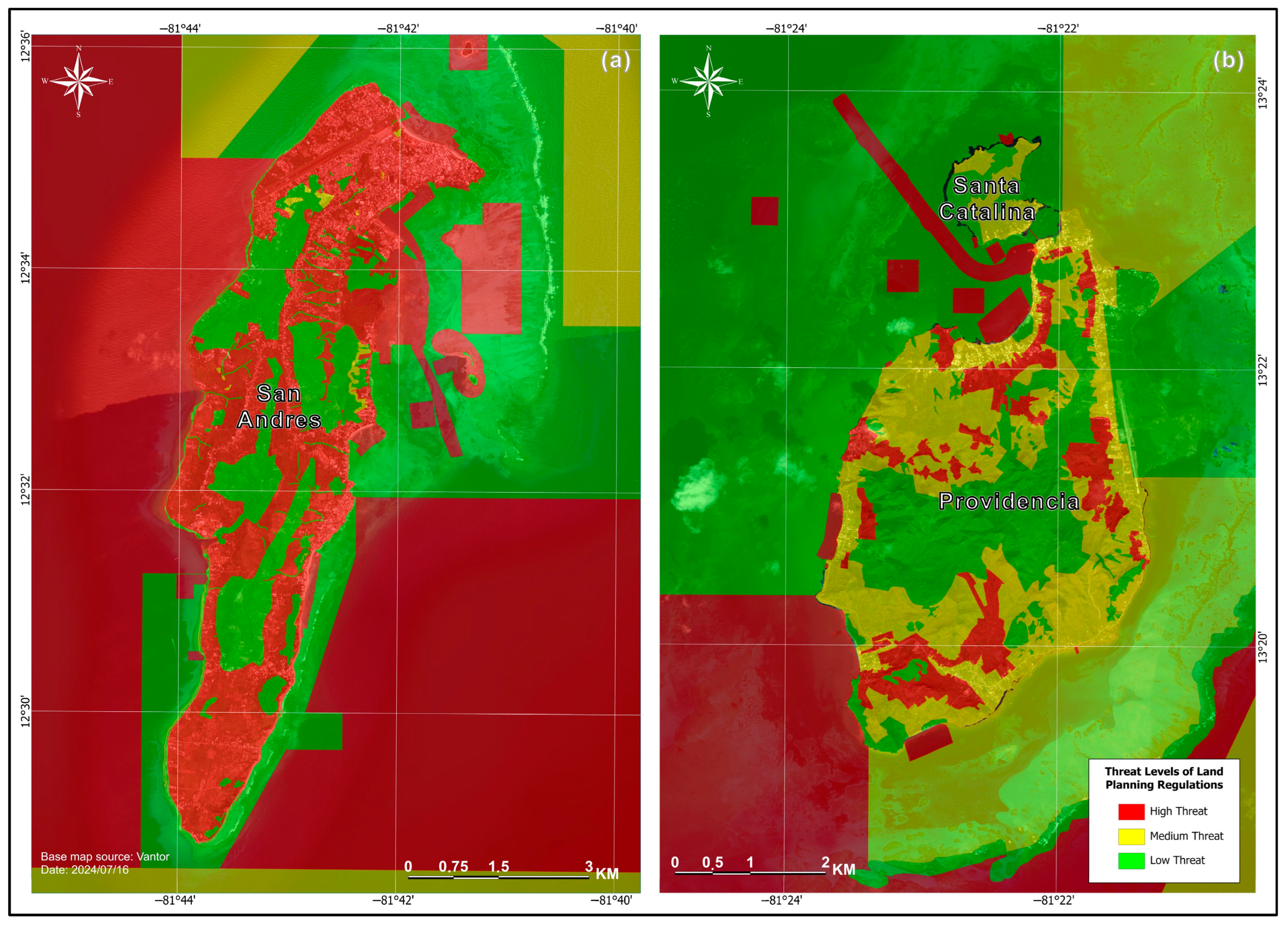
| SEAFLOWER Marine Protected Area Regulations | Special Use Zone (Navigation access channels, Ports, Piers, touristic beach uses, anchoring) | HIGH | 3 |
| General Use Zone | MEDIUM | 2 | |
| Traditional Fishing Sustainable Use Zone | MEDIUM | 2 | |
| Conservation Zone (no take) | LOW | 1 | |
| Preservation Zone (no entry) | LOW | 1 | |
| Terrestrial Ecosystems Threats | |||
| San Andrés Isla Land Planning Regulations | Conservation Zone | LOW | 1 |
| Protection and Preservation Zone | LOW | 1 | |
| Special Regulation Zones (Allow infrastructure, concessions, permits, agriculture) | HIGH | 3 | |
| Restoration Zones (adjacent to inhabited areas) | MEDIUM | 2 | |
| Providencia and Santa Catalina Land Planning Regulations | McBean Lagoon Natural Park Zone | LOW | 1 |
| Protection and Production | MEDIUM | 2 | |
| Recuperation | LOW | 1 | |
| Conservation Zone | LOW | 1 | |
| Rural Population Centers | HIGH | 3 | |
| Population Centers with More Restrictions | MEDIUM | 2 | |
| Agricultural Reserve | HIGH | 3 | |
| High Threat (3) | Medium Risk (3) | High Risk (6) | High Risk (9) |
| Medium Threat (2) | Low Risk (2) | Medium Risk (4) | High Risk (6) |
| Low Threat (1) | Low Risk (1) | Low Risk (2) | Medium Risk (3) |
| Low Vulnerability (1) | Medium Vulnerability (2) | High Vulnerability (3) |
| Island | Ecosystem | Section Name | Total Loss | Vulnerability per Loss | Vulnerability Reclassification | Vulnerability |
|---|---|---|---|---|---|---|
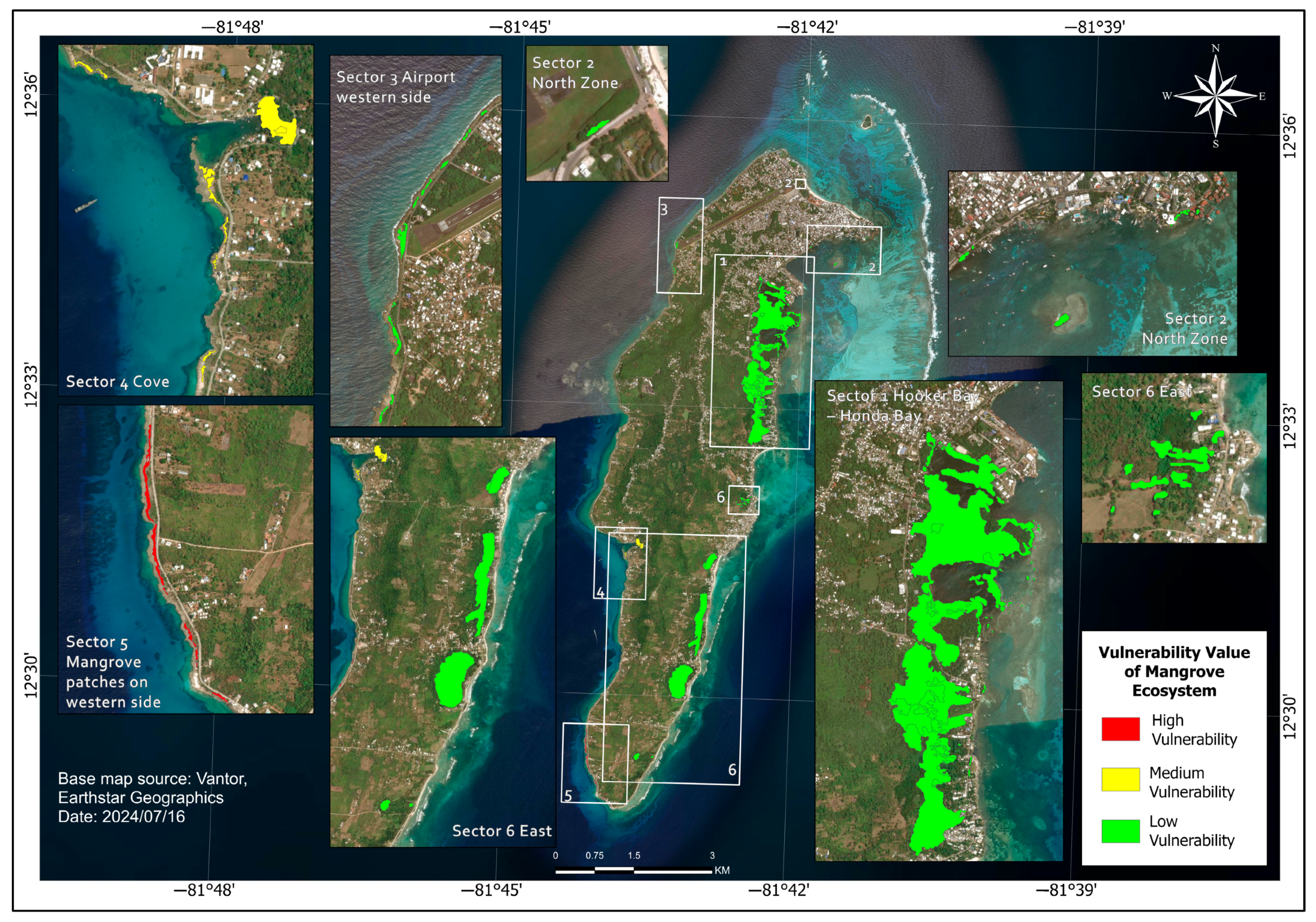
| San Andrés | Mangroves | Sector 1 Hooker Bay–Honda Bay | 5% | Low | Low | 1 |
| Sector 2 North Zone | 0% | Low | Low | 1 | ||
| Sector 3 Airport western side | 0% | Low | Low | 1 | ||
| Sector 4 Cove | 13% | Low | Medium | 2 | ||
| Sector 5 Mangrove patches on western side | 19% | Medium | High | 3 | ||
| Sector 6 East | 0% | Low | Low | 1 | ||
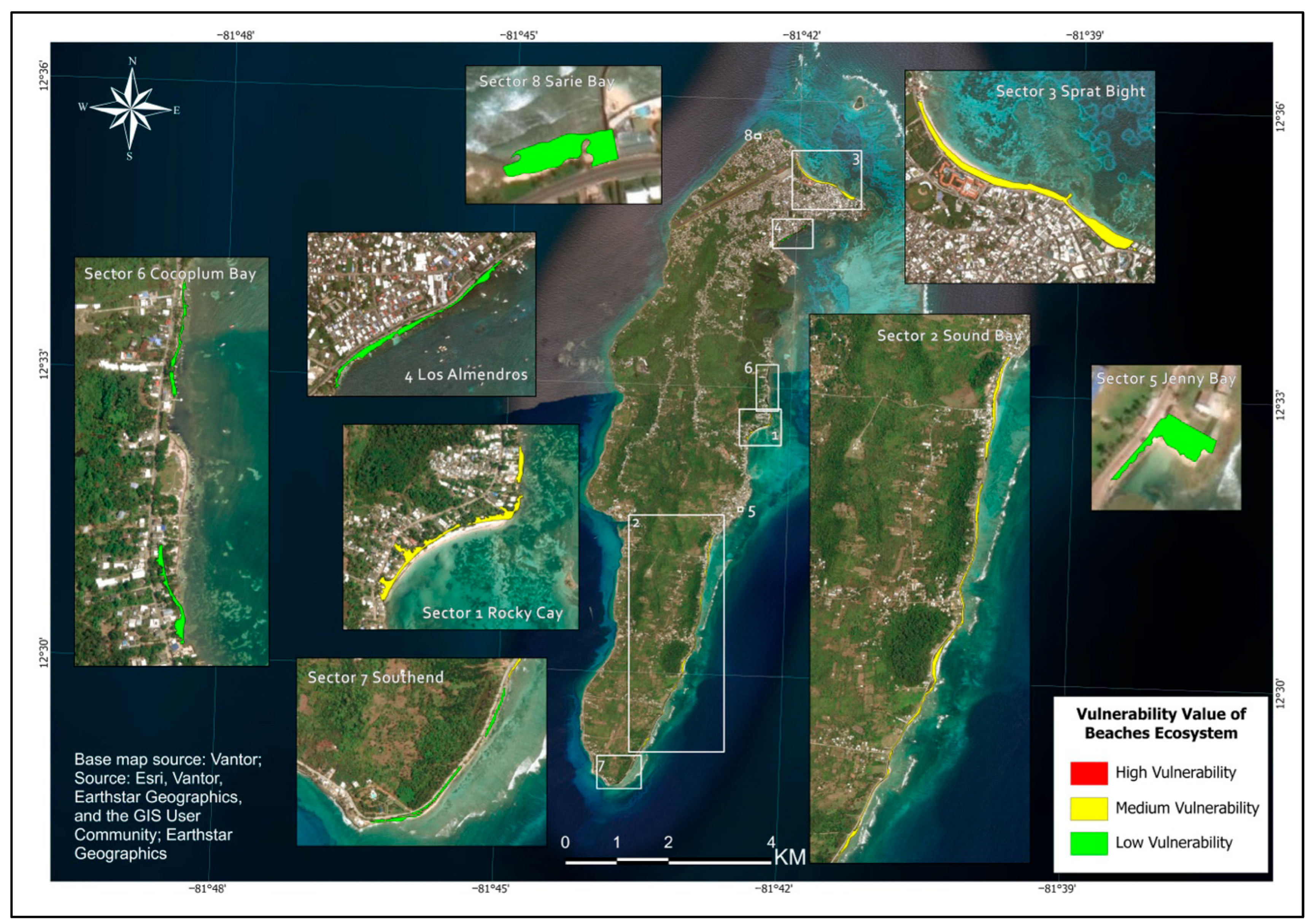
| Beaches | Sector 1 Rocky Cay | 0% | Low | Medium | 2 | |
| Sector 2 Sound Bay | 22% | Medium | Medium | 2 | ||
| Sector 3 Sprat Bight | 3% | Low | Medium | 2 | ||
| Sector 4 Los Almendros | 0% | Low | Low | 1 | ||
| Sector 5 Jenny Bay | 0% | Low | Low | 1 | ||
| Sector 6 Cocoplum Bay | 0% | Low | Low | 1 | ||
| Sector 7 Southend | 0% | Low | Low | 1 | ||
| Sector 8 Sarie Bay | 0% | Low | Low | 1 | ||
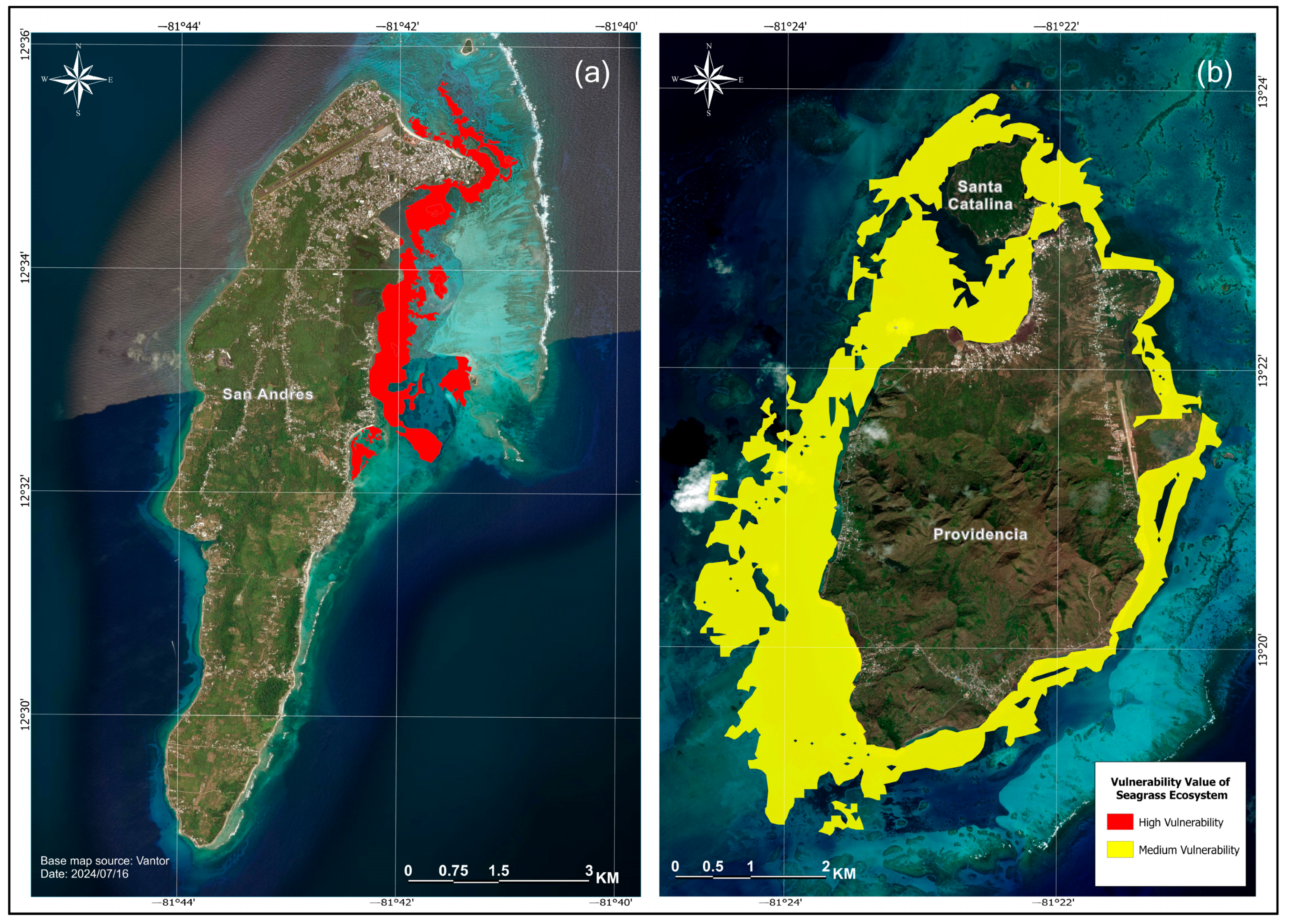
| Seagrass | Sector 1 East | 15% | Medium | High | 3 | |
| Sector 2 West | 100% | High | High | 3 | ||
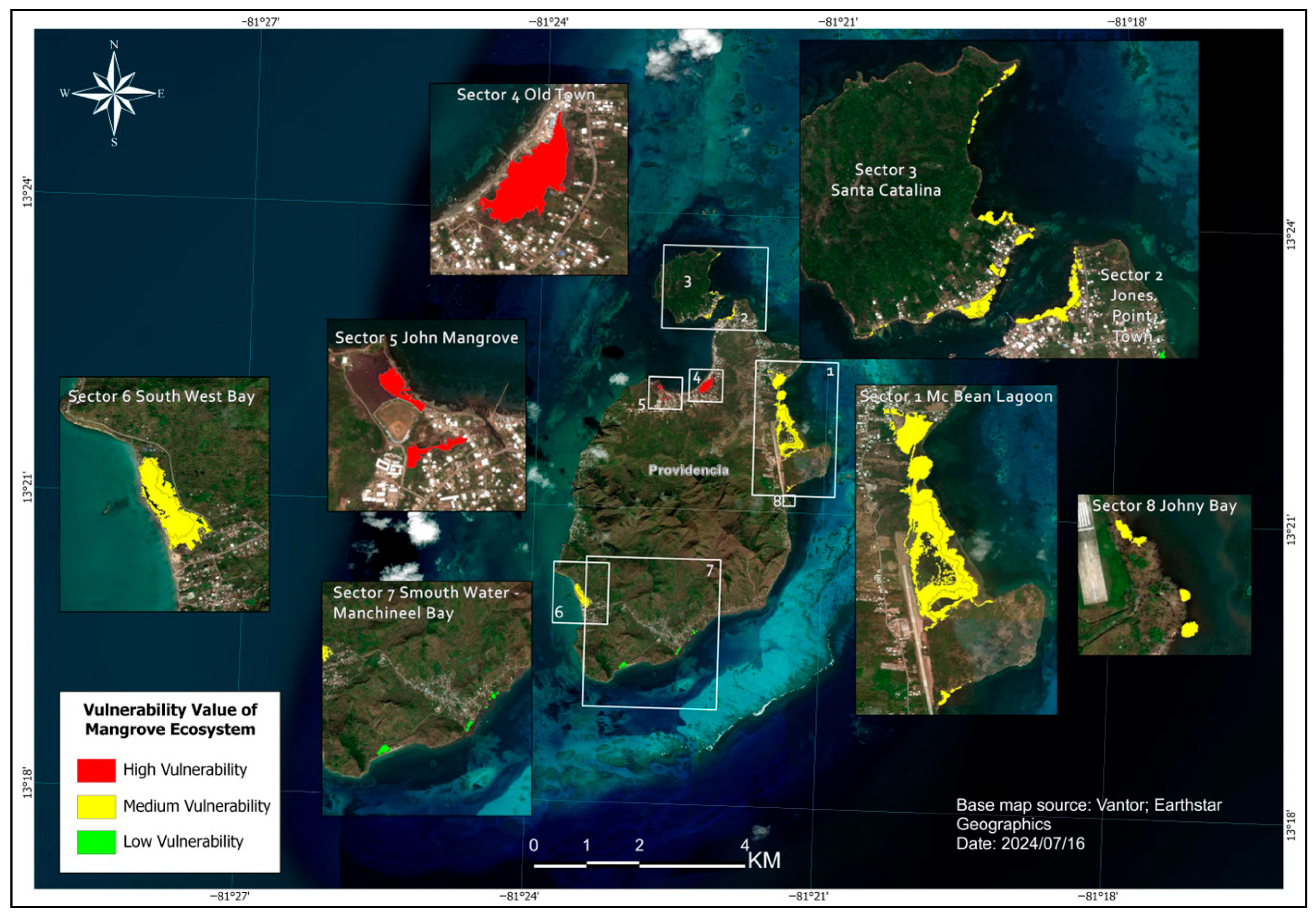
| Providencia and Santa Catalina | Mangroves | Sector 1 Mc Bean Lagoon | 2% | Low | Medium | 2 |
| Sector 2 Jones Point Town | 0% | Low | Low | 1 | ||
| Sector 3 Santa Catalina | 0% | Low | Medium | 2 | ||
| Sector 4 Old Town | 34% | High | High | 3 | ||
| Sector 5 John Mangrove | 65% | High | High | 3 | ||
| Sector 6 Southwest Bay | 21% | Medium | Medium | 2 | ||
| Sector 7 Smouth Water–Manchineel Bay | 0% | Low | Low | 1 | ||
| Sector 8 Johny Bay | 8% | Low | Medium | 2 | ||
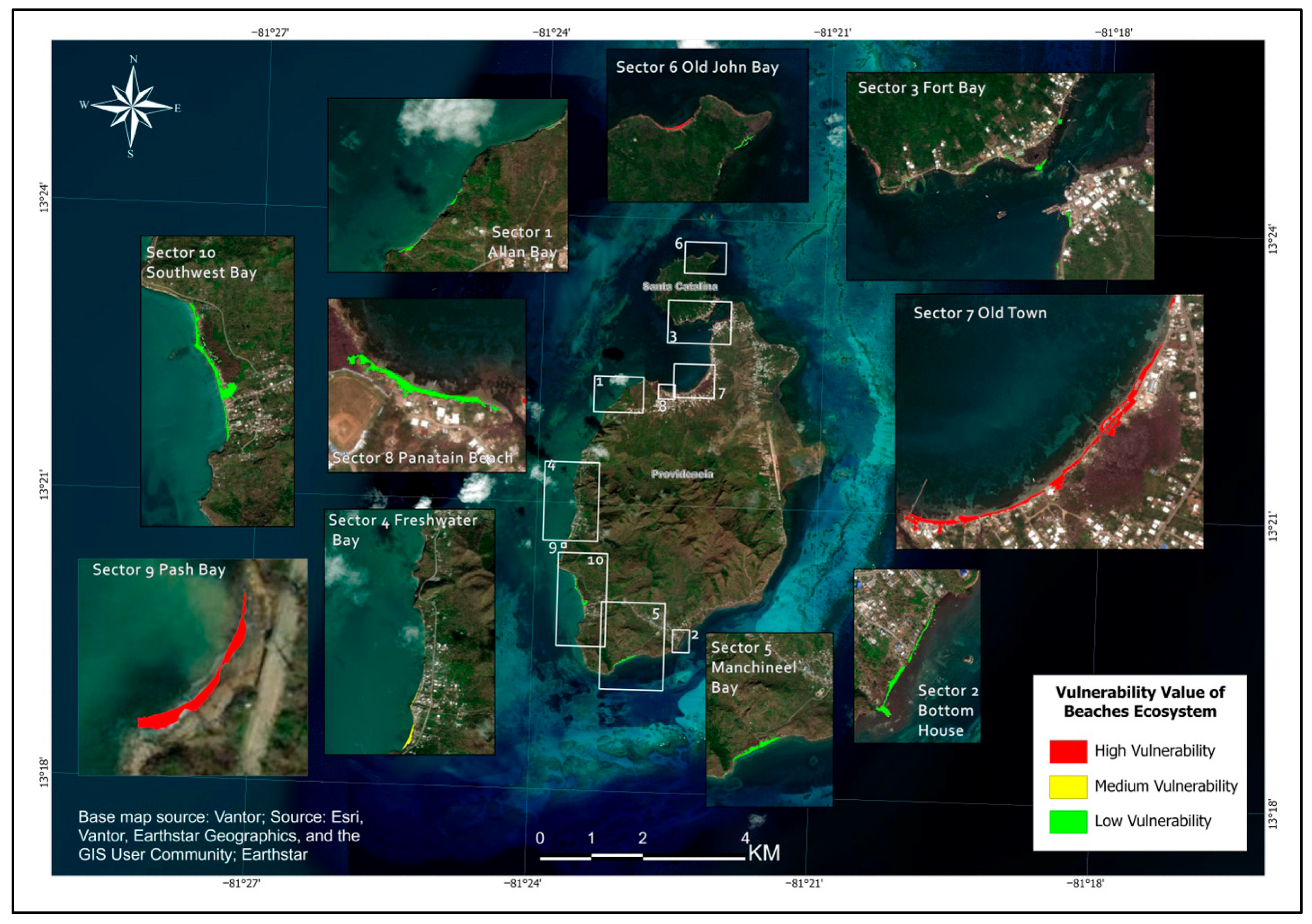
| Beaches | Sector 1 Allan Bay | 14% | Low | Low | 1 | |
| Sector 2 Bottom House | 0% | Low | Low | 1 | ||
| Sector 3 Fort Bay | 65% | High | High | 3 | ||
| Sector 4 Freshwater Bay | 7% | Low | Medium | 2 | ||
| Sector 5 Manchineel Bay | 0% | Low | Low | 1 | ||
| Sector 6 Old John Bay | 37% | High | High | 3 | ||
| Sector 7 Old Town | 43% | High | High | 3 | ||
| Sector 8 Panatain Beach | 0% | Low | Low | 1 | ||
| Sector 9 Pash Bay | 36% | High | High | 3 | ||
| Sector 10 Southwest Bay | 0% | Low | Low | 1 | ||
| Seagrass | In the whole island | 13% | Low | Medium | 2 |
Disclaimer/Publisher’s Note: The statements, opinions and data contained in all publications are solely those of the individual author(s) and contributor(s) and not of MDPI and/or the editor(s). MDPI and/or the editor(s) disclaim responsibility for any injury to people or property resulting from any ideas, methods, instructions or products referred to in the content. |
© 2026 by the authors. Licensee MDPI, Basel, Switzerland. This article is an open access article distributed under the terms and conditions of the Creative Commons Attribution (CC BY) license.
Share and Cite
Yanes, A.; Torregroza-Espinosa, A.C.; Salas, L.; Sierra-Carrillo, M.M.; Noguera, L.; Portz, L. Land-Use Regulations and Ecological Risk in Island Ecosystems: A GIS-Based Vulnerability–Threat Framework in the Seaflower Archipelago (Colombia). Geographies 2026, 6, 38. https://doi.org/10.3390/geographies6020038
Yanes A, Torregroza-Espinosa AC, Salas L, Sierra-Carrillo MM, Noguera L, Portz L. Land-Use Regulations and Ecological Risk in Island Ecosystems: A GIS-Based Vulnerability–Threat Framework in the Seaflower Archipelago (Colombia). Geographies. 2026; 6(2):38. https://doi.org/10.3390/geographies6020038
Chicago/Turabian StyleYanes, Andrea, Ana Carolina Torregroza-Espinosa, Laura Salas, María Margarita Sierra-Carrillo, Laura Noguera, and Luana Portz. 2026. "Land-Use Regulations and Ecological Risk in Island Ecosystems: A GIS-Based Vulnerability–Threat Framework in the Seaflower Archipelago (Colombia)" Geographies 6, no. 2: 38. https://doi.org/10.3390/geographies6020038
APA StyleYanes, A., Torregroza-Espinosa, A. C., Salas, L., Sierra-Carrillo, M. M., Noguera, L., & Portz, L. (2026). Land-Use Regulations and Ecological Risk in Island Ecosystems: A GIS-Based Vulnerability–Threat Framework in the Seaflower Archipelago (Colombia). Geographies, 6(2), 38. https://doi.org/10.3390/geographies6020038