
Need Help?
16 July 2026
Prof. Dr. Konstantinos Kyprianidis Appointed Section Editor-in-Chief of Section “Turbomachinery” in Machines
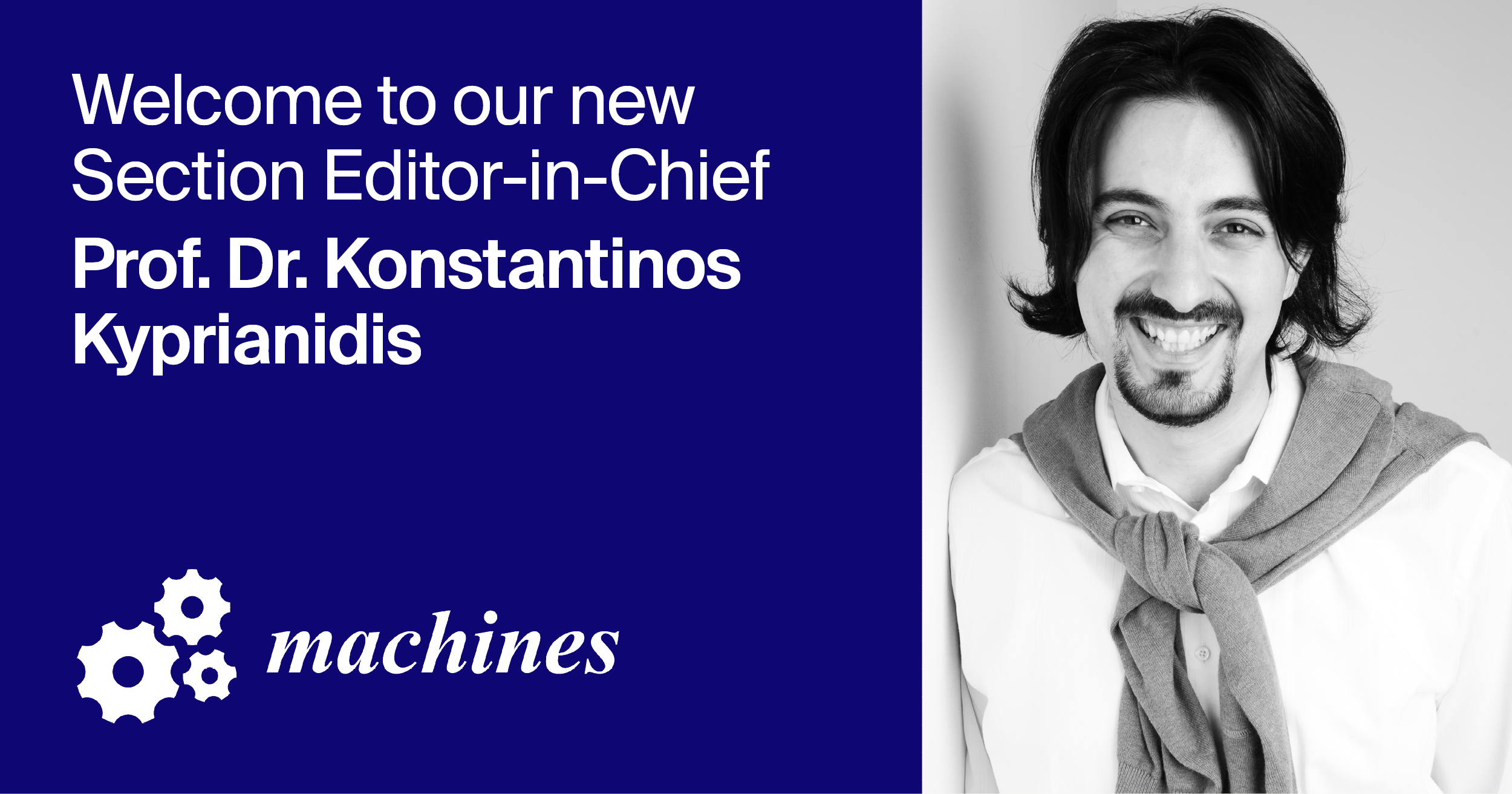
We are pleased to announce the appointment of Prof. Dr. Konstantinos Kyprianidis as the new Section Editor-in-Chief of the Section “Turbomachinery” in Machines (ISSN 2075-1702).
Prof. Dr. Konstantinos Kyprianidis is a Professor of energy engineering at Mälardalen University, Sweden. His research focuses on turbomachinery, propulsion systems, energy conversion technologies, and sustainable aviation, with particular emphasis on the development and integration of advanced gas turbine and power-generation systems. Through his extensive academic, industrial, and editorial experience, he has contributed to advancing research on efficient and sustainable energy technologies and has fostered collaborations across academia and industry. As the Section Editor-in-Chief of the Section "Turbomachinery" in Machines, he aims to further strengthen the Section as a leading platform for high-quality, interdisciplinary research in the field.
The following is a short Q&A with Prof. Dr. Konstantinos Kyprianidis, who shared his vision for the journal with us, as well as his views on the research area.
1. What appealed to you about the journal that made you want to take on the role of Section Editor-in-Chief?
Machines has established itself as a recognized platform for publishing high-quality research across a broad range of engineering disciplines. What particularly appealed to me is the journal’s multidisciplinary scope and its ability to bring together researchers working on fundamental science, applied engineering, and industrial innovation. The Section "Turbomachinery" provides an excellent opportunity to connect diverse research communities working on topics ranging from aerodynamic design and thermal management to digitalization, diagnostics, and sustainable energy systems.
The role of Section Editor-in-Chief offers a unique opportunity to help shape the direction of the field by promoting rigorous, impactful, and forward-looking research. I am especially motivated by the possibility of supporting authors, engaging with leading experts worldwide, and helping create a vibrant forum for scientific exchange.
2. What is your vision for the journal and the Section?
My vision is for the Section "Turbomachinery" to become a leading venue for publishing innovative and influential research that addresses both current challenges and future opportunities in the field. I would like to strengthen the Section’s reputation for scientific excellence while encouraging contributions that bridge traditional disciplinary boundaries.
In particular, I hope to attract research on emerging topics such as sustainable propulsion, hydrogen and alternative fuels, hybrid energy systems, advanced manufacturing, digital twins, artificial intelligence applications, condition monitoring, and energy system integration. I also aim to foster greater engagement between academia and industry, ensuring that published research not only advances scientific understanding but also contributes to practical engineering solutions.
Ultimately, the goal is to create a dynamic and inclusive platform that supports both established researchers and emerging scholars from around the world.
3. What does the future of this field of research look like?
The future of turbomachinery research will be strongly shaped by the global transition toward cleaner, more efficient, and more sustainable energy and transportation systems. Significant advances are expected in areas such as low-emission propulsion, sustainable aviation technologies, hydrogen utilization, electrification, and integrated energy systems.
At the same time, digital technologies are transforming how turbomachinery is designed, manufactured, and operated. Artificial intelligence, machine learning, advanced simulations, digital twins, and data-driven optimization are opening new possibilities for improving performance, reliability, and lifecycle efficiency.
The field will increasingly require interdisciplinary collaboration among experts in fluid dynamics, materials science, controls, data analytics, manufacturing, and energy systems. This convergence of technologies presents exciting opportunities for innovation and will play a crucial role in addressing global energy and climate challenges.
4. What do you think of the development of open access in the publishing field?
Open access has fundamentally improved the accessibility and visibility of scientific research. By removing barriers to information, it enables researchers, industry professionals, policymakers, and students worldwide to benefit from the latest scientific advances regardless of institutional resources or geographical location.
I believe open access plays an important role in accelerating scientific progress by promoting transparency, collaboration, and knowledge sharing. It allows research findings to reach a broader audience and increases opportunities for interdisciplinary exchange and real-world impact.
At the same time, maintaining high editorial standards, rigorous peer review, and research integrity remains essential. The continued success of open access publishing depends on balancing accessibility with quality, ensuring that published work meets the highest scientific standards. When managed responsibly, open access represents a powerful mechanism for advancing research and innovation on a global scale.
