



Journal Menu
► ▼ Journal Menu-
- Sensors Home
- Aims & Scope
- Editorial Board
- Reviewer Board
- Topical Advisory Panel
- Instructions for Authors
- Special Issues
- Topics
- Sections & Collections
- Article Processing Charge
- Indexing & Archiving
- Editor’s Choice Articles
- Most Cited & Viewed
- Journal Statistics
- Journal History
- Journal Awards
- Society Collaborations
- Conferences
- Editorial Office
Journal Browser
► ▼ Journal Browser-
arrow_forward_ios
Forthcoming issue
arrow_forward_ios Current issue - Vol. 26 (2026)
- Vol. 25 (2025)
- Vol. 24 (2024)
- Vol. 23 (2023)
- Vol. 22 (2022)
- Vol. 21 (2021)
- Vol. 20 (2020)
- Vol. 19 (2019)
- Vol. 18 (2018)
- Vol. 17 (2017)
- Vol. 16 (2016)
- Vol. 15 (2015)
- Vol. 14 (2014)
- Vol. 13 (2013)
- Vol. 12 (2012)
- Vol. 11 (2011)
- Vol. 10 (2010)
- Vol. 9 (2009)
- Vol. 8 (2008)
- Vol. 7 (2007)
- Vol. 6 (2006)
- Vol. 5 (2005)
- Vol. 4 (2004)
- Vol. 3 (2003)
- Vol. 2 (2002)
- Vol. 1 (2001)
Need Help?
Announcements
9 October 2025
Meet Us at the 3rd International Conference on AI Sensors and Transducers, 2–7 August 2026, Jeju, South Korea

Following from our two previous successful editions, we invite you to submit your abstracts and participate in the 3rd International Conference on AI Sensors and Transducers, taking place from 2 to 7 August 2026 in Jeju, South Korea.
Organized by MDPI and the open access journals Sensors, Micromachines, AI Sensors, Micro and Remote Sensing, this in-person conference will once again bring together experts and participating researchers who will share insights and innovations in sensors, sensing technology, transducers and artificial intelligence.
Start preparing your abstracts:
Don’t miss this opportunity to showcase your work to peers and leading experts in AI-enhanced sensing systems and transducers. We will be announcing the session topics at AIS 2026 soon.
Find out more about the instructions for authors: https://sciforum.net/event/AIS2026?section=#instructions.
Find out more about the publication opportunities available for authors: https://sciforum.net/event/AIS2026?section=#Publicationopportunities.
Please feel free to share the information about this conference to your colleagues and students.
We look forward to welcoming you in Jeju!
The organizing committee of the 3rd International Conference on AI Sensors and Transducers (AIS 2026).
18 May 2026
Meet Us at the European Society for Precision Engineering and Nanotechnology International Conference, 8–12 June 2026, Krakow, Poland

MDPI will be attending the European Society for Precision Engineering and Nanotechnology International Conference, which will be held from 8 to 12 June 2026, in Krakow, Poland.
The European Society for Precision Engineering and Nanotechnology (euspen) is an influential community linking industrialists, researchers, respected authorities, and new and established players worldwide. It provides an entrepreneurial platform that enables companies and research institutes to promote their latest technology developments, products, and services and keep up to date with those in the field. Euspen’s defined mission is to advance the arts, sciences and technology of precision engineering, micro engineering and nanotechnology; to promote its dissemination through education and training; and to facilitate its exploitation by science and industry.
Euspen’s 26th international conference and exhibition provide a leading forum for industrialists and academics alike to review the best of worldwide industrial innovation, progressive research and technology developments. Delegates will gain an insight into the precision engineering and nanotechnology priorities of Europe’s leading industrial nation.
This event offers the possibility to see the latest advances in traditional precision engineering fields such as metrology, ultra precision machining, additive and replication processes, precision mechatronic systems and control, and precision cutting processes. Furthermore, topics will be addressed covering robotics and automation, precision design in large-scale applications, applications of precision engineering in biomedical sciences, sustainability, digital manufacturing and precision engineering.
The following open access journals will be represented:
- Metrology;
- Journal of Manufacturing and Materials Processing;
- Sensors;
- Applied Mechanics;
- Automation;
- Machines;
- Micromachines;
- Nanomanufacturing;
- Journal of Experimental and Theoretical Analyses.
If you plan on attending this conference, please feel free to stop by our booth and have a conversation with us. Our delegates look forward to meeting you in person and answering any questions that you may have. For more information about the conference, please visit https://www.euspen.eu/events/26th-international-conference-exhibition/?subid=26th-international-conference-exhibition.
13 May 2026
MDPI Webinar | International Day of Light, 15 May 2026
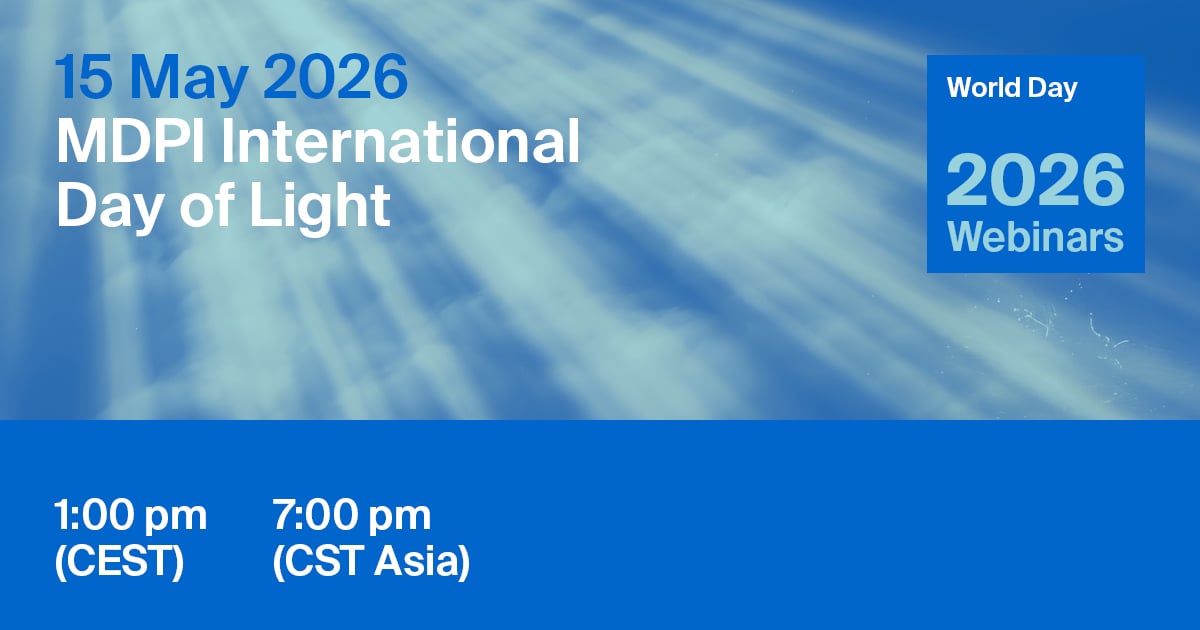
Celebrated each year on 16 May and led by UNESCO, the International Day of Light recognizes the profound impact of light and light-based technologies on science, culture, education, and sustainable development.
This occasion also commemorates the first successful operation of a laser, which was carried out in 1960 and was a breakthrough that continues to shape modern innovation, from advanced research to everyday applications.
This webinar brings together experts across disciplines to explore how light is driving progress in fields such as optics, photonics, materials science, and sustainability.
We look forward to welcoming you to this webinar and hope the session will inspire new ideas, foster meaningful discussions, and encourage future collaborations.
Date: 15 May 2026
Time: 1:00 p.m. CEST | 7:00 p.m. CST (Asia) | 7:00 a.m. EDT
Webinar ID: 863 0596 4340
Webinar Secretariat: journal.webinar@mdpi.com
Website: https://sciforum.net/event/IDL2026
Register now for free!

Program:
| Speaker | Presentation | Time (CEST) | Time (CST Asia / SGT) |
| MDPI Introduction | 1:00–1:10 p.m. | 7:00–7:10 p.m. | |
| Dr. Aung Ko Ko Kyaw | Advanced Interface Engineering: Unlocking the Full Potential of Perovskite Solar Cells | 1:10–1:30 p.m. | 7:10–7:30 p.m. |
| Dr. Lorenzo Giuffrida | Laser-Driven Particle Acceleration: From Fundamental Physics to Sustainable Applications | 1:30–1:50 p.m. | 7:30–7:50 p.m. |
| Dr. Yannis Paulus | Photoacoustic, OCT, and Fluorescence Multimodal Imaging-Guided Retinal Stem Cell Therapy | 1:50–2:10 p.m. | 7:50–8:10 p.m. |
| Q&A Session | 2:10–2:25 p.m. | 8:10–8:25 p.m. | |
| Closing of Webinar | 2:25–2:30 p.m. | 8:25–8:30 p.m. |
After registering, you will receive a confirmation email on how to join the webinar. Registrations with academic institutional email addresses will be prioritized.
Unable to attend? Register anyway, and we will let you know when the recording is available for viewing.
Webinar Keynote Speakers:
- Dr. Dr. Aung Ko Ko Kyaw, Department of Electronic and Electrical Engineering, Southern University of Science and Technology, China;
- Dr. Lorenzo Giuffrida, The Extreme Light Infrastructure ERIC, ELI Beamlines Facility, Czech Republic;
- Dr. Yannis Paulus, Department of Ophthalmology and Department of Biomedical Engineering, Johns Hopkins University Wilmer Eye Institute, USA.
12 May 2026
Sensors Webinar | Recent Trends in Wearable Sensors for the Characterization of Human Spinal Biomechanics, 28 May 2026

A message from the webinar Chair:
Wearable sensors have become ubiquitous across society, with our watches, phones and fitness gear being replete with instruments for monitoring our motion, heart rate, blood oxygen, and so on. Research teams at Brigham Young University and the University of Pittsburgh have been collaborating for several years on a large-scale National Institute of Health initiative to study, and hopefully eventually mitigate, what is possibly the most pervasive societal ailment—back pain. By pushing the frontiers of wearable sensor design and combining the new technology with artificial intelligence data mining approaches, the teams have made significant strides in terms of developing systems for monitoring the biomechanics of chronic lower back pain sufferers—outside of the clinic environment—and interpreting the meaning of the resulting data. Two of the preeminent scientists in this study, Professors Anton Bowden and Kevin Bell, will share their insights on the recent progress made to wearable sensor design, and its potential impact on our spinal health as a society.
Date: Thursday, 28 May 2026
Time: 8:00 a.m. to 9:10 a.m. MDT | 10:00 a.m. to 11:10 a.m. EDT
Webinar ID: 861 4527 2498
Webinar Secretariat: journal.webinar@mdpi.com
Webinar announcement: https://sciforum.net/event/Sensors-30?subscribe
Register now for free!

|
Speaker/Presentation |
Time (MDT) |
Time (EDT) |
|
David Fullwood Chair Introduction |
8:00–8:10 a.m. |
10:00–10:10 a.m. |
|
Anton Bowden The Convergence of Wearable Sensors and Machine Learning is Accelerating Chronic Low Back Pain Diagnosis and Treatment |
8:10–8:30 a.m. |
10:10–10:30 a.m. |
|
Kevin Bell Biomechanical Assessment of Individuals With Chronic Low-back Pain During In-Clinic and At-Home Testing Using Wearable Motion Sensors |
8:30–8:50 a.m. |
10:30–10:50 a.m. |
|
Q&A Session |
8:50–9:05 a.m. |
10:50–11:05 a.m. |
|
David Fullwood Closing of Webinar |
9:05–9:10 a.m. |
11:05–11:10 a.m. |
After registering, you will receive a confirmation email with information on how to join the webinar. Registrations with academic or institutional email addresses will be prioritized.
Unable to attend? Feel free to register anyway, and we will inform you when the recording is available.
Webinar Chair and Keynote Speakers:
- Prof. Dr. David Fullwood, Department of Mechanical Engineering, Brigham Young University, Provo, UT 84602, USA;
- Prof. Dr. Anton Bowden, Department of Mechanical Engineering, Brigham Young University, Provo, UT 84602, USA;
- Prof. Dr. Kevin Michael Bell, Department of Bioengineering, University of Pittsburgh, Pittsburgh, PA 15260, USA.
7 May 2026
Meet Us at the 2026 International Conference on Unmanned Aircraft Systems (ICUAS 2026), 15–18 June 2026, Corfu, Greece

MDPI will be attending the 2026 International Conference on Unmanned Aircraft Systems, ICUAS 2026, from 15 to 18 June 2026 in Corfu, Greece. We welcome researchers from diverse backgrounds to visit our booth and share their latest ideas with us.
Organized by the ICUAS Association, Inc., ICUAS 2026 will offer unique opportunities to meet, interact, and shape the future of unmanned aviation worldwide, bringing together technical, regulatory, and legal communities.
ICUAS 2026 centers around a wide spectrum of topics, with emphasis given to:
- Soft aerial robots;
- Cooperative aerial manipulation;
- Bio-inspired aerial robots;
- Aerial robot aerodynamics;
- Multi-mode unmanned platforms;
- Reconfigurable UAVs;
- Multi-mode unmanned platforms;
- Learning-based perception;
- Navigation and control;
- Online autonomy;
- Real-time applications;
- Human factors and ethical AI for aerial robots;
- Regulations, policies, and safety.
In addition to the technical sessions, a twofold objective is:
- Industry and company participation for attendees to find out about the current state of technology and of commercially available products for civil and public domain applications;
- Understanding technical requirements and standards that are prerequisites to UAS full utilization and integration into the national airspace.
The following MDPI journals will be represented:
- Drones;
- Aerospace;
- Standards;
- Telecom;
- Robotics;
- Safety;
- Electronics;
- Biomimetics;
- Applied Mechanics;
- Journal of Imaging;
- Actuators;
- Signals;
- Sensors;
- Inventions;
- Automation;
- Journal of Sensor and Actuator Networks;
- Technologies;
- IoT.
We welcome you to visit the MDPI booth in Corfu at the Divani Corfu Palace. Our representatives are excited to meet you in person and will address any questions you may have. For further details about the conference, please visit the following website: https://uasconferences.com/2026_icuas/.
6 May 2026
MDPI INSIGHTS: The CEO's Letter #34 - MDPI US Office, Coatings 2026, Media and Partnerships, Recapping Poland Summit & Serbia Salon

Welcome to the MDPI Insights: The CEO's Letter.
In these monthly letters, I will showcase two key aspects of our work at MDPI: our commitment to empowering researchers and our determination to facilitating open scientific exchange.
Opening Thoughts

MDPI Opens First US Office in Philadelphia
I am delighted to highlight an important milestone in MDPI’s continued global development: the recent opening of our first office in the United States, located in Philadelphia.
This marks a significant step in building our engagement with one of the world’s most important research communities. The new office will serve as a hub for supporting scholars across the US, creating closer connections and more localized support.
As highlighted in recent coverage by our press release in InPublishing, this expansion reflects MDPI’s broader commitment to growing our international presence while remaining focused on the needs of the research community.
A Key Market for Research and Collaboration
The United States continues to play a central role in global research. To date, MDPI has published more than 237,000 articles affiliated with US institutions, and we collaborate with nearly 12,000 Editorial Board Members across the country. These relationships are fundamental to our mission of supporting Open Access and advancing scientific communication.
The opening of this office is not just about geography; it is about proximity to the communities we serve. It allows us to better understand the evolving needs of researchers while continuing to build collaboration and trust within the academic ecosystem.
The Team Behind this Milestone

This milestone reflects the efforts of teams across MDPI. I extend a special thank-you to Bob Vrooman (Head of Business Development, MDPI), who is leading this expansion, as well as to our colleagues in Toronto and across our North American teams for their continued support.
Bob shared: “MDPI is already a trusted partner of the North American research community, due in no small part to our dedicated team in Canada. Launching our first US office in Philadelphia is a great first step towards expanding MDPI’s market share and recognition in the US. I’m thrilled to be a part of this new phase in MDPI’s journey.”
As we continue to grow, our focus remains on supporting researchers globally and advancing Open Access with integrity.
Impactful Research

Coatings 2026: Highlights from Our Latest MDPI Conference (20-22 April)
I am pleased to share the successful completion of MDPI conference Coatings 2026, which took place last week in Athens from 20 to 22 April 2026. This conference brought together a diverse international community of researchers, industry experts, and partners, highlighting MDPI’s role not only as a publisher but also as a platform for scientific exchange and collaboration.
Conference Highlights
Coatings 2026 in numbers:
- The event attracted approximately 140 participants from 25 countries
- 143 submissions and a strong scientific program of talks and posters
- 2 keynote speakers and a wide range of invited contributions
- 7 sponsors and 11 media partners supporting the event
|
|
|
|
|
|


Scientific Programme
The program centered on “Safe and Sustainable by Design,” reflecting the growing importance of sustainability, regulatory frameworks, and technological innovation in materials science. Topics ranged from advanced coating technologies and additive manufacturing to AI-driven simulations and strategies to phase out potentially harmful substances in industrial processes.
Importantly, the conference brought together both academic and industrial perspectives, creating a space for dialogue on how research can translate into real-world impact. This is important as industries navigate environmental challenges, evolving regulations, and the need for more sustainable and circular approaches to production.
Thank You!
I would like to thank the entire conference team for their work in organizing this successful event. As we continue to grow, conferences like this play an important role in building our connection with global research communities, supporting interdisciplinary collaboration, and positioning MDPI at the intersection of science, technology, and societal impact.
 Members from Exelisis and MDPI EU Conference & Social Media team at the Coatings 2026 Conference in Athens, Greece.
Inside MDPI

Recent Media Coverage and Partnerships
Over the past two months, news from MDPI has enjoyed strong visibility across international publishing and academic media, reflecting our continued expansion and the increasing relevance of our work within the research community.
Below are some highlights covering partnerships, institutional agreements, and milestones that continue to shape our position in publishing – some of which are featured in leading industry platforms such as InPublishing, which is highly selective and reflects the growing recognition of MDPI’s growth within the publishing ecosystem.
Key Press Releases & Coverage (March–April 2026)
-
MDPI × Sikt (Norway): Partnership Renewal
We renewed our national Open Access agreement with Sikt, a key consortium partnership, continuing to support researchers across Norway through this partnership. The renewal was covered by several international publishing trade outlets.
Covered by: Research Information, STM Publishing News, ALPSP, Europe Says
-
MDPI × Jisc (UK): New Two-Year Open Access Agreement
A new two-year agreement with Jisc significantly expands MDPI’s footprint across UK academic institutions. Coverage appeared across major publishing industry titles in the UK and internationally.
Covered by: InPublishing, Research Information, STM Publishing News, ALPSP
-
MDPI Opens First US Office
The opening of our first US office marks an important milestone in our North American expansion to build engagement with one of the world’s leading research communities.
Coverage by: EurekAlert!, InPublishing, EdTech Innovation Hub, STM Publishing News, ALPSP
-
MDPI × SIGG: Italian Society of Gerontology and Geriatrics
We established a new partnership with the Italian Society of Gerontology and Geriatrics (SIGG), adding to our growing portfolio of society collaborations.
Coverage by: EurekAlert!, STM Publishing News, ALPSP
-
MDPI × Fast Track Health: New Journal Launch
The launch of a new journal in partnership with Fast Track Health reflects our continued expansion into emerging areas of health innovation.
Coverage by: EurekAlert!, Scienmag, STM Publishing News, ALPSP
-
MDPI 2025 Annual Report
Our 2025 Annual Report was also widely covered across international media, highlighting a 12% increase in submissions and continued investment in research integrity, infrastructure, and partnerships.
Coverage by: EurekAlert!, Research Information, STM Publishing News, ALPSP, Choice 360
Coverage also spanned multiple regions including Poland, Romania and South Korea, reflecting our ongoing efforts to communicate more effectively with regional research communities.
Looking Ahead
This coverage shows that MDPI is growing and building on its position through partnerships, visibility, and engagement across regions. As we continue to expand, our focus remains on supporting researchers globally, building on our institutional collaborations, and advancing Open Access with integrity.
Thank you to all teams involved in delivering these initiatives, and to our External Affairs team for ensuring our work is effectively communicated across the global publishing landscape!
Coming Together for Science

Recapping MDPI Poland Summit 2026 in Krakow (23 April)
On 23 April 2206, we hosted the first MDPI Poland Summit 2026 in Kraków, bringing together an engaged group of editors, researchers, and academic leaders from the country.
The Poland Summit welcomed some 45 participants, including Editors-in-Chief, Associate Editors, and Editorial Board Members, many with strong academic track records and international recognition.
Our engagements were open and constructive, focusing on MDPI’s positioning and reputation in Poland, alongside community interest in supporting our development, with active participation across our sessions, including Q&A and panel discussions.
|
|
|
|


MDPI Poland Summit Programme
From research integrity and peer review quality to AI in publishing and the future of academic communication, the agenda featured important topics currently shaping our industry.
During the day, MDPI colleagues shared a series of presentations covering:
- MDPI’s performance, growth, and impact in Poland: Stefan Tochev (CEO)
- Engagement with Academic Community: Dr. Marta Colomer (Public Affairs Lead)
- Research Integrity and Publication Ethics: Anna Pena (Research Integrity Manager)
- MDPI Editorial Process and Peer-Review Quality Metrics: Dr. Liliane Auwerter (Conference Organizer)
- AI in the Publishing Industry – Challenges, Innovation and MDPI’s vision: Dr. Enric Sayas (AI Product Owner)
- Panel Session: The Future of Academic Publishing, moderated by Dr. Marta Colomer
|
|
|
|
|
|
|
|


Poland as a Key Market for Open Access
The summit also highlighted the importance of Poland within the global research landscape.
In 2025:
- 75% of publications in Poland were made in Open Access
- 71% of those in Gold Open Access
- and over 344,000 publications produced in the last five years
MDPI plays a significant role in the Polish publishing ecosystem:
- #1 Open Access publisher in Poland
- 17% share of Open Access publications in 2025
- More than 12,500 publications from Polish institutions in 2025
- More than 91,000 publications overall since 1996
Looking Ahead
Events like the Poland Summit are an important part of how we evolve as an organization. They allow us to share the latest developments of MDPI and listen directly to our researchers and editors to better understand the market and align our development with the needs of the local community.
As MDPI continues to grow, this type of engagement will remain essential in ensuring that we are not only scaling globally, but doing so in a way that is aligned, trusted, and collaborative.

With Igor Matic (Office Manager, Krakow, Poland, MDPI) at the MDPI Poland Summit in Krakow.
Closing Thoughts

Recapping MDPI Serbia Salon 2026 in Belgrade (22 April)
On 22 April 2026, we hosted the MDPI Serbia Salon 2026 in Belgrade. The Salon welcomed over 50 participants, including more than 40 invited scholars from leading Serbian institutions, alongside colleagues from MDPI. The event also marked two important milestones: 30 years of MDPI and 10 years of our presence in Serbia, making it a celebration and an opportunity for reflection.

A Platform for Exchange
The Salon was designed not just as a series of presentations, but as a place for dialogue. Throughout the day, discussions focused on important topics around publishing today: research integrity and editorial standards, journal indexing and visibility, the evolving role of artificial intelligence, and funding and support for Open Access publishing.
|
|
|
|
|
|
|
|


Program Overview
- Opening the Salon MDPI Serbia 2026 – Serbia results and direction: Emir Ramadani (Operations Manager)
- Update on MDPI’s performance and growth: Stefan Tochev (CEO)
- Collaboration with MDPI – A personal perspective: Prof. Dr Srećko Stopić (Editorial Board Member)
- Linking Scientific Quality and Visibility: The role of indexing in publishing
- Research integrity and editorial ethics: Ana Stanković (Research Integrity Specialist)
- Artificial Intelligence in Scientific Publishing – Challenges, innovations and vision of MDPI: Dr Miloš Čučulović (Head of Technology Innovation)
It was encouraging to see the high level of engagement and discussion with the local academic community.
|
|
|
|
|
|
|
|


Publishing in Serbia
With 10 years of MDPI in Serbia (since 2016) and over 620 colleagues across 10 departments spread across offices in Belgrade and Novi Sad, MDPI continues to invest in the long-term development of the research community in Serbia and beyond.
Some high-level indicators illustrate both the strength of the local research ecosystem and MDPI’s role within it:
- 12,910 total publications in Serbia in 2025, of which 8,708 (67%) were Open Access (of which, in turn, 75% were Gold OA)
- A total of more than 55,000 publications (2021–2025), with 68% published Open Access
- 2,122 MDPI publications from Serbian institutions in 2025
- 25% of all Open Access publications in Serbia are published with MDPI
- More than 11,000 MDPI publications from Serbian institutions since 1996
- More than 75 Editorial Board Members from Serbia, including Editors-in-Chief and Associate Editors.
These figures reflect the growth of OA publishing in Serbia and the strong collaboration between MDPI and Serbia's research community.
Top 5 Publishers in Serbia (MDPI #1 with steady growth)

Looking Ahead
Research integrity and artificial intelligence will remain central topics for the industry. At the same time, clear communication of editorial processes will be essential in building trust and transparency.
Workshops and direct engagement remain among the most effective ways to strengthen these connections. As Open Access funding models continue to evolve, new opportunities for collaboration are emerging across institutions, publishers, and the broader research community.
Thank You!
The excellent feedback from participants shows the value of creating spaces where ideas can be exchanged openly and constructively. Sincere thanks to everyone who contributed to the success of this event: our speakers, participants, and especially the MDPI Serbia team for their great organization and support.

Chief Executive Officer
MDPI AG
6 May 2026
Interview with Dr. Saeideh Pahlavan—Winner of the Sensors Outstanding Reviewer Award

Name: Dr. Saeideh Pahlavan
Affiliation: Instituto de Microelectrónica de Sevilla, IMSE-CNM, (CSIC Universidad de Sevilla), Sevilla, Spain
Interests: electronic circuit design, real-time vision sensing, and wireless power transmission
- Could you briefly introduce yourself and tell us about your field of research?
I am currently a postdoctoral researcher at IMSE-CNM (CSIC–Universidad de Sevilla), where I work on neuromorphic ASIC design for biomedical applications. I received my PhD (Cum Laude) from the University of Tehran in 2023, specializing in integrated circuits for bio-inspired and biomedical systems.
My research focuses on low-power analog and mixed-signal IC design, wireless power transfer for biomedical implants, and neuromorphic hardware for intelligent sensing and stimulation. During my PhD, I developed innovative wireless powering methods for moving biological targets, including machine-learning-based approaches for efficient power delivery in dynamic environments. This work resulted in several publications in high-impact journals such as IEEE TBioCAS.
I have also collaborated with TU Delft on wearable health-monitoring systems and am currently leading the design of a programmable neuromorphic ASIC capable of implementing spiking neural networks for applications such as neural sensing, Parkinson’s disease treatment, and smart biomedical devices. My long-term goal is to establish an independent research line in neuromorphic integrated circuits for diagnosis and therapy. - What key aspects do you typically focus on during the review process?
During the review process, I primarily focus on the novelty and originality of the work, as well as the clarity of the research objectives. I carefully evaluate the structure of the manuscript, the relevance and completeness of the literature review, and whether the proposed idea is well-motivated.
In addition, I assess the technical soundness of the methodology and whether the results clearly support the claims. A strong paper should present a well-defined problem, a meaningful contribution, and a convincing demonstration of its benefits. - Based on your reviewing experience, what are some common problems that authors face?
One common issue is an incomplete or biased literature review. Authors sometimes select references that only support their work while overlooking important contributions from other researchers.
Another frequent problem is insufficient validation. Some manuscripts rely only on simulations or limited measurements without providing comprehensive validation. In my view, a strong study should be supported by three key pillars: theoretical analysis, simulation, and experimental validation. Ignoring one of these aspects often weakens the overall contribution. - For young scholars who are just beginning to participate in peer review, what specific advice would you offer?
I would recommend that young researchers accept review invitations only when they have sufficient expertise in the topic and enough time to perform a thorough evaluation. A careful and responsible review is more valuable than a rushed one.
It is also important to rely on one’s own knowledge and critical thinking rather than overusing AI tools. Reviewers should read manuscripts carefully and objectively, providing constructive feedback.
Finally, reviewers should support the development of research. If a paper has potential but requires improvements, it is better to recommend a major revision rather than rejection, giving authors the opportunity to strengthen their work. - How has serving as a reviewer shaped your perspective on manuscript quality and improved your own writing or research practices?
Serving as a reviewer has significantly improved my perspective on research quality and scientific writing. By reviewing a wide range of manuscripts, I have learned to identify both strong and weak aspects of research more effectively.
This experience has directly influenced my own work. It has helped me improve the structure of my papers, strengthen my analysis, and present my results more clearly. Additionally, observing common mistakes in other manuscripts has made me more careful in avoiding similar issues in my own research. - How do you see the role of reviewers evolving with advancements in artificial intelligence and automated tools in research publishing?
Artificial intelligence can be a useful supportive tool, but it should not replace human expertise. AI systems are based on existing data and are not always fully accurate or reliable.
Reviewers will continue to play a critical role by applying their knowledge, experience, and scientific judgment. While AI can assist with tasks such as language improvement or initial screening, the evaluation of novelty, significance, and technical correctness must remain the responsibility of expert reviewers.
29 April 2026
Meet Us at the 3rd Cross-Disciplinary Forum on Artificial Intelligence and Remote Sensing, 15–17 May 2026, Changsha, China

We are pleased to announce that MDPI will participate in the 3rd Cross-Disciplinary Forum on Artificial Intelligence and Remote Sensing (AIRS 2026), held in Changsha, Hunan, China, from 15 to 17 May 2026.
The forum focuses on cutting-edge technologies, research outputs and practical applications in the AI4RS field, with the theme “AI4RS: New Perspectives on Smart Earth” and the slogan “Make RS More Intelligent!” It will gather experts, researchers and enterprise representatives from relevant fields to inspire integrated innovation, facilitate in-depth cooperation and promote the high-quality development of remote sensing intelligence.
The following open access journals will be represented at the forum:
- Remote Sensing;
- AI;
- AI Sensors;
- Sensors;
- Land;
- IJGI;
- Applied Sciences;
- Geohazards.
If you are planning to attend the above forum, please feel free to start an online conversation with us. Our delegates look forward to meeting you in person at booth #1 and answering any questions that you may have. For more information about the forum, please visit the following website: https://www.airs.top/.
28 April 2026
Meet Us at the 5th International Conference on Optoelectronic Information and Computer Engineering (OICE2026), 15–17 May 2026, Harbin, China

MDPI will be attending the 5th International Conference on Optoelectronic Information and Computer Engineering (OICE2026), which will be held in Harbin, China, from 15 to 17 May 2026.
In recent years, optoelectronic information and computer engineering technologies have been widely used in all walks of life in national economy and national defense construction, driving the development of modern information technology with its extremely fast response speed, exceedingly wide bandwidth, great information capacity, and incredibly high information efficiency and resolution. Based on electronic science and technology, computer science and technology, information and communication engineering, OICE aims to provide an international communication platform for scholars, scientists, engineers, and students in related fields to share the latest research results, discuss the existing problems and challenges, and explore the future trends.
As an annual academic conference, OICE has been successfully held over the last 4 years, attracting delegates from more than 10 countries and regions, including China, the United Kingdom, Russia, and Canada. The published proceedings have been included in SPIE Digital Library, EI Compendex, and Scopus.
The following MDPI journals will be represented at the conference:
We invite you to visit MDPI’s booth to meet our representatives, explore our latest initiatives, and discuss potential collaborations. For more details about the conference, please visit the official website: https://www.icoice.org/Default.aspx.
We look forward to connecting with you in Harbin!
27 April 2026
Interview with Dr. Tong Liu—Winner of the Sensors Outstanding Reviewer Award

1. Could you briefly introduce yourself and tell us about your field of research?
I am a Postdoctoral Fellow at The Hong Kong Polytechnic University. My research focuses on measurement and geodesy, particularly ionosphere, high-precision GNSS processing and PNT applications. Since measurement and error handling are at the core of my work, it is closely related to the journal Sensors. Many kinds of sensors can provide raw data, and my research emphasizes how to process these measurements accurately, especially under challenging conditions such as space weather disturbances. A major part of my work examines the impact of ionospheric activity on GNSS, including modeling and scintillation mitigation, which directly connects sensor data to practical positioning and navigation outcomes.
2. What key aspects do you typically focus on during the review process?
I mainly look at the originality of the work and whether the content is substantial. Specifically, I follow a structured approach.
First, I quickly read the abstract and conclusion to understand the field and the core problem. Then, I examine the introduction, methods, and results in detail. For the introduction, I check if it clearly contrasts with the most advanced existing methods to frame the problem. A good introduction should explain not just what the authors are doing, but why it is needed. It should outline what other scholars have done, identify the specific challenges, and show how this work addresses those challenges in a targeted way. This reflects a deep understanding of the scientific question.
For the methods and results, I assess if they are correct and thorough enough to support the conclusions. Some manuscripts have insufficient work or unclear figures, making it hard for readers to judge the findings. Results should directly and specifically address the problem or challenge stated in the introduction and conclusion, showing how it is solved, not just mentioned generally. These aspects are key for peers, both close and broad, to recognize the work's value and innovation.
3. Based on your reviewing experience, what are some common problems that authors face?
The most frequent issue is writing quality. On a deeper level, this often reflects a lack of scientific logic or maturity. One common problem is that many manuscripts read like lab reports rather than research papers. A lab report simply states what was done, but a scientific paper requires real thinking, a grasp of the academic frontier, and a deep analysis of results, especially new findings.
Another issue is with wording and writing itself. Many submissions use terms that are too grand and vague. Academic writing should be clear and specific, explaining exactly what was done and outlining the contribution without exaggeration. Many authors struggle to grasp these two points conceptually. Even when they receive reviewer comments on them, they often cannot revise the paper effectively. This highlights a fundamental difference in mindset between technical engineers and scientists.
4. For young scholars who are just beginning to participate in peer review, what specific advice would you offer?
My advice is to be strict and uphold scientific standards. If a paper does not meet the level for publication, it should be revised and improved according to academic norms, not be accepted with lower standards. I find my reviews are often more stringent and detailed than some other reviewers'. Some manuscripts have flaws in content or method but try to avoid mentioning them in the abstract and conclusion to get by, while being well-packaged in form. These require even more careful scrutiny. Furthermore, for journals like Sensors that cover a broad scope, the reviewer may not be a specialist in that exact niche. For a general peer reviewer, this kind of thorough examination is even more important.
5. How has serving as a reviewer shaped your perspective on manuscript quality and improved your own writing or research practices?
Serving as a reviewer has greatly broadened my perspective. Reading many manuscripts, some excellent and some less so, has helped me understand where my own writing stands. It allows me to learn from truly skilled scientists in how to structure and articulate research. Being exposed to high-quality work is particularly beneficial. Sometimes, a truly good paper has real taste; its logic is so smooth that you can read it in one sitting, and the experience is immediately positive. This inspires me in my own research. It has also been crucial for improving my scientific taste.
6. How do you see the role of reviewers evolving with advancements in artificial intelligence and automated tools in research publishing?
The rise and application of AI is a major, unavoidable trend. However, it cannot currently replace a scholar's judgment in evaluating research. Last year, I participated in an evaluation of large language models by Shanghai AI Lab. The conclusion was that without being fed specific literature, current language models, when used for answering professional questions or doing research, perform at most at an undergraduate level. Therefore, maintaining scholarly judgment and taste is essential. In terms of efficiency, however, AI is very capable in areas like language polishing. This can make communication between reviewers, authors, and readers smoother, reducing misunderstandings caused by unclear English expression.
