


Dynamic Rankings for Seed Selection in Complex Networks: Balancing Costs and Coverage

Abstract
1. Introduction
2. Materials and Methods
| Algorithm 1: Sequential Seeding with Static Ranking and Revival Mode |
| Input: Graph G(V,E), PropagationProbability, SeedingPercentage |
| Output: set of activated nodes ActiveNodes, initially ActiveNodes = {} |
| 0: Initialize: stage s = 0; NumberOfSeeds = SeedingPercentage * NumberOfNodes(G); k = number of seeds in the stage |
| 1: for each node v є V |
| 2: Compute network measure m(v) |
| 3: end for |
| 4: Create initial ranking R of nodes sorted by measure m(v) in the descending order |
| 5: SeedSet = top k nodes from ranking R /* seeds for stage s = 0 */ |
| 6: while NumberOfSeeds > 0 |
| 7: Activate each node from SeedSet |
| 8: ActiveNodes = ActiveNodes ∪ SeedSet |
| 9: R = R\SeedSet /* remove recent seeds from the ranking to avoid double seeding */ |
| 10: NumberOfSeeds = NumberOfSeeds − |SeedSet| /* note that in the last stage |SeedSet| may be < k */ |
| 11: ActivatingNodes = SeedSet |
| 12: % information diffusion process according to IC model starts here |
| 13: while |ActivatingNodes| > 0 |
| 14: for each node i from ActivatingNodes |
| 15: for each not yet activated neighbor j of node i in G(E,V) |
| 16: Generate random number Rand from the range <0,1> |
| 17: if Rand <= PropagationProbability |
| 18: Activate node j |
| 19: ActiveNodes = ActiveNodes ∪ {j} |
| 20: ActivatingNodes = ActivatingNodes ∪ {j} /* neighbor j of k is active and may activate others */ |
| 21: R = R\{j} /* remove activated nodes from the ranking—the crucial part of the sequential algorithm*/ |
| 22: end if |
| 23: end for |
| 24: ActivatingNodes = ActivatingNodes\{i} /* remove i from activating nodes */ |
| 25: end for |
| 26: end while |
| 27: % information diffusion process dies out |
| 28: if NumberOfSeeds > 0 |
| 29: % preparation for revival and selection of new seed candidates |
| 30: SeedSet = top min(k,NumberOfSeeds) nodes from ranking R /* seed set for the next stage s + 1 */ |
| 31: s = s + 1 |
| 32: end if |
| 33: end while |
| Algorithm 2: Sequential Seeding with Dynamic Ranking and Revival Mode |
| Input: Graph G(V, E), PropagationProbability, SeedingPercentage |
| Output: set of activated nodes ActiveNodes, initially ActiveNodes = {} |
| 0: Initialize: stage s = 0; NumberOfSeeds = SeedingPercentage * NumberOfNodes(G); UsedSeeds = 0; k = number of seeds in the stage |
| 1: for each node v є V |
| 2: Compute network measure m(v) |
| 3: end for |
| 4: Create initial ranking R0 of nodes sorted by measure m(v) in the descending order |
| 5: SeedSet0 = top k nodes from ranking R0 /* seeds for stage s = 0 */ |
| 6: while NumberOfSeeds > 0 |
| 7: Activate each node from SeedSets |
| 8: ActiveNodes = ActiveNodes ∪ SeedSets |
| 9: NumberOfSeeds = NumberOfSeeds − |SeedSets| /* note that in the last stage |SeedSets| may be < k */ |
| 10: ActivatingNodes = SeedSets |
| 11: % information diffusion process according to IC model starts here |
| 12: while |ActivatingNodes| > 0 |
| 13: for each node i from ActivatingNodes |
| 14: for each not yet activated neighbor j of node i in G(E,V) |
| 15: Generate random number Rand from the range <0,1> |
| 16: if Rand <= PropagationProbability |
| 17: Activate node j |
| 18: ActiveNodes = ActiveNodes ∪ {j}1 |
| 19: ActivatingNodes = ActivatingNodes ∪ {j} /* neighbor j of k is active and may activate others */ |
| 20: end if |
| 21: end for |
| 22: ActivatingNodes = ActivatingNodes\{i} /* remove i from activating nodes */ |
| 23: end for |
| 24: end while |
| 25: % information diffusion process dies out |
| 26: if NumberOfSeeds > 0 |
| 27: % preparation for revival and ranking recomputation |
| 28: for each not activated node v є V |
| 29: Compute network measure m(v) with the use of use of not activated nodes only |
| 30: end for |
| 31: Create updated ranking Rs+1 for next stage s + 1 of nodes sorted by measure m(v) in the descending order |
| 32: SeedSets+1 = top k nodes from ranking Rs+1 |
| 33: s = s + 1 |
| 34: end if |
| 35: end while |
3. Results
4. Discussion
5. Conclusions
Acknowledgments
Conflicts of Interest
References
- Ferguson, R. Word of mouth and viral marketing: Taking the temperature of the hottest trends in marketing. J. Consum. Market. 2008, 25, 179–182. [Google Scholar] [CrossRef] [Scilit]
- Nekovee, M.; Moreno, Y.; Bianconi, G.; Marsili, M. Theory of rumour spreading in complex social networks. Phys. A Stat. Mech. Its Appl. 2007, 374, 457–470. [Google Scholar] [CrossRef] [Scilit]
- Bond, R.M.; Fariss, C.J.; Jones, J.J.; Kramer, A.D.; Marlow, C.; Settle, J.E.; Fowler, J.H. A 61-million-person experiment in social influence and political mobilization. Nature 2012, 489, 295–298. [Google Scholar] [CrossRef] [Scilit] [PubMed]
- Li, Y.; Wu, C.; Luo, P.; Zhang, W. Exploring the Characteristics of Innovation Adoption in Social Networks: Structure, Homophily, and Strategy. Entropy 2013, 15, 2662–2678. [Google Scholar] [CrossRef] [Scilit]
- Stieglitz, S.; Dang-Xuan, L. Emotions and information diffusion in social media—Sentiment of microblogs and sharing behavior. J. Manag. Inf. Syst. 2013, 29, 217–248. [Google Scholar] [CrossRef] [Scilit]
- Jansen, B.J.; Zhang, M.; Sobel, K.; Chowdury, A. Twitter power: Tweets as electronic word of mouth. J. Am. Soc. Inf. Sci. Technol. 2009, 60, 2169–2188. [Google Scholar] [CrossRef] [Scilit]
- Khmelnitsky, E.; Kagan, E. The Dynamics of Concepts in a Homogeneous Community. Entropy 2013, 15, 2012–2022. [Google Scholar] [CrossRef] [Scilit]
- Nelson-Field, K.; Riebe, E.; Newstead, K. The emotions that drive viral video. Australas. Market. J. 2013, 21, 205–211. [Google Scholar] [CrossRef] [Scilit]
- Totti, L.C.; Costa, F.A.; Avila, S.; Valle, E.; Meira, W., Jr.; Almeida, V. The impact of visual attributes on online image diffusion. In Proceedings of the 2014 ACM Conference on Web Science, Bloomington, IN, USA, 23–26 June 2014; ACM: New York, NY, USA, 2014; pp. 42–51. [Google Scholar]
- Dobele, A.; Toleman, D.; Beverland, M. Controlled infection! Spreading the brand message through viral marketing. Bus. Horiz. 2005, 48, 143–149. [Google Scholar] [CrossRef] [Scilit]
- Lerman, K.; Ghosh, R. Information contagion: An empirical study of the spread of news on Digg and Twitter social networks. In Proceedings of the 4th International Conference on Weblogs and Social Media, Washington, DC, USA, 23–26 May 2010; AAAI Press: Menlo Park, CA, USA, 2010; pp. 90–97. [Google Scholar]
- Berger, J.; Milkman, K.L. What Makes Online Content Viral? J. Market. Res. 2012, 49, 192–205. [Google Scholar] [CrossRef] [Scilit]
- Xiong, F.; Liu, Y.; Zhu, J. Competition of Dynamic Self-Confidence and Inhomogeneous Individual Influence in Voter Models. Entropy 2013, 15, 5292–5304. [Google Scholar] [CrossRef] [Scilit]
- Kempe, D.; Kleinberg, J.; Tardos, É. Maximizing the spread of influence through a social network. In Proceedings of the Ninth ACM SIGKDD International Conference on Knowledge Discovery and Data Mining, Washington, DC, USA, 24–27 August 2003; ACM: New York, NY, USA, 2003; pp. 137–146. [Google Scholar]
- Wang, Y.; Cao, J.; Jin, Z.; Zhang, H.; Sun, G.Q. Impact of media coverage on epidemic spreading in complex networks. Phys. A Stat. Mech. Its Appl. 2013, 392, 5824–5835. [Google Scholar] [CrossRef] [Scilit]
- Kandhway, K.; Kuri, J. How to run a campaign: Optimal control of SIS and SIR information epidemics. Appl. Math. Comput. 2014, 231, 79–92. [Google Scholar] [CrossRef] [Scilit]
- Wang, Y.; Cao, J. Global dynamics of a network epidemic model for waterborne diseases spread. Appl. Math. Comput. 2014, 237, 474–488. [Google Scholar] [CrossRef] [Scilit]
- Cao, J.; Wang, Y. Global stability of an epidemic model with carrier state in heterogeneous networks. IMA J. Appl. Math. 2015, 80, 1025–1048. [Google Scholar] [CrossRef] [Scilit]
- Chen, W.; Yuan, Y.; Zhang, L. Scalable influence maximization in social networks under the linear threshold model. In Proceedings of the 2010 IEEE 10th International Conference on Data Mining (ICDM), Sydney, Australia, 13–17 December 2010; IEEE: New York, NY, USA, 2010; pp. 88–97. [Google Scholar]
- Van der Lans, R.; Van Bruggen, G.; Eliashberg, J.; Wierenga, B. A viral branching model for predicting the spread of electronic word of mouth. Market. Sci. 2010, 29, 348–365. [Google Scholar] [CrossRef] [Scilit]
- Salehi, M.; Sharma, R.; Marzolla, M.; Magnani, M.; Siyari, P.; Montesi, D. Spreading processes in multilayer networks. IEEE Trans. Netw. Sci. Eng. 2015, 2, 65–83. [Google Scholar] [CrossRef] [Scilit]
- Michalski, R.; Kajdanowicz, T.; Bródka, P.; Kazienko, P. Seed selection for spread of influence in social networks: Temporal vs. static approach. New Gener. Comput. 2014, 32, 213–235. [Google Scholar] [CrossRef] [Scilit]
- Hinz, O.; Skiera, B.; Barrot, C.; Becker, J.U. Seeding strategies for viral marketing: An empirical comparison. J. Market. 2011, 75, 55–71. [Google Scholar] [CrossRef] [Scilit]
- Aral, S.; Walker, D. Identifying influential and susceptible members of social networks. Science 2012, 337, 337–341. [Google Scholar] [CrossRef] [Scilit] [PubMed]
- Erlandsson, F.; Bródka, P.; Borg, A.; Johnson, H. Finding Influential Users in Social Media Using Association Rule Learning. Entropy 2016, 18, 164. [Google Scholar] [CrossRef] [Scilit]
- Seeman, L.; Singer, Y. Adaptive seeding in social networks. In Proceedings of the IEEE 54th Annual Symposium on Foundations of Computer Science, Berkeley, CA, USA, 26–29 October 2013; IEEE: New York, NY, USA, 2013; pp. 459–468. [Google Scholar]
- Granell, C.; Gómez, S.; Arenas, A. Competing spreading processes on multiplex networks: Awareness and epidemics. Phys. Rev. E 2014, 90, 012808. [Google Scholar] [CrossRef] [Scilit] [PubMed]
- Jankowski, J.; Bródka, P.; Kazienko, P.; Szymanski, B.; Michalski, R.; Kajdanowicz, T. Balancing Speed and Coverage by Sequential Seeding in Complex Networks. Sci. Rep. 2017. [Google Scholar] [CrossRef] [Scilit]
- He, J.-L.; Fu, Y.; Chen, D.-B. A novel top-k strategy for influence maximization in complex networks with community structure. PLoS ONE 2015, 10, e0145283. [Google Scholar] [CrossRef] [Scilit] [PubMed]
- Zhang, J.-X.; Chen, D.-B.; Dong, Q.; Zhao, Z.-D. Identifying a set of influential spreaders in complex networks. Sci. Rep. 2016, 6, 27823. [Google Scholar] [CrossRef] [Scilit] [PubMed]
- Kitsak, M.; Gallos, L.K.; Havlin, S.; Liljeros, F.; Muchnik, L.; Stanley, H.E.; Makse, H.A. Identification of influential spreaders in complex networks. Nat. Phys. 2010, 6, 888–893. [Google Scholar] [CrossRef] [Scilit]
- Balibrea, F. On problems of Topological Dynamics in non-autonomous discrete systems. Appl. Math. Nonlinear Sci. 2016, 1, 391–404. [Google Scholar] [CrossRef] [Scilit]
- Newman, M.E. Scientific collaboration networks. I. network construction and fundamental results. Phys. Rev. E 2001, 64, 016131. [Google Scholar] [CrossRef] [Scilit] [PubMed]
- Opsahl, T.; Panzarasa, P. Clustering in weighted networks. Soc. Netw. 2009, 31, 155–163. [Google Scholar] [CrossRef] [Scilit]
- Adamic, L.A.; Glance, N. The political blogosphere and the 2004 US election: Divided they blog. In Proceedings of the 3rd International Workshop on Link Discovery, Chicago, IL, USA, 21–24 August 2005; ACM: New York, NY, USA, 2005; pp. 36–43. [Google Scholar]
- Newman, M.E. Finding community structure in networks using the eigenvectors of matrices. Phys. Rev. E 2006, 74, 036104. [Google Scholar] [CrossRef] [Scilit] [PubMed]
- Leskovec, J.; Mcauley, J.J. Learning to discover social circles in ego networks. Adv. Neural Inf. Process. Syst. 2012, 539–547. [Google Scholar]
- Leskovec, J.; Kleinberg, J.; Faloutsos, C. Graph evolution: Densification and shrinking diameters. ACM Trans. Knowl. Discov. Data 2007, 1, 2. [Google Scholar] [CrossRef] [Scilit]
- Ley, M. The dblp computer science bibliography: Evolution, research issues, perspectives. In Proceedings of the International Symposium on String Processing and Information Retrieval, Lisbon, Portugal, 11–13 September 2002; Springer: Berlin/Heidelberg, Germany, 2002; pp. 1–10. [Google Scholar]
- KONECT. Hamsterster Friendships Network Dataset. Available online: http://konect.uni-koblenz.de/networks/petster-friendships-hamster (accessed on 17 January 2017).
- Opsahl, T. Triadic closure in two-mode networks: Redefining the global and local clustering coefficients. Soc. Netw. 2013, 35, 159–167. [Google Scholar] [CrossRef] [Scilit]
- Guimera, R.; Danon, L.; Diaz-Guilera, A.; Giralt, F.; Arenas, A. Self-similar community structure in a network of human interactions. Phys. Rev. E 2003, 68, 065103. [Google Scholar] [CrossRef] [Scilit] [PubMed]
- Opsahl, T. Why Anchorage Is Not (That) Important: Binary Ties and Sample Selection. Available online: https://toreopsahl.com/2011/08/12/why-anchorage-is-not-that-important-binary-ties-and-sample-selection (accessed on 17 January 2017).
- Subelj, L.; Bajec, M. Software systems through complex networks science: Review, analysis and applications. In Proceedings of the First International Workshop on Software Mining, Beijing, China, 12–16 August 2012; ACM: New York, NY, USA, 2012; pp. 9–16. [Google Scholar]
- Joshi-Tope, G.; Gillespie, M.; Vastrik, I.; D’Eustachio, P.; Schmidt, E.; de Bono, B.; Jassal, B.; Gopinath, G.R.; Wu, G.R.; Matthews, L.; et al. Reactome: A knowledgebase of biological pathways. Nucleic Acids Res. 2005, 33, D428–D432. [Google Scholar] [CrossRef] [Scilit] [PubMed]

| Network | Nodes | Mean Values of Main Network Measures | Reference | |||||
|---|---|---|---|---|---|---|---|---|
| D | D2 | CL | PR | EV | CC | |||
| N1 | 16,726 | 5.85 | 40.68 | 0.000363 | 0.000061 | 0.005384 | 0.637985 | [33] |
| N2 | 1899 | 21.38 | 391.77 | 0.110384 | 0.000527 | 0.079915 | 0.060884 | [34] |
| N3 | 1490 | 31.19 | 485.42 | 0.212261 | 0.000817 | 0.079008 | 0.264534 | [35] |
| N4 | 4941 | 2.67 | 10.16 | 0.053679 | 0.000202 | 0.004790 | 0.080104 | [36] |
| N5 | 1589 | 3.75 | 10.20 | 0.000749 | 0.000684 | 0.013706 | 0.693668 | [36] |
| N6 | 4039 | 43.69 | 717.17 | 0.276168 | 0.000248 | 0.040473 | 0.605547 | [37] |
| N7 | 5242 | 11.05 | 30.85 | 0.000769 | 0.000191 | 0.010351 | 0.106230 | [38] |
| N8 | 12,591 | 7.90 | 248.11 | 0.009886 | 0.000079 | 0.009543 | 0.116553 | [39] |
| N9 | 1858 | 13.49 | 240.81 | 0.013139 | 0.000538 | 0.050328 | 0.141386 | [40] |
| N10 | 899 | 74.85 | 273.61 | 0.355536 | 0.001112 | 0.022372 | 0.015780 | [41] |
| N11 | 6474 | 3.88 | 567.14 | 0.276570 | 0.000154 | 0.010303 | 0.252222 | [38] |
| N12 | 1133 | 9.62 | 108.25 | 0.281973 | 0.000883 | 0.077004 | 0.220176 | [42] |
| N13 | 1574 | 35.88 | 371.61 | 0.197187 | 0.000635 | 0.081998 | 0.204187 | [43] |
| N14 | 6120 | 45.33 | 5449.57 | 0.477727 | 0.000163 | 0.007144 | 0.259767 | [44] |
| N15 | 6327 | 46.93 | 504.37 | 0.003694 | 0.000161 | 0.036107 | 0.597632 | [45] |
| Symbol | Parameter | No. of Distinct Values | Variants |
|---|---|---|---|
| N | Network | 15 | Real networks N1–N15 from various areas |
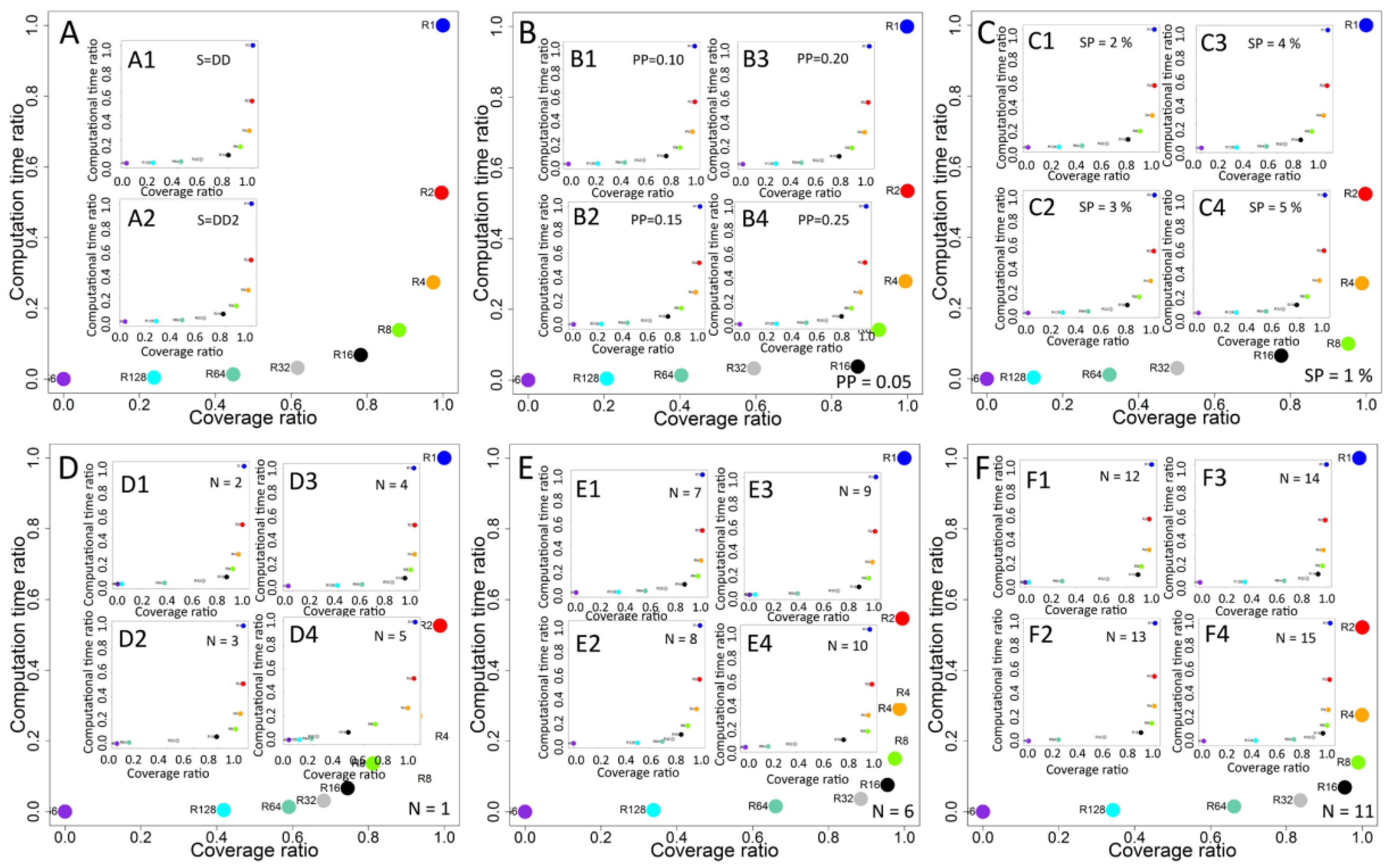
| Rk | Recalculation interval Rk after k steps | 10 | R1, R2, R4, R8, R16, R32, R64, R128, R256, R0—reference static ranking without recalculations |
| PP | Propagation probability | 5 | 0.05, 0.1, 0.15, 0.2, 0.25 |
| SP | Seeding percentage representing budget | 5 | 1%, 2%, 3%, 4%, 5% |
| S | Seed ranking method | 2 | D—degree, D2—second level degree |
© 2017 by the author. Licensee MDPI, Basel, Switzerland. This article is an open access article distributed under the terms and conditions of the Creative Commons Attribution (CC BY) license (http://creativecommons.org/licenses/by/4.0/).
Share and Cite
Jankowski, J. Dynamic Rankings for Seed Selection in Complex Networks: Balancing Costs and Coverage. Entropy 2017, 19, 170. https://doi.org/10.3390/e19040170
Jankowski J. Dynamic Rankings for Seed Selection in Complex Networks: Balancing Costs and Coverage. Entropy. 2017; 19(4):170. https://doi.org/10.3390/e19040170
Chicago/Turabian StyleJankowski, Jarosław. 2017. "Dynamic Rankings for Seed Selection in Complex Networks: Balancing Costs and Coverage" Entropy 19, no. 4: 170. https://doi.org/10.3390/e19040170
APA StyleJankowski, J. (2017). Dynamic Rankings for Seed Selection in Complex Networks: Balancing Costs and Coverage. Entropy, 19(4), 170. https://doi.org/10.3390/e19040170


