
Self-Organizing Maps of Molecular Descriptors for Sesquiterpene Lactones and Their Application to the Chemotaxonomy of the Asteraceae Family



Abstract
1. Introduction

2. Results and Discussion
2.1. Data Generated from the Three-Dimensional Structures and Their Respective Chemical Occurrences, Using SISTEMATX

| Tribe | Acronym | Subtribe | Genus | Species | Occurrences | Compounds | Occurrences/compounds |
|---|---|---|---|---|---|---|---|
| Mutisieae | Mut | 2 | 7 | 11 | 27 | 22 | 1.23 |
| Cardueae | Car | 3 | 15 | 55 | 118 | 63 | 1.87 |
| Lactuceae | Lac | 5 | 6 | 13 | 28 | 17 | 1.64 |
| Vernonieae | Ver | 7 | 16 | 85 | 215 | 116 | 1.85 |
| Liabeae | Lia | 1 | 4 | 7 | 15 | 12 | 1.25 |
| Arctoteae | Arc | 3 | 4 | 7 | 14 | 12 | 1.16 |
| Inuleae | Inu | 1 | 5 | 21 | 104 | 69 | 1.51 |
| Plucheeae | Plu | 1 | 1 | 1 | 1 | 1 | 1.00 |
| Gnaphalieae | Gna | 3 | 5 | 5 | 7 | 7 | 1.00 |
| Astereae | Ast | 2 | 2 | 3 | 8 | 8 | 1.00 |
| Anthemideae | Ant | 9 | 15 | 130 | 363 | 154 | 2.16 |
| Senecioneae | Sen | 2 | 9 | 22 | 57 | 37 | 1.54 |
| Helenieae | Hel | 3 | 14 | 73 | 209 | 123 | 1.69 |
| Heliantheae | Hln | 9 | 39 | 163 | 612 | 385 | 1.59 |
| Eupatorieae | Eup | 12 | 19 | 62 | 201 | 165 | 1.22 |
| Total | 63 | 161 | 658 | 1979 | 1111 | 1.78 |
2.2. Molecular Descriptors and Average Degree of Oxidation (NOX/nC)

| Tribe | Observed NOX/nC | Predicted NOX/nC | Residual (Actual - Calculated) |
|---|---|---|---|
| Mutisieae | −0.753 | −0.774 | 0.021 |
| Cardueae | −0.655 | −0.626 | −0.029 |
| Lactuceae | −0.620 | −0.605 | −0.015 |
| Vernonieae | −0.560 | −0.582 | 0.022 |
| Liabeae | −0.807 | −0.772 | −0.035 |
| Arctoteae | −0.819 | −0.817 | −0.002 |
| Inuleae | −0.934 | −0.942 | 0.008 |
| Plucheeae | −0.700 | −0.723 | 0.023 |
| Gnaphalieae | −0.847 | −0.859 | 0.012 |
| Astereae | −0.983 | −0.983 | 0.000 |
| Anthemideae | −0.794 | −0.798 | 0.004 |
| Senecioneae | −0.936 | −0.929 | −0.007 |
| Helenieae | −0.698 | −0.717 | 0.018 |
| Heliantheae | −0.692 | −0.706 | 0.014 |
| Eupatorieae | −0.593 | −0.603 | 0.009 |
2.3. Self-Organising Maps (Kohonen) and Molecular Descriptors in the Chemotaxonomy of the Asteraceae Family Tribes
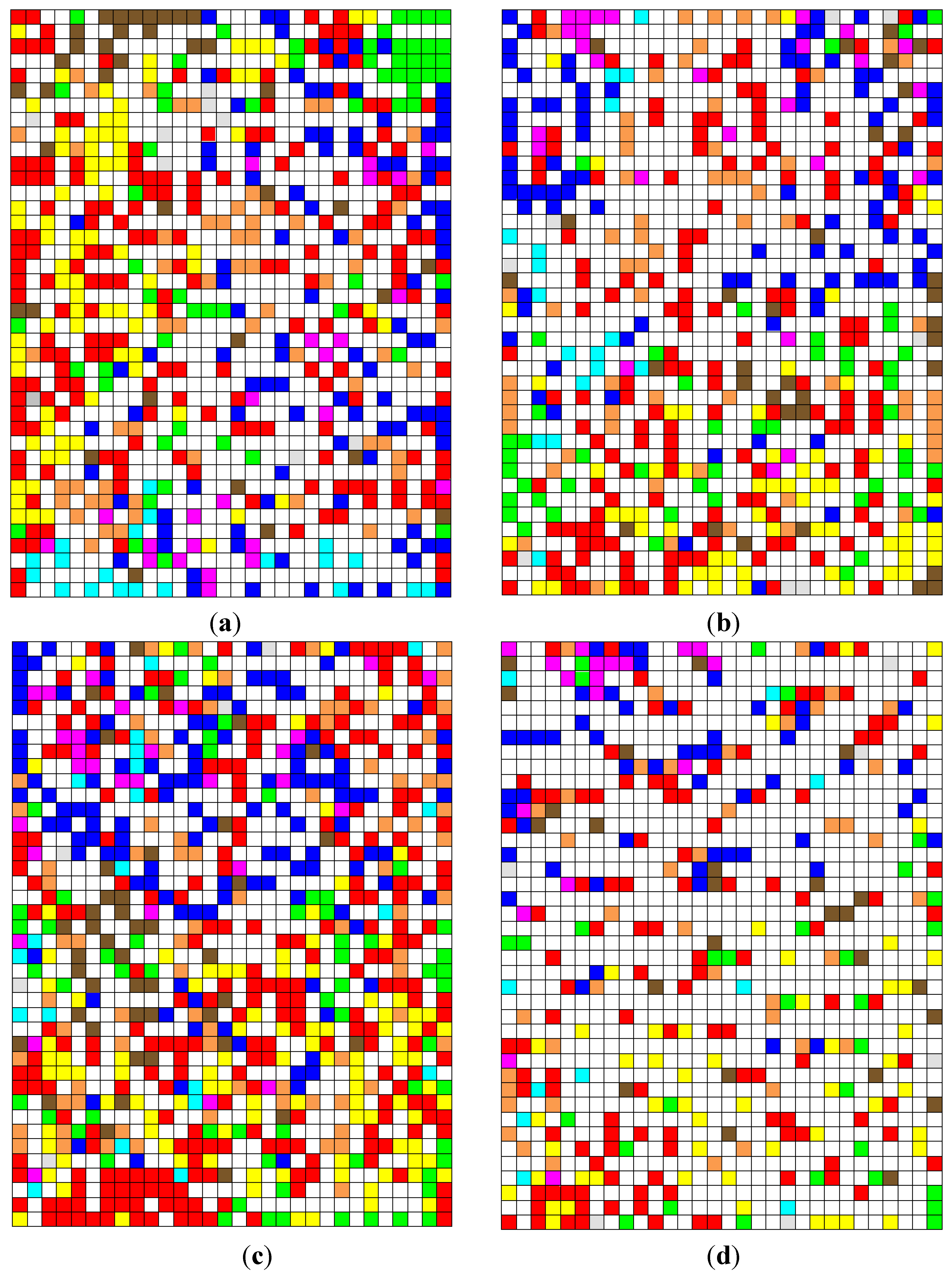
- Anthemideae: blue,
- Cardueae: brown,
- Eupatorieae: yellow,
- Helenieae: orange,
- Heliantheae: red,
- Inuleae: pink,
- Lactuceae: grey,
- Senecioneae: light blue,
- Vernonieae: green.
| Constitutionals – 40 × 30 a | Functional groups - 35 × 35 a | Atom-Centred - 40 × 30 a | 2D Autocorrelation-40 × 30 a | ||||||||
|---|---|---|---|---|---|---|---|---|---|---|---|
| Tribe | Occurrences | Nº of hits | % of hits | Nº of hits | % of hits | Nº of hits | % of hits | Nº of hits | % of hits | ||
| Cardueae | 118 | 81 | 68.6 | 103 | 87.3 | 101 | 85.6 | 95 | 80.5 | ||
| Lactuceae | 28 | 18 | 64.3 | 20 | 71.4 | 21 | 75.0 | 14 | 50.0 | ||
| Vernonieae | 215 | 147 | 68.4 | 174 | 80.9 | 175 | 81.4 | 178 | 82.8 | ||
| Inuleae | 104 | 29 | 27.9 | 32 | 30.8 | 46 | 44.2 | 61 | 58.7 | ||
| Anthemideae | 363 | 268 | 73.8 | 334 | 92.0 | 338 | 93.1 | 336 | 92.6 | ||
| Senecioeae | 57 | 38 | 66.7 | 50 | 87.7 | 53 | 93.0 | 47 | 82.5 | ||
| Helenieae | 209 | 110 | 52.6 | 159 | 76.1 | 171 | 81.8 | 176 | 84.2 | ||
| Heliantheae | 612 | 451 | 73.7 | 517 | 84.5 | 511 | 83.5 | 522 | 85.3 | ||
| Eupatorieae | 201 | 130 | 64.7 | 148 | 73.6 | 157 | 78.1 | 151 | 75.1 | ||
| Total | 1907 | 1272 | 66.7 | 1537 | 80.6 | 1573 | 82.5 | 1580 | 82.9 | ||
| BCUT - 40 × 30 a | Topological - 40 × 30 a | Geometrical - 40 × 30 a | RDF - 40 × 30 a | ||||||||
| Tribe | Occurrences | Nº of hits | % of hits | Nº of hits | % of hits | Nº of hits | % of hits | Nº of hits | % of hits | ||
| Cardueae | 118 | 105 | 89.0 | 99 | 83.9 | 96 | 81.4 | 97 | 82.2 | ||
| Lactuceae | 28 | 19 | 67.9 | 22 | 78.6 | 20 | 71.4 | 17 | 60.7 | ||
| Vernonieae | 215 | 165 | 76.7 | 168 | 78.1 | 164 | 76.3 | 167 | 77.7 | ||
| Inuleae | 104 | 59 | 56.7 | 57 | 54.8 | 49 | 47.1 | 54 | 51.9 | ||
| Anthemideae | 363 | 342 | 94.2 | 324 | 89.3 | 339 | 93.4 | 341 | 93.9 | ||
| Senecioeae | 57 | 52 | 91.2 | 46 | 80.7 | 44 | 77.2 | 48 | 84.2 | ||
| Helenieae | 209 | 183 | 87.6 | 175 | 83.7 | 180 | 86.1 | 180 | 86.1 | ||
| Heliantheae | 612 | 513 | 83.8 | 497 | 81.2 | 487 | 79.6 | 529 | 86.4 | ||
| Eupatorieae | 201 | 154 | 76.6 | 160 | 79.6 | 156 | 77.6 | 161 | 80.1 | ||
| Total | 1907 | 1592 | 83.5 | 1548 | 81.2 | 1535 | 80.5 | 1594 | 83.6 | ||
| 3D-MoRSE-40 × 30 a | GETAWAY- 40 × 35 a | WHIM – 40 × 30 a | |||||||||
| Tribe | Occurrences | Nº of hits | % of hits | Nº of hits | % of hits | Nº of hits | % of hits | ||||
| Cardueae | 118 | 83 | 70.3 | 104 | 88.1 | 106 | 89.8 | ||||
| Lactuceae | 28 | 17 | 60.7 | 17 | 60.7 | 19 | 67.9 | ||||
| Vernonieae | 215 | 143 | 66.5 | 164 | 76.3 | 166 | 77.2 | ||||
| Inuleae | 104 | 43 | 41.3 | 50 | 48.1 | 57 | 54.8 | ||||
| Anthemideae | 363 | 290 | 79.9 | 341 | 93.9 | 339 | 93.4 | ||||
| Senecioeae | 57 | 33 | 57.9 | 46 | 80.7 | 44 | 77.2 | ||||
| Helenieae | 209 | 121 | 57.9 | 173 | 82.8 | 158 | 75.6 | ||||
| Heliantheae | 612 | 430 | 70.3 | 498 | 81.4 | 517 | 84.5 | ||||
| Eupatorieae | 201 | 128 | 63.7 | 168 | 83.6 | 149 | 74.1 | ||||
| Total | 1907 | 1288 | 67.5 | 1561 | 81.9 | 1555 | 81.5 | ||||

| Tribe | Train set 1 | Train set 2 | Train set 3 | Train set 4 | Train set 5 | Train set 6 | Train set 7 | Train set 8 | Train set 9 | Average |
|---|---|---|---|---|---|---|---|---|---|---|
| Cardueae | 89.1 | 79.4 | 86.9 | 86.1 | 84.6 | 88.9 | 85.2 | 90.7 | 91.7 | 87.0 |
| Lactuceae | 68.0 | 74.1 | 82.6 | 65.2 | 76.2 | 69.2 | 73.1 | 70.8 | 69.6 | 72.1 |
| Vernonieae | 79.1 | 82.4 | 78.9 | 75.1 | 78.3 | 78.6 | 82.4 | 80.0 | 80.2 | 79.4 |
| Inuleae | 47.8 | 52.7 | 47.3 | 51.6 | 50.0 | 40.9 | 54.8 | 37.5 | 62.5 | 49.5 |
| Anthemideae | 88.9 | 92.4 | 91.8 | 93.4 | 92.7 | 93.1 | 90.5 | 90.8 | 91.7 | 91.7 |
| Senecioeae | 87.0 | 82.4 | 82.1 | 85.4 | 87.0 | 88.2 | 82.4 | 86.0 | 84.8 | 85.0 |
| Helenieae | 75.3 | 74.6 | 72.8 | 76.7 | 70.1 | 71.4 | 78.8 | 77.0 | 75.4 | 74.7 |
| Heliantheae | 83.7 | 82.6 | 81.8 | 81.4 | 83.4 | 83.5 | 82.2 | 82.5 | 82.1 | 82.6 |
| Eupatorieae | 79.2 | 82.5 | 81.6 | 77.0 | 80.6 | 77.0 | 79.2 | 76.0 | 77.7 | 79.0 |
| Total | 81.0 | 80.7 | 80.9 | 80.6 | 81.1 | 80.6 | 81.7 | 80.5 | 81.9 | 81.0 |
| Tribe | Test set 1 | Test set 2 | Test set 3 | Test set 4 | Test set 5 | Test set 6 | Test set 7 | Test set 8 | Test set 9 | Average |
| Cardueae | 62.5 | 68.8 | 81.8 | 76.4 | 42.9 | 30.0 | 80.0 | 63.6 | 100.0 | 67.3 |
| Lactuceae | 50.0 | - | 50.0 | 50.0 | 66.7 | 100.0 | 100.0 | 100.0 | 50.0 | 70.8 |
| Vernonieae | 63.2 | 59.1 | 68.0 | 66.7 | 52.9 | 85.7 | 72.7 | 75.0 | 85.7 | 69.9 |
| Inuleae | 9.1 | 30.0 | 33.3 | 20.0 | 27.3 | 20.0 | 20.0 | 14.3 | 42.9 | 24.1 |
| Anthemideae | 79.2 | 90.9 | 87.9 | 80.0 | 80.0 | 65.9 | 73.0 | 80.0 | 83.3 | 80.0 |
| Senecioeae | 33.3 | 66.7 | 0 | 66.7 | 66.7 | 83.3 | 83.3 | 71.4 | 80.0 | 61.3 |
| Helenieae | 57.9 | 75.0 | 62.1 | 45.0 | 44.0 | 54.2 | 67.9 | 59.1 | 91.7 | 61.9 |
| Heliantheae | 64.5 | 66.7 | 58.5 | 60.9 | 70.4 | 70.7 | 65.0 | 62.3 | 83.9 | 67.0 |
| Eupatorieae | 72.2 | 27.8 | 54.5 | 55.6 | 80.0 | 56.5 | 39.3 | 55.6 | 66.7 | 56.5 |
| Total | 64.2 | 64.2 | 64.2 | 61.6 | 63.7 | 62.6 | 63.7 | 64.2 | 82.1 | 65.6 |
| Tribe | Train set 1 | Train set 2 | Train set 3 | Train set 4 | Train set 5 | Train set 6 | Train set 7 | Train set 8 | Train set 9 | Average |
|---|---|---|---|---|---|---|---|---|---|---|
| Cardueae | 82.7 | 82.4 | 87.2 | 87.3 | 82.5 | 88.2 | 86.5 | 79.8 | 83.7 | 84.5 |
| Lactuceae | 50.0 | 33.3 | 46.2 | 42.3 | 42.3 | 44.0 | 50.0 | 41.7 | 45.8 | 44.0 |
| Vernonieae | 78.8 | 76.8 | 75.9 | 73.5 | 74.9 | 78.8 | 78.6 | 78.5 | 77.8 | 77.1 |
| Inuleae | 62.2 | 52.8 | 53.3 | 59.8 | 61.5 | 67.4 | 45.2 | 56.8 | 50.0 | 56.6 |
| Anthemideae | 93.3 | 95.7 | 93.8 | 93.7 | 93.4 | 89.2 | 89.5 | 91.0 | 92.5 | 92.5 |
| Senecioeae | 71.2 | 77.4 | 77.4 | 81.1 | 82.4 | 89.6 | 75.5 | 83.3 | 76.6 | 79.4 |
| Helenieae | 76.5 | 71.4 | 79.9 | 72.8 | 75.0 | 77.7 | 80.1 | 75.0 | 72.9 | 75.7 |
| Heliantheae | 84.9 | 81.3 | 82.9 | 82.0 | 81.2 | 84.9 | 81.9 | 83.8 | 84.7 | 83.1 |
| Eupatorieae | 77.6 | 77.7 | 73.3 | 78.1 | 82.4 | 66.8 | 72.5 | 74.9 | 73.9 | 75.2 |
| Total | 81.7 | 79.9 | 80.7 | 80.3 | 80.6 | 81.1 | 79.5 | 80.3 | 80.4 | 80.5 |
| Tribe | Test set 1 | Test set 2 | Test set 3 | Test set 4 | Test set 5 | Test set 6 | Test set 7 | Test set 8 | Test set 9 | Average |
| Cardueae | 87.5 | 70.0 | 77.8 | 62.5 | 73.3 | 50.0 | 42.9 | 71.4 | 57.1 | 65.8 |
| Lactuceae | 0 | 50.0 | 50.0 | 50.0 | 0 | 66.7 | 50.0 | 25.0 | 25.0 | 35.2 |
| Vernonieae | 63.6 | 58.8 | 56.3 | 42.3 | 80.0 | 61.5 | 56.5 | 50.0 | 52.4 | 57.9 |
| Inuleae | 33.3 | 40.0 | 33.3 | 28.6 | 62.5 | 44.4 | 45.5 | 44.4 | 37.5 | 41.1 |
| Anthemideae | 68.8 | 77.8 | 81.4 | 84.4 | 87.2 | 65.5 | 76.7 | 66.7 | 73.3 | 75.8 |
| Senecioeae | 80.0 | 25.0 | 50.0 | 50.0 | 66.7 | 77.8 | 75.0 | 66.7 | 40.0 | 59.0 |
| Helenieae | 54.8 | 54.2 | 65.0 | 44.4 | 61.9 | 47.6 | 52.2 | 44.0 | 64.3 | 54.3 |
| Heliantheae | 59.1 | 63.6 | 71.0 | 61.6 | 50.0 | 60.3 | 61.5 | 48.0 | 71.4 | 60.7 |
| Eupatorieae | 44.4 | 35.3 | 60.0 | 70.0 | 35.7 | 29.4 | 63.2 | 36.4 | 23.8 | 44.2 |
| Total | 59.6 | 59.6 | 67.4 | 60.6 | 64.8 | 56.5 | 60.1 | 51.8 | 56.0 | 59.6 |
3. Experimental
3.1. Acquisition and Registering of Structures of Sesquiterpene Lactones and Their Respective Botanical Occurrences
3.2. Acquisition of Three-Dimensional Structures of Sesquiterpene Lactones and Exportation of Botanical Data
3.3. Molecular Modelling
3.4. Molecular Descriptors
3.5. Calculation of Multiple Linear Regression
3.6. Self-Organising Maps
4. Conclusions
Acknowledgements
References and Notes
- Seaman, F.C. Sesquiterpene lactones as taxonomic characters in the Asteraceae. Bot. Rev. 1982, 48, 123–551. [Google Scholar]
- Zdero, C.; Bohlmann, F. Systematics and evolution within the Compositae, seen with the eyes of a chemist. Plant. Syst. Evol. 1990, 171, 1–14. [Google Scholar]
- Harborne, J.B.; Mabry, T.J.; Mabry, H. The Flavonoids; Champman & Hall: London, UK, 1975. [Google Scholar]
- Bohm, B.A.; Stuessy, T.F. Flavonoids of the Sunflower Family; Springer-Wien: New York, NY, USA, 2001. [Google Scholar]
- Proksch, P.; Rodriguez, E. Chromenes and benzofuranes of the Asteraceae, their chemistry and biological significance. Phytochemistry 1983, 22, 2335–2348. [Google Scholar]
- Murrray, R.D.H. The Natural Coumarins. Occurrence,Chemistry and Biochemistry; John Wiley & Sons: New York, NY, USA, 1982. [Google Scholar]
- Seaman, F.; Bohlmann, F.; Zdero, C.; Mabry, T.J. Diterpenes of Flowering Plants—Compositae (Asteraceae); Springer-Verlag: New York, NY, USA, 1990. [Google Scholar]
- Macari, P.A.T.; Gastmans, J.P.; Rodriguez, G.V.; Emerenciano, V.P. An expert system for structure elucidation of triterpenes. Spectrosc-Int. J. 1994, 12, 139–166. [Google Scholar]
- Heywood, V.H.; Harborne, J.B.; Turner, B.L. The Biology and Chemistry of the Compositae I and II; Academic Press: New York, NY, USA, 1977. [Google Scholar]
- Bremer, K.; Jansen, R.K.; Karis, P.O.; Kallersjo, M.; Keeley, S.C.; Kim, K.J.; Michaels, H.J.; Palmer, J.D.; Wallace, R.S. A review of the phylogeny and classification of Asteraceae. Nord. J. Bot. 1992, 12, 141–148. [Google Scholar]
- Hind, D.J.N.; Beentje, H.J. Compositae: Systematics. Proceedings of the International Compositae Conference I and II; Royal Botanic Gardens: Kew, Australia, 1994.
- Cassini, H. Tableau exprimant les affinities des tribus naturelles de famile des Synanthérées. In Dictionnaire des Sciences Naturelles III; Cuvier, G., Ed.; Le Normant: Paris, France, 1816. [Google Scholar]
- Bentham, G. Notes on the classification, history, and geographical distribution of the Compositae. J. Linn. Soc. Bot. 1873, 13, 335–557. [Google Scholar] [CrossRef]
- Hoffman, O. Compositae. In Die Natiirlichen Pflanzenfamilien; Engler, A., Prantl, K., Eds.; Engelmann: Leipzig, Germany, 1890. [Google Scholar]
- Carlquist, S. Tribal interrelationships and phylogeny of the Asteraceae. Aliso 1976, 8, 465–492. [Google Scholar]
- Wagenitz, G. Systematics and phylogeny of the Compositae (Asteraceae). Plant. Syst. Evol. 1976, 125, 29–46. [Google Scholar]
- Bremer, K. Tribal interrelationships of the Asteraceae. Cladistics 1987, 3, 210–253. [Google Scholar]
- Bremer, K. Major clades and grades of the Asteraceae. In Compositae: Systematics; Royal Botanic Garden: Kew, Australia, 1996. [Google Scholar]
- Funk, V.; Bayer, R.J.; Keeley, S.; Chan, R.; Watson, L.; Gemeinholzer, B.; Schilling, E.; Panero, J.L.; Baldwin, B.G.; Garcia-Jacas, N.; Susanna, A.; Jansen, R.K. Everywhere but Antarctica: Using a supertree to understand the diversity and distribution of the Compositae. Biol. Skr. 2005, 55, 343–374. [Google Scholar]
- Geissman, T.A.; Crout, D.H.G. Organic Chemistry of Secondary Plant Metabolism; Freeman Cooper & Company: San Francisco, CA, USA, 1969. [Google Scholar]
- Harborne, J.B. Ecological Biochemistry; Academic Press: London, UK, 1988. [Google Scholar]
- Emerenciano, V.P.; Ferreira, M.J.P.; Branco, M.D.; Dubois, J.E. The applications of Bayes theorem in natural products as a guide for skeletons identifications. Chemometr. Intell. Lab. 1998, 40, 83–92. [Google Scholar]
- Emerenciano, V.P.; Rodrigues, G.V.; Alvarenga, S.A.V.; Macari, P.A.T.; Kaplan, M.A.C. A new methods for grouping chemotaxonomic parameters. Quím. Nova. 1998, 21, 125–129. [Google Scholar]
- Calabria, L.M.; Emerenciano, V.P.; Ferreira, M.J.P.; Scotti, M.T.; Mabry, T.J. A phylogenetic analysis of tribes of the Asteraceae based on phytochemical data. Nat. Prod. Commun. 2007, 2, 277–285. [Google Scholar]
- Emerenciano, V.P.; Cabrol-Bass, D.; Ferreira, M.J.P.; Alvarenga, S.A.; Brant, A.J.C.; Scotti, M.T.; Barbosa, K.O. Chemical evolution in the Asteraceae. The Oxidation-Reduction mechanism and production of secondary metabolites. Nat. Prod. Commun. 2006, 1, 495–507. [Google Scholar]
- Talete, S.R.L. DRAGON for Windows (Software for Molecular Descriptor Calculations).Version 6.0, 2011. Available online: http://www.talete.mi.it (accessed on 30 May 2011).
- Zupan, J.; Gasteiger, J. Neural Networks in Chemistry and Drug Design, 2nd ed; Wiley-VCH: Weinheim, Germany, 1999. [Google Scholar]
- Kohonen, T. Self-Organizing Maps, 1st ed; Springer: Berlin, Germany, 2001. [Google Scholar]
- Da Costa, F.B.; Terfloth, L.; Gasteiger, J. Sesquiterpene lactone-based classification of three Asteraceae tribes: A study based on self-organizing neural networks applied to chemo systematics. Phytochemistry 2005, 66, 345–353. [Google Scholar]
- Hristozov, D.; Da Costa, F.B.; Gasteiger, J. Sesquiterpene lactones-based classification of the family Asteraceae using neural networks and k-nearest neighbors. J. Chem. Inf. Model. 2007, 47, 9–19. [Google Scholar]
- Todeschini, R.; Consonni, V. Molecular Descriptors for Chemoinformatics; Wiley-VCH: Weinheim, Germany, 2009. [Google Scholar]
- Lindenmeyer, M.T.; Hrenn, A.; Kern, C.; Castro, V.; Murillo, R.; Muller, S.; Schulte-Mönting, J.; Siedle, B.; Merfort, I. Sesquiterpene lactones as inhibitors of IL-8 expression in HeLa cells. Bioorgan. Med. Chem. 2006, 14, 2487–2497. [Google Scholar]
- Wagner, S.; Hofmann, A.; Siedle, B.; Terfloth, L.; Merfort, I.; Gasteiger, J. Development of a structural model for NF-kappa B inhibition of sesquiterpene lactones using self-organizing neural networks. J. Med. Chem. 2006, 49, 2241–2252. [Google Scholar]
- Scotti, L.; Scotti, M.T.; Ishiki, H.M.; Ferreira, M.J.P.; Emerenciano, V.P.; Menezes, C.M.D.; Ferreira, E.I. Quantitative elucidation of the structure-bitterness relationship of cynaropicrin and grosheimin derivatives. Food Chem. 2007, 105, 77–83. [Google Scholar]
- Scotti, M.T.; Fernandes, M.B.; Ferreira, M.J.P.; Emerenciano, V.P. Quantitative structure-activity relationship of sesquiterpene lactones with cytotoxic activity. Bioorg. Med. Chem. 2007, 15, 2927–2934. [Google Scholar] [CrossRef]
- Fernandes, M.B.; Scotti, M.T.; Ferreira, M.J.P.; Emerenciano, V.P. Use of self-organizing maps and molecular descriptors to predict the cytotoxic activity of sesquiterpene lactones. Eur. J. Med. Chem. 2008, 43, 2197–2205. [Google Scholar]
- Schmidt, T.J.; Nour, A.M.M.; Khalid, S.A.; Kaiser, M.; Brun, R. Quantitative Structure - Antiprotozoal Activity Relationships of Sesquiterpene Lactones. Molecules 2009, 14, 2062–2076. [Google Scholar]
- Paukku, Y.; Rasulev, B.; Syrov, V.; Khushbaktova, Z.; Leszczynski, J. Structure-Hepatoprotective Activity Relationship Study of Sesquiterpene Lactones: A QSAR Analysis. Int. J. Quantum. Chem. 2009, 109, 17–27. [Google Scholar]
- Fernandes, M.B.; Rossini, M.; Stefani, R.; Tavares, L.; Emerenciano, V.D.; Scotti, L.; Scotti, M.T. Volsurf Descriptors to Analyse Anti-HCV and Cytotoxic Activities of Sesquiterpene Lactones from Asteraceae Family. Lett. Drug Des Discov. 2011, 8, 44–58. [Google Scholar]
- Larsson, J.; Gottfries, J.; Bohlin, L.; Backlund, A. Expanding the ChemGPS Chemical Space with Natural Products. J. Nat. Prod. 2005, 68, 985–991. [Google Scholar]
- Gastmans, J.P.; Furlan, M.; Lopes, M.N.; Borges, J.H.G.; Emerenciano, V.P. A inteligência artificial aplicada à química de produtos naturais. O programa Sistemat. Parte I - Bases Teóricas. Quím. Nova 1990, 13, 10–15. [Google Scholar]
- Gasteiger, J.; Sadowski, J.; Schuur, J.; Selzer, P.; Steinhauer, L.; Steinhauer, V. Chemical information in 3D space. J. Chem. Inf. Comput. Sci. 1996, 36, 1030–1037. [Google Scholar]
- Hyperchem Program Release 8.0 for Windows, Hybercube, Inc.: Gainesville, FL, USA, 2009.
- Dewar, M.J.S.E.; Zoebisch, G.; Healy, E.F.; Stewart, J.J.P. AM1: A new general purpose quantum mechanical molecular model. J. Am. Chem. Soc. 1985, 107, 3902–3909. [Google Scholar]
- Leach, A.R. Molecular Modelling: Principles and Applications; Prentice Hall: London, UK, 2001. [Google Scholar]
- Moran, P.A.P. Notes on Continuous Stochastic Phenomena. Biometrika 1950, 37, 17–23. [Google Scholar]
- Moreau, G.; Broto, P. The auto-correlation of a topological-structure—A new molecular descriptor. New. J. Chem. 1980, 4, 359–360. [Google Scholar]
- Diudea, M.V.; Horvath, D.; Graovac, A. Molecular Topology. 15. 3D Distance Matrices and Related Topological Indexes. J. Chem. Inf. Comput. Sci. 1995, 35, 129–135. [Google Scholar] [CrossRef]
- Balaban, A.T. From chemical topology to 3D geometry. J. Chem. Inf. Comput. Sci. 1997, 37, 645–650. [Google Scholar]
- Todeschini, R.; Gramatica, P. 3D-modelling and prediction by WHIM descriptors. 5. Theory development and chemical meaning of WHIM descriptors. Quant. Struct-act. Rel. 1997, 16, 113–119. [Google Scholar] [CrossRef]
- Todeschini, R.; Gramatica, P. 3D-modelling and prediction by WHIM descriptors. 6. Application of WHIM descriptors in QSAR studies P. Quant. Struct-act. Rel. 1997, 16, 120–125. [Google Scholar] [CrossRef]
- Talete, S.R.L. Mobydigs Academic version - Version 1.1. 2010. Available online: http://www.talete.mi.it (accessed on 30 May 2011).
- Todeschini, R.; Mauri, A.; Pavan, M. MobyDigs: Sofwtare for Regression and Classification Models by Genetic Algorithms. In Nature-Inspired Methods in Chemometrics: Genetic Algorithms and Artificial Neural Networks; Leardi, R., Ed.; Elsevier: Genova, Italy, 2004. [Google Scholar]
- Mathworks Inc. 2004. Available online: http://www.mathworks.com (accessed on 30 May 2011).
- Vesanto, J.; Himberg, J.; Alhoniemi, E.; Parhankangas, J. SOM Toolbox for Matlab 5. 2005. Available online: http://www.cis.hut.fi/projects/somtoolbox (accessed on 30 May 2011).
- Vesanto, J.; Alhoniemi, E.; Himberg, J.; Kiviluoto, K.; Parviainen, J. Self-Organizing Map for Data Mining in MATLAB: the SOM Toolbox. Simulation News Europe 1999, 25, 54. [Google Scholar]
- Sample Availability: Contact the authors.
© 2012 by the authors; licensee MDPI, Basel, Switzerland. This article is an open-access article distributed under the terms and conditions of the Creative Commons Attribution license (http://creativecommons.org/licenses/by/3.0/).
Share and Cite
Scotti, M.T.; Emerenciano, V.; Ferreira, M.J.P.; Scotti, L.; Stefani, R.; Da Silva, M.S.; Junior, F.J.B.M. Self-Organizing Maps of Molecular Descriptors for Sesquiterpene Lactones and Their Application to the Chemotaxonomy of the Asteraceae Family. Molecules 2012, 17, 4684-4702. https://doi.org/10.3390/molecules17044684
Scotti MT, Emerenciano V, Ferreira MJP, Scotti L, Stefani R, Da Silva MS, Junior FJBM. Self-Organizing Maps of Molecular Descriptors for Sesquiterpene Lactones and Their Application to the Chemotaxonomy of the Asteraceae Family. Molecules. 2012; 17(4):4684-4702. https://doi.org/10.3390/molecules17044684
Chicago/Turabian StyleScotti, Marcus T., Vicente Emerenciano, Marcelo J. P. Ferreira, Luciana Scotti, Ricardo Stefani, Marcelo S. Da Silva, and Francisco Jaime B. Mendonça Junior. 2012. "Self-Organizing Maps of Molecular Descriptors for Sesquiterpene Lactones and Their Application to the Chemotaxonomy of the Asteraceae Family" Molecules 17, no. 4: 4684-4702. https://doi.org/10.3390/molecules17044684
APA StyleScotti, M. T., Emerenciano, V., Ferreira, M. J. P., Scotti, L., Stefani, R., Da Silva, M. S., & Junior, F. J. B. M. (2012). Self-Organizing Maps of Molecular Descriptors for Sesquiterpene Lactones and Their Application to the Chemotaxonomy of the Asteraceae Family. Molecules, 17(4), 4684-4702. https://doi.org/10.3390/molecules17044684