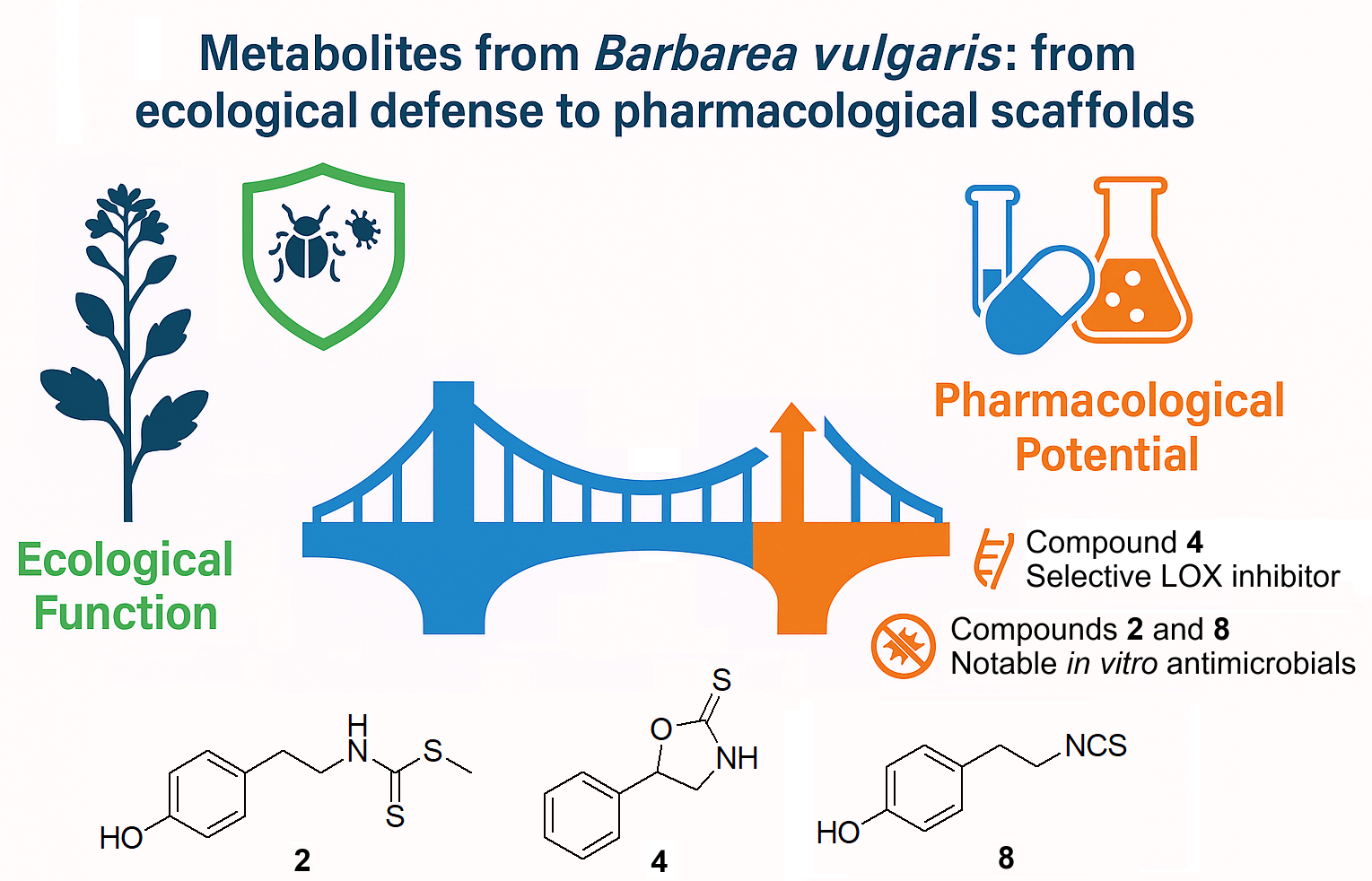
Glucosinolate-Derived Metabolites from Barbarea vulgaris (Brassicaceae): Evaluation of Antimicrobial, Antioxidant, and Anti-Inflammatory Potentials

 , ,
, ,  , ,
, ,  ,
,  and
and
Abstract
1. Introduction
2. Results and Discussion
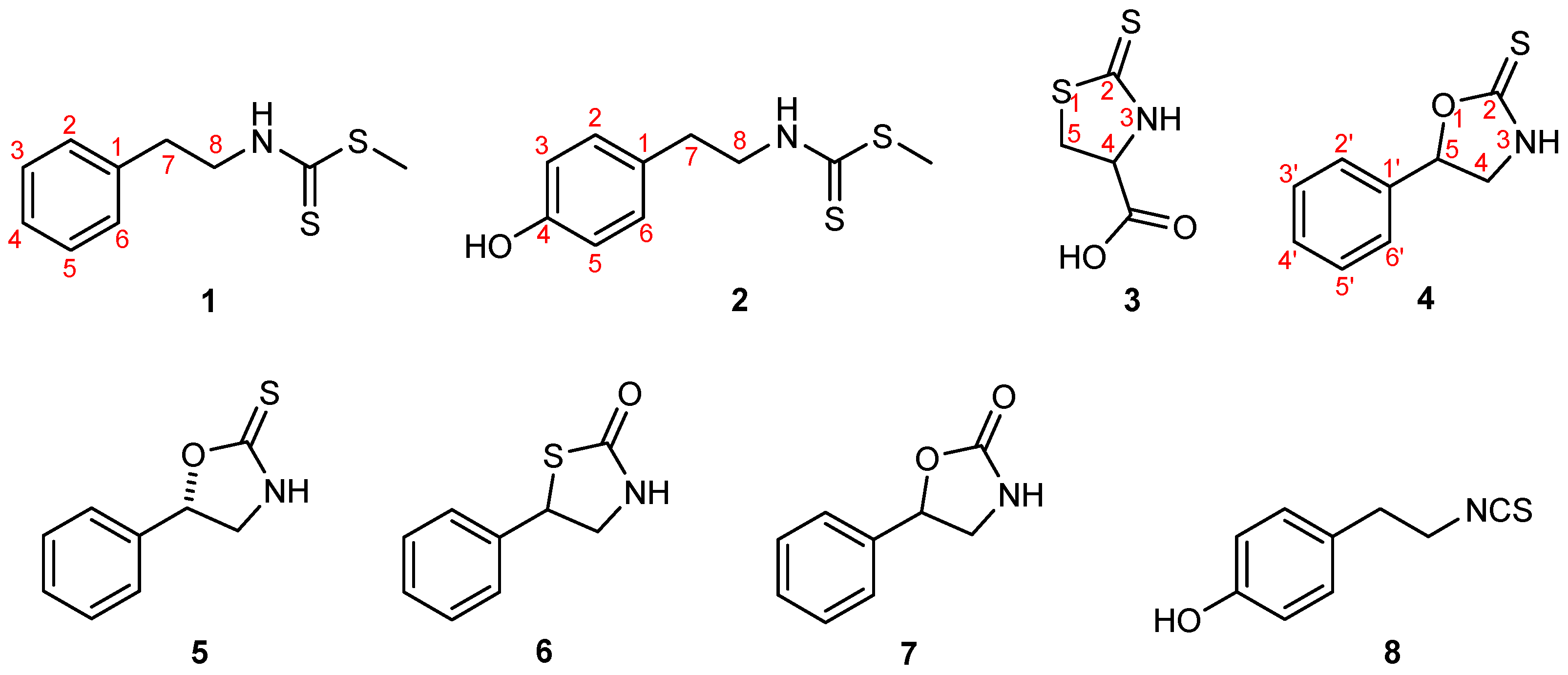
2.1. Isolation of Glucosinolate-Derived Metabolites from B. vulgaris and Synthesis of Equivalents and Analogues
2.2. Antimicrobial and Antibiofilm Activities
2.2.1. Antimicrobial Activity
2.2.2. Inhibition of Biofilm Formation
2.3. Antioxidant Activity Against DPPH and ABTS Radicals
2.4. In Vitro LOX and COX-2 Inhibition Assay
3. Materials and Methods
3.1. General Experimental Procedures
3.2. Synthesis of Nasturlexin A (Methyl phenethylcarbamodithioate) (1)
3.3. Synthesis of Methyl-4-hydroxyphenylethyl Dithiocarbamate (2)
3.4. Synthesis of Raphanusamic Acid (2-Thioxothiazolidine-4-carboxylic Acid) (3)
3.5. Synthesis of (±)-Barbarin (rac-5-Phenyl-1,3-oxazolidine-2-thione) (4) [25]
3.6. Isolation of (S)-Barbarin (5) and Determination of Absolute Configuration
3.7. Isolation of 5-Phenyl-1,3-thiazolidin-2-one (6)
3.8. Synthesis of Resedine (5-Phenyl-1,3-oxazolidin-2-one, 7)
3.9. Synthesis of 2-(4-Hydroxyphenyl)ethyl Isothiocyanate (8)
3.10. In Vitro Antimicrobial Assay
3.10.1. Microorganisms Used for Testing
3.10.2. Preparation of Suspensions
3.10.3. Microdilution Method
3.11. Determination of Antibiofilm Activity
3.11.1. Biofilm Formation by Tested Bacteria
3.11.2. Inhibition of Biofilm Formation
3.12. In Vitro Tests for the Assessment of Antioxidant Activity
3.12.1. DPPH Radical Scavenging Assay
3.12.2. ABTS Radical Scavenging Assay
3.13. In Vitro Tests for the Assessment of Anti-Inflammatory Activity
3.13.1. LOX Inhibition Assay
3.13.2. COX Inhibition Assay
3.14. Statistical Analysis
4. Conclusions
Supplementary Materials
Author Contributions
Funding
Institutional Review Board Statement
Informed Consent Statement
Data Availability Statement
Acknowledgments
Conflicts of Interest
References
- Fahey, J.W.; Zalcmann, A.T.; Talalay, P. The chemical diversity and distribution of glucosinolates and isothiocyanates among plants. Phytochemistry 2001, 56, 5–51. [Google Scholar] [CrossRef]
- Connolly, E.L.; Sim, M.; Travica, N.; Marx, W.; Beasy, G.; Lynch, G.S.; Bondonno, C.P.; Lewis, J.R.; Hodgson, J.M.; Blekkenhorst, L.C. Glucosinolates from cruciferous vegetables and their potential role in chronic disease: Investigating the preclinical and clinical evidence. Front. Pharmacol. 2021, 12, 767975. [Google Scholar] [CrossRef]
- Kuzina, V.; Nielsen, J.K.; Augustin, J.M.; Torp, A.M.; Bak, S.; Andersen, S.B. Barbarea vulgaris linkage map and quantitative trait loci for saponins, glucosinolates, hairiness and resistance to the herbivore Phyllotreta nemorum. Phytochemistry 2011, 72, 188–198. [Google Scholar] [CrossRef] [PubMed]
- Senatore, F.; D’Agostin, M.; Dini, I. Flavonoid glycosides of Barbarea vulgaris L. (Brassicaceae). J. Agric. Food Chem. 2000, 48, 2659–2662. [Google Scholar] [CrossRef] [PubMed]
- Shinoda, T.; Nagao, T.; Nakayama, M.; Sserizawa, H.; Koshioka, M.; Okabe, H.; Kawai, A. Identification of triterpenoid saponin from a crucifer Barbarea vulgaris, as a feeding deterrent to the diamondback moth, Plutella xylostella. J. Chem. Ecol. 2002, 28, 587–599. [Google Scholar] [CrossRef] [PubMed]
- Agerbirk, N.; Olsen, C.E.; Heimes, C.; Christensen, S.; Bak, S.; Hauser, T.P. Multiple hydroxyphenethyl glucosinolate isomers and their tandem mass spectrometric distinction in a geographically structured polymorphism in the crucifer Barbarea vulgaris. Phytochemistry 2015, 115, 130–142. [Google Scholar] [CrossRef]
- Pedras, M.S.C.; Alavi, M.; To, Q.H. Expanding the nasturlexin family: Nasturlexins C and D and their sulfoxides are phytoalexins of the crucifers Barbarea vulgaris and B. verna. Phytochemistry 2015, 118, 131–138. [Google Scholar] [CrossRef]
- Pedras, M.S.; Yaya, E.E. Phytoalexins from Brassicaceae: News from the front. Phytochemistry 2010, 71, 1191–1207. [Google Scholar] [CrossRef]
- Pedras, M.S.C.; To, Q.H. The first non-indolyl cruciferous phytoalexins: Nasturlexins and tridentatols, a striking convergent evolution of defenses in terrestrial plants and marine animals? Phytochemistry 2015, 113, 57–63. [Google Scholar] [CrossRef]
- Pedras, M.S.C.; To, Q.H. Synthesis of stable isotope–labeled nasturlexins and potential precursors to probe biosynthetic pathways of cruciferous phytoalexins. J. Label. Compd. Radiopharm. 2018, 61, 94–106. [Google Scholar] [CrossRef]
- Pedras, M.S.C.; Yaya, E.E.; Glawischnig, E. The phytoalexins from cultivated and wild crucifers: Chemistry and biology. Nat. Prod. Rep. 2011, 28, 1381–1405. [Google Scholar] [CrossRef]
- Pedras, M.S.C.; To, Q.H. Interrogation of biosynthetic pathways of the cruciferous phytoalexins nasturlexins with isotopically labelled compounds. Org. Biomol. Chem. 2018, 16, 3625–3638. [Google Scholar] [CrossRef]
- Cárdenas, P.D.; Landtved, J.P.; Larsen, S.H.; Lindegaard, N.; Wøhlk, S.; Jensen, K.R.; Pattison, D.I.; Burow, M.; Bak, S.; Crocoll, C.; et al. Phytoalexins of the crucifer Barbarea vulgaris: Structural profile and correlation with glucosinolate turnover. Phytochemistry 2023, 213, 113742. [Google Scholar] [CrossRef]
- Gusinac, A.M.; Dekić, M.S.; Palić, I.R.; Mladenović, M.Z.; Radulović, N.S. Volatile glucosinolate hydrolysis products of Barbarea vulgaris from Serbia: Organ-specific patterns, P-type chemistry in a G-type morph, and storage-driven barbarin isomerization. Chem. Biodivers. 2025; submitted. [Google Scholar]
- Hoch, C.C.; Shoykhet, M.; Weiser, T.; Griesbaum, L.; Petry, J.; Hachani, K.; Multhoff, G.; Dezfouli, A.B.; Wollenberg, B. Isothiocyanates in medicine: A comprehensive review on phenylethyl-, allyl-, and benzyl-isothiocyanates. Pharmacol. Res. 2024, 201, 107107. [Google Scholar] [CrossRef] [PubMed]
- Melander, R.J.; Basak, A.K.; Melander, C. Natural products as inspiration for the development of bacterial antibiofilm agents. Nat. Prod. Rep. 2020, 37, 1454–1477. [Google Scholar] [CrossRef] [PubMed]
- Liu, J.-C.; Yang, J.; Lei, S.-X.; Wang, M.-F.; Ma, Y.-N.; Yang, R. Natural phytoalexins inspired the discovery of new biphenyls as potent antifungal agents for treatment of invasive fungal infections. Eur. J. Med. Chem. 2023, 261, 115842. [Google Scholar] [CrossRef]
- Sharma, S.; Mohler, J.; Mahajan, S.D.; Schwartz, S.A.; Bruggemann, L.; Aalinkeel, R. Microbial biofilm: A review on formation, infection, antibiotic resistance, control measures, and innovative treatment. Microorganisms 2023, 11, 1614. [Google Scholar] [CrossRef]
- Simijonović, D.; Vlachou, E.-E.; Petrović, Z.D.; Hadjipavlou-Litina, D.J.; Litinas, K.E.; Stanković, N.; Mihović, N.; Mladenović, M.P. Dicoumarol derivatives: Green synthesis and molecular modelling studies of their anti-LOX activity. Bioorg. Chem. 2018, 80, 741–752. [Google Scholar] [CrossRef]
- Van Den Dool, H.; Kratz, P.D. A generalization of the retention index system including linear temperature programmed gas-liquid partition chromatography. J. Chromatogr. 1963, 11, 463–471. [Google Scholar] [CrossRef]
- Ashton, W.T.; Cantone, C.L.; Meurer, L.C.; Tolman, R.L.; Greenlee, W.J.; Patchett, A.A.; Lynch, R.J.; Schorn, T.W.; Strouse, J.F.; Siegl, P.K. Renin inhibitors containing C-termini derived from mercaptoheterocycles. J. Med. Chem. 1992, 35, 2103–2112. [Google Scholar] [CrossRef] [PubMed]
- Li, Y.; Hu, X.; Huang, H. Synthetic Method for (R)-Tetrahydrothiazole-2-thione-4-carboxylic Acid. CN Patent CN1125228, 26 June 1996. [Google Scholar]
- Rosier, J.; Simonds, R.; van Peteghem, C.; Vanhoorne, M. The preparation of pure 2-thio-thiazolidine-4-carboxylic-acid (TTCA) as a reference standard for carbon disulfide exposure tests. Bull. Soc. Chim. Belg. 1983, 92, 397–402. [Google Scholar] [CrossRef]
- Kopecky, J.; Smejkal, J. A simple preparation of pure 2-thiothiazolidine-4-carboxylic acid (TTCA) as a reference standard for carbon disulfide exposure tests. Bull. Soc. Chim. Belg. 1984, 93, 231–232. [Google Scholar]
- Wu, Y.; Yang, Y.Q.; Hu, Q. A facile access to chiral 4-isopropyl-, 4-benzyl-, and 4-phenyloxazolidine-2-thione. J. Org. Chem. 2004, 69, 3990–3992. [Google Scholar] [CrossRef] [PubMed]
- Radulović, N.S.; Todorovska, M.M.; Zlatković, D.B.; Stojanović, N.M.; Ranđelović, P.J. Two goitrogenic 1,3-oxazolidine-2-thione derivatives from Brassicales taxa: Challenging identification, occurrence and immunomodulatory effects. Food Chem. Toxicol. 2017, 110, 94–108. [Google Scholar] [CrossRef]
- Andrews, J.M. BSAC standardized disc susceptibility testing method (version 4). J. Antimicrob. Chemother. 2005, 56, 60–76. [Google Scholar] [CrossRef]
- Sarker, S.D.; Nahar, L.; Kumarasamy, Y. Microtitre plate-based antibacterial assay incorporating resazurin as an indicator of cell growth, and its application in the in vitro antibacterial screening of phytochemicals. Methods 2007, 42, 321–324. [Google Scholar] [CrossRef]
- O’Toole, G.; Kaplan, H.B.; Kolter, R. Biofilm formation as microbial development. Annu. Rev. Microbiol. 2000, 54, 49–79. [Google Scholar] [CrossRef]
- Chaieb, K.; Kouidhi, B.; Jrah, H.; Mahdouani, K.; Bakhrouf, A. Antibacterial activity of thymoquinone, an active principle of Nigella sativa, and its potency to prevent bacterial biofilm formation. BMC Complement. Altern. Med. 2011, 11, 29. [Google Scholar] [CrossRef]
- Muruzovic, M.; Mladenović, K.; Stefanović, O.; Vasić, S.; Čomić, L.R. Extracts of Agrimonia eupatoria L. as sources of biologically active compounds and evaluation of their antioxidant, antimicrobial and antibiofilm activities. J. Food Drug Anal. 2016, 24, 539–547. [Google Scholar] [CrossRef]
- Avdović, E.H.; Milanović, Ž.; Simijonović, D.; Antonijević, M.; Milutinović, M.; Nikodijević, D.; Filipović, N.; Marković, Z.; Vojinović, R. An effective, green synthesis procedure for obtaining coumarin–hydroxybenzohydrazide derivatives and assessment of their antioxidant activity and redox status. Antioxidants 2023, 12, 2070. [Google Scholar] [CrossRef]
- Abcam. Available online: https://www.abcam.com/en-us/products/assay-kits/cox2-inhibitor-screening-kit-fluorometric-ab283401 (accessed on 14 September 2025).
- Hirao, T.; Yamada, A.; Ohshiro, Y.; Agawa, T. Trimethylsilylmethyl isothiocyanate, an isothiocyanatomethanide equivalent. Angew. Chem. Int. Ed. Engl. 1981, 20, 126–127. [Google Scholar] [CrossRef]
- Laserna, V.; Guo, W.; Kleij, A.W. Aluminium-catalysed oxazolidinone synthesis and their conversion into functional non-symmetrical ureas. Adv. Synth. Catal. 2015, 357, 2849–2854. [Google Scholar] [CrossRef]
- Deng, X.; Chen, N.; Wang, Z.; Li, X.; Hu, H.; Xu, J. A convenient synthesis of thiazolidin-2-ones from thiazolidine-2-thiones: Antibiotic activity and revisiting the mechanism. Phosphorus Sulfur Silicon Relat. Elem. 2011, 186, 1563–1571. [Google Scholar] [CrossRef]
- Nicolas, E.; Russell, K.C.; Hruby, V.J. Asymmetric 1,4-addition of organocuprates to chiral α,β-unsaturated N-acyl-4-phenyl-2-oxazolidinones: A new approach to the synthesis of chiral β-branched carboxylic acids. J. Org. Chem. 1993, 58, 766–770. [Google Scholar] [CrossRef]
- Gabriele, B.; Mancuso, R.; Salerno, G.; Costa, M. An improved procedure for the palladium-catalyzed oxidative carbonylation of beta-amino alcohols to oxazolidin-2-ones. J. Org. Chem. 2003, 68, 601–604. [Google Scholar] [PubMed]
- Spencer, E.S.; Dale, E.J.; Gommans, A.L.; Rutledge, M.T.; Vo, C.T.; Nakatani, Y.; Gamble, A.B.; Smith, R.A.J.; Wilbanks, S.M.; Hampton, M.B.; et al. Multiple binding modes of isothiocyanates that inhibit macrophage migration inhibitory factor. Eur. J. Med. Chem. 2015, 93, 501–510. [Google Scholar] [CrossRef] [PubMed]
- Narasimhachari, N.; Vouros, P. Gas-liquid chromatography and mass spectrometry of biologically active primary amines as their isothiocyanate derivatives. Biol. Mass Spectrom. 1974, 1, 367–373. [Google Scholar]

| Species/Compounds | 1 | 2 | 3 | 4 | 5 | 6 | 7 | 8 | ||||||||
|---|---|---|---|---|---|---|---|---|---|---|---|---|---|---|---|---|
| MIC | MMC | MIC | MMC | MIC | MMC | MIC | MMC | MIC | MMC | MIC | MMC | MIC | MMC | MIC | MMC | |
| B. subtilis ATCC 6633 | 2.5 | >5 | 0.078 | 1.25 | 2.5 | 5 | 2.5 | 5 | >5 | >5 | >5 | >5 | 5 | 5 | 0.312 | >5 |
| B. cereus | 5 | 5 | 0.156 | 0.625 | 2.5 | 2.5 | 5 | 5 | >5 | >5 | >5 | >5 | 5 | 5 | 0.156 | 1.25 |
| B. pumilus NCTC 8241 | 1.25 | 2.5 | 0.156 | 0.156 | 0.625 | 0.625 | 1.25 | 2.5 | 2.5 | 5 | >5 | >5 | 5 | 5 | 0.156 | 0.156 |
| B. animalis subsp. lactis | 1.25 | 2.5 | 0.078 | 0.625 | 0.625 | 2.5 | 1.25 | 5 | 1.25 | 5 | >5 | >5 | 2.5 | 5 | <0.039 | 0.625 |
| S. aureus ATCC 25923 | 5 | 5 | 0.156 | 0.156 | 0.625 | 0.625 | 1.25 | 2.5 | 5 | >5 | >5 | >5 | 5 | 5 | 0.156 | 0.625 |
| S. aureus | 5 | 5 | 0.312 | 0.312 | 0.156 | 0.312 | 1.25 | 1.25 | >5 | >5 | >5 | >5 | 2.5 | 5 | 0.078 | 0.312 |
| E. coli ATCC 25922 | 1.25 | 1.25 | 0.312 | 0.312 | 0.625 | 1.25 | 2.5 | 5 | 5 | 5 | >5 | >5 | 1.25 | 2.5 | 0.078 | 0.312 |
| E. coli | 2.5 | 5 | 0.312 | 0.312 | 1.25 | 5 | 2.5 | 5 | 5 | 5 | >5 | >5 | 1.25 | 2.5 | <0.039 | 0.625 |
| P. mirabilis | 5 | 5 | 0.156 | 0.312 | 2.5 | 2.5 | 2.5 | 5 | 5 | 5 | >5 | >5 | 2.5 | 2.5 | 0.156 | 0.625 |
| S. enterica | 5 | 5 | 0.625 | 1.25 | 2.5 | 2.5 | 2.5 | 5 | 5 | >5 | >5 | >5 | 1.25 | 2.5 | 0.312 | 1.25 |
| K. pneumoniae | 5 | 5 | 0.625 | 0.625 | 2.5 | 2.5 | 2.5 | 5 | 5 | 5 | >5 | >5 | 2.5 | 2.5 | 0.312 | 0.625 |
| C. albicans ATCC 10231 | 1.25 | >5 | 2.5 | >5 | 0.312 | 1.25 | 5 | 5 | 5 | >5 | >5 | >5 | 2.5 | 5 | 2.5 | 2.5 |
| T. viride ATCC 13233 | 0.625 | 1.25 | 0.156 | 0.312 | 2.5 | 5 | 2.5 | 2.5 | 5 | 5 | >5 | >5 | 1.25 | 2.5 | <0.039 | <0.039 |
| A. flavus ATCC 9170 | 1.25 | 2.5 | 0.312 | 0.625 | 5 | 5 | >5 | >5 | >5 | >5 | >5 | >5 | 2.5 | 2.5 | <0.039 | <0.039 |
| F. solani ATCC 11712 | 1.25 | 1.25 | 0.156 | 0.234 | 0.625 | 0.625 | 2.5 | 3.75 | 5 | >5 | >5 | >5 | 2.5 | 2.5 | <0.039 | <0.039 |
| Species/Antibiotics/ Antimycotic | Doxycycline | Ampicillin | Ketoconazole | Amphotericin B | ||||
|---|---|---|---|---|---|---|---|---|
| MIC | MMC | MIC | MMC | MIC | MMC | MIC | MMC | |
| B. subtilis ATCC 6633 | 1.953 | 31.25 | 3 | 4 | - | - | - | - |
| B. cereus | 0.977 | 7.81 | 4 | 6 | - | - | - | - |
| B. pumilus NCTC 8241 | - | - | 8 | 12 | - | - | - | - |
| B. animalis subsp. lactis | 4 | 8 | <0.06 | 0.12 | - | - | - | - |
| S. aureus ATCC 25923 | 0.224 | 3.75 | 0.25 | 0.75 | - | - | - | - |
| S. aureus | 0.45 | 7.81 | <0.06 | <0.06 | - | - | - | - |
| E. coli ATCC 25922 | 15.63 | 31.25 | 0.37 | 0.5 | - | - | - | - |
| E. coli | 15.63 | 62.5 | 1.2 | 2.1 | - | - | - | - |
| P. mirabilis | 15.63 | 62.5 | >128 | >128 | - | - | - | - |
| S. enterica | 15.63 | 31.25 | 1 | 1 | - | - | - | - |
| K. pneumoniae | 2 | 32 | >128 | >128 | - | - | - | - |
| C. albicans ATCC 10231 | - | - | - | - | 1.96 | 1.96 | <0.098 | <0.098 |
| T. viride ATCC 13233 | - | - | - | - | 62.5 | 125 | 0.78 | 1.56 |
| A. flavus ATCC 9170 | - | - | - | - | <0.49 | 1.96 | 0.39 | 0.78 |
| F. solani ATCC 11712 | - | - | - | - | 0.08 | 0.156 | - | - |
| Species/Compounds | 2 | 3 | 4 | 7 | 8 | Tetracycline | ||||||
|---|---|---|---|---|---|---|---|---|---|---|---|---|
| BIC50 | BIC90 | BIC50 | BIC90 | BIC50 | BIC90 | BIC50 | BIC90 | BIC50 | BIC90 | BIC50 | BIC90 | |
| B. subtilis ATCC 6633 | 290 | 1250 | 1190 | 2500 | 2700 | >5000 | >5000 | >5000 | 1100 | 2300 | ˂15.6 | 15.6 |
| S. aureus ATCC 25923 | 220 | 2120 | 2500 | >5000 | 1500 | >5000 | >5000 | >5000 | 868 | 1360 | 250 | 300 |
| P. mirabilis | 1158 | 4500 | 3420 | >5000 | 3170 | >5000 | 3100 | 4754 | 1428 | 2400 | 320 | >1000 |
| S. enterica | 1100 | 3200 | 2400 | >5000 | 1000 | 4470 | 1254 | >5000 | 1547 | >5000 | ˂15.6 | 180 |
| K. pneumoniae | 580 | 3600 | 1262 | >5000 | 3978 | >5000 | 4400 | >5000 | 570 | 2000 | 6 | 125 |
| Compound | DPPH Scavenging Ability (%) 1 | |||||
|---|---|---|---|---|---|---|
| 25 µM | 50 µM | 100 µM | ||||
| 20 min | 60 min | 20 min | 60 min | 20 min | 60 min | |
| 1 | 1.6 ± 1.2 | 1.8 ± 1.5 | 2.5 ± 1.1 | 2.4 ± 1.4 | 2.6 ± 1.2 | 2.9 ± 1.7 |
| 2 | 11.9 ± 0.7 | 12.0 ± 0.4 | 15.6 ± 0.3 | 15.7 ± 1.4 | 24.9 ± 1.1 | 25.2 ± 1.6 |
| 3 | 1.0 ± 0.3 | 1.1 ± 0.5 | 1.9 ± 0.8 | 2.1 ± 1.1 | 7.8 ± 1.8 | 7.9 ± 1.7 |
| 4 | 1.2 ± 0.7 | 1.3 ± 0.5 | 1.7 ± 0.8 | 2.0 ± 0.9 | 3.8 ± 1.2 | 3.5 ± 1.7 |
| 5 | 7.0 ± 0.9 | 8.4 ± 0.5 | 14.8 ± 0.7 | 16.4 ± 0.4 | 21.6 ± 1.2 | 22.4 ± 0.7 |
| 6 | 3.1 ± 0.6 | 3.0 ± 0.7 | 4.2 ± 0.8 | 4.6 ± 0.6 | 5.9 ± 0.9 | 5.8 ± 1.4 |
| 7 | 1.1 ± 0.4 | 0.9 ± 0.7 | 1.5 ± 0.9 | 1.5 ± 0.8 | 2.6 ± 1.0 | 2.7 ± 1.5 |
| 8 | 4.4 ± 1.0 | 4.7 ± 1.2 | 7.3 ± 1.3 | 8.1 ± 1.3 | 13.1 ± 0.7 | 14.2 ± 0.9 |
| Quercetin | 95.3 ± 0.8 | 95.1 ± 0.9 | 96.8 ± 1.0 | 96.5 ± 0.9 | 95.1 ± 0.9 | 95.4 ± 0.8 |
| Compound | ABTS Scavenging Ability (%) 1 | ||
|---|---|---|---|
| 25 µM | 50 µM | 100 µM | |
| 1 | 1.7 ± 1.1 | 2.2 ± 1.2 | 2.6 ± 0.8 |
| 2 | 7.6 ± 1.0 | 13.4± 0.9 | 13.4 ± 0.8 |
| 3 | 1.2 ± 0.3 | 1.9 ± 1.2 | 2.6 ± 0.7 |
| 4 | 0.9 ± 0.1 | 1.6 ± 0.9 | 2.5 ± 0.3 |
| 5 | 6.6 ± 0.2 | 12.3 ± 0.8 | 19.1 ± 0.6 |
| 6 | 2.6 ± 0.7 | 3.9 ± 1.2 | 5.1 ± 0.9 |
| 7 | 1.3 ± 0.1 | 2.7 ± 1.0 | 3.9 ± 0.4 |
| 8 | 2.9 ± 1.3 | 6.8 ± 1.1 | 11.9 ± 0.8 |
| Trolox | 97.5 ± 0.2 | 99.3 ± 0.1 | 99.5 ± 0.3 |
| Compound | Percentage and IC50 of LOX Inhibition 1 | Percentage of COX-2 Inhibition 2 | ||
|---|---|---|---|---|
| 100 µM | IC50 (µM) | 100 µM | 10 µM | |
| 1 | 47.5 ± 1.5 | 125.5 ± 0.4 | - | - |
| 2 | 55.5 ± 0.1 | 97.4 ± 1.3 | - | - |
| 3 | 23.8 ± 0.8 | n.d. | - | - |
| 4 | 90.5 ± 0.1 | 61.6 ± 0.6 | 14.23 ± 1.0 | 4.50 ± 1.6 |
| 5 | 40.0 ± 0.5 | 122.5 ± 1.5 | 21.25 ± 1.3 | 8.11 ± 1.0 |
| 6 | 34.6 ± 0.4 | n.d. | - | - |
| 7 | 18.3 ± 0.3 | n.d. | - | - |
| 8 | 21.2 ± 0.3 | n.d. | - | - |
| Quercetin | 92.0 ± 0.9 | 43.2 ± 0.5 | - | - |
Disclaimer/Publisher’s Note: The statements, opinions and data contained in all publications are solely those of the individual author(s) and contributor(s) and not of MDPI and/or the editor(s). MDPI and/or the editor(s) disclaim responsibility for any injury to people or property resulting from any ideas, methods, instructions or products referred to in the content. |
© 2025 by the authors. Licensee MDPI, Basel, Switzerland. This article is an open access article distributed under the terms and conditions of the Creative Commons Attribution (CC BY) license (https://creativecommons.org/licenses/by/4.0/).
Share and Cite
Mavrić-Scholze, E.; Gusinac, A.; Dekić, M.; Palić, I.; Avdović, E.; Simijonović, D.; Grujović, M.; Marković, K.; Dobričić, V.; Bošković, J.; et al. Glucosinolate-Derived Metabolites from Barbarea vulgaris (Brassicaceae): Evaluation of Antimicrobial, Antioxidant, and Anti-Inflammatory Potentials. Molecules 2025, 30, 4606. https://doi.org/10.3390/molecules30234606
Mavrić-Scholze E, Gusinac A, Dekić M, Palić I, Avdović E, Simijonović D, Grujović M, Marković K, Dobričić V, Bošković J, et al. Glucosinolate-Derived Metabolites from Barbarea vulgaris (Brassicaceae): Evaluation of Antimicrobial, Antioxidant, and Anti-Inflammatory Potentials. Molecules. 2025; 30(23):4606. https://doi.org/10.3390/molecules30234606
Chicago/Turabian StyleMavrić-Scholze, Elvira, Amina Gusinac, Milan Dekić, Ivan Palić, Edina Avdović, Dušica Simijonović, Mirjana Grujović, Katarina Marković, Vladimir Dobričić, Jelena Bošković, and et al. 2025. "Glucosinolate-Derived Metabolites from Barbarea vulgaris (Brassicaceae): Evaluation of Antimicrobial, Antioxidant, and Anti-Inflammatory Potentials" Molecules 30, no. 23: 4606. https://doi.org/10.3390/molecules30234606
APA StyleMavrić-Scholze, E., Gusinac, A., Dekić, M., Palić, I., Avdović, E., Simijonović, D., Grujović, M., Marković, K., Dobričić, V., Bošković, J., Marković, Z., & Radulović, N. (2025). Glucosinolate-Derived Metabolites from Barbarea vulgaris (Brassicaceae): Evaluation of Antimicrobial, Antioxidant, and Anti-Inflammatory Potentials. Molecules, 30(23), 4606. https://doi.org/10.3390/molecules30234606