

RETRACTED: FBXW7 Acts as an Independent Prognostic Marker and Inhibits Tumor Growth in Human Osteosarcoma

Abstract
1. Introduction
2. Results
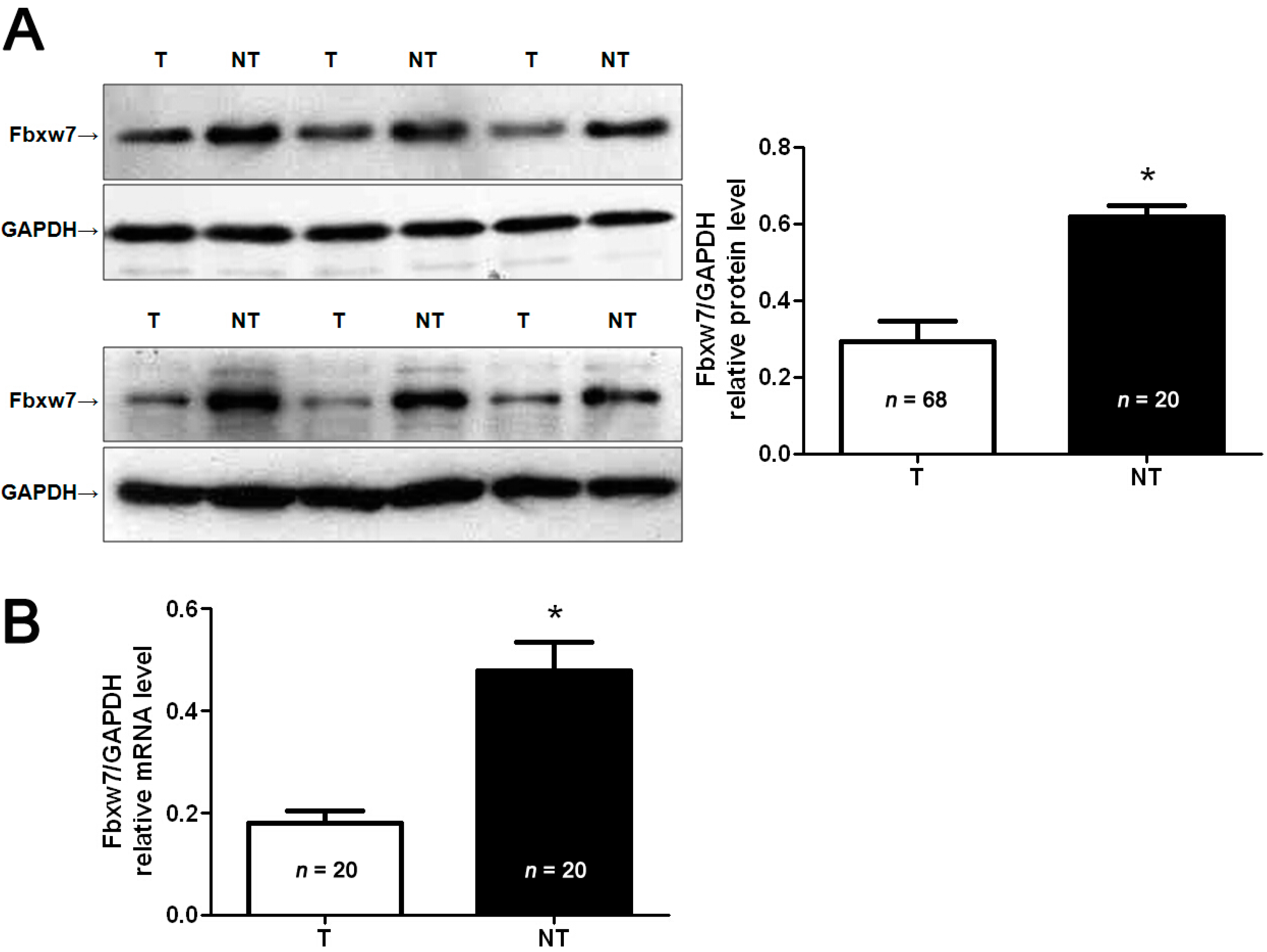
2.1. Clinical Significance of F-Box and WD Repeat Domain-Containing 7 (FBXW7) Expression in Osteosarcoma (OS) Specimens


| Clinicopathologic Features | Total No. of Patients, n = 68 | No. of Patients | p | ||
|---|---|---|---|---|---|
| Low FBXW7 | High FBXW7 | ||||
| Gender | Male | 40 | 19 | 21 | 0.622 |
| Female | 28 | 15 | 13 | ||
| Age (years) | <24 | 49 | 24 | 25 | 0.787 |
| ≥25 | 19 | 10 | 9 | ||
| Clinical stage | I | 27 | 9 | 18 | <0.001 * |
| II | 34 | 18 | 16 | ||
| III | 7 | 7 | 0 | ||
| T classification | T1 | 26 | 9 | 17 | 0.046 * |
| T2 | 42 | 25 | 17 | ||
| M classification | M0 | 61 | 29 | 32 | 0.427 |
| M1 | 7 | 5 | 2 | ||
| Histology | Conventional osteosarcoma | 58 | 28 | 30 | 0.493 |
| Others | 10 | 6 | 4 | ||
| Histological differentiation | G1 | 27 | 8 | 19 | 0.006 * |
| G2 | 41 | 26 | 15 | ||

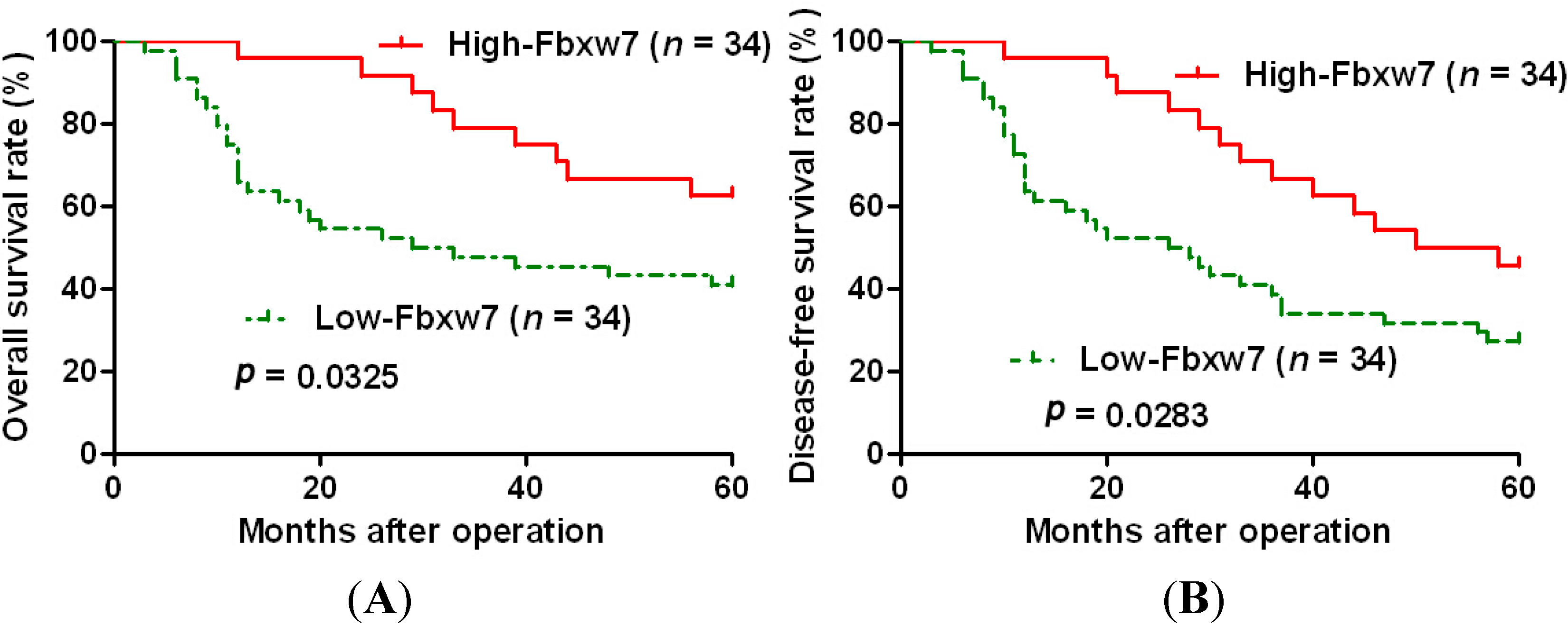
2.2. High Expression of FBXW7 Confers a Better 5-Year Survival for OS Patients
| Variables | Overall Survival | Disease-Free Survival | ||||
|---|---|---|---|---|---|---|
| HR | 95% CI | p | HR | 95% CI | p | |
| Clinical stage | 4.207 | 1.547–11.437 | 0.005 * | 7.363 | 2.134–25.400 | 0.002 * |
| T classification | 1.539 | 0.722–3.284 | 0.264 | 1.892 | 0.940–3.808 | 0.074 |
| Histological differentiation | 1.695 | 0.784–3.663 | 0.173 | 1.646 | 0.579–4.680 | 0.065 |
| FBXW7 expression | 2.976 | 1.109–7.987 | 0.030 * | 2.327 | 1.093–4.955 | 0.029 * |
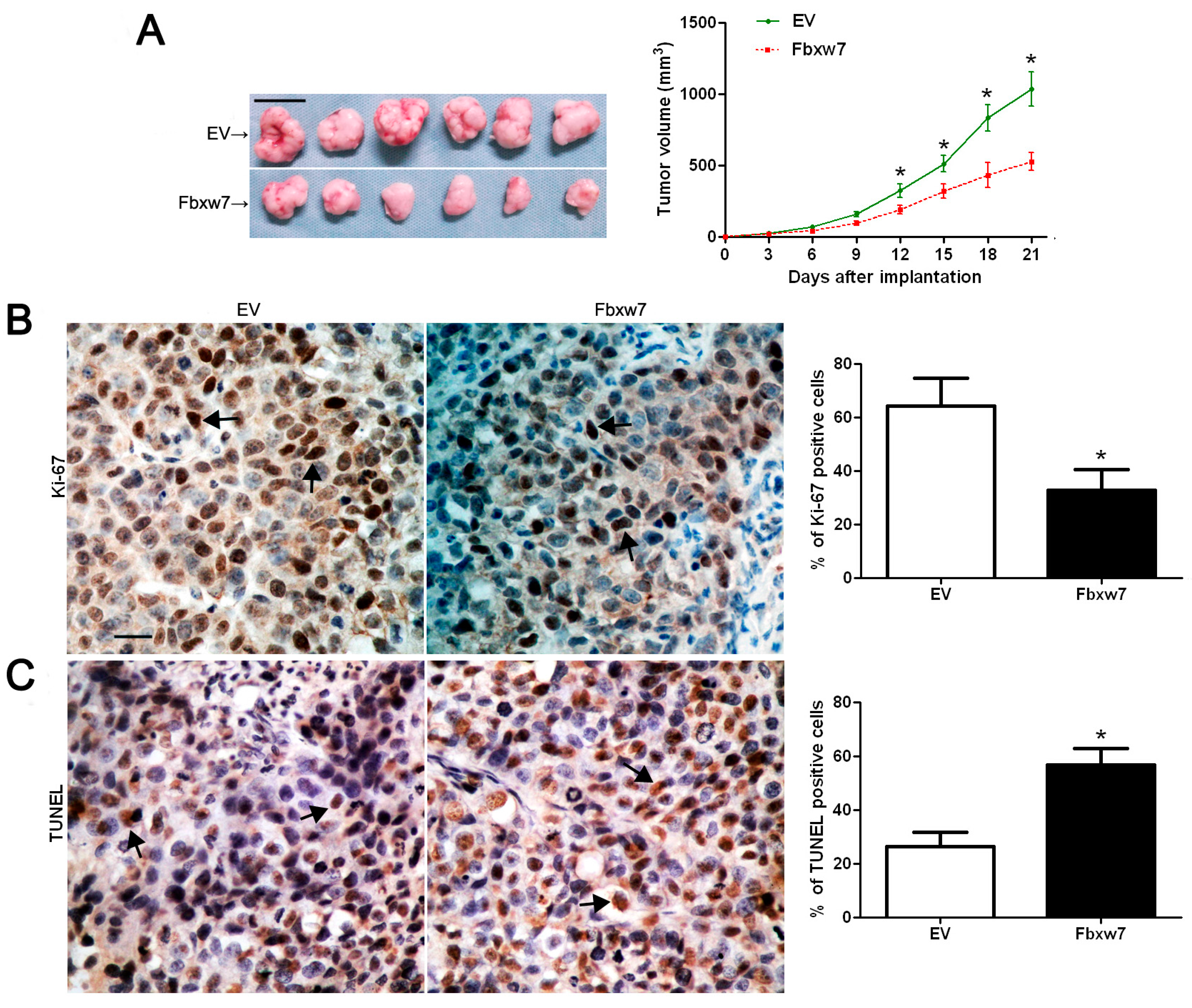
2.3. FBXW7 Overexpression Inhibits OS Cell Growth and Promotes Apoptosis in Vitro and in Vivo


2.4. FBXW7 Inversely Regulates c-Myc and Cyclin E Abundance in OS Cells

3. Discussion
4. Experimental Section
4.1. Ethical Review
4.2. Clinical Samples
4.3. Western Blot
4.4. Real Time Quantitative Reverse Transcription-PCR (qRT-PCR)
4.5. Cell Lines and Transfection
4.6. Cell Cycle, Proliferation and Apoptosis Detection
4.7. In Vivo Experiments
4.8. Immunohistochemical Staining
4.9. Statistical Analysis
5. Conclusions
Acknowledgments
Author Contributions
Conflicts of Interest
References
- Yang, J.; Zhang, W. New molecular insights into osteosarcoma targeted therapy. Curr. Opin. Oncol. 2013, 25, 398–406. [Google Scholar] [CrossRef] [Scilit] [PubMed]
- Ottaviani, G.; Jaffe, N. The epidemiology of osteosarcoma. Cancer Treat Res. 2009, 152, 3–13. [Google Scholar] [PubMed]
- Wang, Z.; Inuzuka, H.; Zhong, J.; Wan, L.; Fukushima, H.; Sarkar, F.H.; Wei, W. Tumor suppressor functions of FBW7 in cancer development and progression. FEBS Lett. 2012, 586, 1409–1418. [Google Scholar] [CrossRef] [Scilit] [PubMed]
- Lau, A.W.; Fukushima, H.; Wei, W. The Fbw7 and βTRCP E3 ubiquitin ligases and their roles in tumorigenesis. Front. Biosci. 2012, 17, 2197–2212. [Google Scholar] [CrossRef] [Scilit]
- Welcker, M.; Orian, A.; Jin, J.; Grim, J.E.; Harper, J.W.; Eisenman, R.N.; Clurman, B.E. The Fbw7 tumor suppressor regulates glycogen synthase kinase 3 phosphorylation-dependent c-Myc protein degradation. Proc. Natl. Acad. Sci. USA 2004, 101, 9085–9090. [Google Scholar] [CrossRef] [Scilit] [PubMed]
- Koepp, D.M.; Schaefer, L.K.; Ye, X.; Keyomarsi, K.; Chu, C.; Harper, J.W.; Elledge, S.J. Phosphorylation-dependent ubiquitination of cyclin E by the SCFFbw7 ubiquitin ligase. Science 2001, 294, 173–177. [Google Scholar] [CrossRef] [Scilit] [PubMed]
- Nateri, A.S. The ubiquitin ligase SCFFbw7 antagonizes apoptotic JNK signaling. Science 2004, 303, 1374–1378. [Google Scholar] [CrossRef] [Scilit] [PubMed]
- Mao, J.H.; Kim, I.J.; Wu, D.; Climent, J.; Kang, H.C.; DelRosario, R.; Balmain, A. FBXW7 targets mTOR for degradation and cooperates with PTEN in tumor suppression. Science 2008, 321, 1499–1502. [Google Scholar] [CrossRef] [Scilit] [PubMed]
- Inuzuka, H.; Shaik, S.; Onoyama, I.; Gao, D.; Tseng, A.; Maser, R.S.; Zhai, B.; Wan, L.; Gutierrez, A.; Lau, A.W.; et al. SCF(FBW7) regulates cellular apoptosis by targeting MCL1 for ubiquitylation and destruction. Nature 2011, 471, 104–109. [Google Scholar]
- Busino, L.; Millman, S.E.; Scotto, L.; Kyratsous, C.A.; Basrur, V.; O’Connor, O.; Hoffmann, A.; Elenitoba-Johnson, K.S.; Pagano, M. Fbxw7α- and GSK3-mediated degradation of p100 is a pro-survival mechanism in multiple myeloma. Nat. Cell Biol. 2012, 14, 375–385. [Google Scholar] [CrossRef] [Scilit] [PubMed]
- Wu, G.; Lyapina, S.; Das, I.; Li, J.; Gurney, M.; Pauley, A.; Chui, I.; Deshaies, R.J.; Kitajewski, J. SEL-10 is an inhibitor of notch signaling that targets notch for ubiquitin-mediated protein degradation. Mol. Cell Biol. 2001, 21, 7403–7415. [Google Scholar] [CrossRef] [Scilit] [PubMed]
- Bengoechea-Alonso, M.T.; Ericsson, J. A phosphorylation cascade controls the degradation of active SREBP1. J. Biol. Chem. 2009, 284, 5885–5895. [Google Scholar] [CrossRef] [Scilit] [PubMed]
- Tu, K.; Zheng, X.; Zan, X.; Han, S.; Yao, Y.; Liu, Q. Evaluation of Fbxw7 expression and its correlation with the expression of c-Myc, cyclin E and p53 in human hepatocellular carcinoma. Hepatol. Res. 2012, 42, 904–910. [Google Scholar] [CrossRef] [Scilit] [PubMed]
- Yokobori, T.; Mimori, K.; Iwatsuki, M.; Ishii, H.; Onoyama, I.; Fukagawa, T.; Kuwano, H.; Nakayama, K.I.; Mori, M. p53-Altered FBXW7 expression determines poor prognosis in gastric cancer cases. Cancer Res. 2009, 69, 3788–3794. [Google Scholar] [CrossRef] [Scilit] [PubMed]
- Ibusuki, M.; Yamamoto, Y.; Shinriki, S.; Ando, Y.; Iwase, H. Reduced expression of ubiquitin ligase FBXW7 mRNA is associated with poor prognosis in breast cancer patients. Cancer Sci. 2011, 102, 439–445. [Google Scholar] [CrossRef] [Scilit] [PubMed]
- King, B.; Trimarchi, T.; Reavie, L.; Xu, L.; Mullenders, J.; Ntziachristos, P.; Aranda-Orgilles, B.; Perez-Garcia, A.; Shi, J.; Vakoc, C.; et al. The ubiquitin ligase FBXW7 modulates leukemia-initiating cell activity by regulating MYC stability. Cell 2013, 153, 1552–1566. [Google Scholar]
- Iwatsuki, M.; Mimori, K.; Ishii, H.; Yokobori, T.; Takatsuno, Y.; Sato, T.; Toh, H.; Onoyama, I.; Nakayama, K.I.; Baba, H.; et al. Loss of FBXW7, a cell cycle regulating gene, in colorectal cancer: Clinical significance. Int. J. Cancer 2010, 126, 1828–1837. [Google Scholar]
- Calhoun, E.S.; Jones, J.B.; Ashfaq, R.; Adsay, V.; Baker, S.J.; Valentine, V.; Hempen, P.M.; Hilgers, W.; Yeo, C.J.; Hruban, R.H.; et al. BRAF and FBXW7 (CDC4, FBW7, AGO, SEL10) mutations in distinct subsets of pancreatic cancer: Potential therapeutic targets. Am. J. Pathol. 2003, 163, 1255–1260. [Google Scholar]
- Akhoondi, S.; Sun, D.; von der Lehr, N.; Apostolidou, S.; Klotz, K.; Maljukova, A.; Cepeda, D.; Fiegl, H.; Dofou, D.; Marth, C.; et al. FBXW7/hCDC4 is a general tumor suppressor in human cancer. Cancer Res. 2007, 67, 9006–9012. [Google Scholar]
- Yan, T.; Wunder, J.S.; Gokgoz, N.; Seto, K.K.; Bell, R.S.; Andrulis, I.L. hCDC4 variation in osteosarcoma. Cancer Genet. Cytogenet. 2006, 169, 138–142. [Google Scholar] [CrossRef] [Scilit] [PubMed]
- Han, G.; Wang, Y.; Bi, W. C-Myc overexpression promotes osteosarcoma cell invasion via activation of MEK-ERK pathway. Oncol. Res. 2012, 20, 149–156. [Google Scholar] [CrossRef] [Scilit] [PubMed]
- Lockwood, W.W.; Stack, D.; Morris, T.; Grehan, D.; O’Keane, C.; Stewart, G.L.; Cumiskey, J.; Lam, W.L.; Squire, J.A.; Thomas, D.M.; et al. Cyclin E1 is amplified and overexpressed in osteosarcoma. J. Mol. Diagn. 2011, 13, 289–296. [Google Scholar]
- Tu, K.; Yang, W.; Li, C.; Zheng, X.; Lu, Z.; Guo, C.; Yao, Y.; Liu, Q. Fbxw7 is an independent prognostic marker and induces apoptosis and growth arrest by regulating YAP abundance in hepatocellular carcinoma. Mol. Cancer 2014, 13, 110. [Google Scholar] [CrossRef] [Scilit] [PubMed]
- Tu, K.; Zheng, X.; Zhou, Z.; Li, C.; Zhang, J.; Gao, J.; Yao, Y.; Liu, Q. Recombinant human adenovirus-p53 injection induced apoptosis in hepatocellular carcinoma cell lines mediated by p53-Fbxw7 pathway, which controls c-Myc and cyclin E. PLoS One 2013, 8, e68574. [Google Scholar] [CrossRef] [Scilit] [PubMed]
- Cao, X.; Bennett, R.L.; May, W.S. c-Myc and caspase-2 are involved in activating Bax during cytotoxic drug-induced apoptosis. J. Biol. Chem. 2008, 283, 14490–14496. [Google Scholar] [CrossRef] [Scilit] [PubMed]
© 2015 by the authors; licensee MDPI, Basel, Switzerland. This article is an open access article distributed under the terms and conditions of the Creative Commons Attribution license (http://creativecommons.org/licenses/by/4.0/).
Share and Cite
Li, Z.; Xiao, J.; Hu, K.; Wang, G.; Li, M.; Zhang, J.; Cheng, G. RETRACTED: FBXW7 Acts as an Independent Prognostic Marker and Inhibits Tumor Growth in Human Osteosarcoma. Int. J. Mol. Sci. 2015, 16, 2294-2306. https://doi.org/10.3390/ijms16022294
Li Z, Xiao J, Hu K, Wang G, Li M, Zhang J, Cheng G. RETRACTED: FBXW7 Acts as an Independent Prognostic Marker and Inhibits Tumor Growth in Human Osteosarcoma. International Journal of Molecular Sciences. 2015; 16(2):2294-2306. https://doi.org/10.3390/ijms16022294
Chicago/Turabian StyleLi, Zhanchun, Jie Xiao, Kongzu Hu, Gang Wang, Maoqiang Li, Jidong Zhang, and Guangqi Cheng. 2015. "RETRACTED: FBXW7 Acts as an Independent Prognostic Marker and Inhibits Tumor Growth in Human Osteosarcoma" International Journal of Molecular Sciences 16, no. 2: 2294-2306. https://doi.org/10.3390/ijms16022294
APA StyleLi, Z., Xiao, J., Hu, K., Wang, G., Li, M., Zhang, J., & Cheng, G. (2015). RETRACTED: FBXW7 Acts as an Independent Prognostic Marker and Inhibits Tumor Growth in Human Osteosarcoma. International Journal of Molecular Sciences, 16(2), 2294-2306. https://doi.org/10.3390/ijms16022294